Spending

...now browsing by category


Haley wants to drop one thing Sanford did right

Wednesday, September 8th, 2010

I’m with Mark Sanford on this one:

Last week, Republican gubernatorial candidate Nikki Haley said she would do away with detailed executive budgets, which were typically ignored due to the acrimony between Sanford and lawmakers. Instead, Haley said, she would set a small list of priorities and work with lawmakers during the process.
In a message sent to Sanford’s campaign e-mail list, the outgoing governor argued his successor should also draft a detailed budget.

“These Executive Budgets have been vital in creating a budget blue print that showed how we could fund core services of government without raising taxes,” Sanford wrote, encouraging recipients to read a Post and Courier editorial on the subject. “They were important in showing the savings that might come from restructuring and consolidating government.”

Sanford does not mention Haley, a political ally who shares many of Sanford’s positions, by name in the e-mail.

Even with our weak-governor system, the governor is the one elected official with the closest thing to a governmentwide perspective — and has the broadest responsibility to voters. He (or she) should at the very least propose a budget setting priorities for spending, which lawmakers are then free to ignore the way they have since Carroll Campbell started the practice a couple of decades back. Campbell was right to go ahead and ACT like a governor, at least in advocacy terms, by submitting a budget, rather than waiting around to actually be put in charge of the executive branch.

Nikki Haley is on the right track looking for ways to antagonize lawmakers less. (Although it’s a bit late for that. Unlike Sanford, who started with a honeymoon, she’s already alienated legislative leaders to such an extent that if elected she would start out in a hole with them, and she knows it, and knows we know it, which is why she’s talking about this.) But this is the wrong item to start with. An executive budget, theoretical as it is, is a useful tool.

And while Mark Sanford went out of his way to alienate lawmakers so that they would ignore his budget proposals, along with the rest of his agenda, he put a lot of work into his budgets. And while they had their flaws, they were worth considering.

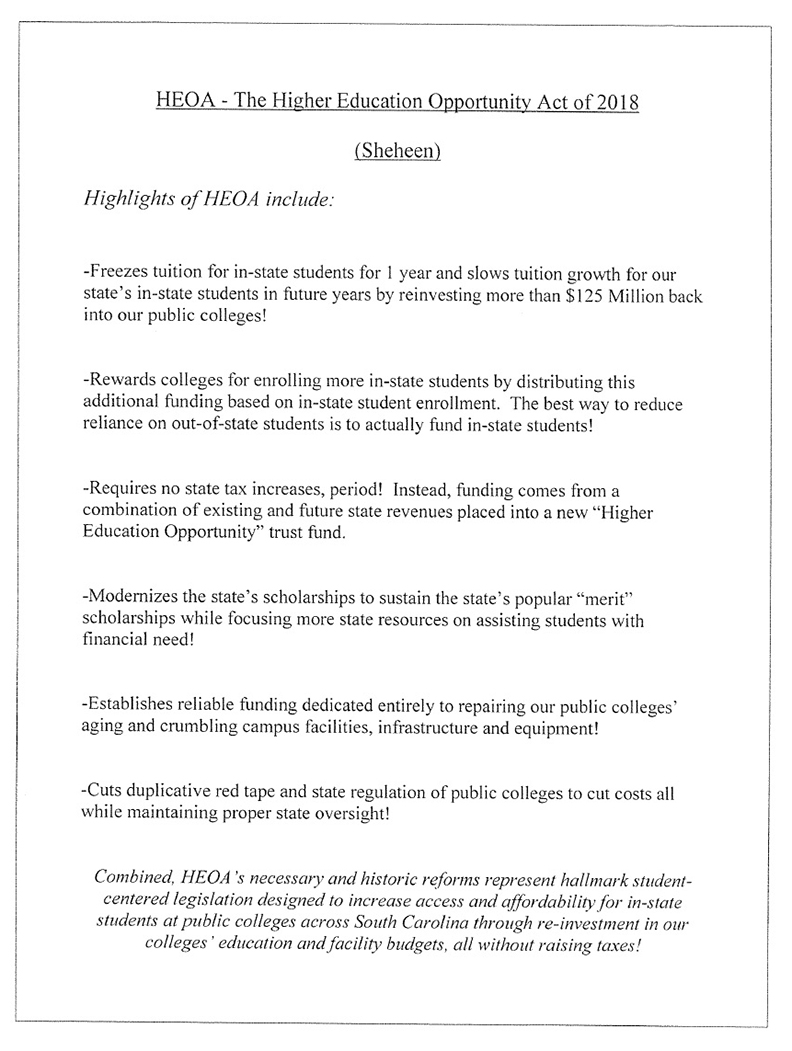
So would be Nikki Haley’s, were she elected. And so would Vincent Sheheen’s, which is why I hope he would continue to submit them. We need governors to actually take an interest in governing.

It’s great that Nikki wants to signal that she’d be different from Sanford. But this is the wrong way to start.

Don’t say I never gave you anything, Doug

Friday, August 27th, 2010

Since Doug was such a great sport giving to the critters back here, I’m including this extreme case of gummint waste for his enjoyment:

(CNN) — A worker was paid for 12 years without ever showing up for work at a Norfolk, Virginia, agency funded by federal, state and local money, officials say.

Norfolk Mayor Paul Fraim told CNN on Friday that when a new director took over at Norfolk Community Services Board recently, she was “doing her due diligence” when she discovered the hooky-playing employee was on the books. The director, Maureen Womack, then notified the city attorney’s office, Fraim said.

Sandy Johnson, a spokeswoman for the Community Services Board, told CNN Friday that her agency couldn’t comment because of the ongoing investigation.

On behalf of the city attorney’s office, Norfolk city spokeswoman Terry Bishirjian referred to a statement released on Wednesday that said, “The city attorney’s office, with the approval of Womack, took appropriate steps to prevent any further payments to the employee and the employee was terminated.”

They fired her now, huh? I’ll bet that’s a bitter pill for her — if she can stop laughing long enough.

Sexual predator price tag seems a bargain

Tuesday, July 6th, 2010

Non-journalists are always complaining about editorials masquerading as news. Usually, they’re wrong. But sometimes reporters and their news editors are so obviously, nakedly, unabashedly (although not admittedly) making an editorial point that it’s painful to read. And mainly (to one like myself, who does not worship at the altar of the god Objectivity or even belief humans are capable of it) because it’s so badly done.

It’s particularly painful if you happen to be a real editorialist. News people, generally speaking, simply don’t think about what they’re writing about in the necessary ways to do it well. So they come blundering into an issue that they have defined poorly and explained badly, making a mockery of serious commentary. This is not because they lack intelligence. It’s because their jobs don’t require them to think about things that way. When you have to set out your opinion on various aspects of an issue, day after day, for the world to pick apart and throw stones at, you think a lot harder about what you DO think, and WHY, and what the implications are. And parts of your brain that were shut off when you were in news and strictly forbidden to air opinions suddenly get oxygen and start to function. It’s sort of weird. After I’d been in editorial for a couple of years, I was sort of embarrassed to recall some of the facile assumptions I held about issues before I really started thinking about them.

But when you are telling yourself that you don’t HAVE an opinion about it, that you are utterly objective, and yet have an editorial point you’re pushing with all your might, the result is likely to reflect that lack of understanding about what you’re doing.

And the thing is, you can’t even fully explain to news people this epiphany that hit me after I made the transition. You couldn’t even state it without insulting them. (In fact, I’m sure you are horrified at my arrogance, and you’re nothing but a layperson. But seriously, it’s not that I’m BETTER or SMARTER. It’s that the different functions make different demands of whatever poor faculties I may possess.) So you just held your tongue, and were frequently appalled by news people’s ventures into places where they should not go.

For instance, take a look at the piece that ran on the Metro front of The State over the weekend. But this is not about The State, but about the Charleston Post and Courier, from which the piece was reprinted.

The original headline was “S.C.’s tab $7.4M for predators,” which wasn’t particularly helpful, so we go to the subhead “Treating each sex offender in program costs state about $63,000 per year.”

An excerpt:

For 12 years, South Carolina has tried to protect the public by keeping its most-dangerous sex offenders locked up behind concrete walls and razor wire long after their prison sentences have ended.

But that sense of security comes at a steep price.

The state shells out about $7.4 million each year to treat those confined under the Sexually Violent Predator Act, which allows authorities to lock up some sex offenders indefinitely for the purpose of alternative care. That translates to about $63,000 per offender annually for each of the 119 predators in the program…

Oooh, golly — $63,000! Of course, it occurred to me immediately that that was probably less than what other states spend on similar programs, because SC always goes the cheap route. And sure enough, the story admits that inconvenient fact down below, but sandwiches it between TWO admonitions to ignore that fact, because… well, because it’s still just too damned much money we’re spending:

Those costs have put the squeeze on many governments struggling to cut expenditures in a crippling recession that has forced layoffs, furloughs and deep program cuts. Though South Carolina spends a good deal less than many other states on its predator program — New York spends $175,000 per inmate and California, $173,000 — the effort is still a drain on already strained coffers.

I mean, knock me down and hit me with a club, why don’t you?

So really, what we’re left with here is whether we think is whether we should keep sexual predators locked up. I happen to think we do. Lots of other people think we do as well.

But that’s just because we’re dumb as a bag of hammers, apparently. We’re a bunch of Neanderthals taken in by “this get-tough tactic” sold by pandering politicians. We are fooled by a “sense of security” rather than the real thing. And the politicians aren’t about to back down and “be seen as soft on rapists and child molesters.”

That’s what it’s about, you see. The mob’s desire for vengeance. Pitchforks and flaming torches. Irrational, emotional responses to problems that could easily be resolved by putting the money into “increased supervision of sex offenders in the community,” the way Colorado has done.

I find this irritating for several reasons, including the fact that I am NOT a “lock ‘em up and throw away the key” yahoo. I actually happen to believe that one of THE greatest policy errors committed year after year in South Carolina is that we lock up WAY too many people who don’t need to be locked up. And we do it because politicians DO play on irrational fears of crime and desires for vengeance on the part of the public. This is foolish, because it simply makes no sense to lock up a guy who wrote back checks. It DOES make sense to lock up a guy who robbed a liquor store and pistol-whipped the clerk into a coma. There’s a difference.

And difference involves a calm, rational assessment of whether someone is a threat to others.

But here’s the thing about sexual predators. Their crimes are not like other crimes. One can rationally understand why an unemployed person — particularly one with a drug addiction — might hold up a liquor store. If he was particularly desperate or high from his latest fix, you can understand his getting violent. You don’t condone it; you punish it; you lock him away for a while to protect society. But someday, when he’s clean and sober, when he’s established a record for calm behavior and maybe when he’s no longer 19 years old or even close, you let him out. It’s a rational decision to lock him up, and a rational decision, under the right circumstances, to let him out again.

But while we’re all prone to greed and many of us have violent impulses, we know about living with those things and dealing with them. But most of us find it unimaginable that anyone would ever, under any circumstances, be attracted to child pornography. And while the thought of anyone having to do with such may make us angry, may make us want to run for the torches and pitchforks, it’s perfectly rational to think, “If someone can EVER have such an impulse, can they ever be sufficiently normal, or sufficiently in control, to be allowed to walk free in the world where our children play?”

Sexual desire is such a complicated, mysterious mechanism even at its healthiest. The sheer galaxy of factors — the light traveling to my eye and through neurons to parts of my brain that process color and contrast and pattern recognition combined with experience-based understanding of such subtleties as facial expression combined with precognitive programming on the cellular level all mixed up with the biological imperative to reproduce — that causes me to react as I do when I look at this picture or this one or, for comic relief, this one is so independent of will and resistant to reasoning, that it’s quite natural to assume that in a person in whom such mechanisms are so twisted as to lead them to unspeakable crimes… well, it’s just not going to go away because of a few years in a quiet place with regular sessions with a therapist.

Of course, we could assume wrongly. And indeed, a quick search on Google establishes that there is no end of arguments out there against the widely-held notion that sexual predators — rapists, and those who prey on children — are incurable.

Fine. Let’s have that discussion. Let’s see the data, and hear the latest findings. But of course, that news story didn’t bother with that. In other words, it didn’t touch upon the one question upon which the issue of whether to treat sexual predators different from other criminal was well-founded or not.

But then, that’s a common flaw in news stories, especially (but not only) those of the ersatz-editorial type: They don’t mention, much less answer, the one question I most want to see addressed. I have spent a huge portion of my life reading, all the way to the bottom, news stories that piqued my interest and made me think, “Maybe there’s an editorial or a column here,” only to find that the one ingredient most needed to help me decide what I thought about it was entirely missing. Which means it got into print with neither the writer nor his editor thinking of it. Which means that the one ingredient most valuable to the reader, as a citizen trying to decide what to think about this issue, is missing.

Nor did it touch upon the second question that should arise, which is whether the circumstances surrounding such crimes are indeed so different as to cause us to set aside such constitutional considerations as equal treatment before the law (due process would seem to be covered by the additional hearings necessary for such commitment). But newspaper stories have finite length, and I would have been happy merely to have had the first question answered, or even acknowledged. But it wasn’t.

And I find that hugely frustrating.

Anton Gunn on why B&C Board didn’t need the money

Saturday, June 26th, 2010

What do Doug Ross and Anton Gunn have in common? They were both thrilled to see the headline in The State this morning, “Budget Board finds millions to offset cuts” — Doug because he’d predicted all along the money would materialize, and Anton because he had predicted it in detail.

(And what do Anton, Mark Sanford and I all have in common? None of us believe the Budget and Control Board should exist. More on that later…)

Anton and I met Wednesday morning and he went over the spreadsheet below with me, which seems to show the agency had like $60 million lying around that it could plug the $25 million hole in operating funds vetoed by Gov. Sanford. I’ve been looking ever since for a couple of hours to write what he told me, and to try to confirm that the numbers meant what he thought they meant, but haven’t been able to. Every day has been like today … today, I just got out of the Converge SE conference, where I had been since 9:30 this morning. (The conference, by the way, was awesome.)

And as I was typing that paragraph above, my wife called me (I’m at the ADCO office) to say one of the twins split her lip and had to go to the hospital today, so I’m about to run over there right away. So I can’t go into Anton’s explanation.

But here’s his spreadsheet anyway. Some of it will at least seem self-explanatory. There’s an interesting narrative to go with it (if I were still at The State, it would have been my Sunday column), but it will probably be Monday before I can write that. (It’s all about his frustrations with the Board, combined with his frustrations with ever getting useful information about the budget before having to vote on it). And at least Monday before I can get any kind of response regarding what just happened from the B&C Board. (As well as their version of what these numbers mean.)

But here’s the raw material. I’ll be back to this early in the week. Gotta go check on my babies now…

Cheerleaders for failure keep shaking pom-poms

Friday, June 18th, 2010

In case you’re wondering what the folks who cheer for South Carolina to fail are thinking today, here’s a brief snippet from the S.C. Policy Council:

thenervesc

lawmakers have turned off the unproductive tax-dollar spigot for hydrogen research funding, at least for one year.http://bit.ly/dAexDCabout 1 hour ago via bitly

Oh, and what do I mean by saying they’re cheering for South Carolina to fail? Well, you know, just like all those Republicans who are cheering for the U.S. economy to keep failing, especially in light of the stimulus. Or all those Democrats who cheered for the U.S. to fail in Iraq (and in fact couldn’t wait, but kept wanting to rush the process by declaring it already a failure). Or the Sanford allies who do the same with regard to public education.

You know, like that.

Apparently, the B&C Board has lost the big one

Wednesday, June 16th, 2010

Looks like maybe the governor won — meaning South Carolina lost — on the big Budget and Control Board $25 million vote, according to James Smith via Twitter this afternoon:

RepJamesSmith

25 million eliminated from B&C Board jeopardizes our AAA credit rating & eliminates 800 MHz radio funding essential for emergency response.

Actually, I wrote this post right after getting that Tweet late this afternoon. But then I got another Tweet from Anton Gunn saying that wasn’t right, and I got confused, and I had to go do “Pub Politics,” so I took this post down. But everything I’ve seen since then indicates James was right the first time: The $25 million veto has been sustained. So this post is back up.

That’s all I know right now. If you’ll recall, this is the veto that Frank Fusco said would key functions of the Board. To quote, he said:

If our General Fund budget is not restored, these areas of the Board would have to virtually cease operation:

• The State Budget Office

• The SCEIS statewide financial system

• The Board of Economic Advisors

• The Office of Human Resources

• The Confederate Relic Room and Military Museum

More when I know more.

But if this report is right, there are essentially no grownups in charge over at the State House.

Folks, just so you know where we all stand: I agree 100 percent with the governor that the Budget and Control Board should not exist. In fact, I’m pretty sure he got the idea from ME.

But until we actually do away with it, it actually performs a lot of vital government tasks (which would be performed by the executive branch in a more rational system, but we don’t have such a system — all we have is the B&C Board). To simply eliminate its funding, thereby making it impossible for it to perform these tasks, is simply insane. It’s anarchistic. It’s nihilistic. It’s appalling. It’s… it’s … South Carolina.

House overrides ETV and tech school vetoes

Wednesday, June 16th, 2010

Went over to the State House after lunch, but when you’re trying to follow something like this all-day march through the governor’s vetoes, you can’t just drop in in the middle and know what’s going on.

Modern irony: As I sat there, listening first to Jerry Govan orate about S.C. State, and then to Glenn McConnell showing off his parliamentary razzle-dazzle, I found that I learned more about what was happening from Twitter than I did from being there, such as this Tweet from James Smith:

Vetoes of ETV, DHEC, tech schools archives have thankfully been overridden – rural health, technology incubator EEDA – sadly sustained.

And this one from Nathan Ballentine:

voted to override 1, 19, 20, 21, 23, 24, 31,33 (Tech Board, ETV, Library, Museum)

… both of which I reTweeted while I was there.

And then when I got back to my laptop, I saw that my buddy Mike Fitts had put out a comprehensive report of what had happened thus far. From that, and other sources, I learned that the House overrode the governor on:

Mind you, the Senate must ALSO garner two-thirds for the governor to be overridden. I’m not sure where the Senate is on things at the moment. I do know that the House plans to work into the night and not be in session tomorrow, while the Senate will have a Thursday session.

Meanwhile the House has UPHELD the governor’s vetoes of the following, which means the Senate doesn’t have to act, because the governor wins (and, in most cases, South Carolina loses):

How many budget vetoes did they deal with? Zero

Tuesday, June 15th, 2010

Having seen nothing on the Web about the big budget showdown, and seeing that the House had quit for the day, I called James Smith back to see what was up; how did it go on the budget vetoes.

They didn’t get to any today. Good thing I didn’t go over and watch.

They’ll be back tomorrow morning at 9 a.m.

OK, so that means there’s still time to set the record straight on something. As midlandsbiz points out:

“The State” Newspaper Prints Incorrect Budget Amount for Museum

COLUMBIA, SC – June 15, 2010 –  The State Newspaper printed an article today about the Governor’s budget vetos.  This story has an incorrect figure for the South Carolina Confederate Relic Room and Military Museum’s budget.  The museum’s general fund budget of $765,000 is a part of the Budget and Control Board’s total general fund budget of $25 million.  Governor Sanford’s Veto #52 would eliminate the entire $25 million, including the museum’s much smaller budget, and will be voted on as a single line item by the General Assembly beginning today.

Yeah, I saw that when I was reading the paper this morning, but by the time I had gotten to my laptop I had forgotten about it.

For days, I’ve been moaning about how the MSM wasn’t doing enough on the vetoes, and then I saw that huge error. Twenty-five million instead of 765,000. I saw where the confusion came from, but still. Man-oh-man, if THAT was what was budgeted for the museum even I might vote to sustain.

I’m happy to report that the figure has been corrected on thestate.com. But you know, there are some people out there who still rely on the dead-tree version…

At least Cindi had that good column on the subject today.

Man up, lawmakers: Override those vetoes

Tuesday, June 15th, 2010

Little left to say, except it’s time for lawmakers of both parties in the House to set aside all the B.S., lay down their insecurities, eschew their customary fecklessness, man up and veto those indefensible vetoes. I’m talking about this veto and this one and this one and most of the others.

I’ve really had it with the argument from the GOP leadership that they just have to sustain most of these vetoes. Kenny denied it the other night when I asked whether Nikki Haley’s strong showing last week had scared the leadership into thinking they have to go along with the Sanford nihilists, even though they’ve slapped him down every other time (even when he had a case, which he doesn’t this time). But I’m convinced that’s the only logical reason to explain this fear to do the right thing. Cindi thinks so, too. And Cindi knows WAY more about the budget process than I do. You’ll note that she gives the governor credit where he deserves it, on fairly marginal issues that don’t involve much money (Cindi has always been much more inclined than I am to reach WAY out to try to find some things to give the governor credit on), but she concludes with this cold bath of common sense:

Most insidious is his repeated implication that by vetoing what he considers frills, he will cause the money to be spent on “core services” of government. Now, I’ll be the first to agree that, as he puts it, “the vast majority of this year’s budget should be directed to core government functions like public safety, education, and health care.” But the facts are that 1) that already is happening and 2) his vetoes do not redirect money from “frills” to “core services”; they simply allow the money to sit in the bank for a year.

I have long believed that the Legislature needs to either increase taxes or else eliminate some programs or agencies altogether (and probably eliminate some even if it does raise taxes). But that’s a decision that needs to be made in an orderly way, by a clear majority in the Legislature — not by a disgraced lame-duck governor with an ax to grind and a third of the members of the House. And perhaps not even by a Legislature that is too frightened of its own shadow to make rational decisions about the responsibilities that come with insisting on operating the government. If lawmakers can’t override most of the governor’s vetoes this week, perhaps they should make arrangements to come back to town later this summer, when emotions have settled down, to consider taking some of the money Mr. Sanford wants to squirrel away and using it to patch critical holes that he has created.

And as for you Democrats: I was much reassured by James Smith telling me yesterday that the Dems would override (with the caveat that while that was the leadership position, Dems don’t do bloc voting), but then I read the paraphrase of Joe Neal in the paper this morning saying Democrats have not decided how they will handle Sanford’s vetoes today and I wonder: Will they stick it out and do the right thing? (And you know what? This is one case in which we actually NEED the Dems to vote as a bloc, because that might embolden the jittery mainstream Republicans.)

If they don’t, and if the Republicans (minus the Sanford loyalists) don’t, then on the whole they are useless.

Why ETV Matters, by Mark Quinn

Monday, June 14th, 2010

Trying to catch up on my e-mail, I ran across this item which also bears upon the Sanford vetoes:

Why ETV matters

For nearly 3 years, my job in public television has forced me to explore many of the crushing effects America’s Great Recession has had on our state. Now, it appears, the economic tsunami which began to wash over the land in 2008, may wipe away 50 years historic and pioneering television produced by ETV. The Great Recession has arrived on ETV’s doorstep, and I am forced to report on what may be the demise in vitality of a treasured state institution.
I work as the host of a weekly radio and television program entitled, The Big Picture. The premise is fairly simple, and almost ancient in its origins. Barry Lopez, the prolific novelist and essayist, summed up my job thusly: “it means to go out there and look and come back and tell us, and say what it is that you saw.” For millennia, this has been an integral part of the human experience. The earliest cave drawings were nothing more than one person’s reporting of the world that existed over the mountain or across the river. And it has always been so.
And while it’s deeply gratifying to travel our state to find the stories that give expression to the lives we lead today, there’s equal satisfaction in being a conduit to help serve another timeless need that we all have, the need to be heard. There is immense power in the connection with ordinary, everyday people and the dignity they claim when they are allowed to tell their story. The brilliance of ETV hasn’t been its coverage of the powerful or the popular, as essential as that may be. It’s been thousands of collective glimpses into the lives of everyday people doing extraordinary things. Or peeks at places you never knew existed. It’s the story of South Carolina.
For me, public television is taking you somewhere you will never go you’re your local newspaper. Nor will you ever go there with your local television station.
For me ETV is sitting in the Sullivan’s Island living room of best-selling author Dorthea Benton Frank, laughing riotously at the random acts of calamity life will throw at you… knowing if you don’t laugh, you will likely cry.
It’s thumbing through a scrapbook and shedding a tear with Dale and Ann Hampton in their Easley home, remembering their daughter Kimberly who was killed in the war in Iraq. This is where divine grace lives.
It’s being completely captivated by the force of nature known as Darla Moore. Her bank account is impressive, but her resolve, wit and determination are much more so. The first woman to conquer Wall Street still lives in Lake City.
It’s sitting down with 5 former first ladies of South Carolina, and hearing what we all assume; that life inside the Governor’s mansion is for most, a pretty grand affair.
It’s Mrs. Iris Campbell, recounting the thick fog of cigar smoke that surrounded the pool of the Governor’s mansion, as her husband hosted a group of German businessmen and wrote out the plan for BMW’s move to South Carolina on a series of cocktail napkins.
It’s the terrible misfortune of Mike Burgess, staggering as best he can through a life that includes a wife who contracted Alzheimer’s disease at the age of 46. Another day when it’s tough not to cry.
It’s spending a day with the resolute Mayor of Marion, Rodney Berry. The city has been in an economic funk for 20 years. It’s on the rebound now thanks to a fierce pride and stubborn resolve to remake its image in the absence of textiles and tobacco.
It’s hiking to see the rare rocky shoals spider lilies on the Catawba River, knowing the river itself has been named America’s most endangered. I’m not a naturalist, but the lilies are regal and captivating.
It might be a boat ride down the Pee Dee River with a group of unlikely activists. They are hunters and fisherman who opposed the building a coal-fired power plant on the river’s banks. They won.
It’s standing in Arlington National Cemetery on a gray, cold November day with Colonel Charles Murray, recipient of the Medal of Honor. He’s a World War II veteran who calls today’s soldiers America’s Greatest Generation.
It’s a long walk through the Harvest Hope Food bank in Columbia with Denise Holland. She saw the Great Recession first. The number of people they serve is up 250%. Denise Holland is scared, but grateful to tell the story of the down and out, and the dispossessed.
It’s 82 year old Laura Spong, now a best-selling artist. Her paintings fetch as much as $10,000. She took up serious art at the age of 62. Anything is possible.
It’s Charleston Mayor Joe Riley, trembling in anger when he produces a small picture of a teen-age boy, shot dead. Mayor Joe wants better supervision of people on probation and parole. Some of his pleas are now being heeded.
It is the absolute decency of former Governor Richard Riley, and his pleas for civil political discourse as we talk about leadership in the 21st century. This one will take some work.
It’s conversations with Dr. Walter Edgar about the complex history of the south, and why it’s meaningful traditions are an endless source of fascination for people all around the world.
And it’s the passion of Charleston chef Sean Brock. His seed-saving campaign to bring back South Carolina grains and vegetables that are almost extinct, is the biggest revolution in lowcountry cooking in a half century.
Chances are, unless you watch ETV, you probably haven’t heard much about any of these stories. And let me be clear, these stories will not be told, will never see the light of day if our institution is starved of its support.
Think about this: the average story on your local television news station is 75 seconds. Imagine that. I worked in that world for many years and can tell you that most all of these stations are truly committed to their communities. But how effectively can they tell you about our collective condition in 75 seconds?
I represent a very small part of the overall efforts of ETV, and its deep connection to the many thousands of people in South Carolina. And yet, I know that my enthusiasm is matched and even exceeded by many of my co-workers. What we do, everyday, is collect the patchwork pieces of stories that make up the fabric of our life here in this state. Public media is an incredibly important resource in a noisy and sometimes polluted information environment.
Bill Moyers, dean of public broadcasters said, “the most important thing that we do is to treat audience as citizens, not just consumers of information. If you look out and see an audience of consumers, you want to sell them something. If you look out and see an audience of citizens, you want to share something with them, and there is a difference.”
More than 50 year ago, in the advent of a ground-breaking experiment that came to be known as ETV, the mission of public broadcasting was to create an alternative channel that would be free not only of commercials, but free of commercial values, a broadcasting system that would serve the life of the mind, that would encourage the imagination, that would sponsor the performing arts, documentaries, travel. It was to be an alternative to the commercial broadcasting at that time. And guess what, it worked… and it still works today.
Can South Carolina survive without ETV? Absolutely. Will she be as rich? Not a chance.
What will you do to keep the story going? What will you do to help save ETV?
.
Mark Quinn
Host, The Big Picture
www.scetv.org