Category Archives: Communications

I’m not the only one who can see this! Hallelujah!

Yes, it’s been awhile since I’ve posted, I know. I’m busier than usual, partly because I’m in my third week of classes at USC.

But my assignments include writing commentary on our assigned readings, and these tend to take a form similar to blog posts. And one that I wrote a couple of weeks back is nearly identical to one I’ve meant to write here for at least a year or two. I haven’t written it because it was one of my long, involved posts like this one or this one. I was going to call it something like, “A Hierarchy of Communications.” Too involved. Too easy (for me) to keep putting it off.

But last week, I had occasion to write a brief summary of one of the ideas that would have been included in that tome. It went sort of like this…

Here’s something that’s long been very obvious to me, possibly because I started regularly using a keyboard to send instant messages directly to other people at some point in 1980. That’s when our newspaper in Tennessee abandoned the IBM Selectric and started generating and editing copy on the screens of dumb computer terminals linked to a mainframe. The system had this wonderful little, almost entirely superfluous, feature: You could, using this same system, generate and send a brief written message directly to anyone else in the newsroom.

I could tell you some horror stories about the trouble this caused, but I’m trying to be brief. I’ll simply say that eventually I learned that that there are things you should never try to communicate using this medium. You should instead get out of your chair, walk over and say it face-to-face.

There are all sorts of reasons for this. But mainly, it’s because when someone’s looking at you and listening, you can communicate more clearly not only emotional content (and emotions fly wildly about in a newsroom near deadlines), but the person can immediately, in a matter of seconds, ask questions that wouldn’t have occurred to you as the writer of the text – usually because you didn’t realize such questions existed.

You save a lot of time this way, and maybe even avoid a fistfight under certain awkward conditions.

Today I live in a world in which most of the billions on this planet (as opposed to the 40 in that small newsroom) possess the ability to send text to anyone else whose mobile numbers they happen to possess. And they can do a lot more with those texts, which means they can cause trouble unimagined back in 1980. (This is a central problem with social media, but let’s stick to texts at the moment.)

I’m constantly begging friends, family and sometimes mere acquaintances NOT to send that important text, but to use another convenient application, the telephone feature. (After all, we do call the thing a “phone,” right?) It would save a lot of time, often a half hour or so of multiple, imperfectly typed and even less perfectly understood texts back and forth. Time and again, these matters could be handled more fully and efficiently with a 30-second conversation.

Evidently, I’ve seldom explained this well, because I don’t often succeed in convincing anyone.

So I refer you to the text in the box. The author tells us that spoken language:

  • allows confusion and ambiguity to be resolved directly by repair and confirmation procedures
  • is used in a social and temporal context, and thus brings with it a great deal of background information; draws on context to complement meaning and fill in ellipses

Absolutely. Written communications don’t offer these same valuable features.

Anyway, that’s the end of what I said — on that one subject — in my notes on the reading. It would have been just one point among many in my treatise on the full range of options in daily interpersonal communications.

Here’s the aforementioned box, from page 20 of English with an Accent, by Rosina Lippi-Green.

The thing that didn’t happen Sunday night at USC

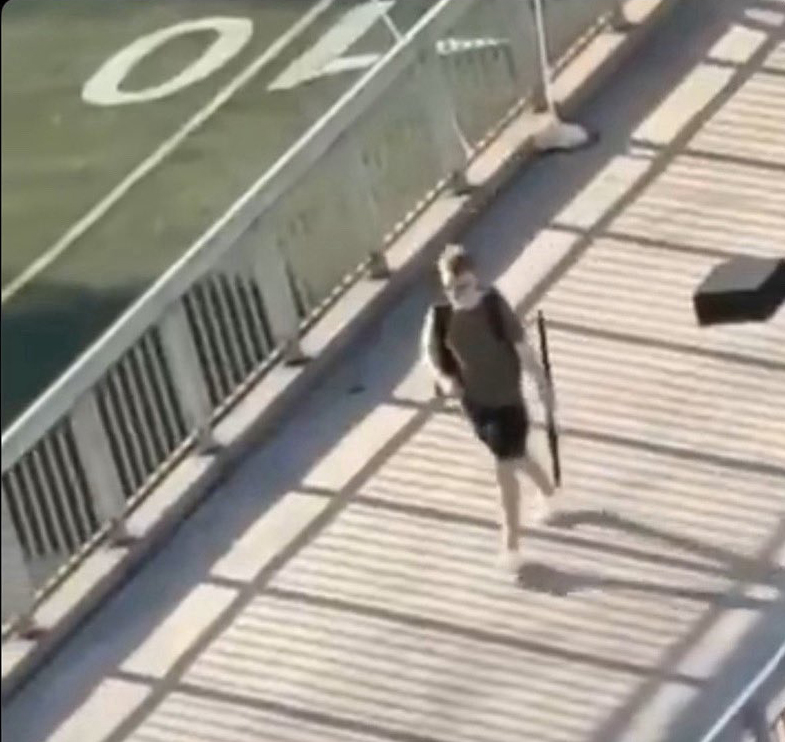
‘The umbrella guy: Were these images a cause, or an effect, of the panic?

We were having a family birthday party for one of my kids Sunday night when I got a call from my brother in Greenville. He called to make sure that we knew we shouldn’t venture near the USC campus. There was apparently an “active shooter” situation, and the campus was locked down.

I saw that one person at our party seemed to be about to leave, so I asked my brother to hold on a moment, and I made an immediate announcement to the entire household about the news, suggesting that no one head in that direction. I was very much in a mode that was a sort of cross between “Now hear this!” and “General Quarters!”

But everyone already knew. My wife informed me that everyone had been talking about it at the table. I had missed it competely, which is a frequent occurrence with the state of my hearing.

Anyway, by that time the folks in charge on campus were already stepping down the alert, and within minutes they had given the “all clear.” Not because the “shooter” had been arrested or otherwise eliminated, but because he hadn’t existed.

There were some reported minor injuries, however — people who got hurt in the stampede of students trying to evacuate the area.

He was a creation of the remarkable new technology that we enjoy in the 21st century. No, not AI. You didn’t need that to produce this panic.

I’m talking about such quaint things as Al Gore’s Internet, smartphones with ever-improving cameras, social media, and the resulting ability of practically everyone on the planet to pass information to everyone else on the planet, whether it’s true or not.

Which is all stuff I have enjoyed greatly over the last couple of decades. But I’ve also pointed out how this combination of items is destroying our country, and other countries devoted to liberal democracy. But enough politics; back to the subject.

Of course, this causes people to scoff at the old newspaper guy wishing for the good ole days. Well, let me tell you about the good old days. Over the last day, I was thinking about how this would have unfolded, say, 25 years ago.

Basically, it would not have unfolded. It wouldn’t have happened. Of course, it didn’t happen, but something else did happen — a campus full of thousands of kids, not to mention their folks back home, were scared out of their wits. And some of them got hurt (but not seriously, apparently) in the rush to the exits.

Of course, I thought of this first from the perspective of a newspaperman. Back when such things as daily newspapers existed and thrived, news happened all through the 24 hours, but it only got published once. Back then, when the word of possible shootings went out, reporters would have rushed to the campus, the way they did Sunday night, and reported what they found. And for an hour or so, the whole news structure would be in high gear to meet the challenge. But then, about an hour later, everyone would know it was a load of nothing, and calm down. There might be a story about how everyone got excited and worried for a time, but there would at no time be a story delivered to actual readers crying out about havoc on the campus.

But I’m not fully imagining what would have happened. The thing is, there wouldn’t have even have been a story about the big scare. Why? Because there would have been no scare, for a number of reasons.

First, the images of a harmless-looking guy ambling along carrying an umbrella would not have existed. If you’re young — very young — it might be hard to imagine that. But you see, a mere quarter-century ago, people didn’t photograph everything they saw around them. I was one of the few people who might have done such a thing, because starting in my own college days, I got into 35mm photography in a big way. But I didn’t shoot a tenth of the images I now shoot every day, for the simple reason that film — and the chemicals I needed to develop it and make prints from it — cost money. It also cost a lot of time. Even if you were one of those civilians who dropped off their rolls at the drugstore, it still cost you some time. And unless you went to one of those one-hour places, you wouldn’t be seeing your prints for some days.

But let’s suppose that, being the camera geek I was, I did shoot such images, and somehow made the finished image appear instantly (remember that not even Polaroids were instantaneous, and the quality was awful). And suppose I also had the poor judgment to decide I wanted urgently to share this image, and my wild imaginings, with the world. How would I have done that — physically, technically? And how many people would I have reached? I assure you I had a much greater chance than most of you to get my picture into print, but I’d have to wait some hours before the presses rolled. And after they rolled, there’d be a further wait of hours (usually) before readers beheld it.

And by that time, we would have known for some hours that the pictures showed nothing that needed to be shared with anybody. They would be worthless, and of no interest.

There is value in having time to think, time to assess, time to recognize the truth before something is shouted to the world.

But we’ve lost that precious resource, and I don’t see any way of getting it back again. So in light of the existence of these new technologies, how on Earth are we going to stop driving each other stark, raving mad?

[Editor’s note: After I wrote the above, reporting on this incident has shifted more in the direction of a deliberate hoax, part of a pattern across the country, with less emphasis on innocent mistake. That significantly reduces the role that social media played, but it doesn’t eliminated it, because it doesn’t change the dynamics of the way current technology cause panic to metastasize, far ahead of the ability of reasonable investigation to catch up. (Although authorities did an excellent job of sorting it out as quickly as possible.) Without the technology, there might have been a panic on campus, but not across the country, as occurred in this case. This explanation raises other questions — if the cause of the panic was a couple of false phone calls, what role did the photos of the guy with the umbrella play? Was that just already-panicked students shooting pics of everything they saw and sending them out? I don’t know. In any case, they played a significant role in the widespread stress, based on what I was hearing from various folks following the incident.]