
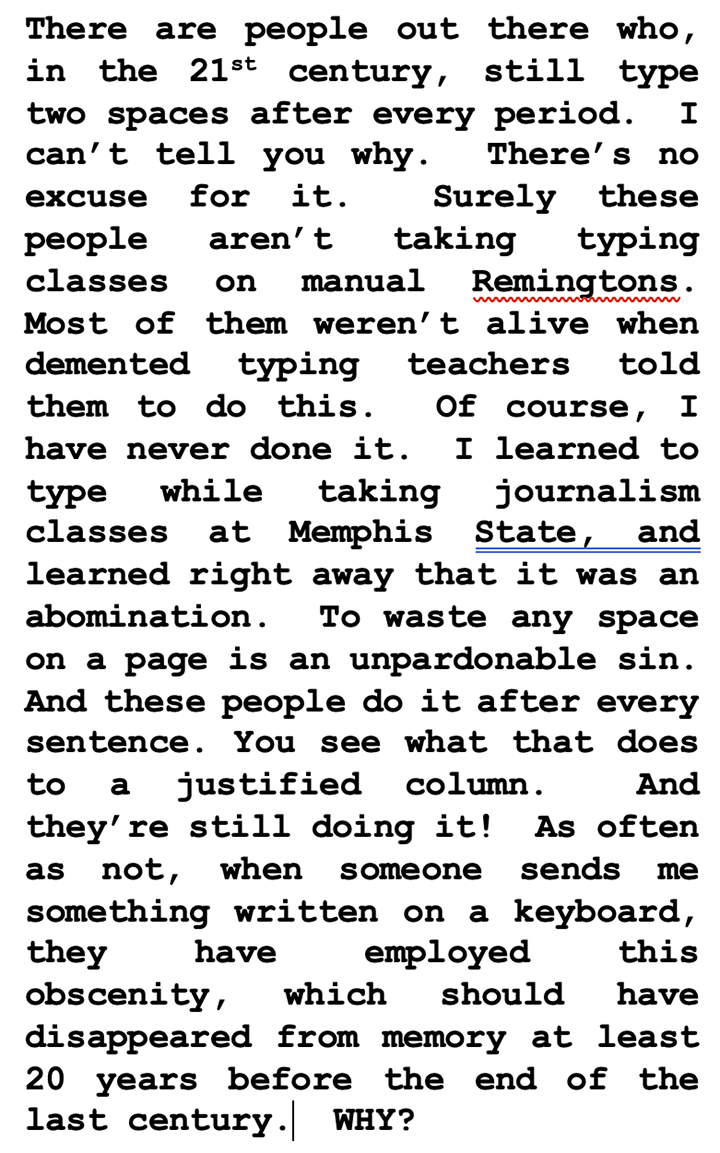
Screenshot
Indeed, why?
Frankly, I don’t understand why anyone ever did it! Google’s AI function offers a reason:
In modern writing, it’s standard to use one space after a period at the end of a sentence, not two. While two spaces were common with typewriters due to their monospaced fonts, computers and proportional fonts have made a single space the preferred and recommended style.
But could that really have been the actual reason? Could people really not see that, when a period appeared — and had a space after it — and the next word was capitalized, the old sentence had ended, and a new one begun?
Of course, I realized, as soon as I typed “and the next word was capitalized,” that a huge portion of the American population (practically everyone who had not been brought up on AP style) capitalizes words at random — which is another form of insanity, to be dealt with another day.
But let’s say that was the reason. Why do people who weren’t alive back in the days of monospacing still do it?!?!?
Perhaps it’s because they’ve grown up in the utterly undisciplined online era, which has no limits whatsoever. You can type all day for the rest of your life, and never fill the available space. In fact, “space” is no longer a concept that defines the life of a writer.
But I was brought up right, and therefore have a semi-religious horror of wasting that precious resource. Or perhaps I should say I had it. Twenty years of blogging has undone me (or undun me). Now, I vomit forth words at a phenomenal rate (when I get around to posting), and feel little or no obligation to tidy up the mess. Back in the day, I spent half my “writing time” cutting what I had initially written, stream-of-consciousness-style, down to fit. Now, I just take the first step, and move on.
Not back then, though. Back then, a good journalist would embrace discipline, thinking “I must not kill any more trees than necessary!” Or more likely (and practically) thinking, “If I don’t cut this to the assigned length, some unfeeling monster on the copy desk will slash it in the middle of my very best sentence, and toss what follows it into the composing room trash bin!” (Which has happened to me.)
But you don’t have to be a journalist who remembers having to shout over the noise of the linotype machines to see that the double-space thing is wrong. Google’s AI feature didn’t exist until last year, and yet it clearly states that “In modern writing, it’s standard to use one space after a period at the end of a sentence, not two.”
Well, I could go on, and probably would, except that I want to get back to my original question:
Why do people still do this? I’d really like to know. It’s one of those human pathologies in which a take a morbid interest…
Simple.
I DID take typing class in high school on a manual Remington typewriter and was taught two spaces after a period. If I did not do that, I would be penalized. I had to pass a typing test in the college of journalism as a freshman before I could move on with my degree and I was not penalized for the additional space after periods. Had I waited until college to learn to type like you did, I would have had to spend an additional semester at the University of South Carolina.
It’s a habit and nothing more. And frankly, I don’t see it as anything to be concerned about anyway, as fully justified margins are, to my mind, a greater abomination to readability in the 21st century. Give me ragged right anytime…
Well, it’s hard to argue with your there. But I will still wage war on double spaces wherever I find them… It doesn’t take much time. Someone gives me some copy to edit that possesses that flaw, so I do a search-and-replace to eliminate all of them in an instant…
Because Virginia Everett taught me to do that in 1969 in typing class (not keyboarding class). And it takes effort to un-learn a habit. If the habit was really harmful to others, I’d give it the effort. But does it really bother anyone that I give the period a little room to breath?
Well, yes, it bothers me. But that’s because of what has been drummed into me.
Thinking back, I have a vague memory of taking a typing class early in my college career, about the time I decided to pursue a journalism major. And I probably did it the wrong way to keep the teacher from flunking me (who wants to take typing twice)? But outside that class, I did it the right way. Think of the thousands of fractions of seconds I would have wasted, utterly wasted (especially since any editor behind me would have terminated them all with extreme prejudice) by typing those unnecessary extra spaces?…
Hey Brad,
I’m writing you from the Philippines, where I’ve found myself in the middle of a life I never imagined — a deeper, more global one. And as the rains pour down and poor communities suffer from flood after flood, I watch with a strange mix of disbelief and clarity as Bongbong Marcos meets with Grumpy Trumpy. It all feels like political theater — a shallow performance while real people drown, both literally and metaphorically.
So much of it feels fake, Brad. Not just them — but the whole machinery of politics today. The rehearsed lines, the hollow gestures, the way they pretend to care while doing so little. But amid all that, I still believe in something real — and I think you do too.
There is still good journalism out there. Still real truth. It’s just buried under algorithms, outrage culture, and the relentless pull of bias — especially confirmation bias, where people only seek what reinforces what they already believe, and implicit bias, those unconscious leanings we all carry, shaped by history and culture. These forces are powerful — and dangerous when unchecked.
I’ve been thinking a lot about who I was and who I’m becoming. I was once the “King of Rosewood” — a neighborhood in Columbia, South Carolina I still feel proud of. That title meant something then. But now, in this strange new chapter, I feel like I’m stepping into something broader — a kind of king of many quiet majorities. The ones who don’t shout. Who don’t trend. But who still care.
You’re one of the people I’ve always respected in that space — a real writer, someone who sees beneath the surface. I hope we can keep calling out what’s fake, lifting up what’s real, and using our voices to make sure truth doesn’t get washed away in the flood.
Mahalin ang mga bata — mula sa isang mabait, makisig na hari na may pasan sa balikat, pero patuloy na lumalaban.
(Love the children — from a kind, handsome king with a burden on his shoulders, still fighting.)
Thanks for the kind words, Bob.
Your line about the Phillipines being “a deeper, more global one” reminds me of a post I wrote long ago about the opening of global trade in that part of the world in, I think, the early 16th century. And unfortunately, I can’t find that post. I think it was based on an excerpt from Charles C. Mann’s 1493, telling about the moment he identified as when global trade completely its loop. It involved some Spanish traders based on the west coast of the Americas making a deal with some Chinese traders. I want to say it happened in the Philippines, but I can’t remember for sure….
I need to keep looking for that…
Well, I still haven’t found it. But here are a couple of paragraphs from the book itself that briefly describe that critical moment that brought the globe together in a commercial sense:
As I recall, the article I read BEFORE I got the book (I think it was in the WSJ) told the story more vividly. Maybe the book (1493: Uncovering the New World Columbus Created) did, too. But just now, this is the best summary of the monumental, world-changing incident.
I highly recommend doing what I did after reading the excerpt: I put the book on my Amazon list.
I also recommend the prequel, 1491…
My wife is from Mindanao, the southernmost island of the Philippines. It’s a land rich in history and culture—steeped in strong Spanish heritage, where the fertile soil still grows some of the best cocoa thanks to centuries-old influences. But it’s also a place deeply shaped by Muslim tradition, a vibrant identity that sets it apart from much of the rest of the Philippines.
Living here reminds me how history isn’t just stories or dates. It’s alive—in the land, the people, and the spirit of resilience.
That spirit runs through us, too. Because when I say,
“We were brothers, Bataan,”
I’m invoking a bond forged in fire during World War II—when American and Filipino soldiers stood shoulder to shoulder, enduring unimaginable hardship and sacrifice on the Bataan Peninsula. We bled together, fought together, and showed what loyalty and courage truly mean.
That legacy is part of who I am. It’s why this journey matters—why protecting family, heritage, and hope remains my mission.
See Ya!
Because Virginia Everett taught me to do that in 1969 in typing class (not keyboarding class, nor journalism class). Touch-typing is taught and learned by making habits. And it takes effort to un-learn a habit. If the habit was really harmful to others, I’d give it the effort. But does it really bother anyone that I give the period a little room to breath?
Dang. I wrote a lengthy response to that comment of Larry’s, and it disappeared.
It wasn’t important. I just acknowledged that it bothers ME, but that’s in large part due to what was drummed into me, which was that double-spaces were unpardonable…
But it was a scintillating read, I assure you…
With Apple, at the end of a sentence, press space twice and you get a period. That habit along with the old typing habit is hard to change. I know publishers hate it. Otherwise, what’s the harm?
Don’t worry about it. Just send your copy to me and I’ll fix it. I do that every day.
And actually, I don’t know how publishers feel about it. But I assure you editors can’t stand it…
It’s what I was taught in typing class in 1978. And I do it still. It’s a muscle memory thing now.
I’m more troubled by the type of people who find it to be so unnerving to see that extra space.
Without extra space and with:
It’s what I was taught in typing class in 1978. And I do it still. It’s a muscle memory thing now.
It’s what I was taught in typing class in 1978. And I do it still. It’s a muscle memory thing now.
The second one is imperceptibly more easily readable as the gap between the period and the next word (in my brain at least ) causes a tiny delay to process what I just read.
That’s an interesting response. And just the kind I was looking for. Without this and several other responses so far, I would still have no idea why y’all do it…
I think I learned the same thing in typing class — and immediately unlearned it, putting out newspapers…
I just saw that the extra space was removed in my post so it won’t make any sense.
I didn’t do it! I mean, it’s something I’d do, but I don’t think I did it this time…
I do it and I like the way it looks better than the way you do it- or anyone that does it like you do. Since I am the one that matters, I’ll keep doing it.
I was brought up right. You weren’t. Sad.
🙂
Hey Brad—
If anyone ever thought I had my life all figured out at 18, they were sorely mistaken. You know how Wilder Than Wild it’s been. Here I find myself—an American veteran based in Makati, at the St. Giles Hotel. Funny twist: the general manager is from Singapore and studied hotel management at Cornell, right near my old upstate New York haunts—ironically, something I seriously considered once.
I’ll be 72 in December, though locals here swear I’m in my 50s. Maybe it’s the tropical air—or maybe it’s being married to a 42-year-old firecracker that keeps me feeling younger than I am.
Being a U.S. vet in the Philippines has given me a kind of respect and status I never expected. But I’m only here a few more days.
Right now, I’m locked in battles with USCIS and with Congressman Nick Langworthy (R‑NY‑23). He’s the representative of New York’s 23rd district since 2023 and has recently supported tougher immigration enforcement policies, including backing ICE’s efforts to deport undocumented people and legislation like the Veto Your Visas Act targeting foreign students .
Meanwhile, I’m holding out hope that Senator Gillibrand will step up and help get my family safe in America. That’s my focus—getting them back and secure on U.S. soil.
People ask me why I’m heading back. Sometimes I ask myself the same thing. But I’ve got a mission – something that might help heal me and others:
“Listening to the Children.”
Thanks for everything, Po—Guapo ne Hari Pasan.
Yeah, that’s “handsome king with the burden.” SMH.