
I’m very busy — which is why I generally restrict myself to simple posts that take less time and don’t say much — but I want to mention this before it gets too far in the past.
This was three days ago.
About the only time I see anything that falls within the definition of “TV news” is when I’m checking in on my Mom at an hour when she watches it. On this occasion, it was something worth watching, and I would have missed it otherwise.
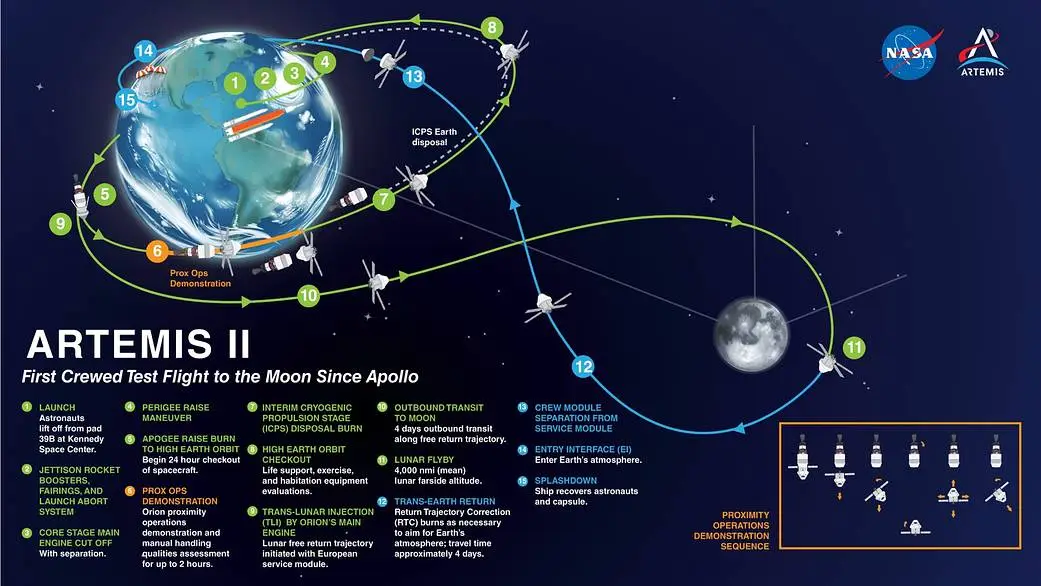
I had heard about Artemis II, in passing. What I heard made me promise myself to pause and read more about it, but with all I’ve been doing, I didn’t get around to it. And now, it appeared, the spacecraft was coming back. We watched the whole re-entry and splashdown, and I was struck by how I was seeing something I hadn’t seen in many a year.
I had watched some of the shuttle launches in the ’80s, especially after the horror of Challenger. I felt I had to keep an eye on these strange things that landed rather than splashing down, if only in case we were going to have to scrap our plans for the next day’s front and whole A section.
But they lacked the excitement of the launches in the ”60s. After all, while the new craft was higher tech and carried a larger crew, these shuttles were just tooling around in low orbit, the way John Glenn had done in 1962. And I’d seen that. Everybody had seen that. My 3rd-grade class — indeed, I suppose the whole school — assembled in the auditorium to watch it live. The black-and-white TV was on a wheeled trolley placed down in front of the stage, to bring the small screen a bit closer to us. It was the biggest thing that happened that year, even bigger than Mantle and Maris vying to beat the Babe’s record back at the start of the term.
What was interesting about this Artemis II return over the weekend was that… well, it was a bit like that day in the school auditorium — or at least it seemed to be to the people on the screen.
There were differences, of course:
- The screen itself. HD, and rich color that none of us could have imagined back in the Mercury, Gemini and Apollo days. Better sound, better everything — except, no John Glenn, the Single-Combat Warrior fighting the godless Soviets in the Heavens, as Tom Wolfe would later describe it.
- Instead of Glenn, there was a group of four I’d never heard of. Of course, this being the 21st century, there was a lot of hoopla about one being black and another being a woman! Like we hadn’t seen that before. You know what “diversity” point meant more to me? At least three of the crew were military — and two of them U.S. Navy pilots. Ike wanted astronauts to be military test pilots, and I’ve always agreed with him. They tend to already meet many prerequisites, and they take orders well.
But the most startling thing to me wasn’t those minor differences. It was the sameness. The breathlessness, in every voice that came on the air. For instance… people kept saying, over and over, that there was going to be a terribly suspenseful few minutes during re-entry when we wouldn’t be able to communicate with the capsule!!!! Also the capsule will turn into a ball of intensely hot fire as it entered the atmostphere!!!
Like no one had ever seen such a thing before. Like it hadn’t been standard in all those flights in the ”60s. Like Hollywood Opie hadn’t Apollo 13, in which the most suspenseful moment was the one in which the capsule was making its re-entry, and the loss of signal was longer than expected.
Finally, of course, it dawned on me that most people hadn’t seen this before, as unimaginable as that was for me. Only 12-15 percent of people today were even living in 1962, much less in the 3rd grade. Only about 22 percent here living on the planet the last time we sent astronauts to the moon.
For that matter, only about half today’s population was even around when the heavily nostalgic “Apollo 13” came out!
So this was a complete, unprecedented novelty to most people watching — as well as to the network TV folks and possibly everyone at Mission Control, and even the astronauts themselves!
Which was weird.
This was underlined by one young TV guy who had drawn the job of interviewing regular folks who had gathered to watch the spectacle. He spoke of their awe at witnessing such a thing for the first time. And he was particularly impressed to have spoken to a man who was so old he could actually remember the early flights back during the Space Age!
But then the young man with the microphone said something that made him sound older and wiser himself. He said that to the people with whom he had spoken, what was happening “seems like something a previous America would have accomplished.”
And he was right. I remember that America. Early in my career I referred to the WWII generation as “the America that got things done.” Later, I realized that generation was still accomplishing things for decades after 1945, because at that point they were still in charge of this country. And they were still pulling together across the lines of division we know today, to get one tough thing after another done. So we got things like the Civil Rights Act, Medicare, Medicaid, the Peace Corps, and… the Space Program.
JFK and his veep got the Moon Landing done, with the whole country dedicated to the goal after Kennedy’s assassination. We were still pulling together then, even as Vietnam was starting to tear us apart.
You know who launched the Artemis program? Trump. Really. Of course, to the extent that he actually deserves credit for that, I suppose this is the ONE way in which he has acted to, in some way, make America great again.
But of course, he is still someone who owes his prominence to division — to the way Democrats and Republicans view each other as members of different species, to the rally crowds that roar approval when a speaker says things about OTHER people that no politician would have dreamed of publicly uttering when when we had some mutual respect, and got things done together.
(Of course, he didn’t inspire the nation with a speech like this. He couldn’t, both because he lacks the ability and inclination and because this isn’t that America. But hey, he signed the paperwork.)
Wouldn’t it be wonderful if the Artemis program served somehow as a portal that led to us being that country again. ‘Tis a consummation
Devoutly to be wished…

The Mercury Seven
Having been around for the original moon landing, I found the Artemis mission underwhelming. Nearly 50 years later with all the advances in technology since then, they basically did what an unmanned spaceship could have done. Nice photos and all but nothing groundbreaking in terms of advancement.
Compare Artemis to landing on the moon, walking on the moon, and actually driving a vehicle around decades ago. I’ll be impressed when that happens again and they stay up there for a few days.
Meanwhile, SpaceX is almost boringly routine now –sending up more than 150+ rockets a year and actually REUSING them (not a concept a government program would consider). Far more impressive in that it has both an actual productive purpose (deploying Starlink around the globe) as well as being an engineering marvel. Meanwhile, the $23 million toilet on the Artemis was broken shortly after they launched and had to be repaired midflight. There’s an analogy there…
“not a concept a government program would consider”
Oh, come on, Doug. I guess you haven’t heard of the Space Shuttle…
The technology has improved over the past century. First we got the Shuttle. Now we’re at the point that a rocket can land on a barge, which is cool to watch…
But of course you and I agree that otherwise, it seems a bit like watching a rerun, only with a better TV picture…
NASA and the space program have been putting up satellites for many decades- including ones capable of communications. Starlink is pretty interesting in its scale, but it’s not exactly a leap in engineering. Still, it’s a valuable tool and a great resource.
I think most people would be surprised at the technological advances we all benefit from- in all types of industry – that is a direct result of the space program discoveries and work of the 1950s and 1960s. Lots of those advances that ended up in the hands of private industry started/was created by funding government programs.
I don’t think the toilet issue matter much given the astronauts said the actual toilet itself worked great- but a simple clog in a drain caused the issues they experienced.
This isn’t that unusual for any industry. I was at a manufacturing plant in late March that had a new $19 million dollar piece of equipment that had recently been installed. When I observed it, I was impressed at its design and function. It was a huge investment and had taken their supplier over 2 years to design and build. It supposedly is the only one in the united states. It took them over 3 months from installation and testing to get it up and running properly due to a $2 electrical connection component that they discovered had failed.
April 12, 1981, a group of NCR engineers watched the first Space Shuttle launch on a small, portable B&W TV. I had to see one in person. That was my sole bucket list item for thirty years. I finally got my chance on July 8, 2011 with the final launch of Endeavour. Thirteen days later, I was back at KSC to watch her return. I was with a group of 50 people on Twitter standing outside the control tower of the Shuttle Landing Facility. The twin sonic booms were sharp and crisp.
Veterans Day weekend 2016, my wife and I were at Kennedy Space Center Visitors Complex where they hosted an Astronaut Autograph and Memorabilia sale. I met the commander of Atlantis and told him that Atlantis was the second final launch that I had seen. He asked, “Apollo 17, the last room landing?” I answered, “No.” He followed with “Skylab?” “No.” “Okay, which Apollo mission?” I answered, “Apollo/Soyuz.” To which he said, “That was the final mission.”
The Apollo launch was memorable. The ground shook. When the sound finally reached us, it was like a rolling wave of continual thunder I could feel in my chest.