
I’m quoting Jack Ridley, as portrayed by Levon Helm, as he prepares to release Chuck Yeager way up in the thin air so he can pursue another speed record. It’s at the very beginning of the clip above.
That’s what came to mind when I saw that Ancestry was launching yet another rescrambling of my “ethnicity estimate.” Only this revamp was way beyond any we’d seen before, so much so that in recent days Ancestry’s been warning us about it — although in classic “You’re going to be so excited!” marketing lingo.
This was way more than the usual “you’re more Scottish than English/no, wait! You’re more English than Scottish” stuff. This was like entering a whole new dimension of perception. This was like Yeager having eaten too many peyote buttons out in the desert before going aloft.
For instance, there is no “England” any more. Alfred the Great might as well not have gone to all the trouble he had pulling it together. Now we have “Northern Wales and North West England,” “Southeastern England & Northwestern Europe” “North East England,” and even added altogether they don’t add up to “Central Scotland and Northern Ireland.”
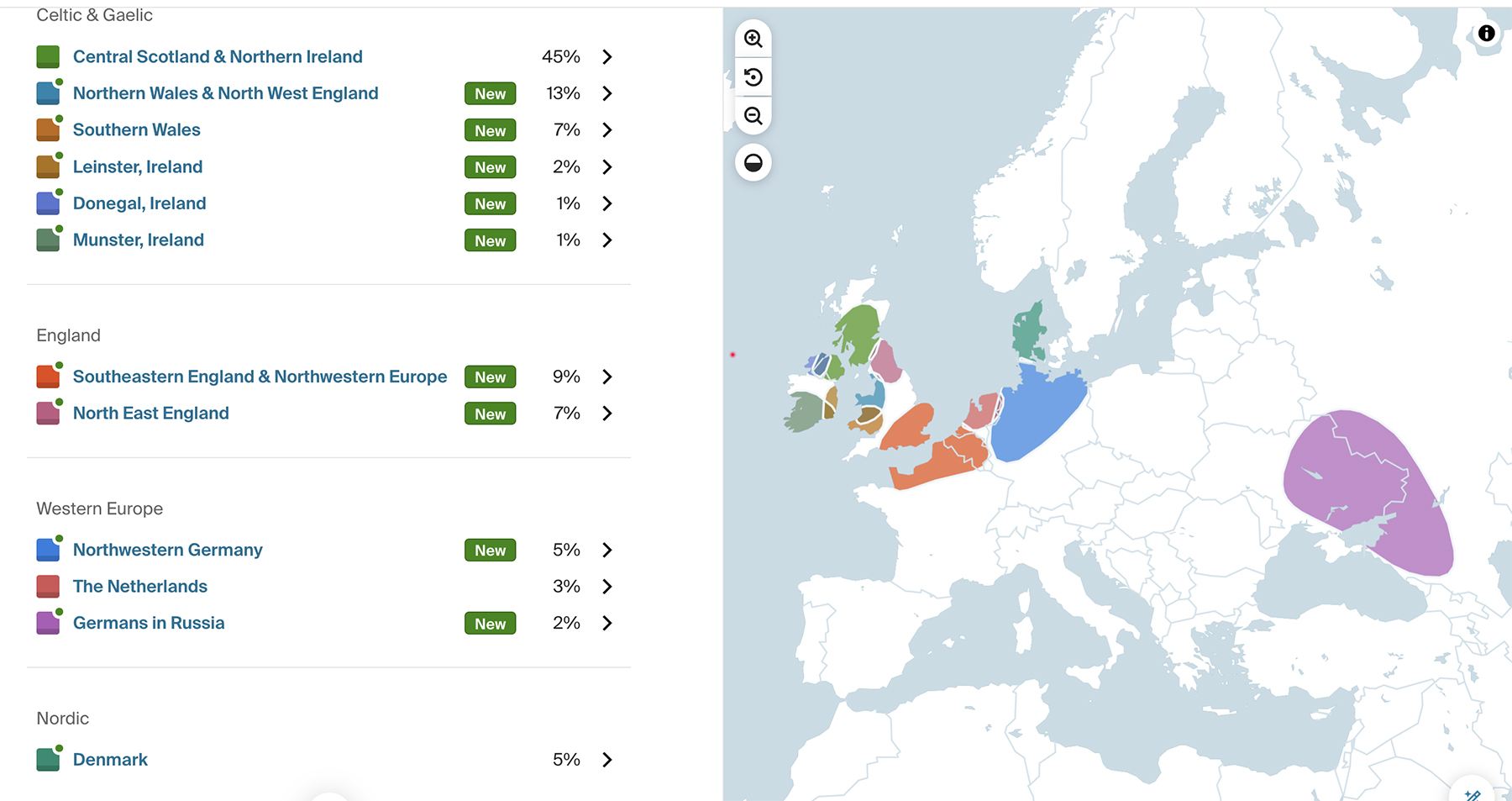
Speaking of Alfred, it made more sense to speak in terms of “Mercia” and “Northumberland” and “Wessex.” At least you could find them on a map!
They even have a category called “Germans in Russia.” What’s that? A bunch who got left behind when Hitler’s boys skedaddled back from Leningrad? Some lost remnant of the Teutonic Knights? And when you try to find them on a map, they’re mostly out east of Ukraine (see the purple above).
About the clearest thing on the map is when they say I’m 3 percent Dutch. Yet they never said I was Dutch at all before I went and stayed in Amsterdam for a week or so last summer — like it rubs off on you or something.
Give me a break. Why don’t you take “Central Scotland” and make it a separate category from “Northern Ireland?” I mean, you’ve gotta cross the North Channel of the Irish Sea to get from one to the other! Yeah, I know, there’s this category we call “Scotch-Irish” that made such a trek centuries ago, but why don’t you just call it that, if that’s what you mean?
(This isn’t as weird as the “England and Northwestern Europe” category they’ve been pushing for years. You know what that means? It doesn’t mean “England plus France, Belgium, the Netherlands and maybe a big hunk of Germany.” It has meant “England and a tiny bit of France that’s more or less within walking distance of Calais” — although that has changed a bit from year to year. That used to describe it. Now it’s — well, it’s hard to describe.

But you know what? Instead of getting all upset with Ancestry, I’m going to assume the best of intentions. Y’all know how I’m always moaning about how sick I am of Identity Politics (most recently in my previous post)? Well, maybe this is Ancestry’s way to make sure I never fall into that trap myself. They don’t want me starting some kind of Scots-supremacy group. They don’t want me to start expressing my opinions by saying something like, “Here’s what I t’ink, speaking as a right-handed, heterosexual, near-sighted Irishman (to paraphrase Clint Eastwood in the middle of this clip).”
And I guess I should appreciate them looking out for me that way…
Yeah, that’s kind of what mine looked like except I don’t have that weird Germans in Russia thing. It really doesn’t seem very helpful; the real estate it covers is about the same.
The traits really drive me nuts. They are pretty much wrong.
I’ve never understood the “traits” thing. What’s the appeal? I KNOW I have blue eyes. I KNOW whether I like cilantro. What could they possibly tell me that I don’t already know.
As for the health stuff that 23andme has pushed so hard — I’m 72 years old. If there’s something I’m going to get, I’ve already gotten it…
I’ll turn 72 next year. I don’t remember which version of the measles I had. Back then, there was measles and the German measles. I had a mild case of measles, but it hit my younger brother and sister harder.
September 30, 2021, I damn near died. The next afternoon in ICU, my wife asked the surgeon to change my status. The surgeon said that was the appropriate decision. The night before, I made a prior trip to the ER after recreating a scene from ‘The Exorcist
What was it that happened in 2021? Was that measles?
I had it in the second grade, when I was living in New Jersey. It was NOT mild…
I had the measles in elementary school. I don’t remember what grade it was. I never got the mumps. I think the only vaccines that were available was polio and smallpox.
The scene from “The Exorcist” was projectile vomiting, except it was split pea soup; it was fried shrimp that I expelled about seven feet. The night of September 30, 2021, I felt “unusual”, but not in pain. EMS turned on lights/sirens when my BP was 60/40. I lost a major organ that night in surgery.
Well, that’s what happens to me when I eat anything with any egg in it. Fortunately, I’ve managed to keep that from happening for more than thirty years. But I take a chance every time I walk into an unfamiliar restaurant and start questioning the server.
Which I hate doing. I’m never sure the right info gets back to the kitchen.
Which is why I prefer either eating at home, or at a familiar restaurant. And in every such restaurant, once I find something I can order safely without having to question the waiter about ingredients, I stick with it. I’m never need to look at a menu; I’m ready to order when I walk in…
The physical traits are about 50/50 which I find odd. Then there are those traits that say whether we are competitive and the like. I don’t see how dna could possibly show that kind of thing; so much of that is experiential. And if the physical traits are 50/50 chance of being correct something is off.
But when I look at dna matches, it seems to be correct regarding relationships.
Re indigenous peoples that I saw you mention on down the comments, my first match noted 1% northern IA. Then that 1% disappeared with the recalculation. Now it’s back. I kind of figure it’s from some Norwegian early ancestry, but who knows.
What does “IA” mean? Indigenous Americans? I don’t think I’ve seen that abbreviation…
From Ancestry!
Indigenous Americas
Canada & United States
1%
So you are 1% American Indian! That’s awesome! Makes me kinda jealous.
It’s a little eerie how white Ancestry keeps saying I am. Which is white as white gets.
For years, 23andme was willing to throw me a bone of color, saying I was .1 percent Somali! I mentioned that in a previous comment on this thread, 11 days ago.
Well, that is no longer the case. A few days later, I became aware that 23andme (which I seldom look at because it’s less helpful in building the family tree) had done an “Ancestry,” rescrambling my ethnicity estimate.
Now, they say I’m 100 percent European. Not a smidge of color. They hardly even let set foot on the continent, saying I’m 94.1 percent “British and Irish.”
The most exotic (from a Brit’s perspective) bit of ancestry they grant me is saying I’m 1.8 percent “Central and Eastern European.”
Whoop-te-do…
It’s evident that I’m mostly (99%) NE Europe – England, Scotland, Wales, Irish, smidge Norway, a smidge on the northern French coast. I really haven’t been surprised. It’s those traits I’ve found odd enough to be irrelevant.
I’ve been mostly trying to connect with the American revolution ancestors. I’ve documented one and there are at least 4 others I’m pretty certain about and probably others. It looks like the latest any of my ancestors came was in the 1700s. It’s an interesting way to connect with history.
You’re like me. I think my earliest ancestors came over to Jamestown starting in the 1610s or maybe 1620ish. My 10th-great grandfather Richard Pace (my grandmother was a Pace) was definitely there by 1622. Several other lines on my tree also passed through Jamestown; I just know more about Richard.
The earliest Warthen (then spelled “Wathen,” and today I know one distant cousin who still spells it that way) came over to Maryland (on account of being Catholic, I assume) in the 1630s.
My latest ancestors that I know of came over in the next century. Possibly all were here by the Revolution.
But like you, I don’t know much about exactly what they were doing during the war itself. I have some references to some who were on lists of veterans from that time, but no details.
I know a little more about my Civil War ancestors. All of them who served in uniform were with the Confederacy. I have some northern ancestors at that time, but just haven’t seen evidence yet of anyone serving in Union blue. Of course, the North had so many more people that it wasn’t as much a total mobilization of the male population as it was down this way.
Oh, speaking of people up North — I do know what one direct ancestress was doing during the Revolution: She was accused of being a witch. Not much came of it because this was a century after the great witch hunts. I’ve told that story before…
Never did the DNA match stuff. My sister did it years and years ago and hers was almost exclusively English (whatever that means).
Despite that, years ago, our grandfather did an extensive family tree that he worked on for years tracing our side of the family back to many German generations.
So my sister dismissed the DNA report which was a good idea.
Well, as I’ve quoted before, here’s what Jim Gaffigan’s reaction to his own DNA report was:
Which cracked me up, because Ancestry tells me the same thing.
On the other hand, some other DNA tests I’ve done have slightly more nuanced findings: 23andMe says I’m .1 percent Somali! And Helix — the service MUSC used to analyze my DNA — has somehow discovered I am .3 Austronesian-Filipino!
Which pretty much adds up to the same thing, I suppose. It would be a bit of a stretch to start calling myself a “person of color.”
But I don’t write it off. Repeatedly, the results mainly say I’m from the British Isles, with some of my forebears having passed through Scandinavia or Western Europe. Which is about what my tree says — with more than 10,000 people.
The most valuable — and for a lot of folks, most shocking — thing the DNA tells people is who their relatives really are. Most people know who their mothers and fathers are, but some are in for a huge surprise on the father part. I’m quite close to some relatives who have experienced that.
But mostly it’s interesting for figuring out how you’re related to this or that third or fourth or fifth cousin. Anyway, my tree is a resource for others in my family. And folks in my wife’s family sometimes check with me to explain their connections to this or that relative. Most people understand that this or that person across town is kin, but they don’t know how. I do. But I’ve established most of those connections through other means. Still, the DNA is occasionally quite helpful…
There is a lot of German ancestry in the English.
Especially if you really ARE Anglo-Saxon, since the Angles and the Saxons are both Germanic groups.
But it’s confusing to try to trace. I suppose if one is English, one will be largely Anglo-Saxon. But good luck proving it.
I’ve followed several lines on my tree back to, say, the 12th century. (And please, no one cry out, “That can’t be accurate!” Yes, it can, but you have to do the work with a full understanding that each generation along the way could be entirely wrong, particularly in terms of knowing who Ancestor X’s father is. If you and your father (and no one close to your father) haven’t had your DNA done, you don’t really know who your father is. And if you go back to generations not living before the past 15 years, you just have to trust the paperwork. But it’s still fun to see where that takes you.
But there are HUGE limitations as to what you get.
Since I’m 30-something percent “English,” I’m thinking I’ve got a large number of Anglo-Saxon ancestors. But I can’t find them. I hope you’ll correct me if I’m wrong about this, but I sort of think that “Anglo-Saxon” only started being used to indicate all native English speakers in the 19th century — at which all my ancestors were here in America. You have to go back (I think) to the couple of centuries after 1066 to get to a time when a sharp distinction was made between Normans and Saxons.
And when I get back that far, all my identifiable ancestors (however shaky the connection) seem to be Normans. Which makes a fan of Robin Hood stories and Ivanhoe feel a bit like a bad guy.
I reassure myself that I probably had even more Saxon ancestors at that time, but the records about them weren’t being kept well, as the Normans overwhelmed their country and cultures…
But again, I could be wrong. That’s not a period of history to which I’ve paid huge amounts of attention…
I follow a couple of genealogy groups on Reddit. Mixed reviews on the Ancestry update to put it politely. From previous readouts, I knew I had a drop of African blood on my father’s side, but not certain which branch. 23&Me shows the African countries, then shows those ancestors lived in eastern North Carolina. That matches my research where I trace back a set of great great grand parents to the Columbus, Robeson, Bladen County area where mixed race among white, black, and indigenous people is relatively not uncommon. Ancestry doesn’t show eastern North Carolina at all.
On my mother’s side a set of great greats’ name literally is translated as “of the mountains”. In this case the Carpathian Mountains of Southern Poland, Northern Slovakia, and Western Ukraine. 23&Me nails it. Ancestry splashes my origins across most of central and eastern Europe.
OBTW, I’m now part Northern Welsh also. Who woulda thunk.
The joke last update was the adding of Iceland as an origin to a ton of people. This year I see many people stating they are seeing eastern Czechia on their report. Ancestry should do better.
Amen. But maybe they still don’t have enough data to get it exactly right. Once they get beyond the British Isles, it looks like they don’t have enough DNA customers to be detailed — so they’ve sort of gone overboard slicing up Britain and Ireland.
It seems the service is most popular among descendants of English speakers. Which is not terribly surprising…
Even in this country, they don’t seem to have a lot of testing among American Indians. And of course, there you’re talking about people from thousands of cultures up until about five hundred years ago, when most of the populations were wiped out by disease that rushed ahead of European settlers.
I even see some indications that the data is so shaky (and complicated by politics) that we might have some Indian heritage even if it doesn’t show up in our reports.
I find that encouraging. This white boy would find that very cool…
I suspect the “Germans in Russia” are the Volga Germans, although the map should have them further east near the Caspian Sea if that is who is being represented. They were Germans invited by Catherine the Great to settle in Russia in the 1760’s. By 1897 there were about 1.8 million Volga Germans living is Russia. After the Revolution, a Volga German Autonomous Soviet Socialist Republic was founded in 1924 on the border of Kazakhstan; its capital was called Engels. According to the 1939 census, nearly 370,000 Germans lived in the Republic. After 1941 the Volga Germans were deported to Central Asia and Siberia. Many returned to Germany in the 1980’s and especially after the fall of the U.S.S.R. by taking advantage of Germany’s “right of return” law. Tom Daschle is of Volga German descent.
This is weird. I approved this comment yesterday, and answered it. I forget what all I said…