Category Archives: The World

What if Malthus was actually right for once?

Not that I think for a moment he will be — no one in the history of ideas was ever more spectacularly wrong (the poor fellow argued that resources would never be able to keep up with population growth even as an agricultural revolution led to much faster growth in food supplies than in population).

But some still predict that he will be. Andrew Sullivan drew my attention to this:

Grain yields are beginning to hit a “glass ceiling” in many countries, Brown said, where farmers have already taken advantage of what science has to offer for improving yield. As more and more countries hit an upper limit on productivity, the world grain harvest will begin to plateau, even as demand for food continues to rise, causing a rise in prices. More worrisome, the global food market is vulnerableto external shocks such as prolonged drought. “We don’t have idle land, we’re flat out,” says Brown. “We don’t have [food] stocks. We’re living harvest to harvest. The question becomes, what if we have a major shortfall in the world?”

Of course, if Malthus were ever proven right, that would be an extraordinarily bad thing. So I continue to root against him, even as I occasionally worry: Have you bought a bad of “topsoil” lately? It’s like all chunks of bark and stuff…

Stiff upper lip, mate: Coping with austerity in Britain

On a previous post, Bud and Silence had an exchange about Britain’s austerity measures, with Bud painting a fairly dismal picture:

Check out the results of the austerity approach in Great Britain. It’s been a disaster with GDP declining a full 2 years after the US began to grow. They’re approach a full blown depression.

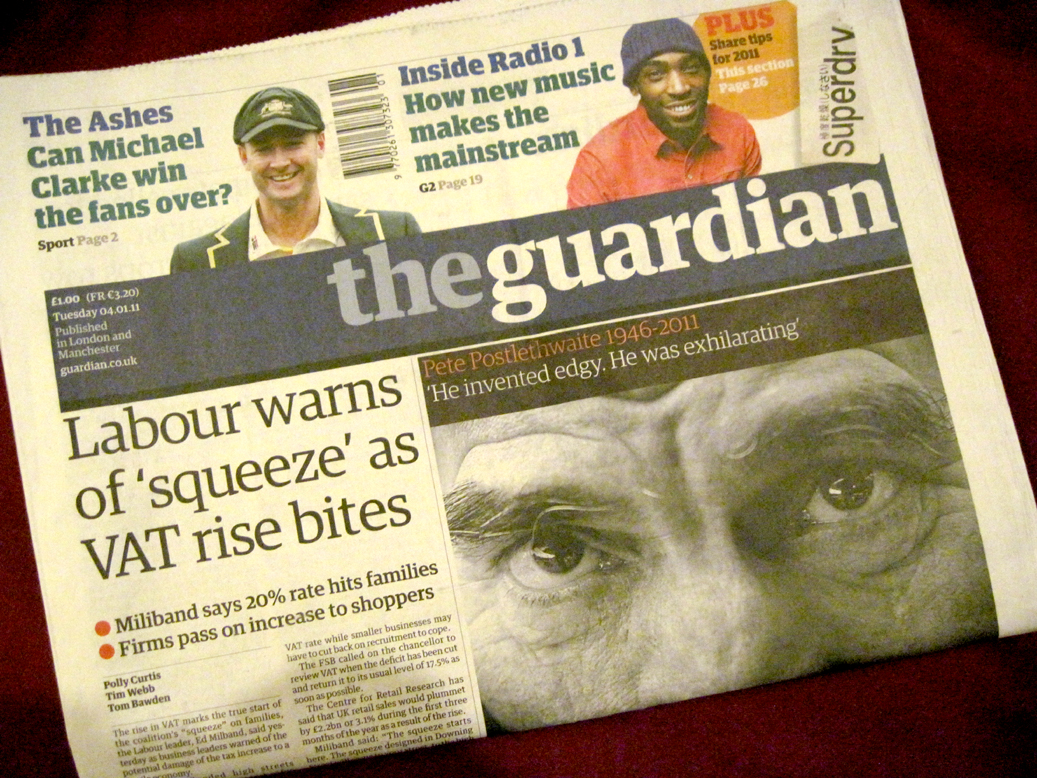
Well, I don’t know about all that, but I do know that when I was there at the start of last year, all the buzz was about the steep increase in the VAT, which took effect while I was there. Everywhere I went, businesses had signs out about sales and such that appealed to people’s worries about the tax increase. The newspapers were full of back-and-forth between Labour pols attacking the increase and Tories defending it.

Personally, I didn’t notice the difference — everything was a little more expensive over there than here before the increase, and I didn’t feel a few more few bob here and there. Besides, when you’re on vacation you don’t count pennies the same way — especially since pennies there are different from here to start with.

I did appreciate the sign in front of The Crown Inn in Woodstock (a short bus ride from Oxford). We went in and had lunch, and I enjoyed a couple of VAT-increase-free pints. But then, I would have anyway. It was (we were told) the oldest pub in town, and we got a nice table next to the fireplace. Cheers!

Even more LINsane in Chinese

In case you’re tired of hearing about all the sports journos getting fired over their Jeremy Lin excesses, perhaps you’d like to look at the phenom from another angle, such as this one from The China Post:

Lin is a common surname in the Chinese-speaking world. According to a government count in 2005, it is the second most common surname in Taiwan after Chen. It is in the U.S., however, that Lin becomes the most popular.

Of course we are talking about Jeremy Lin, the Taiwanese-American NBA former benchwarmer who rocketed to global stardom in less than a month. The Harvard-graduate New York Knicks point guard had the world media performing some rarely seen linguistic gymnastics (at least aside from tongue-in-cheek tabloid headlines): first it was “Linsanity,” then there are “Lincredible,” “Linvincible,” “Linspiration” and pretty much the addition of “L” to any word with a positive meaning that begins with “in-.” On Feb. 14, the New York Post made its contribution: “Happy VaLINtine’s Day.” Jeremy Lin also added an entry of his own by pointing out that he likes the “Super Lintendo” — a pun on the video game console by Nintendo.

Back in Taiwan, the media are also having a good time pulling off wordsmith stunts of their own, mostly by working on Lin’s Chinese name Lin Shu-hao (林書豪).

To begin with, Lin’s given name is an apt description of Lin’s current show of strength. With “shu” meaning books or writing and “hao” leader or heroic person in Chinese, the name fits Lin’s characteristics as a leader in the Knicks’ recent winning form with an Ivy League education.

The Taiwanese puns start with a subtle translation of “Linsanity” by using the close homonym of Lin (林, wood): the English pun becomes “Lin Lai Feng” (林來瘋), with Lin substituting the close sounding “Ren” (人, people) from the Taiwanese idiom “人來瘋” (the three characters literally mean people, come and insane, respectively). The turn of phase originally refers to people who become excited or showy in front of others. Here it pretty much means what Linsanity means.

For local media, however, the character “hao” is a better source for puns because it happens to be the homonym of the Chinese word for “good” or “very” (好) in Mandarin. The Taiwanese press gave the world “Hao Xiao Zi” (豪小子, the great kid), “Hao Shen” (豪神, very amazing), “Hao Wei” (豪威, very mighty), and “Hao Bang Yang” (豪榜樣, good example). The track is actually quite straight forward, just add the term good or very (both Hao in Chinese) to any praise that fits the moment.

If there is an award for best pun, it should go to “Ling Shu Hao” (零輸豪), a term comprising ingenious puns on the first two characters in Lin’s Chinese name: the surname becomes “Ling,” meaning zero and “Shu” has it meanings transferred from its original books (書) to lose (輸). Combined it refers to Lin as the “zero lose Hao,” which was a fitting description of his leading of the Knicks to seven straight wins a few days earlier.

Graham: no ‘containment’ of nuclear Iran

This came in while I was out at lunch:

Graham Introduces Resolution Ruling Out ‘Containment’ Strategy of Nuclear-Armed Iran

WASHINGTON – U.S. Senator Lindsey Graham (R-South Carolina) today introduced a resolution that puts the Senate on record as ruling out a strategy of containment for a nuclear-armed Iran.  The bipartisan resolution currently has 27 Senate cosponsors.

“I’m very pleased the Senate will speak with a strong, unified voice that a nuclear-armed Iran is an unacceptable option for our own national security and the security of our allies throughout the world,” said Graham, a member of the Senate Armed Services Committee.  “My resolution will afford every Senator the opportunity to speak on this issue and I expect a strong bipartisan vote in support.  Having a political consensus between the White House and Congress that a nuclear-armed Iran is unacceptable is a giant step forward in sending an important message at a critical time.”

The Graham resolution:

·         Strongly rejects any policy that fails to prevent the Iranian government from acquiring a nuclear weapons capability and would settle for future efforts to “contain” a nuclear weapons capable Iran.

·         Urges President Obama to reaffirm the unacceptability of an Iran with nuclear-weapons capability and oppose any policy that would rely on containment as an option in response to the Iranian nuclear threat.

·         Urges continued and increasing economic and diplomatic pressure on Iran until they agree to the full and sustained suspension of all uranium enrichment-related and reprocessing activities, complete cooperation with the International Atomic Energy Agency (IAEA) on all outstanding questions related to their nuclear activities including implementation of the Nuclear Non-Proliferation Treaty (NPT) Additional Protocol, and the verified end of their ballistic missile programs.

“It’s obvious to most people that once Iran obtains nuclear capability others in the region will respond in kind,” said Graham.  “A nuclear-armed Iran also makes it exponentially more likely this information could fall into the hands of terrorist organizations.”

“I believe, to some extent, sanctions are working and believe they can be successful in helping turn around Iran’s nuclear ambitions,” said Graham.  “However it is imperative the Russian and Chinese assist the international community in changing Iranian behavior.

“Finally, as President Obama said in his State of the Union address, ‘All options must remain on the table’ when it comes to stopping Iran from obtaining a nuclear weapon,” concluded Graham.

Co-sponsors of the Graham resolution include: Senators John Boozman (R-Arkansas), Scott Brown (R-Massachusetts), Bob Casey (D-Pennsylvania), Saxby Chambliss (R-Georgia), Dan Coats (R-Indiana), Susan Collins (R-Maine), Chris Coons (D-Delaware), John Cornyn (R-Texas), Orrin Hatch (R-Utah), Dean Heller (R-Nevada), John Hoeven (R-North Dakota), Kay Bailey Hutchison (R-Texas), James Inhofe (R-Oklahoma), Sen. Joseph Lieberman (I-Connecticut), Robert Menendez (D-New Jersey), John McCain (R-Arizona), Claire McCaskill (D-Missouri), Barbara Mikulski (D-Maryland), Bill Nelson (D-Florida), Rob Portman (R-Ohio), Mark Pryor (D-Arkansas), James E. Risch (R-Idaho),Marco Rubio (R-Florida), and Chuck Schumer (D-New York).

#####

That’s a pretty good list of sponsors he’s got. And like Graham, I, too, endorse what the president said in the SOTU.

Yeah, that sounds pretty French, all right…

This should distract y’all from the never-ending post on Kulturkampf earlier in the week…

Don’t know if you had seen the piece in The Wall Street Journal about the (American) woman who has written a book all about how the French are better at raising children than we are.

Never mind my natural suspicion of any American who chooses to live in France rather than here. This is NOT the 1920s; it’s just not done any more. Those who do are all a lost generation, to my mind. Alice B. agrees with me.

It still seemed interesting, and my wife and I shared the info with our kids who have kids, in case they could get anything out of it. From my cursory glance, it was stuff like how the French somehow manage to keep their kids from whining and stuff like that. The downside, from what I read — basically, a huge part of the formula is that the French neglect their kids by American standards, because they’re into having time for themselves. And if I got into what I think of that, we’d get into a discussion of whether my Anglophilia has led necessarily to Francophobia, and I don’t want to go there today.

Where I want to go is here, to this revelation I read this morning in the Post:

Pamela Druckerman, the writer who set off parenting debates this week with her essay in the Wall Street Journal, “Why French Parents Are Superior,” (which was an excerpt of her newly published, “Bringing Up Bébé: One American Mother Discovers the Wisdom of French Parenting,” Penguin) has just involuntarily launched another discussion.

It turns out that in another essay a few years ago for the magazine Marie Claire, she revealed that she had planned and engaged in a threesome with her husband.

Slate’s Rachael Larimore discovered the piece called, “How I Planned a Menage A Trois.” It is filled with excruciating details about what she writes was a gift for her husband’s 40th birthday. It culminates in a paragraph that would make anyone viewing it in their own rearview mirror — let alone a writer who is now selling a parenting book — wince:

“Finally, they tire themselves out. There’s a sweet moment at the end when the three of us lie together under the covers, with the birthday boy in the middle. He’s beaming. I’ll later get a series of heartfelt thank-you notes from him, saying it was as good as he had hoped.”

Larimore revealed Thursday that Marie Claire editors had agreed, at Druckerman’s request they said, to remove the essay from the magazine’s online archives. Enough evidence of the essay existed, however, that Larimore said she came on it accidentally.

It’s not what they did; it’s that she frickin’ WROTE about it, under her real name. That’s seriously defective. If you had to get a license to have kids, one hopes she wouldn’t be issued one.

I am reminded of some wisdom I obtained from watching “Talladega Nights: The Legend of Ricky Bobby” (from now on, I’m sticking to American sources of wisdom, however low or tacky). When the French Formula 1 driver tries to join the NASCAR circuit, the other drivers heap scorn on him. He responds by telling them that France had given them “democracy, existentialism, and the Ménage à Trois.” As one of the rednecks responds, “Well that last one’s pretty cool.”

Perhaps so, perhaps not. But it certainly sounds French to me…

Post: Why should troops die in Afghanistan this year if we’re leaving next year?

The Washington Post had a thought-provoking editorial this morning. Excerpts:

On Wednesday, Defense Secretary Leon Panetta floated an entirely different plan: an end to most U.S. and NATO combat operations in Afghanistan by the second half of 2013, a year earlier than expected, and a substantial cut in the previously planned size of the Afghan armed forces. So much for “fight.” Though Mr. Panetta didn’t say so, this strategy implies another big U.S. troop reduction in 2013, beyond the pullout of about one-third of troops already planned for this year. U.S. commanders have lobbied to keep the troop strength steady from this coming autumn until the end of 2014 — the current endpoint for the NATO military commitment.

The new timetable may sound good to voters when Mr. Obama touts it on the presidential campaign trail. But how will the Taliban, and its backers in Pakistan, interpret it? Before negotiations even begin, the administration has unilaterally and radically reduced the opposing force the Taliban can expect to face 18 months from now. Will Taliban leader Mohammad Omar have reason to make significant concessions between now and then? More likely, the extremist Islamic movement and an increasingly hostile Pakistani military establishment will conclude that the United States is desperate to get its troops out of Afghanistan, as quickly as possible — whether or not the Afghan government and constitution survive….

But if President Obama has decided to pursue that course, there’s an inevitable next question. If the goal of a stable and democratic Afghanistan is to be subordinated — if timetables are to be accelerated, regardless of conditions — why should U.S. ground troops fight and die this year?

That’s always the question, when timetables are given for withdrawal: If we’re going to withdraw at a certain time regardless of conditions, what’s the point of fighting now?

It’s a brutally tough question whether you come at it from the direction of a hawk or a dove.

First, they came for the Tweets…

I’m not usually persuaded by “slippery slope” arguments, deeming them intellectually lazy. But I have to confess to being a little bothered that Twitter is announcing it has the capability, which it is willing to apply, to censor Tweets by country.

Twitter still maintains that “our policy and philosophy about the importance of supporting free expression has not changed.” But it doesn’t answer the question of whether it would have helped Egypt and other regimes suppress the Arab Spring.

It does draw the line at making a devil’s bargain, as Google did for a time, with China.

Twitter offers the example, to make us feel better, of cooperating with Germany’s anti-nazi laws. So… we’re supposed to feel good that they’re willing to suppress fascism, but personally, that’s a bit outweighed by the fact that the first country they come up with as an example is German. No offense, meine Kameraden.

This makes me wonder… something I am not at all happy about is that the most-viewed video (65,281 views) I’ve ever put on YouTube is a clip of neo-Nazis saying “Sieg Heil!” on the State House steps four years ago (and two make it worse, two other, longer clips I shot at that same rally rank fourth and fifth, which really creeps me out). So I guess that would have been censored, had Twitter been in charge — in Germany, at least.

I like that Twitter is trying to be, if this isn’t too much of an oxymoron, transparent about its censorship:

We haven’t yet used this ability, but if and when we are required to withhold a Tweet in a specific country, we will attempt to let the user know, and we will clearly mark when the content has been withheld. As part of that transparency, we’ve expanded our partnership with Chilling Effects to share this new page,http://chillingeffects.org/twitter, which makes it easier to find notices related to Twitter.

But I’m still not thrilled about it. You?

This is a job for… SEAL Team Six, the closest thing to superheroes that real life offers

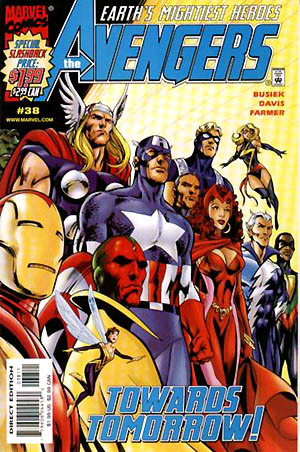
They’re not the Justice League of America, or even the Avengers (although the name sometimes fits). They don’t wear colorful tights. But SEAL Team Six is the closest thing we’re likely to see in real life to a band of superheroes.

First bin Laden, now this:

KHARTOUM, Sudan — American Navy Seals swooped into Somalia early on Wednesday and rescued two aid workers, an American woman and a Danish man, after a shootout with Somali gunmen who had been holding them captive in a sweltering desert hide-out for months.

Under a cloak of darkness, the Seals parachuted in, stormed the hide-out, killed nine gunmen and then whisked the aid workers into waiting helicopters, Pentagon officials said. The Seals were from the same elite Navy commando unit — Seal Team Six — that secretly entered Pakistan to kill Osama Bin Laden in May, senior American officials said, though the rescue mission in Somalia was carried out by a different assault team within the unit…

I'm pretty sure this is NOT what SEAL Team Six looks like...

They just keep doing these amazing things that no one else seems able to do anymore, outside of the IDF and Mossad, and what have they done that seemed quasi-superhuman since the raid on Entebbe?

You know what else? We don’t know their identities. They could be named Clark Kent and Bruce Wayne, for all we know.

OK, I’ll stop with the riffing on the superhero thing. But I like that we don’t know who they are. It allows us to see them as an extensions of all of us, however unheroic most of us may be.

The fact that they’re out there, doing this stuff without any personal fame, makes us think that The Onion was wrong: Steve Jobs was NOT “The Last American Who Knew What the F___ He Was Doing.”

Very good to know.

Only one dark lining in this silver cloud: Ron Paul might get the notion that with these guys active, we can just do away with the rest of our military, and still be fine. And the idea could catch on…

Graham or DeMint? Or, to put it another way, Reagan or Ron Paul? Whither goest the GOP in the world?

Charleston’s City Paper records another skirmish in the internecine battle between Republicans over America’s role in the world:

After the Republican presidential debate in Myrtle Beach last week, Sen. Lindsey Graham said on Fox News, “I hope people in the country understand that we’re Ronald Reagan Republicans in South Carolina. We believe in peace through strength and we’re not isolationists.”

In an interview the next day, Graham’s fellow South Carolinian Sen. Jim DeMint said on Fox Business,”If we spread ourselves too thin around the world we’re not going to be able to defend the homeland, particularly with the level of debt that we have right now. It’s foolish for us to think that we can have military bases all over the world, spend billions of dollars when we’re going broke back home. It just isn’t going to happen.”

Austerity may be a bad word to Graham when it comes to Pentagon spending, but for DeMint it’s the very definition of conservatism. When Republicans like DeMint and his Senate ally Rand Paul say that Pentagon spending cuts must happen, Republicans like Graham and his Senate ally John McCain call such actions “isolationist.” When Paul was elected to the U.S. Senate in 2010, McCain said he was worried about the “rise of isolationism” in the GOP. When Paul later led the charge against President Barack Obama’s military intervention in Libya, both Graham and McCain trotted out the isolationist label again…

I’m sure you don’t have to ask where I stand.

South Carolina: If you care about the country, it’s important that you vote for Mitt Romney today

And so in the end, it comes down to this: The only chance to prevent Newt Gingrich from going forward strengthened, with a chance of winning the GOP nomination, is to vote for the guy no one seems to actively like: Mitt Romney.

Staying home does no good. Voting for Ron Paul or Rick Santorum does no good, however much you may like them. They can’t deny this victory to Newt Gingrich, so a vote for them is a waste. (So is a vote for any of those who have dropped out, but are still on the ballot. I like Huntsman, too — but a vote for him doesn’t stop Newt Gingrich.)

Only Romney still has some slim chance of defeating Newt Gingrich today, so I’m urging everyone to get out and vote for him.

And don’t fool yourself into thinking it makes no difference. It makes a HUGE difference. Don’t fall for any of these rationalizations:

“It doesn’t matter; even if Newt wins South Carolina, Romney will win the nomination.” Don’t assume that. In fact, Gallup reported yesterday that what has happened in South Carolina over the past week-and-a-half has been happening, somewhat less dramatically, elsewhere in the country: Gingrich is catching Romney in national polls. The word Gallup used to describe what’s happening to Romney is “collapsing.”

“It doesn’t matter; Gingrich would never beat Obama, so the nation would be in no danger.” Don’t ever assume that — an infinite variety of things could happen to throw an election from the incumbent to the challenger. And by not voting to stop Gingrich today, you will have helped put him in the White House.

“OK, so maybe the Republican would win the election. In that case it still doesn’t matter, because I don’t like either Mitt or Newt.” This is the one on which you are most wrong.

Newt Gingrich would be a disaster for the United States of America. He would tear the country apart like nothing any of us have seen in our lifetimes. To say nothing of our relations with other countries.

Remember Bush Derangement Syndrome? (How could you forget? Republicans are suffering from a related disease today.) That was nothing. George W. Bush was just this guy, you know? Pretty average. A conservative guy, somewhat given to Texan swagger. That was about it. But Democrats hated him, practically spitting at the mention of his name.

But Gingrich would be all of the things that Democrats imagine Bush was, and on steroids.

None of us, in our lifetimes, have seen a president of the United States who would do what Newt Gingrich would do every single day in office: Try to infuriate and insult half the country, and most of the world. He delights in insulting, demeaning and belittling anyone who disagrees with him. And you know that right from the start, half the country would fit into that category. And that category would grow, as everything he says is magnified by the curvature of the presidential bubble.

All politicians occasionally say things that alienate a lot of people. But with rare exceptions, they don’t do it on purpose. The utter contempt and hostility with which Newt Gingrich regards most of the human race is a palpable thing, and it is intentional. When other politicians say something that alienates or demoralizes the country or inflames other nations, the try to do damage control. Newt Gingrich would instead strut about the stage, immensely pleased with himself.

He would be a complete disaster for this country. You may think that could be said with justice of other politicians you don’t like, but they are nothing to Newt.

Now, as for Mitt Romney — well, I can’t give you a ringing endorsement. About the only thing I can say I like about him is that he is not an ideologue. That’s what the most partisan Republicans — the one’s flocking to Gingrich — don’t like about him. They call him a flip-flopper. That’s because he is a manager, a turn-around artist. His goal would be to run the country well and efficiently, not to enact grand ideological schemes. That’s not enough to make anyone’s heart go pitter-pat, but it’s something. And it beats tearing the country apart.

Read The State‘s endorsement. It gives good reasons why Romney is the best — or at least the least bad — option, now that Huntsman is out of it. Read Cindi Scoppe’s accompanying column, as well. The headline on the endorsement is, “Romney has capacity to build bridges.” I think he does.

But at this point, Mitt Romney is more than the “least-bad” option. He’s the one guy who can stop Newt Gingrich. Newt Gingrich not only has the power to blow bridges up; he can’t wait to plant the charges.

And that’s why any South Carolinian who cares about the country needs to vote for Mitt Romney today.


Huck and Newt speak locally, think globally

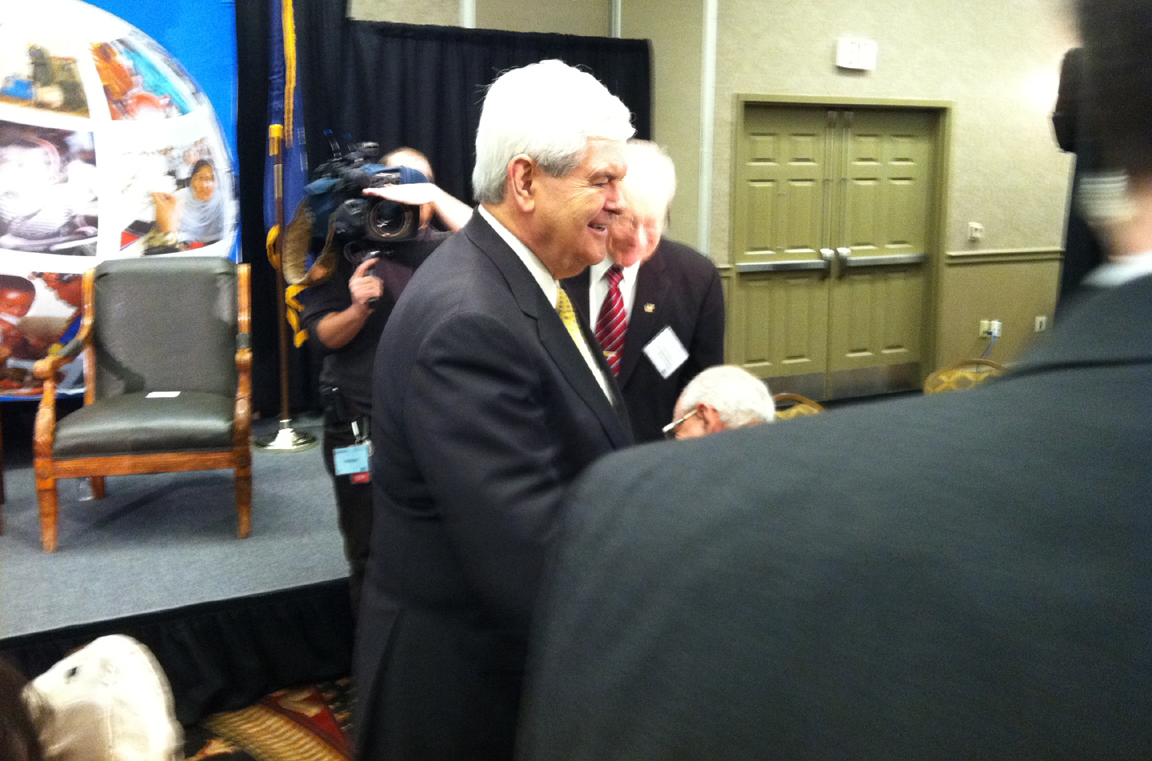
Gingrich arrives, with that Newtish look in his eye.

Newt Gingrich had the limelight to himself today at a gathering at the Columbia Hilton devoted to foreign policy.

Well, almost to himself — the featured speaker was actually Mike Huckabee, whom former ambassador to Canada David Wilkins introduced as “an alum of our primary.” But Newt was given a slot to speak as well.  The occasion was a U.S. Global Leadership Coalition luncheon, and the crowd was a mix of academic and business types — it was co-sponsored by USC, the Columbia World Affairs Council, and the Greater Columbia Chamber of Commerce. The Columbia Chamber’s Ike McLeese had some smart words to say at the outset about how “foolish” isolationism is in today’s world, and Huckabee later used the same word. I guess that’s why Ron Paul wasn’t there.

Between Huck and Newt, I preferred the comments by Huckabee, but then I’ve always sort of liked Huck. Basically, he was channeling John Donne. He didn’t actually say the words, “No man is an island,” or that if a bell tolls anywhere in the world, it tolls for us, but it amounted to the same thing.

He said that Americans — particularly those who consider themselves Christian — can’t sit by and let people in other parts of the world starve or be oppressed. And not just on moral grounds. Basically, he suggested that the world is so intertwined — and this is where the Donne stuff comes in — that our own interests and fates cannot be extricated from those of people in other parts of the world. At the very least, he said, a country we help feed tonight just might be one that we need to fly some planes over, in defense of our strategic interests, on a later date.

Huckabee graciously announced at the beginning of his remarks that whenever Gingrich showed up, he’d shut up and cede the floor. As it happened, he finished before Newt swept in.

Newt had some good stuff to say, too. He’s a smart guy — just ask him; he’ll tell you. But he was also…  more bombastic, more jingoistic, as is his wont. Which can get off-putting.

Like when he condescendingly complained about the better, higher societies — you know, Northern European ones — being dragged down by the obviously inferior ones. He didn’t think it right for America to be “trying to prop up the Germans so that they can prop up the Greeks.” Who, you know, are so worthless… “This is the country the Germans want to learn to be Germanic?” Why, he asked, should the Greeks want to be German. Their choice, as he explained it, is to sit on a beach drinking ouzo, or be miserable applying themselves like the Germans.

Then there was this: “No American president should bow ever again to a Saudi king.” He was making a good point — that we need to achieve energy independence. But there was just that unsettling tinge of complaining about having to be accommodating to the wogs.

I agree with him when he says he doesn’t want his grandchildren living in a world dominated by China, an oppressive regime. I agree that the world is, indeed, better off with the dominant country being the world’s biggest liberal democracy. But I could do without the attitude, such as when he said he would hire the most aggressive trial lawyer he could find to be trade representative to China, and he’d want that rep to get up every morning thinking about how he could maximize the other side’s discomfiture.

And with Newt, it’s not what he says (for me; I’m sure that for some of my liberal correspondents, it is what he says), but the way he says it. The president needs to be cooler than that.

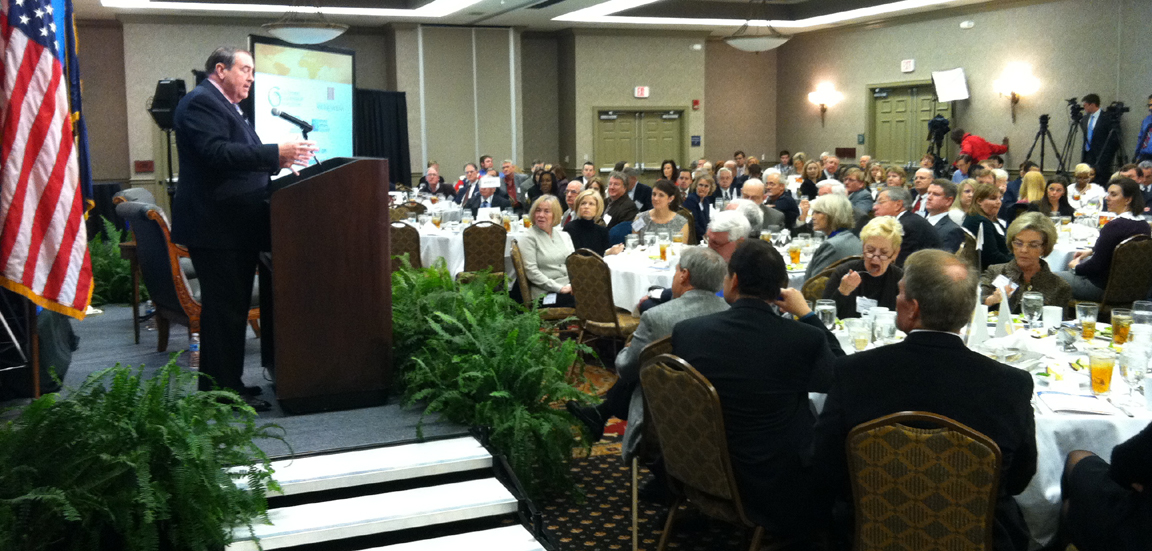
Mike Huckabee addresses the U.S. Global Leadership Coalition gathering.

I didn’t know they had a sense of humor

Maybe we can work something out with the Iranians after all:

Iran says it will send the U.S. government a toy model of the CIA drone the Islamic Republic captured last month. The announcement, made via state media, comes in response to the White House’s request for the return of the unmanned aircraft.

The U.S. drone, a RQ-170 Sentinel dubbed “the Beast of Kandahar,” is one of the most technologically advanced surveillance crafts in the world. The toy model, the Associated Press reports, will be 1/80 the size and retail for the equivalent of $4 in Iranian toy stores.

There’s still no conclusive explanation for how the drone got into Iranian hands in the first place. As the Slatest has previously noted, the U.S. and Iran have offered conflicting versions of pretty much every detail of the story. Iran claims to have noticed the drone in their airspace and then hacked it down electronically. The U.S. says it malfunctioned, but they’re not exactly sure how.

Where there is a sense of humor, there’s a chance for common sense — right? I thought it was quintessentially American, something we had a patent on, when Gen. McAuliffe answered a German demand for surrender by saying “Nuts.”

But this is like a page from our own book. So maybe we’re not so different…

Farewell, Earthlings: Nothing like an emotionally unstable country with nuclear weapons

So supposedly the Dear Leader died Saturday morning, and it took state television until Sunday night to announce it. Why the delay? I suspect it may be that it took the newsreader that long to rehearse making the announcement while sounding grief-stricken.

Why would I suggest that she, and the hundreds of other North Koreans we’ve seen exhibiting ridiculous, over-the-top grief behavior could be faking it?

Because the alternative doesn’t bear thinking about: The idea that a whole country, and one with nuclear weapons, could be this emotionally messed up.

I mean, look at the guy. And review anything you know about him, starting with the way he has kept in country in a perpetual dark age (literally dark in the sense that it is so primitive, it stands out from space at night because of the lack of electric lights). For years, the Chinese have been pressing him to follow their model — continued political oppression, but increased wealth for citizens — but he and his regime said “no dice.” He preferred for his people to suffer in every way.

And again, as I said look at the guy. What a loser. Sure, we westerners may be superficial, with our penchant for electing people who are taller and have good hair, but this is ridiculous. No self-respecting free country would ever elect a guy who looks like this. Far as I’m concerned, The Economist famously said it all several years ago, with its best cover ever.

Basically, this was a guy with no redeeming characteristics whatsoever. Or if he had any, he kept them carefully hidden.

If the grief is sincere, then this is the most extreme mass case of Stockholm Syndrome ever. And that’s troubling.

This is NOT the “end of the war in Iraq”

I was pleased when I heard, on the radio yesterday, President Obama saying this at Fort Bragg:

As your Commander-in-Chief, I can tell you that it will indeed be a part of history. Those last American troops will move south on desert sands, and then they will cross the border out of Iraq with their heads held high. One of the most extraordinary chapters in the history of the American military will come to an end. Iraq’s future will be in the hands of its people. America’s war in Iraq will be over.

I appreciated it because he said “America’s war in Iraq will be over.” At another point in the speech, he referred to the “end of our combat mission,” which was even better, and emphasized that what was happening was that responsibility was being handed over to Iraqi forces.

I was grateful that he had not said this was “the end of the war.” (I was also gratified that he, only slightly grudgingly, spoke of the troops accomplishment: “we’re leaving behind a sovereign, stable and self-reliant Iraq, with a representative government that was elected by its people.” Something that, of course, we would not have done had Mr. Obama had his way.)

This was, unfortunately, about the only place where I would be so gratified. Elsewhere in the speech, he said “end of the war” over and over and over again. But I don’t blame the president. The news media were worse:

And on and on. Among those I saw in a quick survey, only NPR got it right, in a headline that said “Iraq Mission Ends.”

Maybe I’m the only one who cares. But I became hypersensitized to the matter over all these years of antiwar folks saying “end the war,” when what they meant was that they wanted the U.S. forces to withdraw. Which is an entirely different thing.

The “end of the war in Iraq” is either something that happened several years in the past (the interpretation I prefer), or, more ominously, has yet to occur. There are a number of ways that you can speak, legitimately, of “the end of the Iraq war:”

  • You can say it ended with the fall of Baghdad in the spring of 2003, as that was when “war” in the Clausewitzian sense of armies clashing on battlefields with battle lines, and the control of a government at stake.
  • You can say it ended with the Surge, which settled down the various insurgencies that erupted after the fall of Baghdad, leading most people speaking of a “war” continuing to that point.
  • You can say it never ended, because Iraq’s security is far from that, say, of a Switzerland.

But in that last case — if you believe the “war” has continued up to this point — then withdrawing U.S. forces most assuredly does not “end” that war. In fact, it’s hard to imagine anything more likely to make fighting flare back up dramatically.

I hope that doesn’t happen. I hope that President Obama (and Bush before him) are right in their projection that things are sufficiently stable for Iraq to deal with the security vacuum created by a U.S. departure. I don’t know whether they are or not.

But I know this: Speaking of what is happening this month as “the end of the war” is highly inaccurate.

Obama to Pakistan: I’ve got your ‘sorry’ right here

OK, so it wasn’t that dismissive.

Still, it’s interesting that the administration — which apologized for killing that other American (Samir Khan, from North Carolina) who was with Anwar al-Awlaki — doesn’t want to say “sorry” on this one:

WASHINGTON — The White House has decided that President Obama will not offer formal condolences — at least for now — toPakistan for the deaths of two dozen soldiers in NATO airstrikes last week, overruling State Department officials who argued for such a show of remorse to help salvage America’s relationship with Pakistan, administration officials said.

On Monday, Cameron Munter, the United States ambassador to Pakistan, told a group of White House officials that a formal video statement from Mr. Obama was needed to help prevent the rapidly deteriorating relations between Islamabad and Washington from cratering, administration officials said. The ambassador, speaking by videoconference from Islamabad, said that anger in Pakistan had reached a fever pitch, and that the United States needed to move to defuse it as quickly as possible, the officials recounted.

Defense Department officials balked. While they did not deny some American culpability in the episode, they said expressions of remorse offered by senior department officials and Secretary of State Hillary Rodham Clinton were enough, at least until the completion of a United States military investigation establishing what went wrong…

Increasingly, we see signs of the U.S. just writing off Pakistan. This appears to be another such sign.

Or, you could go with this explanation, I suppose:

Some administration aides also worried that if Mr. Obama were to overrule the military and apologize to Pakistan, such a step could become fodder for his Republican opponents in the presidential campaign, according to several officials who declined to be named because they were not authorized to speak publicly…

Tasteful understatement on display

My first reaction when I saw this was to flash on 1979:

Protesters Storm British Embassy in Tehran

But then, I had to smile when I read this blurb leading the NYT site:

In an assault Britain called “utterly unacceptable,” Iranian protesters entered the British Embassy on Tuesday, chanting “death to England,” pulling down a flag and ransacking offices.

Utterly unacceptable, indeed. And insupportable, I might add, if I may do so without being charged with rash hyperbole.

Oh, and by the way… the sun may have set on the Empire, but when all is said and done, I’m going to bet on the culture that says “utterly unacceptable” over the one that gets so whipped up by an ayatollah that it runs amok screaming “death to England” and destroying Her Majesty’s property.

And now, let’s drink to the King. Or to the Queen, if that’s all you’ve got.

‘War in the name of democracy,’ 1775-style

On this Veteran’s Day (I prefer “Armistice Day,” but whatever), the WSJ had an op-ed piece headlined, “America’s Distinctive Way of War,” by Eliot Cohen of Johns Hopkins University. The headline doesn’t quite give away the topic. The thesis is that much about U.S. military doctrine evolved from our encounters with an enemy that to modern minds may seem unlikely: Canada. While much of it is largely forgotten now, over a 200-year period there was a lot of nasty business along “what Indians called ‘the Great Warpath,’ the 200-mile route of water and woodland paths that connected Albany and Montreal…”

There was a lot in the piece that was interesting, whether you fully accept the Canadian premise or not. Such as this:

War in the name of democracy? In 1775, the rebelling colonies—not even yet the United States — launched an invasion of Canada. The Continental Congress ordered the covert distribution of propaganda pamphlets in what is now Quebec province. The opening line: “You have been conquered into liberty.” Congress subsequently sent Benjamin Franklin north with a few companions to consolidate the conquest of Montreal, spread parliamentary government, and familiarize the baffled habitants of Canada — ruled for over a decade with mild firmness by a British governor—with the doctrines of habeas corpus and a free press.

The American way of war is distinctive. If the armed services have an unofficial motto, it is “Whatever it takes”—a mild phrase with ferocious implications. All that those words imply, including a disregard for military tradition and punctilio, the objective of dismantling an enemy and not merely defeating him, and downright ruthlessness, can be found in the battles of the Great Warpath.

It is often a paradoxical way of war. “Conquering into liberty” sounds absurd or hypocritical. In the case of Canada, it failed (though of course Canada took its own path to free government). In the cases of Germany, Italy and Japan after World War II, it succeeded. In the case of Iraq, who knows? In all of these episodes American motives were deeply mixed — realpolitik and idealism intertwining with one another in ways that even the strategists conceiving these campaigns did not fully grasp. What matters is that the notion of conquering into liberty is rooted deep in the American past, and in the ideas and circumstances that gave this country birth…

There is nothing new, apparently, under the sun.

Maybe 90 minutes, if Ahmadinejad’s favorite TV show was on at the time…

Just noticed this:

Nuclear Iran wouldn’t be the end of the world

United Nations inspectors released new documents on Tuesday containing what is supposed to be a bombshell. “Iran has carried out activities relevant to the development of a nuclear device,” according to the International Atomic Energy Agency. The report is the most damning the agency has ever issued.

Unsurprisingly, hawks have jumped on the news to argue that America needs to attack Iran. “If we are in a position where Iran is close to getting a nuclear weapon, then action needs to be taken,” declared Republican presidential hopeful Rick Santorum. “A nuclear Iran poses a challenge to U.S. influence that cannot be tolerated,” argued Commentary magazine’s Jonathan Tobin. Liberals and leftists, by contrast, claim the report is not as harsh as what is being reported. The report will “not likely” contain a “smoking gun,” wrote Robert Dreyfuss of the Nation.

Dreyfuss is right that the report doesn’t contain unequivocal evidence that Iran has an active nuclear weapons program — but so what? If an Iranian nuke was not containable and a major threat to the United States, then America would be justified in destroying the program before it was fully realized. But it is neither. And it is unwise to overlook those points in favor of obsessively following the daily shifts of Iranian nuclear progress like traders scouring the Dow Jones. History and strategic logic say that a nuclear Iran would not represent a major threat to the U.S. or its allies…

Nah, it wouldn’t be the end of the world. I figure we’d still have about an hour to go…

OK, sorry, but silliness brings out silliness.

If there’s anything more predictable than Hawks reacting by wanting to go take out Iran’s nuclear capability, it’s Doves saying Aw, it wouldn’t be such a big deal

Thanks for the ‘sunflower seeds,’ Mr. Weiwei

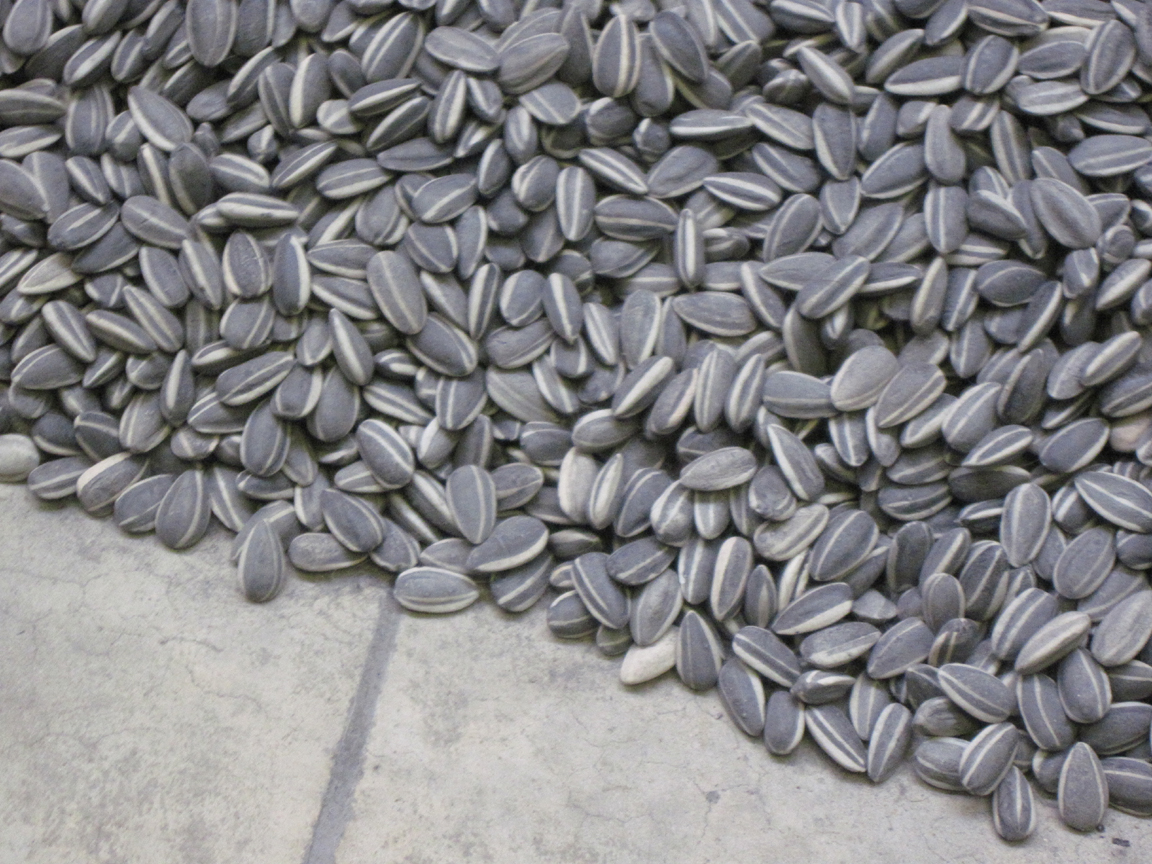
A few of the fake sunflower seeds (life-size if you click on 'em).

Yesterday, I saw this BBC item about how supporters of one Ai Weiwei were helping him pay the $2.4 million in taxes and fees that Chinese authorities say he owes:

Thousands of people have donated money to pay a massive tax bill served on Chinese artist Ai Weiwei.

By Monday, there had been donations totalling more than 5m yuan ($790,000; £490,000) to pay off the $2.4m in taxes and fines the authorities say he owes.

Many people believe he was served the bill because of his outspoken criticism of the government rather than because he had evaded taxes…

And I thought, Hey, is that the sunflower seeds guy? The story didn’t say…

And then I moved on and finished my Virtual Front Page for the day.

A few minutes ago, I went back to check — yep, he was the sunflower seeds guy!

This was an… artwork, um, installation… whatever… that I saw in London late last year, at the Tate Modern. It was 100 million fake sunflower seeds (made from porcelain, no less), strewn across the floor of this huge, warehouse-like room. Weiwei had somehow persuaded the people of some Chinese town to make them by hand. I don’t know whether overtime was involved. I think it was supposed to be an economic stimulus or something.

Here’s what we’re supposed to get out of it, if we’re the right sort of people:

The work continues to pose challenging questions: What does it mean to be an individual in today’s society? Are we insignificant or powerless unless we act together? What do our increasing desires, materialism and number mean for society, the environment and the future?

This is one of those things that make me feel like a total philistine. I see a Van Gogh, and I get it — it’s beautiful. I see a Weiwei, and I turn into a Homer Simpson. I think, That’s impressive, all right, but… you can’t eat ’em. I also think:

  • Was that the best use of those people’s time?
  • Wouldn’t it have saved a lot of money just to use real sunflower seeds, or if you wanted fakes, run them off in a factory?
  • How much do you suppose it cost to transport those things here and spread them on this floor? Did they build this part of the building just for this display?
  • How are the people who made these? Are they better off for his having done this?
  • Are you sure I can’t eat them?

And so forth. You know what, scratch the Homer Simpson analogy; that’s demeaning (to me). Seeing things like this make me more like… Mark Twain and his waggish friends in The Innocents Abroad, berating the European tour guides for showing them all that old stuff, because by golly they were paying good money, and wanted to see something new, etc.

Yeah, that’s the ticket.

Right after the Weiwei exhibit, I saw something that I did understand — my very first public bathroom signage that actually said “WC.” So I took a picture of that. I felt reassured.

After that, we walked downriver a bit and toured the Globe theater — which, as it turns out, is not the actual, original Globe, nor in the right location — yet another fraud! Don’t get me started…

Anyway, I hope Weiwei gets out of trouble with the Chinese authorities.

Gazillions of fake sunflower seeds.

Saving the world from democracy

Direct democracy, that is. But hey, the headline pulled you in, right?

Good thing the Greek PM can’t make a decision and stick with it. He’s backed off from further roiling world markets with his highly destructive idea of holding a referendum on whether his country will accept the terms of remaining part of Europe:

Greek Leader Calls Off Referendum on Bailout Plan

ATHENS — After a tumultuous day of political gamesmanship, Prime Minister George A. Papandreou called off his plan to hold a referendum on Greece’s new loan deal with the European Union and vowed to continue in office despite rumors he would resign and growing pressure from within his own party to do so.

In an address to his party’s central committee on Thursday evening, Mr. Papandreou said there was no need for a referendum now that the opposition New Democracy Party had said for the first time on Thursday that it would back the loan deal.

Trying to capitalize on what appeared to be a major political coup, the prime minister invited that party to become “co-negotiators” on the new deal and later said that talks on a unity government should begin immediately.

OK, so maybe he was crazy like a fox. But playing with the world’s economy like that was still crazy. And we’re not out of the woods yet.