Category Archives: The Stuff I Kept

A finished column I never ran, 30 years ago

Here’s where I was in the project last November. I had already eliminated 11 boxes.

I found what you will see below last night, when I resumed the ongoing, off-and-on, project of cleaning out our two-car garage enough that I can at least park one vehicle in out of the weather.

The problem isn’t the household items one or another of our kids have stored there, or the tools accumulated over the years. The toughest category of clutter is the result of my own packrat tendencies — mostly, the boxes of paper and other items that I packed up and brought home with me when I left The State 16 years ago.

It was a huge mountain to begin with, taking me two full weeks of hauling home in the bed of my truck every night of those last two weeks. (I had a big office, but that was just the beginning. The editorial department had a roomful of filing cabinets almost entirely devoted to my files, and I had a box here and there in other locations. There wasn’t time to sort through it all; I just brought it home.) This is my third time sifting through it all. Each of the first two times, I reduced the pile somewhat. This time, I’ve been throwing away most of what I find. But occasionally, I open a box that’s harder to give up, and I have to make my way through it sheet by sheet, reading some of the letters, notes and such all the way to the end. Those I tend to keep.

I was particularly interested to find this one. I think I’ve mentioned it before, but couldn’t find it to post. I wrote a lot of columns in long draft form over the years that I ended up trashing. Sometimes I found the premise just didn’t work once I had developed it. But usually it was simply that a better idea emerged at the last minute, and I wrote and ran that instead.

But this is the only one I can remember actually completing and having ready to go, and then spiking even though I didn’t write another one to replace it with. I think maybe it was already on the page and I yanked it off and replaced it with a syndicated piece. But I’m not sure, now that 30 years have passed.

I wouldn’t have done that a year or two later. But this was very early in my time on the editorial board. I wasn’t the editor yet, or even an associate editor. This was less than two years after I left news for opinion writing, and I was just an editorial writer. And at that early stage, I couldn’t see publishing an opinion piece that didn’t offer a solution. All I was doing here was describing the problem, and that seemed incomplete. I though it was my duty to prescribe a cure.

I should have run it. It was a decent piece. It had its flaws that jump out at me now, such as that jarring, sudden switch from past to present tense in the fourth graf. But it was worth running, and I wish I had — especially since it identified a problem that at that time was just starting to tear the country apart. It hadn’t fully metasticized yet. If I had known then how bad things would get — it’s one of the things that led both to Trumpism and to the Democratic Party being completely unable to counter it — I would have run it and perhaps even campaigned (unsuccessfully, of course, due to the fundamental division between news and editorial) to have it placed on the front page.

At that time, we were already becoming a country that couldn’t pull together to solve problems. Oh, a few things came along later that harked back to the “we’re all in this together” spirit of the Second World War or LBJ’s extraordinary string of domestic policy victories in the middle ’60s — such as Teddy Kennedy initially supporting George W. Bush’s effort to add prescription coverage to Medicare, or the bipartisan successes Joe Biden had in Congress early in his all-too-brief time in the White House.

But mostly, we have hardened the divisions between “my group vs. your group” that would do our country in. Young people have never known a time when we were regularly able to see each other as fellow Americans and pull together in common cause. For older people, the memories are dimming. Sometimes the problem is simply the rapidly growing party division that started getting bad in the ’80s, and just got worse and worse each decade. Sometimes it’s the inexplicable cult of Trump. Other times, it’s about what this column was about — the growing power of identity, which has fed both of those other two problems.

Look at it either way — that my black colleagues in that gym were blinded by identity, or I was, as the white guy who couldn’t wrap my head around how they could possibly identify with that rich celebrity who had so little in common with them or me. Either way, I found the cognitive divide between my co-workers and me shocking. I thought it was a problem we needed to talk about. I should have run the column.

To place this unpublished column in time: The Simpson verdict was announced on October 3, 1995 — my 42nd birthday. When I left that gym, I showered, headed up to the third floor and wrote the column quickly enough for it to run in the next day’s paper. But it didn’t.

Here it is, as it came off the dot matrix printer, like so many other things I saved from those times:

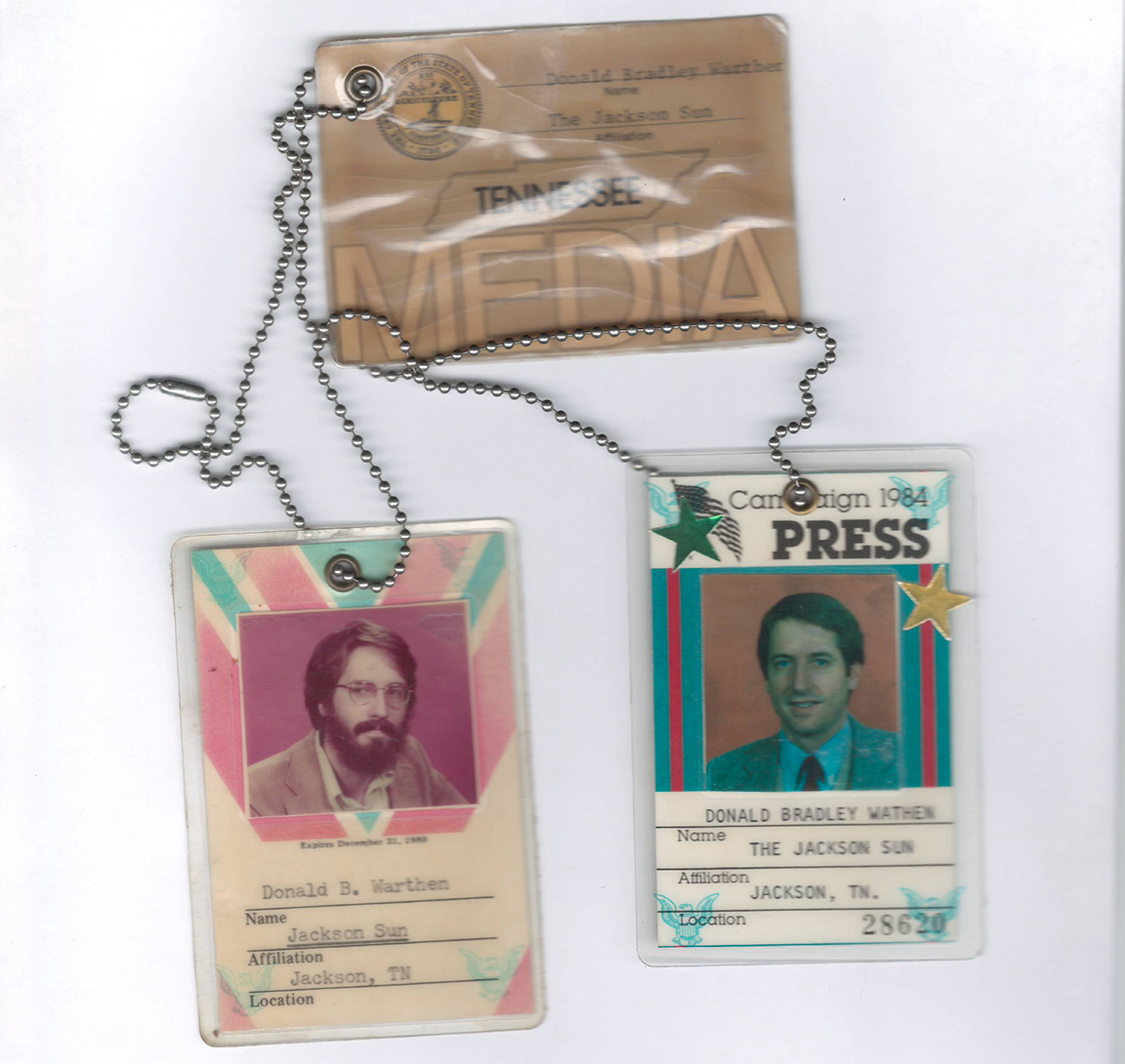
Look what I found: My old press cards

press cards

I was digging around in the closet in my home office, trying to find a staple-plucker to use on some multi-page documents I was digitizing, when I ran across these.

They are:

  1. My Tennessee Press Association press card from the late ’70s or early ’80s.
  2. My Secret Service press card from the 1980 presidential campaign (the one with the beard). I probably got this before going up to Iowa to cover Howard Baker’s unsuccessful bid in the caucuses.
  3. My Secret Service press card from 1984. I was an editor by this time, but I was the sort of editor who didn’t believe in letting my reporters have all the fun. Also, I had a weekly column to write, so I couldn’t stay tied to my desk. I liked to go check out interesting events — such as when presidential candidates came to town — myself. The schedule of a p.m. newspaper allowed this, especially if the event happened in the afternoon or evening. Morning newspaper editors can’t get away from the office as easily.

Halcyon days…

The things we run across looking back on a newspaper career


Bill C. and Bill D.

Occasionally, I have reason to open one of the many boxes containing the roomfuls of files I brought home from The State when I left (in my last two weeks, there was barely time to load it up, and practically no time to go through it, although I did throw out a few things), and sometimes I post one of the finds here.

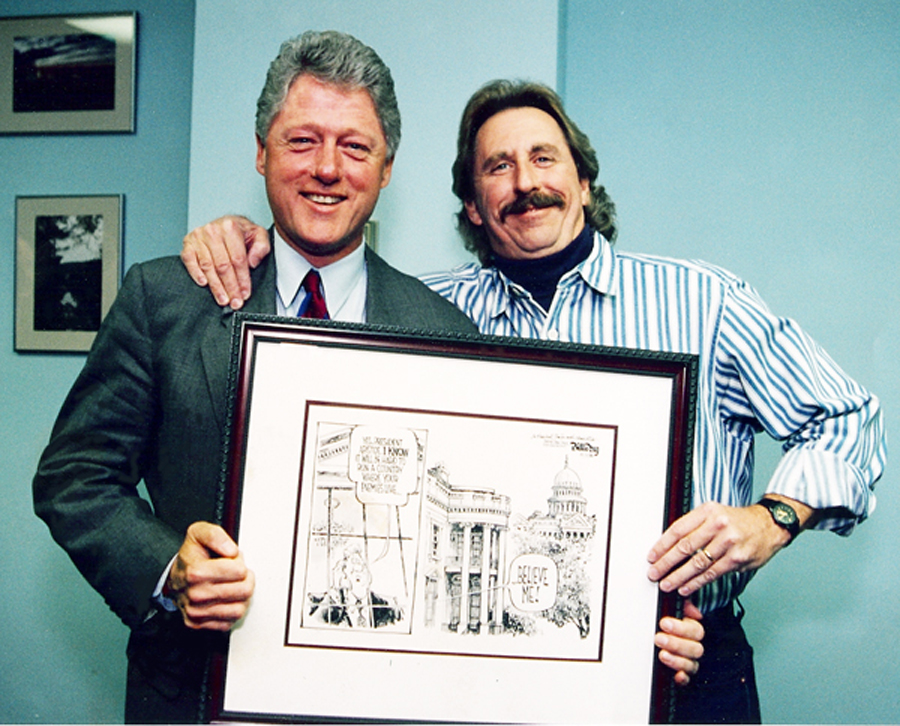
Looks like cartoonist Bill Day, formerly of The Commercial Appeal, has been doing something similar. He sent me this picture today, taken in the mid-90s, with this commentary:

I thought you might enjoy this photo. This was at the Detroit Free Press. He was a great sport posing and loved talking about cartooning. His staff told me that he was looking forward to talking to me because he’s a big fan. About a month later I received a White House photo of him showing it to everyone in the Oval Office. He signed it: ”To Bill Day, Thanks for the laughs!  Bill Clinton”

Bill’s the kind of cartoonist who would get a kick out of meeting Clinton. Robert Ariail is more of a Bush guy — although Robert had so much fun with Clinton when he was in office (Clinton was a large part of his inspiration both times Robert was a Pulitzer finalist, if I recall correctly) that he would have enjoyed meeting him, too — to thank him for providing so much fodder.

That reminds me of a picture I need to show you that involved Bush — and Tony Blair. I’ll try to track it down tonight or over the weekend.

Jody Powell and the Sixth Sense

powell,jody

No, that’s not the name of my band that I’m going to form once I come up with a new name, although I think I might put it on the short list…

This is just me free-associating from one post to the next.

Back on this one, I said something about how some politicians seem to have a sixth sense about when a camera is pointing at them. Or at least, they did back in my reporting days (when I, more often than not, was my own photographer).

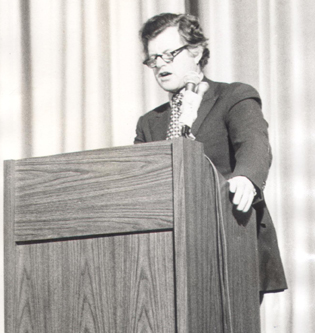
That got me to thinking about this picture that I ran across recently while sorting through old files. It’s a print I made from a shot I took at the Democrats’ mid-term national convention in Memphis in 1978. This was that didn’t go well for Jimmy Carter, whereas Ted Kennedy was greeted lovingly. They went wild for his presentation before a panel on health care reform (yes, we’ve been talking about it that long), during which I took the shot below (I wish I could find the negative from which I cropped this image of Kennedy, because as I recall, one of the panelists behind him was a baby-faced guy from Arkansas named Bill Clinton). Two years later, the party’s left wing would unite behind Kennedy in full-scale revolt against their own incumbent president.

And yes, I realize the Kennedy picture is low-quality. But I shot it on Tri-X with low ambient light, and blew up this portion of the frame, so gimme a break…

Anyway, where was I? … oh yes, the Sixth Sense.

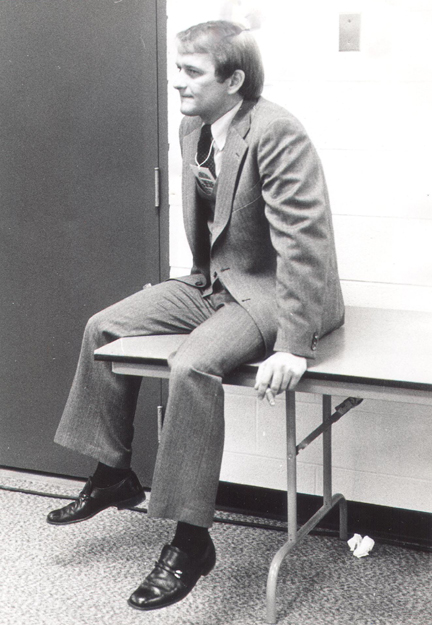
I was looking around and saw Jody Powell sitting on that table at the back of the room a few feet from me. He was unnoticed for the moment by everyone else, and he was relaxing with a cigar and a bottle of beer. As I aimed and focused the Nikkormat and manually adjusted the exposure (and yes, Burl, it was the Tiger tank of cameras; I loved the one that the paper assigned to me), without looking at me, he very deliberately moved the beer in his right hand down to where I couldn’t get it in the picture. I mean, heaven forbid anybody from the Carter White House should be seen having a good time.

Dang. But I took the picture anyway.

And yes, I realize both of these guys died this year, so consider this their official blog elegy.

Ted Kennedy

Yep, the plaid shirt guy

Alexander78

Back on this post, I made a gratuitous name-dropping reference to covering Lamar Alexander back during his gubernatorial campaign in 1978, and Kathryn replied with a suitably unimpressed, “Plaid shirt guy. Swell.”

Indeed, as name-dropping goes, “Lamar” isn’t the same as “Elvis.” So it was a forgettable reference.

I only return to it because, coincidentally, I was going through even MORE files from my newspaper career just hours later, and ran across these two shots from that week I followed Alexander in 1978. I practically lived with the guy that whole time. I flew on his campaign plane with him (with my paper paying a pro rata share of the cost), went where he went, ate where he ate… I’d get about five or six hours away from him at night, and spent a couple of hours of that in my hotel room writing. We used to do stuff like that in those days — actually cover political campaigns.

This was a pretty exciting experience for me, my first exposure to statewide politics as a reporter. The following week, I was following his opponent, Jake Butcher, just as closely. We sort of tag-teamed the candidates in the last weeks of the election.

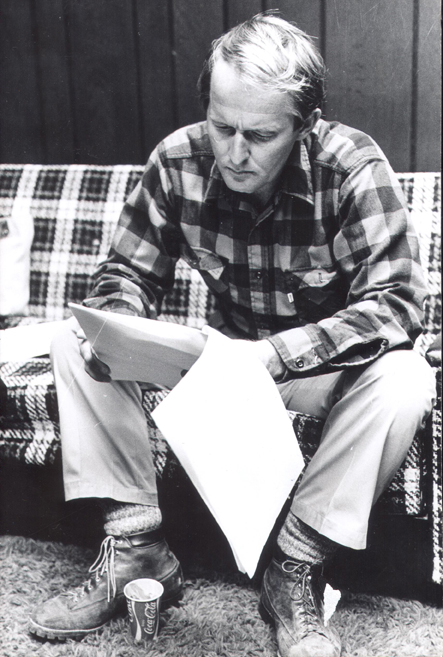
Anyway, the photo above, with Lamar’s tasteful plaid shirt clashing with a really ugly plaid sofa (be grateful it’s not in color) in the back room of a political headquarters in Nashville, captures a tense moment for the candidate. He had just been interrupted during this Nashville leg of his celebrated walk across the state by a reporter from the Tennessean with legal papers in hand. The legal papers — affidavits, I believe — had something to do with a business deal Alexander had been involved in. I want to say it had to do with ownership of some Ruby Tuesday restaurant franchises.

Anyway, somebody was alleging there was something irregular about it, and the candidate was being confronted with it. Big drama. This was his first look at the document, and there he sits with a suitably furrowed brow while we stare at him and wait for a reaction. One of us (guess who) is actually taking pictures of this potentially bad moment for Lamar Alexander. We were all about the next political scandal in those days, and Lamar had served in the Nixon White House, so he knew to take such things seriously, and soberly, and not complain about the pesky press.

But I will confess now to a bit of feeling bad for the guy at that moment. We weren’t supposed to feel that way, but I did. Even as I was dutifully taking the picture (if this is the end of his candidacy, I captured the moment!), I was sort of thinking it would be kind of nice if the guy had a moment to read this in privacy and compose his thoughts — if only so we could get actual facts from him instead of a gut reaction. But we didn’t allow him that.

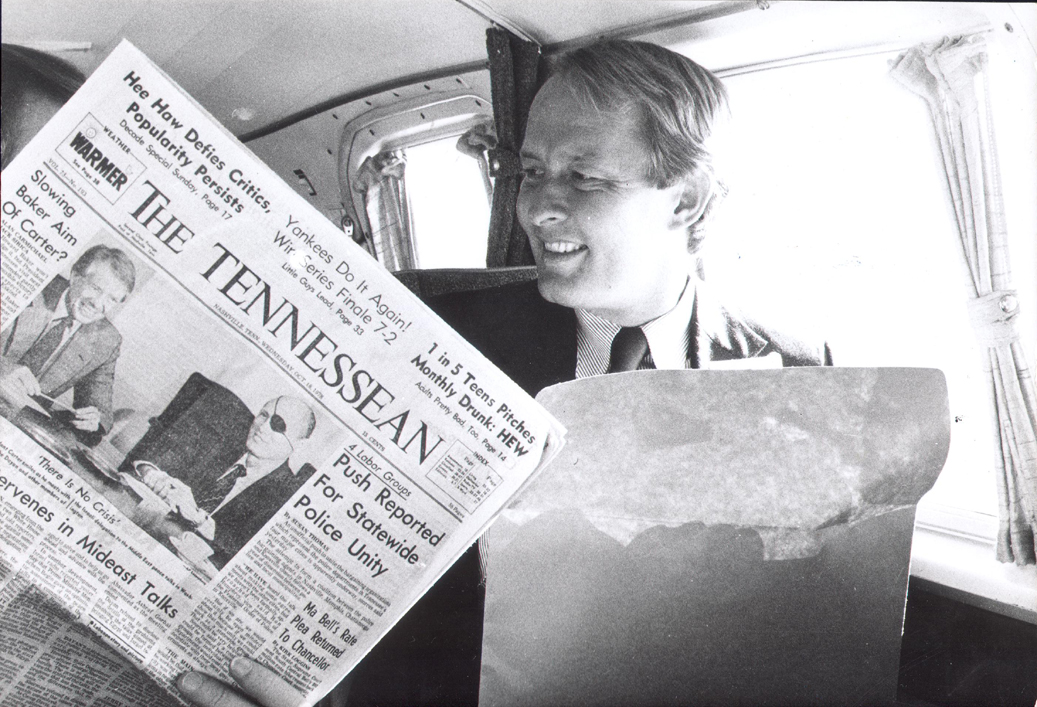
Anyway, to balance that, here’s a happier moment below. It was taken on his campaign plane, as it was preparing for takeoff, early on the morning of Oct. 18, 1978 (going by the newspaper). The Yanks, as you see, had just won the World Series again. Check out Jimmy Carter and Moshe Dayan. The day was going well so far — no scandals yet — and was filled with possibilities.

I like the way the light works in the picture. I was a pretty fair photographer, for a reporter.

Sorry if I’m boring y’all. Don’t know why I’m taking y’all down memory lane. Oh yes, I do: This is my way of getting y’all to think, Ol’ Brad has been covering this politics stuff up close and personal for a long, LONG time, so maybe sometimes his reflections are based in experience and not just gut reactions.

Is it working?

Anyway, it’s certainly been a long time. Burl and I graduated from Radford High just seven years before this…

lamar78

The Stuff I Kept

Overboard

As I mentioned earlier, I’ve been rooting through the vast piles of stuff I brought home when I left The State, stuff I just didn’t have time to go through in those last couple of weeks, but just jammed into boxes and hauled down to the truck, night after night, right up until that last night when Robert and I went off for beers in 5 Points.

And I keep running across fun little things that I want to share, enough of them that I’ve decided to start a new feature on the blog: The Stuff I Kept.

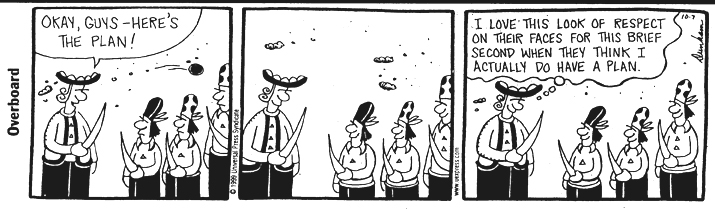
Here’s a favorite comic strip I kept taped to the wall over my credenza.

This one doesn’t take much explanation. As one accustomed to being in a leadership position (I had been supervising other journalists since 1980), I just enjoyed this send-up of the leadership imperative of always appearing to know what to do. Not that I could get away with this dodge with the members of the editorial board; they were a good bit smarter than the pirates in Overboard. But there were times when I did say “All right, then, here’s what we’ll do…” just to make a decision and move things along. Someone had to. And it was good if the someone who had to didn’t take himself too seriously.

Or at least, it was important that he give the impression to his subordinates that he didn’t take himself too seriously, say, by putting little self-deprecating cartoons up on his wall. Oh, leadership is complex, and deep. Deep enough to need hip boots.

From the newsroom of The Status Quo

Status Quo1

Over the weekend, I was going through stacks and stacks of files I brought home when I left The State — mostly stuff I had squirreled away that most people would have thrown away as soon as it touched their desks. If you’ll allow me to mix animal metaphors, I am a notorious pack rat. This has sometimes made me useful to neater people, who will come to me and say, “Remember that memo about such-and-such back in the early 90s? You wouldn’t happen to…?” … and I’d put my hands on it within minutes.

Well, a lot of that stuff went into the trash over the last few days, but some of it I couldn’t part with. And some of it I couldn’t even bear to pack away in boxes. Such was the case with a Pendaflex folder labeled “Strip.”

No, not that kind of strip. A comic strip. The one that Robert Ariail and I brainstormed about at great length back in the mid-90s. It centered around a guy who was a sort of lobbyist-good-ol’-boy friend-of-all in a Southern state capital, a fairly harmless and ineffectual character who lived, improbably, in a boarding house. A small part of the strip centered around a fictional newspaper (and any resemblance to any newspaper, living or dead, is entirely coincidental) called The Status Quo. It was not a realistic newspaper, but a caricature composed of charming (to us) little idiosyncracies that were particularly Southern and fallible and Status Quo 5human.

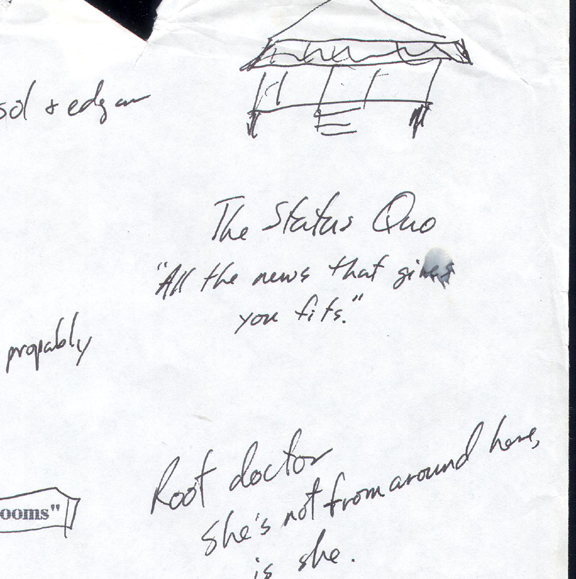
It was that newspaper for which I invented the slogan, “All the News that Gives You Fits,” which this blog now bears. You can see at right a detail from the piece of paper upon which I first jotted that idea, back in either 1994 or 95.

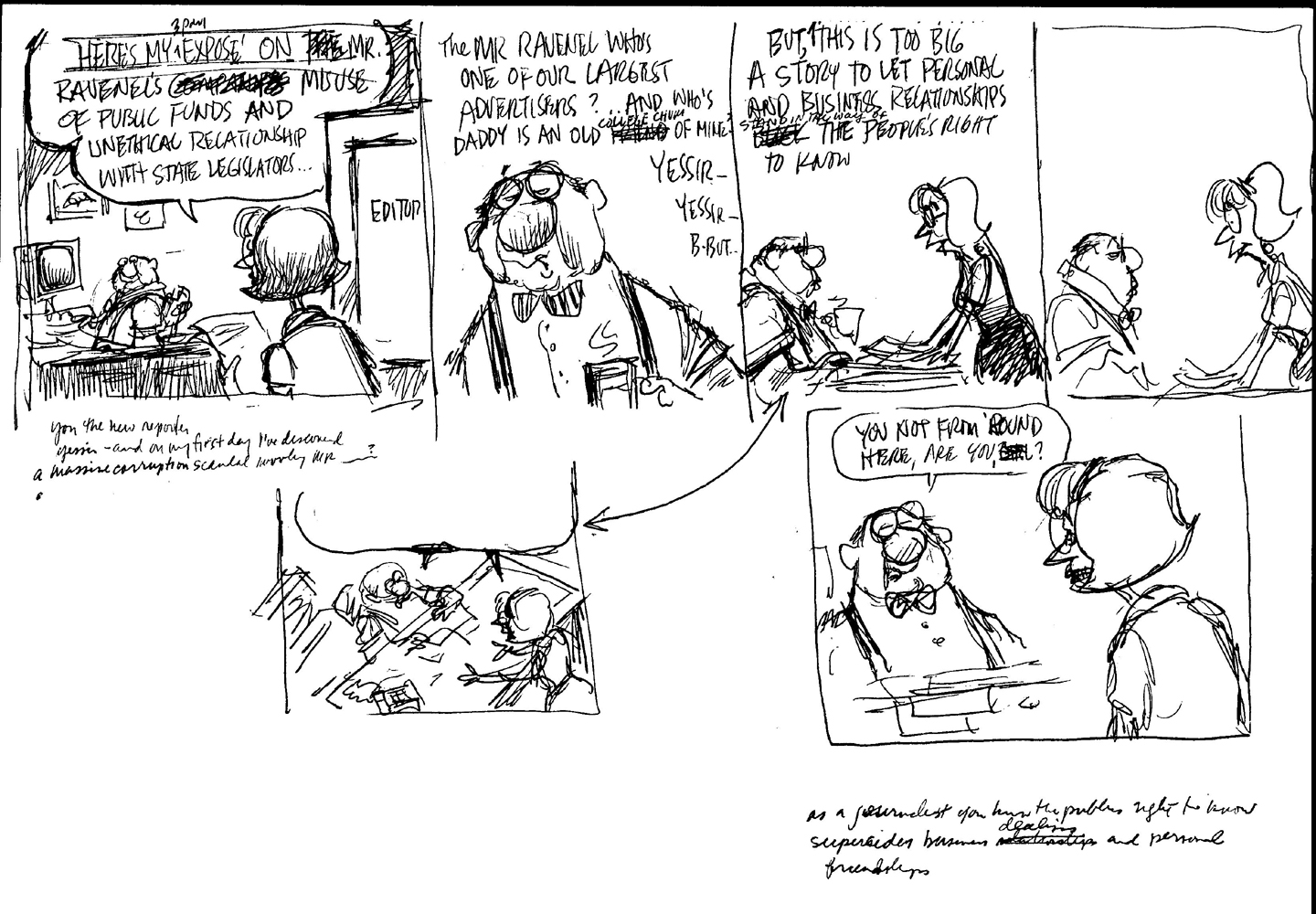
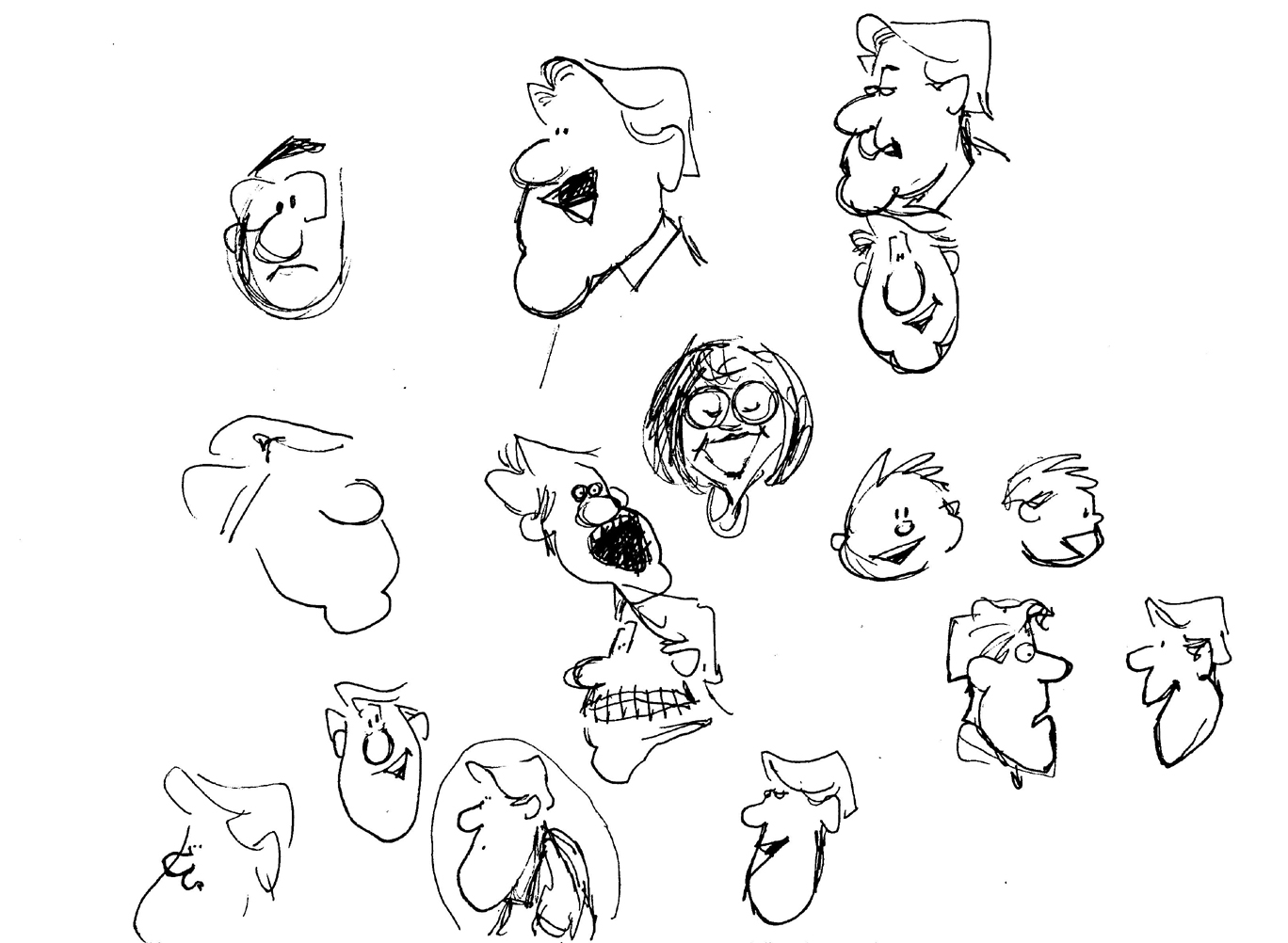
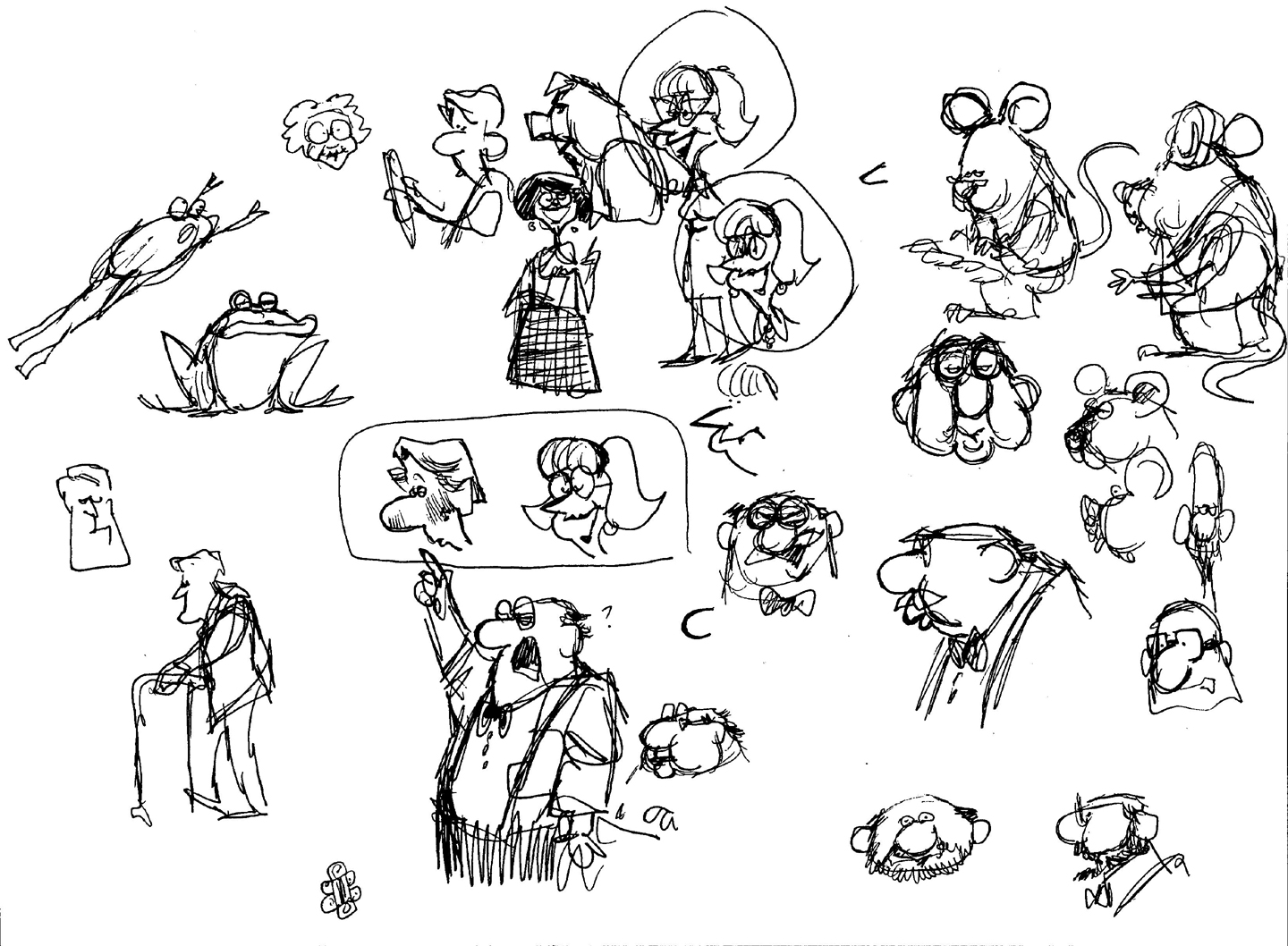
Anyway, for your enjoyment you will find an actual strip that Robert sketched up (characters and dialogue suggested by me) above, and a sheet on which Robert tried to get a feel for the protagonist and other characters, below. Finally, at the bottom, you’ll find some additional sketches, including “Sol” and “Edgar” the two mice who lived in the State House and secretly wrote every bill that ever actually passed (our hero’s friendship with the mice was the key to his success as a lobbyist, such as it was).

We had spent an inordinate amount of time discussing these characters. The two in the strip above were the crusty old editor and the young reporter who, as the editor notes, was “not from around here.” She lived in the same boarding house as our “hero,” and was to be the straight woman for a lot of the comedy. (This is beginning to sound like a Lou Grant/Mary Tyler Moore relationship, and I suppose it owed something to that.)

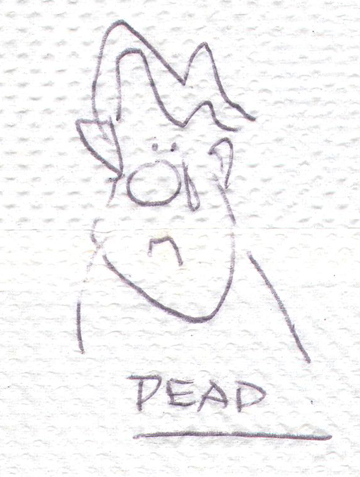
As I wrote before, Robert’s syndicate turned down the strip and we never revived it, although I continued to have hopes for it, even Status Quo 4as newspaper comics pages dropped features right and left. I’d still like to come up with a way of doing it online, if I could talk Robert into it. At right you’ll see a memo Robert gave me to tell me about the syndicate’s thumbs-down. He drew it on a napkin: Our hero, with a tear running down his cheek, and a one-word message.

Weird, isn’t it — I have this little treasure trove of memorabilia about a comic strip that never was. A rare collection, indeed.

Status Quo2

status quo 3