
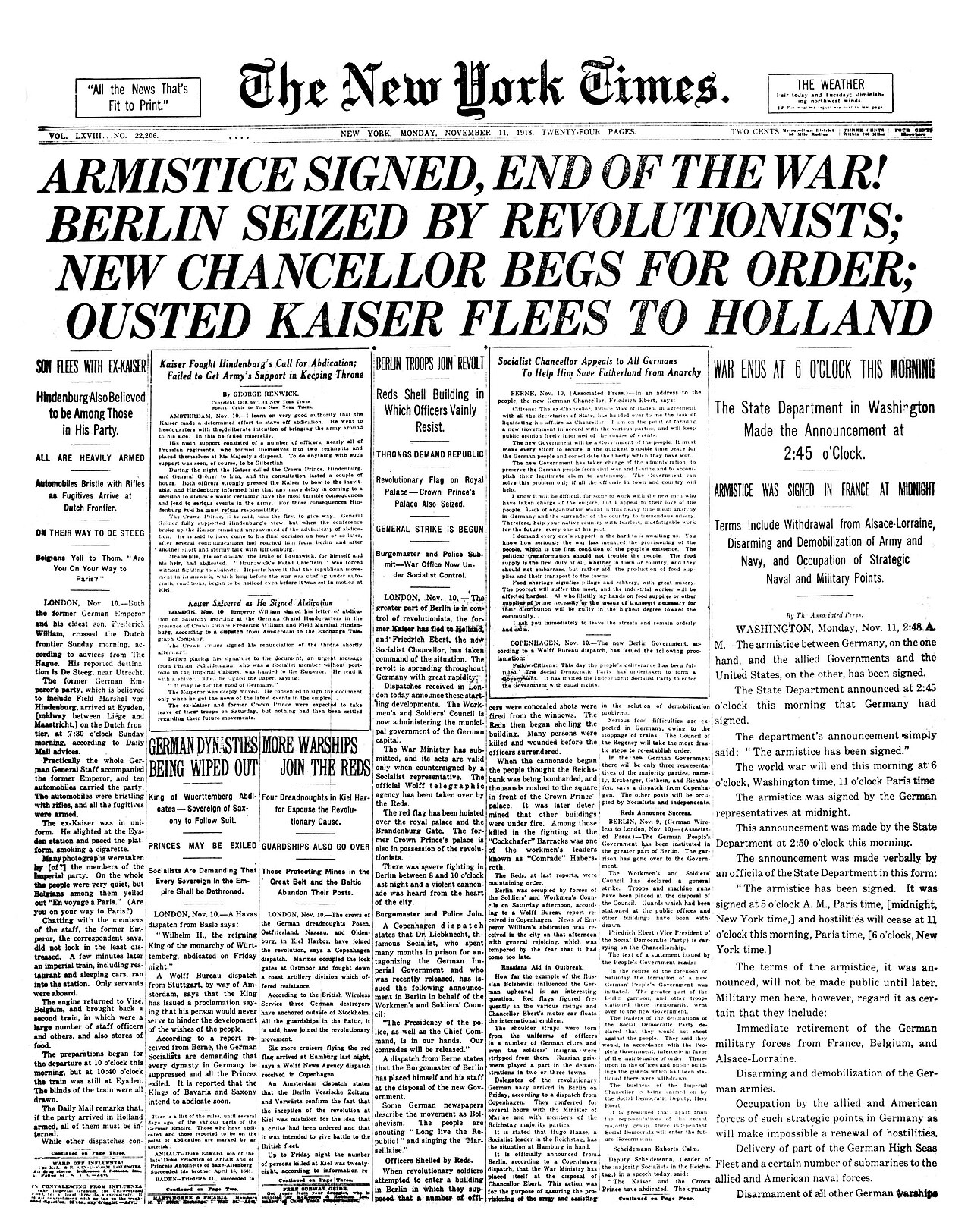
The NYT’s front on Nov. 11, 1918.
I’ve always liked the tidy popular description of the moment we celebrate on Armistice Day, or, as we now call it, Veterans Day:
“The eleventh hour of the eleventh day of the eleventh month…”
But it always kind of bothers me. The armistice ending “the war to end wars” was set to end at 11 a.m. on Nov. 11, 1918. Of course, that only applied to clocks on Paris time. And even there, there was only one point in time — not any period as long as a nanosecond, merely a point — at which you could truly say peace began at the 11th hour (in the sense of “hour” as a time of day as measured by clocks, rather than a period of 60 minutes), but it still misleads. Much quicker than you can say “the 11th hour,” you’re definitely in the 12th hour, just as we are now in the 21st century.
The 11th hour occurred in the hour before 11. And the war was still technically going on then. The armistice was not in effect at any time during that hour.
Worse, to cite Wikipedia:
… according to Thomas R. Gowenlock, an intelligence officer with the U.S. First Division, shelling from both sides continued for the rest of the day, ending only at nightfall.[2][3] The armistice initially expired after a period of 36 days and had to be extended several times. A formal peace agreement was reached only when the Treaty of Versailles was signed the following year.[4]
But people like to cite a number because it convinces them they’re being accurate. All they need to do is use words, such as “Thank God that monstrous war is over.”
Yes, indeed, I’m being pedantic. But I assure you I’m not one of those time pedants who insists this century didn’t begin until 2001. When the first digit changes, you’re in the first century of the new millennium. You get this pseudoscientific objection: “There was no year Zero!” Well, you know, there was no year One, or year Two, and no 44 B.C…. at the time. We only had those numbers for referring to dates starting in what we call the year 525, Anno Domini. It was based on an imperfect guess at when Jesus Christ was born. And historians tend to agree that guess was several years off.
But the system works for helping us see the relationships between one point and another in time. It helps to know the sequence of events, to make sense of them. And it doesn’t matter a bit whether there was a year zero, as long as you can make sense of the sequence.
Right now I’m rereading a book I first enjoyed about 40 years ago, which made me think a bit more clearly about time. Daniel Boorstin’s The Discoverers. I’ve never been a fan of time — that is, clock time. (I like history, but not having to be places “on time.” And I utterly detest Daylight Saving Time, which doesn’t actually give us a second more daylight, and causes the whole country to keep telling me it’s an hour later than it is, every day. And they think they’re justified!) So it’s nice to be reminded that humans made up this business of “hours.” There’s no such thing in nature. There are days, and years, although their durations on whether you’re on Earth. There are no months, exactly, although we do have moon cycles — to which almost none of us pay attention, we’re so absorbed in our imperfect calendars. (Seriously, when is the next full moon, you lubbers?)
And as to weeks: I like only two things about weeks: The weekend, and the Day of Rest, which the insufferable “moderns” all around me refuse to respect these days.
Sorry. Didn’t mean to get off on this rant. Just wanted to mention the awkwardness about the “11th hour.” And of course, that’s not the point of Veterans Day. The point is appreciating and thanking our veterans, although I try to do that every day.
I just wish my Dad were still with us so I could make a particular point of thanking him on this day. But I can’t, so I get off on these tangents…