
Consider this a sidebar to the Robert Duvall obit. My headline said he was “The best actor of his generation,” and wishing to be more generous, I added “or since.” We can argue later whether that was grammatical.
But was he? And who are the others in the Top Five — to employ the Nick Hornby standard? Here’s the list. (And remember ladies, you have your own category. I’ll start thinking about a Top Five Actresses list.):
Top Five
- Robert Duvall — For reasons already stated. Although now that I make this list, I’m worrying that maybe he should be second to the next fellow in this lineup. But Duvall is the one we’re mourning, and he deserves it, so here he stays.
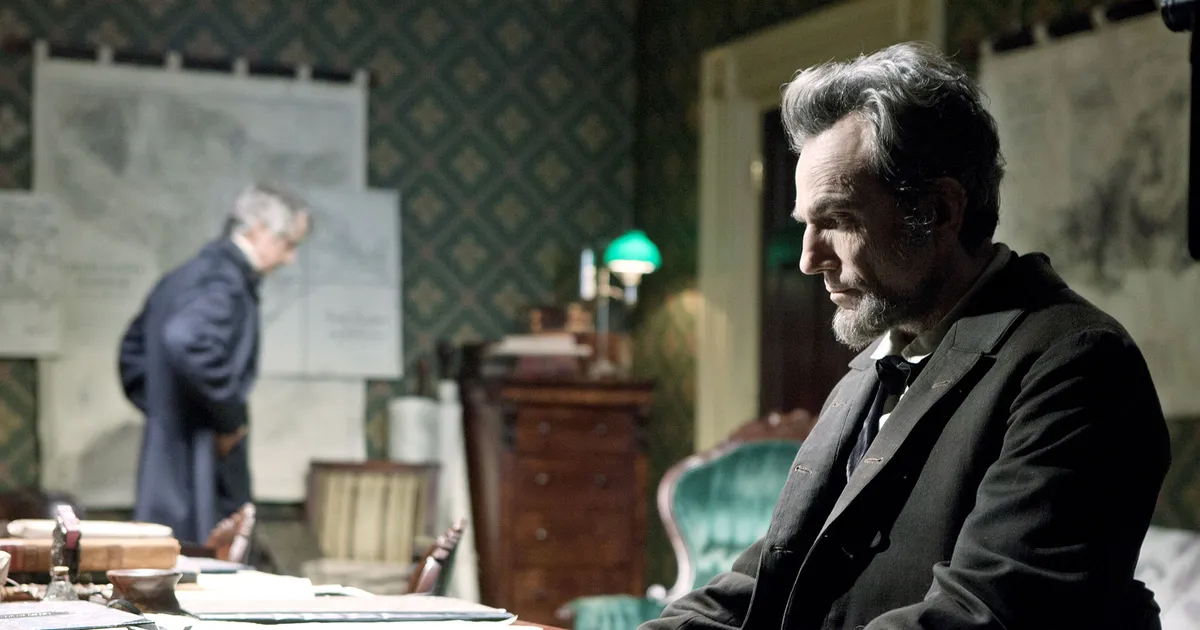
- Daniel Day-Lewis — I no longer need a time machine to go back and meet, or at least see and hear in person, our greatest president. I’ve seen him in the Spielberg movie, and I’m convinced that’s what Abe looked and sounded like. (This scene alone does that for me.) He was great in another movie in which he outdid our countrymen in portraying an archetypical American character — Natty Bumppo (although they didn’t call him that in the movie). Favorite line: When a British officer asks “How is it you are heading west?” at a time when the King needs him to stay and help fight the French, Nathaniel (as they called him in the film) replies, “Well, we kind of face to the north, and real sudden-like, turn left.”
- Denzel Washington — You might not think of him because he fits better into the leading-man movie star category that your great actors seldom enter. But he is a leading man with extraordinary depth. The first time I remember seeing him was in “Glory,” and I just thought, where did they get this guy? He would crack that odd, off-kilter smile that’s hard to read, and you’d realize there’s more to this character than just a bitter man with an attitude. Add to that his deeply flawed hero in “Flight.” Who else could have played that drugged-out pilot? No one, including the others on this list. Perfect fit, without being at all typecast.
- Jack Nicholson — How could I put this wiseass on the list? Because he’s a wiseass with depth and range. Consider “As Good As It Gets,” “Carnal Knowledge,” “The Departed.” And then think how his colonel in “A Few Good Men” stands up next to Duvall’s in “Apocalyse Now.” But we haven’t gotten to his best, which you seldom hear about any more. Behold Signalman 1st Class Billy L. “Badass” Buddusky in “The Last Detail.” My dad the sailor was amazed. He felt he knew that guy and served with him on numerous ships.
- Robert De Niro — It’s kind of a cliche to put him on such a list and crown him No. 1. Well, he has been great, especially in the first part of his career, in “Bang the Drum Slowly,” “Mean Streets,” “The Godfather Part 2” (people are wrong to say the sequel was better than the first one, but I forgive them because his brilliance blinded them) and “Raging Bull.” But after that, he started moving toward a formula that was still fun to watch, but he wasn’t growing as an actor. Eventually, we get “Analyze This,” which I loved, but he was doing the formula, with lots of this expression. He deserves to be on the list, but not first.
Honorable Mention
I add this category not because I couldn’t stop myself at five. That would be undisciplined and lazy. I think there’s a pretty clear line between those above and those below. But as the title suggests, I thought them worth mentioning.
- Edward Norton — He was a Top Five contender with “Primal Fear,” “American History X” and “Fight Club.” But then what happened? Sure, I enjoyed seeing him in “A Complete Unknown,” but come on — what had he been doing since “Fight Club?”
- Morgan Freeman — Great in everything, but as with Norton (and de Niro), the best stuff was awhile back. He was great in “Glory,” but not as great as Denzel Washington. Great also in “Driving Miss Daisy.” I was impressed by him in “Unforgiven.” I loved him as the Lord in “Bruce Almighty,” but it wasn’t something that puts you in the Top Five.
- Colin Firth — Always good, and always entertaining — and he has more range than you might think. I recently enjoyed him in an early film that I had never heard of and ran across by accident — “A Month in the Country” from 1987. He was best in the BBC production of “Pride and Prejudice,” of course. No actor should even try to play Darcy after he did. Next best thing after that? “The King’s Speech,” which also featured a fine performance by the wonderful Geoffrey Rush.
- Michael Shannon — This is a guy who has Top Five chops, and I just need to keep watching him, in things like “Elvis and Nixon,” “Boardwalk Empire,” and the recent remake of “The Little Drummer Girl.” His agent needs to make sure he doesn’t do any more turkeys like “Pearl Harbor.”
- Wes Studi — I would never have thought of this guy, and maybe you don’t even know who he is. But he’s been good whenever I’ve seen him, and he was bloodcurdling amazing in a film mentioned above: “The Last of the Mohicans.” He was Magua, the truly scary guy (not that some of those palefaces didn’t have it coming). And he made him real.
OK, after thinking how scary Studi was as Magua, I started remembering how terrifying Javier Bardem was in “No Country for Old Men.” And then I remembered “Biutiful,” and that turn he did as Desi Arnaz. But I made myself stop. That’s enough for now.
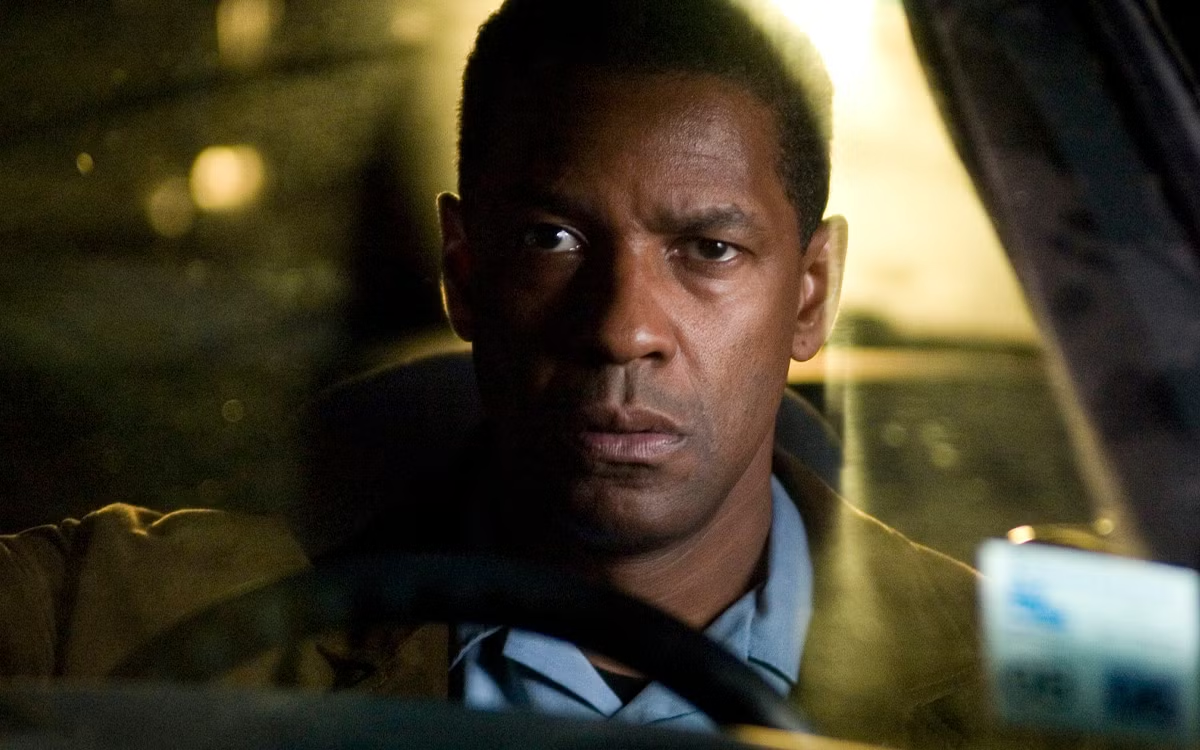
You ever see his time-travel flick, “Déjà Vu?” You should.
I would not argue against Lewis.
But I [personally think Gene Hackman and Dustin Hoffman and Jon Voight, Morgan Freeman and Denzel Washington are the top 5-6 of any list.
Hackman is probably the actor most cited by other actors as a brilliant. I’ve heard so many actors, including recently Kevin Costner talking about how much he learned about acting from being in a movie with Hackman and simply watching him when the camera was on. HIs work in Mississippi Burning was powerful, and you could feel his anger. He should have won him an Oscar for that role. He was nominated but lost to Dustin Hoffman. (Gene has 2 Oscar wins)
Dustin Hoffman for the sheer variety in rolls he took on. Kramer v Kramer? Fantastic work as an everyman father going through a divorce. That the same actor could play Benjamin Braddock, Ratso, Michael Dorsey (Tootsie), and Raymond Babbitt in a convincing way is amazing. (Dustin has 2 Oscar wins)
Jon Voight- – the screen presence and pure talent was incredible. Joe Buck? Ed Gentry? He has played all sorts of roles- a male prostitute to a crazed politician, and many “every-man” roles. His quiet brooding in the final scenes of Deliverance is a masterclass in acting. (Jon has 1 Oscar)
Morgan Freeman- iconic rolls- huge variety of characters – playing prisoners, a chauffeur to an elderly jewish woman with racist tendencies, to Batman’s Q, supplying him with tech in Christopher Nolan’s Batman trilogy. (Morgan has 1 Oscar)
Denzel Washington- his whipping in Glory was enough to seal his fate, without saying a word, in my mind as one of the best actors of the last 50 years. (Denzel has two Oscars)
Unpopular opinion: Ronald Reagan should have been nominated for an Oscar for his performance in King’s Row. A wonderful film, one of my favorites. Reagan was fantastic in the film- well written and had good production values taking on the subject of mental illness and disability long before it would have been popular. While Robert Cummings was the star of the film and did a great job, Reagan’s work was very worthy of a nomination.
Ohmygosh… I forgot Gene Hackman, who would be a serious contender for No. 1!
I didn’t forget him entirely. I was jumping back and forth from one tab to another on the browser (I currently have 31 tabs open on Chrome, and that’s pretty typical), glancing at other people’s lists to jog my memory, checking Wikipedia to remind myself of filmographies, etc. And when I saw someone mention Hackman, I remember thinking “well, of COURSE I’m going to include him!”
If I’d been worried that I would forget him, I’d have immediately clicked over to where I was writing the post and typed him in. But I couldn’t imagine doing that. Yet I did…
So here’s an amended list:
Robert Duvall
Gene Hackman
Daniel Day-Lewis
Denzel Washington
Jack Nicholson
… and sadly, De Niro gets bumped to Honorable Mention. Although on another day I might have bumped Jack Nicholson. Tough call.
I was just in such a hurry to write this so it would be close to the one about Duvall.
I should always remember what Coach Dale said: Slow it down! Pass four times!
If he’d been here while I was typing, he’d have benched me. And he’d have been right…
I love Shooter’s reaction when he benches Rade…
Just watched Tootsie against on TCM.
Dustin Hoffman is underrated if that is possible. He’s an amazing actor that does amazing work. This performance is near perfect.
What a well directed movie, great music, great premise, and Hoffman was incredible.
Jessica Lange, Bill Murray, and Teri Garr, and Dabney Coleman all great in this movie.
It’s a good cast, and I thought it was good when it first came out, but I didn’t like it as much when I saw it years later.
That brings to mind a Top Five list I should do: Top Five Great Movies That Weren’t So Great Upon Rewatching. Or “that didn’t age well,” or something like that.
I already know what will top the list: The Dirty Dozen. Oh, it still has some mildly good bits, but it’s nothing like the way it impressed me in 1967. In some ways, it’s kind of embarrassing. I’ll explain more when I write the post. Need to come up with the other four.
Wait, I just thought of one: Billy Jack…
I like it even better.
I thought the way “she” put her foot down to push back against a completely sexist workplace still held up well.
I love the movie. It’s terrific.
But Casablanca never made any sense.
The Nazi’s are in total control, and they are worried about someone getting out of the country with some transit papers.
Instead of just telling everyone at the airport, or anywhere else- “no one leaves for any reason” – they play around with these supposed papers.
Anyway- still a great film, but the premise is weak.
Well, the thing is, it wasn’t quite as simple as “the Nazis were in total control.”
It was a complicated situation. After the fall of France, the Germans split it into two separate entities — Vichy and the Ocuppied Zone. Vichy France was nominally an independent country, under the nominal leadership of Marshal Pétain, who had been a great French hero in the first war. This time, he had been the leading voice of surrender among those running France when the Germans rolled over them.
So Vichy was a puppet state, but nominally independent — unlike the openly occupied part of France.
Casablanca was under Vichy control from June 1940 to November 1942. Because of that, when Major Heinrich Strasse came to town in the movie, the local officials — including the obsequious (but later courageous) Captain Renault — bowed and scraped before him, or at least tried to stay out of his way.
But the fact that the situation was far from one of a clearly German-run territory was emphasized in that scene in Rick’s bar when the Germans were aggressively signing one of their songs, and Victor Laszlo stands up and demands that the house band play “La Marseillaise.” Rick (“I stick my neck out for no one”) nods his permission to the band to play it. Something he wouldn’t have done, at that stage in the story, if he thought the German could prevent it.
Part of what the movie was saying was that Casablanca, like Rick, was trying to sit out the war and simply survive until it was over. The message was that that was unacceptable — you had to decide which side you were on. It was a position that, at the time the movie came out at the end of 1942, American audiences would applaud, since they had abandoned their isolationism a year before.
Anyway, all that said, I agree with you that “letters of transit” make no historical sense. Such things didn’t exist. And it is rather unbelievable that either the Germans or the Vichy authorities would LET such a thing exist. It was a movie plot trick, rather like a fairy godmother’s wand. The writers were sort of saying, what if there WERE such a device, in this ambiguous moral environment? The plot needed something that enabled him to clearly give up his own safety and give it to the husband of his great love, because the world needed Laszlo more, and Laszlo needed Ilsa. There was no other way, they apparently thought, to make things work out so neatly in the scene at the airfield.
It always bothered me, this device. But it (or something like it) was necessary to making this particular plot work, and I loved the movie. I don’t let it spoil the story at all. And consider: Had there been no “letters of transit” in this fictional universe, we wouldn’t have had that excellent scene with Peter Lorre…
Oh- it’s terrific anyway.
The other thing I didn’t quite understand is that every time I watch the movie, I am more convinced that Ilsa loves Victor more than Rick.
But I also know, the film is trying to tell me that she really loves Rick more.
I never believe that though and have never believed it.
Her relationship with Rick is written as a passionate fling, not as a true love story.
On the other hand, her first love is Victor. Her real and actual husband. When she, in Paris with Rick, finds out he’s really alive, she leaves Rick to go be with him.
She loves her husband. She’s willing to die for him. She’s respects him more than anyone in her world. She ultimately even leaves with him, even though the film explains this by making sure we see and hear Rick giving her permission to leave with the who I think she knows is the love of her life.
I know the film wants us to believe Rick loved her and she loved Rick. I think it was passion, and by the end, respect. But it comes on slowly and gradually. By definition, it’s not as much respect as she has for her husband.
I think the film tries to make it seem like her feelings for Victor were reluctant. But that never really makes sense in the film. She cares for Rick. She probably was falling in love with him in Paris until she learned Victor was alive.
But in in the end, it’s passion for Rick. It’s love for Victor- despite what I think the film wants to convey.
Very good point. That’s a thoughtful analysis.
There’s no doubt she loved Victor. But whether she loved him more than Rick is hard to say.
So it’s easier to see her as agreeing to go with Victor from a sense of duty, a commitment she feels because she understands that what’s going on in the world matters more than “the problems of three little people”…