
I frequently say something here and there about what’s wrong with journalism today (as opposed to what non-journalists tend to think is wrong).
Yesterday’s New York Times offered some good illustrations of two of the main problems with the reporting we now receive from what used to be called “newspapers.”
Not that the NYT isn’t still an excellent newspaper (as the word is now used), and possibly the best left in the country. But while cranking out some wonderful content and doing a better job than most in employing new technology constructively, it still prominently displays some of the worst habits of the medium today.
Before naming them, let me mention the one guiding principle that guided journalism in my day — that is, the late 20th century (and maybe the first few years of the next, but from 2006 on, everything was falling apart). We saw it as our job to inform the reader as much as we could as quickly as we could.
That meant telling the moderately interested reader everything he (or she) wanted to know about a story in the headline — and to tell a reader who couldn’t care less that this was not what he’d picked up the paper for. If you couldn’t do that in the headline, you did it in the first paragraph, the lede. By that time you had communicated the who, what, where, when and how, and maybe even a bit of why. The paragraphs after that were arranged in descending order of importance, in terms of the reader’s ability to understand what was going on. (Think “inverted pyramid.”)
This was based in respect for the busy reader. That respect is now gone, trashed, mutilated, completely irrelevant.
And so we have the present situation. The “murder of the inverted pyramid,” as one blogger has put it. I just ran across that after writing what I did above. Here’s what that writer said:
Once upon a time, when newspapers were both noble and strong, editors and publishers regarded readers’ time as very valuable. Editors and publishers understood that newspaper readers were trying to absorb as much information as possible in the least amount of time. They knew that most readers would not finish most stories. Readers would read until they had absorbed enough of a story to meet their needs, then they’d move on to another story, or move on with their day. Once upon a time, editors and publishers did not try to manipulate readers to rip off readers’ time and attention.
Indeed. Anyway, there are two maddening, insulting, stiff-arming ways that newspapers now play keep-away with the news, day after day, story after story:
- The say-nothing headline. You know those little teasers that essentially say, We know something and you don’t, and you have to click just to start to get the tiniest hint of it. They tend to be shockingly frank about this, starting with such phrases as “What we know about…” and “What you need to know about…,” rather than telling you what you want to know.
- The “live updates” structure. This is used on the biggest story of the day, and is usually played as the lede on a newspaper’s app or its main browser page. You know the form. You call it up, and the top item is the absolutely latest thing the reporting team (this tends to be on an “all-hands-on-deck” story) have learned. Which means the “story” leads with some low-interest detail that would have appeared in about the 20th graf of a normal, coherent news story — if at all. This is completely useless to a person who has a life, and therefore only a moment to learn about this subject. The only person who could benefit from it would be someone following every hiccup on this story since the instant that it broke — in other words, someone without a life, or someone who is somehow peripherally involved in the story. Everybody else is out of luck, and therefore uninformed, and so more likely, say, to vote for Donald Trump.
Whenever confronted with that second atrocity, if I really want to know the essentials, I look at a sidebar to the main story, and usually find something resembling a news lede within the first few grafs.
Anyway, to illustrate these phenomena, I offer you a big story out of New York from two days ago, as reported by, as I said, probably the best newspaper in the country.
It’s the shooting of three people in an office building on Park Avenue Tuesday evening….
And now, you are missing something you would no doubt find entertaining on a surveillance camera: my head is exploding. Because after starting this post yesterday and getting distracted, I’m going back to grab the screenshots I had saved yesterday to illustrate what I’m talking about. And they’re not on my iPad… or my phone… or my Mac. Well, one of them is… As for the others…
Since the image of the shooting story as it dominated the NYT app yesterday morning is gone, here’s a lesser example of it — the tariffs story currently at the top of the browser version of the Times:
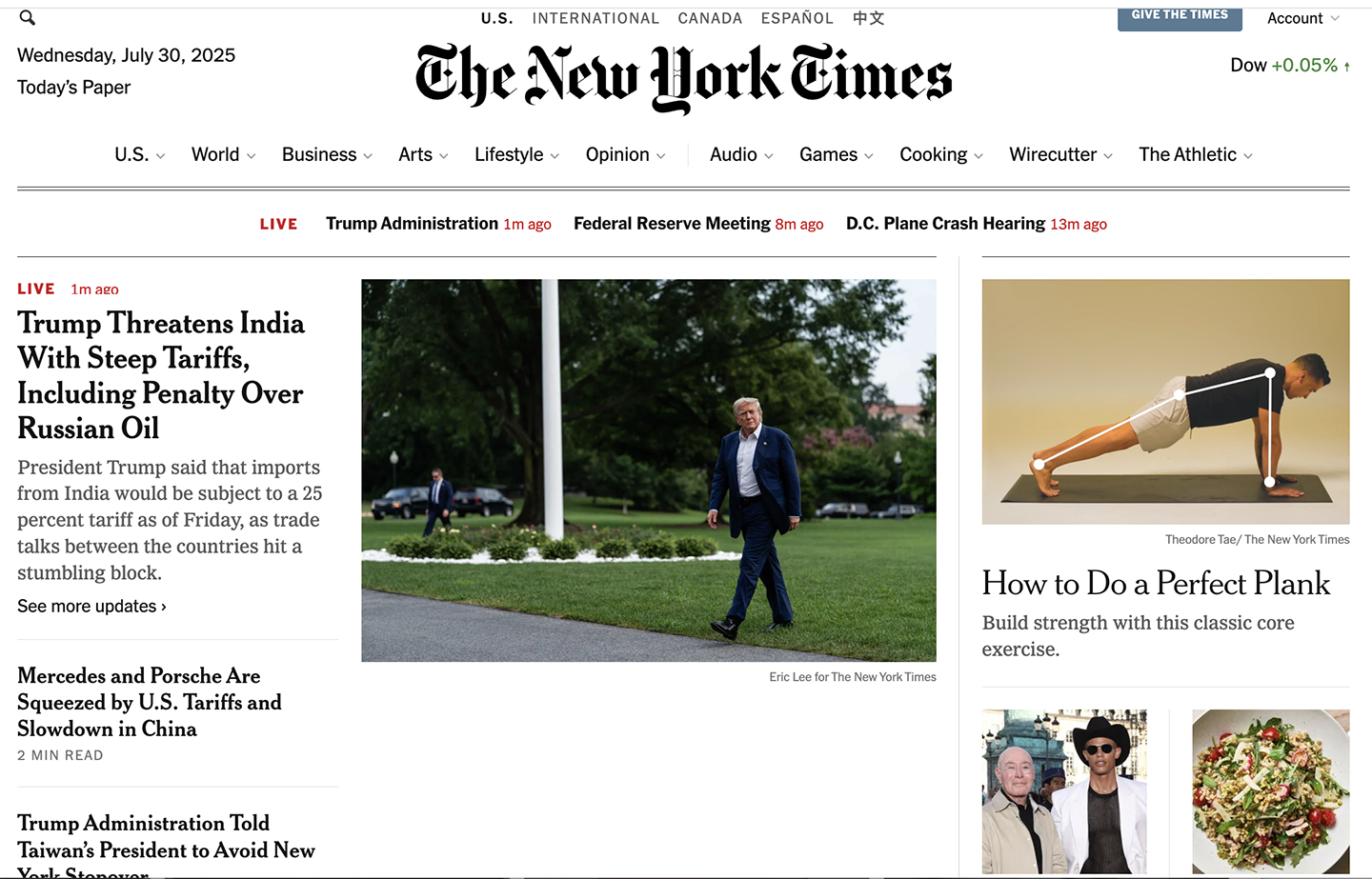
You’ll see examples of what I’m talking about in the shooting case — the incoherent item labeled LIVE in red, and below it the sidebars, the related stories. It’s not a great example because it’s a calmer story; it hasn’t caused the paper to send every reporter all over Manhattan trying to discover what the hell is happening on the park. So it doesn’t lead with a breathless paragraph about the latest minor fact to slip out of a source during a press conference. It even has a nice lede-like summary at the top of it.
But it shows the typical layout. And here is the latest version of the “LIVE” story of the shooting, which now is much calmer than it was yesterday morning. But you see the pointless structure for anyone with limited time — the latest developments, rather than a summary of the important points.
Anyway, with the shooting story, I was more motivated than usual to get to the fundamental facts, because two of my grandchildren were staying with friends in Manhattan. Turning away from the mess in the NYT, I texted my daughter, their mother, who told me that their hosts lived a good distance away. That was reassuring. Not so reassuring was the fact that their daily routine up there took them right by where the shooting happened. But they were fine, thanks be to God.
Meanwhile, I had turned to the sidebars, in search of news. And I found a perfect illustration of the “say-nothing headline:”
What We Know About the Shooting in Midtown Manhattan
After that, it was kind of like a real news story, except for being broken up by subheds into chunks, instead of rationally assembled in inverted pyramid. Subheds like “What happened?” and “Who were the victims?” and “Who was the gunman?” Note how the subheds also conform to the “say nothing” principle.
It was only by accident that later in the day, I happened to run across a real news story about the shooting, with a real headline, in The New York Times. I wasn’t looking for news. I had clicked on the “SECTIONS” link on my app, as a quick way to get to the opinion content

What’s that I see? A real news story?
Look, right there next to Gwyneth Paltrow! A headline! Not a “say nothing” headline, but one that actually relates the essentials! Here’s the story, so you can judge for yourself:
Gunman Fatally Shoots Officer and 3 Others in Midtown Manhattan Office Tower
Presumably, lots of people had managed to find it, or else it wouldn’t have made the “Most Popular” category. But how? I had been looking at both the app and the browser version of the paper, and had seen not a hint of it — at least, not at the times I was looking. All I can guess is that people weren’t looking at the digital version of the “newspaper” at all, but coming in by direct links from social media.
Still, I was glad to see it. It was like discovering an old friend I had thought was dead. Of course, the headline was a bit long, because headline writers today are no longer restricted by limited space. I would have said something more like “Gunman kills four, self, in New York.” You could cram that into a one-column, three-deck format if necessary. It was good that they got the police officer in, though.
I was curious to see what they had done in the print version, under those restricted conditions, but I ran into another depressing fact about newspapers today. Here’s the front of that morning’s paper. If you click on that, don’t bother searching for the story; it isn’t there.
The shooting broke at 6:28 p.m. on Tuesday. But people who bought a paper the next morning wouldn’t see a word about it. That’s because putting out a print version is today an afterthought, something for those few doddering ancients (as opposed to with-it 71-year-old youths like me) who still demand a dead-tree paper. And, to save some of the ungodly cost of producing such a product (that insane $4 rack price doesn’t cover it, folks), the paper rolls off the presses at a stunningly early hour. (Maybe not “stunningly” to i, but to a guy who spent all those years working until 2 a.m. getting out the city edition containing the very latest, it’s unreal.)
(By the way, I currently subscribe to six newspapers, and read them all on my iPad. I’m not going to deal with frustration, not to mention expense, of having a hard copy delivered to my house, just so I can see what happened two days earlier.)
Anyway, as a postscript… of course, the story leads today’s print version. But it now has a second-day, or perhaps I should say third-day, headline. It was still worth four columns, giving more room than the usual one-column lede in the NYT.
Bottom line, as a reader who subscribes to six newspapers, I don’t think it’s too much to expect at least one of them to show me, at the top of its homepage, what I most want to know about the biggest news of the day. But that’s not what the business is about any more…

Brad, your post on the state of journalism—spot on. You’re right: the death of the inverted pyramid is like watching professionalism slowly commit seppuku.
You want to see what real newspapers used to look like? Come visit the Philippines. I’m staying at the St. Giles Hotel, and every morning, they still hand-deliver old-school print editions—ink, headlines, ledes, and all. It’s like stepping into a time capsule where journalism still respects the reader’s time.
Also… just so you’re ready: here, a “thumbs up” is universal. No ambiguity. And remember: don’t get stuck in analysis paralysis—sometimes the story’s right in front of you if you read it the old-fashioned way.
Cheers from Metro Manila (Makati) -(Still a sucker for ink and truth)
By way of full disclosure, I should say that I wasn’t always fully committed to the inverted pyramid. In my youth, I would resist that restriction whenever I could get away with it.
Oh, I could definitely WRITE inverted pyramid, and was glad to have that skill, especially when I had to have a hard-news, breaking story turned in within, say, 20 minutes. I wrote it reflexively. But when I could, I emulated New Journalism (boys and girls, that “New” refers to the 1960s).
So I wrote more than my share of anecdotal ledes.
Today, I hate them, because it seems I am offered nothing else. I go to a story seeking a summary of what’s happening, and suffer through an unbearably boring tale about some guy I don’t know and his personal problem, which the write mistakenly imagines brilliantly illuminates the issue at hand. And it doesn’t. These sagas go on “past the jump” in the terminology of the newspaper age — in other words, past the point where a moderately interested reader stops reading.
You know, “Bob picked a dried up husk that should have been an ear of corn bursting with deliciousness. Things had never been this bad since he inherited his Daddy’s farm, right after he came home from Vietnam…” Instead of saying, “More than half the state’s corn crop has been destroyed by the ongoing drought, which shows no signs of ending…”
Now, I look back on the inverted pyramid as one of those key blessings that once made our country a success, by creating millions of informed citizens…
I sent someone a link to “this piece, which I suppose seems to focus on trivia about how journalists do (and used to do) their jobs, but it is really about how even the best remaining papers aren’t as dedicated to creating an informed electorate as they once were.”
See? I can sum things up briefly if I try. You can read the 1,743 words of this post, or you can read the blurb I just quoted. Of course, the blurb won’t make much sense unless you’ve read the 1,743…