Category Archives: Newspapers

All that really needed to be said about Kirk’s foul murder

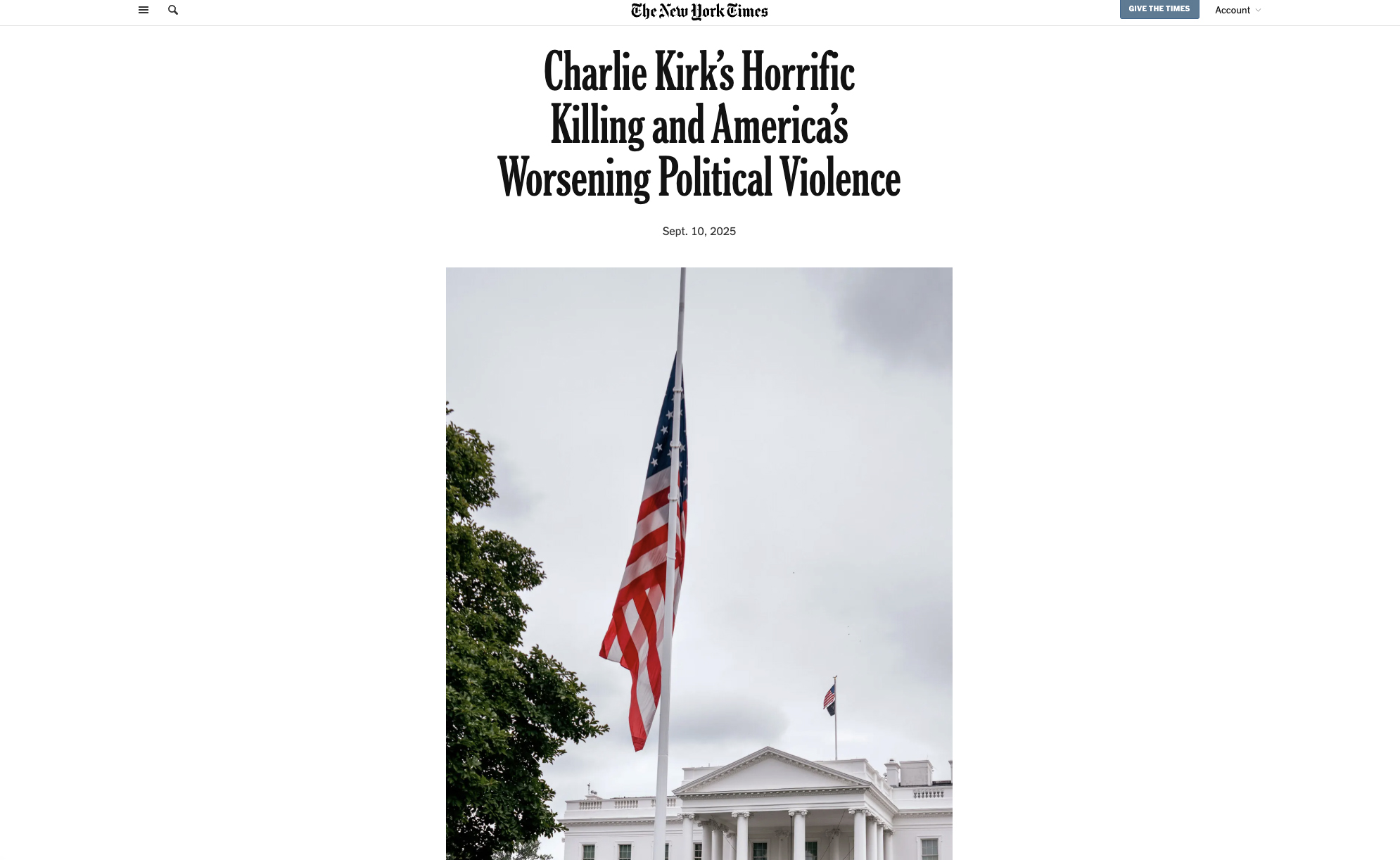
Screenshot

The evening of the day on which Charlie Kirk was murdered — a week ago today — I read an editorial about it in The New York Times that said everything that needed to be said about that appalling event.

Sorry to take so long posting it. The headline was “Charlie Kirk’s Horrific Killing and America’s Worsening Political Violence.” The link on that headline is one of those “gift” links the NYT offers, so you should be able to read it. Let me know if you can’t.

In the meantime, I’ll share some key paragraphs:

The assassination of Charlie Kirk — the founder of a youth political movement that helped revolutionize modern conservatism — at Utah Valley University on Wednesday is a tragedy. His killing is also part of a horrifying wave of political violence in America….

Such violence is antithetical to America. The First Amendment — the first for a reason — enshrines our rights to freedom of speech and expression. Our country is based on the principle that we must disagree peacefully. Our political disagreements may be intense and emotional, but they should never be violent. This balance requires restraint. Americans have to accept that their side will lose sometimes and that they may feel angry about their defeats. We cannot act on that anger with violence.

Too many Americans are abandoning this ideal. Thirty-four percent of college students recently said they supported using violence in some circumstances to stop a campus speech, according to a poll from the Foundation for Individual Rights and Expression published a day before the Kirk shooting. Since 2021, that share has risen from 24 percent, which was already unacceptably high. Surveys of older adults are similarly alarming….

The intensity of our political debates will not disappear. The stakes are too high, and the country disagrees on too many important questions. But we Americans have lost some of our grace and empathy in recent years. We too often wish ill on our political opponents. We act as if people’s worth is determined by whether they identify as a Republican or a Democrat. We dehumanize those with whom we differ….

That was the penultimate graf. Since I’ve quoted so much, I might as well give you the last one:

…This is a moment to turn down the volume and reflect on our political culture. It is a moment for restraint, rather than cycles of vengeance or the suspension of civil liberties, as some urged on Wednesday. It is also a moment to engage with people who have different views from our own. When societies lose the ability to argue peacefully and resort to violence to resolve their political debates, it usually ends very badly.

(When I read that editorial that night, I retweeted it with this comment: “NYT ably describes the violent tip of the iceberg of hostility that is sinking America. But we’re all too busy despising each other to bother trying to find a way to save our ship. “)

As for the excerpts above — if the NYT lawyers call, I’ll just have to ask them how much I have to cut to suit their definition of Fair Use. But I just thought it was too important not to share. It was a grown-up editorial. It seems to me to have been written by someone mature enough to remember when this country was healthy enough that we could disagree strongly and vehemently, and then shake hands and walk away as friends — or at least as people who recognized each other as fellow Americans, and not as “the enemy.”

Of course, maybe it was written by a younger member of the board. If so, we have someone to thank for providing that person with an excellent education, and a firm understanding of what made America great, before our country’s recent tragic decline.

Evidently the faculty members who were suspended from teaching at Clemson were not the kind who provide such intellectual enrichment. Their grotesque fulminations are an embarrassment to anyone with. conscience. Doubt me? Here are some quotes from their outbursts. If that link doesn’t work, I’ll be happy for you, because you’ll be happier for not having read them.

Should they have been fired for it? Let me pose a different question. Should people who would have deliberately published such remarks at such a time have been employed in the first place, in jobs that involve shaping young minds? Such irresponsibility is inexcusable. They weren’t courageously outspoken; they were stupid, cruel and hateful.

You would think that in an atmosphere in which more than a third of college students believe violence can be justified to stop speech they don’t like, anyone who teaches them would understand that their responsibility is to model productive speech and behavior. And the responsibility of college administrators is to make sure they hire people mature enough to understand that.

At this point in our increasingly ones-and-zeroes country, we will now start hearing the “what abouts.” What about those GOP politicians who have demanded their firings? Are you defending them?

Are you nuts? Those people are cheap opportunists, trying to make themselves heroes to an angry crowd. Or, worse, they’re trying to make a merely grieving crowd… angry. Stir things up. Because they seek higher office, and Donald Trump has taught them that the approach taken by every president before him — striving with all their mights to pull us together in troubled times by invoking the values we hold in common — is for chumps. You can win by feeding division, by pouring gasoline on the embers, he has taught them. And they’re acting upon those lessons.

Just as others have learned that if you post something stupidly inappropriate — the more hateful the better — on social media in response to any news event, there are thousands if not millions of people like them who will regard them as brave and witty, and clap them virtually upon their backs in congratulation. A certain needy type eats that sort of thing up.

Both categories are unacceptable in a rational society. But they are so richly rewarded — in the currencies that matter to them — that they just keep doing it.

One final word: If you actually believe that anything those disgraced faculty members said about Kirk was justified by his rhetoric, you are just as much a part of the problem as those hungry GOP pols.

Personally, I had never heard of Charlie Kirk before the news of his murder. But I went and looked at a couple of videos of him speaking. The entire thrust of what he said, even in the milder comments, was wrongheaded and objectionable to me. In others, he was utterly offensive. But all that was what I expected, since Trump is trying to canonize him. And all of it is beside my point.

Y’all know I don’t believe in capital punishment. But even if I did, I certainly wouldn’t support summarily executing a man for saying things that offended me. I could never support that. And I could never support or worse, applaud anyone who mocks a human being who has died that way.

Finally, an actual NEWS story…

I frequently say something here and there about what’s wrong with journalism today (as opposed to what non-journalists tend to think is wrong).

Yesterday’s New York Times offered some good illustrations of two of the main problems with the reporting we now receive from what used to be called “newspapers.”

Not that the NYT isn’t still an excellent newspaper (as the word is now used), and possibly the best left in the country. But while cranking out some wonderful content and doing a better job than most in employing new technology constructively, it still prominently displays some of the worst habits of the medium today.

Before naming them, let me mention the one guiding principle that guided journalism in my day — that is, the late 20th century (and maybe the first few years of the next, but from 2006 on, everything was falling apart). We saw it as our job to inform the reader as much as we could as quickly as we could.

That meant telling the moderately interested reader everything he (or she) wanted to know about a story in the headline — and to tell a reader who couldn’t care less that this was not what he’d picked up the paper for. If you couldn’t do that in the headline, you did it in the first paragraph, the lede. By that time you had communicated the who, what, where, when and how, and maybe even a bit of why. The paragraphs after that were arranged in descending order of importance, in terms of the reader’s ability to understand what was going on. (Think “inverted pyramid.”)

This was based in respect for the busy reader. That respect is now gone, trashed, mutilated, completely irrelevant.

And so we have the present situation. The “murder of the inverted pyramid,” as one blogger has put it. I just ran across that after writing what I did above. Here’s what that writer said:

Once upon a time, when newspapers were both noble and strong, editors and publishers regarded readers’ time as very valuable. Editors and publishers understood that newspaper readers were trying to absorb as much information as possible in the least amount of time. They knew that most readers would not finish most stories. Readers would read until they had absorbed enough of a story to meet their needs, then they’d move on to another story, or move on with their day. Once upon a time, editors and publishers did not try to manipulate readers to rip off readers’ time and attention.

Indeed. Anyway, there are two maddening, insulting, stiff-arming ways that newspapers now play keep-away with the news, day after day, story after story:

  1. The say-nothing headline. You know those little teasers that essentially say, We know something and you don’t, and you have to click just to start to get the tiniest hint of it. They tend to be shockingly frank about this, starting with such phrases as “What we know about…” and “What you need to know about…,” rather than telling you what you want to know.
  2. The “live updates” structure. This is used on the biggest story of the day, and is usually played as the lede on a newspaper’s app or its main browser page. You know the form. You call it up, and the top item is the absolutely latest thing the reporting team (this tends to be on an “all-hands-on-deck” story) have learned. Which means the “story” leads with some low-interest detail that would have appeared in about the 20th graf of a normal, coherent news story — if at all. This is completely useless to a person who has a life, and therefore only a moment to learn about this subject. The only person who could benefit from it would be someone following every hiccup on this story since the instant that it broke — in other words, someone without a life, or someone who is somehow peripherally involved in the story. Everybody else is out of luck, and therefore uninformed, and so more likely, say, to vote for Donald Trump.

Whenever confronted with that second atrocity, if I really want to know the essentials, I look at a sidebar to the main story, and usually find something resembling a news lede within the first few grafs.

Anyway, to illustrate these phenomena, I offer you a big story out of New York from two days ago, as reported by, as I said, probably the best newspaper in the country.

It’s the shooting of three people in an office building on Park Avenue Tuesday evening….

And now, you are missing something you would no doubt find entertaining on a surveillance camera: my head is exploding. Because after starting this post yesterday and getting distracted, I’m going back to grab the screenshots I had saved yesterday to illustrate what I’m talking about. And they’re not on my iPad… or my phone… or my Mac. Well, one of them is… As for the others…

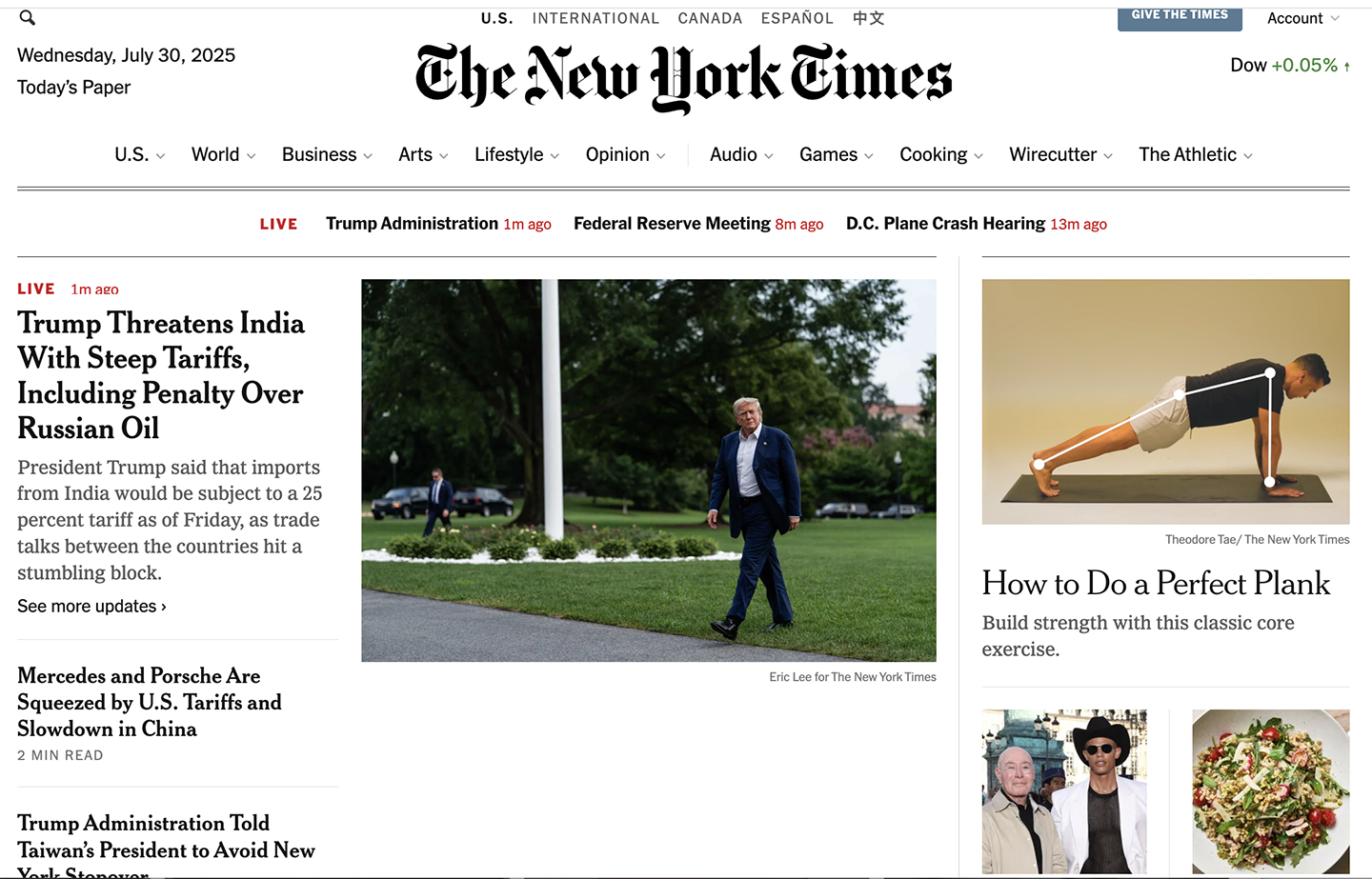
Since the image of the shooting story as it dominated the NYT app yesterday morning is gone, here’s a lesser example of it — the tariffs story currently at the top of the browser version of the Times:

You’ll see examples of what I’m talking about in the shooting case — the incoherent item labeled LIVE in red, and below it the sidebars, the related stories. It’s not a great example because it’s a calmer story; it hasn’t caused the paper to send every reporter all over Manhattan trying to discover what the hell is happening on the park. So it doesn’t lead with a breathless paragraph about the latest minor fact to slip out of a source during a press conference. It even has a nice lede-like summary at the top of it.

But it shows the typical layout. And here is the latest version of the “LIVE” story of the shooting, which now is much calmer than it was yesterday morning. But you see the pointless structure for anyone with limited time — the latest developments, rather than a summary of the important points.

Anyway, with the shooting story, I was more motivated than usual to get to the fundamental facts, because two of my grandchildren were staying with friends in Manhattan. Turning away from the mess in the NYT, I texted my daughter, their mother, who told me that their hosts lived a good distance away. That was reassuring. Not so reassuring was the fact that their daily routine up there took them right by where the shooting happened. But they were fine, thanks be to God.

Meanwhile, I had turned to the sidebars, in search of news. And I found a perfect illustration of the “say-nothing headline:”

What We Know About the Shooting in Midtown Manhattan

After that, it was kind of like a real news story, except for being broken up by subheds into chunks, instead of rationally assembled in inverted pyramid. Subheds like “What happened?” and “Who were the victims?” and “Who was the gunman?” Note how the subheds also conform to the “say nothing” principle.

It was only by accident that later in the day, I happened to run across a real news story about the shooting, with a real headline, in The New York Times. I wasn’t looking for news. I had clicked on the “SECTIONS” link on my app, as a quick way to get to the opinion content

What’s that I see? A real news story?

Look, right there next to Gwyneth Paltrow! A headline! Not a “say nothing” headline, but one that actually relates the essentials! Here’s the story, so you can judge for yourself:

Gunman Fatally Shoots Officer and 3 Others in Midtown Manhattan Office Tower

Presumably, lots of people had managed to find it, or else it wouldn’t have made the “Most Popular” category. But how? I had been looking at both the app and the browser version of the paper, and had seen not a hint of it — at least, not at the times I was looking. All I can guess is that people weren’t looking at the digital version of the “newspaper” at all, but coming in by direct links from social media.

Still, I was glad to see it. It was like discovering an old friend I had thought was dead. Of course, the headline was a bit long, because headline writers today are no longer restricted by limited space. I would have said something more like “Gunman kills four, self, in New York.” You could cram that into a one-column, three-deck format if necessary. It was good that they got the police officer in, though.

I was curious to see what they had done in the print version, under those restricted conditions, but I ran into another depressing fact about newspapers today. Here’s the front of that morning’s paper. If you click on that, don’t bother searching for the story; it isn’t there.

The shooting broke at 6:28 p.m. on Tuesday. But people who bought a paper the next morning wouldn’t see a word about it. That’s because putting out a print version is today an afterthought, something for those few doddering ancients (as opposed to with-it 71-year-old youths like me) who still demand a dead-tree paper. And, to save some of the ungodly cost of producing such a product (that insane $4 rack price doesn’t cover it, folks), the paper rolls off the presses at a stunningly early hour. (Maybe not “stunningly” to i, but to a guy who spent all those years working until 2 a.m. getting out the city edition containing the very latest, it’s unreal.)

(By the way, I currently subscribe to six newspapers, and read them all on my iPad. I’m not going to deal with frustration, not to mention expense, of having a hard copy delivered to my house, just so I can see what happened two days earlier.)

Anyway, as a postscript… of course, the story leads today’s print version. But it now has a second-day, or perhaps I should say third-day, headline. It was still worth four columns, giving more room than the usual one-column lede in the NYT.

Bottom line, as a reader who subscribes to six newspapers, I don’t think it’s too much to expect at least one of them to show me, at the top of its homepage, what I most want to know about the biggest news of the day. But that’s not what the business is about any more…