
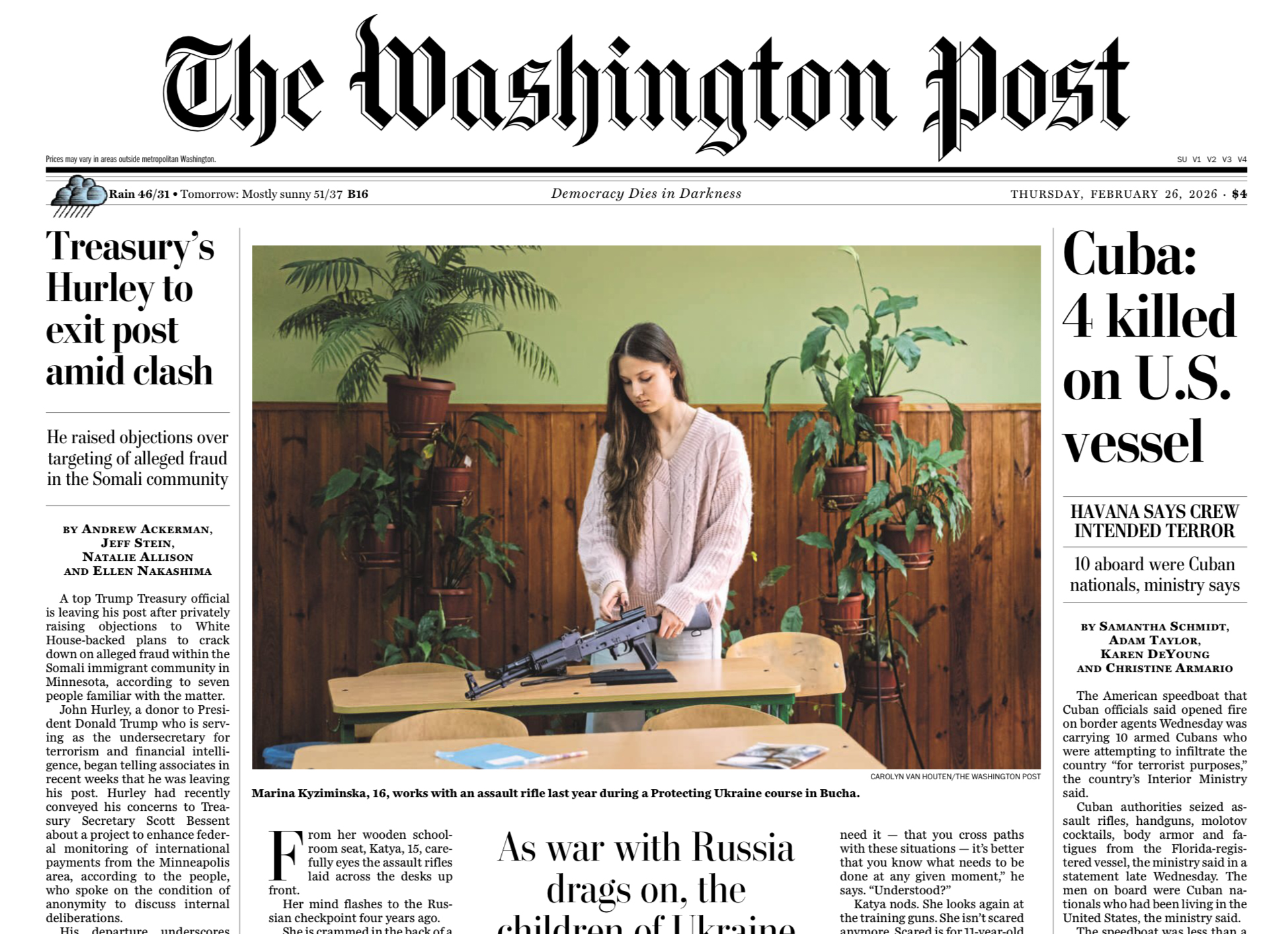
As of Friday, I will no longer be a subscriber to The Washington Post.
For me, that’s a big deal. I can’t say the Post caused me to become a journalist — I was already a copy boy at The Commercial Appeal when Woodward and Bernstein came out with All the President’s Men — but it certainly encouraged me at a key point in my development, and I’ve admired the paper ever since.
That is, I admired it until quite recently.
At first, I thought it was a good thing that Jeff Bezos had bought the paper — just as long as he stayed out of news and editorial decisions. That was the proper role of ownership back in the Newspaper Age — certainly at the papers where I worked. Of course, the problem with ownership that knows nothing about newspapers is they don’t know the rules.
I became very concerned when, with the country on the line, the paper didn’t endorse in the critical 2024 presidential election. That was a bad shock. But don’t take it from me. Check out what Marty Baron (former executive editor of the paper, and the guy who was running The Boston Globe when it won its “Spotlight” Pulitzer) said about it at the time. A key quote: “This is cowardice, with democracy as its casualty.” Another one: “Spineless.”
That wasn’t quite enough to make me drop the Post, although it should have been. I have a long history of calling newspapers spineless for failing to endorse in far less important elections than that one. But I wasn’t ready to pull the plug.
I’d just been reading, and enjoying, the paper for so many years before that. So I held back.
Then, there was the abominable editorial reaction to our incursion into Venezuela. I mentioned that before. That’s when I started thinking about cancelling. At the time, I wrote to longtime Post op-ed columnist E.J. Dionne to get his thoughts. He indicated that that was further evidence of the problems that caused him to “switch papers.”
Well, that was embarrassing for me. I didn’t realize he had done that, because I had been reading the Post (and all my papers) less over the last year or two. But sure enough, he writes regularly for The New York Times now. You know, the paper that had a far more rational response to the Venezuela thing.
But here’s kind of the last straw…
Not long after that Venezuela editorial, the Post laid off 300 people from the newsroom. Or, as the NYT‘s The Daily podcast put it, “Bezos Guts The Washington Post.”
This particularly trashed such areas as local news, international coverage (at a time when Trump has decided he’s not an isolationist anymore, and is sending troops out to threaten adversaries and allies alike), and the sports department.
While I’m not the greatest sports fan you’re likely to meet, that last category includes two people who I see as some of the best sportswriters in the country.
Remember when I wrote about Kent Babb, my former colleague at The State who’s been doing such a great job at the Post since 2012? He’s gone. Here’s what Kent had to say about that. I haven’t spoke to Kent about it yet, but I’ve finally started reading his excellent book about a school I attended in the mid-60s in New Orleans. I’m sorry it took this to make me pick it up from my shelves of books I fully mean to read, but I’m glad I’m reading it.
Remember back in the fall when I praised a story by Chelsea Janes headlined, “Shohei Ohtani just played the greatest game in baseball history?” She was the paper’s national baseball writer — the kind of title you’d expect in front of a name like Ring Lardner or Red Smith. And she’s good enough for that.
But they dumped her, too. Fortunately, she got a new job right away. But she’s no longer national baseball writer of what was once one of the best papers in the country.
Normally, while I’d be sorry to hear about this monumental development, it wouldn’t make me turn away. After all, I didn’t drop my subscription to The State when it laid me off. Sometimes things can’t be helped.
But this is a special case. The only good thing about Bezos owning the paper was that he has an income flow that seemed likely to be able to prop up the paper for the foreseeable future without causing him to have to cut back on his grocery bill a bit.
Obviously, he’s decided he doesn’t want to do play that role anymore, so I suppose that makes the Post, for the first time since he purchased it, vulnerable to the economic forces that have wiped out newspapers across the country over the past couple of decades.
So… there were, all along, obvious serious drawbacks to having him at the helm. And now the one good thing about his ownership — his willingness to throw money at the paper to prop it up — has disappeared.
So I’m following E.J. I’m out…
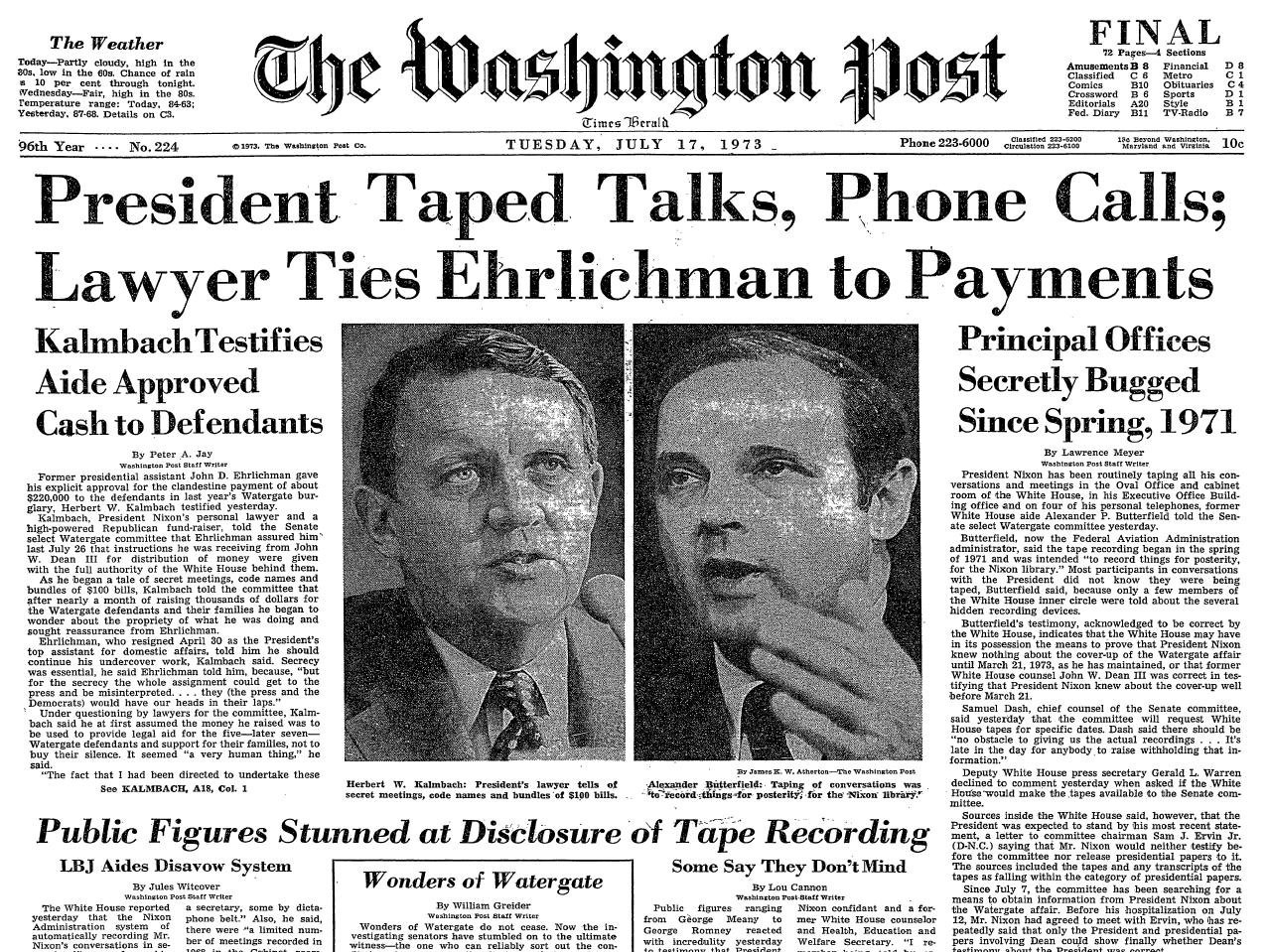
As you may recall, it was a great paper when Katharine Graham had it.
What business model would have allowed it to become even close to break even on revenue vs. expenses?
It’s a business, not a charity. The print side of the house went from 480K subscribers in 2012 to 100K now. The digital side has lost 20% of its subscribers during the Biden administration. There simply isn’t a revenue model that can justify maintaining the staffing levels — and if you know of one, you could get very rich fixing all the other papers in the country who are experiencing the exact same fate.
Yesterday’s news printed on paper and distributed by a fleet of trucks to be delivered by humans to mailboxes is a dead end.
Want to save the Post? Terminate the entire operation related to print and go 100% digital. Produce more video content consumable on social media. There is no other option. The competition ate their lunch by being faster, leaner, and more technologically focused. Has nothing to do with their editorial biases.
OK, Doug, we’ve had these conversations before and you always ignore what I say, but in case anyone else didn’t follow what I was saying, I’ll very briefly address what you say point by point:
There was no business model. That’s the thing. If Bezos thought he was going to have a return that was comparable to his investment, he was an idiot. I don’t think he’s an idiot. The only way to take what he was doing was that he wanted to see if he could — by spending the way only someone like him could spend — stabilize the business to where it could become sustainable without his money. Or something like that. That’s as close as I could come to imagining a way of thinking of it as an “investment.” But it was the way charities spend, not businesses. I’ve been on the committee that distributed Knight Foundation funds in SC. The goal, time and again, it sustainability.
So while you may know a newspaper is a business, and I know it better than you do (as I said, I had no criticism for The State for canning me, because I knew the financial situation, there’s reason to suspect that Bezos DID see it as a weird sort of charity.
What ever he thought it was, that aspect — his willingness to spend amounts on a newspaper that other investors could not was the ONLY good thing about his investment, because he wasn’t contributing anything else to the paper, to the readers, or to the country. And I say “to the country” because the WP was one of the small number of papers that were important to the country — the way The State was once important in a smaller sphere.
Bezos may have believed he had a magic touch that could turn the paper around WITHOUT pumping oceans of money into it way into the future. If so — not to say again that that would be idiotic — it was maybe that he simply could not grasp two things: 1. the phenomenal amount of money that grocery stores and department stores were willing to pump into it back in the days when it was essential for businesses to buy a densely penetrated market with their ad dollars; and 2. that those days were OVER. Advertising doesn’t work that way anymore.
You say, for the nth time, “Yesterday’s news printed on paper and distributed by a fleet of trucks to be delivered by humans to mailboxes is a dead end.”
Well, duh. Everybody knows that. I subscribe to five — no, four — papers, and I don’t get a single one on paper. I don’t want to. Yeah, when I was still at the paper they were still trying to keep print alive (while I was putting more and more of my energy into the blog and virtual opinion pages). Within the next five years, they reversed that situation with surprising speed. Suddenly, print was nothing — except something they provided to a small number of readers who demanded it and were willing to pay a premium for it — and EVERYTHING went into the online product. All the energy; all the effort. But I’ve seen no indication that papers will ever again be able to replace that revenue stream. I wish they could — America NEEDS them to. But I don’t see any indications that such a miracle is in our near future.
Anyway, those are the facts. Briefly. I don’t think I could explain it all if I took all night. And it’s 9:22 and I still have some work that needs doing tonight…
Oh, one more thing, to break it down another way: While Bezos was spending all that money and defying gravity, his involvement had some value to me, the reader. Now that he’s backing off and getting rid of all the value in the product, I see no reason to keep spending my money to subscribe. Seems like that’s a motivation with which a libertarian could identify…
Anyway, I’m keeping the NYT and the Boston Globe. They have their problems, too, but they’re still doing a good job and providing sound products…
You keep ignoring the simple fact that printed newspapers are dead.. and if you cared about the news and not the newspapers you’d agree that the ONLY solution is to complete kill the hardcopy product. That step would save hundreds of reporting jobs at the cost of the jobs related to printing and distributing the papers. What’s more important? There were plenty of telegraph operators who eventually were put out of business. It’s the normal business cycle of innovation.
So if the goal is news, do news. The medium is the message.
This is a completely untrue statement: “You keep ignoring the simple fact that printed newspapers are dead.”
Untrue on two levels: I don’t ignore it at all. I write different words from you because I understand the situation better than you do.
And one thing I understand is this: To quote Magic Max, they’re just mostly dead. But that’s just for now. Unlike Max, I don’t see any way to bring them back.
I know that there is still some money — far less than there ever was before, but some — in print advertising.
I’m not inclined to think it’s worth going after, but then, I’m no longer in those weekly meetings with the business-side people. I’m not seeing the numbers.
If I were running a paper (something I’m glad I’m not doing), I’d plan to ditch the print soon, or would have done it sometime ago. I’ve certainly done that as a reader. But unlike you, I know that I don’t know everything.
For those of you who don’t understand me or newspapers…
I don’t expect for a moment that my cancellation will have any effect on Jeff Bezos and his properties.
In fact, as sad as I am about what’s happened to the Post and to the good people who worked there, I have to smile at myself.
Remember Bloom County? I’ve been looking around for a certain strip that I caused me to laugh when it came out. I can’t seem to get it to come up on the Web. I used to have a clipping of it somewhere — maybe it’s in one of those boxes I’m neglecting to go through in my garage…
Anyway, it was one of the strip’s newsroom scenes. Opus was sitting at his desk talking to an irate reader — a situation with which anyone who’s worked on a paper is well familiar. You can’t always please readers. You can’t even please me, as much as I love papers. If you’re doing your job, you’re going to tick people off. Fact of life.
Opus is being just as sweet and conciliatory to the woman on the phone as he can be. He keeps addressing her by name. I forget the name, but let’s say it was “Mrs. Wilson.”
Finally, Mrs. Wilson says something like “You leave me no choice but to…”
Opus cries out, “No, Mrs. Wilson! Don’t do THAT!”
“… cancel my subscription!” she continues.
Still holding the phone, Opus moves it away from his mouth and cries out in despair, “Mrs. Wilson is LOWERING THE BOOM!!!”
Of course, in real life, Opus would have said “I’m sorry to hear that, ma’am. Would you like me to switch you to the circulation department? I am not authorized to do anything regarding your subscription.”
My own cancellation won’t even disturb a single person at the Post. I’m positive the algorithm that handles these things doesn’t care at ALL…
Been subscribing to the Post for a while but ends sometime this summer. Same last straw reaction as you Brad. I will certainly miss the Kathleen Parkers and George Wills but will switch to the NYT.
Michael Smerconish spent a few days of his radio show talking about The Post and interviewing some former writers and discussing the changes, and the Bezos lack of interest in the paper.
He did a really good job with those discussions back when this first as announced.
Bezos bought the post and then when Trump won in 2024, basically saw it as a way to curry some favor- or at least hope Trump would not attack him anymore. Trump seems to be sidetracked with other issues this time anyway. Bezos has never learned the lesson a lot of people have to learn the hard way: If you suck up to Trump, he owns you even more and you don’t earn credit by doing that. As soon as Trump needs to dump on you, he dumps on you.
They’ve lost so many subscribers at this point.
I also canceled my Washington Post subscription, right after the massive layoff.
Bezos has money to burn. He spent $75 million ($40M: purchase, 35M: promotion) for the mockumentory, MELANIA.