

In this depiction from 550 BC, Helen’s white, but everybody else is black. Go figure.
OK, here we go again…
Yesterday, I questioned the casting decisions for the new film I still haven’t seen, but am anxioius to see — “The Odyssey.” But I did so optimistically, thinking it’s likely that Christopher Nolan knew what he was doing, and has more imagination regarding such things than I do.
Then, I listened to the third of four podcasts (yesterday I forgot the one in the video) that “The Rest is History” put out about about “The Odyssey” (both Homer’s and Nolan’s versions). And I found myself groaning when Tom Holland and his guest, classicist Daniel Mendelsohn cited the first of the “controversies” that have cropped up about the film.
And of course, this being the 21st century, it was about Identity Politics.
It seems that the actress who plays Helen of Troy is black. Her name is Lupita Nyong’o. So here we go.
Well, she definitely fulfills the primary job requirement: She’s beautiful. Does that make her the best choice for the role? I’ll get back to that. Meanwhile, the “controversy” seems to have been kicked off most prominently by a guy who, now that he’s the richest guy in the world, seems to have decided to dedicate the next chapter of his life to reinforcing every negative stereotype about white South Africans:
Chris Nolan is pissing on Homer’s grave. Disgraceful.
— Elon Musk (@elonmusk) May 13, 2026
Sheesh. You’ll notice that in my previous post, I didn’t mention who was playing Helen in this film because I didn’t look to see. It didn’t even occur to me that she would be depicted, since this isn’t the Iliad, but the story about what happened to this one guy and his crew after the Trojan War is over. But apparently it includes the part when Odysseus wins the war by coming up with that big wooden horse trick.
I did raise the question of whether Matt Damon was right to play the star, and so did Holland and Mendelsohn, pointing out that Damon is sort of the ultimate whitebread All-American boy type, which the ancient Greeks were not. And one of the guys on the podcast, at some point, asked one of those overused points of the PC universe by asking, Why don’t they question that, huh? Well, I did, but I’m hoping Damon does a good job with it.
From there, they took the discussion in an intellectually respectable direction by discussing the question: How DID Homer picture Helen?
To encapsulate what they said, they made two excellent points: The first was that Homer was careful not to give many details about what she looked like. (Although he did say she was “white-armed,” but I see that as a reference to class rather than pigment. Upper-class ladies stayed out of the sun. Also, her father was a “swan.”) That, of course, left it up to the reader or listener to picture Helen according to whatever standard of beauty was admissable to those audience members.
Secondly, they made the logical point that what Homer and other ancient Greeks were picturing was probably someone who looked like them and their immediate neighbors. It’s extremely unlikely that they pictured in their minds either a blonde such as the one who played Helen in this flick, or a sub-Saharan African like, well, Lupita Nyong’o. (Although technically, she’s from Mexico. Still, her parents were Kenyan.)
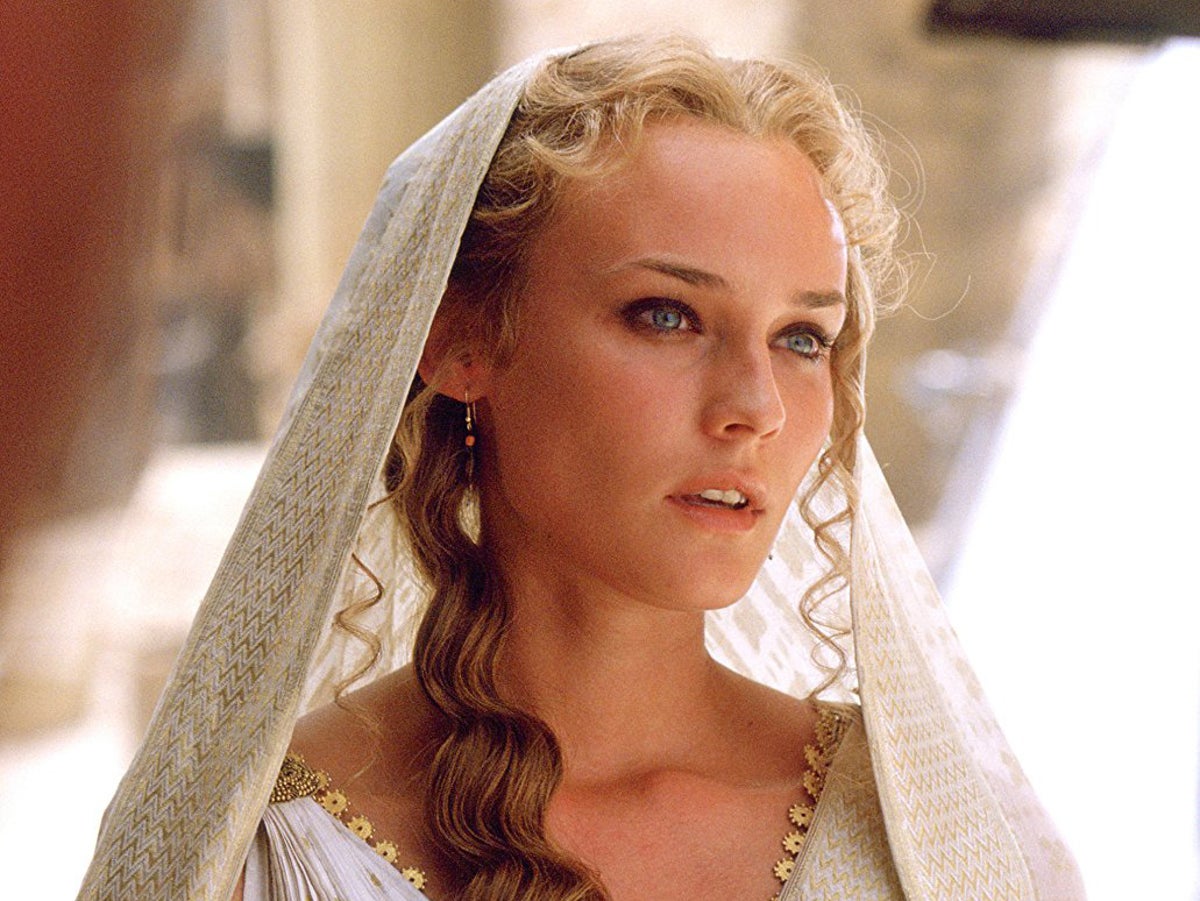
Personally, that’s the way I would have gone. I wouldn’t have taken it to extremes — I wouldn’t say, insist upon a Greek woman — but I would have gone for a more or less Mediterranean look. Or at least sought a beautiful woman with dark hair, like Anne Hathaway — who plays Penelope in the film.
I thought the makers of “Troy: The Fall of a City” did a good job when they chose Bella Dayne to be their Helen. But, possibly illustrating the idea that we all have our own notions of beauty, I thought the most attractive actress in the series was Frances O’Connor. She was cast as Hecuba, Paris’ mom. (Still, she’s a lot younger than I am.)

Anyway, what do y’all think? Who would be the perfect Helen? To get you started, I’ll throw out a few names, and link to images. It’s not a Top Five List or anything. I didn’t think that hard about it. I just thought:
- Who is really, really beautiful, the kind ancient men might have gotten into a huge scrap over? Not only that, but what does she have that’s extra, the X factor, that turns heads?
- Who looks vaguely Mediterranean, or at least isn’t a blonde or redhead or East Asian or sub-Saharan African or anybody who makes the average viewer go “Huh? I thought she was from Greece!” Although if she has the other qualifications and is at least a brunette, I’ll give her a pass on the olive complexion (yeah, I’m cheating to give Anne Hathaway a chance).
- Who is a real actress, preferably with the chops to handle the role — not just some hot pop singer or model?
- She doesn’t have to be the right age for the role NOW. That’s too restrictive because I’m not likely to think of actresses who are that age (which I suppose, given the place and time, would be somewhere between 20 and 30 during the years of the war) at this moment.
Here are my suggestions (not in order):
- Penelope Cruz. Admittedly, I didn’t think of her on my own, but she came up when I Googled beautiful actresses who looked Mediterranean (just to kind of get me started), and she fit the bill.
- Rashida Jones. Wait, you say, her father is of African descent! And you’re thinking that because you’re thinking in racial, Identity Politics terms. I’m thinking looks. And in this case, a combination of a man of African descent and the chick from the Mod Squad gives us the right look. And she certainly has the X factor.
- Rachel Weisz. Dang. I just said “X factor,” and I’m not going to keep repeating myself.
- Emily Blunt. OK, OK, I know — too Northern European. But there’s something Hellenic there that I think the costume and makeup people could work with.
- Gal Gadot. I was done with this list, then someone on the telly mentioned her name, and I had to come add her.
- Marisa Tomei. I’m going to say “X factor” again because she’s got more of it than anyone here. As for unmistakeable Mediterranean (or at least Caribbean) allure, did you ever see “The Perez Family?”
- Marisa Allasio. Mentioning the other Marisa made me think of this one, whom I admit I’ve never seen act, possibly because she retired and married a count when she was 22 and I was 5. She’s way more Helen than those gorgeous Itallian actresses who came along in the ’60s (sorry, Sophia). OK, she’s blonde, but give her a break; she’s from Turin, not Naples! But she’s way Italian, so dye her hair.
That gives us something to start with. But we’ll need a time machine to get them. That last one retired in 1958.
EDITOR’S NOTE: I actually saw the film last night, but nothing in this post reflects that. I mostly wrote it yesterday, but wasn’t done before I had to head to the theater. I just did some editing and fleshing-out of points this morning before posting it. I’ll make observations later about what I saw.
The question of considerably more import here would be: Were there Black folks (or, rather, “Aithiops”) living in ancient Greece and could one of them have been of a nature to have launched a buncha ships? The answer to the first is: yes. And that being so, then the second is also not beyond the realm of the possible.
More importantly still, though, is the question of whether ancient Greeks would’ve been as hung up on these categories as some of us are – or even conceptualized the world in such terms. And the answer to that is, t’aint likely so.
Beyond that, the fact that Nolan took liberties with the story in other respects makes debate over something like Helen’s race wholly lacking in value.
https://mango.wiki.edu.gr/
Of course it was possible. But it would have been a remarkable characteristic, worth mentioning at some point in 15,000 lines of poetry stimulated (allegedly) by the looks of this one woman… instead of using Homer’s vague reference to “white arms,” which was a routine description offered for upper-class women who didn’t work out in the sun.
And of course different cultures react to differences of pigment in different ways. And ours is nothing like, say, Spanish America with its extreme categorization represented in the Casta paintings in the 18th century, which illustrated 16 different categories dividing society into a hierarchy based on racial differences.
I don’t think any of us can understand exactly how ancient Greeks reacted to different physical characteristics in people from far away, on the rare occasions when they encountered such differences. I suspect it was as a curiosity — worthy of mentioning as a break from the everyday, but without great social meaning. With someone like Helen, the normal thing to be concerned about (in terms of who would be married to her, which is of significance in this story) was parentage. What royal house was uniting with what other royal house? Of course, that’s complicated in Helen’s case, since her dad was Zeus and her mother was Nemesis.
And of COURSE it’s a silly thing to object to in a complex film production with scores of named characters. But Elon Musk is a silly man.
And of course, we have no particular reason to believe Helen actually existed. But she’s been a compelling character in literature for thousands of years.
Interestingly, Nolan adds some details to anchor his story in the real world:
The ancient Greeks didn’t just encounter other people on “rare occasions.” They got around – like, y‘know, Odysseus. And not just round about the Aegean. As the link provided points out, not only were there Black people in Greece itself, Greece enjoyed extensive trade networks, which brought them into contact with many other peoples all the time. Which OF COURSE means there could’ve been a Black Helen – regardless of whether one is in Homer’s version of the story or not.
In any case, those who check the link can be better informed about these things than the world’s richest jerk, and many others.
Sure. Just as long as you understand that I know these things as well. I, too, read up on it before writing on the subject. I just disagree that it was likely that someone from thousands of miles away was the queen of Sparta, and a guy who wrote an epic poem about the war supposedly caused by her beauty didn’t think it was worth mentioning. And I certainly disagree that it’s an OF COURSE likelihood, as you do.
This is why I hate it when this kind of pointless garbage is brought up. In this case, the guy who brought it up was Musk. But then people who react to it, living in a time in which identity is something that has to be argued about in ones-and-zeroes terms, go overboard with their reaction, and try to argue that it’s not not only possible but something that was so likely that no one should have to remark upon it.
Which doesn’t make much more sense than Musk, if any. That’s why, as I said, I groaned when I learned what the “controversy” was that was being addressed first on my favorite podcast. I always end up arguing with both sides, both of which seem to think identity is a lot more important than I do.
This bit of casting was successful only in one regard: It provoked a well-known idiot to react loudly, thereby making many others react loudly, and create buzz for this extremely expensive movie. So, a good stroke in terms of the Hollywood adage, “There is no such thing as bad publicity.”
But this film was a hugely complex and worthwhile project, and deserves to be judged on artistic and technical merit. The only question to me is, was this young woman the best possible actress for the part. With the stupid controversy in mind, I was hoping I’d be impressed with her, just as I hoped I’d be impressed with Matt Damon and the rest. I had questions about him and several others, and fortunately, most of them were at least OK. Damon himself did an excellent job, which is important because otherwise the whole project would fail.
Plenty of other people were good, and others were just… OK. I’d put Lupita Nyong’o in that latter category. Not particularly impressive, but she didn’t do the film any harm.
And that’s what matters. I’d put plenty of others in that “did no harm” category. And the good news is, the film was brilliant…
Oh, and before you ask, “Then why did you make a quick list of mostly ‘Mediterraneon-looking’ actresses, if you don’t care about race or identity?”
What I care about it is this: That such things not distract people from the overall effect you’re trying to produce. I don’t want the talk to be about the performer’s race. I want it to be about the acting — and the writing, and the cinematography, etc.
So I tend to cringe a bit when somebody tinkers with identity in casting — unless it really works. Here’s an example of when it works: The Night Manager is one of my favorite le Carre novels, and when the TV series came along, I was really watching out for the series being true to the book. So when I saw that they had turned the title character’s case officer from a man into a woman, I thought, “Uh-oh.” But you know what? It was brilliant. It made me think le Carre should have made the character a woman.
It worked for two reasons: First, the actress was Olivia Coleman. She was going to do a great job any way you looked at it.
Second, making it a woman, and a pregnant woman (which was Ms. Coleman’s condition at the time), created a dynamic that emphasized the sort of mother-hen relationship that a good field officer has with an agent. The agent is out there risking all, and beyond infrequent contacts, all the case-officer can do is prepare the agent as well as possible, and they worry — like a mother sending children out into the world. Sure, fathers feel much of the same, but if you cast a man, people can miss that caring relationship, and see him just as a guy doing a job. Cast a pregnant woman (who happens to be a brilliant actress), and you make it hard to miss the nature of that parental relationship.
So it worked. But you don’t do things like that to make some identity-politics point. You do it to make the character come across better…
Oh, and for what it’s worth, Helen does appear in The Odyssey (Book 4), when Telemachus goes off searching for his dad. Nolan leaves that out, apparently. But this version, considered the most true to the text, includes that bit:
https://www.youtube.com/watch?v=BjN_merCA0Q&list=PLGcs5YdOsiOd0J-GG2bEGX-uZ-1oP8ka3
Yes, and that’s in the movie. That’s a big reason why Nolan needed an actress to play Helen. When Telemachus meets her in the film, Menelaus grabs her roughly to show Telemachus the scars on the left side of her face, he seems to make a bitter joke about whether this face would still launched a thousand ships.
At least, I think that’s what he did. As mentioned, I couldn’t hear most of the dialogue…