Category Archives: Donald Trump

All hail Donaeld the Unready, King of Mercia!

I’ve mentioned before how much I enjoy, in building my family tree, finding ancestors with fun nicknames, such as “Strongbow,” and “Horse-Swapping Billy Smith” and “Shaggy-Breeches.”

The very best sobriquets are the medieval ones — just the best, terrific, believe me. They’re just so… direct. For instance, I am descended from the following: Charles the FatCharles the BaldCharles the HammerCharles the Beloved and Charles the Wise. And that’s just the Charleses. (All are direct ancestors except the Fat, who is just a cousin, but I couldn’t leave him out.)

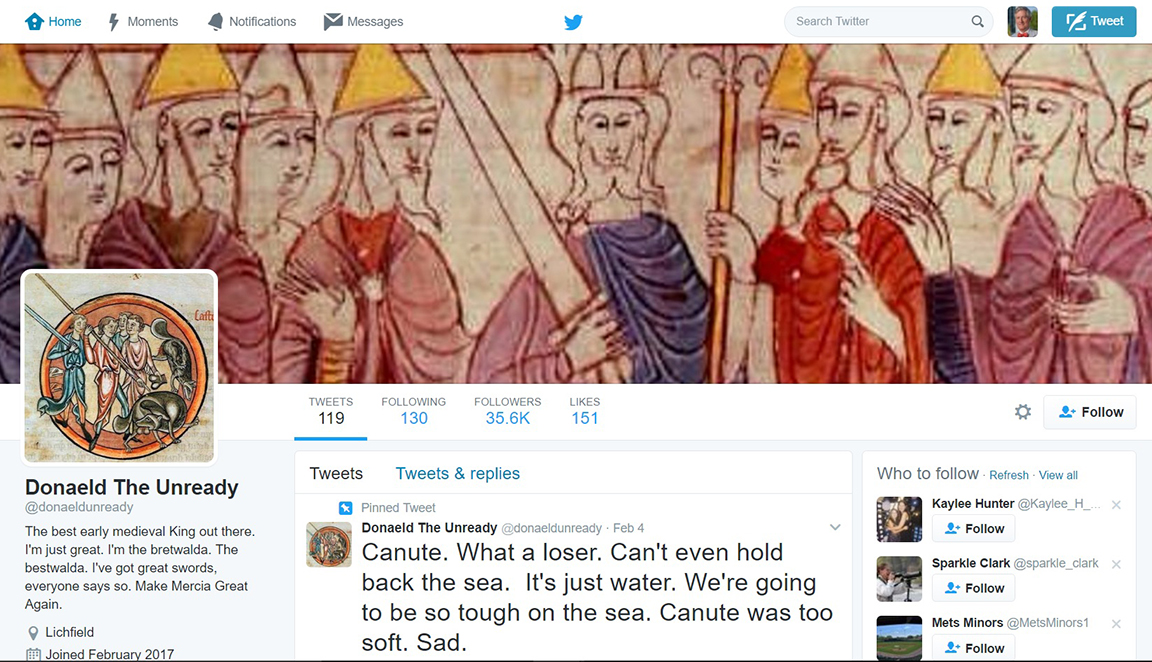
Take that current obsession and combine it with my enjoyment of such TV shows as “Vikings” and “The Last Kingdom,” and you just know that I would love this Twitter parody, “Donaeld the Unready“:

Donaeld

As you can see, Donaeld is “The best early medieval King out there. I’m just great. I’m the bretwalda. The bestwalda. I’ve got great swords, everyone says so. Make Mercia Great Again.”

Some of his recent Tweets:

Enjoy.

Do you have to be a word person to see what’s wrong with Trump?

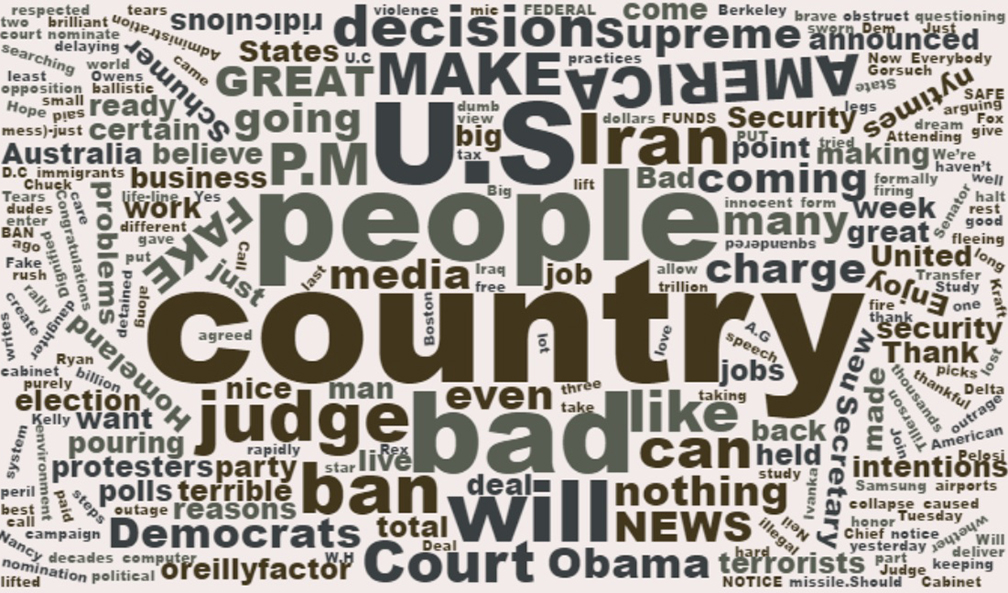
A word cloud of Trump's Tweets from the past week.

A word cloud of Trump’s Tweets from the past week.

E.J. Dionne’s latest column (“The issues all Trump foes can agree on“) reminds me of a thought that’s run through my head a few times in recent weeks, but which I’ve neglected to write about. Here’s the pertinent part of the column (but I recommend you go read the whole thing):

And Trump’s critics don’t have to agree on a single policy to bemoan his crude and sloppy use of language and to see this as a genuine obstacle to honorable politics and a well-functioning government. He doesn’t just want to repeal the Johnson Amendment, which bars religious organizations from getting involved in elections. He wants to “destroy” it. He lightly threatens war with Mexico to go after “bad hombres” and undermines our relationship with Australia by recklessly accusing one of our very closest friends of wanting to export the “next Boston bombers.”

And just this weekend, Trump showed his disrespect for the rule of law by denouncing the “so-called judge” who blocked his administration’s travel ban. In an interview for broadcast Sunday, Fox News’s Bill O’Reilly described Vladimir Putin as a “killer,” and Trump astonishingly but off-handedly replied: “Well, you think our country is so innocent?”

As George Orwell taught us, how people talk offers a clue about how they think and what they value. Our language, he wrote, “becomes ugly and inaccurate because our thoughts are foolish, but the slovenliness of our language makes it easier for us to have foolish thoughts.” He added: “If thought corrupts language, language can also corrupt thought.”

Pretending that there is something “brilliant” or “populist” about how Trump communicates is one of the worst forms of elitism because it demeans ordinary citizens who have always appreciated eloquence, as our greatest leaders knew. And please don’t compare George W. Bush to Trump on this score. We poked fun at Bush’s ability to mangle sentences, but he respected the need to find words that could move and unite the nation….

Some of my friends still have trouble getting just what is so awful about Trump. And while the correlation is far from perfect, I’ve noticed that there’s something of a tendency for such folks to be more number people than word people.

Maybe that’s totally off-base, but it seems a handy way of explaining a phenomenon that has amazed me from the moment last year when Trump started winning primaries. All this time, I’ve thought:

How could anybody possibly consider a guy who talks like that for any sort of leadership position, much less president of the United States?

It’s not just what he says, although he says some pretty awful things. It’s the way he says them. The man’s a Wharton graduate, but he communicates like someone who never made it to high school — and probably didn’t do too well in English in the lower grades, either.

Being a skilled and subtle communicator is so obviously a prerequisite for the presidency that it’s tough for me to understand how anyone could even take the first step toward considering him, given the way he expresses himself. Just watch five minutes of him in those early debates, and you’d immediately put him in the “unqualified” bin, regardless of what he was talking about at the time.

But I’m a word guy. Not everyone is. And those who aren’t are likely not only to dismiss what I’m saying as rank snobbishness, but to toss it out as irrelevant.

And maybe my analysis is completely off. But there is some reason why there’s such a gulf — nay, an ocean — between me and people who could ever have contemplated voting for Trump.

And this seemed like one possible explanation. So I thought I’d share it…

I’m worried poor ol’ Trump’s going to wear himself out

This Tweet was moderately popular over the weekend, so I share it here:

We’ve seen some life in the judiciary, much to the new president’s consternation.

When will we see some life out of the legislative branch — you know, doing stuff rather than just saying stuff?

I know they’re out of practice. And I know that a lot of the stuff they would do would be stupid — like repealing Obamacare without replacing it with something that actually leads to at least as many people having good coverage. But hey, “stupid” is relatively, and they can’t possibly look as bad on that score as the executive branch — can they?

Hamiltonians, Wilsonians, Jeffersonians and Jacksonians

If you’d like to soothe your jangled nerves with an interesting intellectual take on WTF just happened to America, you might want to read this piece in Foreign Affairs by Walter Russell Mead, Columbia native and “radical centrist.”

It’s headlined, “The Jacksonian Revolt.”

Mead

Mead

Here’s the short version: We Hamiltonians and Wilsonians (going by Mead’s descriptions, I’m kind of both, which is unsurprising) have pretty much defined America’s prevailing values and role in the world for the past 70 years. We thought this was the natural, proper order of things, and the way everything was trending as well. But while we were thinking globally and in terms of universal principles, there was… I suppose one would call it discontent… at home. The Jeffersonians (a category that includes Rand Paul and Ted Cruz, which clues you in that I’m not one of them) thought this was a wave they could ride to power, but they reckoned without the way the Jacksonians ran in and grabbed the nation by the throat with all the thoughtfulness and refinement of the backwoodsmen who trashed the White House after the original Jackson’s inauguration. (Some of the editorializing in that last sentence is me, not Mead. In case you wondered.)

Mead is not saying anything new, for him or anyone else — I called your attention to him when he made some of the same points more than a year ago. And I’ve spent much of the past year worrying that our country was repeating the horror of the Election of 1828, only more so.

But now that it’s happened, and now that this latter-day Jackson is trashing not just the White House, but practically every aspect of rational U.S. policy in the world, this seems like a good time for a deeper look into what has happened, and is happening.

An excerpt from Mead’s piece:

The distinctively American populism Trump espouses is rooted in the thought and culture of the country’s first populist president, Andrew Jackson. For Jacksonians—who formed the core of Trump’s passionately supportive base—the United States is not a political entity created and defined by a set of intellectual propositions rooted in the Enlightenment and oriented toward the fulfillment of a universal mission. Rather, it is the nation-state of the American people, and its chief business lies at home. Jacksonians see American exceptionalism not as a function of the universal appeal of American ideas, or even as a function of a unique American vocation to transform the world, but rather as rooted in the country’s singular commitment to the equality and dignity of individual American citizens. The role of the U.S. government, Jacksonians believe, is to fulfill the country’s destiny by looking after the physical security and economic well-being of the American people in their national home—and to do that while interfering as little as possible with the individual freedom that makes the country unique. 

Jacksonian populism is only intermittently concerned with foreign policy, and indeed it is only intermittently engaged with politics more generally. It took a particular combination of forces and trends to mobilize it this election cycle, and most of those were domestically focused. In seeking to explain the Jacksonian surge, commentators have looked to factors such as wage stagnation, the loss of good jobs for unskilled workers, the hollowing out of civic life, a rise in drug use—conditions many associate with life in blighted inner cities that have spread across much of the country. But this is a partial and incomplete view. Identity and culture have historically played a major role in American politics, and 2016 was no exception. Jacksonian America felt itself to be under siege, with its values under attack and its future under threat. Trump—flawed as many Jacksonians themselves believed him to be—seemed the only candidate willing to help fight for its survival….

As you can see, his tones are measured as he describes this resurgence of anti-intellectualism in our politics. That’s what I’m talking about when I say you may find reading the piece soothing. Then again, maybe you won’t…

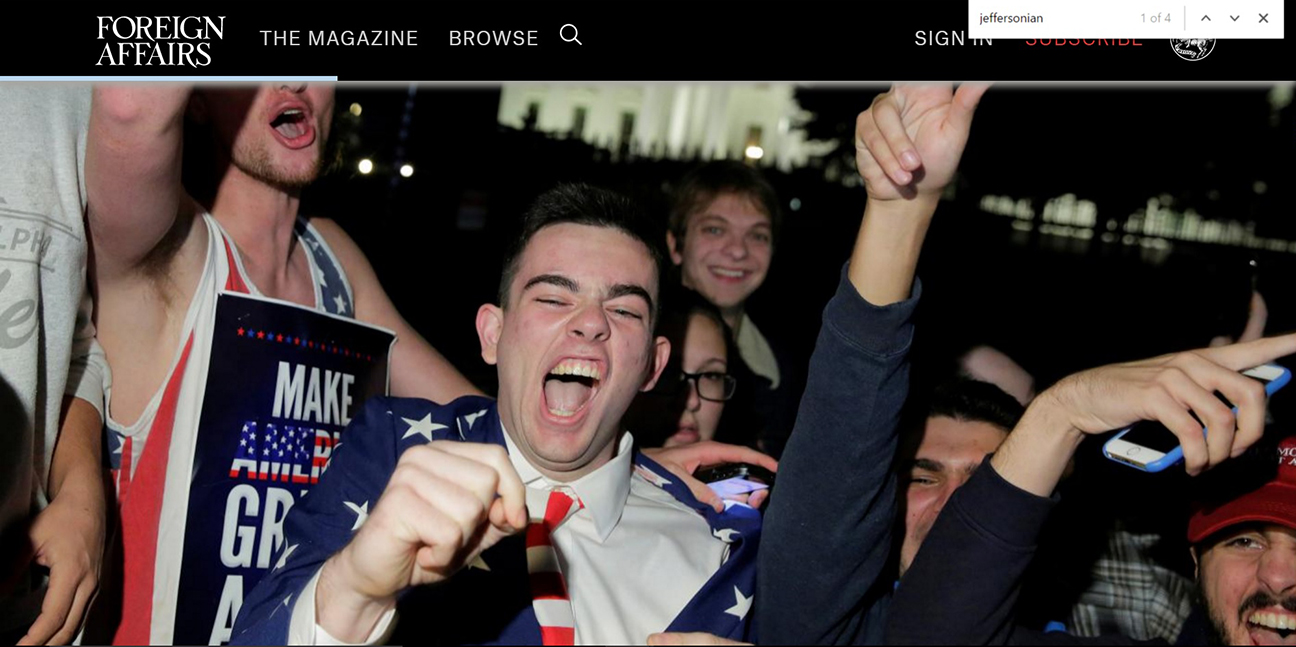
Mead writes politely of the Jacksonians, but Foreign Affairs paired his piece with this image of them celebrating on Election Night.

Mead writes politely of the Jacksonians, but Foreign Affairs paired his piece with this image of them celebrating on Election Night. Even I’m nicer to them than that…

People, can you just chill a bit over court nominations, please?

10569-003-C-P

So Trump nominated someone last night for the Supreme Court, and it looks like he had good advice and listened to it for a change: I’ve seen no indications at all that this Gorsuch guy is anything other than a qualified jurist. Which means that, in a rational world — barring currently unknown problems coming to light — his confirmation should be routine. Which would be welcome; we have enough turmoil in our public life at the moment.

But then, I read this main story (there were many sidebars) about the nomination in The Washington Post:

President Trump nominated Colorado federal appeals court judge Neil Gorsuch for the Supreme Court on Tuesday, opting in the most important decision of his young presidency for a highly credentialed favorite of the conservative legal establishment to fill the opening created last year by the death of Justice Antonin Scalia….

WHAT?The most important decision?” In what way, in what sense, in what universe completely lacking in any sense of proportion?

To keep it simple, let’s just consider three things this “young presidency” has done that are much more far-reaching in likely effect:

  1. Pulling out of TPP. This has disengaged America from the Pacific Rim, and invited the accelerated rise of China, in a way that is likely to have staggering consequences in this century both for us and for the billions of others affected — economically, strategically, culturally and almost any other “-ly” you care to name.
  2. Sticking a finger in the eye of every Muslim on the planet. Never mind the momentary unjust treatment of 90,000 or so individuals from Muslim countries, or the unconscionably inhumane “no” to refugees. This has indelibly engraved in a billion or so people’s minds that America regards them and their faith as the enemy, the one impression that our last two presidents have gone out of their way to avoid giving, even as they prosecuted the War on Terror.
  3. Naming Gen. Mattis as defense secretary. Just as Gorsuch’s appears to be, this was one of Trump’s rare good calls. Deciding upon such a qualified leader for our military at a time when the world is so unsettled and there are so many places where things can go really wrong really quickly was of the utmost importance. But it was also an historic precedent, since we had avoided naming recent generals to that post for my entire life. (By contrast, presidents have named LOTS of Supreme Court justices who have come and gone in my life, and none of them held immediate sway over the immense power of the U.S. military.)

Speaking of Mattis — despite the semi-Constitutional issue his nomination raised, an issue worthy of respectful consideration, but not one that should have been an obstacle in light of his qualifications, and of the nation’s desperate need of some qualified people at this point in our history — all but one senator had the good sense to confirm him.

And if our nation had good sense, something similar would happen with Gorsuch. Will it?

No, of course not. As another piece in the Post, by the venerable Dan Balz, noted:

The coming fight over his Supreme Court nominee will be fiercer than before.

Yes, it will. Else we would all be shocked. (I, for one, would be pleasantly surprised.) And what is likely to happen will be an utter waste of energy in a time when political capital needs to be saved for so many other more important battles.

My attitude toward Gorsuch is exactly the same as it was toward President Obama’s pick for this seat, Merrick Garland. They were both qualified for the job. They had already been vetted; they had already proved themselves. They had the requisite knowledge and experience, and reputations for probity and good judgment. There were detectable differences in judicial philosophy — differences that in a calm, proportional world would matter only to legal scholars. But both were qualified for the job — far more qualified than most people elected to Congress, for instance.

Whether one or the other was confirmed is not the Ultimate Issue. It’s not Armageddon.

Here’s the way I see it: The vast, vast majority of times the Court decides cases with wisdom and with ultimate respect for the law and for our civilization. Most decisions are unanimous — which seems remarkable to this layman, since the court deals mainly in matters lower courts were unable to settle conclusively. This has been the case over the decades, no matter whether the majority of the court is labeled “liberal” or “conservative.” Controversy exists only in a minority of cases, and most of those are at least decided intelligently, even if not the way you or I would prefer.

This has been true my entire lifetime.

To me, this testifies to presidents and senators having done a phenomenal job of picking good, qualified justices. The political branches have a much better record in this than in any other area I can think of.

Am I unhappy with some of the decisions? You bet. My opposition to Roe v. Wade is well documented here. I object not only to its legalization of abortion, but to the devastating effect that decision has had on our national politics — specifically, to exacerbating the very problem that I’m on about in this post.

(Considered logically, I am if anything even more opposed to the absurd precedent upon which Roe is based — the Griswold decision, which magically “discovered” an absolute right to privacy hiding in the shadows of the Constitution, a right that had somehow gone unnoticed in the nation’s previous 189 years.)

Today, in part because of Roe, we have vast numbers of people — thousands, if not millions of Americans will vote for a president based largely if not entirely on the basis of what sort of justices he or she is likely to name — “liberal” or “conservative.” Which is insane, given the far more immediate and far-ranging powers of the presidency. A president has the power, at every morning of every day, to make decisions that could lead to the destruction of all human life on this planet — and yet people will actually let their vote be decided on a narrow range of factors involved in a decision the president might make once, or maybe twice, in a four- or eight-year period.

It’s ridiculous. It’s far out of rational proportion.

Of course, since I’ve described the devastating effect of that one decision on our nation’s politics, you might say judicial nominations should be treated as seriously as they are. But no. That decision was an aberration. The number of bad decisions made by presidents in the same period of time since, say, Plessy v. Ferguson or Dred Scott is far, far vaster. Which argues that we ought to devote more of our attention and political energy on the 99.999 percent of what a president does, and less on this one.

Maybe Dan Balz and other experienced observers are wrong — just as they were wrong about Trump’s electoral chances.

Maybe the enormity of what Trump is doing in virtually every other area within his authority will shock our political players into having a sense of proportion. Maybe they’ll save their powder for the big battles that must be fought, some of which (who knows?) might even be won by the forces of reason. Maybe this confirmation will be as routine as it should be, as most of them should be.

But I doubt it. There is a vast infrastructure of political advocacy out there that exists purely for fights such as this one. And both political parties are closely wedded to those interest groups, and fearful of not doing their bidding with utmost zeal.

We’ll see…

WSJ’s Stephens on Trump: ‘capricious, counterproductive, cruel and dumb’

Kudos to The Wall Street Journal‘s Bret Stephens, who is continuing to keep the heat on Donald J. Trump, even as some others on the paper’s editorial page — who also know better — seem to have lost the will to do so.Bret Stephens

His piece today, headlined “The Wrong Kind of Crazy,” plays off of the Nixonian global strategy — the “madman theory” — of keeping adversaries in the dark about what you might do in a crisis, which theoretically causes them to tread lightly. In the hands of grounded figures such as Nixon and Kissinger, the approach made some sense. But that was in the case of rational actors — the “madman” part was that you wanted your adversaries to want to act in ways that would keep you rational.

It doesn’t work so well when your president is an ignoramus who basically doesn’t do rational, or at least doesn’t do it any more often than a stopped clock states the right time.

Which brings us to the present day, of course, since this is the first time in our history that we’ve been in such a situation.

Stephens says Trump has done one thing so far that — against a background of Nixonian stability and pragmatism — could have fit in the “good crazy” category: throwing China off-balance with that phone call with the Taiwanese president. As he wrote, If Beijing wants to use ambiguous means to dominate the South China Sea, why shouldn’t Washington hit back with ambiguous devices of its own?”

Unfortunately, practically all of Trump’s brand of nuttiness is “the wrong kind of crazy: capricious, counterproductive, cruel and dumb:”

So much was evident with the president’s refugee ban on Saturday. And with Steve Bannon’s elevation to the National Security Council, and the Chairman of the Joint Chief’s demotion from it. And with the announcement Wednesday that Mexico would pay for the wall. And with the withdrawal from the Trans-Pacific Partnership trade deal on Monday and the aggressively protectionist themes of his inaugural. And with his performance at CIA headquarters. And with his incontinent fixations on crowd size and alleged voter fraud….

That’s quite a list, isn’t it, describing the insane things done by an administration that’s only 11 days old? (And that’s a nice phrase: “incontinent fixations.”)

Just take one item: Replacing the head of the Joint Chiefs with Breitbart’s Bannon on the National Security Council would by itself be enough for me, were I a member to Congress, to start looking into impeachment procedures. That’s just beyond gross.

Anyway, I appreciate that Stephens isn’t going all wobbly…

The theory is, there's good crazy and bad crazy.

The theory is, there’s good crazy and there’s bad crazy.


Nazanin Zinouri: The plight of one among thousands

Nazanin and her pooch, Dexter, in a photo from her Facebook page.

Nazanin and her pooch, Dexter, in a photo from her Facebook page.

You may have read of the situation that Clemson grad Nazanin Zinouri finds herself in: She went home for a brief visit to Iran leaving a sick dog and a car at the Atlanta airport. Now, thanks to Donald J. Trump, she can’t get back.

Here’s what she posted on Facebook over the weekend from the Dubai airport where he is stuck (and thanks to Mark Stewart for pointing this out):

I normally don’t write long posts or any kind of political or religious comments.
I apologize in advance and I don’t expect my friends to read this long long past!!
But today I just couldn’t hold it any longer. Friday 1/20/17 started like any other normal day. I was excited about my trip to Tehran. After all I only get to visit them once a year. I was excited and anxious at the same time. I was worried about my little puppy but I couldn’t wait to see my mom…
It was an uneventful trip. I made him home on Monday 1/22/17, after around 28 hours, exhausted but so so happy. We were all happy. I was going to eat lots of delicious Persian food and make tons of great memories and go back to my life in the US. But the happiness didn’t last that long. On Wednesday, we started hearing rumors about new executive orders that will change immigration rules for some countries including Iran. Soon we started reading drafts like everyone else. I might be banned from going back?!?! No that can’t be true. I’m not gonna let that ruin my trip. But then it got serious so fast. Before I knew it, it was actually happening. Even though I didn’t want to leave my family, I quickly booked a ticket to get on the next flight back. Only a few hours after the order was signed, I got to the airport, got on a plane and made it to Dubai. After waiting in the line to get my documents checked and after 40 minutes of waiting, I was ready to board the plane to Washington, only to have officers ask me to live the boarding area. “For security reasons your boarding is denied.”!!! Yes after almost 7 years of living the the United States, I got deported!!!
No one warned me when I was leaving, no one cared what will happen to my dog or my job or my life there. No one told me what I should do with my car that is still parked at the airport parking. Or what to do with my house and all my belongings.
They didn’t say it with words but with their actions, that my life doesn’t matter. Everything I worked for all these years doesn’t matter.
I just had to say it…

Oh, by the way, the dog is fine for now, according to the friend keeping it.

But y’all know me — I care a lot more about people than critters…

If we’re not going to be America any more, what should we call ourselves?

827lowerslobbbovia

The Washington Post had a nice piece over the weekend about the recent history of U.S. immigration policy (“Open doors, slamming gates: The tumultuous politics of U.S. immigration policy“). It began with this anecdote:

In his farewell address to the nation in 1989, President Ronald Reagan told the story of a Navy sailor patrolling the South China Sea who came upon a “leaky little boat” crammed with refugees from Indochina trying to find a way to America.

“Hello, American sailor,” a man in the boat shouted up to the Navy vessel. “Hello, freedom man.” Reagan couldn’t get that moment out of his mind because of what it said about what the United States meant — to those who live here and to the rest of the world….

Well, as of the election of Donald Trump, that’s not what America means — to the world, or to Americans. “America” is what we used to be. At least at the moment, we’re not that any more.

Which raises the question: If we’re no longer America, what should we call ourselves?

Here are some possibilities, if we can get around any copyright considerations. I’m going with names that already have certain connotations in the public imagination, in order to speed up the branding process:

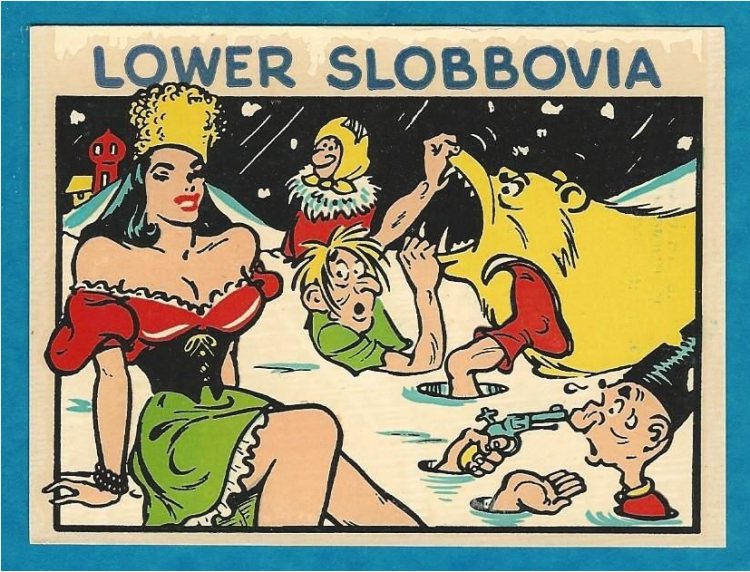
  1. Lower Slobbovia — This one has a certain feel to it that seems to capture where Trump is determined to take the country. It was coined by Al Kapp of “Li’l Abner” fame, and as Wikipedia notes has come to invoke “a place which is underdeveloped, socially backward, remote, impoverished or unenlightened,” or “any foreign country of no particular distinction.” You know, a place that is in no way exceptional. Which seems perfect, if we can get the rights to it.

    Rufus T. Firefly dreaming up fresh mayhem for Freedonia.

    Rufus T. Firefly dreaming up fresh mayhem for Freedonia.

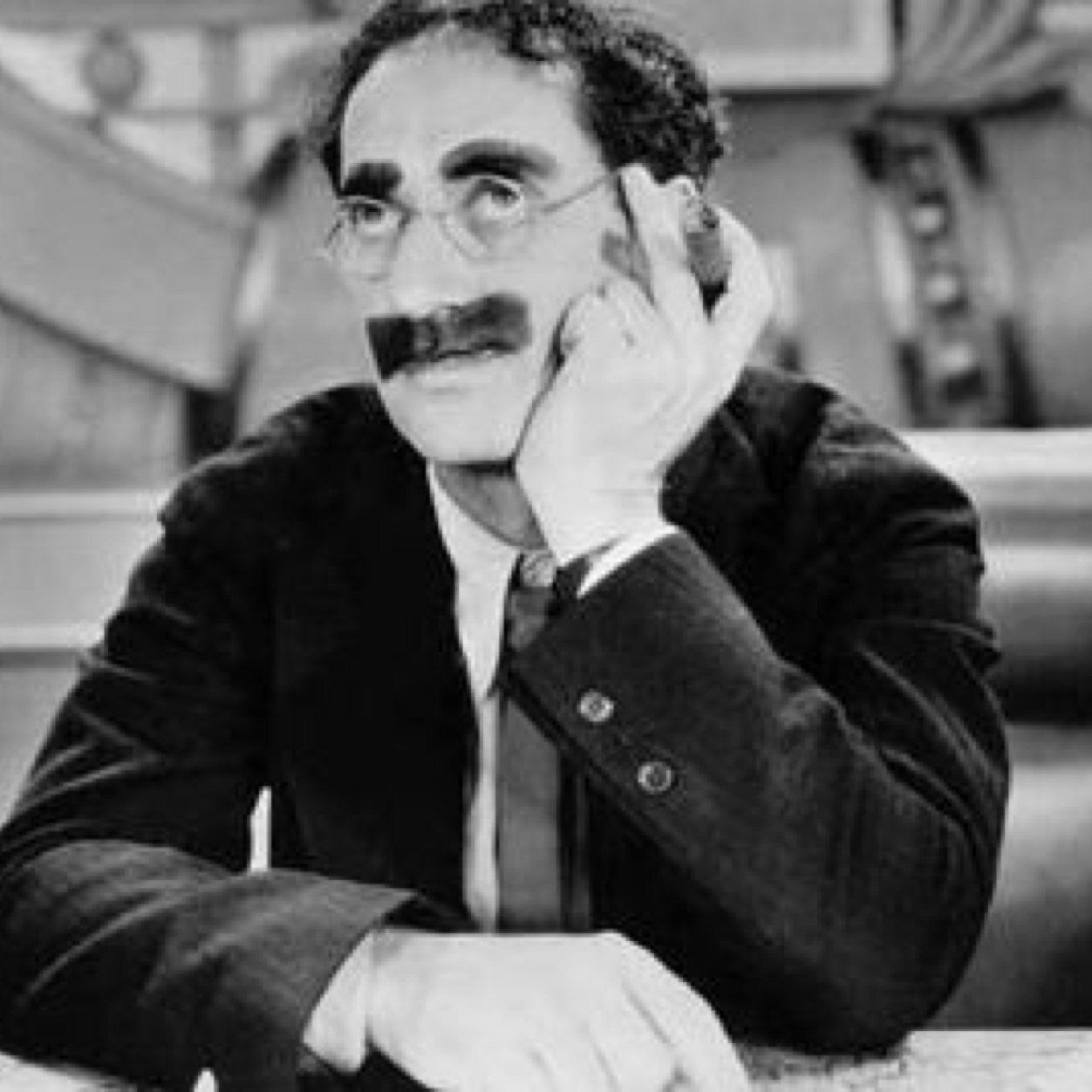
  2. Freedonia — In “Duck Soup,” this was the insignificant country governed by a crude, ill-mannered clown named Rufus T. Firefly (Groucho Marx). I’ll leave it to you to draw the parallel. Also, this should appeal to the Tea Party crowd, since early on, some Americans actually considered calling this country by a variant of that name.
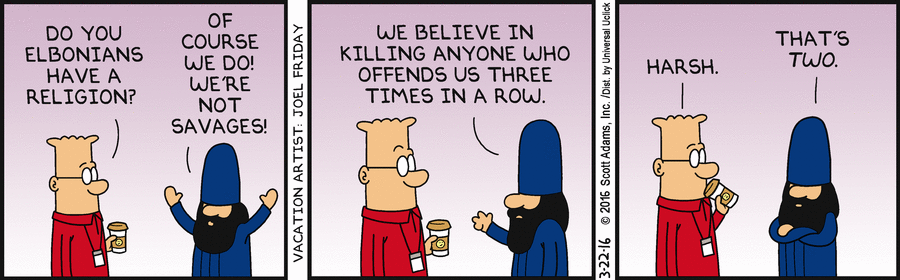
  3. Elbonia — The fictional country from “Dilbert” is “ruled by presidential dictatorship,” and its main export is mud.
  4. Bizarro America — Inspired by Superman comics. The Bizarro World is a place where everything is the reverse of what it is on this planet. Up is down, wrong is right, etc. Again quoting Wikipedia, “‘Bizarro World’ has come to mean a situation or setting which is weirdly inverted or opposite to expectations.” The name would announce to the world that America is now the opposite of what it was.
  5. Tomainia — That’s the country in Charlie Chaplin’s “The Great Dictator.” But since this was a satire about Hitler’s Germany, we’ll probably have to avoid it so that people don’t start yelling “Godwin’s Law!” at us, the way they always do.

Those are my suggestions. Any others out there?

Dt160322

If we had nothing else, this one small thing would show how unhinged Trump is

Forget dumping TPP, “alternative facts,” threats to bring back torture, the Wall, the admiration for Putin, “grab her by the p___y,” Alicia Machado and all the rest.

Try to imagine that up to now, Donald Trump has acted like a perfectly normal, grounded, mature human being.

This one interview would be enough to make you say, “This guy’s lost it!”

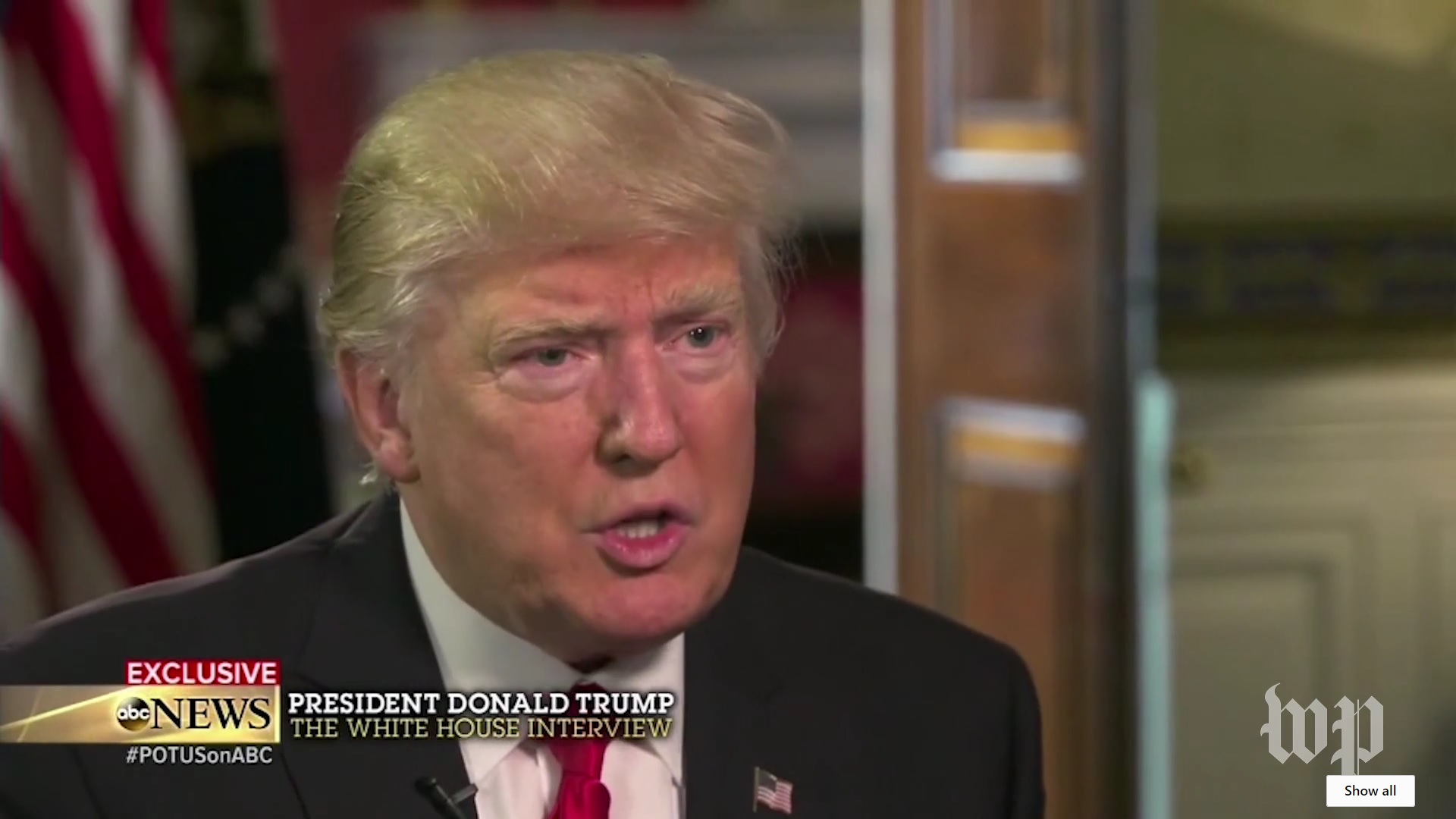
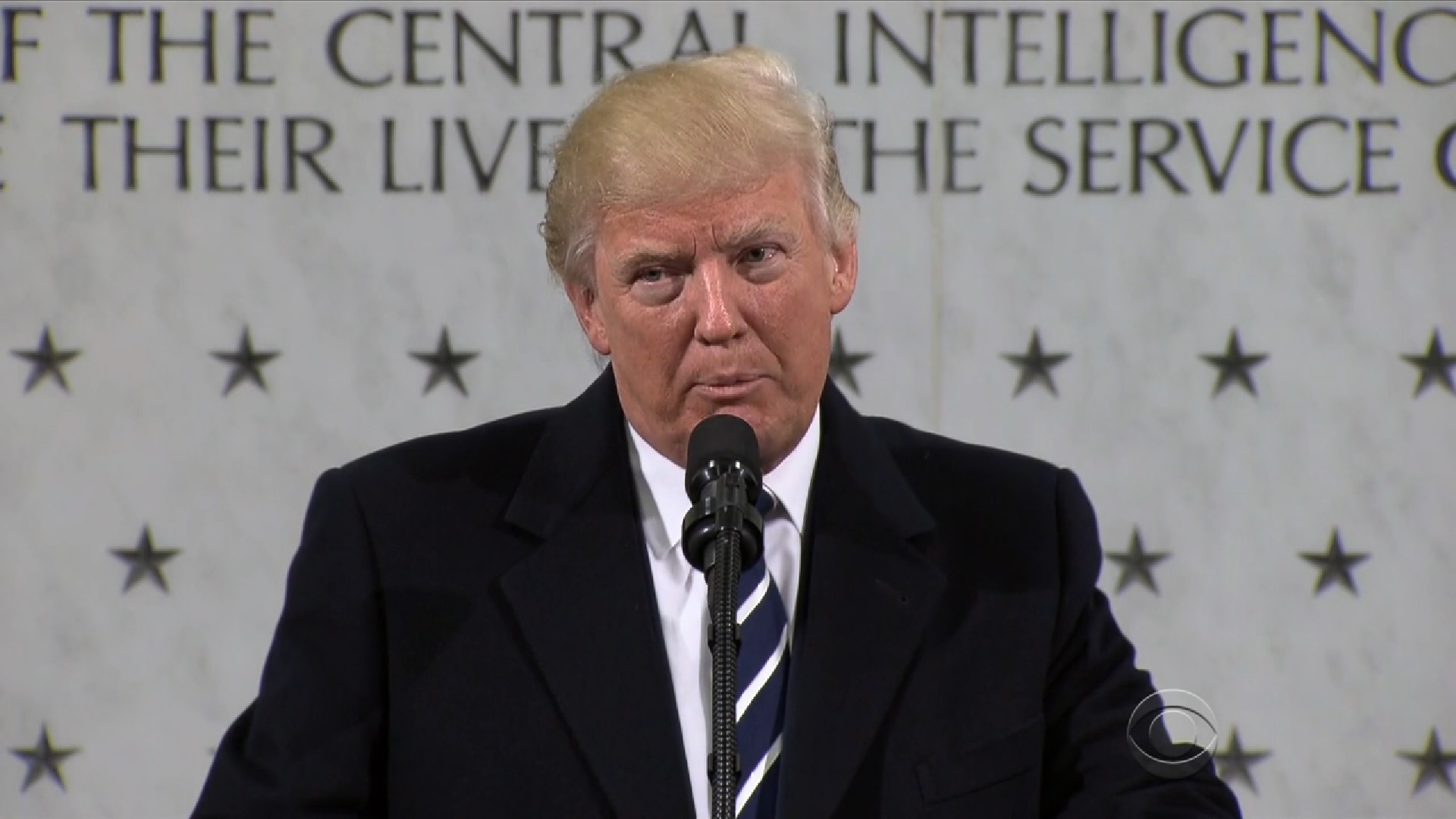
The way President Trump tells it, the meandering, falsehood-filled, self-involved speech that he gave at the Central Intelligence Agency headquarters was one of the greatest addresses ever given.

“That speech was a home run,” Trump told ABC News just a few minutes into his first major television interview since moving into the White House. “See what Fox said. They said it was one of the great speeches. They showed the people applauding and screaming. … I got a standing ovation. In fact, they said it was the biggest standing ovation since Peyton Manning had won the Super Bowl, and they said it was equal. I got a standing ovation. It lasted for a long period of time.”

The most powerful man in the world continued: “You probably ran it live. I know when I do good speeches. I know when I do bad speeches. That speech was a total home run. They loved it. … People loved it. They loved it. They gave me a standing ovation for a long period of time. They never even sat down, most of them, during the speech. There was love in the room. You and other networks covered it very inaccurately. … That speech was a good speech. And you and a couple of other networks tried to downplay that speech. And it was very, very unfortunate that you did.”…

It’s like he was trying to outdo Alexandra Petri’s satirical column (“The true, correct story of what happened at Donald Trump’s inauguration“) spoofing how awesome Trump thinks his inauguration was.

Soon, it will become impossible to lampoon him, as nothing satirists will be able to dream up will exceed the things he actually says.

Seriously, who talks like this? If you’d never heard of the guy, and heard him talking this way about himself, you’d start to steadily back away, trying to make no sudden moves…

trump interview

Trump just handed the Pacific Rim to China

Trump, thinking hard before killing TPP. Feel free to laugh bitterly.

Trump, thinking hard before killing TPP. Feel free to laugh bitterly.

Well, he didn’t just do it. I tweeted about it eight hours ago, but now let’s discuss it here.

Here’s what’s happened:

President Trump began recasting America’s role in the global economy Monday, canceling an agreement for a sweeping trade deal with Asia that he once called a “potential disaster.”

Trump signed the executive order formally ending the United States’ participation in the Trans-Pacific Partnership in the Oval Office after discussing American manufacturing with business leaders in the Roosevelt Room. The order was largely symbolic — the deal was already essentially dead in Congress — but served to signal that Trump’s tough talk on trade during the campaign will carry over to his new administration….

“This abrupt action so early in the Trump administration puts the world on notice that all of America’s traditional economic and political alliances are now open to reassessment and renegotiation,” said Eswar Prasad, trade policy professor at Cornell University. “This could have an adverse long-run impact on the ability of the U.S. to maintain its influence and leadership in world economic and political affairs.”…

Yeah, well, that’s not all it can do, and probably will do.

We’ve heard a lot of nonsense in the past year about TPP, most of which had little to do with what was actually at stake. There was a good piece summing up the situation fairly neatly in the NYT in November after the election. First, it explained, “the deal, between the United States and 11 Asian and Pacific nations, was never just about trade.” So what was it about? Serious, sweeping, grownup-level geopolitics:

The agreement, the Trans­-Pacific Partnership, was conceived as a vital move in the increasingly tense chess match between China and the United States for economic and military influence in the fastest­-growing and most strategically uncertain part of the world. The deal, which excluded China, was intended to give those 11 nations more leverage in that strained match by providing them with a viable economic alternative. And its defeat is an unalloyed triumph for China, the country that President­-elect Donald J. Trump castigated repeatedly over trade…

Now, instead of Pacific Rim nations gathering under American leadership, growing closer in the face of increasing lawless aggression by China, we have China moving to do much the same deal under its own leadership, freezing us out.

And we’re not just talking about weak-kneed nations in China’s geographic shadow, or some of the usual suspects in our own hemisphere, where the Chinese have been steadily wooing friends for a generation:

Australia said on Wednesday that it wanted to push ahead with a Chinese-­led trade pact that would cover Asian nations from Japan to India but exclude the United States. Peru has opened talks with Beijing to join the agreement as well. Even American business leaders are positioning themselves for the potential opportunities in Asia…

Et tu, Australia? One of our four closest friends in the world?

Of course, none of this matters a bit to Mr. America First, who likes to grumble at China but will hand Pacific leadership to it in order to curry favor with his isolationist, xenophobic base.

We’ve been in danger on this issue all year, with gratuitous populism washing over both ends of our political spectrum.

Some of my interlocutors here like to excuse Trump now and then by castigating Hillary Clinton for this or that. Everyone has his or her favorite Hillary sins to cite. Well, you know what I think is the most reprehensible, unprincipled thing she did in the past year?

It was turning away from TPP. And it was the worst because she knew better. Sanders and Trump didn’t but she did. And she lacked the confidence, security and character to stand up to the Feel the Bern crowd, even as the grownups in the Obama administration were working double tides to salvage sound policy.

So we were headed toward the wrong door either way. The only hope was that she might have hesitated when it came time to kill this “gold standard” (her words) agreement outright.

Trump, who is not burdened by knowing better, did not hesitate for an instant. And now, no doubt, they’re breaking out the Maotai in Beijing, because an advantageous position for the cause of freedom in the world just got flipped upside-down….

Trump’s grotesque first outing, and ‘alternative facts’

Trump preening in front of Langley's Holy of Holies.

Trump preening in front of Langley’s Holy of Holies./Still from CBS video.

Before I even knew what he said Saturday, I cringed at the image: Donald Trump… who has likened our intelligence community to Nazi Germany for its sin of having told the truth about Russia injecting itself into our election on his behalf… standing in front of the wall at Langley that honors CIA officers killed in the line of duty.

That, alone, was grotesque. But hey, maybe that’s not Trump’s fault. Maybe the CIA people set it up for him to stand there. Move on…

Then I learned what he said while he was there. He was there to mend fences — and good for him wanting to do that, and making it a priority. But he dishonored those assembled and even more those on the wall by spending a huge portion of his time moaning about the awful media and how they lie all the time.

What would be the pettiest “lie” for him to focus on? Yep, he claimed that the turnout for his inauguration was greater than it was, and lambasted the media for reporting it accurately.

He went on and on about it. To some who were there, it seemed he spent most of his time  talking about his grievance with the media rather than mending fences with the CIA. That’s not quite the case. Here’s a transcript of his rambling, hard-to-follow monologue (no, President Trump will not be any more coherent than the candidate was). I went through and tried, as well as I could, to separate the “CIA” parts from the “me, me, ME!” parts. My rough division came up with 1,450 words in the CIA sections, and 937 words that were purely moaning about himself and the media.

Still, pretty bad. And worse if you consider that he finds it hard to talk about the CIA without self-aggrandizement showing up in the same sentence. An example:

You know, the military and the law enforcement, generally speaking, but all of it — but the military gave us tremendous percentages of votes. We were unbelievably successful in the election with getting the vote of the military. And probably almost everybody in this room voted for me, but I will not ask you to raise your hands if you did. (Laughter.) But I would guarantee a big portion, because we’re all on the same wavelength, folks. (Applause.) We’re all on the same wavelength, right? He knows. It took Brian about 30 seconds to figure that one out, right, because we know we’re on the same wavelength.

But we’re going to do great things….

Maybe I shouldn’t have included those 114 words in the “CIA” file, since it’s so “me, me, me.” But hey, that’s how this guy reaches out to people. The basic form is, Wow, I am so great and awesome, and I know you appreciate that, so you’re great, too. I include you in my awesomeness.

So it’s hard to know what to put in the “focusing on others” category, and what is purely “focusing on me.”

A side note about the part about him and the media: He mentioned one actual error that one reporter had committed (a TIME reporter failed to see the bust of MLK in the Oval Office, and reported it was missing) — and then corrected right away as soon as he knew it was wrong. Which is what reporters do, immediately, when they report things that aren’t right. Trump, of course, uses the incident to suggest that this is but one example of the dishonesty of the media. (At least, that seems to be what he’s saying. As usual, it’s a bit hard to parse. At one point, he’s excusing the mistake; at another, he’s attaching universal significance to it.)

Note that Trump couldn’t even tell this anecdote without an extensive, childishly pathetic digression about how awesome he is: “So a reporter for Time magazine — and I have been on there cover, like, 14 or 15 times. I think we have the all-time record in the history of Time Magazine. Like, if Tom Brady is on the cover, it’s one time, because he won the Super Bowl or something, right? (Laughter.) I’ve been on it for 15 times this year. I don’t think that’s a record, Mike, that can ever be broken. Do you agree with that? What do you think?” Just, wow.

And how were the media being dishonest? By truly reporting a simple fact: The crowd that turned out for Trump’s inauguration was smaller than those for Obama in 2009 and 2013. This is obviously, clearly true, whether you go by photographs or Metro ridership. Here’s the 2009 crowd, and here’s the 2017 crowd. And it’s no big deal. Only the most fragile and insecure of men would be bothered by such a fact being reported. Hey, it was raining — so who cares, right?

Trump cares. Trump cares bigly. And therefore, so do his people.

That same day, we were treated to what may have been the most extraordinary White House press briefing in history — and hey, this was just the press secretary’s first outing! He marked the occasion by fuming at the reporters that lies were truth and truth was lies. His lies were patently obvious ones, easily refuted. And after spouting these lies, he stormed off without taking questions, which would have been remarkable in itself.

Already, this guy has made us nostalgic for the honesty, affability and quiet reason of Ron Ziegler.

OK, so a new administration’s rookie press secretary gets up and makes a jackass of himself in his first at bat. So you acknowledge it and move on, right? You hope to do better in the next game.

Nope. Not this team. The media’s refusal to embrace this lie about how many people attended the inauguration is, in their minds, the first crisis of the new administration, and calls for lashing out and circling the wagons.

The next morning, Kellyanne Conway responded to Chuck Todd’s questions about Sean Spicer’s bizarre performance by saying:

Don’t be so overly dramatic about it, Chuck. You’re saying it’s a falsehood, and they’re giving — our press secretary, Sean Spicer, gave alternative facts to that.

And she was serious about that! Watch the video below.

OK, so now you have it: This new administration that was going to “Make America Great Again” spent its first weekend in power engaging in a full-court press insisting that a lie was true. Insisting adamantly, because this utterly trivial matter is of the highest importance to this crowd, because anything bearing on his fragile ego is of the highest importance to the new president!

And that the new president kicked off this farce while standing in front of a monument to patriots who died in the darkness, without credit or acclaim, transforms what might otherwise be low comedy into obscenity.

Our very first (fill in the blank) president

The saddest thing I saw this morning was United States Marines saluting as Trump arrived at the White House. All these years they kept their honor clean. Now this...

The saddest thing I saw this morning was United States Marines saluting as Trump arrived at the White House. All these years they kept their honor clean. Now this. Not their fault, of course. They’re doing their duty as always. But as someone would say: Sad!

Initially, I saw this in the Post this morning:

John F. Kennedy was the first Catholic president; Ronald Reagan, the first actor and also the first to have divorced; Barack Obama, the first African American….

And was going to Tweet, “And today we swear in our very first idiot president.” But if I Tweeted it, it would also be seen by the politer souls of Facebook, and there could be hurt feelings. And Jesus told us that “whosoever shall say, Thou fool, shall be in danger of hell fire.” Which should most certainly give us pause. And my wife, my conscience, really doesn’t like it when I call people idiots, however richly they have deserved the honor.

So I’m trying to dial that back. Today sorely tries that resolution, but I’m trying to keep it nonetheless. As I type this, I’m listening to some Donovan in the hope that will gentle me, or at least serve as a soporific, something to numb me (Season of the Witch, indeed! So strange..). We’ll see if it works. Laudanum would probably work better.

But back to that Post story about the precedents being set today. A few examples from the list of what Donald J. Trump is:

  • The first president to have never performed public service, either by holding public office or serving in the military….
  • At age 70, the oldest man to be inaugurated president. (Ronald Reagan was 69.)…
  • The first president to be the subject of a Comedy Central Roast….
  • The first president to have not disclosed his tax returns during the campaign since the tradition began in 1976….
  • The first president to have hosted a reality show.
  • And the first to still hold the title of executive producer of one….
  • The first president to appear on Howard Stern’s radio program. Repeatedly. And brag about his sex life and discuss women’s appearances….

I’ll stop there, as I may have exceeded the bounds of Fair Use already. But I should set straight one “first” that is not. The story notes that “He will not be the first to be married to a former model. Betty Ford also modeled. However, he will be the first to be married to a former model who posed topless.”

So we have that to celebrate.

For their part, the folks at The Wall Street Journal protested that “Mr. Trump isn’t wholly unique.” Perhaps not wholly. For instance, they note that “Mr. Trump likes to play golf, a pastime many past presidents relished.”

So there’s that, too, but it’s thin stuff. And in the end, in the Journal story as well, it’s the departure from all that this country has previously experienced that stands out. We were blessed for so long, and being flawed humans, we didn’t properly appreciate it…

Trump point

And now, we have China threatening ‘a large-scale war’

China's one and only aircraft carrier, which they bought used./U.S. Navy

China’s one and only aircraft carrier, which they bought used./U.S. Navy

Or rather, we have state-controlled media doing so, which is a signal I think we have to take seriously:

The US risks a “large-scale war” with China if it attempts to blockade islands in the South China Sea, Chinese state media has said, adding that if recent statements become policy when Donald Trump takes over as president “the two sides had better prepare for a military clash”.

China has controversially built fortifications and artificial islands across the South China Sea. Rex Tillerson, Trump’s nominee for secretary of state, said China’s “access to those islands … is not going to be allowed”.

China claims nearly the entire area, with rival claims by five south-east Asian neighbours and Taiwan.

Tillerson did not specify how the US would block access but experts agreed it could only be done by a significant show of military force. Tillerson likened China’s island building to “Russia’s taking of Crimea”.

“Tillerson had better bone up on nuclear power strategies if he wants to force a big nuclear power to withdraw from its own territories,” said an editorial in the Global Times, a Communist-party controlled newspaper….

I’m not disagreeing with anything Tillerson said, mind you — and it’s not all that different from the policy followed by the Obama administration — but the current situation is fraught.

On a previous post about Nikki Haley, Phillip Bush said:

That’s going to be a tough job, representing the views of the United States to the United Nations and the world when your own Administration is going to be one squabbling, Tweeting, contradictory, capricious, incoherent mess, especially on foreign policy. Her greatest challenge will come not from fellow delegates at the UN or on the Security Council, but trying to sort out and gracefully convey the day-to-day contradictions emanating from the government she is appointed to represent….

Yep.

One of the main narratives of this week has been that Trump’s nominees are not toeing the Trump line, particularly on foreign policy. Which in one way is encouraging (the nominees’ take is usually far wiser and better-informed), but in another way can lead to chaotic, incoherent policy, an unstable situation in which an unstable personality (hint, hint) can trigger an international crisis, perhaps even war, with a phone call — or a Tweet.

I have little doubt that Nikki Haley will conduct herself “gracefully,” but I do worry quite a bit about a diplomatic novice representing us on the Security Council without expert supervision and direction. That said, in a crisis, Nikki would be the least of my worries. And of course, the new POTUS would be my greatest.

What if, sometime after next Friday, Chinese state media issues a blustering threat like that, and includes some less-than-flattering reflections on Trump himself? How do you suppose he’ll react? And who will be able to contain him? And will they be in time?

All the President-Elect’s Men

Remember the last scene of “All the President’s Men?” If you don’t, you can watch it above.

Pretty powerful. On a television on a desk in the newsroom of The Washington Post, Richard Nixon is seen triumphant, being inaugurated for the second time as president. In the background, across the newsroom, Bob Woodward and Carl Bernstein (OK — Robert Redford and Dustin Hoffman, really) are not watching the event, because they’re too busy pounding out one of the stories that will bring Nixon down.

We experienced a moment like that tonight. In a prelude to the inauguration of Donald Trump next week, President Barack Obama was delivering a particularly graceful valedictory address — our last worthy, fit president reminding us of the values that America is supposed to be about. The feeling of the passing of American greatness was palpable. We had a good run there, for 44 presidents. Or 43, if you leave out James Buchanan.

Half of Twitter — including me (you can go peruse my Tweets) — was writing about that. The other half was writing about this, which corresponds to the counterpoint of Woodstein hammering away at the story that will doom the new president. Check this out:

Or this version:

Or, if you’re into the salacious, this:

Wow. I mean, just… wow.

This is early. The picture is incomplete. There’s always the chance that, as Trump claims, this is “FAKE NEWS – A TOTAL POLITICAL WITCH HUNT!” After all, there’s a lot of that going around lately.

But I have never, ever heard of allegations like this, however flimsy, being made about anyone about to become president of the United States. That alone makes this unprecedented.

The report alleges that, while Trump turned down some sweet deals offered by the Russians, “he and his inner circle have accepted a regular flow of intelligence from the Kremlin, including on his Democratic and other political rivals.” Yeah, and “FSB has compromised Trump through his activities in Moscow sufficiently to be able to blackmail him.”

Who knows at this point what’s true? For their part, though, our top intelligence chiefs found it worthy of passing on to the current and future presidents last week.

Here’s a caveat in The Guardian‘s story:

Despite glowing references from US and foreign officials who have worked with the source, there are some errors in the reports. One describes the Moscow suburb of Barvikha as “reserved for the residences of the top leadership and their close associates”, but although it is a very expensive neighbourhood, there are no restrictions on who can own property there. The document also misspells the name of a Russian banking corporation…

Must give us pause. But speaking of misspellings, The Guardian mentioned “Senator Lyndsey Graham” in the same story.

I don’t know where this is going to go. But it feels like one of those moments. You know, like in the movie…

hqdefault

Of course, we don’t know the Russians DIDN’T win it for Trump, either — and that’s the genius in what they did

As serious people do everything they can to persuade Donald Trump and his followers that they must take the Russian attack on the bedrock of our democracy seriously, they keep stressing, in the most soothing tones they can muster:

We’re not saying the Russians threw the election to Trump. We’re saying they tried to, and that’s something that must be taken seriously, however you voted…

I’ve done the same thing here, repeatedly, although with no discernible effect.

And I and others will keep on saying it, because it’s true: We don’t know, we can’t know, whether Russian meddling actually threw the election to Trump.

Of course, there’s an unstated second side to that coin. If we don’t know Putin decided the election, we don’t know that he didn’t, either.

And that’s the side of the coin that I think everyone sort of instinctively understands, and which therefore makes this conversation so difficult.

Here’s the problem: It was a close election, so close that Hillary Clinton lost the Electoral College while winning the popular vote. That means any one of a number of factors could, by itself, account for the losing margin.

In other words, it’s not only possible but perhaps likely that all of the following elements had to be present to get Trump to an Electoral College win:

  • Let’s start with the biggie: The fact that the Democrats nominated the most hated major-party nominee in modern history, except for Donald Trump himself. This is the major factor that, while it couldn’t give him the win (since he was despised even more), it kept him in the game from the start. All other factors after this are minor, but remember: the whole thing was so close that it’s possible that every minor factor had to be present as well.
  • Clinton’s private server. Assuming this had to be present, she doomed herself years ago.
  • Her fainting spell. Here the Russians were, working like crazy to spread rumors about her health, and a moment of human weakness hands them this beautifully wrapped gift.
  • Comey’s on-again, off-again investigations. I’m not saying he was trying to sabotage the election, but if he had been, his timing couldn’t have been better.
  • The anti-qualifications madness sweeping through the electorate across the political spectrum. This populist surge produced both Trump and Bernie. In this election, solid credentials were a handicap. And poor Hillary had a great resume, as resumes have historically been judged.
  • The Russian operation, which gave us a drip-drip-drip of embarrassments (none of which would have amounted to anything alone) with the hacked emails, and a really masterful disinformation campaign as Russians blended into the crowd of alt-right rumormongers.

Could Trump still have won if you took away the Russian efforts — or the FBI investigations, or Hillary’s pneumonia, or any other factor? Well, we don’t know. We can’t know — an individual decision to vote a certain way is composed of all sorts of factors. I can’t give you a breakdown, with percentages, weighting every factor that goes into my own voting decisions — even though I’ve had all that practice over the years explaining endorsements. So I certainly couldn’t do it in assessing the decisions of millions of voters out there. And there’s no way to correlate the effect of any single factor meaningfully with the actual vote totals in the states Trump won.

So we don’t know, do we? The Russians think they know, which is why our intelligence establishment detected them high-fiving each other over Trump’s victory. But they can’t know, either. They certainly didn’t know they’d accomplished their goal before the vote, because they were geared up to sow doubts about the legitimacy of what they expected to be a Clinton victory.

It’s safe to say Trump wouldn’t have won if those other factors hadn’t been present. But I don’t see how we will ever know whether Russian meddling put him over the top.

And as much as anything, that is the most brilliant stroke by the Russians. The effect of what they did can’t be measured. Consequently, they have us doubting ourselves, flinging accusations about motives and completely divided in our perception of reality. We’ll probably be fighting over this for as long as this election is remembered.

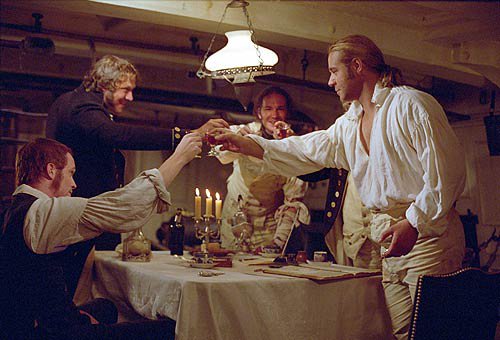
I’ve mentioned this before, but I will again, for Bryan’s sake if no one else’s: In the Patrick O’Brian novels he and I enjoy so much, a favorite toast for Royal Navy officers in the early 19th century was “Confusion to Bonaparte,” or just, “Confusion to Boney.”

The ideal codename for the Russian operation messing with our election would be “Confusion to America.” Because there’s no doubt that they have achieved that

"Confusion to Boney!"

“Confusion to Boney!”

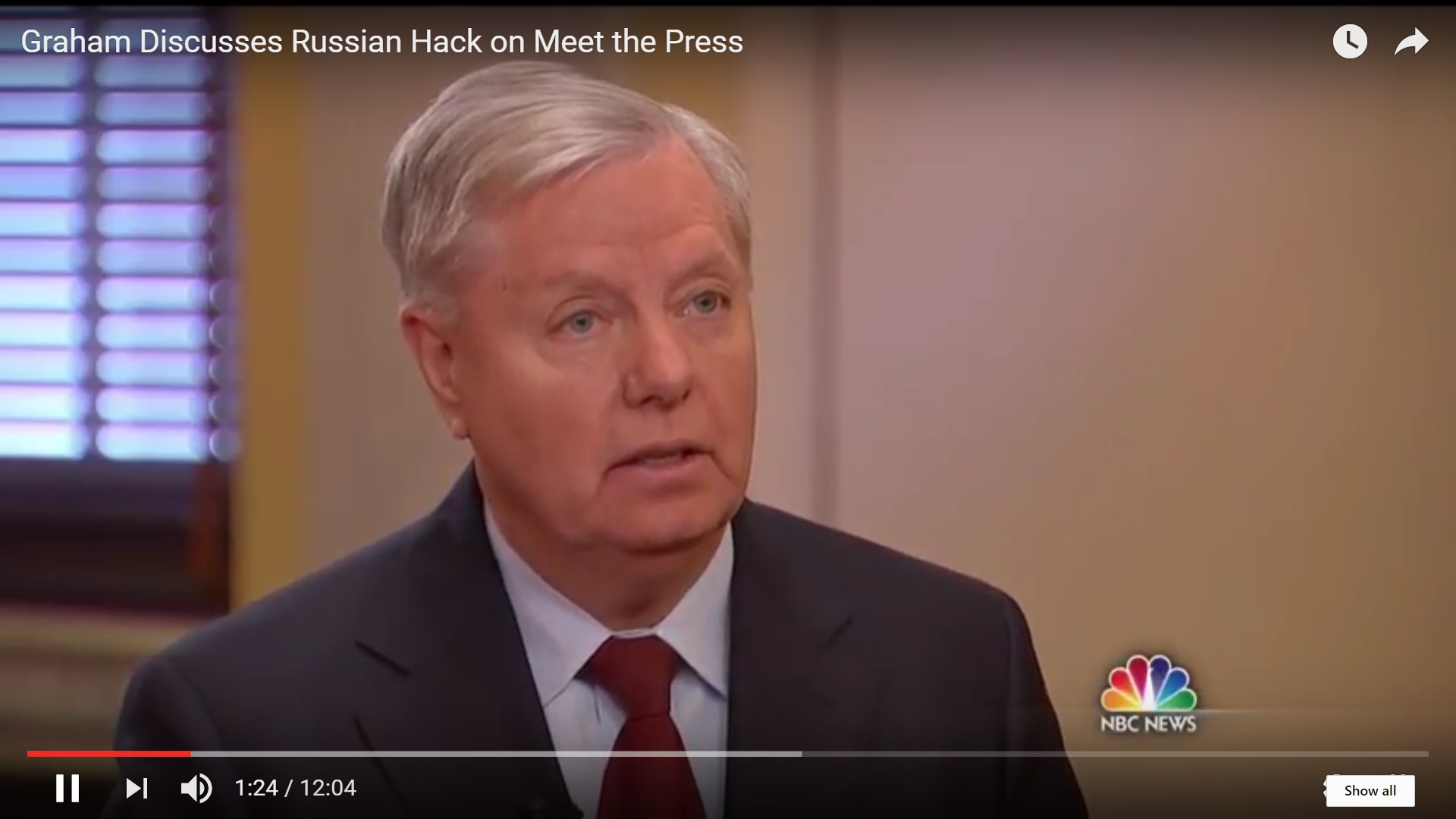
Graham to any Republican who discounts Russian actions: “You are a political hack.”

Some excerpts from Lindsey Graham’s appearance on “Meet the Press” on Sunday:

All I’m asking [President-elect Trump] is to acknowledge that Russia interfered [in our election] and push back. It could be Iran next time, it could be China. It was Democrats today, it could be Republicans in the next election….

Our lives are built around the idea that we’re free people, that we go to the ballot box, that we have political contests outside of foreign interference. You can’t go on with your life as a democracy when a foreign entity is trying to compromise the election process. So Mr. President-elect, it is very important that you show leadership here….

We should all – Republicans and Democrats – condemn Russia for what they did. To my Republican friends who are gleeful: you’re making a huge mistake. When WikiLeaks released information during the Bush years about the Iraq War that was embarrassing to the administration, that put our troops at risk, most Democrats condemned it, some celebrated it. Most Republicans are condemning what Russia did, and to those who are gleeful about it, you’re a political hack. You’re not a Republican, you’re not a patriot. If this is not about us, then I’ll never know what will be about us. Because when one party is compromised, all of us are compromised….

graham-still

Will Graham and McCain stand alone against Trump on intel?

Donald Trump’s insistence on doubting intel indicating that the Russians tried to tip the election in his favor is a remarkable instance of his flaws coming together over one issue.

Combine his lack of faith in people who obviously know more than he does (a large set) with his inferiority complex (in this case, his touchiness over the suggestion that anything other than his own wonderfulness won the election for him), and you have a guy willing to sacrifice the nation’s intelligence-gathering apparatus for the sake of his own fragile ego. This, of course, takes petty self-absorption to a level previously unseen in U.S. history.

Which is, you know, a pretty good illustration of why it was utterly insane for anyone to consider for a moment voting for him to be president of the United States. But that’s water under the bridge, right? This is the irrational world in which we now live.

I was a bit encouraged when I saw this headline leading The Washington Post this morning: “Trump’s criticism of intelligence on Russia is dividing Hill GOP.” An excerpt:

McCain will hold a Senate Armed Services Committee hearing Thursday on “foreign cyber threats” that is expected to center on Russia. Intelligence officials — including Director of National Intelligence James R. Clapper Jr., Defense Undersecretary for Intelligence Marcel J. Lettre II and U.S. Cyber Command and National Security Agency Director Michael S. Rogers — will testify, and some Republicans are hoping they will present evidence that Russia meddled in the elections.

“The point of this hearing is to have the intelligence community reinforce, from their point of view, that the Russians did this,” Graham said. “You seem to have two choices now — some guy living in an embassy, on the run from the law for rape, who has a history of undermining American democracy and releasing classified information to put our troops at risk, or the 17 intelligence agencies sworn to defend us. I’m going with them.”

Graham was referring to Julian Assange, the WikiLeaks founder accused of helping Russia leak emails hacked from the Democratic National Committee….

Unfortunately, it’s not much of a split, going by this story. So far, it looks a bit like another case of John McCain and our own Lindsey Graham standing on the side of reason and national security, and too many others cowering, unwilling to tell the incoming emperor the obvious: that he has no clothes, and that it’s not a good look for him.

Sure, McConnell has spoken up in the past, and Marco Rubio might get on board with McCain and Graham. And Paul Ryan, bless him, had the presence of mind to call that Assange creep a “sycophant for Russia.”

But only time will tell whether the GOP Congress will live up to its obligation to check and balance the absurdities of our president-elect…