Category Archives: Midlands

Before you fill up, here are a few safety tips…

When I was leaving the Marionette Theatre the other day, I decided to swing by Columbia’s Hydrogen Fueling Station, since I was close by and had never seen it before.

The good  news was that, had I been driving a hydrogen car, there would have been no waiting.

The bad news was the really scary series of warnings posted at eye level.

But then I got to thinking — such warnings would have been a good idea at the very first gasoline fueling station in a community, back in the days when folks weren’t accustomed to working with that extremely volatile substance.

Come to think of it, we DO have such warnings at gasoline stations — along with those that tell us not to operate our cellphones, and to place a container on the ground before pumping into it. We just tend not to notice them any more.

There’s a tradeoff with so many things that pack a lot of energy — gasoline, hydrogen, coal, nuclear. Once you get the economics to work — which tends to be tougher with the lower-risk sources such as wind and solar — it becomes a matter a matter of engineering things to minimize risk. Or so it seems to my nonexpert mind.

I’m seeing inspiration for yet another really tacky Christmas song here

An alert source whom I shall keep anonymous shared this with me via email over the weekend. I wrote back to ask, “Is this a real Santa, or a mannequin?” and I was assured it was a real guy. My source was NOT going into the club in the picture, but was attending to important business across the street at the Central Midlands Council of Governments. Or so my source says, and I believe my source.

There’s a really tacky Christmas song in this somewhere. Something like “I Saw Mommy Kissing Santa Claus,” or “Santa, Baby.” Something really, really not in the spirit. Something like the thing I heard this morning for the first, and I hope, the last, time, which I think is called “Gonna Get Drunk, Drunk, Drunk on Christmas.”

Court unanimously finds against McMaster

Kathryn, to whom I think the topic is near and dear, brings this to my attention:

Former state Attorney General Henry McMaster on Monday lost his legal challenge as a landlord of Columbia’s law that barred students from creating mini-dormitories in residential neighborhoods.

In a 5-0 vote, the S.C. Supreme Court rejected McMaster’s argument that the city’s zoning ordinance capping at three the number of unrelated people who may share a residence. McMaster, through his PJM Properties, contends the ordinance violated the state constitution’s due process clause…

For those who wish to delve deeper, here’s a copy of the actual decision.

Where the synapses meet: AT&T’s switching center

First, let’s take a moment to welcome new advertiser AT&T. You may have heard of this outfit. It only employs 2,477 people in South Carolina, with a payroll of $173 million. Not to mention handling all those billions of texts. And now it’s hit the big time — advertising on bradwarthen.com. (See the new ad at the top of the stack on the right.)

Today, coincidentally, I visited the nerve center of it all, the very synapses that handle 90 percent of AT&T’s wireless traffic in South Carolina. Where was that? Well, I can’t tell you. That was a condition of my going there. Very hush-hush.

But here are some pictures I managed to smuggle out. That’s OK; you don’t have to thank me. I live to serve.

AT&T’s Pam Lackey and other officials had invited a number of media and economic development types out to let us know that the company has spent $125 million this year in SC to improve wireless service, including new cell sites and the upgrade of dozens of others. For instance, Forest Acres should see improved service from a new cell site at Trenholm Road and North Beltline. Meanwhile, 60 towers in Richland County have been upgraded with “enhanced backhaul connections,” which has something to do with enabling 4G speeds.

AT&T was showcasing its processing power today because increasingly, that’s what it’s about, explained Laurent Therivel, AT&T’s vice president and general manager of Mobility & Consumer Markets for North Carolina and South Carolina. Consumers are less interested in, say, how many songs they can store on a device; they want to make sure they have a good connection to Pandora. Even such apparently device-specific functions as Siri are all about the network. Smart as she is, if you don’t have a good network, Siri can’t think.

As we toured the facility, I heard a lot about MTSOs and RNCs and MSCs, and GSM vs. CDMA, and I nodded and hoped there wouldn’t be a quiz at the end. And tried not to bump into anything. And I kept my mouth shut as to what I was thinking: A bunch of wires running in and out of boxes, and that’s what enables my iPhone to work as it does? I still think it’s magic.

What’s the most interesting thing that I actually learned and absorbed, aside from the fact that AT&T is really serious about enhancing customer service? This: The whole thing runs on batteries.

Really. At  one point, we were in this room that was like all the others, except a little chillier and darker. But the stacks of electronic paraphernalia in that room consisted entirely of batteries rather than high-tech switching equipment. Basically, the idea is that it doesn’t matter whether the grid is working or backup generation, so long as the batteries get recharged. If there’s an outage, the network never knows the difference.

I would never have guessed that, although I suppose that’s one way to make sure the call — or text, or data — always goes through.

The few, the proud, the 23 percent

On a comment thread recently, we had another one of our periodic discussions of who (among political types) served in the military when and who did not, with all the attendant side comments about how those fellas on the other end of the political spectrum (whichever end you happen to be on) are a bunch of duty-shirking cowards, etc.

At some point, of course, I got into the thing about how I never had the chance to serve because of the rather minor problem of chronic asthma (for which I’m taking prednisone again this week, and it’s working fine, thanks).

I was reminded of this today, because Maj. Gen. James Milano spoke to the Columbia Rotary Club, and he once again mentioned a statistic that boggles his mind and seldom fails to impress others…

What percentage, he asked Rotarians, of Americans aged 17-24* can meet the basic qualifications to serve in the U.S. Army today?

The answer: 23 percent. “And we’re not looking for astrophysicists and Olympic athletes,” he elaborated.

So… more or less, that means that 77 percent of young Americans are what previous generations described as 4-F.

We have an all-volunteer military, and with the economy the way it is, the Army can kind of pick and choose among recruits, but only 23 percent are up to snuff.

He didn’t break it down in terms of how many were due to this or that cause, although he listed some disqualifiers:

  • Asthma. (So no point in my stepping forward.)
  • Having been on anxiety medications.
  • Basically, being on any medications as of the day you report. If you can’t do without, you can’t join the Army.
  • Criminal record (which the general broadened, saying “any type of immoral behavior,” but no one asked for an elaboration and he didn’t offer one).
  • Lack of a high school diploma. The Army was taking GEDs before, not now.

Bottom line, he seemed mostly worried about general lack of physical fitness. You can be 4 percent over the weight limit when you show up for basic, because they’ll work that off of you with little trouble. But beyond that, forget it.

Once the Army’s got you, you’ll probably make it, though. The general said recruits are treated these days like professional athletes in training — zero fried foods, with drill instructors looking at what you put on your tray and letting you know if you’re not picking the right items in the chow line. Physical trainers work to prevent injuries, and help soldiers overcome them when they occur. Consequently, there’s only about a 7 to 8 percent washout rate due to physical problems.

The general worries a great deal about our out-of-shape country, sitting around eating at least one fast-food meal a day, watching TV, gaining fat and losing bone density. Among 12-19 year olds today, he said, one out of five are obese and soon it will be one in four. In 1970 (when, ahem, yours truly was in that demographic group), it was one in 20. “What are we doing? Where are we going? What are our priorities, here?”

He also worries about the fact that more than half of kids today are born to single moms. He was careful to say he wished to cast no aspersions, but he worries about it. Over a third of his female drill instructors being single moms themselves (and 7 percent of the male DIs having sole custody of children), and the Fort operating a child care center from 4 a.m. to 9 p.m. every day, he’s had plenty to worry about.

Anyway, there’s a sampling of what’s on the mind of  the modern major general.

* Kathryn and others who were there: I wrote down 17-24 percent, but later, when he talked about taking people up to 35, I wondered whether I had misheard, and maybe it was supposed to be 17-34. What did you hear? In any case, a lot of out-of-shape young folks.

Occupy Columbia: Charges against 19 dismissed

Just got this:

Charges Against Occupy Columbia’s Nineteen Protesters Dismissed
Occupy Columbia to Hold Press Conference

ACTION ALERT: It our great pleasure to inform those concerned as well as all parties involved, that all charges against the nineteen protesters that were arrested on November 16th of 2011 have been -dismissed.  These charges were dismissed last night, Wednesday November 30th, 2011.

It is to our great pleasure to annouce as well, today at 1:30PM Occupy Columbia is to hold a Press Conference to discuss the dismissal of the case that would have convicted the nineteen protesters.

Occupy Columbia, Protesters, as well Supporters are ecstatic to start this month of Holidays off right: trully this is the Season to be Thankful and Merry!

Get up-to-the-minute updates from our twitter account: @OccupyColumbia.

Sincerely
Occupy Columbia
www.OccupyColumbiaSC.org

I pass it on FYI; I don’t think I’ll make it to the presser. But when I learn more, I’ll share it.

Here’s what the future looks like (and yes, Doc Brown, we’ll still need roads in 2015)

Last night, I saw “Back to the Future” for the first time in many a year. And I had to smile at the end. In 1985, it was still credible that we’d have flying cars in 2015. The shocking thing is that that leaves us only four years now. Well, at least it doesn’t take laying down much infrastructure, so I suppose it is conceivable (especially if we’re fueled by a Mr. Fusion).

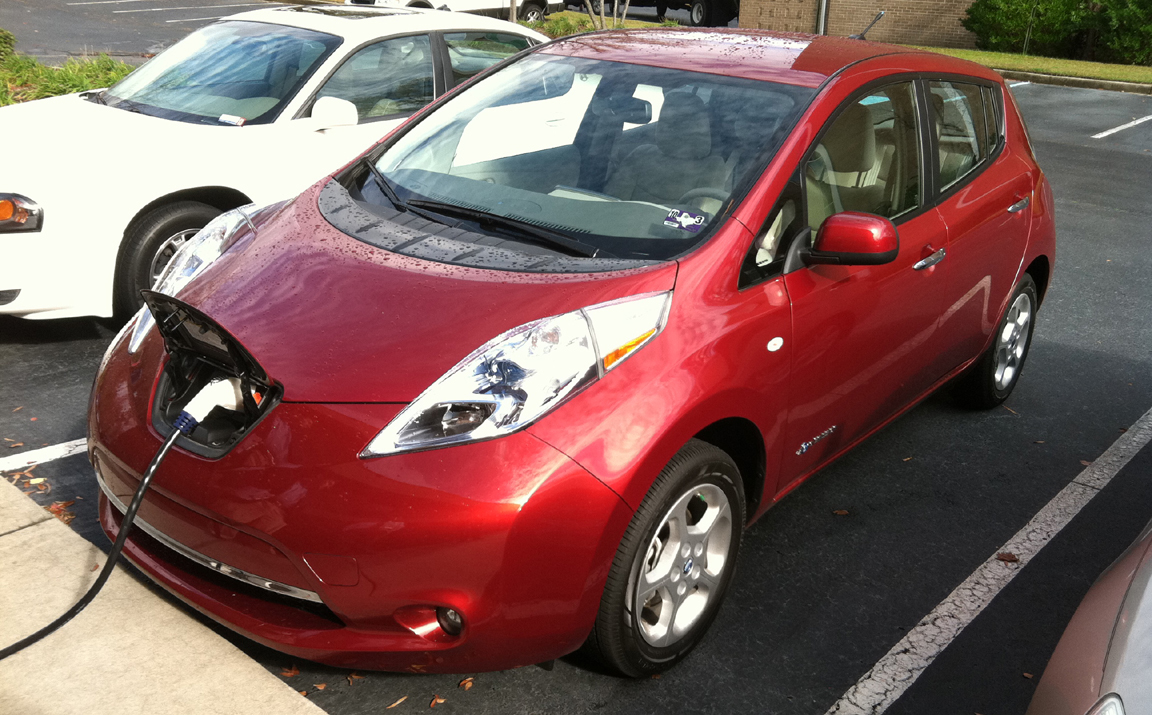
But today, I saw something that is more likely to be our future — a plug-in electric car. In routine use.

I was visiting Mike Couick over at the Electric Cooperatives of South Carolina in Cayce. As it happens, we were talking about sustainable energy (ADCO is working with the Central Midlands Council of Governments and a couple of private partners on a project for local governments). And when we walked outside after the interview, there was some right in front of us.

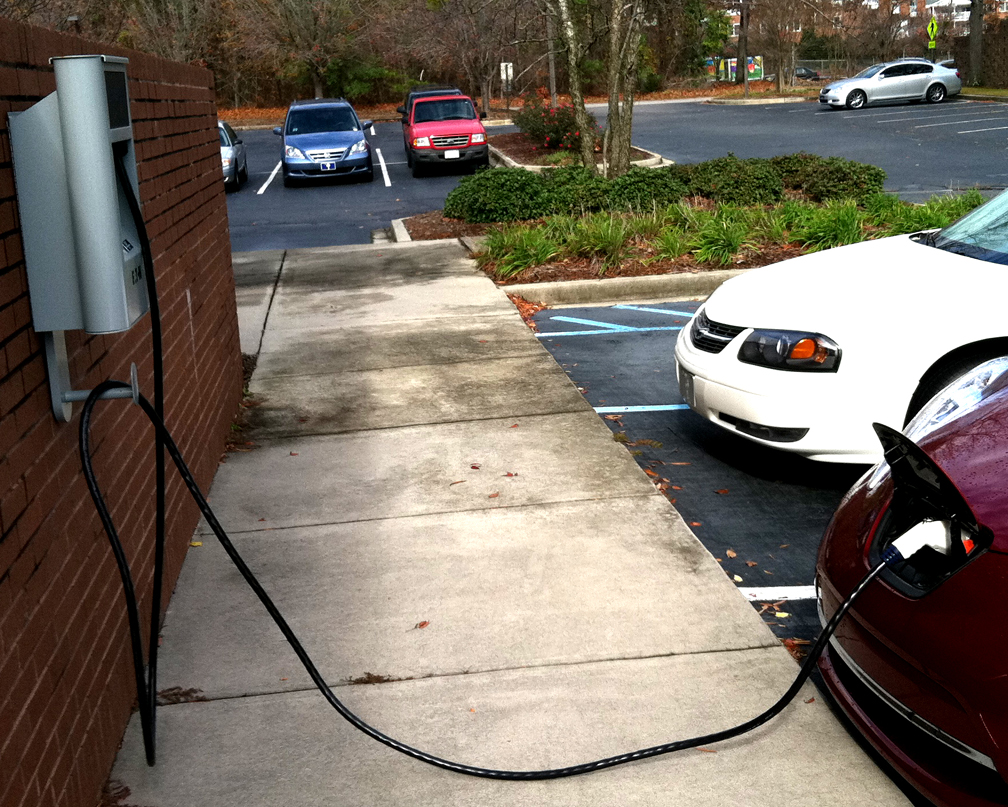
This Nissan Leaf belongs to ECSC, and is used to drive around the state on co-op business, which surprised me — I assumed it was for local use. How does it manage that sort of range? Mike said all the co-ops have charging stations.

Very cool, I thought.

Mike reminded me that this was really sort of retro, since the original automobiles were electric, before the internal combustion engine decided to eat the world (my wording, not his).

With that in mind, I can’t wait to get back to the future and drive one of these myself. And I’ll pass on the gullwing doors, Mr. DeLorean.

What did you think of Rotary, Doug?

Last week, Kathryn Fenner brought a guest to the Columbia Rotary Club: Doug Ross!

It was great to see him. I learned that he was there during the part at the start of the meeting when members stand up to introduce their guests. He was, of course, introduced as a key contributor to bradwarthen.com, a distinction to gild any resume.

As he was introduced, I was standing by the piano holding my guitar, waiting to go on and do Health and Happiness.

I’m afraid I disappointed both Doug and Kathryn by not using much of the material that y’all so generously shared with me. But don’t worry — I’ve saved it all for next time.

What I did instead was a routine that was a last-minute inspiration, in which I sang bits of Dylan’s “The Times, They are a-Changin'” interspersed with topical commentary in a voice that would have been a cross between Dylan and Arlo Guthrie, except that I had awoken sort of hoarse that morning.

I had planned to record a video version for y’all, but my voice got worse and my asthma kicked up over the long weekend, for the first time in quite awhile. It has occurred to me that this may be divine retribution for my routine, but the College of Cardinals is still out on that.

If I feel better any time in the next few days (basically, I’m functioning fine; but if I try to sing, I start to cough), I’ll still do it for you.

Meanwhile, I was wondering what Doug thought of Rotary. Seeing as how I write about it frequently here, and some of y’all ask about it, I thought his fresh and unbiased impressions might be of some interest to y’all.

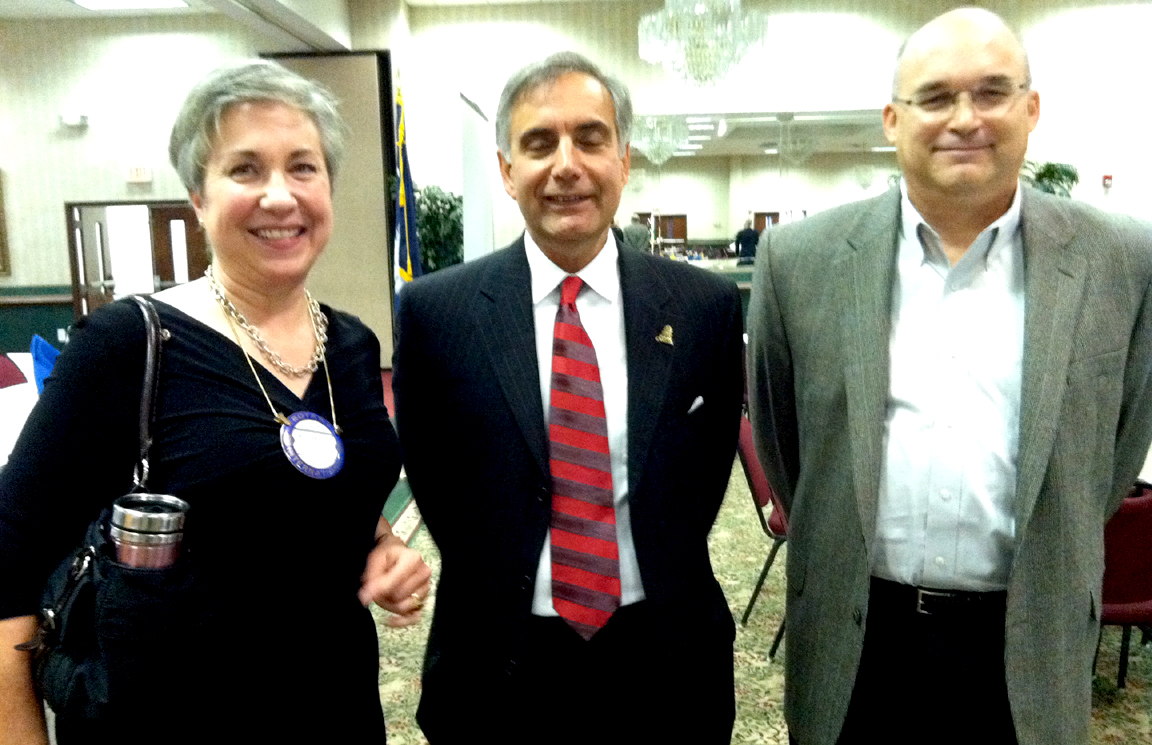
Below you see Kathryn and Doug with USC President Harris Pastides, our speaker last week. You may note that there’s no one left in the room. Our friends had kept him behind for interrogation. I managed to spring him right after this was taken…

We RAKED in the moolah for Salvation Army

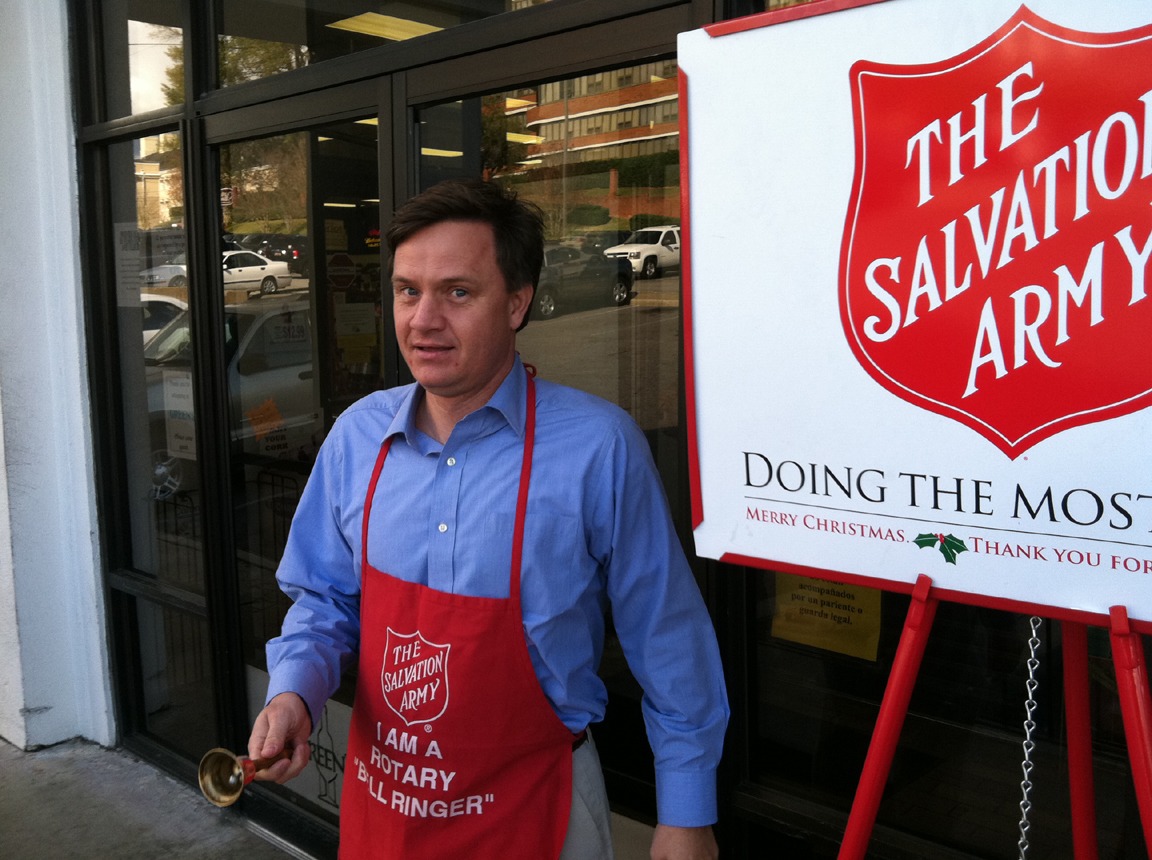
Here, Boyd is giving me his, "You're the Salvation Army guy and you're here to pick up the bucket? Yeah, right!" look.

Boyd Summers and I had a good midday shift today ringing the bell for Salvation Army, representing the Columbia Rotary Club.

I can’t say I like the new kettles. They’re plastic, and no bigger than a bucket, and people have a terrible time jamming their money into the ill-designed slot. The old ones worked much better — the money practically fell in on its own.

Adding to the problem was that the money, from early in our shift, was all the way to the top (it was mostly there when we started). Fortunately, a guy from Salvation Army came and took the full one — which was heavier than you would expect — and left us an empty one.

I mean, we think he was a Salvation Army guy. He had an ID tag. After he left, I observed to Boyd that that would be a pretty good racket if he hadn’t been. Yep, said Boyd, and we kept on ringing the bell.

We had a high old time talking politics, reaching back to the first time I met Boyd, when he ran unsuccessfully against Jim Harrison.

We saw a lot of folks we knew, such as … wait second: Is being a bell-ringer like being a doctor or lawyer, with confidentiality privileges? Maybe so. And maybe certain people will give a little MORE next time I’m out there, so as to remain anonymous. Man, were those people hauling out the booze by the handtruck-load!

Of course, when our shift was over, Boyd and I both did a little shopping (I bought beer and wine; he went to the hard-stuff side). After you watch people come in and out for two hours (and we’re going, oh, yeah, that’s some good stuff — you ever try…?), you just have to get some for yourself.

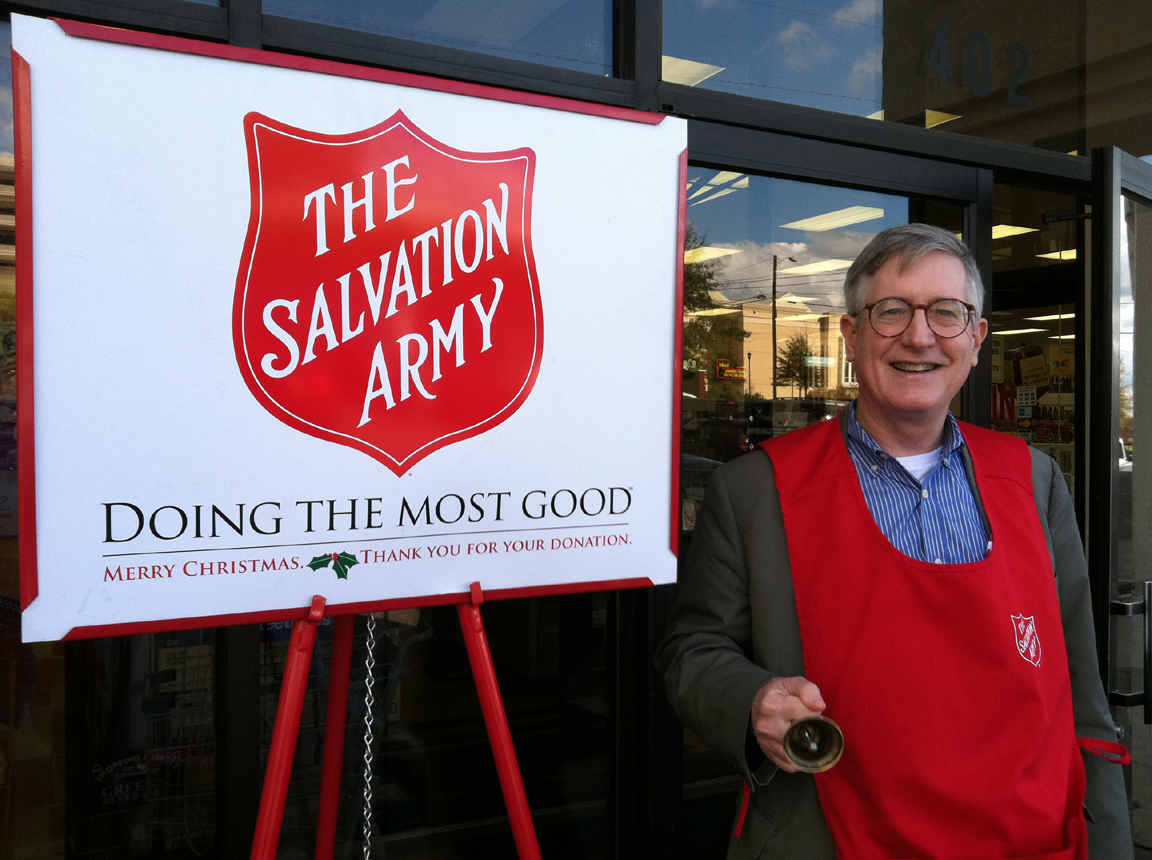
This is me trying to look convincing as I say "Merry Christmas!" when it's above 70 degrees. I wouldn't give this guy money, but plenty of people did.

Ring the Salvation Army bell…

I just figured out why I’ve had one line from an old Simon and Garfunkel song running through my head all day:

Hear the Sal-va-tion Ar-my band…

It’s because, in a few minutes, I have to go

Ring the Sal-va-tion Ar-my bell…

This is a major service project of the Columbia Rotary Club. Fellow Rotarian Boyd Summers and I have signed up for the noon-2 p.m. slot today in front of Green’s liquor store over on Assembly. Come on by and see us on your way in to obtain your favorite adult beverages. Or on the way out. Either way, leave money in the bucket.

And while you think about whether you want to do that, listen to The Bangles’ relatively decent cover of the song in question, so that you can have the frightening experience of having your mind on the same wavelength as mine. Or listen to the original. I actually prefer the original, but since it’s a video, I figured The Bangles were easier to look at.

Ironic lyrics to hear on a day like today. But you can pretend there’s a hazy shade of winter out there, to get yourself in the mood for the holidays. Yeah, I know it’s not easy when you’re sweating…

Big, dramatic, monumental confrontation on State House grounds just turns out to be a party

I went down to the demonstration, to get my fair share of

… ennui?

Not sure I can fairly characterize it all in a word, but that comes close.

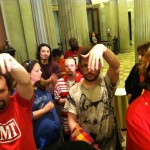
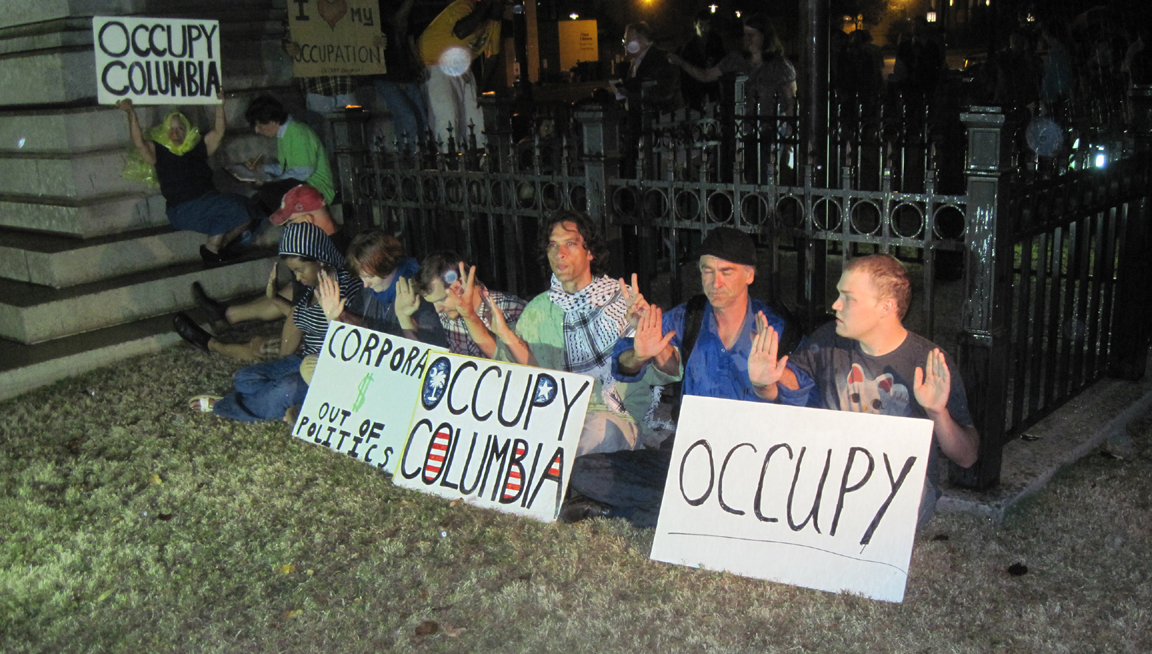
Briefly, here’s what happened: A couple of people gathered around the State House steps at 6 p.m. this evening, and many of them for an hour or so after, apparently with the intention of provoking the authorities into mass arrests, going far beyond the 19 of last week.

It was a bust, because the authorities responded rationally.

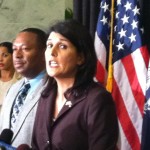
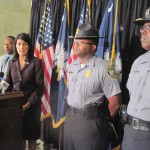
There were cheers when Brett Bursey announced that he had been told by the head of Public Safety that the protesters would be allowed to stay as long as they liked, if they didn’t camp out.

They need to brush up on their Marcuse. This was a classic case of repressive tolerance. OK, maybe not exactly the way Marcuse himself defined it, but repressive tolerance as it came to be commonly used later.

This, boys and girls, is how a liberal society absorbs the energy right out of dissent — the society tolerates it, and the steam goes out of it. Then, of course, if some dissidents are determined to provoke a disproportionate response, they engage in provocations that lose popular support. And so their movement becomes marginalized.

But that hasn’t happened to the Occupy Columbia movement yet, as they went happily on with their “General Assembly” before the Confederate Flag at 7 p.m., doing their “human microphone” thing to their hearts’ content.

In fact, to paraphrase the ultimate journalistic cliche, as of 7:15 when I gave up on it all, a good time had been had by all.

The possibility of confrontation had brought folks out in numbers not seen before. The Old New Left was out in some force, from Tom Turnipseed to Kevin Gray to my gentle Zen friend Hal French. But there were plenty of kids, too, striking poses and shouting high-flown slogans and getting off on the heady rush of having their words passionately repeated by the crowd.

Gilda Cobb-Hunter was there, as the one elected official I saw. Her shouted message was fairly benign, to the effect that This is your house!, which of course it is. (You can see and hear her on the video above, after the unidentified speaker at the start of the clip, who was pretty typical of the speakers.) Not even Nikki Haley — repeatedly excoriated as “our tyrannical governor” by some of the more excitable speakers — disagrees with that.

What happened tonight was that the great fog was clarified a bit. Now we know, and we’re back to what Nikki had complained about to start with — camping out on the grounds is forbidden. At least, that’s the way things stood when I left. I hope the situation didn’t deteriorate after that.

By the way, I have no idea how many of the roughly 200 people there were supporters of the movement, but I’m guessing most. When I told my friend Claudia Brinson that — and she shouldn’t have been surprised — I was not among them, she had one of her Columbia College students interview me. The one coherent thing I remember saying was, “Just because Nikki Haley is wrong doesn’t mean these folks are right.” And it doesn’t, especially when I don’t know exactly what they want.

As I Tweeted a little later, “They just sang ‘We Shall Overcome.’ They think it’s the same. What they miss is that civil rights marchers had clear goals, not just emotion.” At some point, pointless activity becomes an inexcusable waste of human energies.

Speaking of Twitter, before signing off, I’ll share the rest of my impressions from the night, as they occurred in real time:

  • Standing in the middle of this enthusiastic Occupy Columbia crowd, wishing whatever is going to happen would happen soon.
  • As I just told Columbia College student who was interviewing me, just because Nikki Haley’s wrong doesn’t make the protesters right.
  • Here’s what the crowd defying Nikki Haley’s 6 p.m. order looks like
  • They just sang “We Shall Overcome.” They think it’s the same. What they miss is that civil rights marchers had clear goals, not just emotion
  • Brett Bursey says DPS chief says they can stay, just not camp out. Protesters declare victory. They should read up on repressive tolerance.
  • The duly constituted authorities played the best hand they had. Smart, measured response. Crowd has continued to dwindle since announcement.
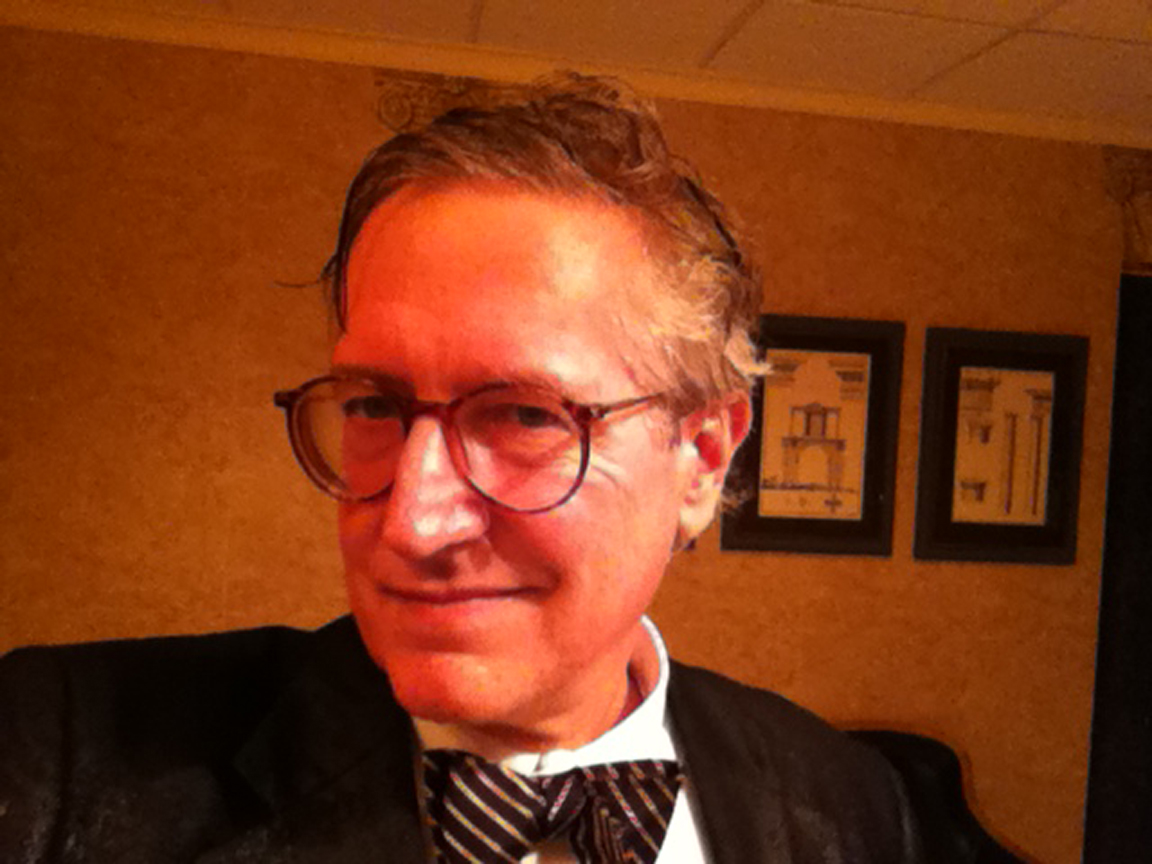
  • I keep seeing protesters who have pulled aside the tape across their mouths so they can smoke. WAY too much smoke around here.
  • Kevin Gray is disappointed he’s not getting arrested tonight. I mean, what’s a guy got to do?

And then, I went home for dinner.

So you don’t have to feel quite SO bad for ordering presents on the Web this year…

I neglected to take note of this a couple of days back:

Amazon opens Cayce distribution center

Staff Report
Published Nov. 18, 2011

Amazon.com’s new 1-million-square-foot distribution center near Cayce has opened in time for the holiday shopping season.

“There will be products going out of there in time for the holiday,” a company spokesman said today.

Called a fulfillment center, the facility at the Saxe Gothe Industrial Park near the interchange of interstates 26 and 77, has about 1,000 employees. Some work began as early as mid-October, the spokesman said.

Products will be flowing in and out of the center by rail, truck and air, he added.

The low-key opening is a stark contrast to the political battle that erupted shortly after Gov. Nikki Haley took office in January….

A thousand employees, already? Do any of y’all work there, or know someone who does? I had no idea.

I’m still a big believer in supporting local merchants, which provide local jobs, pay local taxes, etc.

But now, in time for Christmas, Amazon sort of is a local merchant.

So it’s now kind of a gray area. Make what you will of this moral ambiguity.

What I saw at the revolution, such as it was

After the warning and before the arrests, these were the few chosen to be arrested, waiting as the rain began to fall.

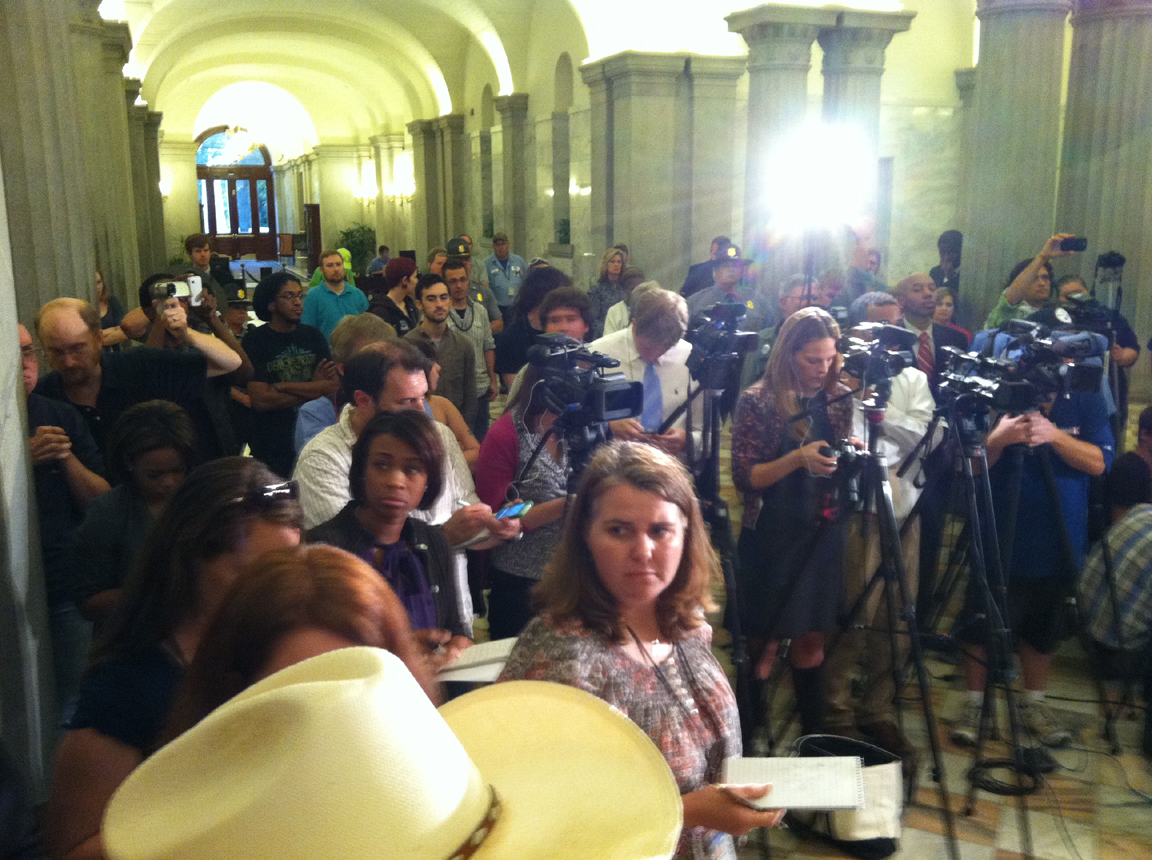
There were about 100 apparent protesters milling about in the dark as the 6 p.m. deadline arrived. People in pools of harsh TV lights being interviewed, others talking on cellphones, others just waiting.

Walid Hakim was, as he has been, a center of attention. He told me — and maybe if I can get it uploaded, I’ll put up video later — that he had just learned that his great-great-great-great-great grandfather had owned the land on which the State House was located. So he said he was just hanging out on the family homestead, waiting to be arrested. He made dramatic statements about how the rights to speak and peaceably assembly that he had defended in the Marines were about to be denied him.

Brett Bursey was there, as he had been earlier in the day. “Do they take credit cards at the jail now?” he asked me. I said they certainly should, this being the 21st century and all. Then he slouched off to confer with others here and there. A few minutes later, I asked how many times he had been arrested, counting this time. He expressed doubt that he would get arrested, and acted a bit like he was being cheated. I didn’t really follow what he was saying was happening. Then he wandered off again.

The cops still hadn’t shown.

Walid and a dozen or 15 others grouped themselves around the Confederate soldier monument, with that “I’m going to be arrested” look in their eyes. At this point, I Tweeted out:

They’re so pumped up, chanting “WE. ARE. THE 99 PERCENT!” It would be rotten of Nikki not to arrest any of them. They’d feel so let down…

Eventually, some of the State House security guys showed up and announced that pursuant to the governor’s announcement, those who did not vacate would be arrested.

By then it had started drizzling. Walid and the other designated martyrs sat around the little fence enclosing the flagpole, and waited. My iPhone and camera started getting pretty wet. I went to stand under a tree. Didn’t help much.

Finally, the officers who had made the announcement came back out onto the grounds with reinforcements — maybe 20 uniformed officers. They formed a skirmish line, donning gloves, and started walking slowly toward Gervais.

I found myself walking backwards with the protesters who would NOT be arrested toward the sidewalk along the street. I realized the working media had stayed behind with those who were to be arrested. The police had simply walked past them, parting around them like a stream around a rock. I thought about standing on ceremony and demanding to be allowed back in with the other media, but a number of disconnected thoughts were running through my mind, such as:

  • I have no credentials, and this didn’t seem like a good moment, standing in the rain with everyone a little tense, to have a debate with the authorities about how I was, too still a member of the Fourth Estate, even though all I had to show was a bradwarthen.com business card. A damp one.
  • While I had bought the insurance on my iPhone, that meant I would “only” have to pay $175 to replace it if it were ruined by the rain.
  • My little Canon with which I was trying to shoot video was likely to suffer the same fate as the one before it, which was splashed by surf and never worked again. No one would reimburse me.
  • This was all moving WAY too slowly. At this rate, no one would get any cuffs before another half hour had passed.
  • What are the long-term effects of rain upon a silk bow tie?

What the line of cops wasn’t blocking, the media types still within the perimeter were. I couldn’t see what was going on with Walid and the rest.

I went ahead and crossed the street. As I did, I saw a group of protesters had gathered on the far side of Gervais under a blue tarp. I envied them their shelter as the wind suddenly picked up dramatically.

Then, it came down in buckets. I was entirely drenched by the time I made the door of 1201 Main.

I rode the elevator up, in my soaked blazer and black (formerly gray) pants and drooping bow tie and mop of thoroughly sopping hair. Everyone looked at me as though I were a lunatic. I got up to the Capital City Club and went to the bathroom to try to dry off some with the little terry cloth towels in there.

I went to a window to look back down at the scene I had left. I couldn’t see a thing. The TV lights seemed to be gone, even.

I went on into the Membership Committee meeting from which I was playing hooky. My appearance excited comment. One member asked me whether I was ignorant of the fact that there was an attached parking garage. I mumbled some explanations, sat down, and did my best to act normal.

Here’s a report from reporters who were paid to stay behind and witness the final tedious act of the drama:

Acting at the behest of Gov. Nikki Haley, S.C. Bureau of Protective Services troopers took 19 Occupy Columbia protesters in front of the State House into custody in a driving rainstorm around 6:30 p.m. Wednesday.

Officers escorted small groups of those taken into custody back towards the State House. Officers placed band-type handcuffs behind their back. Protesters did not resist; there was no violence.

“At least you don’t have to be in rain now,” one officer said to a protester as he led a man. Protesters arrested included both men and women.

It was not known what, if any, charges those taken into custody will face.

Haley’s directive was aimed at keeping the demonstrators off State House grounds during the night. She apparently will not order state troopers to formally remove them during daylight hours.

“We the people shall never be defeated!” protesters chanted immediately before being detained…

And so forth…

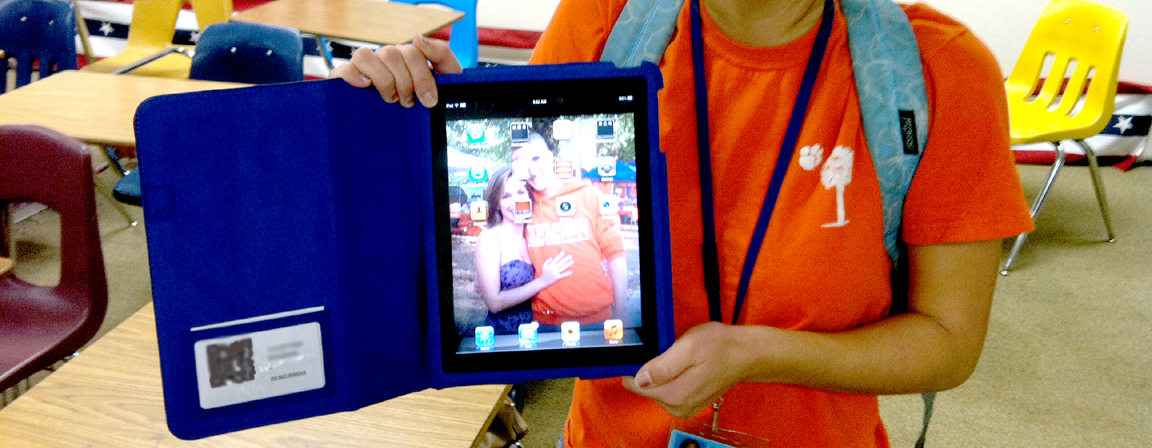
The new iPads arrive at Lexington High School

This student, whom I cannot name because she's just 17, had found time to personalize hers...

Thursday morning I spoke to Michael Burgess’ class at Lexington High School. The format was much like one of Kelly Payne’s classes — the kids had a prepared list of questions, which is what I like. I hate a set speech, with me droning on and wondering whether anyone is interested. With questions, I at least know I’m addressing something my audience cares about — or something their teacher wants them to care about.

Sample questions:

1. How does the media influence the political process? Is this a positive or negative influence?
2. Discuss the impact of social media outlets on the political discourse of today?
3. What is the role of money in determining the outcome of elections?
4.Could you list and describe the various sources of funding for campaigns?
5.What is the real role versus the appropriate role of interest groups in influencing policy?

But my speech was definitely not the most interesting thing happening in those students’ school day, because I arrived on the same day as the new iPads.

I had trouble finding a place to park because the visitor spaces, I was told, were taken up by district people who were there for the iPad rollout.

Here’s a release on the Lexington One website about the new devices:

Last year (the 2010–2011 school year), Lexington County School District One successfully executed a personal mobile computing pilot at Gilbert High School as part of our ongoing search for ways to provide students with the tools they need to support their learning and to prepare them for higher education opportunities and careers.

At that time, we explained that we planned to expand the program to our other high schools.

This year (2011–2012), we are expanding personal mobile computing to our other three high schools. All high schools will begin issuing the devices in November.

The district feels strongly that its personal mobile computing initiative is not about the tool used. It is not about an iPad or a tablet. It is about what a personal mobile computing device enables our students to do.

With these devices, students will acquire the digital competence they need for our increasingly electronic- and technology-driven world. They will learn the essential skills they will need as consumers, citizens and workers.

The devices will give students access to the most current information available through the Internet and to the district’s Learning Management System 24 hours a day, seven days a week during the school year.

Students will be able to complete and turn in assignments, homework, projects or research electronically. Interactive applications will allow them to improve their reading fluency, build mathematics skills or create their own study cards.

Unfortunately, as yet, not all textbook publishers provide electronic copies of every textbook, so the district will not be able to eliminate textbooks. Teachers will be able, however, to supplement material found in textbooks with information they create using various multimedia or with information already available.

Lexington One purchased the personal mobile computing devices as part of the voter-approved 2008 Bond Referendum. That bond referendum included $15 million to expand and upgrade existing technology at all schools.

Read our Personal Mobile Computing Guide for high school students.

I should mention that the students were all politely attentive to my talk. I don’t think I could have been, with a new iPad in front of me…

Coble Trek, The Next Generation

Daniel Coble, son of Bob, has thrown his hat into the ring for the Shandon/5 Points seat that Belinda Gergel plans to vacate after one term:

Dear Friends and Neighbors,
As many of you know, I have been considering running for City Council, District III, and after a lot of thought and conversations I have to decided that I am going to run for City Council, District III.  Bud Ferillo has agreed to be my senior campaign adviser.
I look forward to a positive and issue oriented campaign.  My number one priority is Public Safety and ensuring that we reduce crime throughout our neighborhoods. I also strongly believe that we must protect our environment to ensure the integrity of our neighborhoods.  This means working towards  a long and short term goal of fixing the flooding seen throughout our District, and also in protecting our trees that give our communities such great character.
Please feel free to call or email anytime.  I hope I can count on your support throughout this campaign and look forward to speaking with you all!
Sincerely,

Daniel Coble

I had to hear that from Kathryn Fenner. Daniel, why didn’tcha tell me? I mean, I sort of knew you were running, but anyway… We should get together, talk about this…

Apparently, he’s decided to run now because there will no longer be anyone else on Council named either “Daniel” nor “Coble,” thereby minimizing confusion.

Who’s out there polling about metro issues?

A friend sent me  this last night:

Interesting note: I just got polled about the following issues: view of city-county council, opinions of USC economic development, Harris Pastides, Innovista and funding the bus system.
Also asked about funding a new baseball stadium, riverfront and Zoo improvements.
Even (da-dum) strong mayor!
You might throw that out there (without my name, please) and see who might be paying for such a poll.

So… any of y’all know who’s doing that polling? I mean, I could call around to the usual suspects, but it’s easier to see if y’all know anything first…

Thanks, E.J., for giving us a piece of your mind

Before another day passes, I want to express my appreciation to E.J. Dionne of the Washington Post Writers Group and the Brookings Institution, for delivering the 2011 Cardinal Bernardin lecture at USC last night.

Perhaps because he’s from my world, he spoke to me as no previous speaker has in the 12 years of the series — of faith and public life, particularly in the sense of how the Cardinal’s life and work relate to our existence today. So I thank him for that. I also thank all those who contributed to bringing about this event — the Department of Religious Studies, the College of Mass Communications and Information Studies, President Harris Pastides’ Civil Discourse Initiative, and Samuel Tenenbaum and the Tenenbaum Lectureship Fund.

For those of you who don’t know, Joseph Bernardin was a son of Italian immigrants who grew up here in Columbia, as a parishioner at my church, St. Peter’s. He would become the leading light of the U.S. Conference of Catholic Bishops, the force behind such remarkable documents as “The Challenge of Peace: God’s Promise and Our Response.” He fostered the Church’s Common Ground Initiative, and his greatest legacy (to me) is placing the Church’s pro-life ethic within the compelling — and necessary — framework of the Seamless Garment — a legacy that, inexplicably to me, remains controversial, even anathema, among some. After becoming Archbishop of Chicago, he was widely regarded as a likely first American pope before his death of cancer in 1996 at the age of 68.

E.J. is that rare bird in the higher reaches of journalism who writes regularly of matters that bear upon ultimate questions (see, for instance, “The Vatican meets the Wall Street occupiers” from last week), and does so with an intellectual vigor that not only reflects credit upon his and my faith tradition, but shows what journalism is still capable of achieving at this late date. He knew the cardinal, and has long admired him.

Here’s a rough draft of his remarks. There are typos, and it is incomplete (entire anecdotes are missing), but it gives you an idea of what he had to say. An excerpt:

I want to close with something I have been pondering ever since the Spriritan fathers of Duquesne University asked me to give a talk about immigration. I was struck when I was preparing the talk how much both the Old and New Testament had to say about our obligations to strangers. Not to brothers or sisters or neighbors, but the strangers. And it made me think that perhaps our calling is really to create a world without strangers. Yes, that’s utopian and impractical and all sorts of other things. But it is a useful objective to ponder, a useful goal to keep in front of us. It is a world in which there is no “other,” no “them” or “those people,” just fellow citizens or fellow children of God or fellow human beings. It is a world in which we share each other’s joys and sorrows, each other’s benefits and burdens. It is a world in which the fortunate realize that their affluence depends not just on their own hard work and skill, but also on luck and providence. Often, simply, the good fortune of having been born in a particular place, to a particular family. We all owe so much of who we are to our parents and what they did for us. And not a single one of us can claim to have been wise or farsighted in our choice of parents. That truly was God’s choice, or for those who don’t believe, fate’s. And the same applies to the country in which we are born. We cannot praise ourselves for being really smart to have been born in the United States of America. A world without strangers would be a better world because all of us, everywhere, would feel at home all the time. In a world without strangers, we approach the new people we meet, anticipating the joys of friendship, not the anxieties of enmity. And yes, a world without strangers would be a world more likely to heed the injunction of the prophet Isaiah, to undo the heavy burdens and let the oppressed go free. It would be a world more likely to resemble the place imagined by the prophet Amos, who, as Dr. King taught us in his “I Have a Dream” speech, imagined that justice would roll down like waters, and righteousness like a mighty stream. I believe that Cardinal Bernardin spent his life trying to create a world without strangers. His mission to honor the dignity of every person was not just political but also personal. He provided us a model.  So let us live by his words: “Yesterday is gone. Tomorrow has not yet come. We have only today. Let us begin.”

OK, that’s heavy, I know. Hey, it was the ending. Perhaps I can show you better the spirit of the way E.J. speaks with this ice-breaker from the beginning:

Whenever someone gives me an introduction that is far too generous, I like to note what it’s like to give talks about politics and be introduced with the words: “And now, for the latest dope from Washington, here’s E. J. Dionne.”

That’s E.J. He doesn’t take himself too seriously, but he approaches the most important issues with all the respect and reverence they deserve and demand.

I hope Kathryn Fenner and “Abba,” who were both there, will weigh in with their thoughts about the lecture. I had the impression that they found it meaningful as well.

E.J.’s here — y’all come on out and hear him

Just to let you know — I collected E.J. Dionne from the airport earlier this afternoon, and left him in the custody of Charles Bierbauer.

So he made it to town. Now, y’all do your part. Come on out to hear him at 6 p.m. over at Capstone at USC.

Here’s the info again.

Come hear E.J. Dionne tomorrow night

Hey, y’all — anyone interested in hearing E.J. Dionne speak at USC tomorrow evening on the intersection of faith and public life should come over to Capstone on the USC campus at 6 p.m.

Dionne, for those of you not familiar (which you should be) is a senior fellow at the Brookings Institution, but you probably know him better as a syndicated columnist for The Washington Post. He’s also a professor in the Foundations of Democracy and Culture at Georgetown University. And you may have seen him on the tube now and again.

E.J.’s topic is,”Reweaving the Seamless Garment: Cardinal Bernardin’s Living Legacy to American Public Life.” This is the 2011 Joseph Cardinal Bernardin Lecture. I’ve been on that committee for a decade or so. He’s brought to you by The Department of Religious Studies, the College of Mass Communications and Information Studies, President Pastides’ Civil Discourse Initiative, and Samuel Tenenbaum and the Tenenbaum Lectureship Fund.

I had the honor of making the initial contact, early this year, asking E.J. to come speak to us. He was happy to do so, not only because he’s a fellow Catholic, but because Chapter Five of his recent book was entitled, “What Happened to the Seamless Garment? The Agony of Liberal Catholicism.”

I look forward to hearing him. Assuming I get him here on time — I’m supposed to pick him up at the airport.

I first met E.J. at an API seminar. Our class had lunch with some of the WashPost opinion writers, including (as I recall) Charles Krauthammer and Robert Samuelson, and E.J. was kind enough to give me a tour of the Post. He later visited me in my office at The State when he was here covering… oh, I forget what. The 2004 Democratic primary, perhaps.

I appreciate his arranging his schedule to come speak to us. And I hope some of y’all will come hear him.

An encounter with Occupy Columbia

One of my Saturday activities is catching up on email. I received this three days ago, but didn’t take time to watch it until now.

This shows Walid Hakim having a conversation with a couple of “1-percenters” down in front of the State House. Apparently they were counter-demonstrating with the message that the Dad of one of them works on Wall Street, and has to get to work in an armored car. Or something. I don’t have the counter-demonstrators’ version of events. Here’s the OC version.

It’s the first time I’ve seen Walid in his Dress Blues. Normally, he’s less formal.