Category Archives: Faith

On displacement, and what it says about humans

Some more of my notes from linguistics class. The readings last week in our Language Files textbook were in part about Charles Hockett‘s list of characteristics that distinguish a system of communication as an actual language. They are:

  1. Mode of communication
  2. Semanticity
  3. Pragmatic function
  4. Interchangeability
  5. Cuntural transmission
  6. Arbitrariness
  7. Discreteness
  8. Displacement
  9. Productivity

All communication systems possess the first three of those design features, while only human language exhibit the last two. I’d give you definitions of all of them (here’s a link), but really my own attention was drawn completely to the penultimate one, and that’s what I wrote about in my reading notes:

In both this reading and the one from ULTH, we are told that animals other than Homo sapiens do not possess or employ language, as defined by Hockett, because they lack displacement.

Of everything I read for this week, that was the point that made the greatest impression on me.

It speaks clearly to the most important quality that many humans in different times and places, employing different modes of thought and belief, have cited in asserting their belief that Homo sapiens is not an animal, but a distinct creature on a higher level.

Frequently over the millennia since modern humans developed sophisticated (from the human self-flattering perspective) language and other distinct cognitive abilities (about 70,000 years ago), sapiens have expressed this through belief systems that we refer to as religion. A well-known way of expressing this is that Man was made in the image of God (Genesis 1:27). Therefore we are able to think (and speak and write) about things and events and ideas that we cannot see or touch. This quality is in fact essential to the very existence of religion. We are unable to prove (to the satisfaction of an unbeliever) the existence of God or gods through empirical means.

From the perspective of my own religion, this can tempt me to embrace the sin of pride, since it suggests that unbelievers are inexplicably limiting themselves intellectually to the material, here-and-now perspective of animals (or lesser animals, or simply other animals, depending on the way you choose to frame it).

But unbelievers also perceive the ability to employ displacement in a communication system as an important, defining difference between our species and others.

In Sapiens, A Brief History of Humankind, Yuval Noah Harari stresses repeatedly that the quality that not only took Homo sapiens to the top of the food chain, but also caused our species to outlive Neanderthals and Denisovans, is the ability to perceive that which is not immediately, obviously and materially present or detectable.

The book for which Harari is best known begins in a remarkable way for students of linguistics, particularly for those who study written language. The first page is essentially an atheist’s, or at least materialist’s, take on the beginning of the book of Genesis.

He considers religion to be a myth. But he considers such myths essential to why sapiens have come to dominate the Earth, and survive while other Homo species have faded away. To him, “myths” include belief in gods and spirits, but also such abstract concepts as money, laws, liberalism, communism and many others. He asserts that none of these things exist outside shared human imagination. (If I were writing the Sapiens book, I would tend to use the term “abstraction” when Harari uses words such as “myth” and “imagination.”)

Unlike some other atheists (those tempted to their own sort of pride), he doesn’t see belief in such “imaginary” things as a weakness. In fact, it is the main quality responsible for modern humans’ success over other species, including other humans such as Neanderthals.

Such shared beliefs (and the modifier “shared” is key here) have enabled our species to cooperate in immensely larger social groups. Neanderthals just couldn’t compete with that.

Of course, to be clear. While I embrace such “imaginary” concepts as Christianity, liberalism (meaning the word in terms of the actual approach to government in most of the West until 2016, not today’s popular misunderstanding), and the rule of law, I don’t do so because it’s a nifty strategy for our species’ survival and domination. I embrace them because I believe in them.

And it’s nice to see it brought up in my new field of study…

No, not THAT St. Hillary…

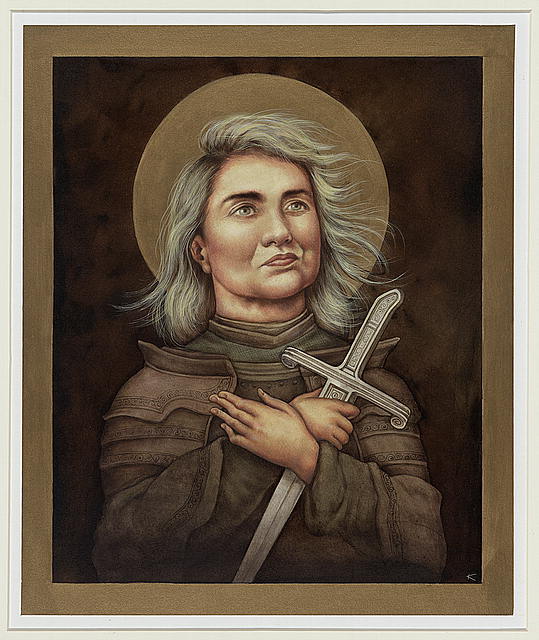
Depiction of St. Hilary’s ordination, painted 1,000 years after he lived.

I’m studying the USCCB’s daily scripture readings, and I see that the alternative reading for today is dedicated to Saint Hilary, Bishop and Doctor of the Church.

This Hilary, by the way, was a man. He lived in the 4th century AD. Interesting fact: He was married, because that was allowed in those days, and he had a daughter who was also a saint.

I mention this because every time I see a mention of this saint, I’m reminded of a certain other person who was called “Saint Hillary” in a satirical manner. Below is the image that appeared with that headline in The New York Times Magazine on May 23, 1993:

When I saw that, only four months after Bill’s inauguration, I knew that this administration’s honeymoon with the press was pretty much over.

Here’s the article, if you want to read it. Here’s an excerpt:

Since she discovered, at the age of 14, that for people less fortunate than herself the world could be very cruel, Hillary Rodham Clinton has harbored an ambition so large that it can scarcely be grasped.

She would like to make things right.

She is 45 now and she knows that the earnest idealisms of a child of the 1960’s may strike some people as naive or trite or grandiose. But she holds to them without any apparent sense of irony or inadequacy. She would like people to live in a way that more closely follows the Golden Rule. She would like to do good, on a grand scale, and she would like others to do good as well. She would like to make the world a better place — as she defines better.

While an encompassing compassion is the routine mode of public existence for every First Lady, there are two great differences in the case of Mrs. Clinton: She is serious and she has power….

Back to the real saint. To lift the tone of this post, here’s an excerpt from the readings offered in his name:

Matthew 5:13-19

Jesus said to his disciples:
… “Do not think that I have come to abolish the law or the prophets.
I have come not to abolish but to fulfill.
Amen, I say to you, until heaven and earth pass away,
not the smallest letter or the smallest part of a letter
will pass from the law,
until all things have taken place.
Therefore, whoever breaks one of the least of these commandments
and teaches others to do so
will be called least in the Kingdom of heaven.
But whoever obeys and teaches these commandments
will be called greatest in the Kingdom of heaven.”

It was good to see the monks pass through town

Technically, I didn’t see them, although a number of people I know did (such as the pastor of my church). But you might say I felt their presence.

I was on my way to Lowe’s Saturday morning between 9:30 and 10, and had some trouble getting there. My elder son and I were aiming to pick up some more lumber for a project, and Highway 1 was jammed because the monks were on their way from Lexington toward downtown. But we eventually got what we needed, and I shot the pictures you see above and at the bottom while on the way to my son’s house, of the people waiting for the monks.

What monks? Well, these monks. Not your Mepkin Abbey kind of monks, but the kind I ran into in Thailand. They were hard to miss there, because they were everywhere. My daughter who was then serving in the Peace Corps lived across her country road in Khorat province from one of their wats. You also run into them on public transportation, where they have preferred seating.

Speaking of preferred seating. On a bus to Kanchanaburi, I met a retired roofer from England who had settled in Thailand with a Thai wife and kids (a lot of farangs do that, it seems. He and I had a high old time sitting and chatting on the back seat. The very back seat is of course the coolest seat on any bus, as I had learned in school. (You’re too far back for the teacher on bus duty to see you, and it bounces more than the forward seats, which is cool when you’re a kid.)

Alas, my wife and daughter were forced to sit farther to the front, because women are not allowed to sit on the coolest seat in those parts. (I think the reason why is because monks sit there.)  I felt bad for them, but Mark (I think that was the retired roofer’s name) and I had a good time anyway, bouncing along, and at one point I took a selfie that included the monk sitting next to us, also enjoying himself. I’m sorry I didn’t manage to get the monk beyond that one into the picture, but you can see his robe:

But I digress….

Anyway… I can’t say I’m fully hip as to the details about the monks’ walk across the South in the cause of peace and mindfulness, but for what little I know, I’m for it. Y’all know I’m not on the whole very fond of public demonstrations, but this is the kind that seems to have its head in a good place. They’re not out to bother anybody (except for maybe slowing down traffic, and what are we in such a hurry for, anyway?).

And you know what? I really liked seeing my fellow Lexington Countians turn out to stand along the road and wait to see them. Some of y’all across the river don’t think we’re cool enough to get into something like this, but we are.

And now you know that…

The Beloved Children of the Holocaust

I’ve mentioned my neighbor Mary Burkett before. We had one of her campaign signs in our yard ahead of the last election. She won election to the Lexington District 2 school board.

Hers was one of five signs we had in our yard, four of whom won, but no one running for school board won as big as Mary did. And if you knew her, you would understand why.

But Mary’s more than a pleasant neighbor and someone with real concern for our schools. Several years back, she took on a new avocation: She started drawing portraits of children who died in the Holocaust. This was in January 2017. Over the course of the next seven months, she produced a collection she calls “Beloved: Children of the Holocaust.”

Why did she do this? She explains:

I felt that not only their lives, but their voices had been taken from them, and I wanted to give them a chance to speak to the world. Simply put, I wanted to honor their precious little lives. My hope is that you will be blessed by them as I have been.

She had no great ambition in taking this on. She doesn’t even see herself as an artist. But her work has been celebrated. Three years ago, a film about her project was shown in Greenville at the Peace Center. If you missed that, you can find it on Amazon Prime.

Anyway, I suppose that’s enough to set up what I wanted to tell you about. I saw this a few days ago on her Facebook page:

I’m going to open us up for a little discussion today, but please remember not to name specific politicians or parties from any country.
Here we go… A major university in the US recently denied a faculty request to show my exhibit, In the Land of Wooden Shoes. Their reason? It is too political…now if you have followed Beloved for any time at all, you know that this work is purposefully non-political.
So, here’s our point of discussion –
How does this type of action relate to Germany in the 1930s, if at all? Perhaps it is simply prudent on the part of the university not to exhibit historical portraits that might be deemed controversial. On the other hand, does the silencing of history matter and where might it lead?
We have a large worldwide audience here; let’s see what people think…

When I called Mary to ask about this, she explained that “In the Land of Wooden Shoes” is a sort of offshoot of her initial “Beloved,” and is “a joint project between myself and the Anne Frank Center at USC.” (Mary was a recipient of the Anne Frank Award in 2024.) It consists of six portraits of Anne at different ages, plus 20 of other children taken from the Netherlands by the Nazis and sent east to their deaths. The portraits are accompanied by biographies.

That’s it. “I don’t tell people what to think. There’s never a punch line.
Look at the pictures, read their stories, and walk away with what you perceive…. I don’t show and don’t talk about numbers of trains” or other details of the Final Solution.

The exhibit has been presented to 5th-graders without causing a problem. Yet for a “major university,” it was too much. Too “political.” (Speaking of universities, though, there was also a showing at the South Caroliniana Library.)

The thing is, Mary is very, very careful to stay away from politics. Note her appeal to commenters “not to name specific politicians or parties from any country.” Makes her kind of the opposite of me, huh? But I appreciate what she’s trying to do, and it’s a version of what I’ve praised and called for in the past. It’s a worthy goal for me, and for all of us, if we’ll only embrace it.

Yet in her unassuming work, she’s run into “politics” in recent years. Take that Facebook page. Before Oct. 7, 2023, she had a huge following — about 5 million at one point, from all over the world. Then, it dropped to about 20,000. Apparently, there were complaints that it was “offensive.”

She thought the drop was something Facebook was doing deliberately. Then she hears from the social medium that “Because of your high-quality content, we’re going to extend your reach.”

Her following has gone back up (to 53,000 at the moment), but is “nowhere in the range of where it was.” She is sad that “Very few from Europe, Canada, Australia comment any more.” She suspects they’re not able to see it. This is because she frequently gets FB messages from abroad asking where her page went.

Note that Mary doesn’t name the university or the faculty member who proposed to show the exhibit. The last thing she wants to do is hurt anyone. I didn’t press her on that. I just wanted to share what I’ve shared here.

By the way, at her website, you can learn about some other projects she’s taken on, such as “Beloved: Legacy of Slavery.”

DeMarco: Why Many Evangelicals Tolerate ‘I Hate My Opponent’

The Op-Ed Page

Charlie Kirk and Trump

By Paul V. DeMarco
Guest Columnist

It is hard to be surprised by anything Donald Trump says. But his statement at Charlie Kirk’s Sept. 21 memorial service that, unlike Charlie, “I hate my opponent” was striking.

First, because it was by all indications true, and truth-telling is not Trump’s strong suit. Second, because it should have been an affront to the evangelical Christians who are some of his most fervent supporters (roughly 75-80% of people identifying as evangelical Christians support Trump).

Hatred is absolutely contraindicated in the New Testament. Jesus explicitly condemns it in the fifth chapter of Matthew: “You have heard that it was said, ‘You shall love your neighbor and hate your enemy.’ But I say to you, love your enemies and pray for those who persecute you.”

Admittedly, this is a high bar. It’s one of the “hard sayings” in the Bible, the commands that are most difficult for us mortals to obey. Moments before Trump spoke, Erika Kirk crossed that bar by forgiving her husband’s murderer.

Erika Kirk

Any sensible human, and particularly any sensible Christian, would have let Mrs. Kirk’s loving statement be. Not Trump, who had to voice a (in his mind) better opinion: “That’s where I disagreed with Charlie. I hate my opponent, and I don’t want the best for them.”

For a secular person, this remark is unnerving, given Trump’s penchant for using the power of the federal government to target his enemies. For a Christian, it is abhorrent. Trump’s enablers recognized this. They knew it couldn’t be defended. JD Vance said he was “joking.” Karoline Leavitt, his press secretary, took a different tack when asked about it in the briefing room. “Look, the president is authentically himself. I think that’s why millions of Americans across the country love him and support him.”

Her first statement is arguable. Who knows who Donald Trump is? He has taken positions on both sides of many issues over his career – abortion, immigration, health care, Ukraine, cryptocurrency, Tik-Tok, etc. It would be more accurate to call him an opportunist or a shapeshifter. The next statement was the most revealing: “that’s why millions of Americans… love and support him.”

They love and support him because he hates his opponents. Trump taps into our deep-seated human capacity for hatred. That’s why the biblical call to reject it is radical – and also liberating, because hating someone is soul-shriveling drudgery. Even those who despise Trump’s policies would do well not to hate the man or his supporters. It contorts our dialogue, and therefore our society.

Conservatives and progressives alike have succumbed to the temptation to demonize and hate their opponents. Neither side is currently occupying the moral high ground.

I hold evangelicals to a higher standard since they are fellow Christians. Secular progressives don’t have a sacred book given from God.  Christians, including many liberals, do. Even a casual reader of the Bible, which warns frequently of the perils of anger and revenge-seeking, should find Trump unacceptable.

I worry about how this disregard for core Christian values is affecting young people who are searching for a principled faith community. Surveys indicate that the most cited reason young people leave the church is its perceived hypocrisy. It is easy to understand how those who loudly represent themselves simultaneously as Christ followers and Trump supporters give young people whiplash.

Blinded by anger, many evangelicals have rejected the bedrock of their faith. No evangelical pastor could use Trump’s words about hate as text for a sermon except as a negative example. Nor is there much in his personal life that aligns with Christian teaching. If one were forced to include Trump in a sermon, it might be as a living example of a golden calf, which the nation of Israel built in their fear that God had abandoned them.

Many evangelicals try to defend their votes for Trump by citing his (new-found) opposition to abortion. However, in 2016, all the Republican candidates were anti-abortion. Evangelicals had a raft of devout and morally superior candidates, among them Mike Huckabee, a Baptist minister; Ted Cruz, son of a conservative preacher; Rick Santorum, a faithful Catholic; and Ben Carson, a Seventh-day Adventist. All these men spoke the language of faith more fluently and convincingly than Trump. Evangelicals’ main motivation for their vote in 2016 could not have been their faith. It was in response to his unique capability to stoke and channel anger and hatred.

In 2024, evangelicals had a near-perfect candidate, Mike Pence, who described himself as a “Bible-believing Christian,” whose public life has been scandal-free, and who saved the country from a constitutional crisis in 2020 by correctly certifying Joe Biden’s electoral victory. Apparently, Pence wasn’t angry enough, or to put it another way, he was too biblical for many evangelicals.

A version of this column appeared in the October 20th edition of the Post and Courier-Pee Dee.

We need more Christian art like THIS

Or perhaps I should say Judeo-Christian. The Christian faith is built on the faith of the rabbi named Jesus, who continued to teach values already clearly and repeatedly set out in the Old Testament:

“You shall not oppress a sojourner. You know the heart of a sojourner, for you were sojourners in the land of Egypt.”
Exodus 23:9 (ESV)

You shall also love the stranger, for you were strangers in the land of Egypt.
Deuteronomy 10:19

“You shall treat the stranger who sojourns with you as the native among you, and you shall love him as yourself, for you were strangers in the land of Egypt: I am the Lord your God.”
Leviticus 19:34 (ESV)

‘Cursed is anyone who withholds justice from the foreigner, the fatherless or the widow.’ Then all the people shall say, ‘Amen!’
Deuteronomy 27:19 (NIV)

You shall allot it as an inheritance for yourselves and for the aliens who reside among you and have begotten children among you. They shall be to you as citizens of Israel; with you they shall be allotted an inheritance among the tribes of Israel.
Ezekiel 47:22

Thus says the Lord of hosts: Render true judgments, show kindness and mercy to one another; do not oppress the widow, the orphan, the alien, or the poor; and do not devise evil in your hearts against one another.
Zechariah 7:9-10

And here’s one from the New, just as an example:

I was hungry and you gave me food, I was thirsty and you gave me drink, I was a stranger and you welcomed me.
Matthew 25:35

There are a number of other such commands, admonitions and illustrations of the idea in scripture, but you get the idea. That is, you certainly should have gotten the idea by now.

Anyway, this all came to mind when I saw this in The New York Times late last week:

St. Patrick’s Cathedral to Unveil Mural Celebrating City’s Immigrants

That’s supposed to be a free link. Let me know if it doesn’t work for you. And either way, here’s how it starts:

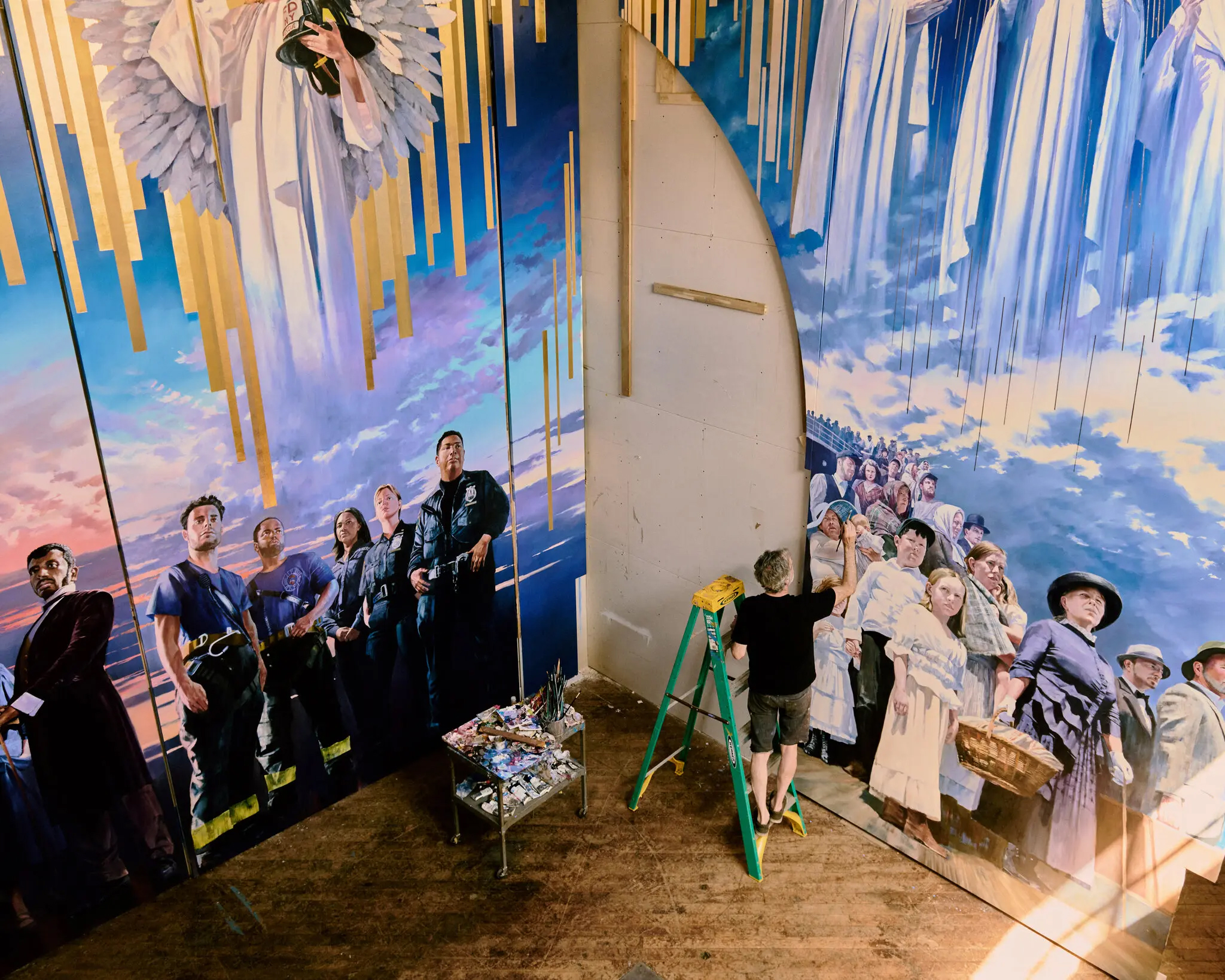
At a time when immigration is a bitterly divisive issue, with the Trump administration ramping up arrests and deportations, St. Patrick’s Cathedral will unveil a huge mural next month depicting the arrival of immigrants to New York City in the 19th century and the present.

“It’s a celebration of a city that has been built by immigrants and where immigrants have been welcomed,” Cardinal Timothy M. Dolan, who is also the archbishop of New York, said in an interview in his official residence adjoining St. Patrick’s. The first major art commission in the cathedral since bronze doors were installed at the Fifth Avenue entrance in 1949, it will be dedicated during a mass on Sept. 21.

Roughly 21 feet tall, the mural, of 12 large panels, was painted by the Brooklyn-based artist Adam Cvijanovic (pronounced svee-YAHN-o-vitch), who titled it (with a slight word adjustment) after a song popularized by Elvis Costello, “What’s So Funny About Peace, Love and Understanding.” Along with immigration, he depicted a historic event dear to the cardinal’s heart: the Holy Apparition at Knock, in which 15 people in the Irish village of that name in 1879 reported seeing the Virgin Mary, two saints and the Lamb of God, a symbol of Jesus Christ, in a vision that lasted for about two hours on a wall of the parish church.

Oh, wait! Cvijanovic? Obviously one a them foreigners, right? Well, not exactly. It’s worse, to many who would object: He was born in Cambridge, Mass. His mom’s people have been here since the 17th century. But hey, his dad is Serbian (and an associate of that Bauhaus dude Gropius!), so make what you can of that…

Back to the topic…

The artist was chosen for his realistic style. “The rest of them were a little too Picasso-like,” Dolan told the NYT. “I wanted something that people could look at and see the Holy Apparition at Knock, and not that you’d have to be on LSD to figure it out.”

Amen to that, too.

The work celebrates the Irish, of course — such as cops who saved people on 9/11 — but the cardinal with the Gaelic name wanted a lot more than that, and he got it. And of course, the many immigrants still trying to come here despite this administration’s efforts to close our nation’s welcoming arms are represented along with those from previous generations.

This mural is a sort of farewell gesture from Dolan, who you may recall, has addressed this topic before:

A week before his birthday, he had strongly criticized an assertion by Vice President JD Vance that the Roman Catholic bishops were in favor of immigration because the church profited from resettlement funds. He called it “inaccurate,” “scurrilous” and “very nasty.” In fact, he said, the church loses money “hand over fist” in caring for immigrants.

After that incident, the artist was worried that the archdiocese might want to back off from the topic a bit. But “the opposite happened,” he told the NYT. “They said, ‘We want to go right ahead.”

Good. Because it’s hard to imagine a more powerful and relevant way to express what the faith is about.

Nothing against old-style art, much of which I very much appreciate. In the article, the artist mentions Caravaggio. I like his work very much. We have a huge print of this masterpiece hanging prominently in a hall at my own parish. I also like some modern work, such as Henry Ossawa Tanner’s The Annunciation.

But maybe we’re overdue for a new approach. I have a very strong impression that we don’t necessarily need a lot more depictions of this or that event described in the Bible. People have seen those, and know the stories. Maybe we don’t need another Adoration of the Magi right now. What I believe we do need is more art that helps people get what our faith is actually about.

This is a wonderful step in that direction.

Present-day immigrants depicted with a native of Italy who became the first American saint — Mother Cabrini.

‘A lot of people are saying…’

This morning’s Gospel reading was the following, from the Sermon on the Mount:

Jesus said to his disciples:
“You have heard that it was said,
You shall love your neighbor and hate your enemy.
But I say to you, love your enemies
and pray for those who persecute you,
that you may be children of your heavenly Father,
for he makes his sun rise on the bad and the good,
and causes rain to fall on the just and the unjust.
For if you love those who love you, what recompense will you have?
Do not the tax collectors do the same?
And if you greet your brothers only,
what is unusual about that?
Do not the pagans do the same?
So be perfect, just as your heavenly Father is perfect.”

After reading that, I watched the video reflection on the U.S. Catholic Bishops site. I almost skipped it when I saw that today’s commenter was Deacon Arthur L. Miller from Hartford. I love the guy and also gain value from his insights, but they tend to be about twice as long as those from others. I listened anyway, and once again gained value.

That happened when he shared a thought that was the same thing I had wondered about when I had read the passage. As you may have noticed, Jesus frequently used this rhetorical device in which he would cite Scripture (Old Testament Scripture, from our perspective) and then add a new insight into its meaning. (He had done it earlier in this same sermon, with such concepts as “An eye for an eye and a tooth for a tooth.”)

Deacon Miller was thinking the same thing when he read, “You have heard that it was said, You shall love your neighbor and hate your enemy.” As he said:

You know what dawned on me? … I looked up where was it that Scripture said — you know, in the Hebrew text, in the Old Testament — where did it say that we are to hate our enemies? Well, it doesn’t say that.

Then he realized that what Jesus was saying there was, “you have heard it said.” In other words, “something that was often used by the people of that time…”

Well, that certainly sounded familiar. But it didn’t make me think of “the people of that time.” It made me think about a certain person in our own time who uses a similar phrase to justify the things that he chooses to believe. This was first widely noted early in the 2016 campaign:

‘A lot of people are saying . . . ’: How Trump spreads conspiracies and innuendoes

In case, like that certain person, you prefer video to the written word, you can look at this NBC clip from 2018.

I suppose the folks I’m obviously addressing here are those who say they are Christians, and yet have voted for that certain person on multiple times. Basically, a guy who justifies himself by saying that a lot is a guy who follows the precise opposite of Christian teaching, which is that we are to “love one another as I have loved you.” And not just your friends, but also “those who persecute you.”

That is the Christian message boiled down to as few words as possible. The rest is elaboration on the idea that we are to love God, and love each other as ourselves.

So I’m harrumphing at the MAGA people, there’s no denying it. But I’d be pretty thick if I didn’t see that the rest of us are enjoined to love the MAGA people, too.

That’s the tricky part, you see. Simple concept, difficult to carry out. I expect to be working on that for the rest of my life. I am obliged to do so, to put it mildly…

¿Hispano como yo?

On prominent display at All Good Books.

Over the weekend, my wife and I were browsing at All Good Books in Five Points — which you should definitely visit often, because Good Books are the only kind you find there — and ran across the volume you see above: America, América, by Greg Grandin.

From the jacket blurb:

The story of how the United States’ identity was formed is almost invariably told by looking east to Europe. But as Greg Grandin vividly demonstrates, the nation’s unique sense of itself was in fact forged facing south toward Latin America. In turn, Latin America developed its own identity in struggle with the looming colossus to the north. In this stunningly original reinterpretation of the New World, Grandin reveals how North and South emerged from a constant, turbulent engagement with each other…

Intriguing. Given my background, I want to read this book. I’ll put it on my Gimme List for Father’s Day, etc. I know many of the ways influence has flowed from the U.S. to the South, but I’m very interesting to see how he backs up the claim that it flows strongly the other way.

Since I lived in Ecuador longer than in any other one place in my childhood, Latin America had a huge effect in forming me. But I’ve been looking around me ever since, and the lack of consciousness of the rest of the hemisphere that I see in my fellow gringos continues to shock, after all these years. And of course, the foolishness that led to the results in our recent election has sunk us as a nation to new depths in that regard.

But until I read it, I can’t say much about the book. It reminds me, however, of something else I’ve been meaning to mention: Our new American pope — who was born in Chicago, to be sure, but has spent so much of his adult life in Peru — even to the point of dual citizenship. (Which I suppose drives the MAGA types who claim to be Catholic nuts. I mean the people who complained that he spoke no English in his first papal greeting.)

No doubt, Pope Leo XIV spent way more time in Peru than I spent in Ecuador. But hey, those were adult years. Kid years are like dog years, if not more so. A year is like an eon. Although I thoroughly enjoyed my time there, those two years, four-and-a-half months (from the ages of 9-11) seemed far longer than any one of the recent decades of my life.

You can tell as soon as he opens his mouth — in Spanish, that is. Also, when it comes to knowing a place and a people, I’m sure his time as a shepherd in Peru gave him an exponentially greater understanding and affinity than I gained goofing around in the streets of Guayaquil.

But still, I feel an affinity. Sort of the way I did with both John McCain and Barack Obama in 2008. I wrote columns about that at the time (and ahem, I headlined the one about Obama “Barack Like Me,” a not-so-subtle literary reference that I have played upon again above).

He’s my kinda pope, so far. He’s also my kind of American — the kind who can think in languages other than English (alas, my own Spanish is in sad shape today), and cares about the rest of the world. This is the kind of leader the Church needs. It’s also the kind of leader America needs, more desperately than at any time in our chauvinistic history. I look forward to him being able to influence the course of events back in his own native country, which is no longer what it was when he and I were kids.

Of course, the parallels with Pope Francis are enormously sharper than any shared characteristics I can claim. Leo is an American who spent his ministry until recently in Peru. He was elevated to cardinal, and carefully placed in a pivotal position) by a son of Italian immigrants who spent his pre-papal life in Argentina.

My man Joe Biden failed rather spectacularly to set up some other sane, qualified person with the electoral appeal to succeed him. And as much as I love Joe, that’s what got us into our current disastrous predicament. (All I can say in Joe’s defense is that the Church offered more material to work with than the Democratic Party has lately.)

It appears that Francis succeeded just as spectacularly, setting up a seemingly ideal successor — who (while it remains to be seen for sure) seems to be like him in more meaningful ways than coming from South America. I pray that impression proves to be accurate.

Of course, Francis didn’t do it alone. I told y’all, during that brief hour or two between the white smoke and learning the new pope’s identity, that I was “trusting the Holy Spirit on this.”

I still am. And I’m very eager to see what happens next…

POSTSCRIPT:

Speaking of Black Like Me (parenthetically, several grafs above), when one applies the “one-drop” rule, Leo is also our first black pope. Well, I can’t claim to touch him in that category. Ancestry keeps going back and forth on just how Scottish I am, but it never wavers on the idea of me being totally, unforgiveably, European.

(Mind you, 23andMe says I’m .1 percent Somali. And Helix — the service MUSC used to analyze my DNA — has somehow discovered I am .3 East Asian! “Austronesian-Filipino,” to be exact. But as a white boy who routinely shifts by 10 or 20 percent on Scottishness, depending on how Ancestry is reading the data that day, I suspect those tiny fractions are well within the margin of error. I will make no extragagant claims to possessing “color.”)

The Holy Father just keeps getting more cosmopolitan every moment! Especially since that part of his heritage came through New Orleans, the most cosmopolitan place I ever lived (that was right after Ecuador).

This is great, and very much as it should be. Remember above when I referred to “the MAGA types who claim to be Catholic?” I put it that way because “catholic” most assuredly does not mean “America First,” or America Only.

It means “universal.” And that’s what the Church, and all believers, must be…

WHITE SMOKE!

Congratulations to my diocese — as far as I’m concerned, Bishop Jacques Fabre-Jeune just scooped the world. I received first a text, then an email, from his office without having heard a word ere that.

Which is a bit surprising. I must have turned off more notifications from news sources than I thought.

Anyway, I then looked, and sure enough:

So now, everybody can pack up and go home, and stop trying so hard to predict who the new pope is. Or at least, they can when we actually know who he is.

I don’t remember this kind of blanket coverage in the past — when we lost John Paul II, or when Benedict retired. It has seemed, well, unseemly.

Some things should be done in private, without the jostling elbows of the world intruding. This is one of those things.

That may sound odd coming from an old newspaperman, but I’m also a (sort of, dating to my conversion in 1981) old Catholic. And I’ve got this archaic thing of trusting the Holy Spirit on this.

Oh, I may complain now and again about the new Holy Father — hey, no mortal is perfect — but I assure you I’m quite at peace on this as we receive the news…

Francis, who did not seek to be great, but was

Peggy Noonan dubbed John Paul II “John Paul the Great,” and who can argue with that? Not I. He certainly fit the description.

From the beginning, Jorge Mario Bergoglio did not seek to be great, in the coarser senses of the term. He signaled that by the first thing he did after his surprise election as pope — deciding to be the first pontiff in our time named “Francis,” after the man who chose a life of poverty, becoming a plain-robed itinerant preacher, a beggar in a time of particularly worldly clericalism.

If you wish to be a cynic (and too many do), you can call Pope Francis’ gestures — living outside the imperial quarters reserved for the pope, riding in a Ford Focus instead of a limo, saying “Who am I to judge?” — a theatrical form of PR if you like. The point, though, is that he chose to display thoughts and behavior consistent with being, first and foremost, a follower of the carpenter from Nazareth.

From the moment he came out on that balcony and said “Buon giorno” to the crowd, he was humble. He was kind. He bestowed his blessings and his love upon the poor, the suffering, the marginalized. He lived the Great Commandment: He loved God with all his heart, soul, mind and strength, and he loved his neighbor as himself. Or more than himself.

He lived his life as an example, one that the world in our time sorely needed, and still needs. And as our pope, he expected us to do the same.

And now, as badly as we need him, he’s gone.

There’s a lot of simplistic conjecture about whether his successor will be a liberal or conservative — reducing the choice of a Supreme Pontiff to the same gross, ones-and-zeroes foolishness that we allow to destroy our politics in this century.

As I grew to love Francis, I listened to those who deprecated him from both the “right” and the “left” — the kind of Catholics who would vote for Trump, and the Culture Warriors who kept saying he didn’t go “far enough,” as though his purpose was to please them by granting all their fondest wishes.

All of them helped me see that this good man was my kind of pope. And we need another just like him — except maybe younger, so he can stay with us longer.

So what else have you got?

My brother-in-law checking over the Nativity in 2019.

A brief Easter reflection. And no, it’s not too late. The Easter Season just started Sunday, and lasts until June 8…

My wife told me this one yesterday. Her youngest brother has had the same Nativity set on his lawn every Christmas season of his life — first at his parents’ home growing up, now at his own. It consists of several hollow plastic figures that I think were once lit from within, but are now illuminated with a spotlight. It’s getting a bit worn out — Mary had to be replaced a year or so ago — but it’s still something everybody in the family looks forward to, especially the kids.

His boys are grown now, and he has no grandchildren yet, so he’s been letting his older brothers’ grandchildren — who are all in the Memphis area — take turns each year with the honor of placing the baby Jesus on the manger.

This past season it was the year for the younger grandson of his oldest brother (whom we lost in 2020). Unfortunately, he didn’t get to do it on account of illness, from which he has fully recovered.

Time has passed, and the boy has gotten older — he turned 5 last month — but he hasn’t forgotten missing out.

So on Sunday, he approached his uncle and reminded him he had not gotten his chance to place the baby in the crèche. And he asked whether he could do it now.

My brother-in-law said well, no. The Nativity had been put away, because it was a Christmas/Epiphany thing. And now, it’s Easter.

So the boy thought for a moment, and tried a different angle. He asked:

“Well, have you got a tomb?”

Good for you for trying, Jeannie Gaffigan!

Here’s another thing Brad’s been doing (for the last few days, at least) instead of blogging: Trying to get through all that email that has been piling up since we went to Europe last summer.

In fits an starts the last week or so, I’ve managed to get back to Nov. 1. Which is like digging back a thousand years — to a time when at least a few people in our country could still think straight, and a decent human being who was not trying to destroy human civilization was president of the United States.

And that’s how I ran into this piece in America magazine by Jeannie Gaffigan. Y’all remember Jeannie. I wrote, with enthusiastic approval, about a previous column of hers back in 2020. Here’s a snippet from that earlier Gaffigan column:

As much as some of my well-intended fellow Catholics will hate to hear this, it is crystal clear to me that the right thing to do is vote for Joe Biden. I believe it will be impossible to tackle these other issues with a president who is working overtime to sow division and hatred in this county through insults, intimidation, fear and blatant racism. This venomous “us against them” mentality is trickling down, seeping into our churches and poisoning our pulpits. To a culture of life, vipers are deadly….

Amen, amen, amen!, said I.

Of course, Jeannie had more to work with at that time — our fellow Catholic Joe Biden, the only qualified candidate to run for our nation’s highest office in the last two election cycles. And, of course, the aforementioned decent human being, which is probably his most defining characteristic.

Jeannie Gaffigan

But Joe had been hounded into doing something I’d thought he would never do: he quit. Up until then, he was willing to spend his last breath struggling to save our country, and doing a fine job of it. But it became too hard for him to focus on the mission when the whole country — including people who should know better — were screaming “QUIT, JOE, QUIT!!!” 24 hours a day.

This put Jeannie, and me, and many others, into the uncomfortable position of urging people to vote for Kamala Harris, who tried hard — you’ve gotta give her that — but was still what she had been in 2020: unready. (And I don’t use that term lightly.)

The only advantage Kamala Harris — and those who would advance her bid — had was that her opponent was Donald Trump, for whom no one could possibly justify voting. And no one did. Justification was something these folks didn’t even attempt. Having gone substantially madder since 2020, they just voted for him anyway.

They ignored Jeannie. They ignored me, too, but I have no room to complain, because now we see that I also ignored Jeannie.

But not intentionally. Anyway, in case America will let you read it, here’s her column of Nov. 1. And if the Jesuits are wanting you to subscribe, here’s an excerpt:

An appeal to the moms out there: If you think parenting temper-tantrum toddlers or rebellious teenagers is nearly impossible, try letting them run your government! What would that look like? It’s a chilling thought but one that we can’t afford to ignore…

Amen again. And right now, a bunch of people on Wall Street who may have ignored you and me in November are now seeing exactly what you were talking about…

Some thoughts on God from the NYT

So did all of you survive the latest War on Christmas (which I suppose ended with Epiphany a few days ago)? I hope so.

Do the alarmists who go on an aggressive “Merry Christmas” offensive each year have a point about the onward march of secularism in our society? Of course they do. It’s been spreading wildly since what practitioners are pleased to call the “Enlightenment.”

But sometimes the warriors are a bit off with some of their assumptions. For instance, many Defenders of Our Faith As They Understand It would probably tell you that The New York Times is practically the Seal Team Six of the secularist aggression, second only to Starbucks in its zeal to wipe out all mentions of God.

And sure, the best newspaper (not necessarily my favorite, but probably the one that does the best overall job with its considerable resources) in such a growingly secular society as ours will include all sorts of views, including those of mockers of the Almighty. Good papers do that.

But since (I suppose) relatively few faithful Defenders actually subscribe to the paper, most of them probably missed something I saw, and was impressed by over the Holidays (oops, there I go being, if not secular, inclusive…).

Several opinion columnists — including some of my favorites — undertook to celebrate the season by reflecting seriously, thoughtfully and respectfully on holy matters.

I didn’t make a study of it at the time, and I can’t tell you how many writers did this, or whether it was a group project or something each was inspired on his own to write. But I enjoyed them all.

Two were written by folks who make enough of a habit of writing on faith that there was no surprise at all about it. They were Ross Douthat and David Brooks. I enjoyed their pieces, as I usually do, but there was less in them that I hadn’t read before. They’re still worth reading, though, especially if you don’t read them all the time. Douthat’s piece was headlined “Religion Has Been in Decline. This Christmas Seems Different.” Brooks’ was “The Shock of Faith: It’s Nothing Like I Thought It Would Be.

But the ones that really impressed me were by Nicholas Kristof, one of my favorite liberal columnists, and David French, an evangelical conservative with whom I am less familiar.

Let’s look first at the French column, “What if Our Democracy Can’t Survive Without Christianity?

Some of our more reflexive “liberals” are already bristling at that headline, saying Just like an evangelical to come up with something like that! But the thing is, he’s right, and he’s not the only one saying it here. In fact, this is less a “column” and more a transcript of a dialogue French had with his friend Jonathan Rauch, described here as “a senior fellow at the Brookings Institution and an atheist.”

In fact, the conversation was inspired more by Rauch, who has an upcoming book that I now hope to read, titled “Cross Purposes: Christianity’s Broken Bargain With Democracy.”

That’s something French has been thinking about, too. As a real Christian conservative, unlike the many we see gathering around Donald Trump, he has been appalled at what he has seen the last few years and wondering why he himself had been unable to see it coming. As he puts it:

Now we’ve finished a third consecutive presidential election when evangelicals voted overwhelmingly for one of the most immoral and cruel men ever to run for president.

This experience taught me something: Sometimes critics outside a community can see the community more clearly in some ways than those who live inside. They can see its virtues, how it interacts with the rest of the public in ways that we would admire and want to emulate, and we can also see the flaws that can demonstrate moral failings….

So he turned to Rauch. And Rauch’s point, though he is an unbeliever, is that what our country really needs is for Christians to act like… Christians:

What really needs to happen to get our country on a better track is for Christianity not to become more secular or more liberal, but to become more like itself, to become more truly Christian.

I came to that for a few reasons, but one of them is knowing people like you and other Christians who showed me that the three fundamentals of Christianity map very well onto the three fundamentals of Madisonian liberalism. And one of those is don’t be afraid. No. 2 is be like Jesus. Imitate Jesus. And No. 3 is forgive each other. And those things are very much like how you run a constitutional republic.

I agree with both, as this is something I’ve been thinking about for years, and contemplating writing a book of my own about. In fact, I hope to rough that book out this year, if I possibly can. It’s something I want to write whether anyone is interested in publishing it or not.

I’ll tell you more when I actually get something written. Now, let’s move on to Kristof.

His piece is called “A Conversation About the Virgin Birth That Maybe Wasn’t,” and as you might guess from that, it is also less of a column and more of a transcript of a conversation. Kristof calls it “the latest in my occasional series of conversations about Christianity, aimed at bridging America’s God gulf.”

This conversation is with Elaine Pagels, whom Kristof describes as “a prominent professor of religion at Princeton University and an expert on the early church.” She also has a book coming out, which I’ve already put on my Amazon gift list. It’s called Miracles and Wonder.

This is one that will quite provocative to many Christians, including many of my fellow Catholics. Ms. Pagels points out that some of the Evangelists — Mark, for instance — don’t ever mention a Virgin Birth. And here’s the most provocative bit:

The most startling element of your book to me was that you cite evidence going back to the first and second centuries that some referred to Jesus as the son of a Roman soldier named Panthera…

It’s not that much of a shock to me because I’ve read about that before — and even, as Kristof and Ms. Pagels mention here, that the Roman soldier raped the woman we see as the Mother of God. That’s horrifically painful to contemplate, but when we have more time, I’ll explain to you why I would revere Mary just as much if such a shocking thing turned out to be true.

In other words, I believe in the Virgin Birth, in a way that might remind you of the way the young Jewish protagonist of the Philip Roth story “The Conversion of the Jews” does. But it’s not as central to my belief in God and Jesus and Mary as it is to a lot of my co-religionists.

What I try to focus on is what Jesus came to tell us all about what another atheist writer, Douglas Adams, facetiously referred to as “Life, the Universe and Everything.”

Which is what Kristof and the lady he’s talking with do as well. As she says,

A professor friend said to me: “I’m an atheist. How can you believe all that stuff?” First of all, as I see it, “believing all that stuff” is not the point. The Christian message, as I experienced it, was transformational. It encouraged me to treat other people well and opened up a world of imagination and wonder…

That’s putting it more mildly than I would. In other words, as Jesus explained, the two greatest commandments are as follows:

36“Teacher,* which commandment in the law is the greatest?” 37j He said to him,* “You shall love the Lord, your God, with all your heart, with all your soul, and with all your mind. 38This is the greatest and the first commandment. 39k The second is like it:* You shall love your neighbor as yourself.

Or as French’s atheist friend put it, it’s about Christians acting like Christians — real ones.

And He did it with no mass (or social) communication

If you’d come today
You could have reached a whole nation
Israel in 4 BC
Had no mass communication…

— Jesus Christ Superstar

After persusing the various papers I subscribe to this morning, and finding little to engage my interest, I turned to my daily (well, most days) Bible readings for the day, and this was in the Gospel:

“If I testify on my own behalf, my testimony is not true.
But there is another who testifies on my behalf,
and I know that the testimony he gives on my behalf is true.
You sent emissaries to John, and he testified to the truth.
I do not accept human testimony,
but I say this so that you may be saved.
He was a burning and shining lamp,
and for a while you were content to rejoice in his light.
But I have testimony greater than John’s….

And it occurred to me that it would be great to know a lot more than we do about John the Baptist. We know he was this highly countercultural dude who lived in the wilderness and wore camel fur and ate locusts and honey. And he baptized people, most famously Jesus himself. And he came to a horrible end on this Earth.

But that isn’t enough to fully explain how big a deal he was in his day. Or apparently was, anyway. To a lot of people who lived in that place and time, it seems like he was even a bigger deal than Jesus for awhile. I infer that from the fact that so often in the New Testament, Jesus is explained to people in terms of his relationship to John. There seems to be an assumption at times that the writer of the Gospel or epistle knows people knew about John, and uses him as a launching point. For instance, The Gospel of Mark starts with John.

It would be great to be able to read a biography of John that’s as in-depth and detailed as a modern book such as Ron Chernow’s Alexander Hamilton, or David McCullogh’s John Adams, or Edmund Morris’ Theodore Rex. And then go from there to fully grasping the foundation of Christianity.

But we can’t. The sources just don’t exist. And not just about John, but about any historical figure from before, say, Gutenberg came along. In fact, we should be grateful that we have more info on John that we do a lot of the more obscure Roman emperors.

Still, to a modern person, it’s frustrating. So we can all dig Judas’ complaint in “Superstar,” about Israel in 4 B.C. having no mass communication. Or even a printing press.

But you know what? That’s what makes Jesus more impressive. You don’t have to be a believer to grasp how awesome his achievement was. This rabbi from the boondocks took a local religion that was only embraced by this one tribe on the borders of an ancient empire, and made it into the dominant faith of the world (yes, Islam is big, but…). And he did it with word of mouth, for the first generation. That, and a few letters written by others.

Which, to me, is exactly the way God would do it. It’s more impressive (and certainly more dignified) than building a rep on “American Idol” and inspiring a billion tweets.

It’s sort of like the way I view evolution. I shake my head at all the arguments between creationists and Darwinists. Of COURSE evolution (and geology and cosmology and all that other stuff) is the way God would make the world. The abracadabra opening of Genesis is a great way to tell an allegory, but come on, people. Look at the sheer, gradual majesty of doing it through subtle changes over billions of years.

Anyway, that’s what I was thinking while doing today’s readings…

St. John the Baptist Preaching, c. 1665, by Mattia Preti

I miss the whited sepulchers

Of course, ol’ St, Jerome would be unhappy that we’re not using his Latin version…

You know, I appreciate the efforts of various people to make Holy Scripture accessible to modern people. I do; it’s a noble motivation.

But sometimes it just leaves me flat, and I regret the poetry that has been lost.

Here is the opening of today’s Gospel reading, in the Catholic Church’s official New American Bible:

Jesus said,
“Woe to you, scribes and Pharisees, you hypocrites.
You are like whitewashed tombs, which appear beautiful on the outside,
but inside are full of dead men’s bones and every kind of filth.
Even so, on the outside you appear righteous,
but inside you are filled with hypocrisy and evildoing….

I’m not trying to make any theological point, much less a political one. In fact, as I suggested above, I suppose the correct theological point is to make the Word more accessible.

But it does bother me a little to imagine future generations missing out on the old wording. It survived to be a secular cliche because it had a certain power to it. You call somebody a “whited sepulcher,” and most people with even a modicum of cultural education will get it.

So for fun, and to gratify the esthetic part of the soul, here’s the old King James version (you know, the Protestant version):

Woe unto you, scribes and Pharisees, hypocrites! for ye are like unto whited sepulchres, which indeed appear beautiful outward, but are within full of dead men’s bones, and of all uncleanness.

Even so ye also outwardly appear righteous unto men, but within ye are full of hypocrisy and iniquity…

Meanwhile, I’ll sit here and worry about the editors of the next edition of the NAB deciding to ditch “Woe to you…” because it “sounds like Yoda or something…”

I mean, they already got rid of the “unto”…


Another way to look at our loss of the Garden of Eden

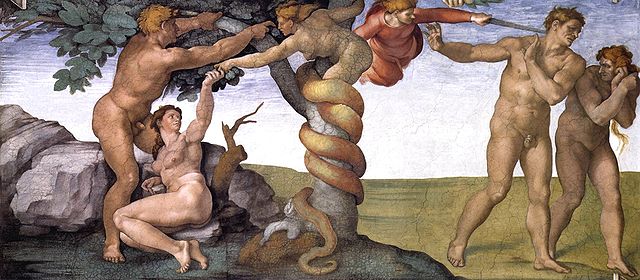
Hey, Michelangelo: I thought they were wearing fig suits when they left the garden…

The Gospel reading at Mass yesterday got me to thinking about ancient agriculture:

“A sower went out to sow.
And as he sowed, some seed fell on the path,
and birds came and ate it up.
Some fell on rocky ground, where it had little soil.
It sprang up at once because the soil was not deep,
and when the sun rose it was scorched,
and it withered for lack of roots.
Some seed fell among thorns, and the thorns grew up and choked it.
But some seed fell on rich soil, and produced fruit,
a hundred or sixty or thirtyfold.

Back in those days, it seems, farming was kind of haphazard. Seed was scattered in ways that today would seem quite haphazard. Whenever I read that passage, I think, why didn’t they put the seed IN the ground? Had the dibble not been invented, or what?

Which reminded me of my theory of Adam and Eve and their expulsion from the Garden of Eden.

It suddenly hit me as I was reading one of those books about the history of our species, from hunter-gatherer days until now — which as y’all know I frequently mention. I don’t remember whether it was Sapiens, or Guns, Germs and Steel, or what. But it was one in which the idea that the big move to agriculture was a decidedly mixed blessing.

Oh, it afforded advantages to the cultures that embraced it, in a competitive sense. As Jared Diamond stressed, the peoples who moved the earliest, and the most successfully, to food and fiber production dominate the world today. That’s how Pizarro conquered the Incan Empire with a handful of Spanish soldiers. He not only had the guns and the steel, but smallpox had spread ahead of the Conquistadores and had hit the Incas pretty hard just before he arrived. More than that, he had writing — not him personally, but the scribes he had along. He knew how Cortez had taken down the Aztecs, and followed suit. Emperor Atahualpa hadn’t known either the Spanish or the Aztecs existed.

It’s why Maori conquered and wiped out the Moriori — former Maoris whose forebears had moved away and gone back to hunter-gathering — on Chatham Island. You may not have heard about that, though, since the Maoris themselves were eventually dominated by European newcomers.

But that’s not my point. The point is that some of these things I’ve been reading make the argument that the big advantage that farming offered had a steep price. Basically, the farming life sucked compared to hunting and gathering. Before agriculture, people worked less each day, and on the whole ate better. They went about and gathered what they needed, and had plenty of time to chill after that. They didn’t think about the future. They didn’t worry about their land, or the weather over the coming months, or the price of cotton. They weren’t the slaves of the farms they worked day and night to keep going.

I was thinking about that, and suddenly it hit me — that’s what the first chapters of Genesis were about. In the Garden, Adam and Eve could just stroll around naked and eat their meals off the bounty of their property, and life was good. Then they fouled up — they couldn’t obey one simple rule — and got booted out. And then they were cursed with farming, in no uncertain terms:

Cursed is the ground because of you!
In toil you shall eat its yield
all the days of your life.

Thorns and thistles it shall bear for you,
and you shall eat the grass of the field.

By the sweat of your brow
you shall eat bread,
Until you return to the ground,
from which you were taken;
For you are dust,
and to dust you shall return.

Which certainly sounds like a raw deal to me.

And it hit me: The people who composed the story of Adam and Eve — and later wrote it down — were on some level remembering the switch to agriculture, and saw it pretty much as Yuval Noah Harari did, thousands of years before he wrote that “the Agricultural Revolution was history’s biggest fraud.” And they saw it as the ultimate human fall from natural grace.

So did I make some great discovery? No way. This was too obvious, and had been too obvious for ages. Search for “garden of eden hunter-gathering,” and you’ll see this idea all over the place. I liked this summary:

Apparently, the trauma of this transition from hunter-gatherers to farmers had a huge and lasting impact on humanity. We’ve never forgotten it. It’s burned into our consciousness. And, that’s why it’s the subject of the Bible’s foundational story. The Torah tells us that when humans were first created, we lived in the Garden of Eden, where we ate the fruit that God provided for us. We didn’t have to work hard or grow anything on our own. In other words, we were hunter-gatherers….

I don’t know where I was when everybody else was talking about it. All I can say in my own behalf is that I realized it on my own. All the talking that people do about Adam and Eve — usually, unfortunately, in the silly arguments between biblical literalists and those who think a story about the Earth being created in six days means all faith is bunk (both sides seem to have trouble grasping the concept of allegory) — and I’d never heard a reference to this.

And it sort of blew my mind. I love it when I see connections to things I had not previously seen as connected — such as the Bible’s foundational story of life on Earth, and the findings of secular scientists and philosophers in our own age — and this was the Mother of All Connections. It tied everything about the origins of humanity and our world together.

And the most amazing thing is that it appears as though the originators of the Eden story had some memory — consciously or unconsciously — about what had happened to people ages earlier, long before writing, before Abraham, much less before anthropology, archaeology, DNA testing or carbon-14 dating.

I marvel at it…

What it’s all about: Willing the good of the other

I meant to post this over the weekend. But here you go…

Our friend Lynn Teague retweeted this from up in the Midwest:

Her comment was to say this was where South Carolina was headed, what with those folks finally managing to pass their bill to pay parents to abandon public schools. (At least, that was what I assumed she meant.) This caused me to recall something I wrote during that period, so I shared it:

Of course, that was back a couple of bishops ago.

Lynn responded:

And that really got me going. First, I responded as you see above: “You know what’s anti-Catholic? Accepting money diverted from schools that exist to educate all the children….”

But I had a little more to say. My favorite homilist Bishop Barron had had a really good sermon on May 14, distilling more or less what our faith is all about — or, to be more precise, what love is. Rather than sending the whole video, I looked for a tweet when the bishop said it (he had mentioned saying it often), and found that here:

I followed that up with this:

Anyway, that’s really what I wanted to share. That’s what love is: Willing the good of the other. The applications of that concept are innumerable, and of supreme importance…

Here is the homily to which I referred…

Coinherence

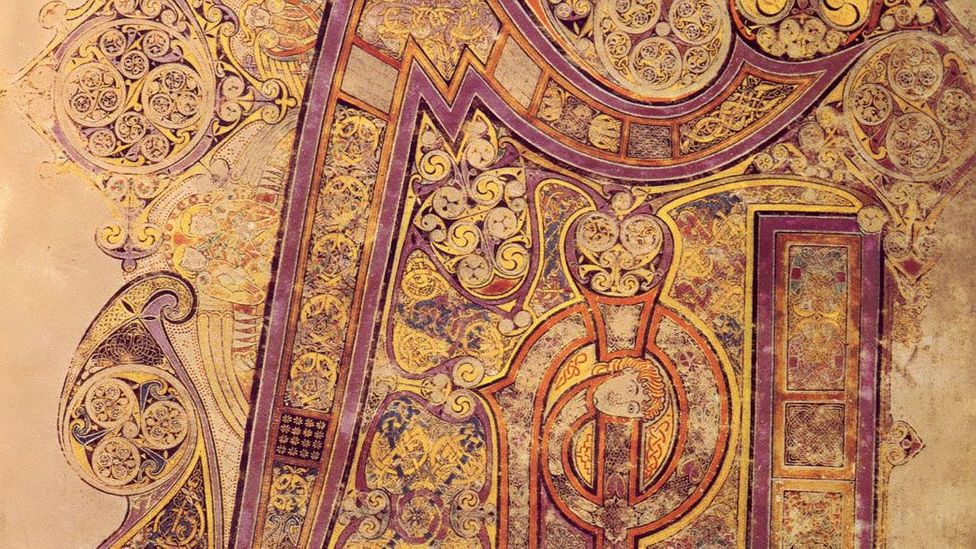
Detail from the Book of Kells.

I have another another word to try to learn about more deeply, the way I did more than 30 years ago with “subsidiarity,” before driving my friends nuts over it.

It’s “coinherence.” I learned it today — or began learning it today — from Bishop Barron‘s reflection on the Gospel reading of 3/31/23:

Friends, in today’s Gospel, Jesus declares, “The Father is in me and I am in the Father.”

Charles Williams stated that the master idea of Christianity is “coinherence,” mutual indwelling. If you want to see this idea concretely displayed, look to the pages of the Book of Kells, that masterpiece of early Christian illumination. Lines interwoven, designs turning in and around on each other, plays of plants, animals, planets, human beings, angels, and saints. The Germans call it Ineinander (one in the other).

How do we identify ourselves? Almost exclusively through the naming of relationships: we are sons, brothers, daughters, mothers, fathers, members of organizations, members of the Church, etc. We might want to be alone, but no one and nothing is finally an island. Coinherence is indeed the name of the game, at all levels of reality.

And God—the ultimate reality—is a family of coinherent relations, each marked by the capacity for self-emptying. Though Father and Son are really distinct, they are utterly implicated in each other by a mutual act of love.

The impossibly good news is that Jesus and the Father have invited us to enter fully into their divine coinherence. The love between the Father and the Son—which is called “the Holy Spirit”—can be participated in.

I suspect that there’s a simpler way to say it, just as I keep saying the Church should go back to “one in being with the Father” in the Nicene Creed, rather than the new phrase adopted in 2011 — “consubstantial with the Father” — which, as much as I love and respect Latin-derived terms, was not a good move.

But while there may be better words for getting the concept across, there’s nothing simple about the idea itself. I really need to understand it better.

But it appeals to me greatly so far, “at all levels of reality” as the bishop says, for a wide variety of reasons, including:

  • I believe salvation (if even that is the right term, given the way so many use it), is achieved with and through others. It’s not about the I; it’s about the we. (Which is another problem with the new version of the Creed). It’s why there’s a Church. It’s why there are families. It’s why there is such a thing as love.
  • I believe in communitarianism, and most assuredly not libertarianism.
  • I love John Donne’s most famous work, to which the bishop alludes.
  • One of my favorite clichés is, “We’re all in this together.” I mean, if we must have clichés, and apparently we must.
  • It’s a big reason I’m Catholic.
  • It’s why I’ve confused so many people when they ask why I’m Catholic, and I refer them to the last sentence of Joyce’s masterpiece “The Dead.” But read the rest of it first. If it’s still not clear, and I admit it may not be, I’ll try to explain further. Maybe I’ll work in “coinherence.”
  • It’s why, back in my newsroom days, I used to talk about my dream of someday putting out a newspaper that is just one story that has everything that happened in it. Because it’s all connected, and there’s something deeply artificial about presenting the news as separate stories with different headlines. Of course, it might take a year — or at least a week — to write such a “daily” newspaper, but it would be worth it, if the laws of space and time could be suspended.

Now I realize that, except for the Donne reference, the bishop didn’t say exactly any of those things, and I may be mistaking the meaning of coinherence entirely. But it made me think of all those things, and I like thinking about those things.

And I’m just getting started with trying to understand it…

I’m impatiently waiting for this other stone to roll away…

This morning, America — the Jesuit magazine to which I subscribe online — had a headline that definitely grabbed my attention:

What the Catholic Church can learn from the resurrection of Barnes & Noble

And I was all like, say WHAT?

I haven’t seen any such resurrection — I mean the bookstore one. I just Googled to see if it came back when I wasn’t looking. I see no such signs or wonders.

As y’all know, my favorite store of any kind in the entire universe was the Barnes & Noble on Harbison. And they closed it, and replaced it with some stupendously unappealing thing called a “Nordstrom Rack,” thereby adding further insult to the injury. I went in there once. They didn’t even offer coffee, as I recall.

If my store is coming back, let me know, and I’ll run there almost as fast as the Apostle John ran to the empty tomb. (I say “almost” because he was young and spry, and, well, that was a much bigger deal. Infinitely bigger, if you will. But I still want my store back.)

Just roll away that stone, and watch me. I want my store back…

(I say “almost” because John was young and spry, and, well, that was a much bigger deal. Infinitely bigger, if you will. But I still want my store back.)

A small epiphany

Then, she noticed me, not knowing what I was…

I experienced a little epiphany just before going to bed last night. To explain…

This being the Feast of the Epiphany, Bishop Robert Barron spends his sermon today talking about that word. Epiphany, from the Greek for “intense appearance.” The Magi experienced two such appearances — the star, and then the baby Himself.

But he spends most of the sermon exploring other instances in which the term can be used. He starts with James Joyce. Joyce was formed in Catholicism, but recorded in “Portrait of the Artist as a Young Man” his realization that he was not to be a priest, but to be “a kind of priest.” His vocation would be to notice epiphanies when he saw them, and then to describe them. Of course, being Joyce, he was able to do so masterfully.

The great example the bishop cites isn’t the birth of Christ, or the Transfiguration, or anything like that. It’s the moment when he first spotted the young woman who would become his wife, down by the shore near Dublin. The bishop calls it “one of the most beautiful scenes in 20th century literature.” It’s not the basis of a religion or anything, but it was the moment that transformed Joyce’s life, and he realized it. Everything changed then for him. And he was able to share that with us.

The bishop then gives various such moments from his own life, things that might have no significance in a plain, factual telling, but had significance to the person experiencing them. These “moments of intense manifestation” just happen. We can’t control them. We can’t “make it happen again.” They are moments of grace that are granted to us.

As I say, I had a very minor one of those last night.

Or rather, very early this morning. At 12:17 a.m. I had turned off the tube after rewatching a bit of “Wolf Hall.” My wife had already turned in, and I was doing my usual walking about making sure doors were locked and lights were turned out. And at one point I glanced out the door that leads to our garage, and through one of the windows in the garage, I saw an extraordinary thing.

The first glimpse, out the garage window.

There was a deer standing on the corner of my neighbor’s lot, directly under a streetlight, peacefully and calmly grazing on the lawn.

Deer are not a miraculous sight in our neighborhood. They leave hoofprints in my wife’s garden, letting us know who’s been feasting on the vegetables. Occasionally, one will streak across the street, running from one clump of trees to another — and then be gone.

But this one might as well have been standing in the Garden of Eden — peacefully, without any sort of nervousness, enjoying the natural bounty available in that spot. It was safe, unthreatened, unconcerned.

I quickly shot a grainy picture through the window. Then I slipped out, as quietly as possible, through the garage — fortunately the door was still open, so I didn’t have to activate the noisy opener — and out into the yard, moving carefully into a spot where my driveway light wasn’t on me, and my profile wouldn’t stand out from the creature’s perspective.

And I got another couple of pictures — something I’ve never had time to do before when deer have briefly appeared.

And then, the deer looked up, and looked directly at me. Or rather, at the something that it sensed out there in the darkness, beyond the pool of light in which it stood. Then, she turned her body in my direction.

She… it (I took it for a doe, but what do I know? It could have been a young male, without antlers. Perhaps one of you can tell me)… considered this unseen manifestation. She turned her head one way, considering me as a quizzical dog might do. Her tail twitched. She leaned her head the other way. She was in no nervous hurry. She felt safe to consider the situation at leisure. Her tail twitched again.

At one point, I thought I detected a slight movement in one of her front legs that meant she was starting to walk in my direction, and, transfixed, I wondered what I should do. Should I stand and wait for her, or should I move toward her myself, given her a chance to see what I was and take evasive action if the spell was broken and she felt the need? What would panic her the least? What was the right way to respond to this moment?

A few long seconds later, it was over. She reacted to the car coming down the street behind her, and turned, and took off into the darkness.

I went in, and woke up my wife, to share the experience. I wasn’t sure how she would react to that, but fortunately she got it, and didn’t mind.

She thought it was pretty cool, too…