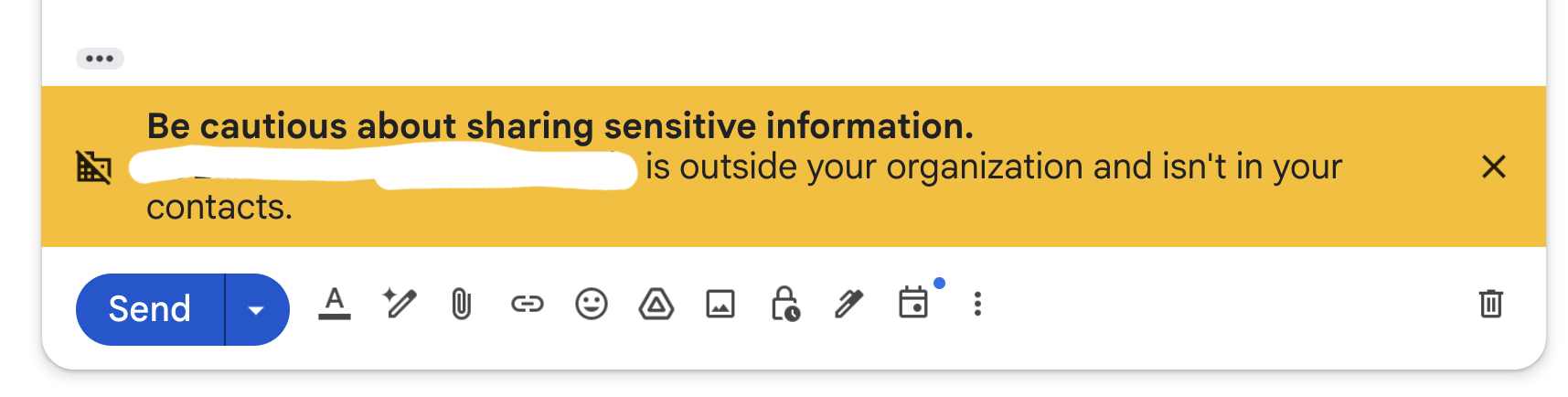
Do any of y’all get these stupid things? I’m sure you do, if you have gmail. (Or maybe you’ve turned this function off in the settings. But rather than figure out how to do that myself, I prefer to complain about it in a post.)
They don’t really get in my way of doing what I need to do, so I just ignore them when they come up. But each time, for a split second, I wonder what Google is asking me to worry about.
Here’s the situation in which the item you see above popped up this morning: I saw something in the NYT that I thought might interest a prof over at USC with whom I was conversing about the same subject a few days ago. He found it interesting, and almost immediately responded. I started to send him that emoji I wrote about recently, to acknowledge his response and to to vaguely communicate something like, “Yeah, thought you’d like that!”
Anyway, once I started the reply process to do that, I got the above orange warning. Why? I mean, I’d already written to the guy once, which indicates that yes, I am intentionally communicating with him. (Can’t remember whether I got the warning on the first message.)
And yet it still gives me an orange alert. That makes no sense.
Also, what does it mean by “outside your organization?” What organization? I’m a guy sitting here in his home office — which is so disordered that I promise the merest glance would assure you that there is nothing you would call “organization” in this vicinity.
Is it referrring to ADCO, for whom I do some writing and editing? I don’t think so. This was not on my entirely separate ADCO email address, which I keep running at the same time in a different browser. This was within my bradwarthen.com domain — that’s the ending of my address (although it’s really a Gmail account). Well, that’s hilarious! Aside from Bryan Caskey, who kindly watched over the blog while I was in Thailand a decade ago, and a couple of people who’ve helped me with technical stuff over the years, there is no one else on the planet who has ever had an email address ending in bradwarthen.com. To my knowledge, anyway. So, what — it’s going to give me a warning whenever I write to anyone else?
I remember getting something like this warning back when I worked at the paper. It seemed weird to me then, too, although I was working in a building with 500 or so people with addresses ending in thestate.com. I suppose there was someone in the building who used email to communicate only internally, but I can’t imagine who it would be. Obviously not news people. Like me, their job (at least, the reporters’ job) was to communicate with people out there. If they only wrote to their colleages in the building, they were not doing that job. Circulation people had to respond to readers. The finance people had vendors to deal with (I’m guessing). The ad account executives needed to be in touch with advertisers — although maybe they weren’t in this period (which could be a good alternative explanation for why the newspaper business collapsed).
I mean, come on! You need to talk to somebody 20 feet from you, walk over and talk. Or yell from your desk. Email is for instantaneous communication around the globe! And if it’s something confidential, hand it over on paper or a flash drive — or ask the Chief of Control if you can borrow the Cone of Silence for a few minutes.
I suppose there are large organizations in the world where such a warning might be appropriate. Say, the CIA. Or parts of Google, where thousands spend their days dealing with proprietary code. But they’d be few. How many businesses don’t need to communicate with customers?
Does Google just do this in keeping with the same CYA logic that causes sellers of packaged goods to include warnings such as: YO! THIS BOX CONTAINS NOTHING BUT RAT POISON! DON’T EAT IT! You know, to please their attorneys?
Maybe y’all can see the reason these distracting little alerts are necessary, or even slightly advisable, for gmail users in general. If so, please share the explanation…