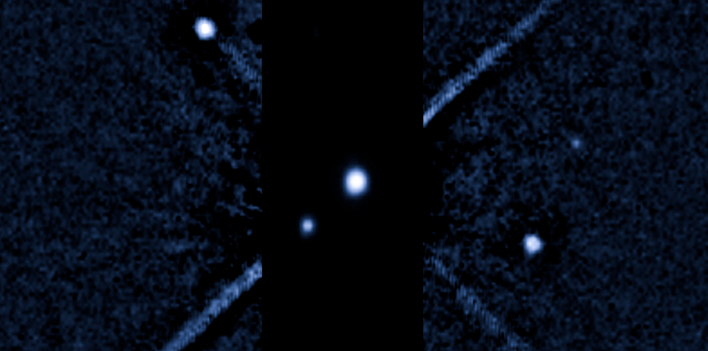
From NASA site: "A Hubble Space Telescope image of Pluto and its moons. Charon is the largest moon close to Pluto. The other three bright dots are smaller moons discovered in 2005 and 2011." Apparently, we still don't have a close-up.
Well, that was exciting. (Ralph Hightower will like this; he’s into space stuff.) I just got a reply from the Hubble via Twitter.
Having seen this:
Astronomers using @NASA_Hubblediscover another moon orbiting dwarf planet #Pluto! http://t.co/PubN0ov
… I naturally asked, “Does that make it a planet again?” I had read right past the “dwarf planet” reference, because I didn’t know what that was.
@NASA_Hubble wrote back to me, “Not quite,” and urged me to “See Resolutions 5A and 6A.” Which I did. To share:
RESOLUTION 5AThe IAU therefore resolves that planets and other bodies in our Solar System, exceptsatellites, be defined into three distinct categories in the following way:(1) A “planet”1is a celestial body that (a) is in orbit around the Sun, (b) has sufficient mass forits self-gravity to overcome rigid body forces so that it assumes a hydrostatic equilibrium(nearly round) shape, and (c) has cleared the neighbourhood around its orbit.(2) A “dwarf planet” is a celestial body that (a) is in orbit around the Sun, (b) has sufficientmass for its self-gravity to overcome rigid body forces so that it assumes a hydrostaticequilibrium (nearly round) shape2, (c) has not cleared the neighbourhood around its orbit, and(d) is not a satellite.(3) All other objects3, except satellites, orbiting the Sun shall be referred to collectively as“Small Solar-System Bodies”.IAU Resolution: PlutoRESOLUTION 6AThe IAU further resolves:Pluto is a “dwarf planet” by the above definition and is recognized as the prototype of a newcategory of trans-Neptunian objects.1RESOLUTION 5AThe IAU therefore resolves that planets and other bodies in our Solar System, exceptsatellites, be defined into three distinct categories in the following way:(1) A “planet”1is a celestial body that (a) is in orbit around the Sun, (b) has sufficient mass forits self-gravity to overcome rigid body forces so that it assumes a hydrostatic equilibrium(nearly round) shape, and (c) has cleared the neighbourhood around its orbit.(2) A “dwarf planet” is a celestial body that (a) is in orbit around the Sun, (b) has sufficientmass for its self-gravity to overcome rigid body forces so that it assumes a hydrostaticequilibrium (nearly round) shape2, (c) has not cleared the neighbourhood around its orbit, and(d) is not a satellite.(3) All other objects3, except satellites, orbiting the Sun shall be referred to collectively as“Small Solar-System Bodies”.IAU Resolution: PlutoRESOLUTION 6AThe IAU further resolves:Pluto is a “dwarf planet” by the above definition and is recognized as the prototype of a new category of trans-Neptunian objects.1
Well, that’s better than nothing. Not that we’ve always given actual human dwarfs much respect on this planet, but I suppose being some kind of planet is better than nothing. WAY better than being just a “trans-Neptunian object.”