Category Archives: Elections

Paul Ryan: The Deerslayer, policy wonk version

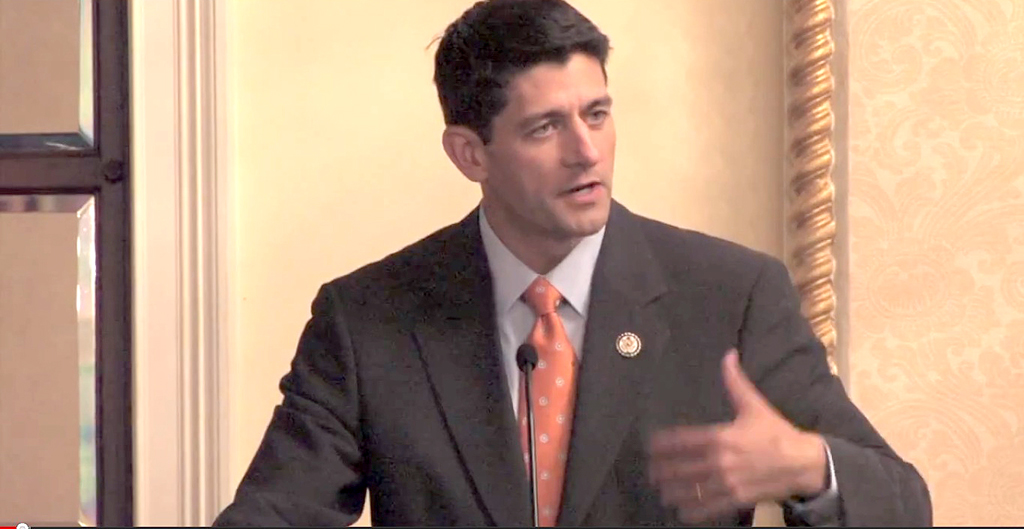
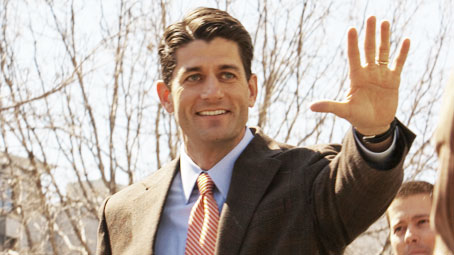
OK, you know veep candidate Paul Ryan is a major policy wonk. One thing you might not think of him as is a good old boy. But a magazine with a name that sounds like a stutter — Deer and Deer Hunting — is aiming to set you straight. See this release:

Republican vice presidential candidate Rep. Paul Ryan opens up to Deer & Deer Hunting Magazine about his love of the outdoors.

“Bowhunting is my passion,” said Ryan to Deer & Deer Hunting’s Editor Alan Clemons. “Studying the strategy, preparing food plots, the strategy of where a dominant buck is living or will be moving and then being in position to get a shot, that’s really exciting.”

Ryan talks more about his childhood, being a father and balancing his hunting and Capitol life in an exclusive interview with Deer & Deer Hunting. The column will be in the October issue of Deer & Deer Hunting and will be available on newsstands September 4.

If you’d like to learn more about the interview, I can provide you with the pre-released interview, a press release, a copy of the magazine issue or any additional information you may need.

For more information on Deer & Deer Hunting, please go to www.deeranddeerhunting.com. For any questions, please do not hesitate to ask.

I didn’t get to read the whole story because I didn’t want to give the mag my email address and have a whole new batch of emails to delete (I’ve made that mistake too many times in the past). But I confess to being curious as to whether the piece contains any other quotes as, um, interesting as “Studying the strategy, preparing food plots, the strategy of where a dominant buck is living or will be moving and then being in position to get a shot, that’s really exciting.”

Yeah, OK. I thought he only got that excited about cutting Medicare costs.

Of course, I’m a bit of an old hand with a bow myself. One day when we were in England last year, we were strolling in Hyde Park and came across a sort of carnival, which had a booth called “Robin Hood,” which enticed marks to shoot an arrow at balloons. Sure, it could have been a trap set by the sheriff, but I couldn’t resist. I immediately laid down my five quid (the real Robin Hood would have loved to find a fat friar carrying that on him), gave my camera to my wife to record the moment, and took my three shots. Unfortunately, my wife thought the camera was set for still photos rather than video, and merely aimed it at me, pressed the shutter release, and turned away.

So it was that she missed when I actually burst one of the balloons. But the great tragedy was that she missed my next shot, which split the previous arrow… yeah, that’s the ticket

OK, so that last part didn’t really happen. But I did get one of the balloons. Of course, I’m sure that doesn’t match the excitement that Ryan speaks of. But that’s OK by me.

Take THAT, ye oppressor of good Saxon yeomen!

Yay! We can stop saying ‘presumptive’ now!

Just got this bulletin on my phone from AP:

Republicans nominate Mitt Romney for president.

No, really. They interrupted my day to tell me that. I guess if you’re still out there in the MSM, and you’ve been forced by your cautious editors to type “presumptive” several hundred times in the last few months, this is a big moment.

Nikki Haley still to speak (I’m sure all of y’all will be greatly relieved to know it)

At first it appeared that planet Earth had gone to great trouble to prevent Nikki Haley from addressing the nation. But the GOP convention planners, not ones to take a hint, have rescheduled her:

TAMPA, Fla. — Gov. Nikki Haley will address the Republican National Convention at nearly 10 p.m. Tuesday under the new, storm-altered schedule of events.

The governor was originally slated to speak at 10 p.m. tonight, but Tropical Storm Isaac forced organizers to scrap the opening night activities and move the Monday night speakers to Tuesday.

Haley, who made history as the state’s first female and minority governor, will follow Artur Davis, a former Alabama Democrat and supporter of President Obama who became a Republican this year after badly losing his bid to become Alabama’s first black governor.

She will speak before GOP presidential candidate Mitt Romney’s wife, Ann, and another popular Republican governor, Chris Christie of New Jersey, according to the revised schedule. Christie was supposed to deliver the keynote speech Monday night…

So I’m sure all of y’all are relieved, right?

What’s really wrong with Todd Akin

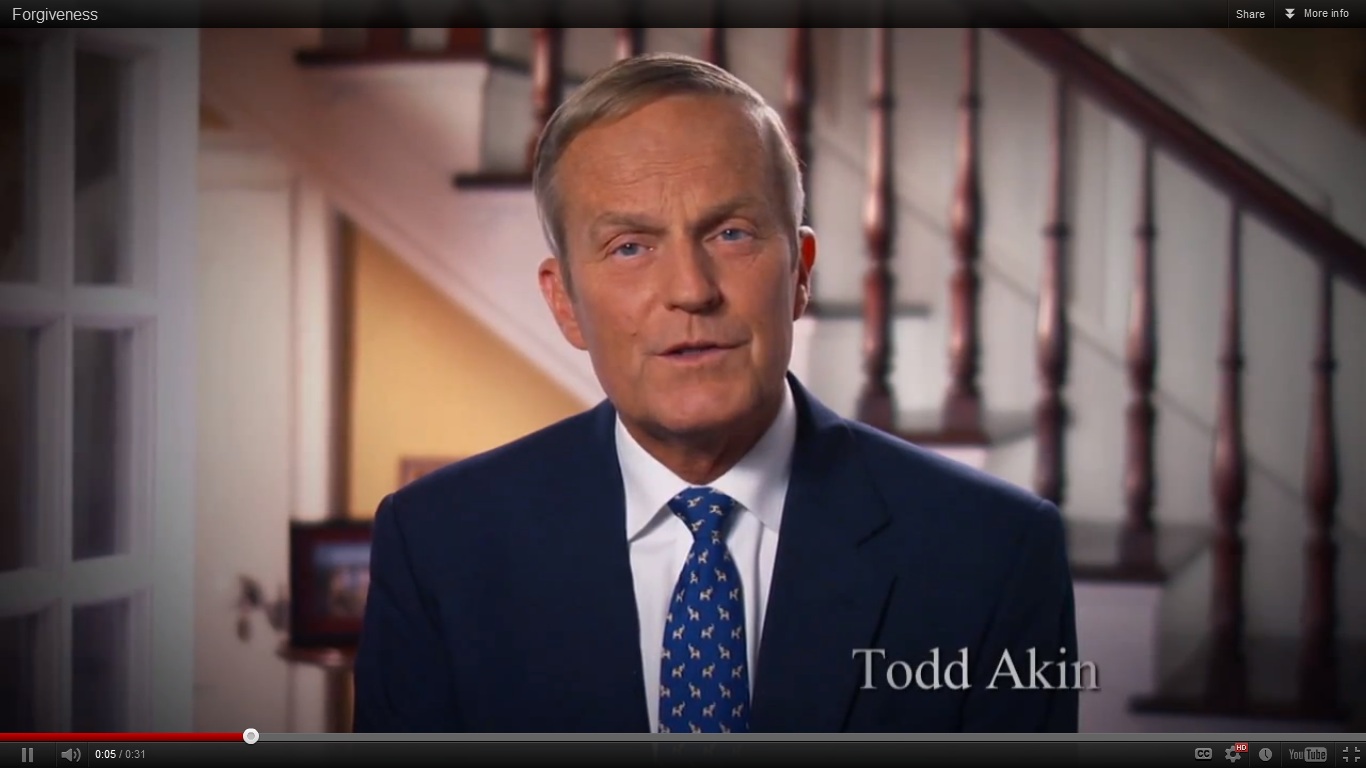
All the moralizing on this previous post about the work Wesley Donehue is doing for this month’s pariah, Todd Akin, goads me to share what I actually think of Mr. “Legitimate Rape.” Even though I know it’s going to make pretty much everybody mad at me.

Well, here goes…

To begin with, Akin is one of those people who makes you furious because he’s on your side of an issue (if you’re me), and he’s giving people on the other side of the issue more than enough excuse to dismiss you and all who think like you (or, once again, to be more accurate, me) as idiots or evil or both.

The issue here being abortion, not rape. The thing (I think) I agree with him on, that is.

As for being an idiot or evil, well, I reject both with regard to myself, although of course I’m not perfect. With regard to Akin… I don’t think he’s evil, although he possesses a certain very common character flaw (which will be my point, when I get to it) in an extreme form. And as to the idiot part… well, my wife often calls me down for calling people idiots, which is one of my character flaws — and after all, we are specifically enjoined from doing so, and very sternly warned about it, in the Bible.

But… confession time here… when I heard about what Akin said, and then saw a picture of him, one of my first thoughts was, Yes, he looks stupid enough to have done that. Which I know is wrong, to leap to such a conclusion just from looking at someone. I am in fact quite embarrassed to confess it. But there it is.

Basically, Akin tried to make a point that would have been extremely objectionable to most people even if he had put it in the most diplomatic way possible. And then, he managed to put it as offensively as possible. This suggests a sort of genius for offending, but again, I look at him and I think he only stumbled on this perfect combination by accident.

Neither I, nor I suspect his most vehement political opponents (although I could be wrong here) thinks that Akin meant to say that any sort of rape is “legitimate,” in the sense of being licit, or a good thing. So we can set that aside. (And yes, I know I’m setting aside a whole, complex discussion about how some people reject that all cases of rape are “real” rape, but I’m trying to address a separate point, and believe me, this post is going to be long enough.)

And of course, I think he was just trying to defend a political position that I share — the notion that if one truly believes that abortion takes a human life, one cannot defend exemptions for rape or even incest.

And yet, I, too, am deeply offended by what he said. I see it as both foolish and wrong. But then, I think his sin is a very common one.

Finally I get to my point: Like many, many people across the political spectrum, Akin sought to rationalize away any human cost of his own political position. What he did reflects both sloppy thinking and a sort of moral cowardice. And it’s a function of the absolutism that infests our politics today.

Akin and I agree that you can’t have exemptions for rape when you’re talking about a human life. That innocent unborn human didn’t commit the rape, and condemning him or her to death for it is unjust in the extreme. I’m deeply opposed to the death penalty even for murderers, but I can certainly see more justice in that than I can in this.

But here’s where Akin and I diverge: He wants to explain away the consequence of this position. He wants to say, well, if it’s really rape, then the woman won’t get pregnant. Which is amazingly foolish and ignorant, but which seems to arise from a very human desire to believe that no innocent human being will suffer because of the position I’m taking.

I know better. I’m not going to shy away for a moment (I hope) from the fact that the human cost to a woman caught in this kind of situation is horrific, beyond even imagining. I can’t even begin to think of what to say or do that would ease the suffering of a woman in such a situation (aside from such weak expedients as providing material support). I don’t want her to be in that situation, any more than the pro-choice person does. It awakens in me powerfully strong protective impulses, and vindictive ones, including a determination that the person responsible for it must be punished to the fullest extent of the law (while, at the same time, knowing that no amount of punishment could possibly erase this woman’s pain). I am fully aware of the terrible odds her child will face — not only not being wanted by his or her mother, but being the material embodiment of the most horrible moment in her life.

But none of that justifies killing the child, either before or after he or she is born. Not in any truly moral balance that I am capable of conceiving. As much as I understand the pro-choice advocate’s desire for a magic solution that makes at least this one facet of the crime go away for the woman, I can’t see any way that that expedient is justified in a society that is just. It in fact adds another moral horror to that which already so unjustly exists.

It’s not comfortable to face and acknowledge the additional pain to which having to bear this child would condemn a rape victim, but I see no moral alternative to doing so. Akin? He wants to cop out on it.

But that’s a common impulse. Too seldom do any of us face up to the very real consequences of the positions we take. We like to believe that our attitudes are all to the good, that nothing bad would happen if only the things we believe were acted upon. And in the take-no-prisoners absolutism of today’s politics — in which each side wants to see itself as all good, and the other side as all bad — people regularly paint themselves into corners trying to make their positions look as good as possible. And to make themselves feel good about those positions. There are a lot of Todd Akins out there.

For instance… and here’s where I make everybody mad… there are those on the opposite side of the abortion issue who rationalize away the human life that is destroyed by abortion. They say it isn’t a human being at all, even that it’s nothing more than a random collection of cells, and ridding oneself of them has no more moral weight than sloughing off dead skin.

(Not all do this, of course. Right off the bat, I can think of pro-choice friends who have persuaded me that they are fully cognizant that abortion takes an innocent human life and that it is deeply wrong — but that the imperative of choice overrides it. This chills my blood — just as my antiwar friends are chilled by my advocacy of some military actions in spite of my pro-life beliefs — but I can’t criticize them for failing to face reality.)

They say this — that the fetus is not a human being — because they would find the moral burden of believing their position results in the destruction of innocent human life even more unbearable than Akin would find it to contemplate the suffering of a rape victim. (Now, before all my pro-choice friends shout that they say it because they believe it, let me quickly interject that I know you believe it. I just, personally, find it very hard to believe that you would believe such an unlikely thing without a powerful human need to rationalize, which is related to the fact that you are a good and caring person.)

Now to an empiricist, of course, there’s a difference between Akin’s rationalization and the it’s-not-a-human-being rationalization — one that I readily acknowledge. After all, you can physically, scientifically prove that Akin is wrong in his fantasy about true rape not leading to pregnancy. Whereas science can’t prove or disprove that a fetus is human — no matter how strongly I believe it unlikely that smart people would assert that it isn’t, in the absence of this powerful cause for rationalization. Nevertheless, I’m convinced that similar mechanisms are at play.

This dynamic translates to other issues, of course. There are those who advocate war, and blind themselves to the worst aspects of the human cost — such as the deaths of noncombatants, at the most extreme end of that spectrum. On the other side are those who are so opposed to war and its horrific human costs that they try to rationalize away the cause for war — minimizing the evils of the Saddam Hussein regime (how many times have I read that we invaded an inoffensive country that wasn’t doing anything to anybody, as though it were Switzerland?), or the costs of a precipitate withdrawal from Afghanistan, allowing the Taliban to rise again.

There are costs both to acting militarily and not acting militarily, and it’s wrong to blind yourself and try to wave them away. For my part, seen as I am here as the bloodthirsty warmonger, I try never to turn my mind from the horrors of war, and I recoil from efforts to make war seem costless just as much as I reject attempts to paint it as never worth engaging in. And for me, the horrible thing about war is not just that innocent civilians, or one’s own soldiers, get killed and maimed. Every armed enemy’s death also diminishes us. (I’m reading right now a phenomenal book about the cost of killing in war, Dave Grossman’s On Killing. It powerfully reinforces something I have long believed — that the greatest price we ask of a soldier is not that he die for his country; the most awful thing we ask of him, the thing that costs him the most, is expecting him to kill for his country.)

Well, I could go on and on. Actually, I have. There are other places I could go with this, carrying this phenomenon out of the realm of life-and-death issues. I could get into how, for instance, in this absolutist political atmosphere, neither those who want more government spending nor those who advocate shrinking government small enough to drown in a bathtub like to face that there are tradeoffs to their positions… but I think this is enough for how…

SC’s Donehue raising money for Todd Akin

Last night, local GOP political consultant Wesley Donehue shared with me some surprising news, by way of explaining why he had to cancel a breakfast we had scheduled. Well, it was sort of surprising. When he said he had a new client (Donehue Direct does web work for candidates across the country) who was going to be keeping him really busy immediately, I thought, Who? Todd Akin?

Yep. That’s right. So I’m thinking shocking is a better word than “surprising.”

But Wesley didn’t tell me much — just that a consultant working for Akin turned to him for help with fund-raising. He promised to tell me more later. I was willing to wait for a more complete story.

But tonight, Todd Kincannon tweeted this:

In fascinating news, hearing that SC’s own@wesleydonehue has been Todd Akin’s online consultant since Tuesday night.

So it’s out, so I’m telling you what I know. I’ll call Wesley tomorrow and learn more. If I can get him. Something tells me he’s going to be getting a lot of calls tomorrow. Wesley’s Twitter profile says “Named Worst Person in the World by liberal idiot Keith Olbermann.” Now that this is out, Olberman may not be alone…

There’s nothing wrong with negative campaigning

This is a favorite topic of Cindi Scoppe’s; let me see if I can beat her to the punch in saying it in this cycle…

There is nothing wrong with negative campaigning. Not a thing in the world. In fact, if there’s something wrong with your opponent that the voters ought to know in making their choice, and there’s a reasonable chance they don’t know it, you do them a disservice by not telling them.

Something that used to drive me nuts in endorsement interviews is when I’d begin the process knowing little about either candidate, and I’d ask one of them to compare and contrast himself and his opponent. Sometimes, the question was as simple and innocent as, “I haven’t met your opponent yet. What can you tell me about him?” The candidate would get all lofty and self-righteous and say, “I’m not going to talk about my opponent.” My reaction to that was, well, then, why are you here? There have to be reasons why I should endorse you and not the other guy; if you’re not going to help me in discovering what they might be, then you’re wasting your time and, closer to my heart, my time….

What sets me off on this minor tirade is that about an ago in my car, I heard a discussion on NPR about negative campaigning. A caller said he had worked in a campaign, and complained that people seemed unable to distinguish between telling what’s wrong with one’s opponent and “negative campaigning.” Well, pal, there’s a reason they can’t tell the difference — there is no difference, if language means anything. Criticizing your opponent is being negative. Not that there’s anything wrong with that.

What’s wrong is misleading, unfair, irrelevant, out-of-context campaigning, or campaigning that plays on the emotions of the electorate, rather than their reason, in a way that is detrimental to one’s opponent’s electoral chances.

For instance… one of the examples mentioned during the radio program was the Willie Horton ad. What was wrong with that? Well, a couple of things. One, it’s ridiculous to try to condemn a governor because one person let out of jail in a program he supervised committed a terrible crime. If that’s your standard, then we would never, ever let anyone out of prison again, given the recidivism rates.

Eddie Murphy as Tyrone Greene

But of course, that wasn’t what was really wrong with that ad. What was really wrong was that everyone involved knew that what was really going on here was an appeal to race — saying Dukakis is soft on those people, and don’t you know you can’t give ’em an inch! The picture said it all. It was such easily understood cultural shorthand. It was the very archetype of the Dangerous Black Criminal. Eddie Murphy mocked this iconic visage, so frightening to the white bourgeoisie, in the skit in which his character, Tyrone Greene, recited his poem, “Images.” (You know, the one with the refrain, “Kill my landlord.”)

To bring it to the present day, acceptable negative campaigning is for Mitt Romney to “blame” the president for Obamacare, and make it clear that he would try to appeal it. What’s not acceptable is repeatedly lying in saying that the president has tried to do away with welfare-to-work requirements (a false charge that employs another racial stereotype, by the way — the black president who wants to undo welfare reform).

Similarly it’s perfectly fine for Obama to accuse the opposing ticket of favoring tax cuts that he opposes (although I could do without the “for the rich” mantra; it gets old). What’s unfair is to blame him for that woman dying.

Sometimes, in my more quixotic and masochistic moments, I think about running for office. I think about, just as an example, running against Joe Wilson for Congress (I think of that because I have no major problems with how my county councilman or state legislators represent me). And I imagine how the campaign would go. And I’ll tell you right now, I’d say negative things (how could any writer of my blog doubt it?).

But I’d be fair. The way I would approach it would be beyond reproach, in my book.

I’d say, first, that I like Joe. He’s a likable guy, and he’s always been nice to me. He sincerely believes in public service, and loves, more than anyone else I’ve ever seen (even Floyd Spence) being a congressman.

But… he is a walking, talking, hand-shaking representative of what’s wrong with Washington. He is a perfect representative of the partisanship that tears our country apart and paralyses our national government. If Joe has ever had an original thought that didn’t come right out of the Republican (or more recently, Tea Party) playbook, I wasn’t around when it happened.

My beef with Joe isn’t that he cried out “You lie!” We all get carried away sometimes. Why once (although when I was only 4 years old), I yelled right out in church, interrupting the preacher, and to this day when I visit Bennettsville, old folks mention it when they see me. Joe got carried away, and he knew he’d done wrong, because he immediately apologized for it.

So I don’t blame him for yelling out, not much anyway. What I blame him for is his deliberate, shameless, continuing effort over the past few years to capitalize on that wrong thing he did, to boast about it and remind folks that he did it, so that they will send him campaign money. That continuing, unapologetic pandering to some of the worst, lowest-common-denominator impulses in our political life, is what I’m running against…

And so forth. See, that’s relevant criticism. And it’s negative. But there wouldn’t be anything wrong with it.

What do you mean, “we,” Kemo Sabe?

I imagine some in the GOP will be echoing that classic punchline after the latest pronouncement from Todd Akin:

“I haven’t done anything morally or ethically wrong,” Akin told Huckabee, saying the backlash against him “does seem like a little bit of an overreaction.”

“We are going to continue this race for the U.S. Senate,” Akin continued. “We believe taking this stand is going to strengthen our country, going to strengthen, ultimately, the Republican Party.”

So… who is this “we,” Kemo Sabe?

I’ve often wondered at politician’s odd penchant for saying “we” when they mean, “I.” So many times over the years I’ve asked an elected official, “What do you think about X?” and heard in reply, “We’re taking the position that…” No. There is no “we” here, white man. It’s you. You are the elected official (or the candidate), the only person responsible to the voters for the position you are taking, so don’t be trying to dilute accountability. You might have a team behind you, but you’re the only player who counts.

Sometimes I think pols believe it sounds less self-centered to say it that way. Other times, I believe they are presuming a certain grandiosity, as in the royal “we.”

Of course, a casual observer might note that I have often written “we” during my career as an editorialist. But that was different. If I were speaking of a personal column, I said, “I think.” If I were speaking for the editorial board — expressing the opinion of an institution, not an individual — I said “we.” The word added to clarity (assuming the listener was paying attention to the distinction), rather than detracting from it.

In any case, I would imagine there are plenty of Republicans right now who wish Akin would ixnay the eeway.

Nyah, nyah! Your Catholics are as bad as ours!

A columnist in The Wall Street Journal (“Social Justice and Ryan the Heretic“) this morning took on liberal Catholics’ criticisms of Paul Ryan. For a moment, my heart leapt at the prospect of a discussion of the meaning of “subsidiarity” (hey, some people get excited that football season is coming; go figure) but it was not to be. This piece existed on a more modest intellectual plane. It was more in the line of, “Oh, yeah! Well, so’s yer mother!”

That is to say, the writer was accusing the left of adopting such a position.

Here’s how the piece concluded:

Unfortunately, suggesting that Mr. Ryan is a bad Catholic is the entire case. Stuck with the fact of Mr. Biden, who has long since made his peace with the party’s absolutism on abortion, progressive Catholics know that it would be laughable to try to present Mr. Biden as faithful to church teaching. They know too that clarity about church teaching does not work to their advantage. The only way to take on Mr. Ryan is to tear him down.

In the past, the liberal Catholic vision sought to inspire. Today, in the pages of the venerable lay Catholic magazine Commonweal, a blogger tries to diminish Paul Ryan by saying, “like the rest of us, he is a Cafeteria Catholic.” Surely it says something about a movement when its most powerful argument against an opponent is this: You are just as lousy as we are.

Think about that. In another age, Catholic progressives would have laughed at the suggestion that people were corrupted by reading certain works; now they believe Paul Ryan’s soul is in peril for his having read Ayn Rand. Before, they would not have feared science; now they insist that a program such as food stamps ought to continue ad infinitum without consideration of its effects. And while they believe that the pope and bishops have nothing of value to offer about the sanctity of marriage or the duty of protecting unborn life, when it comes to federal spending, suddenly a miter means infallibility.

But while columnist McGurn accurately pegs the liberals, he comes up with little substantive defense of Mr. Ryan’s rather odd interpretation of Catholic social teaching, beyond quoting a column by Ryan’s own bishop saying that unlike on abortion, Catholics might legitimately disagree “on issues such as how best to create jobs or help the poor.” I think the bishop has a point. But I’d still like to see a serious discussion of how well Mr. Ryan applies Catholic principles.

Lacking such a ringing endorsement, we are left to conclude, if this is all the evidence we go by, that there is no “good Catholic” to be found on either ticket.

But let’s be optimistic. Let’s say that Mr. Ryan and Mr. Biden reflect different sides of the faith. Put them together, and pare away their objectionable positions, and you have one pretty good Catholic.

From ‘legitimate rape’ to the Country Club

Just a quick post to give y’all a chance to comment on today’s two main trending stories. First this:

Rep. Todd Akin said Monday that he will not give in to calls for him to end his Missouri Senate campaign after his controversial comments about “legitimate rape.”

“I’m not a quitter. My belief is we’re going to move this thing forward,” he said during an appearance Monday afternoon on Mike Huckabee’s radio show. “To quote my friend John Paul Jones, I’ve not yet begun to fight.”

Akin also said he still sees himself as the right candidate to take on Sen. Claire McCaskill (D-Mo.), even as many Republicans have begun to doubt it. He apologized for his remarks but said it doesn’t mean he should end his campaign.

“I feel just as strongly as ever that my background and ability will be an asset in replacing Claire McCaskill and restoring some sanity in government,” Akin said. “Just because someone makes a mistake doesn’t make them useless.”

Akin has found himself in hot water after saying in an interview airing Sunday that “legitimate rape” rarely causes pregnancy. Akin was explaining his no-exceptions policy on abortion…

And then this:

The Augusta National Golf Club, home of The Masters tournament, said Monday it had admitted female members for the first time, following years of criticism both public and private over its stubbornly-held policy of admitting only men as members.

Former U.S. Secretary of State Condoleezza Rice and South Carolina investment banker Darla Moore were both invited and accepted membership, golf’s most prominent club said in a statement. The club’s next season opens in October.

The step breaks with the 79-year-old private club’s practice of admitting only men, who make up a veritable who’s who of corporate America. The club has been under pressure from corporations, some members, a prominent women’s organization, and most recently President Barack Obama, who said through a spokesman before this year’s Masters tournament in April that he thought women should be invited to join….

I congratulate Darla and Ms. Rice, assuming of course that they wanted to join. If they invited me, of course, I’d have to refuse in light of the Marx rule (that would sound so much better than admitting I couldn’t afford the dues). I’m not sure whether this changes anything in the larger picture, unless they didn’t have ladies’ tees before. But as I said, I’m happy for the new members, especially since I know one of them.

I am not capable of thinking like a feminist or anyone else who is into Identity Politics, but I’m imagining that if I were a feminist, I’d be looking at today as sort of a mixed bag. You win some ground, you lose some ground.

No, scratch that. Given the general reaction to Akin, it looks more like a win-win.

One last thought — someone needs to break it to Nikki Haley that Darla got in and she didn’t

This should make the oppo research a LOT easier

This just in from Billy Keyserling, mayor of Beaufort (and one of my favorite ex-legislators, since he served in Columbia as an independent):

August 17, 2012

Dear Friends:

At 12:30 on Wednesday afternoon, I learned — as the deadline for filing for Mayor passed — that no one will be on the ballot running against me. Gearing up and ready to run, I had a funny feeling.

How am I going to run for re-election if there is no opponent?

You see being mayor is not about Billy Keyserling. Rather, it is about making our “best hometown in the world” even better. It’s about communicating more clearly, as well as listening and learning to work well together toward shared goals. It’s about having the confidence to consider new ideas and opportunities even though we may not fully understand the consequences. It’s about achieving success, admitting when something does not go the way we thought it would, acknowledging so and making it right.

Being mayor is about being accessible to Beaufort residents — those who encounter problems with government plus those who need help how we can build on our history and natural beauty without destroying all we have inherited. In all cases we must continuously be aware that we are merely custodians of the city we love for just a relatively short span within the 300-year timeline of our community.

I had looked forward to campaigning because I learned long ago that elections are the people’s best opportunity to hold you accountable for what you promised, and measure how they think you have done. People generally think more about public life when a local campaign is underway and are more engaged in civic matters.

So even though I have no “official” opponent, between now and election day I am going to campaign anyway in order to be a part of the process of listening, learning and gauging how am I am representing you as Mayor of Beaufort.

In this case I am going to take a page from a successful big city mayor who told the city’s voters when he had no election opponent, “I’ve never been one to sit out an election and, while I am grateful for what some of my friends have said is voter confidence in my public service, I will be engaged and available as if I had a serious opponent.”

I thank the people of Beaufort for the chance to serve another term. You’ll be seeing a lot me at campaign events this fall- whether they be Republican, Democrat or non-partisan.

As Michelangelo said at age 91, “I am still learning.”

Sincerely,

Billy Keyserling

Just to be on the safe side, he should get his opponent to sign a pledge to keep the campaign clean and positive. You just never know, these days…

Some of you cynics out there may doubt that this is a real campaign. Oh, yes it is. I refer you to the postscript:

PS: Unfortunately, every campaign needs funding, so I hope you will consider a small donation to help support my initiatives to better communicate with you and the many others in Beaufort about issues facing our community. Last year I invested nearly three times my $6,000 annual salary on newsletters, website, my weekly television show and the many other expenses associated with being Mayor.

I would appreciate what you can to do help defray some of these expenses… You can respond on line by going to

www.mayorbilly.com and clicking “Support” and using PayPal or by sending a modest check to Billy Keyserling for Mayor, Post Office Box 2145, Beaufort, S.C. 29901-2145.

If you have already responded to my initial solicitationand contributed, please disregard this email as I do not want to be redundant or bothersome or seem like a greedy nag. Sorry if that is the case

Never fear, Billy. Not even your opponent would call you a greedy nag…

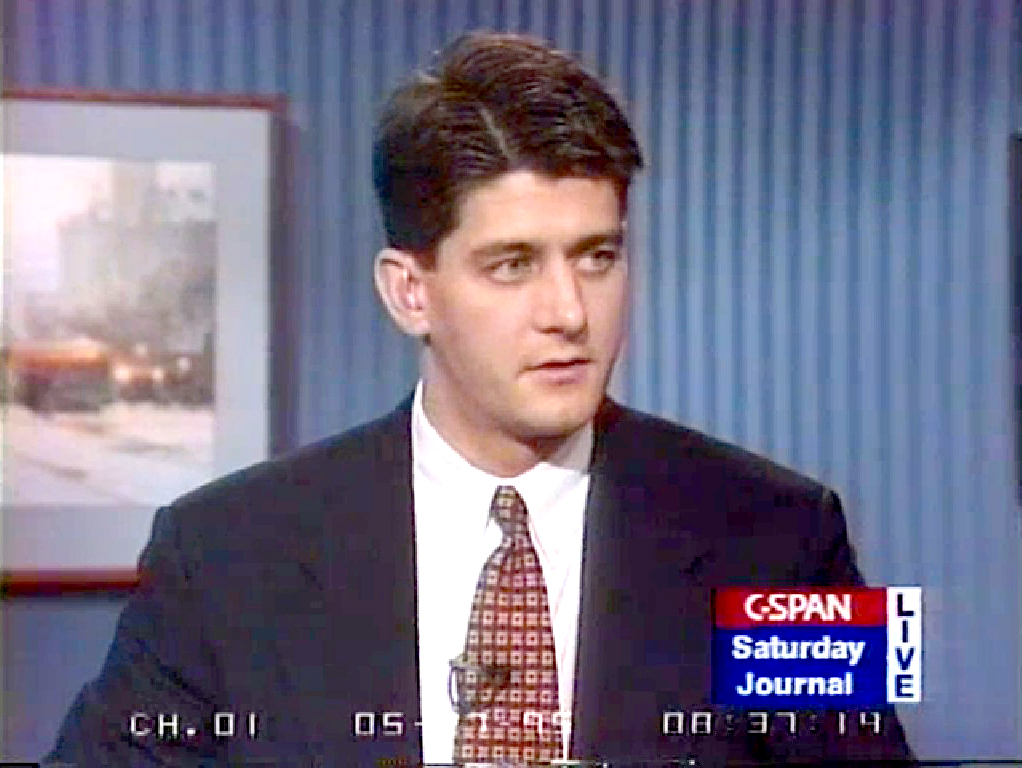
Paul Ryan, back before his voice broke

Here’s one of those videos that proves that your memory is spot on — back in the day, everybody was really, really young.

You will see a 25-year-old Paul Ryan, early in his career as a, well, career politician, appearing on C-SPAN as legislative aide to then-Rep. Sam Brownback.

This is the sort of programming that people are talking about when they make fun of C-SPAN. If the date had been a decade or so earlier, I would have sworn all three of these kids — Ryan, the Democrat, and the moderator — were on Quaaludes. It’s like a contest to see which one can make the other two fall asleep first.

Of course, this is probably as excited as young Paul Ryan ever got, since the topics were the budget, Medicare and Medicaid. It’s… eerie to see him and these other two kids, dressed up like Daddy and looking and sounding every bit like participants in student government. I keep expecting the next topic to be the frat that’s on double-secret probation. Except that it never gets that interesting.

My favorite parts? When Master Ryan predicts Medicare will be “bankrupt” by 2001, and when he mentions a news story by “Knight Ridder,” which still existed then.

National media starting to get a clue about Haley

I wasn’t familiar with Newsday columnist Lane Filler. Maybe The State runs him all the time, and I never noticed before. But when my friends there ran him yesterday, I found a good reason why in the 7th graf:

And Romney dodged the splashy picks that could have backfired like a 1986 Yugo: South Carolina Gov. Nikki Haley, who, honestly, makes Sarah Palin look presidential, and Louisiana Gov. Bobby Jindal, a smart guy who is, unfortunately, best known for a State of the Union rebuttal in 2009 that would have garnered last place at a grade school Optimist Club speaking contest.

It’s nice to see someone outside SC picking up on the obvious. This guy needs to ditch Newsday and head down to Washington. I don’t think they’ve gotten the word there yet.

This is WAY worse than the ‘Swift Boat’ thing

I had to groan when I saw the headline saying that the Obama campaign was accusing political opponents of using “Swift Boat tactics.” That’s because, not having been in a coma the past eight years, I know that when Democrats say those words, they’re not referring to the use of light watercraft to fight the Viet Cong in the Mekong Delta. If only they were.

Instead, as we all know full well, they’re invoking charges brought by a group called “Swift Boat Veterans for Truth,” which raised questions about John Kerry’s war service. Democrats to this day so deeply resent what that group did that they have turned “Swift Boat” into a verb, one that refers to actions they regard as mean, nasty, unethical, uncalled-for and generally beyond the pale.

I am unable to agree with Democrats on this because, well, that group raised questions I was wondering about myself (such as, where are the scars from those wounds that sent him home?). But as a nonveteran, I felt I had no moral standing to raise them. I mean, maybe he did get to go home quicker than other veterans, but he was still there longer than I was.

So I initially sort of appreciated veterans publicly asking those questions, no matter with whom they were affiliated. But in the end, that discussion got into a lot of petty back-and-forth accusations about exactly what happened when and who did what to whom, and the whole thing wasn’t really helpful, and just left a general sour taste behind. And I’d just as soon not have such things front-and-center in a presidential election.

But I don’t see it the way Democrats do. So I groaned when I saw the words.

But then I read on, and saw what elicited the phrase.

Now, this, ladies and gentlemen, is pretty nasty stuff. Maybe Democrats ought to come up with a convenient name for this, and turn it into a verb.

The Special Operations OPSEC Education Fund seems to exist primarily to call into question, as we head into the home stretch of the election, any credit the President might received for killing Osama bin Laden. (That is far from the only question it raises, but that’s the one with the emotional punch.) And that is just beyond cheesy. It’s too petty for words.

This is nursery-school playground-taunt territory. Clearly, whoever was president at the time this happened gets a certain amount of credit for what happens on his watch — just as he gets the blame when it goes wrong. Jimmy Carter didn’t make that Iran rescue mission fail, but he certainly took the rap for it.

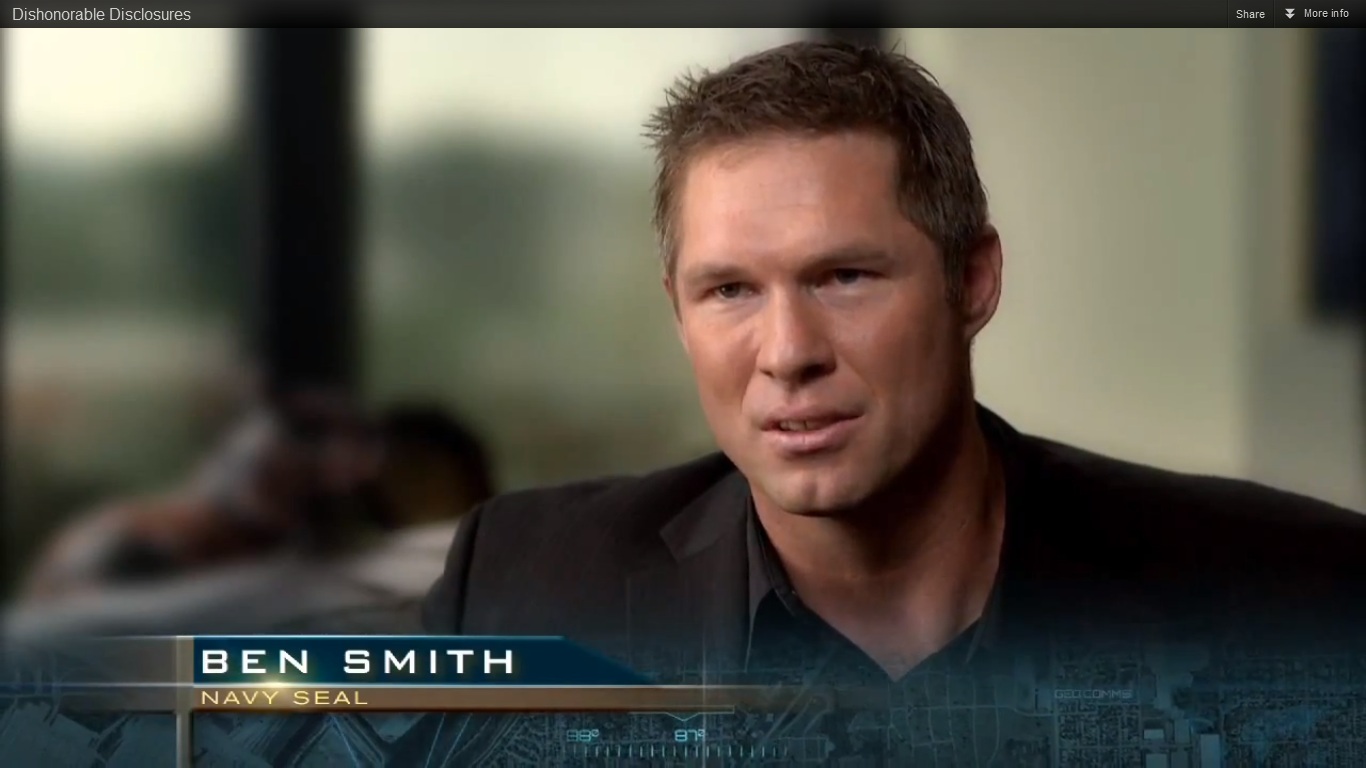
Reuters quoted Ben Smith, whom the group describes as a former SEAL, as saying:

Mr. President, you did not kill Osama bin Laden, America did. The work that the American military has done killed Osama bin Laden. You did not.

It’s easy to believe, in the moment he says that (at 6:55 into the above video), that this guy has been a Tea Party spokesman. He evinces that certain disdain-that-dare-not-speak-its-name that TPers seem to reserve entirely for this particular president.

But aside from the tone — I mean, come on. Nobody in the country is stupid enough to think the president personally suited up, went along on the mission and shot bin Laden himself, and no one in the country has tried for a second to make anyone think that. The simplest voter in the country would laugh at the proposition. So in what way do you suppose that the president is in any way trying to take anything away from the super-soldiers who carried out this amazing raid? Perhaps the most laudable thing the president is congratulated for having done was choosing to send in the SEALs as opposed to copping out with a bombing raid. And if you don’t think it took political courage to make that decision, you don’t know anything about politics or special ops, whatever your resume says.

I go further than that. My initial reaction was that hey, that Obama is a lucky guy to have been in charge on this particular watch. But as I learned more and more about the decision-making process that preceded the operation, I saw multiple points at which the wrong decisions could have been made, and POTUS made the right calls, even when very experienced smart people in his administration were doubting that was the way to go.

The bin Laden operation, furthermore, fits within an overall pattern that had distinguished the Obama administration well before that night in Abbottabad — a sharp increase in aggressively pursuing our nation’s enemies, in Pakistan and wherever else they hide.

Of course, the fig leaf this group is offering for its pettiness is that it is objecting to the very fact that I know as much about the long-term operation as I do. It’s accusing this administration of leaking government secrets for the purpose of its own political aggrandizement. (Which presents an interesting contradiction: If the administration is leaking actual, true intel, and that information shows the president in a good light, then how do you say the president doesn’t deserve credit for what happened?)

That’s a serious charge. I’ve seen no evidence that national security has in any way been compromised in this instance — but of course, I don’t have enough access to classified information to know for sure.

But I do know this: As I mentioned above, this president has been far more aggressive than any recent predecessor in using deadly force to take out terrorists, making George W. Bush look almost timid by comparison. While I have applauded the president for this, I acknowledge such an unprecedented pattern of aggression calls, in a liberal democracy, for a certain amount of sunshine. We need to know, at least in general, about the way the president makes decisions.

By the way, I’m not outraged at the parties who appear in this group’s video, which is the centerpiece of the campaign. I don’t doubt their sincerity. There is a fundamental cognitive disconnect between people who devote their lives to serving their country in the more sensitive parts of our national security apparatus, and people who are elected and directly accountable to the voters of this country. The national security types live by operational security, and have a tendency to see any kind of public disclosure of what they do as a close cousin to treason, rather than the exercise of political accountability. Political figures can indeed go too far in the service of self-interest. But even legitimate disclosure, the kind of thing a political leader should disclose, will not be acceptable to people who, just as legitimately, define their success in large part by their ability to keep secrets.

My beef is with the people who put this piece of emotionally-charged propaganda together, and released it at such a moment. The release of this video, at this time, would make the charges in the video itself about the president’s timing in announcing bin Laden’s death rather laughable. Except, you know, there’s nothing funny about it. (And I don’t even quite follow the logic that it was somehow politically advantageous to the president to announce the success of the operation immediately. If he’d done it a week later, as they suggest, he’d have gotten just as big a political boost.)

The amount of information that is appropriate for keeping a president accountable will always be debatable, and we should engage in it energetically, to the extent we can do so without damaging the very security we seek to protect (ah, there’s the ironic rub).

And we’ve been engaging in it, as the NYT reminds us:

Security officials and members of both parties in Congress have sharply criticized leaks about classified operations under Mr. Obama, and some Republicans have complained about news briefings on the Bin Laden raid and assistance to filmmakers making a movie about the operation.

The next sentence reminds us of something else the group pointedly ignores:

But the administration has also overseen an unprecedented number of prosecutions for press disclosures, and in June, Attorney General Eric H. Holder Jr. directed two United States attorneys to investigate leaks discussed in the Opsec video.

The petty way this group has gone about conducting its political offensive makes me less inclined to take it on faith that they know things that I do, and those things make the president look bad.

Perhaps the verb for this, going forward, should be “Opsecing.” No, that doesn’t look right. “Opsecking?” Nah. Still needs work…

You know Joe Biden’s gone off the rails when even Sarah Palin can see it

Enjoyed this blog post by Alexandra Petri over at the WashPost:

On Fox News, commenting on Joe Biden’s Danville “Put Y’all Back in Chains” gaffe, Sarah Palin observed: “If that’s not the nail in the coffin, really, the strategists there in the Obama campaign have got to look at a diplomatic way of replacing Joe Biden on the ticket with Hillary.”

It is seldom that you get such good quotes from the pot about the color of the kettle.

Then again, you know you’ve made a gaffe when Sarah Palin is suggesting you might have chosen your words more judiciously. That’s like Charlie Sheen suggesting you might have a substance problem.

But perhaps we should cut her some slack. Vice presidential candidates whose comments prompt everyone in the vicinity to wince uncontrollably for several minutes is a subject no one knows better than Palin. Maybe she and Biden were better matched than we thought.

After the selection of Paul Ryan to fill the VP slot on the ticket (prompting such exciting merchandise as this button!), it is hard not to think back to August 2008, when everyone was cheering Palin as a game-changer. And she was a game-changer, in the sense that Godzilla is a city-changer. Say what you will about Paul Ryan and the potential risks of having to engage in a Serious Mature Debate of his policies, everyone admits one thing about him: He’s no Sarah Palin. If anyone sets off the trademark “Mayday! Mayday! The Veep’s Saying Something” alarm this year, it’s Biden.

And yep, she oughta know. Onion Joe!

Quickly, now: What do veep hopeful Paul Ryan and ‘Paulie Walnuts’ have in common?

Well, nothing, strictly speaking. There’s no direct connection, anyway. But bear with me…

Some time ago, as you’ll recall, I expressed my pleasure when Rep. Ryan used the word “subsidiarity,” a favorite concept of mine arising from Catholic social teaching, coupled with my dismay at the odd way he used it. The word (to me) refers to the principle that in any system — governmental, economic, what have you — functions should be left to the smallest, most local unit that can competently perform them, with larger entities only performing the functions that can’t be carried out by the smaller units. Applied to government, that means the federal government should only perform those functions that can’t be effectively carried out at the state or local level, and so forth. It’s sort of related to what was for a time popularly called “devolution,” but with differences.

But fellow Catholic Ryan startled me by interpreting the principle as meaning functions should be performed by private entities other than public ones — which is convenient for him politically, but not the way I’ve understood it.

I’m not the only one who sees Ryan’s use of the term as misleading, if not outright wrong. I ran across this a couple of days back. Carrying it further, here’s a piece further explaining the problems with “small-government” libertarians trying to claim subsidiarity as their own. For one thing, it points out, “Subsidiarity is a communitarian philosophy.” Well, yeah.

Furthermore, Ryan has been taken to task for his misapplication of Catholic teaching to the federal budget by 90 faculty members from Georgetown University (a Jesuit institution), and more to the point, the U.S. Conference of Catholic Bishops criticized his 2012 budget plan for failing to protect the poor and vulnerable.

But there there are those, including some Catholic clergy, who would defend the Ryan interpretation of subsidiarity. I was led to this knowledge by Paulie Walnuts.

I’m a big fan of the Internet Movie Database. I have the app on my iPhone, and can’t watch a movie on television without constantly turning to it to answer such questions as “Who’s that actress?” or “What else has she been in?” or “Was this directed by…?” Sometimes I go from there to Wikipedia for elaboration.

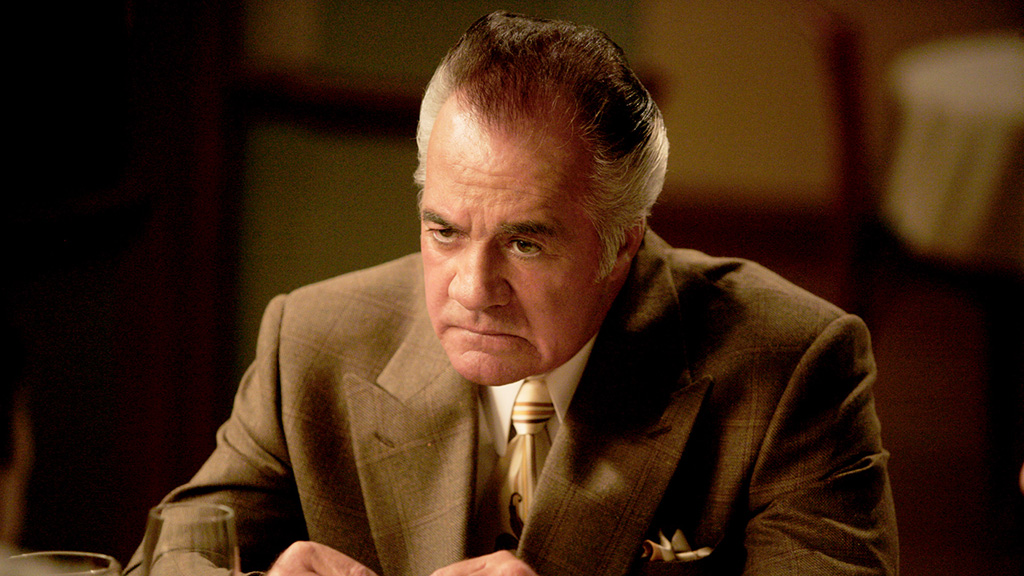
Anyway… and I forget what led me to this… I found myself recently reading the Wikipedia entry about Tony Sirico, the actor who played Paulie “Walnuts” Gualtieri on “The Sopranos.” Mr. Sirico, I learned, has also played gangsters in “GoodfellasMob Queen,Gangsters, Love and MoneyFingersThe One Man JuryDefiance, The Last Fight, Innocent BloodBullets Over BroadwayThe Pick-up ArtistGottiCop Land, Turn of Faith, and Mickey Blue Eyes.”

I read on, and was told that there’s a very interesting reason why he is so convincing as this sort of character:

Before turning to acting, Sirico was reportedly a fast-rising mob associate of the Colombo crime family, serving under Carmine “Junior” Persico, and had been arrested 28 times. There is a Sopranos reference to this fact when Paulie says, “I lived through the seventies by the skin of my nuts when the Colombos were goin’ at it.”[3] In 1967, he was sent to prison for robbing a Brooklyn after-hours club, but was released after serving thirteen months. In 1971, he pled guilty to felony weapons possession and was sentenced to an “indeterminate” prison term of up to four years, of which Sirico ended up serving 20 months. In an interview in Cigar Aficionado magazine, Sirico said that during his imprisonment, he was visited by an acting troupe composed of ex-cons, which inspired him to give acting a try.[4] According to a court transcript, at the time of his sentencing, he also had pending charges for drug possession.[5] Sirico appeared in a 1989 documentary about life, The Big Bang by James Toback, in which he discussed his earlier life.

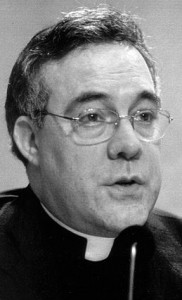
Father Sirico

Interesting, but what does it have to do with the definition of “subsidiarity?” Well, continuing to read the “Background and Career” section, we see that “His brother, Robert Sirico, is a Catholic priest and co-founder of the free-market Acton Institute.”

Really? This was, to me, at least as interesting is Mr. Sirico’s alleged past as a wiseguy. So I checked out the Acton Institute for the Study of Religion and Liberty, where I found commentary with such headlines as “The Rich Don’t Make Us Poor,” “Challenging Liberals on Economic Immobility,” “Moral Formation and the School Choice Movement,” “It Takes a Village to Raise a Business” (that’s my personal favorite) and “Black Scholars Give Obama an ‘F’.”

This is from The Acton Institute Core Principles:

Rule of Law and the Subsidiary Role of Government – The government’s primary responsibility is to promote the common good, that is, to maintain the rule of law, and to preserve basic duties and rights. The government’s role is not to usurp free actions, but to minimize those conflicts that may arise when the free actions of persons and social institutions result in competing interests. The state should exercise this responsibility according to the principle of subsidiarity. This principle has two components. First, jurisdictionally broader institutions must refrain from usurping the proper functions that should be performed by the person and institutions more immediate to him. Second, jurisdictionally broader institutions should assist individual persons and institutions more immediate to the person only when the latter cannot fulfill their proper functions.

On their face, I wouldn’t argue with those assertions, although it’s odd that subsidiarity is being described in terms of an individual’s relationship to the state, rather than between larger and smaller governmental entities. Quite Ryanesque. Here’s how subsidiarity is further interpreted by a writer on that site:

One of the key principles of Catholic social thought is known as the principle of subsidiarity. This tenet holds that nothing should be done by a larger and more complex organization which can be done as well by a smaller and simpler organization. In other words, any activity which can be performed by a more decentralized entity should be. This principle is a bulwark of limited government and personal freedom. It conflicts with the passion for centralization and bureaucracy characteristic of the Welfare State.

This is why Pope John Paul II took the “social assistance state” to task in his 1991 encyclical Centesimus Annus. The Pontiff wrote that the Welfare State was contradicting the principle of subsidiarity by intervening directly and depriving society of its responsibility. This “leads to a loss of human energies and an inordinate increase of public agencies which are dominated more by bureaucratic ways of thinking than by concern for serving their clients and which are accompanied by an enormous increase in spending.”

In spite of this clear warning, the United States Catholic Bishops remain staunch defenders of a statist approach to social problems. They have publicly criticized recent congressional efforts to reform the welfare system by decentralizing it and removing its perverse incentives. Their opposition to the Clinton Administration’s health care plan was based solely upon its inclusion of abortion funding. They had no fundamental objection to a takeover of the health care industry by the federal government…

So I read that, and I thought, “Where have I seen subsidiarity used that way?” Which brought me to the man of the hour. Paul Ryan would no doubt feel very comfortable with the ideas espoused by “Paulie’s” brother, or at least by the organization he heads. But that’s the only thing they have in common, that I know of. If you were hoping for something more, I’m sorry.

I like Ryan’s foreign policy ideas for themselves, NOT as a justification for his domestic proposals

We think of Paul Ryan as an über-libertarian on fiscal issues and as a social conservative. What I didn’t know anything about until this morning was how he stood on the most urgent questions a commander in chief faces — which is pretty critical in the event that Romney is elected, and something happens to him.

One expected the opinion writers of The Wall Street Journal to be hugging themselves with pleasure over Ryan’s fiscal notions. But today, Bret Stephens writes in the Journal about a speech Ryan gave to the Alexander Hamilton Society last year in which he expressed himself on foreign policy. Here’s the speech, and here’s the column. An excerpt from the latter:

Here, in CliffsNotes form, is what the speech tells us about Mr. Ryan. First, that he’s an internationalist of the old school; in another day, he would have sat comfortably in the cabinets of Harry Truman, Jack Kennedy or Ronald Reagan. Also, that he believes in free trade, a strong defense, engagement with our allies—and expectations of them. Also, that he wants America to stay and win in Afghanistan. Furthermore, that he supports the “arduous task of building free societies,” even as he harbored early doubts the Arab Spring was the vehicle for building free societies.

It tells us also that Mr. Ryan has an astute understanding of the fundamental challenge of China. “The key question for American policy makers,” he said, “is whether we are competing with China for leadership of the international system or against them over the fundamental nature of that system.”

Within the speech itself, perhaps the most cogent observation is that the United States doesn’t have the realistic option of fading as a world power the way Britain did, and the way so many on the left and right would like it to do:

Unlike Britain, which handed leadership to a power that shared its fundamental values, today’s most dynamic and growing powers do not embrace the basic principles that should be at the core of the international system.

Now, that’s the sort of thing I agree with. What I don’t agree with is that we have to do all the things Ryan wants to do domestically in order to afford the kind of global position that we can’t afford to surrender. Which takes us into all sorts of other debates that I’m sure we’ll get into before the election…

Anyway, that’s where he loses me. What I didn’t get from the column, and did get from the speech itself, is that for Ryan, the need to maintain U.S. responsibilities in the world is yet another excuse for doing what he wants us to do on the homefront. Of this, I am unconvinced. I agree we have to get our fiscal house in order. I don’t necessarily believe his ideas are the way to do it. Bottom line, we get back to where we started — in his case, his view of America’s role in the world is that of an über-libertarian on fiscal issues…

Stephens is less divided in his admiration. In part, he admires Ryan for setting out clear ideas without any of the softened edges with which presidents must speak, giving little consideration to the fact that House members with no diplomatic responsibility are far freer to speak frankly on such matters.

The truth is, I have generally agreed with the actual actions Mr. Obama has taken as commander in chief (although my views on Afghanistan more closely track Ryan’s). And those speak louder than words, however stirring.

For instance, Stephens likes the way Ryan talks tougher about the Chinese. But it is Barack Obama who has shifted future defense planning toward the Pacific Rim with China in mind, and recently decided to send Marines to Australia in keeping with that strategy.

In any case, this is the beginning of a learning process about Ryan. Although I’m already inclined to agree with Stephens that, in terms of ideas at least, the GOP ticket seems upside-down.

Ryan may be best of all possible picks for Romney

This Tweet said it as well as anything else over the weekend:

Yes, for a presidential candidate who leaves everyone somewhere between cold and lukewarm, Paul Ryan is the perfect running mate: Someone beloved by both the Tea Party and the Club for Growth.

For those of you color-blind in that range, Nikki Haley is a Tea Party Republican, while Mark Sanford is a Club for Growth Republican. Nikki makes hearts go pitter-pat at snake flag rallies; Sanford sent shivers of pleasure down the spines of the editorial board of The Wall Street Journal. The shorthand distinction: One is populist, the other not.

By contrast, the least helpful, indeed most idiotic, thing I’ve seen on the Ryan selection was in the HuffPost: “David Axelrod: Paul Ryan Pick Evokes Memories Of Sarah Palin.”

That headline was a bit misleading. To his credit, all Axelrod was saying was that then, too, one saw excitement among the base. But what Axelrod is missing, or intentionally underplaying, is the breadth of Ryan’s appeal. Not just Tea Party — Club for Growth, too.

Of course, no one in his right mind would suggest Palin and Ryan live anywhere near each other on any measurement of intelligence or gravitas. The one famous for “I can see Russia from my house!” basically doesn’t live on the same intellectual planet as the one current officeholder in American who has ever, to my knowledge, used the word “subsidiarity” in a sentence — for which I honor him, even though his emphasis in using the word would not have been mine.

With Ryan, there’s a bonus, from Romney’s perspective: He gets the cultural conservatives, too, which is a whole other part of the base that casual observers sometimes erroneously lump in with the others. Since Romney isn’t beloved of any of these groups, Ryan brings much that he needs.

This morning, the Palmetto Family Council got so overexcited that it Tweeted this:

We now have a solid pro-life ticket for President… Mitt Romney Picks Pro-Life Rep. Paul Ryan as VP Running Mate…http://fb.me/DVLjuPF0

Um… are you sure about that folks? I mean let’s see… this is Monday… Is Romney pro-life on Mondays?

The Democrats seem a bit shaken up as well. I suspect that, however much they may trash the Ryan selection publicly, they know he’s about as good a pick as Romney could have made. The reasons they give to think otherwise are weak. Politico reported this morning that “On his three-day bus tour, Obama will hit Paul Ryan as a leader of GOP opposition to the farm bill…” To which my reaction was, um, isn’t that kind of a good thing?

The only gamble is, how well does Ryan play among us swing voters? That remains to be seen. But I suspect he’ll do as well on that score as anyone else Romney could have chosen that his party would have accepted.

Nice job of repairing the ol’ Special Relationship there, Mitt. You trying to restart the War of 1812?

Well, you know how that awful Obama person went and insulted our Cousins across the water by dissing the Churchill bust?

Fortunately, Mitt Romney, a.k.a. The Mighty Mighty White Man, hopped across the pond to set things straight.

Above was the result. That’s from The Sun. Very lively newspaper industry they still have over there. Here’s more on the subject.

Anyway, the White House has really, really been enjoying this. And and at least one of Romney’s likely supporters is highly dismayed:

As Charles Krauthammer, who is probably Obama’s most vitriolic foreign policy critic on the right, put it, Romney really didn’t have to do much more than show up for the trip to be a success. Instead, he opened his mouth and undermined both of his goals. Whatever the right might say about the Obama administration damaging the “special relationship” between the U.S. and U.K., Obama has never caused an incident like the one Romney did yesterday. As an exasperated Krauthammer remarked last night, “All Romney has to do, say nothing. It’s like a guy in the 100-meter dash. All he has to do is to finish, he doesn’t have to win. And instead, he tackles the guy in the lane next to him and ends up disqualified. I don’t get it.”

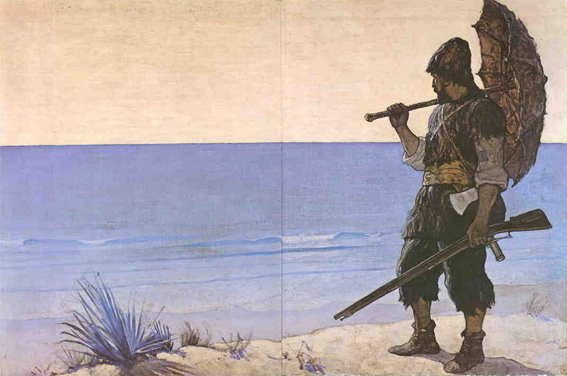
Only Robinson Crusoe did it alone — and then only until Friday came along

And note that not even he made the musket, or the hatchet.

Since I’m not at the paper any more, it fell to Cindi Scoppe to write this column that ran today, basically addressing the orgy of indignation among the libertarians who call themselves conservatives over President Obama’s unfortunate choice of words in explaining the painfully obvious fact that practically no one in our crowded, interdependent world achieves anything worthwhile alone:

A LOT OF what the president says and does is ripe for criticism. But what he said the other day about no one being an island, about how our parents and our communities and our teachers and mentors and, yes, our government all contributed to our success is not one of those things.

If you’re wondering who in the world would criticize such obvious commentary, it’s because you don’t recognize the full context of that bizarre, ridiculous, one hopes bungled quote that came in the middle of it: “If you’ve got a business — you didn’t build that. Somebody else made that happen.”…

Of course business owners built their businesses — unless they inherited them or bought them from someone who did. Their initiative and hard work and luck set them apart.

As important as parents are to our success, one sibling can create a multi-billion-dollar business while another languishes on welfare. As much as we need good teachers, even the best have some students who drop out of school. Although government policy can give some businesses a leg up, others can go bankrupt even with too-generous government grants.

That’s because some people have initiative, and some do not. Some people are creative, and some are not. Some people are smart, and some are not. And while the schools can affect which group any individual is in, government does not eliminate those basic differences.

At the same time though, the vast majority of people who own businesses would not have been able to do that if we didn’t have a monetary system and a court system and roads and police and other functions of government. The vast majority of people who have any sort of success would not have it in a world without government. In fact, they wouldn’t have it if not for the peculiar kind of government that our country embraced from the start: self-government.

Can, and should, our government be more efficient? Of course so. Is there room to debate whether the government should bail out the banks or the auto industry or help pay for our medical care? By all means. Is there a legitimate question as to whether taxes are too high or too low? Certainly.

But the vast majority of Americans would not have the lives we take for granted — lives that are inconceivably luxurious compared to the lives lived by the overwhelming majority of people throughout human history — if it weren’t for our flawed but better-than-any-alternatives government.

Seems to me Cindi was being slightly over-cautious in saying that only “the vast majority of people” would have gotten nowhere without the basic conditions — civil order, rule of law, basic infrastructure — that are provided through the processes we call “government.” I suppose there are some to whom that doesn’t apply, but very few. It’s even harder to think of anyone who accomplished anything worthwhile completely and utterly alone — without anyone, whether you’re talking about government or not.

I suppose there’s Robinson Crusoe — that is, until Friday came along. This reminds me of an economics exercise we did in high school. We had to suppose we were stranded on a desert island, and we had to allocate our resources — which included time, and effort — so as to survive. This much time building a shelter out of available materials meant that much less time spent gathering food. X amount of time spent making a tool that would facilitate building that shelter cuts the construction time, leaving more time to weave a net to make fishing easier, etc.

A castaway who is completely alone can create something useful — to him, anyway — without anyone else’s involvement. But a business, in our crowded society? Well, to start with, you have to have customers. And then, depending on your business, there are suppliers, and vendors providing services that it would be inefficient to perform yourself. And as you grow, there are employees who become essential to your further growth, etc. Without the willing participation of those often vast networks of people, you can work and create all you want, but you’re not getting anywhere.

The extreme libertarians would put government in another category from just “people.” But in our system, the government and the people are the same thing. “Government” is just the word for the set of arrangements that we have among us, the people, for handling certain things that are best handled that way, such as building roads or deepening a port or passing and enforcing the laws without which the concept of private property is meaningless.

In fact, if I had a quibble with Cindi’s column, it would be that, in her litany of things for which government is essential, she kept referring to government as “it.” As in, “It creates and maintains a monetary system,” and “It provides a civil justice system…”

Given the screwy way so many of our neighbors these days think of government, that can be misunderstood as government being some separate entity that provides certain things to us, the people. But it’s not that at all. A better word than “it” would be “we,” because government is simply the process through which we create and maintain a monetary system, provide a civil justice system, and so forth.

Government does not give or take away. It’s just the arrangements through which we, the people, do certain things that we decide, through our system of representative democracy, are best done that way.

2012 electoral math (as usual, SC influence=zero)

Paul “The Forehead” Begala, writing about the swing voters in those six states that are still in play in the 2012 presidential election, runs the numbers for us:

The truth is, the election has already been decided in perhaps as many as 44 states, with the final result coming down to the half-dozen states that remain: Virginia and Florida on the Atlantic Coast, Ohio and Iowa in the Midwest, and New Mexico and Colorado in the Southwest.

But of course not everyone in those closely divided states will make an electoral difference. We can almost guarantee that 48 percent of each state’s voters will go for Obama, and another 48 percent will decide for Romney. And so the whole shootin’ match comes down to around 4 percent of the voters in six states.

I did the math so you won’t have to. Four percent of the presidential vote in Virginia, Florida, Ohio, Iowa, New Mexico, and Colorado is 916,643 people. That’s it. The American president will be selected by fewer than half the number of people who paid to get into a Houston Astros home game last year—and my beloved Astros sucked last year; they were the worst team in baseball. Put another way, there are about as many people in San Jose as there are swing voters who will decide this election. That’s not even as many people as attended Puerto Rican cockfights in the past year—-although there are obvious similarities.

And, oh, the lengths we will go to reach those magical 916,643. The political parties, the campaigns, the super PACs (one of which, the pro-Obama Priorities USA Action, I advise), will spend in excess of $2 billion—mostly just to reach those precious few. That works out to $2,181.87 per voter—or as Mitt Romney might call it, pocket change…

There’s nothing wrong with the election being decided by we few, we unhappy few, swing voters. What’s awful is that your favorite swing voter, founder of the UnParty himself, yours truly, is not among those whose vote counts. On account of how, during my lifetime, the overwhelming majority of my fellow South Carolinians have done some extreme swinging of their own, switching from never considering voting for a Republican to never considering voting for a Democrat.

Which is a shame. Since we have now totally blown our status as the state that picks the eventual nominees (the Republican ones, anyway) by that Gingrich snit back in January, it would be really nice if the nation had to hold its breath to see which way we choose to go.

But it is not to be.