Category Archives: Parties

More common sense from Bob Inglis

My colleague Jay Barry (celebrated drummer for Lunch Money) brings my attention to this item from Andrew Sullivan:

“Several recent studies have found that 95 percent of climate scientists are convinced that the planet is rapidly warming as a result of human activity. But a George Mason University-Yale University poll in May found that only 13 percent of the public realizes that scientists have come to that conclusion. You would expect conservatives to stand with 95 percent of the scientific community and to grow the 13 percent into a working majority. Normally, we deal in facts, we accept science and we counter sentiment,” – Former Congressman (2010 Tea Party casualty) Bob Inglis (R-SC).

Jay told me about that in response to my having reTweeted this from Rasmussen:

Just 36% Believe Global Warming Primarily Caused by Human Activity…http://tinyurl.com/RR3332

Cindi’s good column about Haley’s naivete

On Tuesday, while still eating breakfast, I sent Cindi Scoppe an email telling her what a good column she had written about Nikki Haley’s ridiculous claim (later retracted) that half the job applicants at SRS had failed drug tests.

I was proud of the fine job she had done. I was also proud of myself, because I told her it was good without any caveats or “yes, buts” or any qualifications of any kind. I mean, I didn’t even tell her that I thought the headline could have been stronger. I was unusually nice, for me. (Dave Moniz, who worked for me as a reporter in the early 90s, used to say the highest praise anyone ever got from me was “pretty good.”)

But was she grateful? No. She complained later that I hadn’t said how good the column was on the blog.

So here goes. Actually, I think I’ll just quote from the piece:

THE EXTRAORDINARY thing about Gov. Nikki Haley’s discredited claim that half the job applicants at the Savannah River Site had failed drug tests — the actual number was less than 1 percent — wasn’t her acknowledgement that she couldn’t back it up. It was her explanation for why she ever would have parroted such an absurd claim to begin with.

Some unidentified someone she talked to told her that during the campaign, she told The Associated Press’ Jim Davenport last week, and she took it at face value and ran with it. “I’ve never felt like I had to back up what people tell me,” she said. “You assume that you’re given good information.”

I used to think the same thing about elected officials.

I don’t mean I believed everything they said. Quite the contrary. As a reporter, the most fun I had — and some of my most important work — was writing “fact check” articles that explained what was untrue or misleading about the claims politicians made in their political ads, speeches and debates.

Typically, this involved sins of omission: Candidates take their opponents’ votes or comments out of context to create an incorrect and unfair impression. And it tended to be confined to the campaign trail. The overwhelming majority of elected officials I’ve dealt with in a quarter century of covering politics could be trusted with the basic facts once the campaign was ended and they were talking about policy instead of their opponents. They didn’t fabricate “facts”; even Mark Sanford just manipulated numbers in convoluted and misleading ways — although he did it more purposefully and masterfully than any of his predecessors.

I took note before last year’s GOP primary of several misleading claims Ms. Haley had made during a meeting with our editorial board. What was striking was that she would stretch the truth so far in a setting where most candidates go out of their way to be extra careful. More striking was that there was no need for any of it. Although it might have meant a bit more work, she could have made legitimate arguments if she had stuck to the facts.

What has remained notable since she took office is that her demonstrably inaccurate claims continue to be unnecessary…

She goes on to give examples. It’s a good piece. You should go read it.

Wait, here’s another good bit:

That sort of carelessness is fairly common among people who aren’t used to being in the public spotlight. But most elected officials I know are actually quite careful about getting the facts right. They footnote their claims. They say they’ll have to get back to you before answering a question — not because they want to figure out how to spin it but because they want to make sure that they know what they’re talking about…

And here’s another:

Now that she has been forced to back off the drug-testing claim that she says convinced her that we need to make laid-off workers pass drug tests before they receive unemployment checks, I’m struck by the fact that she’s still pushing for the mandatory tests.

I don’t find it objectionable to require the tests. Wasteful, yes — since taxpayers would have to foot the bill, and indications are that fewer than 5 percent of applicants would test positive — but not philosophically objectionable.

What I find objectionable is basing an expensive policy position on an unbelievable anecdote that you didn’t even bother to question because it fits so comfortably with your preconceived notions. And then clinging to that position even after the anecdote has been so utterly discredited…

But you should still go read the whole thing.

The worst thing about Haley’s chirpy greeting order is the insulting assumption that underlies it

The worst thing about the “It’s a great day in South Carolina!” order isn’t the fact that it is so grating and insulting to the caller. Callers can shrug that off; if they really need to do business with the state, they’ll take a breath and go ahead (even while filing a mental note that they now think less of SC government than they did before).

The worst thing is the attitude that underlies the order, which was ably set out in the newspaper this morning by Haley spokesman Rob Godfrey:

“While the press focuses on the negative, the governor is changing the culture of our state.. She is proud of South Carolina, and while we have challenges, we are making great progress every day. The focus of this greeting is to have state employees pass along a positive attitude and ask the caller, ‘How can I help you?’ so that they remember – and the people know – that they work for the taxpayers. The governor has always said that it’s time for government to work for the people, and this is the first step.”

She’s changing the culture of our state…. It’s time for government to work for the people…

This is the first step.

Because, you see, that never happened before. It’s never occurred to any state employee that they serve the people of South Carolina. Ever. Nikki Haley invented it. Thank God for Nikki Haley, because not one single state employee in the history of South Carolina has ever considered serving the public, even for a moment. If any had, this would not be the “first step” in implementing this wonderful new day. And this is the first step.

Again, we are seeing what we get when a person who does not have a clue about an organization — what it’s for, whom it serves, what its personnel are like, how it works, how it should work — is placed in charge of that organization.

Tragically for all of us, that organization is our state government — an institution that the people of our state, perhaps more than the people of any other state in the union, badly need to be well-led.

But there’s more to it than that. Nikki Haley is merely a symptom of a sickness in the politics of our state. The sickness is a nasty attitude of despising those who serve the public — and despising them more and more as their jobs become more difficult.

She is now engaged in the process of tearing down that workforce. And the first step is humiliation.

Joel Lourie: What we need in SC is jobs

In a more serious vein, I thought I’d share with you more of what Joel Lourie had to say at Rotary today.

I realize when you read that headline, you’ll think, “So? Everybody knows that, and all politicians say it.”

But Joel said it better than most.

One thing he did was share the numbers above — which I scanned directly from the sheet he shared with me afterward. (To read it better, click on it.) The numbers provide statistical snapshots of South Carolina before and after the Great Recession hit.

What Joel had to say about that was not — as you’d expect in a lesser politician — to complain about those awful Republicans (which in a Democrat in SC these days shows remarkable restraint), and blame it on them. It was more to say look, here’s the situation we have, and this is what we must deal with.

And to him, the way out is not to pass this or that particular piece of legislation (although he did make an able case for comprehensive tax reform), or to embrace this political ideology or reject that one. Nor does he see our state’s salvation in anything that government might do, because government can only do so much. All government can do is pursue whatever policies it can that encourage our economy to come back.

As an example of how lawmakers should work together to allow jobs to emerge in our state, he told the story of how Democrats and Republicans worked together to make sure Amazon didn’t take its 2,000-plus jobs and leave this year, how they worked together to turn a 2-1 “no” vote into a 2-1 “yes” vote for the sake of the Midlands, and of South Carolina. In that ecumenical spirit, he particularly praised his old USC classmate, House Majority Leader Kenny Bingham.

I never was as wholeheartedly for the Amazon deal as Joel was, but I certainly appreciate his point, just as I appreciate the motivation that he and Kenny and so many others had to turn that around for the sake of their community.

For Joel, that sort of service to the whole community is what it’s about, just as it was for his father before him. And because he delivers that service so earnestly and ably, I’m proud to know him. I didn’t tell him that at Rotary today. You don’t want stuff like that to go to people’s heads, you know.

Thaddeus McCotter Shocker!!!

This just in! The dynamics of the 2012 race for the White House have inexorably shifted!

Rep. Thaddeus McCotter withdraws from 2012 presidential race

The Michigan Republican and former House Republican Policy Committee chairman on Thursday dropped out of the GOPpresidential battle.

McCotter told the Detroit News that he was frustrated because he could not win access to the presidential debates, one of which is taking place tonight among nine other major GOP candidates in Florida. He plans to seek reelection to his 11th district.

McCotter told the newspaper he plans to back former Massachusetts governor Mitt Romney, although Texas governor Rick Perry is also a good candidate, but better suited for the vice presidency.

Yeah, I didn’t know he was running, either. Nor had I ever heard of him. But I suppose it’s like the Butterfly Effect. This flutter of wings in an obscure corner could change everything. Or not.

Cool name, though: Thaddeus McCotter. Another potential band name, in the style of Jethro Tull and Uriah Heep. Doesn’t have quite the same punch, though…

Here are some SC Rick Perry backers

I hadn’t even finished that last post about his new video before Perry put this out:

Twenty One South Carolina GOP Legislators
Endorse Rick Perry for President

COLUMBIA, SC – Texas First Lady Anita Perry today announced 21 GOP South Carolina General Assembly members’ endorsement of Texas Gov. Rick Perry for President at the grand opening event of the Perry Campaign’s South Carolina Headquarters office. The five Senators and 16 Representatives will serve on Perry’s State Legislative Steering Committee.
“Republicans across South Carolina want two things in our nominee: a proven conservative record of job creation and a plan to put America back on track,” said Senate Majority Leader Harvey Peeler. “Rick Perry is the candidate who meets both of those criteria. The number and the regional diversity represented by today’s endorsements are a clear indication of the strong support Gov. Perry has across the Palmetto State.”
Gov. Perry has been endorsed by the following South Carolina GOP leaders:
State Senate Majority Leader Harvey Peeler, Cherokee
State Senator Paul Campbell, Berkeley
State Senator Ronnie Cromer, Newberry
State Senator Larry Grooms, Berkeley
State Senator Mike Rose, Dorchester
State Rep. Todd Atwater, Lexington
State Rep. Liston Barfield, Horry
State Rep. Eric Bedingfield, Greenville
State Rep. Alan Clemmons, Horry
State Rep. Marion Frye, Saluda
State Rep. Dan Hamilton, Greenville
State Rep. Bill Hixon, Aiken
State Rep. Chip Limehouse, Charleston
State Rep. Philip Lowe, Florence
State Rep. Chris Murphy, Charleston
State Rep. Andy Patrick, Beaufort
State Rep. Bill Sandifer, Oconee
State Rep. Gary Simrill, Rock Hill
State Rep. Tommy Stringer, Greenville
State Rep. Bill Taylor, Aiken
State Rep. Mark Willis, Greenville
“It truly is an honor to receive the endorsements of these respected lawmakers of the South Carolina Assembly,” said Gov. Perry. “These conservative leaders understand that our nation cannot afford four more years of an administration that is trying to tax and spend our nation to prosperity. I look forward to these fine individuals’ support as I travel the nation to share my vision for how we will get our nation’s fiscal house in order and get America working again.”
Sen. Paul Campbell: “Rick Perry is the right choice because of his proven, successful executive leadership experience. I believe Governor Perry is the only candidate in the race who can take back the White House and restore a path of prosperity for America. I’m supporting Rick Perry and I will be encouraging others to do the same.”
Sen. Ronnie Cromer: “I’m supporting Rick Perry not only because of his fiscally sound record and his experience of creating jobs,” Cromer said. “I’m also supporting Perry because I believe he is the only candidate who can beat President Obama next year. It would be devastating for our country to endure another four years of the Obama administration. Rick Perry is the guy to beat him and he can get our country back on track.”
Rep. Todd Atwater: “Our country needs a leader who can balance the budget and create jobs. I believe Rick Perry is that leader. He has a record of maintaining a balanced budget without raising taxes while creating jobs. We cannot afford another four years of a plummeting job market and out-of-control spending. We need to send Rick Perry to Washington.”
Rep. Liston Barfield: “I’m supporting Rick Perry for President because his leadership and conservative values are what our country needs to get back on track. Rick Perry’s experience of balancing a budget and creating jobs makes him my first choice for President.”
Rep. Eric Bedingfield: “This race is about two things, Jobs and the Economy. Governor Perry, soon to be our Republican nominee for President, is exactly what South Carolina Republicans are looking for to replace the current resident of the White House. Rick Perry has the job creation record and executive experience to make President Obama a one-term president and to get America working again.”
Rep. Bill Hixon: “I am excited about getting on board with Governor Perry’s campaign. Governor Perry has shown outstanding leadership in Texas by maintaining a balanced budget and creating jobs is the kind of leadership we need in the White House.
Rep. Chip Limehouse: “Rick Perry is the best choice because of his conservative record as Governor of Texas. His commitment to balancing the budget of Texas without raising taxes despite the economic downturn should be an example to all legislators across the country and especially to Congress. We need Rick Perry in the White House.”
Rep. Chris Murphy: “Rick Perry is a real conservative – exactly what our country needs. We can’t afford another four years of the Obama administration and I believe Rick Perry is the man who not only shares our values, but also can win. I’m proud to endorse Rick Perry for President.”
Rep. Bill Sandifer: “Rick Perry’s record of job creation, maintaining fiscal responsibility, and commitment to conservative values is why I’m supporting him for president. I’m confident that Governor Perry can get our country on the right path and get America working again.”
Rep. Tommy Stringer: “Rick Perry can get our country back on the right path. Governor Perry not only has a fiscally conservative record, he also is a social conservative who shares our family values. The leadership he has shown in balancing the budget and his commitment in protecting the unborn is exactly the type of leadership and commitment we need in Washington.”
Rep. Mark Willis: “I’m supporting Governor Rick Perry for President because I believe he is the candidate of the people,” Willis said. “Governor Perry’s humble beginnings, his upbringing, and his proven conservative record as Governor of Texas are very appealing to voters looking for a real change. The people want someone they can trust and I believe Rick Perry is that person.”

I wonder why it was announced by his wife? Is he too busy?

Is Lamar Alexander about to do something very cool — from an UnParty perspective?

I’m puzzling, hopefully, over what this means:

The no. 3 Republican in the Senate will step down from his leadership position early next year, despite having no plans to retire from Congress.

Lamar Alexander informed his fellow GOP colleagues of his rather surprising decision on Tuesday morning in a letter obtained byPolitico, saying that the move was the best decision for him and the Senate.

“Stepping down from leadership will liberate me to spend more time working for results on the issues I care most about,” the 71-year-old former Tennessee governor wrote. “I want to do more to make the Senate a more effective institution so that it can deal better with serious issues. There are different ways to provide leadership within the Senate. After nine years here, this is how I believe I can now make my greatest contribution. For these same reasons I do not plan to seek a leadership position in the next Congress.”…

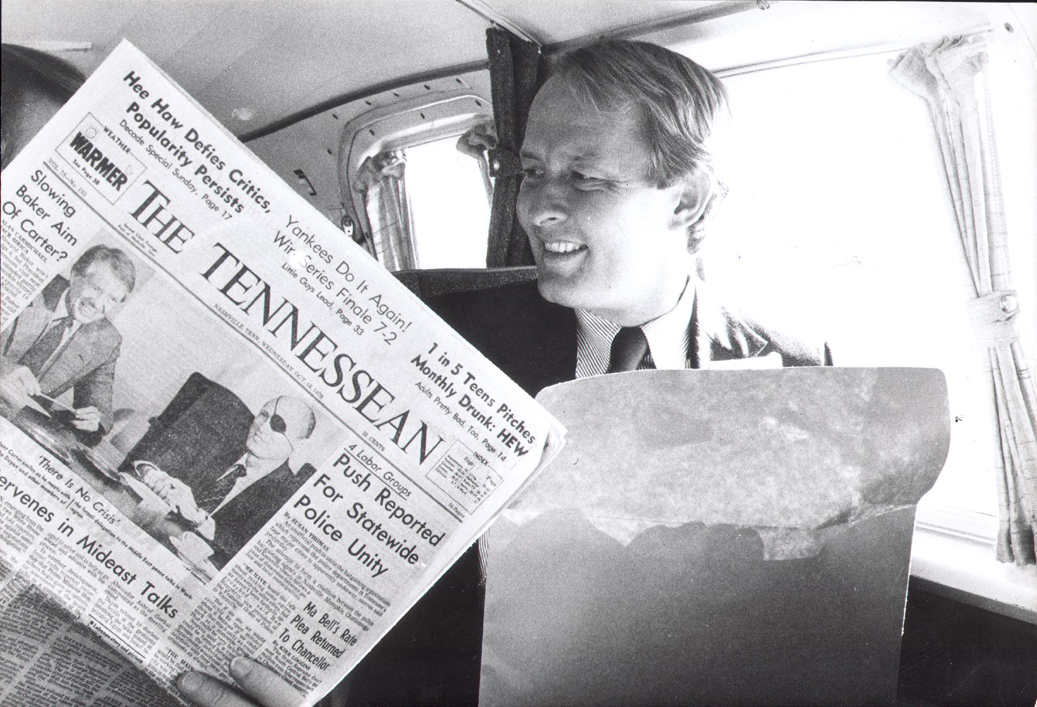
I’ve respected Lamar Alexander since  I covered him in his first successful run for governor in 1978, spending a good bit of time with him on the road (OK, so I was on the road with him 24/7 for one week before switching over to cover his opponent, but it was enough time to form a positive impression).

Lamar was never a guy you get particularly excited about. He was… bland. One of the most striking things about him was how much his speaking voice sounded like Pat Boone’s. (Once, I heard a PSA on the radio by Boone, and I thought it was the governor until he identified himself at the end — or was it the other way around?) His much-publicized walk across Tennessee in the trademark red-and-black shirt was SO contrived, such an earnest bid to be interesting, that I would joke about it, while at the same time appreciating his seriousness. He was what Tennessee needed after the rollicking corruption of Ray Blanton (who had defeated him four years earlier, on the very first election night of my newspaper career, when I was a copy boy at The Commercial Appeal). I would joke that Lamar’s main appeal to the voters was to subliminally project, “I won’t steal the silverware from the governor’s mansion.” But after Blanton, that was progress.

Turned out that there was a lot more progress to come with Alexander. He was different from any Republican governor I have seen since. He started out appointing Democrats to his Cabinet (his chief political adviser was someone who had worked for Democrats), and he reached out to the Democratic majority in the legislature to get his agenda passed, including significant movement toward merit pay for teachers. From day one, he was about raising the incomes of the average Tennessean, and he was for working with whomever it took to get that done. He worked particularly productively with the iconic speaker of the House (and later governor) Ned Ray McWherter.

He has served his state, and now his country, with pragmatic dedication and moderate sensibilities. So I’m sorry to see him leave leadership.

And puzzled. What does he mean he can be more effective outside that role? There’s a hint in the original Politico story:

Alexander says the decision was rooted in his desire to foster consensus in the gridlocked Senate, a role he felt constrained playing while spearheading the partisan Senate GOP messaging machine.

That sounds very cool — and even, despite this being Lamar Alexander, exciting. In an UnParty sense. I’d love to hear an elaboration on that. It would be nice to have back about 15 minutes of that time I spent riding around with him in cars and planes back in the day. I think I’d have more interesting questions now…

On the campaign plane with Alexander, back in the day./Brad Warthen

Nikki and the HPV vaccine

If you’ll recall, Nikki Haley got into trouble for sorta, kinda, trying to do the right thing: Save girls’ lives by getting them vaccinated against the papillomavirus that causes most cervical cancers. Until she realized it might not be a popular move with political extremists.

Here’s CNN’s recap:

Columbia, South Carolina (CNN) — As the debate over Texas Gov. Rick Perry mandating the HPV vaccine continues between Republican presidential candidates, a woman whose endorsement is coveted by all them, South Carolina Gov. Nikki Haley, has her own complicated history on the issue.

In 2007, shortly before Perry issued an executive order requiring that schoolgirls be vaccinated against the sexually transmitted human papillomavirus, or HPV, that causes most cervical cancers, Haley was throwing her support behind a similar bill in South Carolina. At the time she was in her second term as a state representative.

State Rep. Joan Brady introduced the Cervical Cancer Prevention Act in South Carolina, and the Republican corralled more than 60 legislators, including Haley, to sponsor the bill. Unlike the executive order for which Perry is taking heat, this legislative mandate did not include a provision for parents to opt out of inoculating their daughters.

Within months, fierce opposition mounted, and legislative records back up accounts from sources who recall sponsors “dropping like flies” before a unanimous vote killed the bill on April 18, 2007.

More than a dozen legislators formally requested to be removed as sponsors from the bill, but the future governor of South Carolina was not one of them…

[State Rep. Kris] Crawford, a Republican, said he is not so sure.

“There are exactly two groups of people who can claim they were against this giant overreaching of government — those who never sponsored the bill and those who were sponsors but subsequently removed their names from the bill when it was explained to be a boondoggle mandating vaccination of little 12-year-old girls against a sexually transmitted disease,” Crawford said. “Everyone else was either for the bill or riding the fence trying to claim victory regardless of outcome.”…

This is a pattern we’ve seen, of course — one in which our young governor blunders into a situation, can’t decide which is the safest political course for her, hunkers down and hopes to survive it, whatever happens to everybody else. By being on both sides, she hopes eventually to be on the winning side, and have some credit splash on her. It’s worked for her so far. As you’ll note, CNN is still calling her a “rising star.” Really.

But even some of the national media are starting to notice things.

Why do you think all those people are out of work here in South Carolina?

I didn’t have much to say about South Carolina’s 11.1 percent unemployment rate, beyond these two thoughts: 1) I really hope this isn’t a double-dip recession (and if we actually got out of the first one, which I can’t tell; can you?), and 2) boyohboy am I sick of this stuff.

The disorienting thing for me about all this is that I can’t tell what’s happening. Outside of the newspaper business, I have trouble telling how things are going. I understood the economics of that, so I could tell as we went along: I can see things are bad. OK, now they’re worse. Now they’re WAY worse. Uh-oh, the PACE of getting worse just accelerated, dramatically. Whoa! The bottom just dropped out!

Not so much a roller-coaster ride as a fall down a well.

But out here in the world, where I’m immersed in the thing I was held away from, as a matter of policy — the thing called business — I’m disoriented, and have trouble telling what’s going on. Because it’s going on all around me, above me and below me and inside of me. It’s like… I read once that each man’s experience was totally different on Omaha Beach in the early hours, trapped on a limited scrap of sand that was all pre-sighted by the Germans, as death of various kinds rained down. You would experience one battle, and a guy 15 feet from you would experience something dramatically different.

This is like that, in the business world. Since I wasn’t supposed to touch business in the newspaper world, I could see it unfolding in front of me — like watching it on a screen. Now, I’m in it, and it’s much harder to see the real picture.

So some days I think things are going well, and the economy as a whole is picking up (based on what I see at ADCO and through the lenses of our various clients), and other days… not well at all. And it’s hard to make out the trend, the pattern.

Is it that way for you? Whether it is or not, I can tell that the unemployment rate climbing further is not one of the good signs. Not for any of us.

So that’s what I have to say about it. Someone writing in Salon decided to dig into the numbers, and this is what he had to say:

But a look inside the numbers, at the five worst and five best states, is unhappily revealing. The states with the five highest unemployment rates are Nevada (13.4 percent), California (12.1 percent), Michigan (11.2 percent), South Carolina (11.1 percent) and Florida (10.7 percent.) Nevada, California, Michigan and South Carolina all registered unemployment increases in August, compared to July. Florida held even.

The states with the lowest unemployment rates are North Dakota (3.5 percent), Nebraska (4.2 percent), South Dakota (4.7 percent), New Hampshire (5.3 percent) and Oklahoma (5.6 percent.)…

What does the geographical distribution of the hardest hit areas tell us? Again, not a whole lot that’s new. California, Florida and Nevada were among the three states hit hardest by the housing collapse, with Nevada getting the extra negative bonus of depressed Las Vegas tourism. Michigan, battered by globalization and the woes of the auto industry, has long been near the top of the unemployment charts. (Although the state had been improving quickly until about four months ago, when unemployment started rising again.) South Carolina’s high unemployment rate has been something of a mystery for years. Perhaps the most that can be said is that as a relatively low-tax state dominated by some of the most conservative Republican politicians in the country, it is certainly no advertisement for conservative orthodoxy, at least as far as boosting employment goes.

Of course, that’s about what you’d expect to read in Salon. Next time I see Salon saying anything positive about Republicans, it will be my first time.

They do have a point, though. We have pursued a certain course in South Carolina, in rather dramatic contrast to neighboring states such as Georgia and North Carolina, which decided to build up the kind of infrastructure — especially human infrastructure — that has made their economies stronger than ours.

I’ve lived all over in my life. And in my adult life, I’ve worked — and closely observed politics — in three states (the other two being Tennessee and Kansas). And I’ve never seen any place in this country more afflicted by self-destructive ideology than my home state of South Carolina.

So, you’ve heard what I think, and what some guy writing for Salon thinks. What do you think?

On Jim Clyburn, earmarks, race, and representing a poor district

I’ve never liked one thing that traditionally has been core to the makeup of members of Congress: bringing home the bacon.

Yes, I know it’s a particularly honored tradition in South Carolina, from Mendel Rivers through Strom Thurmond and on and on. This state was devastated in The Recent Unpleasantness, and it was sort of natural in subsequent generations for folks to want their elected representatives to bring home Yankee bacon whenever possible.

Doesn’t mean that’s the right way to run a government. The federal government should look at the entire country and decide where it needs to build military bases or roads or bridges or place programs of any sort, according to which locations best suit the needs of the whole nation. Or where the greatest need for a particular service might be at a given time — such as disaster services. Largess should not flow according to which lawmakers has the most pull.

Congress has been so bad about this that when we decided we needed to close some military bases the nation no longer needed, we had to set up BRAC to prevent interference by individual members of Congress. It’s been a successful process, but the need for it testifies to a painful failure of our basic system of government.

Congressional pull is not the way to set priorities for our government. This is particularly obvious to a lot of people when we look at spending, but I’ve always been concerned that it’s just a bad policy all-around for making effective decisions for the country. And it disenfranchises Americans whose representatives have less pull.

So it is that I’ve been pleased (in general) with Jim DeMint’s efforts to stop earmarks (which are actually only a small part of the problem), and have never been much of a fan of Jim Clyburn’s more traditional bring-home-the-bacon approach.

But I’m not without sympathy for Clyburn. To explain why, I’ll share a story that at first may seem unrelated. I did not witness this, but I’ve heard about it.

A large part of why Jimmy Carter was elected in 1976, as you will recall, was that he proposed to clean up government. No more Watergates. He promised, although we didn’t yet use this word for it back then, transparency. It was a huge deal; he was never going to lie to us. So after the election, there was a meeting in Columbia of people who had worked in his campaign in South Carolina. Probably a pretty big meeting, since back in those days, we actually had some Democrats in this state. And the Carter guy who was conducting the meeting told them that they shouldn’t expect any inside track on getting positions in the new administration. Everything was going to be open and aboveboard and a level playing field, and there was to be no smoke-filled room patronage.

One of the campaign supporters in the room, a local black leader who was then quite young (I’d want to talk to him and refresh my memory of the story’s details before using his name), protested, “But we just got into the room, and we just started smoking.”

Which was true enough. And more than once have I heard such protests from black politicians — now that we have some political influence, you want to weed such influence out of government.

Well, yes, I do. And I’m sorry some folks just got into the room, but we’ve had enough of that kind of politics.

Nevertheless, I am sympathetic to Jim Clyburn’s desire to get some federal investment into parts of the state that were bypassed when white politicians were grabbing federal resources for South Carolina. This isn’t about unsavory practices; this is about funds that will be distributed somewhere, so why not in your neglected district? Perfectly understandable. Even admirable. So while I am against, for instance, the bridge he wants to build between Lone Star and Rimini, I understand his desire to get some infrastructure into that area that might help economic development flow in behind it.

Against this background, I was interested in Warren Bolton’s column in The State today. I had actually missed it in a cursory skim through the paper this morning (I was conversing with several people while perusing), so I’m glad that my attention was called back to it by a release from, quite naturally, Jim Clyburn’s office. It was headlined, “Earmarks saving grace for Clyburn’s district.” An excerpt:

Frankly, I think the free-wheeling system that has allowed members of Congress to target pet projects for funding is too loosely monitored and arbitrary and, therefore, can be wasteful. But I don’t think that earmarks in general are bad; they can be used to make sure worthwhile projects are funded. In addition to a lack of transparency, the big problem is that the system doesn’t ensure that those important things get done.

But Mr. Clyburn didn’t invent this system. It was in place eons before he even arrived in Congress. Given that those in his district have grave needs that aren’t being met by the state, which has yet to come up with an effective way to address rural challenges that can’t be met by cash-poor local governments, he’s doing what he can.

It’s amazing to me how so many in this state can criticize Mr. Clyburn’s actions when they should be familiar with the challenge of rural South Carolina. While we get many letters to the editor from writers taking issue with Mr. Clyburn on legitimately debatable grounds, such as his positions on issues, his philosophy and even his use of earmarks, many others make statements and accusations that are just plain unfair, false and — quite frankly — racist….

I, like Warren, have fielded some of those calls — and emails, and letters, and blog comments. And while I may often agree with the person commenting that a particular spending proposal is a bad idea, it is disturbing to hear the undertone, the emotion that underlies the complaining. And Warren is right to use what he calls “the ‘R’ word” to describe this thing we hear. It’s the same undertone that I so often hear in the constant attacks on the very idea of public schools, or of government in general — because so many whites in our state, and in other parts of the country as well, have gotten it into their heads that government exists to take money away from honest, hard-working, moral, thrifty, sensible white people and give it, outright, to lazy, shiftless, no-good black people.

Not to put too fine a point on it.

Anyway, I’ve probably given you enough to discuss, but I’d like to point out another passage in Warren’s column:

I get lots of letters and calls from people who try to suggest that Mr. Clyburn can be a big spender and favor increasing taxes on the rich because he is insulated by voters in his “gerrymandered” majority-black district; some all but suggest that the congressman configured the 6th District himself.

But the truth is that Republicans in the S.C. State House gerrymandered the district in an effort to pack as many of the state’s black people together as possible so they could get as many Republicans as possible elected to Congress. That meant creating a majority-black district that has lots of rural areas that are heavily poor, undereducated and undeveloped. They’re areas that lack infrastructure such as water, sewer and roads — or libraries, theaters and bowling allies.

Amen to that Warren, and I’m glad to see you writing that, since I’m not at the paper to do it anymore.

I would amend his characterization of what happened slightly, though. I recall particularly what happened in the early ’90s in the Legislature: Republicans worked with black Democrats to draft a plan, over the resistance of the white Democrats who ran the SC House, that created several more majority-black districts.

Black lawmakers were frustrated with Speaker Bob Sheheen and other Democratic leaders because they were not willing to draw as many “majority-minority” districts as possible. The motivation of the Republicans was less direct. They had figured out that for every district you make majority black, you remove black voters from several other districts, thereby making those seats safe for Republicans, and unsafe for Democrats of any color. So, a tiny gain for those who wanted a few more black lawmakers, but a HUGE, strategic victory for Republicans who wanted to take over South Carolina.

Once that reapportionment plan was in place, the way to power was paved for the GOP. It put them in striking distance. They had big gains in the 1994 election. That, plus some key defections by white Democrats after the election (indeed, the earlier defection of David Beasley to the GOP had given them the head of their ticket), and we saw the Republicans take over the House in January 1995.

But I’ve reminisced enough. Time for y’all to have your say.
Moderates are rare in office, but fairly numerous out here in the real world

The other day, Bart shared with me the following piece from The New York Times. Before I provide an excerpt, I’ll share what Bart had to say first:

Brad,

I am copying and pasting an article in the NYT about Jim Cooper, a Blue Dog Democrat considered to be the last true moderate in the House.  A very good read.  FYI – linking to articles is not one of my strong points.

Personally, I think he has identified the turning point of politics in my lifetime and how things have devolved since Newt Gingrich, a man I have never liked for one second, was elected to congress.  Gingrich tries to come across as an intellectual but in my estimation, he is a man possessing a high I.Q. but without the ability to put it to proper use for the good of everyone, not just his own personal ambitions.

The article is a refreshing walk down memory lane when one considers the tone of things out there today.  There was a time when politics was populated with men and women who had a certain sense of duty to all citizens, not just party loyalty.

Thanks,
Bart

My response to Bart was to say:

I don’t know whether Cooper is the LAST, but there are precious few — in office. We’re not so rare out in the population.

Which is true. Unfortunately, our vaunted two-party system increasingly guarantees that moderates will not make it to Congress. No one has a chance in the fall without the backing of one party or the other. And the nominating process weeds out reasonable people, most of the time. Sort of makes me want to try running myself sometime, just to see how hard it would be. My prediction: Hard as getting a Republican to say something nice about Barack Obama. Or a Democrat about W.

Here’s the excerpt:

The Last Moderate

By 

Jim Cooper, a Blue Dog Democrat who represents the Nashville area, was first elected to Congress in 1982. He was 28, and if it’s not quite right to say he’s been there ever since — he spent eight years in the private sector after losing the race for Al Gore’s Senate seat — he’s still been a congressman most of his adult life.

You’d think that Cooper’s tenure would ensure him the privileges of seniority. It doesn’t. Considering that he’s a mild-mannered man, you’d think he’d have friends on both sides of the aisle. Not so. He’s loathed by Republicans for being in the wrong party, and scorned by Democrats for his fiscal conservatism. At the least, you’d think that he’d be respected for his institutional memory. Wrong again.

The reason is that Cooper is the House’s conscience, a lonely voice for civility in this ugly era. He remembers when compromise was not a dirty word and politicians put country ahead of party. And he’s not afraid to talk about it. “We’ve gone from Brigadoon to Lord of the Flies,” he likes to say….

Read the rest here.

Let’s hear it for the Norwegian UnParty!

At Rotary today, Kathryn Fenner gave me the above bracelet, a souvenir from her visit to the Land of the Midnight Sun. She said it represented “the Norwegian UnParty.”

Naturally curious, I went to the website, and at first found absolutely nothing to argue with. On account of it being in, you know, Norwegian. But then I asked my browser to translate the site — which it did, into a sort of stilted version of English.

And you know what? I found a lot to like. Not that I agreed with everything, of course. Nor would I agree with everything that came out of a hypothetical UnParty convention. But it was not bad. The UnParty isn’t strictly a “Center Party,” which is how this translates, but a lot of the basic ideas are at least compatible. I don’t think any Senterpartiet member would get thrown out of an UnParty meeting (if only because we’re, like, way tolerant of differences, unlike some parties I could name). Here’s a sample, from the A’s:

Abortion

The Center will continue the current abortion laws. A fertilized egg is the seed of a new life. The community has a duty, through legislation and otherwise, to give the unborn child and the woman suitable protection. We will oppose the use and research on embryos, fetal tissues and aborted fetuses in humans.

Adoption

The Center will increase adoption support for 1G (70.256 million). Furthermore, we want to simplify the adoption process through, among other things, simpler regulations, and shorter processing times…

Alcohol

The Center aims to reduce alcohol consumption in the population. Besides a systematic public health with an emphasis on promoting healthy drinking habits, the controlled access and high taxes as the most active full measures to limit alcohol use and reduce alcohol related harm. Prevention among young people and raising the average age at onset of alcohol is of great value, so that alcohol use decreases. Minimum age for purchase is an important preventive measure.

Alternative Energy

Environment and climate change means we must invest heavily in developing new technologies and alternative energy sources. The Center’s goal for Norway to produce 23 TWh of renewable electricity by 2020. New energy in the form of district heating and goals for energy efficiency must be additional to this. The total hydropower resources to be used better. There should be more wind power on land and at sea, it will be extracted more heat and electricity from biomass, and energy production from the sea in the form of wave and sea heat should be increased….

Asylum

The Center will have an immigration and integration policies that put human life in focus and where the individual has clear rights and obligations. All who live in the country should have their rights and opportunities addressed regardless of the original national origin. Any individual applying for asylum and stay in Norway must have confidence that the legal rights protected and that have met their rights as individuals. Everyone should have equal opportunities and equal access to language training, education and work backgrounds and resources. New citizens must, on their own terms, contribute a great effort to be included in community life through learning the language, and through participation in key community venues such as work, organizations and education. Good integration policy is best for the community. The Center will have an immigration and integration policies that allow local knowledge and local involvement is bearing so that the integration is real…

I also sort of liked what they said was their basic ideology, as far as I can like any ideology:

Ideology

The ideology of the Centre builds on the ideas of responsibility, fellowship and a long-term and sustainable management of nature and the environment. A vibrant democracy and decentralization of ownership, power, capital and population are basic elements of the Centre’s policy.

You know, I need to get some of my UnParty ward heelers and lackeys to get organized and put together a proper manifesto for us. All we have so far is our basic “fundamental, nonnegotiable tenets:”

  • First, unwavering opposition to fundamental, nonnegotiable tenets. Within our party would be many ideas, and in each situation we would sift through them to find the smartest possible approach to the challenge at hand. Another day, a completely different approach might be best.
  • Respect for any good idea, even if it comes from Democrats or Republicans.
  • Contempt for any stupid idea, even if it comes from our own party leaders.
  • Utter freedom to vote however one’s conscience dictates, without condemnation or ostracism from fellow party members.

Perhaps I should elaborate. Or perhaps it’s perfect the way it is. I don’t know.

Here’s how our governor apologizes: It’s HER fault!

Earlier today, I passed on a headline on the WIS site that said, “SC Gov Haley says she regrets ‘little girl’ remark.”

WIS later took down that headline because they realized what I did when I read their story. There was nothing supporting the implication of the headline, which was that the governor had apologized.

Later in the day, Gina Smith over at The State explained what had actually happened. Here’s the operative paragraph:

“The story painted a grossly inaccurate picture and was unprofessionally done,” Haley said in a statement. “But my ‘little girl’ comment was inappropriate and I regret that. Everyone can have a bad day. I’ll forgive her bad story, if she’ll forgive my poor choice of words.”

Yep. In her expression of “regret,” she went further in trying to insult the reporter.

That’s our governor. If she does something she shouldn’t obviously it’s someone else’s fault.

Once, we had a “young lady” reporter at the paper, and a governor wanted to SPANK her. No, really.

Nowadays, we have our young lady governor calling a reporter a “little girl.” In the olden days, when men were men and so were governors,  they were somewhat more polite toward the youthful and female. But if they weren’t careful, they also came across as a bit kinky. I refer you to this column I wrote in 1994:

CARROLL CAMPBELL MUST LEARN HOW TO TAKE THE HEAT

State, The (Columbia, SC) – Sunday, April 10, 1994

Author: BRAD WARTHEN, Editorial Writer

If Carroll Campbell really wants to run for President of the United States, he will have to grow a much tougher hide.

The Governor is regularly mentioned as a top contender by some of the most respected political writers in America, including The Washington Post’s David Broder. But Broder and company are missing something. To use a baseball analogy, the top sportswriters have taken only a cursory look at this rookie. They’ve seen him field, throw and bunt. They’ve yet to determine if he can hit a curve ball. Or as Harry Truman might have asked, can he take the heat?

Mr. Campbell is an extraordinarily thin-skinned man for a politician. The general public doesn’t know this because Campbell manages his public exposure with an artful care reminiscent of the way Richard Nixon was handled in 1968. He stays above the fray.

But when he can’t do that — say, when someone surprises him with a tough question, off-camera — the image can fall apart. Experienced reporters have seen that carefully groomed mask shift, with remarkable speed, into a visage of suspicion and hostility. His eyes flash, and his answers, if he responds, are highly defensive. The motives of questioners are questioned.

This flaw isn’t fatal. People can change and, in fact, over the last couple of years, Mr. Campbell has mellowed. He’s become more statesmanlike and less confrontational. In seven years as governor, he has polished some of his rough edges.

At a luncheon briefing for editorial writers at the Governor’s Mansion in January, I saw the Carroll Campbell that Dave Broder sees. He was open, talkative and articulate, exhibiting an easy command of any topic that came up. In the next day’s editorial on his State of the State speech, I wrote about the “New Carroll Campbell .”

A month later, the Old Carroll Campbell was back.

It started with the effort by former state Rep. Luther Taylor to get his Lost Trust conviction thrown out. One of the tactics his lawyer used was to say the federal investigators had backed off investigating charges that could have implicated Mr. Campbell .

A little background: In 1990, when I was The State’s governmental affairs editor, we looked into these same charges and found an interesting story about how the Legislature gave 21 people an $8.6 million tax break. But we never found any evidence that Mr. Campbell was involved. And neither did the feds, with their far superior investigative powers.

Taylor alleged that the federal agents hadn’t gone far enough. The new U.S. attorney, a Democrat, agreed to investigate. The State’s federal court reporter,Twila Decker , concluded that the only way to check the course of the previous investigation was to gain access to Mr. Campbell ‘s FBI files, and she needed his permission. So she asked.

The Governor went ballistic. He requested a meeting with The State’s publisher and senior editors. This led to an extraordinary session on Feb. 17. Assembled in a conference room at The State were the various members of the editorial board and three people from the newsroom: Managing Editor Paula Ellis, chief political writer Lee Bandy and Ms. Decker . Mr. Campbell had a small entourage. Most of us wondered what the Governor wanted.

Over the next hour or so, we found out — sort of. Mr. Campbell had brought files with him, and between denunciations of those raising these charges anew, he read sporadically from the files. Each time Ms. Decker tried to ask a question, he cut her off, usually with a dismissive “young lady.”

Throughout the session, rhetorical chips fell from his shoulder: “This young lady had given me a deadline. . . . You’re smarter than the court. . . . I will not even be baited. . . . May I finish. . . . Now wait a minute, young lady; you’re mixing apples and oranges. . . . I really don’t care what you have, young lady. . . . You seem to be obsessed with ‘lists.’. . .”

No one in the room thought Mr. Campbell had done anything wrong, and everyone wanted him to have the chance to clear the air. But we were all riveted by his agitation, particularly as it was directed at the reporter. At one point, Editorial Page Editor Tom McLean felt compelled to explain to the Governor that Ms. Decker wasn’t imputing wrongdoing on his part by simply asking questions. It did little good.

At the end, the Governor stormed out, without the usual handshakes around the table — without even eye contact.

Later that afternoon, Consulting Editor Bill Rone, who had missed the meeting, stuck his head into my office to ask what had happened with Mr.Campbell . Bill said he had run into the Governor in the parking lot, and that he had been upset about Twila Decker . He told Bill he had been so mad he had wanted to “spank” her.

Repeatedly during the interview, Mr. Campbell had expressed indignation that he was being questioned by someone who wasn’t “here at the time.” Is that what he will say when the national press corps starts taking him really seriously, and somewhere in Iowa or New Hampshire or Georgia someone in the pack asks him about that capital gains thing in South Carolina? Or the 1978 congressional campaign against Max Heller? Or fighting busing in 1970? Or the Confederate flag?

Mr. Campbell has gotten altogether too accustomed to the relative politeness of the South Carolina press corps. Our group was throwing him softballs — real melons — and he went down swinging. What will he do when he faces major league pitching?

Of course, the late Gov.  Campbell didn’t mean anything kinky about it. He just wanted to punish her somehow. Putting Twila in the pillory would probably have satisfied him.

I remember one of the newsroom editors — someone who has not worked there for a long time — saying after he read my column, “Hey, I’d like to spank her, too.” He meant it the other way.

Hey, that kinda stuff can get you into trouble: My email from then-Rep. Anthony Weiner

A few days ago, I actually managed to get my email INbox down to single digits. Which required days of ruthless slaughter, starting close to 500 and more than 100 coming in every day.

Before I delete it, though, I thought y’all would enjoy this perfectly routine official Democratic Party rant — of the sort that I frequently share with y’all — which would not have been worth sharing, except that it was from a guy who was not quite yet a household word at the time. OK, so maybe his name WAS a household word, but it wasn’t applied to him, specifically, until he showed his to the world.

The date was March 26 (oh, trust me; I dug through layers of sediment much older than that). The name was Anthony Weiner:

Brad —

Let me tell you something about these Republicans: the only way to deal with them is to stand up and face them head on.

Just look at the stunts they’ve tried to pull since taking the Speaker’s gavel: cutting off funding for teachers, ramming through a bill to defund NPR and repealing health care reform.

Now, they’re trying to let the same banksters and corporate criminals that got us into this economic mess off the hook by tearing away at Wall Street reform.

We’re fighting them with everything we’ve got but it doesn’t mean anything unless we’ve got you standing behind us every step of the way.

Contribute $3 or more to our Million Dollar Matching Gift Campaign before the March 31st FEC deadline and your contribution will be matched 2-to-1 by a group of generous Democrats — tripling the impact of your support.

I mean seriously — an emergency meeting to defund NPR?

This is going to create jobs and get our economy back on track? This is the crisis that Republicans think we should be focused on? Give me a break.

We’re just 5 days out from the big March 31st FEC deadline. Everyone’s going to be pouring over Democrats’ numbers to see if we’ve got what it takes to fight the right. We’re just over $300,000 short of our million dollar goal. I need you to stand with us.

Contribute $3 or more to our Million Dollar Matching Gift Campaign before the March 31st FEC deadline and your contribution will be matched 2-to-1 by a group of generous Democrats — tripling the impact of your support.

Thanks,

Anthony Weiner
U.S. Congressman

“the only way to deal with them is to stand up and face them head on…” But one tip, Mr. Weiner: Be sure your clothes are on before you do that! Oops. Too late…

Anybody else think Jim DeMint, the Man Who Would Be Kingmaker, has gotten too big for his britches?

Or breeches, if you prefer to be proper. I just like using the colloquial version in this context.

I was not set off by the video above, but rather by this headline in the paper this morning:

DeMint mocks Obama in video, won’t attend speech

What I’m saying is that boycotting the speech is what gets me much more than the video, which is fairly run-of-the-mill, even tame. But the part where he won’t deign to listen to the president, after the president has already been dissed by the House, takes us to a new level.

Jim DeMint, between refusing to tolerate the presence of the president of the United States (perhaps our latter-day Wellington is frustrated not to have brought about Mr. Obama’s “Waterloo” yet) to his peremptorily summoning those who would replace the president before him, to be questioned one at a time like prisoners in the dock, seems to be trying to carve out a unique space for himself in American politics.

It seems to be a position something like that of a king (or something more powerful, a kingmaker). In any case, it’s nothing that our Framers envisioned in setting up this system of governance. It’s personal. It’s specific to him. And it answers to no one. We need to come up with a whole new system of political science (or at least, hark back to a very old one) even to come up with the terminology with which to explain what he is doing.

How does his pattern of behavior strike you?

And for more conventional analysis of the debate…

Having given you very fragmented impressions, I owe you some synthesis, some analysis. I generally endorse the thrust of this assessment by Politico:

Mitt, Perry bet big on GOP direction

By: Jonathan Martin and Ben Smith
September 8, 2011 04:43 AM EDT

SIMI VALLEY, Calif. – The two leading Republican presidential candidates made very different bets Wednesday night about the GOP primary electorate – dueling wagers that will set the contours of the race going forward.

Rick Perry’s debate debut here was hot and uncompromising. He threw elbows at Republicans from Ron Paul and Karl Rove on up. Offered an opportunity to retreat from his attacks on Social Security, he promised more “provocative” language about the program. Mitt Romney, by contrast, was measured and sober. He presented himself as a competent manager who can fix the economy and beat President Obama.

Perry’s bet is on a conservative, confrontational and mad-as-hell Republican Party. Romney’s is that GOP activists want, above all, to win and will come to recognize that nominating the Texas governor would be an act of political suicide.

The divide between the two men reflects an ongoing debate that’s splitting the Republican Party both on the campaign trail and beyond it. Some of its leaders, looking back at the 2010 midterm elections, believe that the party – and the nation – are ready to gorge on red meat as never before. The American people, goes this line of thinking, recognize that entitlements must be addressed and that old-style demagoguery over the issue has become less effective…

Every election — every partisan election, that is (municipal elections in SC, for instance, offer blessed exceptions to the dismal rule) — we face this problem. The primaries are all about appealing to extremes, and the general is about appealing to swing voters like me. Each time that happens, I can hardly wait for the primaries to be over. Unfortunately, too often the result is that we independents are left with two extremist yahoos yelling at each other in the general election, and no viable options. (The 2008 presidential election was a blessed exception from that, with both parties choosing to nominate their least partisan candidates.)

But this time, the contrast seems more stark in the GOP. You have a couple of candidates — Romney and Huntsman — with their eyes somewhat on what happens after the primary. But the rest of the field acts as though that day will never come — as indeed it won’t, for them, if the majority of Republicans agree with the Romney/Huntsman assessment. All of the others are about where they think the GOP electorate is, and nothing more.

(Ron Paul, of course, is in his own category. But strangely, he is acting like a guy who believes that he actually has a chance of winning. Why else would he be attacking Perry so relentlessly — unless, perhaps, he just thinks Perry would be worse for the country than the others. Normally, you’d expect a guy in Ron Paul’s position, outlier with a mission, to simply use the exposure to advance his ideas, hoping to influence the debate — which he has had success at doing. This “take down the other guy” behavior, coming from him, is interesting.)

It will be awhile before we know who is right. The first indication will occur here in South Carolina. I have little faith in Iowa or even New Hampshire as bellwethers.

Impressions from the Reagan Library debate

I keep going back and forth between live-blogging, and recording my impressions on Twitter, during live TV debates and speeches.

Last night, I went with Twitter. Here are some of the thoughts I had, mixed in with some thoughts from others that were in response to me, or which I reTweeted (the responses are distinguished by the avatars):

Brad Warthen

BradWarthen Brad Warthen: Needless to say, Michele Bachmann isn’t aiming for the Energy Party vote, with all that “cut energy prices” stuff.

BradWarthen Brad Warthen: Why is Paul going after Perry? It’s not like Paul has a chance to win. Why not use opportunity to push his own ideas instead?

BradWarthen Brad Warthen: Romney running hard tonight for the “not crazy” vote.

BradWarthen Brad Warthen: Will they EVER let Huntsman speak?

BradWarthen Brad Warthen: Hey! Huntsman got to say something!

BradWarthen Brad Warthen: Poor Perry — having to get defensive about the sensible things he’s done. This is not where he wants to be. #ReaganDebate

BradWarthen Brad Warthen: If Republicans cared at ALL about beating Obama next year, they’d stage a debate between Romney and Huntsman, and leave out the rest.

Nu Wexler

@wexler Nu Wexler: North Carolina should blame education issues on sharing a border with South Carolina. #reagandebate

BradWarthen Brad Warthen: @wexler I confess I’ve gone up there MANY times — without papers, amigos!

BradWarthen Brad Warthen: Bachmann keeps talking about what “the American people” have confided to her… I haven’t been talking to her. You?

BradWarthen Brad Warthen: Huntsman — on immigration this time — is edging out Romney for the “not crazy” vote (if there’s any justice in this world).

BradWarthen Brad Warthen: Whoa: Ron Paul started trying to out-sane Huntsman on immigration. But then he reverted to form with that “fence to keep us in” stuff.

BradWarthen Brad Warthen: Check it out: Huntsman is the ONLY one with the cojones to say no pledges, no way. My hat off to you, sir.

SCHotline Editor

@SCHotline SCHotline Editor: @BradWarthen yeah your kind of guy, why dont the two of you move to effing China?

BradWarthen Brad Warthen: I agree with Perry on the good things he said about Obama. Something you won’t hear Democrats do…

BradWarthen Brad Warthen: @SCHotline He already did. He went there and served his country.

BradWarthen Brad Warthen: Whoa. Bachmann just dissed our successful involvement in Libya…

BradWarthen Brad Warthen: Santorum just called Reagan the “Wicked Witch of the West!”

BradWarthen Brad Warthen: Which is saying something, given the lowness of the bar… “@adamsbaldwin: Stupidest question EVER!!!”

Mary Pat Baldauf

@mpbaldaufMary Pat Baldauf: @bradwarthen Thank you! Do you like Hunstman? Lee Bandy and I do – saw him at the gym after work, and we talked pre-debate trash.

BradWarthen Brad Warthen: @mpbaldauf You saw Huntsman at the gym?

Adam Baldwin

adamsbaldwin Adam Baldwin: Newt for Sec. of ???

BradWarthen Brad Warthen: @adamsbaldwin Energy, maybe. He might do something bold…

Mary Pat Baldauf

mpbaldauf Mary Pat Baldauf: Applause for Texas holding more executions than any other state? Really? Switching channels on that one.

BradWarthen Brad Warthen: Yeah. Suddenly I felt like I was in the Roman Colosseum. “@pwire: Applause for executions?”

Gary Karr

garykarr Gary Karr: I’ve seen an execution. I don’t think I’d applaud one, even if it was the killer of a loved one. #reagandebate

What did you think of the DeMint event Monday?

I’m talking about the thing with most of the GOP presidential candidates here. You know, the come-and-kiss-DeMint’s-ring thing.

I was out of town Monday, and haven’t had time to watch it online. In fact, I haven’t seen the whole thing online anywhere, but here are some pieces.

Anyway, I’ve had a couple of interesting conversations today with people who were there, and that’s about it. Their comments were positive, by the way, and they would probably not agree that it was a DeMint-as-kingmaker thing, even though it was his show and he summoned them each to stand alone without a lectern before him, like prisoners before a judge. And they may be right, because I wasn’t there.

Thoughts?

… But the Repubs have better production values

Now we see what Ron Paul’s doing with all of that money. Or some of it, anyway.

He certainly has been able to afford better production quality than what the Democrats are churning out. Here’s what Politico had to say about Rep. Paul’s attack on his fellow Texan:

EXCLUSIVE — NEW PAUL AD HANGS AL GORE ON PERRY — Ron Paul takes the fight to Rick Perry today, releasing a new 60-second TV ad hammering Perry for supporting the Democrat’s 1988 presidential campaign. From the script of the ad, backed by a six-figure buy, which Paul’s camp is trying to place during Wednesday’s debate: “The establishment called him extreme and unelectable, they said he was the wrong man for the job. It’s why a young Texan named Ron Paul was one of only four congressmen to endorse Ronald Reagan’s campaign for president…After Reagan, Senator Al Gore ran for president, pledging to raise taxes and increase spending, pushing his liberal values. And Al Gore found a cheerleader in Texas named Rick Perry.” See the ad: http://youtu.be/kUHlIPJTMIg

Apparently he couldn’t find actual video footage from Perry’s Gore days. Neither could I, at least on YouTube. Has anyone seen any?

Not that it matters to me. But it could certainly matter to those Tea Partiers.