Category Archives: Health

DeMarco: Ozempic and related drugs are tremendous game-changers

The Op-Ed Page

By Paul V. DeMarco
Guest Columnist

EDITOR’s NOTE: What? Three posts from Paul DeMarco in a row? No, the good doctor hasn’t quit practicing medicine to blog full-time. But he had saved up these three healthcare-related columns and sent them to me a couple of weeks back, and to my shame, I’m just getting around to posting them. Thanks so much for sharing your professional perspective on these important matters, Paul!

RFK Jr. promised radical positive change for American health care. So far, he has weakened the CDC’s vaccine advice, presided over the nation’s largest measles outbreak in three decades (the current epicenter of which is Spartanburg), and made inconsequential changes in the food pyramid and food additives.

The real opportunity to MAHA is to increase access to drugs such as Ozempic, Mounjaro, Zepbound, and Wegovy. These drugs are in the class of glucagon-like peptide-1 receptor agonists (GLP-1s). They stimulate the production of GLP-1, a hormone produced by the gut and brain that stimulates insulin secretion, helping lower blood sugar. In addition, they reduce mortality from heart attack and stroke and show promise in preserving kidney and liver function. They rank as one of the most consequential drug classes of the last quarter century.

I’ve spent my entire career trying, mostly unsuccessfully, to help patients lose weight. I started in the 1990s giving out quixotically restrictive diets (a half grapefruit, a slice of toast, and one boiled egg for breakfast, etc). Then in the 2000s, I hoped we could educate our way out of obesity. All we needed to do was put nutrition information on menus. I predicted (obviously incorrectly) that once people realized that a McDonald’s Quarter Pounder with cheese, large fries, and a large Coke was north of 1,500 calories (which is more than half of most people’s daily requirement), they would be running out the door and making a bee line for the nearest grocery store’s produce section.

Obesity is less a personal defect than the natural consequence of a country’s abundance. Once food becomes accessible, inexpensive, and engineered to be delicious, most of that nation’s people are going to eat too much of it. Remaining lean in this environment is possible – about a third of Americans manage it – but it requires a combination of favorable genetics, resources, education, and sustained restraint.

I still encourage my patients to do all the things they already know to do – break up with Little Debbie, eat more veggies, and stay active. But those tired instructions usually fail to make a difference. After decades of futility, I’m glad to finally have something to offer patients that works. The typical weight loss with sustained use of a GLP-1 is 15-20% of a patient’s body weight. For someone weighing 200 lbs., that’s 30 to 40 pounds.

Do I wish that the standard advice was enough? Yes, I would love to have a population of patients that crushed a kale smoothie every day after their 45-minute work-out. But most people don’t, or can’t, live like that. Now we have a drug that gives us the power to navigate the modern food landscape without falling into its many ravines.

Currently, most of my patients taking GLP-1s are diabetics. Watching A1Cs magically normalize is a wonder. For most of my career, we treated Type 2 diabetics with insulin. However, in Type 2, the primary defect is insulin resistance rather than insulin deficiency. If you give a patient enough insulin (sometimes hundreds of units a day), you can overcome this resistance and normalize blood sugar. However, insulin is an anabolic hormone which often causes weight gain.

The great advantage of GLP-1s over insulin is their ability to control diabetes while inducing weight loss. It’s now commonplace for one of my patients to walk into the exam room feeling both healthier and lighter. A weight, literally and figuratively, has been lifted off their shoulders. Some obese patients are not too bothered by the number on the scale. But for others, the lifelong struggle with their weight is shame-inducing. Patients are dogged by feelings of helplessness and unworthiness. I have shared my patients’ joy in both the physical and emotional boosts that GLP-1s provide.

There are, of course, cautions. Not everyone can take these medications. The most common side effect is nausea but there are a host of others, including serious ones like pancreatitis. However, overall, about 9 out of 10 people who start GLP-1s can tolerate them.

Ironically, while RFK Jr. has often criticized reliance on drugs like Ozempic, the administration he serves is moving to decrease their price. The administration has announced agreements with GLP-1 makers Novo Nordisk and Eli Lily to lower prices. One proposal seeks to lower the Medicare co-pay for GLP-1s to $50 a month. RFK Jr. should be championing that and similar ideas. He should intensify the pressure on the companies by educating the public about the economics of the GLP-1 market.

A recent peer-reviewed cost analysis published in JAMA Network Open estimates that GLP-1s cost less than $5 a month to manufacture. To be fair, this does not include research, development, distribution, and capital investment costs. But it’s clear that these companies are generating billions of dollars in profits, much of it from the U.S. market. Over the last several years, prices for GLP-1s have been roughly 5 to 10 times higher in the United States than in other developed nations. For example, in Britain last year, prices were approximately $100 per month compared to $1000+ in the US.

RFK Jr. could be leading the way on increasing accessibility for GLP-1s, rather than being a reluctant follower of a rare sound policy proposal coming out of the Trump White House.

Paul DeMarco is a physician who resides in Marion, SC. Reach him at pvdemarco@bellsouth.net.

DeMarco: The Best Model for Primary Care (part 2 of 2)

The Op-Ed Page

This is where Paul’s HH practice is located, at Francis Marion University.

By Paul V. DeMarco
Guest Columnist

My tens and tens of readers out there might remember how I ended my last column, about the pros and cons of concierge medicine. My bottom line was, though concierge medicine is a benefit to the physicians who choose it and to the patients that can afford it, it is ultimately corrosive, ignoring patients with limited means whom physicians have historically had a strong ethical imperative to serve. I ended with a mild teaser: “If you think community health centers (CHCs) are just safety net clinics for those who have no other option, stay tuned.”

Spoiler alert: they are not. Certainly not in Florence County, which is served by HopeHealth (HH), one of the finest CHCs in the state. Again, I will admit my bias – I work for HH. But let me try to convince you that CHCs are the best primary care delivery system.

CHCs are the most accessible, affordable model. We see everyone, we take almost every insurance, and we have a sliding scale for those without it. If you have ever approached the front desk of a medical office other than a CHC without insurance, you know the anxiety that can produce. Some practices refuse to see you unless you pay a certain amount up front. Others immediately put you on a payment plan. At CHCs, you are not treated as unworthy because you don’t have insurance. We say, “No problem, let’s get some financial information so we can place you on our sliding scale. Your co-pay may be as low as $20 a visit.” We also make it our business to help patients obtain the medications they need. HH operates a pharmacy with a team of pharmacists who are well versed in low-cost options for patients.

Although HH is clearly a great place for uninsured and Medicaid patients, it is also an outstanding option for patients who have Medicare or private insurance. Nationwide, of all patients seen at CHCs, roughly 20 percent of CHC patients have private insurance and 11 percent have Medicare. At HH, those numbers are significantly higher – roughly 37 percent of our patients have private insurance and 30 percent have Medicare. That’s a testament to our leadership and the care that we provide. Many patients that can choose any provider they want choose us.

That’s why I work at HH. It aligns with what I thought I was signing up for when I was in medical training. During those days, powered by sense of idealism, I had dreams of how to make a difference in the world. I regularly have medical students in my office now, and I watch them make the same kinds of calculations I was making 40 years ago. I tell them that my idealism has been tempered but remains intact, and that if I had to do it all over again, I would again choose to work at HH.

One of my core principles when I was in their shoes was that I wanted to work in a practice that saw everyone, regardless of their ability to pay. Once you crossed my threshold, your treatment came first, and how we were getting paid would come later. The community health center movement has exemplified that ethic since CHCs were founded in the mid-1960s as part of the War on Poverty. My guess is that without the CHC system, I would not have been able to uphold my principles. I doubt, without an MBA, that I would have been willing to take on the challenge of opening and running a practice that would take all comers.

It is important to acknowledge the federal government’s role in supporting CHCs, which are also called Federally Qualified Health Centers (FQHCs). Federal grants (Section 330) provide 10-25 percent of most center’s budgets. FQHCs receive a higher Medicaid rate than other providers. Those with pharmacies are eligible for the federal 340B Drug Pricing Program that allows us to reduce costs for those who struggle to pay for medications. In return for this support, CHCs are obligated to care for any uninsured patient who seeks care with them.

CHCs offer a wise and effective approach – a partnership between taxpayers and health care organizations dedicated to serving everyone. Anyone can walk into a CHC and be treated, without compromising on quality. CHCs, including HH, deliver high-quality care that compares favorably with other primary care models.

It’s astonishing that in the 15 years I have worked for HH, we have grown from a staff or about a dozen providers when I started to more than 100 providers serving more than 85,000 patients in 2026.

CHCs in general, and HH, in particular, are not perfect. There are ways we can and should improve. But in a health care system that is fraught with fragmented care, perverse financial incentives, and profit-over-patient mentality, it provides a welcome respite, a place where the mission is still clear and the patient remains at the center.

I’m not a big fan of corporate mission statements – they are often empty words. But I like HH’s, especially the part that says we try to “exemplify love for people and passion for their well-being.” Those are not empty words, and could apply to any CHC. They have allowed me and more than 300,000 others across the country – physicians, APPs, nurses, mental health professionals, dental providers, pharmacists, and support staff – to care for patients in a way that has kept our ideals about what medical care could be untrampled.

Paul DeMarco is a physician who resides in Marion, SC. Reach him at pvdemarco@bellsouth.net.

DeMarco: The Paradox of Concierge Medicine (part 1 of 2)

The Op-Ed Page

This photo from a previous post represents to traditional ideal of  medicine. But is Concierge Medicine the way to restore that ideal.

By Paul V. DeMarco
Guest Columnist

Almost all people of a certain age who are concerned about their health wants a primary care provider. I have been privileged to be that person for a small but well-loved group of people for the past 30-plus years. Over the past two decades, a new way of providing primary care has emerged which is often called concierge medicine (CM).

A common concierge medicine arrangement is for a patient to pay a monthly subscription fee. Rates vary, but in the Pee Dee you would expect to pay about $2000/year. In addition, the patient (or his insurance) may have to pay for individual visits above what the subscription allows. The per-member, per-month revenue allows physicians to see fewer patients while generating the same (or higher) revenue. Proponents of CM point to this as a primary motivating factor, which I fully understand. Physicians who practice primary care invest years and hundreds of thousands of dollars training with the goal of developing long-term relationships with patients. But when they begin practice, they often work for hospitals or companies that overload them with patients, not to mention all the documentation and communication a busy practice entails. CM allows physicians to do more of what they trained to do and love to do, spend time with patients in an unhurried way.

Concierge medicine provides a setting in which relationships have time to develop and deepen. Many non-CM physicians, including myself, who work in a typical office practice have their patients’ appointments scheduled 15 minutes apart. That is often not enough time, and part of the reason patients’ waits are so long in practices like mine.

Another positive aspect of CM is the return of the house call. Many CM physicians will visit with patients at home and also still make hospital rounds. I think the renaissance of the house call is a marvelous development. Visiting a patient at home is an intimate enterprise and feels completely different from meeting with a patient surrounded by the generic four windowless walls of an exam room. Patients are often more relaxed, family is more often involved, and occasionally food is offered. Many patients see the house call as a gift and feel a special gratitude. Doctors who visit homes always come away with a deeper understanding of the person for whom they are caring.

As you can tell, I appreciate the CM model. It’s the way primary care should be practiced. I understand the reasons why CM physicians are drawn to it. I personally know some truly excellent concierge physicians.

However, CM is ethically untenable. From Hippocrates onward, the obligation of physicians to provide care to any patient in need, regardless of their ability to pay, has been central. It’s an easy obligation to forget, given the gigantic profits hospital, pharmaceutical, and insurance companies make in our system. But when one becomes a physician, he or she is bound by a moral duty.

Put another way, I have never heard a physician of any kind publicly remark, “I just want to see affluent patients.” Nor have I ever read a medical school application essay with that statement. Our commitment to all patients, not just a select few, is part of physicians’ social contract.

I am not suggesting physicians are required to treat everyone for free. Physicians’ offices have high overhead. It usually takes many support staff-receptionists, medical assistants, nurses, administrators, business managers, etc., to run a successful practice. What I do say is that physicians abrogate a core responsibility of medicine if their business model excludes people below a certain income. Despite what is right and attractive about CM, I think in final analysis it represents a destructive trend in primary care, and ultimately an abandonment of the patients who need us the most.

Therein lies the paradox. In order to practice in a fulfilling way, one that rewards physicians emotionally and financially and satisfies patients, our current medical system incentivizes many physicians to abandon a fundamental tenet of patient care.

There are better solutions. I will mention one in passing and then expand on it and some others in my next column. There is an organization that already exists to provide excellent primary care to all patients – the Community Health Center (CHC). There are approximately 1,400 CHCs in the US that serve more than 30 million patients, almost 9 percent of the population. Full disclosure, I work for one. My CHC, HopeHealth, has more than a dozen offices spread across Florence, Clarendon and Williamsburg counties. If you think CHCs are just safety net clinics for those who have no other option, stay tuned.

A version of this column appeared in the December 17th edition of the Post and Courier-Pee Dee. Dr. DeMarco’s opinions are his own and do not necessarily represent those of HopeHealth.

‘Abby Someone… I’m almost sure that was the name…”

Screenshot

I’m having my annual physical next Monday, so yesterday I went in to have blood drawn. You know, the standard “fasting lab.”

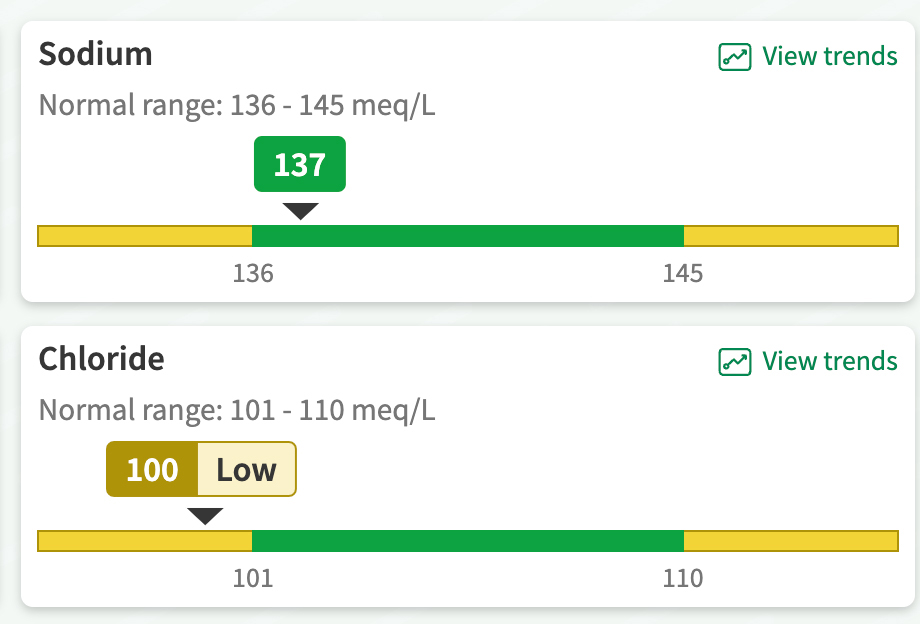
The fun thing about having medical tests done these days is that you don’t have to wait to learn the results. You can diagnose yourself, and make bets whether it will turn out you were right when you see the medico. I could have seen them last night, but I forgot to look until I was eating lunch today.

I like the way they inform you if any of the results are just a bit off. Off course, it would seize my attention even more effectively if the “ABNORMAL” were in a red box rather than plain buff, and it flashed, and was accompanied by a loud klaxon sound.

It would cause one to respond, “I say: What’s all this then?” And you might even click and look at the results. In my case, I’d have opened it without the warning sign, because I’m always curious about a couple of the data points. And yes, it turns out I am still low on both sodium and choride (“abnormally” so on the chloride), so I can keep having all the salt I want. In fact, I’d best get right to it.

As for the “ABNORMAL” bits, well, they’re kinda dull when you look at them. Oh, maybe one day one of them will be something bad, but you can’t tell by looking at them. Or I can’t.

Anyway, the point of this post was that it gave me an excuse to share one of my favorite clips from one of my favorite movies.

Enjoy.

Well, I did it

One of the various newspapers to which I subscribe had a story this morning about people who have done an extraordinary job of sticking to ambitious resolutions. I can’t find that story now, but who cares about those slackers? At the moment, I’m more impressed at what I did.

In early May, I reported to you that, having dropped down to 167.9 pounds, I was at least theoretically eligible to wrestle Shute. That was nothing.

I’ve now dropped below 160, which was my goal all along. I thought it was kind of crazy when I first told my wife I was going to do that, late last year, and she probably thought so, too. I was in the low- mid-180s then, and sick and tired of all my pants being too tight, and having to buy new ones. At Christmas, I was wearing new pants with a 36-inch waist. Which was unprecedented.

Now, I’m back in my old 34s, and most of them are a bit loose. The looseness is OK — it’s way better than being tight, and I figure at some point I’ll relax discipline and put back on a few pounds. Almost anywhere between 160 and 170 seems like a comfortable, healthy weight. And entirely doable.

Speaking of relaxing discipline, I now know I can do that without disastrous results. I first got down to 159.9 on June 5, and was a bit lower on D-Day. But then, we spent last week down in the Tampa Bay area, and since I was traveling, I allowed myself to eat pretty much what I wanted. And with my routine disrupted, I only managed to achieve my usual daily goal of 10,000-plus steps once.

But I still only gained back a pound or so. I weighed in at 161.5 yesterday. But today… and here’s the good part… I was back down below 160. The photo above of my scale was taken this morning.

For anyone who cares, here’s how I did it:

  • Smaller portions, on smaller plates.
  • No going back for seconds.
  • No snacks of any kind at any time.
  • Walking at least 10,000 steps a day. Last month, my average was 12,000.

So, in other words, it wasn’t that hard. And I’m glad to see the new weight isn’t all that hard to maintain. I had been wondering.

I know it’s harder for other people. I was always a skinny guy, and when I was young, I lost noticeable weight any time I skipped a meal. The hard thing was gaining.

That has changed in recent years, and I found the way I felt last year kind of a drag. So I did something, something I had never tried to do before. And I’m pleased with how it turned out…

I’ve kept ONE resolution, so Shute’s in trouble

I’ve bored you many times with my long-standing ambition to lose enough weight to wrestle Shute.

You know, the shtick about how I was a high school wrestler, and there’s only one really great high school wrestling movie, and it’s “Vision Quest,” yadda-yadda…

Well, this is sort of about that, but more about the fact that at least I’ve kept ONE of this year’s resolutions. Or rather, I’m more than halfway to achieving it, with less than half the year having passed. Here’s the resolution:

Lose weight. This still feels new to me, although as you know, I have tried before. It still feels new because I was a skinny kid, and continued the tradition for several decades after I grew up. When I was little, I was also almost always the shortest kid in the class. I got over that in high school, reaching my present moderate height of 5’11” and a fraction. Which was satisfactory (although an even 6 feet would have been more so). But talk about skinny… In my junior year, I was this height, but in the 115 class on the wrestling team. The following year, I was in the 132. Now I weigh in the vicinity (sometimes more, sometimes less) of 13 stone. In the 180s, that is. In the past, I’ve tried and failed to get down to 168. This time I’m going for 160. (That way, maybe I’ll get to 168.)

I’m proud to report that this morning, I broke the 168 barrier. See the image of the bathroom scale at right. Like Louden in the clip above, I, too, had to ditch my shorts — as I do every morning for weigh-in — but I found it unnecessary to blow all the air out of my lungs. So here we are. Ya ready, Shute?

It’s not 160, but I’m headed there. Which is pretty good for someone who weighed in the low 180s at the start of this thing.

And basically, I really just did it in the last month. I sorta kinda was losing weight there for the first few. I had managed to get too small for the 36-waist pants I’d bought at the end of 2023. I got a couple of pairs of 35s (which aren’t that easy to find), and they were sort of working, but then I kicked the project into gear…

It wasn’t that hard. I just went from simply avoiding seconds to fairly serious portion control on first helpings, plus zero snacks. And… while I kept up my 11,000 steps a day routine, I added ankle weights. That risks adding leg muscle and therefore weight, but it really ramps up the loss of fat. And waist reduction.

So now, the 35s are too big, and I’m back to the size I’ve worn for most of my adult life — 34. Just in time, too: All of my shorts are 34s, and it’s that time of year.

Since I had posted my resolutions, I figured I had a right to brag. A little. We’ll talk about those other resolutions another time.

How are y’all doing on your goals?

That would have been a good tweet during the campaign

I posted this with a release advocating medical cannabis, and James saw it and told me to take it down NOW. So I did, and I saw his point. But I had liked it, and whatever I substituted it with was boring…

Y’all may or may not remember that back during our campaign in 2018, James and Mandy supported medical cannabis. James knew veterans who would benefit from it, and Mandy had co-sponsored the bill in the House that would have legalized it.

I myself was kind of neutral on the issue, but my job as communications director wasn’t to push my views, but theirs. So I wrote a release or two about it. Here’s one, if you can read it. (I can’t link you to it because the website is long gone — or at least, I can’t find it.) That one was taking Henry McMaster to task for his coldly facile dismissal of the idea — I certainly believed he was wrong about that, however undecided I may have been on the larger matter.

Why undecided? Well, to quote from the release, Henry had been asked “whether the substance should be legalized for the limited use of sick people who have no other recourse for relieving their suffering.” In Henry’s position, I’d have said “yes,” but would have gone on to say I would need to educate myself more to feel persuaded that there were conditions nothing else would cure. It seems couterintuitive that would be true, given the huge variety of pharmaceuticals available in the world — but I had heard repeatedly that it was uniquely effective and I was at the “I need to learn more” point.

Doug Ross doesn’t need that, being a libertarian. So he supported our campaign, based at least in some part on that position. I very much appreciate that support. But I’m not a libertarian, and have no problem with the government saying “no” to people when there’s a reason. And to me, the reason has always been that I need to be persuaded that an intoxicant that is currently illegal needs to be made legal. I might be halfway there in this case, but not quite all the way.

But I might have been closer to a conclusion back then if I’d seen what Mandy retweeted the other day. This was impressive…

Apparently, my immune system is my superpower…

Normally, I go to dump No. 9 (“number 9, number 9…”). But Saturday, I cranked it up to 11 (thank you, Nigel Tufnel)…

It started with the B-12.

I had been dragging recently in the mornings, so I thought I’d take some B-12 my wife had in a kitchen cabinet, but had quit taking. I let one dissolve under my tongue on Saturday, and it seemed to work. I loaded up my truck with stuff from our garage that we needed to get rid of, and set out to rapidly accomplish a series of tasks:

  • Went to the pharmacy to pick up a refill.
  • Wanting to give away anything charity might accept before going to the dump, I drove to His House over on Meeting St. The lady who came out said right off she wasn’t taking that mattress, but I assured her that was going to the dump. I was there about three things I thought someone might want. She accepted two of them, but not the almost unused Christmas tree stand (we went back to artificial several years ago). It seems they had too many of them.
  • On a lazier day, I might have gone on to the dump. But not today. I headed to Goodwill, and they gladly took the stand.
  • Then I headed to the dump — I mean the county Collection and Recycing Center. Not the one near me, but to one almost half an hour away that I had heard was more likely to take the mattress. I went out to the one at 325 Landfill Lane, Gaston (I assume no one’s trying to sell residential real estate there). And they took everything else. Done and dusted.
  • As I left the dump, I regretted I hadn’t thought to bring my golf clubs, or I could have hit a bucket of balls at the range next door. I was still full of pep.

But that didn’t last long. When I got home, I tried working out the measurements for another complicated bookcase I plan to build, but I started making mistakes on the arithmetic and spatial relationships. So I quit and took a nap. By dinner time, I had a sore arm. And I never even ate dinner.

That’s because, in my get-things-done mood, I had done one thing too many. Right at the start, at the pharmacy, I saw a sign urging folks to get the next COVID vaccine shot, and it reminded me I was due for my second shingles shot. So I stopped and did that, because I was up for anything. And the guy who gave it to me assured me I’d never need another one. Which is good news, as it turned out.

Once it took full effect, I was sick the rest of the weekend. I couldn’t remember whether this had happened with the first Shingrix shot, but it had with every COVID shot I’ve had.

My immune system goes nuts in reaction. It feels like having the flu, only there’s no measurable fever. I can’t do anything. Sitting at my computer is too difficult, even something fun like working on my family tree. I just sat and watched movies on the TV. And I had to take periodic recesses from that, for a nap. Watching TV was too tiring.

But this is a good thing, you see. I think it means I have a strong immune system, and it’s doing its thing. No, really. I must have the immune system of Superman. Even though I can’t fly. I just have the one superpower. Apparently, if I was given a choice, I didn’t choose well. Reminds me of something my 9th-grade English teacher said to a classmate: “Boy, when they were handing out brains, you took a ham sandwich.” But while it’s not as cool as moving at super-speed, it’s what I’ve got.

I was pretty much recovered by this morning, so I took another B-12. And look — already, two posts!…

Images of USC campus as pandemic closed things down back in March 2020

Four days ago, my phone invited me to look back on pictures from that date — March 11 — in years past. So I did, and saw some pictures taken on what I suspect was my last walk around the USC campus and downtown Columbia in 2020, before we closed down the office for the duration of the pandemic.

Of course, I stayed home, but ADCO eventually ended up opening another office downtown, and some of my colleagues actually go there, but not every day. Sometimes we have our weekly meeting on Zoom and I see everyone’s there in the conference room; other times everyone’s at home like me.

I do my walking around my neighborhood, and on the elliptical, which is satisfactory to me.

But I did like walking around the campus, especially during summer and spring break when there weren’t all those people about. I felt a bit like a landed lord taking a turn through my private park. It was peaceful, and healthy.

But this day things were so peaceful, they were starting to feel a bit weird…

Below, you see:

  1. The Horseshoe.
  2. A copy of The Washington Post in Thomas Cooper library. Note that six were dead in the U.S. at that point. As you are probably aware, that number is now at 1,117,856. Or at least, it was on March 3. There was some cheery news, though, with other Dems lining up behind my man Joe.
  3. A sign on a rest room in Thomas Cooper library. Nothing like a dose of British pluck to help a chap deal with adversity, what?
  4. The seating area — or what normally would have been the seating area — in the food court area of the Russell House.
  5. Greene Street in front of the Russell House. Not really bustling that day.

Stroke Guys of the World, Unite!

What are yinz lookin’ at?

Paul DeMarco didn’t specifically mention John Fetterman in his piece posted earlier, but he alluded to him when he mentioned what happened in Pennsylvania last month.

And that reminded me of a selfie I snapped a couple of weeks ago. I had just stepped into the bathroom, and happened to glance in the mirror, and… something looked familiar.

No, I’m not saying you can’t tell us apart or something. I just mean I saw something in the mirror that reminded me of John Fetterman. Yeah, to some extent the effect had to do certain sartorial choices. I wouldn’t have been reminded of him back when I went around looking like this. Oh, and if you want to see the senator-elect in a hoodie, there are plenty of such images.

But there was more to it. I now feel more of a commonality with this guy than I did back when he first emerged on the national scene, going around with his eccentric chin spinach saying strange things such as “yinz.”

But then, when people started picking on him because of a minor cognitive symptom following his stroke — when he was obviously still an intelligent and discerning man — I got all defensive on his behalf. How dare they?

Y’all know how opposed I am to Identity Politics, but don’t go picking on my special group — guys who have minor bits of damage after a stroke (in my case, the “nap attacks” I think I’ve mentioned before), but are pretty danged hale and hearty otherwise, dagnabbit!

Yeah, I know I’ve kind of mentioned all this before, but that recent glimpse in the mirror got me going again. And mentioning it now, after the election, I can also take a moment to celebrate the fact that Fetterman is going to the Senate, instead of that yahoo carpetbagger from TV — the guy Paul did mention by name.

Stroke Guys Unite!

Shute’s got nothing to worry about at the moment

Louden weighs in.

An unpleasant thing happened the other day.

But first, a bit of background…

Last time I mentioned my usual weight-loss standard — which involves losing down to 168 so I can “wrestle Shute” — I was actually almost there.

That was early 2018. I was spending a lot of time on my elliptical trainer at home, and walking miles downtown every day, and averaging about 15,000 steps a day. I was eating more or less paleo, and feeling pretty good.

That’s not where I am now. A series of events occurred since then. First, later that year, there was the campaign, which left me basically no time for serious walking and forced me to grab whatever I could to eat. And since then, there was the stroke, and the long COVID, and other stuff, punctuated finally by lightning frying the electronics in my elliptical. I still get out and walk, but it’s not regular, and I haven’t been at all thoughtful about what I eat.

And then, the unpleasant thing happened. It was a week ago today. I had an appointment at one of the many medical offices in which I find myself these days. No big thing, just a followup. But as the nurse led me in, we paused for one of those little rituals that are usual in such places. We stopped at the scale.

Now first, so that you know the scale was in some way dysfunctional, she had trouble getting it to come on. I made a lame joke about “Who broke it?” She muttered something about “batteries,” and fiddled with the back of the column that has the display atop it, and it came on. And I stepped on.

And it said I weighed 190. Actually, it said 190 point something, but I’ve managed to block that much of it out. What I can’t forget is that I have made a scale register 190 for the first time in my life. An unhappy landmark.

Now let me quickly say that I was not only fully dressed — shoes, shirt, pants, belt, plus iPhone, wallet, keys — but I had on a jacket, and I think even a hat. So I don’t really weigh 190. Since this happened, I’ve stepped on the scale at home a couple of times when getting into the shower, and I was in the low 180s.

That doesn’t erase the fact that in the past, I always considered 180 an unhealthy mark.

Now I know a lot of you guys will laugh, and say you wish you could get back down to 190. After all, my BMI may say I’m slightly overweight, but I’m still below the average weight for my height, which is 199.7 in this country.

But not me. I was a super-skinny kid, and a skinny young man, and it’s a bit late to expect me to adopt a new self-concept. To give you an idea based on the Vision Quest standard, when I was Louden Swain’s age and still on a high school wrestling team, I was in the 132 class. And the same height I am now. Yeah, I was a real Ichibod, but I was strong and except for the injury that ended my wrestling career, I felt great.

And now, I have made a scale register the weight that Louden started at, before losing down through two weight classes to wrestle Shute. And I don’t feel at all great like this.

So when the New Year comes (there’s not much use trying before that), I’m going to get serious. I’m going paleo again. And I’m getting serious about the walking — I’m even looking around for a replacement elliptical, so the weather can’t stop me.

Warn Shute. It’s the fair thing to do. The poor beggar deserves that much…

This is me when I was Louden’s age. See? I’m really a skinny guy…

Now I have TWO vaccine cards! Take THAT, COVID!

I don’t mean to lord it over the rest of you with my conspicuous consumption of preventive medical care, but there it is: I got the bivalent shot on Friday, and now I have not one, but two vaccine cards.

This is due to an error someone made on my first card, and had to scratch out. I don’t understand what the problem was, but it eliminated a vacant spot on the first card. Also, I’m just noticing that a space was skipped on the front, because the little stickers they put on were too wide. Anyway, I had to get a new one Friday.

And now, I’m finally protected against the variant that I probably had back in January. Better late than never, right?

I meant to boast about this on Friday itself, but I didn’t feel like it. I was doing OK until I took my usual post-stroke afternoon nap, then woke up feeling like someone had hit me in the arm with a baseball bat. And then I felt lousy generally, as though I had a minor bug of some sort, for the next day or so.

That pain thing is weird. I don’t understand it. As someone who got a lot of shots as a kid — I started on allergy shots as a toddler, and got a truckload of vaccinations before moving to Ecuador when I was 9 — this doesn’t fit the pattern.

In my experience, the world record for soreness is held by the typhoid shots I got that summer of 1962. If I remember correctly, it was a series of six, and we got them about a week apart. I specifically remember getting one at the old state health department office on Market Street — next to the hospital where I was born, which is now long gone — and then getting into the car, and having trouble closing the door because my scrawny arm was already so sore.

Seems like someone once told me that the soreness had to do with the viscosity of the fluid being injected into the muscle. So it makes sense that the typhoid injections hurt immediately.

Then… why do COVID shots not hurt right away? I’ve had five of them now, and the pattern seems to be: Get the shot, feel some relief over the next few hours because it doesn’t hurt, then WHAM! It starts hurting not quite as badly as a typhoid shot, but it’s not great, either. This is weird because it seems that the alien substance would have spread out by that time, and therefore hurt less.

Anyway, it’s way better now, so I’m not complaining…

It occurs to me that maybe so many Trumpistas avoid vaccination because there’s so much Spanish on the card…

I can identify with John Fetterman

Oh, not because neither he nor I seem to own any grownup, run-for-the-Senate-type clothes, although I can understand you getting that impression.

I’m sitting here wearing:

  • Cargo shorts (although this pair is fairly new, just ordered from Amazon a couple of months ago, unlike the ones that are full of holes).
  • My brown Yesterday’s T-shirt, which I admit is getting old — its logo celebrates the tavern’s 30th anniversary, which was 14 years back. But it’s now a collector’s item!
  • My sandals I bought at Walmart for about six dollars more than 15 years ago (I recently bought another, similar pair, but they’re not nearly as comfortable as these).
  • And not much else. (I won’t get into underwear, although I just bought these skivvies, too).

And of course, John Fetterman… well, just look at pretty much any picture out there of him. Dressing like a slob is part of his populist shtick. He’s really into hoodies.

But this similarity is transitory. Most of my life I wore a coat and tie pretty much every day. I dress the way I do now because I don’t intend to go work in an office again, ever. But if I lost my mind and decided to run for the U.S. Senate, or pretty much any elective office, I’d get back in uniform — out of respect for the office, and for the voters. And to make sure no one mistakes me for a populist.

Then, of course, both of us have a penchant for distracting facial hair. But I shaved off the beard just before my brother-in-law’s funeral (which happened to fall on Election Day 2020), and I’d do so again, were I to run for office. Voters are likely to have enough problems with me without being mesmerized by this. I might even go back to shaving every day.

No, it’s not those things. I’m identifying with the guy on a different level:

Pennsylvania Democrat John Fetterman’s Senate campaign said Wednesday that his stroke recovery, which has complicated his ability to engage in verbal conversations, could influence his plans for debates with Republican nominee Mehmet Oz in one of this fall’s highest-stakes races.

“We are working to figure out what a fair debate would look like with the lingering impacts of the auditory processing in mind,” Fetterman campaign strategist Rebecca Katz said. “To be absolutely clear, the occasional issues he is having with auditory processing have no bearing on his ability to do the job as senator. John is healthy and fully capable of showing up and doing the work.”…

You see, I, too, have lasting effects from my own stroke (which was enough without the stupid “long COVID”), and have big-time trouble following human speech when there are other sounds going on around me.

Of course, in my case these are two different things:

  1. As a result of my stroke, I have these things I call “nap attacks” (although a neurologist told me they’re called “sleep attacks”) pretty much every day. Some days, especially if I make the mistake of getting up early in the morning, I have two of them. I just get to a point, sitting her at my desk, when my brain tells me, Can’t do this any more — lie down and closer your eyes, NOW! Within five minutes, I’m in my recliner in a deep slumber, with dreams and everything. Then, after an hour or so, I gradually wake up, and Thank GOD I don’t have anything incapacitating, like losing the ability to walk or talk. Anyway, I have this lesser problem because I had a bilateral thalamic stroke. Those are fairly unusual. If the stroke hits one side of the thalamus, you’re good. If it hits both sides, you’re taking a lot of naps.
  2. The inability to intelligibly separate human speech from the background isn’t a stroke thing. It’s my hearing. Remember how a decade ago, Ménière’s mostly wiped out the hearing in my right ear? Well, I finally got hearing aids early this year, and they helped in some ways — especially if just one person is speaking to me, clearly and facing me, without a distracting background.

But anyway, put together my stroke thing and my hearing thing, and I can really identify with Fetterman’s stroke thing. It’s a problem, especially when other people don’t understand it.

And yet, I agree with his campaign that his problems should have “no bearing on his ability to do the job as senator.”

Frankly, I even think we go a little overboard in worrying about the health of presidents. I’ve thought that ever since we were obsessing over the polyps in Reagan’s colon back in the mid-80s. I really could have done without that, especially when I was eating at my desk.

Sure, you want the president to be healthy, all other things being equal. And presidents have to deal with things of literal earth-shaking importance suddenly, at any hour of the day or night. But… if the president is incapacitated, we have detailed procedures for both temporary and permanent succession. And even if he’s just trying to get a good night’s sleep, we have the biggest, most expert national security apparatus in the history of the world, manned by extremely well-trained people ready to react effectively and instantaneously, any time of any day or night.

And the Senate? Are you kidding me? Look how often those people don’t even show up for work on the Senate floor! I think we can wait until the nap is over — or until there’s time for a clear-speaking aide to explain to Fetterman what all those people were yelling about back in that room a few minutes earlier.

Mind you, I’m not making an argument that I’m ready to run for the Senate, or for anything. Right now, between the stroke thing, the fact that my Ménière’s started getting worse over the summer, the long COVID, and just being 68 years old, I wouldn’t work in somebody else’s campaign again, much less run myself.

But I don’t see how Fetterman’s stroke problem disqualifies him

I suggest we follow the Wally Schirra approach

If we must exercise, let’s do it Wally’s way.

First, a complaint that’s unrelated to the subject: For some time, I’ve been meaning to write something about the sudden death of the newspaper headline. I’m still going to write it, but I’ll just touch on it here.

Back when there were real newspapers everywhere, journalists had an important ethic — to tell their readers everything they needed (or might want) to know about the subject at hand as quickly as possible. Do it in the headline if possible. Then, if you couldn’t do it in the hed, you did it in the lede. People should be able to read nothing but the hed and the lede and move on, and know the most important facts about what the story was about. If the story was a tad too complicated for that, certainly you finished telling the basics in the next couple of grafs — then, assuming you were writing in the classic inverted-pyramid form, the importance of the information you related diminished with each paragraph.

You did this for two reasons. First, those rabid lunatics on the copy desk (no offense to copy editors; I’m just describing them the way a reporter would) were likely to end your story randomly wherever they felt like ending it, in order to cram it into inadequate space, so you needed to get the best stuff up top. Second, you saw it as your sacred duty to inform the busy reader as well as you could. A reader who didn’t have the time to sit down and read the stories should be able to glance over the headlines on the front page and at least have a rough, overall idea of the important news of the day. A reader with a little more time should be able to get a somewhat deeper understanding just by reading the front, without having to follow the stories to the jump pages. And so forth.

But no more. Now, the point is to get readers to click on the story. So you get “headlines” that say things like, and I am not making this up, “What you need to know about X.” When there was room in the headline to just tell you what you needed to know. Or they make it clear that the story is about a particular person, but don’t name the person. The idea being that if you aren’t willing to click, then you can just take a flying leap. (There’s another, even more absurd, reason why the person is often not named, but I’ll get into that another time.)

Different ethic — if you want to call it that.

But you see what I just did? I wrote 414 words without getting to the point of this post. See what writing for an online audience, without the discipline enforced by the limited space of a dead-tree newspaper, can do to you?

I went on that tangent, though, because I was irritated by a story headlined, “What Types of Exercise Reduce Dementia Risk?” That grabbed me on account of knowing someone — a good friend, you see — who will soon be 69. And he might care to know. But did the story tell me? No. At least, not in the first 666 words. After that, it finally gave me a subhed that said, “Start by doing what you like best.”

Which meant we were getting somewhere, but not exactly. Still, I forgive this writer and her editors, because she had an excuse: She doesn’t know the answer. Nobody knows the answer. At least not an answer that would satisfy me — or rather, my friend.

So, in a way, my long digression about bad headlines was even less relevant than it seemed. Oh, well. At least I got some of that out of my system. But I’ll return to the subject in another post, with examples.

Back to the exercise thing — while there are no answers, there are… indications, such as those from three recently-published “major long-term studies” that “confirm that regular physical activity, in many forms, plays a substantial role in decreasing the risk of developing dementia,” and further tell us that “Vigorous exercise seems to be best, but even non-traditional exercise, such as doing household chores, can offer a significant benefit.”

That’s good. But I went into this hoping — that is, my friend went into it hoping — that the stories would endorse the Wally Schirra approach.

Did you read The Right Stuff? Well, you should have, and if you haven’t, go read it right now, and return to this point in the post when you’re done…

Did you enjoy it? It’s awesome, isn’t it? Well, I always liked the part where Wolfe is telling about how the people in charge of the Mercury program encouraged our nation’s first seven astronauts to engage in frequent exercise. And John Glenn, demonstrating what a Harry Hairshirt he was, would go out and run laps around the parking lot of the BOQ. But most of the guys agreed with Wally Schirra “who felt that any form of exercise that wasn’t fun, such as waterskiing or handball, was bad for your nervous system:”

Nothing against John Glenn. He’s a hero of mine, as for most Americans alive in that time. I was really disappointed that he didn’t do better in his bid for the presidency in 1984. I was definitely ready to vote for him.

But I like Wally’s approach to exercise. And while the data may not all be in on precisely the best exercise for keeping one’s nervous system functioning properly, it seems a good idea to “Start by doing what you like best.”

At least that way, maybe you’ll keep doing it…

I think this was my first post-COVID dream…

I think the setting was supposed to be the old State newspaper building, but wildly different on the inside…

Well, we know I have long COVID, which consists of some post-COVID physical symptoms.

But I think I just had my first post-COVID dream. (Actually, this was Thursday night, but I’m just getting around to posting it.) So I thought I’d better set it down for the sake of medical science.

I have work dreams, or perhaps I should call them stress dreams, all the time. In terms of the way they feel, they’re related to the cliché dreams that everyone who has been to college has — it’s the end of the semester and you have to go take an exam, only you’ve never been to the class, and you’re afraid to ask anyone where it is, because then they’ll know you haven’t been to the class, etc.

At least, that’s the way those dreams work with me. And with me, looking back on my college career, they’re not that different from reality. But they’re stressful.

And the work dream I had last night was like that, but it had a new, post-COVID wrinkle. By the way, I should mention that these dreams are almost never related to any work I’ve done in the last few years. They’re drawn from the intense situations I encountered daily in the decades of my newspaper career — sometimes from the early days in the newsroom, and occasionally from my time later on the editorial board.

This fit in that genre, but with a twist that is very much pandemic-related. It’s not that I’d had COVID in the dream, it’s that my work habits were what so many of us have experienced the last couple of years. And it’s not that — as in the college dreams — I didn’t know where the office was. I knew the place well, but I just hadn’t been there in a really long time. And things had changed radically.

(In this sense, it’s a little like my current life. We shut down the ADCO office when the pandemic started — in mid-March 2020. Sometime later, we shut it down for good. But in the last few months, my colleagues opened a new office. Nobody goes there as often as they went to the old one. I don’t go there at all. Except for two meetings and one case where I went and took a picture of a client, I haven’t encountered any work that can’t be done in my home office. Anyway, those circumstances seem  to have imposed themselves on this otherwise standard newspaper dream.)

It started with a phone call. Someone called me from the office — an office I hadn’t been to on a long time. He wanted to discuss a backup editorial (a short item that ran below the lede editorial, back when such things existed) he was writing for the Sunday page. He wanted some sort of guidance on it. I found this call disconcerting on a number of levels. First, it was ridiculous that he seemed to think he needed urgent help at this time, because it was a Monday afternoon — normally we wouldn’t even have identified a topic for such an edit at that point. Secondly, the call cut off before we could get the matter settled, and I couldn’t seem to reconnect with him.

But the worst part was that I had no idea who this guy was. And I was aware that there were a number of such people at the office now — new associate editors and editorial writers I had never met, but whom I was supposed to be supervising. It dawned on me that this was probably an unacceptable situation. I decided I should probably start going in to the office and sort all this out. I didn’t want to, but it seemed the responsible thing to do. At the very least, I needed to find out who this one guy was, so I could address his question.

I needed to go there and find Cindi Scoppe, who was the only person I knew who still worked there. (Of course, in real life, even though she was the last member of my team to get laid off, at this point she hasn’t been there either, for several years.)

I went there, and I eventually found her. She was outside a door to the editorial department. I peered in through a window in the door, and saw a place I’ve never seen before. A confusing, chaotic place, crowded with old desks jammed together, and strangers wandering among them. I had hoped to infer somehow which of them had called me, but I couldn’t. Nor could Cindi. She knew these people — she named some of them to me — but had no idea which had called me. I was going to have to get past that door somehow — it was locked — and engage these people in conversation until I sorted out which was the right one, and answered his question.

Eventually, I got in, and engaged with some of these strangers. My first problem is that I had no idea where to put down my laptop, because I couldn’t figure out where my office was. I finally realized that none of these people had offices (we all did back in my newspaper days) so maybe I just had a desk among all the others. I found this disconcerting, and was already missing working at home, but worse, I couldn’t sort out which was mine, so I couldn’t put down the things I was carrying.

And of course, I couldn’t ask anyone. Cindi had wandered off, and I couldn’t say anything to these strangers that indicated that I didn’t know where my workplace was, and I had no idea who any of them were.

Anyway, you get the idea. Like in the classic college dream.

The weird thing is, in real life, I’ve experienced no such difficulty working from home. I talk to people and I write things. With very rare exceptions, of it is easily accomplished using the phone, or perhaps Zoom on my iPad, and my PC — all right here in my office.

But in the dream, it seems I had thought everything was working fine before the dream started, and the main point of everything that was happening was that I was finally realizing what should have been obvious.

This doesn’t worry me, because I have these work/stress dreams all the time. I’m just setting this one down as the first in which the stress seems to have been driven by things we’ve experienced during the pandemic — in this case, by my favorite part of the “new normal,” the part where I don’t have to go to an office outside my home any more.

Anyone else have any such dreams?

Well, it seems I DO have what is termed ‘long COVID’

No longer confined to my home office, I may wrap up and head out to walk.

Several days ago, one of our regulars here on the blog emailed me — apparently motivated by a mix of solicitude and impatience. I hadn’t posted in a startlingly long time, the unapproved comments were stacking up, and he asked, “You doing OK?”

When I explained that my absence from this venue reflected a lot of things — such as being busy with family, and still dealing with doctors and such in connection with the lingering effects of my having had COVID — he asked, “Could it be long covid?”

Since I was going to see my pulmonologist next morning (Friday), I said I’d ask, but that I didn’t think so.

I was wrong. He said yes, that’s what this was. I had been confused for two reasons. One, I hadn’t really paid much attention to all the stories I’d seen about “long COVID” — which I assumed referred to a continuing, contagious presence of the virus itself — and up to this point the doctor had referred to my problem as “post-COVID.” Of course, I hadn’t worried all that much about what to call it; I just wanted it all to go away. I was tired not only of the symptoms themselves, but the side effects of the remedies (for instance, my difficulties sleeping at night, caused by the long course of prednisone I was on).

On Friday, the bad news was that my lungs — still impaired by inflammation from the long-gone virus — were only working at 67 percent of normal capacity. The good news was that overall, he saw me as having improved considerably, and he took me off the prednisone! Yesterday was the first day I didn’t take it, and I slept like Rip Van Winkle last night, and through most of this morning. It was wonderful.

He also took me off colchicine. I had wondered why I was taking that, anyway — it’s known as a remedy for gout. It can also be helpful with arthritis, I believe. I assumed it was for something he saw in the battery of tests he ran last month (which I repeated several days before this appointment), and which I could not detect.

When I asked, he explained that colchicine is an old, inexpensive drug that helps prevent a “cytokine storm” — which is the phenomenon that leads to so many COVID deaths. Wikipedia defines such a storm as a condition “in which the innate immune system causes an uncontrolled and excessive release of pro-inflammatory signaling molecules called cytokines. Normally, cytokines are part of the body’s immune response to infection, but their sudden release in large quantities can cause multisystem organ failure and death.”

Inflammation like that which had messed up my lungs. It seems that colchicine prevents such a “storm” through the same mechanism that alleviates gout.

The doctor said that I, and many others, had not heard about this use of colchicine because so many were talking about another, extremely expensive, drug that does the same thing. I didn’t write down the name of that other drug, because I was uninterested in anything that cost “$10,000 a dose,” especially since colchicine did the job.

So now, all I’m taking that was prescribed by this doctor is Vitamin D3 (which, I have learned, is actually a hormone rather than a vitamin, but since I don’t fully understand the difference, never mind). And he had me reduce the dosage of even that — from 10,000 units a day to a mere 5,000. He had had me on the high dosage because the standard range is 30-80 ng/mL, and mine was at 17.3 on the first test. He told me last month he wanted to get me closer to 60 than a mere 30. According to last Monday’s test, I was at 55. Satisfied, he reduced the dosage.

So, I’m getting better. The main restriction I had experienced was a lack of stamina. I haven’t done my normal 10,000 steps in a day since before I got the bug. I’ve tried, but I haven’t gotten past 2,000 without feeling great fatigue and beginning to cough again.

The doctor says it’s time to start getting exercise — and to get some sun as well, which I assume would help with the D3 — but not to attempt 10k. He says 3,000 to 4,000 is more my speed.

OK, now you have my update. Which I have shared in such detail partly to explain why I’ve been so unavailable, but also to make a larger point. Apparently, about a fourth of people who get COVID are “long-haulers.” This is a huge part of the effect of the disease on our society. In fact, I waited almost two hours past my appointment time to see him because he was overwhelmed with patients with my condition. This guy is really, really knowledgeable about it, and I think a lot of other doctors are doing what my primary-care doc did — sending their patients to the expert. Which means he’s getting better and better.

Anyway, I say all that for the benefit of those of you who make the mistake of calculating the effect of COVID solely in terms of the number of people who actually die. As tragic as every one of those 6 million deaths has been, and as horrific as they are in the aggregate, that’s not the entire story. There are other things happening as well…

OK, I didn’t have COVID ALL that time. And I’m getting better…

Reporting from my official home-office recliner: Things are looking better. This was Sunday morning.

About the third time I bothered my primary care doctor on the phone about the fact that I still felt like crap after three weeks (and after a second positive COVID test), he put me together with a pulmonologist — largely because my oxygen levels kept dipping in weird ways. (Like, down to 90 and below a time or two last week.)

I had a fascinating phone conversation with that specialist Thursday evening, and learned a lot.

First, he said I didn’t have COVID — not anymore. Not even when I got the second test. He said that was some leftover virus RNA strands still littering the lining of my nose. Of course, I always thought that that’s kind of a virus was — random, disorganized strands of more or less living material — but he sounded quite certain, and I was convinced.

So what was wrong with me? What was with the continuing, irritating, hacky little cough that interfered with talking to people? Why did I continue to run a low fever and have chills? Why didn’t I feel up to doing anything?

He said those were post-COVID effects, the most salient of which was probably inflammation in the tiny, hair-sized ends of my bronchial tubes, interfering with respiration enough to cause that cough and keep me feeling low. Also had something to do with the low fever, I think.

He put me on a course of prednisone — for the inflammation — plus 5,000 units a day of Vitamin D, because he was sure I had a deficiency. And he was right. He sent me to the hospital Friday morning for some blood tests, and one of them confirmed I was well under the normal range on D. I’m to see him for a followup later this week.

Anyway, I’ve been on the steroid and the D since Friday, and I’m dramatically better. No cough. No fever — in fact, I didn’t even think to take my temp for a couple of days. I 3made myself take it last night, and it was 96.1. That’s not even a fever by MY low standards.

The O2 levels remain very good — like 98 percent, frequently with my heart rate in the 50s where I’m used to it being. That had been elevated before, when the O2 was lower.

I’m still not walking or anything — I don’t feel that good. And I’m still spending all my time, including sleeping, in my home office, at least until I find the time to start moving my junk back to other parts of the house. In the meantime, I’m getting some work done. And I’d better get back to that now…

A fortnight and counting

Reporting to you from the front, where things are not so much grim as tedious.

Just thought I’d report in from the COVID front — which, for me, is located in my home office. Since I work from home, I already spent a lot of time here, but now it’s pretty much ALL my time. I’ll go down to the kitchen — masked — to heat a meal and bring it up to eat at my desk. I sleep on a futon here. Just don’t call me Mark Sanford.

Of course, there are other COVID fronts as well, some of them with much heavier fighting going on, and significant losses — such as hospital ICUs. But this is mine.

I’m actually about to go to a hospital this afternoon. It will be my first time out of the house since my positive test two weeks ago. I wonder what that will be like. When I present myself at the door and am questioned and say, “Yes, I have COVID,” will alarms go off? Will everyone scramble to implement a Code Red? I don’t know.

I’m not sure it’s necessary. But since I bothered my doctor on the phone yesterday, he decided to have me get a chest x-ray, as a precaution. Why did I bother the doctor? Because it had been two frickin’ weeks, and I wasn’t getting better. I still felt like crap, I still got a slight fever and chills whenever I went a few hours without acetaminophen, and the last few days I had developed this irritating cough.

I basically called to say, Yes, it’s just a mild case and I don’t need to be hospitalized. And I doubt there’s anything to be done. But it’s been two weeks, which is way longer than I expected, and I’m even feeling a bit worse (the irritating cough), so should I be concerned? Also, is there some magic thing you can do that I’ve missed in reading about this for the last two years?

Well, as it happens, there was something he could have done if I’d called him right after my positive test. There are a couple of meds that could help with the condition — ask Paul; he knows about them — but you have to take them pretty early. There are drugs like that for flu as well, I believe. But I saw no need to bother my doctor in those early days. I wasn’t worried, and I figured it would be over in a few days.

Oh, well.

There are times when I think I’m getting better. Yesterday, in fact. I had an awesome nap from about 2:30 to 4, and it set me up amazingly. I felt stronger, generally less lousy. Having taken a single 500 mg acetaminophen tablet at 2, I decided not to take any more. But then by bedtime, I was back to the usual crappiness, with a temp of 99.4.

By the way, that’s what I meant by “slight fever.” I feel pretty awful when I get to that temp. And the couple of times in recent days when I’ve been at 100 or more, it’s been much worse. Technically, no one in the medical profession would call 99.4, or even 100, a “fever” — even a “low-grade” fever.

But hey, my normal temp is about 97. Do the math, and you see that 99.4 is 2.4 degrees more than that. If a person whose “normal” is 98.6 goes up by that much, he’s at 101. So get outta my face, before I give you COVID.

Anyway, this is probably all very boring to you. Half of you have probably already had this, and probably worse cases. But I thought I’d report in. This is what’s going on in my world.

May God send his healing grace upon all those who are really sick…

Well, I’ve got it. What now?

Just got the above notice, from my test yesterday morning.

How am I? I feel like crap. I have since last night. I’m going to do a quick couple more work things, including a phone interview at 1 p.m., then I’m going to eat some lunch and lie down.

After that… what?

I thought when they told me it was “DETECTED,” they’d say, and here’s what you should do in addition to what you’ve already been doing.

I thought it would be like, I don’t know, getting a draft notice: “GREETINGS,” followed by specific instructions on where to report for my physical.

But nope.

Kind of anticlimactic, really…


We’re all gonna get this thing now, right?

That’s what Dr. Fauci said yesterday, and I just nodded.

After all, it’s finally in my house.

My youngest daughter, who was about to head back to her home in the Caribbean on Monday, had to change her flight to several days later because her COVID test was late coming back.

Then it came back, and she has it. She’s fully vaccinated of course, and her symptoms are mild. But she’s got it. She’s staying in her room — teaching her dance students in Dominica, and her English students in South America, remotely — and the rest of us are wearing masks in the house and being as careful as we can be.

Another daughter, who was with her a lot just before the positive test, isn’t feeling well. She’s awaiting a test result.

I got tested at 9 a.m. today at Lexington Medical’s site near me. I’ll have the results in a couple of days. That was my second test in a week. My wife has an appointment to get one at CVS tomorrow.

My test was at a little off-campus building LMC owns that’s down a side street right across from the turnoff from Sunset to our subdivision. Toward the end of the holidays, the line of cars for that process was maybe a hundred or so vehicles deep, stretching out onto the main road. Last week, I was the 10th or so in line. Today, I arrived 15 minutes early and there was no line at all. For a moment I thought the place was closed, but there were the poor nurses bundled up in the doorway in the 31-degree weather. One came out, did the deed, told me to look the MyChart app in 24 to 48 hours, and I was gone. Less than a minute.

So this is what we do now.

How’s it going for you out there?

At the time of my last appointment — 3:30 p.m. last Friday — I still had some people in front of me. Today, I didn’t have to wait at all…