Here’s what Mick Mulvaney had to say about the laudable decision of Joe Wilson and others to sit with members of the opposite party during the State of the State:
“If you’re looking for empty symbolism, where one sits at the State of the Union (address) might be at the top of the list.”
Translation:
If you’re looking for obvious examples of giving the people of this country the finger, the refusal to do such a simple thing as sit without regard to party might be at the top of the list.
Of course it’s a small thing. Just like, say, taking down the Confederate Flag from the Statehouse grounds — which you will also hear state lawmakers dismissed because they have so many more important things to do and think about.
And of course, they DO have many more important (or at least, less embarrassing) things to deal with. The problem is that they’ll never make progress on the things that really matter when they have such a powerful mental block against doing something so small as taking the flag down. Or, in the case of Congress, ending the egregious practice of sitting by party during the presidential address.
Simple, yes. But there is no one thing lawmakers could do that would be as easy, but say so much, as taking this action.
I’ll get back to the flag, but about this seating arrangements thing: The problem is that these guys are to entirely stuck in the rut of this abominable practice of sitting by party that it doesn’t occur to them, ever, that it is an abomination. You and I may think they were elected to represent us and to serve the nation. But THEY obviously think that they are there to serve their respective parties. They say this in the most obvious of ways — by only sitting with members of their party, by only caring what their party wants them to do or say, by thinking party first, last and always. Serving the party is SO automatic with them, that it doesn’t even occur to them that it’s a problem. They are even offended by the suggestion that it might be. Which tells you an awful lot about these guys.
This is, as I say, an abomination, and inexcusable. And so easy to address.
Which brings me back to the flag. What do these two issues have in common? The fact that they would be so easy to accomplish. Yes, I know state lawmakers think it would be really hard. But all that is needed to accomplish it is the same, simple thing it would take to end the execrable practice of sitting by party in Congress (and not only on the night of the State of the Union, but every day): All that have to do is GROW UP, and gain a sense of perspective. And then it’s easy.
It didn’t occur to me until today to ask the questions seriously, which I did after I read this at The Fix:
When the Democratic centrist group Third Way proposed the idea of members of different parties sitting next to one another at tomorrow’s State of the Union speech, there was considerable skepticism that it would happen.
Senate Minority Leader Mitch McConnell (R-Ky.), for one, said that people are “more interested in actual accomplishments on a bipartisan basis here in the next six to nine months than they are with the seating arrangement at the State of the Union.”
And yet a number of members have signed up — including Rep. Joe Wilson (R-S.C.), whose “You lie!” outburst during a speech by President Obama last fall is frequently cited as a sign of partisan incivility in Congress.
So without reading further in that piece (which would have given me my answer), I e-mailed Neal Patel of Joe’s staff to ask who his bipartisan buddies would be, and immediately got this response:
Susan Davis from California and Madeleine Bordallo from Guam. Both are HASC members.
Rep. Bordallo
Rep. Davis
Then I saw that Joe had Tweeted earlier that he was “Honored to be sitting” with those two ladies. Presumably, they are, too. And they’ve already worked together on some stuff, according to The Fix: “Davis and Wilson teamed up last year on a military pay raise bill. In 2007, Bordallo and Wilson traveled to Afghanistan together.”
This will be interesting. But whatever happens — and I’m thinking it all goes well, with no new outbursts (partly because the first one was uncharacteristic of Joe, but also because, well, we Southern boys tend to act better in the presence of ladies) — I appreciate that Joe was up for this. As I heard someone saying on the radio over the weekend, this sitting-together thing won’t likely change the world, but it couldn’t hurt.
There's just so much more temptation to get rowdy when you're sitting with your boys.
Been trying all day to get to Nikki Haley’s speech last night. Here are a few quick observations:
First, the style: Nikki is a WAY better speaker than Mark Sanford. She, at least, can read a speech that’s right in front of her (and do it in a fairly engaging way). Her predecessor could not, or would not. Every year, I’d get my copy of the speech over lunch on the day of. I’d read it, mark it up, and ask questions about it. I would have completely digested it by the time of the speech itself. Then came speech time, which I generally watched from the comfort of my office on the tube. And then I had to suffer through his hems and haws, and “I would says” and “at the end of the days,” and flat-out off-script digressions, all of them awkward, pausing to search for words, ignoring the speech in front of him. Nikki, with her teleprompter, was MUCH better. But I expected no less.
This is not to say that her style is without its irritating characteristics. There’s her prim, smug, I’m-the-girl-with-the-most-gold-stars-in-the-class tone that she too often affects. Watch, for instance, when she extols the blessings of having “a chief executive willing to lead the charge and make the tough decisions” — speaking, of course, of herself. I guess someone who came from the back bench to governor in a year is bound to be a bit self-congratulatory. Human nature. But she could tone it down a bit. And often, she does.
Do you know why she can only suggest $120 million worth of cuts toward the $719 million shortfall? Because she hasn’t suggested anything that her political base might object to. And it’s hard to come up with cuts that deep and still do that. She hit programs for those worthless, lazy poor people, of course. And when she got to the middle class, she only went after the stuff that those wicked, decadent liberals like — such as ETV. But the truth is, everybody will have reason to gripe when all the cuts are in. Because believe me, this state’s leaders will never pull an Illinois. Not that they should; I’m just assuring you that they won’t. It’s going to be cuts all the way. And that has nothing to do with Nikki Haley; that’s just the way our State House does things.
The ETV thing, of course, is nothing new. Back during the GOP runoff last year, I went over to tape an interview at ETV. They had already talked with Gresham Barrett for the same show. But Nikki wasn’t even calling them back. Scuttlebutt in the ETV corridors was that she didn’t want to talk to them because she was going to back Mark Sanford’s veto of their entire budget. Don’t know whether they were right, but I could see how they’d get that impression.
Don’t you love the way she blithely suggests that if you kill ETV (excuse me, “When you release government from the things it should not be responsible for…”), it has this miraculous effect: “you allow the private sector to be more creative and cost efficient.” Remarkable, the things these ideologues will say as though they believed them. Love or hate ETV — and I see it as what it is, one of those few things that South Carolina can point to as something it has done as well as, or better than, other parts of the country (at least in past years) — the notion that the private sector will fill the gap is laughable. You know, this private sector… (Remember when Bravo was known for high-quality arts programming. Not anymore, baby.)
I’m definitely with her on asking for quick confirmation of her appointees. She’s made some good picks, and they deserve the opportunity to get to work. Advise, consent, but let’s do it quickly.
That little nonsensical (to all but Tea Party ideologues) lecture about how federal funding is inherently a BAD thing was painful to listen to. See, the trouble with the feds sending us money to fund services is that “federal money comes strings, and with those strings come limitations.” The alternative, of course, in South Carolina is that those needs don’t get funded at all. But they’re not really needs, are they? Say that often enough, and you start to believe it. Apparently. In my book, it’s offensive nonsense to say “my cabinet will stop the practice of working the system to get increases in federal funding simply for the sake of expanding our budgets” — as if agencies have sought such funding for any other reason that to fund important services — services they are charged with providing — that the state won’t fund. But yeah, I get it: Her base believes government shouldn’t do such things anyway.
I love, love, love that she’s starting out asking for ending the separate election of constitutional officers. Of course, I’m disappointed that she’s only pushing to do two of them — Gov Lite and superintendent of education. But it’s a start, and maybe that’s the smart way: Isolate a couple, so lawmakers can’t hide their votes to kill them. Then do the others later. Remember what they did last time there were votes on the whole shebang? The senators swapped votes, with just enough voting against putting each constitutional change on the ballot to kill it, but each senator being able to say he voted for some (or most) of them. So in this case, maybe piecemeal is smart. And, we hope, a substantive move toward the greater accountability Nikki says she wants to foster.
NOTE: THIS BULLET POINT IS COMPLETELY WRONG. I MISREAD WHAT THE GOVERNOR SAID. IN FACT, I THINK WHAT SHE SAID WAS PRAISEWORTHY. I’VE WRITTEN A SEPARATE POST TO SAY SO, IN NO UNCERTAIN TERMS. How’d you like this part? “The state of South Carolina pays more than $16,000 annually to incarcerate a single prisoner. We spend more each year on a prisoner than we do on a student. Think of the savings we’ll realize if we aren’t constantly welcoming back behind bars those prisoners who finish out their initial terms.” Usually, when a politician says that, he or she is suggesting that we need to do more to make sure kids get a good education so they don’t end up in prison, which IS more expensive. Nikki says it to justify spending less than our current lowest-in-the-nation amount per prisoner. One way she’d do this? Well, we’re already spending rock-bottom per meal, so we’ll just serve fewer meals. If you think this is a great idea, there’s nothing I can say to you. Except that there is a danger to all of us in running undermanned, underguarded prisons full of starved prisoners. But let’s move on.
I very much like that she’s started off her tenure on the Budget and Control Board by helping it work well together. She’s right to be smug about that. I like even better that she sound MORE determined last night than she has to insisting that the board be replaced with something more answerable to the governor. For years, lawmakers were able to shrug off this reform (and cling illegitimately to executive power) by saying you just couldn’t work with that Mark Sanford (which was true, but it was still just an excuse). Now, with the cooperative tone she’s set, they can’t say that. Let’s see some action. Stay on them on this, and keep pouring on the honey — since vinegar didn’t work.
This morning, I saw tweets from SCRG touting her speech. But there was no getting around the fact that she did not mention their signature issue — diverting funding from public education to private schools. Good for her. That was a welcome relief from the distracting nonsense of recent years.
Finally, a bit of a digression of my own: On the day that the U.S. House engaged in one of the most offensive partisan gestures I’ve seen in many a year — their farcical “repeal” of health care reform, demonstrating yet again that these yahoos who have taken over the GOP don’t give a damn about health care in America, they just want to cock a snook at Barack Obama at every opportunity — it was just as offensive to see the governor of our state take ANY time in a 34-minute speech to say that HER Cabinet will do all it can to opt out of that same reform. Because, you know, we don’t want South Carolina reaping any benefits that might accrue. If she hadn’t done that, I might have been able to take the fact that she wants to make the lion’s share of her cuts to Medicaid. But paired with that ideological statement, there was no way to put a positive spin on the cuts to care for the poor. Together, those gestures said, “We’re not going to help these people get health care, and we won’t let anyone else do it, either.”
There was good and bad in this brief, brisk, well-delivered speech. But that one thing kind of cast a pall over it all for me. Maybe it wouldn’t have bothered me so much if not for what the House had done that day. After all, while she couched it in ideological language (which is the only way to say the things she was saying, since pragmatism doesn’t enter into such an equation), and while her 1860-flavored digression about the rights of states to resist federal initiatives was kinda creepy amid the celebrations (as opposed to mere observances) we’re seeing related to that period, was downright creepy… still, I was pleased with the respectful, nonpartisan way she described her interaction with the president. But in the end creepy is creepy. And playing ideological games with the lives of sick people is inexcusable. No, we can’t pay for everything we’d like. And no, that federal legislation is far, FAR from perfect. But it’s the only live preserver that’s been thrown, and our governor has no business trying to yank it away.
It just seems to me that we have enough challenges here in South Carolina, more than enough for the governor to say grace over. I can see NO good reason to use any of our limited time, energy or resources mixing into these national partisan fights — especially if we don’t have a better plan for accomplishing what the feds are trying to accomplish.
Washington (CNN) – Two new polls, but as of now the same old story: Mike Huckabee, Mitt Romney, and Sarah Palin remain the leaders of the pack in hypothetical 2012 GOP presidential nomination matchups.
According to an ABC News-Washington Post survey, 21 percent of Republican or independent leading Republicans say that as of now, Huckabee, the former Arkansas governor and 2008 Republican presidential candidate, is their choice for their party’s presidential nomination, with 19 percent supporting Palin, the former Alaska governor and Sen. John McCain’s runningmate in the last presidential election, and 17 percent backing Romney, the former Massachusetts governor who also ran for the White House in 2008.
Former House Speaker Newt Gingrich was a distant fourth, at nine percent, followed at eight percent by New Jersey Gov. Chris Christie, who has repeatedly said he is not going to make a bid for the White House in 2012. Everyone else was in the low single digits.
That’s very good news for Barack Obama. I like Huckabee, but his viability remains to be seen. Romney SHOULD be viable, but the GOP has embraced, as though it were gospel, the idiotic doctrine that insurance mandates are bad, so bye-bye, Mitt. Sarah Palin is severely hampered by the fact that she is Sarah Palin.
Of course, these early polls mean little, they just show how little people have thought about whom they will actually vote for. The contest is not yet engaged. As Spencer Whetstone wrote on Facebook this morning when I mentioned this poll, “Of course at this point in the last cycle the punditry were telling us that a Giuliani – Clinton match-up was inevitable.”
So maybe you didn’t feel it where you are, but today was the day — and they’ve been building up to it for the whole week that we’ve been in the UK, with sales urging people to come out and buy before it happened — that the VAT went up from 17.5 percent to 20 percent.
Guess what — I didn’t feel it, either.
There are several things that it’s taken some time to get used to here in the UK:
People driving on the left. This is maddening when you’re riding in a bus. And I’ve almost been hit from behind by buses several times walking along a road too close to the curb, with the road on my right (you expect to see traffic oncoming, but it sneaks up behind you — and is really close, because the lanes are so narrow).
The fact that tips aren’t expected. We made friends with a barman from Sri Lanka in Greenwich (a really nice guy), and he explained that they don’t get tips. We left him one anyway. But it’s really weird to leave, say, 15 quid for a bill of 12 pounds 52 pence, and have the server chase you out of the place trying to give you change. It happens time and again.
The fact that you NEVER feel the tax, no matter how high it is. That’s because it’s built into the price of the things you buy. If something is listed as 99p, and you give the clerk a pound coin (and why is it we haven’t had a dollar coin, or two or three dollar coin, catch on in this country? they’re so convenient), you get back a penny.
The fact that I’m in a country where the conservative party is raising taxes (OK, technically it’s a coalition government), and the dominant party of the left (Labour) is griping about what a terrible burden taxes are on ordinary families.
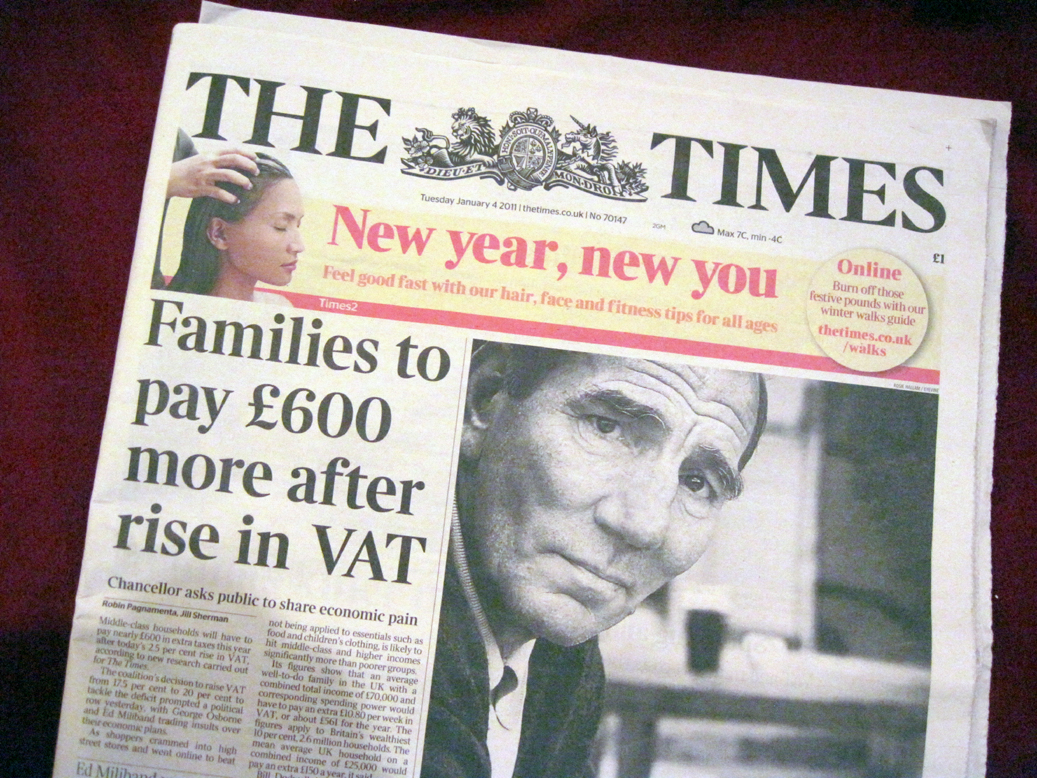
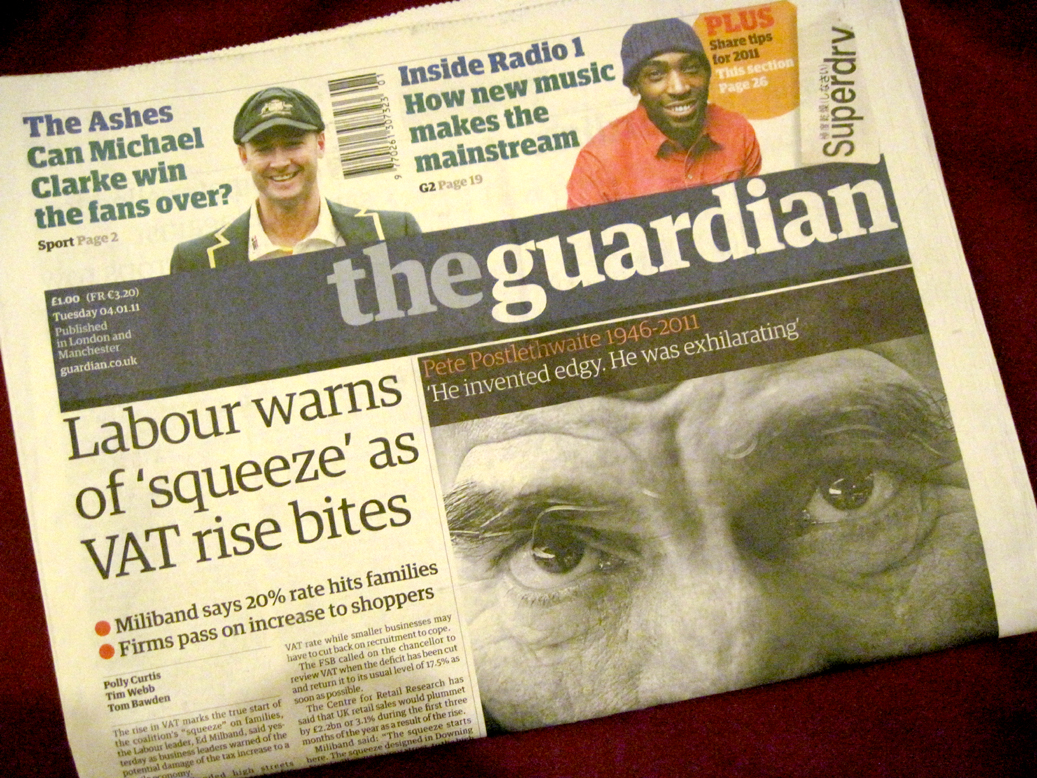
But both The Times and The Guardian are going on about this big, monstrous, huge increase. To which I say, who crosses the street to get a 2.5 percent discount on anything? I mean, really? This increase would amount to 25 p on 10 pounds. Or say you spend a thousand pounds on something — which is a lot more than a thousand dollars, mind — what’s the increase in tax? Twenty-five pounds. Like you’re going to worry about that if you can afford a thousand. (Oh, and by the way — that 600 pounds a family The Times predicts is on families that make 70,000 pounds or more. The burden is much less on median incomes.)
All that aside, the most amazing thing, the thing hardest to get used to, is that I’m in a country where the government has decided to deal with the deficit by — now get this — cutting spending and raising taxes. Of course, back home, the recent huge compromise between President Obama and the Republicans was to raise spending and lower taxes. That’s how we deal with deficits in the U.S. of A.
Riding through London on the magnificent Tube — which as far as I’m concerned is one of the marvels of the world, a testament to the ingenuity of Man — and asking directions from the helpful bobbies (“just 200 metres more on your roight, mate”), reading the extremely clear directions on where the buses that come every few minutes go, or going to the fantastic museums and paying nothing (except a few pounds voluntary contribution now and then), I personally feel that the tax I’m paying is one of the great bargains of all time.
And I’m wondering how well I’ll adjust when I get back home to a place where folks don’t want the gummint doing anything, ever, if it’s going to cost a penny more…
No, folks, I’m not a convert to socialism. I worry about the burdens of the welfare state, and I know that increasing taxes too much can have a nasty cooling effect on growth. But I have enjoyed some amenities here that seem more than worth the taxes I’ve paid here. All I’m saying.
The lt. gov. with his mother and sister at the dedication ceremony Dec. 21.
How did I miss this? Earlier this week, the humongous interchange where I-77 runs into I-26 was named the “Lt. Governor-Senator André Bauer Interchange.” Which is a mouthful. Not sure I’ve ever seen that construction — “Lt. Governor-Senator.” Kind of like “singer/songwriter,” I guess…
I suppose this was the best parting gift Jake and them could think up, but it really seems like it would have been more appropriate to give André, I don’t know, a plaque, or a toaster, or a pair of socks.
Anything but a public road, seeing as how he is so famous for tearing up such roads. We’re talking about the guy who:
When stopped speeding down Assembly Street, charged so aggressively at the cop that he felt threatened enough to draw his weapon.
When driving 101 mph on a wet highway, got on the police radio frequency to tell the patrolman pursuing him that “SC2” was “passing through,” and when he was stopped anyway, asked, “Did you not hear me on the radio?”
Lied to reporters about that incident, then said he “forgot” about it when confronted with the evidence.
Well, here’s the latest show. Go back to this post for supplementary materials, such as a release from Dr. Rex on his tenure.
It went well, I thought, but you’re the judge. All of us here at “The Brad Show” thank Dr. Rex for including us on his farewell tour of interviews, and we wish him the best in the future.
Next up (later this week): The Shop Tart. Don’t miss it.
Yesterday, after reading about the split between Lindsey Graham and Jim DeMint on the tax cut deal, I Tweeted this:
So I see Jim DeMint is siding with the most liberal Democrats on the tax cut deal. No surprise there: Extremes are extremes…
Today, I get this release from Jim Clyburn:
WASHINGTON, DC – House Majority Whip James E. Clyburn (D-SC) released the following statement on the vote before the House on Obama’s tax cut package.
“While I am pleased that the tax package approved by the House tonight extends important tax cuts to middle-income families and unemployment insurance for millions of Americans, adding $25 billion to the deficit to give a major tax benefit to the estates of the richest 6,600 families in America made it impossible for me to vote for the final package. This measure does not create a single job or stimulate the economy in any way.
‘I hope that as we move forward and our economy continues to recover, we will restore some fairness to the tax code and reduce the burden we are putting on future generations.”
As I said…
Lots of people go through life thinking of Republicans as “the other side” if they are Democrats, and vice versa. Me, I tend to think of the ideological True Believers as the “other side,” the folks with whom I tend to have a knee-jerk disagreement.
The fact that DeMint and Clyburn are both against this deal that President Obama made with (some) Republicans makes me predisposed, on a gut level, to like it.
Of course, that is in some ways irrational, akin to a partisan response. Only with me, I’m being reflexively, emotionally UnPartisan. There is much to dislike in this deal. Such as what? Well, take a look at the national debt. How am I supposed to feel great about a “compromise” that means MORE spending and LESS tax revenue (unless, of course, it has a stimulative effect on the economy and leads to MORE revenue, which I sincerely doubt at this point, since we’re mainly talking about simply continuing current practices)? Not that I’m against continuing unemployment benefits, or against continuing the tax cuts (and I truly could not care less that rich people also get the tax cuts — this obsession some people have with what other people “get” is most unseemly). It’s just the sum total effect that concerns me. (To paraphrase something Tom Friedman famously said about George W. Bush, Just because the Tea Party believes it doesn’t mean that it’s not true. The “it” here being the idea that ever-deeper deficit spending is something to worry about.)
But when you have the pragmatic Obama on one side of an issue, and DeMint and Clyburn locking arms on the other side, my gut pushes me to go with Obama. It’s just a little quirk I have.
Phillip Bush well, if you take the religious component out of it, I’d say the Democratic party comes closest in the US, and various Social Democratic parties in Europe.
8 hours ago · Like
Brad Warthen Why not the Christian Democrats? To me, religious faith is far more likely to lead to communitarianism than without it.
8 hours ago · Like
Phillip Bush Yes, you’re right, that’s closer still. Also paradox of US politics: GOP touts religious/cultural “values,” but central ethos to me is more anti-spiritual than US liberalism, which seeks to balance community and individual, and acknowledges values beyond just $.
8 hours ago · Like
Stanley Dubinsky Because communitarians, having community and (hence) lots of friends, are busy building their community and have no time for the pointless activities that are the hallmark of party politics. Libertarians, on the other hand, are very lonely (being out hiking on the Appalachian Trail or traveling alone to Brazil, and all that). They have few friends, and the few friends they do have are narcissistic to the point of being poor company. Desperate for something that has at least the appearance of social interaction, they form a political party. Through this, they can convince themselves that they have friends … or at least imaginary ones.
7 hours ago · Like
Doug Ross Libertarian: I’ll do it
Democrat: YOU should do it because it will make ME feel better
Republican: We won’t do anything unless there’s something in it for us
Communitarian: I hope someone else does it
There’s no Communitarian Party because there are no Communitarian principles. As soon as the community picks a side on one topic, they lose everyone on the other side. You can’t be a pro-choice Communitarian or an anti-war communitarian, can you?
9 minutes ago · Like
Brad Warthen No, you can’t be a “pro-choice” communitarian, since that’s one of the most libertarian positions you’re likely to find. I suppose you COULD be an anti-war communitarian, in that you could believe war is not healthy for communities and other living things. Of course, Tony Blair’s support for the Iraq invasion, and my own, arose from communitarian attitudes…
I missed the announcement of Nikki Haley’s new senior staff yesterday, but I went looking for it after a friend (NOT a professional political observer, but a communications pro) at lunch today mentioned how… lackluster the announcement was. My friend said it really looked like Nikki was saying, “Well, since I went and won the election, I guess we have to do these things…”
This struck me because it sounded so much like my impression of Nikki’s low-energy victory speech on election night. Like it’s all sort of a letdown to her, compared to the frisson of campaigning. I’m finding it a bit hard to reconcile campaigning Nikki and soon-to-be-governor Nikki, in terms of enthusiasm. But maybe I’m just being a sexist pig who expects women to be bubbly all the time, right? Yeah, that’s probably it.
Anyway, enough about style over substance. My concern is not whether Nikki is enjoying the job so far, but what happens after she takes office. Let’s take a quick look at the staff she announced (all of whom seemed about as excited as she did, by the way — not particularly enjoying each other’s company, like they’re afraid they might accidentally touch each other or something…. no, I wasn’t going to talk style anymore…). Let’s break it down this way: Here’s Nikki’s press release, and here’s some minimal commentary from me:
Tim Pearson, Chief of Staff. Well, Nikki really damned him with faint praise: “He not only comes from The Hill…” say WHAT!?!? That’s supposed to be a recommendation? “… but also has presidential campaign and gubernatorial experience and he’s getting ready to do great things for our state…” a state which, far as we know, he knows nothing about. Look, I’ve done no more than exchange an e-mail or two with Pearson, and shake hands when I ran into him with Nikki at a restaurant, and he seemed OK. But with such an inexperienced governor, the idea of a guy who’s not from here and has limited knowledge of our state, its politics or its government being her chief of staff is not reassuring. What she needs is what Mark Sanford had the wisdom to hire at the start of his administration — Fred Carter. Fred didn’t last long, but he was exactly what Sanford needed. And what Nikki needs, too. Worst way to paint this? The way an ex-colleague did in an e-mail today: Kevin Geddings. Yeah, the guy who who led the governor’s winning campaign, but had little else to recommend him. Here’s hoping Tim Pearson will be WAY better than that.
Katherine Haltiwanger, Deputy Chief of Staff (Operations). Can’t say I know her. Know some very nice people named Haltiwanger. Maybe she’s related.
Ted Pitts, Deputy Chief of Staff (Policy and Cabinet Affairs). Great choice! And I’m glad to know Ted’s back OK from Afghanistan. If you’ll recall, Ted is MY representative. I briefly thought about making a run at the seat on the UnParty ticket when I heard he wasn’t running again. But I let Rick Quinn have it instead.
Trey Walker, Deputy Chief of Staff (Legislative Affairs and Communications). Another good choice — in fact, I’ll go so far as to say that if merit guided the gov-elect, Trey would be the guy in the top job. But I guess that since Trey — who ran Attorney General Henry McMaster’s office — didn’t join her until after the primary, Pearson was just in line way in front of him. Aside from actually knowing South Carolina, Trey also has the kind of experience Nikki seems to value most — helping run a national presidential campaign (McCain’s).
Rob Godfrey, Press Secretary. Another veteran like Trey, although I have to say that Rob’s been a bit — testy — this past year, as evidenced by this and this. Maybe he’ll settle down. Or maybe we’ll have a Ron Ziegler situation on our hands. We’ll see.
Taylor Hall, Cabinet Liaison. Don’t know him. I’m impressed that “Hall also worked at the European Parliament in Brussels, Belgium, where he dealt with Transatlantic and European security issues,” although I’m not sure how it’s relevant. Maybe Nikki plans on raiding the EU for her Cabinet. Watch out, Brussels!
Rebecca Schimsa, Special Assistant to the Chief of Staff. I know a lot of very young people, but I don’t know Rebecca. (Or do I? If so, I apologize.) Oh, and note that a few years ago I was grumbling about Ted Pitts seeming too young, so consider the source.
Jamie Shuster, Director of Budget and Policy. Don’t really know her, but I know the South Carolina Policy Council. That reminds me. I was supposed to set up lunch with Ashley Landess. Y’all don’t let me forget that…
Katherine Veldran, Legislative Liaison. This is the one, I suppose, that that same ex-colleague mentioned above referred to thusly: “the chick who’s going to be working with the Legislature whose experience is working for a Hilton Head hotel. Huh?” I don’t know what that’s about, either. Perhaps she’ll lecture lawmakers on the inherent superiority of the private sector. We’ll see.
This sad news suddenly took me by surprise. I just got this from Bud Ferillo a few minutes ago:
FOR IMMEDIATE RELEASE
Former State Representative Harriet Hirschfeld Keyserling of Beaufort has died at the age of 88.
Harriet Keyserling grew up in New York City, graduated with honors from Barnard College, the women’s college ofColumbia University, majoring in Economics and Mathematics.
During World War II, she married Dr. Herbert Keyserling of Beaufort, SC and spent the next thirty years raising four children and engaging in community activities, primarily in the field of the arts and social services, in Beaufort.
She helped organize a Beaufort branch of the League of Women Voters, which led to her running for Beaufort County Council, to which she was elected in 1974, the first woman to serve there. Two years later she was elected to the SC House of Representatives from House District 124, serving for 16 years.
In the legislature she was involved in many issues, including public education, nuclear waste, energy and the environment, the arts and women’s issues. She waged a successful five year campaign to eliminate filibusters from the House of Representatives. Keyserling served on the House Education Committee, Ways and Means Committee, Rules Committee, and chaired the Joint Committee on Cultural Affairs, the Joint Committee on Energy and the Women’s Caucus.
On the national level she served on the National Conference of State Legislatures’ Executive Committee, its Task Force on the Arts, and co-chaired the Women Legislators Network. She also served on an advisory committee on nuclear waste to the U. S Congress Office of Technology, and on a panel of the National Endowment for the Arts .
After her retirement from public office in 1992, Keyserling served on the Southeast Compact for Low-level Nuclear Waste, South Carolina Humanities Council, Spoleto Festival USA, S. C. Nature Conservancy and Penn Center. She was recipient of the SC Arts Commission’s Elizabeth Verner O’Neill Award, Order of the Palmetto, Greenville News Legislator of the Year, and honored by the American Civil Liberties Union, the SC Nature Conservancy, SC libraries, SC Women’s Commission and others.
She wrote a memoir about her experiences in politics, “Against the Tide: One Woman’s Political Struggle,” published by the USC Press.
Keyserling is survived by her four children: Judy, Billy, Beth and Paul Keyserling.
A graveside service will be held on Monday, December 13 at 3:30 p.m. at Beth Israel Synagogue Cemetery in Beaufort. The family will receive friends at the Firehouse, at the corner of Craven and Scott Streets, following the service. Copeland Funeral Home is in charge.
Ms. Keyserling was a great lady who served her state with dedication and distinction. If you’ll recall, I was corresponding with her very recently, as she energetically recruited members for her “Women for Sheheen” movement. I had no idea she wasn’t in the best of health.
Phil Noble’s SC New Democrats are trying to figure out the future of their party (if it has one in SC), so they’ve sent out a survey to the faithful.
Somehow, I got a copy, too:
1,500 SC Democrats have had their say. Have you?
Friends,
Since we emailed you on Friday, over 1,500 people have completed our “What’s Next” survey. That’s 1,500 SC voters ready and eager to change the game and get Democrats back on the road to victory.
We’re certainly thrilled with the response, but we still really want to hear from you.
In less than a month, Nikki Haley will take the oath of office and become this state’s next governor, and for the first time in a long while, no Democrats will hold statewide office, which makes it all the more important that Democrats step up and project a clear vision for our state.
We’ll be taking a look at the results this weekend and will report back with the findings.
We can’t wait to hear from you,
South Carolina New Democrats
I went ahead and filled it out, knowing I’d probably skew the results. For instance, when it asked, “What do you think that Democrats in South Carolina do POORLY?” I answered, “Everything. Which is fine by me, because I don’t like parties. Actually, the Dems’ fecklessness sort of endears them to me. Nothing worse than a well-organized political party.”
And some questions, I just didn’t know how to answer. For instance, when the survey asks:
Which best describes your opinion of the Democratic Party in South Carolina?
… what am I supposed to say? I mean, I don’t WANT the party to do better. I want it, and the Republican Party, to go away. But I chose the second option as the closest to my opinion. I mean, if it really DID get “fundamental change,” it wouldn’t be what it is anymore, would it?
Anyway, y’all should help them out and take the survey. After all, some of you are actually Democrats…
My friends at The State were right today to praise the fact that President Obama is working with Republicans on a compromise on taxes and unemployment benefits. But they were equally right to be unenthusiastic about the deal itself.
On the one hand, it’s good that we’re not going to see our economy further crippled by untimely tax increases (even if all they are are restorations to pre-Bush levels). And it’s good that the jobless needing those benefits will have them. (At least, that these things will happen if this deal gets through Congress.) On the other, we’re looking at a deal that embodies some of the worst deficit-ballooning values of both parties: tax cuts for the Republicans, more spending for the Democrats.
It’s tragic, and bodes very ill for our country, that this flawed compromise stirs such anger on both partisan extremes: Some Democrats are beside themselves at this “betrayal” by the president. (Which bemuses me — as y’all know, I have trouble understanding how people get so EMOTIONAL about such a dull, gray topic as taxes, whether it’s the rantings of the Tea Partiers who don’t want to pay them, especially if the dough goes to the “undeserving poor,” or the ravings of the liberal class warriors who don’t want “the undeserving rich” to get any breaks. Why not save that passion for something that really matters?) Meanwhile, people on the right — such as Daniel Henninger in the WSJ today — chide Obama for not going far enough on taxes.
In this particular case, I think the folks on the right have a bit of a point (some of them — I have no patience for DeMint demanding the tax cuts and fighting the spending part), but it doesn’t have to do with taxes — it has to do with the president’s overall approach to leadership, and a flaw I see in it. Henninger complains that these tax cut extensions are unlikely to get businesses to go out and invest and create jobs, since the president threatens to eliminate the cuts a year or two down the line.
That actually makes sense (even if it does occur in a column redolent with offensive right-wing attitudes — he sneers at Ma Joad in “The Grapes of Wrath”), and I see in it echoes of the president’s flawed approach in another important arena — Afghanistan.
Here’s the thing: If keeping these tax cuts is the right thing to do to help our economy, then they should be kept in place indefinitely — or “permanently,” as the Republicans say. Of course, there is nothing permanent in government. The next Congress, or the one after that, can raise taxes through the roof if it chooses.
The problem, in other words, isn’t that the cuts won’t be permanent, because nothing is in politics. The problem is that the president is, on the front end, negating whatever beneficial effect might be gained from extending the cuts by coming out and promising that they won’t last.
One of the big reasons why the economy hasn’t improved faster than it has this year is that businesses, small and large, have not known what to expect from the recent election in terms of future tax policy with these tax cuts expiring. People were waiting to see what would happen on taxes before taking investment risks. (Even if the liberal Democrats were to eliminate the cuts, knowing that would be better than the uncertainty.) And even with the election over, the future has remained murky. The best thing about such a deal between the president and the GOP should be that it wipes away those clouds and provides clarity.
But the president negates that by saying yes, we’ll keep the cuts in place, but only for a short time. You may look forward now to a time when there are unspecified increases. And Henninger has a point when he says:
But if an angry, let-me-be-clear Barack Obama just looked into the cameras and said he’s coming to get you in two years, what rational economic choice would you make? Spend the profit or gains 2011 might produce on new workers, or bury any new income in the backyard until the 2012 presidential clouds clear?
Ditto with the Taliban and al Qaeda in Afghanistan and Pakistan. What good is it to say we’re going to stay and fight NOW if at the same time you give a future date when you’re going to leave (or, as the president has said, start leaving)? What are they going to do? They’re going to sit tight and wait for you to leave on schedule. (And yes, pragmatic people may take comfort from the fact that the president has allowed himself lots of wiggle-room to stay there — but the harm has been done by the announcement of the intention to leave). Every effort should be taken to make one’s adversaries believe you’re willing to fight them forever (even if you aren’t), if you ever hope to achieve anything by fighting.
The problem in both cases is trying to have one’s cake and eat it, too — making a deal with the Republicans without one’s base getting too mad at you, or maintain our security commitment without (here comes that base thing again) freaking out the anti-war faction too much. What this ignores is that out in the REAL world, as opposed to the one where the parties play partisan tit-for-tat games, real people react in ways that matter to your policy moves: Business people continue to sit rather than creating jobs; the Taliban waits you out while your allies move away from you because they know they have to live there when you’re gone.
What would be great would be if Barack Obama should commit for the duration to something. He should have committed to a single-payer approach to health care from the beginning. Going in with a compromise meant that we got this mish-mash that health care “reform” turned into. He should commit to a plan on the economy, and not undermine it by saying he’s only going to do it for a little while. And most of all, he should commit to Afghanistan, and not try to mollify his base with dangerous deadlines.
What the president does, and even says, matters. He needs to recognize that, pick a direction, and stick with it long enough to have a salutary effect. Whatever their ideology, that’s what leaders do. And we could use some leadership.
CRBR Publisher Bob Bouyea, Chamber President Otis Rawl, Rep. James Smith, Sen. Joel Lourie, Rep. Nathan Ballentine. In the foreground is former Rep. Elsie Rast Stuart, now chairwoman of the the Richland-Lexington Airport Commission. / grainy phone photo by Brad Warthen
I meant to post about this yesterday, when it happened, but better late than never.
We were there to hear a discussion by a panel featuring Otis Rawl from the state Chamber, Rep. James Smith, Sen. Joel Lourie, Rep. Nathan Ballentine and Rep. Chip Huggins. Joel was a few minutes late, and Chip had to leave just as Joel arrived, but it was still a good discussion.
Here’s Mike’s description of the event, in part (I’d quote the whole thing, but I don’t know how Mike’s cohorts feel about that Fair Use thing):
Lawmakers speaking at the Business Report’s Power Breakfast this morning said they see major difficulties ahead in the new budget year, but they also said there are new opportunities for bipartisanship.
The event, hosted at the Embassy Suites, featured Reps. Nathan Ballentine, R-Chapin, Chip Huggins, R-Columbia, and James Smith, D-Columbia; Sen. Joel Laurie, D-Columbia; and Otis Rawl, president and CEO of the S.C. Chamber of Commerce.
With a new Legislature and new governor coming to Columbia in January, much of the discussion focused on the budget crisis that will greet them.
Ballentine, a member of Gov.-elect Nikki Haley’s fiscal crisis task force, drew a stark picture of the challenges facing lawmakers. Ballentine compared the situation to a lifeboat with a limited number of seats. There won’t be enough dollars to take care of students, the elderly, the disabled and law enforcement, Ballentine said.
“Somebody’s going to get left out, and that’s going to hurt,” he said…
To Mike’s focused report I will add the following random observations:
I don’t know if this would have been the case if Chip Huggins had stayed, but the general consensus, or at least lack of overt conflict, between James, Joel and Nathan on issue after issue was quite noticeable. Nathan alluded to it, saying he was sure that the business people in the room were probably wondering why a pair of Democrats and a close ally of Nikki Haley were agreeing about issue after issue. (And some of the agreements were remarkable, going beyond mere civility, such as when Nathan volunteered his acknowledgement of the problems with Act 388.) Nathan further speculated that the audience might reasonably wonder why, in light of what they were hearing, the General Assembly had so much trouble getting anything done. He explained that the reason was that there were these 167 other people in the Legislature… And he was completely right. If we filled the Assembly with Jameses, Joels and Nathans, South Carolina would see a Golden Age of enlightened governance. These are reasonable young men who, despite their disagreements on some points are reasonable, deal with others in good faith, and truly want what’s best for South Carolina, and want it more than their own advancement or the good or their respective parties. If only their attitude were catching.
I’ll add to that point the observation that if all discourse about issues were on the intellectual level of this one, we’d see a very different, and much better, South Carolina. The conversation was wonderfully devoid of partisan, ideological, bumper-sticker cliches. For instance, I never heard anyone mention “growing government” or “taking back our state.” Observations were relevant, practical, and free of cant. I used to hear discussions like that regularly when I sat on the editorial board, because intelligent politicians did us the courtesy of leaving the meaningless catch-phrases behind. It was good to hear that kind of talk again. (It occurs to me that the fact that over the years I’ve been privileged to hear politicians at their best, trying to sound as smart as possible, may help to explain why I don’t have as jaded a view of officeholders as Doug and others do.) I’d be inclined to say that the discussion was on this level because the lawmakers were paying this assembly the same compliment of respect — but these particular lawmakers pay everyone that sort of respect. Which is why we need more like them.
Otis Rawl, incidentally, was slightly more confrontational — something you don’t usually see in a Chamber leader. He exuded the air at times of being impatient with the air of civil agreement in the room. When Nathan said that he had not realized when he voted for it the harm that Act 388 would cause — Otie challenged him directly, saying he knew good and well that his group had informed lawmakers ahead of time, and there was no excuse for anyone to claim innocence (I think he’s right in the aggregate — the body as a whole knew better, but ignored what they knew it order to scratch a political itch — but if Nathan says he didn’t understand, I believe him; he was a relatively inexperienced lawmaker at the time; and I appreciate greatly that he’s learned from experience). Awhile back, I chided Otie for not being more frank about what he thought on an issue. The Otis Rawl I saw Thursday morning could not be chided for the same thing. I suspect this reflects a growing dissatisfaction with Sanford-era fecklessness in the State House, which helped lead to the Chamber’s endorsement of Vincent over Nikki.
Speaking of Vincent, Nikki, Otie, James, Nathan and Joel … It struck me as interesting, just because language and civility interest me, that everyone speaking of Nikki Haley referred to her carefully as “Governor-Elect Haley.” It was notable partly because it was stilted coming from people who know her quite well as “Nikki,” but also because (and this might have been my imagination) there was a slight change of tone when the speakers said it, a shift to a formality mode. It seemed natural enough that the Democrats present would use that highly formal construction — it’s important to them (particularly since the two Democrats in question are Vincent Sheheen’s two best friends in the General Assembly) to sound scrupulously neutral and respectful in this post-election period. It’s a way of papering over their feelings about her election, and perfectly proper. It was also perfectly appropriate for Nathan to refer to her that way; it just sounded odder coming from him. They were seatmates, and allies in her fights with the leadership. But being a gentleman, he wasn’t going to top it the nob in a public setting by assuming excessive familiarity. Bottom line, just over a month ago ALL of them would have called her “Nikki.” But now they are the very pictures of proper Southern gentleman. Which I like. But then I’d like to see a return of the sort of manners I read about in Patrick O’Brian and Jane Austen. We just don’t see that very often nowadays.
As civil and intelligent as this discussion was (in fact, probably because it was so intelligent), it offered little hope for the General Assembly effectively dealing with any of the important issues facing our state in the foreseeable future. Everyone spoke with (cautious, on the part of the Democrats) optimism about Nikki — excuse me, Gov.-elect Haley — being able to work better with the Legislature than Mark Sanford has (a pitifully low bar). But I heard little hope offered that this, or anything else, would likely lead to the reforms that are needed. The institutional and ideological resistance to, say, comprehensive tax reform is just too powerful. The most hope Joel Lourie would offer is that steady pressure over a long period of time might yield some small progress. He cited as an example his and James’ long (eight-year) battle to get a sadly inadequate cigarette tax increase. The terrible truth, though, is that the cigarette tax was such a no-brainer — it shouldn’t have taken two days, much less eight years — that if IT took that long, much less simple and obvious reform seems unlikely in our lifetimes. But perhaps I’m not being as optimistic as I should be. It’s just that I’ve been fighting these battles, and hearing these same issues discussed, for so very long…
Earlier this week, Tom Friedman had a column in which he “couldn’t help but wonder: What if China had a WikiLeaker…?”
It was a good column as far as it went, because it highlighted the way self-destructive American partisan gridlock prevents us as a nation from facing the future wisely and pragmatically — unlike the Chinese. So it was that he imagined a leaked Chinese diplomatic message that said in part:
Things are going well here for China. America remains a deeply politically polarized country, which is certainly helpful for our goal of overtaking the U.S. as the world’s most powerful economy and nation. But we’re particularly optimistic because the Americans are polarized over all the wrong things.
There is a willful self-destructiveness in the air here as if America has all the time and money in the world for petty politics. They fight over things like — we are not making this up — how and where an airport security officer can touch them….
Americans just had what they call an “election.” Best we could tell it involved one congressman trying to raise more money than the other (all from businesses they are supposed to be regulating) so he could tell bigger lies on TV more often about the other guy before the other guy could do it to him. This leaves us relieved. It means America will do nothing serious to fix its structural problems: a ballooning deficit, declining educational performance, crumbling infrastructure and diminished immigration of new talent.
The ambassador recently took what the Americans call a fast train — the Acela — from Washington to New York City. Our bullet train from Beijing to Tianjin would have made the trip in 90 minutes. His took three hours — and it was on time! Along the way the ambassador used his cellphone to call his embassy office, and in one hour he experienced 12 dropped calls — again, we are not making this up. We have a joke in the embassy: “When someone calls you from China today it sounds like they are next door. And when someone calls you from next door in America, it sounds like they are calling from China!” Those of us who worked in China’s embassy in Zambia often note that Africa’s cellphone service was better than America’s.
But the Americans are oblivious. They travel abroad so rarely that they don’t see how far they are falling behind. Which is why we at the embassy find it funny that Americans are now fighting over how “exceptional” they are. Once again, we are not making this up…
Very good points — the kinds of smart points that you expect Tom Friedman to make, which is why he’s one of my favorite columnists. But I was still disappointed on a gut level, because I had expected the column to answer the rhetorical question with an even blunter, simpler, more obvious truth.
China’s security solution is to suppress the flow of information, let creativity be damned, and steal from us. (The New York Times’s Thomas Friedman yesterday asked: “What if China had a WikiLeaker?” The three-word answer: They’d execute him.)
Henninger is not usually one of my faves, but this was a pretty decent column about how tough it is, bordering on futility, to prevent such leaks in the Internet age.
And my disappointment aside, Mr. Friedman’s column was excellent as well, because it, too, said things that need to be said over and over.
But it occurred to me that, whether you’re concerned that our nation isn’t pursuing the right priorities for our future competitiveness, or just outraged that the U.S. government hasn’t taken serious action to find, apprehend and lock up that sleazebag Julian Assange for the rest of his life and then some, the roots of the problem are the same.
I’ll put it this simply: The lack of national consensus. Or another way, a perverse refusal to acknowledge that we’re all in this together, and act accordingly.
I try to imagine someone like Julian Assange wandering free anywhere in the world controlled by allies of this country back, say, in the 1940s. And I can’t. There would have been such a powerful sense of a shared national interest, and instantaneous consensus that someone leaking classified military data and confidential diplomatic communications was the enemy of this country that effective action would have been taken to stop him.
Today, a creep like Assange exploits the HUGE division in our country over our role in the world. (We can’t even decide whether we’re fighting one or two wars.) Now before my antiwar friends loudly protest that I’m blaming them for not getting with the program, note that I am NOT. I’m not blaming either doves or hawks. It’s the GAP between us itself that I blame. That’s the No Man’s Land in which Assange walks with impunity. Only after diplomatic communications were compromised this week did we achieve anything like a consensus of outrage between left and right, and thus far even that is too tepid to lead to effective action. (Oh, and by the way, I’m not suggesting we be as ruthless as the Chinese. But somewhere between the harshness of that system and the utterly helpless fecklessness of ours today lies a rational medium, an effective course of action for liberal democracies that hope to survive.)
As for Mr. Friedman’s concerns… go back to that same time — the war years, and just after — and look at the way we formed consensus to do profoundly bold and intelligent things to provide for a better future for our own country and the rest of the world that we suddenly dominated: the GI Bill, the Marshall Plan, the interstate highway system, the policies that boosted homeownership, and on and on.
Today, we find it impossible to come up with a coherent, rational energy policy or keep our infrastructure up to date or deal with the deficit or accomplish anything else requiring bold action because ANY bold action envisioned by the right or the left will be fought, vilified, trashed and frustrated to the utmost of the opposition’s ability (and they’ll do so not because of any merit or lack of merit in the idea, but because the other side came up with it). And again, I’m not blaming either the right or the left, but the GAP, and the insane tit-for-tat game that BOTH sides think is more important than the real needs of the nation.
So whatever you think about the implications of a hypothetical Chinese WikiLeaker, the problem is the same.
It’s a problem that has so integrated itself into our public life that it’s hard even to think of a way out. It’s like a tumor with tentacles slithering to wrap themselves around every fold of the victim’s brain — very tough to remove. I don’t really know how to get to where we need to be. Except, of course, to vote UnParty (if ever given the chance).
Glenn McConnell and other who say stuff like this completely mystify me:
“Today, I again introduced a joint resolution that would limit the growth of government. My desire was to give the people of South Carolina the opportunity to decide at the ballot box if government should grow faster than their wallets. I have introduced this bill every session since 2007, and hope that it will pass this year. The need for this legislation has been made clear by the current crisis we are in. I believe that we should have manageable growth that allows for providing core services of government. We do not need a feast or famine approach to budgeting for our core government functions. I also believe that what the government does not need should be returned to those who paid the bill in the first place. Sadly, I have seen that government, when faced with a buffet of tax dollars, could not control its appetite. Therefore, I felt compelled to introduce a legislative way to staple its stomach.”
That’s from an e-mail release I got today from Senate Republicans. Set aside the overuse of weary cliches. My point is this: Where, oh where in the state of South Carolina is Glenn McConnell seeing government “grow,” or indeed do anything other than retrench, shrivel, stumble and limp along? Where is the “problem” that his is allegedly addressing? I see it nowhere in this state, and haven’t in the 23 years I’ve been closely watching.
If this were anyone but McConnell, I would say it was just mindless GOP rhetoric. Since the Republicans have decided to nationalize all politics, since we’ve seen expansions of such programs as Medicare and Homeland Security under Bush, and other medical programs and the stimulus under Obama, a state senator of GOP persuasion might spout such nonsense reflexively.
But we know that McConnell is particularly a South Carolina creature, and he knows this state inside and out. He thinks SC thoughts, in SC symbols. There’s nothing generic about him.
So in his case, it really makes no rational sense at all.
Of course, he’s not alone. I hear Tom Davis has done the same. I like Tom, and he’s certainly right about some things, but he definitely loses me when he puts forward such Sanfordesque legislation as trying to create a formula limiting future spending to an arbitrary formula:
Tomorrow, I will pre-file a bill that caps general fund appropriations to a “population growth plus inflation” increase over the amount spent the prior year, with revenues above this cap returned to taxpayers, pro-rata in accordance with their payments. Time to draw the line.
The problems with such proposals should be obvious. To name four of my favorites:
There is no solid reason to believe (except that it sounds like it might apply) that such a formula will bear any accurate relationship to the future requirements of government. There’s no way you can know that a formula based on population growth and inflation will be more relevant than one based on a function of the ERAs of left-handed pitchers in the American League.
The Framers who handed down our system of republican government (of which our SC system is a sort of Bizarro World parody, but hey, it’s what we’ve got) intentionally placed such decisions as taxing and spending in the hands of regularly elected representatives who are delegated to decide how best to address the needs of the moment. They most assuredly did NOT set up a system that would make future Congresses’ (or in our system, Legislatures’) decisions for them, much less try to substitute present or future representatives’ deliberation with a mathematical formula. It’s hard to imagine any decision that lawmakers make that is more central to their responsibility as stewards, or more sensitive to the particular factors of the given year, than the annual budget.
No one who believes in any sort of democracy, representative or otherwise, should support anything like this. Basically, a proposal like this arises from a desire to use a momentary political advantage to bind all future elected representatives to follow the proposer’s philosophy. The idea is, get a momentary majority, and then you don’t have to win elections in the future — even if your philosophy is completely rejected in future elections, you have prevented those elections from having consequences. And that is unconscionable if one believes at all in the American way of democratic republicanism.
Finally, we return to the objection I raised initially above: This is South Carolina, gentlemen. At no time has there been any indication that there is a problem for which this proposal might be even an imperfect solution. “Time to draw the line?” Really? On what, Tom, on what?
After Senate Minority Leader Mitch McConnell, R-Ky., oh-so-reluctantly gave in to Tea Party demands to swear off on the earmarks he so dearly loves, the Senate Democrats came to his rescue today:
Senate shuns push for elimination of pet projects
By ANDREW TAYLOR
The Associated Press
Tuesday, November 30, 2010; 11:41 AM
WASHINGTON — The Senate Tuesday rejected a GOP bid to ban the practice of larding spending bills with earmarks – those pet projects that lawmakers love to send home to their states.
Most Democrats and a handful of Republicans combined to defeat the effort, which would have effectively forbidden the Senate from considering legislation containing earmarks like road and bridge projects, community development funding, grants to local police departments and special-interest tax breaks.
The 39-56 tally, however, was a better showing for earmark opponents, who lost a 29-68 vote earlier this year. Any votes next year should be closer because a band of anti-earmark Republicans is joining the Senate…
He owes them one. But will he repay? Is there honor among earmarkers?
The Arizona Republican, responding to a question from CNN’s Candy Crowley about Palin being “divisive,” noted thatRonald Reagan was often seen as divisive as well.
It wasn’t a direct comparison to Reagan (McCain never said Palin is similar to Reagan), but it was a comparison nonetheless. And the reaction was swift, as it often is when it comes to Palin.
So the big question follows: Is it a valid comparison? The answer: In many ways, yes.
The fact is that Reagan has benefited tremendously from the years since his presidency, and people look back on him in a much favorable light than they did during his presidency.
According to Gallup polling data, Reagan’s average approval rating during his presidency was 53 percent — lower than John F. Kennedy,Lyndon Johnson, Dwight Eisenhower and George H.W. Bush andBill Clinton.
As for the operative word here — “divisiveness” — Reagan had a claim to it. Many more Republicans approved of him than Democrats, and even at his peak, just 68 percent of Americans approved of him, a number lower than everyone but Richard Nixon over the last 65 years.
The reason Reagan couldn’t get higher than that was because there was a segment of the population, about one-third, that was dead-set against him. Reagan is often listed in polls of people’s favorite presidents, but because of that one-third, he’s also among the leaders for people’s least favorite presidents. His detractors often feel just as strongly as his supporters about Reagan’s legacy.
Recent polling shows Palin is on par with all of that…
Hey, it works for me. I, for the record, was among that one-third. And probably one of the more adamant members of that segment. My attitude has softened somewhat over the years, but that may be due to the 1984-style revisionism to which I’ve been subjected in media for more than two decades. You know, Ronald Reagan was a great president; he was always a great president — and we have always been at war with Eastasia. (Or would a better analogy be the sleep-teaching in Brave New World? Discuss.)
To the extent that I can clearly recall the past, I remember seeing Reagan — when he emerged on the national scene in 1976, then again in 1980 — as a destructive, negative, insurgent, dumbing-down force in the GOP. So yeah, a comparison to Sarah Palin is valid on those grounds.
Of course, after all these years of hearing what a great job he did, it seems a disservice to him to compare him to Mrs. Palin. One thing’s for sure, though — as a thoroughly professional actor, Reagan played the role of president with far greater dignity than I can imagine the ex-governor of Alaska managing to project.
Catching up on stuff that grabbed my attention the last few days. For instance, there was this item about a Pew poll:
Poll: Less than half know GOP won the House
(CNN) – The Republican Party won decisive control of the House in this year’s midterm elections, but it appears less than half the country is aware of it.
According to a new Pew poll, only 46 percent of those surveyed correctly identified that the Republican Party won the House as a result of the November 2 elections. But it’s not all bad – 75 percent did know the Republicans performed better than the Democrats, it’s just that many aren’t aware exactly what the party won.
Fourteen percent thought the GOP won control of both the chambers, 8 percent thought Republicans won just the Senate, and 27 percent didn’t know one way or the other. Five percent meanwhile thought Democrats maintained control of both the House and Senate….
I raise this NOT to make the average guy sound like an idiot. I raise it to say that the average guy probably doesn’t care. And he’s right.
No matter how much the oversimplified media — which do their best to reduce everything in politics to a binary choice, like sports (if one team is up, the other team is down), and to naitonalize EVERYTHING — voters still, to some extent, vote for individuals, not parties.
At least I do, and it’s all about what I think, right?
But seriously — if you’re trying to choose between Candidate A and Candidate B, then that’s the choice you’re making. How many people outside the Beltway do you think actually think, “Golly, will Jim Clyburn still be able to be called Majority Whip if I chose this guy?” And if they do, well, they should lose their franchise…
Maybe this doesn’t mean a thing, but it struck me…
Remember when I told you yesterday about Bobby Harrell’s overwhelming re-election as Speaker? I mean, we had expected Nancy Pelosi’s coronation as Minority Leader, but Bobby’s win was much more convincing than hers. (Harrell won 112-5 over a challenger who had been much touted as representing Tea Party dissatisfaction with the speaker. Pelosi won 150-43 over a moderate who was never given much of a chance in the increasingly liberal Democratic caucus.)
Today, at 4:42 p.m. — more than 27 hours later — I got this from Karen Floyd:
Dear Subscriber
Yesterday, State House Representative Bobby Harrell retained his leadership position as House Speaker with an overwhelming majority.
Speaker Harrell is a true conservative leader who will continue to honorably represent the ideals and values of South Carolinians. We are excited to have someone at the state house that will take the helm and guide us towards a brighter future.
For the next legislative session, you can be sure that more conservative reforms will be making their way through the legislature. Speaker Harrell will promote lower taxes and business incentives in the coming months, as well as strive to streamline state government to make it more efficient and effective.
After the enormous outcry from the people this past election season, it is imperative that we move toward smaller government and tighter spending controls. We are blessed to have a House Speaker who takes these matters seriously and will ensure that your trust was not misplaced.
Sincerely,
Karen Floyd
SCGOP Chairman
Why did that boilerplate, lukewarm-to-middling congrats take so long? Maybe it was just that there aren’t as many people on deck attending to business over at party HQ now that the election is over.
But in that wording — which flatly offers assurances that Bobby WILL obediently do what you “conservatives” out there want him to do, fear not — and in that timing, I sense a hesitation, a decision-making process: Should we congratulate him? If so, do we need to talk to him first and get certain assurances?
Maybe not. Maybe, since I’m on the outside looking in, I’m just reading too much between the lines. But I’m reminded of the way I felt on election night, during that eerie waiting period while we wondered when Nikki Haley would come out and give a victory speech. What, indeed, was going on backstage? (And when she appeared virtually alone, I wondered whether there had been some sort of debate in the wings as to whether anyone besides Henry would appear with her.)
But that had been a long day, and my imagination was overly active. Same thing today. Long day. Although not as long as the day that passed before this congratulations went out…