Category Archives: Personal

The ‘Draft Brad’ movement suffers a setback

Doug Ross brought to my attention the "fact," documented in this "TV news" clip , that there’s a growing movement out there to draft Yours Truly as an alternative to McBama. Watch it; you’ll get a laugh out of it. (I tried to imbed the video, but couldn’t find the code.)

But as pleasing as that was to my ego, imagine my shock and horror when I learned that an almost identical movement has arisen to back my good friend and fellow Energy Party idea man Samuel Tenenbaum! No wonder Samuel keeps bugging me to read that book he gave me! He wants me too busy to notice that he’s trying to steal away my delegates!

Would Obama victory be ‘bad for black folks’?

Obamawhitehouse

My attention was just drawn to this item by Lawrence Bobo on TheRoot.com, headlined, "President Obama: Monumental Success or Secret Setback?" An excerpt:

To hear some barbershop talk, it is as if the racial progress in
America that Obama’s success has helped to crystallize also brings with
it a death knell for true racial justice. If Obama becomes the
president, every remaining, powerfully felt black grievance and every
still deeply etched injustice will be cast out of the realm of polite
discourse. White folks will just stop listening.

A
black president means that America no longer has any race problem to
talk about! It would mean there is no longer any special debt to
African Americans to be repaid! Kiss that 40 acres and a mule goodbye,
my friends (or that BMer and a Rolex in modern reparations exchange
units)….

I have two thoughts about this piece, if it’s OK for a white guy to weigh in on this:

  1. Talk about what the election of Barack Obama as a black man means misses the point, since — as a lot of black folks asserted last year leading up to the primaries — Obama simply is not a "black man" in the sense that the phrase has meaning in American history, sociology and politics. I’ve got a column I’m planning on writing about that, after I read his autobiography on the subject. It will be headlined "Barack Like Me," and it will be rooted in the experiences he and I share spending part of our formative years in Hawaii (where race simply did not mean what it means here) and outside the United States — both in the Third World, in fact. None of these experiences are common to the sort of guy we describe when we say "black American." I hope to write that one before the summer is over.
  2. Because the popular narrative of this is that Obama IS a black man (despite all the evidence I see to the contrary), that’s the way an Obama victory will play in the public imagination. And that WILL be a death knell to the kind of black politics of resentment and grievance practiced by Jesse Jackson and (even more so by) Al Sharpton, Jeremiah Wright and to some extent by black politicos here in SC (such as Leon Howard, who said the former superintendent of Richland 1 had to go because "He catered to white folks").

Mr. Bobo agrees with me on the latter point, by the way:

"The politics of the perpetual outsiders demanding inclusion will finally end (read: Al Sharpton and Jesse Jackson will get less face time). And good riddance (perhaps). We’ve come too far over too many years for shrill protest to still be our main political posture today, no matter how necessary and relevant in the past…."

Wrightetal

Will YOU get to retire? Well, good for you…

Will YOU ever get to retire? And no, you state employees who get to kick back, or start new careers, after a mere 28 years on the job, this post is NOT aimed at you. I’m talking regular folks here.

I’m 54 years old. I’ve been on the job, at this and other newspapers, since 1974. I’ve got a pension (for NOW; let’s see where that is when I’m 67, or 70, which I hear is the new 65) and Social Security (same deal; we’ll see about that when the time comes) and I put as much as I can into my 401k every paycheck. In fact, my wife, who as I’ve mentioned before handles the money at our house, says we can’t really afford to be putting THAT much into the 401k, hence our pecuniary strangulation of recent years. And of course, at the rate that the people in charge of high finance have been screwing up lately, we’ll be lucky if any of those mutual funds or whatever they put my 401k into has any value at all going forward.

So I’m sort of wondering if there are going to be enough Wal-Mart greeter jobs available for all of us in the future.

Anyway, such thoughts are prompted by this release from an advocacy group, which says in part:

Many Americans envision their retirement years to be leisurely and relaxing -– well deserved from all the hard years of work they put in to save for it. Whether it’s spending more time with their families or traveling the world, most people don’t think about the financial sacrifices they will have to make along the way. Yet a new study conducted by Ernst & Young for Americans for Secure Retirement, The Retirement Vulnerability of New Retirees, shows that middle-class Americans are anything but secure when it comes to having enough savings to last throughout their golden years…

The purpose of the press release is to scare us (and it works there) and to try to get us to lobby Congress to make some kind of change in law to allow us to get guaranteed lifetime paychecks from something called "lifetime annuities." I didn’t read very far into it, sort of assuming that it’s like everything else — it would be great for people who have money to put into it.

Well, hey — if I had money in the first place, I wouldn’t worry about the future. Duh.
 

The vanity of John Adams

Adamsjohn

As I’ve mentioned before, my favorite Founder was John Adams. This attachment on my part dates from my college days in the early 70s, when I more or less inadvertently earned a second major in history (I had not planned it thus; I suddenly realized, with one semester to go, that I was within six credit hours of such a major, so I took two more courses. Up until then, I had merely taken as many history courses as I could as electives.)

The last week or two, I’ve been watching — gradually — the HBO series based on the Pulitzer-winning McCullough book. I was reminded by the book, and am reminded again by the excellent series, that one of the things that endeared Mr. Adams to me was his all-too-human frailty. It brings him down to a level where I am able to identify with him. The airy aloofness of Jefferson is not my way; nor is the lofty unattainability of Washington, with his natural leadership ability.

But almost every time I read of, or see portrayed so well by Paul Giamatti, the crabby vanity of Adams, I have to laugh, because I see myself. Tonight, my wife and eldest daughter joined me in recognizing his touchiness as he complained mightily of having come in second to Washington in the first presidential election.

Adams was of course right to feel that he had done much — perhaps more than any man — to earn the affection and electoral support of his countrymen. After all, HE had put Washington’s name forward to become commander of the Continental Army so that he could rise to greatness, and HE was the one who insisted that Jefferson write the Declaration, after HE, Adams, had nagged and argued and fought independence into being adopted by Congress. And then there was the matter of being the first ambassador to the Court of St. James’s, etc….

But even the lamest modern political consultant could have explained how much more attractive as a candidate Washington was. And Adams’ protests that he should have done better in the election, when you see them portrayed by the brilliant Mr. Giamatti, are comically unbecoming. He was SO vain, so quick to be affronted. And when I noted I would have been the same, my wife and daughter nodded. (You know, they COULD have argued with me just a little, but they didn’t.)

As explained in the series (by way of Abigail reading a letter aloud), Washington got 69 electoral votes, and Mr. Adams only 34, which wounded him deeply. But the guy who came in third (John Jay, no slouch himself) received only nine. Adams received as many as all the rest put together (a field of 8 or 10), and yet he is so put out at getting fewer than half as many as Washington that he pouts to Abigail, "I consider such a showing a stain upon my character!"

This is why I could never offer for public office — I’d be just as petulant, were I to lose, which I probably would, being the way I am.

Far better to suffer such mortification vicariously, through studying (and seeing portrayals of) the life of Adams — and joining Laura Linney’s Abigail in being affectionately amused at his humanity. Far less painful than living it.

Of course, Abigail gets him over his tantrum by calling him "Mr. Vice President," thereby puffing him up a bit. The office had not yet been compared unfavorably to "A warm bucket of spit."

And yes, I realize that seeing myself in John Adams, a great man, is also very vain. See what I mean?

So you think numbers can’t dance?

Here’s another digression from my Sunday column that got left on the cutting room floor:

    But things like this always perplex me. I am not an economist, you see, nor a financial expert, which I’m told is something different. Nor am I any kind of a businessman. Put it this way: At my house, I am not allowed to try to balance the checkbook.
    It’s not that I’m stupid, or can’t do math. I took calculus in school, and, for a guy who can’t handle a checkbook, got a ridiculously high score on the math part of my SAT. But something happens to numbers when they appear on a checkbook, or on a spreadsheet, or on anything where the numbers are meant to represent units of money. It’s like the fictional form of mathematics, found only in restaurants, that humorist Douglas Adams called “Bistromath.” One of his characters explained it this way: “On a waiter’s bill pad… numbers dance. Reality and unreality collide on such a fundamental level that each becomes the other and anything is possible.”
    Checkbooks are like that….

I wasn’t just trying to be silly there. The numbers really do dance. Probably my biggest problem with keeping a checkbook is that I am determined to keep it to the penny, or not at all. Since I seldom actually write a check, but use my debit card, keeping the account up to date involves frequently logging the receipts that I keep in my wallet.

Of course, the actual account is never, ever up to date with what I have in my wallet, so I can almost never make a direct, one-to-one comparison between debits and credits as I know them and as the bank currently recognizes them — there’s never a moment when I can look and say, "Yep, that’s the total I have, too."

If you want to see the numbers really dance, of course, try letting your account get close to zero — which mine does at some point during every pay period. Note how lackadaisical your bank is about recording your debits most of the time, but how it will all of a sudden pounce with what looks like a year’s worth when it senses that you are within range of an overdraft. Financial institutions actually have this down to a science, although it looks more like an art to me.

And once you have an overdraft, then try getting it straight what’s actually in your account, what with trying to figure out when the overdraft fee is debited, whether you’ve actually paid the overdraft back, etc. At that point, I get dizzy.

Which is why my wife handles the accounts.

Oh, and on the SAT thing: I did better than Al Gore, but not nearly as well as Bill Gates. I’m not giving you the links (because my wife thinks telling people your SAT scores is really, really uncool); you do the "math."

My point is — at least, I think my point is — that the ability to handle money involves something other than pure mathematical ability. It involves being in touch, somehow, with the whole mystique of money. I suspect that it’s like Zen; I need to relax or something. Or maybe it’s the opposite — maybe keeping accounts requires a whole lot more effort than I’m willing to put into them.

I expect accounts to be really simple — far less simple than calculus — and to easily be computed. After all, it’s just adding and subtracting, right? Well, apparently not.

Do YOU feel sufficiently stimulated? ’Cause I don’t…

By BRAD WARTHEN
Editorial Page Editor
WHAT DID you do with your “economic stimulus” check from the government? Did you spend it in a suitably patriotic manner, doing your bit to kick-start the good ol’ U.S. economy?
    You did? Are you sure? I just ask because, as a member of the U.S. economy, I’m feeling a little understimulated.
    But then, I always had doubts about the whole scheme.
    Sort of like with the government’s bailout of Bear Stearns. I’m not a libertarian, not by a long shot, but sometimes I break out with little itchy spots of libertarianism, and one of those itchy spots causes me to ask, Why am I, as a taxpaying member of the U.S. economy, bailing out something called Bear Stearns? I didn’t even know what it was. Even after I’d read about it in The Wall Street Journal, I still could not answer the fundamental question, “If you work at Bear Stearns, what is it that you do all day?” I understand what a fireman does, and if the fire department were about to go under, I’d be one of the first to step forward and say let’s bail it out. Of course, if the fire department wanted me to lend it $29 billion, with a “B,” I might have further questions. Yet that’s what we’ve done for Bear Stearns.
    Apparently Bear Stearns is a financial institution that the federal government considers “too big to fail,” which makes me wonder, if it’s too big to fail, then why does it need to be bailed out?
    But things like this always perplex me. I am not an economist, nor a financial expert, which I’m told is different. Nor am I any kind of a businessman. At my house, I am not allowed to try to balance the checkbook.
    Anyway, while I’m still pondering why you and I and the guy down the street lent $29 billion to bail out this Bear Stearns, along comes Congress and the president wanting to send somewhat more modest checks to you and me and that same guy.
    I’m all for Democrats and Republicans setting aside pointless bickering to do something for the good of the country, but when the economy’s going into the tank, and the Democratic Congress and the Republican president are racing to see which of them can send us the biggest check, sort of like the Three Stooges all trying to get through a door at the same time, I begin to have doubts.
    I start to think, “With the national debt at — wait a sec while I go check the Internet — 9 trillion dollars, and climbing at a rate of more than a Bear Stearns bailout every month, the government is going to send several hundred dollars to every household in the country?”
    It seems that everybody in Washington was acting along the same lines of reasoning as when, in response to attacks upon this country more deadly than Pearl Harbor, we were told to go out and shop, instead of buying bonds or rationing gas or something that would have made sense to an earlier generation. And now, six-and a half years into the War on Terror, some of us weren’t shopping hard enough. So to help us get back into the fight, the government decided to send us all some more ammunition.
    As it got closer to time for me to get my ammo, my martial spirits rose, and I started thinking this was a better and better idea. If my country needed me to shop, I was going to make sure every shot counted. So I did some research.
    Finally, a suitable target presented itself. Week before last, we all went to Memphis for a wedding. The wife and I stayed with Mary, one of her best friends from high school.
    My wife has always held Mary up as one of the smartest in her class — not only a scholar, but a woman of great good sense and practicality. Mary had recently earned some extra money, and had spent it on a 42-inch, 1080-resolution flat-panel HDTV set. It had cost her $800 at Sam’s Club. I studied this item very closely while we were there, flicking back and forth between ball games on the HD channels and the same ball games on mere mortal channels, and came to the inescapable conclusion that Mary was indeed the smartest in her class, and had made an excellent investment — way better than the Bear Stearns thing.
    So by the time we got back from Memphis, I was all in a sweat to get that stimulus check, which would amount to $1,200.
    But when it came, do you know what we spent it on? A hospital bill. Not a hospital bill for major surgery or life-saving emergency treatment, because none of us had needed that, thank God. No, this was for a few X-rays for my daughter’s sprained ankle — for my baby, who was temporarily off my insurance but was covered by a separate policy that we were paying $117 a month for, which seemed like a really good deal until she needed some actual routine medical care.
    When you have five kids between the ages of 19 and 31 in the United States of America, you spend a lot of time holding your breath until they get safe jobs with their own group medical insurance. Two of mine have achieved that status, and both know they’d better not try to actually stimulate the economy by starting their own businesses or anything, because their Dad would have a stroke.
    All of this gets me to thinking… If Congress really and truly wants to help the U.S. economy, maybe, just maybe, it should pass a National Health Plan along the lines of practically every other developed nation on the planet, instead of sending me a check that would barely cover two months worth of premiums on health insurance for my wife and me and only one of my children.
    So Congress, I appreciate the thought, but I’ve got to tell you: Sending me $1,200 to throw into a debt hole that I wouldn’t have if I lived in any other industrialized country just doesn’t cut it.

Get stimulated at thestate.com/bradsblog/.

New USC pres wearing Stephen Colbert’s tie

Colbert

R
emember last fall, when Emile DeFelice gave Stephen Colbert a special new South Carolina tie, and Colbert whipped off the tie he was wearing and tied the new one on perfectly, without missing a beat as he kept the gags coming?

Sure you do — I posted video of it and everything.

I was reminded of it today because I spoke over at Seawell’s to a meeting of retired federal employees, and a nice lady who had been present at the Colbert event gave me the above picture of myself and the "candidate." It was apparently takenPastidesshake when we were shooting the "Colbert endorses Brad Warthen’s Blog" video, which I KNOW you’ve seen.

Anyway, you can imagine my shock when the folks downstairs at thestate.com posted a picture of Harris
Pastides being congratulated as he was named president of the University of South Carolina today, and he’s wearing Stephen Colbert’s tie! The one Emile gave him?

Did Colbert throw it away as soon as Emile wasn’t looking? Did Pastides find it in a dumpster on campus? Weren’t we paying him enough before to buy his own ties?

This just raises all sorts of disturbing questions…

About Brad Warthen’s Blog

For three years, I’ve been unable to get that "About Brad Warthen’s Blog" link in the upper left-hand corner to work. The folks at TypePad have been no help.

This is an attempt to force the thing to work by turning it into a link to this post. Here’s what I want to say about my blog:

This blog is about civil discourse
on an infinite array of topics, but we will return, like a compass
needle toward magnetic North, to South Carolina politics. It is my
fervent wish that we engage our political questions with open minds and
an eye to what works, without cant and party lines. There are rules, but I’m fairly cool about them as long as folks behave reasonably toward one another.

Ditto with national politics, which over the next few months has
played an exaggerated role here, since South Carolina has filled a
prominent role in choosing the next POTUS.

You will see certain themes here — the rejection of political
factions (especially the Democratic and Republican parties), sometimes
through the medium of the UnParty; a somewhat more focused alternative called the Energy Party; advocacy of changing our forms of government on the state and local levels; the rejection of radical individualism; an unhealthy interest in popular culture, by which I am alternately attracted and repelled.

Another purpose — and perhaps the central purpose — is to provide
a window into my own thinking, which is but one perspective on the
newspaper’s editorial board. When I became EPE in 1997, I mandated that
henceforth, editorial writers would produce a weekly column,
so that readers could see the personalities, interests and attitudes
that shape our official editorial positions. This blog is an attempt to
go beyond what the columns are able to do.

Who am I?
I’m the Catholic, communitarian-leaning, 54-year-old editor of the editorial page of The State, South Carolina’s largest newspaper; I am a husband, the father of five and grandfather of three.


Last of the Cosmic Ha-Has

Just got a note from Bill Robinson about the post featuring his farewell message:

Your post about me was truly "Cosmic." …. Ha-Ha!

Get it?

Indeed I do. At the going-away gathering for Bill and the other 10 on Thursday, it suddenly occurred to me that he was (by my reckoning, and I stand ready to be corrected) the last of the Cosmic Ha-Has in the newsroom.*

Bill thought for a moment, and realized I was probably right. He was impressed: "That’s sort of like being the last of the ’27 Yankees."

Sort of — if you really stretch the point.

The Ha-Has were a slow-pitch softball team that consisted mostly of guys who worked in The State‘s newsroom in the 1980s. It was a team that, had you seen it play, would have convinced you that here was a team totally focused on the pitcher of beer after the game.

Not that we didn’t have some serious players. I remember this one kid who worked in sports (guys who work in sports, being frustrated spectators, can be some of your most intense players of slow-pitch softball) who hit hard and was a super-fast base runner, something he was not modest about: "I’ll teach ’em to throw behind me," he fumed after the opposing team had tried, late, to throw him out on second, and he zoomed around for an inside-the-park homer.

But most players — while having a love of the game, and preferring winning to losing, so long as it did not involve violating the laws of physics — had a certain ironic detachment about the team and its chances. Hence the name.

I joined in the late 80s, which — if the original Ha-Has were the ’27 Yankees, and I ask you to indulge me for the sake of making a point — would have been more like the late Mickey Mantle era. My best hitting days (when I played for the Knights of Columbus team in Jackson, Tenn., in the 70s, it was a bad night that I didn’t go at least 2 for 4) were behind me. Even in slow-pitch, which is a small step up from T-Ball, I no longer had confidence in my ability to hit line drives wherever I wanted. I was an undistinguished member of the pitching line-up, who was happier playing catcher. The qualifications for pitcher in slow-pitch are to be willing to a) have guys hit the ball back at you really hard from alarmingly close range, and b) suffer the humiliation of streaks in which you cannot get the ball to fall through the strike zone from the approved trajectory, thereby walking several batters in a row.

(I will add that there is nothing more infuriating than pitching in slow pitch and being up against a strategic-thinking team that would just as soon walk in runs as get hits. The entire point of slow pitch is that anybody can hit. You’re supposed to put the ball in play. If you want to walk, you can, because the truth is that it’s a lot harder to loft a ball up in the air and have it drop through a strike zone than it is to throw it overhand. In fact, it’s easier to throw strikes underhand in fast pitch than it is to throw slow-pitch strikes. Having guys stand there and take balls was enough to make me want to bean the batter, but in slow-pitch, who’d notice?)

The greatest humiliation that the Ha-Has suffered during my tenure had nothing to do with my pitching ability, though. One year, we were in a commercial-industrial sort of league. You have not seen lopsided until you’ve seen a bunch of scribes, some of whom were possibly passable athletes in high school (and that’s the best you can say), up against a bunch of hairy mesomorphs who spend their days tossing anvils to each other or something. If you play, say, church-league, you might see one guy in a season hit the ball over the fence, and that guy will be legendary — at least, in the church leagues I’ve played in. Different story in commercial-industrial.

You may think I’m making this up, but it’s true. In one game that year, every single member of the opposing team hit at least one home run, and some more than one, before the game was over. I think the "mercy rule" — if you’re more than a certain number of runs ahead after a certain number of innings, the game is called — was eventually invoked. Either that, or the "mercy rule" was invented because of this game; I forget. Something had to stop it, because we couldn’t, and if things had kept going at that rate, one of those huge specimens would have keeled over from the sheer exhaustion caused by running around the bases.

Some Ha-Has who played with Bill back in the Golden Age:

  • Charlie Pope — Who now works in the Washington bureau of a paper from the Pacific Northwest. Charlie was The State‘s environment reporter back when I was his editor. In those days, Charlie’s favorite movie was "A Flash of Green," in which Ed Harris plays a reporter who writes about environmental issues, and at a climactic moment in the movie stuffs his editor into the trunk of a car. I don’t have a current picture of Charlie, even though he dropped by recently because his son was thinking of going to USC. But to me, Charlie always looked vaguely like Tommy Smothers. You know, the funny Smothers Brother, not the straight man. I don’t think I ever told him that, come to think of it…
  • Dave Moniz — A player with his own personal language. Once, as I ran out to start warming up in the outfield before a game, Dave greeted me with a chipper, "Key lid!" It took me a couple ofMoniz_2 minutes to realize he meant that he liked my hat. Dave is now a civilian PR guy for the United States Air Force, with a civilian rate that is the equivalent of a brigadier general. The picture here shows him from a recent visit to our editorial board, at which he was joined by two guys wearing Air Force "yoonies" which was the way Dave used to say "uniforms." (Teams that had nice uniforms had "key yoonies," and so forth.) Dave was our military reporter before leaving to do the same for USA Today.
  • Jeff Miller — Also went to Washington to work in another paper’s bureau, but now does something else, also out of Washington. Miller Which reminds me — I owe him a call back. Anyway, Jeff’s first job for me was covering the 1988 Republican presidential primary, for which we brought him up from the Newberry County bureau (the journalistic equivalent of AAA ball at the time). He was still covering politics last time I saw him. One of his colleagues took the picture at right, of Jeff and me on a New York street on the last night of the 2004 GOP convention. This picture reminds me, for some reason, of the opening credits of "Saturday Night Live."

And now Bill moves on. But the legend continues.

* Note that I said "in the newsroom." For those of you who are still confused about the difference between news and editorial, I haven’t worked in the newsroom since 1993, so I don’t count.

A colleague’s goodbye note

My longtime colleague Bill Robinson (I was his editor about 20 years ago) was one of the 11 journalists who stepped forward to accept a buyout offer to leave the newspaper as a cost-cutting measure. Even though he had been looking at relocating anyway, I know it wasn’t an easy decision.

His — and their — last day was Thursday, July 3. After he had left for the day, Bill sent the following message to all the news and editorial employees at The State. While Bill is a little younger than I am (he was in high school during Watergate; I was in college and already working as a copy boy at The Commercial Appeal), the values he expresses are those that have inspired a generation of journalists in this country. It is in that spirit that I share Bill’s message:

Dear colleagues:
     Thank you for laughing at the silly story about my first two days as a reporter at old The Columbia Record 23 years ago. As Mark Lett knew, I wouldn’t pass on an opportunity to have a final word.
    However, after attending the past several Hampton-Gonzalez award events, I knew I would be unable to compete with the oratorical eloquence of Sammy Fretwell, Carol Ward, Allison Askins and Rick Brundrett.
    But I wanted to leave you with a final thought or two …
    Richard Milhous Nixon was the POTUS when I was in high school and as history books note, he had a little problem called Watergate.
    Actually, his problem was with Bob Woodward and Carl Bernstein, or as my J-school law class professor used to call them, collectively: "Woodstein."
    They are the reason a lot of journalists of my generation entered the profession. Being a reporter, as Sammy noted in his acceptance speech, was an opportunity to "afflict the comfortable and comfort the afflicted" — and get paid for it.
    I remember vividly reading that whenever Nixon had to give a speech about Vietnam, he would order the White House theater to provide him a private showing of the film "Patton." Nixon apparently was enamored with the George C. Scott’s opening sequence speech to get him fired up.
    I say this for a reason. Over the years, when I felt like the job was getting me down, I would pop into my VCR a now well-worn tape of "All The Presidents’ Men." Not because I was emulating Nixon; I did it to remind me why I got into the business.
    It always provided me a pick-me-up.
    Over the next few days or weeks, as you contemplate the future of print journalism, I strongly recommend that you go rent a copy of All The Presidents’ Men.
    Newspapers have value in this country and you all are on the front line. I wish I knew a way to wake people up and remind them about the important work The Washington Post and New York Times did reinforcing democracy in the mid-1970s. But I don’t.
    The Fox News Channel or any of the other TV broadcasters are not going to do what you are capable of delivering. I will be watching from afar.
    Best wishes and thank you again for all the kind words of support and praise over the past several days.

Bill Robinson

I have my own copy of "All The President’s Men" on DVD. But that’s no compensation for the loss to this trade of a guy who knows what it means.

What you get for griping about my specs

Cropspecs3

S
omebody started griping, irrelevantly, about my big ol’ round horn-rims back on this post, which led me to
point out that I used to wear smaller, round wire-rims, which made me remember that there used to be a mug shot of me wearing those on file down in the newsroom, which caused me to go look for it (and not find it), which caused me to run across the mug I just put up on my blog to replace the offending one with the big specs that I actually wear every day.

I’m not absolutely sure, but I think this one was taken when I first arrived at The State, from the Wichita paper, in 1987.

But hey, you’re the one who didn’t like the accurate, up-to-date one with the glasses. Or one of y’all was…

Anyway, the "new" one is what I really look like… in the sense that a soft-drink still costs a dime.

Oldbrad_2

What stuff is really worth

This is a test of age as much as anything, but I’m curious as to what y’all think stuff is actually worth.

I got to thinking about this looking at the receipt pictured back on this post, which showed that a diet Pepsi I bought for my daughter cost me $1.39. But that wasn’t the outrageous part. The outrageous part was that a bottle of water — and we’re talking tap water here, folks, not mineral water or holy water or something that the bottler claims was gleaned from an Icelandic glacier — cost the same amount.

Set aside the fact that we’re poisoning ourselves drinking from plastic. My beef is with the price. And my sense of injustice flows from an internal meter I have that says things are worth a certain amount, and no more. I arrived at most of these prices as a kid, when buying a PopSicle and a Mad magazine required a couple of hot summer hours spent combing the weeds along the side of the road looking for pop bottles, which back then were worth money when you returned them to the store (AND better for the planet).

However long I live, in my mind, every penny I spend on such items above these prices is a penny I’ve been cheated out of. For that and other reasons, I seldom buy these items any more. Here is a partial list, just to get the discussion started:

  • Soft drink — 10 cents. That’s 10 wheat pennies, or a dime if you get it from a machine. This is in 12 oz., returnable bottles, so you get two or three cents of that back. Preferably a real Co-Cola of the kind they don’t make in this country any more (did they really think they’d fool us with that "New Coke" scam, followed by the "return" of "Coca-Cola Classic" in which corn syrup substituted for cane sugar? we know only the Cokes from Mexico taste right any more) or a Nehi grape. Or maybe a Teem, or an Upper 10.
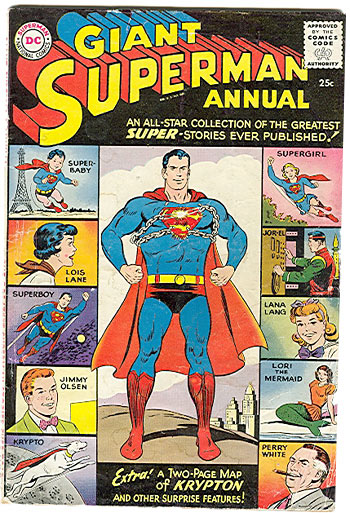
  • Comic book — 12 cents. Mind you, that’s the inflated price, from a dime. I am not opposed to theSgtrock_2
    folks at DC Comics making a couple of pennies, and even though I thought the two-cent increase a great injustice at the time, I made the adjustment at a young age, and now accept the higher price. Of course, the "specials" — the ones with "imaginary" stories in which Perry White gets super powers, or an all-red kryptonite edition or some such, which had the content of about three regular comics — were well worth a quarter. Mad magazine was also worth a quarter. Anyway, this price consciousness has prevented me over the years from buying my son who still collects comics as many as a good Dad probably should on special occasions.
  • A computer — gazillions of dollars, especially if it had the computing power of the one the Man of Steel kept at the Fortress of Solitude, which had a voice recognition program and could tell you anything about anything. As for real-life computers, only a big gummint agency like NASA could afford one, and then only if it was a supreme national priority to go to the moon or something. So this is one area where we’ve come out ahead, even if we don’t get to go to the moon any more.
  • Water — free. Oh, sure, Mamanem might have paid a monthly bill or something, but what concern was that of mine? Even when I lived in South America, and we never drank straight from a tap, and every drop we drank had to be boiled and put into a gin bottle first (the bottles were hand-me-downs from the guy my Dad replaced; I don’t know what they cost originally), I don’t remember having shelled out any of my money for it. I did spend money there on Cokes, which in Ecuador at the time cost 40 centavos, which was the equivalent of two cents back in the day when a sucre was worth a nickel. (Which is way back before the sucre went all Zimbabwe and the country switched to the U.S. dollar.)

You get the idea. And as for you wise guys who are going to tell me that a newspaper’s never been worth more than a nickel, I beg to differ. My sense of what a newspaper is worth formed as an adult, and as an adult I’ve always been aware that the person who buys the paper is paying a small percentage of what it cost to produce it. I will say, though, that 5 bucks for a Sunday New York Times is too much, even if they put gold, or even Mexican Coca-Cola, in the ink.

Boy, don’t I feel morally superior!

Boy, did it make me feel good to get this message from a colleague urging all members of the newspaper’s senior staff to take part in our upcoming blood drive:

All: Please consider setting a good example and donating blood at The State’s drive next Wednesday, July 9, if you’re able. We have about a dozen time slots left to hit our target of 26 units. Clink on the link in the first item on the intranet to book an appointment that fits your schedule. Thanks…

I was able to respond that I gave already (although not at the office)! And it’s not just a line! It’s true!

Do I get a medal or anything, or do I just get to gloat?

Where will the Starbucks ax fall?

Starbucks_old_logo

The one thing I wanted to know in the news stories about the closing of 600 Starbucks locations is the one thing none of them could tell me: Which stores will close?

To a true aficionado, this is a matter of some import. Among those I hope will not close are the following:

  • Gervais Street — I went by this one this morning just to help out by buying a cup of the much-maligned Pike Place Roast. The Vista’s only location, its opening last year was long overdue. I suppose the cutbacks preclude the realization of my dream of another store opening nearby, only on the south side of the street — that one would have a drive-through window, and be well-positioned for those of us coming into town from Lexington County via 378. As things stand, the Gervais Street location is the only one conveniently located for folks coming in from West Columbia or Cayce, and therefore should be untouchable.
  • 5 Points — Like the Vista, Five Points has to have at least one Starbucks, even though I’ve always slightly resented the fact that this one replaced the last incarnation of The Joyful Alternative.
  • White Station in Memphis — Located right next to the Southern railroad tracks, this is a sentimental favorite for two reasons. First, it was for years the only Starbucks convenient to my in-laws’ home in the Bluff City, and I made many a trek there in the early days of my addiction — I mean, infatuation. Second, it replaced a Pancho’s taco location where my wife worked with her friend Mary to earn the money for their backpacking trip across  Europe the summer just before I met her. I wasn’t there, but I’ve heard so much about it. And I ate a few tacos from there. I suppose I should resent that one replacing Pancho’s, just as I should resent the Joyful Alternative thing, but I don’t.
  • Kirby Parkway (Memphis) near the Bill Morris expressway — Just because I picked up two cups (a tall Pike Place for right away, and a travel mug of Sumatra for the road) on my way out of Memphis Monday. It’s near Mary’s house, where some of us stayed over the weekend.
  • Central_parkColumbus Circle in Manhattan — Near a subway station I use pretty much every time I’m in New
    York. Several of my kids and I used coffee from that location to warm us as we walked through Central Park on the super-cold (to me, anyway) day after Thanksgiving last year.
  • The coffee shops in Barnes & Noble — Yeah, I know these aren’t technically Starbucks locations (they don’t accept Starbucks coupons for that reason). But they do "proudly serve Starbucks coffee," and they loom large in my own Starbucks legend. That’s where it all started for me, as documented in the early days of my blog. Being ignorant of the way business works, I worry that somehow the Starbucks corporate woes might indirectly affect some deal that Barnes & Noble has with them. May it never happen, because Barnes & Noble bookstores are my favorite places to drink the coffee, while browsing (but seldom buying — you don’t have to tell the Barnes & Noble people that, though). My two favorite such locations? Harbison, and the one at exit 247 on I-81 in Harrisonburg, Va. — a great place to stop on the way to PA.

As for which ones they should close? I have a list, but I don’t wish to see anyone lose his or her job, so I’ll keep it to myself for now. Let’s just if something has to go, I suppose I could live without any that compete a bit too closely for customers with any of my favorite locations…

Dixie Lee field peas

Just had lunch at my desk, which included various odds and ends from meals past, putting me in mind of an observation of Huck Finn’s:

The widow rung a bell for supper, and you had to come to time. When you got to the table you couldn’t go right to eating, but you had to wait for the widow to tuck down her head and grumble a little over the victuals, though there warn’t really anything the matter with them, — that is, nothing only everything was cooked by itself. In a barrel of odds and ends it is different; things get mixed up, and the juice kind of swaps around, and the things go better.

In my barrel, or rather on my microwaveable Corelle plate, I had some bits of fried catfish, some steamed broccoli, several slices of fried squash, and a ground turkey patty.

But the item that held it all together and combined so well with all of it was a bed of white rice topped with field peas. And not your mean, ordinary field peas that you can buy in any store, but the very finest, the kind your quality eat (or would, if they knew what was good for them): Dixie Lee field peas. As you should know, the pea liquor from Dixie Lees is the finest kind of juice to have swapping around amongst your odds and ends. (I remember being told as a child about a relative from way back who wanted to be enbalmed with pea liquor when his time came. I’ve always assumed that he meant Dixie Lee pea liquor, because nothing less would inspire such a wish.)

These were made better by the fact that they were cooked by my Mama, who treated my wife and me to dinner last night to give us a break after our trip over the last few days. These were the leftovers — or rather, some of them. I save some for tomorrow, to have with the rest of the leftover fried catfish. That will some more get you through the working day.

This was a rare find on my mother’s part. Previously, we had only found Dixie Lees at produce stands in our native Pee Dee. But she got these at the Farmers Market, according to my Dad, whom I just spoke to, because Mama was taking a nap.

But this taste has made me greedy, and I was wondering — does anybody know where I can get some plantable Dixie Lees that I can grow in a home garden? I’d be much obliged.

The party’s over

Wedding_twins

W
e had a nice time in Memphis over the last few days — all of my kids and grandkids were there, as well as all of their relations on that side of the family. But the all-day drive back Monday, and the shock today of starting the process of putting out a week’s worth of pages in three days, has me feeling sort of like one of my twin granddaughters when we put them into the stroller at the end of the big-bash wedding reception Saturday night. Or rather, at the end of it for them — bigger people got to keep on dancing.

Specifically, I’m feeling like Baby A, on the right. Baby B took it all a bit more philosophically.

That’s life. Some people keep on dancing, but some of us have to strap in and get back to flying the airplane. Or sailing the ship. Or whatever — I’m not really up to metaphors today…

Wedding_dance

Get into the blues — WAY into the blues

I‘ve been driving around in Memphis today, having made it across Mississippi and all those other states, listening to the all-blues WEVL, which has some great sounds.

If you’d like to hear it, too, you don’t have to drive 10 hours the way I did. Just click on the link here, and choose an application to play the live link (I’m using RealPlayer.)

Enjoy.

5 minutes, 28 seconds! Can I bleed or WHAT?

Looking back, that’s probably not the best headline for persuading you to give blood. But at least it got your attention, right?

I went to donate at the Red Cross last night, it having been at least 112 days since the last time I gave double-red cells (called the "Alyx" process) back in February. I was prepared to do that again — it’s a really cool process (quite literally, in that they take out your blood, remove the red cells and pump it back in mixed with saline that is a tad cooler than the blood, and the coolness spreads from your arm across your body; but maybe that’s more than you want to know). And, don’t ask me to explain this, but they actually use a smaller needle somehow.

But they had moved the bar on me. See, you have to have a certain amount of iron to do the double-red thing, more than just to give a pint of whole blood. I had been taking iron pills so as to avoid past humiliation, but they used a new test. On the old test, I had to have a "40." On the new one, you need a "14," and I only scored a 13.2. But that was plenty for whole blood, so they took me for that.

Here’s where the bragging comes in. I always try to accelerate the process of giving whole blood by clenching my fist more often than necessary. There was this guy who had started at least 10 minutes, maybe 15, before I did. Once they got started on me, about 2 or 3 minutes later, one of the technicians looked at my receiving bag and said "Whoa! He’s already ahead of him" — indicating the guy next to me. This encourages me to go into my "kick" for the home stretch, and I finished off my pint at five minutes, 28 seconds. The other guy was still going.

This was great, because in the past I’ve taken as much as half an hour for whole blood (Alyx takes longer, but then you have to wait twice as long before giving again), and even as many times as I’ve done this, I’ve never completely lost my dread of it (as I wrote in a column once, for me, giving blood was my Room 101). So I like to get it over with quickly. The secret of my success? Eat and drink (especially water) SO much the day of the donation that you feel like you’re about to pop — the higher blood volume makes a difference. That, and the fist-pumping.

Here’s hoping this doesn’t gross you out, because my point in writing about this is to say YOU should give, too. There’s a great need here in the Midlands, as always. If you can give (not everyone is qualified), and you won’t, then you’re a wuss. So there.