Category Archives: The World

If I were Muslim, this would make me a militant

Terrorists, would-be terrorists and terrorist sympathizers come up with all sorts of reasons to declare us the Great Satan: U.S. troops being in Muslim countries (the fave of Osama bin Laden and incompetent bomber Faisal Shahzad), support for Israel, the immodesty of our women, rock-‘n’-roll, beer, what have you.

Of them all, the only excuses that strike any sort of resonance in me are the cultural ones. I do sympathize with people of a religion that values sobriety and modesty feeling beleaguered by the global assault of the tackier, baser elements of American popular culture. If you’re trying to keep the young men’s minds on the words of the Prophet, Lady Gaga cannot be seen as helping one bit. It doesn’t justify violence, but it could certainly be maddening.

But now, Western influence has gone too far. Check this out:

KUALA LUMPUR—The U.S. has “American Idol.” Britain has “The X Factor.” Malaysia, one of the world’s more progressive Muslim nations, has something rather different—a televised search for the country’s most eligible young religious leader.
“Young Imam” might look familiar at first glance. Ten good-looking male contestants in sharp-looking suits are assigned to sing and complete a series of complex tasks. At the end of the show, the studio lights dim, the music drops to a whisper, and a clutch of young hopefuls step forward nervously, waiting hand-in-hand to find out who will be sent home that night.
Instead of a record contract or a million-dollar prize, though, the last imam standing wins a scholarship to the al-Madinah University in Saudi Arabia, a job leading prayers at a Kuala Lumpur mosque and an expense-paid trip to Mecca to perform the Haj pilgrimage.
The sole judge who decides who stays and who goes each Friday in prime-time isn’t an aging pop star or talk-show host. He’s the turban-wearing former grand mufti of Malaysia’s national mosque, Hasan Mahmood. Last week Mr. Hasan stifled a sob as he eliminated 25-year-old Sharafuddin Suaut from the show for stumbling over some of the finer points of Islamic theory…
Sorry, folks, but desecrating Islam with the great cultural evil of our time, “reality TV,” is an outrage too far. If I were a conservative Muslim seeing this on the tube, I would have just become radicalized.

Good news is, Petraeus knows how to do the job

On the one hand, it’s a great shame for someone who by many accounts is a fine officer to lose his job. Insubordination is insubordination, but it’s not a happy day for America when the president has to bust the top guy in a war zone where things haven’t been going well.

On the other hand, at least we know Gen. Petraeus knows how to get the job done if anyone can. He is literally the man who wrote the book on counterinsurgency, and he showed he could put his theories into effective practice by saving the mission in Iraq.

Frankly, I sort of hated to seem him bumped upstairs to MacDill, leaving implementation of his plans to subordinates. As hairy as things are in Afghanistan, it’s good to know it will be run, on the scene, by the guy who knows how to turn things around.

Other thoughts?

We’re making one heck of an international impression

It’s just not the sort a sane person would want to make.

As I was getting out of a vehicle to walk to the State House right after lunch today, I got a call on the Blackberry from Paris. Caller ID said the number was … well, there were 11 digits. To summarize the phone call, I quote from the e-mail I found when I got back to the office:

Good Morning M. Warthen,

I am a french journalist, working for a french national private media
called Radio Classique.
I am working today on a story about Alvin Greene and the democrat
candidacy.
It would be very interesting for me to talk to you about that and may be
doing a short interview by phone.
Is it possible ?
It would be great.
May be within two hours or tomorrow morning your time ?

It would be great and very interesting.

thank you very much.

Best regards.

Marc Tedde
Radio Classique

I asked if he also wanted to talk about all the Nikki Haley stuff. He didn’t know about any of that. Just as well.

Just what South Carolina needs.

Anyway, we’re going to do the interview tomorrow morning — afternoon, his time, morning our time. I’m going to let him call me again, rather than vice versa, I assure you.

Friedman notes good news from Mideast

I appreciated this Tom Friedman column, in which he dismisses the troublemakers who grab our attention (such as the blockade-running provocateurs and those who back Israel settlement-building), and directs our attention instead to the actual progress being made on the Israel-Palestinian front:

… I adore the Israelis and Palestinians, but God save me from some of their European and American friends. Their grandstanding interventions — like those blockade-busters sailing to Gaza or the wealthy American Jews who fund extremist settlers’ housing purchases in Arab East Jerusalem — often fuel the worst trends on either side and divert our energies from the only thing that is important: forging a two-state solution.
So is there anything good happening in that regard? Yes. The effort by the Palestinian president, Mahmoud Abbas, and Prime Minister Salam Fayyad to build the institutional foundations of a Palestinian state from the ground up — replacing the corrupt, jerry-built structure that Yasir Arafat created and Israel destroyed — is actually making progress. This matters — and must be nurtured.
You see, there are two models of Arab governance. The old Nasserite model, which Hamas still practices, where leaders say: “Judge me by how I resist Israel or America.” And: “First we get a state, then we build the institutions.” The new model, pioneered in the West Bank by Abbas and Fayyad is: “Judge me by how I perform — how I generate investment and employment, deliver services and pick up the garbage. First we build transparent and effective political and security institutions. Then we declare a state. That is what the Zionists did, and it sure worked for them.”
The most important thing going on in this conflict today is that since 2007 the Palestinian Authority, Jordan and the U.S. have partnered to train a whole new West Bank Palestinian security force in policing, administration and even human rights. The program is advised by U.S. Lt. Gen. Keith Dayton — one of the unsung good guys. The Israeli Army has become impressed enough by the performance of the new Palestinian National Security Force, or N.S.F., under Abbas and Fayyad that those forces are now largely responsible for law and order in all the major West Bank towns, triggering an explosion of Palestinian building, investment and commerce in those areas.
Here are highlights: the Jordanians have trained and the Palestinian Authority deployed and equipped five N.S.F. battalions and one Presidential Guard unit, some 3,100 men. Plus, 65 Palestinian first-responders have been trained and are being equipped with emergency gear. A Palestinian National Training Center, with classrooms and dorms, is nearing completion in Jericho so the Palestinians themselves can take over the training. The Palestinian Authority is building a 750-man N.S.F. camp to garrison the new N.S.F. troops — including barracks, gym and parade ground — near Jenin. At the same time, the Palestinian security headquarters are all being rebuilt in every major Palestinian town, starting in Hebron. An eight-week senior leadership training course in Jericho — bringing together the Palestinian police, the N.S.F. and Presidential Guards — has graduated 280 people, including 20 women….

As he says, everything else is just a sideshow. Or should be.

Good news: Ship stopped without bloodshed

Here’s a bit of good news that puts recent bad news in perspective:

JERUSALEM–Israeli soldiers boarded a cargo ship carrying pro-Palestinian activists just after noon Saturday, with the military saying there was no violence and the ship was now headed under Israeli control to the Israeli port of Ashdod.

A spokeswoman for the Israeli Defense Force said the protesters resisted nonviolently, but the IDF “took over the ship.”

“The use of force was unnecessary and no shots were fired,” the IDF said in a statement later in the day. The IDF also released photos and aerial video footage of the boarding, conducted by commandos in small boats that came alongside the 225-foot cargo ship, the Rachel Corrie.

In the video clip, the ship’s crew and passengers appear to assemble on the ship’s top deck and sit down. Israeli soldiers then board the ship from a small boat and speak to a passenger.

And what was different about this? How did this differ from the incident in which some of the blockade runners were killed?

None of them were there to provoke violence. None of them attacked the Israelis trying to enforce the blockade. And without those provocateurs earlier in the week, we wouldn’t have this outcry against Israel.

Can we have a collective sigh of relief now?

Footage from the Gaza blockade incident

Just got this from regular contributor Stanley Dubinsky, with this commentary:

Anyone who says that Israeli soldiers opened fire first, or that they came to kill (or even hurt) any of those aboard the Turkish boat, is lying … the “humanitarians” own video says otherwise.

Make of it what you will. Personally, I’m fed up with Israel taking the blame for every damned thing that happens amid all that insanity over there. Want to blame Israel for something? Get on them about all those settlements on the West Bank. That’s an unnecessary provocation — although not nearly as overt as the provocation from these activists doing everything they can to provoke these troops into violence.

The very idea that any nation would unequivocally condemn Israel for what happened — much less MOST nations, which is what we’re seeing — is outrageous. I’ve really about had it with the opinion of the “international community” with regard to Israel.

Did somebody screw up? Yes, in failing to carry out this operation in a way that prevented hostiles from provoking gunfire. In failing to assume that there were people present who would act this way, and boarding in sufficient force to control the situation. This must not be allowed to happen again. But rest assured, whatever Israel does to try to control such a situation, there will be provocateurs thinking of ways to take it to the point of bloodshed.

Perhaps you think there should be no blockade of Hamas. I’d be interested in hearing that argument. But as long as there is one, as as long as there are blockade runners, we run the danger of this happening.

We could blow it up — blow it up REAL GOOD!

Shades of the “Farm Film Report” on SCTV…

Have you seen the latest wacky idea floated for sealing the oil spew in the Gulf? They say nah, they wouldn’t really do it, but it IS leading the NYT site at the moment:

The chatter began weeks ago as armchair engineers brainstormed for ways to stop the torrent of oil  spilling into the Gulf of Mexico: What about nuking the well?

Decades ago, the Soviet Union reportedly used nuclear blasts to successfully seal off runaway gas wells, inserting a bomb deep underground and letting its fiery heat melt the surrounding rock to shut off the flow. Why not try it here?

The idea has gained fans with each failed attempt to stem the leak and each new setback — on Wednesday, the latest rescue effort stalled when a wire saw being used to slice through the riser pipe got stuck.

“Probably the only thing we can do is create a weapon system and send it down 18,000 feet and detonate it, hopefully encasing the oil,” Matt Simmons, a Houston energy expert and investment banker, told Bloomberg News on Friday, attributing the nuclear idea to “all the best scientists.”

Or as the CNN reporter John Roberts suggested last week, “Drill a hole, drop a nuke in and seal up the well.”

This week, with the failure of the “top kill” attempt, the buzz had grown loud enough that federal officials felt compelled to respond…

If we cain’t burn it off, ‘n’ we cain’t top kill it off, ‘n’ if the blamed SAW ain’t gettin’ ‘er done, le’s NUKE the sumbitch. Why, if the Rooskies kin do, so b’God kin we!

That’s the first time I’ve had the sense I was reading The Onion when I wasn’t since… well, since that Monday when our governor went missing.

Nicholas Kristof is a traitor to his gender, God bless him

My wife called my attention to this Nicholas Kristof column the other day. In describing it, she said Kristof had gotten fed up with an unpleasant truth about why aid efforts in poor areas of the world fail to save children: Their fathers blow what little money they earn on booze and prostitutes.

I just got around to reading it a few minutes ago. I expected a rant, an angry diatribe using the kind of slashing language that, well, that I tend to use when I’m fed up about something.

But no, Mr. Kristof was as carefully rational as ever. If anything, I think he undersold his point by being so mild about it. An excerpt:

… Look, I don’t want to be an unctuous party-pooper. But I’ve seen too many children dying of malaria for want of a bed net that the father tells me is unaffordable, even as he spends larger sums on liquor. If we want Mr. Obamza’s children to get an education and sleep under a bed net — well, the simplest option is for their dad to spend fewer evenings in the bar.

Because there’s mounting evidence that mothers are more likely than fathers to spend money educating their kids, one solution is to give women more control over purse strings and more legal title to assets. Some aid groups and U.N. agencies are working on that…

This tracks with what folks who give microloans to the poor in backwards parts of the world have learned: That if they want the loans to go to better the family’s plight, they need to lend the money to the mothers.

Nicholas Kristof, who uses his own bully pulpit to keep us mindful of the plight of the world’s least fortunate — and in doing so shows no respect for the orthodoxies of left or right — has now blown the whistle on guys everywhere. The man is a traitor to his gender. And God bless him for it.

The REAL problems with illegal immigration

To continue a discussion from a previous thread, and make it more visible on the blog…

The reason we can’t communicate meaningfully with the folks who are all worked up over the Mexicans is that they see the absolute opposite of what we’re seeing. We’re seeing thousands of people crossing the border to come here and work their nalgas off doing construction, picking crops and processing chickens — and more often than not, coming alone or in groups of workers who send all the money they earn by the sweat of their brows back home to their families. For some bizarre reason, a lot of people see the opposite — freeloaders coming here to sit around and soak up public services. Do they really not see the work these people are doing? Do they really not see that that’s why they’re here?

This is coming from people who have a worldview that I don’t share. It comes from people who have a hair-trigger response that makes them explode at the slightest suggestion that anyone — from Reagan’s welfare queens to these supposed Mexican freeloaders — might be getting something at the expense of the taxes they so hate to pay.

These are people who, when they were kids, were always complaining to the teacher about what Johnny at the next desk was doing (as in, How come Johnny gets to do X, and I don’t?), and the teacher would say, “What Johnny does is none of your concern; concern yourself with what you do.” Only they didn’t listen.

Anyway, this fundamental disconnect between folks who see the world that way and those of us who don’t (and who see hard workers, not freeloaders) prevents us from addressing the real problems inherent in illegal immigration. And there are real problems. It is unfair that some people play by the rules and can’t get into this country, or stay once they get here. It is a problem that we have millions of undocumented people in this country that we can’t keep track of, especially in a time when there are a lot of people from other parts of the world who would love to sneak in for purposes of terrorism. It is a huge problem that we’ve got a drug war practically causing the government of Mexico to collape (a war caused by demand on this side of the border), and occasionally that violence spills over. (For that matter, even if it doesn’t spill over, the fact that it’s happening right on our border is a problem for us, if only because it stimulates more illegal immigration.)

These are all things we need to deal with. But we can’t have a rational conversation with those who are just furious that any of those people are here at all. And we need to.

Obama to send troops to Mexico border

This should absolutely thrill some of you — you know, those who think Mexican laborers are the greatest threat to the nation.

Yes, finally, the president has decided to send Gen. “Black Jack” Pershing after that foul bandido Pancho Villa…

… no, wait… wrong century. Oh, well, just to make this easier, here’s the latest news:

President Obama will deploy an additional 1,200 National Guard troops to the southern border and request $500 million in extra money for border security, according to an administration official. The decision comes as the White House is seeking Republican support for broad immigration reform this year.

The official said the new resources would provide “immediate enhancement” to the border even as the Obama administration continues to “work with Congress to fix our broken immigration system through comprehensive reform, which would provide lasting and dedicated resources by which to secure our borders and make our communities safer.”

The 1,200 troops will join about 340 already working in the border region, the official said. They would provide support to law enforcement efforts against drug trafficking by increasing monitoring of border crossings and performing intelligence analysis.

Feel better, folks? Feel safer?

Rethinking Miranda rights for terror suspects?

There was a  heated debate over a week ago over whether the Times Square suspect should have been Mirandized. And lots of folks said absolutely, and not just the usual types on the left who think terror is about crime and not war. Conservative voices spoke up quite thoughtfully in defense of the idea that

Today, as three more are arrested, seems like a good time to revisit the issue.

Especially since the Obama administration signaled a couple of days ago that it was rethinking the wisdom of reading such suspects their rights.

Did you see that? Here’s an excerpt from a report about that:

WASHINGTON — The Obama administration said Sunday it would seek a law allowing investigators to interrogate terrorism suspects without informing them of their rights, as Attorney General Eric H. Holder Jr. flatly asserted that the defendant in the Times Square bombing attempt was trained by the Taliban in Pakistan.

Mr. Holder proposed carving out a broad new exception to the Miranda rights established in a landmark 1966 Supreme Court ruling. It generally forbids prosecutors from using as evidence statements made before suspects have been warned that they have a right to remain silent and to consult a lawyer.

He said interrogators needed greater flexibility to question terrorism suspects than is provided by existing exceptions….

I didn’t realize that had happened until I saw an op-ed piece today in the WSJ praising it:

… In other words, the Miranda rights to remain silent and have an attorney present during questioning would be suspended for terror suspects believed to possess information that could prevent an attack.

The administration is making a number of admissions here: Mirandizing Umar Farouk Abdulmutallab, aka the underwear bomber, after only 50 minutes of questioning was a mistake; terrorists are enemies of America, not ordinary criminals; and the law-enforcement approach to combatting terrorism, which is designed to obtain evidence admissible at trial after a crime has already been committed, is not the most effective way to obtain intelligence to prevent future attacks.

This is an important step forward and a sign that, after the Manhattan subway plot, Fort Hood, Detroit, and now Times Square, the administration has become more adaptable to the realities of the war on terror. Yet the jury is out on whether the administration has a real plan or is merely improvising. Times Square bomber Faisal Shahzad remains in the criminal justice system and has not been designated as an enemy combatant, though he is still eligible for such designation….

Of course, the idea that Mr. Holder is raising is based in the oft-cited nostrum that the Constitution is not a suicide pact.

Anyway, I was wondering if anyone had had any further thoughts on this point.

Visitors from Azerbaijan

The six visitors and me at St. John Episcopal Church today. At the far right is our interpreter, Bahruz Balayev.

Today, a white guy from South Carolina met some REAL Caucasians.

Specifically, I had the honor of speaking to a group of journalists from the Republican of Azerbaijan, which for you geography-challenged folk is located in the Caucasus, hence the bad pun.

They were visiting in connection with the Open World Program of the National Peace Foundation. Their local sponsors were Mary Bryan (whose daughter Chandlee follows me on Twitter, just to get a plug in) and Tom Kohlsaat, who traveled to Azerbaijan in 2006 where Mary worked with their friend Ann Furr to provide mediation training as part of a Rule of Law program funded by CEELI and OSCE. Also, Tom is currently providing technical support to a fledging conservation nonprofit in Azerbaijan.

But that’s not what I was there to talk to them about. I was there as a blogger with MSM experience to talk about new media, old media, and how to overcome the challenges facing both.

Of course, the “challenges” facing journalists in this country are pretty minor compared to what folks in that former Soviet satellite face. When Khalid Asif Kazimli mentioned that there are fewer newspapers and other news outlets in his country than there were six years ago, I rather superficially asked whether that was because of the financial challenges they face. He said yeah, that — and government suppression.

Another member of the group, Samira Bahadur Guliyeva, asked me whether it was more meaningful to be a journalist in a totally free country or in one that is less free, I told her that obviously, you have more of an impact when you are one of the few journalists in a country in which journalism is rare, and especially where it is officially discouraged and constrained.

I should have added, to all of them, that I have tremendous respect for them for being journalists at all in any country that lacks the legal, political and cultural protections that we take for granted in this country. They are far braver than I am.

It was an honor and privilege to meet them. Here are excerpts from the profiles of the group I spoke with:

Guliyeva, Samira Bahadur
Current Employment: Correspondent, Make-up Editor, Turan News Agency
Additional Leadership Position: Executive Board member, Institute for Reporters Freedom and Safety
Level of English: Basic conversation
Other Languages: Russian
First Trip to US:  Yes.

Kazimli, Khalid Asif
Current Employment: Web-editor of musavat.com web-site, “Yeni Musavat” Newspaper
Level of English: Basic conversation
Other Languages: Russian, Turkey
First Trip to US: Yes.

Mammadli, Turgut Zeynal
Current Employment: Sound Arranger at Cultural Program, Azadlig Radio
Additional Leadership Position: Public Relations Officer, Journalism and Development Center
Level of English: Fluent
Other Languages: Russian, Turkish
First Trip to US: Yes.

Mehdiyev, Rashad Azad
Current Employment: Director, RIYAD MEDIA Information Agency
Level of English: Basic conversation
Other Languages: Turkish, Russian, English  First Trip to US: Yes.

Huseynova, Sayida Mammad

Current Employment: Reporter, Internews Azerbaijan Public Union, Mediaforum Website
Level of English: Basic conversation
Other Languages: Russian
First Trip to US: Yes.

Farzaliyev, Elshad Akif (Facilitator)
Current Employment: Head of Corporate Communications, Azerfon LLC,Local Mobile Operator
Level of English: Fluent
Other Languages: Russian, Turkish
First Trip to US: No.

Graham not so ‘cool’ now on global warming

Back in late February, Tom Friedman wrote the following about our senior senator:

And for those Republicans who think this is only a loser, Senator Graham says think again: “What is our view of carbon as a party? Are we the party of carbon pollution forever in unlimited amounts? Pricing carbon is the key to energy independence, and the byproduct is that young people look at you differently.” Look at how he is received in colleges today. “Instead of being just one more short, white Republican over 50,” says Graham, “I am now semicool. There is an awareness by young people that I am doing something different.”

But today, we have the following  release from some of his erstwhile young fans:

Youth Activists Demand S.C. Leadership on Energy and Climate Legislation

(Columbia, SC) – Responding to Senator Lindsey Graham’s withdrawal from federal energy legislation and the offshore oil disaster, youth activists in South Carolina have called on the Senator to renew his leadership.

“Students at Clemson were proud to stand behind our hometown Senator in pushing for federal energy and climate legislation,” says Gabriel Fair, co-president of Clemson University’s Student for Environmental Action. “Lindsey Graham’s leadership really encouraged the young people who are fighting to cut carbon pollution and create a clean energy economy in this state.”

Over the previous months, Graham has led in federal energy and climate legislation. In February editorial in the New York Times, Thomas Friedman quoted Graham saying, “I have been to enough college campuses to know if you are 30 or younger this climate issue is not a debate.  It’s a value.  These young people grew up with recycling and a sensitivity to the environment – and the world will be better for it.”

Senator Graham’s withdrawal from the federal energy debate has disappointed students across South Carolina. “We’d like to stand behind our Senator again and hope he comes back to the table and strengthens the bill further,” says Fair.

Students in South Carolina are looking for the jobs comprehensive energy and climate legislation would produce. According to Winthrop University student Lorena Hildebrandt, “Young people face the highest unemployment rates in this country right now. Like many of my friends, I’ll be graduating college soon and looking for a job.  That’s why building a new clean energy economy is so important to young people. It’s absolutely necessary we pass comprehensive federal legislation to create a clean energy economy.”

Graham’s backing away from the process occurs at a crucial time for federal energy legislation.

In light of the unfolding oil disaster in the Gulf of Mexico, Americans are reconsidering our country’s dependence on oil. Recent polls have indicated that the Deepwater Horizon explosion has actually bolstered support for federal climate legislation, while support for drilling is falling.

According to a poll conducted last week by Clean Energy Works, 61 percent of Americans now favor a climate bill that would cut carbon pollution.  Meanwhile, CBS News reported this week that forty-one percent of Americans feel the risks of offshore drilling are too high, up from twenty-eight percent in 2008.

Students on the coast are worried about what Graham’s pulling out will mean for federal legislation on energy and climate. “We’re disappointed here on the coast that Senator Graham walked away from federal energy and climate legislation,” says Marissa Mitzner, Sustainability Coordinator at Coastal Carolina University. “Especially with the oil disaster in the Gulf unfolding and our own South Carolina coasts vulnerable to the impacts of climate change and the threat of oil drilling, we need Senator Graham’s leadership more than ever.”

###

Face it, senator: You’re not even “semicool” now, not with the kids.

As for what a cool guy like me thinks, well, I’d certainly appreciate a better understanding about why the Dems’ recent moves on immigration mean you can’t lead on this.

Oh, and kids — Tom Friedman didn’t write that in “and editorial.” It was a column. He doesn’t write editorial.

Note how markets react to stimulus news

Just thought I’d point something about about gummints and markets.

Markets rose yesterday on news of massive European bailout. That’s because markets are pragmatic, not ideological, things.

Also, while I know Europe has it’s own psychoses (thank God our own neo-Nazis are marginal), I haven’t heard of anything equating to a Tea Party movement arising across the Continent to complain about the gummint taking steps to stave off disaster. That’s a peculiarly American phenomenon.

Of course, it’s early yet.

Talkin’ ’bout the Tolly-Bon

Was listening to the radio this morning — NPR, probably (I only listen to music on commercial stations) — and the announcer was talking about the pending confab between Presidents Obama and Karzai, and a mention was made of Mr. Karzai’s dealings with the Taliban.

Only the announcer didn’t exactly say “Taliban.” He took a sort of half-hearted stab at pronouncing it the way President Obama does, “Tolly-Bon.”

Here’s the thing about that. Having grown up speaking Spanish as well as English, I approve of people pronouncing words from other languages properly (personal peeve: English-speakers pronouncing “llama” as “lama”).

But when the attempt is lame, it grates. And the president, with his extremely normal American accent, simply does not pronounce “Taliban” the way a man from the Mideast or central Asia would. He sounds like… well, a Texan speaking Spanish. OK, not THAT bad, but it sounds odd, and it’s distracting, and it causes you to miss the rest of what he’s saying while you’re going, “TOLLY-BON?”

Actually, truth be told, it can be distracting even when it’s done perfectly. I always sort of go huh? when, at the end of a report delivered in perfectly accentless broadcast English, I hear the reporter sign off as “Mandalit del Barco.” That’s because she pronounces it with a perfect, extra-intense Spanish accent. And obviously both are natural to her, but it’s still distracting. It’s as though an actor were speaking a line with an Italian accent, and in the middle pronounced two words as a German.

It’s also a bit — showoffy. Because not many people can do it, perhaps. I could have, when I was young and fluent in both. But as I’ve gotten older, it can take me several minutes to get the muscles of my mouth warmed up to read Spanish properly (which I have to do from time to time to proclaim the Gospel in Spanish at Mass). If I try to pronounce “Mandalit del Barco” properly in the middle of a sentence in English, my tongue would trip over my front teeth, and I wouldn’t be able to get any of it out. It’s not so much the “Mahn-da-LEET,” which even a Texan could almost say correctly, but getting the L and especially the R right in “del Barco.” I can’t represent the difference phonetically. They’re just pronounced completely differently in Spanish. The tongue does tricks it’s never called on to do in English. (Here’s a link to a report by her that illustrates some of what I’m saying. It starts with a gringo anchor introducing her, saying her name with a lame American accent, then she goes on to report a story about recent immigrants with a fairly smooth, nondistracting shift between words like “sombrero” and English words — which I guess contradicts my point. But when she signs off at the end, as usual, she really punches the correct pronunciation of her name. It’s like she takes several steps back and gets a running start at it. And maybe that‘s what grabs my attention. Whatever the accent, you seldom hear an announcer so overpronouncing his or her own name.)

Anyway, I have thoughts like those every time I hear her. Which is distracting. I suppose there’s something to be said about the arrogant British habit of pronouncing everything, every foreign name or word, with an English accent, and foreign sensibilities be damned. It at least makes for a smoother delivery, with fewer cognitive bumps in the road. (But, as I said in the previous parenthetical, one CAN pronounce things correctly without distracting, if one is really good. Maybe Ms. del Barco just has an ego thing about her name; I don’t know.)

Something just occurred to me: Maybe the president does that Tolly-Bon thing as a very subtle way of having his cake and eating it. Maybe he makes a lame stab at pronouncing it “correctly” in order to reach out to folks in other parts of the world, but does it with a painfully American accent so as not to sound too alien at home. Could it be?

Ground Zero as an emblem of America’s dysfunction

ground zero

The opinion writers at the WSJ are, predictably, fulminating over the upcoming trials of Khalid Sheikh Mohammed et alia in NYC. Whatever you think about that, one of them made an excellent point about our nation’s fecklessness with a photograph and a sharp couple of paragraphs:

The third way to consider the trials is to look at Ground Zero itself. After eight years of deliberation, planning, money and effort, what have we got? The picture nearby is the answer.

Let me be more precise. After eight years in which the views and interests of, inter alia, the Port Authority, NYPD, MTA and EPA, the several governors of New York and New Jersey, lease-holder Larry Silverstein, various star architects, the insurance companies, contractors, unions and lawyers, the families of the bereaved, their self-appointed spokespersons, the residents of lower Manhattan and, yes, even the fish of the Hudson river have all been duly consulted and considered, this is what we’ve got: a site of mourning turned into a symbol of defiance turned into a metaphor of American incompetence — of things not going forward. It is, in short, the story of our decade.

By failing to quickly decide what to do at that site and then DO it, our nation has shown its weakness — the flaws that come inevitably with being a liberal democracy riven with partisan and cultural conflicts, a society that values everyone having their say more than going ahead and getting things done.

Some of these things about our country I would not change; others I would. The thing is, a liberal democracy CAN get its act together. This was a pretty great country back in 1941-45, and yet we managed to pull ourselves together after Pearl Harbor and build and operate a towering war machine that quickly eclipsed the ones that Germany and Japan had been building for two decades. Those militaristic and fascistic countries underestimated us then, thinking we were too soft and divided in our purposes to defeat nations as focused as they were.

Today, fanatics who are willing to die for their cause think we are too soft, comfort-loving, life-loving, indecisive and ineffectual to defeat them. Failing to rebuild and move on at Ground Zero — allowing their act of terror to leave us in a state of paralysis at that site for eight years — speaks volumes about our dysfunction, and makes them look right. I mean, what do you say about a country that goes into paroxysms over something as obvious as the need for health care reform — or the need to rebuild at Ground Zero?

It’s not that we don’t know how to design something and build it. We’re great at that. We just can’t decide what to build, and that is just one among many effects of the fact that, as a nation, we still haven’t been able to get together on HOW we want to respond to 9/11.

Is a nation that divided and confused capable of continuing (is it capable, for instance, of summoning the energy to overcome our economic crisis so that I can get a job, just to bring it down to the personal level)? Or are we all washed up? Or is the answer somewhere in between, and if so, precisely where?

What were Richland council members doing in China?

OK, now that it’s been two weeks since this was in the paper:

With four members on their way home from China, one under the weather and a sixth with a scheduling conflict, Richland County Council couldn’t hold its regular meeting Tuesday.

Chairman Paul Livingston said he couldn’t remember another instance in his 19 years on the council when a meeting was canceled because not enough members showed up.

Absent were Joyce Dickerson, Norman Jackson, Damon Jeter and Gwendolyn Davis Kennedy. They went on a nine-day trip to China with the Greater Columbia Chamber of Commerce.

Councilman Jim Manning called in sick and Kelvin Washington had to work, Livingston said.

“I know folks can sometimes have a legitimate reason for not attending,” the chairman said, “but, still, it’s embarrassing not to have a quorum.”

After waiting about 20 minutes, he canceled the meeting. The 211-page agenda listed 40 items of business.

… I’ll go ahead and ask the question: What were these four council members (one of whom was voted out of office for an unjustifiable junket to Hawaiit, but was inexplicably returned to the council by voters in the last election) doing in China?

Anybody who knows the answer, please speak up. Maybe the explanation has been published somewhere, and I missed it.

C’est moi, l’ancien éditorialiste

Remember when I was interviewed last month by Philippe Boulet-Gercourt, the U.S. Bureau Chief for Le Nouvel Observateur, France’s largest weekly newsmagazine? Well, I was. And a few days ago I wrote to Philippe asking if his piece had run. He wrote back to say yes, a couple of weeks ago, and to share the link.

Here, of course, is my favorite part:

Mais «je ne crois pas que Joe Wilson soit raciste, confie Brad Warthen, ancien éditorialiste du «State», le quotidien local. C’est plutôt une réaction très américaine contre le gouvernement, une tradition encore plus forte chez les Blancs de Caroline du Sud, cette idée que personne ne doit pouvoir nous dire ce que l’on doit faire». La diabolisation d’Obama, en somme, ne serait qu’une variante du vieux procès intenté aux démocrates : «Clinton était une fripouille, il ne s’intéressait qu’à lui, juge Rich Bolen, le républicain de Lexington. Obama, lui, est très idéologique, il est un socialiste de conviction. C’est bien plus dangereux.»

Now personally, I don’t recollect having said all that there Paris talk, but I reckon I did. Seriously, from what I can make out of it (and Philippe was right, although I can’t speak French at all, my background in Spanish and Latin enables me to make out, roughly, what is being said in written French — it’s the pronunciation that foxes me), Philippe quoted me correctly.

As for being an ancien éditorialiste — well yeah, I have a few gray hairs, but come on. It’s interesting the way the same word will come to us through Norman influences and come to mean something quite different. Idioms are cool, but confusing.

About why we invaded Iraq (here we go again, y’all…)

OK, I’ll bite on bud’s parenthetical back on this thread:

(As a side note, its, funny how the folks who wanted that war in the first place pretend it acutally started with the “surge”, forgetting the fabricated justifications that led to the initial invation.)

While I know I won’t get anywhere with bud (he and I have had this conversation too many times for me to entertain false hopes), I believe that every once in a while — say once a year at least — I should rise up and contest the conventional “wisdom” that we went into Iraq based on a pack of lies.

Nothing that causes me to conclude that we should go into Iraq later proved to be false. I say this with all due respect to people who didn’t think we should have gone in to start with. A legitimate case could have been made at the time that invasion at that time was not the best way to achieve our goals. But saying, after the fact, that all the reasons to go in were lies is itself a lie. I know, because I know why I believed we needed to take that action.

I also know that nothing I have ever written or thought has ever pretended that the war started with the surge. On the contrary, what you will find is that the surge was the moment when we finally started prosecuting the effort the right way, instead of the Rumsfeld way. (I know that some folks’ minds are boggled by the concept that whether we should have been in Iraq and whether we were going about it the right way are two separate questions, but I ask them to bear with me on that point.)

As for the “fabricated justifications”… first, I’ll refer you to a post on my blog from last year, headlined “Why we went to war in Iraq.” It was inspired by an opinion piece I had read in the WSJ by Doug Feith. bud’s reaction at the time was “Doug Feith is full of s***.” Perhaps you will agree, but I urge you to go back and read it.

Then, going back further, to before the invasion itself, I refer you to my column of Feb. 2, 2003. You won’t find a lot of talk about WMDs and other such distractions. You will find a lot of stuff about “draining swamps.” The need to do that, after 9/11 showed that our old strategy of maintaining the status quo in the region was extraordinarily dangerous to this county, combined with the fact that Saddam had been violating for a decade the terms of the 1991 cease-fire, constituted the argument for me.

Anyway, here’s that column in its entirety:

THE UNCOMFORTABLE TRUTH ABOUT WHY WE MAY HAVE TO INVADE IRAQ
Published on: 02/02/2003
Section: EDITORIAL
Edition: FINAL
Page: D2
By BRAD WARTHEN
Editorial Page Editor
AMERICA SEES ITSELF, quite admirably, as a nation that doesn’t go around starting fights, but is perfectly willing and able to end them once they start.
Because of that, President Bush has a tall hill to climb when it comes to persuading the American people that, after 10 years of keeping Saddam Hussein in his box, we should now go in after him, guns blazing.
In his State of the Union address, the president gave some pretty good reasons why we need to act in Iraq, but were they good enough? I don’t know. Probably not. It’s likely that no one outside of the choir loft was converted by his preaching on the subject. And that’s a problem. Overall, while there have been moments over the last 16 months when he has set out the situation with remarkable clarity, those times have been too few and far between.
He has my sympathy on this count, though: His efforts have been hampered by the fact that the main reason we may need to invade Iraq is one that the president can’t state too clearly without creating more problems internationally than it would solve. At the same time, it’s a reason that seems so obvious that he shouldn’t have to state it. We should all be able to figure it out.
And yet, it seems, we don’t.
I hear people asking why, after all this time, we want to go after Saddam now. He was always a tyrant, so what’s changed? North Korea is probably closer to a nuclear bomb than he is, they say, so why not go after Kim Jong Il first?
We left him in power a decade ago, they ask, so why the change?
The answer to all of the above is: Sept. 11.
Before that, U.S. policy-makers didn’t want to destabilize the status quo in the Mideast. What we learned on Sept. 11 is that the status quo in the region is unacceptable. It must change.
Change has to start somewhere, and Iraq is the best place to insert the lever, for several reasons — geography, culture, demographics, but most of all because Saddam Hussein has given us all the justification we need to go in and take him out: We stopped shooting in 1991 because he agreed to certain terms, and he has repeatedly thumbed his nose at those agreements.
Iraq may not be the best place in the world to try to nurture a liberal democracy, but it’s the best shot we have in the Mideast.
I’m far from the only one saying this. The New York Times’ Tom Friedman, who has more knowledge of the region in his mustache than I’ll ever have, has said it a number of times, most recently just last week:

“What threatens Western societies today are not the deterrables, like Saddam, but the undeterrables — the boys who did 9/11, who hate us more than they love life. It’s these human missiles of mass destruction that could really destroy our open society. . . . If we don’t help transform these Arab states — which are also experiencing population explosions — to create better governance, to build more open and productive economies, to empower their women and to develop responsible news media that won’t blame all their ills on others, we will never begin to see the political, educational and religious reformations they need to shrink their output of undeterrables.”

Journalists can say these things, and some do. But if the president does, the Saudis, the Egyptians, the Syrians and just about everybody else in the region will go nuts. In European capitals, and even in certain circles here at home, he will be denounced as the worst sort of imperialist. Osama bin Laden’s followers will seize upon such words as proof that the West has embarked upon another Crusade — not for Christ this time, but for secular Western culture.
None of which changes the fact that the current state of affairs in Arab countries and Iran is a deadly threat to the United States. So we have to do something about it. We’ve seen what doing nothing gets us — Sept. 11. Action is very risky. But we’ve reached the point at which inaction is at least as dangerous.
Should we go in as conquerors, lord it over the people of Iraq and force them to be like us? Absolutely not. It wouldn’t work, anyway. We have to create conditions under which Iraqis — all Iraqis, including women — can choose their own course. We did that in Germany and Japan, and it worked wonderfully (not that Iraq is Germany or Japan, but those are the examples at hand). And no one can say the Germans are under the American thumb.
But that brings us to a problem. The recalcitrance of the Germans, the French and others undermines the international coalition that would be necessary to nation-building in Iraq. It causes another problem as well:
Maybe we could accomplish our goal without invading Iraq — which of course would be preferable. By merely threatening to do so, we could embolden elements within the country to overthrow him, which might provide us with certain opportunities.
But the irony is that people aren’t going to rise up against Saddam as long as Europeans and so many people in this country fail to support the president’s goal of going after him. As long as they see all this dissension, they’ll likely believe (rightly) that Saddam might just hang on yet again.
If the United Nations, or at least the West, presented a united front, the possibility of Saddam collapsing without our firing a shot would be much greater. But for some reason, too many folks in Europe and in this country don’t see that. Or just don’t want to.
Maybe somebody should point it out to them.

Argue that we could have pursued other courses to achieve our legitimate goals. Fine. But don’t tell me the reasons I was persuaded we should invade were lies. I know better.

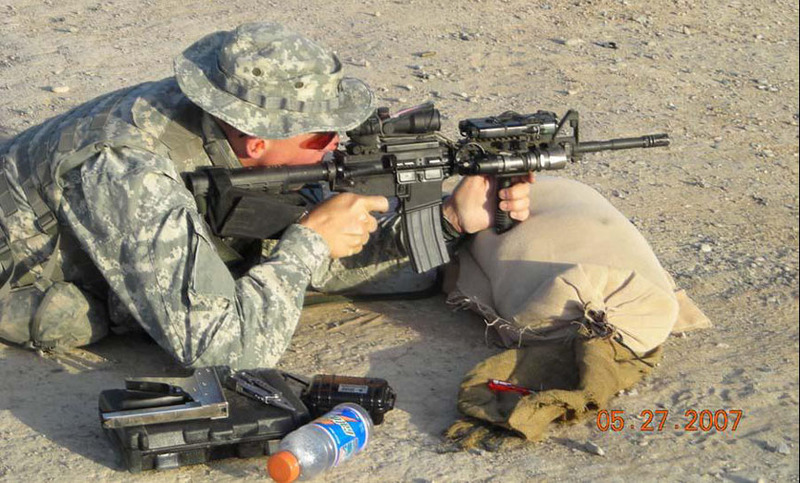
Is the M4 a lethal weapon (to the user)?

Something Burl wrote in a comment reminded me of this story the other day:

WASHINGTON — In the chaos of an early morning assault on a remote U.S. outpost in eastern Afghanistan, Staff Sgt. Erich Phillips’ M4 carbine quit firing as militant forces surrounded the base. The machine gun he grabbed after tossing the rifle aside didn’t work either.

When the battle in the small village of Wanat ended, nine U.S. soldiers lay dead and 27 more were wounded. A detailed study of the attack by a military historian found that weapons failed repeatedly at a “critical moment” during the firefight on July 13, 2008, putting the outnumbered American troops at risk of being overrun by nearly 200 insurgents.

Which raises the question: Eight years into the war against the Taliban in Afghanistan, do U.S. armed forces have the best guns money can buy?…

I’ve sort of wondered for years why this country couldn’t simply produce a weapon as simple, as effective, as cheap, and most of all as RELIABLE as the AK-47.

I read part of the recent book by Larry Kahaner about that remarkable weapon (one of the many books I’ve read “part of” while drinking coffee but not buying anything at Barnes & Noble, my favorite leisuretime activity), and it reads like pretty much an indictment of the free enterprise system. The way it developed was this: A soldier in the Red Army, dissatisfied with what guys like him had to rely on in battle, decided to design a multi-purpose infantry weapon that would get the job done, and always work. So he did, the Soviets mass-produced it, and it became the number-one weapon in the world, the favorite of rebels, terrorists, thugs, and child soldiers everywhere.

It’s cheap; it’s ubiquitous. It puts a LOT of high-impact bullets on a target in a big hurry, so you definitely don’t want to go up against one if you can help it. It’s simple, and easy to maintain. It requires so little skill — and upper-body strength — to operate that it makes a child soldier into a particularly dangerous person.

In other words, it’s pretty horrible. But it’s a way better weapon, in lots of ways, than anything we’ve mass-produced.

We’ve heard about the troubles with the M16 since Vietnam, and the M4 is its descendant. The M16 fires a lower-weight slug at a high velocity, so it rips up whatever it enters — although it doesn’t have much knockdown power. (In Black Hawk Down — the book, not the film — a Delta team member gripes about the M16 because when he shoots somebody who’s shooting at him, he wants to see the guy go down.)

Meanwhile, nothing ever seems to go wrong with Kalashnikovs, no matter what you do to them. The story Burl told matches one I’ve heard before:

A friend (now deceased) who was part of the Army test team for the M-16 told me this anecdote.
He thought the M-16 was delicate and undependable, told the Army so, he was told to shut up and buy stock in Colt.
A few years later, he’s in command of a firebase in Vietnam, and they’re clearing a kill zone. The bulldozer uncovers a dead Viet cong who has buried for a year or so, along with his AK-47. Dave jumped down in the hole, said “now here’s a REAL weapon,” and cocked the muddy, rusty AK, pointed it at the sky and pulled the trigger.
It fired.

So — are our soldiers taking unnecessary risks because of inadequate weapons?  I’d be interested in particular to hear from Capt. James Smith and others who have actually taken the M4 into battle (that’s him below getting his ACOG zeroed in on arriving in Afghanistan — at least, I think that’s an M4).

Smith