Top Five Best Vacation Spots from Movies

‘There wolf. There castle…’

I read yesterday about this fun idea, poorly executed:

If you like scary movies, as the ghostly voice famously asks on the other end of the phone, you can now stay in the original house from the horror movie “Scream.”

Because this Halloween season marks the film’s 25th anniversary, Airbnb will be offering three one-night stays for up to four people at the Northern California estate where the movie took place….

Besides just being really scared, guests will have the opportunity to explore the two-story property in Tomales, Calif., and see eerie details such as knife marks on the doors to the garage. They will also get a virtual greeting at check-in from their host, David Arquette, who will be reprising his role as small-town sheriff Dewey Riley….

As one who loves movies, I think this is a tremendous idea. And when I say “poorly executed,” I don’t mean they didn’t follow through properly on details. For instance, here’s a picture of a room in the house, which you see comes complete with such time-appropriate items as a cordless landline phone. Also, it appears that when you watch the four movies in the series, they will be on VHS. Nice.

The trouble is, they chose a movie — or movie franchise — that I have never seen, and never intend to see. In fact, I’m not into the genre. My favorite work in this vein is this Geico ad, which makes fun of it wonderfully. So they’re not getting my hard-earned vacation bucks.

But there are some I would at least consider, assuming I had the money, and if certain impossible things were possible. Note that these are not my Top Five movies or anything. I thought about that. For instance, I thought about the Bailey home from “It’s A Wonderful Life.” But beyond having the top of the newel post on the stairs come loose every time you grabbed it, I wasn’t sure how to perfectly create the feeling of being in that particular house. So I just picked five movies I like that were set in places that lend themselves to the concept:

Number Five: “Home Alone” house — This is at No. 5 because it really didn’t require much creative thought. But I had to include it because among films I actually like, I can’t think of any that is more about a house as much as anything. Sure, Macaulay Culkin and Joe Pesci are both very entertaining, and who can forget John Candy’s cameo as the reassuring Polka King? But the house itself plays as important a role as any of the humans. “Home” is even in the title. I came away from watching it thinking, “I’d like to live in that house.” And it’s a real house, in the actual suburbs of Chicago. It’s still there. But since it sold for more than $1.5 million in 2015, you’d be better off aspiring to rent it through Airbnb.

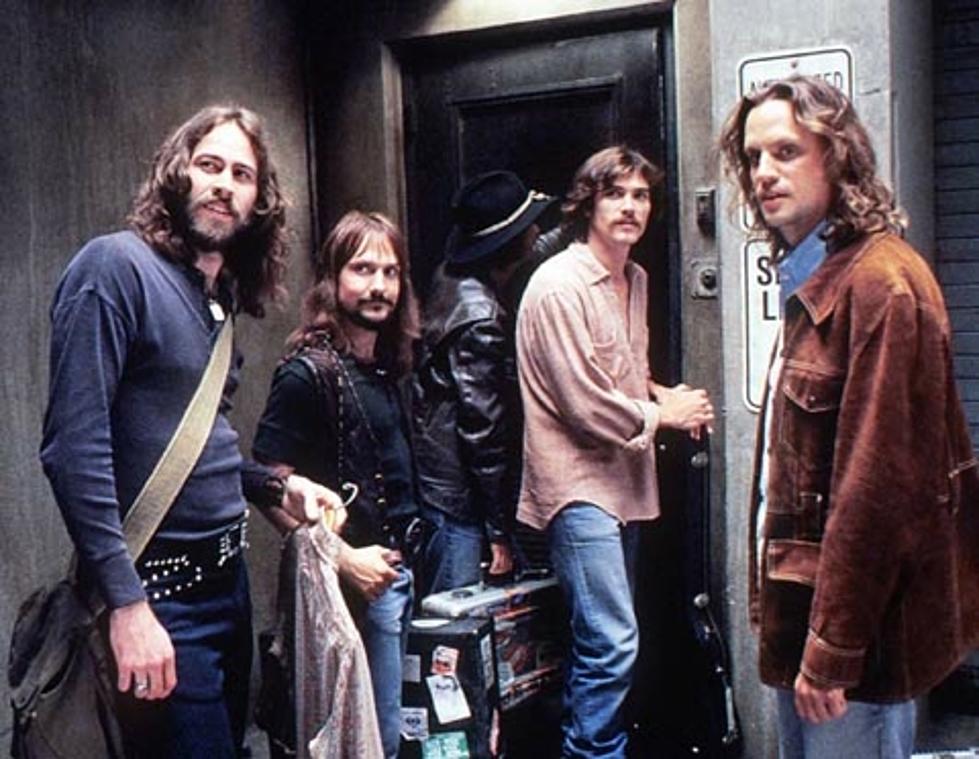
Number Four: Almost Famous” bus — Why does it have to be a house? Rock bands’ tour buses have places to sleep on them, right? Of course, for this one to work, you have to assume a little magic: The actors from the movie would all be there, too, and they would all be the same ages they were when the film was made in 2000. Well, Patrick Fugit wouldn’t be there, because the idea is that you, the paying guest, would be that character. But you’d see Russell Hammond and Jeff Bebe and the other members of Stillwater. And here’s the best part: You’d get to sit next to Miss Penny Lane! You’d all be on your way to the Riot House in L.A., which would be a long way away as you drive through Midwestern farm country. And all of you would be singing “Tiny Dancer” together.

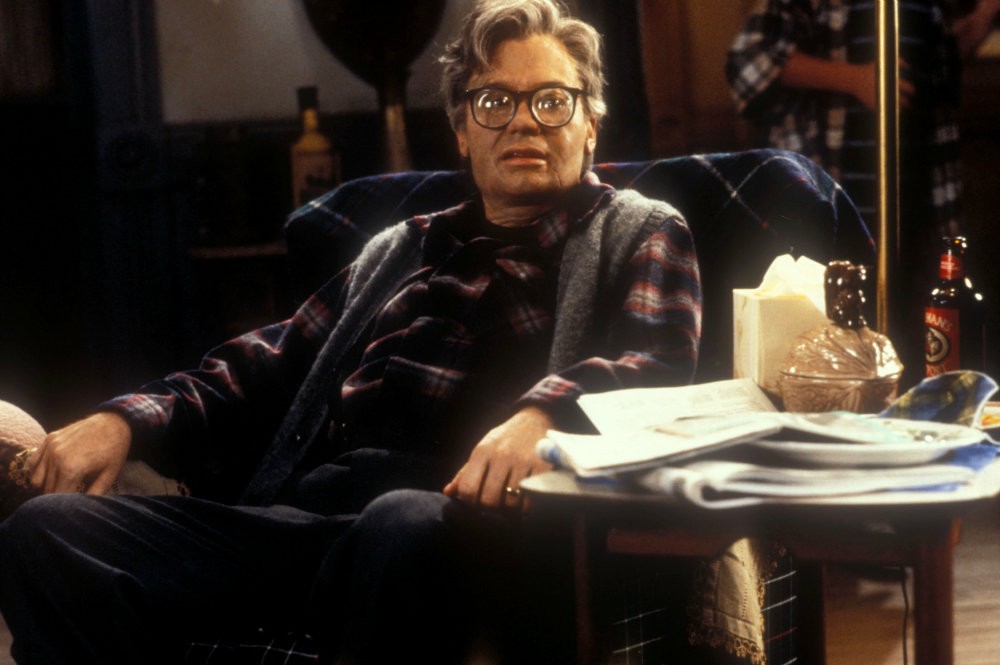
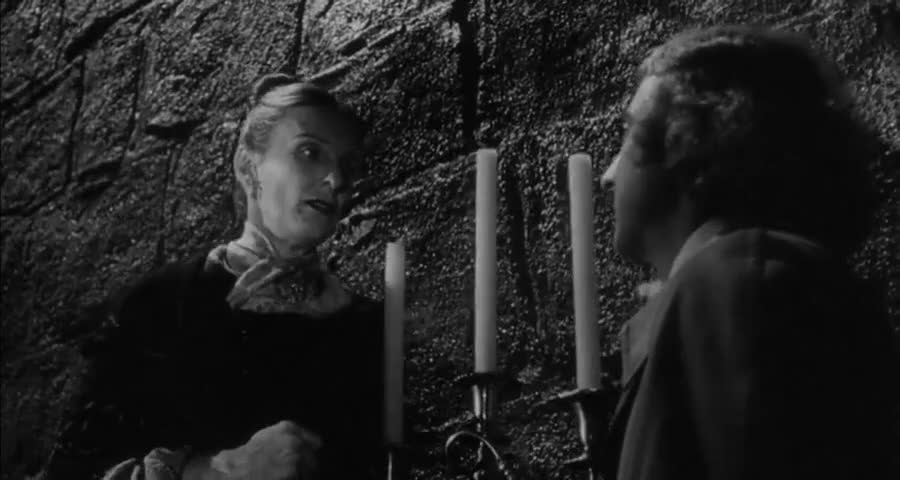
Number Three: Young Frankenstein” castle — As you approached your destination, Eye-gor would announce, “There wolf. There castle.” Assuming you wanted him to talk that way, which you would. You, of course, would be back in the hay with Inge. Once at the castle, you would be led to your chamber by the housekeeper, Frau Blücher (the horses outside all whinny loudly), carrying an unlit candelabra. She would warn you to stay close to the candles, for the stairs are treacherous. Then she would offer you Ovaltine before you retired. The fun would start when Inge came to your bed to wake you up from your Nachtmare, and the two of you would then follow the secret passage (“Put… the candle… BACK!”) down to the hidden laboratory, which would be filled with the actual, functioning equipment from the movie this one was lampooning.

Number Two: Cool Hand Luke” barracks — Hey, if people will pay money to be in a place where a horror movie was set, why not a prison? And you can have a lot of fun here, playing poker with your fellow guests for a cold drink. If you get tired of that, you can bet everyone you can eat 50 eggs. Why 50? It’s a nice, round number. Then, after everybody’s in their bunks, Dragline will keep you all awake by talking endlessly — in great, steamy detail — about “Lucille.” Speaking of the bunks, remember that clean sheets come on Saturday, at which time you put the clean sheet on the top, the top sheet on the bottom, and turn in the bottom sheet to the laundry boy. That’s a rule. There are a lot of rules, but don’t complain about it. If you do, that will be regarded as back-sassing a free man, and you’ll spend the night in the box. And you don’t want that.

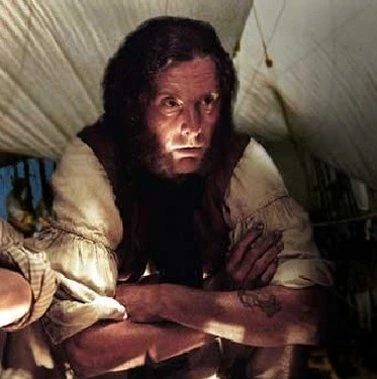
Number One: HMS Surprise — Really, I just wrote the whole post for this one, because it is truly the ultimate. And like the “Home Alone” house, the venue actually exists. The filmmakers adapted HMS Rose to look and sail exactly like Surprise herself, and with ol’ Boney dead and the war over, it’s probably available now. At the start of your experience, instead of being greeted by a video of David Arquette like in the “Scream” version, the real-life Killick himself (as portrayed by David Threlfall) will walk up to you, as ornery as ever, jerk his thumb back over his shoulder, and announce, “Wittles is up!” That will be the start of a magnificent feast featuring soused hog’s face, flying fish that just happened to land on the deck moments before, an unending flow of wine (“The bottle stands by you, sir!” the captain will say repeatedly), and some sort of pudding, maybe even Spotted Dick. And that’s just the start. Your stay won’t last a weekend, or even a week, but months and months, because you’ll be sailing to the Far Side of the World. And it won’t cost you a thing. In fact, you yourself will be paid — not much in wages, but prize money is guaranteed! When you catch up with the chase, the captain will give you a pep talk, then give the poor sods a broadside, and you’ll board ’em in the smoke — a pistol in one hand and a heavy cavalry saber in the other! And you can’t say fairer than that, can you, mate?

I look forward to your own ideas.
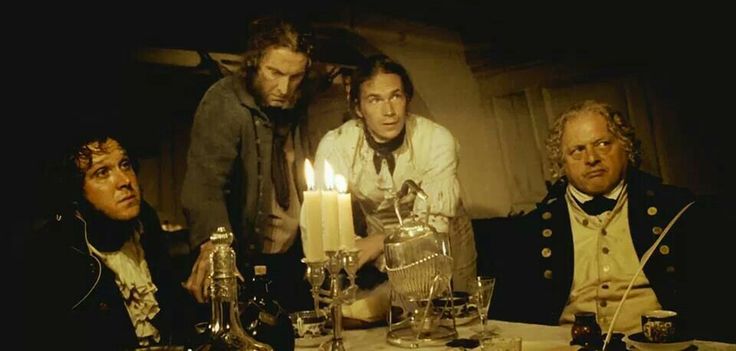
Some of your shipmates aboard Surprise. That’s Killick pouring the wine.

In the ‘before’ time, we just would not have known

The Op-Ed Page

Her Twitter profile image.

By Paul V. DeMarco
Guest Columnist

One of the benefits of growing older is that you remember when things were different. We now have adults who were born after 9/11. There is no “before” time for them, no frozen moment when they realized we were being attacked.

Similarly, the fact that Nicky Minaj’s tweet about – and if you haven’t heard about this, I’m sorry to be the one to break it to you – her cousin’s friend’s testicles will not strike people younger than a certain age as unusual. They don’t remember a time when it would have been impossible to know about said testicles.

But in the before time, say the mid-seventies when I was a teenager and began to be interested in the wider world, we received our news in aliquots. Like many of my contemporaries, I started reading the morning paper and watching the evening news. There was often a lag time between big news stories and when they were reported. This cuts both ways. In a hurricane, up-to-date news can be life-saving. But sometimes having hours to get a story straight before the presses started rolling provided readers a much clearer picture the morning after than could have been given the day of the event.

I have also experienced the sweet anticipation that is no more. If there was a ball game I had missed, I had three choices. Call a friend, stay up for the 11 o’clock news and hope it was mentioned, or wait for tomorrow morning’s paper (which is what I usually did). Then there was the reading of the box score trying to piece together the ebb and flow of the game.

I’m not suggesting we go back. I like my immediate highlights as much as the next man. But I know it wasn’t always so, and have a sense of the wonder of instant results – as well as a twinge of sadness for what we have lost.

I recently was given a new laptop for my medical record at work. The toolbar was set so that when I hovered over a certain icon in the bottom right corner, a news feed would appear. I found this infinitely distracting and disabled it. I can’t ponder the issues of the day while I’m caring for patients – my brain’s not big enough.

For me, the time for current events is while I’m getting ready for and commuting to work – and when I’m commuting back home.

For those that missed it, let’s review Nicky’s tweet from 9/13. In response to questions about why she did not attend the Met Gala, she reported that she had not been vaccinated. Then she tweeted the reason: “My cousin in Trinidad won’t get the vaccine cuz his friend got it & became impotent. His testicles became swollen. His friend was weeks away from getting married, now the girl called off the wedding. So just pray on it & make sure you’re comfortable with ur decision, not bullied.”

What I know, because I remember the before time, is that this third-hand, difficult-to-believe anecdote of questionable provenance should have only been shared by Minaj to her inner circle, i.e., people she actually knows and talks to. In the before time, the only way for her to publically disseminate such a dubious claim would have been during a live radio or television interview. My sense is that any editor or producer of a taped interview would have cut this story since it is so flimsy – and also possibly harmful. It may encourage some of her “stans” to eschew the vaccine.

In the seventies, the only print publication that might have carried this tidbit would have been the National Enquirer – along with rumors of celebrity breakups and the latest alien abduction.

Minaj did get plenty of pushback on Twitter (would that be “Tweetback”?), including “’My cousin’s friend’ is the start to a story that totally happened” and my personal favorite “when u get an STI and don’t want ur girl to know.”

But, to my young friends: None of us should know anything about this. Imagine you are a cub reporter, presenting this story idea to your news editor, Brad Warthen. Think of the many questions he might have for you: Have you talked to an infectious disease doctor to see if this has been a reported side effect? (Answer: If this ever happens, it’s exceedingly rare); Have you talked with the person in question? (Answer: No one, including the health ministry of Trinidad and Tobago, has been able to find him); How about a story on Beyonce? I’m more Beyhive than Barbz.

Paul DeMarco is a physician who resides in Marion, SC. Reach him at pvdemarco@bellsouth.net.

Oh, yeah? Well, YOU spelled your name wrong…

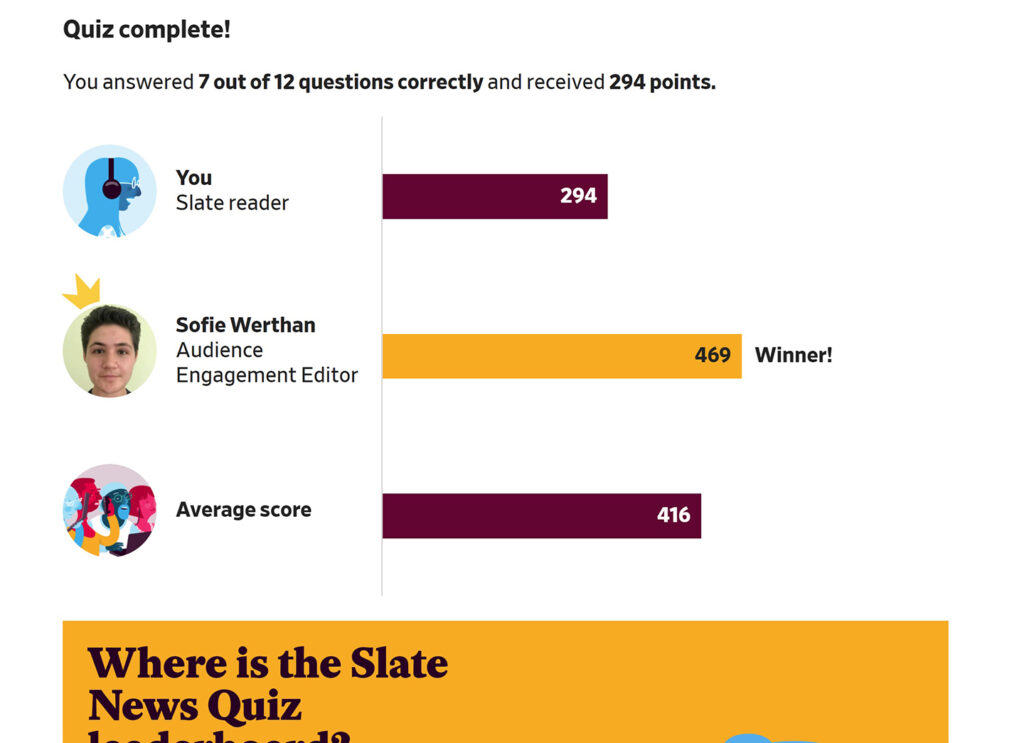
I haven’t been posting any scores from the Slate news quiz lately, for two reasons:

  1. I really don’t like the new format. Try it, and see what you think.
  2. My scores really, really suck. This may be because of my recent aversion to pretty much all the news I encounter, thereby causing me to read less of it. But that’s probably not all of it.

See if you can do better. Actually, I expect a bag of hammers could do better.

Even that kid they call their “audience engagement editor” did better. Way better. But I comfort myself with the observation that she doesn’t even know how to spell her own name. I mean our own name… whatever…

OK, now the shootings are happening too close

Maybe you don’t see a shooting in Collierville, Tenn. — a suburb of Memphis — as close, but in my family we do.

And not just because my wife is from Memphis.

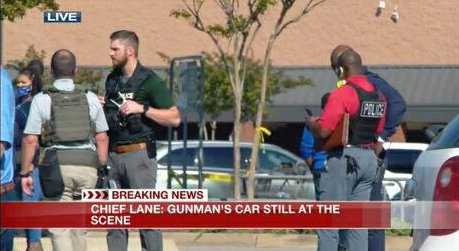
You see that picture above, taken from a TV news report? The tall guy with the beard is Kevin, our nephew — my wife’s brother’s son. He’s a detective with the police department of Germantown, right next door. Collierville had asked for help from surrounding towns.

Not only that, but his father, my brother-in-law, a retired businessman, was there as well — just not quite as much in the thick of things. He had shopped in that same store the day before. This time, he was passing nearby and saw all the cars with flashing lights headed in that direction, and followed so he could ask the gathering crowd what was happening.

He’s like that. He’s a very sociable, gregarious guy. He’s like his father. Several decades ago when we were in college, my father-in-law was in a bank when it was robbed and hostages were taken. He had always spent a lot of time when he visited that bank on business, talking with the tellers and other employees, asking them what was going on in their lives. In this case, being taken hostage with the other folks there, he ended up being drafted by the robbers to act as a go-between for communicating with the cops outside. They could tell he was the man for the job.

None of us were surprised. Alarmed, but not surprised. Fortunately, he emerged unscathed from the incident.

Anyway… how many of these mass shootings have we seen? And now, they’re getting too close. I’d like them all to go away now…

Hoots, mon! So now I’m even MORE Scottish?

The New Me: My latest ethnic makeover from Ancestry.

“They send you information. Mine just said, ‘Dude, you’re white. In fact, you’re very white. I hope you feel guilty…'”

Jim Gaffigan

Yeah, Ancestry has told me that from the beginning. On that one point their message has been consistent: “You are officially the whitest white boy at Bypass High. Don’t even think about trying to be cool.”

But beyond that, they can’t seem to make up their minds. I’ve written about this before. I need to stop complaining, I guess, because it just seems to irritate Ancestry, and they get vindictive.

But it irritates me no end, because after all this research, with 8,902 people on my tree (no, I am not making that up; guys like me are really uncool enough to amass something like that), I have noted certain patterns. And since I’ve traced almost every branch back to the Old Country, I can make this general observation: Most seem to come from England. Not all — there are a few here and there from Ireland, or Scotland — but mostly England. If I get on a lucky roll that carries me centuries back before their descendants came over here, some of those “English” people got to Albion from the Continent.

Now, I realize that this is grossly incomplete. I have records on the people who were in the dominant culture, and weren’t, like my obscure Irish ancestors, conquered (by, say, the English). If my Viking ancestors hadn’t come and conquered part of France and become Norman, and if they had not, as Normans, jumped over and conquered England, and if the English (really, the Norman ones) hadn’t conquered Ireland, maybe more French, Saxon and Irish people would show up on my tree, with complete records.

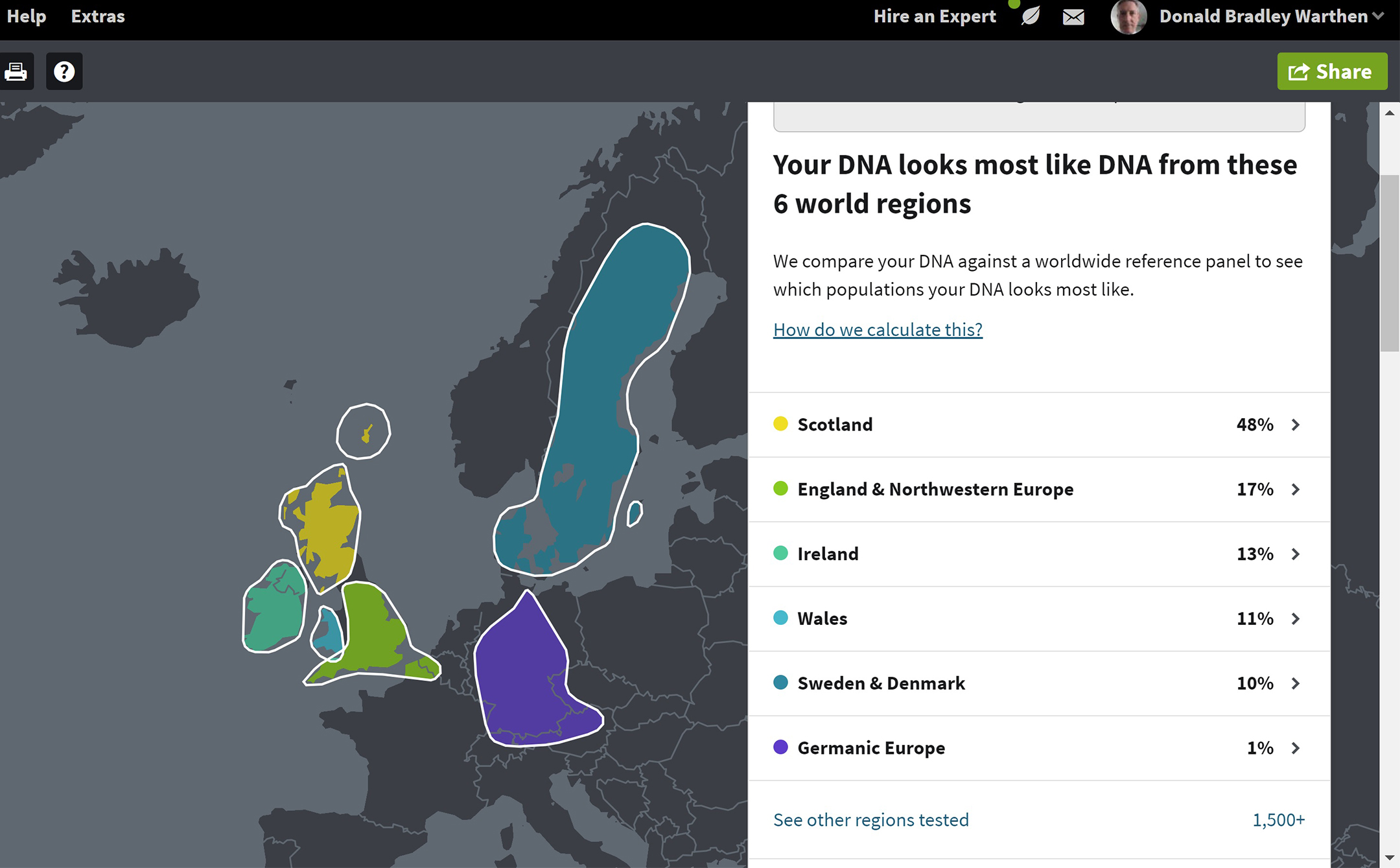
But still, based on the information I have, it seemed natural when Ancestry told me my DNA showed that 65 percent of my ancestors were from “England, Wales and Northwestern Europe,” and 29 percent were from Ireland and Scotland.

That was in 2019 (which was itself a change from before). Then a year ago, Ancestry said never mind all that. Really, you’re 40 percent Scottish, 24 percent Irish, only 17 percent from England and Northwestern Europe, and 8 percent Welsh.

Which ticked me off. Because it really shook confidence in the whole project. Really, that’s a pretty wild swing — or multiple wild swings. So I complained about it.

So Ancestry showed me. The other day, I got a new notice from them. Now, they say, I’m 48 percent Scottish, and only 13 percent Irish. I’m still 17 percent from England and Northwestern Europe, but slightly more Welsh.

So I guess I should just shut up, before they tell me I have to start wearing a kilt…

Stuart Mackenzie, my new role model, I suppose.

Time runs short to testify on redistricting!

The Op-Ed Page

By Lynn Teague
Guest Columnist

Time is running short to make your thoughts known on South Carolina’s redistricting, the process of adjusting our legislative districts to 2020 census data. The resulting maps will be in place for the next decade. Many citizens of South Carolina feel that they are not represented in the General Assembly or in Congress. Redistricting is a significant contributor to that. If a district has been distorted to make it “safe” for the incumbent, help make it better by identifying what you think should be considered in drawing districts.

Lynn Teague

Help ensure that legislators know about the important communities of which you are a member when they draw legislative districts. Do you want an S.C. House district that doesn’t break up your county or city? Do you want a House district that leaves your neighborhood or an area with a shared economic foundation intact? Do you want a Congressional district that meets Voting Rights Act requirements, but isn’t stretched out across most of the state to pack in every possible minority voter? You need to tell legislators about it now.

S.C. Senate hearings around the state have been completed, but the last few S.C. House hearings remain and are taking testimony relevant to Congressional and S.C. House maps. The House hearing schedule is posted at https://redistricting.schouse.gov/docs/Public%20Hearing%20Schedule.pdf. The last in-person-only opportunity for oral testimony was last night, Sept. 22, in Orangeburg.

There are now two meetings at which virtual oral testimony will be accepted. The first virtual opportunity is now scheduled for Tuesday, September 28, at 4:30-8:30 PM in the Blatt Building, 1105 Pendleton St., Room 110. The second is scheduled for Monday, October 4, at the same time and place. To sign up for virtual testimony on either date, email virtualtestimony@schouse.gov and specify the date that you wish to testify.

In addition, written testimony can be submitted to redistricting@schouse.gov.

Speak up, in whatever way you choose to do it! Redistricting may determine whether you have a meaningful vote when you go into a voting booth in November, and whether you have legislators who consider your interests and respond to your concerns.

Lynn Teague is a retired archaeologist who works hard every day in public service. She is the legislative lobbyist for the South Carolina League of Women Voters.

How about an ‘I ALREADY GAVE’ button?

I don’t mean to pick on Wikipedia here. I find it to be an amazingly useful tool, the handiest reference source to which I or anyone else has ever had access.

This is just something I wonder about sometime.

For instance, when I’m listening to the NPR One app. Not the radio, because the radio version can’t address the problem. But it seems that anything that comes to me over my phone, my iPad, my laptop, or any device to which I am logged in in a way that identifies me, should be able to leave me out of the “please donate” pitch, if I already gave.

So no more pitches that I’ve heard a thousand times urging me to give to South Carolina Public Radio. (Especially ones I’m forced to wait through — the app lets me click past a news story if I’m not interested, but that’s not an option during the begging segments.)

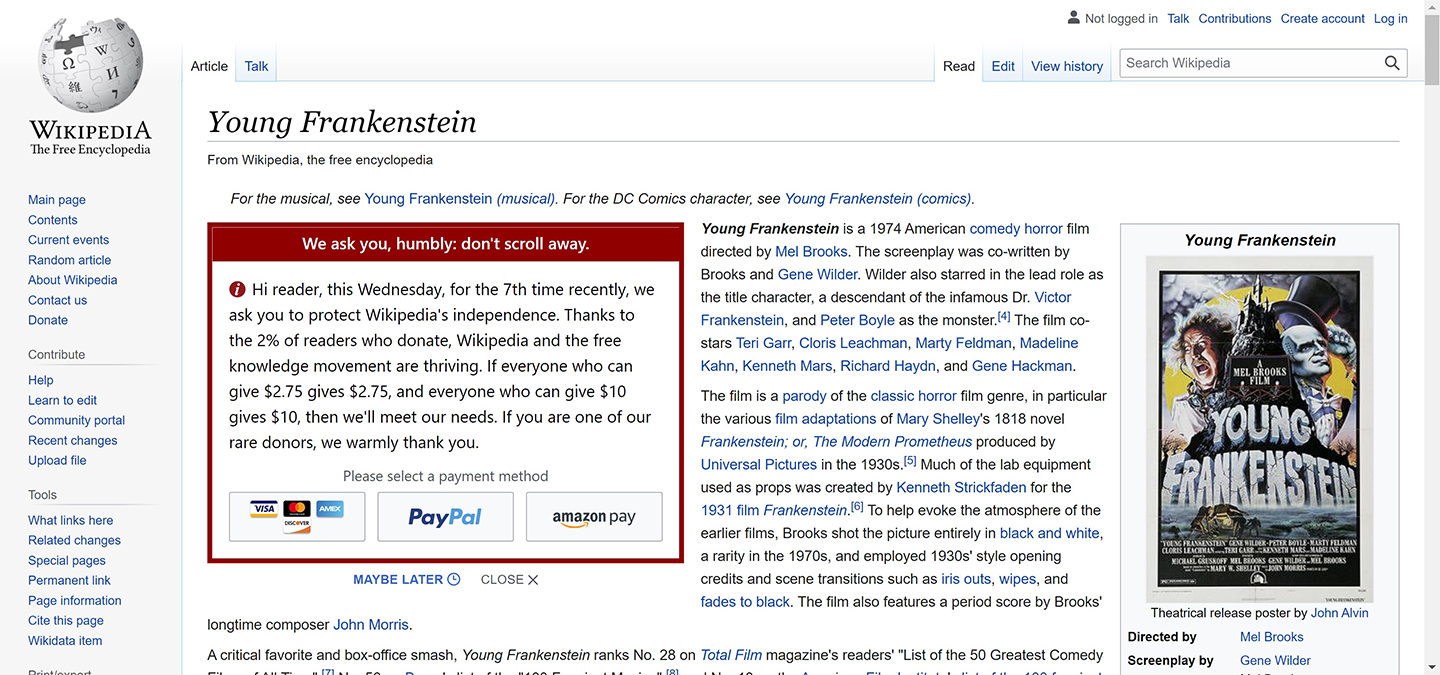
And, in the case of Wikipedia, no more having large portions of my screen filled with a fund-raising appeal when I look something up.

For you see, I am one of the 2 percent who give to Wikipedia. Oh, don’t think I’m topping it the nob or anything. It’s a pittance. But they said that’s all they need. Near as I can tell, I’ve been sending them $3.10 a month (although it’s not easy to find that out — I had to infer it from my bank account). I don’t know how I came up with that amount. It’s a money thing, which means five seconds after I did it, my brain had tossed out the information.

And for that wee bit, I don’t even expect thanks, much less a ticker-tape parade. But it would be nice if you would see that it’s me using Wikipedia on this Chrome browser through which I’m logged into my Google account (and all sorts of other things), and spare me the message. I wouldn’t even mind specifically logging into a Wikipedia account, if that would do it — as long as I only had to do it once.

Or, if you MUST show me the appeals, offer another button in addition to the ones that say “MAYBE LATER” and “CLOSE.” The new one would say, “I ALREADY GAVE,” and clicking it would make the box go away.

I mean, this artificial intelligence thing ought to be good for something, right?…

Gail Collins and Bret Stephens take on the Rabbit Hole problem

You ever read “The Conversation,” a weekly opinion feature in The New York Times? It’s very good.

It just consists of two Times opinion columnists — former NYT Editorial Page Editor Gail Collins and former Wall Street Journal columnist Bret Stephens — kicking around a number of issues of the day, and having fun doing it. Even more than that, enjoying each other’s company. (I use “company” loosely — I think what they’re doing is writing back and forth to each other via email or instant messaging. If they’re just talking and saying these things, they’re both even smarter than I take them to be.)

Even though one represents the “left,” and the other the “right.” More than that, they represent different generations — she is 28 years older.

Gail Collins

It helps that she is known for her sense of humor (not always a thing in great supply among former EPEs) and he is a particularly thoughtful never-Trumper. In other words, neither is a representative of what you see today screaming at each other from either end of the spectrum. She’s more of an old-school liberal than “woke.” He’s more of a Buckley-style thinking conservative than a troglodyte.

They do disagree. It’s just that they show us how civilized people disagree. That’s something we used to see all the time, but now it’s rare, and worth seeking out.

Anyway, I recommend the feature. I particularly enjoyed this week’s, in part because they touched upon the whole Rabbit Hole thing that I’ve spent so much time worrying about. An excerpt, as they were speaking of the collapse of consensus in the country:

Bret: Largely agree. There’s a small academic field called neurohistory, which uses neuroscience to help us better understand the distant past.

Gail: I love it when you expand my vocabulary. OK, “neurohistory” is my word for the day.

Bret: The field deserves more attention, because maybe the most important event of the past 20 years wasn’t how we changed the world, for better or worse. It’s that we created algorithms and digital platforms that scrambled our brains. The new technologies have shortened our attention spans, heightened our anxieties, made us more prone to depression and more in need of outside validation and left us less capable of patient reflection and also less interested in seeking out different points of view. It’s no accident that Trump’s favorite outlet was Twitter: The medium is perfect for people who think in spasms, speak in grunts, emote with insults and salute with hashtags.

Gail: Probably the biggest transformation since America got national mail service and people suddenly learned what folks in other parts of the country were really thinking….

A lot of people worry about whether our republic — or other Western-style liberal democracies — will survive. Well, this is the biggest reason it’s endangered. (You can make a case, of course, that the problem is rampant stupidity, but what we’re talking about here is the cause of that cognitive dysfunction.) Stephens takes it to another level, and questions the ability of our whole species to survive the Rabbit Hole, although he doesn’t use the specific term.

Bret Stephens

I think he’s right. We’re in a cognitive crisis. Technology has gotten way out ahead of our brains’ ability to evolve to deal with it constructively.

Ms. Collins disagrees, as is her wont. She basically says, Hey, kid, you don’t remember when things were really bad. After all, she remembers (better than I, since she’s eight years older) living in a country in which, for instance, racism actually was systemic.

But I think on this one Stephens has the stronger point. In any case, it’s enjoyable to watch while they kick it around, as usual. In days such as these, it’s balm for the soul to witness this sort of disagreement.

Top Five Social Media I Hate (Personally)

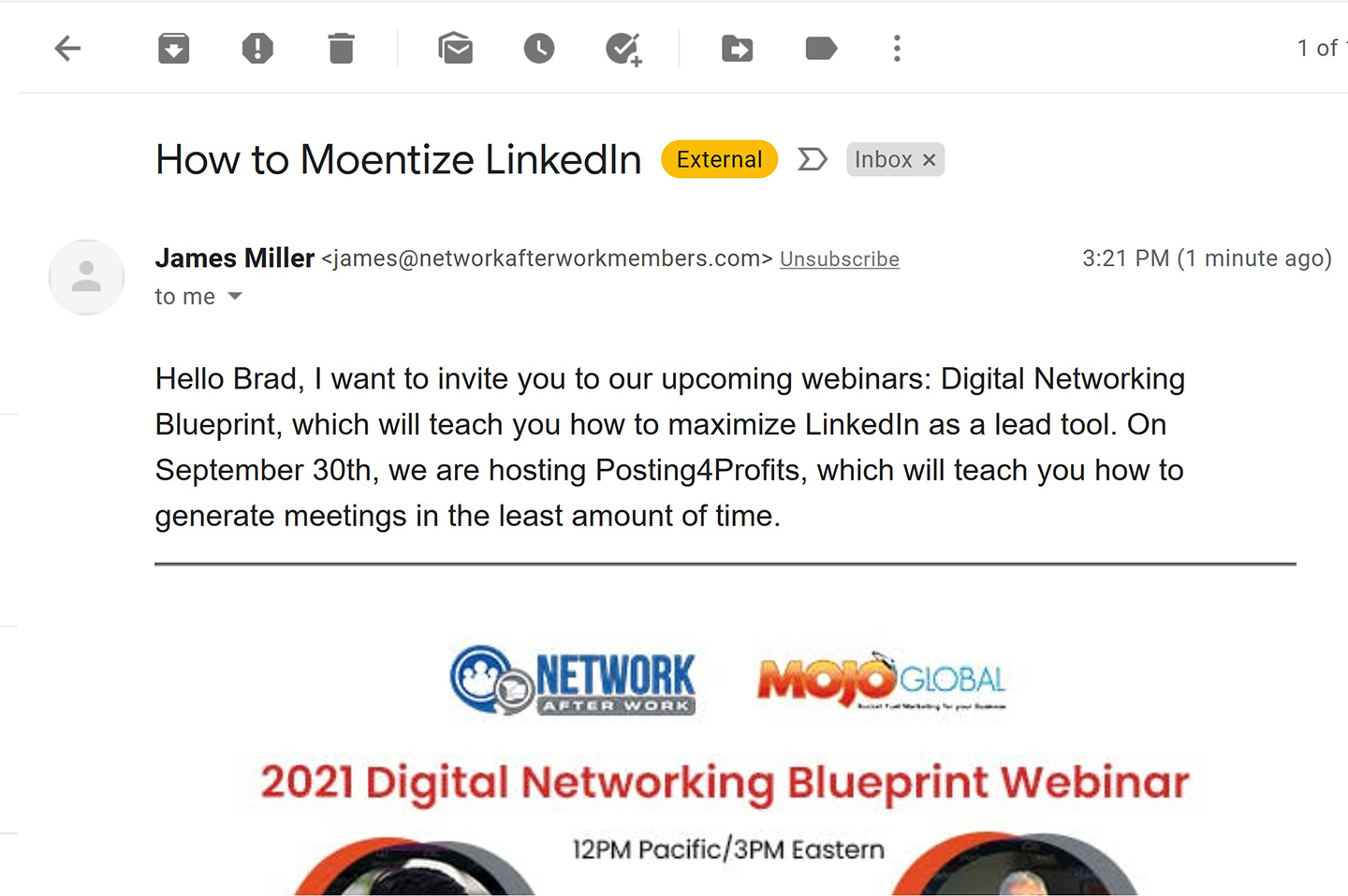
The above is an email I got today. My reaction was, “LinkedIn deserves to be ‘moentized,’ far as I’m concerned. I may moentize it myself, next time I see it…”

We’ll talk another day about people who send out such emails, and are so careless with their headlines. Today let’s stick to LinkedIn, shall we? I hate it.

Which inspired me to write this quick-and-dirty list of social media I hate. And when I say “quick and dirty,” I mean even quicker and dirtier than the sloppy one about the Top Songs earlier.

I think I spent way less than one minute coming up with the five. Which is fitting, when writing about social media, don’t you think?

Anyway, here’s the list. Note that this is a personal list. I have to deal with some of these professionally, and in truth for many in business something like LinkedIn actually is useful, and I often help people make it more useful to them. But for me, I don’t get much out of it. This is partly because I’m not at a point in life when I’m trying to a) get a job or b) build a career. In other words, this is not business; it’s strictly personal:

  1. LinkedIn — Years ago, a colleague persuaded me to sign up for this, because it was the “professional Facebook,” or something like that. Not long before that, someone had persuaded me to sign up for Twitter, and I had loved that, so why not give this a chance, too, I figured. Also, I was briefly persuaded that in my post-newspaper career, I needed to be on LinkedIn. I no longer am. In fact, I haven’t been for years. Persuaded, I mean. Maybe y’all can argue me into believing again that it serves a purpose to me. Have at it.
  2. Snapchat — OK, I think maybe this feature has changed, but I’m not going to look it up, because I don’t care. I mean the feature that anything you posted there would soon disappear. This was touted as a feature rather than a flaw, which means it was being pushed to people who were stupid enough to post, on the internet, things they did not want other people to see. Here I was, glorying in the fact that anything posted on the Web could stay there forever (unless one’s blog disappeared), meaning that I would never in my life have to type or copy or in any way again publish the “background” we used to have to put in news stories — all you had to do was link to the old material, because it wasn’t going away! That was possibly the one most wonderful thing about the Web. And these people were giving it the finger. So I hate it.
  3. Instagram — It’s about pictures, and yet you can’t right-click and save a picture from it. How stupid and pointless is that? I can grab pictures, if I need them, from anywhere else. But not from here. Which I realize is intentional, and that irritates me no end. I’m responsible with pictures, and careful not to use them if I don’t have permission to do so, within the boundaries of Fair Use. (Ask Paul DeMarco.) So I stay away from it.
  4. Reddit — Listen, I know a lot of intelligent people who really like this medium. But I don’t, because I don’t understand it. I’ve tried using it, and couldn’t find any reason way in which it was a helpful or useful tool, and decided I didn’t understand it. Which meant the people who love it must be smarter than I am. And what do I think of a social medium that shows me other people are smarter than I am? I hate it.
  5. Facebook — It’s a little weird that this is only No. 5 on my list, because I’m sure that I say “I hate Facebook” more than I say I hate all other social media combined. But that’s just because I deal with it that much more. So does everyone, because it is by far the most ubiquitous. And one of many reasons it’s so dominant is that in many ways it is useful. Like for sharing pictures and news with a group of friends and relatives. For instance, one branch of my family has a members-only group from which I’ve gotten lots of great old family pictures for my tree. And Facebook does that better, and more conveniently, than most other instruments. Of course, if you start using FB as your sole Source for News and All Knowledge, it will mess you up. But that’s your fault. So really, I just occasionally dislike it fairly strongly, and other days enjoy what I get out of it….

Of course, there are other social media I love, even as I see their profound flaws and worry about the Rabbit Hole phenomenon. Those include Twitter — use it responsibly — and YouTube.

Then there are in-between social media — such as Pinterest. I go surf through it occasionally, and it intrigues me, but I can’t shake the feeling that it could be so much better

DeMarco: What Trump Could Have Learned From 9/11

The Op-Ed Page

Photo by Andrea Booher/ FEMA News Photo

By Paul V. DeMarco
Guest Columnist

We’ve just marked the 20th anniversary of one of the worst days in American history. We remember the horror and heroism of that day and all those we lost. We also recall the strong sense of unity that Americans showed in the aftermath of the attack: the countless Americans who gave blood, held vigils, and supported the grieving. Over the next several months, our national mood gradually returned to a bickering normality as the divisions that we had put aside resurfaced. But many of us recollect with pride how we as a nation responded to that dark day.

In the winter of 2020, Americans became aware of another assault, not as sudden, but one we quickly realized would dwarf the number of casualties from Sept. 11. COVID was a second attack on the homeland. It could have been framed as such by our President Trump and used to galvanize the nation.

To be fair, George Bush had it easier than Trump. All of us over a certain age can tell you where we were on 9/11. Few of us can remember where we were when we first heard the word “COVID.” But the difference between the men is that Bush responded quickly to solidify the national moment. The image of him with a bullhorn exhorting weary first-responders as they sifted grimly through the rubble at Ground Zero is iconic. “I can hear you! The rest of the world hears you!” he told them.

The COVID pandemic, of course, did bring us together in many ways. The images of medical teams clapping for COVID survivors being wheeled out of the hospital, neighbors banging pots and pans to celebrate healthcare workers, and nurses with tears in their eyes after losing COVID patients have created a sense of shared struggle. Too many of us have a mental scrapbook of the family and friends we have lost. Mine includes three of my patients. For more than a year and a half, we have been arranging our lives around the virus, caring for one another, and grieving together.

But the unity we have shown during COVID has been despite Trump, not because of him. He had several opportunities for an “I can hear you” moment, but he missed them all. He initially tried to wave away the pandemic and then downplayed its seriousness. Despite the bubble in which he exists, he managed to contract COVID. And because he spent years denigrating the mainstream media, many of his supporters ignored medical experts’ advice to wear masks and get vaccinated.

When he was hospitalized, the nation held its breath. Fortunately, he recovered quickly and returned to the White House after only three days. He released a video that evening in which he could have changed course and brought us together. Here was a moment to trumpet American exceptionalism. What if he had said “I’ve been too cavalier about the coronavirus and I paid for it. I might have died like so many other of my fellow Americans. If a president can end up in the hospital, so can you. Even if you are young and at low risk, take precautions for the elders in your life. Let’s demonstrate American greatness by ending the pandemic quickly.”

But instead he rambled. He minimized. He talked about what a good leader he was. The line that made the headlines was “One thing that’s for certain: don’t let it dominate you. Don’t be afraid of it. You’re going to beat it.”

In the subsequent 11 months, approximately 400,000 Americans have died.

Another misstep in Trump’s messaging was his failure to publicize his own vaccination. Many high-profile politicians including Mike Pence, Joe Biden, and Kamala Harris widely distributed images of their vaccinations, as did a host of athletes, musicians, and other celebrities.

Donald and Melania Trump were vaccinated sometime in January prior to leaving the White House, and released no photos. This is surprising since Trump’s Operation Warp Speed was a spectacular success. It was the Manhattan Project of public health, something about which Trump and all of America can be proud. Our nation’s ability to simultaneously develop and produce a vaccine saved precious time and countless lives.

But Trump has undercut the success of Operation Warp Speed by his half-hearted endorsement of the vaccine. Since losing the White House, he has continued to send mixed messages. At a rally on August 21 in Cullman, Alabama, he was booed when he suggested that the crowd get vaccinated. He quickly backpedaled. “You’ve got your freedoms, but I happened to take the vaccine.” In an interview with the Wall Street Journal published on Sept. 3, he said he “probably won’t” get a booster shot.

We will never know how much better it could have been. A different approach by Trump, or a different president, could have prevented much suffering. In an interview with Bob Woodward on Feb. 7, 2020, Trump indicated that he knew early on how deadly the virus was but didn’t want to stoke panic. That was a grave miscalculation. Unlike Bush, he underestimated the American people, and for his lack of confidence, we have paid dearly.

Paul DeMarco is a physician who resides in Marion, SC. Reach him at pvdemarco@bellsouth.net. A version of this item previously appeared in the Florence Morning News.

A slapdash ‘Top Ten (plus) Songs of All Time’ list

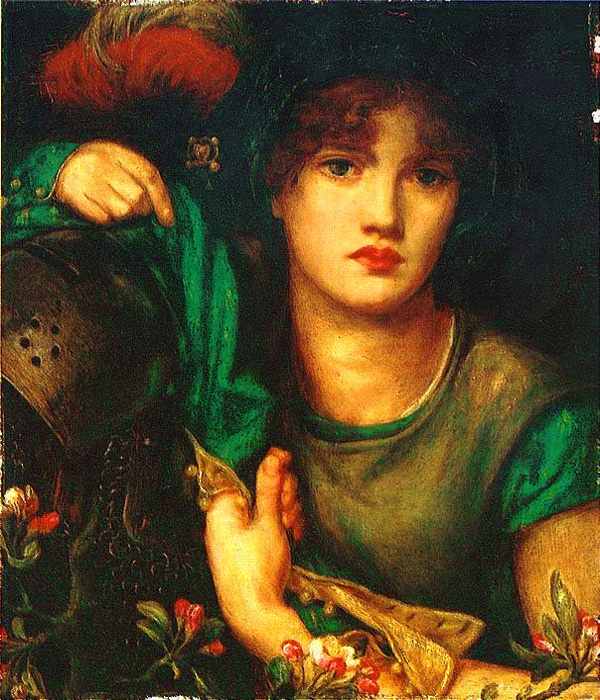
A Pre-Raphaelite take on “Greensleeves”…

Just to start a conversation…

I mean, a serious Top Ten Songs of all Time would take years to think through and put together, and even then I’d probably hesitate to publish it without lots of caveats, protesting my own ignorance and forgetfulness. How do you construct such a list and have confidence in it?

Think about it. I doubt that any of us would even be familiar with a tune dating back before, maybe, the 9th century (see my list below). And surely there was something catchy going on somewhere in the Roman Empire — not to mention the many thousands of years homo sapiens was kicking around before inventing writing. Some caveman might have had a great groove going on around the campfire (assuming fire had come along).

Because “all time” is a long time.

But even within my own lifetime, I’m sure that if I tried to do it, within five minutes after posting, I’d remember something I’d forgotten. And then I’d remember something else.

Nevertheless, I’ve been thinking about doing such a list for awhile, and I was reminded of that notion today when I saw this tweet, shared by our own Bryan Caskey:

Bryan had replied, “Rolling Stone Magazine is just trying to stay relevant and avoid relegation into the lower tier.” (I sort of wondered what he meant. What about that list made it “relevant?” And relevant to whom, in what context?)

In any case I jumped in, criticizing specifics: “Seems like they’re trying a bit too hard to ‘take care of TCB,’ to cite a painfully redundant phrase I heard somewhere. And ‘Like a Rolling Stone?’ I’m not sure that would even make a list of top ten songs by Dylan alone…”

I was overreacting a bit. That probably would make a Dylan Top Ten. But fourth best song of all time, by anybody? Come on…

Anyway, here’s the Rolling Stone list.

And now, my own slapdash effort. I’m just going to throw a bunch of songs out there, with some of them being representative of several other songs I might have chosen in the same category. And to save time, I’m not going to worry about paring it down to 10, much less my usual five, because that takes extra work. Note that these are all popular songs; I’m not trying to be all arty with you. (You may argue that Veni, veni, Emmanuel is sacred plainchant — or something like that; I’m no expert — but I will say it had to be really popular to last 12 centuries.)

Oh, and I’m not ranking them, just listing sorta, kinda chronologically. Here we go:

  • O Come. O Come, Emmanuel” — If you’d perused the charts back in the 9th century, you’d probably have known it as Veni, veni, Emmanuel. Definitely my favorite hit from before the Norman Conquest. And I guess it’s the oldest song I know — or the oldest that I know is that old. The Church plays this a lot during Advent — it’s sort of the Advent song. But they never quite play it enough for me.
  • Greensleeves” — Or, as it was known when published in 1580, “A Newe Northen Dittye of ye Ladye Greene Sleves.” As you probably know, Shakespeare mentioned it. I first heard the tune myself when I went to see “How the West Was Won” as a kid. Now, I usually hear it at Mass in the weeks after Advent ends, as “What Child Is This?” Whatever the lyrics, it’s an awesome tune. So congratulations, King Henry. This was your one chance to make the list, and you did it! (Just kidding.)
  • La Marseillaise” — This is the only national anthem on the list, I promise. I love our own, and “God Save the Queen,” and the Russians have a nice one. I can even say positive things about “Deutschland über alles” (or, as it is correctly called, the Deutschlandlied — but we don’t usually call it that because it’s a lousy song name). But I think the French take the prize in this, if in nothing else. If you doubt the song’s power, go watch “Casablanca” again.
  • Lorena” — There were a lot of hit songs during the Civil War, but of all those Ken Burns weaved so artfully into his TV series, I find this one most appealing. It predated the war, but during the fighting it was huge among both the blue and the gray. Here’s a version with words.
  • “I’ll Be Seeing You” — Same here. Written in 1938, but during the war, this one most powerfully captured the yearning of so many millions to be back with their loved ones. One of the most wistful songs ever.
  • Hard-Headed Woman” — Had to get in some Elvis P. This one was my fave when I was about 3 (the year it came out), and I’m just going to keep it there. It’s special because it represents a certain category in my mind, which is songs that really rock out, no holds barred. You could say the same about “Tutti-Frutti,” or maybe another Little Richard track such as “Good Golly Miss Molly.” Creedence made a solid entry in the class with “Traveling Band.” But this is my favorite. When I was a kid, I definitely had a favorite line. I used to go around saying, “You better keep your cotton-pickin’ fingers out my curly hair…” Oh, and if you like some Wanda Jackson, here you go.
  • Summer Wind” — I’m also making a special effort to get in some Sinatra, and to me, this one blows away all the others.
  • Yesterday” — OK, I’m being hard on the Beatles here, only allowing them one song. Especially hard on Lennon, since as even he admitted, he had nothing to do with this one. If you want to be kinder to John, you can substitute “You’ve Got to Hide Your Love Away” or maybe “In My Life.” If I spent years working on this list, really did the homework and the sweating, I might end up with more than one Beatles song on the list, but this one will have to represent the rest.
  • Just Like a Woman” — My answer to Rolling Stone including “Like a Rolling Stone.” Yes, that’s very emblematic of him, but it’s easy to name a bunch of his works that are simply better songs, no doubt about it. And if you don’t think this is the best thing from “Blonde on Blonde,” I’ll allow you to substitute “Visions of Johanna.”
  • Soldier of Love” — This me pulling a real Barry (from High Fidelity) move, going with a pop song that’s sort of esoteric. I loved it when I heard the cover of it on “The Beatles on the BBC,” but I think I might have enjoyed the Pearl Jam cover even more. In fact, I don’t think I’ve ever even heard the original, whoever did it. (Oops, found it.)
  • Mas Que Nada” — If you want to evoke the 1960s in the mind of someone who actually lived through them, you’ll play this perhaps even more readily than something by the Beatles or the Stones. That’s what Austin Powers did, and it worked. Coming from me, it also represents my love of samba music from that era. So you could also have chosen “One-Note Samba,” “Desafinado,” or the ultimate standby, “The Girl from Ipanema.” For that matter, just get Astrud Gilberto to sing anything, even if not samba, and I’ll be happy.
  • Green Shirt” — My official Elvis C. entry. Again, could have been any number of others, but we love this one down at the Quisling Clinic.
  • Hallelujah” — I’ve raved about this a number of times in the past, but I tell you — this Leonard Cohen masterpiece would probably make the Top Ten list even if I spent the rest of my life on it.
  • Creep” — Wanted to get in something good from the early ’90s — the very last gasp of rock music — and probably would have been happy with something from Weezer or Green Day, but for now this will do. The boys from Abingdon did a great job on this one. And if you’d like a fun cover, here ya go.
  • Hey Ya” — Here, I’m just being perverse by including one song from the Rolling Stone list. It was the only pick that I found at all original or thoughtful, and I’m sure Barry would say the same. So I’m throwing it in. It ain’t “Greensleeves,” but it’s catchy.

Yeah, that was 15. I just didn’t want to do the sweating necessary to get it down to 10. I look forward to seeing y’all’s lists. And remember, “all-time” doesn’t just mean, you know, when you were in high school…

‘This Murdaugh case is like something out of ‘The Bay'”

I had not really been following the Murdaugh case, although practically everyone who still works at The State seemed to be doing so, in their professional capacities, over the last few months. I skimmed the headlines, and there were a lot of those, so I sort of knew the gist of what had been happening before it got even crazier this past week or so.

How crazy? Well, I missed a call last night at 11:37 p.m., then listened to the voicemail this morning. It was from a night editor at The New York Post. They wanted to see if I’d cover a hearing for them today in the Murdaugh case. I’m still on their stringer list, going back to that time when I “covered” Mark Sanford’s return from Argentina back in 2009, right after I left the paper. I put “covered” in quotes because all I did was take notes at the notorious marathon presser at the State House, while someone in New York wrote the story from watching it on TV. I was just an excuse for them to put a Columbia dateline on the story. But they generously gave me a byline, under the modest, understated headline, “LUST E-MAILS OF BUENOS AIRHEAD.” As Dave Barry would say, I am not making this up. Anyway, friends of mine in New York saw it, and brought it to my attention. Time has passed, but I’m not sure I’ve lived it down yet. Sigh…

Anyway, I said I was busy — which I was (a second Post editor called me this morning as I was taking my Dad for a medical appointment) — and wished them luck in finding someone.

But I wasn’t writing about that; this is about the Murdaugh case.

Wait, another digression… Any of you ever watch the Britbox streaming service? It’s pretty good. My wife and I have been enjoying it for about a year now. Anyway, the last couple of weeks we were watching both seasons of “The Bay.” It’s a Brit cop show built around a woman who is a family liaison officer with the police department in Morecambe, Lancashire.

Each full season — or as the Brits would say, “series” — tells the highly involved story of a single case. The second “series” is about a lawyer who is shot and killed at his own home in front of his young son. Then, as the protagonist Lisa Armstrong works with the victim’s family during the investigation, things get really complicated. Documents are found that indicate problems at the family law firm. Relationships among members of the family turn out to be unbelievably tangled, suggesting a number of reasons why the attorney was murdered. Someone else — actually, a main character on the show — is killed along the way. It takes every episode just to lay it all out.

So when my wife said the other day, “This Murdaugh case is like something out of ‘The Bay’,” I nodded. Because it is. Except, more people die in this real-life story.

And here’s what’s interesting about that — to me, if not to you. Often, when we’re watching another one of these tangled mystery stories — not just “The Bay,” but all of them, with bodies falling left and right and everything so mixed up you have no idea whodunit — I observe with a knowing tone that murder in real life isn’t like this.

Murder in real life is more like… Well, I remember one from many years ago in Tennessee. One drunk shot another drunk during an argument over what to watch on TV. I remember that one not because it was so remarkable, but because it epitomized the kinds of homicides you usually see — just a straightforward, disgusting mess. No mastermind carrying out a meticulous plot. Just someone who was so obvious a kindergartener could solve the case. Except you don’t even need the kindergartener, because the killer so often confesses. Even when it’s in the first degree.

Anyway, that’s the kind of killing I generally covered during my brief time as a reporter, more than 40 years ago back in Tennessee.

But the Murdaugh case isn’t like that. It’s more like the ones on TV. And we’re all still waiting for the answers to the biggest questions, as if we were on the next-to-last episode of a season of “The Bay,” or “Unforgotten.”

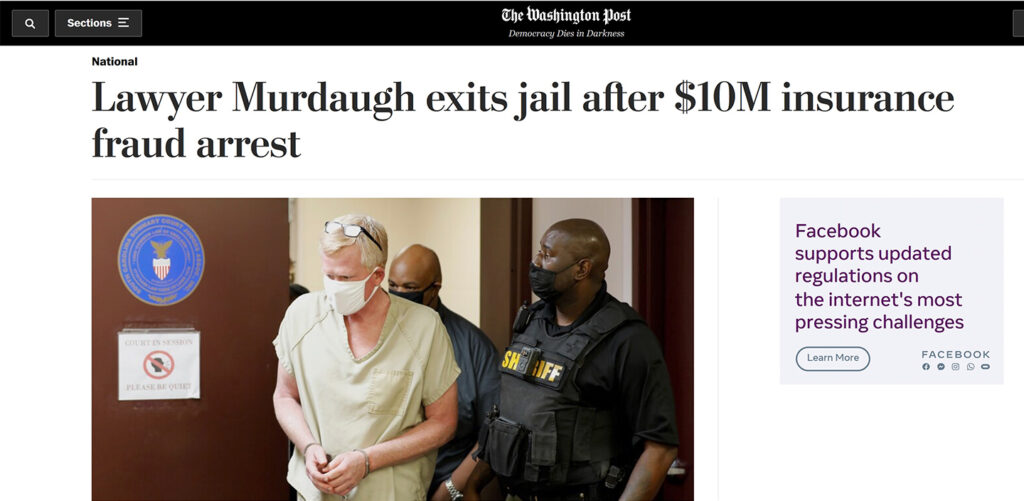
And that’s why the whole country is riveted. By the way, if you’ve been ignoring it much as I had been until now, it’s kind of handy to read the accounts today in national newspapers, because they have to touch on all the main episodes in the story. Here’s the one in The New York Times, and here’s the one today in The Washington Post

Just like a TV mystery. Except, of course, that it involves real people, our neighbors. I don’t know the Murdaughs, but I know people who know them. I know one of Alex Murdaugh’s lawyers, for instance, as do many of you.

And for months, I refused to be entertained by the horror visited upon this family and the people around them. I refused to be a riveted consumer of a latter-day penny dreadful. A made-up story on TV is one thing. This is entirely different.

But it’s become rather difficult to ignore, hasn’t it?

I think we’re back up and running…

It was a… complicated process. I mean the process of getting from there to here. (Maybe when I’m not so tired I’ll tell you about it, if you care. Which you probably don’t.)

How about giving it a try? See if you can leave a comment. On whatever you’d like. Comment on Rube Goldberg, if you like.

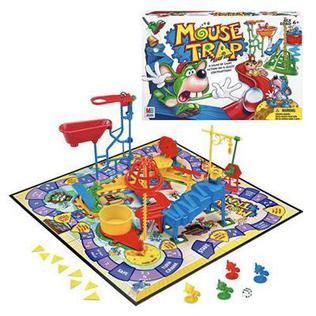
Or we could talk about that Goldberg-inspired game, Mouse Trap. Ever play that? I loved it when I was a kid, and then later when my kids were kids. (I need to break it out for my grandkids now!)

Anyway, once we have all the kinks out — and I think we’re about there — I’ll get back to actual, serious blogging. Or semi-serious. Perhaps seriocomic. Whatever…

The blog is dead; long live the blog!

At least, I think the old blog is dead.

I’ve got a new one up and running, but problems with it remain.

Please bear with me…

If you’d like to try to post a test comment, go ahead. I don’t know what will happen.

I would ask you to email me if you have trouble, but my email isn’t working, either — possibly because it uses the blog domain name. Or something. Anyway, see you later. I hope…

UPDATE: My email’s working again, and the URL is corrected on the blog, but there are still some major problems. If you’ve tried to comment, I assume you’ve failed. I’m working on it…

Let’s talk about ‘sex work.’ Or rather, let’s not…

No, that’s not just a cheap bid to attract readers who think there will be pictures…

Lately I’ve been gathering threads for a thus-far ill-defined post I want to write. It would be a Top Five post (maybe). It’s about words I’ve heard too much lately, and that need to be sent somewhere (very far away, in some cases) for R&R. But sometimes it’s phrases. And sometimes the words (or phrases) should never have been coined. Other times they’re perfectly fine words (or, as I say, phrases) that have simply been overused — or misused — recently.

Anyway, while I’ve been diddling trying to figure out how to define the post, someone went ahead an wrote an op-ed for The New York Times addressing a term that should never have been conceived, and which is also terribly overused. As soon as I saw it, I thought, Yes! That needs to go on the list! But while we wait for me to get around to it, let’s look at this…

The headline is “OnlyFans Is Not a Safe Platform for ‘Sex Work.’ It’s a Pimp.” Well, I don’t know what “OnlyFans” is, beyond some recent headlines about it. What interested me was that “Sex Work” was in quotes, and that drew me in, and I was not disappointed. An excerpt:

We are living in the world pornography has made. For more than three decades, researchers have documented that it desensitizes consumers to violence and spreads rape myths and other lies about women’s sexuality. In doing so, it normalizes itself, becoming ever more pervasive, intrusive and dangerous, surrounding us ever more intimately, grooming the culture so that it becomes hard even to recognize its harms.

One measure of this success is the media’s increasing insistence on referring to people used in prostitution and pornography as “sex workers.” What is being done to them is neither sex, in the sense of intimacy and mutuality, nor work, in the sense of productivity and dignity. Survivors of prostitution consider it “serial rape,” so they regard the term “sex work” as gaslighting. “When the ‘job’ of prostitution is exposed, any similarity to legitimate work is shattered,” write two survivors, Evelina Giobbe and Vednita Carter. “Put simply, whether you’re a ‘high-class’ call girl or a street walkin’ ho, when you’re on a ‘date’ you gotta get on your knees or lay on your back and let that man use your body any way he wants to. That’s what he pays for. Pretending prostitution is a job like any other job would be laughable if it weren’t so serious.”

“Sex work” implies that prostituted people really want to do what they have virtually no choice in doing. That their poverty, homelessness, prior sexual abuse as children, subjection to racism, exclusion from gainful occupations or unequal pay plays no role. That they are who the pornography says they are, valuable only for use in it….

Yes, absolutely.

After that, the piece goes on to discuss the thing in which I’m not interested, OnlyFans, but along the way it makes some good points about pornography and, of course, the absurd euphemism “sex work.”

As with so many fashionable neologisms, we can do without that term because the English language already has a perfectly serviceable word: “prostitution.”

Yes, I know what my libertarian friends will say. And I’m familiar with the views expressed by this movement. (It takes a lot of attitudes to make a world, and some are induced by something akin to Stockholm Syndrome. By the way, in keeping with my mania for genealogy, I even have a distant cousin who famously underwent such a process.) And perhaps I’ll be harrumphed at by “sex-positive feminists.” But in general, I’m curious what the rest of you will say…

prostitution copy

By the way, looking for an image that did not titillate, the NYT went with this. Determined to outdo them, I went with the above, from a link in the op-ed. So I win…

Hey, y’all, the whole blog is about to disappear!

Uhhhh... say WHAT?!?!

Uhhhh… say WHAT?!?!

That is, unless I do something. I’m not sure what yet…

Today has not been a good day. I had just been talking to my wife about how three things had happened in my world today already that caused great consternation to various people, and every one of them had seemed like someone who thought there wasn’t enough trouble in the world had gone out of his or her way to create the problem. Not that they had meant to do it; it just seemed like it, and it was weird how similar these unrelated problems were in that regard.

I’m sure you’ve had days like that. Anyway, other folks affected and I were staggering along trying to deal with these things and keep going, and then came a fourth in the series.

The first three are none of y’all’s business, but I’m going to share the fourth with you, because all of you have shown some degree of interest in this blog, so it kind of affects you:

Important information about the closure of WebFaction

Dear customer,

We’re getting in touch regarding your ‘bradwarthen’ account with WebFaction.

As previously communicated WebFaction is closing down on September 15th.

Before this time you need to ensure any sites, services, applications, email addresses
and domains (including NS records) are either migrated away from WebFaction to your new
service provider or you have made local archive copies outside of the WebFaction systems.

Please also make sure you have copied all relevant account information from WebFaction
that you may require, this includes any invoices and receipts alongside support contacts.

As of September 15th access to login to your WebFaction account will be fully disabled.

The platform will be archived, purged and fully shutdown soon after.

Regards,

The WebFaction team

Oh, yeah? Well, regards back atcha, buddy.

Webfaction is this outfit that the person who redesigned my blog a decade or so ago picked to be my host, and I’ve been automatically paying something like $9.50 to them every month since then. To the best of my knowledge, this outfit was based in England. Recently — like, the last year or so — it changed names a couple of times. The second time, suddenly my automatic payments stopped working, and they dunned me for the money, and I spent an hour of my life that I’ll never get back navigating through their system, trying to figure out how to do it. I thought I had done it, but then later my wife asked why I had paid something in pounds rather than dollars, and I said I didn’t know, because I didn’t.

And now this.

So now I have to spend time I definitely can’t afford right now dealing with this problem.

I’ll keep you posted, if I can find the time…

Teague: Math and Redistricting: Diagnosing a problem

The Op-Ed Page

An image from the presentation Lynn links to in the last graf.

An image from the presentation Lynn links to in the last paragraph.

By Lynn Teague
Guest Columnist

Brad drew my attention to an article in The Washington Post about mathematics and
redistricting. This brought to mind some important math about South Carolina’s current
legislative districts. The majority of South Carolina’s legislative districts are non-competitive in
the general election. The winning candidate is selected in the primary in June. This makes
November elections meaningless in many cases and encourages polarization, since highly
engaged and often extreme voters are especially likely to participate in primaries. It also seems
odd, since we know that in S.C. statewide races the majority party draws about 55% of the vote,
while they now control a super-majority in the Senate and House. The most common
explanation for this disparity in proportions is partisan gerrymandering.

However, you can’t fix a problem if you don’t know what the problem really is, and guessing
isn’t good enough. Even well-designed districts can look odd, and gerrymandered districts can
look okay. An eyeball test isn’t enough. So, League of Women Voters of South Carolina board
member Matthew Saltzman supervised a Clemson grad student thesis to evaluate whether our
districts meet mathematical tests of partisan gerrymandering. Anna Marie Vagnozzi used a test
originally employed in the 2017 case League of Women Voters v. Commonwealth of Pennsylvania. Vagnozzi generated millions of maps and found that the current S.C. maps do not fall at the extremes of the resulting distribution and do not seem to have been pushed to extremes by partisan bias. Instead, they fall very much where the presumably fair post-litigation Pennsylvania maps do.

So, why are South Carolina’s maps so non-competitive? Some of this arises from demography.
South Carolina retains a significant level of racial polarization in voting, so the tendency of black
voting-age populations to be concentrated in some areas, especially urban centers, is a major factor. Votes are wasted when a group of voters are clustered together in such high numbers that their district would have been won by the same party without many of them. White populations are more evenly distributed throughout the state and this provides an automatic electoral advantage, giving them greater voting strength with fewer votes wasted.

The other big factor is incumbent protection. Incumbents of both parties have engineered their
districts to be “safe.” They have amplified the differences caused by demography to create even
more extreme differences by carefully choosing their boundaries to include neighborhoods favorable to them and exclude others. This bipartisan process, repeated through successive redistricting cycles, has led to some excessively predictable districts. (Bipartisanship is not always the Holy Grail of good politics.)

A very recent presentation on redistricting in South Carolina is posted on-line at the League website. It includes maps of our noncompetitive districts as well as a short summary of Vagnozzi’s research and discussion of where we are in the redistricting process.

Lynn Teague is a retired archaeologist who works hard every day in public service. She is the legislative lobbyist for the South Carolina League of Women Voters.

Giving NPR another try…

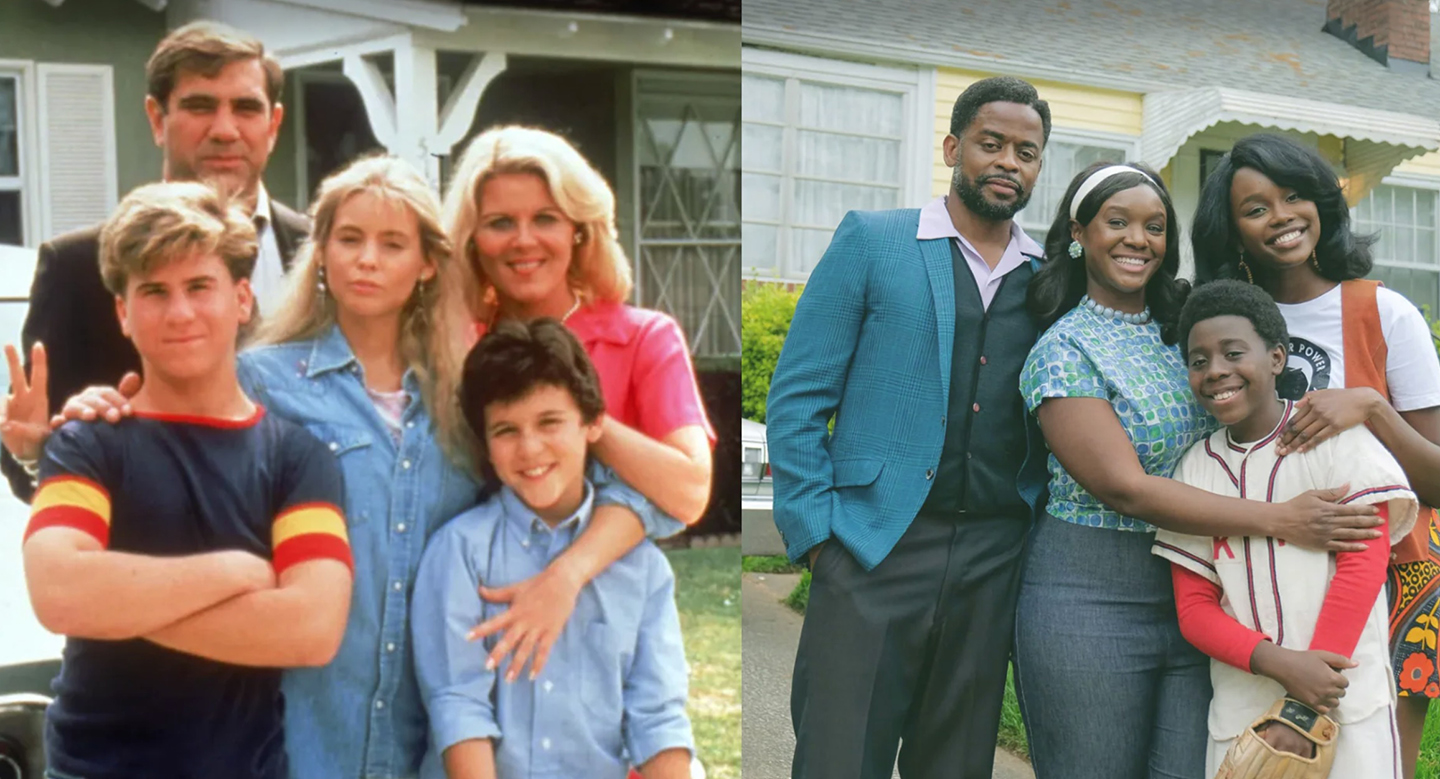
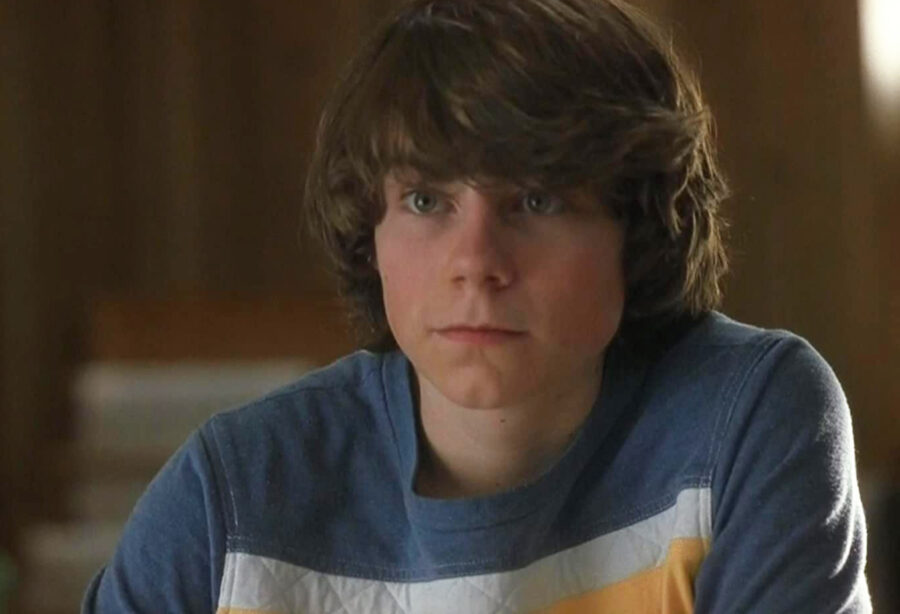
I thought the reboot of 'The Wonder Years' sounded OK, but I didn't watch the first one, either, so...

I thought the reboot of ‘The Wonder Years’ sounded OK, but I didn’t watch the first one, either, so…

Editor’s note: I’m experimenting with editing the new version of the blog.

Following up on my previous post about how fed up I am with most news these days…

I just did a quick walk around the block (it’s a big block, just under a mile) — after lunch and before diving back into work.

I listened to NPR One, and resolved from the start that I would immediately click past anything that had to do with any of the topics mentioned in that post. (That includes, as an extension of the ban on Afghanistan stories, anything that tried to take a “20th anniversary of 9/11” approach, which tends to get you into the same stuff). Oh, and I also clicked very quickly past anything that smacked of Identity Politics. You know how I am about that. You can take any interesting subject in the world, and ruin it by trying to interpret it solely in demographic terms.

I was trying to be optimistic. I was hoping to find something like the Myers-Briggs podcast I wrote about in this separate post.

That didn’t happen.

In the more than half an hour I walked, I only allowed three stories to play, and only one of those all the way through. Two of them dealt with people who play the piano — a 4-year-old prodigy, and a… well, I didn’t listen to enough of it to remember. (Sorry, Phillip!)

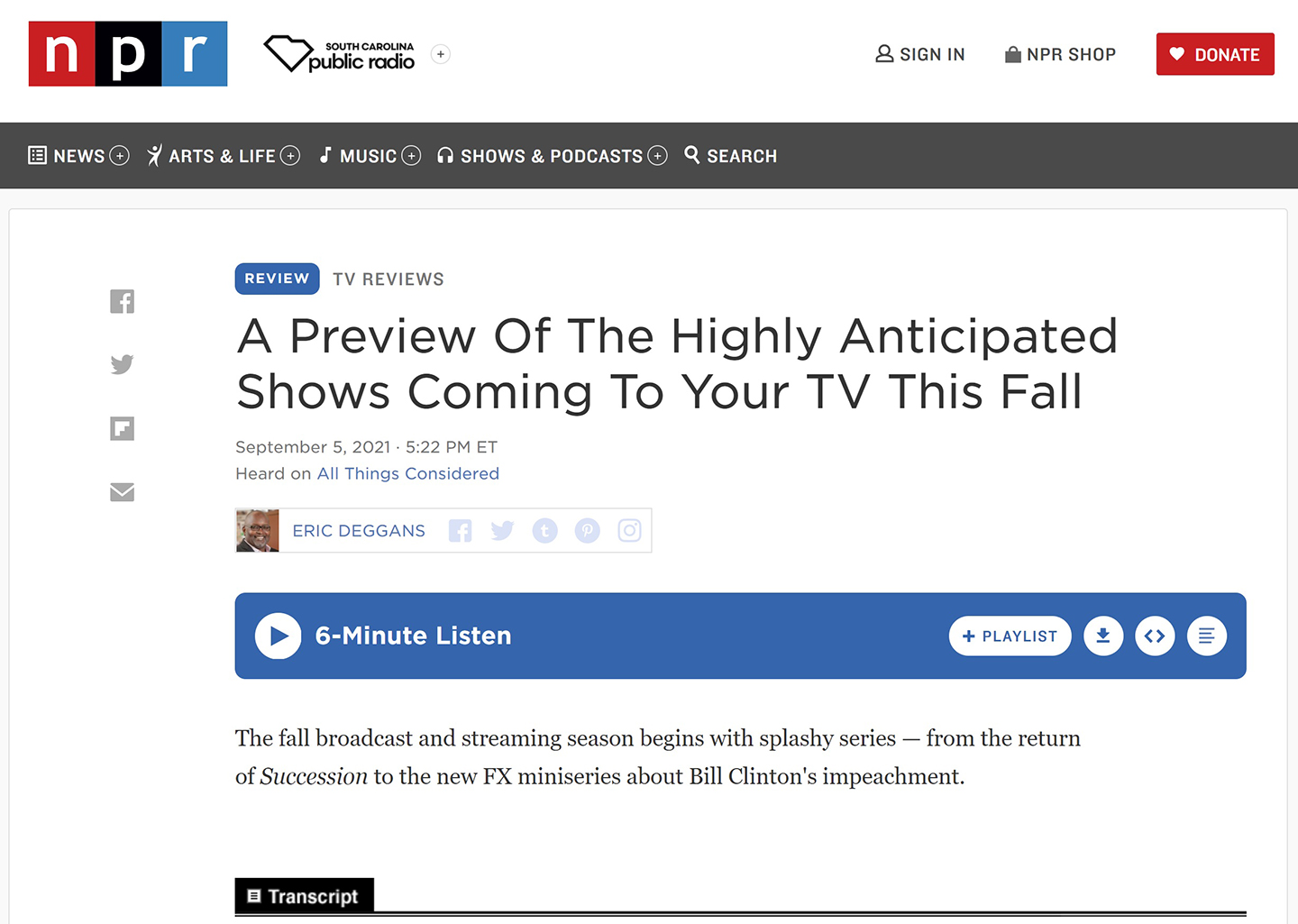
The one thing I listened to all the way through was this piece about the TV season about to be unveiled. I was curious because, this not being 1965, I didn’t realize people still seriously talked about “the new fall TV season.” In fact, if you had asked me whether any such thing even still existed, I might not have answered correctly.

I listened all the way through because I was curious to see whether any of the shows mentioned would be something I might want to watch. None met that standard…

I DID listen to this one, but it wasn't awesome...

I DID listen to this one, but it wasn’t awesome…

The story of how Myers-Briggs happened

OK, enough with the complaining!

I do occasionally find things to read in my various newspapers and magazines that I actually enjoy. And while I find myself clicking through the stories on NPR One rather quickly and impatiently these days, I occasionally run into something I can dig there as well.

Like this…

I was flipping through the aforementioned NPR app while walking, and found something fun. Longtime readers know about my interest in the Myers–Briggs Type Indicator. I’ve written about it often enough. And of course, I know a lot of smart expert types look down on it. But I like it, possibly for some of the reasons they hate it. More about that in a moment.

Anyway, I ran across this three-part podcast about how the MBTI came to be, and I was immediately hooked. Really. Go listen to the first few minutes, and see if you don’t find it intriguing, even if you thought it was an excruciatingly stupid topic before.

Katharine Cook Briggs and Isabel Briggs Myers, early 1900s

Katharine Cook Briggs and Isabel Briggs Myers, early 1900s

One of the first things you learn about the test is that it wasn’t whipped up in a psych lab by a couple of nerdy colleagues in white coats named Myers and Briggs. No, it’s named for the eccentric, uncredentialed woman who developed the test, over the protests of experts, based on the theories of her own equally-if-not-more eccentric mother, Katharine Cook Briggs. The mom, born in 1875, was unusually well-educated and only had one child who survived infancy — and then dedicated herself to discovering innovative ways to raised the perfect child. The daughter was named Isabel, and she married a man named Myers. She developed the personality-type inventory — based on her mother’s ideas about types — as a way of figuring out why she and her husband were so wildly different and incompatible. It saved her marriage, and gave rise to possibly the most widely-used personality test in the world — which she named for her mom and herself.

Why is the test so popular? Well, one thing you learn is that the system tells everybody, from INTPs like me to our irritating opposites, the ESFJs, that we’re all fine. None of our personality quirks are problematic. We just all have different strengths. The test offers us ways to understand each other and work together better, with an appreciation of the differences that helps us not throw lethal objects at each other. Everybody feels affirmed by what they learn. (I suspect this is sort of related to why LGBTQ people like to go to “Pride parades.” Everyone feels affirmed, and we all like that, right?)

That’s how it was offered to all of us editors at The State in the early 90s. We had a newsroom managers’ retreat — and back then, there were more editors with managerial responsibility than there are employees today at the whole newspaper. Anyway, an HR person out of Knight Ridder headquarters in Miami tested us all, and then released the results about everybody to the whole group.

People who look down on the MBTI tend to think it runs on the Barnum effect. Sort of like fortune cookies in a Chinese restaurant. It tells you something vague and nonjudgmental that is allegedly about you, and no matter what it says, you tend to nod and cry, “So true! How did they know?”

Well, I did feel the test pegged me, particularly on the first two categories, because I am about as introverted and as intuitive as people get. (On the other two, I’m closer to the middle.) But personally, I feel like I learned a great deal about my co-workers as well, and while it didn’t revolutionize the way we worked together, it helped explain some things. For instance, there were certain people who I knew I tended to irritate, sometimes a lot. And I wondered about it. It turns out they were all S types, who tended to think we intuitive types were, for instance, just making stuff up and trying to foist it on them without justification. I couldn’t change the way they were or the way I was, but at least I could better understand the cause of the friction. And maybe I could explain my conclusions more patiently — show more respect, for instance, for steps 2, 3, and 4 in making my wild leaps from 1 to 5. That is, if wanted to. (We extreme introverts are known for not caring very much about other people’s opinions of us, yet another irritating thing about us — especially when combined with the intuition thing.)

++++++++++++++++++++++++++++++++

Oops — just realized I posted this at some point when I meant to save it as a draft. Oh, well. I was almost done. I wrote all of the above yesterday when I had only heard the first two installments, and today I heard the third. Anyway, I recommend it. It’s a good listen. Give it a try…