Category Archives: Personal

I don’t go for these same-sex work partnerships

Having decided it was time, after 10 years, for me to leave The Jackson (TN) Sun, I started putting out feelers in the spring of 1985.

Just before I flew out to Wichita to interview for a job I would eventually take, I got a call from an editor at The Charlotte News, who wanted me to come there before making up my mind. By the end of the conversation, we had made travel arrangements for right after the Kansas trip. (But then days later, the editor called me back to cancel. The hiring freeze word had just gone out; the afternoon paper would close later that year.)

It was a fairly lengthy call. When I got off the phone, my wife asked who I’d been talking to.

“An editor in Charlotte who wants me to go there instead of Wichita.”

“Was it a woman?” she asked.

“Yeah… how could you tell?”

“You were enjoying yourself,” she said.

She knows me very well. Most of my career, my closest working relationships — certainly most of the really enjoyable ones — have been with women. (One of my best friends at the Jackson paper once referred to herself as one of “Brad’s women.” Some might have misunderstood that, but all within hearing knew what she meant.) I don’t know why. Nothing against guys. I’ve had a great working partnership with plenty of guys, such as Robert Ariail, as I described back here. But who’s to say? — maybe if we’d also had a cartoonist who was a woman, I might have an even closer partnership with her. Or not. I never set out to work more closely with women. It just keeps happening.

Earlier today I mentioned the Power Failure project. While I worked with people from across the newsroom off and on during that year, there was a core group of three women, from start to finish, without whom I couldn’t have gotten it done. One of them was assigned to the project mainly to keep me on track, to make sure that all my theories and plans and ideas were actually translated into articles and graphics and photos, on time. She was essential to the project becoming something that you could hold in your hand.

And anyone who had occasion to observe the portion of my career spent at The State knows how important was the partnership I had with Cindi Scoppe, from when I first supervised her as a 23-year-old reporter in the late ’80s through those last 12 years on the editorial board.

Anyway, I share all this to explain why I thought this piece in The Wall Street Journal today was such a crock:

Picking Someone for a Project? Chances Are, He’ll Look Like You

Here’s at least one instance of parity among the sexes: Men and women are equally biased when it comes to choosing work partners, a new study suggests.

When selecting colleagues to collaborate with on a daily basis, males and females are both significantly more likely to choose someone of their own gender, according to an analysis by Innovisor, a Copenhagen-based management consulting firm…

“We prefer to collaborate with people who look just like us,” says Jeppe Hansgaard, a managing partner at Innovisor. “That’s a management issue, because you want your employees to collaborate with the right people, not just people who look like them.”…

Maybe the piece set me off particularly because I’d just read (part of) this distressing report telling me that the Obama campaign plans to stress Identity Politics more in this election. But every time I read anything about  how people choose to associate with “people like them,” it ticks me off. I like to think people are broader than that.
Adam uncovers a blast from the past

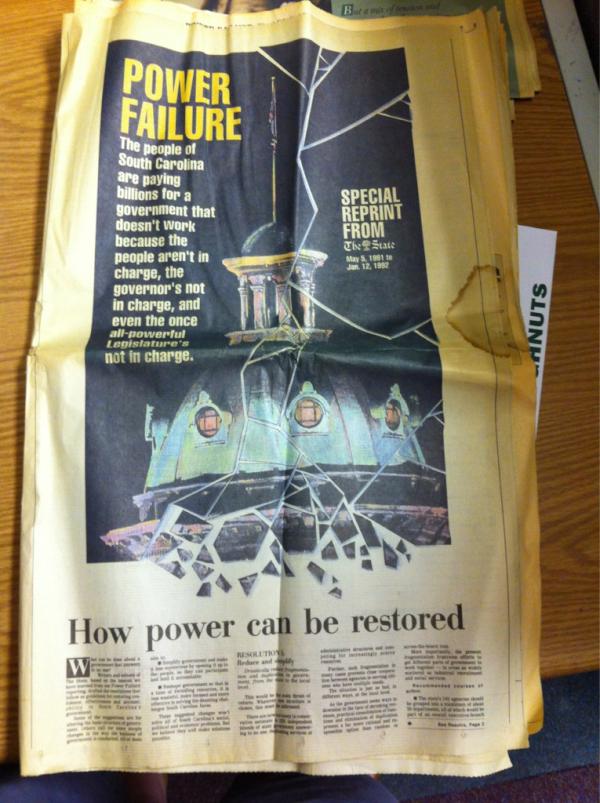
Adam Beam of The State Tweeted this over the weekend:

Adam Beam
Adam Beam
@adambeam

@BradWarthen Look what I foundpic.twitter.com/7V5M1vlr

Adam must have been spending Saturday at the office going through old drawers in the newsroom. There are a number of these scattered about here and there.

This is the special reprint we did early in 1992 of the Power Failure series that I had spent most of the previous year directing.

Power Failure was something I dreamed up in 1990. As governmental affairs editor that summer, I had been going nuts keeping up with an unbelievable string of scandals in and around state government, the most memorable of which was the Lost Trust investigation, which led to indictments against a tenth of the Legislature.

In the midst of it all, then-executive editor Gil Thelen stopped by my desk one day to wonder, What could we do to give our readers a positive way to respond? What could be done to make state government better, rather than just wallowing in the bad news day after day?

The answer I came up with was a project highlighting all of the deep, structural flaws in South Carolina’s system of government — flaws that set South Carolina apart from every other state. Flaws that made our system particularly resistant to change.

These flaws are difficult to summarize briefly, but all of the problems — the weak executive, weak local governments, centralization of authority, fragmentation of that central authority, almost complete lack of accountability (in terms of anyone being able to hire and fire key officials), and on and on — were vestiges of a constitutional system originally designed to put all authority in the hands of the landed, slaveholding antebellum gentry, and to fragment that power across that whole class of people, so that no one person could make important decisions. For instance, not only did departments that in other states reported to the governor (an official elected by all of the state’s people) report to a separately elected official, or to a board or commission appointed by the Legislature, but even decades after the passage of Home Rule, lawmakers still retained a surprising degree of control over local government services.

As I said, it’s difficult to summarize briefly, although we tried with the tagline, “The Government that Answers to No One.” To explain it, I conceived of a 17-installment series, each installment filling several full pages of newsprint (back in the day when pages were much bigger than they are now), totaling well over 100 articles. Gil and Paula Ellis, then the managing editor, essentially laid the resources of the newsroom at my disposal for most of 1991. Reporters came and went from the project, depending on which subject area we were dealing with at the time.

Were there results? Yes, but nowhere near what we were seeking. A partial restructuring of state government in 1993 put about a third of the executive branch under the governor. That third of a loaf, though, was great success when you consider that huge areas that were just as important — Home Rule, education governance, reducing the number of statewide elected officials — were pretty much ignored.

As for me — I was ruined as a governmental affairs editor, since the project was an unprecedented sort of news/editorial hybrid — for instance, I had written opinion columns advocating all of these changes throughout the series. I spent a couple of years supervising this or that non-political team (although I retained control of the Washington Bureau) until I made the move to editorial at the start of 1994 — where I spent the next 15 years continuing to advocate these reforms. Most of the items I listed in my last column for The State, “South Carolina’s unfinished business,” was to a great extent a recap of Power Failure.

Recently, we saw one tiny piece of the reform picture fall into place, with the legislation putting the governor and lieutenant governor on the same ticket advancing. Hoorah for small victories.

It’s been frustrating, but hey, this system had been in place in one form or another for 300 years — and the one great characteristic that it possessed all that time was a profound resistance to change. That is still the hallmark of government in South Carolina.

Bad news, good news about newspapers

I learned yesterday that one of America’s great cities will no longer have a daily newspaper in the unkindest way, courtesy of my favorite celebrity Twitter follower, Adam Baldwin:

Adam Baldwin Adam Baldwin
@adamsbaldwin

Buggy-Whipped?! | RT @carr2n “Times-Picayune facing deep layoffs, may cut back from daily publication.” – http://nyti.ms/Jsib87

He jests at scars that never felt a wound. How would ol’ Jayne Cobb feel if the financial underpinnings of movies and TV suddenly collapsed? (Hey, don’t say it could never happen. Have you heard about Autohop? Remember, newspapers didn’t start dying because people didn’t want news; it was the ads drying up.)

That newspapers are having to cut back isn’t new (especially not to me), although nothing quite like this has happened before in a major city, so it’s a milestone (and the same company is doing the same with its papers in several other cities, including Birmingham). But my sadness is for the city as well. I lived in New Orleans almost as long as anywhere else growing up — I went to school there for two years (7th and 8th grades) instead of the usual one — and news like this makes it feel like the city itself is dying, with a vital spark fading:

The latest to go to three days a week: The storied New Orleans Times-Picayune, one of America’s oldest papers, which announced Thursday that it plans to limit its print schedule — beginning this fall — to Wednesday, Friday and Sunday editions. It will maintain 24/7 online reporting via its site, Nola.com.

This is a tactical trend for New York-based Advance Publications, which owns the Times-Picayune, as it pushes toward a limited print-digital model. Advance said Thursday that in addition to the Times-Picayune, it will also cut back the print frequency of its three papers in Birmingham, Mobile and Huntsville, Ala., to three days….

First Katrina, now this.

But enough bad news. We have some startlingly good news from closer to home: Warren Buffett is investing in newspapers. Including in South Carolina.

You may have seen that news last week. I was sufficiently surprised that I didn’t know what to make of it, and haven’t commented yet. But I have a new news peg: Buffett has written a letter to his editors and publishers, communicating his thinking in making this move. It’s a bracingly confident message:

Until recently, Berkshire has owned only one daily newspaper, The Buffalo News, purchased in 1977. In a month or so, we will own 26 dailies.

I’ve loved newspapers all of my life — and always will. My dad, when attending the University of Nebraska, was editor of The Daily Nebraskan. (I have copies of the papers he edited in 1924.) He met my mother when she applied for a job as a reporter at the paper. Her father owned a small paper in West Point, Nebraska and my mother worked at various jobs at the paper in her teens, even mastering the operation of a linotype machine. From as early as I can remember, my two sisters and I devoured the contents of the World-Herald that my father brought home every night.

In Washington, DC, I delivered about 500,000 papers over a four-year period for the Post, Times-Herald and Evening Star. While in college at Lincoln, I worked fifteen hours a week in country circulation for the Lincoln Journal (earning all of 75? an hour). Today, I read five newspapers daily. Call me an addict.

Berkshire buys for keeps. Our only exception to permanent ownership is when a business faces unending losses, a remote prospect for virtually all of our dailies. So let me express a few thoughts about what lies ahead as we join forces.

Though the economics of the business have drastically changed since our purchase of The Buffalo News, I believe newspapers that intensively cover their communities will have a good future. It’s your job to make your paper indispensable to anyone who cares about what is going on in your city or town.

That will mean both maintaining your news hole — a newspaper that reduces its coverage of the news important to its community is certain to reduce its readership as well and thoroughly covering all aspects of area life, particularly local sports. No one has ever stopped reading when half-way through a story that was about them or their neighbors…

So… if we are to take Mr. Buffett at his word, this isn’t some bid to rack up losses for tax reasons, or any other convoluted strategy. He actually believes this is a good investment. And he’s not known for being wrong about such things.

Back when I was first laid off, the executive editor position at the Florence paper was open. But I didn’t apply for the job — a combination of wanting to stay where my grandchildren are, and a reluctance to jump back into a dying industry, having done more than my share of laying-off and cutting back in the last few years.

But had the opening occurred under these circumstances — with new ownership, and that owner being Warren Buffett, and he bullish on newspapers — I might have looked at it differently.

The Birth of The One Who Will Bear the Name

Why have I been writing off and on about “guy stuff” all week? Well, it’s been on my mind, and here’s why. I’ve been getting ready.

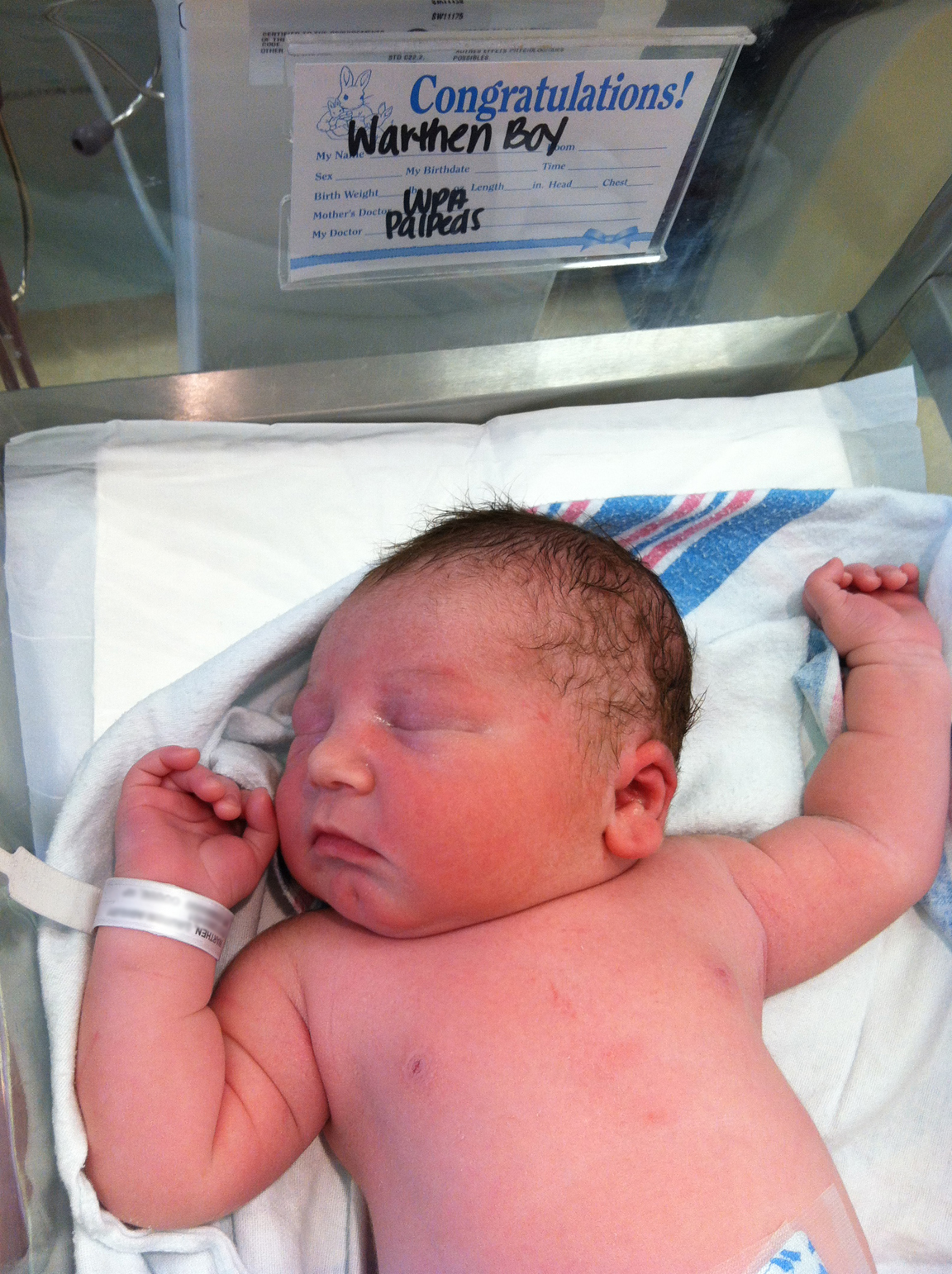
Today, my first grandson was born. Here’s what a milestone he is:

  • The first boy born into the family since my younger son, who is now 31.
  • We’ve had eight wonderful, beautiful girls in a row in the meantime — my two youngest daughters, my brother’s two daughters, and my four granddaughters.
  • My father had only one brother, who had no sons. Then there was my brother and me, and my two sons. And now my older son has a son, and he’s the only one in his generation.
  • He’s the first boy in an even longer time on the other side of his family (the Herring side).

So you can see how I would be contemplating the nature of the male of the species, and trying to get my head around the concept.

We are excited. Excited the way we have been with every one of our grandchildren, only this time with a novel factor (for us).

Look at him. He’s a big boy, isn’t he? Look at those hands — I think he could palm a baseball. Unfortunately, I forgot to take one into the nursery with me (see how you can forget stuff when you haven’t had a boy in a while?). He’s 9 pounds, 7.5 ounces. A mannish boy. And dig that Kirk Douglas cleft. All the women who see him exclaim over that.

He will have all new stuff, unlike all the girls who had loads of hand-me-downs. We are not set up for a boy, but we will adjust.

His big sister, the super-articulate 2-year-old, isn’t entirely sure what she thinks. But I know she’ll love him, as we love her. He’s going to have her, and 6 girl cousins, hovering over him. But I think he’ll handle it OK.

We’re going to spend a lot of time with this guy in the days to come. And with our granddaughters, too, reminding them of how awesome and special each of them is.

This is going to be fun.

Rattler in my yard=dead snake, if I can help it

Two or three weeks ago, my wife saw, from our deck, a fat snake with a triangular head gliding over a pile of brush in our backyard. I resolved, with a shudder, to do something about the pile of brush — which would require actually working in the yard, which for me is a big price to pay, but some things ya gotta do. (Where’s George W. Bush when you need him? He loves to clear brush.)

Based on her description, I Googled “copperhead” and showed her the picture. Yep, that was it, she said.

So last weekend, after she mentioned her intention of letting the grandchildren play behind our house at some point in the near future, I backed up my truck to the pile, and attacked it with a pitchfork. Yeah, it’s easier to pick up with your hands, but I’m not crazy. No snakes were encountered, which will explain why I got through the weekend without experiencing myocardial infarction. The brush is gone. Which, I remind myself, means the snake is likely somewhere in the vast, poison ivy-choked, “natural” parts of my yard (where we won’t let children go), which is located one block from the Saluda River.

(Dang. I just remembered I forgot to get any pictures of me manfully wrestling that potentially snake-infested debris into my pickup. I could have used that in future political campaigns. Oh, well…)

Anyway, with that memory fresh, I was less than thrilled to read this news today:

The Eastern diamondback rattlesnake, a venomous reptile with a nasty bite, is under consideration to become a federally protected endangered species in South Carolina and neighboring states.

Look, I love the bald eagle. I’m for protecting the snail darter. I can even see some value in protecting wolves, sort of. And seeing as how I live nowhere near the Arctic, I’m for sticking up for the polar bear, even though it’s the only kind of bear that hunts people for food.

But a rattlesnake? Sorry, but the usual catchall of “biological diversity,” great as it is, isn’t quite enough to override the negatives in this instance.

The obligatory explanation is to be found in this story:

Eastern diamondbacks are important because they kill rodents and small mammals that could otherwise overpopulate the countryside.

“If this goes missing, it could have effects we’re not even thinking about today,” Fish and Wildlife Service biologist Harold Mitchell said. “It has a role to play. The less pieces there are in the ecosystem, the less functional that ecosystem becomes until it breaks.”

Sorry, but that’s not enough. It’s too vague and general. I could have given that justification without your help. You’re going to have to go farther than that. The idea that diversity in the ecosystem is in and of itself a justification doesn’t go far enough here. I need to know which rodents are controlled by this species and this species only. Are you saying rat snakes and king snakes and the like are picky, and won’t kill the ones that this kind of rattler goes after? If so, say so. Make the case.

(If your faith in biodiversity is of the religious sort, then it’s all about faith that why you may not know exactly why this species is essential to the balance of life, it is in some way you can’t know, and therefor you must preserve it. In other words, it’s a mystery; have faith. Sorry. Most of the time, I’m from South Carolina. But when it comes to rattlers, I’m from Missouri.)

I’m listening. But in the meantime, if I see one of these monsters in my yard, I’m going to do what I can to hasten its extinction.

And now, for you youngsters, Maurice Sendak

Yesterday, Kathryn protested that she should not be expected to know how Paul McCartney was dressed on the cover of “Abbey Road” because she was too young. I shot back that her youth was no excuse, that she might as well claim she couldn’t picture Alberto Korda’s photo of Che Guevara because she was not a communist.

Once she followed the link I provided, of course, she responded, “Oh, that one.” The exchange sparked a fun sub-thread on iconic images of the 20th Century.

Well, this morning, I experienced the feeling of being too old for a shared cultural experience. As the news spread that Maurice Sendak, author of Where the Wild Things Are, had died, Twitter was filled with references to how important he was to the childhoods of the writers — such as this one from actor/director Jon Favreau.

I immediately felt a disconnect. I wasn’t familiar with who he was until I was an adult. Actually, he may not have fully registered on me until Richland County Public Library had some sort of special Sendak celebration several years back.

To me, his most famous work was one of those books in the stacks of books from which we read to our children, and then grandchildren. But not one that had made a big impression on me, like my favorites (Socks for Supper by Jack Kent, The King’s Stilts by Dr. Seuss, and especially Bread and Jam for Francis, by Russell and Lillian Hoban). And while I get the impression that he had greater literary cachet than the authors of “The Berenstain Bears,” I was more affected by the passing of Jan Berenstain.

How about you young folks out there? How did Sendak affect you?

Naked without a jacket

Some of y’all were advising me on a “look” for my band, once I start a band. That, of course, is a worthwhile consideration — yet another thing to settle before actually forming the band itself, along with the band name and playlist.

But y’all were a bit off with the platform shoes with goldfish in them and other suggestions. As I responded, my own concept of a “look” is somewhat different.

I tend to think back to when I saw Dylan with The Band in Memphis in 1974. Basically, they were casually dressed with dark sport coats over work shirts, and jeans or other casual pants. I seem to recall a scruffy old sofa on the stage. It was comfortable, homey, and vaguely old-fashioned. They were dressed sort of like Butch Cassidy and the Sundance kid, only without the guns and cowboy hats.

That’s the sort of look I’m comfortable with. It’s the way I dress. It’s more or less the way I’ve dressed since high school. There was once a sort of clearance/warehouse sale at the base exchange at Hickam Air Force Base back in 1970, and they were getting rid of all kinds of out-of-style items. I picked up a couple of sport coats for $5 each. One of them I really liked. It was wool, a sort of rough, tweedy wool. It was a dark, dark blue with other dark colors in it, vaguely seen, and a faint sort of reddish pinstripe running through the hard-to-see pattern. I wish I still had that jacket, even though it wouldn’t fit me now. It was very like what The Band would wear, or what a cowboy in a particularly cool western might wear, and have to pull out of the way to draw his sixgun.

Over the years, I got dressier than that, and took up such items as the bow tie. But nowadays, when I do wear a tie, I’m the only one at ADCO who does. And more and more often, I don’t wear one at all. So I’m drifting back more toward that look I had as a student. But part of that look is that I always, always wear a jacket.

How could I not? How would I get around? Where would I put my:

  • Car keys (right outside pocket)
  • Wallet (sorry, but I’m not going to deform my spine by sitting on a wallet in my hip pocket)
  • notebook (my Moleskine fits perfectly in my inside pocket on the right
  • flip-up shades (breast pocket)
  • pills, tissues, etc. (antihistamines and such that I always carry — left outside pocket)

Where would all that stuff go without a jacket? And then there’s my iPhone, which I wear clipped to my belt — you want me to go around with my phone exposed to the weather?

The other day, on NPR, I heard an interview with British actor Bill Nighy, who among other things said the following:

SIEGEL: You have a look and bearing that says, at least to my American eyes: British gentleman. Is it true that you feel naked if you’re not wearing a suit?

NIGHY: Yeah. In fact, a jacket, really. I’m a jacket man. And if I’m without one, I am kind of seriously disabled. I don’t know how to operate in shirt sleeves.

SIEGEL: You don’t?

NIGHY: It makes me anxious and uneasy.

SIEGEL: Even to a reading for a part or something very informal?

NIGHY: Yeah. It’s ludicrous. People sometimes inquire why there’s a lack of classical work on my CV with the emphasis on Shakespeare and I have joked in the past that it’s because I can’t operate in those kind of trousers. But, in fact, it’s true. I can really only operate in a decent lounge – what we used to call a lounge suit. It is kind of my muse and I am ludicrously attached to the idea.

I did a play on Broadway here in New York and the director desperately tried to get a jacket off me. He said, you’re in the garden. It’s summertime in England. What would you be doing wearing a jacket? I said, I always wear a jacket in the garden. Anyway, he did get the jacket off me and he actually made me appear without socks, which was deeply unsettling.

SIEGEL: This was very difficult for you.

NIGHY: Yeah…

Exactly! How indeed does one get along with a jacket? I can’t imagine. I gathered that this was supposed to be heard as an expression of the actor’s eccentricity, but I thought he made perfect sense. No wonder I like Nighy in pretty much anything I see him in (“Page Eight,” “I Capture the Castle,” “Love Actually“).

As for going about without socks? Totally beyond the pale. Let’s not even go into that.

Like Butch and Sundance, but without the guns and hats.

Great to see my old friend Michael Mercer!

An old friend sent me the above video. When I got home last night, I asked my wife to watch it without telling her why. She looked at it only a second before saying “Michael!”

Yep. The guy playing the “English teacher” at the beginning is Michael Mercer. Michael and I started out as copy editors together at The Jackson (TN) Sun in 1975, soon after I graduated from Memphis State. Michael got out of the business long before I did, taking a teaching gig at Auburn. Now he’s at another college in San Antonio, as he explained when I asked about the video:

The young lady featured in the film is one of my student-advisees at the University of the Incarnate Word in San Antonio. She’s a communication arts major concentrating in journalism — although broadcast like most of them do today. She asked me at the last minute to be in the video that she and the filmmaker — her boyfriend from another school in San Antonio — were doing for a video contest promoting San Antonio park recreation.

They didn’t win the contest but I thought they, too, did an excellent job. I was only familiar with the classroom scene where they asked me to  mouth a few words as an “English teacher.” Those other students in the video in the classroom are UIW students but not any of mine. We spent about an hour shooting various takes, angles, short bites. I was told it would only take about five minutes. Then a week later, my student asked me to wear the same shirt and pants for a scene they wanted to shoot minus the class in that same classroom showing me walking out the door after that “chill” comment.

No, most of my South Carolina readers won’t know Michael, but some of our former colleagues will see this, which is why I share it here. The fact that I can do so so easily — the fact that a student could even produce something like this — is testament to how the world has changed since Michael and I started out.

In those days, the copy desk was still a big horseshoe (or “elephant’s commode,” as one of my Tennessee colleagues referred to it), with the slot man (or woman) sitting in the center, distributing copy to those on the rim who would edit it and write headlines as assigned by the slot. The copy and headlines would then be passed back to the slot for checking before being sent to the composing room. Except that the editing wasn’t done on paper at this point. The text had been scanned and output onto a paper punchtape, which was clipped to the hard copy with a clothespin (without clothespins, we couldn’t have gotten the paper out). After an editor received the copy with attached tape from the slot, he or she would take it over to a Harris 1100 editing machine, and feed the punch tape into it. The copy would appear on a CRT screen, and the editor would use a keyboard to edit it. When done, the edited text would be output to another punch tape of a different color, which the editor would roll up the tape (using a little electrical device that was sort of like one of those handheld, flashlight-sized fans) and clip it back to the copy. That bundle is what the editor would pass back to the slot, along with a headline written in pencil on a hand-torn strip of paper.

A couple of months after I joined The Sun, I was pulling shifts in the slot, and I found I liked it so much that by the time I moved on from the desk, I was doing it most days. The job entailed what would have been three to five jobs at a paper the size of The State in those days. The slot not only supervised the editing process, but laid out the entire A section, monitored the wires and selected all wire copy, and oversaw the production process in the composing room. If a page was late, it was the slot’s fault. And in those days, things were so loose and informal at The Sun that an assertive slot (which, I confess, I was) could pretty much decide how all of the news in the paper was played, including local copy.

The day started at 5:30 a.m., and the whole first edition (which was more pages than you find today in The State) had to be out at 11. Then we’d grab a quick lunch before having the city edition out by 1:30.

Doing that job at the age of 22 gave me a lot of confidence that stood me in good stead in the years to come. And it gave me a taste for calling the shots. Which is why after that gig, I only spent a couple of years as a reporter before becoming a supervising editor. You can learn a lot by starting out in a small pond.

Michael followed a similar path, without being quite as power-mad as I was (you can probably tell in his brief appearance that Michael is a nicer guy than I am — which I’m betting is why he was cast in this film; I’m sure he’s the sort of teacher who might be students’ favorite). He was one of my assistant editors over the news reporters at The Sun in later years.

And now there he is, playing the “English teacher.”

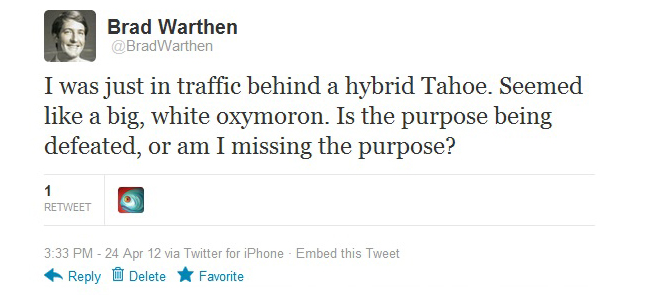
Maybe I’m just missing the purpose…

Speaking of Twitter, here’s something I sent out yesterday…

It’s a conundrum.

Is the purpose to help the planet, or to save gas? Either way, a hybrid something else would get the job done better. I mean, why buy a Tahoe, and then spend extra to make it a hybrid (I’m assuming, perhaps erroneously, that the hybrids cost more).

Or is it just to send a message to the world: I care about the planet, I really do! I just can’t help myself — I gotta drive a dreadnought through the city streets!

Or is it something else? Such as sheer irony?

Forgive me for intrusinating on your day with a word about Twinspeak

My three youngest granddaughters, in an intrusination-free moment.

Saturday night, we kept all three of our youngest granddaughters. Sunday morning, I was recuperating on the couch, just barely dozing, while the Twins played a few feet away from me.

I was awakened by a sudden loud dispute, as Twin B got frustrated with her sister for grabbing at some toys she was playing with.

“Stop intrusinating me!” she cried.

I lifted my head to look in that direction in wonder: “What did you say?”

Twin A, speaking as one would to a hard-of-hearing elder, explained, “She said to stop intrusinating her.” Like, what did you think she said?

OK, I said. Thank you.

I suppose the word — which I’m guessing is kin to both “intrude” and “insinuate,” and perhaps “excruciating” — if fine, as long as the one to whom it is spoken understands. Which she did.

The twins are 4 now.

I’m a lumberjack, and I’m OK (or not)…

A friend points out to me that “newspaper reporter” is now listed as one of the five worst jobs to have. Right down there with lumberjack. Here’s the CNN Headline News report:

On the heels of a report indicating good job prospects for the college class of 2012, career guidance website CareerCast released its list of the best and worst jobs of the year, and after reviewing 200 professions across a wide range of industries.

The five “best” jobs are software engineer, actuary, human resources manager, dental hygienist and financial planner. The top five “worst” jobs are lumberjack, dairy farmer, enlisted military soldier, oil rig worker and newspaper reporter.

So what makes a job among the best or the worst? CareerCast based the rankings on a methodology that rated each profession’s work environment by assessing both the physical and emotional demands, including: necessary energy, physical demands (crawling, stooping), work conditions (toxic fumes, noise), degree of competitiveness, degree of hazards personally faced and degree of contact with the public. Each category was broken into elements and then each element was given points. In the end, a higher point total made a job less desirable, while a lower total indicated a job was more desirable….

I’m not sure whether that was supposed to make me feel good or bad. Actually, it’s sort of irrelevant, since I haven’t been a reporter since the early months of 1980. But I can tell you that being a newspaper editor is not what it once was, if you can even find such a job.

Which of course is the problem. The main thing wrong with being a newspaper anything is that if that’s what you do, it probably won’t be long before you join the ranks of those who used to do it.

Beyond that, I’m suspicious of the criteria used in compiling this list. Lumberjack? Obviously they’re not taking into account such factors as leaping from tree to tree as they float down the mighty rivers of British Columbia… the giant redwood, the larch, the fir, the mighty Scotch pine… the smell of fresh-cut timber… the crash of mighty trees… with my best girly by my side…

A song from the deepest early memories

I had an unexpected bit of pleasure this morning. In a desperate bid to get away from the ETV Radio pledge drive, I accidentally pressed button 3 on my radio, forgetting that the format had changed a while back to country.

And I heard “Singin’ the Blues,” which struck deep chords of early-childhood memory for me. I couldn’t have told you the words, and I mistakenly assumed it was a Hank Williams song — it seemed to have that sort of universal appeal. But the tune was as familiar, as wired into every cell in my brain, as if it had been sung to me as a lullaby.

All I knew about the song was that I really, really liked it. As though I was MADE to like it; it was part of my early formation.

Unfortunately, the radio didn’t tell me who was singing it (which should be a violation of FCC regulations). Fortunately, there’s Google and Wikipedia.

I quickly learned that the song was written by one Melvin Endsley, and first recorded successfully by Guy Mitchell. But I’m pretty sure that what I heard this morning was the Marty Robbins version.

Whichever, I loved hearing it. Next thing you know, I’ll hear “Volare” on the radio one morning (to cite another song that made a deep impression on me before I was old enough to worry about what was cool and what wasn’t, and able to just respond to music on its own terms)…

If we could just suspend the Constitution long enough to take care of this ONE thing…

I spent Easter weekend at the beach with some of my family. We stayed at the beach house that my grandfather built in Surfside Beach. It’s on a small, narrow freshwater lake — the twins call it “the river” because it is so long and narrow that that’s what it looks like — with the ocean a couple of blocks beyond.

I don’t get there often, but we made it this time. The weather was beautiful. We had the whole day free Sunday (at least, until we had to drive back), having attended Easter Vigil Mass at my cousin’s church in Conway.

Between the Easter egg hunt with the twins and dinner, I managed to find a few quiet moments to lie in the hammock right next to the lake. Conditions were perfect. The breeze was perfect. I put some early Steve Miller Band on my iPhone and set it next to my head (I had no earbuds) as I prepared to snooze. I was right on the verge of doing something unusual for me — thoroughly enjoy the outdoors.

Just then, the roar of a riding lawnmower started up about 20 feet from my head, over on the lot next door. The guy on the mower was not the owner of that property, but a stranger. He was doing this for pay, on Easter Sunday.

I went inside fuming about it, but took solace from the fact that with that riding mower and he being a professional, it couldn’t take more than 10 minutes for him to mow that yard. I even found myself making excuses for him in my mind: Poor fellow must be desperate for the income to be mowing lawns today…

Then I headed back outside and resolved to escape the noise the way Huck Finn escaped the things that he didn’t like about “sivilization.” I got into the jon boat and pushed off with an oar to drift across the lake. It’s only about 40 yards across. As I drifted, I realized to my horror that some unseen fiend was using a leaf blower on the far side. Which sounded even worse.

I turned back as the first guy stopped mowing, only to see that the heathen mercenary had started using a weedeater.

I changed course again and started rowing perpendicular to the line between these two abominations.

As the first guy put down his weedeater and picked up a leaf-blower of his own — to blow the yard trash he had cut out onto the surface of the lake — I paused to write the following on Twitter:

Forget the Constitution: Anyone operating obnoxious power tools on such a beautiful Easter Sunday should be drawn and quartered, then fined.

I was reTweeted and received supportive replies from several folks (one who totally got into the Swiftian spirit of the thing wrote, “And then punished in a manner that could be considered cruel and unusual for such a crime.”). Good to know there are some sane people left in this world.

Three times in a week, I’m mistaken for Mike

It happened two more times last night.

Mike Miller

After dropping by the victory party Cameron Runyan was having at 701 Whaley, I went to Kit Smith’s house to see what was happening with Daniel Coble. I went in wondering whether things were going well — and knowing that if they weren’t, people would feel somewhat constrained with a blogger in their midst. It only took a moment to find out that Daniel was a close second in a runoff, and that the campaign felt good about that — better than if they had been in a runoff with Jenny Isgett.

As I was absorbing that, a nice lady came up to me and started telling me that while she hadn’t followed me all that closely when I was at the newspaper, she had really come to appreciate my work, and she really, truly appreciated that I had decided to throw in my lot with the Coble campaign, and then she gave me a big hug. As I was trying figure this out, and muttering, “But I’m not… that is, I’m neutral… I mean…,” Bud Ferillo explained that I was there as a blogger. At which point the lady stepped back and looked at me and realized who I was.

Which was not Mike Miller.

A very short while later, I was in another room discussing the state of the world with Joel Smith, and a man came up to me and said, “Hi, you’re Mike Miller. I’m…,” at which point I interrupted to say, “No, I’m not.”

Not Mike Miller.

I told you previously about how this happened over at Belinda Gergel’s house the day she and Mike and Steve Morrison endorsed Daniel.

I don’t know what it is (it’s not like Mike looks like THIS guy), but I can almost sorta kinda see it. And I have this vague memory of this mistake having happened once or twice, long ago, when we worked at the paper together. Something about general similarity in height and weight and maybe head shape, and now hair color. We’re both from the Pee Dee (he’s from Dillon;  I’m from Bennettsville), but I don’t think that’s it.

Most of the folks at that gathering had on Daniel Coble stickers. I felt like I needed my own sticker, in the same yellow-and-black motif that Rob Barge designed for him, saying “I’m not Mike Miller.” But I don’t know if it would do any good…

Santorum could beat Obama — at bowling. Can Romney say the same?

Mitt Romney has, from the start, based his candidacy for the nomination on the claim that he’s the guy who could beat Obama, if anyone can.

But now we have proof that Santorum could easily beat the president at one thing — bowling.

The ex-senator has been putting in time in some bowling alleys lately. The only actual score I’ve f0und was a 152, which Bloomberg calls “respectable.” Which it is. That’s all it is, but it is that. A guy who can’t go out and roll a 150 basically shouldn’t bowl in front of cameras. That’s about what my average was when I was in a league in high school in Tampa.

“Respectable” is not a term anyone would use to describe the president’s skills at this game. So Santorum should have really played this up from the start.

Here’s video of him rolling a turkey. And if you don’t know what a turkey is, you shouldn’t bowl for money against Santorum. Or me, even though I haven’t bowled seriously in more than 40 years.

According to The New York Times, Santorum even managed to work in a communitarian theme while at the alley:

In an interview about his bowling background, Mr. Santorum referred to the famous book about bowling as a thread in the fabric of small-town America, “Bowling Alone,” by Robert D. Putnam, a professor of history at Harvard.

“ ‘Bowling Alone’ is about the breakdown of social capital in this country,” he said. “People used to come together in leagues and groups. Bowling is a social sport. You talk and eat and drink and are together. It’s a commitment to go every week. My dad bowled in a league, and I went with him. He was a lefty. We went on league night, it was part of my childhood.”

I had to laugh at this site, though, which breathlessly stated that “He even has his own bowling ball.” Oh, yeah? So do I. Doesn’t everybody? And in my younger days I had my own two-piece pool cue. Didn’t make me Minnesota Fats.

The big ‘one size fits all’ lie we keep hearing from school ‘choice’ advocates

OK, I’ve let it go about a thousand times, but this was just one time too many:

“Parents have spoken out enough to make lawmakers understand that they deserve choices,” said state Rep. Eric Bedingfield, R-Greenville, a lead sponsor of the bill. “Education is not a one-size-fits-all proposition. Each child is educationally unique in how they learn.”

Of course, that paragraph is chock-full of nonsense (parents have all the choices they could ask for; this issue is about whether they should be rewarded, at the expense of  the public schools, for exercising those choices in certain ways), but I want to zero in on one point we haven’t discussed before: The laughable notion that public education constitutes a “one-size-fits-all” approach to education, while private school education does not.

In my experience, it’s the other way around.

Of course, you don’t really need personal experience to understand the obvious: Public schools take everybody, and therefore have to make teach all types of learners. While there are some private schools that are specifically set up to address different learning styles, the private schools that get the largest numbers of those fleeing public education tend to be of the “keep-up-or-fail” variety.

Our kids started out in Catholic schools — in Tennessee, then Kansas, then here. After we’d been living here for about a year — this was the late ’80s — we decided for several reasons to switch to public schools. (One factor was cost, another was travel time — we had a very good elementary school in walking distance of our home, as opposed to having to drive the kids downtown every day.)

Another factor was that my younger son, who had always been bright — we marveled at his vocabulary from the time he was a toddler — was really struggling in the first grade. He never got to go to recess, because the teacher kept him in to finish his work. He would strain to complete homework late into the night, past bedtime. He was very conscientious, and always applied himself to finish the work, but it was a struggle — and he was under way too much stress for a first-grader. Like his Dad, he had trouble focusing on a task, but there was more to it than that — we would later discover that he had a form of dyslexia.

His teacher at the Catholic school didn’t know what to do with him, except to make him finish his work however long it took.

After he started in the public school, as soon as his teachers saw how much trouble he was having, a meeting was called with us and the teachers and specialists from the district, to draft a strategy for helping him keep up and learn the material. This strategy was updated and followed all the way until he graduated from Brookland-Cayce High School.

Were the methods perfect? My son, who now has a bachelor’s degree in psychology, says no — he believes the schools still had a lot to learn. And in fact, his dyslexia wasn’t specifically diagnosed until much later than it should have been. But the point is, they did something to help him, and kept on working with him. And that gave him the space and the tools to learn how to learn, to graduate and to earn a college degree. As wonderful as Catholic education is for mainstream learners, that just wasn’t going to happen where he was before.

By definition and by necessity, public education is not one-size-fits-all. They have to educate everybody, so they have to stock all sizes. Many of the debates we have over education — such as over the impact of putting children on different tracks — result from the wide variety of learning needs different children bring to school.

(I don’t know what I would do if I had to attend school in my children’s or grandchildren’s generation. In my day, you could get by just on being smart, being good at tests, and class participation. My teachers knew that I knew the material even if I didn’t get assignments done — I aced the tests that were such a large part of my grade, even when I didn’t finish them. Since then, schools have become much more task-oriented, and place a greater emphasis on homework and daily assignments; I’m not at all sure I would have kept up.)

And for that reason, it really ticks me off when people who want to drain public resources from the public schools try to make us think it’s the other way around.

Why I am not an Eagle Scout

On a previous post about the Carolina Cup, after I had expressed my aversion to being trapped somewhere far from my car and adequate sanitary facilities, Steven Davis II asked whether that meant I had not been a Boy Scout. I answered as follows…

Actually, I was, but not for all that long.

I was really active in a troop in Ecuador, made up of expatriate gringo kids. I had finish Cub Scouts there, and made it through Webelos, and was really pumped about becoming a full-fledged Scout. Ever since I was a really little kid I had read my uncle’s Scout Handbook, which I took to be The Guide to Life for Guys. I was excited about the opportunity to apply some of those things I’d learned about.

My troop went on one camping trip, to an undeveloped beach near the town of Salinas.

There were zero facilities, of course. It was like a beach on the surface of another planet, with surf pounding against sandstone formations that framed little patches of sandy beach. We carried in our own water in canteens, and washed our mess kits in the surf, scrubbing them with sand. We had brought along some ice and some new metal trash cans. We put our water and perishable food in the garbage cans, and buried them up to the lids in the sand just above the high water mark. You know, for the insulation, to keep things cool.

That night — the darkest night I’ve ever experienced (no moonlight or starlight that I recall, and definitely no manmade light) — we lay in our tents and told the scariest stories we could make up (I was a big Poe fan at the time). The one that stuck in my mind as I tried to get to sleep, listening to the unseen surf, went like this — a ghost ship of undead Vikings lands on our stretch of beach and hacks us all to death before slipping away, and NO ONE ever knows what happened to those Boy Scouts. I lay there thinking that it was the height of irrationality to pay any heed to a ridiculous story that a bunch of 11-year-olds had just moments before collaboratively made up, while at the same time constantly hearing, above the surf, the keel of a Viking longboat grounding itself on the sand mere yards from our tent.

Anyway, during the night, some jerk went to the garbage can and dumped out a lot of people’s water, including mine. Why? You’ve got me.

The next morning, I participated in my five-mile hike requirement for my Second Class badge. We marched out along the beach to a distant point sticking out into the sea, and back. In the equatorial sun. Without water.

I was a pretty scrawny little kid anyway, without a lot of water in my flesh to begin with. Very wiry. It didn’t take that much to wring out what moisture was in me.

It had rained slightly during the night, just enough to dampen the driftwood we had collected for our fires, so I had a hard time cooking my lunch, and finally gave up because between the heat I was able to generate with the coals and the sun beating down on my back, I was about ready to pass out.

On the long drive home that afternoon, I got a bad case of the runs. The van we were in would pull over to the side of the road (facilities? in the third world? are you kidding?) and I would assume the position right there with my fellow scouts watching.

When I got home, I was clinically dehydrated, with my skin starting to wrinkle up here and there.

Later, my Dad was transferred to New Orleans, where our troop leader often didn’t show up for meetings and was extremely disorganized when he did show, and I never could get the paperwork done to get my Second-Class badge I had earned in South America.

I retired from the Scouts as a Tenderfoot.

And my enthusiasm for camping never really recovered from that experience.

Again, I give my very lifeblood (some of it, anyway) for the cause

Do not try this at home, boys and girls — even if you are one of the Twitterati!

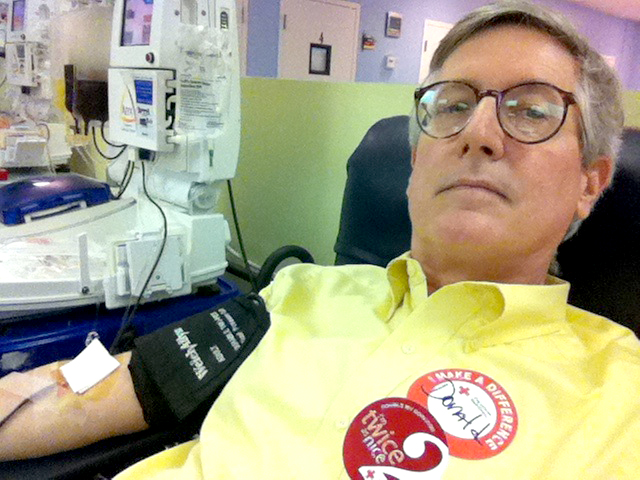
Late yesterday afternoon, I Tweeted out the above picture with this message:

I’m giving blood at the Red Cross with my right, and Tweeting with my left!

Once again, I was giving double red cells, on account of this region needing it so badly. I can’t do it again until 16 weeks from now. But you can fill the need in the meantime.

But again, don’t try it at home. Go down to the Red Cross office on Bull Street (or attend one of the Red Cross blood drives). Click here for info on how to give.

So THAT’s why I don’t feel as smart as I used to

This is an interesting piece brought to my attention by Stan Dubinsky:

SPEAKING two languages rather than just one has obvious practical benefits in an increasingly globalized world. But in recent years, scientists have begun to show that the advantages of bilingualism are even more fundamental than being able to converse with a wider range of people. Being bilingual, it turns out, makes you smarter. It can have a profound effect on your brain, improving cognitive skills not related to language and even shielding against dementia in old age.

This view of bilingualism is remarkably different from the understanding of bilingualism through much of the 20th century. Researchers, educators and policy makers long considered a second language to be an interference, cognitively speaking, that hindered a child’s academic and intellectual development.

They were not wrong about the interference: there is ample evidence that in a bilingual’s brain both language systems are active even when he is using only one language, thus creating situations in which one system obstructs the other. But this interference, researchers are finding out, isn’t so much a handicap as a blessing in disguise. It forces the brain to resolve internal conflict, giving the mind a workout that strengthens its cognitive muscles….

Set aside the fact that this NYT piece is written by one Yudhijit Bhattacharjee, who probably speaks at least two languages, since this is written in English. It fits with what I’ve read and heard elsewhere — aside from the fact that it stands to reason.

It also gives me a clue as to why I used to feel so much smarter when I was a kid than I do now. When I was a kid, I spoke Spanish as easily and smoothly as English. I thought in Spanish, I dreamed in Spanish. I learned the language at what was probably the last possible moment for learning it as easily as I did — when I was 9.

I learned it the best way, in a sense — from being forced to speak it. From the time my family arrived in Guayaquil, Ecuador, most of the people I encountered spoke no English. I did take Spanish as a course in school, but that had little effect, as I recall. Probably a bigger factor was that I took half of my courses in Spanish — including history, geography and science. That was at the Colegio Americano. I was in the Clase Especial, which didn’t quite mean what it means here. There, it meant I was in the one class in my grade that was for native English speakers, and that the classes I took in Spanish were actually a grade-level behind my English classes. Near as I could tell, that didn’t put me behind my peers when I got back to the states. And I certainly knew a lot more than the other kids back home about Latin American history. Not that anybody up here cares about that.

I learned a lot of my Spanish at home as well. My Dad at the time was a lieutenant commander in the Navy, which made us modestly middle class at home. But there, we had two maids, one of whom lived with us 24 hours a day. And no, it wasn’t like Downton Abbey. But the maids had no English, and I interacted with them constantly — I had to, to get through the day. The first word I remember learning from them by way of context happened the first couple of days we were in the country. One of the maids started working for us while we were still staying in the Humboldt Hotel on the waterfront. She took us for walk one day along the quay  (with me probably fuming because, at 9, I felt no need for a babysitter), holding my little brother’s hand. He was only 3, and of course he wanted to touch everything. She would pull him away, saying in an urgent, admonitory tone, “Sucio!” It wasn’t hard to figure out that that meant “dirty.”

Anyway, when we came back to the states two-and-a-half years later, I had this ability that I was seldom called upon to use. I only took Spanish once in school subsequently, and of course aced the course — even though my grammar going in wasn’t so hot (the result of having learned the language naturalistically, and sometimes from people whose own language skills weren’t the best). When I went to college, my skills were still good enough for me to test out of having to take any foreign language at all.

But since then… it’s been slipping away from me.

About a decade or so ago, we started having masses in Spanish at St. Peter’s. I became one of those who would read the Gospel in Spanish at mass. To do this, I read it aloud multiple times before I leave home, just to warm up the necessary muscles in my tongue and mouth — otherwise, I can’t do the accent. My accent still isn’t perfect when I get up there and read (to my critical ear), but it’s better than that of people who learned as adults. It’s good enough that folks who have no English come up to me after Mass and ask me questions, which only embarrasses me and causes me to say, “Lo siento, pero necesitas hablar con María…” and refer them to our Hispanic Minister.

Because the thing is, I can hardly understand a word they’re saying to me. When I do speak the language (and I only fully understand what I’m reading if I look up some of the words), it’s very halting. And to my mortification, whether speaking or listening, I have to translate the words or idiomatic phrases in my head — which would never have been necessary when I was a kid.

So I think being bilingual made me smarter — I remember the couple of years after I came back as a time when everything, from school subjects to popular culture, gave me a fantastic rush in my brain as I soaked it all up.

But I don’t think I’m that smart any more.

I purely despise Daylight Saving Time, and I don’t think we should put up with it any more

"Make it noon."

I’m beginning this post at 11:19 a.m. on the Ides of March. That is, it’s 11:19 in real time, sun time. According to every time-keeping device within reach of me, including this laptop, it’s 12:19 p.m. (OK, 12:21 now, as I stopped to look something up.) But that’s because every time-keeping device in my vicinity lies. They are required to do so by law.

The law is the Energy Policy Act of 2005, which extended the lying practice of observing Daylight Saving Time for four weeks more out of the year. You know why? Because Senator Michael Enzi and Michigan Representative Fred Upton thought it would be a fine idea to move the end of it later in the fall so that kids could go trick-or-treating in daylight. Really. (As if any self-respecting spook would venture forth before darkness has fallen.) I don’t know the excuse for moving the start from April to before the middle of March, but I’m sure it is also a doozy.

Lobbying for this change were “the Sporting Goods Manufacturers Association, the National Association of Convenience Stores, and the National Retinitis Pigmentosa Foundation Fighting Blindness.” Lobbying against, unsuccessfully, were “the U.S. Conference of Catholic Bishops, the United Synagogue of Conservative Judaism, the National Parent-Teacher Association, the Calendaring and Scheduling Consortium, the Edison Electric Institute, and the Air Transport Association.

I had no idea that my church’s bishops were against it, but of course that makes perfect sense, as all right and moral people would be.

There are few measurements of time that are based in the natural world. There is the day, and the year, which both make sense as long as one is earthbound. Divorced from the cycles of the moon, months are nonsensical — just arbitrary devices we’ve agreed to pretend are real. The hours of the day make sense in only one way — if noon occurs at the height of the sun. In the days of sail, in the Royal Navy at least, noon was the occasion of some ceremony — the official beginning of the naval day. The captain would assemble his midshipmen on the quarterdeck and they would all shoot the sun with their sextants, and when there was agreement that indeed it was noon, the captain would say to the quartermaster, “Make it noon,” and a marine would strike the bell, and the foremast jacks would be piped to their dinner. Noon was real, it was grounded, and it provided a reference point for giving every other hour of the day meaning.

Now, the time of day is arbitrary, and I see little reason to respect it. Particularly when it robs me of an hour of sleep on my weekend, then causes me to rise before the sun every day for most of the year. Then — and this is the thing that bugs me more — it completely eliminates any enjoyment of the evening. I don’t know about you, but I am completely uninterested in eating my last meal of the day while the sun still shines. I’m a busy guy, and I continue being busy until the setting of the sun tugs at my attention. (This is rooted, I suppose, in all those years of newspaper work, when the climax of the long working day occurred in the evening.)

So the sun goes down, and we eat supper, and… it’s time to go to bed. No relaxing evening. No downtime. It’s all over. And I know I’ll have to get up an hour early in the morning. Which I resent.

I’m feeling this with particular force this week because I recently started working out everyday (I have a new elliptical trainer at home), and this week was when I started trying extra hard to do my workout in the morning rather than at night. I get that initial boost of energy from the workout, then I eat breakfast and about mid-morning I crash, and feel tired the rest of the day. I blame this on having to do my workout before the sun is up.

Some say it’s just an adjustment. Even people who don’t hate DST say the first few days are hard. I say stuff to that. I’ll hate it until the first week in November arrives.

You know, it’s not inevitable. Since DST is a false construct of man, it can be undone by man (arrogant man, who thinks he can revoke the movement of the spheres). They don’t put up with this tyranny in Arizona:

Arizona observed DST in 1967 under the Uniform Time Act because the state legislature did not enact an exemption statute that year. In March 1968, the DST exemption statute was enacted and the state of Arizona has not observed DST since 1967. This is in large part due to energy conservation: Phoenix and Tucson are hotter than any other large U.S. metropolitan area during the summer, resulting in more power usage from air conditioning units and evaporative coolers in homes and businesses.[citation needed][disputed – discuss] An extra hour of sunlight while people are active would cause people to run their cooling systems longer, thereby using more energy.[8] Local residents[who?] remember the summer of 1967, the one year DST was observed. The State Senate Majority leader at the time[citation needed] owned drive-in movie theaters and was nearly bankrupted by the practice. Movies could not start until 10:00 PM (2200) at the height of summer: well past normal hours for most Arizona residents. There has never been any serious consideration of reversing the exemption.

Did you read that? They’ve figured out in Arizona that it costs more money, because it makes you run air-conditioning longer. Well, duh. DST might, just might, make some sense if you live in Minnesota. Or back in 1918, before air-conditioning.

But it makes no kind of sense now, in South Carolina. Where are all these neo-Confederates who want to nullify every sensible act of the Congress when it comes to a useless act such as DST? How dare those damnyankees tell us to build our entire days upon a lie against God’s creation? Why, it offends all decent sensibilities.

People just accept things, as though they were sheep. Are there no men among us anymore?

I don’t know, but I wish somebody would do something. I would, but I’m too blamed tired