Category Archives: Television

“Breaking Brad,” or, “I need an old drug”

With the change of weather, my throat started feeling a bit scratchy yesterday, although with the help of an antihistamine, a decongestant and cough drops, I got through dress rehearsal last night.

Today, there’s a definite soreness creeping in, and it feels… I hesitate to type this… the way it does before my voice goes all croaky and barely inaudible. I share that periodic condition with Bill Clinton. Related to allergies.

And we open tonight.

So I started thinking about what I could do about it, and my mind naturally turned to thoughts of Tedral.

Tedral was an amazing, cheap little pill that used to be prescribed for asthma, but I discovered a neat side effect — it cleared my throat, and my voice, like nothing else in the world. Back in the 70s and early 80s, I used to take one before speaking, or appearing on stage, or singing in the folk choir at church, and it worked wonderfully. It was like magic.

Very off-label, of course.

So I was about to call around to some pharmacies (starting with my own) to see if anybody still had it, or knew who did. Because near as I can recall, the last time I got any, it was available over-the-counter.

But I thought I’d check the Web first. And as near as I can tell, Tedral was banned from the U.S. market in 1993. Although I haven’t really found what looks like an authoritative source on that.

It probably had something to do with the ingredients, which according to the Web were:

  1. theophylline
  2. phenobarbital
  3. ephedrine

I had known about the theophylline (a bronchodilator) and phenobarbital (a narcotic that I suppose was meant to take the edge off the bronchodilator). But I hadn’t remembered the ephedrine.

Looks like I’m out of luck. And I’m glad I didn’t start calling multiple pharmacies looking for it. They might have thought I was a Walter White copycat.

So... you wouldn't happen to have any, um, Tedral in stock, would you?

Obama gets an actual, literal lift in Florida

Not only is Barack Obama enjoying a post-convention bounce, not only has he outstripped Mitt Romney in fund-raising for the first time in four months, he actually got a physical lift while visiting a pizza parlor in Florida.

No word on where the Secret Service was during this, but I suspect the president’s detail spent the next hour breathing through paper bags, trying to calm down…

Meanwhile, Cardinal Dolan spanked the Democrats on their home field

My favorite moment in either convention came late last night, when one of the commentators on PBS used the word “exegesis” in describing what he’d just heard.

He was referring to Cardinal Timothy Dolan’s benediction right after President Obama’s speech. I had not heard it, whether because PBS didn’t show it or I was out of the room, I can’t recall. But C-SPAN had it, as you see above.

The commenter — I think it was Ray Suarez — was saying that the Cardinal had delivered “a riff” on something. Then he corrected himself, saying perhaps the word “exegesis” was more appropriate. His colleagues were impressed.

I very much appreciate that the Democrats gave the cardinal this forum, only about an hour after ostensible Catholic Joe Biden had roared out his approval of the party’s embrace of abortion. The cardinal said, among other things:

Thus do we praise you for the gift of life. Grant us to defend it. Life, without which no other rights are secure. We ask your benediction on those waiting to be born, that they may be welcomed and protected…

At the end of his prayer, the assembled Democrats responded with a strong “amen,” which was a settler for all those Republicans who think they’re just a bunch of heathens. To what extent all had been listening carefully, I don’t know. But the fact is that as with most public prayers, most of the words were ones they would most likely have agreed with.

The coverage came later, after the assembled media caught their breath.

The cardinal was the one person who spoke at both conventions, by the way.

Oh, what did I mean by my headline above? Well, this morning I saw a Tweet from the Charleston paper that said, “Bishop England beats Porter-Gaud. Story:http://bit.ly/NYyg6j .” So I couldn’t resist responding, “… And Cardinal Dolan thrashes the Democrats. Big night for the Catholics…”

Mackerel-snappers had a big one the night before, too. Among the non-headliners, I thought the speech by Sister Simone of “Nuns on the Bus” probably the most uplifting, least off-putting of the two weeks. Her delivery was beatific, but pulled no punches: After taking apart the budget of another dubious Catholic, Paul Ryan, she said to fervent cheers, “This is part of my pro-life stance, and the right thing to do.”

Both of them expressed what I believe. Which is a big reason why I’m so uncomfortable with both parties.

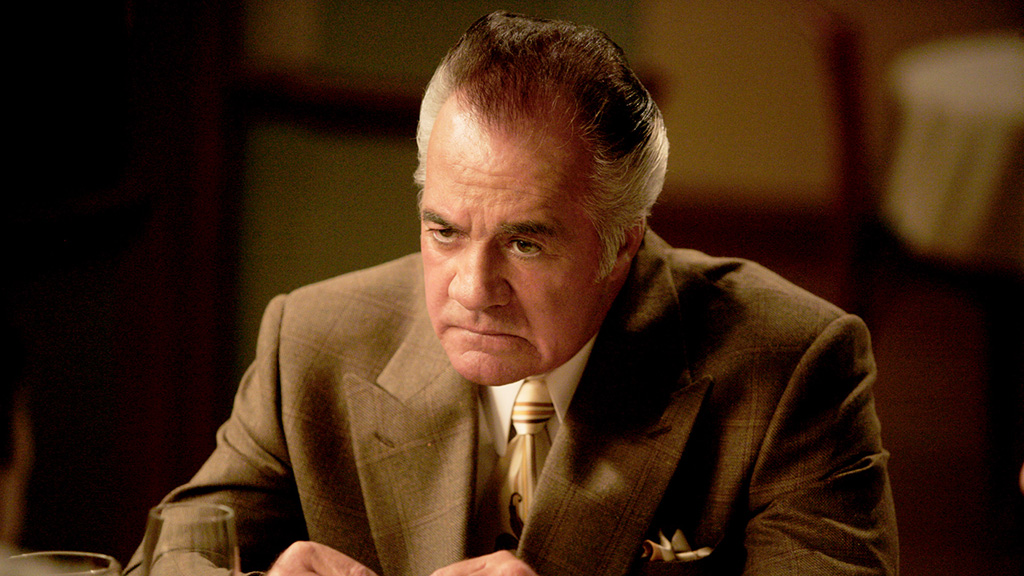
Quickly, now: What do veep hopeful Paul Ryan and ‘Paulie Walnuts’ have in common?

Well, nothing, strictly speaking. There’s no direct connection, anyway. But bear with me…

Some time ago, as you’ll recall, I expressed my pleasure when Rep. Ryan used the word “subsidiarity,” a favorite concept of mine arising from Catholic social teaching, coupled with my dismay at the odd way he used it. The word (to me) refers to the principle that in any system — governmental, economic, what have you — functions should be left to the smallest, most local unit that can competently perform them, with larger entities only performing the functions that can’t be carried out by the smaller units. Applied to government, that means the federal government should only perform those functions that can’t be effectively carried out at the state or local level, and so forth. It’s sort of related to what was for a time popularly called “devolution,” but with differences.

But fellow Catholic Ryan startled me by interpreting the principle as meaning functions should be performed by private entities other than public ones — which is convenient for him politically, but not the way I’ve understood it.

I’m not the only one who sees Ryan’s use of the term as misleading, if not outright wrong. I ran across this a couple of days back. Carrying it further, here’s a piece further explaining the problems with “small-government” libertarians trying to claim subsidiarity as their own. For one thing, it points out, “Subsidiarity is a communitarian philosophy.” Well, yeah.

Furthermore, Ryan has been taken to task for his misapplication of Catholic teaching to the federal budget by 90 faculty members from Georgetown University (a Jesuit institution), and more to the point, the U.S. Conference of Catholic Bishops criticized his 2012 budget plan for failing to protect the poor and vulnerable.

But there there are those, including some Catholic clergy, who would defend the Ryan interpretation of subsidiarity. I was led to this knowledge by Paulie Walnuts.

I’m a big fan of the Internet Movie Database. I have the app on my iPhone, and can’t watch a movie on television without constantly turning to it to answer such questions as “Who’s that actress?” or “What else has she been in?” or “Was this directed by…?” Sometimes I go from there to Wikipedia for elaboration.

Anyway… and I forget what led me to this… I found myself recently reading the Wikipedia entry about Tony Sirico, the actor who played Paulie “Walnuts” Gualtieri on “The Sopranos.” Mr. Sirico, I learned, has also played gangsters in “GoodfellasMob Queen,Gangsters, Love and MoneyFingersThe One Man JuryDefiance, The Last Fight, Innocent BloodBullets Over BroadwayThe Pick-up ArtistGottiCop Land, Turn of Faith, and Mickey Blue Eyes.”

I read on, and was told that there’s a very interesting reason why he is so convincing as this sort of character:

Before turning to acting, Sirico was reportedly a fast-rising mob associate of the Colombo crime family, serving under Carmine “Junior” Persico, and had been arrested 28 times. There is a Sopranos reference to this fact when Paulie says, “I lived through the seventies by the skin of my nuts when the Colombos were goin’ at it.”[3] In 1967, he was sent to prison for robbing a Brooklyn after-hours club, but was released after serving thirteen months. In 1971, he pled guilty to felony weapons possession and was sentenced to an “indeterminate” prison term of up to four years, of which Sirico ended up serving 20 months. In an interview in Cigar Aficionado magazine, Sirico said that during his imprisonment, he was visited by an acting troupe composed of ex-cons, which inspired him to give acting a try.[4] According to a court transcript, at the time of his sentencing, he also had pending charges for drug possession.[5] Sirico appeared in a 1989 documentary about life, The Big Bang by James Toback, in which he discussed his earlier life.

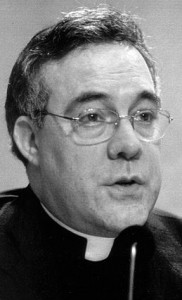
Father Sirico

Interesting, but what does it have to do with the definition of “subsidiarity?” Well, continuing to read the “Background and Career” section, we see that “His brother, Robert Sirico, is a Catholic priest and co-founder of the free-market Acton Institute.”

Really? This was, to me, at least as interesting is Mr. Sirico’s alleged past as a wiseguy. So I checked out the Acton Institute for the Study of Religion and Liberty, where I found commentary with such headlines as “The Rich Don’t Make Us Poor,” “Challenging Liberals on Economic Immobility,” “Moral Formation and the School Choice Movement,” “It Takes a Village to Raise a Business” (that’s my personal favorite) and “Black Scholars Give Obama an ‘F’.”

This is from The Acton Institute Core Principles:

Rule of Law and the Subsidiary Role of Government – The government’s primary responsibility is to promote the common good, that is, to maintain the rule of law, and to preserve basic duties and rights. The government’s role is not to usurp free actions, but to minimize those conflicts that may arise when the free actions of persons and social institutions result in competing interests. The state should exercise this responsibility according to the principle of subsidiarity. This principle has two components. First, jurisdictionally broader institutions must refrain from usurping the proper functions that should be performed by the person and institutions more immediate to him. Second, jurisdictionally broader institutions should assist individual persons and institutions more immediate to the person only when the latter cannot fulfill their proper functions.

On their face, I wouldn’t argue with those assertions, although it’s odd that subsidiarity is being described in terms of an individual’s relationship to the state, rather than between larger and smaller governmental entities. Quite Ryanesque. Here’s how subsidiarity is further interpreted by a writer on that site:

One of the key principles of Catholic social thought is known as the principle of subsidiarity. This tenet holds that nothing should be done by a larger and more complex organization which can be done as well by a smaller and simpler organization. In other words, any activity which can be performed by a more decentralized entity should be. This principle is a bulwark of limited government and personal freedom. It conflicts with the passion for centralization and bureaucracy characteristic of the Welfare State.

This is why Pope John Paul II took the “social assistance state” to task in his 1991 encyclical Centesimus Annus. The Pontiff wrote that the Welfare State was contradicting the principle of subsidiarity by intervening directly and depriving society of its responsibility. This “leads to a loss of human energies and an inordinate increase of public agencies which are dominated more by bureaucratic ways of thinking than by concern for serving their clients and which are accompanied by an enormous increase in spending.”

In spite of this clear warning, the United States Catholic Bishops remain staunch defenders of a statist approach to social problems. They have publicly criticized recent congressional efforts to reform the welfare system by decentralizing it and removing its perverse incentives. Their opposition to the Clinton Administration’s health care plan was based solely upon its inclusion of abortion funding. They had no fundamental objection to a takeover of the health care industry by the federal government…

So I read that, and I thought, “Where have I seen subsidiarity used that way?” Which brought me to the man of the hour. Paul Ryan would no doubt feel very comfortable with the ideas espoused by “Paulie’s” brother, or at least by the organization he heads. But that’s the only thing they have in common, that I know of. If you were hoping for something more, I’m sorry.

Would Mr. Sulu lie to us about space exploration? No way!

Kurt Rebello, who graduated from Radford High School with Burl Burlingame and me, brings my attention via Facebook to the above photo from George Takei, which comes with this caption:

The first image has now been received from Curiosity on Mars.

You may think this is some sort of gag, but hey: This is Mr. Sulu. Could he possibly mislead us on anything having to do with space exploration?

That would not be logical, captain.

Binge TV watching: “You don’t want to know”

Never mind that noise. It's just a bunch of walkers...

The “walker” down in the well was making that characteristic noise they make — the half-strangled, wheezy, snuffling snarl — as the survivors debated what to do about getting it out of there. And I guess I had it turned up a little louder than usual.

My wife called from another part of the house, “What is that noise?”

I hesitated.

Then, I said, “You don’t want to know.”

She laughed, and dropped it. I breathed a sigh of relief that I didn’t have to answer further, which would have embarrassed me. I was deep into a “Walking Dead” binge. And I knew that my wife had the exact attitude toward the series that I did before I got hooked on it — I couldn’t imagine wasting my time watching something that gross.

I had recorded the entire second season when they showed it in marathon form a weekend or two back, and was well into it now. This was to prepare me for the premiere of the third season, which is in… October! How’m I going to wait that long? Especially if this season leaves things hanging the way it almost certainly will, with this unresolved conflict between Rick and Shane, and Herschel likely to throw everybody off the farm any minute? And of course, walkers all over the place, and ammunition in finite supply.

At the back of my mind lingers another worry — my DVR is running out of space. Do I go ahead and erase this when I’ve watched them all? And what about the most recent seasons of “Breaking Bad” and “Mad Men,” which aren’t on Netflix yet? OK, I can erase “Breaking Bad” Sunday, when the Season 5 premieres and Season 4 does go up on Netflix, but what about the rest? It’s a tough call.

So it is that I could identify with this piece in The Wall Street Journal this morning, headlined, “Binge Viewing: TV’s Lost Weekends,” which is all about how, “Using streaming and DVRs, TV viewers are increasingly gobbling up entire seasons of shows in marathon sessions: How that’s changing the game for media companies, advertisers and show creators.”

An excerpt:

With the new season of “Breaking Bad” starting Sunday night, Chad Rohrbacher plopped down on his couch recently to catch up on some past episodes of the show about a chemistry teacher turned drug kingpin. Twenty-two hours passed before he clicked off the set. Pausing only for bathroom breaks, sandwiches and occasional comments of disbelief from his wife, he watched two entire seasons in one go. “It just kind of snowballed,” the 40-year-old novelist and college professor recalls.

When last season ended with a showdown between the bespectacled antihero and his drug boss, Mr. Rohrbacher watched the climax alone in his Greensboro, N.C., living room at 4 a.m. “I could barely see,” he says. The next day, “he was there in body, not in mind,” says his wife, Melanie, who did not participate. “I have a house and kids to take care of.”…

I feel for you, Chad. Been there.

Used to be, I had Netflix — and my DVR —  just for the movies. In fact, that was pretty much the only reason I had a TV. But now, that’s changed. And AMC has played a big role in making that happen. They seem the best at making must-keep-watching, high-quality TV shows. And now, you can watch them all at once.

So you’re saying that you’re a grownup, and you have your head on straight and a solid set of priorities, so this doesn’t affect you. Well, yes it does, if you watch TV at all — because it’s altering what’s being offered. Writers are having to write differently for this kind of audience. And it’s changing the whole business:

The industry ramifications are bigger than the occasional weekend lost to “Lost.” Bingeing breaks habits that have long supported the TV business, built on advertising and syndicated reruns. TV executives are torn by the development: gratified that people are gorging on their product, frustrated because it’s a TV party that all-important advertisers aren’t invited to. For middlemen like Amazon Instant Video, Hulu Plus and Netflix, it’s a godsend, boosting their quest to attract and retain subscribers. Writers and producers are just starting to confront the challenges of creating TV for an audience that may digest an entire season in one sitting.

Vince Gilligan, the creator of “Breaking Bad,” got his start in the writers room for “The X-Files.” There, he was schooled by creator Chris Carter in building cliffhangers to lure the audience through commercial breaks and into the next episode. Now, besides unspooling a narrative week by week, year by year, writers must also keep in mind fans who take the story “in a giant inhalation,” says Mr. Gilligan.

He describes his show as “hyper-serialized,” in the way writers try to close the loop on every character and plot point. A homemade poison that methamphetamine whiz Walter White (Bryan Cranston) tried to use on a drug dealer in season two ended up driving a big plot twist in season four. “We use every bit of the buffalo,” says Mr. Gilligan. He now believes fans who devour multiple seasons in short order are “more rewarded” because their memories of all the story threads are fresher. (Others disagree: TV critics are arguing about whether serialized TV is better when savored between episodes.)

Of course, the good news is, if I’m caught up on all three of the AMC series I watch (there would be four, if they hadn’t cancelled “Rubicon“), and I haven’t gone off on another tangent, like that period several months ago when I was plunging through all six seasons of “Lost,” I’m relatively free to live my life — interact with actual humans, or even read a book.

But when I’m in the middle of a season, it can be bad. The WSJ piece warns, “Brain chemistry plays a role in bingeing. ‘We get into something akin to a trance with great storytelling,’ says psychiatrist Norman Doidge, author of ‘The Brain That Changes Itself.’ Viewers identify with characters on screen and subconsciously begin to mimic their emotions—be it sadness or triumph or anxiety—and each emotional state triggers different brain chemicals, which linger.”

No kidding. I remember, in the first couple of seasons of “Breaking Bad,” when I’d stayed up long after my wife had gone to bed, I’d hesitate to go in and hit the sack, because I felt guilty. She might wake up and ask questions. No, I hadn’t personally been running a mobile meth lab and killing off competitors and keeping it a secret from my wife. That was Walter White. But I’d been so wrapped up in his tension, trying to keep it from his wife, that my nerves were on edge. I felt like an accomplice. I felt like I was descending into the sordid depths as surely as he was.

This feeling eased up in the most recent season, as Walter became more ruthless and started agonizing less over his actions. So… does that mean I’m as bad as he is now? Aye, there’s the rub.

But there’s always the fallback. If there are any questions, I’ll just say, “You don’t want to know.”

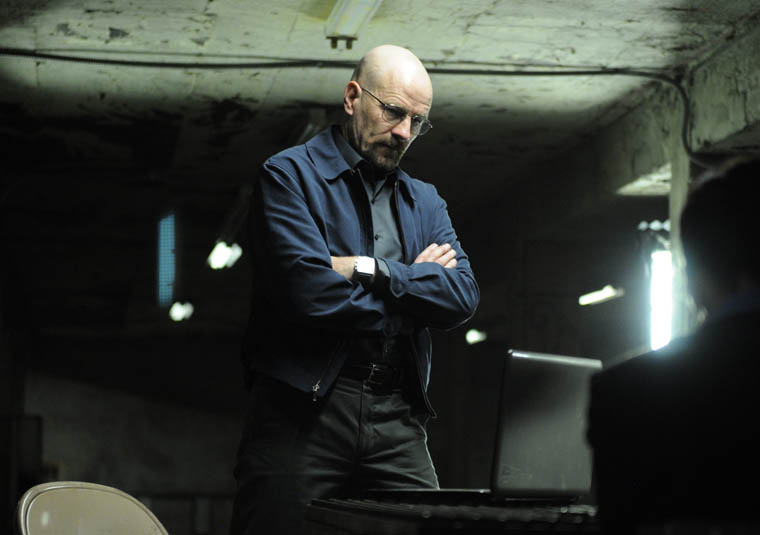
Nothing, dear! I'm just cooking up a batch of... stuff...

God rest you, Andy Griffith

Well, I reckon it had to happen someday, but I declare I wish it wasn’t so:

Beloved actor Andy Griffith died this morning.

Former UNC President Bill Friday says The Andy Griffith Show and Matlock actor died at his home in Dare County, North Carolina around 7 a.m.

Friday, who is a close friend of the actor, confirmed the news to WITN News.

Some will think back on ol’ Andy and remember such irrelevancies as “Matlock,” which I never took any interest in. That image is apparently indelible, though. On Saturday, I was sitting out in the 108-degree sun at a wedding, and the guy in front of me commented on someone up ahead wearing a seersucker jacket, and said something like, “Somebody went with the Matlock look.” (If he’d turned around, he’d have seen someone wearing a full seersucker suit, which of course was the only thing to wear. This guy was in black, if you can believe it.)

But that’s not the impression Andy left on me, or on most people, I suspect.

To me, he’s the character of his youth. He’s the enthusiastic innocent of “No Time for Sergeants.” He’s the really scary, dark side of that character in “A Face in the Crowd” (in an awe-inspiring performance that I never saw him equal since — although few would want to remember him for that).

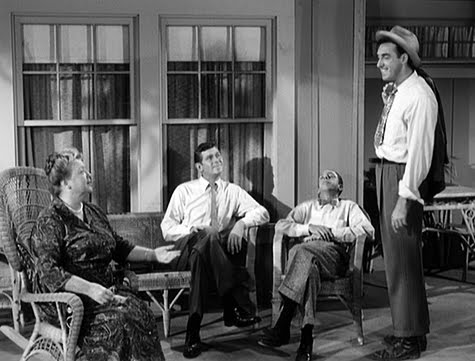
But mostly, he’s Andy Taylor, the Sheriff Without A Gun. And I mean the early Sheriff Taylor, in black and white, with Barney Fife, before he got jaded and bored with the character (his portrayal is unrecognizable in the later episodes, after Opie stopped being cute).

For the Andy Taylor I know, there’s a perfect heaven. It’s on the front porch of his house in Mayberry, just a-settin’ there rockin’ with Barney after one of Aunt Bea’s Mmmm-mmmm! dinners. Maybe he’s strumming the guitar a bit, but not too energetically. And he’s engaged in this sort of conversation:

Andy: You know what would be a good idea? If we all went up town and got a bottle of pop…
Barney: That’s a good idea, if we all went up town to get a bottle of pop.
Andy: You think Mr. Tucker would like to go?
Barney: Why don’t we ask him… if he’d like to go uptown to get a bottle of pop?
Andy: Mr. Tucker?
(No response from Mr. Tucker)
Andy: You wanna lets me and you go?
Barney: Where?
Andy: Uptown to get a bottle of pop?

That’s the sort of peace most anyone would like to rest in…

A little something for you Trekkies out there

This was brought to my attention by pourmecoffee, one of the better Twitter feeds:

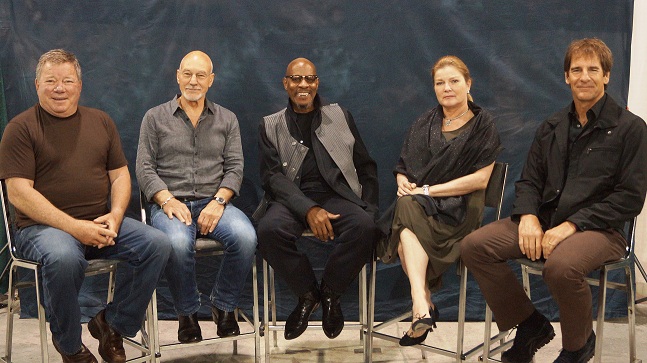
All five of the Star Trek captains appeared together for the first time this weekend at Wizard World Philadelphia Comic Con. The photo shows William Shatner, Patrick Stewart, Avery Brooks, Kate Mulgrew, and Scott Bakula from left to right. The photo above was taken by Tomlin Campbell for Wizard World.

Of course, there was only one real captain. The fat guy on the left used to be him. This is one subject on which I agree with Hitler.

The upside is that you NEVER lose an argument

video platformvideo managementvideo solutionsvideo player

Or if you do, you have a whole other set of problems…

Anderson Cooper brings our attention (blast him) to the following:

Daytime Exclusive: Woman Marries Herself in Ceremony

Nadine, 36, joins Anderson to explain why she married herself after getting a divorce. Nadine had a ceremony to celebrate the event and invited 40 guests. She even received wedding gifts.

Her unusual event made headlines, but Nadine says she wasn’t in it for the publicity. She says she decided to go through with the self-marriage because “it was about really committing to changing my life. I feel very empowered, very happy, very joyous. I want to share that with people, and also the people that were in attendance, it’s a form of accountability.”

Nadine experienced a painful divorce and says it was rough after learning her two kids wanted to live with their father. “Six years ago I would’ve handled a problem by going out and drinking. I smoked, I was 50 pounds overweight… this is just celebrating how far I’ve come in my life.”

Since the split, Nadine enjoys spending time with herself, going out on date nights, buying treats and gifts for herself, and says she’s no longer waiting for “someone to complete her.”

What are we going to call this? “Same-self marriage?” Will it catch on?

I hope not. The whole thing worries me. It’s just so easy for self-love to turn to self-abuse…

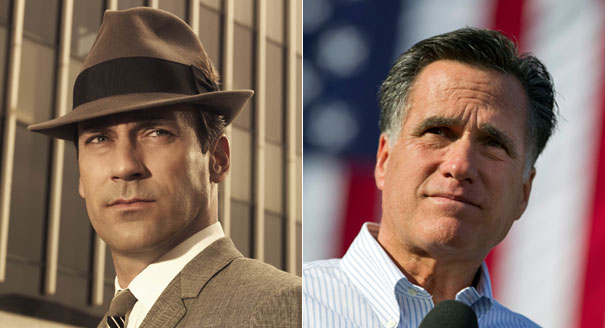
Politico promises “The Draperization of Romney,” but totally dodges the subject

The Politico piece (which ran last month, but Nu Wexler just called my attention to) started out with an intriguing premise:

The Draperizing of Mitt Romney is under way.

He may not drink or cheat, and he lacks the fictional ad-maker’s charisma, but Democrats, despite the potential perils of such a strategy, remain determined to paint Romney as a throwback to the “Mad Men” era — a hopelessly retro figure who, on policy and in his personal life, is living in the past…

But it really sort of fell flat.

I thought it was going to go deeper. For instance, the central conflict regarding Don Draper (at least in the early seasons) is that he’s not who he says he is. Now that would be a pretty meaty thing to throw at the famously mutable Romney. You can easily see Don Draper donning any political mantle required to get his way with a client, or a woman, or anyone — because he just doesn’t care about that stuff. Ditto with Mitt. He just wants to be president; he doesn’t give a rat’s posterior about the stuff that the True Believers in his party get all cranked up about.

But the Politico piece completely dodged the subject, instead citing some tired chestnuts about how the 50s and early 60s were awful because moms stayed home with the kids. (Although I admit I’d rather hear that oldie than more of the tiresome “war on women” meme.)

And then… it goes into this interminable discussion of that stupid flap over what some Democrat said about Ann Romney several weeks ago. It goes on and on. I guess that was fresh when it was written, but what does that have to do with the advertised subject? Not much.

Hello!?!?! This is supposed to be about how Mitt Romney is like Don Draper! Neither of them is a woman! Can we stick to the subject? Don’t make me think you’re going to talk about guy stuff and then not even touch on that area… It’s enough to make a guy want to go off with those idiots who get together in sweat lodges and beat tom-toms and talk about how tough it is to be a guy. Almost. OK, not even close. But don’t bill something as being about guy stuff when it’s going to be yet another rehash of chick stuff.

As for Don… I’m worried about the guy. This week’s episode ended with him putting “Revolver” on the turntable (is it 1966 already?) at the behest of his young wife, who’s trying to clue him in on what the late ’60s will be about. He briefly listens alone (his wife is off taking acting lessons, leaving him behind in more ways than one) in his Hugh Hefner dream pad, and the contrast between him and “Tomorrow Never Knows” could not possibly be more stark.

The early 60s — say, round about 1962, which Gene Sculatti‘s brilliant Catalog of Cool termed “The Last Good Year” — was his time, the time he was created for, and which was created for him. He is going to be so lost going forward.

I want to bite that hand so badly

Anybody see “Mad Men” this week?

If so, what do you think?

Is it all over for Sterling Cooper Draper Pryce?

The firm has had enough trouble clawing its way back, and now this…

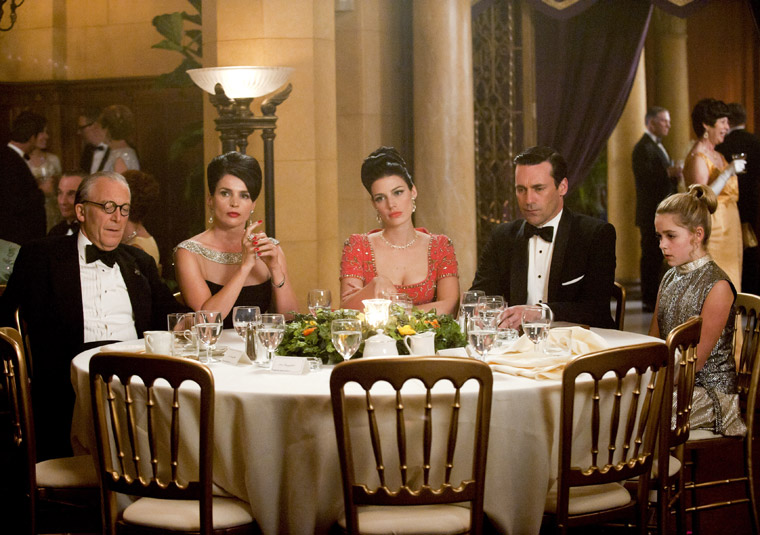
Don Draper, who created a sensation last season by biting the hand that fed his agency — Lucky Strike — with an anti-tobacco letter published in the NYT, seems to have been vindicated. He’s to get an award for taking a courageous stand, and captains of industry will be there to see him get it. Roger Sterling goes along to the banquet and is happy as a clam passing out his business cards in that target-rich environment. (By the way, I’m sort of the Roger Sterling at ADCO, because that’s the sort of thing I do. Fortunately, dropping acid is optional.)

But then, in a calculatingly offhand manner, the guy from Dow Corning confides to Don that sure, all those people will give him awards, but none of them will ever work with him, because his letter demonstrated that no client could ever trust him. And then asks him if he’d like another drink. Yes, as it turns out.

The episode ends with Draper sitting back at his table at the banquet looking like he just got hit by a stun gun. (Everyone else at the table looks the same way, for differing reasons.)

So was the guy from Dow just blowing smoke? Was he just saying Dow will never work with SCDP? Or was he delivering a message on behalf of the other fat cats? Or was he just speculating? And will Don share what he’s learned with his partners (I’m guessing not)? Or will Roger, his mind having been expanded, figure it out?

I don’t know, but I wish I could have found a clip of my favorite line of the episode. It’s when Roger shares yet another “brilliant” insight with Don, and Don tells him that even some people who have not experienced LSD know that…

In pop music, was 1965-1975 unique?

On a previous thread, young Kathryn scoffed at people my age, suggesting that we think the music that was popular when we were in high school (and I would add, college) was great just because it came along when we were young.

I think people of any age are going to have a special feeling for music that was played when their hormones were raging at their peak. But while I hesitate to invoke an “objective” standard, I think you can demonstrate with some degree of detachment that the period in question for, say, Burl and me (roughly 1965-1975) was one of extraordinary creativity on many popular fronts.

There were so many genres just exploding:

  • British pop groups and their American imitators (what everyone thinks of first). And I’m not going to bother splitting this into its many sub-genres.
  • Folk, evolving from acoustic to electric, in numerous directions (Dylan and Simon and Garfunkel are very different)
  • Varieties of soul, from Motown to Memphis
  • Burt Bacharach — He gets his own category. If you want to create a 60s feel in a movie, you’re as likely to turn to Bacharach as the Beatles — if not more so
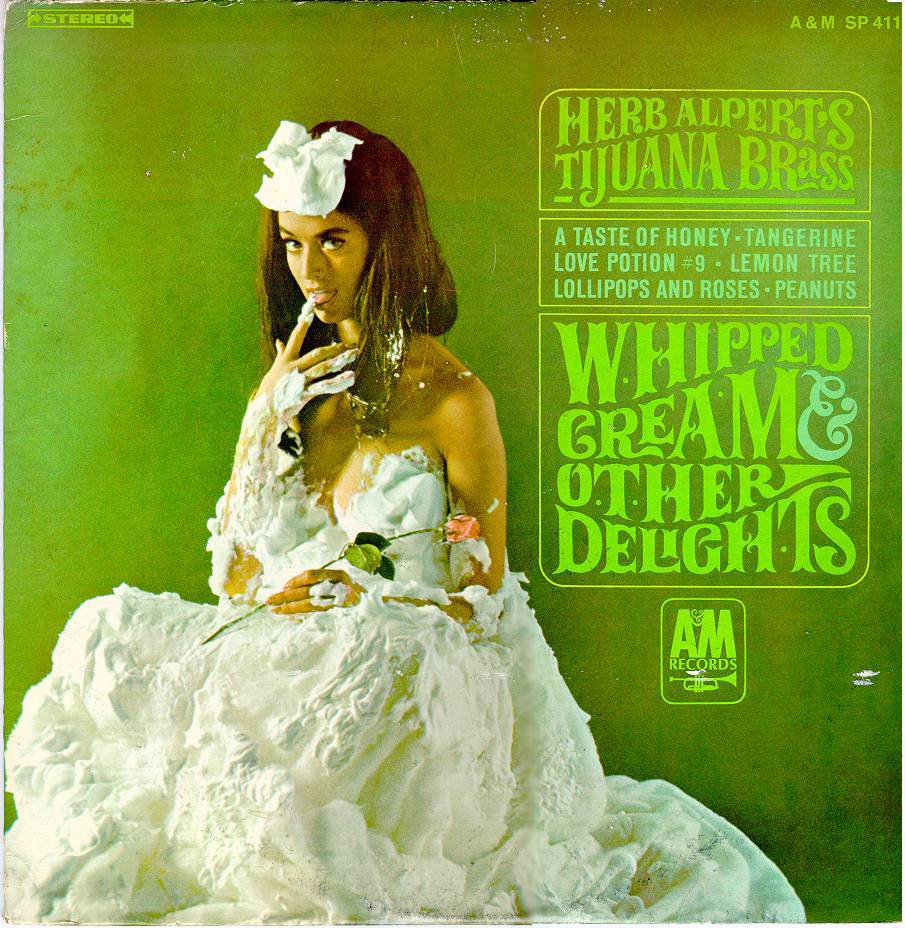
  • Latin (Spanish variety), spanning a broad spectrum from Herb Alpert to Trini Lopez to Jose Feliciano (Alpert is as essential as Bacharach to a 60s soundtrack)
  • Latin (Brazilian variety), from Girl from Ipanema through Sergio Mendes and Brasil 66
  • Old folks/Rat Pack-style — Dean Martin and others reached broadest audiences ever on TV
  • Crossover country — spanning a wide spectrum from Glen Campbell to Johnny Cash, enjoying wide popularity not seen before or since
  • West coast beach music (surf music) — Yes, it came along earlier, but there was still a lot going on in the early part of this period (“Wipeout,” the later Beach Boys stuff
  • East coast beach music — This movement started in the 40s, but some of the big hits came along in the early part of this period (“Can’t Help Myself”)
  • Even Broadway show tunes — Almost every show tune I’m familiar with was sung repeatedly on the 60s TV variety shows
  • White blues — big overlap with British groups here (The Animals, Cream, early Led Zeppelin), but Paul Butterfield and others sort of stand alone

Then there are all those bands and individuals that can’t be easily categorized — Warren Zevon, Randy Newman (late in the process), David Bowie, The Band, Creedence Clearwater Revival, Janis Joplin, Linda Ronstadt, Elton John, Blood, Sweat and Tears

I just can’t think of a time when so many kinds of music were so huge, and reaching such a diverse audience (in the pre-cable age, everyone was exposed to pretty much the same cultural influences — if it got on TV, the audience was immense), with so much energy and creativity exploding out of every one of them.

Can you?

It wasn't just about guitar groups -- not by a long shot.

Anybody want to talk Mad Men?

I called AT&T (and be sure to check out the ad at right) on Saturday to upgrade my TV options so that I could see the season premiere of “Mad Men” Sunday night. In HD.

I even went to see Dreher High School’s production of “How to Succeed in Business Without Really Trying” — twice — over the weekend to help get me in the mood. (Quick, what is the most direct connection between that play — and I’m thinking the original Broadway production — and “Mad Men”? There’s a hint in the photo above.)

And it was all that I had expected it to be.

So I come in to work at my own ad agency Monday morning, and we usually spend a few minutes batting the breeze at the start of the traffic meeting, but… no one but me watches “Mad Men”! So there was no one to discuss it with.

Anybody want to talk about it? Here, I’ll start…

My favorite story line wasn’t Don’s relationship with his hot new wife, or Lane’s dilemma over the picture he found in a wallet. It was the one that went (SPOILER ALERT):

  • Young white twerps at competing agency, tired of hearing civil rights marchers outside their window, start dropping water bombs on them — which makes news.
  • Our protagonists at Sterling Cooper Draper Pryce decide (in their own white-twerpy fashion) to add to the competitors’ discomfiture by running a help-wanted display ad declaring that they are “an equal opportunity employer.”
  • Joan (my very favorite Mad Man, even though “Man” fits her less well than it does anyone else on television), who is on maternity leave, thinks the agency is hiring someone to replace her, and charges into the office with her baby to demand explanations.
  • A reception-room full of earnest young black applicants, quite naturally taking the ad at face value, show up to apply for the job. NOW what are our wiseguys going to do — say there IS no job, and risk getting as big a black eye as the rival agency did?

Suddenly, our “heroes” are entangled in the mid-60s, and they have to figure out how to cope with it. And it’s deftly and realistically handled, if a bit larger than life.

Getting in the mood for ‘Mad Men’

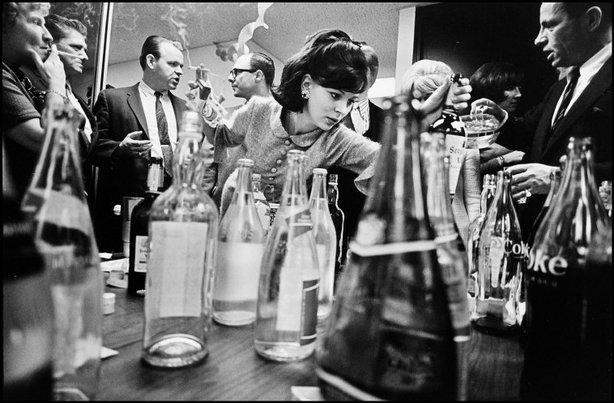
NEW YORK CITY—An office party, 1966. © Leonard Freed / Magnum Photos

Slate has put up a really interesting photo slide show invoking the “Mad Men” era, to help us all get psyched up for the season premiere coming Sunday.

This is but one. I urge you to go view the whole package. And check out other excellent archival images from Magnum Photos.

Oh, and in case you wondered, fans — working at an ad agency is just like that. Only without the smoke.

The flip-floppers of ‘Lost’

John Locke at his most obsessed. Trust him, or not?

If you’ve never watched “Lost,” and intend to someday, don’t read this, because I’m going to give some stuff away.

I didn’t watch it when it was on, maybe because I had seen bits of it, and it made no sense, or so I inferred.

Now, I have almost finished watching all six seasons on Netflix, and I know for sure — without having to infer — that it makes no sense. I would have finished watching all of it by now, except that I turn it off and look for something else when my wife enters the room. Not because I’m sensitive to what she wants to see, but because I don’t want to be scoffed at. Because I know it’s silly, but I’m determined to see it to the end. NOT because I have any expectation of the ending being satisfying, but because I can’t help myself.

I thought it was a flawed show before I watched it, and now I know just how flawed it is, in great detail. And the greatest flaw, the greatest sin against storytelling, is its inconsistency.

I’m reminded of this by something Kathryn shared with me via email. It’s this piece, on a subject I addressed last week (“Let’s hear it for the flip-floppers — compared to the rigid ideologues, they are a breath of fresh air,” Feb. 28). It from NPR, and it says in part:

But we have lots of brain circuits that are making predictions about all kinds of things, every second of every day. And the brain pays special attention to other people, Linden says.

“We’re extremely attuned to the veracity, and the predictability, and the group spirit and the motivations of those around us,” he says

That’s probably from thousands of years living in groups. To stay alive, we had to know if the person who helped us yesterday might hurt us tomorrow.

Prediction is so important that our brains actually give us a chemical reward when we do it well, Linden says.

“We are intrinsically wired to take pleasure from our predictions that come true,” he says.

Get it right and you get a burst of pleasure-inducing dopamine or a related brain chemical. Get it wrong and dopamine levels dip, Linden says.

All that training makes us extremely sensitive to the consistency and predictability of people we depend on, Linden says.

“If we have a sense that there is a mismatch between our prediction and their actions, that is something that sets off neural alarm bells,” he says. And if we think they have been inconsistent about something fundamental, he says, we will feel betrayed.

“When we feel deeply betrayed, either by a leader, or by someone in our social circle, or by our beloved, that pain really is similar to physical pain,” Linden says.

In other words, we’re hard-wired to suffer from the inconsistency of flip-floppers. No wonder we don’t like them.

Well, maybe. And that would help to explain why I don’t like the central flaw in “Lost:” You can’t rely on the characters to be consistent.

Take John Locke, for instance:

  • First, you like him. You’re cheering for him because you’re glad he can walk again. And you like that his knowledge of outdoor lore (which I guess he got from books or something) — tracking, knife-throwing, boar-killing, etc. — can be useful to the castaways. He’s a reassuring presence, an avuncular figure who befriends the boy with the dog and makes a cradle for Clair’s baby.
  • Then, you start to wonder about him, as he starts talking about what “the island” wants and demands, and obsessing about “the Hatch.”
  • Then, you’re SURE he’s nuts, as he makes a religion out of pushing the button.
  • Then, you find out he was RIGHT, because not pushing the button was what crashed their plane to begin with. And leads to a catastrophic mess when it happens again.
  • Then, you find out about his miserable life before the island, and you really sympathize with him.
  • Then, he dies.
  • Then, he turns up alive after his body is brought back to the island.
  • Then, it turns out he’s dead after all, and the “Locke” we see is really the Smoke Monster.
  • Then, character A trusts him anyway, and tries to do his bidding, while Character B fights him as hard as possible.
  • Then, Character B trusts him completely, and Character A strives to frustrate him.

And… well that’s as far as I’ve gotten.

There are a couple of character arcs that are a little more consistent, but still jarring. Such as the steady degradation of Jack from Boy Scout Everyone Can Rely On to nervous, neurotic wreck who might do anything. Meanwhile, Sawyer goes from the guy you can’t trust to a fairly heroic figure, more or less.

Other characters will switch back and forth, sometimes more than once in an episode, from bad to good, trustworthy to untrustworthy. Note how many times we are led to believe that it’s a good idea to trust Ben Linus, only to find out, yet again, that it is not?

Beyond the characters, there’s the fact that the Explanation of What is Going On keeps changing. Something is revealed, then we learn that that is an illusion, and it’s deeper than that, on and on down the rabbit hole. (Speaking of rabbits, the occasional allusion is fun. Such as when a lab rabbit is referred to by name as “Angstrom.” Or the characters named for philosophers.)

“Lost” isn’t the worst in this regard. The worst case of this I’ve ever seen in a TV series was another cultish series, “24.” Within the bounds of a single episode, a character who we are led to believe we can all trust our lives to turns out to be the incarnation of evil, and then switches back. Which is made even more outrageous when we consider that this is all supposedly happening within one hour’s time.

I felt so manipulated and abused by that series that I gave up after two seasons.

So why am I still watching “Lost”? I don’t know. Maybe it’s the scenery. In any case, I don’t have far to go now…

Mercifully, I had forgotten this incident

Talking to Kara Gormley Meador yesterday, I momentarily drew a blank when she mentioned her run-in with John Graham Altman some years ago. She reminded me of the details, which made me go, “Oh, yeah.” Here’s a summary of the incident:

Excerpts from the exchange between WIS-TV reporter Kara Gormley and Rep. John Graham Altman, R-Charleston, over a S.C. House committee’s vote to make cockfighting a felony while tabling a bill that would toughen criminal domestic violence laws

Gormley: “Does that show that we are valuing a gamecock’s life over a woman’s life?”

Altman: “You’re really not very bright, and I realize you are not accustomed to this, but I’m accustomed to reporters having a better sense of depth of things, and your asking this question to me would indicate you can’t understand the answer. To ask the question is to demonstrate an enormous amount of ignorance. I’m not trying to be rude or hostile, I’m telling you.”

Gormley: “It’s rude when you tell someone they are not very bright.”

Altman: “You’re not very bright, and you’ll just have to live with that.”

So basically, when she talks about the lack of civility in politics, she’s speaking from personal experience.

Davy Jones, 66, catches last train to Clarksville

Yeah, that’s a pretty cheesy headline, but it was the first thing I thought of. I guess I could have said, “Davy Jones heads for the locker,” but that would have been worse:

Davy Jones — forever young and forever beloved by fans the last 50 years — has died, according to Reuters. Age: 66. The cause of death was apparently a heart attack.

Jones and his band the Monkees were in a brief moment and time very nearly as popular as the Beatles — whom they so gently satirized and idolized in that long ago NBC hit. (“The Monkees,” by the way, bowed Sept. 13, 1966 — five days after “Star Trek” launched.)…

Anyway, it’s sad. Especially for those of us who were in junior high (the perfect demographic target) when the Monkees came on the scene. Because we mourn for our youth, and how easy it was to get excited over the smallest things, even a pre-Fab Four. And I suppose it’s particularly sad for those who were girls at the time, since Jones had the faux “Paul McCartney” role in the quartet.

How strange that just yesterday, we were talking about Michael Nesmith and Peter Tork. I suppose that at this point, just to round things out, I should mention Mickey Dolenz.

You know, it’s just impossible that this much time has passed…

Colbert proves he’s a good South Carolina boy; drops everything to care for his sick Mama

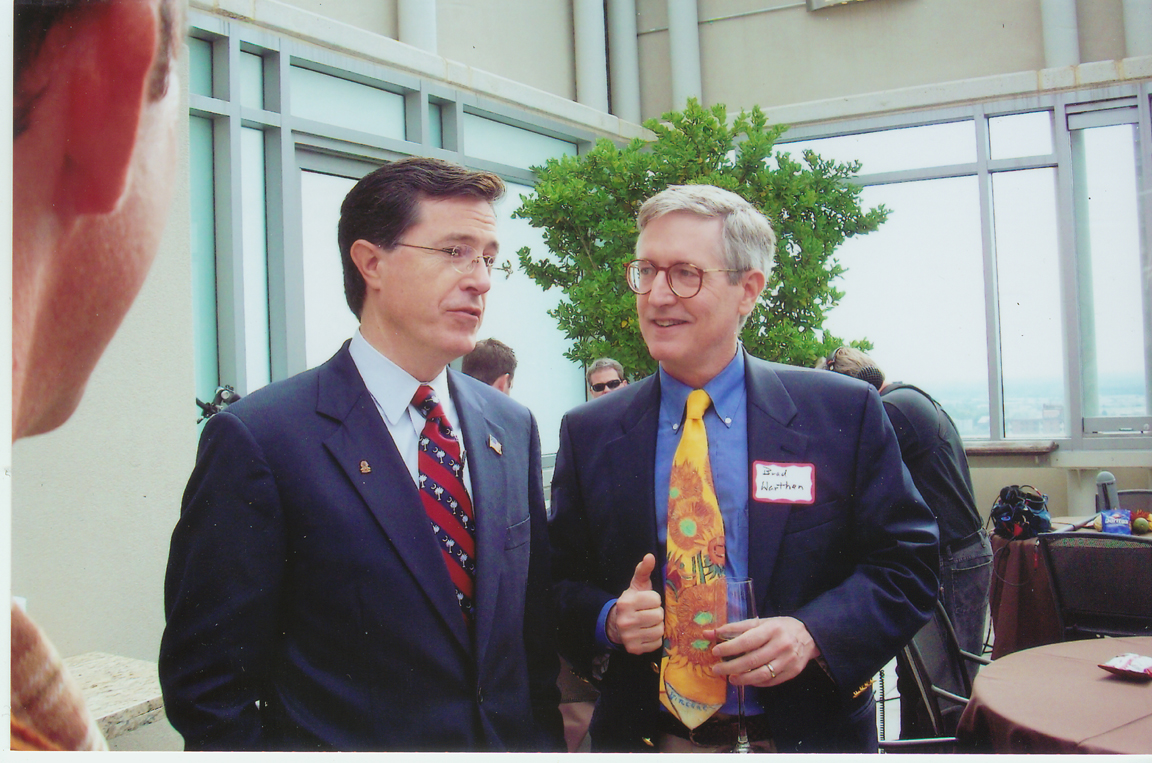
Colbert, seen in this file photo with another South Carolina boy.

If anyone doubted that Stephen Colbert was really one of us, this should settle it:

Episodes of “The Colbert Report” were canceled this week, reportedly because of the serious illness of Colbert’s 91-year-old mother, and fans have been showing their support for “a deeply decent guy.”

Several news outlets reported Friday on the illness of Colbert’s mother, Lorna, who incidentally is a resident of South Carolina — the state where her comedian son was running for office as “President of the United States of America of South Carolina.”

The comedian comes from a large Irish Catholic family, with 11 children. His father and two  brothers were killed in a plane crash in 1974.

The Wednesday and Thursday tapings of the series were canceled at the last minute, with Comedy Central releasing only a short statement that cancellations were because of “unforseen circumstances.” Although sources close to the show say they anticipate returning to new episodes soon, there’s been no official statement from the comedian or his family.

Fans have been tweeting their words of support on Twitter; none are upset about the missed shows. “Stephen Colbert… is a deeply decent guy,” wrote one fan. “Hope everything is going well with our Mom. Your fans are all thinking about you,” wrote another….

He’s a good Southern boy after all; in spite of his funny way of talking.