Category Archives: Top Five Lists

Top Five Things Wrong With This PBS Quiz

decade

As y’all know, I dig PBS almost as much as I do NPR, and it’s basically the only broadcast outlet I ever watch. (Mostly I have a TV for Netflix and Amazon Prime, and occasionally, when I’m feeling retro, a DVD.)

So I have high expectations when I see the PBS logo. Which is why I was so disappointed by this lame “Which Decade Do You Belong In?” quiz.

The whole thing was phoned in for the shallowest of purposes — promotion of three “Masterpiece Mystery” series. Nothing is offered that would provide a serious time traveler with helpful insight into which decade he would be most at home in.

Here are the Top Five things wrong with it:

  1. The individual questions force you into ridiculous choices. Such as “Choose a Women’s Hairstyle,” and the options are “Beehive,” “Poodle cut” and “Shag.” In other words, you have to have a fave among the most extreme, least appealing, hairstyles of three decades. (The worst: “Who’s your biggest critic?”, with the choices being “The Establishment,” “The Church,” and “Your mother.” Y’all know me: I’ve got no beef with any of those parties. But I chose “The Establishment” because I knew that would make me cool in at least one of the three decades on offer.)
  2. Even if the individual questions offered minimal guidance, there aren’t enough of them to add up to anything helpful. There are only seven of them! I mean, why even bother inventing a time machine to begin with? With info like this, even if I fell and hit my head and thought of the flux capacitor, I wouldn’t bother to build it, because I’d have no idea where I wanted to go!
  3. Crass commercialism. Or, since this is technically not commercial television, crass… I don’t know… promotionalism! There have been loads of fine “Masterpiece Mystery!” shows over the years, set in many very fine decades, but this is all about three that were currently showing or about to have a season premiere. About as shallow as you can get, and strangely trapped in the current moment, considering that the point is to appeal to people who presumably want to live in other moments.
  4. Lack of truly cool decades. Forced to choose between the 1950s, ’60s and ’70s, I of course ended up in the 50s, which will surprise few of you. But that’s because the decade of 1800-1810 wasn’t even offered! And you would think that PBS, if it exerted itself even slightly, would be able to manage that…
  5. One of the three shows that inspired this insipidity was a show that I haven’t even watched,
    No Annie Cartwright.

    No Annie Cartwright.

    from lack of interest: “Prime Suspect: Tennison.” I tried watching it one night, but quickly lost interest, mainly because it takes us back to the Metropolitan Police Service in 1973. In other words, it covers ground already covered far more entertainingly by “Life on Mars.” The central character is a young WPC trying to make her way in a service just beginning, reluctantly, to take female cops seriously. And I’m sorry — I’m sure she does her best, but she is no Annie Cartwright! Anyway, I lived through the 1970s; I became an adult in the 1970s, so show me something more interesting.

In the grand scheme of things, of course, such quizzes are beneath the dignity of PBS, which is probably why the person who contrived this just gave it a lick and a promise. But if you’re going to try to engage my appetite for quiz clickbait, then make it worthy of the PBS name!

That is all…

50s

Top Five Performances of All Time by Black Actors (1st draft)

Weirdly, the movie wasn't in black and white -- but I remember it that way, for some reason.

Weirdly, the movie wasn’t in black and white — but I remember it that way, for some reason.

I hesitate to put this out there because I KNOW I’m doing this rather randomly. I don’t think in those terms (best black this, best white that), so when my brain tries to run a report based on such criteria, it doesn’t operate as efficiently as it ought.

But I had to react to this piece in The Guardian about all-time top film performances by black actors. The story is from way back in October, but I just saw it, and now is when I’m reacting.

It’s headlined “Sidney Poitier’s Mister Tibbs voted best performance by black actor in public poll.” And that’s what I’m reacting to.

Don’t get me wrong. I thought “In the Heat of the NIght” was pretty awesome, one of the greats of the decade. It was groundbreaking, with talented actors skillfully depicting characters groping their way through unfamiliar roles and relationships. This was done, in 1967, with better understanding and fresh open-mindedness than we usually see today. Everybody was good, from Poitier and Steiger down to Warren Oates.

I also enjoyed the sequel, the title of which was the most memorable line in the original.

But I’m sorry — I’m going to have to go with “To Sir, with Love” as Poitier’s best performance. OK, so bits of it were mawkish and I first saw it at an impressionable time when high-school themes were particularly appealing (when I had yet to attend high school). But the character was unique, and drawn with masterful nuance. And the song still kind of gives me chills. (OK, guys, go ahead and give me the business, but I think it was better even than when Jim Brown threw those grenades down the vents to fry the Nazis in “The Dirty Dozen.” So there.)

Anyway, here are the top five from the British Film Institute poll that The Guardian was reporting on:

  1. Sidney Poitier (In the Heat of the Night, 1967)
  2. Pam Grier (Jackie Brown, 1997)
  3. Michael K Williams (The Wire, 2002-08)
  4. Chiwetel Ejiofor (12 Years a Slave, 2013)
  5. Morgan Freeman (The Shawshank Redemption, 1994)

As much as I dug Pam Grier in “Jackie Brown,” the only one I can put on my list is Michael K. Williams in “The Wire.”

Here’s my initial stab at a personal list — which I will no doubt amend when y’all remind me of performances I’m forgetting. (I wish The Guardian had linked to the 100 performances on the list the poll respondents chose from — that would have helped.)

I’m not going to rank mine — I’m just going to list five, and see what y’all think:

  • Sidney Poitier in “To Sir, with Love” — I already explained this above. Sort of.
  • Michael K. Williams in “The Wire.” — You could pick Idris Elba’s Stringer Bell, or any of a dozen or so powerful performances by black actors in this series. But Williams steals every scene in which he appears. Best scene ever — when he traipses to the grocery to pick up some Cheerios early one morning, and on the way back a dealer tosses his goods out the window at him, because the cry of “Omar comin’!” strikes such terror. (“They don’t have the honey-nut?”)
  • Chiwetel Ejiofor in… wait for it… “Serenity.” Nope, not “12 Years a Slave” or anything else most people would cite. I thought his portrayal of The Operative was practically hypnotic. Have you ever see such a thoughtful, sensitive, really bad guy? And the sword thing appealed to the 12-year-old in me.
  • Danny Glover in “Places in the Heart.” — Yeah, he’s great in lots of things — his cold-hearted cop-gone-bad in “Witness” was amazing. But I loved the way his character stuck to the role that society assigned to a black man in Texas in the ’30s, while showing his intelligence and experience in guiding helpless widow Sally Field to grow the crop that saves the day — even though his tactful assertiveness nearly costs him his life. Love the scene when he distracts the grieving boy by making a fuss over what bad luck it is to rock an empty chair.
  • Butterfly McQueen in “Gone With The Wind” — Yes, I’m being a bit perverse here, overlooking Hattie McDaniel’s much larger role, for which she rightly received an Oscar. But “Prissie” was just so… inventive. What a weird character, played so convincingly! When she meanders through the gate singing to herself just before the famous “birthin’ babies” line — was she tripping, or what? (OK, I admit it. I’m deliberately refusing to choose the obvious performance lest Barry in “High Fidelity” mock my list.)

I consider this to be a start on a good list. I’m eager to see what y’all suggest…

Miss_Melly_she_done_had_her_baby


Ranking the Bonds (a Roger Moore memorial post)

Accept no substitutes, unless you're forced to.

Accept no substitutes, unless you’re forced to.

In breaking the news about his death this morning, The Guardian called Roger Moore “the suavest James Bond.”

The way I think of Moore.

The way I think of Moore.

OK. Maybe. I’d say Pierce Brosnan comes close, though.

The thing is, personally, I never quite accepted Moore as Bond, even though he played the part in more films than anyone. I thought of him as “The Saint.” Part of the problem in accepting him as 007 is that he had the rotten luck of following Sean Connery, who of course defined the role.

All of this is to build up to a Top Five List, in this case ranking the Best Bonds. Yes, I know; it’s been done to death. But it’s the first way I could think of to mark the passing of Simon Templar.

So here goes:

  1. Sean Connery. Yes, I know: It’s like picking the Beatles as “best pop group.” Barry in “High Fidelity” would sneer at me for being so obvious. But it’s not even close. He was Bond when Bond was cool — in the Mad Men, Playboy magazine era when wearing the right tux, drinking the right martini and having as many beautiful women as possible was fashionable, even praiseworthy. He wore his hyper-masculine image with just the right bit of irony, at a time when we boomers weren’t old enough to realize what a joke it was. Austin Powers showed us that, much later. (If you go back and watch the Connery films now, you’ll see Mike Myers wasn’t changing or exaggerating the details at all; the films really were that ridiculous.)
  2. Daniel Craig, particularly in “Casino Royale,” essentially an “origin story.” He’s the roughest, least-suave Bond, to the point that you’re a bit surprised to find out (in “Skyfall”) that he was of the landed gentry. He’s what you might suppose a guy with a License to Kill would be in real life — an ex-SAS ruffian who, if he showed up in a John le Carre novel (which he probably wouldn’t), would be confined to Scalphunters down in Brixton (think of the marginal character Fawn in Tinker Tailor and The Honourable Schoolboy).
  3. Roger Moore. He played the part loyally and with good humor for all those years, and if nothing else kept the franchise warm while we waited for another Connery to come along (which did not, and likely will not, ever happen). His was always the likable Bond, with the obvious question arising: Do we want Bond to be likable?
  4. Timothy Dalton. OK, so his films aren’t that memorable, and he only played Bond in one more film than that dabbler George Lazenby. But I thought he had a decent presence for the part, even though it was insufficiently explored. He’s the Bond we hardly knew.
  5. Pierce Brosnan. I hesitate to include him, since he brought so little to the part that I’m having trouble remembering the titles of the ones he played in. But I have to have five. The main thing I remember about the Brosnan films was that a BMW Z3 starred in one of them.

That’s my list. Your thoughts?

Daniel Craig: A bit of the old Ultraviolence.

Daniel Craig: A bit of the old Ultraviolence.

TV had better do Stranger in a Strange Land RIGHT!

ayxuhj8ditddrmklrtm0

Y’all may recall that several years back, this item topped my list of Top Five Books that Should Have Been Made Into Movies by Now:

  1. Stranger In A Strange Land — … Definitely number one. An entire generation would buy tickets to see this, if it were any good at all. The sex stuff toward the end might have been a barrier in the 60s, but not now. I remember once in the early 70s hearing that it was being made into a movie starring David Bowie, but that turned out to be something else. Since nobody else seems interested, I’ve thought about trying to write the screenplay myself, but only if Hollywood would let me be in it. I would have been a natural for Ben Caxton when I was younger, but now I’d probably have to audition to be Jubal Harshaw. Of course, the soundtrack would have to include the Leon Russell song of the same name.

And today, just days after the death of Leon, I get this news:

Robert Heinlein’s Scifi Classic Stranger in a Strange Land Is Coming to TV

True to its name, the Syfy channel has made a habit of adapting science fiction and fantasy literature both established (Childhood’s End, Hyperion) and contemporary (The Expanse, The Magicians). Now it seems there’s another much-beloved property on the network’s list: Robert Heinlein’s 1961 Stranger in a Strange Land.

According to a press release, this is the first TV adaptation of Stranger in a Strange Land—very broadly, the tale of a Mars-born man who travels to Earth and experiences human culture for the first time; it influenced the counterculture and won a Hugo en route to becoming a classic. No further details on the proposed TV series were announced, but we’ll be keeping an eye on this one….

OK, first, this had better be good. I’ve been waiting for it for 46 years. Not a long time at all from an Old One’s perspective (they’d be content to wait another century or two), but quite a stretch for those of us who have no immediate plans to discorporate.

And in that time — especially most recently — we have become accustomed to a level of quality in TV series that we couldn’t have dreamed of back when I first read the book.

So when I say this needs to be be good, I mean like “Sopranos” good, or “Band of Brothers” good. I want it to be better than “The Walking Dead” and “Game of Thrones.” Merely making it better than “Dune,” The Worst Movie Of All Time, won’t even get you into the right universe of how good this needs to be.

So yeah, we’re ALL gonna keep an eye on this one. If they don’t grok the fullness, if we sense a wrongness in the result, the Old Ones will know, because they’re monitoring.

You grok what we’re saying, TV people?

Oh, also, I’d still like a part in the series. Ben Caxton would be best, but as I say, I’m too old. And I’m much, MUCH too young to play Jubal — he’s supposed to be so old, people are amazed to find him still walking around, much less as spry as he is. He’s like at least in his 90s.

I’d settle for something minor. How about James Oliver Cavendish, the famous Fair Witness whose services Ben engages to go interview the fake Man from Mars? I think that’s in my range.

Now, let’s discuss who will play the other parts….

It better be THIS good. We'll be watching. Capisce?

It had better be THIS good. We’ll be watching. Capisce? (That’s Italian-American for “grok”…)

Leonard Cohen: Hallelujah

Just thought I’d put this up to mark the passing of Leonard Cohen.

As y’all know, I love this song, so much that awhile back, I asked Phillip and other musical sages here on the blog to help me understand why it was so awesome…

Interestingly, the song almost never reached a wide audience, thanks to the myopia of a record executive.

It’s almost certainly his most covered song, which prompted him to say, “I think it’s a good song, but I think too many people sing it.” See one of the less conventional video versions below.

Anyway, thanks, Leonard, for spending five years writing it. And for all the rest….

Wishing away reality of 2016: Top Five Fictional Presidents

Notice how I chose an image that included Leo, my very FAVORITE character from the show?

Notice how I chose an image that included Leo, my very FAVORITE character from the show?

2016 is such a political annus horribilis, the choices before us is so dispiriting (although quite clear), that we may choose to escape into fiction, and dream of better choices, or at least better presidents.

Over the weekend, The Wall Street Journal indulged in such wistfulness, listing “44 Fake Presidents From Worst to Best.” As the paper explained:

The 2016 U.S. presidential campaign has often seemed stranger than fiction. On the eve of the national conventions, it’s a fitting time to look back at fictitious presidents from movies and TV shows. We watched dozens—and ranked them, based on their accomplishments in on-screen office. The best commanders-in-chief rise to the challenges presented by plot twists. They make tough decisions, defeat evil forces and save the nation. The worst don’t uphold the duties of the fake presidency so well. They waffle and whine, lie and cheat, give in to temptation. Based on those loose criteria, here is our complete ranking of 44 fake presidents.

You may be surprised to learn that Frank Underwood didn’t come in last. That dishonor was reserved for Cliff Robertson’s “President Jack Cahill” from “Escape from L.A.,” which I confess I’ve never seen. Oh, I’ve thought about seeing it, but “Escape from New York” was so perfect (the talented Miss Adrienne Barbeau!) that I just didn’t want to risk the disappointment. Call me Snake

F.U. was next to last.

But the fictional presidents who got the lowest ratings don’t interest me as much as the ones who got the highest.

Unfortunately, the WSJ got it wrong. They did not pick Jed Bartlet as No. 1. He came in second (which at least tells us he wasn’t completely snubbed for being a liberal icon) to…

Harrison Ford’s President James “Get off my plane!” Marshall, who kicked terrorist butt in “Air Force One.” OK, he was awesome. And as you might imagine, I loved his foreign policy (spelled out in his “Be Afraid” speech in Russia at the beginning). If you’re gonna have a fantasy president, he should definitely be one who takes no guff from the bad guys.

But Jed was all-around great. I didn’t agree with all his policies, but I liked the general thrust, and the thought that went into them. You could definitely see why all his people loved him like a father. When’s the last time we got that from a real-life president, or a candidate? FDR, I’d say. Or maybe we even have to go back to Father Abraham, who embodied it best.

I also felt like the list didn’t give enough love to a sentimental favorite, “President” Dave Kovic from “Dave.”

So here’s my own slightly amended Top Five, which I invite you to answer with your own:

  1. Jed Bartlet from “The West Wing.” No contest. Think about it: He’s a president who loudly complains to God, in Latin! He’s the all-around best ever, which even Republicans can see — just ask Ainsley Hayes. And I think of him as real, not just some figment of Aaron Sorkin’s imagination. After all, Sorkin created the title character in “The American President,” and he’d never make my list.

    BN-OW172_0711FK_M_20160711195925

    “Well, let me finish, Dmitri…”

  2. President Merkin Muffley from “Dr. Strangelove or: How I Learned to Stop Worrying and Love the Bomb.” Yeah, I’m being a little bit ironic here, but he was just so reasonable and inoffensive: “Now then, Dmitri, you know how we’ve always talked about the possibility of something going wrong with the Bomb… The Bomb, Dmitri… The hydrogen bomb!… Well now, what happened is… ahm… one of our base commanders, he had a sort of… well, he went a little funny in the head… you know… just a little… funny. And, ah… he went and did a silly thing… Well, I’ll tell you what he did. He ordered his planes… to attack your country… Ah… Well, let me finish, Dmitri…” This was sort of a forerunner of Chance the Gardener in “Being There.”
  3. The President from “Fail-Safe,” the serious version of “Dr. Strangelove.” Because he’s Henry Fonda! Wouldn’t you vote for Henry Fonda to be president under pretty much any circumstances? I would. So what if he ordered the U.S. Air Force to drop nukes on American cities? He was in a tight spot! You had to be there! And besides, he’s Henry Fonda, Mr. Roberts! And because, near as I can recall, Gary Cooper never played a president. Or did he?
  4. “President” Dave Kovic from “Dave.” Possibly the most likable fictional president in our history, even though his “a job for everybody” goal may have been a bit pie-in-the-sky. And he’s an “outsider” who gives the word a positive spin (which is hard to do with me) — Trump without the malevolence and proud cluelessness, Bernie Sanders without the class resentment.
  5. President James Marshall from “Air Force One.” He’s certainly way better than the president in my very favorite Wolfgang Petersen flick, “In the Line of Fire.” And in the “atavistic presidents who personally lead us into battle” category, he beats out President Thomas J. Whitmore from “Independence Day” because think about it: All Whitmore did was give a give a speech and fly an airplane — there was no hand-to-hand, and no firing of automatic weapons. The wimp.

OK, that’s my list, just based on these 44. There may be someone not on the WSJ list that I should have included, but I’m drawing a blank.

And yeah, it’s all white guys. I don’t think I saw any of those pictures in which a woman had the job (tried watching Veep, but couldn’t get into it). And while I love Morgan Freeman, I’m not a fan of “Deep Impact.” He was better as God than as the president. He was a pretty fair acting president in “Olympus Has Fallen,” though.

You?

OK, so he ordered a nuke strike on U.S. cities. But hey, he's Henry Fonda!

OK, so he ordered a nuke strike on U.S. cities. But hey, he’s Henry Fonda!

What Bill Gates would want on a desert island

I daydream about having some small portion of Bill Gates’ fortune (say, a billion after taxes): I think about what I would do first with the money, how I would apportion the lion’s share of it among my kids and grandkids immediately so that they were provided for, how I would arrange for people to handle the remainder so that I would never have to think about the money again (which to me would be the point of having a lot of money — I hate thinking about the stuff — which is why I’m not the kind of guy to MAKE a lot of money), and so forth.

Here’s what Bill Gates daydreams about:

I generally think of people like the slackers at Championship Vinyl spending time musing about their Top Five Desert Island tracks, so it’s interesting to see what comes up when an overachiever like Gates does the same. Particularly since it involves speculating about a situation in which his money would do him no good. Think about it: Did it help Mr. Howell?

Obviously, he’s a guy who doesn’t approach music quite the way we do. We like a song, we listen to it on YouTube, create a Pandora station around it, download it, or if we’re really retro, buy a CD (or if we’re audio snobs, vinyl). Bill Gates does this:

Music also played a special role in Melinda’s and my wedding. She is a big Willie Nelson fan, and I surprised her by hiring him to play after our rehearsal dinner. I’ll never forget dancing with her as he played “Blue Skies”—it was magical….

That Tweet was a bit of a bait-and-switch. I went to the link, and found that I would have to go listen to the whole BBC show (the one that inspired all those lists in “High Fidelity”) to learn what his picks were. Fortunately, the Financial Times saved me the trouble:

  • David Bowie & Queen, “Under Pressure”
  • Willie Nelson, “Blue Skies”
  • Ed Sheeran, “Sing”
  • The Jimi Hendrix Experience, “Are You Experienced?”
  • U2, “One”
  • The Beatles, “Two of Us”
  • Rodgers & Hammerstein, “How Can Love Survive?” (from “The Sound of Music”)
  • Lin-Manuel Miranda and the Broadway cast of Hamilton, “My Shot”

Not what I would have picked. But then, if I were stranded on a desert island, picking a soundtrack would be sort of low on my hierarchy of concerns…


It’s time to listen to the world’s most autumnal band

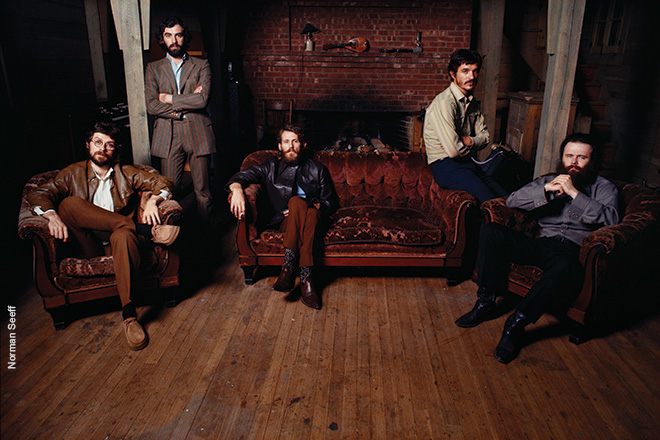
the_band_huge

Which would be, of course, The, um… Band.

Yeah, I know, I know — according to Brad, every season is the right season to listen to The Band. That’s true, and evidently I’m not the only one to think so. See the banner image that you can find on Peter Hamby’s Twitter feed, season after season:

hamby

Well played, Mr. Hamby.

Back to my point, I ask you: Doesn’t that photo look like autumn? And doesn’t this one and this one and this one? And not just because they always look like that’s the season they’re dressed for — which I consider the ultimate cool look, possibly because fall is my favorite season. (Broke out my rumpled vaguely dusty-green corduroy jacket last week, because it’s finally the season to dress like you’re in The Band!)

It’s supremely fitting that their greatest item, the eponymous one, is brown, with black-and-white photos. When I listen to their music, I picture brown, gray, black, and muted orange. They are far more like an old, scuffed brown shoe than, say, George Harrison was.

Because it’s not just a look — it’s a sound. Starting with their most autumnal song of all…

ARRGGGHHH! The whole point of writing this post was to share this awesome video I found, and long ago favorited, of The Band playing “King Harvest” in the studio, a version I liked even better than the one on the album, and now when I click on it it says, “This video contains content from Eagle Rock. It is not available in your country,” and then adds, in much smaller type, “Sorry about that..”

Ya know, there’s just one thing I expect from the internet… OK, there are a lot of things that I expect from the internet, but this one is very near the top of this list… and it is that stuff doesn’t go away! It’s always there to look at whenever you want it. It’s handy! It’s convenient! It’s at your fingertips! Always!

So I really, really hate it when something like this happens.

Sigh.

OK, well, the album version will have to do.

Anyway, here are the top five most autumnal songs by the most autumnal of bands, to give you a nice, crunchy, brown, orange and black soundtrack for the season:

  1. King Harvest — Yeah, partly because of the title, but listen to it! “Dry summer, then comes fall/ Which I depend on most of all…” And not just the words, but the tone… If Richard Manuel doesn’t sound like a man who’s reached the autumn of his life, I don’t know who does. He’s a man defined by the seasons who is adjusting to new realities and trying to put the best face on it he can. And Garth Hudson on the Lowrey organ — doesn’t it sound like the perfect accompaniment to the words, “Scarecrow and a yellow moon/ And pretty soon a carnival on the edge of town?”
  2. The Unfaithful Servant — After that servant has said goodbye to that country home, the lady he has left looks out on a landscape that is dominated by a gray sky with low clouds. Most of the leaves are on the ground now and it’s recently rained, dampening the carpet of leaves that’s turning from brown to black as they decompose. Or maybe I’m reading too much into it.
  3. Long Black Veil — OK, this one is late fall, bordering on winter, but still just barely autumn. Say, late November. I’m fairly certain there are few leaves on the trees as “she walks  these hills” and “the cold wind moans.”
  4. The Weight — I’ll admit this is less autumnal than the others. I picture it being sort of hot and dusty as our humble narrator pulls into Nazareth, feeling about half-past dead. But I wanted an excuse to link you to the great live version at Woodstock in 1969. At least that one hasn’t gone away… “Crazy Chester followed me, and he caught me in the fog…”
  5. The Rumor — OK, the truth is, I could have picked almost any five songs by The Band and they would all have fit the category. I can’t even think of any reason to tell you why this one makes the list; it just does. It evokes fall for me. I listen to it, and it’s October.


I loved this music when I was 17, but now that I’m at a more autumnal age they’re an even better fit for how I’m likely to feel when I hear them.

I hope you enjoy them as well, if you click on the links.

All the President’s Songs

Obama playlist

Another pop culture post to get us through the Dog Days…

At first, when I heard President Obama had a personal Summer Playlist on Spotify, I was concerned: Surely they don’t mean this summer — because even if you apply no standards at all, it would seem impossible to glean from current releases enough songs for a playlist that a grown man could stand to listen to. (Unless that grown man is Doug, who claims to have the tastes of a teenage girl — not that there’s anything wrong with that.)

But 2015? I mean, if the summer were 1965, or 1969, or 1971, or 1985, maybe, but not a European swallow (oops, got my pop culture wires crossed there).

That would constitute a painfully obvious, and unconvincing, stab at pandering to the youth vote. And hey, young people today listen to old stuff in a way that would have been inconceivable when I was young. So it would be doubly stupid.

But as it turns out, it’s more of an All Time list (which to us chauvinistic moderns means “last few decades), like the Top Five lists in Nick Hornby’s High Fidelity. Now that’s more like

Here’s the playlist.

It starts strong, with The Temptations’ “Ain’t Too Proud to Beg,” but I’m going to have to take off points for its unfortunate associations with “The Big Chill.” Sorry.

No. 3, “Memories Live” by Reflection Eternal is a fine, non-obvious, more recent track that helps restore some of the cred lost to the Big Chill faux pas.

Then we are rewarded by Dylan’s “Tombstone Blues.” Can’t beat that. Perhaps the clincher for POTUS was this passage:

The Commander-in-Chief answers him while chasing a fly
Saying, “Death to all those who would whimper and cry”
And dropping a barbell he points to the sky
Saying, “The sun’s not yellow it’s chicken”…

… which of course is a thinly veiled reference to the president’s drone program, exactly 50 years ahead of time. Dylan, the prophet…

That’s followed by some Marley, for those of you who like that sort of thing — and the president, who used to regularly get more than one toke over the line, does — followed by Coldplay, which means little to me beyond its association with a politically incorrect joke in “The 40-Year-Old Virgin.”

Some of the songs are too obvious, such as the Temptations tune. But POTUS redeems himself by choosing “Another Star” to represent Stevie Wonder, instead of, you know, something like “I Just Called to Say I Love You.” Although I would have preferred “I Believe (When I Fall In Love It Will Be Forever)” (admittedly, because of its association with the film version of “High Fidelity.”

The Stones are represented, and not, say, The Beatles. Which is cool. But “Gimme Shelter?” No (although I confess that as I hear the guitar intro I feel elevated far above what has preceded it on the list). Completely off-base for a summer playlist. That was on the “Let it Bleed” album, which was released in December 1969, which is why everybody was listening to it that Christmas. Duh. The proper Stones song for a summer list is “Honky-Tonk Women,” which was released in July of the same year, and which I distinctly remember listening to while driving on Hwy 17 between Myrtle Beach and Surfside that summer and thinking, “This is the perfect driving song.” (Since I wasn’t yet 16 and just learning to drive, anything that could be associated with operating a motor vehicle was cool.)

But overall, not a bad effort. If there’s a flaw, it may be that there is too little from recent summers. He could have thrown in a “Call Me Maybe” or “Rolling in the Deep” or “Party Rock Anthem.” But he may have stayed away from them because of their prominent inclusion in another well-promoted summer playlist.

I don’t know. But it’s worth a listen, if only as an alternative way to get into the president’s head. Or, if you want to be cynical, the head of whoever put this together for him…

Gender aside, who would YOU rather see on the $20 bill?

After reading this piece by the wonderfully named Feminista Jones, arguing that putting Harriet Tubman on the $20 bill would actually undermine her legacy, I got to thinking: Who would I rather see on the double sawbuck in place of Andrew Jackson?

I mean, you know, demographics aside. Me not being all that big on identity politics and all.

The simple answer is “just about anybody,” including Harriet Tubman and whoever the also-rans were behind her in the Women on 20s contest.

Jackson’s not my fave president. I’ve always sort of seen his electoral victory over the vastly more qualified John Quincy Adams as a moment, if not the moment, when American politics went off the rails. I mean, good one on the Battle of New Orleans (even though the war was over), but just not one of the greats, to my way of thinking. Also, Davy Crockett was my hero when I was a pre-schooler, and Davy (who split with Jackson over the Trail of Tears), if anything, thought less of him than I do.

So whom would I pick to replace him? This is an occasion for another Top Five List:

  1. John Adams — My favorite Founding Father. I have long believed that history gave him short shrift. Everybody remembers Jefferson for writing the Declaration of Independence. But there would have been no declaration without Adams. He’s the guy who tirelessly rammed it through the Continental Congress, while Jefferson sat there like a bump on a log. In fact, it’s likely that it was Adams’ decision to have Jefferson draft the actual document, because he knew the Virginian had a way with words. But Adams was far more the author of our liberty than Jefferson. You say Washington is the Father of our Country? Well, Adams was the one who set him up to become that, by pushing him as the guy to lead our army. For that matter, Adams was the one who proposed that there be a Continental Army to begin with. Then there were his significant contributions as a diplomat in Paris and London during and after the war, which did a lot to make our victory possible. Sure, his presidency wasn’t anything to brag on, but you don’t even have to have been a president to be on a bill. Ask Franklin and Hamilton.
  2. Franklin D. Roosevelt — Led us through the greatest crises in our history, outside of the Civil War — and Lincoln’s already on the five. And he did it with such elan. Who else in our history could have bucked us up and kept us going through the ’30s and early ’40s? No one. And yeah, he’s already on the dime, but he still comes in second — or even first, making Adams second — on my list.
  3. Martin Luther King — After you mention Lincoln and Roosevelt, whose spoken words stirred the American spirit with more power? He inspired us to be the kind of country we always meant to be. We’re still working on that, and he still inspires us.
  4. Harriet Tubman — For all the reasons she won the recent competition to come up with a woman to put on the list. And not just because she’s a twofer — y’all know I don’t go in for such things. Did I ever tell you that when my wife spent a year up in Pennsylvania with our youngest daughter, while the daughter was training at a ballet school, they lived in an antebellum house that had been part of the Underground Railroad? True story. So I must confess to that personal connection.
  5. John Glenn — I’ve always found the first American to orbit the Earth one of the more admirable people of my lifetime. Also, I wanted to have at least one surprise nominee in my five, and Bryan got me to thinking again today about how much I love “The Right Stuff.” And while he’s a nonpresidential nominee, he was my favorite candidate in 1984, even though he didn’t make it. Godspeed, John Glenn.

Whom would you choose?


The last really great song by The Band

Just a little musical interlude to calm you down on this third day in Advent.

This was the last really great song recorded by The Band, from their largely unregarded 1975 album, “Northern Lights-Southern Cross.” For whatever reason, I didn’t even buy this one, so I had to discover the song in later compilations. I’ve been listening to it a lot in recent days, from a CD of The Band’s best that I bought at Walmart for $5.

I like this assessment of the song:

“I thought about the song in terms of saying that time heals all wounds,” Robertson told interviewer Robert Palmer at the time of the song’s release. “Except in some cases, and this was one of those cases.” Yet writing the song was only half the battle with The Band. With three brilliant singers available, choosing between Richard Manuel, Levon Helm, and Rick Danko was never an easy task, although you really couldn’t go wrong.

Danko got the call, and his emotional performance, all wavering notes and reckless abandon, is the uncanny embodiment of a man driven to the end of his tether by his love’s absence. He gets interpretive assistance from his Band-mates, who give a typically intuitive performance. Garth Hudson’s stately but sad saxophone sounds like it has accepted defeat, while Robertson’s delirious guitar isn’t ready to give up just yet.

Robertson’s metaphors and similes are simple yet effective in showing the narrator’s inner torment. In the bridge, the imagery gets direr, all empty halls and stampeding cattle. As the song closes out, Danko uncorks his final lines with desperation dripping off every word: “Well I love you so much and it’s all I can do/Just to keep myself from telling you.” At that point, he is ironically joined by his good buddies Helm and Manuel on sympathetic harmony for the coup de grace: “That I never felt so alone before.”

Nobody did melancholic grandeur better than The Band, and there’s no topic more suited to that treatment than lost love, so it would have been an upset if “It Makes No Difference” hadn’t turned out so fine. Either you’ve been there before, in which case Robertson’s eloquent anguish will seem achingly familiar, or you haven’t, in which case Danko’s fearless vocal will act as a public service announcement on the merits of holding on to a good thing for dear life.

What Mike Nichols achieved with ‘The Graduate’ was unique

bus1

Upon the passing of director Mike Nichols, I find myself marveling yet again at “The Graduate,” and how there’s just nothing else like it in the history of film.

How do you describe it? A farce, a drama, social commentary? If so, it was like no other farce or drama or social commentary I’ve seen. I like this description from the AP:

Mixing farce and Oedipal drama, Nichols managed to capture a generation’s discontent without ever mentioning Vietnam, civil rights or any other issues of the time. But young people laughed hard when a family friend advised Benjamin that the road to success was paved with “plastics” or at Benjamin’s lament that he felt like life was “some kind of game, but the rules don’t make any sense to me. They’re being made up by all the wrong people. I mean no one makes them up. They seem to make themselves up.”

At the time, Nichols was “just trying to make a nice little movie,” he recalled in 2005 at a retrospective screening of “The Graduate.” ”It wasn’t until when I saw it all put together that I realized this was something remarkable.”…

Yeah, well… they thought they were just cranking out something routine with “Casablanca” and “It’s a Wonderful Life,” too… Maybe you can only achieve greatness when you have humble intentions.

How does something work as comedy — as heartwarming comedy… when it’s about a guy who falls in love with the daughter of the woman he’s having sex with? More than that… How do you come to love a movie like that, to want to see it again and again, because it strikes a chord in you, even though God forbid you should ever be in a similar situation?

And that is what makes it unique: That it is such a universal cultural touchstone for members of my generation. It’s not that it was topical — as the quote from AP mentions above, it doesn’t mention any burning issues of the day. That’s one of the many things that separate it from self-consciously “topical” films that end up being eminently forgettable — such as, say, “Getting Straight.” Oh, you don’t remember that one? Then you’re making my point.

What makes that connection? What makes the film essential to our sense of that time? Is it Simon and Garfunkel? Aside from it being my favorite soundtrack ever, is the music essential to the film’s appeal? Would it be “The Graduate” without “The Sounds of Silence” or “Mrs. Robinson?”

No, it wouldn’t. But it wouldn’t be “The Graduate” without Anne Bancroft, or Dustin Hoffman, or even Buck Henry’s hotel clerk (of course, Henry’s main contribution is as screenwriter). Or the “plastics” guy. Or that wonderful long camera shot of the Berkeley campus.

SPOILER ALERT (In case there’s someone left who hasn’t seen it): The closest thing to social commentary on the ’60s that I can think of is the film’s enigmatic, excruciatingly ambivalent ending. The young lovers have triumphed! They’ve dramatically left behind the corrupt older generation and its agents and all it stands for (even to the extent of using a cross as sword, then as a lock to keep them in their church)! They’re together! They’re free! So they laugh uproariously; Ben claps his hands in glee. Then, you can see the thought enter their minds — what’s next? When you’ve rejected all that went before, and must now make your own life, your own way of living, your own morality — what then? And they stare straight ahead, with a smile still occasionally flitting across their faces, alternating with the stare of people who are overwhelmed at the enormity of what lies ahead. What now, indeed?

It comments on the sexual revolution and on the delegitimization of institutions, and the consequences those developments entail, without words. Just with looks.

The only film I can think of that does anything like it, or does it as well, is “Carnal Knowledge” — also directed by Nichols. Of course, that’s much darker, and hence not as beloved — although nearly as admired. And that one beats you over the head with the point, not least in the title — although it does so magnificently.

Carnal Knowledge” is a great film. I’m also really fond of the way Nichols brought Catch-22 to the screen. (And it just hit me — Art Garfunkel plays a key role in each of the three.)

But if he had never done anything but “The Graduate,” Mike Nichols would still be one of the great filmmakers…

bus2

Bus passengers in an alternative universe

on the bus

Today, I got one of those emails trying to get me to engage more with Pinterest, and one of the pins it offered me was this one, which I thought was cool, because it’s one of my fave flicks of all time.

So I repinned it.

But then I noticed something… you ever take a good look at the passengers on the bus who turn back to stare at Benjamin and Elaine.

It’s like Mike Nichols deliberately filled the bus with People Who Will Never Be Seen Riding a Bus. At least, that would be the case in Columbia in 2014. And I’m even thinking it would be the case in California in 1967.

Dig the guys in suits. Especially the guy wearing cufflinks.

This is such a glaring anomaly that I find myself wondering whether it’s intentional, and it means something. Like maybe Nichols wanted a painfully bourgeois set of people to be staring at our lovebirds, or something.

Anyway, I’d never noticed it before, and I found it interesting…

How could Huck Finn not top any list of Great American Novels?

Thomas Hart Benton's depiction of Huck and Jim

Thomas Hart Benton’s depiction of Huck and Jim

A piece in The Washington Post this morning on the new book about living next door to Harper Lee mentions the status of To Kill A Mockingbird as a, if not the, Great American Novel — and casually links to a list.

The list isn’t explained. I don’t know who compiled it, or what the criteria may have been.

But of course I’m drawn in. The list extends to 358 books (which requires straining the definition of “great”), but let’s just examine the top ten:

  1. The Great Gatsby, by F. Scott Fitzgerald
  2. To Kill A Mockingbird, by Harper Lee
  3. The Adventures of Huckleberry Finn, by Mark Twain
  4. The Catcher in the Rye, by J.D. Salinger
  5. The Grapes of Wrath, by John Steinbeck
  6. East of Eden, by John Steinbeck
  7. Slaughterhouse-Five by Kurt Vonnegut
  8. Moby Dick, by Herman Melville
  9. Catch-22, by Joseph Heller
  10. Of Mice and Men, by John Steinbeck

OK, first, it’s just not right for Steinbeck to get three out of the 10. Especially since — confession time — I’ve never read the first two. The Grapes of Wrath is one of those novels I’ve meant to read for most of my life, and I will (my wife finds it utterly incredible I still haven’t). East of Eden, not so much.

And, to confess further, despite having started it again to great fanfare, I’ve still never finished Moby Dick. It just seems to start to drag after they go to sea. (Yeah, I know that’s pretty early in the book.) Which is weird, because that’s when seafaring tales generally get good.

I think all the other works are deserving of the top ten, although I might move up some of my faves from the second ten (On the Road, The Sun Also Rises, One Flew Over the Cuckoo’s Nest, Fahrenheit 451).

But my main beef is this: How could any list of the Greatest American Novels not start with Huckleberry Finn? Hemingway famously said, ““All modern American literature comes from one book by Mark Twain called Huckleberry Finn. American writing comes from that. There was nothing before. There has been nothing as good since.” And I agree, except that I would delete the word, “modern.” It’s superfluous. All American literature, period.

It’s THE American novel. It’s episodic, picaresque structure is quintessentially American. Huck Finn, the freest character in literature, untainted by the history or culture of the Old World, couldn’t be more American. Huck can be anyone he wants to be, and slides in and out of identities throughout. And the central conflict in the novel is about the deepest, most profound issue of our history — in the sense that it has a central theme. Remember the author’s warning:

PERSONS attempting to find a motive in this narrative will be prosecuted; persons attempting to find a moral in it will be banished; persons attempting to find a plot in it will be shot.

Which is a very American sort of warning — notice in no uncertain terms that pretension will not be tolerated.

Even the novel’s weaknesses are very American. Such as the uneven tone — starting out with farcical comedy that is an extension of Tom Sawyer, moving to tragedy with the Graingerfords and other incidents, the slapstick and menace of the Duke and the Dauphin, and ending with the broad comedy of Tom’s insistence on throwing flourishes from literature into Jim’s escape from the Phelps farm — itself a deadly serious matter, which nearly leads to Tom’s death, and does result in Jim’s recapture (as a result of his own selflessness).

Sorry, that was a confusing sentence. But you see what I mean. The novel was no more constrained by a particular tone than life itself. Very free, very American. And certainly great.

OK, off the top of my head, my own list:

  1. The Adventures of Huckleberry Finn, by Mark Twain
  2. To Kill A Mockingbird, by Harper Lee
  3. The Great Gatsby, by F. Scott Fitzgerald
  4. On the Road, by Jack Kerouac
  5. The Sun Also Rises, by Ernest Hemingway
  6. One Flew Over the Cuckoo’s Nest, by Ken Kesey
  7. Fahrenheit 451, by Ray Bradbury
  8. All the King’s Men, by Robert Penn Warren
  9. The Red Badge of Courage, by Stephen Crane
  10. Catch-22, by Joseph Heller

Some runner-ups:

  • The Chosen, by Chaim Potok
  • Flowers for Algernon, by Daniel Keyes
  • City Boy, by Herman Wouk
  • The Natural, by Bernard Malamud
  • A Connecticut Yankee in King Arthur’s Court, by Mark Twain
  • Goodbye, Columbus, by Philip Roth
  • The Last of the Mohicans, by James Fenimore Cooper
  • The Godfather, by Mario Puzo
  • God’s Little Acre, by Erskine Caldwell
  • Stranger in a Strange Land, by Robert Heinlein

Better stop there, as my quality was slipping a bit at the end there (Heinlein is fun, but is it literature?).

I’ll come back and explain those choices a bit another day. Gotta run now…

Bee Gees tune makes my hypothetical band’s playlist

Last night, I was watching an episode of “The Americans” and it ended with a song in the background that was a pleasant-enough-sounding ballad, but for one thing: It seemed to be very close to something very familiar, and something that I wanted to hear, but it never got there. It was too busy being artsy, too free-form, too showy in its refusal to be anything like the original.

I now know it was Roberta Flack’s version of “To Love Somebody.” It was pleasant, but considered as a cover of that song, it was awful. It left out all the best bits, such as the change when it launches into “you don’t know what it’s like,” and then when it takes it down a notch, for “to love somebody.”

Everything that made the song special was missing, including the appealing rhythm of the verses, in between the aforementioned best bits.

Frankly, I hadn’t ever realized how special the song was, until it had been stripped of what made it that way.

So I’m unilaterally adding it to the playlist for my band, for when I have a band. I’m not consulting my bandmates on it, because I don’t have any, and it wouldn’t do to start having artistic differences before we even get together.

I’m even thinking of going out on a limb and adding “I’ve Gotta Get a Message to You,” because I’ve always known that was great, even though it was by the Bee Gees. After all, the Brothers Gibb were pretty good before disco (he said defensively).

This is coming together well. Before long, I’ll have a complete playlist for my ultimate cover band, and that will give us a head start when I get around to actually putting the band together. Don’t you think?

Here’s how we used to find stuff out in the old days, kids

Since this post the other day, I’ve been listening more closely to the Christmas music to which I’ve been exposed.

This morning, I heard something really unusual. What got me was the very different rhythm part of this rendition of “O Come Emanuel.” I’d actually been listening a while before I realized what the song was — even though it’s my favorite Advent song. This was before coffee, you understand.

I wanted to know right then who it was. But I couldn’t do what I would normally do. I was driving the truck, which is straight-shift and takes two hands, and wearing my winter coat that zips up, and couldn’t get at my phone to get my SoundHound app to give it a listen and ID it for me. Frustrating (in any event, as I discovered when I got to work, I’d left my phone at home — again, the lack of coffee).

So I decided that I’d fall back on trying to find out who that was when I got to a keyboard. To my inexpert year, it sounded like Pearl Jam. So I hunted on Google, and on YouTube. I asked everybody on Twitter:

Heard a very offbeat rendition of “O Come Emanuel” on radio this a.m. Sounded like… Pearl Jam. Google couldn’t find that. So who was it?

Weirdly, no one answered. I asked again about six hours later. Still no takers. Which is unusual. Normally, someone at least guesses.

So you know what I did? I found out the old school way. Soon as I got a moment (late this afternoon, after a busy day) I called the request line at Magic 98.5. I asked who that was doing “O Come Emmanuel” between 7:45 and 8 this morning.

Turns out it was Third Day, a Christian rock band that formed back in the early ’90s. You know, when everybody was trying to sound like Eddie Vedder.

The fact that my crowd-sourcing efforts failed, I suppose, testifies to grunge-style Christian bands  occupying a lesser-known part of the pop music spectrum. Even Rob, Dick and Barry might have had trouble with it.

I’m just glad I solved the mystery. I’m sure you’re happy for me.

Humbug: Top Five Worst Christmas Songs

wings

Paul and Linda, “simply… having… yadda-yadda…”

And now that my temper is up, I may as well go on and abuse every body I can think of.
— Mark Twain, The Innocents Abroad

Is that headline a contradiction in terms? Should it be, “Bottom Five?” Or would saying that, with “Worst” — which I feel compelled to use — be redundant?

Whatever.

But before I get to my list, allow me to complain that we are not in the Christmas season. This is Advent. Even though I was sick at home with a cold the first Sunday, and late the second Sunday, and therefore missed the candle-lighting ritual at Mass both times, I know this is Advent. You know how? I can read a calendar. Christmas starts on the 25th (remember how we used to call it Saturnalia, o fratres mei?), and ends on the Feast of the Epiphany.

Silence kindly created this image of me as Scrooge to go with this post.

Silence kindly created this image of me as Scrooge to go with this post.

Oh, you say only the Church calls it that? Well, let me clue you in: The Church invented Christmas. In fact, Protestants refused to celebrate it for generations because it was seen as so Catholic. Even Santa Claus is a saint. So there.

Speaking of which, one category of song you won’t see represented here is the kind that isn’t really a Christmas song at all; it’s really a winter song. Take “Jingle Bells,” please. (OK, I don’t really hate “Jingle Bells;” constant repetitions of it when I was a small child conditioned me to associate it with festivity. It’s just an illustration of my point, so bear with me.) Does it say anything about Christmas? No, it doesn’t. OK, there’s the sleigh — but it’s not, specifically, Santa’s. It’s a run-of-the-mill sleigh. It’s drawn by one horse, not by reindeer.

Or, worse yet, “Frosty the Snowman.” Is there a single Christmas allusion in it, direct or indirect? No, there is not. It’s about winter. Ditto with “Let it Snow,” which was thrust upon me one morning this past week.

Moreover, it’s about winter as we in South Carolina seldom experience it. Oh, sometimes we get a dusting of snow — in February. I, having spent most my life in the South (or in the tropics), have never experienced a white Dec. 25th. Granted, we had a nice blanket of the stuff fall on the second or third day of Christmas in 2010, but that’s an exception that proves the rule.

Songs like that are about winter in a particular part of the world, which is not here. So where’s the relevance?

Mind you, it’s not that songs must contain Jesus, Mary and Joseph, much less the Three Kings (who in any case should not be heard from before Jan. 6) in order to make the category. I’m happy with Santa, or the elves, or the reindeer, or a Yule log, or a tree… something, anything, that relates it to the actual holiday.

But enough about what the list is not.

Here’s the actual list:

  1. The Little Drummer Boy” — OK, you’re thinking, how could anybody hate “The Little Drummer Boy?” Well, I have since I first heard it, sometime in the mid-60s. It had been around since 1941, but I first heard it in about ’65 or ’66 (I remember being puzzled by it when we lived in that old converted barracks in New Orleans) — and then heard it and heard it and heard it. Everybody covered it; it was in everybody’s special Christmas album, and seemed to turn up on every Christmas special on the tube. What’s wrong with it? Let’s start with this: Where did a drummer boy come from? I’m not demanding that everything have a biblical basis — after all, I’m a Catholic. But how does a drummer boy make sense? Maybe a shepherd boy with a lyre or Pan pipes, but a drum? Who brings a drum into a home — or temporary quarters — where there’s a newborn? Mary didn’t have enough problems with having to give birth in a shed, and having to lay her baby in a filthy feeding bin, and all these strangers tramping through the place? The song suggests Mary and the baby dug the drumming. Yeah, right. Had I been there, I’d have been the third shepherd, the grumpy one, raising his crook menacingly and saying, “Go ahead, kid. Say ‘pa rum pum pum pum’ one… more… time…”
  2. Wonderful Christmas Time” — You know, “Simply… having… a WONderful Christmas time…” The greatest offense against music ever committed by Paul McCartney. He is absolved by all his really great stuff, but this monotonous bit of tinsel should never be heard again.
  3. Grandma Got Run Over By A Reindeer” — Do I have to explain? Yeah, it’s satire. But I’m pretty sure I thought it was bad satire the first time I heard it. And every repetition grates a little more.
  4. Santa Baby” — When I was a young lad, they used to have these cartoons in the December issue of Playboy — in those days, as you may have heard, it was filled with interesting articles — that would feature these mostly or entirely nude, extremely pneumatic bunny girls in some sort of sexual situation with Santa Claus. And I always found that offensive. It felt like a form of libel of a beloved figure. Santa should be nothing if not G-rated. “Santa Baby” has always seemed like the musical counterpart of those cartoons. Not to mention the fact that it’s probably the most materialistic of all “Christmas” songs.
  5. Santa’s Super Sleigh” — OK, I’m cheating here. But I was having trouble coming up with a fifth — I’m really not as much of a Scrooge as I’m letting on to be here — and in tribute to Nick Hornby I always try to do Top FIVE lists. But I think this is OK because Nick himself invented this song for his novel About A Boy, and it was recorded for the film version. It’s a deliberately bad song that the protagonist hates to hear (even though it’s the reason he doesn’t have to work for a living). But I believe if the actual song marketplace had come up with it, rather than it coming from a novelist’s imagination, I would still dislike it.

An Armistice Day reflection

Doughboys of the 64th Regiment celebrate the news of the Armistice, November 11, 1918

Doughboys of the 64th Regiment celebrate the news of the Armistice, November 11, 1918

I originally posted the below material as a comment on the “Top Ten War Movies” post from over the weekend. Bryan suggested that today, it should be a separate post. I suppose he’s right.

The context is that I was responding to two previous comments — one by Rose praising the TV series “Band of Brothers,” and the other from Phillip about “anti-war” messages. This lies in the larger context of a long debate of several years’ standing, in which Phillip takes the position that all sane people oppose war, and I take the armchair-warrior position of “not always”…

“Band of Brothers” was the best thing ever made for television.

And it had the kind of anti-war message in it that I appreciate [as opposed to the kind of anti-war message I hate, which I had described earlier as “one that beats you about the head and shoulders with the idea that war is futile and stupid and anyone who decides to involve a nation in war is evil and unjustified, and we should never, ever engage in it”]. It’s very similar to a powerful one in “Saving Private Ryan.”

There’s this great scene in which the actor portraying David Kenyon Webster — the writer, from Harvard — is riding past thousands of surrendering Germans being marched toward the rear (the opposite direction from which he and Easy Company are traveling) and he spots some senior German officers. He starts shouting at them (excuse the language):

Hey, you! That’s right, you stupid Kraut bastards! That’s right! Say hello to Ford, and General fuckin’ Motors! You stupid fascist pigs! Look at you! You have horses! What were you thinking? Dragging our asses half way around the world, interrupting our lives… For what, you ignorant, servile scum! What the fuck are we doing here?

To explain what I mean by this… I grew up with shows like “Combat,” which gave a sort of timeless sense of the war. Sgt. Saunders and his men were soldiers, had always been soldiers, and would always be soldiers. And they would always be making their way across France in a picaresque manner, doing what they were born to do.

Well, what Webster is shouting at those Germans is that NO, we were NOT born to do this. This is a huge interruption in the way life is supposed to be.

That lies at the core of Tom Hanks’ character in “Saving Private Ryan.” His men think HE was born to be a soldier, and can’t imagine him in any other role (as Reuben says, “Cap’n didn’t go to school, they assembled him at OCS outta spare body parts of dead GIs.”) — hence their intense curiosity about what he did before the war. And their stunned silence when they learn the reality:

I’m a schoolteacher. I teach English composition… in this little town called Adley, Pennsylvania. The last eleven years, I’ve been at Thomas Alva Edison High School. I was a coach of the baseball team in the springtime. Back home, I tell people what I do for a living and they think well, now that figures. But over here, it’s a big, a big mystery. So, I guess I’ve changed some. Sometimes I wonder if I’ve changed so much my wife is even going to recognize me, whenever it is that I get back to her. And how I’ll ever be able to tell her about days like today. Ah, Ryan. I don’t know anything about Ryan. I don’t care. The man means nothing to me. It’s just a name. But if… You know if going to Rumelle and finding him so that he can go home. If that earns me the right to get back to my wife, then that’s my mission.

There, you learn this this is NOT supposed to be where he is. This was not the way his life was supposed to go.

Now… on the other hand…

Dick Winters was a real-life guy who had no desire to be a warrior. After surviving D-Day (having led his men in an action that should have gotten him the Medal of Honor, but he “only” received a Distinguished Service Cross for it), he took a quiet moment to pray that “I would make it through D plus 1. I also promised that if some way I could get home again, I would find a nice peaceful town and spend the rest of my life in peace.”

That’s all he wanted.

And yet, by having been forced to be a soldier, he and everyone around him found that he was superbly suited to it. He was one of those rare men who thought quickly and clearly under fire, and communicated his calm and his self-assuredness to his men. He knew what to do, and how to give orders so that it got done. He had a gift.

And that gift actually was a thing of value — to his society, and to the world. And here’s where we separate. Here’s where we draw a line between being “anti-war” as an absolutist position — that war is always wrong and evil and has no redeeming qualities — and my position, which is that sometimes nations need people like Dick Winters to step forward and exercise those abilities that they have. In other words, the warrior is a valuable member of society like the butcher, the baker and the candlestick-maker (actually, nowadays, perhaps more valuable than the candlestick-maker).

Which seems like a good place to stop, a little more than an hour before 11 o’clock on Nov. 11.


The Guardian’s Top 10 war movies

Clint Eastwood firing two MP40s at the same time in "Where Eagles Dare."

Clint Eastwood firing two MP40s at the same time in “Where Eagles Dare.”

Yeah, I know, The Guardian. I’d as soon ask Jane Fonda for her top ten war pictures as I would The Guardian.

But I didn’t ask; they just published it on their own initiative the other day, and I find such lists irresistible. So here is their list, but with my comments on each:

10. “Where Eagles Dare” — They included one slam-bang, fun-to-watch action picture, and I appreciate the gesture. I actually think of this one as less a war movie, and more an action/spy story. But it is of course technically a war picture, and probably fires more (blank, I hope) rounds from Schmeisser machine pistols than any other film ever made (in this scene alone). Best bit — the battle on the cable car/ski lift thing.
9. “Rome, Open City” — Haven’t seen it. Sounds intriguing.
8. “La Grande Illusion” — Also sounds interesting. Need to put it on my list.
7. “The Deer Hunter” — Some fine performances by some great American actors, but perhaps a bit too ponderous, too impressed with its own seriousness. And the whole Russian roulette thing only makes sense in the way The Guardian sees it: “as a metaphor for America’s suicidal intervention in south-east Asia.”
6. “Three Kings” — Saw this, but quickly forgot it. “Kelly’s Heroes” did the same thing better (or at least, more entertainingly, although it is unfortunately an exemplar of the wearisome “WWII was so much fun!” genre so prevalent at the time). All I remember is a character’s graphic description of what a bullet does when it enters the body (or was that in something else?). Why did The Guardian include it? Why else? “What Three Kings is really concerned with is challenging some of the bogus US triumphalism that clung to the war at the time.” Bogus? Really? I thought that was supposed to be the “good war” in the estimation of people who opposed going in and finishing the job in 2003.
5. “Come and See” — Haven’t seen it. Sounds like something extremely unpleasant, that would mostly tell me something I knew — the Nazis were really, really bad guys.
4. “Ran” — The Kurozawa classic that I’ve never seen, and need to. It’s in my Netflix queue. Maybe this weekend.
3. “The Thin Red Line” — The most disappointing war picture I’ve ever seen. I went to see it right after reading James Jones’ superb novel, and was sickened by Hollywood’s cheesy, gauzy, preachy version of it. I hated it so much I wrote a column about how bad it was, which you can read here. (It’s a Word file — you have to go to your “downloads” folder to read it.)
2. “Paths of Glory” — I’ve only ever seen parts of it, and I want to see the whole thing. It probably deserves to be here more than another Kubrick film that too often makes lists such as this one, “Full Metal Jacket.”
1. “Apocalypse Now” — An awesome piece of film-making. Although this is another one that I don’t exactly think of as a “war picture.” The Vietnam War is just used as a setting for retelling Conrad’s Heart of Darkness, which is more about the war in men’s souls than a bang-bang war. Most people’s favorite bits, such as Robert Duvall’s surf-mad air cav colonel, are to me fun to watch, but distracting, and degrading to the film’s artistic value. I like the slower, darker, quieter, more contemplative narrative, the plot thread of the film that stays true to Conrad. I like the parts when Willard is talking to himself, narrating. So did a lot of people, obviously, since this seems to have launched a whole new career for Martin Sheen doing commercial voiceovers.

Mainly, what’s glaringly missing from this list are such obvious greats as “Saving Private Ryan,” “Platoon,” “Black Hawk Down,” “The Bridge on the River Kwai,” “Stalag 17,” “The Big Red One,” and maybe “The Hurt Locker.” (And, for sentimental reasons, because I loved it as a kid, “The Great Escape.”)

And of course, “The Thin Red Line” would be on a 10 worst list, if I were compiling it.

Aside from the foreign classics that serve to air the critics’ erudition, their guiding preference for iconic anti-war works, and the fun pick of “Where Eagles Dare,” it’s like they phoned this list in.

Top 12 Songs I Either Missed Entirely, or Didn’t Fully Appreciate at the Time

This started out as a Top Five List, but there were just too many, even for a Top Ten. Maybe I should have split it into two lists (or  even three) or simply been more selective. But I did none of those things. To carry on…

There are gaps in my musical memory.

For instance, there’s the late ’70s, when I was too busy starting a family and launching my late lamented newspaper career. Popular music of that time was in the very distant background for me, so I didn’t discover the Clash, or even Elvis Costello (just about my all-time favorite), until years later.

Music videos pulled me back in in the early ’80s — first TBS’ Night Tracks on the weekends, then later MTV. I loved the medium. Video may have killed the radio star, but it turned me on to so much music I would otherwise have missed. Madness, for instance. For a time, I told everyone, in all honesty, that if I could figure out how to become a director of music videos, I would give up newspapers for that.

Then, in the early to mid-’90s, MTV quit showing videos. Or at least, quit showing them all the time (video killed the radio star, and reality TV killed MTV). I had this routine in which I’d go down to the basement gym at The State and turn the tube onto MTV and watch videos while I worked out. This kept me current up to Soundgarden and Smashing Pumpkins and Nirvana, but then all of a sudden, the videos disappeared and I lost touch.

Consequently, I missed a lot of great stuff by Radiohead and Weezer and Green Day and Death Cab for Cutie and Me First and the Gimme Gimmes and Adele, to mention a few of those I’ve been listening to on Pandora or Spotify or YouTube lately. (At first, I was put off by Pandora’s way of refusing to play the song I asked for, and playing other things like it, but that has introduced or reintroduced me to a lot of great stuff I would not consciously have sought out).

Then, there are songs that came out at a time when I thought I was paying attention to music, but that went right by me — either because I was listening to the wrong stations, or my tastes hadn’t matured to the point that I fully appreciated them.

Here’s a list that just gives a sample of the stuff I find myself appreciating lately, and wondering how they got past me the first time (by the way, I’m not ranking these 1-12; I’m not sure I could. But I don’t mind naming these as, more or less, the top 12 in the category):

  1. Love and Happiness,” Al Green.Al Green I could just as well have named “Tired of Being Alone,” or “Let’s Stay Together.” I was actually living in Memphis at the time that he was recording these classics, but was too focused on The Rolling Stones, James Taylor, Elton John, Paul Simon, Bob Dylan, The Band and other international stars to pick up on the richness that was right there at my feet. I choose “Love and Happiness” because I actually heard it recently and thought, I’ve heard that forever and never appreciated how awesome it is, and even thought, who is that?, before realizing a split-second later that of course, of course, it was the Rev. Al. And kicking myself.
  2. Creep,” Radiohead. I had half-heard this many times before really listening to it once and realizing how good it was, how it qualified as rock in a way that so little other new music I’d heard in recent years did. This was two or three years ago. Then, when we visited Oxford and stayed on Abingdon Road, I somehow became aware that Radiohead was from Abingdon, and resolved to look into them further. Much later, I did, and now listen to my Radiohead “station” on Pandora as much as any other. Best bit: When the soft opening is first interrupted by the stuttering “CHA-chunk, CHA-chunk” of distorted guitar, and the whole nature of the song changes.
  3. You Can’t Hurry Love,” The Supremes. supremes Or almost any of their greatest hits, really. In the couple of years after I returned to this country in 1965 (after 2.5 years in South America), when I just could not get enough of American popular culture, the Supremes were always there — on the Sullivan show, everywhere. But I wasn’t into them. I was the stereotypical little white boy, into English guitar bands and Americans who imitated English guitar bands, with an occasional side trek into Herb Alpert or whatever. I just wasn’t that into those three elegant black women dressed like old people going to a formal affair. It was decades later before I realized how deeply they had imprinted their sound into my fondest memories of the period. Maybe it was Phil Collins’ special-effects tribute to this particular song in the early, exciting days of MTV that made me look back and consciously realize how amazing the Supremes were. Or the effective way “China Beach” used “Reflections” to, well, reflect the era. (I never actually watched the show, but I can remember pausing the channel long enough to list to the intro a number of times.)
  4. Life on Mars?” David Bowie. I could swear to you that this song did not exist before I first watched, on DVD, the British time-travel-cop show of the same name (sans question mark). I had zero memory of it. Of course, I wasn’t at all into Bowie in his initial iteration, but still — I had heard and enjoyed “A Space Oddity” and heard other songs of his in the background. But I had completely missed this. Even now, I’m not sure if it’s just that the song itself is so great (which it may be; a critic in The Telegraph listed it as the single greatest song of all time, with “Let it Be,” one of my personal favorites, in second place) or it’s just the way it shaped the wonderful opening scene in which the protagonist of the TV show is transported back to 1973 that imprinted it so favorably on my mind. (Wonderful touch — the song begins the scene playing on the character’s early iPod, which itself now looks dated, then ends up on an 8-track.) In any case, I listen to it a lot now. Oh, a word in your shell-like: Don’t bother putting the American series based on this into your Netflix queue (despite the presence of Harvey Keitel in the cast); just watch the original. (Best bit: 37 seconds into this clip, as the character “wakes up” into 1973 and the music reaches its climax.)
  5. Say It Ain’t So,” Weezer. In this position I could put Green Day’s “Basket Case,” or any one of a number of super-catchy way-post-punk, post-grunge tunes. But I’ll just pick this one, because I’ve been listening to my new Weezer station on Pandora a lot the last couple of weeks. I got into them through their relatively recent hit, “I Want You To,” which has everything a pop song should have, despite the feckless theme of the lyrics (assuming it’s up to a girl to make the first move — although, when you see Weezer, you understand this better).
  6. I Want You to Want Me,” Cheap Trick. cheaptrickNot much to say about this except that the title of Weezer’s “I Want You To,” got me to thinking about it, and wondering who had played it — because I assure you, I had never been a Cheap Trick fan (I was way too busy in 1975). But I finally recognized it as a very well-crafted pop song, which has a classic feel to it after all these years. It’s sort of anthem-y. After all, doesn’t the title rather economically state what most pop songs are about?
  7. Hallelujah,” Leonard Cohen. I wrote about this before, wondering at the alchemy that made it so hypnotically beautiful. Ever since I was quite young, I had known that cool people were supposed to be into Cohen — it was more of a measure of coolness even than being into Jeff Beck. But I was aware that I was not cool, and was satisfied not even to try to listen to him. It was the use of this in the love scene of “Watchmen” that made me focus on this song finally (which followed on a cover effectively used in “Shrek”), and I’m glad I did.
  8. Such Great Heights,” The Postal Service. First, I heard the cover by Iron and Wine, which was on a copy of the soundtrack of “Garden State” belonging to my daughter. She referred to it as “that Postal Service song,” and later she persuaded me to spend a gift certificate for Best Buy on “Give Up” — which is probably the last complete album that I have bought and really, completely gotten into, to the point of listening to it scores of times they way I did, say, with Abbey Road in 1969.
  9. I’ve Been Loving You Too Long (To Stop Now),” Otis Redding.OtisatWhiskey66-1-TH How did I live all the way through the 1960s thinking that Otis Redding was just that guy who had sung “Dock of the Bay”? Yes, that was a magnificent song, and no one could have done it better, but it wasn’t even really representative of what he did. I didn’t learn how wrong I was until I borrowed a greatest-hits CD from my brother (which I fear I never returned). This song moved me more than any other, but I could just as well have chosen “Try a Little Tenderness,” “That’s How Strong My Love Is,” or “Mr. Pitiful.” One weekend recently, my wife and I were walking up St. Philip Street in Charleston, and heard the echoing sound of “I’ve Been Loving You Too Long” coming out of one of the old Charleston-style houses turned into apartments. It made my day, and made me think highly of the tastes of the person (probably a very young person, since everyone in that neighborhood seemed to be about 24 — in which case, it’s someone who is much more hip to what’s good than I was at that age) who lived in that apartment.
  10. Bring It On Home to Me,” the Animals. After what I said about the Supremes, I guess I shouldn’t pick the version of this by a white guitar group, but hey, Eric Burdon wanted to be black more than any other white boy ever to come out of Newcastle. And this version is pretty soulful, I think. I think I like it better than the Sam Cooke version (which, I hate to say, seems to have most of the soul bleached out of it, in the deliberate effort to create a “crossover” hit). Anyway, I didn’t get into it until I bought an Animals greatest hits compilation on CD, sometime in the past decade. Eventually, I put the song on the playlist of my band — you know, for when I get around to starting a band.
  11. Goin’ Down,” The Monkees.the-monkees-goin-down-colgems I’ve mentioned this before. It’s sort of a special category. I thought it was cool when it came out (I had the album), but as I got older peer pressure brainwashed me into thinking that nothing by the Monkees could possibly be cool. Then it was used as background for a frantic meth-cooking montage on “Breaking Bad,” and I couldn’t place it for a moment, then recognized it. At first, I thought it was maybe someone else doing it, not Mickey Dolenz, it was just so good. Finally, I realized I had been right the first time, when I was 13 years old — it was a great song, very well done. And the “Pre-Fab Four” should probably get more respect than they did. (Oh, and yes, I know that The Rutles actually called themselves the Prefab Four, but the sobriquet was applied to the Monkees first, intended as an insult.)
  12. Mais que Nada,” Sergio Mendes and Brasil ’66. So yes, I heard this at the time, but it was in the background, and I never could have named it, the way I could have Mendes’ covers of Beatles and Simon & Garfunkel tunes. After I’d seen “Austin Powers” — which uses the song very effectively to evoke the period — several times, I set out to learn what that signature Brasil ’66 song was called. (It’s interesting to me how a Sergio Mendes or Herb Alpert or Petula Clark song, played in a background, can evoke the 60s more effectively than a Beatles or Rolling Stones song can do.) Once I figured it out, I’ve listened to it a lot.