Category Archives: The Nation

Longing for the virtues of a democratic republic

You hear people of various political stripes saying apocalyptic things about how the country is going down the tubes, or WILL go down the tubes, if this or that faction is or is not elected, and so forth.

I started my adult life with a sort of fatalistic attitude that caused such warning to sound far, far too late. In college, I took so many history electives that shortly before I graduated I realized to my surprise that I was within reach of a double major (the other major being journalism). There was no plan; I had just had a lot of room in my schedule because I had tested out of a number of courses others were required to take — foreign language, and math — and took things that interested me. And that tended to included history courses concentrating on the early decades of the United States. (I also took a few courses in Spanish and Latin American history and political science, but that has little bearing on my point today — aside from instilling in me a deep appreciation that for all our country’s flaws today, it was built on a far better foundation that those others.)

I was particularly impressed by the wisdom of those who chose to establish a republic, and resisted the fatal temptation to fall into the madness of pure democracy. And then, as I read on, I watched it seem to fall apart. There was the election of Andrew Jackson for starters, and then… well, we have simply come to accept, even demand, “leaders” who govern with all ten fingers in the wind, like the master of an old sailing vessel seeking to squeeze maximum advantage of whatever winds prevailed.

To question pure democracy today is to seem unAmerican. When, in truth, this experiment started in a different place altogether. (Oh, and before some of you start in about how it started with blacks and women and the propertyless having no say, you know that’s not what I’m talking about. We’re talking about parallel phenomena, not factors that are dependent on one another. It’s not about upper-class white male leaders with their hair tied into queues. It’s about thoughtful, restrained leadership of vision, regardless of the demographics of those providing it. Frankly, I think Barack Obama has it in him to provide the kind of leadership that the Founders envisioned, unlike anyone who has thus far gotten much press on the GOP side. He has the ability to rise above the popular passions of the moment and see beyond them — which is one reason why so many of the most passionate today despise him so.)

Anyway, that introduction was longer than I intended. I just wanted to call your attention to a David Brooks column from a couple of weeks back — one which I missed, but which was called to my attention today by Kelly Payne via Facebook (she brought it up in a context I didn’t quite follow, but I was glad to see it nonetheless). An excerpt:

… As Kristol points out in the essay, the meaning of the phrase “public spiritedness” has flipped since the 18th century. Now we think a public-spirited person is somebody with passionate opinions about public matters, one who signs petitions and becomes an activist for a cause.

In its original sense, it meant the opposite. As Kristol wrote, it meant “curbing one’s passions and moderating one’s opinions in order to achieve a large consensus that will ensure domestic tranquility.” Instead of self-expression, it meant self-restraint. It was best exemplified in the person of George Washington.

Over the years, the democratic values have swamped the republican ones. We’re now impatient with any institution that stands in the way of the popular will, regarding it as undemocratic and illegitimate. Politicians see it as their duty to serve voters in the way a business serves its customers. The customer is always right.

A few things have been lost in this transition. Because we take it as a matter of faith that the people are good, we are no longer alert to arrangements that may corrode the character of the nation. For example, many generations had a moral aversion to debt. They believed that to go into debt was to indulge your basest urges and to surrender your future independence. That aversion has clearly been overcome.

We no longer have a leadership class — of the sort that existed as late as the Truman and Eisenhower administrations — that believes that governing means finding an equilibrium between different economic interests and a balance between political factions. Instead, we have the politics of solipsism. The political culture encourages politicians and activists to imagine that the country’s problems would be solved if other people’s interests and values magically disappeared…

Brooks is concerning himself with rather prosaic, although nevertheless important, issues such as spending (“The democratic triumph has created a nation that runs up huge debt and is increasingly incapable of finding a balance between competing interests”). And doing so rather from the position that we do too much of it. But there are broader themes in what he’s saying, and those are what appealed to me.
The math doesn’t quite work either way…

Friend of mine shared this link with me today…

First, there’s plenty to be embarrassed about, as a South Carolinian, in this video — the main thing being that Sen. Mike Fair is struggling, and failing, to justify his concern about the “danger” of Sharia law being established in South Carolina. It sort of reminds me one of the first corny jokes I remember hearing as a little kid: Man stands on a street corner, snapping his fingers. Cop comes up and threatens to run him in for loitering. Man says, “I’m not loitering. I’m snapping my fingers to keep the elephants away.” Cop says, “There are no elephants around here!” Man says, “I’m doing a good job, aren’t I?”

Against the background of that, his hyperbolic statement that “99 percent probably” of all terrorist acts since the Lebanon Marine Barracks bombing have been carried out by Muslims seems unremarkable. It’s one of those things that “everyone knows,” and he’s just being sloppy. But since the folks doing this report saw fit to dispute it very explicitly, using figures that also seemed a bit dubious, I decided to take a closer look. The report says:

Fair’s calculation, that nearly every single act of terrorism for the past couple of decades was committed by Muslim men, is off base. In reality, in the last ten years alone, nearly twice as many terrorist plots were hatched by non-Muslims in America than by Muslims.

Hmmm. And  that period doesn’t even include Oklahoma City. Follow that link and you go to a previous report, which says:

Since the attacks on the Twin Towers and Pentagon, Muslims have been involved in 45 domestic terrorist plots. Meanwhile, non-Muslims have been involved in 80 terrorist plots.

… and then in turn provides a link to this report, by the Muslim Public Affairs Council, that seems in a quick review to fairly assess the number of terror plots hatched by each group. It even gives nonMuslims a break by not counting eco-terrorism.

But then I got to thinking… Muslims make up six-tenths of one percent of the U.S. population. So that means that there are more than 99 times as many non-Muslims as Muslims in the country. But only twice (actually, a little less than twice) as many “terror plots” are hatched by nonMuslims. So… less than 1 percent of the population, but hatch 36 percent of the terror plots. So that means … and my math may be wobbly here, because of assumptions I’m making to come up with a number … Muslims are involved in terror plots about 60 times as often as you would expect, all other things being equal.

It gets extra muddy after that. Fair is talking about worldwide, and the study is about U.S. threats. And it is counting Muslim incidents regardless of whether the plotters are U.S. residents or not.

But there does tend to be, apparently, a higher proportion of plots hatched by Muslims than non, as percentages of the population, in this country. Just way less than 99 percent.

I digress, though. Bottom line, even if Fair were right, taking preemptive action to prevent the establishment of Sharia law in South Carolina, or fretting about prayer shawls in public places, is ridiculous.

I just can’t prove that mathematically. But the burden should be on him to prove that what he’s talking about is an actual problem.

More on The Filter Bubble

If you were interested in this post back here, you might want to check out this review of Eli Pariser’s book, The Filter Bubble. An excerpt:

… Personalization is meant to make Internet users happy: It shows them information that mathematical calculations indicate is more likely than generalized content to be of interest. Google’s personalized search results track dozens of variables to deliver the links that a user is predicted to be most likely to click on. As a result, Google users click on more of the results that they get. That’s good for Google, good for its advertisers, good for other websites and presumably good for the user.

But Mr. Pariser worries that there’s a dark downside to giving people their own custom version of the Internet. “Personalization isn’t just shaping what we buy,” he writes. “Thirty-six percent of Americans under thirty get their news through social networking sites.” As we become increasingly dependent on the Internet for our view of the world, and as the Internet becomes more and more fine-tuned to show us only what we like, the would-be information superhighway risks becoming a land of cul-de-sacs, with each of its users living in an individualized bubble created by automated filters—of which the user is barely aware.

To Mr. Pariser, these well-intended filters pose a serious threat to democracy by undermining political debate. If partisans on either side of the issues seem uninterested in the opposition’s thinking nowadays, wait until Google’s helpful sorters really step up their game….

If you read the book, let me know how it comes out. The review said was strong on identifying a problem, not so hot on solutions. Which I wouldn’t blame on Pariser. No one else knows the answer, either.

Some thoughts on the president’s Mideast speech

Coverage of President Obama’s speech today is concentrating on one big item related to the conflict between Israel and Palestinians: “Obama Sees ’67 Borders as Starting Point for Peace Deal.” Plenty is being said about that.

Setting that aside, here are my favorite parts of his speech today:

He didn’t sugarcoat the way people have been manipulated in the region for too long: “In the face of these challenges, too many leaders in the region tried to direct their people’s grievances elsewhere. The West was blamed as the source of all ills, a half century after the end of colonialism. Antagonism toward Israel became the only acceptable outlet for political expression. Divisions of tribe, ethnicity and religious sect were manipulated as a means of holding on to power, or taking it away from somebody else.”

He made sure no one could doubt where we stand on the change sweeping the region (while specific responses to specific situations may, and should, vary): “Not every country will follow our particular form of representative democracy, and there will be times when our short term interests do not align perfectly with our long term vision of the region. But we can – and will – speak out for a set of core principles – principles that have guided our response to the events over the past six months:

“The United States opposes the use of violence and repression against the people of the region.
“We support a set of universal rights. Those rights include free speech; the freedom of peaceful assembly; freedom of religion; equality for men and women under the rule of law; and the right to choose your own leaders – whether you live in Baghdad or Damascus; Sanaa or Tehran.
“And finally, we support political and economic reform in the Middle East and North Africa that can meet the legitimate aspirations of ordinary people throughout the region.”
When he WAS specific, he was generally right: “The Syrian people have shown their courage in demanding a transition to democracy. President Assad now has a choice: he can lead that transition, or get out of the way. The Syrian government must stop shooting demonstrators and allow peaceful protests; release political prisoners and stop unjust arrests; allow human rights monitors to have access to cities like Dara’a; and start a serious dialogue to advance a democratic transition. Otherwise, President Assad and his regime will continue to be challenged from within and isolated abroad.”
Finally, he committed us to the most empowering thing we can do for people in the region, and for ourselves — help them bring something other than oil to the world economy: “Fourth, the United States will launch a comprehensive Trade and Investment Partnership Initiative in the Middle East and North Africa. If you take out oil exports, this region of over 400 million people exports roughly the same amount as Switzerland. So we will work with the EU to facilitate more trade within the region, build on existing agreements to promote integration with U.S. and European markets, and open the door for those countries who adopt high standards of reform and trade liberalization to construct a regional trade arrangement. Just as EU membership served as an incentive for reform in Europe, so should the vision of a modern and prosperous economy create a powerful force for reform in the Middle East and North Africa.”

Were there weaknesses? Yes, from my perspective. I could have done without another ritualistic slap at our decision to go into Iraq, which took this form: “…we have learned from our experience in Iraq just how costly and difficult it is to impose regime change by force – no matter how well-intended it may be.”
But I don’t think he meant it quite as negatively as that sounded at first, as I determined upon rereading it. I realized that after I heard this strong endorsement of what has been achieved there: “In Iraq, we see the promise of a multi-ethnic, multi-sectarian democracy. There, the Iraqi people have rejected the perils of political violence for a democratic process, even as they have taken full responsibility for their own security. Like all new democracies, they will face setbacks. But Iraq is poised to play a key role in the region if it continues its peaceful progress. As they do, we will be proud to stand with them as a steadfast partner.” None of which would have happened, of course, with Saddam Hussein still in power.
On the whole, a speech that hit the right notes, and was a coherent and appropriate American response to a complex web of events and issues of critical importance to the world.
Good job.

How much do I actually NEED to know about the bin Laden raid?

How much of what THEY know do WE need to know?

Here’s a consideration I hadn’t though much about before now, and should have (given all those spy novels, and military history books, and Tom Clancy thrillers I’ve read):

Has the U.S. Said Too Much About the Bin Laden Raid?

Military officials fret that constant stream of leaks may hinder future missions, put Navy SEALs at risk.

By Josh Voorhees | Posted Friday, May. 13, 2011, at 11:09 AM EDT

In the nearly two weeks since the U.S. operation that killed Osama Bin Laden, a near-constant stream of detailed information about the raid’s specifics has seeped out from White House officials, lawmakers, and pretty much anyone else with security clearance.

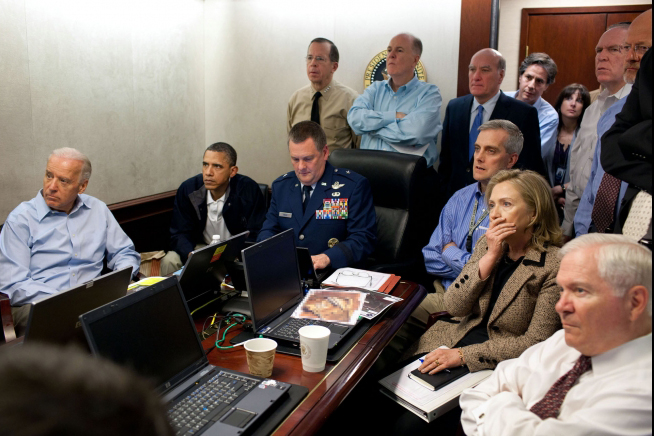
But that’s not how things were supposed to be, at least not according to Defense Secretary Robert Gates. “Frankly, a week ago Sunday, in the Situation Room, we all agreed that we would not release any operational details from the effort to take out Bin Laden,” Gates told Marines at a Wednesday town hall at Camp Lejeune. “That all fell apart on Monday—the next day.”…

The White House announced last week that it was done briefing reporters on the specifics of the mission, but that has done little to stop the ongoing flow of new details from being reported. The latest major leak came Thursday night, when CBS News gave a detailed play-by-play of what the Navy SEAL team’s helmet cameras captured during the raid….

There is the danger that the more we know about details of the raid, the greater potential for threatening our capability to do something like it in the future.

For instance, the lede story on The Washington Post‘s front page yesterday told us that a key element in preparing for the raid involved high-altitude drones flying WAY deeper into Pakistan than the Pakistanis suspected we were going. So that we could get higher-resolution photos than you get from satellites. And if you consider how high-resolution satellite photos can be, these images must have been pretty awesome. So… you have a revelation of greater technical capability than the world might have expected, and of a tactical deployment that no one knew about.

Of course, it’s a two-edged thing. Let enemies and potential enemies know what you can do, and it could intimidate them into deciding they don’t want the United States as their enemy after all. Or at least, it MIGHT work that way with some — say, your less fanatical foes. But let anyone know what measures you are capable of, and it empowers them to develop countermeasures. That’s a huge theme in military history — measures and countermeasures — and it never ends.

We may find all these details fascinating — I know I do. But how much of it do we really need to know?

A realistic view from another smart Republican

To elaborate on my theme that smart Republicans know that unseating Barack Obama will be a tall order (something that the fringe people, such as those who think the Tea Party is the “voice of the people,” completely miss), I point you to this piece by Daniel Henninger.

He blames, interesting enough, new media. He says GOP candidates who start this early will be cut down to nothing by the time the campaign is over by the constant drip of criticism on Twitter. It’s related to what we spoke of four years ago as Romney’s YouTube problem.

Strangely, he doesn’t see this as a problem for Obama, and his explanation of that is odd:

Meanwhile, it’s good to be president. With his opponents determined to spend a year and a half telling each other why “no one” is worth supporting, turning off contributors and independent voters, Barack Obama floats below the radar vacuuming up campaign cash at fund raisers.

He does make a legitimate point in the next sentence, however:

Every GOP candidate’s utterance is wholly political, but the Obama fundraisers and “policy speeches” are submerged in the presidency.

But he got the metaphor wrong. A president doesn’t fly BELOW the radar, but in a way above it. He’s fully visible, but can cloak his political statements in doing the job. Yep, that’s an advantage of incumbency. And always has been.

What Henninger ignores is that Obama has been thoroughly tested by new media, and not found wanting. There is nothing that can be thrown at a candidate via Tweets that hasn’t been hurled at him millions of times. And he sort of dropped the Big One on those flak sites a couple of weeks ago with the long form of his birth certificate, and his well-tempered scorn at his most imaginative critics. And, you know, by killing bin Laden. And, more substantially, by not being the extremist that his most extreme critics would paint him as.

If the GOP wants to prevail, it needs to come up with a candidate who can likewise endure the thousand slings and arrows. But the ones with that kind of substance are increasingly reluctant to get in.

In the end, Henninger rightly assesses the situation thusly, given the field as it stands:

A Republican candidate committed to running this gauntlet has to believe that come November 2012, the party will have nowhere else to go but to the polls to pull the lever for the last one standing. This assumes that the messaging power of electronic networks will magnify them. I believe the opposite: Given this much time, the medium eventually will melt them. The president, head ever up, will hold his ground.

The message in this for Republicans is that they need to come up with a candidate who, after being whittled at for 18 months, still has some substance left.

Oh, and by the way. I don’t know how Henninger votes. But if he isn’t a Republican, he missed a good chance.

I just can’t get THAT much into political trivia

Twitter alerted me to this item on Taegan Goddard’s Political Wire:

Iowa Straw Poll Rises in Importance

“With the Iowa straw poll a mere 90 days away, the absence of an obvious leader in the GOP race for the presidency, or even an obvious lineup, has left Republicans in a state of unease — but the uncertainty has also heightened anticipation,” the Des Moines Register reports.

First, I don’t care all that much about the Iowa caucuses themselves. That is to say, I don’t believe they should have the impact they have had for the last few decades. I wrote about that in a column several years ago.

Second, I can’t think of when I was ever impressed by a “straw poll” — anytime, anywhere. If I did, it was a moment of weakness in which my sense of perspective was badly diminished, perhaps by a nutritional deficiency of some sort.

But the idea of anybody being so a-quiver about such things as to write the phrase, “With the Iowa straw poll a mere 90 days away…” causes me to think that somebody needs to get a life…

Whew! I feel SO much better…

No doubt you, too, will sleep more soundly once you read this:

Haley dismisses risk of debt
ceiling disaster

… Haley was asked Sunday on ABC’s “This Week” whether the debt ceiling should be raised.

“Absolutely not,” she said. “We are seeing total chaos in D.C. right now. The very first thing they need to do is make sure that they stop raising the debt.”

However, the federal government finances itself partly by selling debt to investors and other countries through Treasury bills that must be paid back, Obama said in a town hall style meeting shown on CBS’ “Face the Nation.”

“If they thought that we might renege on our IOUs, it could unravel the entire financial system,” he said, and the result would be a recession worse than the last one.

“So we can’t even get close to not raising the debt ceiling,” Obama said.

Asked about the possibility of damaging America’s credibility, Haley said, “Government is notorious for saying the sky is falling.”…

And remember, our gov knows about money stuff like this. She is a way skillful accountant. Just ask her; she’ll tell you.

Also, she never makes mistakes. Ever. We are in such good hands…

And if you read further in that same story, you encounter this:

“I find it silly,” Haley said about talk of her joining a Republican presidential ticket in 2012.

Right again, governor! Nothing sillier… Told you she was awesome.

Of course, there is a downside to this good news:

Haley said she is committed to serving out her term as governor.

“The people of South Carolina took a chance on electing me,” she said. “It is my job and my family’s job to prove to them that they made a good decision.”

Geronimo, bin Laden, history and popular culture

That headline sounds like the title of a college course that might be briefly popular among those trying to fulfill a requirement in history or sociology or the like, doesn’t it?

Just ran across this WashPost piece from six days ago, stepping away from emotion over the use of “Geronimo” as the name of the operation that killed Osama bin Laden, and noting the parallels between the U.S. military’s pursuits of the two men. I found it informative, so here it is. An excerpt:

The similarities are not in the men themselves but in the military campaigns that targeted them…

The 16-month campaign was the first of nearly a dozen strategic manhunts in U.S. military history in which forces were deployed abroad with the objective of killing or capturing one individual. Among those targeted were Pancho Villa, Che Guevara, Manuel Noriega and Saddam Hussein.

The original Geronimo campaign and the hunt for bin Laden share plenty of similarities. On May 3, 1886, more than a century before a $25 million reward was offered for information on bin Laden’s whereabouts, and almost 125 years to the day before the al-Qaeda leader’s death, the U.S. House of Representatives introduced a joint resolution “Authorizing the President to offer a reward of twenty-five thousand dollars for the killing or capture of Geronimo.”

In both operations, the United States deployed its most advanced technology. Whereas a vast array of satellite and airborne sensors was utilized in the search for bin Laden, Gen. Nelson Miles directed his commanders to erect heliograph stations on prominent mountain peaks, using sunlight and mirrors to transmit news of the hostiles. Neither system helped anyone actually catch sight of the man who was sought.

Small raiding forces … proved more decisive than large troop formations in both cases. In 1886, Lt. Charles Gatewood was able to approach the 40 Apache warriors still at large with a party of just five — himself, two Apache scouts, an interpreter and a mule-packer. He convinced Geronimo and the renegades to surrender on Sept. 4, with a deftness that would have been impossible with 5,000 soldiers. Similarly, the United States could never have deployed the thousands of troops necessary to block all escape routes out of Tora Bora — the deployment of 3,000 troops three months later to Afghanistan’s ShahikotValley in Operation Anaconda failed to prevent the escape of the targeted individuals from similar terrain — but a lightning strike by a few dozen commandos was successful.

Both campaigns also demonstrated the importance of human intelligence to manhunting. Gatewood was alerted to Geronimo’s location near Fronteras, Mexico, by a group of Mexican farmers tired of the threat of Apache raids, but he also needed the assistance of Apache scouts familiar with the terrain and with Geronimo’s warriors to close in on his quarry. So, too, according to administration officials, did the success in finding bin Laden depend upon the interrogation of his former confederates in al-Qaeda and upon the efforts of local agents in Pakistan to track the courier who led U.S. intelligence officers to the Abbottabad compound….

And so forth. By the way, on a related topic, here’s a piece written by a paratrooper on the history of U.S. soldier’s tradition of yelling that name when jumping out of perfectly good airplanes. Apparently, it all came from a 1939 movie starring “Chief Thundercloud,” a.k.a. Victor Daniels (not to mention the immortal Andy Devine!).

And talk about your coincidences… I had been clicking around through my Netflix instant queue one night recently and watched a few minutes of the ubersilly “Hot Shots Deux,” starring Charlie Sheen and Lloyd Bridges. (Hey, in small doses, I very much enjoy the whole “Airplane!” comedy genre — even when Leslie Nielsen is absent.) The scene below was part of what I saw. The very next morning, I first read of the controversy among some American Indians over the “Geronimo” operation… Seemed ironic. You know, what with Charlie Sheen being such a paragon of sensitivity and all.

Oh, and what do I think of it? The same thing I think about the Redskins, the Braves, et al. It’s a tribute, not a sign of disrespect. You really have to want to be insulted to take it that way. But as you know, I have little sensitivity toward — or, admittedly, understanding of — the complex resentments than can be felt by people to whom Identity Politics is important. And I hate arguing with people like that, because I’m willing to grant that in many cases such people DO actually feel hurt, with or without justification that makes sense to me. But it seemed like it would be a cop-out if, after bringing up the subject, I didn’t share my own opinion, for what little it’s worth, and however lightly I may hold it.

Keep a clean nose; watch the plainclothes…

Cindi Scoppe — who, to my memory, doesn’t cite popular song lyrics all that often herself — liked this NPR item and shared it with me, and I share it with y’all:

ROBERT SIEGEL, host:

How many times can a judge cite a song to adorn some obscure point of law? And how many times can a lawyer cite songs for the client he’s arguing for? Yes, and what if the song is a Bob Dylan song? Could it be a hundred times or more? Well, the answer, my friend, was 186 times. The answer was 186 times.

That is how often Bob Dylan lyrics were quoted in court filings and scholarly legal publications according to a study in 2007 by University of Tennessee law professor Alex Long, who joins us now from Knoxville.

You should go check it out. Apparently, neither the Beatles nor Springsteen nor anyone else comes close to Dylan, in terms of the number of times cited in legal documents. Apparently, the California court of appeals says “You don’t need a weatherman to know which way the wind blows” so often “that it’s almost boilerplate.”

The Rolling Stones come in sixth. You can probably guess what that would be. Yep. Because it’s true, in the law as in life: You can’t always get what you want.

Sweetness is in the eye of the beholder

The Elephant In The Room from SCGOP on Vimeo.

First, sorry about all the posts the last few days about political parties. Such as this one and this one and this one and this one and this one. It’s a disagreeable subject, and one that I usually avoid rather scrupulously. But ever since I made the mistake of delving a bit into the Democrats’ intraparty politics, and then their convention, and then the Republicans’ convention, my attention has been drawn more than usual to this unseemly, depressing topic.

I’m sure I’ll climb out of this ditch soon. But in the meantime… my attention was drawn to the above “sweet video” — his words — by Wesley Donehue.

It generates in me several unpleasant thoughts:

  • My biggest question of all is, who are the “they” that the video repeatedly refers to? First, I don’t know ANYONE who said some of these things. And even if someone did say them, surely the same person/people didn’t say ALL of them? And who would pay any attention to anyone who DID say these things? Which pundits said the GOP was “heading backwards” two years ago? (Personally, I said — and still believe — that after the 2008 defeat that the NATIONAL party, not the SC one, was demoralized to the point that it left a vacuum that was being filled by extremists — and that has certainly had its effects here. But that’s not “heading backwards;” it’s heading somewhere I’d never seen the party go before.) Who on earth ever thought for a moment that Republicans “could never retain the governorship?” Whoever said, ungrammatically, that a “woman governor” was impossible? (For those who didn’t get my point about “ungrammatical” — and fewer and fewer people do these days — “woman” is a noun, not an adjective.) And who even CARED about when the GOP would pay off its mortgage? Talk about your esoteric insider concerns. And on and on.
  • The video illustrates, better than the recent ones Harpootlian has been pumping out, one of the main things that is wrong with political parties: It’s this assumption that because something wears Brand X, it is GOOD. It reminds me of those cars I see with multiple bumper stickers on them, and they are almost always (I could, if all such cars I’ve ever seen were to parade before me, count the exceptions on one hand, with fingers left over) all of one party. As though a thinking person could possibly get so worked up in favor of Candidate A as to deface his or her car with a bumper sticker, and then get so enraptured with another, and another, and another, and they would ALL be of the same party, when that’s the only “virtue” they share. The odds against that, if the voter THINKS about each candidate and makes a discerning choice, are astronomical. And yet that’s what one almost always sees. In this case, we are to embrace the election of Nikki Haley as a GOOD THING (which, deep down, a lot of Republicans do not), and the defeat of John Spratt as an equally good thing, and … this is the part that strains credulity… for the same reasons! When the only characteristics we are given for judging those phenomena are that Ms. Haley is a Ms., and Mr. Spratt has been in office 28 years. Well, those and the fact that the victor in each case happens to wear the Republican label, which is a most dubious unifying characteristic.
  • Finally, according to Wesley, this video about how wonderful it is that the Republican Party treads unopposed across the face of South Carolina was produced by Texans. Specifically, this one and this one. So… apparently the paradise that the GOP rules over here is incapable of producing anyone with the talent to produce a “sweet video.” Or so we are left to gather. Sorry, but ever since I went into the advertising/marketing/communications game I’ve learned to have a low opinion of those who insist on procuring such services from out of state. Like nobody here needs the business, or is good enough.

Well, I could go on, but I won’t. OK, one more point: “Sweet” is an odd thing to call such strident triumphalism. One practically hears the stamp of boots marching in the background, it is SO triumphalist.

OK, I get it; this is a love letter to Karen Floyd. But who saw it as worthwhile to spend money — OUT OF STATE — to produce such a thing? What is its worth to anyone, other than Karen, who is departing the stage?

I’ve just got to start ignoring all this party stuff and find something more pleasant to write about.

The connection to the royals didn’t do the trick

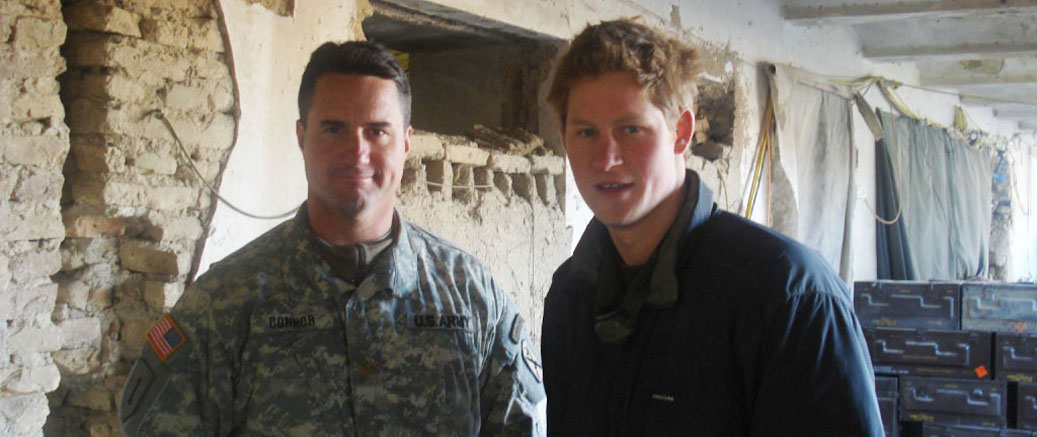
That's 2nd Lt. Prince Harry (Henry Charles Albert David) of Wales on the right, Lt. Col. Bill Connor on the left, in 2008 (or late 2007; I'm not sure): "He called me Bill and I called him Harry."

Remember all the back-and-forth between the candidates for Democratic Party chair back before the convention, some of which I kept track of here (to the point that I was sort of sorry I started)?

I just didn’t get those kinds of releases from the candidates for GOP chair beforehand. Oh, I saw some back-and-forth on Twitter about how Nikki Haley was backing one candidate, and her critics at SCTruth were backing another, and so forth and so on. But they didn’t give a lot of context, and if there was a battle of emailed press releases, I missed it. Even though I had specifically asked to be kept in the loop (and folks, I seldom ASK for press releases), and at least two of the three campaigns said they’d send me whatever they sent out.

But about all I received via that medium in the last days was this one Facebook alert from Bill Connor, on the day of the royal wedding:

“Brad,
Thought you might like this bit of history in honor of the Royal Wedding (the picture is on my fb profile).  Hope you are well!:  http://www.facebook.com/l/ae801_1klnj9MQbQucenXRWIjsA/seattletimes.nwsource.com/html/nationworld/2004253009_harrypal01.html“

As it happened, I had already known that about Connor. In fact, he had written us an op-ed piece about it, right after his highness had spent a brief time serving alongside SC Guard troops in Afghanistan (before the word got out and they had to yank him out of the country). The above photo ran with that piece.

Anyway, so much for any of the fairy-tale effect of the royal wedding rubbing off. Bill Connor came in third in the competition state GOP chair.

Which reminds me — I need to get winner Chad Connelly in here for a “Brad Show.”

Bachmann running DOUBLE ads at thestate.com! Where’s my taste?

OK, this is getting ridiculous. I knew that Michele Bachmann throwing around Web ad money in SC, but multiple ads per page on thestate.com? (On one page, I saw THE SAME AD twice, with one copy of it stacked on top of the other, the way those two slightly different ones are below. But when I tried to call it up like that again to grab a screen shot, I couldn’t get it to refresh quite that way.)

And not a single ad on bradwarthen.com. Which would probably give her a better deal.

At least, not yet.

Is this right? Is this fair? Is this the way the world should be? To quote the guy in the movie that came out today, “I say thee nay!”

If this pattern keeps up, I’m going to start seriously questioning this lady’s judgment…

Anybody see anything good at GOP debate? (FYI, this post mentions Ron Paul)

As I mentioned before, I didn’t go. To the GOP debate in Greenville, that is. And I didn’t even think to watch it on TV last night (was it even on live? I wouldn’t know). When I got home from the Five Points event, the fam was watching a 1944 musical comedy called “Bathing Beauty,” starring Red Skelton, Esther Williams, Basil Rathbone, Xavier Cugat and Harry James and his orchestra. Which caused me to realize something: When he was young, Red Skelton looked a lot like Conan O’Brien.

Anyway, I read the stories about the debate in The State today — this one and this one — and didn’t get the sense that I missed anything at all.

But perhaps some of my readers DID see it, and were impressed by something or other. If so, this would be a good time to share.

I’m sure it wasn’t as bad as this guy says:

Hollywood is reportedly at work on a remake of the 1991 film “Don’t Tell Mom the Babysitter’s Dead.” This, however, is unnecessary, because a remake is already playing. It’s called the Republican presidential primary.

In the original, a mom leaves her kids with a babysitter for three months, but after the babysitter dies of a heart attack, the children fend for themselves for the summer.

The GOP nominating contest so far follows a very similar plot. With the grown-ups (played by Jeb Bush and Mitch Daniels) out of town, the field has been left in the custody of caretakers (played by Mitt Romney, Donald Trump and Newt Gingrich). When even the babysitters fail to show up at the first debate of the season, the juveniles run the thing themselves.

At Thursday night’s debate in South Carolina, Libertarian Rep. Ron Paul explained why heroin and prostitution should be legal and why the Department of Homeland Security should be eliminated…

As I said, I’m pretty sure it wasn’t that bad. But… I don’t seem to have missed anything. There IS quite a bit of excitement among Ron Paul fans, partly because they’re always excited (which is why I put him in the headline — that’s always good for about 1,000 page views), and partly because apparently no one at the debate offered him any competition in attention-grabbing.

Bottom line, what’s going on here is… nothing. You might see some activity at some point in the future among some Republicans who, if they gain the nomination, just might have a chance of giving Barack “Hey, I Just Killed bin Laden” Obama a run for his money, but none of them were going to poke their heads out this week.

And I’m not going to bet that this ever gets competitive, with serious candidates really running hard. At least, not soon. (Which is a shame because, you know, I’d like to get some of those ad bucks here on the blog.)

The contrast to four years ago is palpable. In May 2007, there was a GOP presidential debate here in Columbia, and while I didn’t actually go to that one, either, I did watch it on TV. I watched it in a bar with Bob McAlister. The reason we were in the bar was that John McCain was supposed to show up there after. He did, and that’s when I shot my most popular candidate video ever — the one that has been viewed 62,671 times on YouTube — the one in which McCain refers to Lindsey Graham as “that little jerk.”

There were enough actual contenders for the nomination there that Ron Paul, while he attracted attention, was regarded as a curiosity, as the outlier he is. Not this time. Did you see that Rep. Paul had again raised a boatload of money? Don’t know exactly what he plans to do with it. Surely not even he believes he is ever likely to be president of the United States. I suppose it will be like last time — lots of posters and such, not all that many voters beyond the passionate core, who are sort of doing their own thing. Perhaps Doug can explain it to us…

Obama right, Graham wrong on bin Laden photos

Meant to blog about this all day, but wanted to do a little research first. I’m out of time, and before the day ends, I’m just going to throw it out there…

I was disappointed by Lindsey Graham’s criticism of the Obama administration for deciding not to release photos of Osama bin Laden’s bullet-riddled body:

WASHINGTON — Sen. Lindsey Graham, R-S.C., criticized President Barack Obama’s decision Wednesday not to release death photos of terrorist Osama bin Laden.

Graham on Monday had congratulated Obama on Sunday’s daring raid that killed the al-Qaida leader, but he said withholding photos of bin Laden’s corpse would raise questions about whether he is really dead.

“The whole purpose of sending our soldiers into the compound, rather than (delivering) an aerial bombardment, was to obtain indisputable proof of bin Laden’s death,” Graham said.

“I know bin Laden is dead, but the best way to protect our decisions overseas is to prove that fact to the rest of the world,” the second-term senator said. “I’m afraid the decision made today by President Obama will unnecessarily prolong this debate.”

Obama, though, said releasing photos of the slain terrorist would amount to gloating that would only inflame anti-American sentiment and do nothing to satisfy skeptics.

“That’s not who we are,” Obama told CBS in an interview. “We don’t trot out this stuff as trophies.”

Especially since I seem to recall Lindsey Graham saying additional Abu Ghraib pictures should not be released, using pretty much the same arguments the White House uses for not releasing this.

By the way, in going to look up an Abu Ghraib link, I just noted that Mother Jones notes the same inconsistency that I do. Mark this day, folks — Mother Jones and Brad Warthen having the same thought.

Sen. Graham’s argument now is that we must shut up doubters by proving we did, too, kill bin Laden.

But you know what I think? I think this decision fits perfectly with the series of good decisions the president has made in this situation, from the start. He was right to send in the SEALS rather than B-52s so that we’d know we got him (not to mention the intelligence treasure trove that would have been destroyed in a bombing). He buried him at sea so that not one could make a fetish of his body or his grave. Then he similarly refused terrorists a rallying point by refusing even to let them see photos of the body.

The president knows he’s eliminated bin Laden (let anyone who says otherwise produce him as evidence). That’s enough for him. It’s enough for me, too.

AP, Reuters ALSO sit out B-team debate tonight

First, most of the candidates who count decided to skip tonight’s GOP debate in Greenville.

Then, so did I. Just not worth the trip. THAT did not make news. Partly because I didn’t tell anybody.

Now, The Associated Press and Reuters are staying away, as a protest:

The Associated Press announced Wednesday night that it’s not going to cover tomorrow night’s Republican presidential debate, citing “restrictions placed on media access.”

“The debate sponsors, Fox News Channel and the South Carolina Republican Party, will only allow photos to be taken in the moments ahead of the debate and not during the event itself,” the AP said in an advisory to editors.

“These are restrictions that violate basic demands of news-gathering and differ from other debates where more access was granted. Accordingly, the AP will not staff the event in any format nor will the AP disseminate any pool photos taken by another outlet.”

The AP said the decision was “consistent with longstanding policy” in coverage of events like these, and would be reassessed “should access conditions change.”

Reuters confirmed that it would not be covering the event photographically, because it shared concerns about access. However, Reuters did not confirm whether it would be going as far as AP and not filing text either.

While I suppose he won’t be there covering it, The AP’s Jim Davenport DID do an advance story, which you can find here.

Are you smarter (about civics) than an 8th grader?

Kathryn Fenner, knowing my weakness for taking poli sci tests and giving them to my readers, shared this Slate item about the civics portion of the National Assessment of Educational Progress (NAEP).t

Slate shared these 10 sample questions:

1. Which activity is an example of civil society rather than an example of government?

  1. The sanitation department picks up Town X’s garbage every Monday morning.
  2. The School Board of Town X decides on its yearly budget.
  3. A builder in Town X asks the planning board to approve his plans for a housing development.
  4. The places of worship in Town X join together to provide food and shelter for the homeless.

2. A military government in Country X is taking away the political rights of a particular group in the country. What impact would this most likely have on the United States?

  1. An increase in inflation in the United States
  2. An increase in immigration from Country X to the United States
  3. A decrease in United States import tariffs
  4. A decrease in the number of cases brought before the Supreme Court

3. The United States and Japan disagree most about the

  1. growing power of the Japanese military
  2. openness of Japanese markets to American products
  3. need to give aid to underdeveloped countries
  4. number of Japanese who can immigrate to the United States

4. Which of the following has been ruled unconstitutional by the Supreme Court?

  1. Requiring students in public schools to recite prayers
  2. Requiring journalists to reveal the names of people who provide information for news stories
  3. Allowing citizens to sue the federal government
  4. Allowing states to require that children be vaccinated against diseases

5. Which of the following is an example of people using power without having the right to do so?

  1. The owner of a newspaper prints her own opinions in the newspaper.
  2. A governor vetoes a bill passed by the state legislature.
  3. A group of people against nuclear power march outside a nuclear power plant.
  4. A police officer arrests someone because the person looks suspicious.

6. The process for amending the United States Constitution is described in Article V of the Constitution. According to Article V, both Congress and the states must participate in the amendment process. This requirement reflects which of the following ideas about the distribution of power in America?

  1. Separation of powers among the three branches of government
  2. Separation of church and state
  3. The importance of local government control
  4. The importance of federalism

7. Which of the following is a true statement about the United States Constitution?

  1. It created a democratic socialist state.
  2. It established a parliamentary government like that in Great Britain.
  3. It proclaimed that the government was based upon the consent of the people.
  4. It allowed a totalitarian government to function.

8. What is one responsibility that modern Presidents have that was not described in the Constitution?

  1. Commanding the armed forces
  2. Granting pardons
  3. Appointing Supreme Court justices
  4. Proposing an annual budget to Congress

9. Sometimes the common good conflicts with individual rights. Which of the following is an example of this?

  1. A person is put in jail because she is guilty of a violent crime.
  2. A person must move out of his house so that a highway can be built.
  3. Schools are closed because of icy roads.
  4. A community organizes to clean up a vacant lot.

10. Near the end of an election campaign, a poll shows that an issue that no candidate has mentioned is of great concern to voters. What is most likely to happen?

  1. The election will be postponed.
  2. Newspapers will not report the results of the poll.
  3. Candidates will start talking about the issue.
  4. Some candidates will drop out of the race.

Get yourselves a scratch sheet, and jot down your answers.

I did, and, ahem, I got them all right. Which of course made me particularly eager to share it with you. I was afraid I might not, because I thought maybe the test would cover very specific things from the school curriculum, and it’s been a long time since I was in the 8th grade.

But it was the best sort of test, one that tests whether you know how our society works, rather than testing rote memorization. The sort that — if not for, you know, constitutional questions — ought everyone ought to be required to pass before voting. Think how much better governed we would be if voters actually understood what was going on…

All done? You can find the answers here. How did you do?

Changing my mind — maybe we DID get Osama because of Obama

This is one of the problems with new media. Sometimes you spout off before you have taken in enough information and processed it. After the Obama administration analyzed intel for eight months, and STILL only had a little better than a 50-50 supposition that bin Laden was in the house, maybe I should have taken a little more time to pass judgment. After all, my original training was in a medium when I could take all day, or — in the case of my columns — all week to make up my mind. Consequently, I can only think of one or two columns ever that I later regretted writing.

Blogging is different. I try to make sure I really mean what I say here, too, but sometimes my interlocutors get my dander right up, as Professor Elemental would say, and I give ill-considered answers.

Such is the case with my reaction to a comment by our old friend Bud the other night. Here I was very pleased with President Obama’s performance in the bin Laden case, and saying so, when I read this by Bud:

Let’s not forget the tireless work the president did as commander in chief to bring this operation to a successful conclusion. It really does matter who our leader is. Thankfully we have someone competent in charge.

… it tapped me on a sore spot. The comment itself was pretty innocuous by Bud standards, but in it I read the ghosts of so many other comments by Bud along the lines of EVERYTHING George W. Bush ever did was wrong, especially invading Iraq, and so I responded:

Bud, we should all give President Obama full credit for playing his leadership role well. But don’t make the political mistake of thinking this happened because he is president. This is more about stellar work by nameless, ground-level people in our military and our much-maligned intelligence services.

There is one sense in which Obama was a critical factor, though. It’s complicated. I think I’ll do a separate post about it…

That separate post was the one in which I argued that it was Obama’s laudably bellicose attitude toward going after our enemies hiding in Pakistan that made a positive difference here….

And as I was writing that, my sense that Obama being president WAS critical to the way this happened started to take hold. Not that Bud was right or anything; I still object to the way he characterized it, especially later when he said, “I find it so refreshing to have a competent, bright, hard-working leader in charge. He’s not rashly going in to places like Iran and Libya. Not sure why we still have troops in Iraq but otherwise Obama is doing an outstanding job keeping our foreign involvements to a minimum.”

But that’s quibbling over personal quirks.

Bottom line is, the more I’ve thought about it the last couple of days, then more I have decided that on the MAIN, unadorned point, Bud’s right: There are elements to what happened that are uniquely Obama. Not that it wouldn’t have happened under other presidents — JFK, LBJ, Nixon, Ford, Carter, Reagan, Bush Sr. and Bush Jr. — but maybe not exactly this way, or this successfully.

I was thinking that this morning when reading The Wall Street Journal’s detailed story on how the raid unfolded, “U.S. Rolled Dice in bin Laden Raid:”

An early favorite: a bombing raid. That approach would minimize risk to American troops and maximize the likelihood of killing the residents of the compound. But it might also have destroyed any proof bin Laden was there.

A helicopter raid would be more complex, but more likely to deliver confirmation. Some officials were wary of repeating a fiasco like “Black Hawk Down” in Somalia, when U.S. forces were killed after a botched raid on a warlord… [By the way, one quibble on this story: That last sentence was inaccurate. The raid was NOT on the warlord, but to grab some of his lieutenants, and it was successful, not “botched.” The lieutenants were neatly grabbed and the operation was essentially over when the militia managed to hit two helicopters with RPGs.]

On April 19, Mr. Panetta told the president the CIA believed bin Laden was there. Other advisers briefed Mr. Obama on preparations for an assault, including the outcomes of the dress rehearsals. Mr. Obama told them to “assume it’s a go for planning purposes and that we had to be ready,” an administration official said.

That same day, Mr. Obama gave provisional approval for the commando-style helicopter assault—which was launched from Jalalabad, Afghanistan—despite the added risk. Senior U.S. officials said the need to get a positive identification on bin Laden became the deciding factor.

You’ll notice that Bill Clinton wasn’t on my list above. That’s because I’m practically certain that he would have opted for the bombing. And the more I think about it, the less I’m positive about the other presidents.

Whereas Obama made exactly the right call. The Seal raid was the way to go. And the president was completely right not to tell the Pakistanis — another point where I have my doubts about some of those earlier presidents (for instance, Bush pere was all about some multilateralism). There is a certain confidence — something important in a leader — in Obama’s choosing the riskier option in the absence of certainty, and then, once HE was satisfied that this was bin Laden who was killed, having the body buried at sea. The president was saying, LET the conspiracy theorists claim it wasn’t him — I know it was, and I’ve eliminated his body or his grave becoming an object for our enemies to rally around.

The president may be a lousy bowler, but he makes good calls in a tough situation. That is my considered opinion — now that I’ve taken time to consider.

By the way, I might not have decided to write about this change of mind — it happened sort of organically the more I read, rather than in a “Eureka” moment — if I hadn’t read two other items in the WSJ this morning. As it happens, they were opinion pieces by people who are as firmly entrenched on the right as Bud is on the left. But whereas Bud’s reflexive anti-Bush rhetoric put me off from being convinced of his point (that, and the fact that I just didn’t have enough info yet to reach that conclusion), their unadulterated praise of someone they usually criticize really drove the point home in a way that not even I could miss it.

Bret Stephens’ piece was headlined, “Obama’s Finest Hour:”

Thane’s point isn’t that vengeance is better than justice. It’s that there can be no true justice without vengeance. Oddly enough, this is something Barack Obama, Chicago liberal, seems to better grasp than George W. Bush, Texas cowboy.

The former president was fond of dilating on the point, as he put it just after 9/11, that “ours is a nation that does not seek revenge, but we do seek justice.” What on Earth did that mean? Of course we sought revenge. “Ridding the world of evil,” Mr. Bush’s other oft-stated ambition, was nonsense if we didn’t make a credible go of ridding the world of the very specific evil named Osama bin Laden.

For all of Mr. Bush’s successes—and yes, there were a few, including the vengeance served that other specific evil known as Saddam Hussein and those Gitmo interrogations that yielded bin Laden’s location—you can trace the decline of his presidency from the moment he said, in March 2002, that “I really don’t care [where bin Laden is]. It’s not that important.”…

Good points, although I may not be totally with him on the virtue of “vengeance” alone. Note that he makes a point similar to one I made yesterday, as my mind was starting to change (sometimes, and this may be hard to understand, I change my mind as I’m writing something — on the blog, you can sometimes see it happen, as I argue with myself) — that when it comes to Pakistan, Obama is more of a go-it-alone cowboy than Bush. Which to me is a good thing.

Then there was William McGurn’s column, which was about how Republican candidates (obsessed as they are with fiscal matters) have a long way to go to catch up with Obama on foreign policy:

It’s not just that Barack Obama is looking strong. For the moment, at least, he is strong. In the nearly 10 years since our troops set foot in Afghanistan, a clear outcome remains far from sight, and many Americans have wearied of the effort. As President Obama reminded us Sunday night, getting bin Laden doesn’t mean our work there is done—but his success in bringing the world’s most hunted man to justice does reinvigorate that work.

It does so, moreover, in a way that few of Mr. Obama’s recent Democratic predecessors in the Oval Office have matched. The killing of bin Laden was no one-shot missile strike on a Sudanese pharmaceutical factory suspected of making chemical weapons, as ordered by Bill Clinton. Nor was it a failed hostage rescue in Iran à la Jimmy Carter. Instead, it was a potent combination of American force and presidential decisiveness.

First, Mr. Obama authorized a ground operation with Navy Seals far inside Pakistani territory. Second, he did not inform the Pakistanis.

These are the kinds of hard decisions that presidents have to make, where the outcome is likely to be either spectacular success or equally spectacular failure. For taking the risks that would paralyze others, and for succeeding where others have failed, the president and his team have earned the credit they are now getting.

Also good points. And hearing such good points made by people who don’t like the president nearly as much as I do made a big impression on me.

So in the end, I find myself agreeing with those guys, and with Bud, on this point: Having Obama as president made a big difference in this case.

The Obama Doctrine, and the end of the Kent State Syndrome

Back on the initial post about the death of bin Laden, I got into an argument with some of my liberal Democratic friends about the extent to which “credit” is due to President Obama for this development.

Don’t get me wrong — I thought the president performed superbly. I was in considerable suspense last night between the time we knew bin Laden was dead and the president’s speech, wondering how he would rise to the moment. I needn’t have worried. He met the test of this critical Leadership Moment very well indeed.

Also, he seems to have made the right calls along the way since this intel first came to light. That’s great, too.

Where I differed with my friends was in their assertion/implication that this success was due to Obama being president, as opposed to He Who Must Not Be Named Among Democrats. Which is inaccurate, and as offensive as if this had happened on Bush’s watch and the Republicans claimed it was all because we had a Republican in the White House.

ANY president in my memory (with the possible exception of Bill Clinton, who had a tendency to resist boots on the ground and go with cruise missiles, which would have been the wrong call in this case) would have made more or less the same calls on the way to yesterday’s mission, although few would have delivered the important speech last night as well. (Obama’s the best speaker to occupy the White House since JFK — some would say Ronald Reagan, but his delivery never appealed to me.)

That’s the thing — Obama, to his great credit, has generally been a responsible and pragmatic steward of national and collective security. As most people who actually get ELECTED president tend to be. The continuity that his tenure represents may frustrate some of his base, but I deeply appreciate it, and have from the start. (I first made this observation before he took office.)

But I hinted that I thought that maybe there was ONE way that they were right, although it was not for a reason they were suggesting…

Here is that one way: Obama has been far more aggressive toward going after the bad guys in Pakistan. Which I think is a good thing. I’ve always thought it was. In fact, I first wrote about that in August 2007. At the time, Obama was criticized by many — including Hillary Clinton — for this:

Democratic presidential candidate Barack Obamaissued a pointed warning yesterday to Pakistani President Pervez Musharraf, saying that as president he would be prepared to order U.S. troops into that country unilaterally if it failed to act on its own against Islamic extremists….

The muscular speech appeared aimed at inoculating him from criticism that he lacks the toughness to lead the country in a post-9/11 world, while attempting to show that an Obama presidency would herald an important shift in the United States’ approach to the world, particularly the Middle East and nearby Asian nations…

I applauded it.

And now we see that proposed doctrine translated into reality. Actually, we’ve seen it for some time. Pakistan has gotten pretty testy with us for our across-the-border strikes, which have been far more common under Obama than under his predecessor.

On Sunday, convinced that our most prominent individual enemy was “hiding” practically in the open in a Pakistan suburb, Obama sent in the troops and got him — and didn’t bother telling the Pakistanis until it was too late for them to interfere.

For THIS he deserves great praise. But folks, that’s not the sort of things that folks in his Democratic base praise him for (aside from some nodding that he was right to say Iraq was the “wrong war” — just before they demand we get out of what Obama terms the “right war” immediately).

This was not Obama being sensitive, or multilateral, or peaceful, or diplomatic, or anything of the kind. This was Obama being a cowboy, and going after the guy in the black hat no matter where he was. This was out-Bushing Bush, to those who engage in such simplistic caricatures.

This is not a surprise to anyone who has watched Obama carefully, or even halfway carefully. But it should be a HUGE shock to the portions of his base who are still fighting the Vietnam War, the ones who backed him because they thought he was an “antiwar” candidate.

I’m reminded of Kent State. First, don’t get me wrong — the killing of those students was a horrific tragedy, that was in no way justifiable. I, too, feel chills when I hear Neil Young’s song. Shooting unarmed civilians is never excusable. I felt the full outrage of my generation when that happened. But I’ve always thought the tragedy was deepened by the fact that the protest that led to the shootings was to an extent wrong-headed.

Folks in the antiwar movement were SO angry that Nixon had pursued the enemy into Cambodia. This, to them, was a war crime of extreme proportions.

Me, I always thought it was sensible and pragmatic. You don’t let people shoot at you and then “hide” by crossing a political barrier, not unless you like having your own people killed with impunity.

Yeah, I realize there are important differences in the two situations (the most obvious being that the Cambodian incursion was on a much larger scale). But I think it’s very interesting that some of my most antiwar friends here — antiwar in the anti-Vietnam sense — are even more congratulatory toward our president than I am, when he, too “violated sovereignty” to kill Osama bin Laden. What if Nixon had sent troops to a mansion outside Phnom Penh to kill Ho Chi Minh? The antiwar movement would have freaked out — more than usual. Again, not quite the same — but you get the idea.

One of my antiwar friends recently was arguing with me that the antiwar movement has, indeed, faded away. I had said it had not. But the more I think about this, the more I think Phillip was right. I try to imagine how the antiwar left would have reacted to such a move as this 40 years ago. And yes, we have changed. Then, college students rioted in outrage. Today, they gather outside the White House and party down with American flags. Both reactions seem to me inappropriate, but I’m hard to please.

One thing does please me, however: I do approve of President Obama’s performance on this (as I do, increasingly, on many things).