I was sort of proud of my sunset pictures from the last night of the fair, what with the fact that I didn’t even have a real camera with me. This morning, I was almost as impressed by the sunrise that I saw coming in towards town on Sunset Blvd. in West Columbia.
Not quite as colorful as the fair pics, and I was a little disappointed that the Blackberry didn’t quite capture the light exactly as I was seeing it, but I thought I’d share it anyway.
Remember when I mentioned running into Valerie Bauerlein (formerly of The State, currently of The Wall Street Journal) recently? She was having breakfast at a neighboring table with Tim Rogers, interviewing him for a story on longtime letter writer Clif Judy’s sadly successful campaign to close the Sheds to rehearsing bands.
I told her that sounded like a candidate for the page one feature read in her paper. She said that was what she and her editor hoped for. You know the story I mean — it’s generally at the center of the bottom of the front page. It’s almost always a great read, an excellent example of why the WSJ has long held the reputation of the best-written paper in the country (they told me that in J-school in the 70s, and it’s still true). According to Valerie, this story is called the “A-hed.”
Well, today Valerie’s story made the A-hed. (Although in this case, they ran it on the right-hand side rather than the middle.) So congrats to Valerie.
As for the story itself, here’s an excerpt:
COLUMBIA, S.C. — It looks like any other block of garage-sized metal storage units. But Sumter Street Self-Storage has long been the heart of this city’s rock ‘n’ roll scene.
Located on an industrial strip at the edge of the University of South Carolina, “The Sheds” are legend to local rockers — college kids with guitars, gray-beards still nursing band fantasies and hard-core professional musicians who have been cranking up their amps inside the units most nights for two decades.
It was in one of the 139 bays of The Sheds that hometown favorites Hootie & the Blowfish wrote and practiced hits like “Hold My Hand” and “Only Wanna Be With You.” Those songs, included on the 1994 Grammy-winning album “Cracked Rear View,” sold 16 million copies.
But thanks to a nearly two-year campaign by a local activist named Clif Judy, the music at “the Sheds” is coming to an end…
To me, it’s sad about the Sheds; two of my sons have been in bands that rehearsed there. First, complaints to police helped shut down the legendary punk club “2758;” now the Sheds. What are kids supposed to do?
At Rotary yesterday, at the beginning of the Q-and-A session with our speaker, I got a look from blog regular KBFenner (on this blog, we’ve definitely got anything that happens at the Columbia Rotary covered) that seemed to say “Are you going to ask a question, or what?”
But I don’t ask questions in those settings. One reason is habit. As a longtime newspaperman, I always felt like I could ask this or any other source any question I might have at some other time. I felt like Q-and-A periods should be left to the laypeople who didn’t have such opportunities.
Maybe I should change that habit now that I no longer have such opportunities — or no longer have them without trying, anyway. But I still feel like if I really WANT to ask a newsmaker a question, I can get it answered without taking up precious Rotary time.
There’s another reason I don’t ask questions: I tend to ask quirky questions that in such a setting might not be taken the right way. In an hour-long conversation, you can give a quirky question context (although I certainly embarrassed Cindi a few times, I’m sure), but when you raise your hand in a big group and stand to ask it, there’s no way to make it come out right.
For instance… Monday, our speaker was Brig. Gen. Bradley W. May, commanding officer of Fort Jackson. He was, as all such officers have been in my experience, a really impressive guy. Good command presence, cool, calm and collected even in the adverse circumstances of being subjected to civilians’ questions. The kind of guy whom you meet and think, “Why can’t this guy be our congressman?” Or something like that. (And the answer is, because guys like this don’t run.) Not everyone who is or has been an officer in the U.S. military is like this (ex-Marine Rob Miller, for instance, lacks that presence, as does reservist Joe Wilson), but people who rise to this level generally (no pun intended) are.
Anyway, people were asking all sorts of questions, none of which was anything I would have asked. They were either things I felt I already knew the answer to, or things that I wasn’t wondering about. What I WAS wondering about was this: How come soldiers come to Rotary in their BDUs?
Now you see, there’s no way that would have been taken right. It would have been seen as disrespectful. And I would never want to communicate disrespect, because I deeply respect and admire Gen. May and the soldiers who accompanied him, and am as grateful as all get-out for their service.
But I DO wonder about the fatigues. I mean, fewer and fewer Rotarians are wearing suits, but for the most part, it’s a business dress kind of thing. Now I know Gen. May meant no disrespect to us whatsoever; I’ve grown accustomed to soldiers dressing this way — as though they’re going into combat, or about to police the area for cigarette butts, rather than sitting behind a desk all day or going to business meetings. It’s official; it’s accepted. This is the way they dress.
What I wonder about is WHY they dress that way when they’re not in the field. They didn’t used to. I grew up in the military, so I grew up with dress codes. I know that within my lifetime, a soldier couldn’t leave the post without being in his Class As. It was all about spit and polish. Can’t let those civilian pukes see you looking sloppy, and so forth.
And while I was never in the military myself (the general on Monday referred to the fact that only 3 out of 10 Americans between the ages of 17 and 24 are qualified to serve in the military; I was one of the 7), it touched me. Here’s an anecdote from my youth that I related in a column back in 2001:
One balmy night in Hawaii 30 years ago, I drove up to the sub base gate of Pearl Harbor Navy base.
I was in high school and still an inexperienced driver, and I forgot something: I didn’t click off my headlights so the guard could see the sticker that would assure him this ’58 Oldsmobile was cleared to enter. Not realizing this, I failed to understand the guard’s gesture that I douse the lights, at which point he proceeded to get my attention as only a Marine sergeant could do.
Fully understanding his command to halt, I did so and started rolling down the window. He leaned in to demand some ID, but then stopped, and gave me a stare that made me feel like a boot who had called his rifle a “gun.” In a voice like Doomsday, he demanded to know, “Are you out of uniform, sailor?”
In an instant, all of the following ran through my mind:
I was wearing a Navy-issue denim work shirt, the kind sailors wore to swab decks (not what they wore on liberty). It was in my closet, and I had put it on without thinking.
I had recently gotten my hair cut — not to Marine standards, but short enough to look to Marine eyes like a particularly sloppy sailor.
Over the shirt, I was wearing a maroon jacket that was, to say the least, decidedly non-regulation.
I had no right to wear that shirt. The sergeant had instantaneously enlightened me on this point. Though I had grown up in the Navy, I was still a member of that lowest of all categories of humanity — a civilian.
Could they throw you in the brig for just looking like a sailor out of uniform? The sergeant sure looked like he had that authority — and the inclination.
Despite appearances, there was nothing routine about entering a U.S. Navy installation. This facility was guarded by the U.S. Marine Corps, and I had to be prepared at all times to give an account of myself.
“But … but … I’m a dependent, Sarge,” I finally managed to explain as I dug my ID out of my wallet. After examining the card carefully, the gyrene waved me in, still eyeing me like the worm that I was.
A dependent. Some excuse. I drove away wishing I had been a sailor out of uniform. He would have put me on report, but I would have been less embarrassed…
Sometime between 1971 and the present — maybe about the same time that Army officers started addressing sergeants as “sar’unt” (which, as near as I can tell, they picked up from Dale Dye), all that went away. You could still see Marines dressed like that sentry — impossibly crisp shortsleeved khaki shirt with the collar open to reveal a T-shirt, dress blues pants, etc. — on recruiting duty. But soldiers, right up to commanding generals, dressed like they were on the front.
I’m not sure when it changed. The 80s, or earlier.
The funny thing is, they still HAVE the Class As. In fact, a soldier who spoke to Rotary two years ago wore his. I don’t know why the regulations would require him to wear his while speaking to Rotary, but not other soldiers under similar circumstances (I’m assuming there’s a regulation involved, of course). Not only that, but they have those blue dress uniforms that look like they’re in the Union Army circa 1863, which are pretty sharp.
But enough about the Army. Let’s talk about something I theoretically understand — appropriate civilian attire. Recently, I’ve had it impressed upon me that I am among the few, the proud, who still wear a coat and tie every day. I do this even though I’m unemployed. In fact, I do it particularly because I’m unemployed. People with secure (they think) jobs can afford to look like slobs; I have to look like I’m constantly being interviewed. That’s the way I think of it, anyway.
Friday, I had lunch with Jim Foster (of the state Department of Ed, formerly of The State) at Longhorn Steakhouse (that’s what I was doing while some of y’all were freaking out over the multiple e-mails). As we sat down, he said, “Why are you dressed like that?” I brushed off the question, because there was nothing remarkable about the way I was dressed: starched shirt, bow tie, jacket. But he persisted: No really, why are you dressed like that?
Well, I said… I always dress like this. Doesn’t everybody? Well, obviously HE didn’t. Neither did anyone at the surrounding tables. Finally, when someone walked in wearing a suit, I almost pointed him out.
Then yesterday, I dropped in on Bob McAlister over at the offices of his consulting business. You know, the former chief of staff to the late Gov. Carroll Campbell. A guy with pictures of himself with George W. Bush, Lindsey Graham, John McCain, Jack Kemp and other GOP luminaries all over the office. He was wearing a rumpled blue sport shirt (untucked, I believe) that looked like he’d gotten if from L.L. Bean about 15 years ago. He had taken off his shoes — no, excuse me, his bedroom slippers, which had also seen better days.
He said he didn’t wear a tie except under the most exceptional circumstances. It was easier, and he saved a lot on dry cleaning. He said when he was about to go to a business meeting in D.C. recently, he was told to ditch the coat and tie so he wouldn’t stand out. With some trepidation he did, only to be relieved that he had. We discussed it for awhile, and agreed that in other parts of the country, the phenomenon is more advanced than here. We’re slower to change. I mentioned to him how offended I’d get when Knight Ridder executives would come visit the paper in the years after the corporate move to California — here would be these guys who make a million dollars a year meeting with us, and we’d all be in coats and ties (the men, anyway; the women wearing some distaff equivalent), and they’d be wearing unbuttoned shirts with no ties. Yeah, right, like you guys are all Bill Gates or something just because your office is close to Silicon Valley. I hated it.
At the advertising agency where I’m hanging out (and where I’m typing this), no one but me wears a tie most days. Not exactly Mad Men.
At the Capital City Club, the rules were relaxed over the summer to allow gentlemen to have lunch in the main dining room without jackets. Ties haven’t been required for some time. These must be the end days. Next thing you know, we’ll have dogs and cats living together…
So today, I succumbed to the pressure. For the first time this season I donned my black camel-hair jacket, with white dress shirt and hounds-tooth slacks — but didn’t put on a tie. I felt like I was going skinny-dipping in public or something, but hey, if this is the style.
Then, as soon as I got downtown, I stepped onto an elevator, three other guys got on with me — and they were all dressed in suits and ties. They would have put Don Draper to shame. And I looked at my reflection in the mirrored door, and I looked like I’d just gotten out of bed or something. I wanted to ask myself, “Mister, are you out of uniform?…”
That’s it. Soon as I get home, I’m putting on a tie. I might sleep in it.
Do you pick up pennies? I do, and this morning I struck a bonanza (not the one with Hoss, though).
I was plugging the meter with quarters when I dropped one. As I bent to pick it up, I remember having read or heard someone saying that, with inflation, it’s not worth the trouble. Well, it is to me. For that matter, I still pick up pennies. I like to say to myself, as I straighten back up, “And all the day you’ll have good luck.” It’s just, I don’t know, a little gesture of faith in life, an optimistic way to look at things. Bright penny, bright outlook. It pleases me.
Well, today, not 10 seconds after I picked up my own quarter, over across the street I came upon another quarter on the sidewalk — a 2007 with Montana on the back (why does “Montana on the back” ring a bell? Oh, yeah — Montana Wildhack). So I picked it up and put it in my left pants pocket, where it couldn’t get mixed up with the ordinary coins for spending.
Twenty-five days good luck. This could not have come at a better time for me. I resolve to make the most of them.
It occurred to me that I’d have even better luck it I gave it away, but no panhandlers came up to me. When one does, I’ll give it to him or her. Of course, I’ll have to hope it’s not one of those picky panhandlers who turns his nose up at a dollar. Maybe if I explain that it’s a lucky quarter… ah, but I can see the look of withering contempt now…
No, no… it’s a positive vision of the future that we’re embracing here. Bright quarter. Bright immediate future. This is great…
A former colleague asked me if I had done anything on the blog about the Columbia city employee pay raises. Come to think of it, I had not. Here’s the story in The State he was referring to.
I don’t know about you, but I had trouble sorting through all the numbers in the story — which is why I didn’t post when I first tried to read it. I found it confusing. I had trouble finding the one figure I wanted most, the one I could hang my hat on: The average percentage increases each year. You tell me they were getting raises of 10 percent, and I get upset. If it’s more like 2 percent, I’m just jealous.
You can sort of guess at averages, but I couldn’t quite arrive with the available data. For instance, we’re told that between 2004 and 2009:
The number of employees making more than $50k rose from 172 to 412.
Employees making more than $50,000 a year had a combined total of $5,078,016 in raises.
OK, I don’t know how many there were over $50k in each year, but we can perhaps say that those 412 employees had a combined total of $5,078,016 in raises over five years (I think it’s saying that, but I’m not quite sure — how do you read it?). So if I’ve got those numbers right, they received an average of about $12,325 in increases over the period, or about $2,465 a year. An employee making $60k a year who got that much got a 4 percent raise. An employee making $120k receiving a $2,465 raise in one year got an increase of about 2 percent. Which is better than I got in my last couple of years at the paper, but not wildly out of line. But it’s at least debatable for anyone to get a 2- 4-percent raise in hard times.
Trouble is, one gets the impression that guesstimates of average percentages don’t mean much here, because some people got WAY more than that. And that’s the hardest, and most eye-opening, information in the story, to wit:
Valerie Smith, whose annual pay grew to $79,000, about a $26,000 increase, with a promotion from executive assistant to office manager, where she supervised five people.- Shirley Dilbert, whose annual pay grew to $60,000, about a $24,000 increase, with a promotion from executive assistant to the city manager to public services coordinator.
– Starr Hockett, whose annual pay grew to $56,000, about a $13,000 increase, with a promotion to administrative fiscal resources coordinator.
– Libby Gober, whose annual pay grew to $77,000, about a $23,000 increase, with a promotion to administrative liaison to City Council.
– Gantt, whose annual pay grew to $135,000, about a $22,000 increase, with a promotion to bureau chief of operations. (Gantt now is interim city manager.)
… and so on. Those are the facts that really jump out.
I don’t know anything about those individual cases, and I have no idea to what extent those promotions are meaningful. But it seems unlikely to me that that many people, in a city government with as many problems as this one had, should have gotten raises of those magnitudes.
Thoughts? I would particularly appreciate some analysis from someone who is more adept with figures than I.
I forgot to post my comments to the Five Points Rotary on Friday. As you know, I hate to write anything (for public consumption, that is) without posting it here. And since it elaborates on a discussion we’ve had on a couple of recent posts (about the sorry state of the newspaper industry), I might as well go ahead.
Some of you will note that I’ve used the little self-mocking anecdote at the beginning before. Hey, it got me a laugh the first time, so why not stick with it? Only one person in the crowd had heard it before — a fellow member of the Columbia Rotary who was attending the Five Points club as a pre-emptive “make-up” in order to skip listening to Gov. Mark Sanford at our club on Monday (name withheld to protect the guilty). Anyway, here’s my speech:
Current and Future Challenges in the Newspaper Industry
Rotary Club of Five Points
10/9/09
Here’s a story that went over well during Health & Happiness at my own Rotary Club:
One Saturday several months ago, I was walking through Columbiana mall when I was accosted by a pretty young woman with an exotic accent who grabbed my hand and started buffing my left thumbnail with some device in her hand while extolling the virtues of a line of cosmetics from the Dead Sea in Israel. I was helpless in her grasp – how do you pull away from a pretty young woman who’s holding your hand insistently and standing so close that you smell the sweet fragrance of her chewing gum as she breathes into your face?
But, being unemployed and having no disposable income, I did manage to resist buying anything. Moments later, I posted something about the encounter on Twitter. By the time I left the mall, several acquaintances had Twittered back to say that they had encountered the same young woman, and had been less successful at resisting the sales pitch. My friend Mike Fitts wrote, “Yes, they’re ex-Mossad agents (you know, the Israeli secret service) who’ve gone into the Mary Kay business, I’m pretty sure. Three minutes in, I told them where the explosives were hidden.”
Bottom line, and the moral of the story:
If The State newspaper had these ladies selling advertising, I’d still have a job!
As you may know, I’m the former vice president and editorial page editor of The State, where I worked as an editor for 22 years. I was the best known of the 38 people who were laid off in March. The reason I don’t have a job now is that the newspaper couldn’t bring in enough revenue to pay my salary. I suppose I’d feel picked on and persecuted if not for the fact that, as a vice president of the company, I had sat in on senior staff meetings in which, for the last few years, each week’s revenue figures were worse than the week before – sometimes dramatically worse.
There was no way that the newspaper could continue paying all the people it once paid to write and edit the paper. People had been laid off before me, and people have been laid off since then, and while I’m no longer privy to those dismal weekly reports, I have no particular reason to believe the industry has hit bottom yet.
Note that I say, “The Industry.” This is not a problem peculiar to The State. In fact, sad to say, but The State is probably somewhat better off than the average. Other newspapers have closed, while still others – most notably The Chicago Tribune, have gone into bankruptcy.
Nor is it a problem confined to newspapers, or to papers in this country. I was interviewed by a journalist from France’s largest weekly newsmagazine earlier this week, and he spoke of how his publication is suffering. Nor is the problem limited to print: Conventional television stations, once gold mines for their owners, are suffering as well. But the problem is most acute in print.
What is the problem? Well, it’s not a lack of interest in news. The demand for news – indeed, for news conveyed by the written word – is a great as always. And it’s not competition from the Internet – not in the simple sense. But the Internet does play a huge role, just probably not in the way you think.
The fact is, no one is better positioned to bring you news on the Web than newspapers. They still have far more reporting resources and expertise than any other medium in local and state markets. And it’s the easiest thing in the world for newspapers to publish their content online – far easier, and far, FAR cheaper, than publishing and delivering the news to you on paper. Eliminate the need to print and distribute the paper version, and you eliminate half of a newspaper’s cost (most of the rest being personnel).
There are a couple of problems with that, though: While newspaper circulation is down everywhere, there is still enough of a demand for the paper version that newspaper companies can’t simply abandon the traditional medium. If they did, someone else – most likely a bare-bones startup without the traditional paper’s fixed costs – would step in to take that money off the table.
The second problem is that without the revenue from print ads, as reduced as such revenue is, newspapers would have even more difficulty paying their reduced staffs.
And that points to the main way in which the Internet is killing newspapers: While it’s easier and even cheaper to publish content online, and newspapers can provide more such content than anyone, newspapers can’t maintain the staff levels it takes to do that with Web advertising.
The problem is that on the Web, the market won’t bear prices comparable to the prices newspapers have been able to charge for print ads. Sell just as many Web ads as you did print ones in the past, and you lose huge amounts of revenue.
Basically, that’s the problem facing The State and every other newspaper in the country. There’s no problem in the relationship between journalist and reader; that’s as strong as ever (and the people who mutter about newspaper’s dying because they’re “too liberal” or “too conservative” – and believe me, I’ve heard both of those many, many times – simply don’t know what they’re talking about). The demand for news, particularly U.S. political news, has never been greater.
The problem is between the newspaper and a third party – the advertiser. That’s what has always supported newspapers in this country. If you think you’re paying for it through your subscription you’re wrong – that pays for maybe an eighth of the cost of producing the newspaper. The problem is that the advertising is going away.
The business model that has made newspapers so prosperous in the past – not long ago, owning a newspaper was like having a license to print money – is simply melting away.
And no one that I know of has figured out what the new business model will look like.
I firmly believe the answer is out there somewhere – the demand for news will eventually lead to a profitable way to pay for gathering and presenting it – but no one has found it yet.
QUESTIONS?
By the way, the topic was suggested by the Rotarian who invited me to speak. I try to deliver what is requested when I can.
I left a generous amount of time for questions, and was not disappointed. That’s always my favorite part of a speaking engagement. I’m never completely at ease during the actual speech part, because I can’t tell whether I’m reaching my audience or not. That’s one reason I speak from notes, or even write it out as I did here, if I have time. Otherwise, I can get flustered and lost as I stand there wondering, Is anybody even interested in this?
So to keep that suffering to a minimum, I keep the formal speech part short, and as soon as I start interacting with the audience, I’m completely comfortable, whatever questions come up.
In this case, the questions were mostly directly related to my topic (which is slightly unusual; generally the topics are across the board), although I did get one or two about Mark Sanford and Joe Wilson.
This morning I had a very pleasant breakfast at the usual place with Philippe Boulet-Gercourt, the U.S. Bureau Chief for Le Nouvel Observateur, France’s largest weekly newsmagazine. I forgot to take a picture of him, but I found the video above from 2008 (I think), in which I think he’s telling the folks back home that Obama was going to win the election. That’s what “Obama va gagner” means, right? Alas, I have no French, although I’ve always felt that I understand Segolene Royal perfectly. Fortunately, Philippe’s English is superb.
It was my first encounter with a French journalist since I shot this video of Cyprien d’Haese shooting video of me back in 2008, in a supremely Marshall McLuhan moment. If you’ll recall, I was interviewed by a lot of national and foreign journalists in the weeks and months leading up to the presidential primaries here. (You may also recall that a lot of them came to me because of my blog, not because I was editorial page editor of the state’s largest newspaper. Philippe, of course, also contacted me because of the blog, although he was aware of my former association, and expressed his kind concern for my joblessness.)
He had come to Columbia from New York, which has been his home for 14 years, to ask about “this summer uprising among the conservatives, peaking with the Joe Wilson incident,” as he had put it in his e-mail.
Well, to begin with, I disputed his premise. I don’t think there has been a resurgence of conservatives or of the Republican Party, which is still groping for its identity in the wake of last year’s election. What we’ve seen in the case of Joe Wilson — the outpouring of support, monetary and otherwise, after the moment in which he embarrassed the 2nd District — was merely the concentration of political elements that are always there, and are neither stronger nor weaker because of what Joe has said and done. Just as outrage over Joe’s outburst has expressed itself (unfortunately) in an outpouring (I’m trying to see how many words with the prefix “out-” I can use in this sentence) of material support for the unimpressive Rob Miller, the incident was a magnet for the forces of political polarization, in South Carolina and across the country.
What I tried to do is provide historical and sociological context for the fact that Joe Wilson is the natural representative for the 2nd District, and will probably be re-elected (unless someone a lot stronger than Rob Miller emerges and miraculously overcomes his huge warchest). It’s not about Obama (although resistance to the “expansion of government” that he represents is a factor) and it’s not about race (although the fact that districts are gerrymandered to make the 2nd unnaturally white, and the 6th unnaturally black, helps define the districts and their representatives).
In other words, I said a lot of stuff that I said back in this post.
We spoke about a number of other topics as well, some related, some not:
He asked about the reaction in South Carolina to Obama’s election. I told him that obviously, the Democratic minority — which had been energized to an unprecedented degree in the primary, having higher turnout than the Republicans for the first time in many years — was jubilant. The reaction among the Republican minority was more like resignation. Republicans had known that McCain would win South Carolina, but Obama would win the election. I explained that McCain’s win here did not express a rejection of Obama (as some Democrats have chosen to misinterpret), but simply political business as usual — it would have been shocking had the Republican, any Republican, not won against any national Democrat. I spoke, as I explained to him, from the unusual perspective of someone who liked both Obama and McCain very much, but voted for McCain. I think I drew the distinction fairly well between what I think and what various subsets of Republicans and Democrats in South Carolina think…
That got us on the topic of McCain-Bush in 2000, because as I explained to Philippe, I was destined to support McCain even over someone I liked as much as Obama, because I had waited eight years for the opportunity to make up for what happened here in 2000. Philippe agreed that the world would have been a better place had McCain been elected then, but I gather that he subscribes to the conventional wisdom (held by many of you here on the blog) that the McCain of 2008 was much diminished.
Philippe understood 2000, but as a Frenchman, he had trouble understanding how the country re-elected Bush in 2004 (And let me quickly say, for those of you who may be quick to bridle at the French, that Philippe was very gentlemanly about this, the very soul of politeness). So I explained to him how I came to write an endorsement of Bush again in 2004 — a very negative endorsement which indicted him for being wrong about many things, but in the end an endorsement. There was a long explanation of that, and a short one. Here’s the short one: John Kerry. And Philippe understood why a newspaper that generally reflects its state (close to three-fourths of those we endorsed during my tenure won their general election contests) would find it hard to endorse Kerry, once I put it that way. (As those of you who pay attention know, under my leadership The State endorsed slightly more Democrats than Republicans overall, but never broke its string of endorsing Republicans for the presidency, although we came close in 2008.)
Anyway, when we finished our long breakfast (I hadn’t eaten much because I was talking too much, drinking coffee all the while) I gave him a brief “tour” of the Midlands as seen from the 25th floor of Columbia’s tallest building, then gave him numbers for several other sources who might be helpful. He particularly was interested in folks from Joe’s Lexington County base, as well as some political science types, so I referred him to:
Rep. Kenny Bingham, the S.C. House Majority Leader who recently held a “Welcome Home” event for Joe Wilson at his (Kenny’s) home.
Rep. Nikki Haley, who until recently was the designated Mark Sanford candidate for governor, before she had occasion to distance herself.
Sen. Nikki Setzler (I gave him all the Lexington County Nikkis I knew), who could describe the county’s politics from the perspective of the minority party.
Blease Graham, the USC political science professor who recently retired but remained plugged in and knowledgeable. (Philippe remarked upon Blease’s unusual name, which started me on a tangent about his ancestor Cole Blease, Ben Tillman, N.G. Gonzales, etc.)
Walter Edgar, the author of the definitive history of our state.
Neal Thigpen, the longtime political scientist at Francis Marion University who tends to comment from a Republican perspective.
Jack Bass, the ex-journalist and political commentator known for his biography of Strom Thurmond and for his liberal Democratic point of view.
I also suggested he stop in at the Gervais Street Starbucks for a downtown Columbia perspective, and the Sunset Restaurant in West Columbia.
I look forward to reading his article, although I might have to get some of y’all to help me with understanding it. With my background in Spanish and two years of Latin I can generally understand French better when written than spoken, but I still might need some help…
Forgot to share this with you over the weekend, but I remembered it when I was cleaning some pictures off my phone.
At the Walk for Life Saturday morning, I heard a voice behind me say, “Well I read on your blog that you would be here…,” and I looked around and it was Bob Coble. As you probably know, his wife Beth is the hostess of the Walk.
Anyway, we walked together for a few minutes, and talked about various things in the news. But the most relevant thing to share was his answer to how he’s adjusting to the fact that he’s not going to be mayor anymore after next year.
He said he’s doing great with it. He hadn’t known for sure, when he was making the decision, how he would feel about it once it was done and too late to change his mind. But as it turns out, he’s loving it.
Ever since Monday I’ve been meaning to share some things I learned about swine flu at Rotary on Monday. Dr. Stephen L. Shelton from Palmetto Health spoke from a wealth of expertise on the H1N1 virus. (Over at the hospital they call him Boss Hog.)
Some of it was highly technical, such as the diagram of the virus that he used to explain why it’s called H1N1. I’m afraid that sort of went in one ear and out the other. Other parts were sort of obvious, such as a list of typical flu symptoms, or what to do if you get it (drink fluids, avoid contact with others, stay home for 24 hours after fever is gone).
More useful were some of the slides in his presentation, such as the one I photographed above about how to tell when your child needs to go to the emergency room rather than simply be treated at home.
Beyond that, the following points really stood out in my mind:
You probably know the signs of flu (fever, cough, body aches, sore throat, runny or stuffed nose, headache, chills, fatigue, diarrhea, vomiting), but how do you know you’ve really got it, as opposed to a cold or some such? By the rapid onset of the symptoms. If one hour you’re fine and an hour later it’s like you’ve been hit by a truck, it’s the flu.
And if it’s the flu, and you’re getting it now, the odds are 99 to 1 that it’s swine flu, because the regular seasonal variety hasn’t arrived yet.
Most swine flu victims are children so far — and they started getting it when school started.
Because there is so little immunity in the population, if you are exposed to swine flu, you will almost certainly get sick. This is not true of the more common seasonal flu bugs.
Interestingly, the one subset of the population that has some immunity to H1N1 is folks over 55. So for a change, older people are actually the lowest-priority group needing to get the swine flu shots when they arrive (and Dr. Shelton swore this was not a “death panel” plot to get rid of old folks). The highest priority? Pregnant women. Having that baby crowding the diaphragm really makes them vulnerable to a lower-lung infection.
However, old folks should still, as usual, get the regular, garden-variety flu shot, if they haven’t already. It helps boost immunity for the other kind.
Anyway, those are the points that made an impression on me.
By the way, for a video version of Dr. Shelton’s presentation, follow this link.
Please come join us. I can’t think of a better cause, and it looks like it’s going to be a beautiful day. As some of you know, my wife is a cancer survivor, and we’ve been blessed with eight wonderful years, so we look forward to this event as a chance to help others overcome this horrific disease.
And maybe it’s not to late to pull together an impromptu blog team. If you’re on Twitter, send me a Tweet when you get there to let me know where you are and we’ll see if we can march together.
I’ll be reprising my (very tiny) role in “The Producers” tonight at 8 at Workshop Theatre. I urge you to come see it — if you can get a ticket. I’ve heard that they’re pretty scarce.
But if you can’t get in tonight (which is my last performance), the good news is that the show’s been held over. And I promise, it’s almost just as good without me.
Folks, I’m about to go over to this Steve Benjamin thing at 701 Whaley. But as usual, my attendance will not be an expression of personal political preference. I’m just going to check it out.
And of course, in keeping with my principles, I’m not planning to pay. I plan to go, walk around with a beer or something and try to blend, and learn what I can. As Capt. Mal said to River Tam in “Serenity,” “It’s what I do, darlin’. It’s what I do. I am an inveterate free-loader. It’s my M.O., and if I ever were to pay for anything, it would ruin my reputation in more ways than one. (Some would say I shouldn’t accept free beer. I believe my high school buddy Burl has said he wouldn’t, and maybe I should listen, because he is a journalist who still has a jobby-job. But Burl doesn’t understand the whole Southern thing. It’s not polite to refuse a drink from one’s host. And I’m very polite.)
Or at least, I plan to do those things until they throw me out. Anyway, maybe I’ll see you there. It starts at 5:30. Here’s the info. The most interesting thing on that link, by the way, is the list of the host committee, which is as follows:
Governor Jim Hodges
Emile DeFelice
Jenni & Cameron Runyan
Tiffany and Anton Gunn
DJ Carson
Bubba Cromer
Robbie Butt
Beth Binkley
Trav Robertson
Courtney Gibbes
Rhodes Bailey
Laurin Manning
Brad Weeks and Chris Terlinden
Hal Peters
Dana Bruce
Shani and Aaron Gilchrist
Debbie McDaniel
Mark Sweatman
Ashley Newton
Bosie Martin
Will Bryant
Amy and Rick Quinn
Jen and John Adams
Brian Murrell
Ashley Medbery and Adam Floyd
John Nichols
Kevin S. Baltimore
Marti Bluestein
Jocelyn & Derwin Brannon
Brandon Anderson
Tony Mizzell
Shennice and LeBrian Cleckley
Now — does anybody know of any Kirkman Finley III events I can crash? I want to be perfectly fair and balanced about this.
And when a third viable candidate emerges (it is my considered opinion that there will have to be third major vote-getter for Finlay to have a chance against Benjamin, so I’m sort of waiting for another shoe to drop here), I will be thrilled to crash any party they have as well.
Joe heads home to continue his focus on the families of South Carolina’s 2nd Congressional district and over 100 supporters turn out to walk with him in the Lexington DooDah parade. In this short video, Joe thanks his supporters for standing with him in his fight against government run health care.
Joe’s fight has really angered the big government liberals who are working to push their health care plan through Congress. They are storming the district and targeting Joe in next year’s election.
But Joe won’t back down.
No, Joe, it’s not your “fight” that’s got them ticked off. It’s your childish outburst, and your subsequent decision to cash in on it. At least, that’s what has the rest of us disgusted; I can’t speak for these “big government liberals” that are your straw men.
Oh, by the way, Joe doesn’t thank people for supporting him on health care in the short video — at least, not specifically. What he does is celebrate the common decency and patriotism of the folks in the heart of his district. And maybe it’s a good thing for Joe to get in touch with those qualities instead of having his head turned, the way he has for the past week or so, by the kinds of spiteful extremists who want to lionize him for doing something that he was initially, and appropriately, ashamed of.
Y’all hear enough from me. Now, for a message from the “Good Brad” — Brad Smith, the founder of the Souper Bowl of Caring.
That Brad spoke to Rotary today. Although he’s now the senior pastor at Eastminster Presbyterian in Columbia, he still believes strongly in the organization he founded, and headed up full-time for seven years. (To remind you of the story, it all started with a line from a prayer that Brad said on Super Bowl Sunday in 1990: “Lord, even as we enjoy the Super Bowl football game, help us be mindful of those who are without a bowl of soup to eat.” Some kids at his church — Spring Valley Pres at the time — stood outside after services with a cookpot asking folks to give a buck. Then kids at lots of other churches started doing it…)
And he’s got this dream about it. Even though it has grown far beyond anything he could have imagined at the beginning — the Souper Bowl has raised $60 million for charity, and on the most recent Super Bowl Sunday involved 200,000 kids in its good work, and now has the backing of two former presidents (and their First Ladies) and seven NFL team owners — he has a vision of it being even bigger.
His vision is a two-parter: That the president of the United States would decide to highlight the Souper Bowl (as one of the inspiring stories of volunteerism that presidents are always citing in such speeches) in his State of the Union address. And that would inspire enough people to give that during the Super Bowl itself, the Souper Bowl would be mentioned, and the announcer would say that X hundred thousand kids participated, and an amount equal to a dollar for each person (the standard “ask” for Souper Bowl is a dollar) watching the game had been raised.
That would be over a hundred million dollars, which would eclipse what the program has raised in total thus far.
Yes, it’s a reach, but it’s possible, given the right conditions. As Brad (the other one) said today, “Somebody here knows someone who can make that vision come to pass…”
Well, maybe. And if not, then maybe somebody reading this knows somebody who knows somebody who can make it happen.
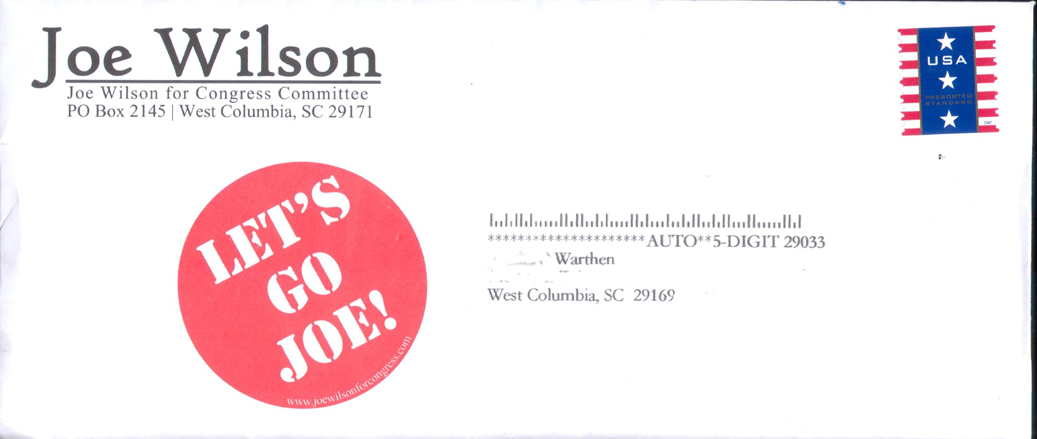
Yesterday, my wife got the envelope above in the mail.
It contains the usual “paint-yourself-as-a-victim-of-the-inhuman-opposition” language that we are accustomed to seeing in fund-raising appeals:
I’ve been under attack by the liberal left for months because of my opposition to their policies, especially government-run healthcare. They’ve run commercials in the Second District and flooded my office with phone calls and protestors. They’ve done everything they can to quiet my very vocal opposition to more government interference in our lives. Now, it’s gotten even worse.
Of course, Joe goes on to express regret — but not really — for his outburst, in a classic political non-apology apology:
I am also frustrated by this and, unfortunately, I let that emotion get the best of me. Last week, I reacted by speaking out during the President’s speech. I should not have disrespected the President by responding in that manner.
But I am not sorry for fighting back against the dangerous policies of liberal Democrats. America’s working families deserve to have their views represented in Washington. I will do so with civility, but I will not be muzzled.
Of course, he needs your money to buy himself a bigger megaphone…
Call the tone “defiant regret.”
You see, in the world of hyperpartisan politics, you NEVER really give ground to the other side, because it is ALWAYS wrong. Raking in the big bucks means never having to say you’re sorry and mean it.
You can’t mean it, and you can’t be seen as meaning it, because you’re counting on getting contributions from the very people who are GLAD you yelled “You lie!” at the president.
This is why I don’t mind Joe’s outburst nearly as much as I mind his continued, deliberate efforts to cash in on it. Anybody can lose control for a moment. Remind me to tell you about the time I yelled out in church when I was four years old, an incident that some old folks in Bennettsville still talk about. I didn’t mean any harm.
But this cold-blooded campaign to benefit from that outburst is what I find unforgivable. I find it contemptible on all sides: Democrats demonizing Joe, and Joe demonizing them back. But Joe is my congressman, and he’s the one I hold accountable. I’ve always liked Joe personally. We get along fine. But that’s because I always thought he was the sort of guy who’d REALLY be sorry about such an outburst.
Anyway, this mailing was an invitation to a “Welcome Home Reception” for Joe in West Columbia on Sept. 28 at Kenny Bingham’s house. One is asked to RSVP to fellow blogger Sunny Philips… and to contribute between $25 and $500, or more.
The “LET’S GO JOE!” seems an unfortunate choice of a battle cry. It sort of begs the opposition to come back with “Let Joe Go,” which has more of a ring to it. Maybe someone — someone other than Rob Miller — should have a party with that on the invitations, and welcome Joe home for good.
I agreed. And my appearance will be tonight. Other local non-actors are playing the same part on different nights. Judge Joe Anderson is on tomorrow night, for instance. Sheriff Leon Lott will do it next Friday night (the 25th), followed by Sheriff Jimmy Metts the next night.
It’s a small part. A very, very small part, and very silly. And now that the night is upon me, I’m suffering from pre-performance jitters to the extent that I really sort of hope no one is there to see me — but, since the idea behind inviting me and the sheriffs and the others to do this was that we might have a certain following that might come out and buy tickets, well, I… I urge you to come on out, and watch me make a perfect ass of myself.
Here’s the part I’ll be doing, from the movie version. Not exactly like this — the director gave each of us the freedom to change the character as we chose, and my version, while still silly, is silly in a very different way from the guy in the movie. (No doubt I could make if sillier if I had a government grant to develop it.)
So come on out. But don’t blink when I step out onto the stage, because you might miss me. Fortunately, for the enjoyment of paying customers, my part is very short. But I said that already.
Joe Wilson’s outburst last week should have created an opportunity to upgrade our congressional representation in the 2nd District (which is where I live and vote).
Unfortunately, the dynamics of the perpetual partisan shoutfest centered in Washington have utterly precluded that. The fix is in, all we have to look forward to in 2010 is more of the same.
Thanks to the way the partisan spin machines have manipulated this affair (mutually supporting each other in their common cause of constant political conflict), Joe Wilson and Rob Miller have both raised enough money to make each a fait accompli for his respective party’s nomination. This is it, the choices we will get.
The choice will be between Joe Wilson, as reflexive a party follower as you’re likely to find in the GOP, and Rob Miller, who is a nice young man who deserves our deep gratitude for his service as a United States Marine, but (from what I’ve seen so far) is no more capable of expressing independent thought that goes beyond his party’s cliches than Joe is.
Our chance to improve the quality of representation in the 2nd District has been blown away by this hurricane of money — a hurricane driven entirely by the mutually-supporting partisan spin cycles of the two parties, and NOT by the interests of the people of the 2nd District. (It works just like a hurricane, too — first you get furious winds tearing at you from one direction, then after the eye passes and you think it’s over, furious winds tear at you from the opposite direction. But it’s all the same storm.)
If it weren’t for the constant, furious spinning of those machines (which are really one machine ultimately, since neither can “justify” its existence without the other — do you think I’ve made that point in enough parenthetical asides yet?), this past week might have been a time for some thoughtful individuals to step forward and send up test balloons about a possible candidacy. But that won’t happen now, with the way the knee-jerkers on both sides have inflated the campaign warchests of these two.
You know, if I could figure out how to put groceries on the table while doing it (which is sort of my top priority these days), and if I thought there was some possibility of wresting attention away from these well-financed inevitabilities, I would run, win or lose, just so the voters of the 2nd District would have a real choice, one that offers a break from absurdity as usual … But those are two really big ifs.
Well, I sure didn’t see this coming. Looks like it’s going to be Mayor Steve Benjamin (unless some other similarly viable candidate emerges because of this news). Here’s Mayor Bob’s statement:
I wanted to let you know that I have made a personal and family decision that twenty years as Mayor of Columbia is enough, and I will not run for re-election next year. I have had the honor of serving as Columbia’s Mayor and have enjoyed every minute. I count as a source of pride being called “Mayor Bob.”
Working together over the last two decades we have accomplished a great deal. Columbia and our neighborhoods have been revitalized, reversing three decades of declining population; we have started Innovista and Engenuity that are critical components of our entering the knowledge economy; Columbia’s Downtown and Riverfront have been revitalized including the Gervais Streetscaping, Publix, Main Streetscaping, EdVenture and Three Rivers Greenway; we built the Convention Center, the Hilton Hotel and the Colonial Life Center; and under the leadership of Ike McLease we successfully navigated BRAC in 2005.
While we have accomplished much there is still much to be done during the remainder of my term including funding the RTA and addressing homelessness.
I will not be seeking any other political office but will concentrate on my family and law practice. On behalf of the Coble Family we would like to thank the citizens of Columbia for allowing us to serve as Mayor.