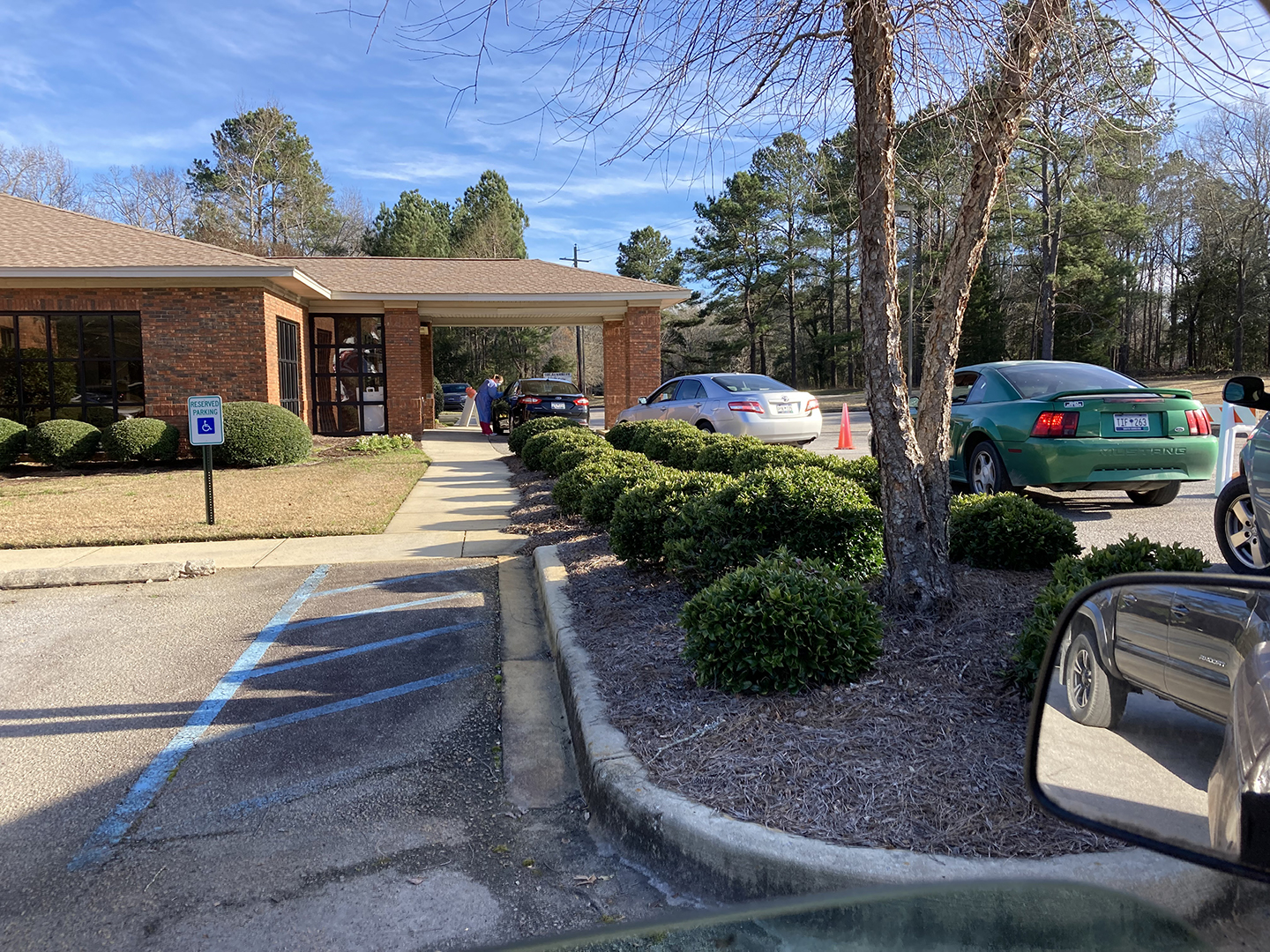
Voting was fine. There were even some nice flowers in front of the community center. Another voter seems to be digging them in the background…
Sorry to be such a downer yesterday about the whole democracy thing. I was sounding a bit like Marvin the Paranoid Android with that headline.
I feel much better now that I’ve actually voted. I hope you will, too — or already do, assuming you’ve already done it.
I voted as I said I would. On governor, I voted again for James and Mandy, just because that was the only governor/lieutenant governor team I could think of that I could vote for. It didn’t quite work, though. I typed “JAMES SMITH/MANDY POWERS N,” and it wouldn’t let me type any more. I thought I’d mention it here as a statement of my intentions, in case we get into a challenging-the-count situation.
For the U.S. Senate, I voted for my wife. I didn’t consult with her in advance. I told her about it later as we were walking in the neighborhood. It didn’t faze her, being married to me and all. She asked, “Does that mean I get to move to Washington?” I said sure, and I’ll go up to visit and we can go see that great new exhibit I read about at the National Gallery, “Sargent and Spain,” which I see as an extension of that work of his I love that my granddaughters posed in front of when we were in Boston. So we have a plan, in case. It’s good to have a plan.
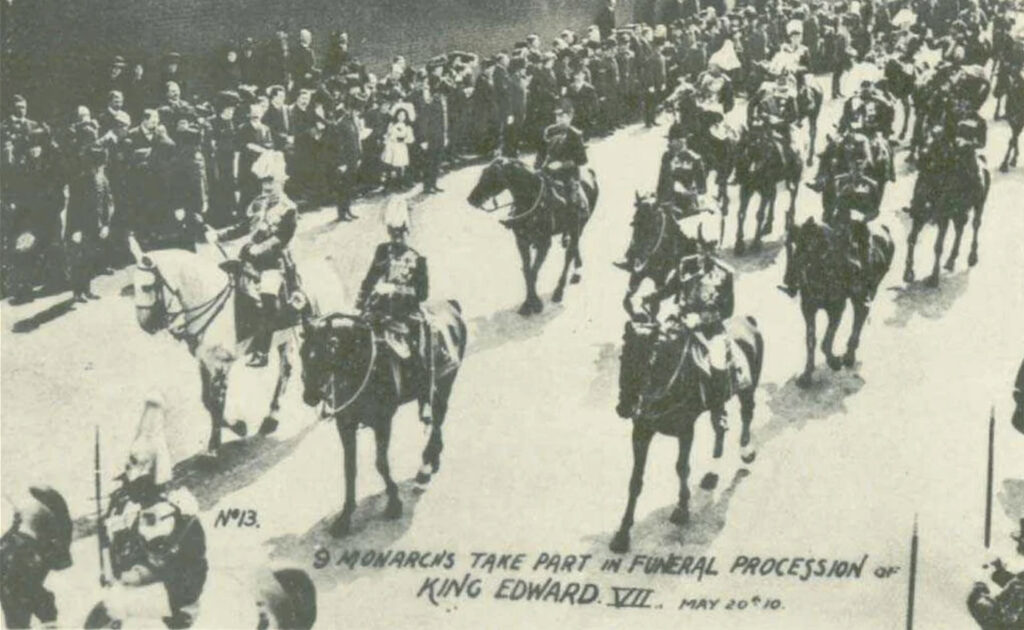
Of course, I refer to the funeral of King Edward VII, on May 20, 1910.
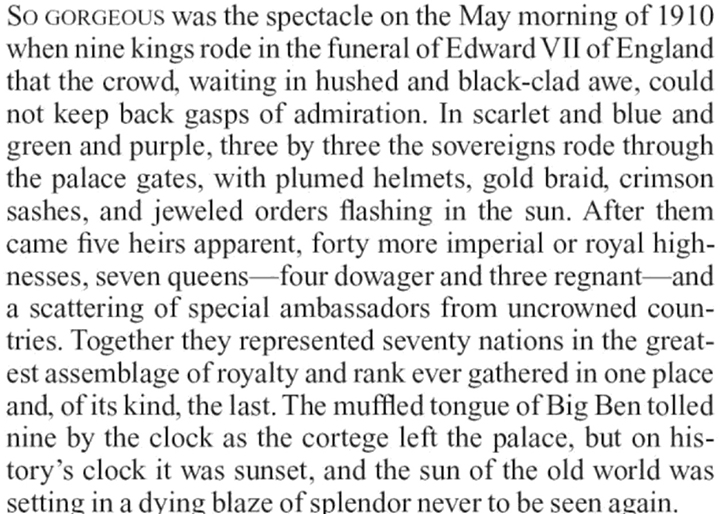
Y’all remember that one? It was a biggie. I cite the first paragraph of The Guns of August:
I don’t mean to disrespect Her Majesty’s funeral yesterday, by any means. Based on all I’ve heard and the few photos I’ve seen (the reverence, the solemnity, the dazzling colors — except for the two disgraced princes in mufti), it was splendid — as it should have been.
I’ve just got this one on my mind because a couple of days back, I started re-reading the Tuchman book. I’m using the term “re-reading” loosely here, because I didn’t finish it the first time. After it shifted to the Eastern front, it seemed to bog down. All I remember about it was the incompetence of the tsar’s government (sort of like Putin’s in Ukraine), which gave me a bit of insight into why the revolution happened.
So I decided to start over, partly because I knew the first chapter was awesome, beginning with that portrait, excerpted above, of the old world that was about to end — that ruled by closely related kings, attending the funeral of their kinsman. He was known as “the uncle of Europe,” which Mrs. Tuchman explained thusly:
Anyway, I had remembered all that — not each and every relationship, or even the precise number of royal highnesses and such in the cortege. But I had remembered the main points — the pomp and splendor, the significance of this last gathering of the fam, and the general reasons why this was all to come to an end.
But I didn’t remember everything. And that’s my point. When I was young, I remembered any book I had read — no matter how much earlier — in absurd detail. Not photographic memory exactly, but I remember details clearly, and could quickly find them. Long before Google, I could in a brief moment find a quote I wanted in a book read 20 years earlier, by leafing through it thinking, OK, it was in the upper part of a left-hand page, and it was before this… but after that… a couple more pages… there! And when I got there, it was as I had remembered.
To some extent, that’s still there. And I remembered there were certain alarming ideas current in Germany at the time, and how I was impressed when I first read about them, thinking, As much as we make of Nazi ideology, this stuff didn’t just come from the twisted mind of Hitler a generation later….
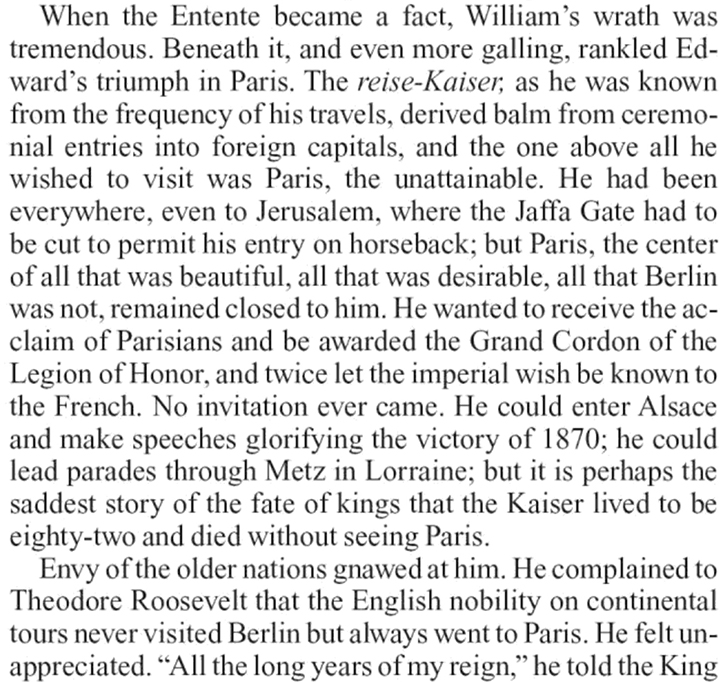
But I had forgotten her portrait of the most prominent of those foreign cousins riding in the cortege — Kaiser Wilhelm II. “William” was glad his uncle Edward was dead. It meant, he thought, he — and Germany — would get more recognition, more respect. Note the way the author describes the kaiser’s reaction to Edward’s triumphant visit to Paris a few years earlier:
(Sorry about all the long screenshots, by the way. I would copy and paste much shorter quotes, but Google Books won’t let me, so I do this. I know it’s rather unsatisfactory. I don’t do it just because I’m lazy; retyping introduces a greatly increased possibility of errors.)
I’d forgotten what a cranky, needy child the Kaiser was. Of course, he comes across a lot like Trump — all that whiny me, me, me. Maybe it strikes me more strongly now because I first read that chapter pre-2016, when Trump was still this ridiculous figure from the 1980s whom we are all free to ignore.
Now, I think, Well, as messed up as our democracy not is, and as much as I like and will miss the queen, here’s another reason to appreciate that we don’t have a monarch. Think about it. As much as Trump tried to become king — on Jan. 6, and so often before and since — he failed. But imagine how much more awful things would be were he a sovereign, and his identification with the country were such that he was the country and the country was him? (Yes, I know this isn’t the Middle Ages and things were different by 1914, but there’s still the psychology of identification that lies at the heart of the idea of monarchy.)
Of course, if we had a monarchy, Trump would never have been the king. But let’s not get lost in speculative details.
Anyway, that’s not my point. My point is to bring up one of the few fun parts of getting older: It’s forgetting things, and enjoying the delight of rediscovering them.
It’s not that I’ve become a goldfish. I remember most things, and since I’m an intuitive type, I pretty much always remember, and can accurately describe in general terms, the forest. Which is what matters to someone who thinks the way I do. But I let go of a lot of the trees.
I first saw this coming on maybe 15 or 20 years ago (or, from my perspective, a few days ago) when I suddenly realized that I longer remembered all of the lyrics of every single Beatles song. I had always taken that knowledge for granted, and now there were many holes in it. Big deal, I was able to say to myself — those weren’t details I needed in my life. Still, it was a loss.
Then, about the time I entered my 60s, the delightful thing came along: I didn’t retain any new TV shows I saw. Oh, I remembered what Jethro did in “The Beverly Hillbillies” back in the mid-60s. But I could watch an episode of some British murder mystery and enjoy it in 2012 or later, and then come back in a year or so with NO idea whodunit, and enjoy it all over again. Because my personal hard drive was no longer adding this stuff to the database.
Which is awesome. Lately, my wife and I have been rewatching “Endeavour” from the beginning, and having a great time. Oh, something about a scene will be familiar; I might even say “I know this scene; this is the moment I realized the writers were basing this episode on ‘The Great Gatsby’.” But I still won’t know what’s going to happen. And there are episodes I don’t remember at all.
Which is great. It’s so much easier to be entertained whenever I want to be. I don’t have to look so hard for “new” content.
For some time, I’ve been thinking, What if this could happen with books, too? I mean, what if I could completely forget O’Brian’s Aubrey/Maturin series, and start over and experience it for the “first time” again? That would be bliss.
I’m not there yet, by any means. But this bit of forgetfulness with the Tuchman book is a promising beginning…
Nor did I make myself watch “Braveheart,” on the off chance I would like it better this time.
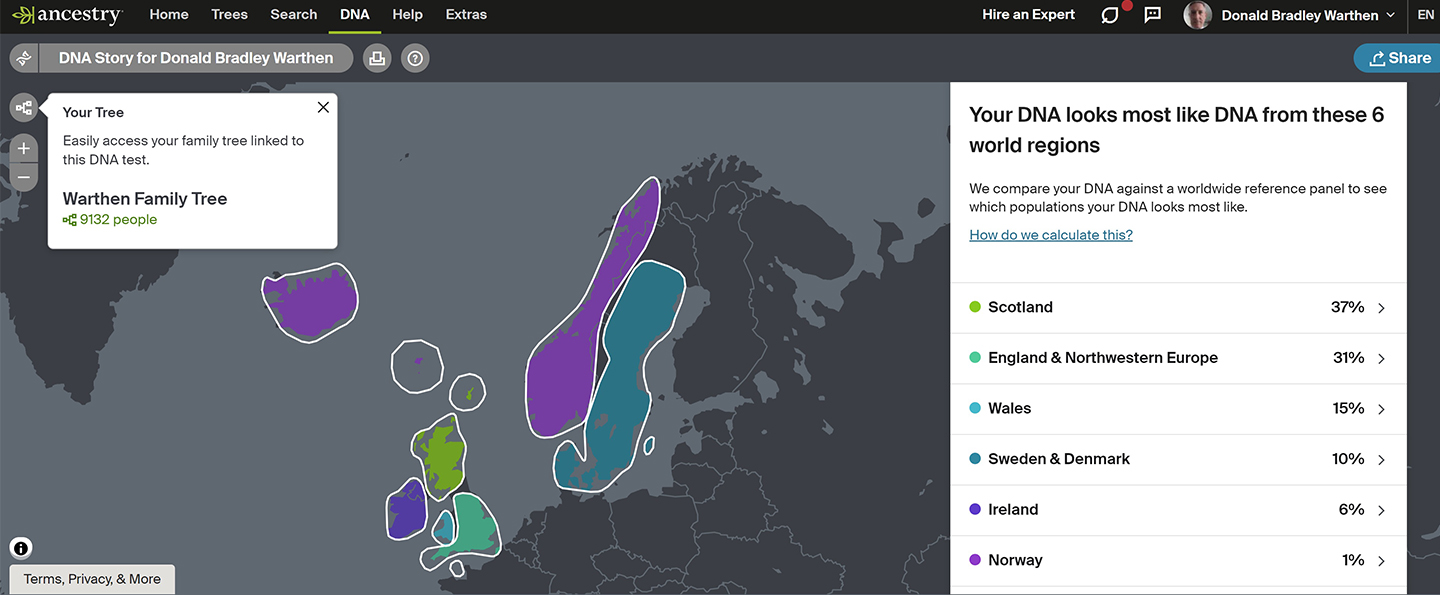
In fact, I made no effort to acclimate myself to being Scottish, in spite of Ancestry’s bold claim that I was 52 percent thataway. Oh, when my wife and I were discussing where in the world we should travel to next, I mentioned that maybe I had a sort of ancestral obligation to try out Scotland — but I didn’t push it. Frankly, I’d rather go back to England or Ireland — or maybe Wales.
Which they have now done, to a rather dramatic degree:
So now, I’m allegedly somewhat more Scots than anything else, but not mostly Scottish. I now await the next adjustment, which should get us back down to something based more in fact. Which means more English, and a good bit more Irish.
Nothing against being Scottish, mind you. It’s just that I don’t think its accurate, based on my family tree. Near as I can tell, I’m mostly English, followed by Welsh, Irish and Scottish all vying for a distant second.
Of course, as I’ve acknowledged before, this may just be because the English managed to keep better records — while busy lording it over those other three groups (and likely destroying a lot of those records). It’s particularly difficult tracing ancestors once they get back to Ireland. I can get them back there, but once in Ireland, they seem to have had no parents or any other antecedents.
But this latest assessment seems closer to reality…
It had been a long day, flying in from Columbia, with a brief stop at LaGuardia. We had ridden around Boston to get our bearings, then checked into our B&B in Newton before walking around that area — checking out the location of the dance studio where the twins had their training with Boston Ballet, and other local features. We’d been up since 3:30 a.m., had put in 18,515 steps, and were ready to relax when we went to have dinner at O’Hara’s Food & Spirits on Walnut St.
My wife had ordered a chicken pot pie, while I had chosen the broiled steak tips, with a Guinness to wash it down. The food had arrived, and we had just started enjoying it when… I got a text from our neighbor in West Columbia.
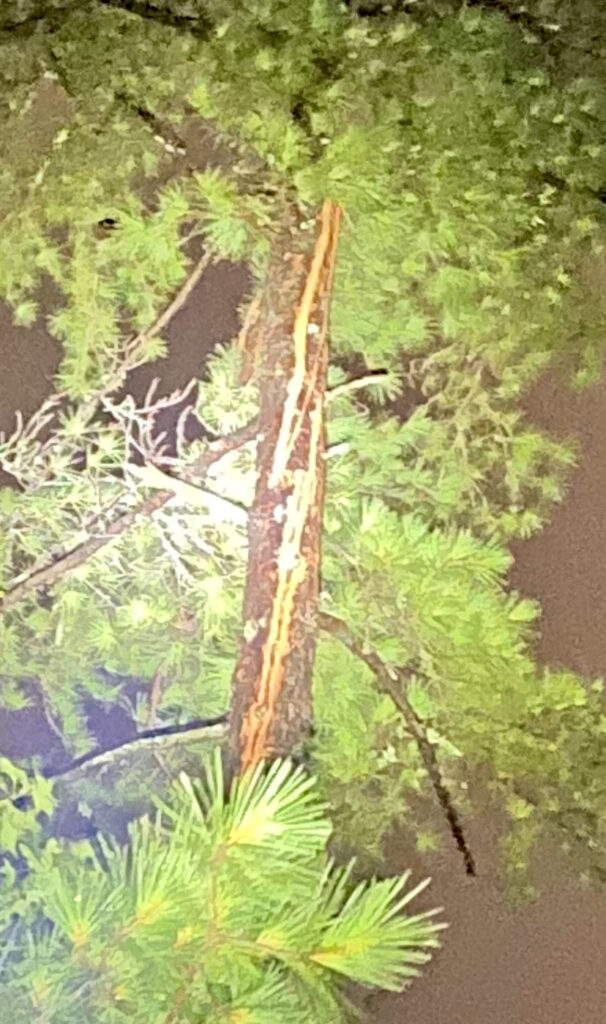
A shot my neighbor took that night. Note the Harry-Potter-scar effect…
He was checking on us to see if we were still alive. He was wondering why we hadn’t come out to see what had happened in our front yard — on account of the loud, booming crash. He had had a perfect view of it. He’d been in his garage watching the storm we knew nothing about, and his garage door perfectly framed the spectacle.
He said it was really something — the light flashed around multiple trees in the yard in various colors. He said it seemed to go on for about 10 seconds. He wished he’d shot video. Then, as soon as he said that, he apologized for seeming to speak of the event as a source of entertainment. I said no, don’t concern yourself — I wished he’d gotten video, too. I’d like to have seen it.
He did his best, though, going over and shooting some pictures of the damage. It was pretty spectacular, without the light show. There were streaks of stripped-away bark on at least three of the trees — a couple of pines and a sweetgum.
After we got back, we watched the pine nearest our house start going brown. I had an arborist out to look the situation over, and he said that one would definitely have to go, and mostly likely a couple of others as well. In the end, we decided to say goodbye to five of them, and they’re coming down now.
Mind you, this was not an isolated incident. We’ve had a rash of this sort of thing on our street lately. A neighbor across the other street (we’re on a corner) had trees behind the house hit a week or so before we did, and those came down just recently. They also had some damage in the house, from the charge running to it underground.
What greeted us when we got home…
We had a bit of that ourselves. At the bottoms of the streaks down the trees were pits where earth had been blasted away, and then trenches dug toward the house where the roots ran. But the damage was minimal. It put two HD TV antennas — the kind you put in a window — out of action, without harming the TVs. It also, I just realized to my sorrow a couple of days ago, destroyed the electronics of my elliptical trainer — which was plugged into the same outlet as one of the antennae, on the same side of the house as the trees.
The worst damage, the thing that worried us the whole time we were in Boston, was that our upstairs air-conditioning went out. When my son checked on things the day after the storm, he found it was 105 degrees up here, so he turned the system off.
But we lucked out there. The only damage was to a valve, the loss of which had confused the system so that it was trying to cool the house by blowing heat. It was easy, and cheap, to fix.
The biggest deal is what’s happening now — the felling of the trees.
After this, the view from our house will be radically different. See that house across the street in the picture below (this is the other street, not the one from which my neighbor witnessed the event)? We’ll have a perfect, unobstructed view of that house after today, since all five trees between us and it will go.
Maybe we’ll plant something in place of them. I’m thinking a Japanese maple. Those are pretty cool…
We’ll have a perfectly clear view of my neighbor’s house when we’re done.
I’ve remarked a number of times recently, I think, on the fact that no matter how much history I think I know, I keep getting slapped in the face by the fact that I don’t know squat about it.
Even when you limit it to a certain period I’ve obsessed over, I keep learning things that you would have thought anyone would have known. But I didn’t. Makes me humble — almost. I wish it would make those people on both sides of the CRT battles — who all think they know everything they need to know about what went before, and what it means — humble. Or at least quiet them down a bit. Because they get tiresome.
I had this happen again a few minutes ago. For reasons having nothing to do with this post, I happened to look up a town called Jeannette, Pennsylvania. A guy named it for his wife. It’s a pretty new town, only founded in 1888. You’d think it was out West or something, but no. Near Pittsburgh, which is only out West if you’re in Philadelphia.
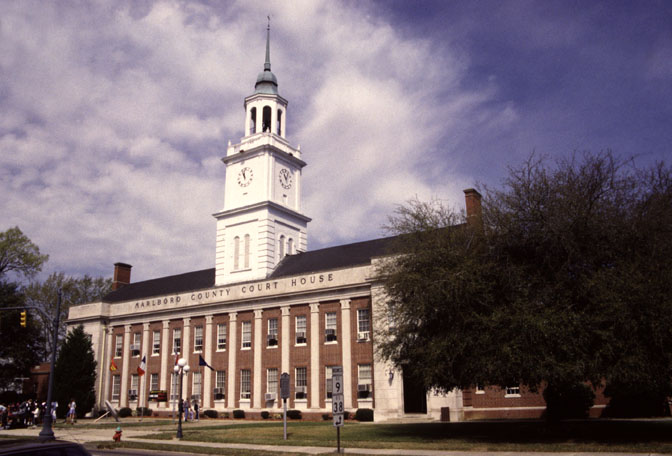
Anyway, I read that its 2010 population was 9,654. Which made me think of my hometown, Bennettsville. Y’all know, of course, that I use that term “hometown” loosely, as only a Navy brat can. I grew up in America — mostly — rather than one bit of it. But I was born there, and it was the place I returned to in the summers, and I spent the entire 9th grade at Bennettsville High School, back when there was one (go, Green Gremlins!). I feel a great fondness for the place, but as I’ve said repeatedly, I could walk all the way through downtown on Main Street and not be recognized by anyone, unless I got lucky.
So I looked up B’ville on Wikipedia as well, and found that as I thought, the population was close to the same — 9,069 in 2010.
I’d never thought about it before, but I guess I’d always assumed it had been named for, you know, somebody who lived there in the early days. Some plucky pioneer who was among the first Europeans to turn the sod on the banks of the Pee Dee, or who operated a ferry, or some such.
But no, this guy was just — the governor. Some guy from Charleston. It appears he raised some questions about the conduct of the Denmark Vesey investigation, trial and executions. Perhaps the points he raised were to his credit. It’s a bit hard to tell, because the article isn’t very well written.
But that’s all irrelevant to the point that, aside from having it named for him, I don’t see anything that indicates he had anything to do with Bennettsville. Or Marlboro County, for that matter. Or the Pee Dee, even.
Which is rather disappointing. It’s like founding a town and naming it for Henry McMaster, even though he’d never been there. Don’t you think that’s kind of lame? I’d think it was lame even if Henry were a more interesting and distinguished governor. Which, as we know, wouldn’t take much.
I’m not lobbying to change it, of course, even though B’ville has plenty of more interesting sons and daughters — Hugh McColl, Marian Wright Edelman, or if you want someone more recent, Aziz Ansari. I mean, come on — it was the home and base of operations of Sen. Jack Lindsey! Why, my Uncle Woody embodies the town, far as I’m concerned, and could entertain you enormously telling stories about it. But it’s not named for him, either.
But again, I love the name “Bennettsville,” and wouldn’t change it. It has a certain warm, rounded feel. It’s part of my own deepest identity, one of the essential “B” names and words for which I’ve always felt such a keen comfort and affection. (Have you seen me in my new B hat?) Like the color blue.
I just wish we had a better reason for the name. Maybe there is one, and it didn’t make Wikipedia. I’ll have to ask Walter Edgar, next time I see him. Being a real historian, he knows stuff like that…
It’s about how measures that employers instituted at workplaces a century ago might help with today’s Great Resignation problems. A number of things were done to make workplaces more pleasant, but this was my (and the headline writer’s) favorite step:
Goodyear President F.A. Seiberling … embraced employee welfarism with a wide-reaching program in Akron, Ohio, that included an improved working environment, a thrice-a-week employee newspaper, a housing development and even a company baseball team to make workers feel like part of the “Goodyear family.” Confronted with the same problems, his crosstown competitor Harvey Firestone followed suit.
These companies met others on baseball fields in a league they organized that spanned at least two other states. The brick stadium where the Firestone Non-Skids played (named for the company’s first treaded tires, “non-skids”) seated 4,500 cheering workers, and it still stands in front of the old company headquarters. The idea was that when employees sat in the stands and cheered for the company, they’d be more loyal, and as a result, they were encouraged to do so. Goodyear told workers in 1920, for example, that attending the games alone wasn’t enough; “moral support, organized cheering, [and] boosting 24 hours a day” were critical as well.
The quality of baseball had to be good enough to attract these fans, though. In rising industrial cities like Akron and Michigan’s Flint and Grand Rapids, where there were no professional teams, fans typically watched amateur clubs compete. Industrial teams played as part of that environment, and so increasingly, companies hired men who were good baseball players. During World War I, Frank Stefko remembered hearing from a fellow soldier, Glenn “Speed” Bosworth, that Goodyear was hiring ballplayers in Akron, so after the war, he traveled to the Rubber City from Scranton, Pa. The personnel office said the company didn’t have openings until he mentioned Bosworth’s message. “Oh, you’re the ballplayer!” They hired him on the spot….
It worked. Employee morale and longevity improved, as did productivity. Employers did this not just to be nice guys, but because it was good for business. It also helped stem union efforts — until the Depression led to cutbacks in such expenditures, so the great heyday of unions arrived in the 1930s.
My wife knew I would like the story because of my grandfather. She never met him — he died of lung cancer when I was four — but he found some time to teach me some basics of baseball before we lost him.
And playing baseball on the workplace team is a big part of his legend. I’ve told you all this before, but I’ll tell you again, because I love these kinds of stories from the days when this was a baseball-loving country. Here’s something I wrote about it before, with a picture of the house where my grandmother lived with her family before her marriage:
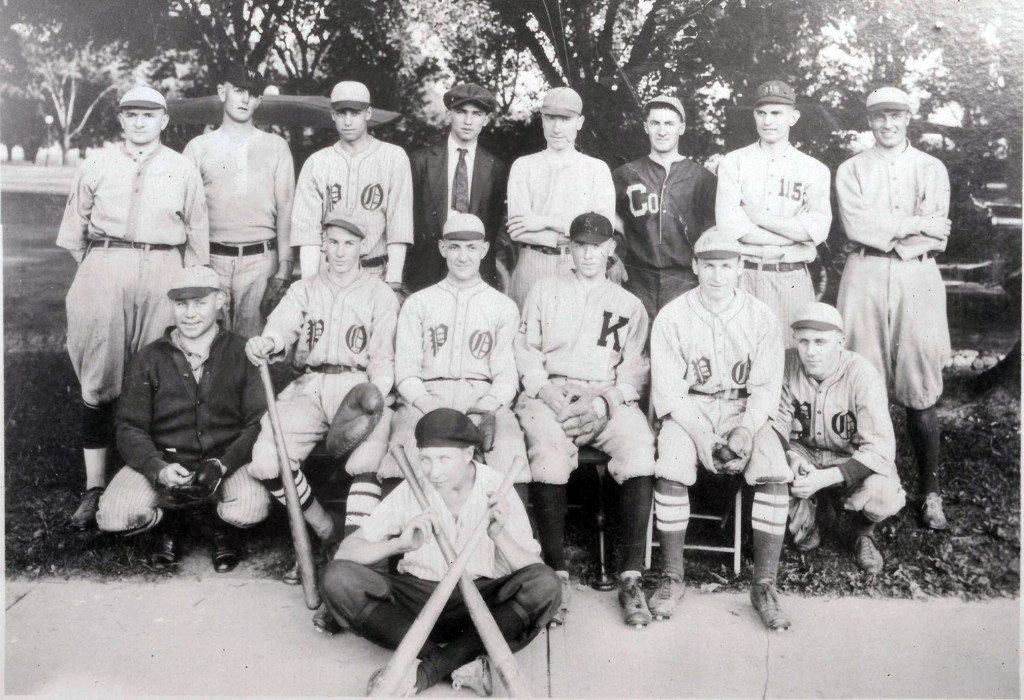
Here’s how she met my grandfather — she would see him walking past her house on the way to the train station each day in a suit and straw boater, carrying a bag. She thought he was a salesman, and the bag contained his wares. Actually, he was a ballplayer, and bag contained his uniform and glove. He worked for the Post Office, but he only worked there so that he could play ball for its team. He was a pitcher. Gerald “Whitey” Warthen would eventually be offered a contract with the Senators, which he turned down to work in his father’s business.
A couple of minor corrections: He worked, I think, for the Railway Post Office, which I take it was some subset of the P.O. we all know. More importantly, he wasn’t just a pitcher, as I have learned since reading about him in recent years in old copies of The Washington Post and other local papers. He was also an infielder. Basically, he played anything as long as it was baseball. Oh, and before he launched on this working-for-baseball period, he had been captain of the team at Washington and Lee.
Anyway, I guess I am genetically predisposed to see baseball as a great way to attract employees. Unfortunately, the end of that story in the Post sounds a discouraging note:
Today, companies are also experimenting with ways to boost worker welfare in the context of the Great Resignation. Baseball spectatorship has been replaced by team-building activities that include workplace climbing walls, wine-tasting events, table tennis, family picnics, free lunches and special doughnut days. At the turn of the last century, employers experimented to identify which perks resonated with workers. While the jury is still out on whether such programs will be successful today, companies are following in the footsteps of NCR, Goodyear and Kellogg’s in experimenting with programs that employees find meaningful and useful — enough so to stay in their jobs.
You see that? No baseball. That’s the sad state of America today. Baseball is no longer seen as a way of pleasing the masses. Is there any hope for us?
Now that I’ve spent every spare moment I could find for several days gradually putting that post about Boston together — determined to get that done once after one of my trips — I can turn to catching up on email.
Not work email — I’m up to date on that chore. I mean my personal email. The screenshot above from my iPad indicates the scale of the problem. Not exactly, but that “2,031” you see over the email icon is roughly how many I have sitting unexamined in my personal In box.
Which I hate. Of course, I’ll delete most of them — not even opening the overwhelming majority of those before I do — and save most of the few left to folders, also unread. You know, just in case they prove useful at some point in the future. Which they almost certainly will not. But even the system I have for committing unthinking mass murder to hundreds or thousands of messages can take me a couple of hours, when there are this many. Of course, it’s not the many that cause it to take so long — it’s the few I open and glance at, and perhaps even read.
Remember when — 25 to 30 years ago — we thought email was a convenience? And certainly it was, compared to snail mail, which takes so much time and physical effort to process even a single letter. It was made more seductive, there in the early-to-middle ’90s, by the fact that relatively few people out there had email, which really cut down on the volume.
Yesterday, I was talking about something else with an IT professional — no, not a funny one like this guy, but a real one — and he was talking about some new technology he was working with, and I asked him to let me know if he ran across any new technology that eliminated the hassle of email.
Trying to be helpful, he made a suggestion or two, but I had tried them already, leading to failure. For instance, he suggested creating folders in which to dump things that might require some action (or at least reading), so they can be addressed later. With bitter regret, I told him of my hundreds of such folders, which have done nothing to reduce the work — and which, of course, I pretty much never look back at. The junk just sits there.
Part of it is my personality. I’ve always been a pack rat, and I have a great, almost mortal, dread of having something in my hands at one point, throwing it away, and then desperately needing it at some later date. (This, of course, predates email. My office, or my desk if that’s all I had, would always be a forest of piles of paper. To this day, I defend this system because of something that happened once in the very early ’90s — Managing Editor Paula Ellis, knowing my habits, came to me and asked whether I had a copy of a memo that had been distributed in the newsroom several months earlier. Certainly, I said. I went immediately to the right pile and shuffled through it for a moment — then proudly handed it to her. See? My way was the right way. It may have only happened once, but it happened…)
Then there is the problem of my chosen profession — or rather, the profession that chose me. It’s very difficult for a journalist — at least this one — to throw away written information. It may not be useful later, but on rare occasions it can be critical later. This only got worse when I turned to opinion writing — and much worse than that when I took up blogging. At least, when I was a beat reporter 40-odd years ago, there was a limit to the range of things I might write about. No longer. And since I still blog, this perceived need to hang onto things has continued well past the end of my newspaper career.
Even the stupidest, most useless, boring piece of crapola — say, an appeal for money from a political campaign — can inspire me to write something, depending on my mood. Sometimes, I write only to share how stupid, useless and boring it is.
Oh, well.
I’ll turn to it later, and get it done eventually. Right now, I think I’ll turn, however briefly, to some actual paying work…
Those of you who travel more than I do (these days, I hardly leave my house!) probably noticed this before, but it’s the first time I’ve run into it.
As I mentioned, we took a quick trip to Memphis a few days back, and while we were there, I looked at my phone and noticed I had an appointment with one of my doctors set for the next day — which was the day we’d be driving back. The time was for right about the time we’d be leaving Memphis. (I knew I had an appointment that week, but I’d thought it was later in the week.)
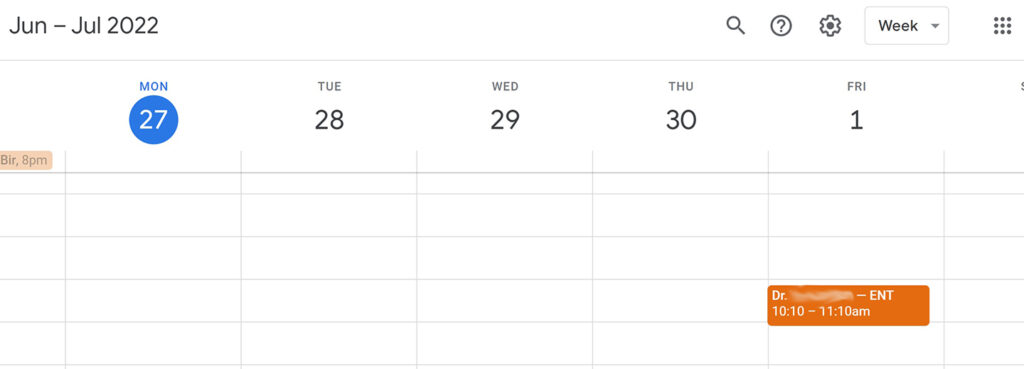
So I called, and they called me back the next morning as we were about to leave, and reset the appointment for this coming Friday at 9:10. So I entered that into my iPhone.
So… I’m left to assume that since I entered the time as 9:10 when I was in the CDT zone, my iPhone automatically “corrected” it when we cross the line back into EDT.
I fixed it earlier on my phone, but it still shows up on my PC as 10.10. (Which is another technical problem.) So now I’ve put in a call to the doctor’s office to make sure.
Anyway, I hadn’t known iOS could be quite that “helpful.” Or that presumptuous…
In the next couple of weeks, my wife and and I are taking a trip to Boston — the first time either of us have been there. The last time I even had a chance to go there was 2004. I managed to work into the budget travel for one editorial board member to attend each of the presidential nominating conventions. I decided it would be really selfish of me to go to both of them, so I sent Mike Fitts to the Democratic convention in Boston. I went to New York. I didn’t regret it, because it was the first time I’d been to NYC since a day spent there when I was 9 years old. But I’ve always regretted missing Boston.
This time, we’re going up to see my twin granddaughters who are doing a summer program training with the Boston Ballet. But since they’ll be busy all day in classes, we’ve got a lot of sightseeing planned, including:
Historical walking tours downtown. One if by land and two if by sea, and all that. A big deal to a guy who concentrated on the Revolutionary era in college.
The Adams National Historical Part in Quincy. Walking the home ground of my fave Founding Father John, and other members of his distinguished clan.
“Old Ironsides.” Walking the deck of the U.S.S. Constitution will be a big deal. One of the U.S. Navy’s six original frigates and now the oldest ship in the world still afloat, this is a treat for a guy who loves naval stories from that period so much. I expect to walk about exclaiming, “What a fascinating modern age we live in!”
A game at Fenway Park. And not just any game. The Sox will be playing — wait for it — the New York Yankees!
I’m particularly excited about that last one after something I just learned yesterday.
As I’ve probably written in the past, I’m a weird sort of baseball fan. I’m more in love with the idea of baseball than I am the game of the moment. For instance, I enjoyed Halberstam‘s Summer of ’49, which is why think it’s great to be able to see these two teams play each other. No, the DiMaggio brothers won’t be there, but still…
I would follow the sport on a more current basis, but I can’t. I don’t have cable, and in case you haven’t noticed, the freely available TV stations very rarely show baseball games any more. Back in the days when everyone had only two or three channels, you could see baseball any weekend. Now, you can find all the football you want (and far more than I want), and staggering amounts of golf — but rarely is an inning of the National Pastime available.
Which, of course, is what is wrong with America today. In case you were wondering.
During playoff and World Series season, I go to great lengths, sometimes signing up for absurdly overpriced subscriptions, to see the games. And often, that’s the first time in the whole season I become familiar with even my favorite teams’ current players. (My favorite teams are the Braves and the Red Sox. At various times, many years back, I was also a fan of the Cardinals, the Phillies and the Reds.)
So it was that I was surprised yesterday to learn a wonderful thing. I was doggedly viewing highlights of some recent games online, and… there was Jackie Bradley Jr. in right field! Last year he was with the Brewers, and now the MVP of the Gamecocks’ 2010 College World Series was back with the Red Sox. Just in time!
And guess where our tickets — which I bought a couple of days before learning this — are?
Yep, right field. So, assuming he’s not injured or not playing that night for some other reason, he’ll be the player we can see the best.
No, Babe Ruth won’t be playing for either team. We won’t get to see Ted Williams, or Carl Yastremski, or Big Papi. And Mookie Betts is still playing for somebody else.
But we will (most likely) get to see Jackie, and that’s good enough.
Yeah, some of you avid fans will think I’m a big idiot for not having already known he was back in Boston. And maybe I am. But in this case, I’m a happy idiot…
Hey, y’all. I’ve been out of pocket for a few days. We drove to Memphis on Friday, came back yesterday, and boy are my arms tired. Yeah, I know that old joke doesn’t really work there, but I’m wiped out and not fully functional at the moment.
But I thought I’d share this with y’all. On Saturday, we drove from Memphis to Jackson, Tenn., for a family get-together. That’s the place where I had my first newspaper job after graduation from Memphis State. We were there for 10 years. It’s where my wife, and our first three children, were born.
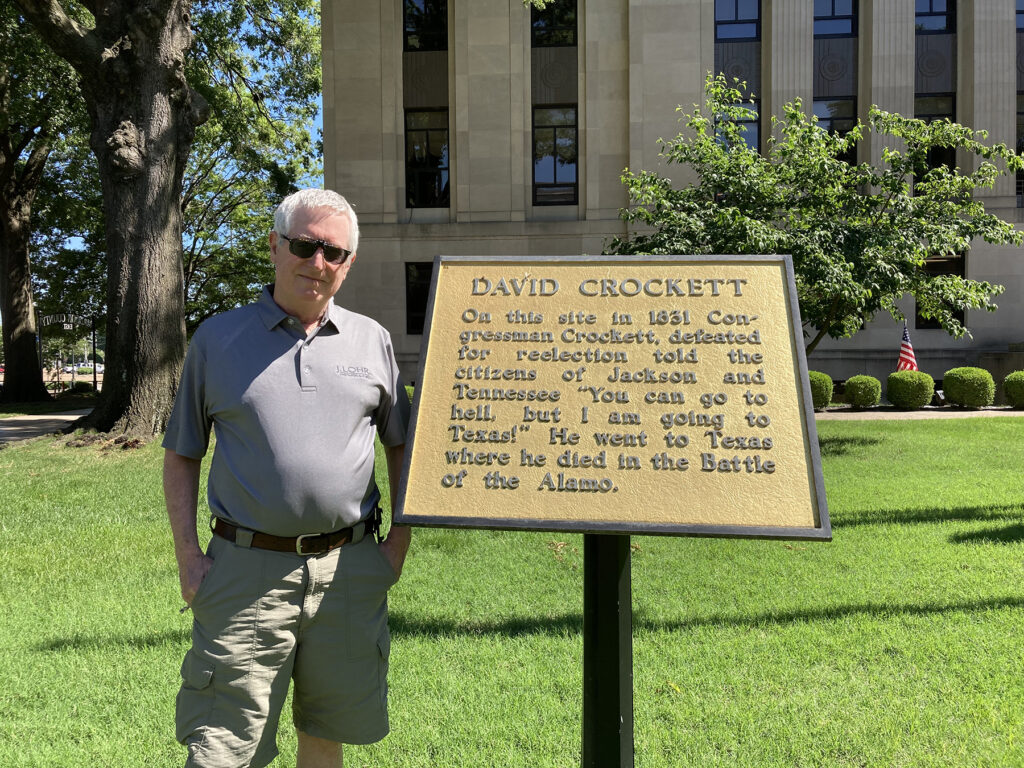
Anyway, before the family party, we showed my youngest daughter (who was born right here) around town. We hit various landmarks, including the houses we’d lived in, the newspaper building, and the Madison County courthouse square, the location of my favorite historical marker anywhere.
I think I’ve told you about it before, but it was good to see it again. But you know what? I don’t think I’d ever noticed before that the inscription is missing several commas. (How many are missing by your count?)
Oh, well. It’s still my fave. And here I am in front of the paper…
Then I got the blood drawn, and went to Radiology for my chest x-ray. All of it being routine follow-up on my long COVID case. After I had checked in for that and was waiting to be called back for the x-ray, I got a couple of texts from my wife. She said:
So, we sat and ate our lunch behind… little cricket because there’s an active shooter thing going on in our neighborhood. But finally we came on in because it’s located in the Apartments. So, it’s OK if you come home.
The “we” in the text was her and two of our grandchildren, who had spent their first morning off from school at our house. “Little Cricket” is the convenience store where you turn off Sunset Boulevard to get to our subdivision.
I called her immediately, and she said there were about 25 emergency vehicles in the area, but they were letting people into the subdivision, but not letting them go to Quail Hollow Apartments or the nearby gated community, Hulon Green.
I got my x-ray and headed straight home. All of the abovementioned places are within about a mile of the hospital. At the roundabout at the main entrance to Quail Hollow, two cops were waving people into the subdivision, but blocking them from heading right — toward Hulon and the apartments. I asked what was going on, and got an incomplete answer, to the effect that yeah, that area was still blocked off.
I had to wind around a sheriff’s vehicle and some others to get into the neighborhood. A car marked with WIS livery was stopped on the side of the road, which made me glad I’d called the paper to make sure they knew about it back before my x-ray. Yeah, I still do things like that.
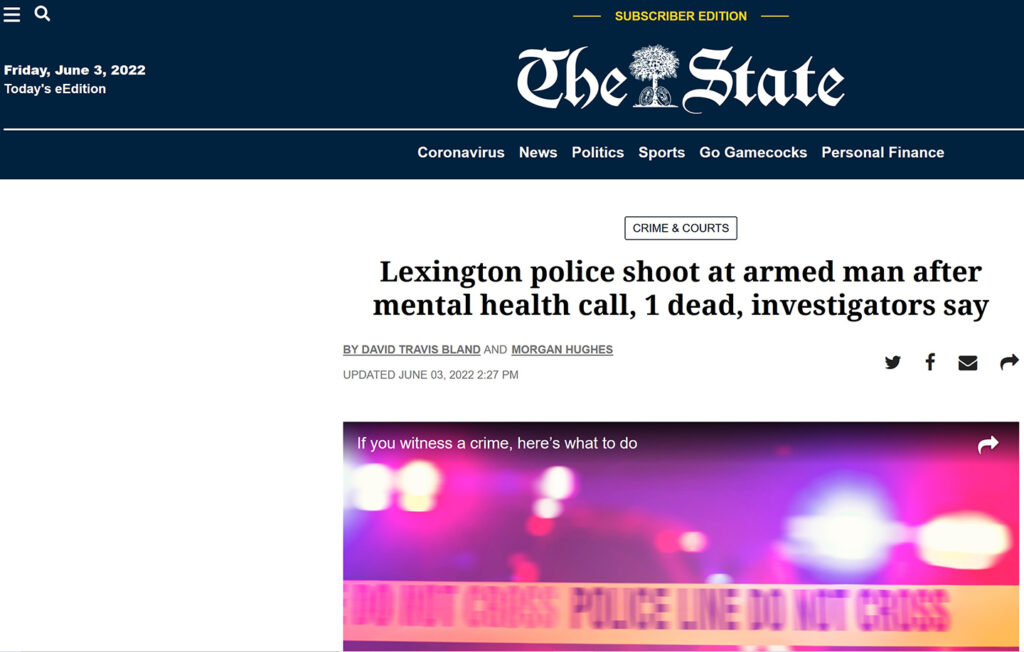
Lexington police shoot at armed man after mental health call, 1 dead, investigators say
By David Travis Bland and Morgan Hughes
Updated June 03, 2022 2:27 PM
A mental health crisis call turned into a fatal shooting near a Lexington County neighborhood on Friday, according to the sheriff’s department.
The shooting happened in the area of Feather Run Trail and Quail Hollow, the Lexington County Sheriff’s Department said. Police are still in the area.
Lexington County Coroner Margaret Fisher told The State that one man died during the incident and that deputy coroners are at the scene. The identity of the deceased man has not been released.
The department said that a 911 caller reported a mental health patient with a handgun was threatening to shoot family members and himself. When police arrived, the man ran into some woods and fired at pursuing officers. The officers fired back.
The sheriff’s department did not say if the officers shot the man.
However, the department did say “there is no active threat to the community.”
“As we can, we are letting people come and go from the area,” the department said….
When I first learned that the man was evidently dead, I texted the reporter to say that while I had been far more worried about other things — such as the safety of my family — I had not wanted that to happen, either. “Yeah,” he responded. “Shootings never cease to suck.”
I wrote back:
They never cease, period. That guy would be safe in mental health care if not for the presence of the gun…
One last thing I should mention: This incident will not add to that count I mentioned at the top of this post. It wasn’t a “multiple…”
At 3:46, much of the area had been opened to traffic, but I think this is where the shooting occurred…
… and these other vehicles were blocking that area from another direction.
I did, when I was a toddler. Or at least, when I was a pre-schooler.
Now when I say “nightmare,” I don’t mean the kind that makes you wake up screaming in a sweat. When I was a kid, that kind of dream was usually about a witch inspired by the one in “The Wizard of Oz” — only scarier. I’ll tell you about one of those another time.
But the bridge dreams were creepy, and unsettling, and undermined my basic confidence, as a child, in living in a world governed by sensible laws such as gravity.
And I had a bit of a flashback when I saw this Tweet today, from a photog at the Post & Courier:
Throwback traffic going into Charleston over the old narrow two lane Cooper River bridge. pic.twitter.com/yeXXPJfMsk
Notice how narrow it was? Notice how it kept rising in a way that could be really disturbing to a little kid riding in a car driven by an otherwise trustworthy adult?
It kept rising, and rising, leaving the Earth far behind, abandoned…
Anyway, I would have these dreams in which I’d be riding in a car climbing up like that, rising and rising and rising, and then… it wasn’t a bridge anymore. No girders, no solid pavement. It had become a ribbon, no more than an inch wide, and so thin and flexible that it waved about in the thin air as it rose higher and higher…
And that was it. The dream would then fade away (possibly due to imagined oxygen deprivation). Or maybe I would wake up — I don’t remember now. Just not the same way as with the witch dreams. In any case, whether I was awake or asleep at the end, the dream had transported my mind to a very weird place.
I last lived in Charleston when I was about 2. I think these dreams were a couple of years later, and I wasn’t sure where they came from. But I connected them in my mind with “that bridge” my mother would occasionally mention, talking about the great lengths she would go to to avoid having to cross it when we lived down there. And I would think, “that’s the bridge in the dream…”
I wasn’t sure, though. Not until sometime after we moved back to South Carolina in 1987, and one day I had to drive down to Charleston, and for whatever reason had to cross the Cooper, and… it sort of blew my mind. Suddenly, in the strength of my 30s, I was back in that childhood dream, only it was real life. And it felt sort of like the bridge was going to dematerialize under me — because that’s what that bridge did.
I only crossed it a couple of times after that, until the Arthur Ravenel went into operation in 2005.
That one’s nothing. It’s so wide, you don’t even realize you’re up in the air. Acrophobia or no, I can drive back and forth on that one as much as you like.
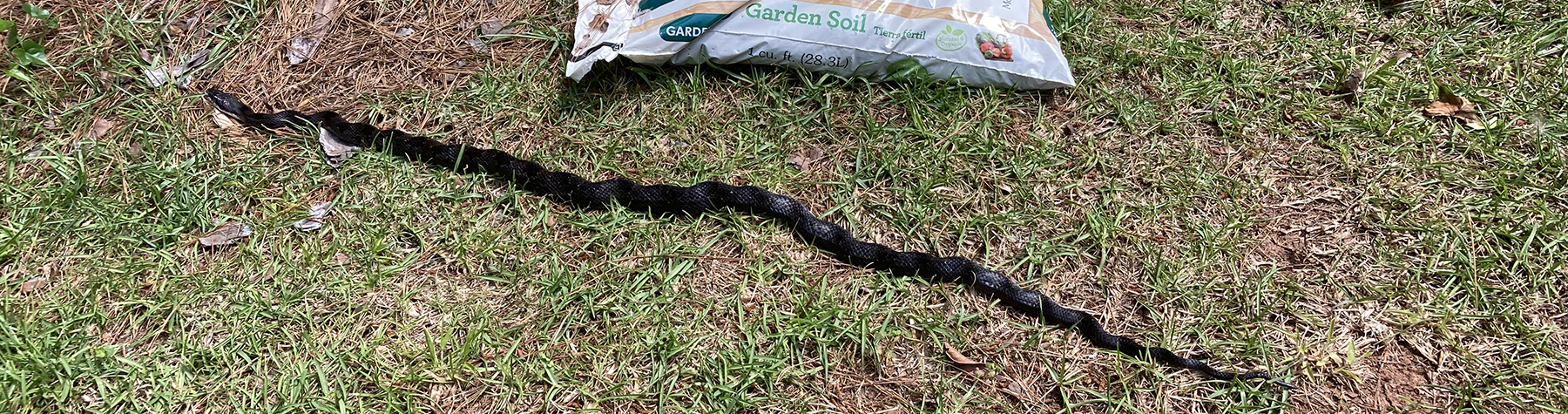
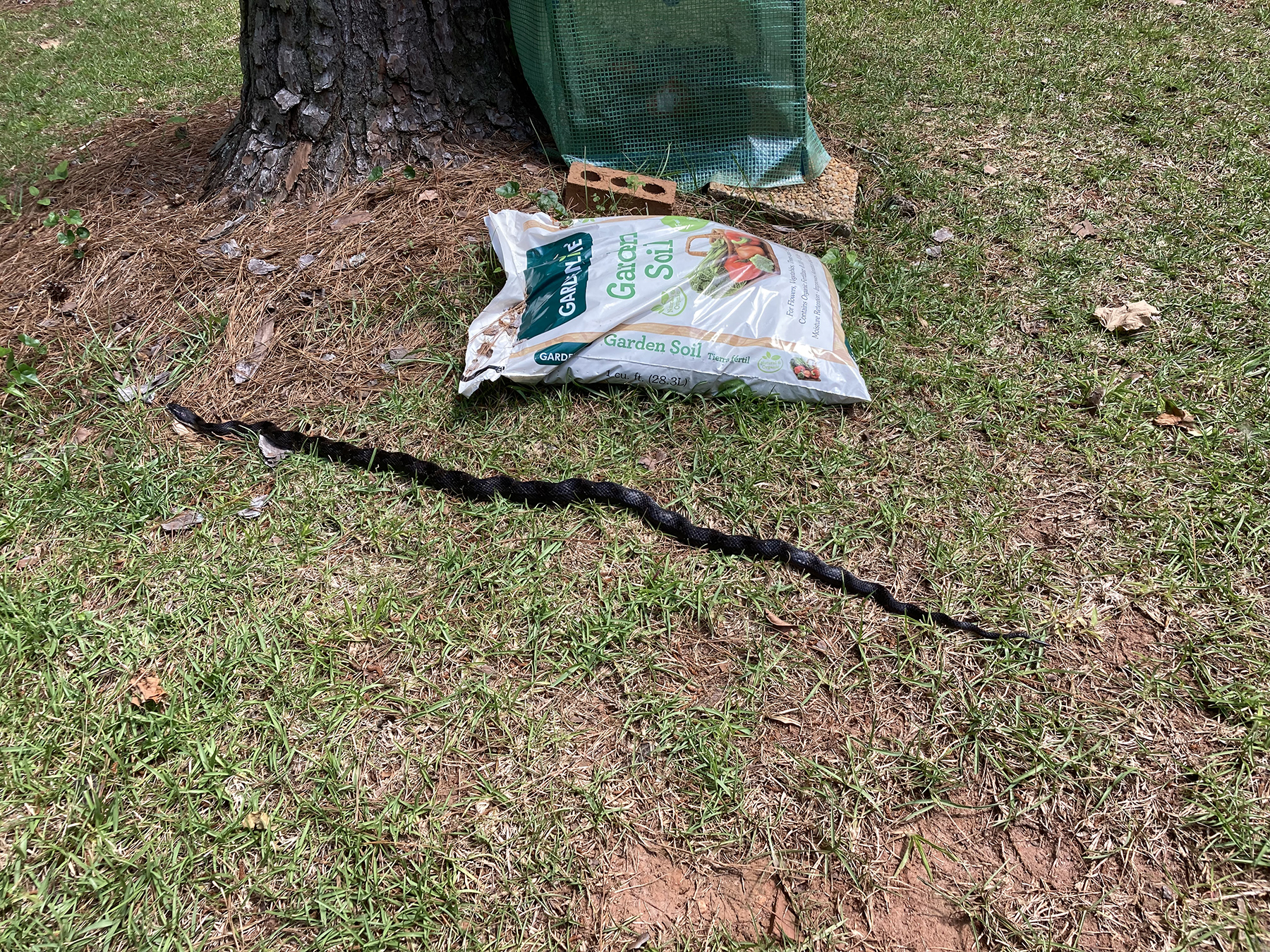
This guy was in our backyard yesterday. Actually, my wife says he’s out there a lot. It is a considerable understatement to say that she spends a lot more time outdoors than I do, so she would know.
Of course, he might be a she. I have zero idea on that. Fortunately, it’s the official style of this blog to use the inclusive “he” for reptiles. I’m still allowed to do that, right? I don’t want to tick off any feminist snakes or anything.
Beyond that, I’m pretty sure he’s harmless. Sure enough not to kill him, anyway. Of course, how reliable is the opinion of someone who can’t tell the difference between male and female?
Actually, I might do what I did then, and send it to Rudy Mancke. But not so much to ask him the species. What I want to ask him is, Why is this snake all crinkly? I mean, why is his body all compressed in a sort of sawtooth pattern? Kind of weird-looking. Is he just tense because I’m standing next to him (although he looked like this from a distance)? Is he about to shed his skin or something? Is this some variation on coiling — is he contemplating springing forward dramatically? Or does he not feel well?
The view from my dorm room, taken in 2006, just before they tore the Honeycombs down. This, kids, is from the days when dorm rooms were a bit like prison cells, and were located on the actual campus.
I’ve probably mentioned this a few times before, but…
Often when I pass by the defunct K-Mart on Knox Abbott (it’s between my house and my older son’s), I think of the expedition I undertook to that location during my one semester as a student at USC, the fall of 1971.
My uncle in Bennettsville, which I visited most weekends, had asked me to get some vacuum cleaner bags for his machine, and the only place where he knew he could get them was at that store. (No, kids, there was no Amazon for such things.) That being a bit far from my dorm, the also defunct Snowden, I had to find a ride. So I asked my older roommate, who knew everyone on our floor (I was a freshman, he a junior), and he referred me to a guy who, as I recall, was the only one on the floor who had a car. How I persuaded this stranger to take me there I don’t recall, but that’s how I got the bags.
Of course, today every freshman at the University drives one (and possibly more than one) SUV that is no more than a year old. As a result, any trip across Columbia requires some strategy in order to avoid the hordes of erratically driven SUVs.
Frequently, I ponder whether the city would seem to be completely choked with kids between the ages of 18 and 22 if it were not for the traffic jams. Maybe not. Maybe walking down Main Street would just feel like being in the film “Logan’s Run,” in which everyone seems to be walking around in a mall and all humans are put to death at the age of 30. But I don’t know for sure.
I just know the high rises keep rising, with no end in sight. I’m all for having a thriving university, and I know that since the Legislature no longer supports “public” universities the way it did back when we didn’t have cars, a growing enrollment is pretty much essential. So it’s complicated.
Anyway, that’s what I was thinking when I replied to this tweet from Mike Fitts:
There might be a few square inches in the area that have not yet been blessed with such an edifice…
I think the setting was supposed to be the old State newspaper building, but wildly different on the inside…
Well, we know I have long COVID, which consists of some post-COVID physical symptoms.
But I think I just had my first post-COVID dream. (Actually, this was Thursday night, but I’m just getting around to posting it.) So I thought I’d better set it down for the sake of medical science.
I have work dreams, or perhaps I should call them stress dreams, all the time. In terms of the way they feel, they’re related to the cliché dreams that everyone who has been to college has — it’s the end of the semester and you have to go take an exam, only you’ve never been to the class, and you’re afraid to ask anyone where it is, because then they’ll know you haven’t been to the class, etc.
At least, that’s the way those dreams work with me. And with me, looking back on my college career, they’re not that different from reality. But they’re stressful.
And the work dream I had last night was like that, but it had a new, post-COVID wrinkle. By the way, I should mention that these dreams are almost never related to any work I’ve done in the last few years. They’re drawn from the intense situations I encountered daily in the decades of my newspaper career — sometimes from the early days in the newsroom, and occasionally from my time later on the editorial board.
This fit in that genre, but with a twist that is very much pandemic-related. It’s not that I’d had COVID in the dream, it’s that my work habits were what so many of us have experienced the last couple of years. And it’s not that — as in the college dreams — I didn’t know where the office was. I knew the place well, but I just hadn’t been there in a really long time. And things had changed radically.
(In this sense, it’s a little like my current life. We shut down the ADCO office when the pandemic started — in mid-March 2020. Sometime later, we shut it down for good. But in the last few months, my colleagues opened a new office. Nobody goes there as often as they went to the old one. I don’t go there at all. Except for two meetings and one case where I went and took a picture of a client, I haven’t encountered any work that can’t be done in my home office. Anyway, those circumstances seem to have imposed themselves on this otherwise standard newspaper dream.)
It started with a phone call. Someone called me from the office — an office I hadn’t been to on a long time. He wanted to discuss a backup editorial (a short item that ran below the lede editorial, back when such things existed) he was writing for the Sunday page. He wanted some sort of guidance on it. I found this call disconcerting on a number of levels. First, it was ridiculous that he seemed to think he needed urgent help at this time, because it was a Monday afternoon — normally we wouldn’t even have identified a topic for such an edit at that point. Secondly, the call cut off before we could get the matter settled, and I couldn’t seem to reconnect with him.
But the worst part was that I had no idea who this guy was. And I was aware that there were a number of such people at the office now — new associate editors and editorial writers I had never met, but whom I was supposed to be supervising. It dawned on me that this was probably an unacceptable situation. I decided I should probably start going in to the office and sort all this out. I didn’t want to, but it seemed the responsible thing to do. At the very least, I needed to find out who this one guy was, so I could address his question.
I needed to go there and find Cindi Scoppe, who was the only person I knew who still worked there. (Of course, in real life, even though she was the last member of my team to get laid off, at this point she hasn’t been there either, for several years.)
I went there, and I eventually found her. She was outside a door to the editorial department. I peered in through a window in the door, and saw a place I’ve never seen before. A confusing, chaotic place, crowded with old desks jammed together, and strangers wandering among them. I had hoped to infer somehow which of them had called me, but I couldn’t. Nor could Cindi. She knew these people — she named some of them to me — but had no idea which had called me. I was going to have to get past that door somehow — it was locked — and engage these people in conversation until I sorted out which was the right one, and answered his question.
Eventually, I got in, and engaged with some of these strangers. My first problem is that I had no idea where to put down my laptop, because I couldn’t figure out where my office was. I finally realized that none of these people had offices (we all did back in my newspaper days) so maybe I just had a desk among all the others. I found this disconcerting, and was already missing working at home, but worse, I couldn’t sort out which was mine, so I couldn’t put down the things I was carrying.
And of course, I couldn’t ask anyone. Cindi had wandered off, and I couldn’t say anything to these strangers that indicated that I didn’t know where my workplace was, and I had no idea who any of them were.
Anyway, you get the idea. Like in the classic college dream.
The weird thing is, in real life, I’ve experienced no such difficulty working from home. I talk to people and I write things. With very rare exceptions, of it is easily accomplished using the phone, or perhaps Zoom on my iPad, and my PC — all right here in my office.
But in the dream, it seems I had thought everything was working fine before the dream started, and the main point of everything that was happening was that I was finally realizing what should have been obvious.
This doesn’t worry me, because I have these work/stress dreams all the time. I’m just setting this one down as the first in which the stress seems to have been driven by things we’ve experienced during the pandemic — in this case, by my favorite part of the “new normal,” the part where I don’t have to go to an office outside my home any more.
No longer confined to my home office, I may wrap up and head out to walk.
Several days ago, one of our regulars here on the blog emailed me — apparently motivated by a mix of solicitude and impatience. I hadn’t posted in a startlingly long time, the unapproved comments were stacking up, and he asked, “You doing OK?”
When I explained that my absence from this venue reflected a lot of things — such as being busy with family, and still dealing with doctors and such in connection with the lingering effects of my having had COVID — he asked, “Could it be long covid?”
Since I was going to see my pulmonologist next morning (Friday), I said I’d ask, but that I didn’t think so.
I was wrong. He said yes, that’s what this was. I had been confused for two reasons. One, I hadn’t really paid much attention to all the stories I’d seen about “long COVID” — which I assumed referred to a continuing, contagious presence of the virus itself — and up to this point the doctor had referred to my problem as “post-COVID.” Of course, I hadn’t worried all that much about what to call it; I just wanted it all to go away. I was tired not only of the symptoms themselves, but the side effects of the remedies (for instance, my difficulties sleeping at night, caused by the long course of prednisone I was on).
On Friday, the bad news was that my lungs — still impaired by inflammation from the long-gone virus — were only working at 67 percent of normal capacity. The good news was that overall, he saw me as having improved considerably, and he took me off the prednisone! Yesterday was the first day I didn’t take it, and I slept like Rip Van Winkle last night, and through most of this morning. It was wonderful.
He also took me off colchicine. I had wondered why I was taking that, anyway — it’s known as a remedy for gout. It can also be helpful with arthritis, I believe. I assumed it was for something he saw in the battery of tests he ran last month (which I repeated several days before this appointment), and which I could not detect.
When I asked, he explained that colchicine is an old, inexpensive drug that helps prevent a “cytokine storm” — which is the phenomenon that leads to so many COVID deaths. Wikipedia defines such a storm as a condition “in which the innate immune system causes an uncontrolled and excessive release of pro-inflammatory signaling molecules called cytokines. Normally, cytokines are part of the body’s immune response to infection, but their sudden release in large quantities can cause multisystem organ failure and death.”
Inflammation like that which had messed up my lungs. It seems that colchicine prevents such a “storm” through the same mechanism that alleviates gout.
The doctor said that I, and many others, had not heard about this use of colchicine because so many were talking about another, extremely expensive, drug that does the same thing. I didn’t write down the name of that other drug, because I was uninterested in anything that cost “$10,000 a dose,” especially since colchicine did the job.
So now, all I’m taking that was prescribed by this doctor is Vitamin D3 (which, I have learned, is actually a hormone rather than a vitamin, but since I don’t fully understand the difference, never mind). And he had me reduce the dosage of even that — from 10,000 units a day to a mere 5,000. He had had me on the high dosage because the standard range is 30-80 ng/mL, and mine was at 17.3 on the first test. He told me last month he wanted to get me closer to 60 than a mere 30. According to last Monday’s test, I was at 55. Satisfied, he reduced the dosage.
So, I’m getting better. The main restriction I had experienced was a lack of stamina. I haven’t done my normal 10,000 steps in a day since before I got the bug. I’ve tried, but I haven’t gotten past 2,000 without feeling great fatigue and beginning to cough again.
The doctor says it’s time to start getting exercise — and to get some sun as well, which I assume would help with the D3 — but not to attempt 10k. He says 3,000 to 4,000 is more my speed.
OK, now you have my update. Which I have shared in such detail partly to explain why I’ve been so unavailable, but also to make a larger point. Apparently, about a fourth of people who get COVID are “long-haulers.” This is a huge part of the effect of the disease on our society. In fact, I waited almost two hours past my appointment time to see him because he was overwhelmed with patients with my condition. This guy is really, really knowledgeable about it, and I think a lot of other doctors are doing what my primary-care doc did — sending their patients to the expert. Which means he’s getting better and better.
Anyway, I say all that for the benefit of those of you who make the mistake of calculating the effect of COVID solely in terms of the number of people who actually die. As tragic as every one of those 6 million deaths has been, and as horrific as they are in the aggregate, that’s not the entire story. There are other things happening as well…
Reporting from my official home-office recliner: Things are looking better. This was Sunday morning.
About the third time I bothered my primary care doctor on the phone about the fact that I still felt like crap after three weeks (and after a second positive COVID test), he put me together with a pulmonologist — largely because my oxygen levels kept dipping in weird ways. (Like, down to 90 and below a time or two last week.)
I had a fascinating phone conversation with that specialist Thursday evening, and learned a lot.
First, he said I didn’t have COVID — not anymore. Not even when I got the second test. He said that was some leftover virus RNA strands still littering the lining of my nose. Of course, I always thought that that’s kind of a virus was — random, disorganized strands of more or less living material — but he sounded quite certain, and I was convinced.
So what was wrong with me? What was with the continuing, irritating, hacky little cough that interfered with talking to people? Why did I continue to run a low fever and have chills? Why didn’t I feel up to doing anything?
He said those were post-COVID effects, the most salient of which was probably inflammation in the tiny, hair-sized ends of my bronchial tubes, interfering with respiration enough to cause that cough and keep me feeling low. Also had something to do with the low fever, I think.
He put me on a course of prednisone — for the inflammation — plus 5,000 units a day of Vitamin D, because he was sure I had a deficiency. And he was right. He sent me to the hospital Friday morning for some blood tests, and one of them confirmed I was well under the normal range on D. I’m to see him for a followup later this week.
Anyway, I’ve been on the steroid and the D since Friday, and I’m dramatically better. No cough. No fever — in fact, I didn’t even think to take my temp for a couple of days. I 3made myself take it last night, and it was 96.1. That’s not even a fever by MY low standards.
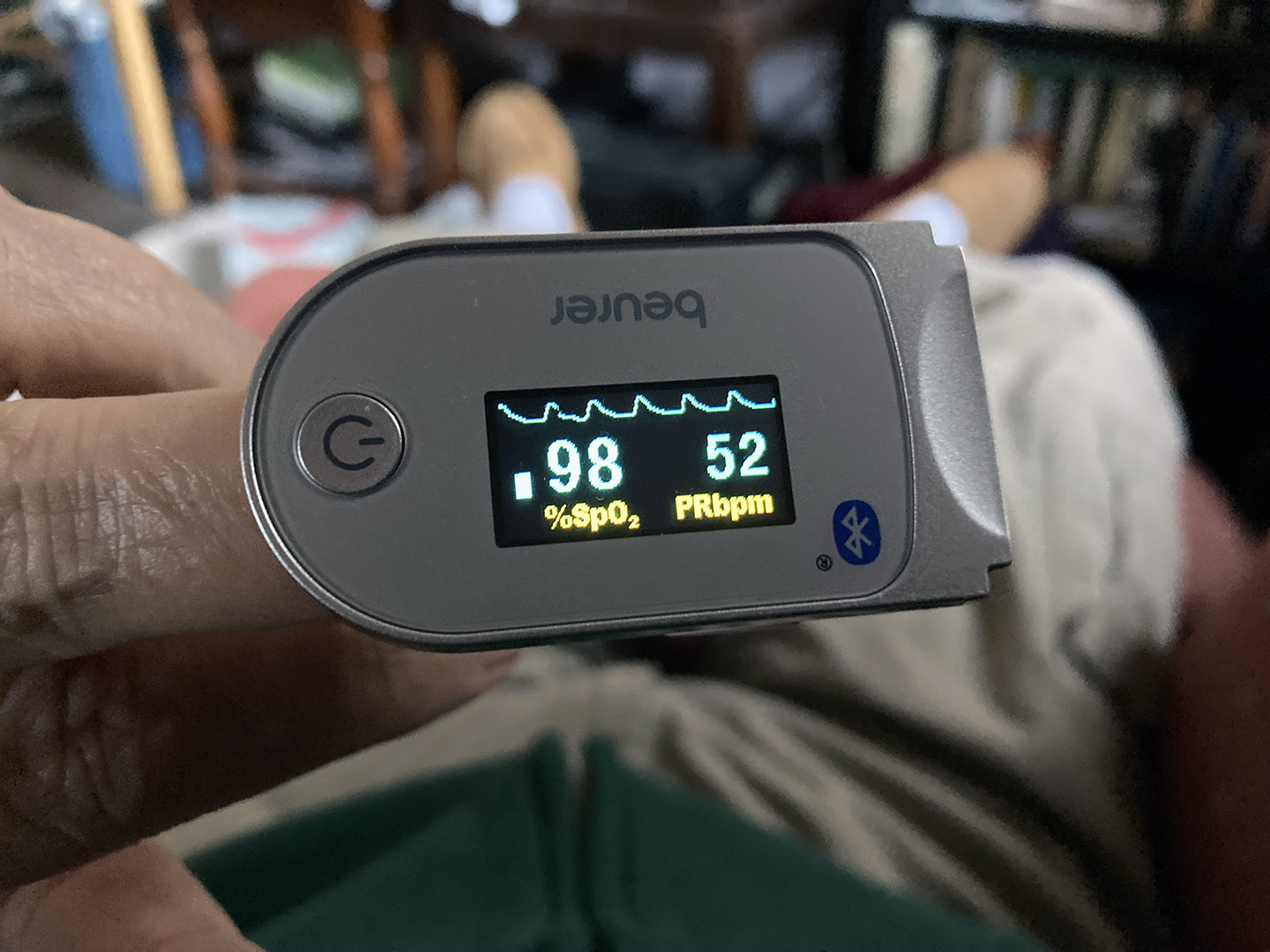
The O2 levels remain very good — like 98 percent, frequently with my heart rate in the 50s where I’m used to it being. That had been elevated before, when the O2 was lower.
I’m still not walking or anything — I don’t feel that good. And I’m still spending all my time, including sleeping, in my home office, at least until I find the time to start moving my junk back to other parts of the house. In the meantime, I’m getting some work done. And I’d better get back to that now…
Reporting to you from the front, where things are not so much grim as tedious.
Just thought I’d report in from the COVID front — which, for me, is located in my home office. Since I work from home, I already spent a lot of time here, but now it’s pretty much ALL my time. I’ll go down to the kitchen — masked — to heat a meal and bring it up to eat at my desk. I sleep on a futon here. Just don’t call me Mark Sanford.
Of course, there are other COVID fronts as well, some of them with much heavier fighting going on, and significant losses — such as hospital ICUs. But this is mine.
I’m actually about to go to a hospital this afternoon. It will be my first time out of the house since my positive test two weeks ago. I wonder what that will be like. When I present myself at the door and am questioned and say, “Yes, I have COVID,” will alarms go off? Will everyone scramble to implement a Code Red? I don’t know.
I’m not sure it’s necessary. But since I bothered my doctor on the phone yesterday, he decided to have me get a chest x-ray, as a precaution. Why did I bother the doctor? Because it had been two frickin’ weeks, and I wasn’t getting better. I still felt like crap, I still got a slight fever and chills whenever I went a few hours without acetaminophen, and the last few days I had developed this irritating cough.
I basically called to say, Yes, it’s just a mild case and I don’t need to be hospitalized. And I doubt there’s anything to be done. But it’s been two weeks, which is way longer than I expected, and I’m even feeling a bit worse (the irritating cough), so should I be concerned? Also, is there some magic thing you can do that I’ve missed in reading about this for the last two years?
Well, as it happens, there was something he could have done if I’d called him right after my positive test. There are a couple of meds that could help with the condition — ask Paul; he knows about them — but you have to take them pretty early. There are drugs like that for flu as well, I believe. But I saw no need to bother my doctor in those early days. I wasn’t worried, and I figured it would be over in a few days.
Oh, well.
There are times when I think I’m getting better. Yesterday, in fact. I had an awesome nap from about 2:30 to 4, and it set me up amazingly. I felt stronger, generally less lousy. Having taken a single 500 mg acetaminophen tablet at 2, I decided not to take any more. But then by bedtime, I was back to the usual crappiness, with a temp of 99.4.
By the way, that’s what I meant by “slight fever.” I feel pretty awful when I get to that temp. And the couple of times in recent days when I’ve been at 100 or more, it’s been much worse. Technically, no one in the medical profession would call 99.4, or even 100, a “fever” — even a “low-grade” fever.
But hey, my normal temp is about 97. Do the math, and you see that 99.4 is 2.4 degrees more than that. If a person whose “normal” is 98.6 goes up by that much, he’s at 101. So get outta my face, before I give you COVID.
Anyway, this is probably all very boring to you. Half of you have probably already had this, and probably worse cases. But I thought I’d report in. This is what’s going on in my world.
May God send his healing grace upon all those who are really sick…
How am I? I feel like crap. I have since last night. I’m going to do a quick couple more work things, including a phone interview at 1 p.m., then I’m going to eat some lunch and lie down.
After that… what?
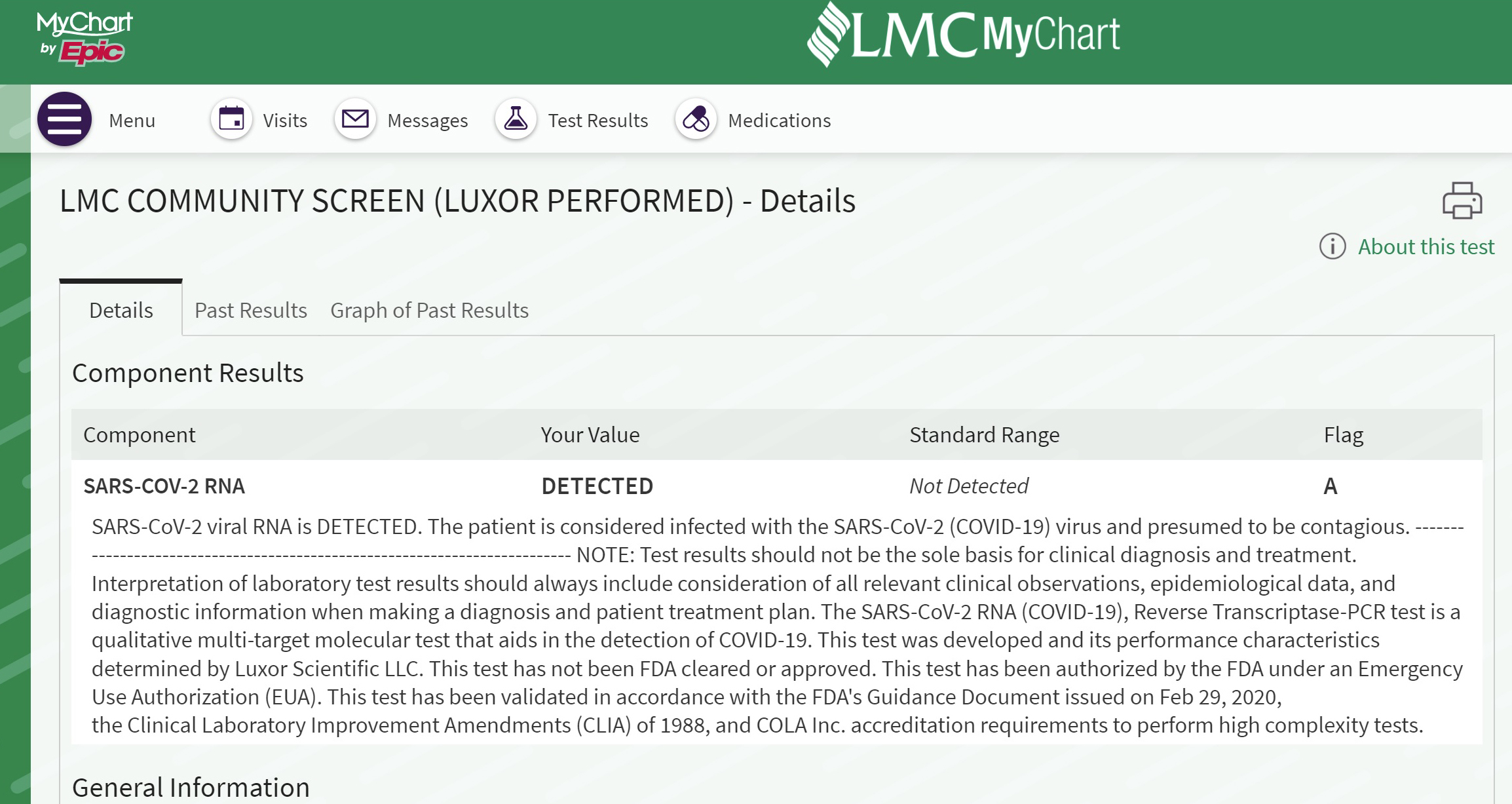
I thought when they told me it was “DETECTED,” they’d say, and here’s what you should do in addition to what you’ve already been doing.
I thought it would be like, I don’t know, getting a draft notice: “GREETINGS,” followed by specific instructions on where to report for my physical.
My youngest daughter, who was about to head back to her home in the Caribbean on Monday, had to change her flight to several days later because her COVID test was late coming back.
Then it came back, and she has it. She’s fully vaccinated of course, and her symptoms are mild. But she’s got it. She’s staying in her room — teaching her dance students in Dominica, and her English students in South America, remotely — and the rest of us are wearing masks in the house and being as careful as we can be.
Another daughter, who was with her a lot just before the positive test, isn’t feeling well. She’s awaiting a test result.
I got tested at 9 a.m. today at Lexington Medical’s site near me. I’ll have the results in a couple of days. That was my second test in a week. My wife has an appointment to get one at CVS tomorrow.
My test was at a little off-campus building LMC owns that’s down a side street right across from the turnoff from Sunset to our subdivision. Toward the end of the holidays, the line of cars for that process was maybe a hundred or so vehicles deep, stretching out onto the main road. Last week, I was the 10th or so in line. Today, I arrived 15 minutes early and there was no line at all. For a moment I thought the place was closed, but there were the poor nurses bundled up in the doorway in the 31-degree weather. One came out, did the deed, told me to look the MyChart app in 24 to 48 hours, and I was gone. Less than a minute.
So this is what we do now.
How’s it going for you out there?
At the time of my last appointment — 3:30 p.m. last Friday — I still had some people in front of me. Today, I didn’t have to wait at all…