Category Archives: Popular culture

The Guys gird themselves for battle. Or something.

You ever watch people in a public place doing something fairly ordinary, but there’s something about it that makes it interesting, and you’d like to ask them what’s up, but the normal social threshold for doing so just isn’t quite there, and you’d sound sort of loony asking? You know, people you see and without being able to help yourself, starting making up a story about, for no particular reason?

It happens to me a lot. But I’m easily distracted.

One recent morning, I was coming down the steps in the city garage behind the Capitol Center (yep, I’d been to breakfast at Cap City), and as I passed one of those glassless windows in the concrete — between the 2nd and 1st floors, it was — I saw five guys standing lined up with their backs to me in the median of Assembly. They were in dress shirts and pants, but no coats yet. They were standing alongside two SUVs, standing so close to the tinted windows that their noses couldn’t be a foot away. All in the same attitude. It was like a drill team or something, and this was their routine. I half expected each of them to hold an arm out to the side to dress the line.

I kept descending the steps, and by the time I passed the next window, I realized they were putting on, or adjusting, ties. They were making quite a production of it. I was next put in mind of a group of commandos in an action thriller — you know, the guys who, after they’ve slipped in past security, reach into their duffels and, all together, in practiced motions, pull out black coveralls and automatic weapons. (Forgive me; I’ve recently watched the whole “Die Hard” series while working out at home. There’s a scene like that in every one of those. See the video below.)

By the time I’d reached the street, they were pulling on suit coats, very deliberately and seriously. In all this process, there had been nothing of preening; they were too sober about it. Deadly serious. They were girding themselves, preparing for… I don’t know what. Something they had trained for, seemingly. The two younger guys closest to me looked like athletes. And the older, beefier guys could have been ex-athletes. Or soldiers. Or cops. Putting on suits didn’t look like an everyday thing to them, although when they were done they were the essence of business propriety.

I didn’t notice any of them talking to each other as they started walking together along the median. They were just… moving out. Again, like they’d rehearsed this.

Sorry that I hadn’t taken a picture from the stairwell when I’d first noticed them lined up, looking at themselves in the SUV windows (if you’d seen that, you’d know why they seemed out of the ordinary), I shot a picture of them crossing Assembly after I stopped at the light there. I had to stop again at the light at Main and Gervais. By that time, they were crossing the street in front of me, headed for the State House.

All that time, they had walked down the street with the air of the Earps and Doc Holliday heading for the O.K. Corral. Not talking at all, that I could see.

Initially I had thought they were headed for some serious business meeting in the Capitol Center (the old AT&T building), maybe at the state Commerce Department, or one of the law firms in the building. “Business” in the sense that Beaver Cleaver used it: They were gonna give somebody “the business.” Lay down the law, as Dad did when Wally or the Beav got out of hand.

But when I saw them headed for the State House, I decided they were either representing a police association that was lobbying lawmakers about some kind of law enforcement legislation, or one or more of them (or maybe a fallen comrade) was about to be honored by a resolution of the General Assembly.

But really, I have no idea. I just knew there was some kind of Serious Guy Business going down. And these guys had dressed for the occasion, right there on the street, in unison.

An unpardonable insult to Jack Kerouac

I’m reeling here. I’m stunned. I’m looking about for some hope for the world.

In connection with a comment I was responding to today, I went looking for when I’d written about repealing the 17th Amendment not being such a crazy idea, and there I found a link to a Christopher Hitchens piece from early 2011, which I followed for nostalgic reasons, and noted there a link to the cover of the current edition of Vanity Fair, and there I saw the thing that shocked me.

What I saw (accompanied by a photo in which she demonstrated that, however much money you spend on a glamour shoot, there are some people you can’t MAKE glamorous, because their facial expression will drag the whole thing down) was a mention of Kristen Stewart — she’s the notably underwhelming star of the “Twilight” movies — in  the same breath as Jack Kerouac. I saw her name in connection with a coming movie adaptation of On the Road. In a connection that was crafted as though she were starring in it or something:

As the Twilight-series finale approaches, Kristen Stewart is also starring in this month’s Snow White & the Huntsman,followed by an adaptation of Jack Kerouac’s On the Road. Ingrid Sischy finds her on the run, in Paris. Photographs by Mario Testino.

See? They even used the actual word, starring! Well, first, I had to think, so is she Dean Moriarty or Sal Paradise? Or Carlo Marx? And if so, how does that work? OK, so she’s Marylou. Well, I have to admit I don’t have as clear an image in my mind of Marylou as I do the others, except for this: I can’t imagine the wild jailkid Dean, the quintessential Mad One who burns, burns, burns across the American landscape, going for anyone remotely like Kristen Stewart. There is no way you envision her as a character produced by a brain writing on a continuous roll of butcher paper under the influence of benzedrine. (OK, so she’s based on a real-life person, but you know what I mean.)

Now, I’ve seen other people say less than kind things about this actress, and I was like, Aw, leave the kid alone, but when you start talking about putting her anywhere near the centerpiece of anything as iconic as On the Road, well you’ve gone to messin’. Near as I can tell, there’s a reason why she was the star of the Twilight movies. It’s because she was so painfully ordinary and unremarkable that teenage girls everywhere could project themselves onto her, and identify.

That’s not a quality I connect with Kerouac.

Also… one expects a Kerouac project to have a bit of an alternative feel to it, and not be cast according to mundane box office considerations.

OK, that’s about all I’m going to say, except to say that this is a little bit personal for me. Kerouac introduced me to my wife. OK, not personally, because he was dead at the time. What I mean to say is, we met at this party she threw for a mutual friend, and she was reading a Kerouac biography at the time, and I was reading On the Road for the first time, and we realized it and started talking about that, and connected in a powerful way, and started dating seriously about a week later, and were married a year after that.

So, you know… it seems like whoever was in charge of casting would have checked with me or something…

J. Jonah Jameson was right! (Of course he was — he was the editor!)

"I'll prove that wall-crawler's a menace if it's the last thing I ever do!"

Forgot to post this yesterday when I saw the news:

Peter Parker isn’t the only man trying to hide his identity by donning a Spider-Man mask.

A robber wearing the web slinger’s mask was spotted in two robberies June 11 in the Midlands.

In the first incident, the masked man and an accomplice swung into Computer MD in the 4400 block of St. Andrews Road, swiped four laptops and ran out the front door, Lexington County deputies say.

The store’s owner tried to chase them but couldn’t catch the men before they made off for the woods…

This, of course, vindicates J. Jonah Jameson, who’s been telling the world that webhead is a crook for years.

We editor types always know what’s really going on.

Post-newspaper retail environment born in 1962

This morning was one of those moments when several threads came together for me, providing a small insight into the shape of the world in which we live.

It’s related to a moment of revelation I experienced in about 1996. I was attending one of a series of monthly meetings that our then-new publisher, Fred Mott, had instituted to brief employees in general about the state of the business side of the newspaper. I was probably sitting there trying not to let my eyes glaze over too obviously when he said something that cut through. Something that should have been obvious, but was not until that moment.

He observed — I forget exactly how he said it, but this was what I got out of it — that Walmart had shifted the ground upon which the business model of newspapers had been built. The key element was “everyday low prices.” Everyone knew that Walmart was the place to get the lowest prices available locally on anything they sold. And they sold everything. If everyone knows that you have low prices every day — and not now and then, in the form of sales events — you have nothing to communicate, on a regular basis, through advertising.

To show how that affected but one of the newspaper industry’s key advertising constituencies… people were used to reading about all the grocery stores’ specials — which changed if not day to day, then at least week to week — in the newspaper. But what’s the point in that if you can get all those same groceries — same brands and everything — cheaper at Walmart? And every day. So beyond some general branding, which it does mainly through television, reminding people of said everyday low prices, what does Walmart have to communicate? There is no news to pass on. That gives it yet another competitive advantage over those regular advertisers, because it saves the ad costs. To try to compete, those advertisers cut back on their ad budgets, and so forth.

And since Walmart sells practically everything a mass market wants, there is no retailing area unaffected. Department stores, appliance stores, clothing stores — everybody is competing against an adversary that doesn’t have to advertise to the extent that they traditionally had done.

That was just a piece of what was strangling newspapers, but a significant piece. Hence the expense cutbacks and hiring freezes that were already a monotonous part of newspaper life. The next year, Fred made me his editorial page editor, and shortly thereafter, as a measure of his confidence in me and his perception of the importance of the editorial mission, I was able to grow my department by one FTE. That was it. From then on, every budget year was an exercise in doing it with less. And less. And less. Until, two publishers later, it was decided to do without me.

But where did Walmart come from?

I got to thinking about that this morning. I was reading, in the WSJ, an oped piece about Eugene Ferkauf, who recently died at the age of 91.

In the postwar years, he pioneered discounting through his chain of stores called E.J. Korvette. This required challenging the “fair trade” price-fixing laws then in place in many states:

Retail price-fixing in the United States—often packaged for popular consumption as “fair-trade” laws—was a Depression-era concoction. Launched in California in 1931, it was quickly copied by state legislatures across the country. These statutes were premised on the idea that manufacturers retain a legal interest in the price of their products even after actual ownership has moved downstream to retailers. The laws were written so that once a single retailer in a fair-trade state agreed to observe the manufacturer’s proposed retail price list, it would in effect impose those prices on all other retailers in the state.

Conceived as a means of protecting small, independent merchants against predatory chains, fair-trade laws were pushed through state houses by legislators beholden to the influential retail chambers of commerce. The big manufacturers, especially appliance makers like GE, Westinghouse, RCA and Motorola, usually lent tacit support. It was easier for them to deal with a multitude of small customers through their wholesalers than to directly confront retailers big enough to muscle them for price concessions and promotional allowances…

I had never heard of E.J. Korvette stores, but I got to thinking, when was the first time I experienced discount store shopping? I realized that it was when we moved to New Orleans in 1965, after having lived in South America since late 1962. One of the elements of modern American culture that made an impression on me that year was the local Woolco store, a short drive from my home.

Anybody remember Woolco? They went out of business for good in the 80s, but this one was thriving in 1965.

I looked it up on Wiki, and found that Woolco was founded in 1962. This made me curious, and I looked to see when Kmart was founded. 1962. When did the first Walmart open? As it happens, 1962.

Then there was this passage in the oped piece this morning about Ferkauf:

In the end, the demise of fair-trade laws didn’t help E.J. Korvette. Ventures into high-end audio, home furnishings, soft goods and even supermarkets made E.J. Korvette considerably bigger but also shakier financially. In July 1962, Ferkauf was on the cover of Time magazine, hailed as the PiedPiper of the new consumer-centered retailing. Four years later he was ejected from his company, which by 1980 went into final bankruptcy. Ferkauf’s legacy, though, was secure. He had finally killed off legally protected price fixing.

Something about that year. A cusp of sorts. A changing of the guard, as retailing pivoted.

In his awesome book The Catalog of Cool (and if you can lay hands on a copy, you should buy it — although you may want to go the used route, since Amazon prices new copies at $127 and more), Gene Sculatti published an essay titled “The Last Good Year.” An excerpt:

Sixty-two seems, in retrospect, a year when the singular naivete of the spanking new decade was at its guileless height, with only the vaguest, most indistinct hints of the agonies and ecstasies to come marring the fresh-scrubbed, if slightly sallow complexion of the times. On the first day of that year, the Federal Reserve raised the maximum interest on savings accounts to 4 percent while “The Twist” was sweeping the nation. A month later “Duke of Earl” was topping the charts, and John Glenn was orbiting the good, green globe. That spring Wilt Chamberlain set the NBA record by scoring 100 points in a single game and West Side Story won the Oscar for Best Picture. The Seattle World’s Fair opened, followed five weeks later by the deployment of five thousand U.S. troops in Thailand. Dick Van Dyke and The Defenders won Emmys, and Adolph Eichman got his neck stretched. By that summer, the Supreme Court had banned prayer in public school, Algeria went indy, and Marilyn Monroe died of an overdose…

No mention of a major shift in retailing, though, as I recall.

One last tidbit, which you may consider to be unrelated…

Recently, I picked up several old paperbacks for 50 cents each at Heroes and Dragons on Bush River Road. One of them was The Ipcress File, which is what originally turned me on to spy fiction. You may recall the 1965 film, with Michael Caine — who expressed the cooler, hipper side of the 60s, as opposed to the mass-production James Bond.

In it is a passage in which the protagonist has a conversation with an American Army general who points out that the essential difference between the United States and Europe was this: A European develops a ballpoint pen, and sells it for a couple of quid and makes a modest living from it. An American, he said, invents the same thing and sells it for 5 cents a pop and becomes a millionaire.

Where am I going with this? Well, The Ipcress File was first published in 1962.

Apparently, war really IS hell…

Found myself back at Barnes & Noble again today, and remembered something else I took a picture of last week when I was there.

Above is a shot of one of the “New in History” shelves. OK, it’s slightly doctored. Hell in the Pacific was actually on a lower shelf and I moved it up to take this, but they were all in the same category.

Sometimes it seems that the only time “history” was happening was from 1939-45, the bookstore shelves are so dominated by that period. Or maybe it’s just because Father’s Day was coming up. In any case, it seemed that about 50 percent of all history books were about WWII, and another 40 percent was about other wars in which the United States was involved.

And I say that as a big fan of military history, and particularly the WWII period. But still, let’s have SOME perspective, people.

The least you could do is provide some variety in the titles. Does no one at the publishing house notice when it’s getting monotonous?

That is all, men. Smoke ’em if you’ve got ’em. This is my rifle; this is my gun. Off yer dead asses and on yer dyin’ feet. And other cliches of the era…

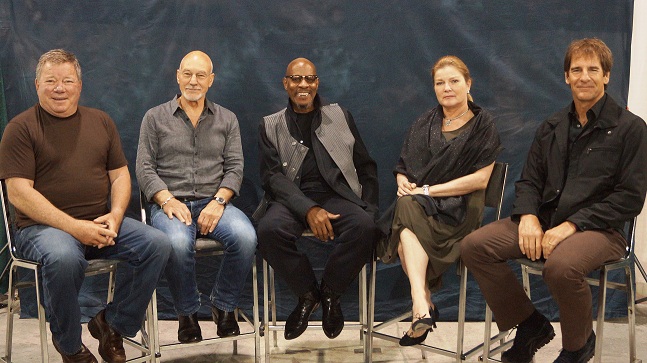
A little something for you Trekkies out there

This was brought to my attention by pourmecoffee, one of the better Twitter feeds:

All five of the Star Trek captains appeared together for the first time this weekend at Wizard World Philadelphia Comic Con. The photo shows William Shatner, Patrick Stewart, Avery Brooks, Kate Mulgrew, and Scott Bakula from left to right. The photo above was taken by Tomlin Campbell for Wizard World.

Of course, there was only one real captain. The fat guy on the left used to be him. This is one subject on which I agree with Hitler.

The upside is that you NEVER lose an argument

video platformvideo managementvideo solutionsvideo player

Or if you do, you have a whole other set of problems…

Anderson Cooper brings our attention (blast him) to the following:

Daytime Exclusive: Woman Marries Herself in Ceremony

Nadine, 36, joins Anderson to explain why she married herself after getting a divorce. Nadine had a ceremony to celebrate the event and invited 40 guests. She even received wedding gifts.

Her unusual event made headlines, but Nadine says she wasn’t in it for the publicity. She says she decided to go through with the self-marriage because “it was about really committing to changing my life. I feel very empowered, very happy, very joyous. I want to share that with people, and also the people that were in attendance, it’s a form of accountability.”

Nadine experienced a painful divorce and says it was rough after learning her two kids wanted to live with their father. “Six years ago I would’ve handled a problem by going out and drinking. I smoked, I was 50 pounds overweight… this is just celebrating how far I’ve come in my life.”

Since the split, Nadine enjoys spending time with herself, going out on date nights, buying treats and gifts for herself, and says she’s no longer waiting for “someone to complete her.”

What are we going to call this? “Same-self marriage?” Will it catch on?

I hope not. The whole thing worries me. It’s just so easy for self-love to turn to self-abuse…

Something else women would never think of

This week, we’re going to be celebrating the particular genius of the human male — why he is special and essential, as wonderful as women may be. I mean, as wonderful as they are.

I’ll explain why later.

Here’s something else (in addition to the subject of this earlier post) a woman would never think of.

Seriously. First of all, it’s hard to get most of them even to care about video games. You may have noticed this. But to think of inserting Bo Jackson into Super Mario Brothers to run the board? That is something that only the male of the species, with his uncanny willingness to sit and think about stuff like this for hours on end, could possible conceive. And to actually spend the time turning the idea into reality? Well, you have to have that extra bone in your head that the male is blessed with to achieve it.

Watch the video, and bask in the brilliance of the concept, even if the execution is a bit lacking (obviously, Bo should have been bigger, so you could see him better — but that leaves room for the next generation of guys to improve the concept, so it’s all good).

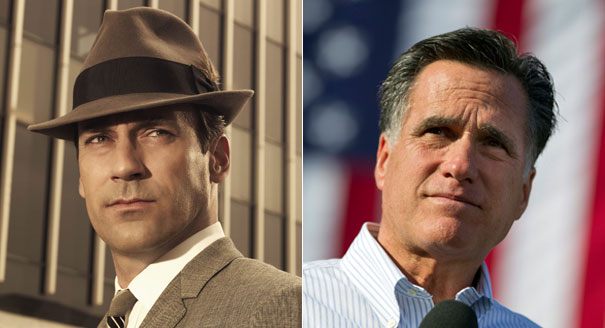
Politico promises “The Draperization of Romney,” but totally dodges the subject

The Politico piece (which ran last month, but Nu Wexler just called my attention to) started out with an intriguing premise:

The Draperizing of Mitt Romney is under way.

He may not drink or cheat, and he lacks the fictional ad-maker’s charisma, but Democrats, despite the potential perils of such a strategy, remain determined to paint Romney as a throwback to the “Mad Men” era — a hopelessly retro figure who, on policy and in his personal life, is living in the past…

But it really sort of fell flat.

I thought it was going to go deeper. For instance, the central conflict regarding Don Draper (at least in the early seasons) is that he’s not who he says he is. Now that would be a pretty meaty thing to throw at the famously mutable Romney. You can easily see Don Draper donning any political mantle required to get his way with a client, or a woman, or anyone — because he just doesn’t care about that stuff. Ditto with Mitt. He just wants to be president; he doesn’t give a rat’s posterior about the stuff that the True Believers in his party get all cranked up about.

But the Politico piece completely dodged the subject, instead citing some tired chestnuts about how the 50s and early 60s were awful because moms stayed home with the kids. (Although I admit I’d rather hear that oldie than more of the tiresome “war on women” meme.)

And then… it goes into this interminable discussion of that stupid flap over what some Democrat said about Ann Romney several weeks ago. It goes on and on. I guess that was fresh when it was written, but what does that have to do with the advertised subject? Not much.

Hello!?!?! This is supposed to be about how Mitt Romney is like Don Draper! Neither of them is a woman! Can we stick to the subject? Don’t make me think you’re going to talk about guy stuff and then not even touch on that area… It’s enough to make a guy want to go off with those idiots who get together in sweat lodges and beat tom-toms and talk about how tough it is to be a guy. Almost. OK, not even close. But don’t bill something as being about guy stuff when it’s going to be yet another rehash of chick stuff.

As for Don… I’m worried about the guy. This week’s episode ended with him putting “Revolver” on the turntable (is it 1966 already?) at the behest of his young wife, who’s trying to clue him in on what the late ’60s will be about. He briefly listens alone (his wife is off taking acting lessons, leaving him behind in more ways than one) in his Hugh Hefner dream pad, and the contrast between him and “Tomorrow Never Knows” could not possibly be more stark.

The early 60s — say, round about 1962, which Gene Sculatti‘s brilliant Catalog of Cool termed “The Last Good Year” — was his time, the time he was created for, and which was created for him. He is going to be so lost going forward.

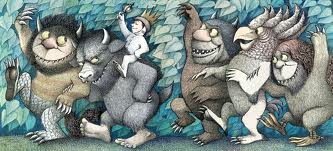
And now, for you youngsters, Maurice Sendak

Yesterday, Kathryn protested that she should not be expected to know how Paul McCartney was dressed on the cover of “Abbey Road” because she was too young. I shot back that her youth was no excuse, that she might as well claim she couldn’t picture Alberto Korda’s photo of Che Guevara because she was not a communist.

Once she followed the link I provided, of course, she responded, “Oh, that one.” The exchange sparked a fun sub-thread on iconic images of the 20th Century.

Well, this morning, I experienced the feeling of being too old for a shared cultural experience. As the news spread that Maurice Sendak, author of Where the Wild Things Are, had died, Twitter was filled with references to how important he was to the childhoods of the writers — such as this one from actor/director Jon Favreau.

I immediately felt a disconnect. I wasn’t familiar with who he was until I was an adult. Actually, he may not have fully registered on me until Richland County Public Library had some sort of special Sendak celebration several years back.

To me, his most famous work was one of those books in the stacks of books from which we read to our children, and then grandchildren. But not one that had made a big impression on me, like my favorites (Socks for Supper by Jack Kent, The King’s Stilts by Dr. Seuss, and especially Bread and Jam for Francis, by Russell and Lillian Hoban). And while I get the impression that he had greater literary cachet than the authors of “The Berenstain Bears,” I was more affected by the passing of Jan Berenstain.

How about you young folks out there? How did Sendak affect you?

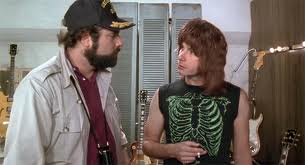
Idea for my band: “These go to three”

Just had an inspiration for how to make my band a success, at least on the local level. By “my band,” of course, I refer to the one that I’m going to start just as soon as I come up with a name, and finalize the playlist. I’ve been working on this for more than 40 years, and I’m making good progress. Don’t rush me.

Back when I was young and impatient, I briefly tried rushing it, and it didn’t work out. Some of the lads and I tried forming a band in Hawaii, and it only had one rehearsal, at Steve Clark’s house on Hickam Air Force Base. Burl Burlingame was there with his harmonicas, which proved it was a serious effort (he probably doesn’t remember, it was such a tiny blip on his music career). I was the front man, and thought I was the next Mick Jagger. But you see, we hadn’t settled on the name, or on our playlist — although we had written one song, called “Grilled Beaver Blues,” which we tentatively rehearsed that day — so the whole thing was just half-baked and premature.

Now, I’m going about it in a more organized and sedate manner.

And today, I had an inspiration for how to make some moderate money on the local level.

Last night I was at a business open-house kind of reception, and there was a band playing. And you couldn’t carry on a normal conversation when the band was playing, because the amps were turned to a point that would be useful for reaching the higher seats in Williams-Brice Stadium. As the organizer said to me in a LinkedIN message this morning, “Glad you were able to stop in last night — it was LOUD!!!”

Yes, it was. But not unusually so.

Have you noticed how very often this is the case? In fact, it seems to always be the case. Take the afterparty at the 100th episode of Pub Politics at Jake’s. Rep. James Smith’s latest band was playing, and no one could hear each other. I remember having what might have been a pretty interesting conversation with Trey Walker about working for the governor, and now for USC, except that it was conducted entirely by taking turns shouting into each other’s ears at a distance of about an inch.

Yeah, boys, I know you shelled out money for the amps and all, but do they really have to be turned to 11? Wouldn’t it be nice to put them at a volume where each note can be heard quite distinctly by people who are not talking, but which would allow those who DO need to talk to do so in normal tones?

I think a band that did that would really be in demand for almost any kind of event involving grownups — pretty much anything short of the latter hours of a wedding reception where everyone’s had too much to drink. I know what you’re going to say: “If it’s too loud, you’re too old.” Well, wake up and look around you — everybody is old. The Baby Boom hasn’t been 16 for some time.

I think that if a band could promise not to hurt the ears of attendees, it could name its price. And no one would care what its name was, or what it played, as long as it wasn’t too discordant. You could probably get away with playing Sex Pistols stuff at a Chamber event, as long as people could talk over it.

My sales pitch to event organizers would involve showing a specially modified amplifier. See? I would say. “These go to three.”

I want to bite that hand so badly

Anybody see “Mad Men” this week?

If so, what do you think?

Is it all over for Sterling Cooper Draper Pryce?

The firm has had enough trouble clawing its way back, and now this…

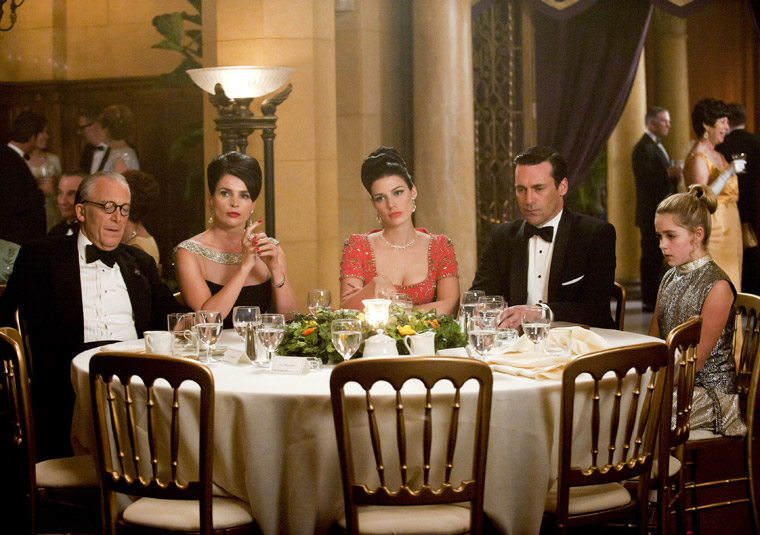
Don Draper, who created a sensation last season by biting the hand that fed his agency — Lucky Strike — with an anti-tobacco letter published in the NYT, seems to have been vindicated. He’s to get an award for taking a courageous stand, and captains of industry will be there to see him get it. Roger Sterling goes along to the banquet and is happy as a clam passing out his business cards in that target-rich environment. (By the way, I’m sort of the Roger Sterling at ADCO, because that’s the sort of thing I do. Fortunately, dropping acid is optional.)

But then, in a calculatingly offhand manner, the guy from Dow Corning confides to Don that sure, all those people will give him awards, but none of them will ever work with him, because his letter demonstrated that no client could ever trust him. And then asks him if he’d like another drink. Yes, as it turns out.

The episode ends with Draper sitting back at his table at the banquet looking like he just got hit by a stun gun. (Everyone else at the table looks the same way, for differing reasons.)

So was the guy from Dow just blowing smoke? Was he just saying Dow will never work with SCDP? Or was he delivering a message on behalf of the other fat cats? Or was he just speculating? And will Don share what he’s learned with his partners (I’m guessing not)? Or will Roger, his mind having been expanded, figure it out?

I don’t know, but I wish I could have found a clip of my favorite line of the episode. It’s when Roger shares yet another “brilliant” insight with Don, and Don tells him that even some people who have not experienced LSD know that…

Suddenly, Obama appears in Afghanistan…

I was just this minute repeating to one of my ADCO colleagues my oft-state theory about how Bush was Sonny Corleone, and Obama is Michael. Bush was the blusterer who telegraphed his moves and failed to get his enemies. Michael’s the nice, reasonable, I-want-to-negotiate, blood-is-a-big-expense guy who turns out actually to be far more aggressive than his predecessor. Just when you think he’s totally absorbed in domestic policy (the equivalent of the old Don puttering about in his tomato garden), WHAM!, he whacks some guy in a country where you didn’t even know the U.S. was operating. No seeking permission from the U.N. No paving the way rhetorically. Just bada-BING! and we get another terrorist’s brains all over our nice Ivy League suit.

Anyway, I had just been saying all that, and my iPhone buzzed, and I got this headline:

Obama in Afghanistan to sign security pact

KABUL, Afghanistan (AP) — In an unannounced trip, President Barack Obama has arrived in Afghanistan to sign an agreement cementing the U.S. role in the country after the war ends in 2014….

He’s like the Spanish Inquisition! Nobody expects him; he just turns up!

Right now, he’s probably sitting down with some Taliban leader who think’s he’s safe because his bodyguard is a police captain, and the Taliban guy is saying, “Try the veal; it’s the best in Kandahar.” And Obama is excusing himself to go to the men’s room, where they’ve got one of those old-fashioned toilets — you know, the kind with the chain…

‘It goes like this, the fourth, the fifth, the minor fall, the major lift…’

This is a question for Phillip Bush (or maybe Burl, or pretty much anyone who knows more about music than I do, which is a large set)…

After I posted that item about “Sulky Girl” and “So Like Candy” and other Elvis Costello songs that have an appeal to me that is mysterious, elemental and profound, I got to thinking about something else I’d heard in the last couple of days that had an equally mystifying appeal.

I had been watching the film noir comic-book movie “Watchmen,” and there was a scene that was utterly transformed by Leonard Cohen’s “Hallelujah.” So I went to YouTube (the one place you can find practically any piece of music you want to hear immediately and for free) and listened to several versions, and tried to plumb why it completely kicked my brain, my being, into another state as reliably as peyote did for Carlos Castaneda (although perhaps a tad less dramatically).

I have no idea. Is the secret revealed in this lyric?

It goes like this, the fourth, the fifth

The minor fall and the major lift

Are those particular changes where the magic happens? For that matter, do those words even describe what is happening in the music as I hear that line? I’ve looked up the guitar chords, and I see that they go like this:

  • It goes like this — C
  • the fourth — F
  • the fifth — E
  • the minor fall– Am
  • the major lift — F

Or, in another version, I see it’s G, C, D, Em, C…

Are those even the right chords? I expected them to be something more exotic, with “sus4” or something after them.

Is it even the music, or is it the lyrics, with their mixing of the transcendent divine with the transcendent sexual? No. I mean, yes, they’re evocative, and work as poetry (to my unsophisticated ear, they strike a literary note somewhere near that of the Song of Solomon), but they aren’t the secret. I remember when I first heard the song — the cover version used in “Shrek” — I was deeply impressed with the music without hearing the words beyond “Hallelujah.” (Yeah, I’m that uncool. I’m sufficiently unfamiliar with Leonard Cohen that I first remember hearing it watching “Shrek.”)

And how about the fact that it is used in such incongruous contexts as “Shrek” and “Scrubs” (which I discovered from Pandora), and works?

Speaking of Pandora (which I just did, parenthetically), it was little help. I tried creating a “Hallelujah” station, to see if it would give me other songs with that special something. And once or twice, it has moved in that direction — “Let it Be” and “Maybe I’m Amazed” do have something of that essence — but it’s played Israel Kamakawiwo’ole’s “Over the Rainbow” so many times that it’s rapidly losing its charm for me. And “I Just Died In Your Arms Tonight,” and “The Times They Are a-Changin'”? I don’t think so. “The Sound of Silence”? Maybe. But I’m not sure.

Help me out, those of you who understand music. What is it?

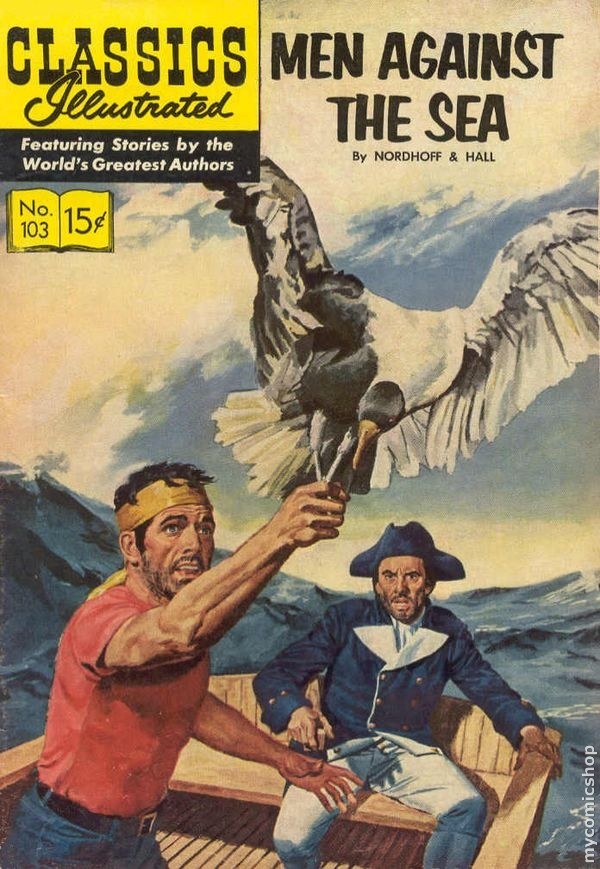
Has anyone read “Men Against The Sea”?

And if so, how was it?

I just finished reading Mutiny on the Bounty, for the first time — I think. I initially had this vague idea that I had read it as a child. Yet most of it seemed fresh to me. Of course, I knew at ever step of the way what was to happen next. Who doesn’t know the general outline of the story? Who hasn’t seen at least one of the Hollywood versions? But the actual words seemed fresh as I read them, and certain things about it — such as the fact that, bizarrely, the English sailors refer to the people of Tahiti as “Indians” throughout — seemed totally unfamiliar.

In any case, I’m certain I’ve never read either of the sequels, Men Against the Sea or Pitcairn Island. That is to say, I’ve never read the “chapter book” versions. I have a clear memory of reading the Classics Illustrated version of Men Against the Sea. What sticks out in my mind is the desperate men in the open boat managing to kill a seagull, and Captain Bligh rigidly serving out portions of its blood to the neediest men on board. (Or do I remember Charles Laughton doing that in the 1935 film?)

Anyway, now that I’ve finished the first book, I’m wondering whether it’s worth my while to read the second. I know what happened — Bligh, a tyrant of a captain but an extraordinary seaman, manages to get himself and 17 others safely to Timor, 3,500 miles away, in an open boat with practically no provisions. It stands as one of the most extraordinary feats of seafaring history.

But I’ve got to think it’s not much fun to read. It’s a tale of horrific suffering, day after day. And the main protagonist is a guy who’s hard to like. I mean, Mutiny on the Bounty had gorgeous topless Tahitian girls. (No pictures, but still…) What’s this got to recommend it?

Perhaps the fact that it’s told mainly through the experience of Thomas Ledward, acting surgeon, helps you root for these guys a bit more than you otherwise might. I’m pretty sure I wouldn’t want to read it in Bligh’s voice.

Anyway, has anyone out there read it? Did you like it? And if so, why?

And now, another Sulky Girl is heard from…

I had just posted the item about our governor’s latest bout of petulance, and was driving home with disc 1 of “The Very Best of Elvis Costello” in the CD player, and this came on. Hearing that at such a moment may not have been fraught with meaning, but it was enjoyable:

I think you’d better hold your tongue
Although you’ve never been that strong
I’m sorry to say that I knew all along
You’re no match for that sulky girl

It put a nice finish on the day.

I had forgotten how amazing it was. It’s not one of the usual suspects, like “(What’s So Funny ‘Bout) Peace Love and Understanding” — the quintessential Elvis song which, ironically, was not written by him. Or “High Fidelity” or “Lipstick Vogue” or “Radio, Radio.” Just one of those gems that you aren’t seeking out, and there it is, putting a whole new texture on your day.

And then, right after it, there’s “So Like Candy,” which he co-wrote with Paul McCartney. Another unexpected bit of delight, showing the depth and breadth of Declan Patrick McManus.

That’s a great compilation, by the way. If I have a complaint, it’s that “The Invisible Man” isn’t included:

I was committed to life and then commuted to the outskirts
With all the love in the world
Living for thirty minutes at a time with a break in the middle for adverts…

But with Elvis, you can’t possibly include everything that is great, even in a two-disc set. I mean, “Green Shirt” is on there, so they knew what they were about…

In pop music, was 1965-1975 unique?

On a previous thread, young Kathryn scoffed at people my age, suggesting that we think the music that was popular when we were in high school (and I would add, college) was great just because it came along when we were young.

I think people of any age are going to have a special feeling for music that was played when their hormones were raging at their peak. But while I hesitate to invoke an “objective” standard, I think you can demonstrate with some degree of detachment that the period in question for, say, Burl and me (roughly 1965-1975) was one of extraordinary creativity on many popular fronts.

There were so many genres just exploding:

  • British pop groups and their American imitators (what everyone thinks of first). And I’m not going to bother splitting this into its many sub-genres.
  • Folk, evolving from acoustic to electric, in numerous directions (Dylan and Simon and Garfunkel are very different)
  • Varieties of soul, from Motown to Memphis
  • Burt Bacharach — He gets his own category. If you want to create a 60s feel in a movie, you’re as likely to turn to Bacharach as the Beatles — if not more so
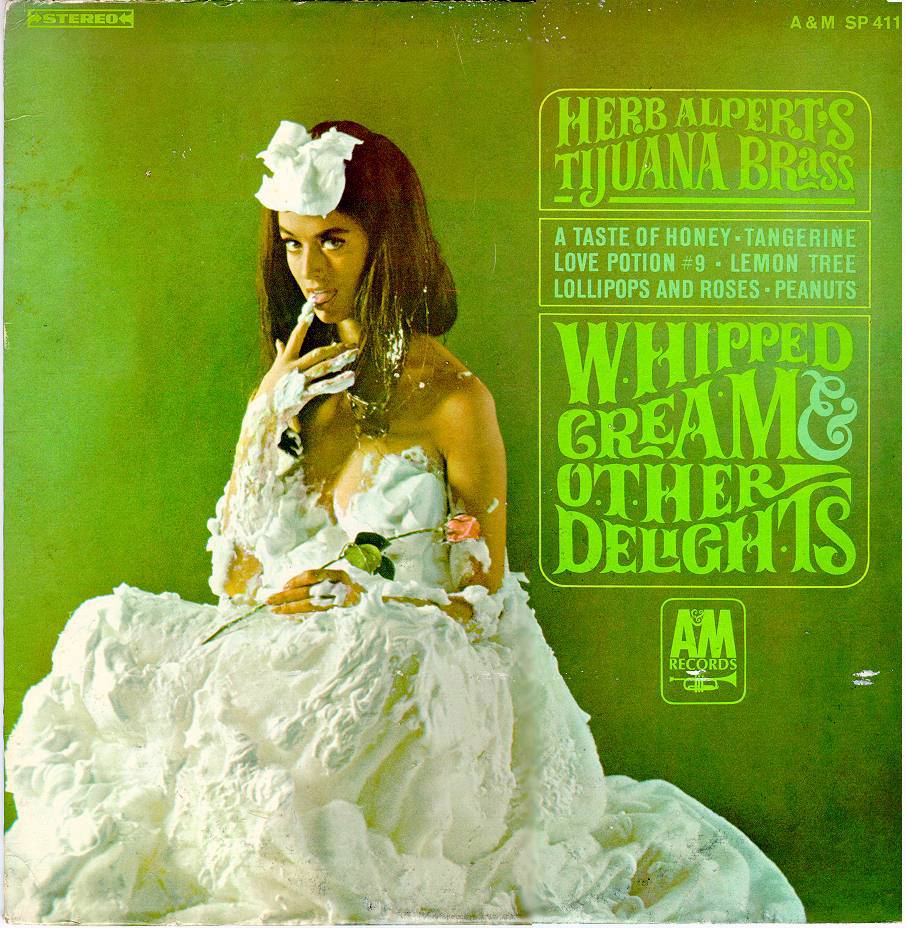
  • Latin (Spanish variety), spanning a broad spectrum from Herb Alpert to Trini Lopez to Jose Feliciano (Alpert is as essential as Bacharach to a 60s soundtrack)
  • Latin (Brazilian variety), from Girl from Ipanema through Sergio Mendes and Brasil 66
  • Old folks/Rat Pack-style — Dean Martin and others reached broadest audiences ever on TV
  • Crossover country — spanning a wide spectrum from Glen Campbell to Johnny Cash, enjoying wide popularity not seen before or since
  • West coast beach music (surf music) — Yes, it came along earlier, but there was still a lot going on in the early part of this period (“Wipeout,” the later Beach Boys stuff
  • East coast beach music — This movement started in the 40s, but some of the big hits came along in the early part of this period (“Can’t Help Myself”)
  • Even Broadway show tunes — Almost every show tune I’m familiar with was sung repeatedly on the 60s TV variety shows
  • White blues — big overlap with British groups here (The Animals, Cream, early Led Zeppelin), but Paul Butterfield and others sort of stand alone

Then there are all those bands and individuals that can’t be easily categorized — Warren Zevon, Randy Newman (late in the process), David Bowie, The Band, Creedence Clearwater Revival, Janis Joplin, Linda Ronstadt, Elton John, Blood, Sweat and Tears…

I just can’t think of a time when so many kinds of music were so huge, and reaching such a diverse audience (in the pre-cable age, everyone was exposed to pretty much the same cultural influences — if it got on TV, the audience was immense), with so much energy and creativity exploding out of every one of them.

Can you?

It wasn't just about guitar groups -- not by a long shot.

Well, it happened: Levon’s gone now

We only heard how bad off he was yesterday, and now comes this:

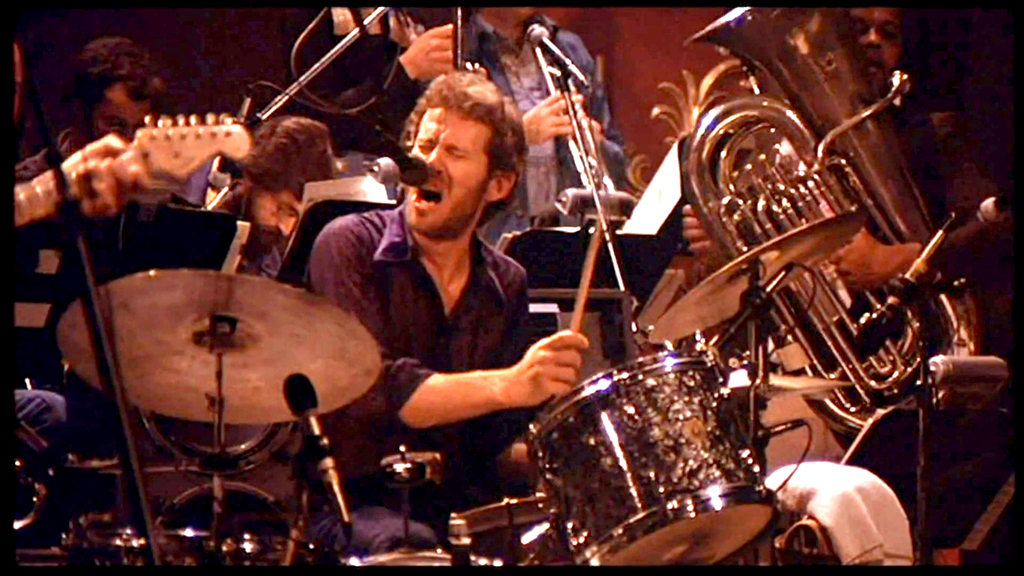
Levon Helm came to fame in a rootsy rock group that featured three extraordinary voices. But you could always tell which was his: It was the sound of the lusty wildcat, the stern Southern preacher, the depleted Confederate soldier, the dirt farmer at the end of his day.

Helm, 71, who as a drummer backed a pair of legendary musicians and then became a star himself with The Band and as a solo artist, died today from throat cancer at Memorial Sloan-Kettering Cancer Center in New York.

“Thank you, fans and music lovers, who have made his life so filled with joy and celebration,” said his daughter, Amy, and wife, Sandy, in a statement released Tuesday before he died. “He has loved nothing more than to play, to fill the room up with music, lay down the back beat and make the people dance! He did it every time he took the stage.”…

You know, that first graf is some fine writing, even if it does appear in USA Today. That’s a very solid description of his voice.

Reading that statement from his daughter reminds me of something that has stuck in my memory from a piece about The Band in TIME magazine in 1970 — the cover piece that first interested me in them, and caused me to go out and buy one of their albums. I forget which of the guys was quoted, but he said that while it was all the rage in those days to be alienated from one’s parents, the Band members were not — they all stayed close to their families and were comfortable with them.

That impressed me. Of course now with this generation, “family” has gone from being just about parents and siblings to being about spouses, children and grandchildren. But the importance of the relationships, the power of the continuity of life, continues with the timelessness of The Band’s songs, which seemed so deeply rooted in a time other than the ’60s and ’70s.

Dick Clark’s dead, and Levon Helm’s dying


And to channel Lewis Grizzard, I suppose I should say I don’t feel so good myself.

I was sad this morning to read that Levon Helm is in the last stages of cancer. Virgil Caine himself! Not only am I a huge fan of The Band (I saw them live with Bob Dylan in ’74!), but he’s the most awesome, naturalistic actor I’ve ever seen. Remember him as the coal miner himself in “Coal Miner’s Daughter”? You’d have thought they had dragged him right out of the mine, he was so real.

My favorite role was the flight engineer Jack Ridley, Chuck Yeager’s best buddy in “The Right Stuff.” Sample down-home dialogue:

Chuck Yeager: Hey, Ridley… you got any Beeman’s?
Jack Ridley: I might have me a stick.
Yeager: Well loan me some, would ya? I’ll pay ya back later.
Ridley: Fair enough.
Yeager: I think I see a plane over here with my name on it.
Ridley: Now you’re talkin’…

He was also the narrator, because he came closest to having that aw-shucks Yeager quality that the job required:

There was a demon that lived in the air. They said whoever challenged him would die. Their controls would freeze up, their planes would buffet wildly, and they would disintegrate. The demon lived at Mach 1 on the meter, seven hundred and fifty miles an hour, where the air could no longer move out of the way. He lived behind a barrier through which they said no man could ever pass. They called it the sound barrier.

And now, this afternoon, I hear this:

Dick Clark, the music industry maverick, longtime TV host and powerhouse producer who changed the way we listened to pop music with “American Bandstand,” and whose trademark “Rockin’ Eve” became a fixture of New Year’s celebrations, died today at the age of 82.

Clark’s agent Paul Shefrin said in statement that the veteran host died this morning following a “massive heart attack.”…

Clark landed a gig as a DJ at WFIL in Philadelphia in 1952, spinning records for a show he called “Dick Clark’s Caravan of Music.” There he broke into the big time, hosting Bandstand, an afternoon dance show for teenagers…

I first saw “Bandstand” on local TV in Philadelphia. I lived across the river in Woodbury, N.J., in 1960-61, and used to watch all those “big kids” talking about which songs had a good beat and were easy to dance to.

All these years, and he never got old… but time eventually took its toll.