Category Archives: Popular culture

This is a job for… SEAL Team Six, the closest thing to superheroes that real life offers

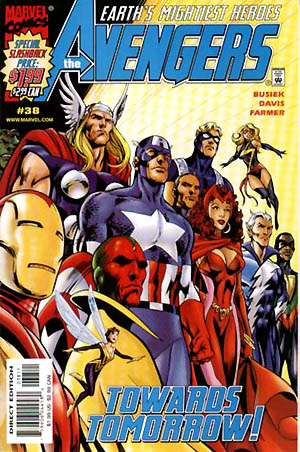
They’re not the Justice League of America, or even the Avengers (although the name sometimes fits). They don’t wear colorful tights. But SEAL Team Six is the closest thing we’re likely to see in real life to a band of superheroes.

First bin Laden, now this:

KHARTOUM, Sudan — American Navy Seals swooped into Somalia early on Wednesday and rescued two aid workers, an American woman and a Danish man, after a shootout with Somali gunmen who had been holding them captive in a sweltering desert hide-out for months.

Under a cloak of darkness, the Seals parachuted in, stormed the hide-out, killed nine gunmen and then whisked the aid workers into waiting helicopters, Pentagon officials said. The Seals were from the same elite Navy commando unit — Seal Team Six — that secretly entered Pakistan to kill Osama Bin Laden in May, senior American officials said, though the rescue mission in Somalia was carried out by a different assault team within the unit…

I'm pretty sure this is NOT what SEAL Team Six looks like...

They just keep doing these amazing things that no one else seems able to do anymore, outside of the IDF and Mossad, and what have they done that seemed quasi-superhuman since the raid on Entebbe?

You know what else? We don’t know their identities. They could be named Clark Kent and Bruce Wayne, for all we know.

OK, I’ll stop with the riffing on the superhero thing. But I like that we don’t know who they are. It allows us to see them as an extensions of all of us, however unheroic most of us may be.

The fact that they’re out there, doing this stuff without any personal fame, makes us think that The Onion was wrong: Steve Jobs was NOT “The Last American Who Knew What the F___ He Was Doing.”

Very good to know.

Only one dark lining in this silver cloud: Ron Paul might get the notion that with these guys active, we can just do away with the rest of our military, and still be fine. And the idea could catch on…

Mitt defends media from Newt. So I guess it’s true: Romney IS a RINO

What other explanation could there be for siding with the godless news media against a fellow Republican. Oh, Mitt… I’m glad Spiro Agnew isn’t alive to see this…

Now you see, that was mockery — what I just did, in my headline and lede. The Politico item I’m about to quote is headlined, “Mitt Romney mocks Newt Gingrich’s attacks on media.” But what follows doesn’t support that. It’s more like “criticizes” or “corrects” or, perhaps most accurately, “takes exception to.” At least going by the words. Maybe he said them in a snarky way. Maybe I need to see the video…

In any case, here’s what he said:

“It’s very easy to talk down a moderator. The moderator asks a question and has to sit by and take whatever you send to them,” Romney said on Fox News. “And Speaker Gingrich has been wonderful at attacking the moderators and attacking the media. That’s always a very favorite response for the home crowd.”…

But the former Massachusetts suggested that being on the offense against the media doesn’t equate to the more important skill of being able to take on other rivals in the presidential field.

“It’s very different to have candidates go against candidates, and that’s something I’ll be doing against President [Barack] Obama if I get the chance to be our nominee, that this guy has been a failure for the American people, he has not gotten people back to work, internationally he shrunk the power of our military. He has to be a guy who we replace from the White House,” he said.

‘Are you not entertained?’ The increasing futility of the GOP nomination process this year

Bret Stephens really sliced and diced the Republican presidential field in today’s Wall Street Journal, in a piece with a headline that does not equivocate: “The GOP Deserves to Lose.” After predicting, as have I, that Barack Obama will win re-election, he goes on to excoriate the challengers:

As for the current GOP field, it’s like confronting a terminal diagnosis. There may be an apparent range of treatments: conventional (Romney), experimental (Gingrich), homeopathic (Paul) or prayerful (Santorum). But none will avail you in the end. Just try to exit laughing.

That’s my theory for why South Carolina gave Newt Gingrich his big primary win on Saturday: Voters instinctively prefer the idea of an entertaining Newt-Obama contest—the aspiring Caesar versus the failed Redeemer—over a dreary Mitt-Obama one. The problem is that voters also know that Gaius Gingrich is liable to deliver his prime-time speeches in purple toga while holding tight to darling Messalina’s—sorry, Callista’s—bejeweled fingers. A primary ballot for Mr. Gingrich is a vote for an entertaining election, not a Republican in the White House.

Newt reminds me less of Claudius than of the fictional Maximus in “Gladiator.” Are you not, indeed, entertained?

And last night, we didn’t even get that. Mitt Romney, looking every inch the sap gladiator whose role in the ring is to approach the headliner hesitantly and poke at him before getting killed (could he have seemed MORE desperate?), dutifully played his part. But Newt, now in the position of front-runner, wouldn’t fight. He didn’t do what he had done in South Carolina, where he recklessly drove the mob wild.

So I have to ask, if there are to be no more circuses, where’s our bread?

A final word, from Gingrich spokesman Daffy Duck

First, I must confess my deep embarrassment. In a comment yesterday, I mistakenly suggested that Newt Gingrich was channeling Sylvester, he of “Thuffering Thuccotash!” fame, when he said “despicable.”

Obviously, I meant Daffy Duck, who does a much better job of representing the former Speaker’s demeanor and attitude.

I hate it when I get pop culture references wrong.

Forgive me, Sylvester.

But can either Mitt or Newt match THIS?

Bob McAlister and other Republicans may be eager to see their particular candidate debate President Obama.

But I ask you, how would Newt Gingrich or any of the others answer the above?

Well, they couldn’t. I was pretty speechless myself. First Bill Clinton and the saxophone, now this.

All Newt could do under such circumstances would be to denounce the president as a blasphemer for imitating the Rev. Al…

Of course, this performance automatically makes my Top Five Soul Covers by a Sitting President list. I just don’t know where I’m going to find the other four to round it out…

Well, there’s ONE Republican woman out there who’s crossed Newt off her list: Jenny Sanford

OK, I pretty much said my intro in the headline. Here’s an excerpt from the story:

Former S.C. First Lady Jenny Sanford is not a Newt Gingrich fan…

(Mrs.) Sanford said voters need to consider at Gingrich’s personal history that includes three marriages with his last one ending after he was having an affair with his current wife, Callista. Gingrich’s poll numbers have spiked after a strong showing in Monday’s debate in Myrtle Beach.

“It does call into question his character on a personal side,” (Mrs.) Sanford said. “As a voter, I encourage people to look at both sides, the personal side, and if you’re going to overcome somebody’s moral failings or infidelities, you also have to see where they fit ideologically, and how much their rhetoric meets their reality and in my mind, Gingrich falls short on both fronts. So he wouldn’t get my vote.”

She said a candidates personal history has an impact on the job they can do in office.

“I think it comes down to the simple question of character,” she said.

And that’s something she knows about. Hear her.

How do you think the debate went?

I think that if people were waiting to make up their minds tonight, Newt just won the primary.

What do y’all think?

And why do you think Romney can’t just go ahead and release his stupid tax returns? All his responses on that are so lame.

Mind you, I don’t think Gingrich should win this. It’s just looking more like he might…

And now, for a little communitarian paranoia

My last post was about the epidemic of paranoia that is libertarianism.

Now, as a treat to the other side, I give you an example of communitarian neurosis. It’s a funny op-ed piece from The Wall Street Journal today by Rick Moranis (of “Great White North,” “Honey, I Shrunk the Kids,” “Ghostbusters” fame):

This morning, while I was grinding my blend of French, Colombian and Italian coffee beans, it occurred to me that I could be doing harm to the coffee shop and diner businesses in my neighborhood by making my own coffee at home. Might I have a responsibility and obligation to consume their product, either within their premises or brought right to my door by one of their speedy, undocumented-alien delivery men?

I also wondered whether still using my old, reliable German-brand coffee grinder, manufactured in China, might be an unpatriotic betrayal of American kitchen-appliance makers by choosing not to buy their Chinese-made grinder.

As I poured some house-brand almond milk into my homemade granola, I thought about the depressed demand and earnings on the higher-priced product manufacturers that I wasn’t patronizing, their resulting order and production declines, and the backlogged inventories and possible layoffs at their factories.

How much of this country’s economy am I personally destroying by my consumption preferences? I honestly never intended to do so much harm…

Yes, Rick, I’ve been there, brother! Now take off, you hoser…

I want my, I want my, I want my Wikipedia

OK, so that doesn’t quite work, poetically speaking. What’s MTV? Is that a dactyl, or what?

My alternative idea for a headline was “Money for SOPA, money for dopa.” Which do you like better?

Anyway, I’m pretty ticked at somebody, I’m just not sure who, for the fact that I can’t use Wikipedia today. At least Google’s working (having opted for a purely symbolic “blackout”), but what good is it when the best source it keeps sending me to is Wikipedia?

Just a moment ago, trying to look up “dactyl,” I of course clicked on the first thing Google gave me, and for a split second saw the Wikipedia entry on “dactyl” before I got the above brick wall.

This would be OK, if I could just tell myself that Wikipedia isn’t available today, and not try to use it today. But I could hold my breath that long more easily. Using Wikipedia is an autonomic response. I think. I mean, I think that’s the term, but I can’t frickin’ check on Wiki!

At whom am I ticked? Jimmy Wales? Or the gigantic coalition of old-media companies lined up in favor of SOPA? For the last two days, I’ve been hearing in-depth reports on NPR from both sides, and I’ve heard all sorts of claims, but one thing I haven’t heard is an explanation of what on Earth the legislation does. This is the simplest explanation I’ve found:

Under the current wording of the measures, the Attorney General would have the power to order ISPs [internet service prividers] to block access to foreign-based sites suspected of trafficking in pirated and counterfeit goods; order search engines to delist the sites from their indexes; ban advertising on suspected sites; and block payment services from processing transactions for accused sites.

If the same standards were applied to U.S.-based sites, Wikipedia, Tumblr, WordPress, Blogger, Google and Wired could all find themselves blocked.

Such requests would need to be reviewed and approved by a judge. But accused sites would get little notice of a pending action in U.S. courts against them, and, once blacklisted, have little effective means of appeal.

But then, I heard advocates of the legislation this morning on The Takeaway (they were being interviewed by a woman who belongs to one of the associations backing SOPA, by the way) insist that it wouldn’t do that, that it had been amended to remove all objectionable characteristics, and that they’d be happy to have it amended further, etc., etc.

I just don’t know. But I do know this: Today, I’m inclined to cast my vote on Saturday for whichever candidate convinces me that he would keep Wikipedia up and running. SOPA or no SOPA, I don’t care.

(At this point, imagine Sting’s voice fading out, repeating “I want my, I want my…” At least I think it’s Sting. How am I suppose to check?)

But what does “Patriocracy” mean, exactly?

Someone passed this invitation on to me. I think I’d like to attend, although I’m double-checking to see whether I’m welcome, since I wasn’t invited directly. I mean, I assume I’m included in “everyone,” but does a gentleman assume?

You Are Invited to Attend…

The South Carolina Premiere of the Documentary Film ‘Patriocracy‘, Followed by Panel Discussion

6 pm, Wednesday, January 18, 2012

Greater Columbia Chamber of Commerce Auditorium, 930 Richland St., Columbia

Sponsored by the League of Women Voters       Co-Sponsored by the Greater Columbia Community Relations Council

The League of Women Voters invites everyone to a special free screening of ‘Patriocracy’. This new, award-winning documentary film drills down to the roots of political polarization in our nation and offers sound solutions to move beyond it. Brian Malone, the film’s producer and five-time Emmy Award winner, will introduce the film in person. The film features an A-list of national political and media personalities, including former MT Senator Alan Simpson, VA Senator Mark Warner, ND Senator Kent Conrad, former SC Congressman Bob Inglis, Bob Schieffer (CBS News), Eleanor Clift (Newsweek/McLaughlin Group), Ken Rudin (NPR),  and many more.

After the film there will be a panel discussion, moderated by Elisabeth MacNamara, national president of the League of Women Voters. The A-list of panelists includes former Rep. John M. Spratt, Jr.(D; SC 5th Congressional District); Charles Bierbauer (USC College of Journalism and Mass Communication Dean and former CNN senior White House Correspondent); Lee Catoe (Greater Columbia Community Relations Council Interim Dir., former SC Dept. of Alcohol and Other Abuse Services Dir., appointed by Gov. Mark Sanford, Exec. Assistant for Gov. Carroll Campbell); filmmaker Brian Malone; and others.

This event is free and open to the public. Refreshments will be served. Please share with everyone you know.

Film information is available at http://www.patriocracymovie.com/.

RSVP requested, but not required at 803-251-2726 or info@lwvsc.org.

Save Wednesday evening, January 18 at 6 p.m., and see the film ‘Patriocracy’ being shown at Greater Columbia Chamber of Commerce Auditorium, 930 Richland St., in downtown Columbia.

One thing I’m frustrated about, though — I don’t understand where the title came from. Why “Patriocracy?” What do the filmmakers mean by that word? I hope the movie will tell me.

Why do people keep coining new words, instead of using the tried and true ones. Such as, you know, “UnParty.”

Born to rule, that’s me (Can a quiz be wrong?)

First, I think this quiz is fixed. Wes Wolfe Tweeted out that he’d taken a “which Downton Abbey character are you” quiz, and turned out to be “Robert, Earl of Grantham.”

So I took it — there are only seven questions, all multiple choice — and sure enough, I, too, am the lord of the manor.

Of course, as I was taking it, I was deliberately (but honestly, except when the questions were too silly to have an honest answer) answering the questions that I knew would take me in that direction — with one or two exceptions. In response to the question, “I have a whole weekend to myself! I’m going to…,” I did not answer “Attend a jolly good foxhunt, followed by billiards and cigars.” That’s because I enjoyed the answer, “What’s a ‘weekend’?” so much. I knew that another character said that — the old lady who is clueless how the world works outside of Downton.

But even when I turned away from that path, I still ended up being the earl. For instance, on “My favorite movie is…,” the honest answer for me was “The Godfather.” So I said that, knowing that the best answer for the earl was “Henry V” — which would have been my second choice. I ended up being the earl anyway. And when I went back and tried it again, answering “Henry V” this time, I was still the earl.

I have a theory that the thing is rigged. Would anyone, taking this, end up being one of the downstairs characters? I doubt it, unless they were trying.

If you take it, let me know where you end up.

‘Tinker Tailor’ eminently worth seeing, although of course I have my pedantic objections

Well, I finally got to see the film I’d awaited for a year, and which opened in Britain in September, and in other parts of this country in December. Thanks to the Nickelodeon  for bringing it here (you can still see it there through Thursday).

And the verdict? It was good, very good. You should definitely see it, whether you’ve read the book or not, and whether or not you, like me, own the 1979 TV series on DVD.

Was it as good as that, the Alec Guinness version? No. Still, that leaves a lot of room to be very good indeed. (The series was one of the best things ever made for television.)

The film was slicker, certainly, with more impressive production values. But that’s to be expected. Everything I had read about the film’s effective evocation of mood was true. I don’t know what sort of process the film was run through, but it seemed to have been subjected to something akin to what was done with “Saving Private Ryan.” Only there is a rustiness to the scenes, rather than the greenish cast.

And Gary Oldman is wonderful, as usual. Afterward, my wife was asking where she had seen him before. She couldn’t recall. Was it just that the actor is such a chameleon? Yes, he is (as you can see here and here and here and here and here). Which makes him perfect to portray the forgettable, unremarkable George Smiley. In his own way, perhaps even as good as Guinness.

On the whole, a very good job was done in spite of not having the six hours that the TV series had to do it in.

That said, I have a number of objections, and they are mostly of the pedantic, fanboy sort. They have to do with inexplicable changes in the stories, and the characters — changes that are not excused by the demands of brevity or limitations of the medium. Changes that in some cases unnecessarily complicate the story, even making it less credible.

I’ll warn you now with a SPOILER ALERT, but ask you to return and review my list after you’ve seen the film:

  • Why on Earth does Control send Jim Prideaux to Budapest, rather than Czechoslovakia? Why make the alleged contact Hungarian? A totally gratuitous change. No harm, but unnecessary. As I viewed the scenery, I wondered whether it was easier to get establishing shots of Budapest that looked as they did in the 70s. But so what? The action, in the book (and the TV series), took place near a cabin out in the woods. There was NO need for an establishing shot, as the locale was generic. It could have been shot anywhere.
  • Why, indeed, was Jim shot in an urban setting? Just so we could be horrified by the unnecessary death of a particularly vulnerable innocent bystander — an incident completely missing from the original story?
  • Why did Colin Firth get so little to do in the film? I had assumed that he signed on because the role of Bill Haydon was such a meaty one. Haydon was not only the critical character in the story, he was a particularly charismatic and tragic figure, the hero to a generation of intelligence officers, a flamboyant and brilliant presence, a source of cuttingly ironic remarks, the cynosure of regard by all. And yet, except for a couple of obligatory scenes, he is hardly drawn for the audience at all. (This is one thing that perhaps could be explained by the need for brevity, of course, although it’s an insufficient excuse.)
  • Given that there is so little time to explain what must be explained, why is a scene added that does nothing but tell us that one of the characters is gay? A character who, by the way, is not gay — to the extent that one respects the book. (Another key character was bisexual — which is accurately touched upon in the film.) Peter Guillam is perhaps the closest to a “James Bond” type you find in the novel — a relatively uncomplicated tough guy (head of the department of tough guys, Scalphunters) with a penchant for fast cars and beautiful young women (something you see more clearly explicated in later books). Why do this? It advanced the story in no way.
  • For that matter, why was Guillam not portrayed as Smiley’s close friend? The first thing we hear him say to George is to address him as “Mr. Smiley.” In the book, Peter takes George out drinking after Smiley is fired. In this film, George’s sacking is portrayed as a long walk out of the building with Control, who was close to no one. Peter is just one of the people who watch him go. This is no minor detail. In the film, you are left to wonder why Peter is the one person still at the Circus whom George trusts. In the book, you knew why. He was like a Watson to George’s Holmes.
  • You are particularly left to wonder about that because, in the film, Peter is not that critical to setting the action in motion as he was in the book. And THIS is the biggest unnecessary flaw in the production, one that actually matters. For some bizarre reason, we are asked to believe that a mere phone call from low-level Scalphunter Ricki Tarr to senior bureaucrat Oliver Lacon (one of the few in Whitehall with keys to the secret kingdom) causes Lacon to contact George and launch him on his hunt for the mole. (Lacon hadn’t believed Control when he had alleged the same thing; it is utterly incredible that he would take such extraordinary steps on the word of the mercurial, untrusted Tarr.) We are halfway through the film when Tarr emerges from hiding to tell Smiley his story. This is completely absurd. In the book and series, Tarr contacts his boss, Guillam, who then contacts Lacon (because he is senior enough to do so and be heard), and his detailed story is what convinces Lacon, Guillam and Smiley that there is a mole at the Circus. Without that, there is no credible basis for the investigation that is the plot of this story.
  • A side casualty of this strange twist is that what should be the tensest scene in the film is missing something critical. When Percy Alleline calls Guillam on the carpet and accuses him of consorting with Tarr (officially regarded as a defector), Peter lies masterfully in the original. In this film, he doesn’t have to lie, because he has not seen Tarr.
  • Yesterday I mentioned that an unlikely actor was chosen to portray Jerry Westerby. Having seen the film, I wonder why the character was even given that name. In the film, they essentially call Sam Collins “Jerry Westerby.” I understand combining characters in movies, but this isn’t a combination; it’s a substitution. The part the character plays in the story is in every detail Sam Collins, and he in no way does or says anything that Westerby did or would have. Strange. Now that they have confused things to this extent, it will be even harder to make a sequel out of the next book in the series, in which Westerby is the title character.
  • Then there is all the gratuitous depiction of violence, twisting credibility in order to show blood. Pure Hollywood, I suppose. There’s quite a list, starting with the nursing mother who is accidentally shot in Budapest. Tufty Thesinger is brutally murdered in his office (which is also in the wrong country, by the way — why Istanbul, instead of Lisbon?). So is Boris. Tarr actually sees the brutally beaten Irina carried onto a ship on a stretcher (in the book, he persuaded a witness to tell him of seeing a woman placed on a plane). Irina is shot, shockingly, in front of Jim Prideaux during his interrogation, instead of being eliminated far from anyone’s view in a cell at Dzerzhinsky Square (in the book, Prideaux would never have met Irina, or known she existed). Then there was the implied violence of Toby Esterhase being threatened with immediate extradition — the realization of what he had done should have been enough, as it was in the book and series, to turn him.
  • Speaking of violence, there is the completely unnecessary change in how the mole Gerald meets his end. Is it really that much more appealing to movie audiences to see a man killed at long distance with a rifle than to get his neck broken with his killer’s bare hands? I wouldn’t complain, except that it makes the mole’s last-second recognition of his killer (which is important to the arcs of the characters) a little harder to believe.

One tiny, last detail — in the TV series, they at least showed George Smiley living on Bywater Street. In the film, it was somewhere else. Probably no one but me would be bothered by that. And it’s forgivable. Perhaps the neighbors wouldn’t allow it; I don’t know.

But other than all that, it was great. Don’t mind me. Just go see it. In fact, if you are a le Carre fan you must see it; excuses will not be tolerated. I look forward to discussing it with you.

I’m going to see Tinker, Tailor!

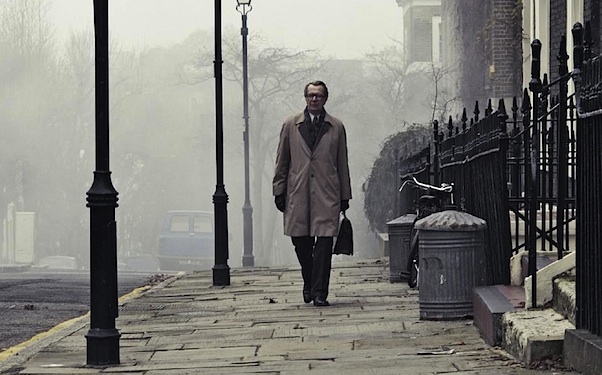
Smiley and Control, before they were sacked.

… just as soon as I finish typing this.

I’m pumped about it — and very appreciative to the folks at Nickelodeon for bringing it here in spite of Hollywood’s insulting decision not to send the film to South Carolina for standard commercial release.

I’m wondering whether I’ll like it. Gary Oldman is awesome, but how will he stack up against Alec Guinness, who so embodied the character that le Carre said he didn’t feel that he owned him any more?

Colin Firth as Bill Haydon is intriguing. But I really wonder about the decision to cast Toby Jones as Percy Alleline. When I saw Jones was cast, I assumed it was as Toby Esterhase — not because of the coincidence of given names, but because of physical similarity (“tiny Toby,” as he was called in the book). And I’m sorry, but Benedict Cumberbatch isn’t nearly tough enough, or old enough, for Peter Guillam.

I also think it strange that the filmmakers cast Stephen Graham in the minor part of Jerry Westerby. I think Graham is a fine character actor — I enjoyed him in “Band of Brothers” and “Snatch” — but Westerby is supposed to be an upper-class leading-man type. He’s the dashing sort who calls everybody “old boy.” More to the point, he is the title character of the next book in the series, The Honourable Schoolboy, and that tells me that the powers that be on this project are probably not thinking series. Which is disappointing.

Or will be, if the movie is as good as I hope it will be.

All right, I’m off!

Good thing for Romney Joan Jett’s not running

Doug and Steven, if you’re counting, this post is not really about Nikki Haley. It’s about women. It’s about me having trouble figuring them out. Or having trouble figuring out how the world reacts to them. Or something…

HuffPost calls our attention to the following:

South Carolina Gov. Nikki Haley (R), in an interview in Marie Claire published Wednesday, discussed what lessons she has learned.

She named her role models. “Mine are my mother, Margaret Thatcher, Hillary Clinton, Martina Navratilova, Gabby Giffords. And Joan Jett. I tell you, Joan Jett is my idol. I would just love to meet her!”

Joan Jett’s pretty cool, I guess. Although I have to confess that I continue to get her confused with Pat Benatar. (Hey, gimme a break. By that time, I was an adult with a wife and kids and very busy running a newsroom.) And I’m sure the phrase “my mother and Margaret Thatcher” would fall easily from many Tory lips.

But you know, I’ll never get this chick thing about admiring people just because they share one’s gender.

I mean, really — Hillary Clinton coming right after the Iron Lady. I can see that they have a lot in common, but then I’m not a Democrat or a Republican.

Think of it this way: If Romney or Santorum or any of the guys running for president were asked to name his role models, and he named six, and one of them was Bill Clinton and another was a Democratic member of Congress, don’t you think he’d get in trouble with his base?

But if a woman does that, we don’t bat an eye. Because the gender bond is just supposed to be so profound that such differences don’t matter. In a way, that’s really cool (I certainly admire people from across the political spectrum). And good for Gov. Haley for being broad-minded. But in another way, it’s… I don’t know… either we’re condescending to women by not expecting consistency (like the Jack Nicholson character saying that to create female characters, “I think of a man, and I take away reason and accountability“), or we’re being unfair to men. One or the other. Whatever it is, it ain’t equality.

Not being a feminist, I’ve got no objection, in principle, to double standards. Boys and girls are different, in important ways. But this is one difference that puzzles me.

Drat! The Professor was here, and I missed him!

That is to say, he was “here” if you define “here” as “in this country.” I learned that obliquely this morning, from this Tweet:

So very lovely to come back from the states and find nearly all of my twitter friends talking about the weather. #comforting #likeanicesoup.

What?!? He was on this side of the pond, and I missed him? Confound the luck. It’s enough to make a chap want to don his fighting trousers.

I wrote to the Professor to express my dismay in the strongest terms, and by way of consolation he replied,

@BradWarthen I’ll be in San francisco at the end of january if that’s any help old chap. #edwardianball

Well, that would be just as lovely as a cup of the brown stuff, if not for the fact that this country has grown a bit since we were colonies (the news may not have traveled back to the Old World as yet), and S.F. is hardly nearer than Brighton…

For those of you not among the cognoscenti, Professor Elemental (known to his particular friends as Paul Alborough), is the master of Chap-hop, a sort of cultural offshoot of the Steampunk sensibility.

He’s also one of my highly valued celebrity followers on Twitter, along with the inimitable Adam Baldwin. I feel honored by this, naturally, even though he does follow 27,389 others. (There are those who might call him indiscriminate, but if they do, I’m certain that the Professor will demand satisfaction. Perhaps he’ll ask me to be his second, if the other 27,389 are busy.)

But I still would very much like to see his act in person. So here’s hoping that next time he comes to the East Coast, he’s not booked by the same agents who chose where “Tinker, Tailor” would be screened…

Santorum tries to ‘look older’ — you know, like Jimmy Olsen, cub reporter

I was somewhat taken aback this morning when I read this:

We thought Rick Santorum’s sweater vests were just a regular old-fashion statement. Turns out, they’re so much more. Santorum explained to Laura Ingraham on Monday that he likes to wear the sleeveless numbers because they make him look “a little older.”

Said Ingraham, “When I think of sweaters I think of Jimmy Carter, I think of Lamar Alexander, so all I’m saying Rick, with how you and I are so aligned on social issues and world view, but I’ve got to take issue with you on the sweater vest.”

“Is it geek chic? What is it?” Ingraham pressed.

The 2012 candidate explained that saying yes to the vests has a lot to do with looking more like an elder statesman. Santorum, 53, pointed out that a man in Iowa guessed he was 32…

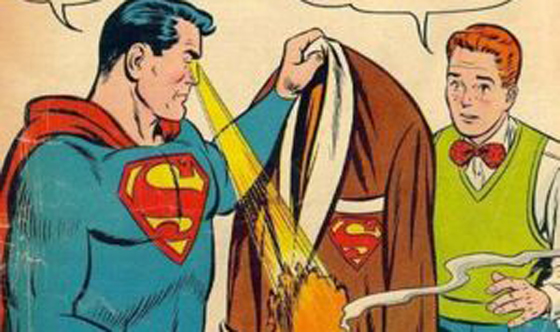
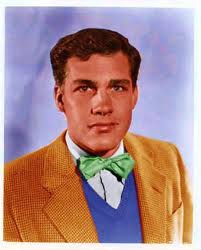
So he’s trying to look older? You mean, like Jimmy Olsen, cub reporter? Jimmy was often portrayed with a sweater vest back in DC’s Silver Age, and I see evidence, both here and here, that he hasn’t lost the look in his latter-day manifestations, either.

Nothing against sweater vests, mind you. Below, you can see the one I’m wearing today. Unfortunately, I’m not going the fully Jimmy today — no bow tie — on account of all my shirts being too tight in the collar all of a sudden. I think I was exposed to some kind of special Kryptonite over the holidays or something. More on that later, though…

Back to Santorum: Does it tell us something that someone who presumes to ask us to elect him president looks so much like a kid that the Jimmy Olsen look is a step up in gravitas? By the way, if you want to look avuncular, you need a long-sleeved cardigan, not a sweater vest. Do I have to explain everything to these people?

No, Allen didn’t get his ‘groove’ back with ‘Midnight.’ But wouldn’t it be pretty to think so?

The Guardian celebrated it this way: “Woody Allen gets his groove back with ‘Midnight in Paris‘ after years of decline.”

If only it were true. I mean, the part about getting it back. We have a consensus on the years of decline.

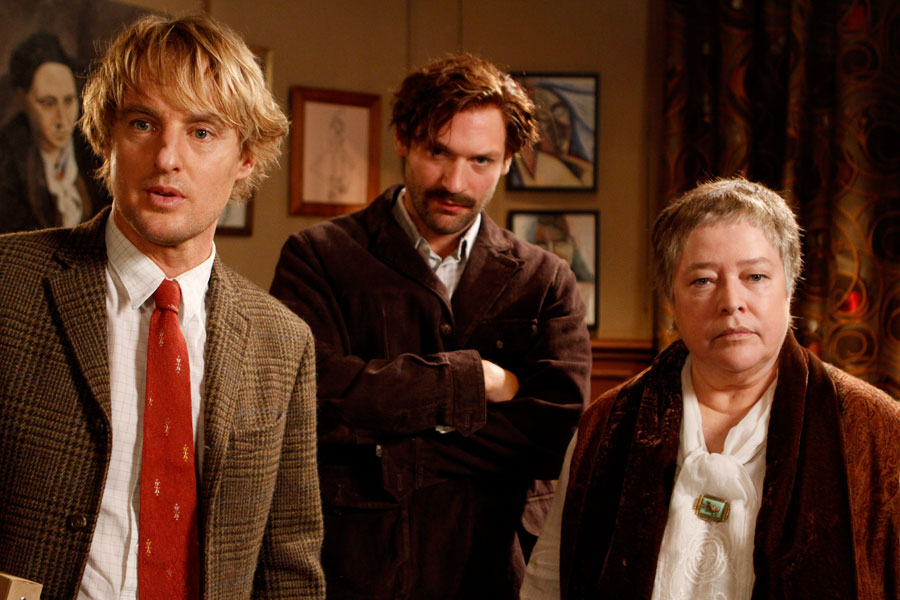
I spent the first moments of 2012 watching the latter part of the film, in which Owen Wilson speaks the Woody Allen lines. Which works pretty well. It brings a smile when this younger man speaks words that you know Allen himself would have spoken 40 years ago. There’s an echo there, and you do smile, because he really used to make you laugh. As Wilson has also done, more recently.

And then there’s the central conceit of the movie, which is that… wait… SPOILER ALERT!

… which is that after midnight, Wilson’s character — the Woody Allen character (let’s go ahead and call him “Gil” to avoid this confusion) — finds himself transported to the very best time to be in Paris.

And when was that? Well, for him it is the same time that it would be for me, the 1920s. The Lost Generation, when you couldn’t swing a bat on the Left Bank without maiming a genius in the art form of your choice. So he finds himself staggering across Montparnasse from party to party with Hemingway, the Fitzgeralds, Dali, Picasso, and the rest of the gang.

Gil is, by his own estimation, a hack writer for Hollywood who hopes to save himself with a novel he’s struggling with. Hemingway tells him to let Gertrude Stein read it. Ms. Stein, who in real life looked like this — by which I mean to say, looked like somebody no insecure writer would hand his heart to that way — is in the film a sort of amiable den mother who would LOVE to read his book and tell him encouraging things. Which she may have done for Hemingway, but for this nebbish? I don’t know.

Anyway, this premise is loaded with possibilities, and you want to see them explored. But they are not. Allen walks up to this great idea, and then shrugs, backs away and gives us a “so what?’ ending.

And it makes me sad. I mean, this is the guy who made “Manhattan.” It may or may not have been a masterpiece, but it was funny and poignant. And how about that ending: Mariel Hemingway says, “You have to have a little faith in people,”  and your heart gets sucked into such depths in a whirlpool formed by the currents of innocence, cynicism and desire. In that moment, you forgive Allen, if only momentarily, for being such a perv and corrupting young girls. In that moment, you recognize the complexity of being human.

And with this thing, what has happened? Nothing. Gil has blown off an engagement that every viewer has wanted to see him walk away from since the first 30 seconds of the film. No conflict there. Every moment spent with the grotesquely drawn caricatures of his “present” life is tedious, and obviously pointless.

There is no depth to anyone in this film, including the protagonist. Here I am thinking “this is really cool; we’re going to meet Hemingway and Fitzgerald and Picasso,” and they are played for not very good laughs, especially Hemingway. And none of the promises are realized. None of them.

So no, he doesn’t have his thing back. But I kept hoping he would; kept hoping it would be as good as it tried to be. But it wasn’t.

Phillip’s Top Ten arts events of 2011

Our own Phillip Bush has listed his top ten “arts happenings that brought joy in 2011.” He doesn’t claim it’s inclusive; it just covers the stuff he caught and enjoyed. Here it is:

10. USC Symphony with violinist Vadim Gluzman, Sept. 22: Gluzman’s rendition of the Brahms violin concerto was as masterful as any you could hope to hear at Carnegie Hall, Royal Festival Hall in London, or Disney Hall in LA. Even in the quietest passages, his Strad’s tone penetrated to the cheap seats in the notoriously mediocre acoustics of the Koger Center with astonishing presence. The “kids” of the orchestra under Donald Portnoy’s direction played this “symphony of a concerto” at a very high level, especially considering it was their first concert of the year. Bonus fun was had watching Gluzman join in on tuttis and practically wander halfway into the middle of the violin section, exhorting his fellow fiddlers.

9. Launch of “Jasper” Magazine, September: Cindi Boiter left “undefined” magazine to launch a new bimonthly arts periodical, “Jasper,” with a strong team of contributors. I sure hope it succeeds, as the first two issues look very promising, with perceptive writing, intriguing subject choices, and an appealing look to the eye. Ms. Boiter says the magazine is “committed to comprehensive arts coverage…across artistic genres” and I also hope that will be borne out in issues to come. Their strengths and interests do seem to lie primarily with visual art, dance, and theater, which is perfectly fine–those are all vibrant cauldrons of activity in the Midlands. I’m personally hoping that their music coverage will not limit itself to rock and the club scene but also include the very active “alt-classical” scene here (vividly described by the Free Times in this July cover story) and even…dare one hope?…the best of the more “straight-ahead” classical scene as well. After all, who’s really more radical than Beethoven when you get right down to it?

8. Triennial Revisited/Biennial at Gallery 701 CCA (Sept.-Dec.): The retrospective of the Triennial shows of SC artists dating back to the early 90’s and the relaunch of the concept in the form of a two-part Biennial show at 701 CCA was a very promising development for the visual arts in this state. The Triennial retrospective, being a kind of all-star selection of already “select” works from past Triennials, naturally was more uniformly impressive. But, whatever the limitations of this space,  the selection process, etc., (see piece by Jeffrey Day in “Jasper”s Nov.-Dec. issue) the two Biennial shows had some very arresting works, especially ceramics (Jim Connell of Rock Hill and Alice Ballard of Greenville), and the gesso-and-graphite black-and-white works of Chapin’s James Busby.

7. Opening of Conundrum Music Hall in West Columbia (June): Like my #6 which follows, there is a bit of fraudulence for me to cite this event, in that I still have not made it to a single Conundrum show. (I mentioned those babysitting costs, right?) But it’s not because I haven’t wanted to. The dreamchild of local arts entrepreneur Tom Law, the alternative West Columbia space has already welcomed a dizzying array of musics, from avant-jazz to experimental-classical to a string quartet from the SC Phil, and much, much more. It’s astonishing how busy the space has gotten already. Law’s eclectic tastes and interests promise a continually intriguing menu of presentations into the indefinite future. Conundrum is a tangible manifestation of the transformation of Columbia’s music scene in the past decade.

6. Columbia Museum of Art opens “Masterpieces of the Hudson River School” Nov. 19:OK, this is also kind of cheating to put this on my list, since I haven’t technically “seen it, ” i.e., spent time with it (plus it’s barely been up a few weeks and will be around till April, so it probably should–and likely will–be on the Top 10 list for 2012). But I had a meeting with museum staff on an unrelated matter earlier this month in the actual galleries containing this show, and thus kind of breezed through with a cursory glance at these works, and a lingering look at just a very few. Well, to quote from a famous “Seinfeld” episode: they’re real (masterpieces, that is), and they’re spectacular.

5. Calder Quartet, Southern Exposure Series, Nov. 17: This LA-based quartet, as comfortable with thorny modernist scores as with backing The Airborne Toxic Event on David Letterman, riveted the audience at the USC School of Music’s recital hall with a superb performance. It was a special thrill to be able to hear one of the first performances of British wunderkind (you can still say that about him, can’t you?) Thomas Ades’ “The Four Quarters,” which had all of Ades’ trademark sonic imagination but with a greater mastery of understatement. But the highlight was the Calder’s unrelenting performance of Henryk Gorecki‘s obsessive Second String Quartet. That the hall had not a few empty seats for this (free, for goodness’ sake) show was criminal: bad luck/timing or something more worrisome?

4. Edward Arron & Friends “Wadsworth” Series Concert at Columbia Museum of Art, May 3: The world-class chamber music series at the Museum formerly curated by Charles Wadsworth is alive and well under cellist Arron’s leadership, and is in fact generally more programmatically intriguing since he took the reins. The players and playing is almost always at a level one would hear at Lincoln Center or any major-city chamber venue, but last May’s concert stood out, a world-class Dream Team of American string artistry, Naumburg-prize-winners sprinkled among them: Yehonatan Berick and Carmit Zori, violins; Hsin-Yun Huang and Nicholas Cords, violas, along with Arron. If you were not reduced to tears by their committed, passionate readings of Mozart and Dvorak string quintets, you surely must be one of those Easter Island stone statues. Or a Republican presidential candidate. Or both.

3. South Carolina Philharmonic with Jennifer Frautschi, violin (September 15): What a week that was for world-class violin soloists in town(see #10)! Morihiko Nakahara certainly “gets it” about the role a conductor has to play in a community like this if an orchestra’s going to survive, much less thrive; but lest ye think he’s merely about the marketing and being the genial “be-everywhere” public face of the SCP, this concert was a reminder of the ways in which he has musically transformed this band. Frautschi’s scintillating Korngold concerto with the orchestra’s lush and agile accompaniment was a delight in itself: but it was the committed and heartfelt Tchaikovsky “Pathetique” Symphony that could not help but win over any listener. Sure the strings are undermanned, but MN wrung every ounce of passion and sound from them. And the winds, so pivotal in this work, are a great strength of this orchestra. Heck, the very opening of the Tchaikovsky was a bracing reminder that, oh yeah: quite possibly the greatest American bassoonist around today happens to live in our town. And more good news, thanks to ETV (see #1 below), you can hear this concert right now if you’re so inclined.

2. JACK Quartet on Southern Exposure Series, USC (April 15): If I think about it, I’d probably have to say that every year since I moved here in 2004 Southern Exposure would have presented the “concert of the year” in my estimation. 2011 is no exception. It says a lot about the band, the piece, and the audience that a concert series has built over time, when a performance of Xenakis’ “Tetras” brings a packed house to its feet in Columbia, South Carolina. That’s exactly what happened last April, for a string quartet in which it’s rare at any moment for any player to be playing their instrument in anything approaching the “conventional” method. But the logic, rigor, and emotional arc of this masterpiece is undeniable, especially in the hands of such masterful advocates as the JACK Quartet. Their star is continually rising: I can hear the refrain now, years from now,  “Did you know they once did a concert here in Columbia? Blew the roof off the joint.” JACK Qtet has released a DVD of the Xenakis quartets; you can get a taste of what you missed here on YouTube.

1. SC Legislature Smacks Down Gov. Haley’s attack on Arts Commission, ETV (June): The legislature’s rebuff of the Governor’s cynical and shortsighted attacks on these small but vital South Carolina institutions (by resounding margins) was easily the best news of the year for the arts for a couple of reasons. Of course, the veto overrides preserved (for the moment) funding for the good and often overlooked work that the Arts Commission, for example, undertakes in underserved corners of the state. But above and beyond that immediate effect, the debate over this issue mobilized arts supporters around the state to positive action, a stance of fierce advocacy; it also crystallized for many the real value of the arts to both the quality of life and actual economic well-being of the state. Also, and not unimportantly, at a time when the Palmetto State has become a laughing-stock for much of the country (see Daily Show’s “Thank You, South Carolina” feature), this moment was one where South Carolinians could stand proudly, in contrast to the sad situation in Kansas, for example.

You went the wrong way, King Obama

Whaddya gonna do with this Romney guy, huh? Dig the latest:

Reporting from West Des Moines, Iowa –—

Speaking to supporters at a chilly outdoor rally, Mitt Romney on Friday sought to cast President Obama as out of touch with the economic pain being felt by average Americans.

“He’s in Hawaii right now. We’re in the cold, in the rain, in the wind because we care about America,” Romney said, speaking in the parking lot of a grocery store. “He just finished his 90th round of golf. We have 25 million Americans who are out of work, stopped looking for work or are underemployed. Home values have come down. The median income in America in the last four years has dropped by 10%.”

He dismissed the Obama administration’s contention that they stopped the recession from getting worse.

“The other day President Obama said, you know, it could be worse,” Romney said. “Sounds like Marie Antoinette, ‘Let them eat cake.’ ”…

This from the guy who, when challenged, immediately offers to bet $10,000.

One thing Mitt’s got is nerve.

But I want to thank him for reminding me of the old Allan Sherman song above. Enjoy.

Unless you’re a kid, you remember Allan Sherman. He’s the “Hello Muddah, Hello Faddah” guy.