Category Archives: The Nation

France getting disgusted with us burger-eating surrender monkeys

A piece in the WSJ this morning by John Vinocur discussing the strange new paradigm whereby the French are tough on bad guys, and disgusted with Americans for wimping out:

In an interview with the Associated Press on Oct. 4, Barack Obama depicted Iran as a country living with sanctions “put in place because Iran had not been following international guidelines, and had behaved in ways that made a lot of people feel they were pursuing a nuclear weapon.”

For French Foreign Minister Laurent Fabius, that was a pastels-and-wispy-brushstrokes rendering of reality. Two days later, in an interview with Europe 1 radio, Mr. Fabius drew a darker, edgier picture. “As we speak,” he said, Iran keeps the centrifuges turning that are needed to make enriched uranium for nuclear bombs. But Iran is also pursuing a second, separate track toward atomic weapons with the construction, at Arak, of a heavy-water reactor producing plutonium.

That project might take “around a year” to complete. And “if it is completed, you won’t be able to destroy it,” Mr. Fabius said, “because if you bomb plutonium, it will leak.” At that point, he said, for “the Americans, the Israelis and others,” there would no longer be adequate sanctions to stop Tehran.

He gave no hint of who those “others” might be. But here was the French foreign minister talking about a possible military engagement against Iran in a more forceful manner than anything summoned so far by the U.S. president. Mr. Fabius was not advocating a strike, volunteering eventual French participation, or indulging in simple Obama-bashing. But he was expressing a kind of French contempt for the U.S. administration’s evasive vocabulary about the Iran endgame…

The French, fresh from having led the way in Libya and having very neatly clapped a stopper on al Qaeda’s doings in Mali, have little patience with American waffling, according to Mr. Vinocur. Some factors that feed into that are the president’s sudden backing away in Syria, and a broken promise by then-SecDef Leon Panetta last year, who promised to give France any help it needed in Mali, only to be overruled by the White House.

American actions or inactions aside, I find it fascinating to see how aggressive France has become on the world stage the last couple of years….

No, Mr. Sanford, it’s YOU who chose to do this to us

I’m sure you’ve all seen coverage of our fellow South Carolinian Chris Cox, who took it upon himself to do yardwork at the Lincoln Memorial.

God bless him for his gesture, especially since he seems to have done so out of a generosity of heart, rather than as implied criticism of anyone:

He said he does not have a political position on the shutdown. “I’m not here to point fingers,” he said. “I only want to inspire people to come out and make a difference.”

“The building behind me serves as a moral compass, not only for our country but for the world.”

“And over my dead body are we going to find trash pouring out of these trash cans,” he said. “At the end of the day we are the stewards of these buildings that are memorials.”

“I want to encourage my friends and fellow Americans to go to their parks, and show up with a trash bag and a rake,” he said. “Show up with a good attitude and firm handshake for the U.S. Park Service.”…

With an attitude like that, I can even forgive him for seeming to be a super-visible example of a certain sort of neighbor. You know, the guy who gets up eagerly on Saturday morning and spends the whole day ostentatiously laboring over his lawn, and acting like he likes it, in an obvious attempt to make other husbands in the neighborhood look bad for wanting to take a nap like a sane person.

I don’t think Chris Cox is like that at all, and I appreciate him.

What I don’t appreciate is what Mark Sanford said in praising him:

“I’m impressed, Chris embodies what it means to be not just a South Carolinian, but an American,” added Sanford. “He saw a job that wasn’t getting done and decided to take care of it. We are not a nanny state, and when government in this case chooses not to do something it’s in keeping with the American tradition to ask, “What can I do to fix the problem?” Chris’s example is one we could all learn from in Washington, and accordingly, I applaud him.”

Let’s review the pertinent part of that. Going right by the nonsensical bleating about a “nanny state,” let’s focus on “when government in this case chooses not to do something.”

Let’s run that again, because it completely blows my mind: “when government in this case chooses not to do something.”

No, Mr. Sanford. Only in the sense that you are the government (because you insisted on running for Congress again) did government “choose not to do something.”

It was you, and your colleagues in the Congress. This is true, obvious, beyond question. Aside from the fact that, contrary to your beliefs, the government is not some alien entity “out there” separate from the people, “in this case,” the guilty parties are unquestionably you and your cohorts.

I’m flabbergasted. It’s just beyond belief that he said that…

Why do political flacks risk the hazards of Twitter? Because they HAVE to

pfeiffer

Talk about your nightmares.

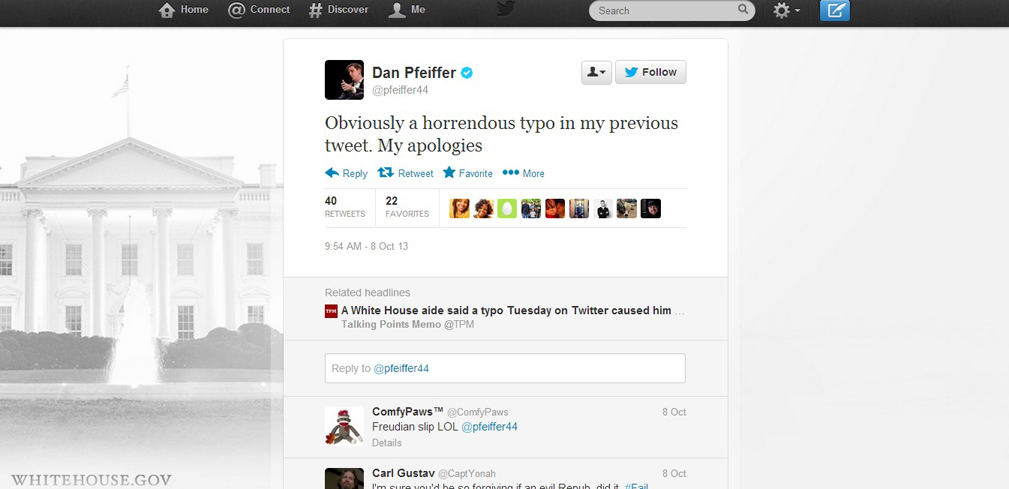
White House senior adviser Dan Pfeiffer made an observation Tuesday on Twitter about how the changing media world was adding to political polarization in the country. Then he tried to add, to @jmartNYT, “also a much bigger factor on the right.”

Only his finger slipped, and he typed an N rather than a B on “bigger.” (Look at your keyboard; they’re right next to each other.) This was on an official White House Twitter account, mind you.

The Tweet was deleted, and he apologized. And the world moved on.

But then, some “veteran politicos” on the Hill started wondering why a senior adviser to the President was fooling around with anything as dangerous as Twitter anyway?

POLITICO explained, as would we, that he has little choice:

For years now, Twitter has served as the public square for political journalists, the place where the conventional wisdom is shaped before it turns into “the narrative.” Communications aides have always monitored that conversation closely, and some have long had an active Twitter presence. But many — top White House spokespeople, especially — often felt safer limiting their own remarks to carefully edited statements shared via press release. As a public forum, Twitter was too informal, too risky, too off-the-cuff.

Increasingly, however, flacks have come to see Twitter as a necessary tool in their communications arsenal. Instead of waiting to respond to reporters’ inquiries, Twitter enables them to influence reporters’ thinking and nip negative coverage in the bud.

“Twitter, like cable news, is another medium where the conversation in Washington gets shaped,” Jay Carney, the White House press secretary, told POLITICO. “Given the current media environment, we engage in real time so that as many folks as possible understand our perspective. Twitter is simply another resource to get our message out, and we generally like to avail ourselves of every opportunity to do just that.”

Brendan Buck, the press secretary for House Speaker John Boehner, said Twitter was “what the Speaker’s Lobby used to be. You want to find and talk to assembled reporters, open your Tweetdeck.”

Absolutely.

I am reminded of Trav Robertson who dealt with media for the Vincent Sheheen gubernatorial campaign in 2010. I ran into him (at Starbucks, of course) some months after Sheheen narrowly lost that contest, and he confided that there was one thing that he had been unprepared for: the fact that the old “news cycle” was gone, and that he had to pump out information, and counter stuff that was out there, 24/7.

I was surprised that he was surprised, and wondered if that played any role in Sheheen’s defeat. Probably not, but it was a close race, for a Democrat in South Carolina…

Profile in Courage, 2013 edition: Boehner promises to do the right thing to avoid default

First, I want to applaud Speaker John Boehner for promising to do the right thing, at least with regard to a default that could devastate the world economy:

With a deadline for raising the debt limit fast-approaching, House Speaker John A. Boehner (R-Ohio) has been telling colleagues in recent days that he will do whatever necessary to avoid defaulting on the federal debt, including relying on House Democrats to help pass an extension, according to GOP aides familiar with the conversations…

But after I’m done applauding the speaker for his courage, let’s have a moment of silence to mourn how low the “courage” bar is these days.

What that says is that the speaker of the House promises he will work with all of his willing colleagues, regardless of party, for the sake of the nation — to make sure that a terrible, needless thing does not happen to the country and the world.

That should be business as usual. Once upon a time, it would have been (in support of that statement, I submit the fact that the United States has never before defaulted in its 237-year history).

But today — and this just makes me sick — it’s extraordinary. In the U.S. House Republican caucus, it is seen as political suicide to work with Democrats, even on something of critical importance to the country.

So yay, Mr. Speaker. And here’s hoping and praying that we’ll live to see the day when this sort of behavior is once again sufficiently common that we have no reason to take note of it…

NYT: In SC, Obamacare fails to help the poorest, thanks to Haley, Legislature

Meant to share this sad piece from The New York Times earlier in the week:

A sweeping national effort to extend health coverage to millions of Americans will leave out two-thirds of the poor blacks and single mothers and more than half of the low-wage workers who do not have insurance, the very kinds of people that the program was intended to help, according to an analysis of census data by The New York Times.

Because they live in states largely controlled by Republicans that have declined to participate in a vast expansion of Medicaid, the medical insurance program for the poor, they are among the eight million Americans who are impoverished, uninsured and ineligible for help. The federal government will pay for the expansion through 2016 and no less than 90 percent of costs in later years.

Those excluded will be stranded without insurance, stuck between people with slightly higher incomes who will qualify for federal subsidies on the new health exchanges that went live this week, and those who are poor enough to qualify for Medicaid in its current form, which has income ceilings as low as $11 a day in some states….

Yep, they’re talking about us, as one of the states who have refused Medicaid expansion.

Doug will point out we’re one of the slight majority of states (26) that have insanely refused to participate.

But even if we were one of 49 states, we’d still be profoundly wrong.

The rest of the world thinks we’re nuts. Who can blame them?

I read a really good piece by Martin Wolf in The Financial Times today. Excerpts:

Is the US a functioning democracy? This week legislators decided to shut down a swath of the federal government rather than allow an enacted health law go into operation at the agreed moment. They may go further; if they do not vote to raise the so-called “debt ceiling”, they risk triggering default on US government debt – a fate far worse than the shutdown or fiscal sequestration. If the opposition is prepared to inflict such damage on their own country, the restraint that makes democracy work has gone. Why has this happened? What might be the result? What should the president do?

The first question is the most perplexing. The Republicans are doing all of this in order to impede a modest improvement in the worst healthcare system of any high-income country….

 High quality global journalism requires investment. Please share this article with others using the link below, do not cut & paste the article. See our Ts&Cs and Copyright Policy for more detail. Email ftsales.support@ft.com to buy additional rights. http://www.ft.com/cms/s/0/bca4c114-29d8-11e3-bbb8-00144feab7de.html#ixzz2gb1dcT5f

So what should the administration do? In a democracy, people overturn laws by winning elections, not by threatening the closure of government or even an outright default. It is impossible to run the government of a serious country under blackmail threats of this kind. Every time the administration gives in, it stores up more difficulty for itself. It has to stop doing so. Some argue that the 14th amendment of the constitution, which states that “the validity of the public debt of the United States, authorized by law … shall not be questioned”, gives the president the power he needs to borrow, in order to redeem debt. But such a presidential action would be risky. The Supreme Court might side with the president, but a constitutional crisis could itself impair US ability to borrow on favourable terms. Again, the clever proposal to mint a trillion-dollar coin and use that as security at the Federal Reserve might also cause mayhem.

Playing chicken with credibly reckless people is always scary. But the administration cannot give in. I remain, like Winston Churchill, optimistic: the US will do the right thing in the end, though not before first exhausting all the alternatives.

Sometimes. people looking at us from across the ocean see us most clearly. I think what they find hardest to believe is that part about how the nihilists in the House “are doing all of this in order to impede a modest improvement in the worst healthcare system of any high-income country.” It is pretty mind-boggling. Especially when this modest improvement is based on a Republican approach.

That’s far from the only good piece I’ve seen in the last few days that look at this situation from an international perspective.

I particularly liked E.J. Dionne’s column about how Germany — which we taught how to do democracy after WWII — has a lot to teach us now about how to have a functioning republic:

Are Germans now more American than we are?

As we stare at the prospect of a government shutdown driven by tea party radicalism and ludicrously irresponsible hostage-taking politics, we’d do well to study how postwar Germany — yes, encouraged by the United States — has embraced the sort of consensual, problem-solving politics for which we were once famous….

But let’s focus for now on public policy inside Germany, which has proved that capitalism with strong social protections works. The Christian Democrats call it “the social market,” a system that has been enhanced and reformed over the years by both Merkel’s party and the center-left Social Democrats.

This moderate form of progressive, bring-people-together politics was what the United States and its allies had in mind for Germany when they worked with German leaders, especially Christian Democrat Konrad Adenauer, to create a post-Nazi state. The goal was to avoid the extremism and polarization that destroyed the pre-World War II Weimar Republic and led to Hitler’s seizure of power….

He goes on to discuss how, on both the right and the left, the center of gravity in German politics is moving more and more toward the centrist parties. Now there’s a consummation devoutly to be wished, as the American sickness of gerrymandering drives us further and further apart toward the poles.

Of course, I love the piece because it’s very UnPartyish.

Then there was this piece, also in the WashPost:

As the U.S. government creaked toward a shutdown on Monday, the world looked on with a little anxiety and a lot of dismay, and some people had trouble suppressing smirks.

“To be honest, people are making a lot of jokes,” said Justice Malala, a political commentator in South Africa.

Over the years, Malala said, South Africa often has been lectured about good governance by the United States as well as the International Monetary Fund and the World Bank, which are heavily influenced by Washington.

“They tell us, ‘You guys are not being fiscally responsible,’ ” Malala said. “And now we see that they are running their country a little like a banana republic. So there is a lot of sniggering going on.”…

Of course, they’ll be doing something other than laughing if this country goes into default.

It’s just a tragedy of immense proportions, what is happening to this country.

There’s no question: GOP will be to blame for shutdown

This morning on the radio, I heard reports that some Republicans in Congress are hoping they can shift blame for the likely government shutdown to the president and Senate Democrats.

Wow. Talk about your fantasies.

As you know, I love to blame both parties for everything (which drives Bud crazy).

But in this case, there is simply no question: The Republicans made this happen all by themselves. Some of the older, wiser heads in the party know this — they remember the Gingrich shutdown — and have a bad, bad feeling about now.

But the young innocents of the Tea Party charge blithely on — partly because on a certain level they really don’t care whether the government shuts down (their extreme ideology makes them feel, deep down, that that’s a consummation devoutly to be wished), but also because, in case it does turn out to be something less than a lark, it will be blamed on Democrats.

But no one whose thinking is not distorted by ideology can miss what has happened here.

First, there is the Tea partisans’ insistence on making every single raising of the debt limit some kind of showdown at the OK Corral, which meant we were doing to have a crisis this month anyway.

Then, there is this bizarre fixation on not funding a perfectly legitimate law that has stood up to every legitimate thing they could throw at it. It survived legal challenges. When they tried to run against it in an election, they lost. They have demonstrated 42 times that it is not in their power to repeal it. So now they want to defund it, or delay it — which would be patently illegitimate on its own — and have brought about an imminent shutdown of the whole government in their bid to stop the law from taking effect.

On the issue of Obamacare, they are an utterly defeated army that has turned guerrilla and has nothing left to fall back on but acts of sabotage.

What they have done is so obvious, and so obviously outrageously irresponsible, that there’s little chance that anyone outside of the more fervent parts of their base could dream of blaming anyone but them.

I just figured I might as well go ahead and say that, before the shutdown occurs…

Obamacare, the Constitution and the Bible: A Facebook conversation

Just thought I’d post portions of a conversation I jumped into over on Facebook.

First, Bill Connor posted:

In watching the fight to defund Obamacare, I have this to say. I am a Christian first, as I believe the Bible is the inspired word. Therefore, it is Truth. That said, the Bible is not silent about the role of government and it’s sphere of authority. Romans 13 and 1 Peter 2 give the mandate for governmental authority. That mandate is for the “sword” of protection. Protection from external enemies, and protection from lawlessness (law enforcement, Courts) from within the nation. The government is about force in protection. The Church is given the mandate to care for those in need. The Church does not possess the power of the sword, as “Charity” means love. God wants men to give freely and without coercion when it comes to taking care of the less fortunate in society. When Government exceeds its sphere and gets involved with church functions (as in Obamacare, among other things like welfare, etc.) it destroys the idea of Charity. Forcing someone with the sword to give to another is not a Christian ideal. Our founders believed in the Biblical spheres of authority for Church and State and the Constitution makes this law. The Constitution enumerates powers to Government, and those powers do not include Church type functions. Government is to be restrained by the Constitution to the “Sword” functions. Otherwise, Government essentially takes over the Church and all else and attempts to become “god”. That is a reason while I believe the Biblical position to to oppose Obamacare. We care about those in need. However, we are to give to those truly in need through Charity (Love). We did not give the government the power

After a bunch of other people had had a say, I posted:

Bill, in a representative democracy, we vote to elect people to decide what government does. When enough people are elected to decide to undertake something like universal health care, then that’s what we do. If enough people are elected who don’t want to do that, we don’t do that. That’s how the system is supposed to work. It’s really a stretch to make like the government is something outside ourselves coercing us to do something. We, the people, acting through our elected representatives, have decided to do this with the money that we will all pay into it. Does that mean all Americans wanted to do this? No. There probably hasn’t ever been a single action by the government of the United States that all Americans favored. We’re all in the minority on something. But what we do is accept that fact, and work to have our preferred candidates win the next election. In the meantime, we accept the lawful actions of those who have already been elected. We certainly don’t declare lawful actions illegitimate. Nor do we claim, with very thin evidence, that it’s contrary to the Bible. On that last point, I’m not seeing anywhere in the Bible where it says we can’t pool our resources as a people and provide health care for all, and I’d be shocked to find it. Near as I can tell, in terms of saying what the civil government should do, the Bible is pretty silent on something like Obamacare. That leaves the decision up to us and our elected representatives.

Then Bill responded:

Brad, first I appreciate you posting thoughtful note, even though I disagree. Daniel spelled out my opinion exactly. The reason we have the Constitution is to protect certain rights from the whim of the majority. In this case, we had a very quick period of time in which Democrats controlled the House and POTUS. The founders intended to restrain gov’t to its legitimate functions (drawn from the Biblical worldview) and Obamacare exceeds those Constitutional and Biblical limitations.

The another reader (Ltc Robert Clarke) responded:

Brad is right in that the law was passed following our system….but since not a single person in the opposition party supported it, it is bound to face stiff resistance. The people house holds the pursestrings and they should be able to cut the $ off? If you are going to do something this big, best to do it as a bipartisan effort.

And finally, I said this:

Yes, that is best. But when is the last chance we had in this country to do that? Both parties operate on the strategy of getting 50 percent plus one, and then doing whatever they like — which sets off the other party in paroxysms of desperation, because both parties look upon the other, and all its works, as completely lacking in legitimacy. Both parties need to chill, and accept the fact that sometimes people they disagree with are going to win an argument, and just try to win themselves next time around. It’s really getting overexcited to see Obamacare as some sort of Gotterdammerung, the end of all that is good and holy and American and Constitutional. It’s just not. It’s a fairly ugly, pieced-together mish-mash that IS so ugly because there is such opposition to taking the simple approach that Britain and Canada have taken. This is the kind of mess that our hyper-polarized politics produce. It may be too much of a cobbled-together mess to work. But we’ll find out when it’s implemented. It’s going to work, or it’s not going to work. Or it will work in some ways, but not in others. But we won’t know until it’s been in place for awhile.

I didn’t want to get into arguing about whether our Founders intended the Constitution to be “Biblical.” I preferred to stick to this not being the end of the world, or even of the country.

Catering to America’s affinity for ‘soft’ news

revolution

I ran across a recent blog post that looked back at one from 2011 on The Daily Kos.

Showing several examples of recent TIME covers, Kos highlighted the dramatic difference between the American covers, and the corresponding ones from the same weeks in the European, Asian and South Pacific editions. Several weeks of examples were given. See the whole slide show.

There’s nothing subtle going on here. To the extent that these weeks are a guide, we see that TIME has decided people in the rest of the world are more serious-minded than Americans. Foreigners get hard news. Americans’ penchant for “me” news, soft stuff, lifestyle features, is catered to without a shred of hesitation or shame.

It would be easy to blame TIME. But I think TIME knows what Americans want. If they didn’t have the research to back it up, they wouldn’t do anything this blatant. Would they?

mom

Consensus starts to emerge: House GOP is loony

aria130923_cmyk.9xcutqq306eko44woo8cgw0cc.6uwurhykn3a1q8w88k040cs08.th

Even Paul Krugman — who is such a bitter, contemptuous partisan that I avoided running his columns at the newspaper — thought maybe he was going overboard a bit by calling the GOP’s maneuvers on funding Obamacare and the rest of government “crazy:”

In recent months, the G.O.P. seems to have transitioned from being the stupid party to being the crazy party.

I know, I’m being shrill. But as it grows increasingly hard to see how, in the face of Republican hysteria over health reform, we can avoid a government shutdown — and maybe the even more frightening prospect of a debt default — the time for euphemism is past…

But aside from the typically Krugmanesque assertion that the GOP was stupid before it was crazy (everyone who disagrees with Krugman is stupid — just ask him; he’ll tell you), the economist really wasn’t going out on much of a limb in this instance.

He was simply stating something that seems to be emerging as a consensus across the political spectrum. Among people who have clue, that is.

While his language is milder, Gerald Seib, writing in that wild-eyed liberal publication The Wall Street Journal, is similarly dismissive of the sanity of GOP House members’ actions:

The list of conservatives who didn’t want the House to do what it did late last week—that is, pass a bill trying to defund Obamacare, at the risk of shutting down the government—is long and distinguished: Karl Rove, Rep. Pete King, Sen. John McCain, the editorial page of this newspaper, even the House’s own Republican leadership.

But House Republicans went ahead anyway, passing a bill tying the financing of government operations starting Oct. 1 with the removal of money for implementing the new health law. The bill won’t pass the Senate, and it won’t be signed by the president, but it may lead to a partial closure of the government that many believe would be politically disastrous for the Republican Party.

Which raises again the question that animates much of the conversation in the capital: Why do House Republicans do the things they do?..

He goes on to answer himself with a primer on what most of us already understand about House Republicans. Basically, that these people’s experience of government doesn’t precede the existence of the Tea Party, and that they are elected from districts that are so safe for a Republican that a GOP member need only fear a primary challenge. Stuff, as I said, we knew already. Although he reminded me of a fact I had forgotten if I knew it: That these districts are SO grossly gerrymandered that Republican candidates in the aggregate “lost the popular vote for the House in 2012 by more than a million votes nationally, yet kept control of the House by 33 seats.” (Although I see this writer disagrees that redistricting was the culprit.)

Then there is Judd Gregg, a Republican and former senator from New Hampshire, who writes for The Hill:

Most Americans these days are simply ignoring Republicans. And they should.

The self-promotional babble of a few has become the mainstream of Republican political thought. It has marginalized the influence of the party to an appalling degree.

An approach to the debt ceiling that says one will not vote for its extension unless ObamaCare is defunded is the political equivalent of playing Russian roulette with all the chambers of the gun loaded. It is the ultimate no-win strategy….

… which almost makes Krugman sound temperate. Gregg continues:

You cannot in politics take a hostage you cannot shoot. That is what the debt ceiling is. At some point, the debt ceiling will have to be increased not because it is a good idea but because it is the only idea.

Defaulting on the nation’s obligations, which is the alternative to not increasing the debt ceiling, is not an option either substantively or politically…

He goes on to write about the destruction that defaulting on our debt would wreak on the world’s economy — something about which the babbling infants in the House (half of the GOP members have been there less than three years) and their fellow loony in the Senate, Ted Cruz, care not at all.

The people who elected them, and who will vote for someone crazier in a GOP primary if these individuals don’t act with gross irresponsibility, don’t know or care what sort of harm their actions could bring about, so they don’t know or care, either. This is apparently regarded, by at least one writer at RedState, as a good thing.

Here’s how James Taranto, whose standard tone in his Best of the Web Today column at the WSJ is every bit as dismissive of the left as Krugman is of the right, characterizes Ted Cruz’s effort to support the House GOP effort to defund Obamacare. After noting the commonsense fact that there is “no realistic prospect of enacting the House resolution,” he writes:

Instead of playing possum, a group of Senate Republicans led by Texas freshman Ted Cruz propose to play Otter: “I think we have to go all out. I think that this situation absolutely requires a really futile and stupid gesture be done on somebody’s part!“…

Taranto then casts Sarah Palin in the role of Bluto, given her op-ed at Breitbart.com in which she essentially said, “We’re just the guys to do it.”

OK, so from the left and the right, we’re seeing such modifiers as “crazy,” “futile,” stupid,” and “appalling.”

To all of those qualities, let us add disingenuousness. Here is the entire text of a release that Joe Wilson, my congressman, sent out on Friday:

Wilson: Senate and President Must Act


(Washington, DC) – Congressman Joe Wilson (SC-02) released the following statement after the House passed the Continuing Resolution which funds the government through December 15, 2013.

“Today, House Republicans have acted responsibly by passing a solution to keep the government’s doors open.  Because of our efforts, American families are protected from the unworkable, unaffordable healthcare law and hardworking taxpayers can rest assured that our nation will stop spending beyond its means.


“It’s time for the Senate and the President to act.   Time is ticking. We have ten short days until the federal government’s funding will expire. Senate Democrats should follow our lead and join us in protecting the American people, rather than placing politics over policy and threatening a government shutdown,” Congressman Joe Wilson said.

Note that only a passing reference is made to the actual point of the resolution for House Republicans: “…American families are protected from the unworkable, unaffordable healthcare law…” What an odd choice of words: “protected from.” He avoids saying what the measure does, which is deny funding to a program that is set in place by law — a law which he and his allies have demonstrated, an amazing number of times, that they are utterly incapable of repealing.

Then there is the really, truly cheesy dodge of making like it’s all on the president and the Senate whether the government is funded or not. Who are the children that Joe and the other Republicans who voted for this think will be fooled by that? Who will think, if the government shuts down, that anything other than the GOP obsession with Obamacare is to blame?

These guys are far gone. And everyone, on left and right, except them, seems to know it.

Boy, I sure can pick cities to live in, can’t I?

Kathryn brought this to my attention. It’s a list, from the Asthma and Allergy Foundation of America, of the top 100 cities that are “the most challenging places to live with allergies this fall in the United States.”

As she noted, “We are up there, but better than Charleston or Augusta!” Columbia came in 33rd on the list; Charleston was 26th, and Augusta was 27th.

But then I looked at the list, and discovered something more startling — I have lived in three of the top 11 cities, including No. 1 Wichita. (The other two were No. 5 Memphis and No. 11 New Orleans.) I also lived in Charleston as a kid.

Lower down on the list, I’ve lived in Philadelphia, No. 42; and Washington, No. 83. OK, technically I lived in Woodbury, N.J., and Kensington, Md., but each was close.

So, given that I’m a hyperallergic kind of guy, I can really pick ’em, can’t I?

At least I made a relatively smart move coming here from Wichita…


How many people in the country do you suppose really, truly know whether Janet Yellen is best qualified?

Certainly not I. But you see, I strongly doubt that most of the people really stirred up about her candidacy for the Fed do, either.

This is stimulated by a couple of things. One of which is the withdrawal of Larry Summers — the candidate the president wanted — from consideration for Ben Bernanke’s job, for “reasons” that seem kinda sketchy.

Then, there was this email this morning:

Hi Brad,

Now that Larry Summers — the President’s Rock of Gibraltar — has withdrawn himself from consideration for the top Fed job, he should — in for a penny, in for a pound — do everything he can to make sure that Janet Yellen gets the job. Summers should privately tell the President that Yellen is the best choice (because she is), he should aggressively lobby Senators from both parties to support Yellen (because they still listen to him, even though they don’t want to), and he should publicly endorse her for the job.

Just think: if the President nominates Janet Yellen to the Fed, Republican Senators will have no choice but to vote to confirm her or to face the wrath of American women at the voting booth. And even the GOP isn’t that stupid. I mean seriously, hell hath no fury like women scorned by a bunch of old white male Republican Senators stopping the confirmation of the first female Fed Chair in American history.

So if Larry comes out and supports the best person for the job…a historic President gets to make a historic appointment…the country gets the most qualified person to run monetary policy…Republicans suffer apoplectic seizures while being forced to do the right thing or cost themselves the women’s vote for the next 20 years…and Larry Summers gets to redeem himself with 51% of the population (even those oh-so-hard-to-please Harvard feminists).

Everybody wins.

Come on Larry, be a real man, support Janet.

-Erica

No, I don’t know who this Erica is when she’s at home, either. Even after finding this page. Near as I can tell, she’s some sort of professional “progressive.”

Nor, as I say, do I know anything about this Janet Yellen, although at a glance her resume seems a good fit. But so did Summers’.

And following the link my new BF Erica sent me, I see that the reasons given for Democrats not liking Summers were pretty weak. I find myself focusing on this:

Some Democrats are not keen on Summers as a candidate for the job, arguing that he was too supportive of deregulation during the Clinton administration. Nineteen Democratic senators – joined by an independent – signed a letter last week urging the president to instead consider Fed Vice Chairman Janet Yellen. Other candidates may in the mix as well.

“He is really a non-starter for us,” one senior Democratic staffer said of Summers.

Really? I have to say that any Democrat who would not want to return to the policies of the Clinton era — a time of balancing budgets, a booming economy and triangulating the Republicans silly — is a few bricks shy of a load. I’ll never quite understand what motivates these Democrats who think the people they manage to get elected aren’t lefty enough. Something they’re all smoking, I suspect.

Of course, we have reason to suspect it’s not really about that. That isn’t the emotional center for these rather gut-led people, is it? Isn’t it about that all that hoo-hah at Harvard? Erica seems to refer to that with her appeal to Larry to “redeem himself with 51% of the population,” which is the kind of hyperbole we have come to expect with people who think Summers said something horrid. Frankly, when I go back and look at what he actually did say, it’s so dense that I find myself wanting someone to interpret it for me from the academese. And I suspect any set of people constituting “51% of the population” would have the same problem. And “interpreters” play a big role in this. Most of the people who are truly indignant toward Summers — which I sincerely doubt is anything close to a majority of the country, or even of women — are mad about what someone said he said, rather than what he said.

In any case, he’s out and some people who look at things in simplistic terms are going “Yay!” and thinking this means Janet Yellen is in, although that’s not necessarily the way the president is going to go.

Far as I know, she’s the best candidate. But I know that I don’t know enough to judge that. (I know that my gut feeling that she’d be good is just a prejudice on my part — I tend, other things being equal, to cheer for in-house candidates, and she already works there.)  And I marvel that so many other people seem to think they do…

Oh, yeah… what about Nikki Haley and the Savannah port?

Kristin Sosanie over at the SC Democratic Party brings up something I hadn’t thought about for awhile, but which we’re likely to hear more about as Nikki Haley tries to get re-elected:

Vice President Biden will be in South Carolina’s lowcountry today to talk about the importance of the Port of Charleston for the state and national economy. Governor Nikki Haley will attend, and we can only imagine she’s hoping beyond hope that the people of South Carolina have forgotten how she sold out the Port of Charleston and the South Carolina economy for $15,000 in campaign contributions.


Actions speak louder than words, and no matter what she says today, South Carolinians remember that when it came down to it Nikki Haley chose to give Georgia the competitive edge over South Carolina in order to stuff her campaign coffers. Take a look back at the coverage of Nikki Haley’s infamous “Savannah Sellout”:


Haley Received $15K from a Georgia fundraiser prior to port deal that gave Savannah an edge over Charleston and hurt the state’s economic future. “Gov. Nikki Haley faces increasing questions over her role in a decision that helped Savannah gain a competitive advantage over the Port of Charleston, the state’s main economic engine. New concerns arose over two recent events: Haley’s refusal to attend a Senate hearing next week on the matter, and revelations that she raised $15,000 at a Georgia fundraiser 13 days before the S.C. Department of Health and Environmental Control approved dredging Savannah’s harbor. That Nov. 10 approval came about six weeks after the agency denied the request over water-quality issues the dredging would cause.” [Post & Courier, 11/24/11]


Haley Sold Charleston Port Down River. “Last week, Georgia Gov. Nathan Deal put out a statement to thank our own Nikki Haley ‘and others’ for helping out with the expansion of the Savannah port. That sure was nice of him. Of course it’s the least he could do, seeing as how our governor and “others” — her hand-picked Department of Health and Environmental Control board cronies — sold out South Carolina and the Charleston port for him. The DHEC board recently approved a controversial permit to dredge the Savannah River, a move that literally will put the river on life support and could cost this state billions.” [Post & Courier, 11/20/11]


Pay to Play Politics at its Worst. “An investigation has uncovered plane rides and large campaign contributions that some say show a cozy relationship between Gov. Haley and the DHEC board….Gov. Haley attended a fundraising event in Georgia just two weeks before DHEC approved the Georgia dredging permit. The event raised money from Georgia businesses to fund Gov. Haley’s 2014 re-election campaign. Before Gov. Haley appointed them to the DHEC board, campaign records show that Kenyon Wells and his family gave the governor $50,000, while DHEC Chair Allen Amsler gave $3,000. A third DHEC board member and Gov. Haley-appointee gave the governor $570 in 2010.” [WIS, 11/30/11]


Opposition from Democrats & Republicans. “Republican and “South Carolina House Republicans and Democrats alike blasted Gov. Nikki Haley on Tuesday for vetoing their resolution expressing displeasure with a state agency’s move to clear the way for the deepening of Georgia’s Port of Savannah. The House overrode Haley’s veto of that resolution by a 111-to-1 vote. ‘This is a political ploy,’ state Rep. Jim Merrill, R-Berkeley, said of Haley’s veto. ‘Once again, (Haley) is working more on behalf of Georgia, when it comes to this permit and this issue, than she is on South Carolina.’” [The State,2/28/12]

One silver lining to the Syria crisis — it utterly shatters the whole left-right dichotomy

A piece in the WSJ this morning stated the obvious — that the congressional battle lines over what to do with regard to Syria completely scramble the usual assumptions about left and right, Democrat and Republican in U.S. politics.

Which, of course, is one good thing about this whole horrible mess. It’s forcing people to actually think about an issue rather than simply go with the party line, and form alliances based upon their own discernment, rather than simply backing the partisan team.

An excerpt:

MoveOn.org, which usually supports the president, is mobilizing members to oppose intervention and running a television ad stating its disagreement with Mr. Obama. Organizing for Action, the group spun off from the president’s own re-election effort to promote his agenda in office, is sitting out the fight.

By contrast, Stephen Hadley, who served as national-security adviser to President George W. Bush, backs military force in Syria. When Mr. Hadley stated his position in an interview with Bloomberg Television, Mr. Obama’s national-security adviser, Susan Rice, highlighted his remarks on Twitter.

The Obama administration also received an offer of help from Sheldon Adelson, the casino mogul who spent about $100 million on Republican campaigns last year. In an interview with National Journal, the influential GOP donor, who is known for promoting policy that supports Israel, said he supports the push for military action and would be willing to help the president build support in Congress.

The surprising lines of demarcation show how the crisis in Syria has scrambled the usual political calculus, dividing both political parties and pitting those who usually play on the same team against each other….

If only this would happen on all issues. If only our politicos would actually wrestle with every issue and make up their minds about it rather than buying a set of prefab values off the shelf. Why, if that happened, Democrats and Republicans might actually start listening to each other, and trying to find solutions rather than win yardage for their respective factions.

And then, the deliberative process might start working the way it should in a republic…

Putin, Obama, and American exceptionalism

There are a number of things worth discussing in Vladimir Putin’s op-ed in The New York Times today. One of my favorites is the part where this ex-KGB man invokes God in lecturing us about our exceptionalism:

And I would rather disagree with a case he made on American exceptionalism, stating that the United States’ policy is “what makes America different. It’s what makes us exceptional.” It is extremely dangerous to encourage people to see themselves as exceptional, whatever the motivation. There are big countries and small countries, rich and poor, those with long democratic traditions and those still finding their way to democracy. Their policies differ, too. We are all different, but when we ask for the Lord’s blessings, we must not forget that God created us equal.

I guess someone at the Kremlin persuaded him that that’s how you speak to those simple, theistic folk in America.

Whatever. In any case, I am not deeply shocked that Putin does not believe in, or at least not approve of, American exceptionalism.

I’ll just say that there’s something deeply ironic about the guy whose tank treads so recently rolled over Georgia to be saying such things as, “It is alarming that military intervention in internal conflicts in foreign countries has become commonplace for the United States.”

And don’t get me started on this absurdity:

No one doubts that poison gas was used in Syria. But there is every reason to believe it was used not by the Syrian Army, but by opposition forces, to provoke intervention by their powerful foreign patrons, who would be siding with the fundamentalists…

“Every reason to believe” the rebels launched the chemical attacks? Uh, no, there isn’t. In fact, I don’t know of any reasons to believe it, unless you’re an Assad cheerleader and therefore really want to believe it. Yep, some of those rebels would do it if they could. But I’ve seen no credible arguments that any of them have the capability to do it. It’s not like we helped them. We’re just now finally getting around to supplying some of those small arms we promised months ago.

So “every reason?” No, not even close.

Let’s look at the rest of that statement. Which side has “powerful foreign patrons” who are actually actively engaged in supporting its war aims? The only side that describes is the Assad regime, which has been receiving substantial material support from both Russia and Iran. I’m not aware of the rebels having “powerful foreign patrons.” But if that’s a reference to us, then he tells yet another whopper with that bit about “who would be siding with the fundamentalists.” No, as everyone knows, the main reason we have NOT come down unequivocally on the side of the rebels, the way Putin has for Assad, is that we don’t want to risk siding with said fundamentalists.

Oh, but I said “don’t get me started.” Sorry; I seem to have started myself. I’ll stop now.

I mean, I’ll stop that, and turn to the reference to exceptionalism in the president’s speech the other night.

He really defined it oddly:

America is not the world’s policeman. [Wrong, but I’ve addressed that elsewhere.] Terrible things happen across the globe, and it is beyond our means to right every wrong. [Nor is any policeman able to right every wrong on his beat, making this a deeply flawed analogy, but again, I’ve discussed that elsewhere.] But when, with modest effort and risk, we can stop children from being gassed to death, and thereby make our own children safer over the long run, I believe we should act. That’s what makes America different. That’s what makes us exceptional. With humility, but with resolve, let us never lose sight of that essential truth.

No, Mr. President, our exceptionalism is not a matter of simply making “our own children safer over the long run.” Pretty much all nations will take military action if the lives of their own children are threatened. In that respect, as you once inappropriately said, American exceptionalism is no different from “Greek exceptionalism.” You’re right in that collective security affects us all, and a crime against foreign children is ultimately a crime against our own. But America is exceptional in that it has the power to act against tyranny when it’s harming other people, and when our own interests are not directly or obviously involved.

You would have been right if you’d simply said, “when, with modest effort and risk, we can stop children from being gassed to death… I believe we should act.” That is exceptional. The qualifying phrase about our own children makes us unexceptional. See what I mean?

We are exceptional because, in the ongoing effort to uphold certain basic civilizing principles across the globe, America is what former Secretary of State Madeleine Albright called “the indispensable nation.” We have the power to act for good in ways that other nations cannot, and because we have that power, we have responsibilities that we cannot abdicate. Or, at least, should not abdicate.

It doesn’t have to be rationalized in such terms as, Hey, those could be our kids.

Of course, there are many other ways, Mr. Putin and Mr. Obama, in which this nation is exceptional: This is the country where a foreign leader whose interests are clearly opposed to those of this nation can get an oped published, in the leading national journal, trashing that same nation’s cherished ideas of itself, without any consequences to anyone. It’s always been like that here, and it has set us apart starkly from such nation’s as, just to throw one out, the Soviet Union. It’s also the country that believes the whole world should enjoy such a free flow of ideas, and is wiling — occasionally, at least — to stand up for that. Just FYI…

The president’s speech was good — but we ARE the world’s policeman

The headline pretty much says it.

I thought the president gave a good, reasoned, tempered, well-balanced speech at a very tricky time. He scheduled this talk tonight to sell us on the idea of taking military action in Syria, and in the last two days we’ve seen developments that may preclude that.

But he handled it well. He made the case for action, should it still prove necessary, but gave diplomacy a chance to work, given the present extraordinary circumstances.

There’s only one false note he sounded — the repeated emphasis on the United States not being the world’s policeman.

Yes, we are. Everything else the president said indicated that he knows that we are.

This is not me saying that the United States should be the world’s policeman, or that’s what I think we should aspire to. That’s what we are. We have power to act effectively, and if we don’t, it’s an abdication of a moral responsibility. As the president said.

It’s silly to say something like that, just to satisfy the factions who hate the reality that that’s what we are.

Note the faulty logic in this passage:

America is not the world’s policeman. Terrible things happen across the globe, and it is beyond our means to right every wrong.

Guess what? A policeman can’t prevent every crime that happens on his beat. He’s not perfect; his power is not absolute. But he does his best.

Other than that, good speech. Just what was needed at this awkward moment.

The ‘unbelievably small’ threat to Assad

I thank Slate for bringing this to my attention:

Secretary of State John Kerry’s case for a U.S. strike in Syria seems to rest on two assumptions. One, that it is a crucial test for U.S. national security and the values of the civilized world comparable to the rise of Nazi Germany. Two, that it’s not really a big deal….

Today, Kerry—now in Britain—issued an ultimatum to Syrian President Bashar al-Assad, giving him one week to turn over his complete stockpile of chemical weapons, or else. Or else what?

Kerry said the Americans were planning an “unbelievably small” attack on Syria. “We will be able to hold Bashar al-Assad accountable without engaging in troops on the ground or any other prolonged kind of effort in a very limited, very targeted, short-term effort that degrades his capacity to deliver chemical weapons without assuming responsibility for Syria’s civil war. That is exactly what we are talking about doing – unbelievably small, limited kind of effort.”

I may not have much experience with brinksmanship, but it seems to me that threatening to hit someone becomes a lot less effective when at the same time you’re telling your friends,Don’t worry, I’m not going to hit him that hard. And convincing the public that this situation is analogous to the buildup to the largest war in human history is difficult when you’re also saying that an “unbelievably small” effort will be sufficient to deal with it. Given the blows the Assad regime has already absorbed over the last two years, it’s hard to imagine statements like these changing his thinking.

One wonders whether Bashar Assad is now laughing unbelievably hard…

Senate panel OKs limited action against Assad

Well, President Obama has passed his first hurdle in getting authority from Congress (authority he knows he already possesses, which I’m sorry, I just can’t stop pointing out) to take military action against the Assad regime in response to crimes against humanity.

The authority the panel’s resolution grants is limited, but not all that limited:

The Senate committee’s version, released late Tuesday by a bipartisan group of senators, would permit up to 90 days of military action against the Syrian government and bar the deployment of U.S. combat troops in Syria, while allowing a small rescue mission in the event of an emergency. The White House also would be required within 30 days of enactment of the resolution to send lawmakers a plan for a diplomatic solution to end the violence in Syria.

Opening a hearing Wednesday afternoon to consider amendments to the resolution, Sen. Robert Menendez (D-N.J.), chairman of the Foreign Relations Committee, said it was “tightly tailored” to give the president the necessary authority but “does not authorize” the use of U.S. ground troops in Syria. The committee subsequently rejected, by a 14-4 vote, an amendment from Sen. Rand Paul (R-Ky.) that would have imposed further restrictions by invoking provisions of the 1973 War Powers Resolution…

Still… it really bothers me for a commander in chief to go into a combat situation with his options for response to the situation limited. Dwight Eisenhower, who oversaw one of the most complex military plans in human history, the invasion of Normandy, famously and correctly said that before the battle begins, plans are everything. After the first shot is fired, they are nothing. You have to be able to react to the situation.

But this is about as good as it could get on the course that the president has chosen.

Unfortunately, it’s probably as good as it’s going to get, what with Rand Paul planning another of his filibuster stunts on the Senate floor, and the House prepared to do what it does best — pose and posture and demonstrate utter disregard for the responsibilities of governing.

Two thoughts about ‘Carolina Conservatives United’

I had two thoughts about this release:

FOR IMMEDIATE RELEASE                                                                    September 4, 2013


CONTACT: Bruce Carroll

Chairman, Carolina Conservatives United

Email: bruce@carolinaconservativesunited.org

Phone: (704) 804-4854


CAROLINA CONSERVATIVES UNITED URGES CONGRESSIONAL DELEGATION TO VOTE “NO” ON MILITARY ACTION AGAINST SYRIA

(YORK, SC) — Carolina Conservatives United has announced its opposition to the use of United States military force and assets against the Syrian government and urges the entire South Carolina Congressional Delegation vote against this measure.


Chairman Bruce Carroll today issued the following statement:


We share the humanitarian concern for the Syrian people who have been killed and injured by conventional weapons and chemical weapons and the millions of refugees that are suffering due to that nation’s two-year civil war. 


However, we strongly believe the situation in Syria will not improve, and could well deteriorate, due to American military involvement.  Additionally, we do not believe President Obama has adequately made the case that any national security interests are at stake, a minimum requirement for military actions abroad.


Therefore we would like to, in the strongest terms, urge our Members of Congress, especially Senators Lindsey Graham and Tim Scott, to vote against military action against the Syrian regime.  We urge our fellow citizens in South Carolina to call their Congressmen and Senators immediately so that our elected officials are completely aware of the views of the people on this important matter.


September 4, 2013

Page 2


Carolina Conservatives United will be sending a letter today to each Member of the South Carolina Congressional Delegation requesting a “NO” vote on Syria use of force.  Our organization will also track the vote for authorization of force in Syria as a “key vote” for purposes of our ongoing Congressional scorecard that aligns to our organization’s fundamental principles.


#  #  #

Carolina Conservatives United is a grassroots, non-profit political association based in South Carolina. 

CCU supports and promotes the long-standing American values of limited Constitutional government, low taxes, freedom of the individual, entrepreneurism, free enterprise, and strong national security and sovereignty. CCU’s mission is to support political candidates who support conservative values and oppose those who do not. 

For more information, visit www.DefeatLindseyGraham.org.


# # #

The first was the same reaction I have when I see anything referring to “Carolina,” as though North and South Carolina were one state or something — or as if they had any more to do with each other than SC and Georgia, which they don’t.

That reaction is, “This must be out of Charlotte.” Because only people from that ambivalent city, lacking a clear identity with either state — sort of the Danzig Corridor of the Deep South — use the term “Carolina” in an inclusive way like that.

And sure enough, there’s a 704 area code on it.

The second reaction is, Yeah, boy, I bet old Lindsey is just sittin’ up nights wondering what the folks at DefeatLindseyGraham.org want him to do…

Key Republicans line up behind action in Syria — but will the latter-day Robert Taft Republicans do so?

John Boehner and Eric Cantor have both joined Nancy Pelosi in lining up behind the president’s proposal to take limited military action in Syria.

There are reports that John McCain and Lindsey Graham are doing so as well, despite all the reservations they expressed the last couple of days.

That’s important, even impressive, given the problems Congress has had lining up behind anything in recent years.

But it doesn’t answer the big questions. A big reason why Congress has been so much more feckless than usual lately is that the leadership lining up behind a plan is not the same as Congress doing so.

One of the causes of the president’s highly disturbing indecision on this issue is attributable to the fact that his party has been drifting toward what has been its comfort zone since 1975 — reflexive opposition to any sort of military action.

But the real indecision is expected on the Republican side, where pre-1941 isolationism has been gaining a strong foothold in recent years.

In that vein, the WSJ had an interesting column today headlined, “The Robert Taft Republicans Return.” As Bret Stephens wrote,

Such faux-constitutional assertions—based on the notion that only direct attacks to the homeland constitute an actionable threat to national security—would have astonished Ronald Reagan, who invaded Grenada in 1983 without consulting a single member of Congress. It would have amazed George H.W. Bush, who gave Congress five hours notice before invading Panama. And it would have flabbergasted the Republican caucus of, say, 2002, which understood it was better to take care of threats over there rather than wait for them to arrive right here.

Then again, the views of Messrs. Paul, Lee and Amash would have sat well with Sen. Robert Taft of Ohio (1889-1953), son of a president, a man of unimpeachable integrity, high principles, probing intelligence—and unfailing bad judgment.

A history lesson: In April 1939, the man known as Mr. Republican charged that “every member of the government . . . is ballyhooing the foreign situation, trying to stir up prejudice against this country or that, and at all costs take the minds of the people off their trouble at home.” By “this country or that,” Taft meant Nazi Germany and Fascist Italy. The invasion of Poland was four months away.

Another history lesson: After World War II, Republicans under the leadership of Sen. Arthur Vandenberg joined Democrats to support the Truman Doctrine, the creation of NATO, and the Marshall Plan. But not Robert Taft. He opposed NATO as a threat to U.S. sovereignty, a provocation to Russia, and an undue burden on the federal fisc.

“Can we afford this new project of foreign assistance?” he asked in 1949. “I am as much against Communist aggression as anyone. . . but we can’t let them scare us into bankruptcy and the surrender of all liberty, or let them determine our foreign policies.” Substitute “Islamist” for “Communist” in that sentence, and you have a Rand Paul speech…