Category Archives: The Nation

Gallup: Veterans are cause of the gender gap

Here’s an interesting fact I didn’t know before.

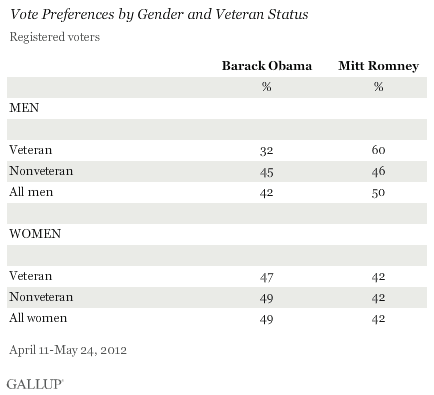
Turns out that the “gender gap” that has Mitt Romney doing better among men and Barack Obama doing better among women (the usual pattern for a generation, at least) is less a gender thing, and more a matter of whether men have served in the military or not. According to Gallup:

PRINCETON, NJ — U.S. veterans, about 13% of the adult population and consisting mostly of older men, support Mitt Romney over Barack Obama for president by 58% to 34%, while nonveterans give Obama a four-percentage-point edge.

These data, from an analysis of Gallup Daily tracking interviews conducted April 11-May 24, show that 24% of all adult men are veterans, compared with 2% of adult women.

Obama and Romney are tied overall at 46% apiece among all registered voters in this sample. Men give Romney an eight-point edge, while women opt for Obama over Romney by seven points. It turns out that the male skew for Romney is driven almost entirely by veterans. Romney leads by one point among nonveteran men, contrasted with the 28-point edge Romney receives among male veterans.

The small percentage of female veterans in the U.S., in contrast to their male counterparts, do not differ significantly in their presidential vote choice from the vast majority of women who are not veterans…

Here’s a graph:

Interesting. I wonder what the long-term implications of this will be. Most of the men who have served in the military are older than I am. Twenty years from now, will much of the gender gap have disappeared, in favor of Democrats? I don’t know. I’d need to understand better why this veteran gap exists to be able to answer that.

Whites not the majority? Nothing new in that…

Did y’all see the “news” the other day — ironically, the day before my grandson was born — that white babies are no longer the majority? I first heard it on NPR’s Talk of the Nation. Quoth Neal Conan:

We’ve known for years this day would come, but here it is. The Census Bureau announced today that nonwhite births now make up a majority in the United States. Data gathered in 2011 show that nonwhite, Hispanic, African-American, Asian, Native American, mixed race and others combined for 50.4 percent. That’s the first time that white births were not a majority in U.S. history, and that raises some questions about policy – from education to social services programs – and about how we see ourselves as a nation….

Perhaps this is a good time to inject a bit of historical perspective…

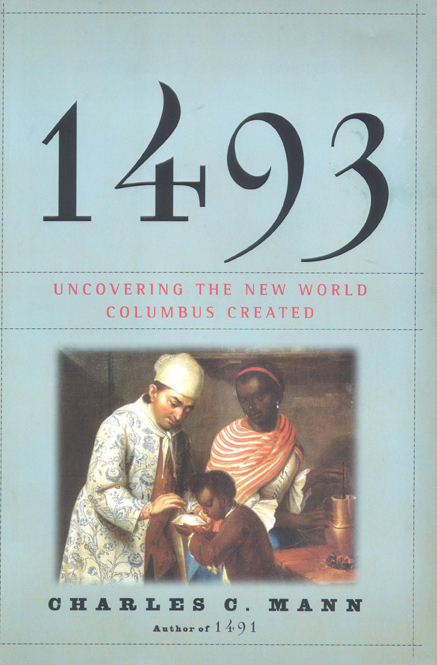
I’m still off-and-on gradually making my way through Charles C. Mann’s 1493, while reading several other books at varying rates, and every time I read a stretch in it, I learn something startling. For instance, I refer you to the fact that for most of the history of Europeans in the Americas — up to the mid-nineteenth century — there were far more people of African descent in the Western Hemisphere than there were white. Way more. An excerpt (I hope the publishers will excuse the length of this quote. I share it within the context of urging you to run out and buy this book; there are many other things in it that will surprise you, and enlarge your understanding of our world.):

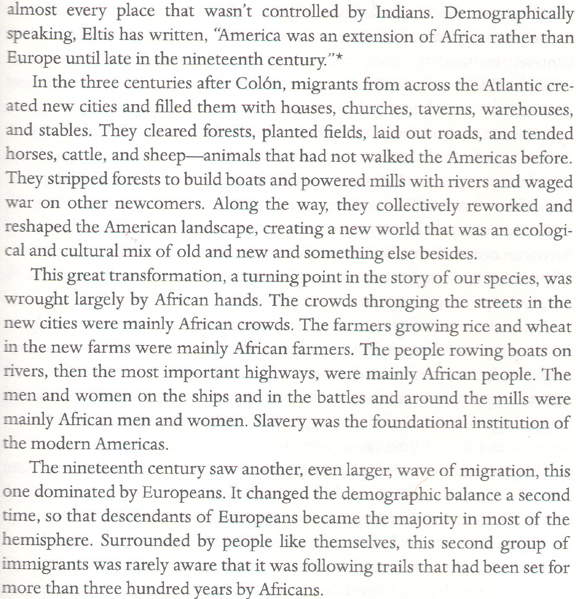
This was surprising to me for a couple of reasons. For instance, I had long known that before and after the Civil War, South Carolina had a larger black population than white. Which means that before 1860, most of the state’s population was enslaved.

I used to think of that as anomalous. I thought of it as helping explain the fact that South Carolina slaveholders were more fanatically devoted to their Peculiar Institution that the white elites anywhere else. Hence that firing on Fort Sumter thing.
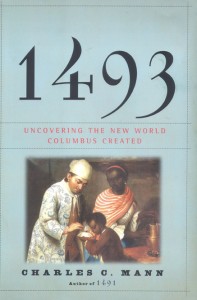
But as it turns out, if you look at ALL post-Columbian immigration across the hemisphere, not just English, you see that far, far more were brought here as slaves from African than came here, either free or indentured, from all Europe. By 1860, this balance had changed in many places (thereby making SC somewhat anomalous), but for most of the time from 1492 until then, a larger black population had been the norm. (Of course, for that same period, there remained more Indians than whites or blacks, in spite of the way native populations had been decimated by European and African diseases.)

I also found it surprising because I spent part of my childhood in Latin America, and it did not prepare me for this statistic — even though I studied history in Spanish in school (Mann’s references to Columbus as Cristóbal Colón seem very natural to me). In Ecuador, where I lived for two-and-a-half years, it was very unusual to see anyone who looked at all African. I knew that Brazil had imported vast numbers of slaves during the colonial period, and that you could see the results on the streets of Rio. I would have said the same of the islands of the Caribbean.

But for there to be that many more blacks than whites across all the Americas? I had no idea. We all are aware that black labor largely built this country, but I guess I thought that was because those workers were owned by a white majority. I was wrong. At least from a hemispherewide perspective.

In any case… whites not being the majority? Nothing new about that on this side of the world.

Are women fed up with Democratic pandering?

Tom Edsall makes some interesting observations in this piece in The New York Times from over the weekend. If you haven’t read it, you should.

His topic is the impact of Barack Obama’s rather overt bids for the renewed affections for key Democratic constituencies and interest groups defined by demographic identity. Unsurprisingly, Edsall finds that the voting public at large is suspicious of such moves. For instance, while the public is evenly split on the subject of gay “marriage,” there is widespread cynicism toward the president’s embrace of the notion:

Some evidence that Obama must walk a fine line as he seeks majority backing can be found in the May 15 CBS News/New York Times poll, which showed that 67 percent of respondents said Obama came out for same-sex marriage “mostly for political reasons,” while just 24 percent said he made the decision “mostly because he thinks it is right.”

But the really surprising thing he finds is the way, after all the gyrations Democrats have gone through in recent months, including the “war on women” and other absurd rhetoric, the president has lost ground among women:

In an equally troublesome finding for Obama, the Times poll recorded a dramatic drop in the level of support for Obama among women, with Romney actually pulling ahead, 46-44. Obama’s support among female voters has fallen from 49 to 44 percent over the past two months, while Romney’s rose three points.

Stephanie Cutter, deputy manager of the Obama campaign, has challenged the accuracy of the Times poll, arguing that the methodology – calling people who have been previously surveyed,  known as a “panel back” — resulted in “a biased sample.”

But even if the poll findings can be reasonably disputed, they still suggest that Obama’s aggressive bid to strengthen his support among women may be backfiring. Separate polling by Marquette Law School in Wisconsin shows Obama holding a strong, but declining advantage among women voters. In February, Obama had a 21 percentage point lead among women, 56-35; by mid-May, his margin among women had fallen to 9 points, 49-40….

Could it be that you just can’t go past a certain point in pandering to women without insulting their collective intelligence? It would appear so…

Glendon on why Catholic institutions are suing

I read with interest this piece in The Wall Street Journal today by Mary Ann Glendon, headlined “Why the Bishops Are Suing the U.S. Government,” partly because she is someone I’ve suggested in the past as a potential speaker in the Cardinal Bernardin lecture series (remember, last year we brought E.J. Dionne).

I first became interested in her a couple of decades back, when I was reading a lot of communitarian literature. I was interested in her study of how nations in Europe had found it easier to come to accommodations over abortion, because unlike Americans, they didn’t frame the issue as a clash between absolute “rights.”

Anyway, here are some excerpts from her piece today:

This week Catholic bishops are heading to federal courts across the country to defend religious liberty. On Monday they filed 12 lawsuits on behalf of a diverse group of 43 Catholic entities that are challenging the Department of Health and Human Services’ (HHS) sterilization, abortifacient and birth-control insurance mandate.

Like most Americans, the bishops have long taken for granted the religious freedom that has enabled this nation’s diverse religions to flourish in relative harmony. But over the past year they have become increasingly concerned about the erosion of conscience protections for church-related individuals and institutions. Their top-rated program for assistance to human trafficking victims was denied funding for refusing to provide “the full range of reproductive services,” including abortion. For a time, Catholic Relief Services faced a similar threat to its international relief programs. The bishops fear religious liberty is becoming a second-class right…

The main goal of the mandate is not, as HHS claimed, to protect women’s health. It is rather a move to conscript religious organizations into a political agenda, forcing them to facilitate and fund services that violate their beliefs, within their own institutions.

The media have implied all along that the dispute is mainly of concern to a Catholic minority with peculiar views about human sexuality. But religious leaders of all faiths have been quick to see that what is involved is a flagrant violation of religious freedom. That’s why former Arkansas Gov. Mike Huckabee, a Baptist minister, declared, “We’re all Catholics now.”…

Religious freedom is subject to necessary limitations in the interests of public health and safety. The HHS regulations do not fall into that category. The world has gotten along fine without this mandate—the services in question are widely and cheaply available, and most employers will provide coverage for them.

But if the regulations are not reversed, they threaten to demote religious liberty from its prominent place among this country’s most cherished freedoms. That is why Cardinal Dolan told CBS’s “Face the Nation” on April 8: “We didn’t ask for this fight, but we won’t back away from it.”

When did truckers become so law-abiding?

Over the weekend, I was a passenger in my wife’s car when I saw the following amazing sight, and reported it on Twitter:

Just saw a tractor-trailer do a U-turn at Gervais and Huger. Really. Brown Trucking Co. of Lithonia, Ga.

Seriously. We were several cars back from the light on Gervais, waiting to proceed eastward (with the McDonald’s on our right) and this truck, which was going the way we were, pulled out into the intersection, cut way left and swung across several lanes to turn all the way around within the intersection, and head back toward the bridge over the river. Cars converging on the intersection from four directions just froze — probably in amazement. He did it on the first try, which makes me think it wasn’t his first time.

And this got me to thinking of something. I got to thinking about how you seldom see truckers do really crazy stuff anymore.

I mean, compared to back in the ’70s, about the time of the CB radio craze. Back then, it was seemingly an outlaw culture. Driving on an interstate in a normal car (much less my Volkswagen Rabbit I had back then), was truly taking your life in your hands, with kamikaze behemoths hurtling down upon you at ungodly speeds.

If you saw a trucker doing less than 80 in those days, it meant he was climbing a steep grade and hadn’t gotten as much of a running start as he’d like.

It was SOP for truckers to bear down upon you from the rear (especially if you dared to get into the left lane to pass somebody), closing at speeds that would ensure that it was all over if you tapped your brakes. You had to veer out of their way the first chance you got; it was imperative to survival.

Then, suddenly, just a few years ago (I want to say it was the middle of the last decade), I noticed something — truckers were almost all driving at or below the speed limit. They were no longer aggressive, much less homicidal. Cars passed them, instead of the other way around. The interstate seemed much less dangerous than it had been.

Anybody else notice this? And does anyone know why it happened? Was it:

  • Rising fuel prices, which made it imperative that they drive in a more economical fashion?
  • Tougher enforcement? (If it was this, it happened in multiple states at once.)
  • Those “How Safe is My Driving” signs with the phone numbers?
  • A change in trucker culture, a maturation beyond the “Smoky and the Bandit” stage?

Or something else I’m not thinking of?

Theories are welcomed. Anyone who actually knows something from within the industry would be even more so.

The execution of the wrong Carlos

The Guardian has a fascinating story about the Columbia Human Rights Law Review‘s expose of a case in which, its exhaustive research indicates, an innocent man was executed in Texas.

Some excerpts:

From the moment of his arrest until the day of his death by lethal injection six years later, DeLuna consistently protested he was innocent. He went further – he said that though he hadn’t committed the murder, he knew who had. He even named the culprit: a notoriously violent criminal called Carlos Hernandez.

The two Carloses were not just namesakes – or tocayos in Spanish, as referenced in the title of the Columbia book. They were the same height and weight, and looked so alike that they were sometimes mistaken for twins. When Carlos Hernandez’s lawyer saw pictures of the two men, he confused one for the other, as did DeLuna’s sister Rose…

At the trial, DeLuna’s defence team told the jury that Carlos Hernandez, not DeLuna, was the murderer. But the prosecutors ridiculed that suggestion. They told the jury that police had looked for a “Carlos Hernandez” after his name had been passed to them by DeLuna’s lawyers, without success. They had concluded that Hernandez was a fabrication, a “phantom” who simply did not exist. The chief prosecutor said in summing up that Hernandez was a “figment of DeLuna’s imagination”.

Four years after DeLuna was executed, Liebman decided to look into the DeLuna case as part of a project he was undertaking into the fallibility of the death penalty. He asked a private investigator to spend one day – just one day – looking for signs of the elusive Carlos Hernandez.

By the end of that single day the investigator had uncovered evidence that had eluded scores of Texan police officers, prosecutors, defense lawyers and judges over the six years between DeLuna’s arrest and execution. Carlos Hernandez did indeed exist.

Liebman’s investigator tracked down within a few hours a woman who was related to both the Carloses. She supplied Hernandez’s date of birth, which in turn allowed the unlocking of Hernandez’s criminal past as the case rapidly unravelled…

You should just go read the whole thing. Or for that matter, the original study.

This, of course, is one of the main reasons I oppose the death penalty. There are others, but this one is enough for a lengthy discussion…

Thoughts on what’s been done to this poor kid?

A little motherhood controversy for Mother’s Day.

It would of course be startling enough to hear that a woman is nursing an almost 4-year-old. What’s shocking is the photograph, in which the kid looks big enough (compared to apparently petite mom) to be about 7.

But the worst thing, to me, are his eyes looking at the camera — looking out at America, in the photo that will dog him the rest of his life.

Am I saying that in high school, bullies will be pinning him down and cutting his hair against his will? I don’t know about that. I’m sort of worried about him surviving 1st grade.

A really cruel thing has been done to this boy, and at this point he has no idea. I feel bad for him.

Carefully, artfully, Obama shifts to support for same-sex ‘marriage’

Perhaps some of y’all will want to discuss this. For that purpose, I give you this post.

Basically, in a fairly transparent series of steps designed to test the waters, two people in the administration stepped out and said they now support same-sex marriage. From the time they did so, it seemed highly likely that they were doing so to see if the world exploded in their faces, ahead of the president making this statement. (Excuse the mixed metaphors; I’m having a busy and harried day.)

But it was artful the way they did it. By having Joe Biden, the famous loose cannon, be the first one to step out, it was possible to disown the statement completely if there was too much of a negative reaction. There wasn’t — at least, not particularly (something that reflects the fact that most people, whether they are pro- or anti-, simply don’t care as much about this as the portion of Obama’s base that cares deeply) — and that made it safe for the next soldier to step into the minefield (sorry! sorry! there’s another metaphor). And when Arne Duncan didn’t get blown up, that made everyone go, Arne Duncan — he’s no loose cannon. And he’s Obama’s longtime basketball buddy!

The next step was for the president himself to say the words that would calm down a significant portion of his fund-raising base. And to do it early enough in the campaign that most of us will have mostly forgotten it by November, since there are so many other things we care so much more about.

The calculated nature of this move was reflected in the language used by one “LGBT advocate” quoted by the WashPost: “The conversation is, what can and should we do to quiet the uproar and to get donors back on board.”

Well, that’s done, and now the Obama campaign will be ready to move on, having brought this up and dispensed with it during the dead time in the campaign between the effective end of the GOP contest and the party conventions just before Labor Day. There was no other time that the president could have done this that would have made less of a political splash.

As I say, deftly done. If there was anything about it unartful, it was perhaps this part:

And he said he wanted to be “sensitive” to the fact that for many Americans, the word “marriage” evokes “very powerful positions, religious beliefs and so forth.”

That somewhat bemused characterization of religious traditionalists is somewhat reminiscent of his “God and guns” misstep of four years ago, making people with traditional values sound a bit like critters in the zoo or something — as something out there that one understands only with great effort. But it wasn’t nearly as bad as that earlier faux pas. And after all, how is he supposed to characterize people whose entire worldview he is rejecting?

So the thing was done about as skillfully as it could be done. If one is determined to do it.

Happy V-E Day, and can you keep a secret?

The P.M. flashes his famous V-for-Victory sign. We can't tell, from this photograph, whether he was flashing an "E" sign with the other hand.

After The Times played down its advance knowledge of the Bay of Pigs invasion, President Kennedy reportedly said he wished we had published what we knew and perhaps prevented a fiasco. Some of the reporting in The Times and elsewhere prior to the war in Iraq was criticized for not being skeptical enough of the Administration’s claims about the Iraqi threat. The question we start with as journalists is not “why publish?” but “why would we withhold information of significance?” We have sometimes done so, holding stories or editing out details that could serve those hostile to the U.S. But we need a compelling reason to do so.

— Bill Keller, then-executive editor
The New York Times
June 2006

Germany surrendered to the Allies 67 years ago today. A few days ago, we saw a little footnote to that milestone. The Associated Press apologized for firing correspondent Ed Kennedy in 1945 over one of the biggest scoops in AP history. Kennedy reported the unconditional surrender a full day ahead of the competition, defying military censors to do so. The AP publicly rebuked him, and quietly canned him.

The apology came a bit late for Kennedy, who died in a traffic accident in 1963.

This is not to confuse him with another Kennedy who also died in 1963, and had earlier persuaded The New York Times to back off the Bay of Pigs story for national security reasons. (See Keller quote above.)

The icing on this tale came today, when we learned that the AP knew last week that the United States was closing in on Underwear Bomber II in Yemen — but withheld the news at the request of the government. That’s what the WSJ reported this morning, anyway:

U.S. officials had known about the plot for about a month, and President Barack Obama was briefed on the plot in April. White House officials had persuaded the Associated Press, which had an account of the plot in hand as early as last week, to hold off on publishing because the intelligence operation was still under way.

This is fascinating. It was one thing to stand shoulder-to-shoulder with government censors in 1945, when the entire country was united in the all-out effort to win WWII, and cooperation with the censors was reflexive.

But today? When it is fashionable to call the War on Terror the “so-called War on Terror”? When, as Keller mentions above, the leftward side of the political spectrum persists in excoriating the media for not being skeptical enough prior to the Iraq invasion? For a major media entity to respond with a snappy salute to a government request to be discrete is decidedly remarkable.

This will no doubt spark dark rumblings — and probably already has; I’m not bothering to look — among Republicans about whether the AP would have agreed to this request if it had come from the Bush administration.

Interesting question.

What do you think about all of this? Oh, you want to know what I think. Well, I don’t know enough to have an opinion yet. I’d like to know what the AP knew, and what it was told before it made the decision to hold back on the story. The default position for a journalist is to report a story when you know it’s true, as Keller reported. But this sounds like it’s one of those rare cases in which lives may have been saved by holding back — which would justify the decision to wait.

How are Newt Gingrich and John Edwards alike?

When The Washington Post posed this question this morning on Twitter:

What do John Edwards and Newt Gingrich have in common?

I thought the answer was obvious, and shared it:

Ummm… Both won SC, but not much else?

Of course, that’s not exactly what the Post had in mind. This is what they were thinking:

Don’t be surprised if you hear the names of John Edwards and Newt Gingrich mentioned on the Senate floor this week.

Senate Democrats plan to consider a measure Tuesday that would extend lower interest rates for some federally subsidized college loans and pay for the extension by ending tax breaks for firms with three or fewer shareholders — commonly referred to as “S-corporations.”

Democrats call these types of tax breaks the “Newt Gingrich/John Edwards loophole,” because both former politicians took advantage of a federal tax law that allows those with high incomes to avoid paying Medicare payroll taxes on earnings by establishing S-corporations and treating only a portion of their total earnings as taxable wages…

Later, Cindi Scoppe (my mind is blown by the fact that Cindi is now on Twitter) weighed in with another answer, from the NYT’s Frank Bruni:

Gingrich and Edwards belong to different parties but are beholden to similar demons, and they have a whole lot more in common than a bounty of hair — white in the Republican’s case, brown in the Democrat’s. They’re the salt and pepper of outsize egos in presidential politics.

And to look at the two of them together, which their recent convergence in the news and on the map encouraged, is to confront some unsettling truths about a kind of person too frequently drawn to high-level office and about traits that often abet his rise and then seal his fall.

Beware the extreme narcissist. Although he may radiate a seductive confidence, he can justify and forgive himself for just about anything, given his belief in his own exalted purpose. He’ll lose sense of the line between boldness and recklessness. And he’ll quit the stage reluctantly, because he can’t bear not to occupy the very center of it…

So I guess the bottom line is that they have a lot in common.

Apparently, it’s all over for Eric Holder

Well, it’s all over for Eric Holder. Chad Prosser, who is running for Congress in the new 7th District, put out this release yesterday:

CONSERVATIVE REFORMER CHAD PROSSER CALLS FOR ERIC HOLDER TO RESIGN

Former Sanford Cabinet Member points to interference in SC internal affairs and mishandling of Fast and Furious scandal as reasons for Holder’s immediate resignation

(MURRELLS INLET, SC) – In the wake of Attorney General Eric Holder’s failure to intervene in the Fast and Furious “Gunwalking” Operation, unprecedented intrusion into the internal affairs of South Carolina, his perjury before Congress and his intentional obstruction of a Congressional investigation into who is at fault for the death of U.S. Border Control Agent Brian Terry, Chad Prosser is calling for United States Attorney General Eric Holder to vacate his office immediately.

“Holder’s role in blocking the efforts of South Carolina to crack down on illegal immigration and protect the integrity of elections in our state are reason enough for him to resign. Adding perjury, obstruction of justice, and an impending citation for contempt to the case against Holder should be enough for President Obama to ask Eric Holder to leave his cabinet post immediately,” said Prosser.

When Holder was forced to appear before Congress to testify regarding Fast and Furious on May 3, 2011, he told members of the House Oversight and Government Reform Committee that he first heard about the operation “over the last few weeks”. Shortly after his testimony, a briefing memo dated July 5, 2010 and addressed to Eric Holder was uncovered which outlined Fast and Furious and contradicted his sworn statement to Congress. Since that time, the Justice Department has repeatedly denied the media and Congress access to documents surrounding the scandal.

Now, congressional leaders are set to pursue a contempt citation against Holder to force him to comply with multiple requests for government records outlining the failed operation.

“We need an Attorney General committed to upholding and enforcing the law, not one who makes his own set of rules and breaks the law,” added Prosser. “Eric Holder needs to resign immediately and our nation is in desperate need of a president who appoints competent leaders who understand, respect and abide by the law.”

… More information on Chad and his campaign for conservative reform in Washington can be found at www.chadprosser.com.

###

Sure, Mr. Holder may work for the president of the United States, and not for Chad Prosser, and not have a clue who Chad Prosser is, but of course he has no choice but to resign now, right? I just don’t see how he can withstand this withering pressure. I mean, Chad has demanded that he quit. And he is a “conservative reformer.” Just ask him; he’ll tell you.

OK, back to being semi-serious…

What did Mr. Prosser hope to achieve with this out-of-left-field release about something that was in national, not SC, news a year ago? Apparently, the message is “Trust me to attack anyone in the Obama administration, regardless of whether it has anything to do with me or any of the issues in my district.” Because, you see, that’s what the GOP electorate wants.

Is he right to assume that? Is it that bad?

Rove says SC’s a toss-up? Is this a typo, or what?

I think maybe the partisans at both ends have totally lost their minds now. I just got this from Dick Harpootlian:

President Barack Obama is going to win South Carolina.

You don’t believe it? Would you believe the Prince of Darkness Karl Rove?

Well click here and read his latest poll calling South Carolina a “toss up.” So even the biggest Republican propagandist in the country has to admit Barack Obama CAN win South Carolina this fall.

So help us make Karl Rove’s nightmare come true and click here to volunteer. President Obama CAN win, but only if you help. Just do it.

Hey, anything can happen, but if you’re talking probabilities… no way.

Here’s the original Rove info to which Harpootlian refers, but it doesn’t answer the question: What is the basis for putting SC in the “toss-up” column?

If anyone knows, please share.

So long to Blue Dogs and GOP moderates

There’s a good piece over at CNN.com by David Gergen and Michael Zuckerman detailing, and decrying, our continued slide into extreme-partisan gridlock.

Basically, it takes note of some the latest developments in this abhorrent trend:

One can see these trends in harsher relief amid campaigns for the Senate and House. Olympia Snowe, a moderate and much-beloved GOP senator from Maine facing her first primary challenge, is retiring because of a lack of bipartisanship and mechanisms to find “common ground.”

Sens. Richard Lugar and Orrin Hatch — both stalwarts of the GOP who have committed apostasy by trying to work across party lines — face primaries this season that imperil their survival: A poll Thursday morning found Lugar down 5 points to a tea party-backed challenger in Indiana, and Hatch failed to secure a 60% supermajority at his party’s convention in Utah, sending his race to a primary. Only two years ago in Utah, another stalwart Republican who had worked with Democrats, Bob Bennett, was deposed by an ideologically purer primary challenger.

In the House, meanwhile, the once-robust cadre of “Blue Dog Democrats” — moderate to conservative members of the liberal party — has been winnowed out, with two more members (Reps. Jason Altmire and Tim Holden of Pennsylvania) defeated in primaries this past Tuesday by opponents from their left flanks.

As of 2010, there were as many as 54 Blue Dogs, but the midterms knocked their caucus down to 26. With retirements and primaries, that number will probably be well below 20 by next January — an effect that further turns Democrats into the party of the left…

Are there any good guys left? Yes there, are, but they are few:

So it’s crucial to bolster the men and women of courage in politics: the ones who can act as ambassadors between these increasingly dug-in parties and who can kindle that small flame of trust that has almost gone out. Sens. Lamar Alexander (R-Tennessee) and Mark Warner (D-Virginia) and a handful of others, for example, have launched laudable work on this count in the Senate, pulling together small, quiet dinners with legislators from both sides of the aisle who are strong in principles but equally strong in their commitment to moving the ball forward for the country…

I’ve always liked Lamar, ever since I covered him running for governor back in 1978.

One thing seems sure — you won’t get “change” of any kind with Mitt Romney

This morning on the radio, I heard a discussion of what a challenge Obama has in his re-election effort getting young people to back him they way they did in 2008.

Those young people, the argument went, wanted “hope” and “change,” and didn’t get enough of it.

I can see how that might have the effect of dampening enthusiasm, perhaps even of suppressing turnout.

What I don’t see it doing is translating to support for Romney. Unless these young folks really delude themselves, or unless the change they want is of a rightward bent — in which case, they’re still deluding themselves.

And most of us know this. It’s why the GOP base went running to everyone else they could think of before settling on Romney — they knew he wasn’t a True Believer on the kind of change THEY wanted.

And I knew it, which was why I saw him as the most palatable candidate in the field — the real conservative. Romney is a manager. He wants to manage the nation to prosperity. And maybe he can do that. But he’s not a revolutionary, or a counter-revolutionary. He’s a manager.

Now you might throw at me various statements that he’s made or positions he’s taken that contradict that, to which I’ll say, Right. And he’s also the father of Obamacare, but you don’t see him acting like it, do you? As you may have noted, his positioning is somewhat… flexible… based on what he thinks is needed to get the job done at a given time.

I backed Romney — reluctantly — because I didn’t like the kind of “change” that the GOP field was offering this time around. Repealing Obamacare. Endangering the full faith and credit of the United States by absolutely insisting that budget cuts not be accompanied by any kind of tax increases. I didn’t want any of that stuff.

When McCain and Obama ran four years ago, there were changes I looked forward to with each. I believed McCain would manage the War on Terror much better than Bush had. I knew he had the courage to take on things like comprehensive immigration reform. With Obama, while being reasonably certain that he would NOT institute the kinds of national security changes his base hoped for (and I was right — in fact, he has pursued the war with a stronger hand than Bush, and gotten away with it) and he just might give us meaningful health care reform. I even sorta had hopes for a rational energy policy.

But Romney’s virtue, to me, is that he does not represent the kind of change that his party has stood for since 2010 (or perhaps I should say, since the day after Election Day 2008, which seems to be the moment that party went off the rails). That’s a good thing.

I still don’t understand how ANYONE was fooled by John Edwards, at any point in time

Here is an explanation by one accomplished professional (Walter Shapiro) who was completely taken in. Excerpts:

About three weeks after Sept. 11, 2001, my wife, Meryl Gordon, and I had an off-the-record dinner with John and Elizabeth Edwards at the Washington restaurant Olives. The dinner was at the blurry intersection of Washington life—ostensibly social (Meryl had bonded with Elizabeth after writing an Elle magazine profile of her husband in 2001) but at its core professional (I was a columnist for USA Today and Edwards had White House dreams). Everyone was in a shell-shocked daze after the terrorist attacks, but my only clear memory of that dinner was Edwards’ palpable dislike for John Kerry, an obvious rival for the 2004 Democratic presidential nomination.

That was the beginning of a political-journalistic courtship that now makes me cringe. With Edwards on trial in North Carolina on charges of violating federal campaign-finance laws—after the disgrace of being caught with a mistress and denying being the father of her baby—I wish I had befriended a comparatively more honorable political figure like Eliot Spitzer or Mark Sanford…

In hindsight, I feel like the jaded city slicker, bristling with self-confidence that he can never be fooled, who ends up hoodwinked by the smiling rural Southern confidence man. Please understand: I did not deliberately put a thumb on the scale when I wrote about Edwards. It was more that I was convinced by Edwards’ sincerity when he talked passionately about poverty and the Two Americas. And I especially believed (because I spent so much time with Elizabeth) the romantic myth of the Edwards marriage.

Many Edwards insiders from the 2004 campaign say the vice-presidential nomination (bestowed by, yes, John Kerry) changed him. The entourage, the plane, the Secret Service detail and the frenzy of a fall campaign all supposedly fueled Edwards’ self-importance and sense of entitlement. But as I struggle to understand my own entanglement with a scandal-scarred presidential contender, I wonder if this arbitrary division between pre-veep Edwards and post-veep Edwards is too glib.

The danger signs and character flaws were always there, and I failed to notice them. I was certainly not alone in my blindness. David Axelrod, for example, was Edwards’ first media consultant during the 2004 primary campaign. Even after Axelrod drifted away to concentrate on a long-shot Senate race for a candidate named Barack Obama in Illinois, he returned for Edwards’ last stand in the Wisconsin primary. I recall running into Axelrod in the Pfister Hotel in Milwaukee on primary day and hearing him say of Edwards, “He’ll be president someday.”…

Yes, the “danger signs and character flaws WERE always there,” and they stuck out a mile. While I hadn’t reached the point of completely dismissing him in print as a phony, you can see my uneasiness with him in this column from 2003:

… There are few things more unbecoming than a millionaire trial lawyer presenting himself to a crowd as the ultimate populist. Huey Long could pull it off; he had the common touch. So did George Wallace. But John Edwards is one of those “sleek-headed” men that Shakespeare wrote of in “Julius Caesar.” He may be lean, but he hath not the hungry look. Mr. Edwards is decidedly lacking in rough edges. Not even age can stick to him.
His entrance was predictably corny. Other speakers had unobtrusively climbed the back steps onto the platform. Mr. Edwards snuck around to the back of the crowd, then leaped out of his hiding place with a huge grin and his hand out, looking for all the world like he was surprised to find himself among all these supporters. He hand-shook his way through the audience to the podium, a la Bill Clinton , thereby signifying that he comes “from the people.” Watch for that shot in upcoming TV commercials.
His speech was laced with populist non-sequiturs. For instance, he went way over the top exhibiting his incredulity at Bush’s “jobless recovery,” chuckling with his audience at such an oxymoron – as though the current administration had invented the term. (A computer scan found the phrase 641 times in major news sources during calendar year 1993 ; so much for novelty.)…

(The point of the column was to say that some protesters who were there to picket Edwards were even worse than he was. But first I had to establish what I’d thought of him. This incident formed part of my better-known “phony” column in 2007, in which I particularly concentrated on a detail I had not used in this piece — because it involved such a subjective impression that I didn’t have the confidence to attach importance to it until I’d had more experience with him.)

I’m not smug for having been put off, from the first time I saw him in person, by what seems to have taken in others. I’m just surprised that they didn’t see it, too.

Rawl defends Georgia dredging decision

South Carolina Chamber of Commerce President Otis Rawl — who two years ago led his organization to make the unprecedented move of endorsing Vincent Sheheen for governor — today stuck up for Nikki Haley for something virtually no one at the State House will defend her on.

Speaking to the Columbia Rotary Club, he said the DHEC decision allowing Georgia to deepen the way to the port of Savannah was not a game-changer, and not a problem, for South Carolina in the long term.

In saying this, he was partly reflecting the wishes of multistate members who like the idea of competition between ports to keep costs down. But he also said it was a competition that Charleston, and South Carolina, would win.

To start with, he said, the proposed work would only deepen the Georgia port to 48 feet, compared to Charleston’s 52 — and that those four feet made a big difference. Further, he said that if South Carolina makes the right moves (always a huge caveat, but he seemed optimistic) we are well-positioned to become the entry point for the world to the Southeast, and an ever-greater distribution hub. One of the things SC has to get right — opening up the “parking lot” that I-26 has become at key times between Charleston and Columbia.

Otis agreed with me that this stance makes him a lonely guy over at the State House, where both houses almost unanimously rebuked the governor for, as many members would have it, selling out South Carolina to Georgia. Aside from Otis, only Cindi Scoppe has raised questions that challenge that conventional wisdom.

Now, lest you think ol’ Otie has gone soft on the Sanford/Haley wing of the GOP, he went on to say that one of the things business and political leaders must do to help build the SC economy is to refute, challenge and combat the Big Lie that our public schools are among the worst in the country. Because who in the world would want to invest in a state like that?

Not that we’re where we want to be, but as Otie pointed out, on realistic measures of quality, SC is more likely to rank in the low 30s. Which may not be fantastic, but is a far cry from “Thank God for Mississippi.”

On the whole, a fine set of assumption-challenging points from today’s Rotary speaker…

Jon Huntsman marvels at inadequacy of 2012 presidential field, compares GOP to Chicoms

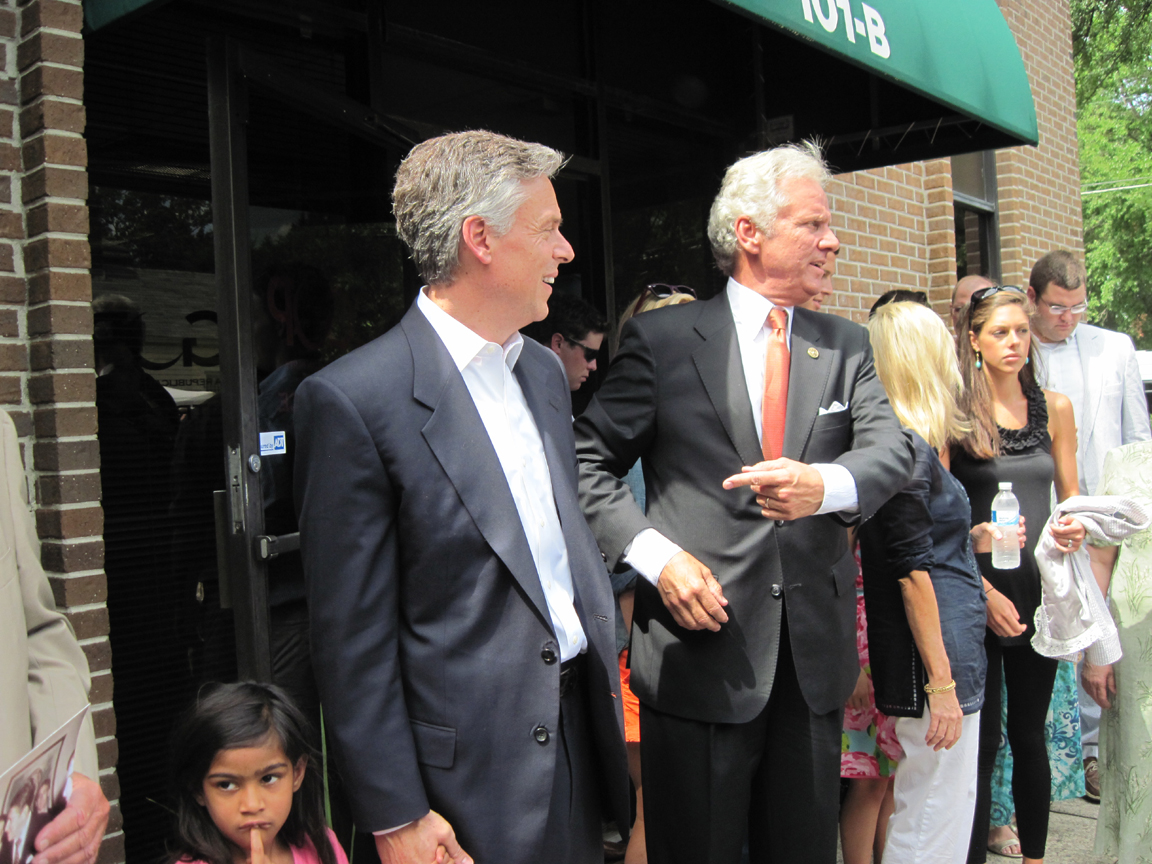
In this file photo from last summer, Henry McMaster points to the one GOP presidential candidate who might have impressed Jon Huntsman.

Just ran across this over at HuffPost:

Jon Huntsman leveled harsh criticism at his party on Sunday evening, BuzzFeed’s Zeke Miller reported, comparing the Republican Party to communist China and questioning the strength of this year’s presidential field.

During an event at the 92nd Street Y in New York City, Huntsman spoke candidly about his party’s flaws, lamenting the Republican National Committee’s decision to rescind an invitation to a major fundraising event after Huntsman called for a third-party candidate to enter the race.

“This is what they do in China on party matters if you talk off script,” Huntsman said.

Huntsman, a former Utah governor who dropped out of the GOP primary in January, served as U.S. ambassador to China under President Barack Obama.

He also criticized the Republican candidates’ foreign policy stances, particularly in regard to China.

“I don’t know what world these people are living in,” Huntsman said…

Huntsman also spoke on Sunday about his presidential candidacy, revealing that he was less than impressed by his fellow candidates when he attended his first debate in August.

“Is this the best we could do?” Huntsman said he asked himself.

Turns out that Huntsman, whose SC followers largely did not follow his lead in endorsing Mitt Romney when he dropped out, is also rather lukewarm on his fellow Mormon.