Category Archives: The Nation

WashPost column about the limitations of OWS

I found this column by Anne Applebaum in the WashPost this morning interesting:

What the Occupy protests tell us about the limits of democracy

On paper, it isn’t easy to reproduce the oddity of the Occupy the London Stock Exchangerally that took place on the steps of St. Paul’s Cathedral last weekend. It’s all very British — people are cooking pots of porridge on the sidewalk — yet reverent homage is being paid to the original Occupy Wall Street protests, too. The London demonstrators have even adopted the “human mic” used in New York’s Zuccotti Park — the crowd in front repeats whatever the speaker says, so that the crowd in back can hear — despite the fact that megaphones and microphones have not been banned in London. The effect, as can be heard on aGuardian online video, was something like this:

“We need to have a process.” (We need to have a process!)

“This meeting was called for a reason!” (This meeting was called for a reason!)

“We know that you are there!” (We know that you are there!)

“And we have solidarity with you.” (We have solidarity with you!)

Unintentionally, it sounds a lot like a scene from the Monty Python movie “Life of Brian,” the one in which Brian, who has been mistaken for the Messiah, shouts out at the crowd, “You are all individuals!” The crowd shouts back: “We are all individuals!”

Then there was this good bit:

In New York, marchers chanted, “This is what democracy looks like,” but actually, this isn’t what democracy looks like. This is what freedom of speech looks like. Democracy looks a lot more boring. Democracy requires institutions, elections, political parties, rules, laws, a judiciary and many unglamorous, time-consuming activities, none of which are nearly as much fun as camping out in front of St. Paul’s Cathedral or chanting slogans on the Rue Saint-Martin in Paris.

Then there was this excellent ending:

Democracy is based on the rule of law. Democracy works only within distinct borders and among people who feel themselves to be part of the same nation. A “global community” cannot be a national democracy. And a national democracy cannot command the allegiance of a billion-dollar global hedge fund, with its headquarters in a tax haven and its employees scattered around the world.

Unlike the Egyptians in Tahrir Square, to whom the London and New York protesters openly (and ridiculously) compare themselves, we have democratic institutions in the Western world. They are designed to reflect, at least crudely, the desire for political change within a given nation. But they cannot cope with the desire for global political change, nor can they control things that happen outside their borders. Although I still believe in globalization’s economic and spiritual benefits — along with open borders, freedom of movement and free trade — globalization has clearly begun to undermine the legitimacy of Western democracies.

“Global” activists, if they are not careful, will accelerate that decline. Protesters in London shout,“We need to have a process!” Well, they already have a process: It’s called the British political system. And if they don’t figure out how to use it, they’ll simply weaken it further.

Amen. Bottom line, as good as the piece was, the headline is misleading. This is more about the limitations of the OWS approach.

OK, I quoted an awful lot of it, but if the Post believes I quoted TOO much, I’m sorry and will take it down. But in the meantime — I urge you to go read the whole thing, at The Washington Post.

Obama swamps would-be opponents in fund-raising — in SC, of all places!

Maybe it’s always this way. I don’t recall having looked at fund-raising numbers in quite this way before, at this point, in a campaign shaped like this one. Cindi Scoppe probably has — she compiled The State‘s first campaign-contribution website if I recall correctly. She’s into stuff like that. As for me — well, it’s about money, so MEGO.

But this got my attention:

Rick Perry is the leading Republican presidential fundraiser in South Carolina, and he did most of it on one day in August.

The Texas governor took in $55,000 of the $103,000 that he has raised in South Carolina on Aug. 25. Katon Dawson, who is advising Perry’s S.C. campaign, confirmed Perry held an S.C. fundraiser that day but told a reporter, “I can’t tell you anything about it.”

While languishing in the polls, former U.S. Sen. Rick Santorum of Pennsylvania also is popular among S.C. donors. Santorum has raised $80,080 in the state, the second-highest of any Republican candidate, just ahead of former Massachusetts Gov. Mitt Romney, who raised $75,230.

President Barack Obama, a Democrat, actually was the top fundraiser in South Carolina, collecting $238,291. However, Obama is not expected to carry South Carolina, which last went for a Democratic presidential candidate in 1976.

Say what? Repeat that last?

Yeah, I get it. He’s the incumbent. But he raised way over twice as much money as the richest fund-raiser among all GOP candidates, and he raised it in South Carolina — a state he doesn’t have a prayer of winning in 2012. Which is why his bus tour somehow magically appeared in North Carolina on a trip northward without having passed through South Carolina, far as we could tell. (Did you hear his teleprompter got stolen in Virginia?)

He’s raised $238,291 in our state — more than 90 grand of it in Richland County (three times as much as all Republicans combined in the capital city) — and has spent… $2,385 (that’s according to a graphic in The State that I couldn’t find online). Yep, 1 percent.

You realize this makes South Carolina a Democratic Party donor state? So much for Democrats being all about what Washington can send to them… I guess this is payback time, huh?

Who are these rich Columbians? And how come they aren’t buying ads on bradwarthen.com? (If I were still at the paper, I’d get Cindi to go find out for me. I didn’t find names in a cursory Web glance at the data Adam drew his story from. Of course, if I were still at the paper, I wouldn’t get to sell ads and keep the money, so… Anyway, more as I know more. I just wanted to go ahead and get something up on this before the day was out.)

Meanwhile, over on the fiscally conservative side, Jon Huntsman has raised $2,550 here, and spent $277,744 in SC. According to the FEC’s website, which is where Adam’s numbers come from. Michelle Bachmann has raised $23,197 and spent $83,156. Others, such as Perry and Santorum, are staying within their SC-raised means in SC.

All told, if young Adam did his sums right, presidential candidates have raised $382,902  from SC sources and spent $719,276 here. So on the GOP side, SC is a beneficiary of political welfare — which makes sense, we being an earlier-primary state than the places where their money likely came from.

Which depends. For Perry, it’s Texas. For Obama, it’s California and the Northeast. For Romney — well, the map looks kind of the way it does for Obama, except the Republican is getting a larger proportion from Florida. Here’s where you can look all that up. Now you don’t need me. Let me know if you find the names of those donors. Get their contact info…

A morning ‘rant’ about a borderline word

Maybe that headline’s wrong. Maybe it’s not a borderline word. Maybe it’s clearly over the border. I don’t know. Y’all decide.

A friend had a bad start to her day this morning, and vented a bit.

I should explain that the friend is black, and she works for a large organization in the Midlands. That’s all I’ll say, since she asked me not to identify her. Here is her self-described “rant,” with all the installments run together:

I can’t even say Good Tuesday bc I’m starting with a rant.
Staff meeting today and co-worker refers to a church as the “colored” church. Really? How do u respond to that?
I know that’s how some of my coworkers think, but they have to verbalize it every so often. Lack of motivation is bad enough.
Ignorance is another story. That is all. Rant is complete.
I don’t even know if he’d get why I’m upset.

I’ll bet he wouldn’t.

In fact, as a Clueless White Guy myself, I really don’t know how my black friends would react if I used the word “colored.” Of course, this not being 1955, it would never occur to me. It’s so…

Well, the first word that strikes me is “anachronistic.” It makes me wonder, first, how old this guy is. I’m getting on up there, and while I remember the old folks using this word in my childhood, I don’t think I had occasion to use it myself. (No, wait! Maybe once… Oh, it’s too long ago to quantify… I was a tiny kid at the time.) For the old white folks, it was then the “polite” word they used to describe black folks.

By the time I was aware that there was a such a thing as demographic designations, the official, universally-approved word — if you had to refer to a person’s “race,” which I avoided and still avoid when possible (I was reluctant to do so in my second paragraph above, but it seemed essential to the story) — was “negro.” Then, it was “black.” Which I resisted. I preferred, if forced to refer to race, to use a word that sounded clinical, and technical, and less likely to divide people on an emotional level. “Black” sounded to me like, well, like we weren’t fellow human beings. Black and white are opposites, and have nothing in common. It seemed to me, as a teenager, a polarizing word.

But eventually I adopted it. My acceptance was eased by the fact that it was only one syllable. Force me to acknowledge race, and I’d get through it more quickly and move on. I liked that part of it. So I got used to it.

And I’ve stuck with it. I don’t think I’ll ever reconcile to the seven-syllable “African-American,” which is even longer than the “Afro-American” that was briefly popular in my youth. It seems to dwell WAY too long on something that I believe unnecessarily divides people. The only thing worse than that would be “European-American” — eight syllables — which thankfully has never caught on with anyone. (It’s so irrelevant. I never knew a single ancestor who even knew an ancestor who came from Europe. What would be the point?)

Yet, you’ll hear be use “African-American” in an extended discussion of race. Mainly because I get tired of saying “black” after awhile. (When you’re an editorial page editor in South Carolina, or a member of the Columbia Urban League board as I was for a decade, you end up having a LOT of extended discussions of race.)

But it has never occurred to me to say “colored.”

Did that guy think it was cool because he’d heard some of more politically conscious black people say “people of color?” Maybe. But you know, I’m not sure white people are licensed to say that. I’ve heard them try, and it sounds extremely stilted and phony — even more stilted than when black speakers say it. It’s like listening to people who learned a foreign language as adults. The pronunciation may be approximately correct, but the accent is all wrong.

“Colored” used to be a euphemism. Was it for this guy today? Did he use it just because my friend was present? What would he have said otherwise?

Maybe he went home today congratulating himself on his tact. Do you think?

A post-mortem on containment doctrine, from 2003

I got into sort of a mini-debate with Bud back here on the subject of the old Domino Theory, which in turn led to me running on and on about the Cold War doctrine of containment, which got me to thinking about this old column. That is to say a very brief interchange with Bud, then me weighing back in repeatedly here and here and here and here and here.

It ran in the paper four days after Baghdad fell, which means I wrote it a day or two after, which may be why the lede seems vague — it assumes a lot of immediate knowledge on the parts of readers. If you’ll recall, even though the drive toward Baghdad from Kuwait only took about three weeks, in about the third week, there were already naysaysers saying that our invasion had “bogged down.” Now that Baghdad had just fallen, their political opponents were nyah-nyahing back at them.

I was saying that they should not expect the invasion’s detractors to shut up, nor should they. But I was also noting that the relatively small antiwar factions at that time were somewhat voiceless, as they lacked a coherent narrative for what they wanted to do instead.

That was one theme of the column. Another was to point out something that seemed quite obvious to me then, and still does now: That the most natural opponents of the invasion, if ideology meant anything at all (an idea I often challenge, of course), were conservatives. I mean, paleo-conservatives such as Pat Buchanan.

Because even though it was being pursued by a particularly strong-willed conservative president, it was distinctly a liberal enterprise.

The two elements that I took off on in making these points were a fascinating lecture I had heard on C-SPAN by Prof. Alan Brinkley of Columbia University — a liberal opponent of the invasion, who nevertheless voiced the frustration of intellectuals who had trouble articulating their opposition in a way that he, at least, found satisfactory. That, and some things I had read in The New Republic, which called Bush “the most Wilsonian president since Wilson himself.”

As we all know, the invasion did “bog down” — after the technical, Clausewitzian war was over. Which means, the post-war occupation ran into huge problems with multilateral post-war violence, nearly sinking the entire effort in failure (before the Surge).  That I attribute to the fact that this effort to harness military power to liberal ends was being conducted by a conservative, one who had assured us before his election did not believe in nation-building. No wonder his administration was so bad at it.

But we didn’t know anything about that then. Remember that as you read this:

DEBATE OVER U.S. ROLE UNDERMINES ASSUMPTIONS ABOUT ‘RIGHT’ AND ‘LEFT’

State, The (Columbia, SC) – Sunday, April 13, 2003

Author: BRAD WARTHEN Editorial Page Editor

Enough Acton: Power corrupts and absolute power corrupts absolutely, except when it does not.

-The New Republic

IN THE HEADY thrill of reaching the “tipping point” in Iraq, some people said some silly things on the 24-hour-chatter TV channels. Some even speculated that recent events would shut up all the naysayers with regard to America’s new role in the world.

Don’t look for that to happen. After all, it’s a free country. At the same time, don’t look for critics to come up with any helpful alternative ideas, either. I say that based on excellent authority.

On C-SPAN last weekend, I caught a remarkable presentation by Alan Brinkley, provost and chairman of the history department at Columbia University. Professor Brinkley is erudite, thoughtful and intellectually honest. He is also an opponent of what the United States is doing in Iraq. But to his own frustration, he can’t offer a compelling alternative to that policy.

Addressing a conference on the war in Iraq, he spoke with what I took to be understated nostalgia for the doctrine of containment that dominated U.S. policy during the Cold War. He paid particular attention to the fact that “containment” applied not only to the Soviet Union and other enemies, but to ourselves as well. Faced with a rival superpower, the United States held back its own power. We didn’t, for instance, invade North Vietnam during that war, or even bomb those missile sites in Cuba in October 1962.

Containment still managed to hang on to some extent after the Soviet collapse. “September 11, I think, provided the final blow to this already tottering edifice . . . whose original rationale had long since been removed,” he said.

Under President Bush, he noted, America has been guided by a whole new set of assumptions, along these lines: that Europe has abdicated responsibility for any active role in the world, “that the United States is the only nation in the world capable of dealing with the great crises that face the world,” and that America must act, even if unilaterally.

“(M)y own view is that the real perception in this administration of the threat they are dealing with is not weapons of mass destruction, not the alliance between the Iraqi government and al Qaeda or other terrorist organizations, not Saddam Hussein himself even,” but rather “the sense among conservatives in policy positions in Washington that we face now a large if somewhat inchoate threat . . . , and that threat is radical Islam and the . . . inherent instability and danger of the Islamic world to the survival of the world as we know it.”

He worried that Iraq was but the first step, and that the same logic would lead to other wars.

While he considers this to be an “extremely dangerous view of American foreign policy,” he generously posited that it was “not a crazy view,” but rather “the product of a real set of intellectual beliefs” that is “ideologically powerful.” Prof. Brinkley concluded his remarks with this concern:

“(T)here is at the moment no clear and coherent alternative model for American foreign policy. There is an instinctive return to the containment idea among some people, there’s an instinctive embrace of all sorts of idealistic-sounding multilateral slogans, but I have yet to see the production by liberals or people on the left of a coherent alternative foreign policy that would allow those of us who are opposed to the powerful model being presented by this administration to debate effectively. Um, thank you very much.”

It was a remarkable admission, and I respected the professor for making it. But I have to quibble on one point: This is not about the failure of liberals to mount an intellectually vigorous argument against conservative policies. In fact, if language means anything, this is a liberal war.

What President Bush has led us to do in Iraq – and quite successfully so far, although the really hard parts are yet to come – is not about conserving the status quo. It’s about blowing it up. It’s about being open to new possibilities. It’s about promoting liberal democracy in a region that has not known it. It is the greatest liberal policy adventure since the days of John F. Kennedy.

I’m far from the only one who thinks so. “In word if not yet in deed, Bush is becoming the most Wilsonian president since Wilson himself,” wrote Lawrence Kaplan in the March 3 edition of The New Republic. “He, more than his left-leaning critics, is harnessing American power to liberal ends.”

In an editorial headlined “The Liberal Power” in that same edition, the “liberal” magazine’s editors rejected the famous dictum of Lord Acton, asserting that “power may also ennoble, when it is employed for good and high ends. The notion that American power has never been so employed and can never be so employed is a sinister lie, and a counsel of despair to the hurting regions of the world.”

The editors continued, “There are terrors of which only American power can rid the world, and blessings that only American power can secure for the world.”

I couldn’t agree more. So does that make me a liberal? Sure. Just like George W. Bush, Ronald Reagan, Harry Truman, “Scoop” Jackson, Paul Wolfowitz and all the rest of those wild-eyed leftists.

From the other end of the spectrum, the April 7 issue of National Review frets about the “Unpatriotic Conservatives” who not only oppose the war in Iraq, but have even recently taken distinctly anti-American (and, not coincidentally, anti-Israeli) positions. Essayist David Frum dismisses “paleoconservatives” such as Pat Buchanan, Robert Novak and Jospeh Sobran as not representing the conservative mainstream. Nevertheless, wouldn’t it be conservative to avoid this risky undertaking in the Mideast? Not right, but conservative. As in “prudent,” a la the first President Bush.

Of course, it doesn’t matter what you call the likes of Messrs. Novak and Buchanan, as long as you muster the good sense to reject what they are saying.

My point is, this isn’t about liberal and conservative. This is about America doing the right thing in the world.

Left, right; left, right: You can’t tell one from the other as America marches relentlessly down a promising, and intellectually unchallenged, new path.

‘What do we want?’ ‘WE CAN’T TELL YOU!’

I could have sworn I saw something similar to this on a promo for the Letterman show (“Top Ten Things Overheard at the Occupy Wall Street Demonstrations,” or some such), but couldn’t find it on the Web. In any case, partly inspired by that, but more by what I’ve seen and read in recent days, I Tweeted this this morning

“What do we want? WE DON’T KNOW! When do we want it? DOESN’T MATTER! WE’LL STAY HERE FOREVER!”

And of course, it’s not just me. The NYT had this story on its site this morning:

Protesters Debate What Demands, if Any, to Make

In a quiet corner across the street from Zuccotti Park, a cluster of 25 solemn-faced protesters struggled one night to give Occupy Wall Street what critics have found to be most lacking.

“We absolutely need demands,” said Shawn Redden, 35, an earnest history teacher in the group. “Like Frederick Douglass said, ‘Power concedes nothing without a demand.’ ”

The influence and staying power of Occupy Wall Street are undeniable: similar movements have sprouted around the world, as the original group enters its fifth week in the financial district. Yet a frequent criticism of the protesters has been the absence of specific policy demands…

In other words, they don’t know why they’ve spent the last five weeks of their lives doing this. At least, not in any way that could actually translate into results.

While the demonstrators’ goals are no clearer to me after having read that, my own opposition to the movement itself is a bit sharper.

One thing they seem to believe in, and which I strongly oppose, is direct democracy. One of the things that has prevented them from articulating aims is their insistence on everyone participating meaningfully in the decision.Which is impossible.  (They’ve tried it with Facebook, then decided not everyone is on Facebook, so that lacks legitimacy. Which shows how extreme they are in their democratic impulse.) Beyond the kind of painfully simplistic, bumper-sticker demands you hear in the kinds of chants I mock in my headline and Tweet above, a crowd can’t take a position on anything. And even on that mob level someone, or some few someones, have to come up with the idea to chant to begin with.

Where these folks are on the right track is in their sense that our representative democracy isn’t functioning as it should. But the answer is to fix the republic, not to abandon it for mob rule.

A mob cannot discuss, or refine, or incorporate minority ideas to achieve consensus. A crowd can’t deliberate or discern. Come up with an algorithm to assemble opinions from masses of people and synthesize a position, and you still won’t be arriving at anything like an intelligent decision. (Aside from placing a great deal of undemocratic power into the hands of the writers of the software.)

Good ideas for governing a multitude seldom spring, like Minerva, directly from the brow of an individual. They are even less likely to do so from a crowd. In either case, the idea should be tested, challenged and refined in debate. The problem in our republic today is that we don’t have real debate between people with differing ideas — we have shouting matches between irreconcilable factions who are not listening to each other. And a crowd on the street is just another set of shouters.

The thing is, you NEED a “1 percent” to arrive at properly nuanced decisions for a multitude. In fact, the decision-makers need to be fewer than that for anything larger than a village, or a neighborhood. It’s not possible for the 99 percent to all interact with each other meaningfully in arriving at an intelligent decision on a complex issue.

Speaking of which — something else I Tweeted about this morning: “I saw ‘the 99 percent’ demonstrating at the Statehouse. Apparently, there are fewer people in Columbia than I had thought.”

Actually, what you had there on the State House grounds the last couple of days was about the right number for making effective decisions for the entire state — if they had been selected in a manner infinitely better than self-selection, and also better than the way we’re choosing lawmakers now. Because that’s not working so well, either.

Someone responded to my latter Tweet this morning. It took him two posts to say it all:

I actually sympathize with the movement. They just can’t articulate. But damn, Columbia protesters are cringe-inducing.
to me, there are actually similarities between OWS and Tea Party. They know something’s wrong, but are too dumb to articulate.

Indeed. But it’s not that they’re too “dumb.” They could all be the smartest people in America, and it wouldn’t matter. A crowd can’t articulate anything — or if it can, the thing it articulates going to be too simple. That’s the problem with street protests.

I love one of his children, but not the other

My sons gave me birthday gift cards for Barnes and Noble, my favorite place for hanging out aimlessly and browsing, and I’m there now, contemplating a dilemma.

A couple of days ago, I saw the review in the WSJ about this new biography of James Madison by Richard Brookhiser, and they have it here. Since college — when I took so many electives (to some extent concentrating on that period) that I ended up getting a second major in history when I hadn’t planned to — I’ve been drawn to that period, and the Founders. Particularly the Framers.

But do I really want to use one of my cards for that? The publisher overpriced it a bit, for a book with such large type and so few pages. Nowhere near the heft of McCullough’s John Adams. I could get several paperbacks for this price.

Also… I’m still reading, and fascinated by, Charles Mann’s exploration of the Americas and the world pre- and post-1492.

Do I really want to delve into my mixed attitudes toward Madison right now (I inadvertently typed “Jefferson” just then, a pre-Freudian slip)?

The thing is, I revere the man as the Father of our Constitution, a political achievement I honor as much as any in human history.

But… he’s also the father (note the lower case) of a bastard child — American partisan politics. Or one of the main fathers, anyway (the mother was indiscriminate). Certainly the most successful one. The Federalists (which, if I had to pick a party, would have been my preference then) faded away, but Madison’s Democratic Republicans remain vital, although in different form, under truncated name. (And no, for those who don’t follow such things, it’s not the Republicans, a later invention.)

I love one of his children, but the other is the bane of my life as a political writer.

Another reason to hesitate, and wait until this, too, is marked down or in paperback… I have yet to read the book about his chief rival, the one by Ron Chernow, that Fritz Hollings recommended to me several years ago. Fritz thought it was great, and I asked one of my kids for it for birthday or Christmas, and it sits on my shelf yet.

Of course, if anything, my attitudes toward Hamilton lean even more toward the jaded. Despite my Federalist leanings (which is really more of a reaction to the Democratic Republicans than a love of the Federalists), and despite my great admiration for the role that he, too, played in the Constitution, there’s that nasty partisanship thing.

While Adams and Jefferson were conducting themselves more or less above the fray, Hamilton and Madison were carrying out the nastiest sort of partisan warfare in their behalfs. But at least Madison served Jefferson well in so doing. One thing I respect about Adams is that he truly hated party politics, as much as I do, and his own party worked against him perhaps more than it supported him (to name but one example, there’s the way they blackened his legacy with the Alien and Sedition Acts). Jefferson was more affected in his nonpartisanship, and carried it off well, while Madison more smoothly conducted his dirty work.

As for my decision — oh, I’ll have to read the book at some point. I just haven’t decided whether to get it now. I’ll browse a bit more first…

Some SC Democrats getting excited about Cain

In a previous post, I derided the widespread notion among Republicans that Democrats will work to try to praise and promote the weakest Republican candidates.

That doesn’t mean it never happens.

Today, a couple of young SC Democratic wise guys have been having fun with Herman Cain’s rise in the polls. First, Lachlan McIntosh Tweeted this:

Herman Can for President? Where do we donate? http://www.youtube.com/watch?v=uUmdexAKLuw New SC Forward Progress video

Then, Tyler Jones echoed that on Facebook

Endorsements that don’t help Huntsman, but should

Last night on Pub Politics, since Joel Sawyer was co-hosting, I brought up this Tweet from the day before in which Nicholas Kristof mentioned Joel’s candidate:

It’s odd to see Republicans struggling to find an electable candidate.They have 1: Jon Huntsman.They just don’t like him.

To me, that’s a fine thought with which I agree completely. I greatly respect Nicholas Kristof. But of course, with the great mass of GOP voters who seem determined in 2012 to run off a cliff together with the most Out There candidate they can find, it’s an invitation to like Huntsman even less. Because Kristof is a liberal. A very thoughtful, iconoclastic liberal (a guy who, for instance, persuaded me to have a big problem with Obama’s lack of support for the Colombian Trade Agreement in 2008) who is in no way like the ranting partisans of the left.

But that doesn’t matter. He’s a liberal, and that’s that. The kinds of Republicans who don’t like Huntsman — and there are a great many of them — are of the sort (and you find far too many such people in both parties) who are convinced that a person who leans the other way would only say good things about a candidate of their party as some sort of dirty trick meant to promote the weakest candidate.

That, of course, is extremely foolish in this context. If Kristof is up to anything underhanded in this instance (which he isn’t), it would be a sort of double-reverse move — I’ll praise the best candidate in their party so they’ll be sure not to like him.

This huge mass of post-2008 Republicans seem bound and determined not to nominate anyone who might win the general election. Which is very odd, given that they seem to dislike Barack Obama so much.

In 2008, a wonderful thing happened: Both parties actually chose the candidate most likely to appeal to the political center. I do not recall any time when that happened before in my adult life (or at least, I don’t remember the last time my own favorite candidates in both parties won their respective nominations).

At the time, of course, there was a faction that utterly rejected this approach, and for the longest time waged an “anybody but McCain” quest. (Ironically, the choice of the Right — such as Jim DeMint — was Mitt Romney, who this year is considered Mr. Moderate. Which shows you what’s happened since 2008.) Just as the more vehement partisans of the left insisted their party had to nominate Hillary Clinton.

Tragically, the conclusion that far too many Republicans have drawn from 2008 is that they were not extreme enough. (They fail to understand that McCain was defeated mainly by two factors: the collapse of the economy in mid-September, and his having chosen Sarah Palin as an attempt to please the very faction that didn’t like him.)

So they flit from Bachmann to Perry to, now, Cain. And in the polls, Romney remains bridesmaid to them all.

And they utterly ignore that there’s another moderate choice, one without Romney’s baggage: Huntsman.

Last night, when I brought of the Kristof Tweet on the show, co-host Phil Bailey (who works for the SC Senate Democrats) weighed in with how much he, too, liked Huntsman.

I don’t think that thrilled Joel, either.

Phil, I believe, really was employing the strategy of saying nice things about a strong candidate on the other side so that the other side wouldn’t like him. But don’t let that blind you to the fact that Huntsman is the candidate most likely to appeal to the center, and even to disaffected Democrats.

Kevin says I ‘attacked’ Free Times. News to me…

Perhaps you should go back and read my original post. Not much to see, really — a lightweight stream-of-consciousness thing in which I started out joking about something I’d read on Twitter, teasing everyone involved… and then decided, near the end, that that was too much levity and that I should play the grownup and harrumph a bit over the Decline of Western Civilization. So I did. And down below, I will again.

My award-wining colleague Kevin Fisher seems to have taken it quite seriously:

Brad Warthen, local blogger and former editorial page editor of The State, is someone I know, like and read regularly. But it seems he needs a trip back to the newsroom at his old haunt on Shop Road, or to sit in on a Journalism 101 class at USC, or to reflect on the wisdom of shooting the messenger.

In a post on bradwarthen.com that surprised me (and I bet others who know and respect him), Warthen attacked Free Times staff writer Corey Hutchins for accurately reporting a comment made by Rep. Boyd Brown (D-Fairfield) about Gov. Nikki Haley…

He was even offended by the joshing part, before I got around to the harrumphing:

Yet Warthen seemed unable to differentiate between the message and the messenger in his Oct. 5 post on the subject, writing: “And Corey and Boyd — what are you boys doing using language like that …”

“You boys.” Tsk, tsk. Yeah, that sounds like me rolling out the big guns, all right. Kevin should refresh his memory regarding the way I write when I’m being critical. This, for instance, is me criticizing someone:

Mark Sanford approaches elective office with the detachment of a dilettante, as though it simply does not matter whether anything is accomplished. His six years in Congress are remembered for a futon and a voting record replete with empty, ideological gestures. As governor, he has proven himself utterly unable — or perhaps worse, unwilling — to lead even within his own majority party. He is easily the most politically isolated governor we can recall. He is startlingly content to toss out marginal ideas and move on, unruffled by the fact that most of his seeds fall on rocky ground.

I guess I should have sensed a foreshadowing of this. Initially, Corey Hutchins and Eva Moore seemed a bit put out with me, but then I decided they were being ironic, too. A day or two later, I worried that I’d misread that situation when Corey Tweeted another mention of me. But all was well, he assured me when I inquired: “All in good fun, friend!”

Maybe THAT was ironic. But I don’t think so.

Originally, the headline of that post was something like, “Don’t use that language around Amanda!” or something similarly silly. Me being the avuncular old guy, protecting the young lady’s sensitive ears: “(W)hat are you boys doing using language like that around Amanda?” See what a corrupting influence this has had upon the poor lass?

But just before I published it, my rather slow mental processes finally penetrated down a couple of layers and realized what I was looking at. So I began the “Seriously, folks…” part, and then changed the headline. (I dig alliteration.)

Why did I do that? What did I see that I hadn’t seen when I started out being facetious?

First, consider that on a superficial level there was nothing original in what Boyd had said. It’s become a bit of tired joke in politics to say something like, “Oh, he’s only doing to her what he’s been doing to the rest of the country for four years.” The reference is a bit salacious, but refers obviously to what the speaker believes as harmful policies. (I say “old.” The earliest references that I find in a quick search — such as here — refer to Bill Clinton. I found some to Bush and Obama, too. But I actually think the device is older than that, a bit of a chestnut.)

But this was said with reference, specifically, to Nikki Haley. Who is not only the first woman ever to be governor. but the only candidate I can recall to have been accused, repeatedly and VERY publicly, of marital infidelity in the course of a political campaign.

Which takes on something different from the meaning of that joke in the normal course of political waggery. And which is, as I said, “grossly inappropriate” in the public sphere, whoever says it and whoever passes it on — particularly when one cutely plays around with the coarsest word we have in the language for such activity.

I shouldn’t have to explain all that. Our sense of propriety should not be so far gone that such an explanation should be necessary. But what should be and what is are not always the same.

The Perry media staff is very energetic

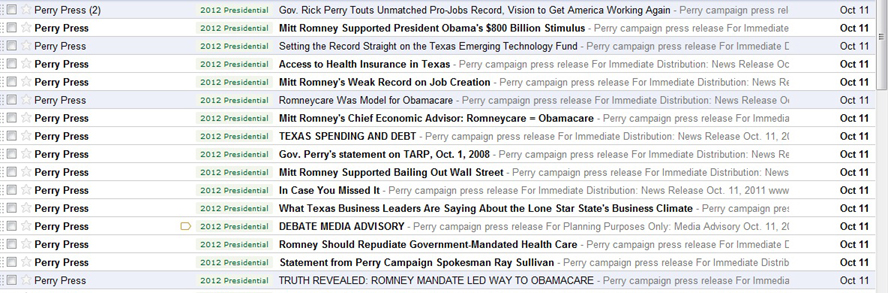
That’s the conclusion that I draw from the fact that I have received 16 email releases from his campaign in less than 24 hours (typical headline: “TRUTH REVEALED: ROMNEY MANDATE LED WAY TO OBAMACARE.”)

Thus far, that’s the only conclusion about them I’ve been able to reach. I certainly haven’t had time to read them all. And I have… 139 other new emails to deal with in that one account before I can get down to any actual work today. Either that, or I can ignore my Inbox and have twice as many tomorrow.

In any case, I thought I’d report the salient fact: Perry has a very eager, very energetic media staff.

Meanwhile, no word from current front-runner Herman Cain. Perhaps I should sign up for his stuff. Or wait a week, and see who the new flavor of the month is.

A weird political season.

By the way, anyone see the debate last night? I didn’t get home until after it had started, and it wasn’t on any of the few TV stations I now get, and I got out my laptop to try to find it, got distracted by some comments here on the blog, and eventually decided to eat some dinner.

Anyway, if you saw it, any thoughts?

‘Obama: A disaster for civil liberties’… Really?

On my way back to the office from Rotary today, I heard this guy Jonathan Turley on NPR going on and on about how Barack Obama is — gasp — “worse than Bush” on civil liberties (or words to that effect; I wasn’t taking notes while driving).

Conveniently, he wrote out his thoughts on this in an op-ed piece in The Los Angeles Times recently. An excerpt:

Civil libertarians have long had a dysfunctional relationship with the Democratic Party, which treats them as a captive voting bloc with nowhere else to turn in elections. Not even this history, however, prepared civil libertarians for Obama. After the George W. Bush years, they were ready to fight to regain ground lost after Sept. 11. Historically, this country has tended to correct periods of heightened police powers with a pendulum swing back toward greater individual rights. Many were questioning the extreme measures taken by the Bush administration, especially after the disclosure of abuses and illegalities. Candidate Obama capitalized on this swing and portrayed himself as the champion of civil liberties.

However, President Obama not only retained the controversial Bush policies, he expanded on them. The earliest, and most startling, move came quickly. Soon after his election, various military and political figures reported that Obama reportedly promised Bush officials in private that no one would be investigated or prosecuted for torture. In his first year, Obama made good on that promise, announcing that no CIA employee would be prosecuted for torture. Later, his administration refused to prosecute any of the Bush officials responsible for ordering or justifying the program and embraced the “just following orders” defense for other officials, the very defense rejected by the United States at the Nuremberg trials after World War II.

Obama failed to close Guantanamo Bay as promised. He continued warrantless surveillance and military tribunals that denied defendants basic rights. He asserted the right to kill U.S. citizens he views as terrorists. His administration has fought to block dozens of public-interest lawsuits challenging privacy violations and presidential abuses.

But perhaps the biggest blow to civil liberties is what he has done to the movement itself. It has quieted to a whisper, muted by the power of Obama’s personality and his symbolic importance as the first black president as well as the liberal who replaced Bush. Indeed, only a few days after he took office, the Nobel committee awarded him the Nobel Peace Prize without his having a single accomplishment to his credit beyond being elected. Many Democrats were, and remain, enraptured…

As you know, I have commented upon the same phenomenon myself, only not as a bad thing. From my endorsement of his tough talk about Pakistan in 2007 to my praise of his national security continuity right after the election, through my noting the end of the “Kent State Syndrome,” I’ve been pretty laudatory.

What’s really amazing about Obama is that he managed to persuade people before the election, and many after, that he’s this antiwar guy who was going to undo all the supposedly wicked deeds of the Bush administration. I wasn’t hearing that.

But even I was unprepared for how much further Obama would take things than Bush. I guess he’s able to do it because he has the political permission within his own party. Sort of like it took Nixon to go to China, Obama is allowed the latitude to more aggressively pursue the (I’m going to use the term that his base avoids) global War on Terror. As you recall, I made the analogy earlier that Bush was like Sonny Corleone (the blusterer who had trouble getting the job done), and Obama is Michael (who speaks softly and convinces everyone he’s the peaceful don, but wipes out his enemies efficiently without a word of warning). Of course, I don’t see them as heading a criminal enterprise. Others disagree.

It really does put Democrats in a weird place. Some of my most reasonable Democratic friends used to make these extravagant claims about how George W. Bush had trashed the Constitution. They really seemed to believe it. They are quieter now.

I don’t know WHAT I think about the ‘Chinese currency manipulation’ thing. You?

I don’t know what I think about the issue that Lindsey Graham keeps going on about:

Graham Responds to Chinese Government Criticism of Senate on Vote over Currency Manipulation

WASHINGTON – U.S. Senator Lindsey Graham (R-South Carolina) made this statement in response to criticism from the Chinese government’s Central Bank, Foreign Ministry and Ministry of Commerce over Senate legislation to crack down on Chinese currency manipulation. (Articles below.)

Last night, the Senate voted to proceed to debate on legislation cracking down on Chinese currency manipulation.  The procedural vote was 79-19.  The Senate continues to debate the legislation today.

Graham said:

“China’s threats to the United States Senate should fall on deaf ears.  We should be examining their business practices, not their rhetoric.  China should be rewarded and engaged when they play fair and we should push back when they continue to cheat.

“The Chinese government’s criticism of our efforts to bring about long-overdue currency reform is ill-advised.  We all want a healthy trading relationship with China, but their business practices – from intellectual property theft to currency manipulation, has created an unhealthy business relationship.

“China’s pegging of the yuan to the dollar and keeping it consistently undervalued continues to create a competitive advantage for the Chinese.  China has too big of an economy to allow them to continue creating an unfair trade advantage.  Chinese currency manipulation has resulted in 2 million jobs being lost in the United States and over 40,000 in South Carolina.  China must stop cheating.”

#####

How would I know? Like I’m an international currency expert or something.

I know what my gut reaction is — to be mad at the Chinese for being all unfair to us and everything. But what does my gut know about fair currency policy?

From what I hear, what they do is fairly standard practice for developing economies. And they DO have a developing economy — a humongous, planet-eating developing economy, but still…

That’s it. I just exhausted by expertise on this.

Gov. Perdue did have a point, you know

Speaking of emails, I just got this one from Joe Wilson:

What is Governor Perdue thinking?

She suggested recently that we shouldn’t hold a Congressional election in 2012 because you might hold your Congressional representatives accountable for the decisions they make.

Isn’t this what our country is all about? Aren’t you supposed to hold your elected officials accountable for the decisions they make?

By holding elections, you have the opportunity to send a message to your leaders, one that can have a very immediate and permanent effect.

This knowledge makes those of us in Congress aware of what our constituents want back home. It keeps us accountable. Without it, we could pass legislation in Washington that only benefited a select few.

That’s not how our country works, no matter how beneficial Gov. Perdue thinks it would be.

Your voice is important, and I consider your will as I cast my vote for any piece of legislation.

Actually, I think the lady had a point. All due respect to the Framers’ wisdom in putting “the people’s House” in perpetual election mode (which sort of got watered down when we started directly electing senators), but I have to wonder… what do we accomplish in these rituals every two years?

You know what will happen in 2012? Joe will raise a whole lot of money through emails such as this one, and the ones in which he exploits his “You Lie!” moment, and he will spend it, and he will be re-elected.

Same thing will happen with Jim Clyburn over in the 6th. I can’t speak to what will happen in the other four SC districts because I don’t observe them as closely, and the incumbents are all so new. So perhaps they are slightly more vulnerable — although probably not Tim Scott.

But Joe’s and Jim’s warchests and the power of incumbency will guarantee that no one credible emerges to run against them, and they will be re-elected.

And yes, I know that Doug and others will say this is why we need term limits. I’m not willing to drop that particular nuclear option on democracy, but we do need something. Because otherwise, these elections pretty much are a waste of time. Except to the political consultants and the media that get the advertising, of course. (See, Wesley, I didn’t just talk about you — I talked about the media, too.)

And if he’d made a different decision, he’d have been a big, fat jerk. With the emphasis on ‘fat’

Catching up on email, I had to smile at this one from yesterday:

Statement by Gov. Perry Regarding Gov. Christie’s Announcement

AUSTIN – Gov. Rick Perry today released the following statement regarding New Jersey Gov. Chris Christie’s announcement earlier today:

“Chris Christie is a friend, a great governor and rising star in the Republican Party.  I’m sure this was an exciting and stressful process for Chris, Mary Pat and his family, but I know they have a bright, successful future ahead of them. Gov. Christie will be a strong asset for the Republican Party as we work to build a national movement to get America working again, reduce the influence of Washington in our lives, and defeat President Obama next year.”

Somehow, I knew before opening it that it would be laudatory. What made me smile was imagining how it might have read had Christie decided to run.

Of course now, as the AP notes, this puts him in the position to be “a kingmaker.”

So he’s a great guy to know. Really.

Guess who topped this list of dumb governor tricks? Yep, ‘Gov. Sunshine’…

I’m beginning to suspect that when people go to compile such things as this piece on Salon, “Why are the governors of America saying such dumb things?,” they look at South Carolina first. The very first example given was:

According to the Associated Press, South Carolina Gov. Nikki Haley announced at a cabinet meeting on Tuesday that forthwith, state employees are to answer official phones with a cheery, “It’s a great day in South Carolina!”

Gee whiz, that should solve everything! As AP noted, “Never mind the state’s 11.1 percent jobless rate and the fact that one in five residents are on Medicaid.” Great day, indeed. Presumably, Gov. Sunshine plans to accompany the next set of her state’s unemployment figures with a chorus of “We’re in the Money.”

Which frankly isn’t even fair. It’s not even something Nikki said; it’s something she made everybody else say, which therefore goes into the category of dumb things governors do.

If they wanted something she said, they could have gone to the thing Cindi was writing about — the one about all the drug fiends applying to work at SRS. She apparently said that one over and over, which should have qualified for extra points.

But I’m really tired of national media, and comedians, looking first to South Carolina for material (as Jon Stewart keeps saying, “THANK YOU, South Carolina!”).

I’m even more tired with our politicians giving them reason to.

The anti-U.S. lawsuit brought by a “conservative watchdog group”

All I have to say for the moment is that I agree completely with the government on this one:

(AP) WASHINGTON – Public disclosure of graphic photos and video taken of Osama bin Laden after U.S. commandos killed him would damage national security and lead to attacks on American property and personnel, the Obama administration contends in court documents.

Here’s the lame argument for releasing the images:

Tom Fitton, president of Judicial Watch, accused the Obama administration of making a “political decision” to keep the bin Laden imagery secret. “We shouldn’t throw out our transparency laws because complying with them might offend terrorists,” Fitton said in a statement. “The historical record of Osama bin Laden’s death should be released to the American people as the law requires.”

As you’ll recall, I disagreed with Lindsey Graham about this subject earlier. He was right at the Abu Ghraib pictures, but wrong about this.

And while the AP is just doing its job as it sees it, I believe its own request should be denied as well:

The Associated Press has filed Freedom of Information Act requests to review a range of materials, such as contingency plans for bin Laden’s capture, reports on the performance of equipment during the assault on his compound in Abbottabad, Pakistan, and copies of DNA tests confirming the al Qaeda leader’s identity. The AP also has asked for video and photographs taken from the mission, including photos made of bin Laden after he was killed.

The Obama administration refused AP’s request to consider quickly its request for the records. AP appealed the decision, arguing that unnecessary bureaucratic delays harm the public interest and allow anonymous U.S. officials to selectively leak details of the mission. Without expedited processing, requests for sensitive materials can be delayed for months and even years. The AP submitted its request to the Pentagon less than one day after bin Laden’s death.

OK, maybe not denied. I think a delay of maybe 25 years would be about right. Leave it to historians. Ones with strong stomachs.

A lot of people — including a lot of this administration’s strongest supporters — don’t believe there is such a thing as information that should be withheld for national security reasons. They are wrong. One can have arguments about what should be classified and what should not, but the fact remains that some things should be.

The end (almost) of violence

In my previous post, I referred to the “peaceful times” in which we live. That’s counterintuitive for many people, for two reasons: First, modern communications make them aware of far more, and more widely spread, instances of violence than they would have known of in previous eras. And second, those things grab our attention — indeed, they are reported in the first place — because they stand out as exceptions to the peaceful rule.

There’s a very good piece in The Wall Street Journal today (there are always so many wonderful pieces in that paper on Saturdays — the only day I take now, after my subscription price more than doubled) taking the long view, and explaining why “we may be living in the most peaceable era in human existence.” None of what it says is surprising or new — except perhaps for the statistics — but it’s nice when someone takes a moment and pulls it all together.

In “Violence Vanquished,” Steven Pinker describes six major declines in violence through human history. The first is one that our friends who believe that government is the worst plague ever visited upon mankind should contemplate:

The first was a process of pacification: the transition from the anarchy of the hunting, gathering and horticultural societies in which our species spent most of its evolutionary history to the first agricultural civilizations, with cities and governments, starting about 5,000 years ago.

For centuries, social theorists like Hobbes and Rousseau speculated from their armchairs about what life was like in a “state of nature.” Nowadays we can do better. Forensic archeology—a kind of “CSI: Paleolithic”—can estimate rates of violence from the proportion of skeletons in ancient sites with bashed-in skulls, decapitations or arrowheads embedded in bones. And ethnographers can tally the causes of death in tribal peoples that have recently lived outside of state control.

These investigations show that, on average, about 15% of people in prestate eras died violently, compared to about 3% of the citizens of the earliest states. Tribal violence commonly subsides when a state or empire imposes control over a territory, leading to the various “paxes” (Romana, Islamica, Brittanica and so on) that are familiar to readers of history…

Since those days, violent death has shrunk to less than 1 percent, even if you factor in war-caused disease and famine. Oh, and we’re not just talking about good or benevolent government. Even the plunder economy of the Romans had its positive effect:

It’s not that the first kings had a benevolent interest in the welfare of their citizens. Just as a farmer tries to prevent his livestock from killing one another, so a ruler will try to keep his subjects from cycles of raiding and feuding. From his point of view, such squabbling is a dead loss—forgone opportunities to extract taxes, tributes, soldiers and slaves…

And this is not just about pointing out how wrong the Tea Party is (although deeply wrong it certainly is). Some of our other friends on the left view commerce as though the taking of profit itself were inherently evil and destructive to mankind. Quite  the contrary; it is a civilizing force just as is a well-ordered government (which is why the haters of government and the socialists are both wrong):

Another pacifying force has been commerce, a game in which everybody can win. As technological progress allows the exchange of goods and ideas over longer distances and among larger groups of trading partners, other people become more valuable alive than dead. They switch from being targets of demonization and dehumanization to potential partners in reciprocal altruism.

Finally, back to that matter of perception. If you wish to be simplistic, you can say it’s “the media’s fault,” for always telling you about the bad things rather than the good. If you ever spent, say, a month having to make decisions for a media outlet, you would realize how foolish that is. Even when times were flush, a newspaper’s or television station’s resources, and claim on your time, were finite. If you’re a town crier, your job is to tell people about the one house that’s on fire, so they can rise up and do something about it. You are useless if you instead say, “99.9 percent of the houses in the village are fine.”

That’s not to say I don’t decry the effect. In the grand scheme, media have had a devastating effect on society simply by playing their rightful role as government watchdogs. Over time, readers have come to the shockingly erroneous conclusion that government is nothing but crooks and waste, and the ability of government to be that civilizing force has been seriously weakened. As for violence — one of the most distressing developments of recent years in media is the rise of 24/7 TV news, which creates unlimited time that has to be filled. Consequently, violent crimes that would have been purely local stories 30 years ago are now thrown in the faces of the world constantly. There’s always something bad happening somewhere. This type of coverage creates the impression that it’s happening everywhere all the time.

If you can gain access to the full piece, it’s worth reading. So might be Mr. Pinker’s book, The Better Angels of Our Nature: Why Violence Has Declined.

Full engagement, the only viable, effective and moral stance for the U.S. to take toward the world

Posting that column last night — the one from 9/23/01 — I realized that I had forgotten to post something else a week earlier.

When I shared with you the hasty column I wrote for the “extra” we put out on 9/11, and the one I turned around immediately and wrote for the next day, I had fully intended also to share a more important piece from several days later — the editorial I wrote for that following Sunday. But the 16th of this month came and went, and I failed to do that.

So I share it now. Being an editorial (an institutional, rather than personal opinion) and being a Sunday piece (when newspapers take a step back from immediate events, and also when they tend to express the views they regard as being of greatest import), it’s different from the other pieces. Less of my voice and style, more formalized. But at the same time, for the purposes of this blog, it also has perhaps greater value as a clear expression of my own views of what the nation should do going forward.

In it, I expressed views I had long held, and still hold, but they were sharpened and set into relief by the events of that week.

Spoiler alert: Basically, this piece is about a couple of things. The first is the need for re-engagement in the world, after a growing isolationism that had worried me all through the 90s. With notable exceptions — our involvement in the Balkans, for instance — we had become more insular, more preoccupied with our own amusements as a fat, happy nation. Up to that point, I had objected on the basis that when you are the world’s richest and most powerful nation (indisputable after the fall of the USSR), it is morally wrong to turn your back on the world, like a rich man behind the walls of his gated community. What 9/11 did was add to that the fact that such disengagement was positively dangerous.

The other main point is something I later learned an interesting term for: DIME, for “Diplomatic,” “Information,” “Military” and “Economic.” Actually, that’s not quite it, either. The DIME term refers to ways of exerting power, and that it certainly part of it, but not all of it. Another piece of the concept I was talking about was what you often hear referred to as “soft power.” Unfortunately, that is often mistakenly expressed as an alternative to “hard power.” But they complement each other. A unipolar power trying to achieve all of its goals through either alone is doomed to fail, ultimately.

No, I have to go back to the earlier, vaguer term: Engagement. On every level you can think of — diplomatic, cultural, mercantile, humanitarian, and yes, military.

Much of this piece, given the moment in which it was written, is occupied with the military part. That’s natural. That’s the hardest to persuade people of in our peaceful times (if you doubt we live in peaceful times, I plan a post after this one to address that). The rest, people just nod about and say, yes, of course we should do those things. (OK, perhaps I’m being a bit sanguine about that. I’ll just say that the people who need convincing on the military part are likely to say that — others are likely to say ‘Hell, no — let them fend for themselves.” And thus we have the two sides of isolationism.) They take more convincing on the tough stuff. (Some of you will object, “Not after 9/11! People’s blood was boiling!” But that’s not what I’m talking about. I’m not talking about passions of the moment. I was talking about long-term policy. I’m talking about what happens after people calm down and say, Never mind; let’s just withdraw.)

Reading it now, I wish the piece had been longer, with far more explication of the other elements, and how they were integrated. The following years, we saw constant argument between two views, neither of which saw the value of the whole concept. On the one hand, you had the Bushian — really, more the Rumsfeldian — notion that all you had to do was topple a tyrant and things would be fine. On the other, there was the myopic view that soft power was the only kind that was moral and effective.

These ideas are as relevant now as ever. Now that we have employed hard power to topple a tyrant in Libya, will we engage fully on other fronts to help Libya have a better future, one in which it has a chance of being a long-term friend, ally and trading partner? Or will we turn our attention away now that the loud noises have stopped going off?

Anyway, I’ve explained it enough. Here it is:

IN THE LONG TERM, U.S. MUST FULLY ENGAGE THE WORLD

State, The (Columbia, SC) – Sunday, September 16, 2001

IF YOU HAD MENTIONED the words “missile defense shield” to the terrorists who took over those planes last Tuesday, they would have laughed so hard they might have missed their targets.

That’s about the only way it might have helped.

Obviously, America is going to have to rethink the way it relates to the rest of the world in the 21st century. Pulling a high-tech defensive blanket over our heads while wishing the rest of the world would go away and leave us alone simply isn’t going to work.

We are going to have to drop our recent tendencies toward isolationism and fully engage the rest of the world on every possible term – military, diplomatic, economic and humanitarian.

Essentially, we have wasted a decade.

After the Berlin Wall fell and the Soviet Union crumbled, there was a vacuum in our increasingly interconnected world, a vacuum only the United States could fill. But we weren’t interested. After half a century of intense engagement in world affairs, we turned inward. Oh, we assembled and led an extraordinary coalition in the Gulf War – then let it fall apart. We tried to help in Somalia, but backed out when we saw the cost. After much shameful procrastination, we did what we should have done in the Balkans, and continue to do so. We tried to promote peace in the Mideast, then sort of gave up. But by and large, we tended our own little garden, and let the rest of the world drift.

We twice elected a man whose reading of the national mood was “It’s the economy, stupid.” Republicans took over Congress and started insisting that America would not be the world’s “policeman.”

Beyond overtures to Mexico and establishing a close, personal relationship with Vladimir Putin, President Bush initially showed little interest in foreign affairs.

Meanwhile, Russia and China worked to expand their own spheres of influence, Europe started looking to its own defenses, and much of the rest of the world seethed over our wealth, power and complacency.

Well, the rest of the world isn’t going to simply leave us alone. We know that now. On Tuesday, we woke up.

In the short term, our new engagement will be dominated by military action, and diplomacy that is closely related to military aims. It won’t just end with the death or apprehension of Osama bin Laden. Secretary of State Colin Powell served notice of what will be required when he said, “When we’re through with that network, we will continue with a global assault against terrorism in general.” That will likely mean a sustained, broad- front military effort unlike anything this nation has seen since 1945. Congress should get behind that.

At the moment, much of the world is with us in this effort. Our diplomacy must be aimed at maintaining that support, which will not be easy in many cases.

Beyond this war, we must continue to maintain the world’s most powerful military, and keep it deployed in forward areas. Our borders will be secure only to the extent that the world is secure. We must engage the help of other advanced nations in this effort. We must invest our defense dollars first and foremost in the basics – in keeping our planes in the air, our ships at sea and our soldiers deployed and well supported.

We must always be prepared to face an advanced foe. Satellite intelligence and, yes, theater missile defenses will play roles. But the greatest threat we currently face is not from advanced nations, but from the kinds of enemies who are so primitive that they don’t even have airplanes; they have to steal ours in order to attack us. For that reason, we must beef up our intelligence capabilities. We need spies in every corner of the world, collecting the kind of low-tech information that espiocrats call “humint” – human intelligence. More of that might have prevented what happened last week, in ways that a missile shield never could.

But we are going to have to do far more than simply project military power. We must help the rest of the world be more free, more affluent and more democratic. Advancing global trade is only the start.

We must cease to regard “nation-building” as a dirty word. If the people of the Mideast didn’t live under oligarchs and brutal tyrants, if they enjoyed the same freedoms and rights and broad prosperity that we do – if, in other words, they had all of those things the sponsors of terror hate and fear most about us – they would understand us more and resent us less. And they would, by and large, cease to be such a threat to us, to Israel and to themselves.

This may sound like an awful lot to contemplate for a nation digging its dead out of the rubble. But it’s the kind of challenge that this nation took on once before, after we had defeated other enemies that had struck us without warning or mercy. Look at Germany and Japan today, and you will see what America can do.

We must have a vision beyond vengeance, beyond the immediate guilty parties. And we must embrace and fulfill that vision, if we are ever again to enjoy the collective peace of mind that was so completely shattered on Sept. 11, 2001.

Thaddeus McCotter Shocker!!!

This just in! The dynamics of the 2012 race for the White House have inexorably shifted!

Rep. Thaddeus McCotter withdraws from 2012 presidential race

The Michigan Republican and former House Republican Policy Committee chairman on Thursday dropped out of the GOPpresidential battle.

McCotter told the Detroit News that he was frustrated because he could not win access to the presidential debates, one of which is taking place tonight among nine other major GOP candidates in Florida. He plans to seek reelection to his 11th district.

McCotter told the newspaper he plans to back former Massachusetts governor Mitt Romney, although Texas governor Rick Perry is also a good candidate, but better suited for the vice presidency.

Yeah, I didn’t know he was running, either. Nor had I ever heard of him. But I suppose it’s like the Butterfly Effect. This flutter of wings in an obscure corner could change everything. Or not.

Cool name, though: Thaddeus McCotter. Another potential band name, in the style of Jethro Tull and Uriah Heep. Doesn’t have quite the same punch, though…

Sen. Graham, ‘opting out’ would leave South Carolina with no options at all

I’ve just been shaking my head ever since I read this release a day or two ago:

WASHINGTON – U.S. Senators Lindsey Graham (R-South Carolina) and John Barrasso (R-Wyoming) will hold a press conference tomorrow to discuss legislation they plan to introduce, the Medicaid Flexibility for States Act, which enables states to ‘Opt-out’ of the Medicaid expansion mandate included in Obama health care law.

And now they have introduced it.

Here’s the thing, Sen. Graham: The health care reform bill passed by Congress was far from perfect. This is thanks in part to your friend and mine (more your friend than mine, but I still respect you, him and John McCain as much as or more than anyone else in the Senate), Joe Lieberman, who blocked key provisions that could have made it more worthwhile.

But it might help. When fully implemented, it will offer some alternatives to depending upon overburdened employers for this benefit, and create at least the beginning of the kind of national pool insured that would make the most sense and benefit the most Americans. Oh, and to go back to the beginning of the sentence: “When fully implemented…” Neither you nor anyone else has even given this legislation a chance to either succeed or fail.

You’re fond of saying that “elections have consequences.” I agree, and always have. But so do votes of Congress. And while this falls far short of the kind of all-purpose nullification we’ve unfortunately seen revived over in the Legislature as our lawmakers have gone careening off into anachronistic extremism, it is still at the very least unseemly for you to be moving to exempt South Carolina from this national law. Yeah, I get that you think you are protecting South Carolina from something. But I submit that in protecting us from the bad effects that you anticipate, you would also be preventing us from receiving any benefit which you may not be able to see.

And since we desperately need something to broaden access to medical care, and you and I both know that the Legislature of this state is NOT going to do anything to help on its own — quite the contrary — it is unconscionable to try to prevent South Carolinians from reaping any such benefit.

For South Carolinians, this is it. There is no state solution. (I don’t believe any state can do it on its own, but set that aside; I know South Carolina won’t.) This is our only chance. If you “opt out” on our behalf, you’ve opted us out of any chance to get greater access to effective, affordable, portable health care.