Category Archives: The Nation

Perry ad serves notice: If he’s the nominee, it’s going to be a fight

Thought you might be interested in this, which Slate called “Perry’s awesome new ad,” and indeed the production values are good. Never mind that he’s looking right past his rivals at the ultimate target of the GOP. But I think he figures that’s what Republican voters want to see.

At first the ad looked sort of familiar — didn’t someone do one much like this in the past month? But then I heard and saw the very new quotes and headlines, and realized it is indeed brand-new.

See what you think.

Wow, he actually did say it. He actually did say he should not be taxed on that leftover $400,000

Visit msnbc.com for breaking news, world news, and news about the economy

At first, I thought nobody would be as stupid as to actually complain about the idea of increased taxes by saying that he, personally, only had $400,000 left over after “feeding his family” and paying his taxes.

And indeed, when I watched the interview with this Tea Party guy John Fleming, I thought for a moment that I was right, that he was actually saying something different. I thought he was saying that he was talking about money he needed to invest in his business and create jobs.

But then… the guy has $400,000 left out of a $6 million business after he has paid all of his business’ operating expenses and his personal and business taxes and met his family’s needs? Really?

This isn’t a Silicon Valley entrepreneur from the late ’90s. He’s not exploring exciting new ways to transform our economy. Nor is he producing high-paying jobs with futures. This guy owns Subway franchises.

So you’re saying, you can’t contribute to paying down the deficit because it might… hamper your ability to open another Subway every year or so? And your failure to do that is going to kill the economy?

I suppose you could argue that he’s right. I could mount such an argument if forced to. But not even I would be persuaded.

Actually, was he even saying that? Since he is deliberately mingling his business revenues with personal income, it’s confusing. But another way to look at it is that he takes home $600,000, which seems to be a whopping 10 percent of his businesses’ total revenues. And then he seems to say that his family’s needs are fully met with one-third of that, and I suppose that’s true. A family could, just maybe, scrape by on 200k a year if they were really careful.

And then he’s got $400,000 left over. He’s making out like this is his businesses’ money rather than his money, but then he is deliberately confusing the two.

It just gets worse and worse…

Is Lamar Alexander about to do something very cool — from an UnParty perspective?

I’m puzzling, hopefully, over what this means:

The no. 3 Republican in the Senate will step down from his leadership position early next year, despite having no plans to retire from Congress.

Lamar Alexander informed his fellow GOP colleagues of his rather surprising decision on Tuesday morning in a letter obtained byPolitico, saying that the move was the best decision for him and the Senate.

“Stepping down from leadership will liberate me to spend more time working for results on the issues I care most about,” the 71-year-old former Tennessee governor wrote. “I want to do more to make the Senate a more effective institution so that it can deal better with serious issues. There are different ways to provide leadership within the Senate. After nine years here, this is how I believe I can now make my greatest contribution. For these same reasons I do not plan to seek a leadership position in the next Congress.”…

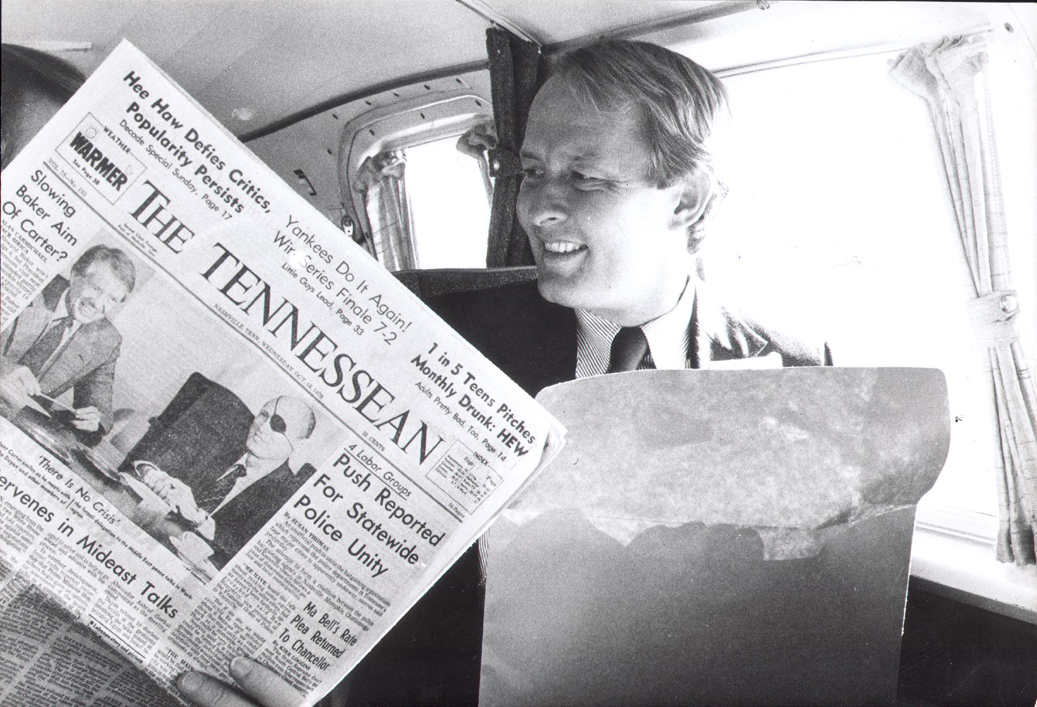
I’ve respected Lamar Alexander since  I covered him in his first successful run for governor in 1978, spending a good bit of time with him on the road (OK, so I was on the road with him 24/7 for one week before switching over to cover his opponent, but it was enough time to form a positive impression).

Lamar was never a guy you get particularly excited about. He was… bland. One of the most striking things about him was how much his speaking voice sounded like Pat Boone’s. (Once, I heard a PSA on the radio by Boone, and I thought it was the governor until he identified himself at the end — or was it the other way around?) His much-publicized walk across Tennessee in the trademark red-and-black shirt was SO contrived, such an earnest bid to be interesting, that I would joke about it, while at the same time appreciating his seriousness. He was what Tennessee needed after the rollicking corruption of Ray Blanton (who had defeated him four years earlier, on the very first election night of my newspaper career, when I was a copy boy at The Commercial Appeal). I would joke that Lamar’s main appeal to the voters was to subliminally project, “I won’t steal the silverware from the governor’s mansion.” But after Blanton, that was progress.

Turned out that there was a lot more progress to come with Alexander. He was different from any Republican governor I have seen since. He started out appointing Democrats to his Cabinet (his chief political adviser was someone who had worked for Democrats), and he reached out to the Democratic majority in the legislature to get his agenda passed, including significant movement toward merit pay for teachers. From day one, he was about raising the incomes of the average Tennessean, and he was for working with whomever it took to get that done. He worked particularly productively with the iconic speaker of the House (and later governor) Ned Ray McWherter.

He has served his state, and now his country, with pragmatic dedication and moderate sensibilities. So I’m sorry to see him leave leadership.

And puzzled. What does he mean he can be more effective outside that role? There’s a hint in the original Politico story:

Alexander says the decision was rooted in his desire to foster consensus in the gridlocked Senate, a role he felt constrained playing while spearheading the partisan Senate GOP messaging machine.

That sounds very cool — and even, despite this being Lamar Alexander, exciting. In an UnParty sense. I’d love to hear an elaboration on that. It would be nice to have back about 15 minutes of that time I spent riding around with him in cars and planes back in the day. I think I’d have more interesting questions now…

On the campaign plane with Alexander, back in the day./Brad Warthen

On Jim Clyburn, earmarks, race, and representing a poor district

I’ve never liked one thing that traditionally has been core to the makeup of members of Congress: bringing home the bacon.

Yes, I know it’s a particularly honored tradition in South Carolina, from Mendel Rivers through Strom Thurmond and on and on. This state was devastated in The Recent Unpleasantness, and it was sort of natural in subsequent generations for folks to want their elected representatives to bring home Yankee bacon whenever possible.

Doesn’t mean that’s the right way to run a government. The federal government should look at the entire country and decide where it needs to build military bases or roads or bridges or place programs of any sort, according to which locations best suit the needs of the whole nation. Or where the greatest need for a particular service might be at a given time — such as disaster services. Largess should not flow according to which lawmakers has the most pull.

Congress has been so bad about this that when we decided we needed to close some military bases the nation no longer needed, we had to set up BRAC to prevent interference by individual members of Congress. It’s been a successful process, but the need for it testifies to a painful failure of our basic system of government.

Congressional pull is not the way to set priorities for our government. This is particularly obvious to a lot of people when we look at spending, but I’ve always been concerned that it’s just a bad policy all-around for making effective decisions for the country. And it disenfranchises Americans whose representatives have less pull.

So it is that I’ve been pleased (in general) with Jim DeMint’s efforts to stop earmarks (which are actually only a small part of the problem), and have never been much of a fan of Jim Clyburn’s more traditional bring-home-the-bacon approach.

But I’m not without sympathy for Clyburn. To explain why, I’ll share a story that at first may seem unrelated. I did not witness this, but I’ve heard about it.

A large part of why Jimmy Carter was elected in 1976, as you will recall, was that he proposed to clean up government. No more Watergates. He promised, although we didn’t yet use this word for it back then, transparency. It was a huge deal; he was never going to lie to us. So after the election, there was a meeting in Columbia of people who had worked in his campaign in South Carolina. Probably a pretty big meeting, since back in those days, we actually had some Democrats in this state. And the Carter guy who was conducting the meeting told them that they shouldn’t expect any inside track on getting positions in the new administration. Everything was going to be open and aboveboard and a level playing field, and there was to be no smoke-filled room patronage.

One of the campaign supporters in the room, a local black leader who was then quite young (I’d want to talk to him and refresh my memory of the story’s details before using his name), protested, “But we just got into the room, and we just started smoking.”

Which was true enough. And more than once have I heard such protests from black politicians — now that we have some political influence, you want to weed such influence out of government.

Well, yes, I do. And I’m sorry some folks just got into the room, but we’ve had enough of that kind of politics.

Nevertheless, I am sympathetic to Jim Clyburn’s desire to get some federal investment into parts of the state that were bypassed when white politicians were grabbing federal resources for South Carolina. This isn’t about unsavory practices; this is about funds that will be distributed somewhere, so why not in your neglected district? Perfectly understandable. Even admirable. So while I am against, for instance, the bridge he wants to build between Lone Star and Rimini, I understand his desire to get some infrastructure into that area that might help economic development flow in behind it.

Against this background, I was interested in Warren Bolton’s column in The State today. I had actually missed it in a cursory skim through the paper this morning (I was conversing with several people while perusing), so I’m glad that my attention was called back to it by a release from, quite naturally, Jim Clyburn’s office. It was headlined, “Earmarks saving grace for Clyburn’s district.” An excerpt:

Frankly, I think the free-wheeling system that has allowed members of Congress to target pet projects for funding is too loosely monitored and arbitrary and, therefore, can be wasteful. But I don’t think that earmarks in general are bad; they can be used to make sure worthwhile projects are funded. In addition to a lack of transparency, the big problem is that the system doesn’t ensure that those important things get done.

But Mr. Clyburn didn’t invent this system. It was in place eons before he even arrived in Congress. Given that those in his district have grave needs that aren’t being met by the state, which has yet to come up with an effective way to address rural challenges that can’t be met by cash-poor local governments, he’s doing what he can.

It’s amazing to me how so many in this state can criticize Mr. Clyburn’s actions when they should be familiar with the challenge of rural South Carolina. While we get many letters to the editor from writers taking issue with Mr. Clyburn on legitimately debatable grounds, such as his positions on issues, his philosophy and even his use of earmarks, many others make statements and accusations that are just plain unfair, false and — quite frankly — racist….

I, like Warren, have fielded some of those calls — and emails, and letters, and blog comments. And while I may often agree with the person commenting that a particular spending proposal is a bad idea, it is disturbing to hear the undertone, the emotion that underlies the complaining. And Warren is right to use what he calls “the ‘R’ word” to describe this thing we hear. It’s the same undertone that I so often hear in the constant attacks on the very idea of public schools, or of government in general — because so many whites in our state, and in other parts of the country as well, have gotten it into their heads that government exists to take money away from honest, hard-working, moral, thrifty, sensible white people and give it, outright, to lazy, shiftless, no-good black people.

Not to put too fine a point on it.

Anyway, I’ve probably given you enough to discuss, but I’d like to point out another passage in Warren’s column:

I get lots of letters and calls from people who try to suggest that Mr. Clyburn can be a big spender and favor increasing taxes on the rich because he is insulated by voters in his “gerrymandered” majority-black district; some all but suggest that the congressman configured the 6th District himself.

But the truth is that Republicans in the S.C. State House gerrymandered the district in an effort to pack as many of the state’s black people together as possible so they could get as many Republicans as possible elected to Congress. That meant creating a majority-black district that has lots of rural areas that are heavily poor, undereducated and undeveloped. They’re areas that lack infrastructure such as water, sewer and roads — or libraries, theaters and bowling allies.

Amen to that Warren, and I’m glad to see you writing that, since I’m not at the paper to do it anymore.

I would amend his characterization of what happened slightly, though. I recall particularly what happened in the early ’90s in the Legislature: Republicans worked with black Democrats to draft a plan, over the resistance of the white Democrats who ran the SC House, that created several more majority-black districts.

Black lawmakers were frustrated with Speaker Bob Sheheen and other Democratic leaders because they were not willing to draw as many “majority-minority” districts as possible. The motivation of the Republicans was less direct. They had figured out that for every district you make majority black, you remove black voters from several other districts, thereby making those seats safe for Republicans, and unsafe for Democrats of any color. So, a tiny gain for those who wanted a few more black lawmakers, but a HUGE, strategic victory for Republicans who wanted to take over South Carolina.

Once that reapportionment plan was in place, the way to power was paved for the GOP. It put them in striking distance. They had big gains in the 1994 election. That, plus some key defections by white Democrats after the election (indeed, the earlier defection of David Beasley to the GOP had given them the head of their ticket), and we saw the Republicans take over the House in January 1995.

But I’ve reminisced enough. Time for y’all to have your say.

Moderates are rare in office, but fairly numerous out here in the real world

The other day, Bart shared with me the following piece from The New York Times. Before I provide an excerpt, I’ll share what Bart had to say first:

Brad,

I am copying and pasting an article in the NYT about Jim Cooper, a Blue Dog Democrat considered to be the last true moderate in the House.  A very good read.  FYI – linking to articles is not one of my strong points.

Personally, I think he has identified the turning point of politics in my lifetime and how things have devolved since Newt Gingrich, a man I have never liked for one second, was elected to congress.  Gingrich tries to come across as an intellectual but in my estimation, he is a man possessing a high I.Q. but without the ability to put it to proper use for the good of everyone, not just his own personal ambitions.

The article is a refreshing walk down memory lane when one considers the tone of things out there today.  There was a time when politics was populated with men and women who had a certain sense of duty to all citizens, not just party loyalty.

Thanks,
Bart

My response to Bart was to say:

I don’t know whether Cooper is the LAST, but there are precious few — in office. We’re not so rare out in the population.

Which is true. Unfortunately, our vaunted two-party system increasingly guarantees that moderates will not make it to Congress. No one has a chance in the fall without the backing of one party or the other. And the nominating process weeds out reasonable people, most of the time. Sort of makes me want to try running myself sometime, just to see how hard it would be. My prediction: Hard as getting a Republican to say something nice about Barack Obama. Or a Democrat about W.

Here’s the excerpt:

The Last Moderate

By 

Jim Cooper, a Blue Dog Democrat who represents the Nashville area, was first elected to Congress in 1982. He was 28, and if it’s not quite right to say he’s been there ever since — he spent eight years in the private sector after losing the race for Al Gore’s Senate seat — he’s still been a congressman most of his adult life.

You’d think that Cooper’s tenure would ensure him the privileges of seniority. It doesn’t. Considering that he’s a mild-mannered man, you’d think he’d have friends on both sides of the aisle. Not so. He’s loathed by Republicans for being in the wrong party, and scorned by Democrats for his fiscal conservatism. At the least, you’d think that he’d be respected for his institutional memory. Wrong again.

The reason is that Cooper is the House’s conscience, a lonely voice for civility in this ugly era. He remembers when compromise was not a dirty word and politicians put country ahead of party. And he’s not afraid to talk about it. “We’ve gone from Brigadoon to Lord of the Flies,” he likes to say….

Read the rest here.

Portrait of America on the 10th anniversary

OK, so I shot this on the day before 9/11/11, and I’m posting in on the day after, but I think it still works. I’m thinking this view of Charleston was pretty similar on Sunday.

This was something I shot spontaneously while waiting for traffic to move, coming out of a side street onto King Street in the Holy City on Saturday afternoon. I didn’t think much about it at the time. The image just seemed worth grabbing.

Not until late last night did I happen to see it on my phone, and really like it. I tried to post it then, while it was still 9/11, but I had trouble with my Internet connection. Eventually I went to bed.

But here it is now. How does it strike you? (Try clicking on it to blow it up and get the full effect of the blue and the gleaming buildings and the flag setting them off.)

What I wrote later in the day on 9/11/01

Yesterday, I showed y’all what I wrote in the first hour, more or less, after learning of the attacks in New York and Washington 10 years ago. That raw, stream-of-consciousness piece ran in the “extra” that The State put out that day.

As soon as I had handed that to the folks putting that special edition together, I turned to what we would say for the next day’s paper — for Sept. 12. Then, almost as quickly, but with the benefit of a couple of more hours to let the news sink in, I wrote the following column.

Still nothing I would hold up as one of my best pieces of work, but it has its moments. For me. See what you think. And remember again: This is not a piece written with the benefit of years of reflection:

NOW THAT REALITY EXCEEDS FICTION, WHAT SORT OF ENDING WILL WE WRITE?

State, The (Columbia, SC) – Wednesday, September 12, 2001

Author: BRAD WARTHEN , Editorial Page Editor

WE’RE IN TOM Clancy’s world now.

Mr. Clancy is derided as a writer by critics for many reasons, one of them being the fact that his plots tend to be so fantastic and contrived. Take his novel Executive Orders. It was too much to be believed. It opened with a 747 having been deliberately flown into the U.S. Capitol, shutting down the government. This is followed by a series of coordinated terrorist attacks that result in thousands of civilian deaths on American soil. And for most of the book, no one knows who is doing this to us, or why.

We now know what that’s like. In fact, what we are now facing is worse than Mr. Clancy’s fevered imaginings.

It may seem unbelievably frivolous to be thinking about pulp fiction at a time like this, but my mind keeps returning to it, and partly because this seems so much like something from the realm of fiction – or because I wish it were.

It certainly outstrips anything that’s happened on any one day in this nation’s real-life history.

The comparisons to Pearl Harbor are inevitable. But in so many ways this is different – and worse. The death toll is larger, and the bodies we’re counting – and will continue to count for some time – aren’t wearing uniforms. They didn’t sign up to fight. They were just going to work, in what they thought was a free and peaceful country.

It’s also worse because we don’t know where to go with our grief and our rage. On Dec. 7, 1941, those sailors looking up at the red suns on the wings of the planes that were killing their buddies knew exactly what to do – and so did the rest of the nation.

I wonder if we’ll ever know what to do about this, in the same, ultimately satisfying sense of being able to restore peace and security to our nation and world. Oh, when we find out who did this, there’s no question about what we’ll do in the short term. Give us a target, something to shoot back at, and it will soon be nothing but smoke and ashes.

It will be a very short war. But what will we do when it’s over? How will we deal with the other disaffected, unconnected people around the world who will take inspiration from Tuesday’s events? What can we do, and what will we do, about the fact that there are people who hate us for no better reasons than that we are strong, wealthy and free?

Pearl Harbor isn’t our only comparison. People have mentioned the explosion of the Challenger as being comparable – then, too, the nation watched in helpless horror as fellow human beings died, in real time. But as awful as it was, there were only seven dead. And we figured out how to fix it. It was a simple problem of engineering.

Better O-rings won’t take care of this.

There are no precedents. Nothing in our past was quite like this. Even the Civil War, the most traumatic event in our collective experience, was in a sense less unsettling, in that everyone had a clearer understanding of what was going on.

Just as we can take little comfort from the past, our future offers no solace. It’s certainly not going to be anything like what we expected.

Some of the changes will come only if we’re smart enough to make them happen ourselves. Americans are going to have to start caring more about foreign affairs, if we’re ever going to deal adequately with this challenge. We can’t just fire a few cruise missiles and then hide behind a magical “Star Wars” shield. We’re going to have to engage the world – or at least, we’re going to have to demand that our elected leaders do so. And those political leaders are going to have to set aside a lot of their petty, partisan differences – or we’re going to have to replace them.

In other ways, some kind of change is inevitable, and all we can do is pick between unsavory choices.

From now on, this nation will be either less safe or less free. The openness and the freedom of movement that we take for granted make us enormously vulnerable, a fact that is absurdly obvious today. I suspect that at least in the short term, we’ll choose being a little less free in order to be a little safer. And that’s a sad choice to have to make.

I said we’re in Tom Clancy’s world. That’s true up to a point. The biggest difference is that I know how the book ends – once Jack Ryan and the other fictional protagonists figured out who was attacking the United States, they made war upon them with devastating effectiveness. In the end, the nation emerged stronger than ever.

What will happen in real life? Our capacity to make war is undisputed. But in the long term, how will we ever be the same?

The fact is, we won’t be. Our challenge is to emerge as something better than we were, not something worse.

The first words I wrote after the planes hit

I think I’ve told this story before, but to recap…

In 2001, the senior staff of The State — the heads of all the newspaper’s divisions (including news, advertising, circulation, HR, finance, production, marketing and of course, editorial) — met with the publisher ever Tuesday morning at 9. On Sept. 11, 2001, we had just sat down when someone from the newsroom came to the door seeking John Drescher, who was then our managing editor. John told us that a plane had hit the World Trade Center, then left the room.

We had it in our minds that it was a big story, and certainly John needed to get started on it, but we were picturing (at least I was) another confused amateur pilot in a Beechcraft or something. The WTC bombing of several years earlier crossed my mind, but I didn’t take it seriously yet.

It seemed we had just resumed the meeting when Drescher burst back in and told Executive Editor Mark Lett (News and editorial each had two editors who were on Senior Staff. The newsroom was represented by Lett and Drescher, while Associate Editor Warren Bolton joined me in representing editorial) that a second plane had hit the other tower.

Now we knew it was a coordinated attack  on the United States.

That was it. Meeting over. Everybody jumped up. A few of us huddled over by the window and discussed putting out an “Extra,” before moving on to putting together the regular paper for the next day. I asked whether they’d like a column from editorial, just to inject a bit of opinion into the special edition. They said “yes,” and I went to get to work.

The first job was to get some sort of sense of what was happened — I mean the total picture, not just the Twin Towers (which probably had not yet collapsed as I began). That wasn’t easy. A  lot was happening at once — the Pentagon getting hit, the Capitol evacuated, the president up in the air, somewhere. And then there were some the unconfirmed reports that later proved to be untrue — I don’t even remember the details of them now, some sorts of smaller incidents going on in the streets of Washington. Once they were discounted, I forgot them so my brain could process all the other stuff going on.

Once I turned to my keyboard, it took me about 20 minutes to write the following. That didn’t keep Drescher from sending up messages from the second floor: Where’s the copy? We’ve gotta go. Of course, all news really had to do is grab the stuff coming in and put it on a page. I had to think about what it meant, on the basis of alarmingly incomplete information, and write it.

So you might say this was written in even more of a hurry than a similar number of words on the blog, and amid great confusion and a certain amount of duress. You can read that in these words. There’s some emotion, and some thoughts, there that wouldn’t have been there a day later, or even a few hours later. Very stream-of-consciousness. I wince at some of it now. But it’s a real-time artifact, at least of what was going through my head that morning. See what you think:

AMERICA WILL FIND A WAY TO PREVAIL AGAINST COWARDLY ENEMY

State, The (Columbia, SC) – Tuesday, September 11, 2001
Author: BRAD WARTHEN, Editorial Page Editor
Sometime within the next 24 hours, no doubt, some television talking head somewhere will say, “This doesn’t happen here.”
Yes, it does. It has.
It’s happened before, in fact. It just wasn’t this close to home.
We remember Pearl Harbor. We’ll remember this, too.
The question is, what will we do about it?
Two nights ago, the nation delved back into its history with a celebrated media event, the premiere of the television version of Stephen Ambrose’s “Band of Brothers.”
We marvel at how a previous generation responded to an unprecedented crisis – a sudden attack by a ruthless, remorseless enemy. We think of those people as the “greatest generation,” and they deserve that appellation because of the way they came together to settle their own crisis and secure our future.
And we all wondered: Are we like them? Do we have it in us?
We’re about to find out.
We’re about to find out if we can snap out of shock, pull ourselves off the ground, set our petty differences aside, and come together as a nation to deal with our enemies.
For now, there is no question that we have enemies. And these enemies are in many ways different from Imperial Japan. In some ways, they are worse.
Pearl Harbor was an attack upon a distant outpost of American military power. The attack, as sudden and dishonest and vicious as it was, was at least an attack that made strategic sense in traditional military logic. And while there were civilian casualties, the obvious primary target was our fighting men and their machines of war.
This time, there is no pretense of such rudimentary “decency,” if you want to stretch so far as to call it that.
This time, civilians were the target every bit as much – if not more so – as our men and women in uniform.
This was a strike – and a temporarily successful one – at the chief power centers that have given this nation the strength to stand astride the world as its only superpower.
We are the world’s largest economy, so they struck, with devastating effect, at the very symbolic heart of that strength.
We are the undisputed military champion of the world, guarantor of security not only for this nation but for the rest of the globe. And this time they struck not just battleships and sailors, but the nerve center of our military colossus.
The greatest gift this nation has given the world is our form of democracy. And they have shut down and evacuated our Capitol and the White House. The home of the most powerful man in the world stands empty, surrounded by nervous men with automatic weapons and itchy trigger fingers.
The nation that gave the world flight is frozen, earthbound, at a standstill.
We are stunned. This attack has been devastatingly successful. We don’t know who did it, and we don’t know how much there is to come.
Our response will have to be different from the response after Pearl Harbor. This appears to be a different kind of enemy – the worst kind of coward. An enemy who strikes, and ducks and runs and hides.
How to prevail against such an enemy and restore peace and prosperity to the land is not immediately apparent.
But we will find a way. This is the same nation that was laid low 60 years ago, by an enemy who thought we lacked the will or the know-how to stop them. They were wrong then, and they’re wrong now.
We may not be the greatest generation, but we are their grandchildren. We are Americans. We are shocked, and we will mourn.
But then we’ll dust ourselves off, and find a way.

Later, I briefly attended a newsroom meeting in which they were talking about the next days paper (the only time I remember doing that during my years in editorial), and then turned to directing my own staff and writing stuff for the next day. I’ll show you that tomorrow.

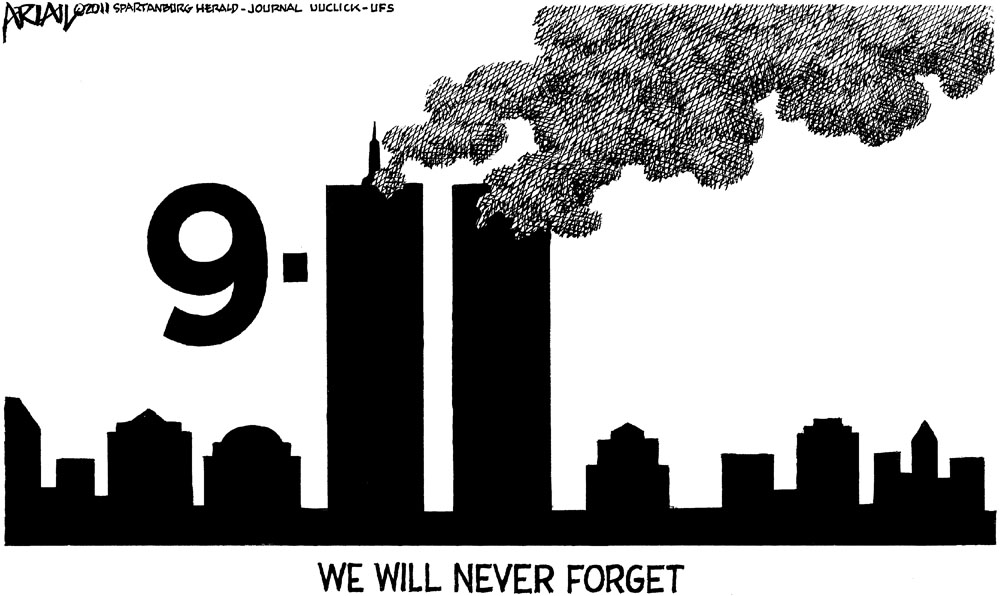
Robert Ariail’s take on the anniversary

When I told Robert Ariail I had cartoon for Sunday from Bill Day and asked for one from him, he was glad to share, as always.

He decided to go back to black-and-white for this one, which I (and I think he) both prefer. I think color looks great on a lot of things, but this medium is stronger, has more gravitas, in black and white.

He mentioned that this was one he had thought of several years ago, and when he described it over the phone, I remembered it from when we were at the paper. So often, Robert had strong cartoon ideas (usually, several in a day), but came up with something he liked better for that day and set the first ones aside. I’m glad this isn’t one that ended up thrown away.

Which makes me think of something. Ten years ago, Robert, and Bill, and my old friend Richard Crowson, all had steady, good jobs at newspapers. So did I, for that matter, although I didn’t have their sort of talent.

Just another way the world changed.

Huntsman’s looking better — to me, anyway

After I saw this today:

Huntsman won’t get endorsement from Haley

You should read her argument for this position. It’s, um, typical. She strings together a series of phrases that almost, but not quite, constitute complete thoughts. Oh, all right, here it is:

“Naturally, I’m going to go with someone that philosophically I agree with and Jon Huntsman is not it,” Haley said. “If you talk to him about things he knows about China and the economy, yes, that’s great stuff, but what I really want to get is a strong conservative who understands jobs and the economy matter, and it’s not what we say, it’s what we do and how we’re going to fix it.”

And it’s a beautiful thing, she forgot to say.

Anybody else think Jim DeMint, the Man Who Would Be Kingmaker, has gotten too big for his britches?

Or breeches, if you prefer to be proper. I just like using the colloquial version in this context.

I was not set off by the video above, but rather by this headline in the paper this morning:

DeMint mocks Obama in video, won’t attend speech

What I’m saying is that boycotting the speech is what gets me much more than the video, which is fairly run-of-the-mill, even tame. But the part where he won’t deign to listen to the president, after the president has already been dissed by the House, takes us to a new level.

Jim DeMint, between refusing to tolerate the presence of the president of the United States (perhaps our latter-day Wellington is frustrated not to have brought about Mr. Obama’s “Waterloo” yet) to his peremptorily summoning those who would replace the president before him, to be questioned one at a time like prisoners in the dock, seems to be trying to carve out a unique space for himself in American politics.

It seems to be a position something like that of a king (or something more powerful, a kingmaker). In any case, it’s nothing that our Framers envisioned in setting up this system of governance. It’s personal. It’s specific to him. And it answers to no one. We need to come up with a whole new system of political science (or at least, hark back to a very old one) even to come up with the terminology with which to explain what he is doing.

How does his pattern of behavior strike you?

And for more conventional analysis of the debate…

Having given you very fragmented impressions, I owe you some synthesis, some analysis. I generally endorse the thrust of this assessment by Politico:

Mitt, Perry bet big on GOP direction

By: Jonathan Martin and Ben Smith
September 8, 2011 04:43 AM EDT

SIMI VALLEY, Calif. – The two leading Republican presidential candidates made very different bets Wednesday night about the GOP primary electorate – dueling wagers that will set the contours of the race going forward.

Rick Perry’s debate debut here was hot and uncompromising. He threw elbows at Republicans from Ron Paul and Karl Rove on up. Offered an opportunity to retreat from his attacks on Social Security, he promised more “provocative” language about the program. Mitt Romney, by contrast, was measured and sober. He presented himself as a competent manager who can fix the economy and beat President Obama.

Perry’s bet is on a conservative, confrontational and mad-as-hell Republican Party. Romney’s is that GOP activists want, above all, to win and will come to recognize that nominating the Texas governor would be an act of political suicide.

The divide between the two men reflects an ongoing debate that’s splitting the Republican Party both on the campaign trail and beyond it. Some of its leaders, looking back at the 2010 midterm elections, believe that the party – and the nation – are ready to gorge on red meat as never before. The American people, goes this line of thinking, recognize that entitlements must be addressed and that old-style demagoguery over the issue has become less effective…

Every election — every partisan election, that is (municipal elections in SC, for instance, offer blessed exceptions to the dismal rule) — we face this problem. The primaries are all about appealing to extremes, and the general is about appealing to swing voters like me. Each time that happens, I can hardly wait for the primaries to be over. Unfortunately, too often the result is that we independents are left with two extremist yahoos yelling at each other in the general election, and no viable options. (The 2008 presidential election was a blessed exception from that, with both parties choosing to nominate their least partisan candidates.)

But this time, the contrast seems more stark in the GOP. You have a couple of candidates — Romney and Huntsman — with their eyes somewhat on what happens after the primary. But the rest of the field acts as though that day will never come — as indeed it won’t, for them, if the majority of Republicans agree with the Romney/Huntsman assessment. All of the others are about where they think the GOP electorate is, and nothing more.

(Ron Paul, of course, is in his own category. But strangely, he is acting like a guy who believes that he actually has a chance of winning. Why else would he be attacking Perry so relentlessly — unless, perhaps, he just thinks Perry would be worse for the country than the others. Normally, you’d expect a guy in Ron Paul’s position, outlier with a mission, to simply use the exposure to advance his ideas, hoping to influence the debate — which he has had success at doing. This “take down the other guy” behavior, coming from him, is interesting.)

It will be awhile before we know who is right. The first indication will occur here in South Carolina. I have little faith in Iowa or even New Hampshire as bellwethers.

Impressions from the Reagan Library debate

I keep going back and forth between live-blogging, and recording my impressions on Twitter, during live TV debates and speeches.

Last night, I went with Twitter. Here are some of the thoughts I had, mixed in with some thoughts from others that were in response to me, or which I reTweeted (the responses are distinguished by the avatars):

Brad Warthen

BradWarthen Brad Warthen: Needless to say, Michele Bachmann isn’t aiming for the Energy Party vote, with all that “cut energy prices” stuff.

BradWarthen Brad Warthen: Why is Paul going after Perry? It’s not like Paul has a chance to win. Why not use opportunity to push his own ideas instead?

BradWarthen Brad Warthen: Romney running hard tonight for the “not crazy” vote.

BradWarthen Brad Warthen: Will they EVER let Huntsman speak?

BradWarthen Brad Warthen: Hey! Huntsman got to say something!

BradWarthen Brad Warthen: Poor Perry — having to get defensive about the sensible things he’s done. This is not where he wants to be. #ReaganDebate

BradWarthen Brad Warthen: If Republicans cared at ALL about beating Obama next year, they’d stage a debate between Romney and Huntsman, and leave out the rest.

Nu Wexler

@wexler Nu Wexler: North Carolina should blame education issues on sharing a border with South Carolina. #reagandebate

BradWarthen Brad Warthen: @wexler I confess I’ve gone up there MANY times — without papers, amigos!

BradWarthen Brad Warthen: Bachmann keeps talking about what “the American people” have confided to her… I haven’t been talking to her. You?

BradWarthen Brad Warthen: Huntsman — on immigration this time — is edging out Romney for the “not crazy” vote (if there’s any justice in this world).

BradWarthen Brad Warthen: Whoa: Ron Paul started trying to out-sane Huntsman on immigration. But then he reverted to form with that “fence to keep us in” stuff.

BradWarthen Brad Warthen: Check it out: Huntsman is the ONLY one with the cojones to say no pledges, no way. My hat off to you, sir.

SCHotline Editor

@SCHotline SCHotline Editor: @BradWarthen yeah your kind of guy, why dont the two of you move to effing China?

BradWarthen Brad Warthen: I agree with Perry on the good things he said about Obama. Something you won’t hear Democrats do…

BradWarthen Brad Warthen: @SCHotline He already did. He went there and served his country.

BradWarthen Brad Warthen: Whoa. Bachmann just dissed our successful involvement in Libya…

BradWarthen Brad Warthen: Santorum just called Reagan the “Wicked Witch of the West!”

BradWarthen Brad Warthen: Which is saying something, given the lowness of the bar… “@adamsbaldwin: Stupidest question EVER!!!”

Mary Pat Baldauf

@mpbaldaufMary Pat Baldauf: @bradwarthen Thank you! Do you like Hunstman? Lee Bandy and I do – saw him at the gym after work, and we talked pre-debate trash.

BradWarthen Brad Warthen: @mpbaldauf You saw Huntsman at the gym?

Adam Baldwin

adamsbaldwin Adam Baldwin: Newt for Sec. of ???

BradWarthen Brad Warthen: @adamsbaldwin Energy, maybe. He might do something bold…

Mary Pat Baldauf

mpbaldauf Mary Pat Baldauf: Applause for Texas holding more executions than any other state? Really? Switching channels on that one.

BradWarthen Brad Warthen: Yeah. Suddenly I felt like I was in the Roman Colosseum. “@pwire: Applause for executions?”

Gary Karr

garykarr Gary Karr: I’ve seen an execution. I don’t think I’d applaud one, even if it was the killer of a loved one. #reagandebate

What did you think of the DeMint event Monday?

I’m talking about the thing with most of the GOP presidential candidates here. You know, the come-and-kiss-DeMint’s-ring thing.

I was out of town Monday, and haven’t had time to watch it online. In fact, I haven’t seen the whole thing online anywhere, but here are some pieces.

Anyway, I’ve had a couple of interesting conversations today with people who were there, and that’s about it. Their comments were positive, by the way, and they would probably not agree that it was a DeMint-as-kingmaker thing, even though it was his show and he summoned them each to stand alone without a lectern before him, like prisoners before a judge. And they may be right, because I wasn’t there.

Thoughts?

… But the Repubs have better production values

Now we see what Ron Paul’s doing with all of that money. Or some of it, anyway.

He certainly has been able to afford better production quality than what the Democrats are churning out. Here’s what Politico had to say about Rep. Paul’s attack on his fellow Texan:

EXCLUSIVE — NEW PAUL AD HANGS AL GORE ON PERRY — Ron Paul takes the fight to Rick Perry today, releasing a new 60-second TV ad hammering Perry for supporting the Democrat’s 1988 presidential campaign. From the script of the ad, backed by a six-figure buy, which Paul’s camp is trying to place during Wednesday’s debate: “The establishment called him extreme and unelectable, they said he was the wrong man for the job. It’s why a young Texan named Ron Paul was one of only four congressmen to endorse Ronald Reagan’s campaign for president…After Reagan, Senator Al Gore ran for president, pledging to raise taxes and increase spending, pushing his liberal values. And Al Gore found a cheerleader in Texas named Rick Perry.” See the ad: http://youtu.be/kUHlIPJTMIg

Apparently he couldn’t find actual video footage from Perry’s Gore days. Neither could I, at least on YouTube. Has anyone seen any?

Not that it matters to me. But it could certainly matter to those Tea Partiers.

Did she move and change her name, or what?

Somehow, on a previous post, we got onto a tangent about persistent Democratic claims that Al  Gore actually won the 2000 election, which he didn’t, as media recounts after the court case demonstrated.

Anyway, in trying to find that link above, I went to Wikipedia, and ran across the name of Katherine Harris, and suddenly pictured her in my mind, and thought, Hey, wait a minute…

I’ve been thinking since she emerged on the scene that Michele Bachmann looked familiar, like someone I hadn’t seen since…

And now the mystery is solved. For me, anyway.

What do you think?

Romney stoops to conquer, tries to get to right of Perry on immigration

Well, this is interesting:

Former Massachusetts Gov. Mitt Romney gave a speech in Florida Friday in which he talked a tough game on immigration, saying that “our country must do a better job of securing its borders.” He said it was time for “a high-tech fence” and insisted the country needs to “get tough on employers who hire illegal immigrants,” reports ABC News. Although Romney never mentioned Rick Perry by name, it was clear he was referring to the Texas governor who has what Time’s Michael Crowley characterizes as “a relatively moderate record on the issue.” Perry has supported granting in-state tuition to children of illegal immigrants, has qualified the idea of a border fence that covers the entire border as “ridiculous,” and even supported a guest worker program.

You mean, Rick Perry, who seemed to have been assembled in a lab from pieces of dead right-wingers, is actually more like John McCain on this issue?

Or perhaps I should say, like George W. Bush? Maybe there’s something about living and growing up with actual Mexicans, having them for a long time as integral parts of your community, that causes Texans to be a little more realistic on the issue than Republicans from, say, Massachusetts. Or, in many cases, from South Carolina…

This voter ID thing is just never, ever going to end, is it? (Please tell me I’m wrong.)

First, for those of you who are new to this blog (and you’re out there, I know, going by my growing readership numbers), I have no truck with either of the two major political parties. And even less with the minor parties that you’ve heard of (the Libertarian Party, for instance, makes the Dems and Repubs look like the soul of reasonableness. Or used to. You can count on less and less, these days).

So when you see me mock a fund-raising press release from the Democrats, do not assume that I’m a Republican. And when I criticize Nikki Haley’s latest madness on Voter ID, do not assume that I’m a Democrat (not that you would, in her case, since she infuriates so many Republicans — although on that issue, they are perfectly in sync with her). When you do those thing, you tick me off, of course — which is why some of you do it on purpose, to get a rise. But more to the point, you find yourself misunderstanding, and following a path that will cause you to to fail to follow other things that you read here.

So it is that, after marveling at the foolish sequence of statements and actions into which her advocacy of Voter ID has led our governess, I now complain at having received yet another communication from the Democrats on the same subject.

As I’ve said over and over, this is an issue that exists purely as something for Democrats and Republicans to fight over. It has no bearing on reality. There are no elections to point to in which significant amounts of fraud occurred, nor elections in which lots of people who followed basic procedures were denied the opportunity to vote. This issue will not affect the outcomes of elections.

But… the Democrats and Republicans believe it will, and that the effect will be manifest along partisan lines. They both believe that it will keep poor black people (and other demographic groups sharing certain characteristics) from voting. The Republicans welcome that anticipated development; the Democrats fear it.

And because of that, day, weeks, even years of legislative time has been wasted on “debate” over this non-issue. It really ticks off the Democrats and Republicans when I say this, because they are both PASSIONATELY devoted to the principles they see at stake — and even more so to the electoral advantage they see as being at stake. You will see a great deal of solemn, deadly serious pronouncements on this subject.

I have lamented every moment wasted on this subject that could have been spent on something else, so I wanted it either to pass or be decisively defeated, so we could move on. Eventually, it passed in South Carolina, and the governor eagerly signed it, and Republicans hailed it as the greatest thing ever, and Democrats wailed and rent their garments, or whatever the modern equivalent is.

For my part, I was glad that it was over. Oh, foolish optimism! Because of course, Republicans are doing all sorts of foolish things to try to ameliorate the perceived harm they have done, and Democrats are getting more and more indignant as days go by, such as in this release I got today:

My Fellow South Carolinians,

My first political memory is sitting on the floor in front of the television watching the results of the 1984 Presidential election with my grandfather. I asked him hundreds of questions about the candidates, the White House, and past Presidents, and in his loving way, my grandfather  attempted to answer each question to the best of his abilities.

Society would have classified my grandfather  as a simple but  hard-working man, a product of the segregated south.  He didn’t have much money, he didn’t have much education, and he didn’t have a fancy job. But what he had and cherished was his dignity, his family, and his right to vote.  It was a right that he didn’t always have — and sometimes didn’t even exercise. Nonetheless he felt it was a right that could not and would not be taken away from him.

The South Carolina Voter ID bill that was passed with GOP support and signed into law by Governor Haley, disenfranchised more than 180,000 South Carolina citizens, and if my grandfather was still alive it would have disenfranchised him as well (after having his leg amputated he no longer had a government issued Driver’s license).

Thanks to the efforts of the Democratic members of the Senate and House, the SC Progressive Network and others to oppose the bill on the grounds that it discriminates against minorities and seniors, the Department of Justice is asking for more information about the legislation.

As Americans, not as Democrats, nor as Republicans, but as Americans, we must keep the pressure on the DOJ, in the 60-day window we have to make sure the SC Voter ID bill is finally struck down.  This bill not only affects our state but others across this nation, who are facing the same efforts to suppress voter participation….

And so on. Pretty moving, passionate stuff, huh? (Although I wish he hadn’t spoken of the extremely recent year of 1984 as though it were olden times, sitting at his grandpa’s knee. I was in my 30s and had already had three kids of my own then.) Yeah, this stuff just isn’t going away.

It’s not that I don’t see merit in what the Dems are complaining about. While I don’t think the new law imposes a significant burden (anyone can find a ride to the DMV SOMEtime during the two-year stretch between elections), I do find the motives of the Republicans off-putting.

Off-putting, but not as horrible as the Democrats think. Because I can see merit in the GOP position to this extent: I don’t believe “easier” is necessarily a good goal when it comes to voting. That runs against something deep in the soul of a Democrat, but there it is. I think this country is full of people — left, right, and middle — who don’t take voting seriously enough. This is why I oppose early voting, and virtual voting, and just about anything other than heading down to the polls and standing in line with all your neighbors on Election Day, being a part of something you are all doing together as citizens. I believe you should have to take some trouble to do it. Not unreasonable amounts of trouble, just some.

We’re expected to deplore low turnout, and I used to dutifully do so. But then I thought, and quit deploring it quite so vehemently. Because when I look at some of the horrible decisions that voters have made because they didn’t think hard enough, and I think of all those people who didn’t care enough even to take the trouble to vote, the last thing we need is to induce those apathetic souls to come out and add their thoughtless votes to the total. We don’t need more voters; we need better votes.

I digress. Back to the topic: Have Voter ID or don’t have it. But let’s not talk about it any more…

Gimme a little help here, Michele

After receiving yet another of these from Michele Bachmann:

Dear Fellow Conservative,

DonateIt’s hard to believe that September is already upon us. As the summer comes to an end, I hope that you are able to spend and enjoy this long Labor Day weekend with your friends and family.

It has been just over 70 days since we announced our campaign for President, and the days have flown by. Although the seasons and months may be changing, one thing remains certain in the United States: Americans are tired of President Obama’s failed leadership and policies….

Below, I’ve included some informative articles about the past week, and some great ways for you to get involved with our campaign. After reading them, I hope that you will consider making a contribution of $25, $50, $100, or any amount up to the legal limit to help spread us our message of growth and prosperity in this busy time.

Sincerely,


Michele Bachmann

Well… at least she didn’t call me “Brad,” the way those grasping missives from the Democrats do. I wrote this note in response:

I seem to have ended up on the wrong email list. I’m a journalist, a 35-year newspaper veteran. I’m now covering the campaign for my own blog, bradwarthen.com. What I need to receive are press releases and media advisories. Yet somehow I’ve gotten on the fund-raiser mailing list.

I assure you, I will not be giving to this or any other campaign. I just need the info necessary to COVER the campaign. Anything you can do for me would be appreciated.

— Brad Warthen

I have no idea whether this note will do any good. It’s one of those “info@” addresses, and those are generally not read by humans, right? But one must try.

I think I got on this list by requesting via Twitter to be included in campaign communications. I need to be more specific in the future, I guess.