Category Archives: The Nation

Here’s why “left” and “right” are all one to me

Actually, what this is is ONE reason why the distinctions between left and right — which seem to mean so much (and of course, I would say far too much) to so many in this country — are of little concern, and NO appeal, to me:

The Few, the Proud, the Anti-Libya NFZ Republicans

Posted Monday, March 21, 2011 12:31 PM | By David Weigel

The Republicans who out-and-out oppose attacks on Libya without congressional authorization are few, and their names are not surprising anyone who follows debates over war funding. Here’s freshman Rep. Justin Amash, R-Mich, who was backed by Ron Paul last year.

It’s not enough for the President simply to explain military actions in Libya to the American people, after the fact, as though we are serfs. When there is no imminent threat to our country, he cannot launch strikes without authorization from the American people, through our elected Representatives in Congress. No United Nations resolution or congressional act permits the President to circumvent the Constitution.

I love that libertarian indignation in “as though we are serfs.” He means it, too. To people of certain ideological stripe, we are all right on the verge of serfdom, every minute.

Here’s the president’s letter ‘splaining things to Congress, by the way. The 119th such letter sent by a president.

Beyond the serf stuff, do some of those phrases sound exactly like the antiwar left to you? Yeah, to me, too. But there’s nothing surprising about it. I think I shared the story with you recently of one of my wife’s leftist professors who supported George Wallace because he’d never get us involved in a Vietnam.

Now, for you Paulistas: Do I not care about the Constitution? Of course I do. And before this nation actually goes to real WAR with an actual other NATION,  the kind of debate that leads to the declaration of war is a good thing, and the Framers were wise to include the requirement — particularly given how weak and vulnerable this nation was in those days, and how ruinous a war with one of the great powers could have been.

But of course, that very generation, and the first president of the limited-national-gummint party, Thomas Jefferson, did not see such a declaration as necessary to deal with the Barbary Pirates. You know, the shores of Tripoli?

They DID think it meet for Congress to authorize the president to act — as Congress did before the Iraq invasion, and before the Gulf War.

If anything, the issue here is whether Obama should have paused long enough to wait for such a formal authorization in this case. Did he act too soon? Did he cave too quickly to Hillary telling him to “man up” and act? I don’t think so, given the circumstances — the dire situation on the ground in Libya, the fact that the Brits and the French (yes, the French!) were ready to go. But frankly, I didn’t think about it before just now. Should we have had a big national debate between the UN resolution and action (regardless of whether it then would have been too late)?

What do y’all think?
Graham grateful for Obama’s “strong women”

Check out Political Wire’s Quote of the Day:

“I don’t know how many people have died as we wait to do something. Thank God for strong women in the Obama administration.”

— Sen. Lindsey Graham (R-SC), quoted by NBC News, on how it was President Obama’s female advisers that prevailed in arguments to take military action in Libya.

Here’s more from the item that came from:

NBC’s Andrea Mitchell reported Saturday night on the internal debate about the decision to go into Libya. “In the end, it became the women foreign policy advisers against the men. Although Hillary Clinton initially resisted the idea of a no-fly zone, she was persuaded at the beginning of this week by the Arab League’s endorsement of military action, and she had intense meetings with the Arab League leaders and a Libyan opposition leader this week. She actually joined U.N. ambassador Susan Rice and two other women in the National Security Council, who had been arguing for some time for more aggressive action in persuading the president on Tuesday. This is a rare instance, by the way, of Clinton going up against Defense Secretary Bob Gates and the National Security Adviser Tom Donilon among other men in the White House who were much more cautious about this.”

To that point, here was more Lindsey Graham on FOX: “I don’t know how many people have died as we wait to do something. Thank God for strong women in the Obama administration.”

Presumably, since he’s for strong women, Lindsey won’t get any overwrought letters from Eleanor Kitzman…

Graham’s modest proposal: Let’s be as bold as the French

This just in from our senior U.S. senator:

Graham Presses Obama Administration to Establish Libyan No-Fly Zone

WASHINGTON – U.S. Senator Lindsey Graham (R-South Carolina) today made this statement on the establishment of a No-Fly zone over Libya and what United States inaction means for our own national security.  Graham is a member of the Senate Armed Services Committee.

“One test in foreign policy – at least be as bold as the French.  Unfortunately, when it comes to Libya we’re failing that test.

“The French and British are right to call for a no-fly zone over Libya, and they are correct to recognize the forces opposing Gaddafi.  I’m very disappointed by the indecisiveness of the Administration in the face of tyranny.  They are allowing the cries of the Libyan people to fall on deaf ears.

“Allowing Gaddafi to regain control over Libya through force – without any meaningful effort to support the Libyan people – will create grave consequences for our own national security.

“The biggest winner of an indecisive America refusing to stand up to dictators who kill their own people, will be the Iranian regime.  The Iranian regime has already used force against their own people when they demanded freedom.  If we allow Gaddafi to regain power through force of arms, it is inconceivable to me that the Iranians will ever take our efforts to control their nuclear desires seriously.

“The world is watching, and time is beginning to run short.  The Obama Administration should join with the international community to form a no-fly zone while it still matters.

“Then-Senator Obama relished the opportunity to label Iraq as President Bush’s war.  If he does not act decisively in Libya, I believe history will show that the Obama Administration owned the results of the Gaddafi regime from 2011 forward.

“Their refusal to act will go down as one of the great mistakes in American foreign policy history, and will have dire consequences for our own national security in the years to come.  I truly fear the decisions they are making today will come back to haunt us.”

#####

Yeah, that’s kind of what I thought the other day, when I saw that the French and the Brits were taking the lead on trying to coordinate an international response to try to stop Qaddafi from continuing to kick the stuffing out of the Libyan people who have risked their lives to fight our enemy for us (and, of course, for themselves and their country).

I don’t know what the right thing to do is — such things are complex — but the no-fly zone certainly seems like a measured response that would carry some likelihood of doing good. Unlike, say, boots on the ground, which Sen. Graham draws the line at.

Let’s get our money down, now: Who will be the first to criticize the senator’s common-sense assertion? An antiwar liberal Democrat, or one of those extremists in his own party who are pleased to trash the “RINO” at every opportunity. Cue the Jeopardy music…

But really, what DO you say?

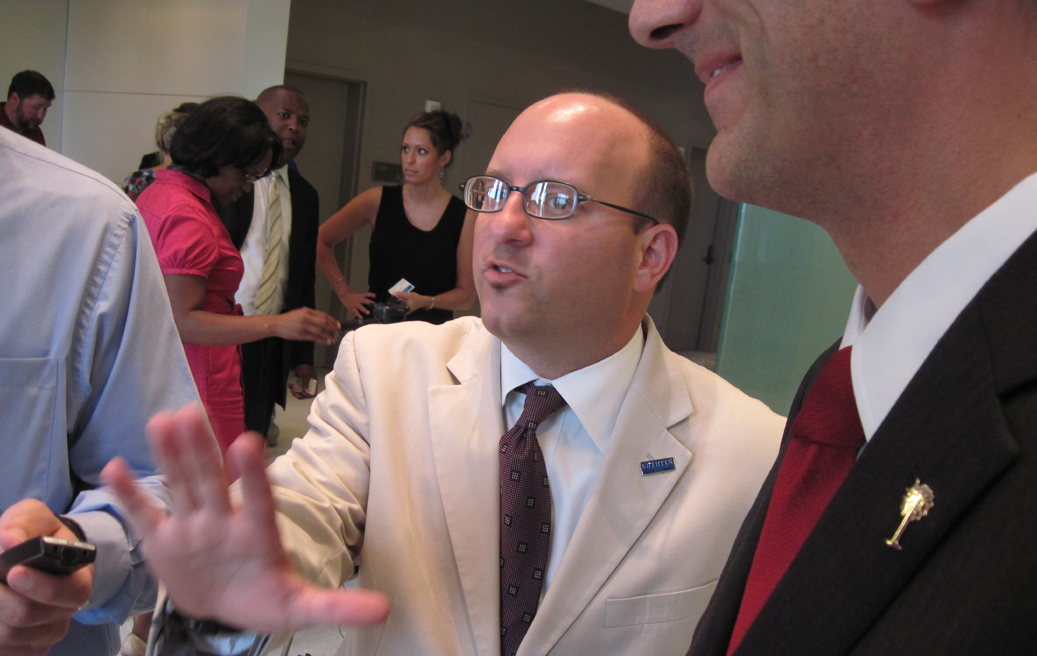
Trav Robertson, as we saw him during the 2010 campaign.

Still sort of reeling from this discombobulation called Daylight Savings, and having had three glasses of sweet tea with my lunch at Seawell’s — to no noticeably helpful effect — I decided to do a wide swing through Five Points to get some REAL caffeine at Starbucks on my way back to the office.

So I got my tall Pike, and once again impressed the baristas with my fancy gift card from across the sea (thanks, Mr. Darcy!), and on my way out ran into Trav Robertson, whom I hadn’t seen since the election. Trav, if you’ll recall, managed Vincent Sheheen’s almost, but not quite, campaign for governor last year.

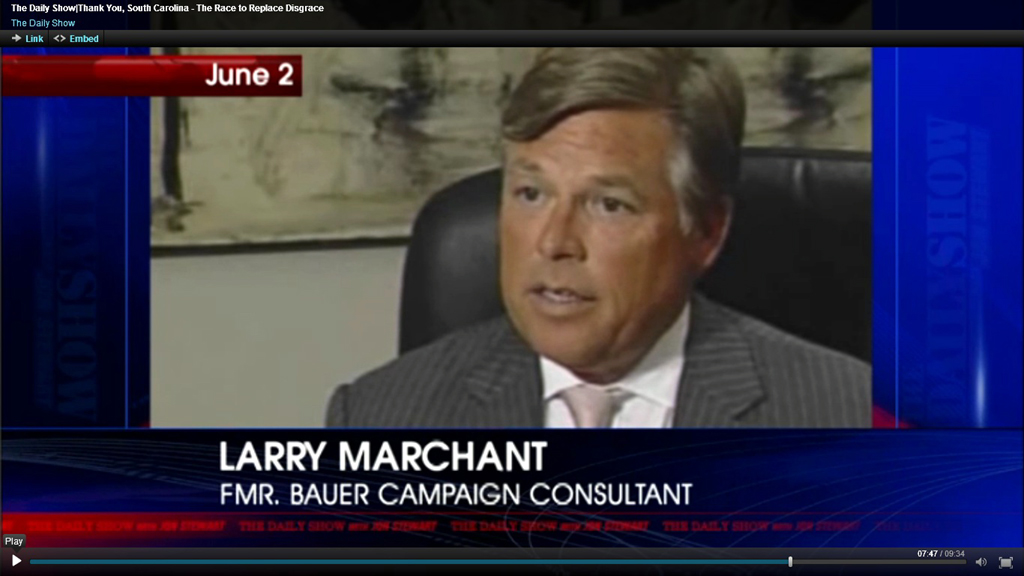
We chatted for a moment, mainly about the state of news media today and how it relates to politics (he said one of the toughest things he found to adjust to in the campaign was this newfangled notion that the story changes at least four times in the course of what we once so quaintly called a “news cycle”), and we parted, and as I walked back toward my truck, who was coming up the steps from Saluda but Larry Marchant. He smiled and we shook hands, and turning back to see Trav standing at the coffee shop door, I said, “Well, here’s you, and here’s Trav Robertson — we’ve just got everybody here, Democrats and Republicans…” as I moved on toward my vehicle.

Which is a pretty stupid and meaningless thing to say, but what DOES one say in such a social situation? I mean, I’m not gonna say, “Well, lookee here, we’ve got Trav, whose candidate lost a close election to a woman you claimed to the world to have slept with, and I last saw you being made fun of by Jon Stewart….”

No, I don’t think so.

And really, I suppose it’s not all that cool to say it here on the blog, either, but… it seems to me there’s a social commentary in here somewhere, having to do with Moynihan’s concept of Defining Deviance Down or whatever. And when I say “deviance,” I’m not picking on Larry or anybody else, but talking about us, the people who are the consumers of such “news.”

I mean, how does one conduct himself in polite society — or any society — in which such things are discussed, disclosed, dissected and displayed publicly? Actually, “publicly” isn’t quite the word, is it? Doesn’t quite state the case. Way more intense than that.

If you’re Jon Stewart, life is simple. You make a tasteless joke or two, get your audience to laugh, and move on to the next gag. But what do you say if you’re just a regular person out here in the real world, and you run into the real people about whom these jokes are made?

Whatever the right thing is, I haven’t figured it out, so today I just fell back on the time-honored stratagem of ignoring any weirdness inherent in the situation, and saying something insipid. Which, in this polite state of ours, still works.

As for Trav and Larry — did they speak after I left? Do they even know each other? If they spoke, what did they speak about? I have no idea. I retreated to the office with my coffee.

Larry Marchant, as we saw him during the 2010 campaign.

You pays your money and you takes your choice

Sorta kinda conservative blogger Andrew Sullivan says “You don’t have to be a flaming Marxist to see that there’s something askew here.” He apparently got the chart from The Daily Kos, which cited “The Christian Left.” (Which I’m guessing is a reference to this group.) The Kos context apparently had something to do with defending public unions in Wisconsin, although the connection makes no sense to me — I guess you have to be a class warrior to get it. The Kos post was later updated to point to the Center for American Progress as the original source. That link, at any rate, cites sources for the numbers.

It was Sullivan’s “Chart of the Day II” on Friday.

Anyway, interesting comparisons. After The Christian Left, Kos, and Sullivan, the link in the chain that brought it to my attention was alert reader Laura Hart, who observed:

“We” chose to enact a bunch of tax breaks, so now “we” have to tighten our belts and make shared sacrifices.  Not that all tax breaks are bad, but can’t we be honest about what is happening?  A similar chart could be compiled for South Carolina.

Sounds like an interesting experiment. Anyone want to take that on — someone, that is, more skilled with spreadsheets and such than I am?

Burl reports in from Hawaii: “that bullet we dodged on Oahu parted our hair”

In case you didn’t see his comment on the previous post, our intrepid Pacific correspondent Burl Burlingame (Radford HS Class of ’71) has checked in with this report:

Man, that bullet we dodged on Oahu parted our hair. The surges on Maui and the Big Island were pretty bad, but at least they weren’t carrying that tumbling wall of debris that flattened communities in Japan. We got feet-wet on the neighbor islands — looks like more than a 12-foot surge in Kailua-Kona. The roads there are broken up.
Lots of small-boat and wharf damage on Oahu, but that’s about it. And we’re all sleepy as hell. The critical period was 3 a.m. to 7 a.m. when you had to be ready to run for it.

Good to hear that Oahu escaped unscathed. And I’m sorry that I carelessly speculated earlier that, given the hour of the earthquake, Burl might have slept through the crisis. Of COURSE he was on deck and attending to duty; we should have expected no less of him.

Obama: Ready To Tap Oil Reserve If Needed — which it ISN’T, not by a long shot

The president at this afternoon's presser. (Official White House Photo by Lawrence Jackson)

Well, gasoline prices are rising toward levels that might, just might, cause some of us to face reality and acknowledge that it’s not a good idea at all to be so desperately dependent on cheap oil from crazy-dangerous parts of the world, and what are our elected leaders — Democrats and Republicans — doing?

Why, what they always do — pandering. But there’s pandering, and then there’s pandering.

The GOP is busily blaming Barack “Root of All Evil” Obama. The president himself is responding by saying, at a press conference today, that he’s prepared to tap the strategic oil reserve, if needed.

But that last part is key, and his way out as a rational man. It’s like his promise to “start” withdrawing troops from Afghanistan by a certain date, which in no way commits him to draw down dangerously before it’s wise to do so. Obama’s smart; he’s not going to pander so far that he commits himself to something irresponsible. This is a quality that he has demonstrated time and again, and which has greatly reassured me ever since he beat my (slightly) preferred candidate for the presidency. This is the quality — or one of them — that made me glad to say so often, back in 2008, that for the first time in my editorial career, both major-party candidates for president were ones I felt good about (and both of whom we endorsed, in their respective primaries).

It’s certainly more defensible than Mr. Boehner’s reflexive partisan bashing. And it’s WAY more defensible than Al “Friend of the Earth” Gore asking Bill Clinton to tap the reserve to help him win the 2000 election.

To quote from the report I just saw on the NPR site:

Obama said he’s prepared to tap the U.S. emergency oil reserve if needed. But as gas prices climbed toward $4 a gallon, the president said the U.S. must adopt a long-term strategy of conservation and domestic production to wean itself off foreign oil.

“We’ve been having this conversation for nearly four decades now. Every few years gas prices go up, politicians pull out the same political playbook, and nothing changes,” Obama said.

“I don’t want to leave this to the next president,” he said.

Some in Congress have been calling on Obama to tap the Strategic Petroleum Reserve. And the president made clear Friday that that was an option, although he indicated he wasn’t yet prepared to exercise it. He declined to specify the conditions that would trigger the step, but said it was teed up and could happen quickly if he chooses to call for it….

His threshold, based on what he said, is a Hurricane Katrina, or worse. Personally, I’d raise the bar a bit higher than that, but he’s on the right track, trying to set a high standard. (You make a disruption like Katrina the standard, then next thing you know, you’re tempted to lower it to, say, a BP oil spill — and that’s not the direction you want to go in.)

The key word here is “strategic,” a threshold that I would think wouldn’t be crossed until we have a sustained inability to GET oil to power our economy — something we came close to, in spots, in recent crises. But it seems to me one only turns to such “strategic” options as a last resort. The president should be “prepared to tap the U.S. emergency oil reserve if needed” in the same sense he is expected to be prepared to crack open the “football” and activate the codes for going nuclear. OK, maybe that’s a bit extreme, but you get where I’m going with this. It’s something we hope and pray never happens, and we do our best to pursue policies that avoid such an eventuality.

By the way, back to that excerpt above. I particularly love “the president said the U.S. must adopt a long-term strategy of conservation and domestic production to wean itself off foreign oil.” Earlier today, I disparaged the president for being no Energy Party man. (I was essentially repeating an observation I made about both him and McCain in a July 6, 2008, column.)

But maybe I was wrong. If he keeps saying things like that, he may deserve the Energy nomination in 2012 after all.

They’re not blaming the earthquake on Obama (yet), but…

The bitter little joke I made earlier about FoxNews not having blamed the earthquake off Japan on President Obama was meant to be funny, but…

This morning, I saw this Tweet:

FrumForum

@FrumForumFrumForum

Boehner Blames Obama for Energy Costs: GOP: Obama to Blame for Higher Energy Costs http://bit.ly/f1cYtQ #tcot

What are you gonna do with people like that?

Of course, he’s got half of a point:

“They’ve canceled new leases for exploration, jeopardized our nuclear energy industry, and imposed a de facto moratorium on future drilling in our country. They’ve even pushed a cap-and-trade energy tax that the president himself admitted would cause the price of energy to skyrocket,” Boehner said.

Republicans have repeatedly criticized the administration and congressional Democrats for what they perceive to be a lackluster response to the rapidly rising cost of oil.

… but half a point, in the hands of partisan ideologues, is a very dangerous thing.

I say “half a point” because the president is no more an Energy Party man than the speaker is. Both of them only see the half that their respective ideologies allow. Boehner is for drilling, domestic exploration, nuclear energy and the like. Obama is for alternative energy sources, conservation, and other “green” initiatives. When the truth is, we need to do ALL of those things, and more, to achieve the critically important (economically and strategically) goal of energy independence.

Yet another way that our two-party system prevents our leaders from even considering real, comprehensive solutions to compelling national problems. Which is another reason we MUST not allow them to further strengthen their death grip on our electoral system.

One other thing: I allowed this comment from our persistent gadfly Steven/Michael/Fred/Luke/etc. earlier today:

… so that I could say this: You’re absolutely correct. But callin’ it business as usual don’t make it right, boss. It just makes it twice as wrong.

Vote UnParty.

S.C. Border Patrol? Can anyone POSSIBLY think of anything more absurd for a state that can’t afford basic services?

Well, I sort of said it all in the headline, didn’t I? In fact, I already did on Twitter early this morning; I’m just repeating myself here because not ALL my readers follow me on Twitter (even though they should). Also, this is a better place for your comments.

But here’s the report that inspired it:

The S.C. General Assembly would have to find money in its already strapped budget to pay for its version of a border patrol if the latest version of the state’s proposed immigration law wins approval.

The Illegal Immigration Enforcement Unit would fall under the supervision of the S.C. Department of Public Safety, according to a provision added Wednesday by Sen. Jake Knotts, R-Lexington. The unit would have its own insignia, uniforms and cars, and the Department of Public Safety would have to create it as a separate entity from the S.C. Highway Patrol, which already faces a shortage of troopers.

The bill passed the Senate after a session that stretched past midnight and into Thursday morning. Senate leaders and the bill’s sponsors were determined to push immigration legislation through its chambers before the schedule gets filled with budget debates and the task of drawing new legislative districts…

Maybe this is a good thing, though. Maybe this way — authorize it, but don’t fund it — they get all this stuff out of their system so they can move on to significant issues facing the state. On the other hand, given the way they’ve approached some of the critical issues lately, maybe not.

This stuff just astounds me. The “small-gummint” people who are trashing critical services left and right, and seeing that as a GOOD thing rather than a bitter necessity, because their ideology blinds them to the realities in the world, want to create a whole new government apparatus — something that is CLEARLY a federal function, under any rational understanding of levels of government, under the principle of subsidiarity or whatever you choose to apply — to scratch this one irrational itch.

Stuff like this just makes me feel… well, perhaps Billy Jack said it best (apologies for the paraphrase, Billy):

Bernard, I want you to know… that I try. When Jean and the kids at the school tell me that I’m supposed to control my violent temper, and be passive and noncynical like they are, I try. I really try. Though when I see garbage like this… the absurdity of this idiotic moment of yours… I just go BERSERK!

THE EARTHQUAKE OFF JAPAN

Image from the United States Geological Survey at 5:46 a.m. Zulu time, or 46 minutes after midnight here on the East Coast.

This is just to give y’all some resources, and someplace to comment if you feel so moved. The picture of what happened — and is happening — is still taking shape. Hawaii seems to be out of trouble — although I’d appreciate an on-the-spot report on that from our own Pacific correspondent, Burl Burlingame.

Personally, on something like this, I tend to turn first to the Los Angeles Times. Of the largest papers in this country, that’s the one most likely to have the best reporting and perspective on developments in the Pacific Rim (that’s pretty intuitive, of course, but I had it confirmed back in my days as an editor responsible for the front page, and the national desk, back in Wichita, when I had to study all of our news services to see who had the best take on each national/international story).

But here are several you can follow:

That’s probably all you need right now. Comment away.

NPR “sting” illustrates the challenges of being PUBLIC media

Back on an earlier post, after I had been wringing my hands (but in a light-hearted manner) about the difficulty these days in finding a way to pay for good journalism in the 21st century, Phillip took occasion to praise the public model, giving us a link, headlined “Public media put millions into investigative work,” about how NPR and PBS are trying to take up some of the slack left by the declining (and, on state and local levels, moribund) MSM.

Wow, that was a long lede sentence. Back in the heyday of the MSM, that would never have made it past the copydesk. But I digress.

I responded that hey, y’all know how I love NPR — it’s as good as any print medium, and I can’t say that about anything else in the broadcast arena.

But the embarrassing news today about a soon-to-be-former executive at NPR sort of illustrates the special tensions of being a public medium.

Did you see the story? Here’s how NPR itself reported on it. But if you prefer another source, here’s the WashPost version:

The former head of NPR’s fundraising arm says in a surreptitiously recorded video by a conservative activist that members of the tea party movement are xenophobic and racist and that NPR would prefer to do without subsidies provided by the federal government.

In the video, released Tuesday morning by conservative filmmaker James O’Keefe, NPR executive Ron Schiller disparages conservatives in general and tea party members in particular, saying some of its followers are part of an “anti-intellectual” movement.

Schiller and another NPR fundraiser, Betsy Liley, believed that that two of O’Keefe’s operatives were representatives of a Muslim philanthropy. The video was shot at Cafe Milano in Georgetown during a lunch meeting set up to discuss a $5 million contribution to NPR by the equally fictitious Muslim Education Action Center, which one of the men tells the NPR executives is connected with the Muslim Brotherhood, a political organization with suspected ties to terrorists.

On the video, Schiller, who formerly headed the NPR Foundation but left the organization last week, says: “The tea party is fanatically involved in people’s personal lives and very fundamental Christian – I wouldn’t even call it Christian. It’s this weird evangelical kind of movement.”

He adds that “tea party people” aren’t “just Islamophobic, but really xenophobic, I mean basically they are, they believe in sort of white, middle-America gun-toting. I mean, it’s scary. They’re seriously racist, racist people.”…

And for another source, here’s ABC’s report.

For the report of the group that pulled this stunt and got this poor Schiller schmo fired, follow this link. The group’s video is above.

And what this makes me think is this:

Hey, it’s great that NPR does such fine work. That’s why I listen to it every day. But boy, this business of being funded partly by the gummint and partly by contributions sure does have its drawbacks. Think about it:

  1. If NPR didn’t get some public funding, it wouldn’t be the big, fat target that it is among anti-government types, and this group would never have pulled this stunt.
  2. If NPR didn’t also depend upon grants and contributions, it wouldn’t have a development executive, and wouldn’t send anybody even to listen to such a pitch from a group allegedly affiliated with the Muslim Brotherhood, much less grovel as embarrassingly ineptly as this guy did. (I’ll give him credit for one thing only: He didn’t quite let them bait him into antiSemitism, try as they might.)

So… there are indeed drawbacks to this funding model.

Let’s hope that the guy who replaces this guy at NPR is a little smarter. The really embarrassing thing about listening to this, as the fan of NPR that I am, is that this guy is so … unsophisticated. Yeah, I realize he’s not a journalist, and he’s not expected to have a nuanced understanding of politics. But anybody in NPR’s news department has to be mortified to hear anyone even remotely connected with them blathering in such a knee-jerk, bumper-sticker manner. I mean, did this guy ever even listen to NPR?

The old business model of the MSM — journalists do their thing, while the entirely separate business side goes out and sells ads — had its challenges, but it worked more smoothly than this. Of course, that’s dying out, and we still have to find something else if we’re to meet the demand for reliable news (which seems to be as great as ever).

But as we hunt about for a new method of paying for newsgathering, we see that the public/donor model has its problems.

Most Wanted “Health Care Fugitives”

Today, Anton Gunn brings to our attention the HHS Most Wanted Health Care Fugitives List, so you don’t have to go to the Post Office any more.

This is for Doug, who loves to talk about fraud and abuse in government health care programs. What I think Doug ignores, of course, is that the reason he hears about such cases is that this is the public sector. Government programs, unlike private ones, are directly accountable to the public, and there is therefore greater transparency. That’s why you have an Office of the Inspector General. (You don’t tend to find, say, an Internal Affairs division in the private sector — that’s very much a gummint thing.) What I suspect he also misses is that these are not cases of the government defrauding private citizens (which might argue against having such programs). They are cases of private citizens, and private companies, trying to defraud the government. At least, the ones I called up were. And in these cases, being detected doing so.

Still, Doug should thank me for giving him this today. In fact if you click on one of the newest cases on the list, you find that this Etienne Allonce is not only the head of a private company that is allegedly defrauding us, but he has been charged with being an illegal alien! A twofer, Doug! Of course, he’s not from Mexico, but you can’t have everything. I mean, whaddya want, eggs in your beer?

But whatever political points y’all derive from this, I thought it was interesting. So thanks, @AntonJGunn!

Callista? Wasn’t she that disturbingly skinny chick on TV?

Well, I’m behind the curve again — when Politico posted this:

Callista Gingrich moves to spotlight

The first word from Newt Gingrich at his announcement last week that he would explore a presidential campaign was “Callista.”

Callista Gingrich is, literally, in the foreground of her husband’s new campaign website, over which her beaming blonde visage looms as large as his. The former speaker’s wife co-signs his organization’s e-mails, produces his movies, appears beside him on Fox News, and even reads his work for audio-book adaptations – but she has maintained such a low profile over a decade in their marriage that she remains an enigma even to some of his closest supporters.

She is, ironically, simultaneously the most public and the least known of the political partners bracing for the scrutiny of a presidential campaign. In eleven years of marriage, Callista Gingrich has never been the subject of a profile. Gingrich’s aides declined to make her available to POLITICO for an interview, to talk about her or the marriage on the record or on background, or even to suggest friends who might offer a glimpse of the would-be First Lady….

… I’m like, Callista? Wasn’t she that chick on that TV show I never watched, the one that everyone talked about being so disturbingly thin?

Apparently not.

But who she IS is a matter of some concern, especially since it looks like Newt’s going to be the latest candidate offering us a “twofer” (which, whether it’s Bill and Hillary or Mark and Jenny or whatever, generally tends to make me uncomfortable, seeing as how one of them isn’t actually elected) and so little is known about her.

For instance, is she Wife 3? Or Wife 4? With Newt, you need a scorecard.

Since she is … let me check … as much younger than Newt as my oldest child is than I (was that last bit grammatically correct? hey, don’t ask me to diagram it), she will no doubt invite comparisons to Jeri Thompson (not to be confused with Mick Jagger’s Jeri, for whom he foolishly overthrew Bianca), who as it happens was born the same year. Although I think she actually looks more like Cindy McCain.

OK, that’s more musing than I usually do on candidates’ wives. But I wanted to get something up for running to some meetings, so there…

Our young governor’s presumption apparently knows no bounds (and it’s kinda freaking me out)

Been feeling the need to write this ever since I read the paper early this morning. I haven’t had time before now…

Nikki Haley kind of blew my mind on three fronts this morning, which caused me to go on a bit of a rant at breakfast (Wesley isn’t the only ranter in Columbia), along these lines:

  1. “Haley to grade legislators.” Did you see that headline this morning? I normally eschew text-speak, but WTF? None of the lawmakers quite came out and said this, but I’ll tell you what they were thinking: “This little girl couldn’t even get called on when she raised her hand at the back of the class a year ago, and now she’s going to grade US?” This would be followed by the aforementioned “WTF?” Yep, lawmakers really think like that, the insensitive brutes. Now, before you think this is just a question of whom you like — with reactions divided between Haley fans who cheer, “Go get ’em, Nikki!” and the harrumphers who do not and never will be Haley fans — allow me to point something out to you. It would be presumptuous for anyone to do this. Back when I worked in Tennessee, some writers at one of the Nashville papers would grade all the legislators at the end of the session each year. I thought it presumptuous as all get-out, but… it was still within the bounds of acceptable commentary. And it would certainly be permissible for me to do something like that on my blog, although you would be equally free to tell me to what extent I was full of it. Just an exchange of views among citizens. But here’s the problem with Nikki doing it, in case you didn’t make it through Civics 101: She’s the governor, which means she’s the closest thing to a head of the executive branch that we’ve got (in another state, she’d be the head of the executive branch, but this is South Carolina). For the chief executive to use whatever political influence she has to harass and bully and threaten lawmakers, even in as silly a manner as this (do my will, or I’ll give you a bad grade!), smacks of bossism. Ben Tillman would have loved a device like that for keeping lawmakers in line, and Boss Crump as well. Folks, the best virtue Nikki Haley has going for her is that she advocates restructuring that would make the executive branch more accountable to the governor (and in fact, it’s their positions on reforms like that that she plans to “grade” lawmakers on). But this kind of behavior gives executive power a bad name, and gives lawmakers — who don’t want to give the governor power anyway — an excuse to blow her off, just as Mark Sanford did with his defecating piglets. And that’s what takes this beyond silly, practically to the realm of outrage. The very modest restructuring legislation that just passed the House will have tough-enough sledding in the Senate (where all such reforms go to die) without this nonsense.
  2. “Governor takes aim at state employee benefits.” Wow. Poor Nikki. Last year, she was the darling of the national media (which is how she won the election), making the cover of Newsweek twice. Now, she feels forgotten. Through the lens of this story, you can see the little wheels turning in her head: Look at all the attention that governor in Wisconsin is getting! That’s so unfair? What’s he doing? Oh, he’s trying to take away state employees collective bargaining power. What an awesome idea! I’ll do that too, and then I can get some attention? What? Oh, drat! We don’t HAVE public employee unions in South Carolina, so I can’t strike dramatic poses fighting against them! That’s really, REALLY unfair! What, oh what am I going to do? There must be SOMETHING I can do to state employees here that will draw attention… but what? I know! I’ll go after their BENEFITS…
  3. “The mystery man on Haley’s staff.” THIS one is so weird, that I suspect there’s a typo in it somewhere. So… Nikki has a guy on her staff who supposedly is only being paid $1 a year. He’s supposedly a government-efficiency expert who’s gonna help the gov straighten out waste and inefficiency in our gummint. He uprooted his family and moved here from Pennsylvania for the job — for the $1-a-year job. OK, this causes a lot of people to suspect there’s something else going on, and speculate that he’s waiting around for a real job that could come open soon. This he denies, or at least says he hasn’t been promised anything. But that wouldn’t be my theory anyway, given those facts. MY theory is that he’s being paid by one of those national ideological groups that flock around the Mark Sanfords of the world. Howie Rich, or Grover Norquist or some such. But he says no, that he’s living off his state employee pension from Pennsylvania. Got that? OK… The story also says he’s 32 years old. Twice. In the main body of the story, and in a graphic. After someone suggested it was a double-typo, I Tweeted John O’Connor to ask him. He Tweeted back that “No, that’s his age according to the governor’s office.” So maybe the governor’s office is wrong about his age. But if not — this guy’s able to live on a state pension (and I went back to look again, and yes, the only jobs listed in the published summary of his resume sound like state jobs) at the age of 32 — and he’s here as an expert on government efficiency? That ought to make state employees breath a sigh of relief. No way he’ll have the nerve to urge the governor to reduce their pensions, huh? Unless he’s the nerviest guy in two states. Somewhere, there’s gotta be something inaccurate in this picture, because the “facts” we have definitely don’t add up.

OK, I got all that off my chest. Now, to shift gears on you, and praise our governor for her pushiness — in that same story about state employee benefits, she promised to present lawmakers with a comprehensive tax reform plan. THAT’S the kind of presumption I can cheer for. But I’m going to hold my applause until I see whether it’s comprehensive, and whether it’s reform. The first sign will be whether she steps up and proposes to undo the execrable Act 388.

And… now that I’m cooled down a bit… I’ll go further in that backtracking direction: I still haven’t made up my mind about what I think of the bill I wrote about earlier that would do essentially what Nikki’s saying with state pensions. (Mainly because I haven’t yet seen enough about it — on something that complex and that financial, I sort of need some broad input to make up my mind.) But the truth is, I read items 2 and 3 right after reading item 1 this morning, so it all looked bad while I was in that mood.

And now that I’m looking at them again before hitting “Publish,” I’m still kinda freaked out…

Some other candidate please put me on your campaign e-release list — and hurry!

Today, I received TWO e-mails from the aforementioned campaign to draft, of all people, Donald Trump, to be, of all things, President of the United States.

Never mind what they were about; it’s the number of them that gets me.

This is disturbing. It rattles my sense of proportion and perspective.

Please… I know the other campaigns are taking their time getting organized this time, compared to the pre-2008 rush, but some of y’all please put me on your mailing list, now. Someone relatively (and I stress relatively) sensible, like Mike Huckabee, or Mitt Romney.

(Funny, after thinking they were a little out there when they were running against John McCain, I’m seeing those guys as relatively sensible. Shows how much the GOP has shifted since then. In 2008, Romney was DeMint’s guy. Today, he’s … the Father of Obamacare. Who knew?)

Some thoughts on Robert Gates’ recent remarks

I like that headline. Sort of 19th century-sounding in its plainness. Anyway, moving on…

Back on the previous post, Phillip said:

This is somewhat indirectly related to issues raised by #1, but I couldn’t help wondering what you made of Sec’y Gates’ remarkable speech at West Point last week:

http://www.nytimes.com/2011/02/26/world/26gates.html

And I responded in a comment that seems worth a separate post, to wit…

Phillip, I had several thoughts about Gates’ remark (which, for those who missed it, was “In my opinion, any future defense secretary who advises the president to again send a big American land army into Asia or into the Middle East or Africa should ‘have his head examined,’ as General MacArthur so delicately put it.”):

  • First, my facetious reaction — Asia? Africa? Middle East? So that leaves what? Europe? Australia? South America? Antarctica? Quite a sweeping set of eliminations. Next thing you know, we won’t be able to go war anywhere, and he’ll be out of a job. Golly, I wonder if the world will cooperate with us on that, and make sure, out of sympathy to our preferences, that the next crisis demanding a deployment of U.S. ground troops happens in, say, Sydney. MayBE, but it seems unlikely.
  • I like Robert Gates (here’s a column I did about him in 2006), have liked him ever since he became CIA director in the 80s (and especially liked him when he delivered us from the disaster of Rumsfeld), so he has my sympathy. And I fully understand why someone who’s had the challenges he’s had as SecDef.
  • From a pragmatic standpoint, what he says makes all the sense in the world. That’s why the option we’re looking at in Libya is a no-fly zone — you know, the mode we were in in Iraq for 12 years during the “cease-fire” in that war against Saddam that started in 1990 and ended in 2003. It’s manageable, we can do it easily enough (we and the Brits are the only ones with the demonstrated ability to provide this service to the people of Libya and the world). Air superiority is something we know how to assert, and use.
  • Ground forces are a huge commitment — a commitment that the United States in the 21st century appears politically unwilling to make. If you’re a pragmatist like Gates — and he is, the consummate professional — you consider that when you’re considering whether the goals are achievable. We’ve demonstrated back here on the home front that we’re unable to commit FULLY to a nation-building enterprise the way we did in 1945. It takes such a single-minded dedication on every level — military, economic, diplomatic — and that takes sustained commitment. One is tempted to say that there’s something particular about Americans today that prevents such a consensus — our 50-50, bitter political division, for instance — but really, this is the norm in U.S. history. The anomaly was 1945. It took two world wars for us to bring us to the point that we could make that kind of commitment.

So there you go. I had another bullet in mind, but was interrupted (blast that person from Porlock!), and it hasn’t come back to me yet. Please share your own thoughts…

UK deals properly with Assange — which reminds me of something funny

Have you seen the latest? A UK court has decided to send Julian Assange where he belongs:

A U.K. court ordered that WikiLeaks founder Julian Assange be extradited to Sweden to face questioning about sexual-assault allegations, dealing a serious blow to the document-leaking site and its founder.

The decision means that Mr. Assange’s efforts to build and promote WikiLeaks will be detoured to some degree in coming months by the possibility that he will face criminal sex charges. WikiLeaks has gained notoriety with governments around the world through its release of thousands of classified documents and diplomatic cables.

Sweden hasn’t formally charged Mr. Assange with a crime, but wants to question him over allegations that he raped one woman and molested another during a visit to Stockholm last August. He denies any wrongdoing and said he will appeal the U.K. decision.

Good. Whatever the outcome of that case, if he is charged, Assange should be there to face the court’s decision.

But while he may be a super-creepy guy (and, say some, a rapist), he can still inspire some decent comedy. I loved this Bill Hader skit from back before Christmas, and today’s news reminded me of it.

In the skit, Assange hacks into a broadcast Mastercard commercial — from his jail cell in Britain (how did he do that? “Maybe you weren’t listening — I’m Julian Assange!” — and issues threats to the world if he is not released, with his “punishments” escalating each day he is held. Such as:

  • Day three. Facebook: You know that one profile picture that makes you look thin? It’s gone. Boo-hoo….
  • Day five, Netflix. Have you seen the fourth season of “Hanging with Mr. Cooper?” You’re ABOUT to. It’s first on your queue…
  • And if I’m incarcerated for one whole week, we start messing with porn sites — the FREE ones. Ooooh — got your attention NOW, do I?

Of course, it’s funnier the way Hader does it. There’s also a good Osama bin Laden joke — but I won’t spoil that. Enjoy.

Mark Stewart and The State both have it right on the port of Charleston

Sometimes my readers spend time thinking about an issue at some length, and write me a note about it, and suggest I write about it on the blog — and I realize it will be days before I find time to think about it as much as they have (if I ever do), so… why not just post that reader’s thoughts? Sort of what I did with Kathryn’s contribution the other day… although I solicited that; this one just came in over the transom.

Anyway, here’s what Mark Stewart thought yesterday after reading an editorial on the subject in The State:

Brad,

I read The State editorial this morning and thought that they came close but missed the boat on a few key points that might make for an interesting discussion on your blog.

After education, I believe that the Port of Charleston is perhaps the most important driver for economic prosperity across the state over the next fifty years.  I don’t normally grandstand on words like this, but I would argue that this issue may be one of EPIC proportions for South Carolina.  As happened with airline hubs, the emergence of a new shipping paradigm, the 50’ depth for super-container ships, will render obsolescent most of the remaining American ports as far as international trade goes.  Only a few of the ports will be viable in this new world.  This will lead to an even greater consolidation of economic activity.

The clear winners will be Los Angeles/Long Beach; New York/NJ; Norfolk, VA and Seattle.  But there will likely be a few others.  One of those might be a Southeastern port.  At present Savannah is the nation’s fourth-largest container port.  But it has a serious issue – it is 35 miles up a river which is now only 42 feet deep.  As Charleston did in the 1830’s when it drove the first Southern railroad to Augusta, The Port of Charleston has the opportunity now to seize back the economy of North Georgia from Savannah.  With a mega port, South Carolina would have the opportunity to become the hub of the Southeast and parts of the Midwest, funneling the economies of Atlanta and Charlotte along the way – and possibly also of Florida.

Georgia recognizes this need/opportunity in a way that South Carolina does not.  And yet, the Obama administration did not support Savannah’s request to begin the dredging process just as it did not provide funds to Charleston.  I believe this is because, unlike with New York and Norfolk, it is not clear who the winner will or should be in the Southeast.

That’s an opportunity.

But here is where The State’s editorial missed the entire picture.  Simply dredging Charleston is not the answer.  The real problem is on the land.  The thing that will hobble South Carolina’s future is the current lack of a robust port to railroad connection.   What is the point of dredging the harbor channels to a depth of 50 feet if the intermodel connections to move freight throughout the state and region efficiently are not there?  Now trucks clog I-26 and the local roadways in North Charleston and yet that city continues to fight more complete rail access to the Port terminals.  Worse still, the largest container terminal is on Mt. Pleasant and not even near a rail line.  So the issue really isn’t whether all politicians support the allocation of federal funds for dredging, it’s does the State of South Carolina support the creation of the landside infrastructure that would make the decision to dredge deeper a rational one?

The second point that the editorial touched on, but did not hammer home is this:  Sen. DeMint wants to promote legislation to have the Corps of Engineers be the party ultimately responsible for selecting which of America’s ports are dredged to the new trade standard.  What he seems not to understand is that this is not a scientific process of comparing variables.  It is instead a political knife-fight.  Yes, items such as channel depths, distances to open water, intermodel connections, and port terminals are critically important in advocating one’s position.  But what we are really talking about is the economic future of our state.  It’s not just that there will be winners and losers; it is that the winners will see compounding economic growth.  If Sen. DeMint does not understand that this is an issue of politics and that the U.S. Congress will be the ultimate battleground, then maybe national politics isn’t the right place for him.  We are not talking about philosophical viewpoints on the issue of earmarks; we are talking about representing the State of South Carolina in the most important battle for our long-term economic vitality and growth.  Senator DeMint is not showing any sort of leadership on this issue – in fact, it appears that he does not even realize what the issue is or that the fight is already on.

Do I agree with Mark on this (as I do on most thing, although not all)? Well, really, I agree with him and The State both. And I’ll add that, like The State, I’m a little more sympathetic than Mark seems to be toward Sen. DeMint’s desire to have the Corps decide. I think that’s a solid, Good Government 101 approach, and I hesitate to endorse Mark’s approach of saying we just need to squeeze all the political advantage for SC that we can out of this situation.

Again, I like The State‘s approach — concede the rightness of the senator’s original intent, but point out in no uncertain terms that such laudable original intents do NOT excuse his subsequent boneheaded behavior on the issue. Here’s what I mean:

Mr. DeMint says he’s focused on convincing the Congress to change the law so that the U.S. Army Corps of Engineers can use its own judgment to decide which projects to pursue, rather than abiding by the political dictates of the president and the Congress. It’s a wonderful idea, and not just because any honest evaluation of our nation’s ports needs would conclude that the Charleston harbor is a better investment of federal dollars than other ports whose deepening is being funded. But there is no realistic chance that it’s going to pass, which means that he has an obligation to work on Plans B and C as well. (If Mr. Wilson or any of our four new members of Congress have any plans for getting the port deepened absent a presidential request or a congressional earmark, they’re keeping them to themselves.)

Would their signatures have guaranteed that President Obama included the funding in his budget? No. In fact, Mr. DeMint might well be correct when he says that it would have made no difference. But he might not be, and the need is so great, and the cost to him and Mr. Wilson so low that it is simply incomprehensible that they would refuse to lend their names to a letter. Their refusal is akin to a mother whose child needs a life-saving operation she can’t afford refusing to sign a letter that her husband wrote to a charity asking for help simply because the charity’s director roots for a different ball team than she does.

One more thought, on one facet of this issue: At some point, South Carolina has to make a decision which it’s going to respect more: the desires of the rich Yankees who move to Charleston (and rich neoConfederates allied with them) and don’t want any nasty commerce spoiling the quaintness they paid for, or the desperate need of this whole state for economic development. Or maybe South Carolina has already decided, and decided wrong. In which case, it’s time to think again.

And finally, I want to thank Mark for getting me to address this important issue. And I addressed it in the best possible way, in the mind of an old assigning editor: I got somebody else to do all the work. Cindi Scoppe and many others who worked for me as reporters will recognize my modus operandi.

“What Happens in Vagueness Stays in Vagueness”

Isn’t that a great headline?

Stan Dubinsky sends out a lot of cool stuff to read via e-mail. You should ask to be on his list — if you’ve got time to read the stuff. I don’t really, but I do tend to glance at the headlines to see if anything draws me in (which, Journalism 101 here, is what headlines are for). And “What Happens in Vagueness Stays in Vagueness” definitely did the job.

And the piece was worth reading. An excerpt:

What Happens in Vagueness Stays in Vagueness

The decline and fall of American English, and stuff

I recently watched a television program in which a woman described a baby squirrel that she had found in her yard. “And he was like, you know, ‘Helloooo, what are you looking at?’ and stuff, and I’m like, you know, ‘Can I, like, pick you up?,’ and he goes, like, ‘Brrrp brrrp brrrp,’ and I’m like, you know, ‘Whoa, that is so wow!’ ” She rambled on, speaking in self-quotations, sound effects, and other vocabulary substitutes, punctuating her sentences with facial tics and lateral eye shifts. All the while, however, she never said anything specific about her encounter with the squirrel.

Uh-oh. It was a classic case of Vagueness, the linguistic virus that infected spoken language in the late twentieth century. Squirrel Woman sounded like a high school junior, but she appeared to be in her mid-forties, old enough to have been an early carrier of the contagion. She might even have been a college intern in the days when Vagueness emerged from the shadows of slang and mounted an all-out assault on American English.

My acquaintance with Vagueness began in the 1980s, that distant decade when Edward I. Koch was mayor of New York and I was writing his speeches. The mayor’s speechwriting staff was small, and I welcomed the chance to hire an intern. Applications arrived from NYU, Columbia, Pace, and the senior colleges of the City University of New York. I interviewed four or five candidates and was happily surprised. The students were articulate and well informed on civic affairs. Their writing samples were excellent. The young woman whom I selected was easy to train and a pleasure to work with. Everything went so well that I hired interns at every opportunity.

Then came 1985….

Undergraduates… seemed to be shifting the burden of communication from speaker to listener. Ambiguity, evasion, and body language, such as air quotes—using fingers as quotation marks to indicate clichés—were transforming college English into a coded sign language in which speakers worked hard to avoid saying anything definite. I called it Vagueness….

We all note, and many of us decry, what social media have done to (and for; there’s an upside as well) effective and elegant use of language. But I found this piece interesting because it went far beyond that, and identified an insidious enemy not only to communication, but to clear thought as well.

That enemy is Vagueness.

More on public (and private) employee unions

Started writing a response to comments on my last post, and it just got longer and longer, so I’m turning it into a separate post…

Responding to what several of you have said: Yeah, I’m almost positive we DON’T, and CAN’T, have public-employee unions in SC, and normally I would just say that flat-out. But something I read not long ago confused me on that point.

Here’s what shook my confidence on that (which I was half-remembering when I wrote this post last night — a friend reminded me enough of the details that I was able to look it up)… It was in a story during the city elections in Columbia last year:

VanHouten and three other police officers have formed a chapter of the Southern States Police Benevolent Association, and their first public act was to endorse Steve Benjamin’s candidacy for mayor…

The police officers say they want to model their organization after the Columbia Firefighters Association, which doesn’t practice collective bargaining or negotiate contracts with the city but does call itself a union. That organization has been active since the 1960s but only recently has begun to flex its political muscle….
This is enough to send me on a whole new rant. Let me see if I have this straight: A few city policemen are forming an organization that will certainly NOT be a union, because there’s no collective bargaining. But they say they want to model it on the firefighters’ organization, which does CALL itself a union, but isn’t one, because of course there’s no collective bargaining.

This boggles the mind: Why on Earth would anyone in South Carolina want to CALL their organization a union — which brings all sorts of calumny and resentment down upon their heads in this right-to-work state, which means they get all the BAD PR from being called that — when they get none of the ADVANTAGES of actually BEING a union, i.e., collective bargaining? You got me.

Anyway, though, I think I can go back now to saying confidently that we DON’T have public employee unions in South Carolina. My point is, we don’t have ’em, and don’t need ’em.

As for Kathryn’s suggestion that you only get lousy employees if you don’t have unions, I disagree: We have many very fine, dedicated, smart people in state government in South Carolina. You just don’t hear much about them because they keep their heads down and do their jobs and try not to draw the attention of the crazies at the State House — the people you DO hear about.

However, let me say that I DO share Tired Old Man’s concern about the fact that in state government, we’ve had a ” series of digressions from past personnel policies that protected state employees.”

I believe strongly in good pay, good benefits and good working conditions for public employees. I think, as an expression of the values of society, we should treat them better in many cases than employees are treated in the private sector (I hear tell that sometimes they even get laid off, ahem). And in the past, we had a consensus for that, in SC and elsewhere in this country — before despising people who dedicate their lives to public service became a political movement. Their pay was never good, but the benefits were, and so was the job security, so there was a balanced tradeoff. Personally, I want any society I’m a party of to treat its employees far better than private companies who lay people off to get an uptick in the stock price. (In fact, I’m marveling at what’s happened to our society that private companies are unashamed to do that. I remember when executives took pride in taking care of their employees. But then, I’m getting long in the tooth.)

That’s what worries me about the proposed pension changes — which I plan to question Nathan Ballentine (a sponsor) about when I see him later this week. There are some public benefits I think are TOO generous — such as full retirement after 28 years. But in general, I want the people loyally working for ME and my fellow citizens to get a decent, fair deal. The last thing I want is to have a union turning that relationship into an adversarial one. Which is what unions do.

By the way, I used to work for a publisher who had a saying, which went something like this: “Companies that get unionized usually have asked for it.” (It was therefore his strategic aim never to give employees such motivation.) I agree. Ditto with public entities, going back to Tired Old Man’s point. To me, when you get to the point that a union comes into your company, something that is essential to civil society is lost. Yes, I realize that the bosses usually started the downward slide in civility, but the formation of a union is to me the last nail in that coffin.

I think it would particularly be tragic for state employees in SC to become unionized. There is already suspicion, and sometimes hostility, between them and the Republicans who run this state. My God, can you imagine how that would be escalated if the anti-government ideologues were actually able to call them, accurately, UNIONS? Warring camps, that’s what we’d have, and the ugliness in the air (already pretty unpleasant after 8 years under a governor who despises the state employees who worked for him for the simple fact that they WERE state employees) would be far worse than anything we’ve ever seen here. The very air of Columbia would smell and taste of bile, permanently. Oh, and for my liberal Democratic friends who think that’s worthwhile, let me clue you in on something: The unionized state employees would LOSE that bitter, adversarial battle. Over and over and over again.

I believe in treating public (and private) employees right, to the point that they don’t want a union. I think that’s smart, but I also think it’s the right thing to do.