Have you tried to watch it? If so, you have my sympathy.
And my hopes had been high. This was a joint effort by Martin Scorcese and Mick Jagger, about the music business in the early ’70s. Martin Scorcese, in case you haven’t noticed, is the director with the greatest sense of rock ‘n’ roll in the history of Hollywood. Think about it: from “Mean Streets” to “The Departed” who used rock better? Let’s be more specific: From the moment Harvey Keitel’s head falls back onto the pillow and kicks off “Be My Baby” to that magnificent Roy Buchanan instrumental cover of the Patsy Cline classic “Sweet Dreams” as the camera pans from the last bloody body to the golden dome of the Massachusetts state capitol… wow.
He has been particularly good at finding perfect ways to use the Rolling Stones — it’s like the songs were recorded specifically for those scenes in those films. So, having Jagger along should make it even better, right?
Nope. It was just awful.
As I said this morning to Robert Rikard when he said he’d had the same unpleasant experience trying to watch the show, the show’s pilot was just a bunch of really unpleasant people being really unpleasant — kind of like a Trump rally, with cocaine.
Even Ray Romano was utterly without any redeeming qualities. Who knew he could be so unlikable? So much for Everybody Loves Raymond. I know actors like to break type, but here’s a tip, Ray — find a new character that audiences can stand to watch…
And the pilot was the episode guaranteed to be good, directed by Scorcese himself!
It is possible to make an engaging movie about the music business in 1973. I point you to “Almost Famous.” Yeah, that was schmaltzy and sweet, but it very successfully captured at least some aspects of why we loved the music. I expected this to be a much, much harder-edged version of that.
Instead, it made me think, “How could I possibly have ever spent a moment of my life listening to anything produced by these people?”
You want to hang out with these guys? Neither do I…
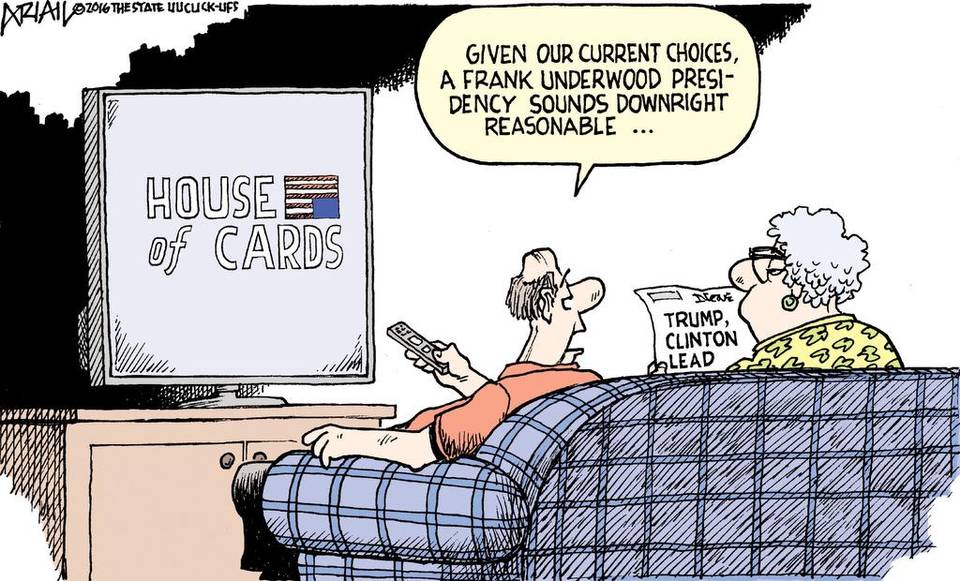
Robert Ariail has proposed it in a cartoon, as a joke.
But as an alternative to, say, Donald Trump, would you accept the devious scoundrel Frank Underwood as president?
Robert also posed the question with regard to Hillary Clinton, and go ahead and address that if you choose.
But I’m more interested with the conundrum on the GOP side, where the dynamic is entirely different. Whatever you think of her, Hillary is pretty middle-of-the-road among Democrats — members of that party won’t have an identity crisis if she is their nominee. “Anybody but Hillary” isn’t really a thing on that side.
It’s over on the Republican side that we see serious people considering deals with the devil.
So why not Underwood? Think about it: Does he advocate any horrible policies? Not so I can recall (although y’all might remind me of some dealbreakers.) Basically, he’s a thoroughly rotten, ruthless individual when it comes to seizing and keeping power. But as long as the policies were relatively benign, would that not make him preferable to someone who is both personally and in policy terms unthinkable?
Saying that runs against my own inclinations. Over the years I’ve increasingly come to care less about people’s specific policy proposals and more about their character. That’s because no one can predict what will really arise once the person’s in office — the candidate’s promises may become impractical, or ill-advised, based on unforeseen circumstances. I look for someone who I trust to make good decisions in the face of the unanticipated.
And it occurs to me that maybe, maybe we could expect ol’ F.U. — who is a pretty smart guy, aside from all his character defects — to act wisely and responsibly, if only because he does love power so much, and therefore would not want to screw up and lose political support.
Whereas we know that Donald Trump doesn’t know wise policy from a hole in the ground. Even if he were trying to do the right thing just to look good, he wouldn’t know how.
This takes me to the film we watched last night on DVD, “Love and Mercy,” starring Paul Dano and John Cusack as Brian Wilson at different stages of his life — in the ’60s, when his mental illness first interfered with his career with the Beach Boys, and in the ’80s, when he began the process of recovery.
I definitely recommend it.
A few points I came away with:
It had never occurred to me before that Cusack and Dano were so much alike. But when Cusack first appeared after several scenes with Dano, I immediately knew he was supposed to be Wilson, only older. I can’t put my finger exactly on what the commonality was — I said to my wife “I never realized before how much they look alike.” But that’s not it. They don’t really look alike. It was something else. Maybe the voice — the lost-child voice Cusack affected for the role. In any case, deftly done.
If you are, like me, fairly ambivalent about the Beach Boys — enjoy their music, but not a huge fan — this film will help you enjoy their work more deeply, especially the “Pet Sounds”-era music. Watching Dano struggle to translate what he was hearing in his head into something others could hear as well, and gradually recognizing the sounds he was picking out on a piano or through some other means, will connect you to his vision on a whole new level. The best pop-music biopics do that, and this one does it better than most. That’s because the music is so central to the character’s central conflicts.
The sounds only he could hear…
This was probably the best depiction I’ve ever seen of the fabled connection between creative genius and madness. At one point in the film, Wilson says he started hearing “voices” in 1963. In late ’64, he experienced a terrifying panic attack on an airliner while traveling home from a gig, and persuades the band to tour without him while he stays home and works in the studio. That eventually led to “Pet Sounds,” which was all about getting the sounds in his head out onto tape. Well, that’s not all it was about — he thought the band needed to grow to keep from being left behind by the Beatles. The problem was that he was the only one who thought this — the others, especially Mike Love, wanted to stick to the surf and sand and cars and girls formula. But because he was the only one pushing in a new creative direction, the sound became much more about what only he could hear, as his bandmates and studio musicians looked on in bewilderment and tried to follow along, when they weren’t resisting with all their might.
For a time, this tension led to some great work — before Wilson pulled away from everyone and everything, fell further into drug abuse, lost his wife and family, spent three years in bed and ballooned to 300 pounds — all of which happens off-screen, between the Dano and Cusack periods. That brought therapist Eugene Landy (Paul Giamatti) into Wilson’s life, which led to Landy taking over his life, overmedicating him and ruling him in a fashion reminiscent of Wilson’s abusive father. Which is where Cusack takes up the story.
To a great extent, the film is about how Melinda Ledbetter, who become’s Wilson’s second wife, manages to involve his family in freeing him from Landy.
Best — and possibly most painful — scene: Dano is tentatively, his voice cracking, playing a demo version of what would become “God Only Knows,” just sitting alone at a piano. At least, you think he’s alone until the camera shows his father seated on a sofa in pajamas and bathrobe. Wilson is seeking his father’s approval for his new direction. The father’s brutal, knife-twisting rejection of the song tells you almost everything you need to know about Brian Wilson’s problems. Later, you learn that his Dad slapped him upside the head so often as a kid that he is 96 percent deaf in his right ear.
Here’s the first part of that scene. If it doesn’t make you appreciate the song more than ever, don’t bother watching the film:
The song “It’s My Turn” comes off Roberts’ upcoming ‘Race for the White House’ EP, a nonpartisan set of songs about four presidential candidates: Donald Trump, Bernie Sanders, Ben Carson, and Clinton. The New Yorker recently premiered the first track, “Feel the Bern”:
“All those meter and key changes symbolize constant evolution, and Hillary has certainly evolved from her early days in Arkansas,” Roberts says about the new song. “The song has a cool stability to it, reflecting her ability to change with time while maintaining her own quiet intensity and relentless purpose.”
Roberts will be on NPR Weekend Edition tomorrow talking about the project, and will debut the songs live at an upcoming residency at New York City’s Birdland, March 8-12. Let me know if you want to hear the other two songs about Trump and Carson.
* One of the most important jazz musicians of his generation, Roberts was recently profiled on 60 Minutes:
How Mr. Roberts came up with Carson as the fourth, I don’t know — maybe he started the project when the surgeon was viable. Personally, I’d consider either Rubio or Cruz as more interesting characters to interpret musically.
Marcus Roberts
But that’s not my point. My point is that I’ve given the Sanders and Clinton compositions a listen — and I don’t dig them. I don’t mean I don’t like them — I’m neutral on that point — but “dig” in the sense of “get” or “grok” or “understand.”
In other words, I don’t see what the music has to do with either subject.
I got a fund-raising appeal yesterday from Joseph Schweitzer, finance chairman of the S.C. Democratic Party. It began:
Dear Brad,
We know that you’re one of the most passionate supporters of the South Carolina Democratic Party…
Time to trot out one of my favorite Bugs Bunny quotes yet again:
You know, I’m not going to worry about the machines taking over until I stop getting emails such as that, and Netflix finally figures out what movies I might like…
Yes, that sounds a tad hyperbolic. Maybe it’s so awesome to me because I’m an abnormally huge fan of “Office Space.”
But… it’s just so spot on! It works so well! And it’s such frame-by-frame match with the original! The rapper is so authentic-sounding! Very nicely done.
I’ll admit that I was a bit slow on the uptake. For about two second, I wondered, Why are they smashing a CPU? (You’ll recall that, in the movie, it was a printer.)
And then I’m like, Oh! The email server!
Which made me appreciate it all the more…
Below is the original. Excuse the language. Yeah, the milder (but still N-word-laced) “Damn it Feels Good to be a Gangster” was memorably used in a different scene. But it’s so closely associated with the movie that it works, beautifully, in the ad.
Remember, real gangsta-ass Clintons don’t flex nuts, ’cause real gangsta-ass Clintons know they got ’em…
How did I get on this subject? Well, Bryan had said something about liking Scott Walker before he dropped out, and I said he failed to stand out and distinguish himself. All the other candidates have a shorthand character people can describe, for good or ill. For instance, Lindsey Graham, who did no better in the polls than Walker, was known as the hawkish guy with the wisecracks.
So I got to thinking about how we all think we know the candidates, even though we don’t really know them any deeper than we do the characters in a cliche-ridden B movie — as a group of familiar types.
So let’s treat them like old-style contract players and cast them in an imaginary flick about World War II, since most of us are familiar with the genre. The title of the film? I dunno. “Hell is for Sad Sacks,” or something like that.
Here we go:
Lindsey Graham‘s the wise-cracking guy who nevertheless can give a pretty good speech about why we fight, and though he’s obviously no John Wayne, he’ll likely be a passable soldier when the shooting starts. Think L.Q. Jones — the character, not the actor who played him and adopted the name (even though he was poorly cast) — in “Battle Cry.” Think the book version. Only Leon Uris fans will get that, so never mind. Instead, think George Luz in “Band of Brothers.”
Scott Walker is the replacement who gets killed at the start of the first battle, and no one in the unit can remember his name. Or maybe he was a member of another company entirely who ended up fighting alongside the main characters because the drop zones were all messed up. Think Private Hall in “Band of Brothers,” the guy who is the first character killed on D-Day. Or, to switch genres, anyone in a red shirt on “Star Trek.”
Ted Cruz is the blowhard who talks big about how many Krauts he’s gonna kill, and the first time he’s within hearing of the guns he’s found cowering, quivering, in his foxhole. Everybody hates him — he’s always figuring an angle for getting ahead, at the expense of the other guys in the platoon — so they’re inclined to leave him there in the hole, but someone calls the medic. In “The Dirty Dozen,” he’d be Victor Franko.
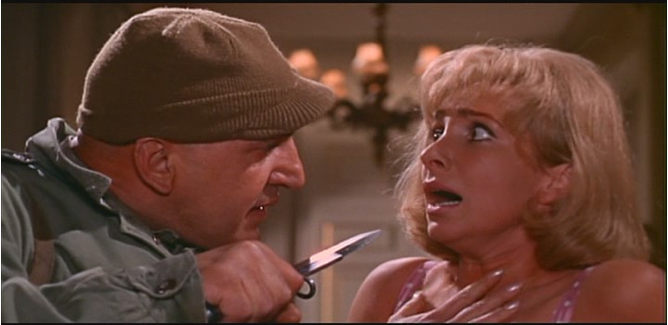
Donald Trump is the utterly corrupt quartermaster who runs the black market operations in the area. A real weasel, although a tremendous businessman (ya gotta give him that) he’s all about insulting the other guys in the battalion. He’s even trading with the enemy; anything for the deal. He gets along great with Starshina Putin, his counterpart in the Red Army unit just over the hill. Think Don Rickles in “Kelly’s Heroes.” (He’s not smooth enough to be Milo Minderbinder.)
Jeb Bush is the well-meaning but largely ineffectual officer who lives under a huge shadow. His father was a general and even his ne’er-do-well big brother made a name for himself earlier in the war. He got great grades at West Point but thus far hasn’t distinguished himself. He’s not a bad guy, but he’s not the kind of guy the men are all that eager to follow into battle. Picture Tom Hanks’ kid in “Band of Brothers.” (I’m not going to be cruel and call him Lt. Dike.)
Bernie Sanders is “Pops,” the impossibly old guy who somehow got drafted anyway. The young guys all think he’s great and look out for him, even politely listening to his crackpot ideas about politics, the Army, etc. He likes to freak out the recruits by popping his teeth out without warning. For some reason I’m picturing James Whitmore in “Battleground,” but I’m not sure that’s quite right. Can anyone think of somebody better?
Chris Christie is the crusty sergeant who’s been there and done that and rides the younger guys pretty hard, calling them “craphead” and “boy in the bubble” and such. Maybe Telly Savalas, in either “Battle of the Bulge” or “Kelly’s Heroes;” take your pick. But not in “The Dirty Dozen” — totally different character. Was James Gandolfini ever in this kind of movie? That would be perfect, but I don’t think he ever was.
Marco Rubio is “College,” the guy who earned half a degree before deciding he’d better join up. He’s a slick talker and will probably get into politics when he gets back home. The guys respect him for his ability to talk his way out of KP and such, but he hasn’t proven himself to them yet, and some wonder how he’ll measure up in combat. Think of David Kenyon Webster, the Ivy Leaguer in “Band of Brothers.”
John Kasich is the battalion executive officer, like Major Strayer in “Band of Brothers.” (Yeah, I keep citing “Band of Brothers,” which doesn’t fit the mold of the stereotype-ridden B movie. But there were just so many characters to choose from.) He’s regular Army and he knows his way around and the guys pretty much respect him and accept him in the No. 2 role, but people just aren’t sure how he’ll lead if the Old Man gets hit. This guy doesn’t usually have a lot of lines in the movie.
I don’t know who Hillary Clinton is. It’s tough, since the Pentagon hadn’t yet rubber-stamped an OK on women in combat. I’m still working on it… She’s not a nurse (unless we’re talking Nurse Ratched, and that’s the wrong genre), and I don’t see her as the dame back home who wrote you a Dear John letter and broke your heart. Maybe she’s the long-suffering wife of the good-time company commander who chases all the nurses — Deborah Kerr in “From Here to Eternity.” But I don’t see her with Burt Lancaster. Maybe I’ll just say she’s Eleanor Roosevelt. She should like that…
I daydream about having some small portion of Bill Gates’ fortune (say, a billion after taxes): I think about what I would do first with the money, how I would apportion the lion’s share of it among my kids and grandkids immediately so that they were provided for, how I would arrange for people to handle the remainder so that I would never have to think about the money again (which to me would be the point of having a lot of money — I hate thinking about the stuff — which is why I’m not the kind of guy to MAKE a lot of money), and so forth.
I generally think of people like the slackers at Championship Vinyl spending time musing about their Top Five Desert Island tracks, so it’s interesting to see what comes up when an overachiever like Gates does the same. Particularly since it involves speculating about a situation in which his money would do him no good. Think about it: Did it help Mr. Howell?
Obviously, he’s a guy who doesn’t approach music quite the way we do. We like a song, we listen to it on YouTube, create a Pandora station around it, download it, or if we’re really retro, buy a CD (or if we’re audio snobs, vinyl). Bill Gates does this:
Music also played a special role in Melinda’s and my wedding. She is a big Willie Nelson fan, and I surprised her by hiring him to play after our rehearsal dinner. I’ll never forget dancing with her as he played “Blue Skies”—it was magical….
That Tweet was a bit of a bait-and-switch. I went to the link, and found that I would have to go listen to the whole BBC show (the one that inspired all those lists in “High Fidelity”) to learn what his picks were. Fortunately, the Financial Timessaved me the trouble:
David Bowie & Queen, “Under Pressure”
Willie Nelson, “Blue Skies”
Ed Sheeran, “Sing”
The Jimi Hendrix Experience, “Are You Experienced?”
U2, “One”
The Beatles, “Two of Us”
Rodgers & Hammerstein, “How Can Love Survive?” (from “The Sound of Music”)
Lin-Manuel Miranda and the Broadway cast of Hamilton, “My Shot”
Not what I would have picked. But then, if I were stranded on a desert island, picking a soundtrack would be sort of low on my hierarchy of concerns…
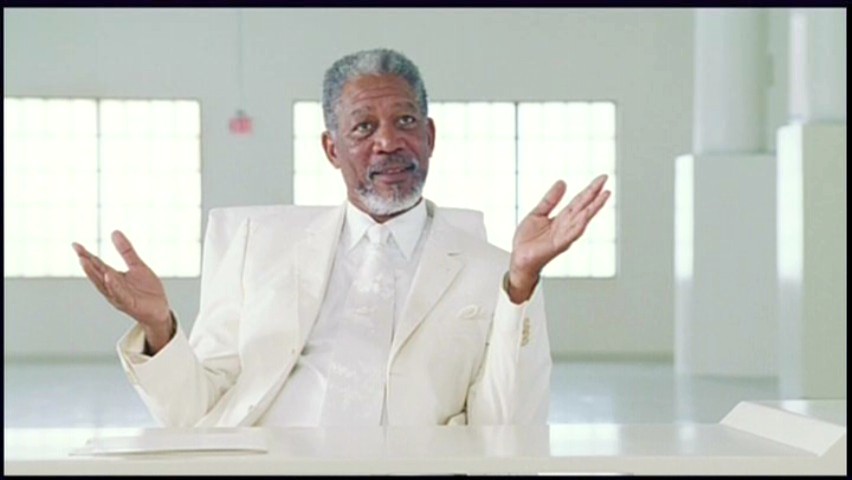
Even when Morgan Freeman played God, it fit into one of the type categories…
The Guardian ran a piece earlier this week that I enjoyed. It addressed the phenomenon of Hollywood not writing good roles for nonwhite actors, which it portrayed as a problem that goes far beyond this year’s all-white Oscars.
But wait! you say. There are lots of great roles for minorities in the movies! Well, yes and no. The part of the piece I enjoyed was its list of Top 10 current stereotypes for “people of colour” (leave it to the Brits to take an already stilted-sounding phrase and make it more that way by adding a “U” to it).
Whether you think opportunities for minority actors are limited or not, you’ll have to smile in recognition at some of the categories, such as No. 1, the “Magical Negro:”
One of the most popular cliches for black characters, a wise, folksy black character with some connection to magical forces or spiritual insight. They only exist to enable a white character to grow as a person and/or reach their goal. Examples include Will Smith in Bagger Vance, Michael Clarke Duncan in The Green Mile, Whoopi Goldberg in Ghost, and most of the roles that Morgan Freeman has ever played.
Or No. 5, “Awkward desexualised Asian:”
A man who is unlucky in love, though often played by extraordinarily good-looking actors. The character can never get a girlfriend, and if they do, it’s down to the intervention of the white protagonist. Generally nerds for good measure. Examples: Kal Penn in Van Wilder, Steve Park in Fargo, and special mention to Jet Li in Romeo Must Die who is in no way awkward but still can’t get a kiss from Aaliyah.
They forgot to mention Raj on “Big Bang Theory.” He exemplifies that type perfectly. (Maybe they were deliberately avoiding TV.)
And let’s not leave out one of my personal faves, No. “7. Jaded older police officer:”
Acts as a counterpoint to a younger, more energetic white police officer. Provides advice based on his own wealth of experience but is often ignored in favour of the white police officer’s instincts. Danny Glover in Lethal Weapon, Reginald VelJohnson in Die Hard, Morgan Freeman in Se7en.
Or Wendell Pierce, Lance Reddick or Clarke Peters in “The Wire.” Especially Clarke Peters, shown here with the requisite younger, brasher white officer. But Danny Glover is definitely the much-lampooned archetype of the category. Now in a way, I’m thinking that role may originally have been conceived by writers as a way of going contrary to type — with the black character representing the Establishment for a change. But yeah, it’s become a type of its own.
So there’s reason to believe this stereotyping thing is real, right?
But you know, in the spirit of “All Lives Matter,” we must acknowledge that Hollywood could stand to have more imagination when it comes to creating characters of all pigments and nationalities.
Here are a couple of types we can see out there for white men:
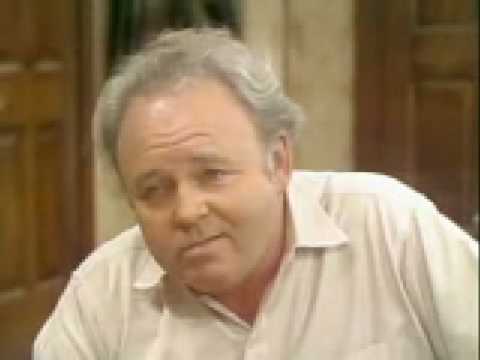
Idiot father and husband: The opposite of “Father Knows Best,” this guy is always wrong, and thank God he’s got a wife and kids to keep him straight. Think Archie Bunker in “All in the Family,” Doug Heffernan in “The King of Queens” (see the video below for the perfect example of the type), Homer Simpson, Peter Griffin in “The Family Guy,” Ed O’Neill as a dad in almost anything.
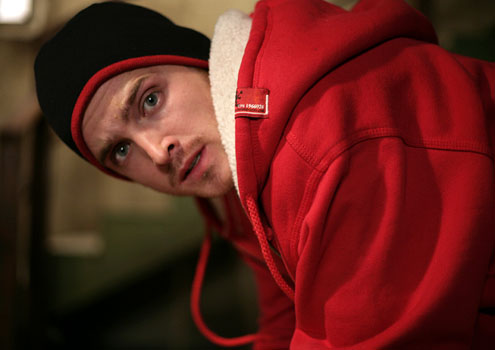
Feckless man-child — This guy is lost in time, lost in the culture, lives in a confused fog and has only the vaguest notion of himself as a man — either according to traditional or modern standards. Jesse Pinkman in “Breaking Bad,” Edward Norton’s characterbefore he and Tyler Durden started the “Fight Club,” almost any character portrayed by Breckin Meyer (I’m thinking particularly of “Clueless” and “Kate and Leopold”), Seth Rogen in almost anything (but especially “Knocked Up”), Wayne and Garth of “Wayne’s World,” Bill and Ted of “Excellent Adventure” fame.
But of course, the roles for white guys don’t always belittle them, not by a long shot. At the opposite end of the spectrum, we have:
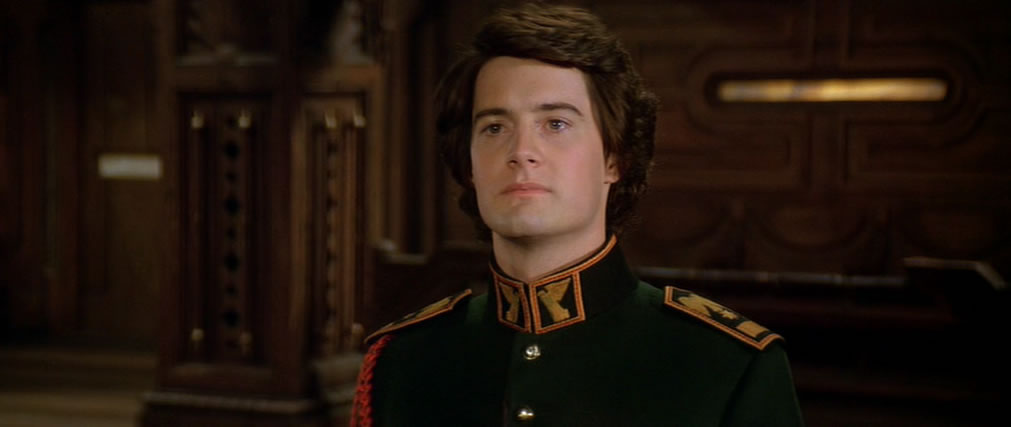
Secular Messiah — Ordinary young man discovers, to his wonder and often his delight, that he is not ordinary at all, but The One — a completely unique and necessary hero with special, mystical qualities who is destined to deliver his people from evil. This is an old role dating back in our literature quite a ways, but the movies have enthusiastically embraced it. Think: Arthur in every story from Le Morte d’Arthur to Disney’s “The Sword in the Stone,” Paul Atreides in “Dune,” Neo in “The Matrix,” Harry Potter in all the books and films of that universe, Luke Skywalker in “Star Wars.”
The One doesn’t have to be a white guy, you understand, but somehow, in the movies, he always is.
Of course, Morgan Freeman got to play God… but that’s covered in the “Magical Negro” category…
As I’m fighting a cold, my sleep has been fitful anyway, so I didn’t need my phone to be making little noises on the bedside table through the wee hours. Eventually, I reached over to see what it was on about. Oh. David Bowie’s dead.
I had not known he was ill, although in truth, he never looked all that robust.
I was never a big fan, but perhaps some of you were, so I thought I’d provide this opportunity for you to comment.
The above video is my favorite song of his, although I could do without the visuals. I always found his theatricality a bit on the excessive side. As you know, I have a different notion of how musicians should look. I like the casual, look-at-my-music-not-at-me approach. I want them to look cool, not overwrought.
Oddly, possibly because I was not a fan and didn’t listen to his albums (back in the ultimate period of album-oriented rock), I was unaware of this one song until the last few years, when it formed such an inspirational part in the British TV series “Life on Mars.” Here’s what I said about it awhile back:
I could swear to you that this song did not exist before I first watched, on DVD, the British time-travel-cop show of the same name (sans question mark). I had zero memory of it. Of course, I wasn’t at all into Bowie in his initial iteration, but still — I had heard and enjoyed “A Space Oddity” and heard other songs of his in the background. But I had completely missed this. Even now, I’m not sure if it’s just that the song itself is so great (which it may be; a critic in The Telegraph listed it as the single greatest song of all time, with “Let it Be,” one of my personal favorites, in second place) or it’s just the way it shaped the wonderful opening scene in which the protagonist of the TV show is transported back to 1973 that imprinted it so favorably on my mind. (Wonderful touch — the song begins the scene playing on the character’s early iPod, which itself now looks dated, then ends up on an 8-track.) In any case, I listen to it a lot now. Oh, a word in your shell-like: Don’t bother putting the American series based on this into your Netflix queue (despite the presence of Harvey Keitel in the cast); just watch the original. (Best bit:37 seconds into this clip, as the character “wakes up” into 1973 and the music reaches its climax.)
Oh, and sorry, but that clip with the best bit is no longer available. The Beeb had it taken off YouTube.
Lately, I’ve become all-too-accustomed to weighing in at over 180 (sometimes well over) on the rare occasions when I do weigh myself — at doctor’s offices, or when I’m at someone else’s home and they happen to have a scale in the bathroom.
That is not my fighting weight, not by a long shot. In fact, when last I was weighed for any sort of ritual combat — when I was on the wrestling team in high school — I was about 132. The year before that, I was in the 115 class — and just as tall as I am now. I was a scrawny kid.
But that was more than 40 years ago, and now that my uncommon genteel figgar has matured, I see my fighting weight as more in the neighborhood of the 160s. In fact, I recently decided — once again — to set my sights on being eligible to wrestle Shute. That, as I’ve mentioned before, is a “Vision Quest” reference. Awesome movie. Anyway, it means weighing in at less than 168.
So I resolved to go back on my paleo diet in the new year, and to keep myself honest, I asked for and received one of those spiffy digital bathroom scales for Christmas.
And this morning, I discovered a wonderful thing: My clothes, which I am always wearing when I step on other people’s scales, weigh a lot.
I weighed myself after showering, shaving and getting dressed — everything, including blazer, sweater, mobile phone, keys, shoes — and as is too often the case, the tally was 180.7.
But just moments before, having stripped to take my shower, I was only 172.4. Which really made those 20 minutes or so I’d just finished on the elliptical seem worthwhile.
Look how far I’ve come already! Just 4.4 more pounds, and Shute is in serious trouble! And I’ve got the whole year to do it in!
Yeah, I know. But allow me to savor this little victory…
This is Shute, the guy who is in such imminent danger.
Look, Chewie! It turns out Thomas Wolfe was completely wrong!
SPOILER ALERT!!!
SPOILER ALERT!!!
SPOILER ALERT!!!
OK, I’ve seen the new “Star Wars” now (I deliberately waited until a quiet Monday night more than a week after the opening, and was rewarded by not having to put up with a boisterous crowd), and if you’re much of a fan you’ve probably seen it now, too.
So let’s speak openly of what we’ve seen, which means we will speak almost entirely in SPOILERS.
Well, what did you think?
I’ll start…
First, it was great. I was not disappointed. No, not as great as seeing the first one 38 years ago, when Han Solo and I were both young and roguish and I wasn’t expecting to see anything that much fun; it was a miraculous surprise. That time, I drove away from the theater — the Park in Memphis — filled with the excitement of the Death Star battle scene, and could not shake the feeling that my sad little orange Chevy Vega was an X-wing fighter. The sensory stimulation was with me for some time.
This time I was more grounded as I left. I knew I was driving a Buick. But I did catch myself humming the theme music — rather loudly, so it was hard to miss.
No, I’m not kidding: Spoilers are coming right NOW…
And it gave me goosebumps at all the right places — when the newbie heroes find the Millennium Falcon. When Han and Chewie come aboard (and Chewie was more fun than ever in this one; he’s obviously been working on the timing of his comically expressive shrugs and Wookie noises), when Leia steps off that ship and sees Han — even when C3PO and R2 show up.
And when, at the very end, The One is found. Which was a special delight for me because my son, who had seen it before, had tried to prepare me for disappointment by telling me he wasn’t in it. What he had meant was that he wasn’t really in it in the sense of participating in any sort of action or engaging with the rest of the characters. But that turned out to be a wonderful UNspoiler for me: There he was after all, and he was in it exactly as much as I would have hoped, since I was told from the start that the movie was about a quest to find him — it was in the trademark screen crawl at the start (which was the first occasion for goosebumps, I now recall). And there he was at the end! So the movie has that going for it, which, as Carl Spackler would say, is nice.
I had read that J.J. Abrams didn’t try to get fancy: He knew what the fans liked and he gave it to them. He was like Paul McCartney. You know how most rock stars hate doing their hits for their fans, and despise the multitude for not appreciating their new stuff? Not Paul. He’s always loved being a Beatle, and he’ll give you “All My Loving” ’til the cows come home.
And he delivered. No fanboy would have done it better. But at this point I will share a few quibbles:
Was it absolutely necessary to follow the plot of the original quite that closely? Let’s see… Desperate character plants a software file in a droid because the bad guys are bearing down. Evil empire searches for the droid. Humble character (who is unknowingly chock full o’ the Force) rescues droid from creepy little scavenger creature. Heroes, including one who wants nothing to do with heroism, are borne to the rebel base by the Millennium Falcon, which offers mechanical trouble on the way. Then it turns out that the main threat to the rebellion comes from — a Death Star. OK, so it’s way bigger than a Death Star, but as Han says, yeah, so it’s big; so what? It turns out to have — you guessed it — an enormous, obvious vulnerability on its surface. Hit it and the whole thing blows. (Apparently. the engineering standards in this galaxy far, far away were not very exacting.) And — a bonus — this vulnerable spot is WAY bigger than a womp rat. So you know this evil base is going to go kablooey. The only question is whether our heroes can get clear of it in time.
Were those really quibbles, or were all those elements precisely what made it so much fun? I remain unsure.
What a wuss of a bad guy! The first time he takes off his helmet, one can’t help thinking, What, they couldn’t get David Schwimmer? They had to go with this poor substitute nebbish? In the climactic fight, he gets beaten not just by a girl half his size, but by a girl half his size with no Jedi training whatsoever. There he is looming over her, wrestling for the light sabers, and she evidently has much greater upper body strength. My older son pointed out after the movie that he had been shot by Chewbacca’s crossbow weapon, which they had demonstrated several times during the film had quite a kick to it, so there’s that. He wasn’t at his best. But still, I’ll say it again: What a wuss of a villain.
Speaking of which… We’re all looking for Luke because we need him, right? And we need him why? Because the Force was always so strong with him. But he was a slouch compared to this girl. She’s able to use Jedi Mind Control as effectively as Obi Wan himself, when she’d probably never even heard of it? I half expected it to backfire, and have the trooper slap himself in the forehead and say, “Those were the droids we were looking for!” But no. It worked. Worked so beautifully that they had a little fun with it. So what does she need Luke for? She’s got all the chops now. She’s got the mind control thing. She can already take out the baddest guy the Dark Side can whistle up. Why bother? Let him stay on his craggy little island…
Oh, and the low point of the movie — when the beloved character is killed? Some people behind me gasped and cried out in shock. Really? They didn’t see that coming? I knew it was over when he walked out on that catwalk thing. I’m sad about it and all, but he was awesome to the end.
OK, that’s all — and I’m stretching to come up with those, just to get a conversation started.
Really, truly, quibbles aside, I loved it. Just as I was supposed to…
When I saw the email from Netflix headlined “Brad, we just added a movie you might like,” I braced myself. Netflix chirpily announcing it has something I will like gives me the same creeping feeling that Arthur Dent got when the Syrius Cybernetics Corporation’s Nutrimatic drinks dispenser offered him another cup of liquid that was almost, but not quite, entirely unlike tea.
And sure enough, here’s what it was offering me:
Don’t know about you, but I consider that to be one of the silliest, most ridiculously hyped films of the past decade. It easily qualifies as my least favorite Ron Howard film, and I suppose my least favorite featuring Tom Hanks as well.
It was like a cheesy retelling of Umberto Eco’s Foucault’s Pendulum, and I didn’t like that, either. There are people who just eat up a tale involving a conspiracy stretching over thousands of years, especially when it involves the Knights Templar (as both tales do). I’m not one of them. I’m not a huge fan of the whole paranoia thriller genre to begin with, and when you stretch it to such extremes, you totally lose me.
And don’t even bother feeding me a tale about brilliant algorithms duplicating the human mind and taking over the world. When Netflix gets a clue as to what I like, then I’ll worry…
In another context, his stance might look menacing. Here, he seems mortified…
Forget about separate bathrooms; there is no more dramatic separation between the sexes than the stark contrast between the store aisles devoted to items marketed to boys and those aimed at girls.
The “boys'” aisles are filled with menacing things that shoot, crash, kick, punch or snarl, and the dominant colors are not baby boy blue, but black and brown, relieved only by blood red, ninja turtle green and sometimes alarming orange.
And the “girls'” aisles are, well, pink. That’s about all you can see at a distance, and sometimes close up. So much pink that I still feel an aversion to walking down them, like there is still a trace of Wally and the Beave in me, thinking, “Aw, Mom! Don’t make me go there! What if one of the guys sees me! He’ll give me the business!”
And anyway, we try hard to find more neutral things for our granddaughters — building sets, puzzles, games — something less frou-frou at the very least. There are such things still to be found, for girls and boys, and they are only occasionally to be found floating in the sea of pink.
And when you find something that doesn’t belong there, boy does it stick out. Like “Ultron” above, which I found amid the pink at Target, no doubt left by some kid whose parents said, “Put that down; we’re shopping for your sister.” (Or maybe the sister wanted it, and her parents preferred to buy her something more “suitable.” I don’t know…)
How did I get here? I’m not touching anything!
I like Ultron’s stance in the photo. With his shoulders hunched up toward his ears (or where ears would be if he had any) and his arms hanging in a way that suggests a reluctance to touch anything, and that mechanical grimace, he looks terribly awkward and embarrassed, as though he had accidentally gone clanking into the women’s bathroom. He seems to be thinking, “Get me outta here before the Avengers see me! They’ll give me the business!”
Well, it just serves him right for being such a testosterone-fueled bully who wants to dominate the world. Maybe in the future he’ll remember to check his privilege before barging in among all these lady dolls…
I hereby launch this blog’s official Most Absurd “Star Wars” Tie-In contest.
See if you can top this one — “Star Wars” bottled water. Near as I could tell without ripping the shrinkwrap, there was nothing about Star Wars on the actual bottles. So if you gave it to a kid in a vain attempt to get him to drink water instead of soda, it probably wouldn’t work. You’d get one of those “What are you trying to foist off on me, pops?” looks.
I’m pretty sure the only branding was on the plastic wrap holding the case together. Although if you’re sucker enough to buy one, and rip it open and prove me wrong, I will stand corrected.
The last couple of weekends I’ve been out toy-shopping for grandchildren, and seen just how far the Star Wars mania has gone. And of course I’ve noted the everyday, ordinary version of a toy, and next to it the version with a Star Wars theme and a price about 76 percent higher.
But I’ve not yet seen anything as ridiculous as the bottled water.
Soon after I moved back to S.C., I was struck by how much my home state was like the England of a couple of generations back — or at least, how its ruling class was like that of the older England. I’d read in books how when one member of the public school set met another, they could usually find a personal connection in one of three ways — family, school or military unit.
On one of my first visits to the State House, I either participated in or overheard conversations in which connections were made in each of those three ways. The Citadel or Wofford may not be Oxford, but the interpersonal dynamics were the same.
(Before I came home to SC, I had never in my work life — in Tennessee and Kansas — met strangers who could make personal connections to me, which gave me a comforting sense of professional distance from sources that I took for granted. Then, one of the first people I met at the State House — Joe Wilson, as it happened — heard my name and said, “Yes, I’ve met your father; he’s doing a great job.” It was bit of a shock. My father at the time was running the junior ROTC program at Brookland-Cayce High School after retiring from the Navy.)
All that was brought back to mind when I was reading a feature in The Washington Post this morning about the origins of the surnames of presidential candidates, and I got to this:
Graham
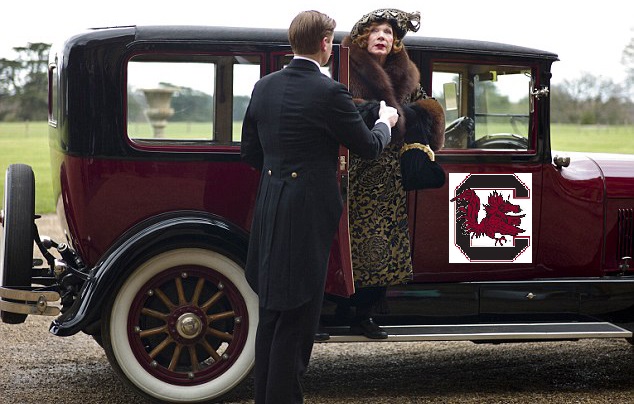
Possible national origins: Scottish or English Meaning: Have you ever seen the show “Downton Abbey”? It’s a good show (or, at least, has had its good moments). It centers on an expansive British estate at which there are strict social norms and a reliance on maintaining the boundaries of proper manners. If it were in America, it would be set in South Carolina.
“Graham,” as it turns out, is a name identifying residents of Grantham in Lincolnshire. And Lord Grantham is the main character in “Downton Abbey.”
As for “Grantham,” it’s apparently a combination of “homestead” — -ham — and either the Old English word for gravel — grand — or a reference to the name “Granta,” which means “snarler.” Making Lindsey Graham actually Lindsey Guy-who-lives-near-a-gravelly-home-or-near-where-the-snarler-lives….
Yes. An American Downton would likely be in South Carolina. In the Lowcountry, I would expect. Think Hobcaw Barony or something like that…
One thing they definitely got right: The grubby disaster area that is the typical reporter’s workspace…
I’ve had an extremely busy day and haven’t been able to keep up with the news. In any case, I was tired because I didn’t get home from the theater until about 10:30 last night, and then couldn’t resist popping my DVD of “All the President’s Men” into the player. I didn’t watch all of it, mind you, but… I was tired this morning.
I doubt that many of you have seen “Spotlight” yet, but you should. And against the day when you do see it, I thought I’d go ahead and share some of the things that struck me about it, most of which I shared with the audience last night during our panel discussion after the show.
First, a plug: That was my first time attending a show in the new Nickelodeon, and it was great. You should give it your custom if you don’t already. Andy Smith and the gang are doing a good job.
Now, my impressions…
I had said I was eager to see whether it really was the best newspaper film since the aforementioned Redford-Hoffman vehicle, and I wasn’t disappointed. In fact, given that the cinematic art has improved over the last four decades (or is it me?), it was better in a number of ways, although there were one or two things ATPM did that this did not (I loved the awkward, naturalistic, disconnected conversations Woodstein had with their sources — very much like real interviews). I was particularly impressed by how thoughtful and nuanced “Spotlight” was. If you watched the trailer, you could be forgiven for thinking it would be a cartoonish, black-and-white depiction of courageous, hard-driving journos relentlessly bringing down wicked Cardinal Law and his army of perverts. It was way more intelligent than that.
The few, the intensely interested: About a third of the audience stayed for the panel discussion.
For instance, while the film did show how a newspaper with the right resources and good leadership can peel away the layers hiding a dark secret eating away at its community, it did the opposite very well. By that I mean, it showed how a newspaper can fail to get that story, year after year. In a different context during our panel discussion, Charles Bierbauer mentioned the old saw that journalists live by, “If your mother says she loves you, check it out.” That very skepticism caused this team and the newsroom in general to fail to grasp the enormity of what they were facing. Yeah, they had a story about a pedophile priest on their hands, similar to a case they’d thoroughly covered years ago. But as indications emerged that maybe there were as many as 12 or 13 such priests in the archdiocese, then maybe as many as 90 (which would represent 6 percent, which a researcher told them they should expect — after all, that’s roughly the proportion of pedophiles in the adult male population), they just could not believe it. It was too outlandish; it didn’t fit their expectations in any way. John Slattery (of “Mad Men” fame) as Ben Bradlee Jr. spoke for all when he cried “b___s___!” to what the team had found at one point.
The members of the Spotlight team — three reporters and “player coach” Walter Robinson, played by Michael Keaton — were time and again dismayed to learn how they had missed the story over the years. After Robinson and a reporter ambush and harass a lawyer who has been dodging them, demanding that he provide the names of priests his clients had made claims against (leading to settlements that were sealed by the court), the lawyer finally explodes at them and says he had given the paper the names of 20 such priests several years ago, and the paper had essentially done nothing with it. Look at your own damn’ clips, he told them as he walked away. They look, and find a story buried inside. (This isn’t made clear, but I’m assuming they didn’t actually publish the names of the priests in that story — it would have been amazing if they had, without the kind of exhaustive investigation they were finally conducting at the time when the film is set, 2001-2002. You don’t run something like that on one lawyer’s say-so.)
The paper had also in the past brushed off a victim turned victims’ advocate, Phil Saviano, and an experienced editor can easily see why. When Saviano meets with the team and presents them with what he has, he starts out patient and then keeps slipping back into deep resentment that he had been ignored by others at the paper in the past, which causes him to lash out angrily. As he excuses himself to go to the bathroom, the reporters exchange a look behind his back. Yeahhh… one of those. We all have experience with sources like that. Full of passion, and full of stuff you can’t prove, and they come across as a bit unbalanced. Maybe he was abused, and it sent him over the edge. Or maybe the thing that sends him there is his frustration that no one believes the truth. At this point, the team is determined to find out if he’s right.
That the paper had missed opportunities in the past doesn’t mean the Globe is a bad paper; it’s far from that. This was just a particularly difficult story to a) believe, and b) nail down. Why, you wonder? Couldn’t they just go look at the court cases? No, they couldn’t. Lawyers for the victims who made claims — a small minority of the number of actual victims — generally didn’t file lawsuits in court. They went straight to the archdiocese, settlements were mediated, and the records were sealed. There would be a case over here that came to light, then one over there — and the paper covered those extensively, and everyone felt like they were on top of it. That there were so many priests, so many victims, that Cardinal Law was aware of the scope of it, that guilty priests would be shunted from one parish to another after useless “treatment,” all came as a shock as the resources of the Spotlight investigative team were devoted to the case.
And how did that happen? How was the decision made to have Spotlight drop what it was working on and bring to bear the kind of resources necessary to get the story at long last? That was interesting. It was the arrival of a new editor, Marty Baron, from The Miami Herald. He was an outsider in a newsroom full of people with deep Boston roots. He was Jewish in a Catholic town (all the members of the Spotlight team were raised Catholic, although apparently none were attending Mass any more). He wasn’t even interested in the Red Sox. He comes in feeling pressure to cut expenses, and focuses on Robinson’s team — four extremely talented, experienced reporters who only turn out a story about once a year (not because they were lazy, but because they put that much into their stories — making the team a very expensive luxury). And then he raises the question, if we’re going to have this team, why not have it look further into these sex abuse cases? He suggests they drop what they’re working on (some sort of police story) and turn to this. They do.
But it’s easy, if you’re not a journalist, to focus on the superficialities in the situation. A member of the audience asked me about that aspect of the story — the Jewish outsider being the only one who could make this bunch of hometown mackerel snappers take on the church in the most Catholic city in the country. I pointed out that he was missing the most salient aspect of Baron’s outsider perspective. It wasn’t that he was Jewish, or that he didn’t care about baseball. It was that he was from Florida — born in Tampa, coming up through the Herald‘s newsroom.
I could identify with his perspective. When I arrived at The State after having spent most of my career to that point in Tennessee, I was shocked to find out how much of public life in South Carolina could remain hidden — closed records, closed meetings. In Tennessee, we had had a Sunshine Law based on Florida’s groundbreaking open-government law. We’d had it when my career started. It spoiled me. I would hear stories of the bad old days before the law, when government bodies could go into something called “executive session” and shut out the press and the public, and I would shudder at the idea of such a thing. Then I came to South Carolina, where government bodies regularly go into executive session. It was like I’d been transported to the Dark Ages. Shortly after I arrived here, Jay Bender came to brief editors on improvements to FOI law that he and the Press Association had managed to push through the recent legislative session. I couldn’t believe what I was hearing. I kept saying things like, “That’s an improvement? You’re kidding me! You couldn’t do better than that?” I don’t think I made a good first impression on Jay.
(As governmental affairs editor, I was determined to break through the culture of closed doors. This led to an embarrassing situation one day. I left the newsroom to go check on my reporters and see what was happening at the State House. There was an important meeting going on somewhere that I was concerned we were missing. I spied a closed door, to one of the rooms off of the lobby near the exterior doors that open to the sweeping outdoor steps, and I strode over and put my hand on it. One of the loungers in the lobby called out that I shouldn’t barge in; there was a meeting going on. Aha! I thought. I self-righteously (I mean, I really made an ass of myself) replied, in a dramatic tone, “I know. That’s why I’m going in!” and pushed the door open with a flourish. It wasn’t my meeting. It was a couple of guys having a private chat, and they looked at me like I was crazy. I muttered something, backed out sheepishly, closed the door and endured the laughter of the lobby as I resumed my search.)
So, when Baron expressed surprise that it was so hard to get access to records in the sex-abuse cases, I felt his pain. And it made all the sense in the world that he would decide to overcome the barriers whatever it took, and suggested Spotlight drop what it was doing and get all over it. Which, as I said, they did. And they got the job done, against the odds.
I spoke of nuances. I loved a couple of the touches that undermined popular prejudices about the church, even as the film told in detail of the exposure of the church’s darkest secret. Sure, Law was the villain of the piece, but he was no Snidely Whiplash curling the ends of his mustache. Early on, when he meets Baron — one of those meetings that a new editor routinely has with key people in a community — he speaks of when he, too, had been an outsider, standing up for civil rights in Mississippi.
As for the old saw about a celibate priesthood being the culprit — hey, you don’t let ’em get married, so they take it out on the kids — there was a very interesting touch in the film. Stanley Tucci, wearing an impressive hairpiece, appears as attorney Mitchell Garabedian — as an Armenian, another outsider — who has decided he will try to make the abuse problem more public by actually suing on behalf of his victim clients in open court. He’s an irascible guy, and it takes some time for reporter Mike Rezendes (Mark Ruffalo) to build a relationship of trust with him. At one point as they’re getting to know each other, Garabedian asks Rezendes whether he’s married. Rezendes says he is (although apparently, it’s complicated). Garabedian asks whether his demanding job causes problems in the marriage. Rezendes admits it does. Garebedian says yeah, that’s why he never married: His work is too important, and he just doesn’t have the time. Which, you know, is the rationale behind priests being celibate — that they’re supposed to devote themselves entirely to being shepherds.
All in all, a rich feast of a film, that never falls back on easy answers. You should see it.
Look! Journalists walking through a newsroom — and it’s not deserted!
I was interested in seeing “Spotlight” because I’d heard it was the best newspaper movie since “All the President’s Men.”
That’s a high bar. I recently watched it again and was surprised how well it held up. I went to see it at the time because it was topical, and because Woodward and Bernstein were heroes to my generation of journalists. I was really startled at how good it was, independent of all that, going on 40 years later.
And I’ve seen Michael Keaton in a good newspaper movie before. I really identified with his character in “The Paper.” Of course, that was largely played for laughs, making it nothing like this film, which I’m anticipating being rather grim.
So, wanting to see it anyway, I was pleased to get an invitation to come watch it at the Nickelodeon tonight, and then participate in a panel discussion with Charles Bierbauer and Sammy Fretwell.
Y’all should come. The movie starts at 6:30 p.m., and the discussion follows.
The folks at the Nick asked me how I wanted to be billed on the website. I said, “Given the subject, I guess you could call me a 35-year veteran newspaper editor who is also a Catholic.” Which they did.
And no, I’m not talking about Hugh McColl, or even yours truly, who was considered to have done fairly well in the wider world until I got laid off. (You doubt my celebrity in the place of my birth? Consider that I was once invited to address the Rotary at Bennettsville’s now-defunct Farron’s Restaurant — which was not defunct at the time. Of course, the invitation did come from my uncle.)
No, I’m talking about Aziz Ansari, whose celebrity now exceeds Hugh’s, and even mine.
The above moment in the pilot of “Parks and Recreation” was a sort of milestone for our hometown. It was, I believe, the first time a recurring character on a prime-time network show said to the world, “I am from Bennettsville, South Carolina.” The fact that he followed it up with “I am what you might call a redneck” hardly takes away from that proud declaration. We Marlboro Countians have a great appreciation for irony.
The irony goes deeper, however, than the assertion that the Indian-American is from Bennettsville and not, as Amy Poehler’s character had guessed, a Libyan.
The fact is that Aziz — since he’s a homeboy, I feel free to call him “Aziz” — has greater claim to Bennettsville than I do. Sure, I was born there (while he was born in faraway Columbia), but only because my mother went home to have me while my father, a newly minted Naval officer, was attending a school in San Diego. I grew up thinking of it as home because it was the place I returned to each summer to visit my uncle and grandparents between new postings to places where I would live for a year or so and never return to.
The one time I lived in Bennettsville almost year-round was the 1967-68 school year, when I was in the 9th grade at (also now defunct) Bennettsville High School. So if you walk down Main Street, you may not be able to find anyone who knows me, although you may run into an older person who will remember me as the boy who yelled right out at the preacher in church, completely cracking up the congregation, in the middle of an otherwise stultifyingly boring sermon in 1957. No, I’m not making this up. I have it on good authority that when my name comes up in B’ville, if it does come up, the conversation inevitably moves to the yelling-in-church incident. I’m quite the local legend for that. It probably surprised no one that I became a writer of opinion; I am after all The Boy Who Didn’t Know When to Shut Up.
But Aziz actually grew up there, and attended Marlboro Academy, which (irony again) is where most of the white kids went after BHS was finally completely integrated at the start of the 1970s. (When I was there I had black classmates in homeroom and P.E., but we were then under the “Freedom of Choice” system in which everyone declared which school they wanted to go to each year, and only the very bravest African-Americans dared to say that they wanted to go to the “white” school — something I didn’t really appreciate at the time; I actually thought the school was integrated.)
So his Bennettsville credentials may be more solid than mine, but at least I can say I was a Green Gremlin (possibly the quirkiest, coolest school mascot ever), and he was not.
So there.
Anyway, have any of y’all seen his new show on Netflix, “Master of None?” It’s pretty funny. Not something you want to turn on until after the kids have gone to bed, but funny. Check it out and we’ll discuss it here…





 I’ll admit that I was a bit slow on the uptake. For about two second, I wondered, Why are they smashing a CPU? (You’ll recall that, in the movie, it was a printer.)

 Lindsey Graham‘s the wise-cracking guy who nevertheless can give a pretty good speech about why we fight, and though he’s obviously no John Wayne, he’ll likely be a passable soldier when the shooting starts. Think L.Q. Jones — the character, not the actor who played him and adopted the name (even though he was poorly cast) — in “Battle Cry.” Think the book version. Only Leon Uris fans will get that, so never mind. Instead, think George Luz in “Band of Brothers.”
 Scott Walker is the replacement who gets killed at the start of the first battle, and no one in the unit can remember his name. Or maybe he was a member of another company entirely who ended up fighting alongside the main characters because the drop zones were all messed up. Think Private Hall in “Band of Brothers,” the guy who is the first character killed on D-Day. Or, to switch genres, anyone in a red shirt on “Star Trek.”
 Ted Cruz is the blowhard who talks big about how many Krauts he’s gonna kill, and the first time he’s within hearing of the guns he’s found cowering, quivering, in his foxhole. Everybody hates him — he’s always figuring an angle for getting ahead, at the expense of the other guys in the platoon — so they’re inclined to leave him there in the hole, but someone calls the medic. In “The Dirty Dozen,” he’d be
 Donald Trump is the utterly corrupt quartermaster who runs the black market operations in the area. A real weasel, although a tremendous businessman (ya gotta give him that) he’s all about insulting the other guys in the battalion. He’s even trading with the enemy; anything for the deal. He gets along great with Starshina Putin, his counterpart in the Red Army unit just over the hill. Think Don Rickles in “Kelly’s Heroes.” (He’s not smooth enough to be
 Jeb Bush is the well-meaning but largely ineffectual officer who lives under a huge shadow. His father was a general and even his ne’er-do-well big brother made a name for himself earlier in the war. He got great grades at West Point but thus far hasn’t distinguished himself. He’s not a bad guy, but he’s not the kind of guy the men are all that eager to follow into battle. Picture Tom Hanks’ kid in “Band of Brothers.” (I’m not going to be cruel and call him Lt. Dike.)
 Bernie Sanders is “Pops,” the impossibly old guy who somehow got drafted anyway. The young guys all think he’s great and look out for him, even politely listening to his crackpot ideas about politics, the Army, etc. He likes to freak out the recruits by popping his teeth out without warning. For some reason I’m picturing James Whitmore in “Battleground,” but I’m not sure that’s quite right. Can anyone think of somebody better?
 Chris Christie is the crusty sergeant who’s been there and done that and rides the younger guys pretty hard, calling them “craphead” and “boy in the bubble” and such. Maybe Telly Savalas, in either “Battle of the Bulge” or “Kelly’s Heroes;” take your pick. But not in “The Dirty Dozen” —
 Marco Rubio is “College,” the guy who earned half a degree before deciding he’d better join up. He’s a slick talker and will probably get into politics when he gets back home. The guys respect him for his ability to talk his way out of KP and such, but he hasn’t proven himself to them yet, and some wonder how he’ll measure up in combat. Think of David Kenyon Webster, the Ivy Leaguer in “Band of Brothers.”
 John Kasich is the battalion executive officer, like Major Strayer in “Band of Brothers.” (Yeah, I keep citing “Band of Brothers,” which doesn’t fit the mold of the stereotype-ridden B movie. But there were just so many characters to choose from.) He’s regular Army and he knows his way around and the guys pretty much respect him and accept him in the No. 2 role, but people just aren’t sure how he’ll lead if the Old Man gets hit. This guy doesn’t usually have a lot of lines in the movie.
 I don’t know who Hillary Clinton is. It’s tough, since the Pentagon hadn’t yet rubber-stamped an OK on women in combat. I’m still working on it… She’s not a nurse (unless we’re talking