Category Archives: The Nation

One thing Graham definitely is NOT is dumb…

salon graham

Say what you want about the increasingly ubiquitous Lindsey Graham, Salon was way off the mark today when its header featured an unflattering photo of our senior senator next to the teaser hed, “Hagel’s dumbest enemies.”

Of course, as is often the case with such hyperbolic come-ons, the actual headline that the teaser linked to took it down a notch: “The increasingly ridiculous Hagel opposition.” The subhed, situated atop huge mugs of Graham and John McCain, begins, “Republicans block a vote for no reason…”

The very first paragraph of the body copy then refutes that (boldface added):

Sen. Graham and his best friend John McCain have been blocking the confirmation of Chuck Hagel as Defense secretary, because they want to know whether President Obama called the president of Libya the night of the Benghazi attack. While that’s not a very good reason to filibuster a Cabinet nominee, it is at least “a reason.” The White House has complied, giving Graham and McCain what they want. Graham’s response: Now he is just going to pointlessly delay the Hagel vote, because it will make him feel good. As always, with Lindsey Graham, being a senator is all about feelings.

Disagree with Graham — and McCain — all you want, but making him the poster boy of the “dumbest” is, well, pretty stupid.

I find a lot of the indignation on the left about delaying the Hagel nomination a few days a little on the disingenuous, even absurd, side. My least favorite manifestation of this is when I hear a Democrat express absolute mystification that these Republicans could possibly be objecting to Hagel, since he’s a Republican. There is no mystery as to why this is a Republican Democrats love. and Republicans have problems with him for the same reasons.

There are actual substantive reasons to question this nomination. We could start with his having been completely wrong on the Iraq surge. Which is kinda relevant in a candidate for SecDef. But then, of course, we’d have a whole other argument that we’ve had too many times before…

So never mind all that. I don’t call the president “dumb” for wanting a guy who looked at Iraq the way he did. I have more respect for the president than that.

But there’s a bigger reason I wouldn’t call Barack Obama dumb: I’ve heard him speak. And the same goes for Lindsey Graham.

I was speaking to a class at Lexington High School yesterday, and I let slip a comment that always makes me sound arrogant when I say it, but it’s true: It’s pretty unusual for me to interview a political officeholder in South Carolina who makes me think to myself, “This guy’s smarter than I am.” But I’ve had that thought more than once when talking with Lindsey Graham.

And I may have a host of faults — correction, I do have a host of faults — but being dumb isn’t one of them.

Graham and Senate GOP block Dems’ attempt to push Hagel vote

At least, I think that’s accurate. This WashPost story doesn’t actually mention Lindsey Graham, which surprised me:

Senate Republicans blocked a vote on Chuck Hagel’s nomination as secretary of defense on Thursday, launching a filibuster whild demanding more information and more time to study their former colleague’s speeches and finances after he left the Senate in late 2008.

Falling one vote shy of the 60 needed to move forward on the nomination, the Hagel filibuster brought stark condemnations from President Obama and Senate Democrats for its precedent-setting nature — the first time a defense secretary nominee had been filibustered. The setback came during what many believe is a critical period for the Pentagon as it winds down troops from Afghanistan and implements costly budget cuts.

Republicans predicted they would relent to a simple majority vote, guaranteeing confirmation, later this month — but only if they see more information about Hagel’s post-Senate foreign policy speeches and his work in private investment groups. Senior Republicans initially scoffed at those demands, first raised by freshman Sen. Ted Cruz (R-Tex.), as unnecessary, but now party leaders hold them up as the main cause for delay…

But it made it clear that all Republicans except for three — and none of the three (no surprise here) is Graham — are standing against an early vote on the Hagel nomination. And a WashPost blog post earlier in the day — when it was believed the vote would not come on Friday, before the Democrats made the tactical mistake of trying to move it up — had made clear what I was pretty sure I already knew about Graham’s central role in the delay-Hagel movement:

At  the center of this drama are Graham and McCain. McCain is likely to support his “amigo” Graham if Graham feels he is still getting stiffed by the White House. Graham has every reason to hold out for the information and to further endear himself to conservatives whose support he will need in his reelection bid. Once we see how Graham and McCain are leaning, we’ll know which way the vote is going to go on Friday.

Anyway, we have a bit of an impasse here. Democrats are understandably upset, although their claims that this delay puts the nation’s security in danger are a bit overwrought. When Harry Reid said:

“This isn’t high school, getting ready for a football game or some play that’s being produced at high school,” Senate Majority Leader Harry M. Reid (D-Nev.) said during an angry floor speech Thursday morning. “This is – we’re trying to confirm somebody to run the defense of our country, the military of our country.”

I thought, Exactly. And if one has sincere doubts about the nominee’s fitness — which I believe Graham and McCain do — it’s not responsible to rush into confirming him.

Yeah, I know, a lot of my friends here on the blog are sick of Graham and McCain and all their doings. Well, to them I say that it’s not like they are alone on this. Moderate Republicans who are less likely to preen on the national talk shows on this subject are also reluctant to be rushed on this. Such as my old Tennessee source Lamar Alexander:

Sen. Lamar Alexander (R-Tenn.) told reporters that cutting off debate is “premature.”

“When we come back from the recess 10 days from now, senators should have had sufficient time to consider Senator Hagel’s nomination, and I will vote to have an up-or-down vote,” Alexander said. “I know of many of my colleagues who think that’s enough time. It would be better for the institution and the country if we had enough time to consider Senator Hagel and then have an up-or-down vote, so we don’t get into a habit of making it look like we’re suing the filibuster to block Cabinet nominees. That’s not the case here.”

Anyway, I think a delay is worthwhile. For the very reason that, as Sen. Reid says, this decision is crucial to the nation’s security, I don’t think we need to be doing this on a party-line vote, when by waiting a few days we might get something closer to consensus. What do y’all think?

Thoughts on the State of the Union?

As I type this, Marco Rubio is wrapping up his response to the State of the Union. And I find myself wondering yet again, as I do every year this time, no matter who is in the White House… how did this ridiculous ritual get started?

I don’t mean the SOTU; I mean the response. The State of the Union is the president fulfilling a constitutional duty — which, by the way, he can do in writing (just a suggestion). But as much as that has transformed into political theater, the response is nothing but theater.

And you know what? It always comes across as lame, no matter which party is delivering it or which up-and-comer they choose to be the face of it. It rubs our noses in the fact that partisanship is so obligatory and ritualized today that an elected official can’t even deliver a constitutionally-mandated  message without the other party immediately standing up to say “nyah-nyah, that guy’s full of it.”

The artificiality of it is underlined by the fact that it is not a response at all, but a speech prepared ahead of time — a set of partisan talking points that the party wants to deliver regardless of what the president said.

Anyway, to me, the party delivering the response always comes across as petty and pointless. To me, anyway. Kind of sad, really.

Enough about that. Thoughts on the real speech, the one the president gave? Here’s an assessment from over at the WashPost:

That was an incredibly ambitious speech.

Imagine, for a moment, that President Obama managed to pass every policy he proposedtonight. Within a couple of years, every four-year-old would have access to preschool. The federal minimum wage would be at $9 — higher than it’s been, after adjusting for inflation, since 1981. There’d be a cap-and-trade program limiting our carbon emissions and a vast infrastructure investment to upgrade our roads and bridges. Taxes would be higher, guns would be harder to come by, and undocumented immigrants would have a path to citizenship. America would be a noticeably different country.

Yes, it was ambitious. About everything. I found that no particular part of it stood out for me, because he touched on so many things that he didn’t fully focus on anything. But maybe that’s just me.

I did like the communitarian touch at the end, about “the enduring idea that this country only works when we accept certain obligations to one another.”

Which of course Rubio summed up as “growing government.” Whatever. Although I’ll say that the president wanted to do so much that anyone would have to wonder at some point how we’re going to pay for it.

What did y’all think?

Graham’s threat to put a hold on nominations

Before I wrap up for the day, I need to mention one of the first things I read this morning, at the very top of The Wall Street Journal‘s “What’s News” column:

Sen. Graham plans a “hold” on CIA, Pentagon nominees. The South Carolina Republican said he would make use of the procedural practice until the White House gives more information about the attack on U.S. facilities in Benghazi, Libya. Democrats criticized the call to block Brennan from the spy agency post and Hagel from Defense, calling it “unprecedented and unwarranted.” A McCain aide said the Arizona senator backs the move. Both lawmakers said they don’t support a filibuster.

What’s missing from the story that links to, and from other stories I’ve seen, is an elaboration on exactly what information Graham still wants from the administration regarding Benghazi. This has been going on so long that I lose track, and a bill of particulars would be helpful. I’ve emailed his office seeking that, and will pass on what I get back.

Meanwhile, a vote on Hagel has been scheduled for Tuesday in the Armed Services Committee. John McCain, for one, has said he will not participate in a walkout during the committee meeting, as he wants the nomination to proceed to the floor: “I will not participate in any walkout of tomorrow’s committee vote—an action that would be disrespectful to Chairman Levin and at odds with the best traditions of the Senate Armed Services Committee.”

Talk among GOP member of the committee about such a walkout have fizzled, says the WSJ.

The new party’s principles and platform

Lovelace

Lovelace addresses the meeting.

First, some news I found particularly welcome: The name that Jim Rex and Oscar Lovelace have proposed for their new political party, which had its initial public meeting today in the Tapps building downtown, is negotiable, or as one of them said, a “first draft.”

Good, thing, too. Not only does “Free Citizens Party” sound like it could have been one of the contenders for the Tea Party’s name, it doesn’t represent at all what they’re trying to accomplish. But they rejected a far more descriptive name — Common Ground — because they couldn’t get ownership of it. Ditto with another name they liked (and for the best of reasons, because it expressed what we all have in common, rather than what divides us), “American Party.” What they didn’t mention was that that would have been a bad idea because of the unfortunate association with George Wallace.

But more than that, the name puts them on the wrong side — from their own perspective — of the constant strain between rights and responsibilities. As I’ve written so many times in the past, one of the things contributing to the destructive polarization of our politics is that we couch far too many issues in terms of “rights,” which, being absolutes, are non-negotiable. Take the right to life vs. the right to autonomy/privacy. The right to health care vs. the right to be left alone. What we need more than anything is to stop demanding more and more personal rights — stop acting like a bunch of two-year-olds crying gimme-gimme — and think a bit more of our responsibilities as citizens.

And indeed, Rex and Lovelace spoke repeatedly of the lack of responsibility in our politics. First, there is the abdication of responsibility of disengaged citizens who are turned off by politics and leave our public life in the hands of the squabbling ideologues (which this new party is intended to address by providing a new challenge to involvement for the disaffected). Then, there is the lack of responsibility of the parties, which concern themselves only with winning, and stick by the very worst of their members. Then, there is the lack of responsibility to the people on the part of elected representatives, who grow complacent in their “safe” seats (at least, that’s how Rex and Lovelace see it).

At one point, Rex even invoked one of my alternative names for the UnParty — the Grownup Party. And that leads directly to the problem with naming the kind of party we really need in this state and country (which, I believe, is what Rex and Lovelace are trying to create) — if you call it the “Responsibility Party,” or the “Grownup Party,” it’s not exactly going to set a focus group on fire. Too much like “Eat Your Vegetables.” And yet that is exactly what we need — an “Eat Your Vegetables” party.

As for the “Citizens” part: Again, this is not about “I’m a citizen and therefore I’m entitled,” the way I hear the word used by some nativists. In fact, in explaining the name, the two principals invoked “the Greatest Generation” — people who paid a price for our freedom, who fully embraced the responsibility inherent in citizenship.

Anyway, just to get the ball rolling, Lovelace and Rex are calling this the Free Citizens Party, and they’ve put some ideas into writing, which invites us all to shoot at them. So, with a minimum of commentary, I’ll pass on what they’ve sent up the flagpole.

First, there are their four party principles:

  1. Legislate and govern from the middle.
  2. Increase economic competitiveness.
  3. Term limits — public vs. self-service (their words, of course, not mine at all, as I see this as their most problematic proposal)
  4. Increase responsibility/accountability. (There’s that word.)

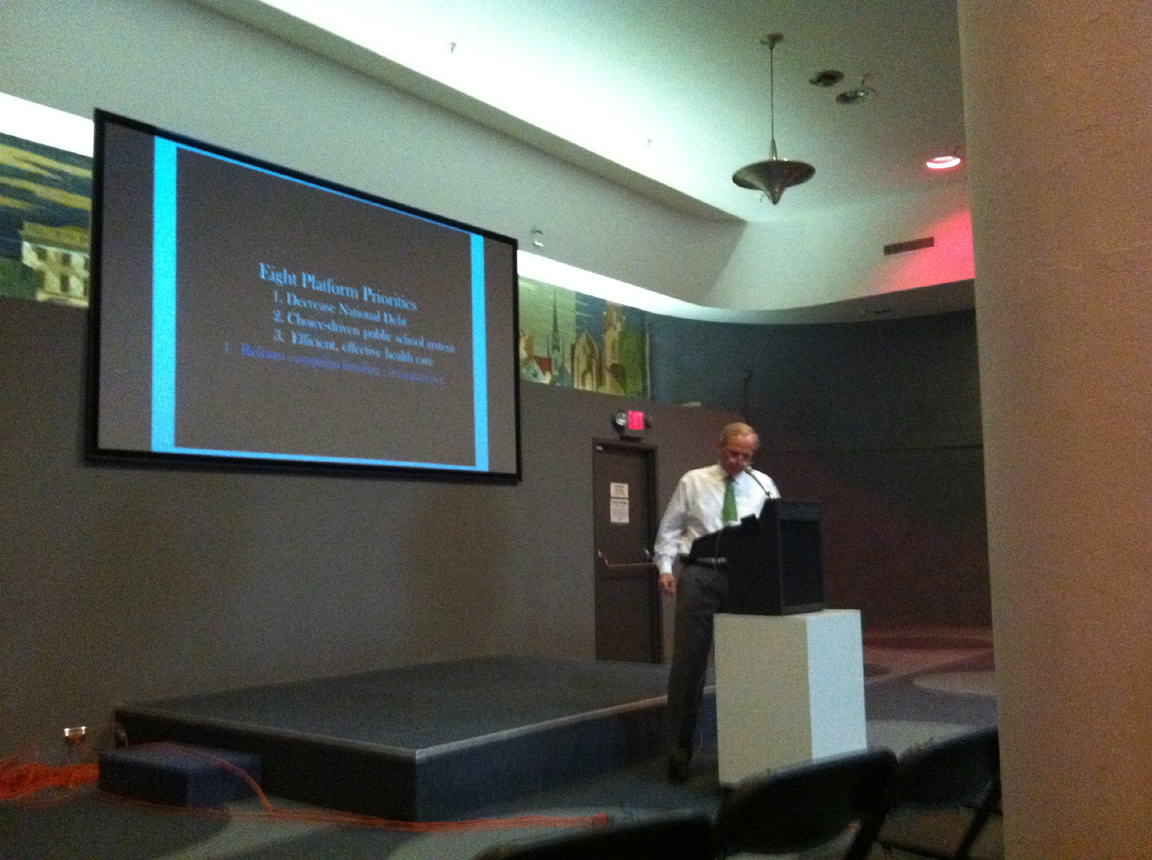
Then, they presented their Eight Platform Priorities:

  1. Decrease national debt through balanced approach.
  2. Strong, choice-driven public school system/early education. (Public school choice, you’ll recall, was a priority of Rex’s as superintendent.)
  3. Efficient, effective healthcare. (To bring in Dr. Lovelace’s particular area of concern.)
  4. Reform campaign funding/transparency.
  5. Ethics reform legislation — state and federal.
  6. Support 2nd Amendment w/ reasonable regulations. (Rex stressed that, being a hunter, he has “a lot of guns.”)
  7. Simplify tax code — promote work, saving, investment.
  8. Comprehensive immigration policy reform. (They brought up an argument for strong borders that I don’t recall hearing advanced before — their concern for public health, wanting to prevent the spread of pandemics.)

After presenting all that, the two masters of ceremony entertained questions and comments from the audience for quite some time.

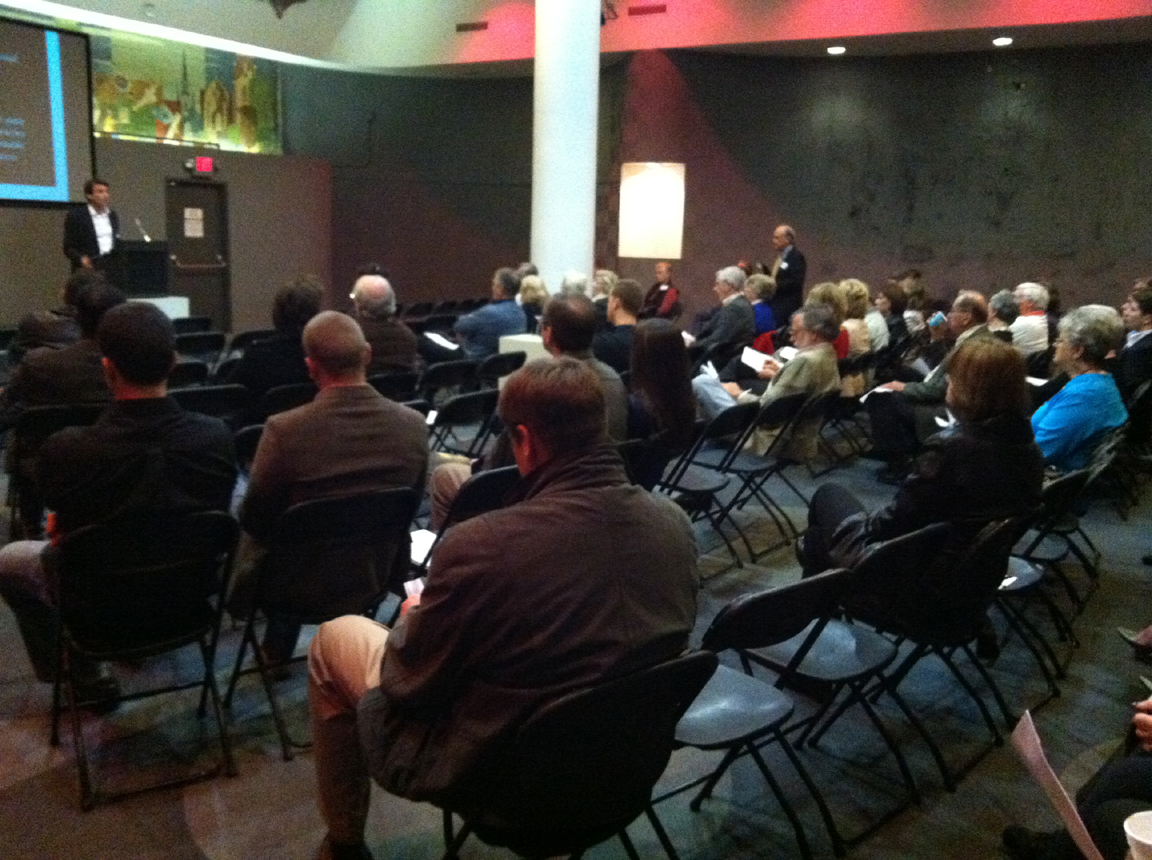
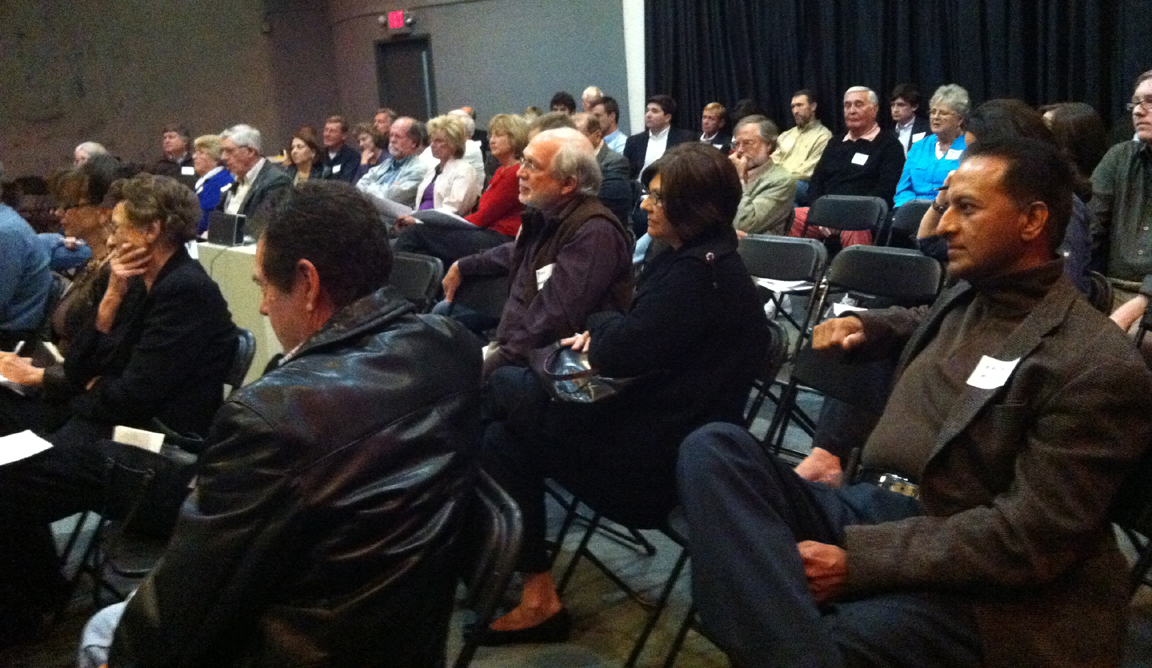
About that audience — I’m thinking fewer than 100, but not a bad turnout for something that had so little publicity. It was mostly middle-aged (in other words, Grownups), although there were a few who didn’t fit into that category. Based on the questions and comments, a serious, thoughtful bunch who are frustrated with the status quo. (And guess who came up and introduced himself afterwards? Our own “tired old man!”)

Lovelace pointed out that no one should be discouraged about the turnout. He said this group was bigger than any county GOP gathering he ever spoke to during his run for governor in 2006. And Rex chimed in that he had the same experience as a Democrat. Their point being that if the existing parties are so formidable, their county gatherings should be bigger than this fledgling meeting.

Before I close this report, a word about their embrace of term limits, which I believe is based in a misdiagnosis of what is wrong. Rex at one point spoke of how offensive the term “safe district” is, and he’s right. But he misses what is most offensive about it. The main problem is not that a district is safe for the incumbent (although the courts allowing incumbent protection as a basis for reapportionment is a problem). The problem is that it is drawn to be safe for a party. And the more extreme the two parties get in their polarizing ideologies, the worse the representation will be from that district.
Rex

Rex walks through the eight platform priorities.

Rex speaks of the complacency of incumbents in “safe” districts. I don’t see them as complacent at all. I see them running like scared rabbits, constantly building their “war” chests to protect themselves, and against what? Not a challenger from the opposite party, or from some moderate independent. They’re protecting themselves against a challenge from someone in their own party who is more extreme than they are. They do two things to protect themselves from this — they raise money, and they become more extreme themselves, in their words and in their actions.

And how do they raise money? They do it by constant appeals to their own partisans, making wild charges against the opposition, stirring fear and loathing in their bases. And that is the problem — that the current system rewards polarization and gridlock for their own sakes. They are good for the business of politics. And johnny-come-latelies are just as guilty of taking advantage of this dynamic as are incumbents. That is the cycle that must be broken by a party that appeals to reason, to moderation, to the interests that we all have in common rather than what divides us.

If incumbents are replaced, who replaces them? Not some Mr. Smith goes to Washington, but a partisan who convinces the primary voters that he’s more extreme than the incumbent. Think what happened to Bob Inglis. Or any of those incumbents either taken out by, or seriously threatened by (which in turn affects their behavior and makes them more extreme), Tea Partiers in recent years.

Anyway, enough about that. For now. These guys are trying to do a good thing, and they have enough of an uphill climb without me carping about the details. They’re shooting for the 10,000 signatures to get their party on the ballot by the 2014 election — really 12,000, given that many signatures get successfully challenged.

And they know that’s not easy. Dr. Lovelace ended the meeting with a quotation from Machiavelli:

It must be considered that there is nothing more difficult to carry out nor more doubtful of success nor more dangerous to handle than to initiate a new order of things; for the reformer has enemies in all those who profit by the old order, and only lukewarm defenders in all those who would profit by the new…

Obviously, they have not hired a political consultant, or they wouldn’t go around quoting Machiavelli. But the point is dead-on. I know, from the unsolicited feedback I’ve gotten over the years from all sorts of thoughtful, rational people across this state — like the strangers who come up and tell me how much they agree with what I write — but they’re seldom the ones who stand up to be counted. It’s defenders of the status quo, and at least as bad, the advocates of terrible ideas for change, who have all the passion. The people who simply want rational, responsible government don’t storm barricades, or make demands. They make for lukewarm advocates.

As it happened “tired old man” had brought with him a printout of a Yeats poem that I think makes the point better than Machiavelli did (not least because it doesn’t have Machiavelli’s name attached). I quoted it not long ago here on the blog. The relevant passage:

… Things fall apart; the centre cannot hold;
Mere anarchy is loosed upon the world,
The blood-dimmed tide is loosed, and everywhere
The ceremony of innocence is drowned;
The best lack all conviction, while the worst
Are full of passionate intensity.

That’s my experience. What we need is for the best to embrace conviction, and advocate for rational government with passionate intensity. Good for Rex and Lovelace for trying to get that going.
crowd

A portion of the modest crowd that attended.

John Yoo on the Obama administration’s drone memo

MQ-9_Reaper_-_090609-F-0000M-777

When I first read of the Obama administration’s drone memo earlier in the week, I idly wondered what John Yoo would think of them.

You remember him. He’s the lawyer who wrote the “Torture Memos” for the Bush administration.

Well, now I don’t have to wonder, because he wrote what he thinks of the latest development in The Wall Street Journal today.

The general thrust of his piece is that the great flaw in the current administration’s justification for its drone program is that it’s based not in the assumption that we are at war with al Qaeda, but on the assumption of so many on the antiwar left that terrorism should be treated as a crime. As he puts it, “the Obama administration is trying to dilute the normal practice of war with law-enforcement methods.” Which means you have to go through extra gyrations of rationalization to order a drone strike.

I’ll let others argue over that. What intrigued me was the ethical question Yoo raised at the very end of his piece:

Rather than capture terrorists—which produces the most valuable intelligence on al Qaeda—Mr. Obama has relied almost exclusively on drone attacks, and he has thereby been able to dodge difficult questions over detention. But those deaths from the sky violate personal liberty far more than the waterboarding of three al Qaeda leaders ever did.

That’s something else I’ve been thinking about: Which is worse, taking someone captive and mistreating him, or killing him?

There’s the related question: Is the killing of our enemies with essentially a deus ex machina from the sky, with no risk to Americans, rather than facing them in battle, the morally preferable course? OK, most Americans would probably say “yes,” to that one, but let’s address the first question: Is killing preferable, morally and ethically, to capturing and torturing?

And no, those aren’t the only two options we have. But that’s the question Yoo posed, and I find it an interesting one.

Strangest email of the day: Orrin Hatch wants me to host a breakfast for him

I have no idea why I received this email an hour ago:

Hope you are well and that your New Year is off to a nice start.

I wanted to be in touch with you and ask if you would consider Hosting a small breakfast  for Senator Hatch and his leadership PAC, ORRIN PAC.

You and others like you were instrumental in our hard fought victory last year.

It is critically important to Senator Hatch that he be in a position to help our Senate and House Republican incumbents, challengers and candidates in open seats this cycle.

I have taken the liberty of suggesting a few dates that we have held on the Senator’s schedule for such events (listed below).

If you are able to step up and host an event please just let me know if any of these dates work for your schedule.

Thank you for your consideration, and for all of your past support of Orrin!

Hope to speak with you soon.

Liz

Liz Murray

ORRIN PAC and Hatch Election Committee

703.749.1819

Possible dates:

February 28 Breakfast

March 5, 7, 12, 14 Breakfast

I assure you, I did nothing to help him win anything last year.

Todd Kincannon seems to have found his own Heart of Darkness


I’m not sure how else to put it.

I’ve known Todd, slightly, for several years now. Once, I would have said, “I know him to say hello to.” Now, I say, “I know him to exchange Tweets with,” which I have done frequently. I’ve only met him in person a handful of times, and when I have, he’s been a polite, friendly young man who seems to know how to behave himself in public.

But lately, his Tweets — and there are a LOT of them; I don’t personally know anyone who Tweets more constantly — have been trailing off into a strange, dark, extreme place. Following them is like traveling up the Congo (or, in Coppola’s version, the Mekong) in search of Kurtz, who had lost himself in savagery. Increasingly, they are of a sort that I can’t quote here without violating my own standards. Even showing you the ones that this post is about is a departure. But now that Todd has gone on national media to defend these truly indefensible Tweets, and not backed down an inch or admitted in any way that they are beyond the pale, and been identified to the world as a former executive director of the state GOP, well… I’m laying them out before you.

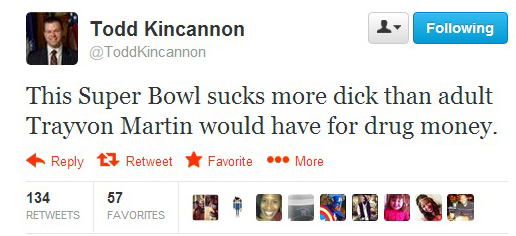
Here’s the one that the above video interview is about:

todd1

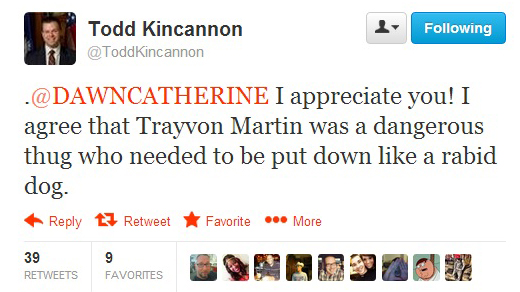
Here’s another related to it:

todd2

I don’t know what has led Todd on this path. I know that when he stepped it up (or rather, down) a few degrees a month or so ago, he found himself gaining a lot more attention, and I’ve seen that do bad things to people’s heads before.

Is it just immaturity? When Rusty DePass posted something on Facebook that deeply offended all who saw it, he immediately took it down (too late; it had been grabbed and preserved) and truly, sincerely apologized to everyone for it. (I think Kathryn, and others here who know Rusty, will back me up as to his sincerity.)

Todd operates in an environment where… well, the maturity level is pretty well established in the language used in this Wonkette piece criticizing him. A place where there are no rules of civility, or at least it seems that there aren’t — until Todd manages to find a way to violate them. (The problem with Wonkette’s reaction, of course, is that it helps Todd believe in his explanation that this is just a left-right thing, and he’s just doing what everybody does to people on the other side.) A place where obscenities that would only sound daring to a 7th-grader are the standard.

How hard is it to simply say that, for instance, Trayvon Martin was just this kid, you know? He was neither an angel nor a devil, he was just a kid who didn’t deserve to die because he had a run-in with this George Zimmerman guy, who wasn’t an angel or a devil either. MIsguided people on the left and right have glommed onto these people as some sorts of symbols, but they were just people. And his shooting was what the prosecutors in Tom Wolfe’s Bonfire of the Vanities would have called a “piece a s__t case,” a case that’s just a horrible, tragic mess any way you look at it, with no heroes, no one to admire, no good coming out of it, no redeeming lesson to be drawn.

But one thing is clear: Now that the kid’s dead, he sure as hell doesn’t deserve to have his memory trashed in terms that shouldn’t be used in public under any circumstances, about anybody.

Todd’s performance in the above video is nothing short of appalling. I don’t know what to say but to define it in Conradian terms, and express how sorry I am to see it. He might not be sorry, but I am…

The Obama skeet-shooting brouhaha

8436110735_5ec05750a2_b

Something I saw over the weekend and neglected to post was the above official White House photo of the POTUS allegedly shooting skeet.

And I’m inclined to believe that, even though the elevation of the weapon seems a little low, more like Dick Cheney’s style of shooting.

I post it now in case y’all are at all inclined to discuss the whole “does he or doesn’t he, and if he does, does he ‘all the time'” thing that was going on for several days last week. An excerpt of an NYT story, to get y’all started:

WASHINGTON — When President Obama mentioned last week that he had picked up a new hobby — skeet shooting at Camp David — it was a surprising disclosure by a president whose main identification with guns these days is his effort to ban assault rifles and high-capacity magazines.

To some, Mr. Obama’s newfound enthusiasm for shooting clay pigeons — he said in an interview that he did it “all the time” at the presidential retreat — also seemed a bit suspicious.

So on Saturday, the White House tried to silence the skeptics by releasing a photograph of Mr. Obama shooting on the range at Camp David in August. The president, wearing protective glasses and ear-muffs, is squinting down the barrel of a shotgun moments after pulling the trigger. Smoke is shooting from the front of the gun…

Actually, to me it looks like the picture was taken in the very same second that the president pulled the trigger, not “moments after.” But what do I know, compared to somebody who actually still gets paid to work at a newspaper, and The New York Times, no less?

Bottom line, I think we can still safely say that the president’s weapon of choice is the drone…

Of COURSE food stamps shouldn’t pay for junk food

I actually meant to address this subject a couple of months ago, when I read this op-ed by Louis Yuhasz, the founder of an anti-obesity nonprofit in Charleston:

Our foundation works with a 17-year-old girl who weighs 495 pounds. At home she’s fed a diet of convenience store food, bought at convenience store prices, largely at taxpayer expense. Rare is a salad or lean meat. Processed, packaged food is all she knows. And it’s slowly killing her.

But she won’t leave this earth without costing us all a small fortune. She’ll need knee replacement surgery before she leaves her 20s, and in her 30s her hips will fail her too. Taxpayers can probably expect to pay for a long stay in a nursing home for her, because of the toll diabetes will take on her vision and limbs.

If ever there was an example of solving one problem while creating another, it’s the food stamp program in America. Through it, as one critic recently suggested, our government is “subsidizing the obesity epidemic.”…

Don’t get him wrong, he explained. The food stamp program has done a lot of good, and saved lives. But it needs to be changed:

So here’s something Washington should think very seriously about: strictly limiting what foods can be purchased with the money we provide SNAP recipients. We already impose limitations: Beneficiaries can’t use their payments to buy alcohol or cigarettes. Why not take it one step further and bar the purchase of foods that are making us fat and sick, at least with the money coming out of taxpayers’ pockets?

Where would we draw the line? If it comes from the meat, seafood, produce or dairy sections, it’s probably good to go. Or maybe we could use an even more general standard: If my 100-year-old grandmother would recognize it as food, it is.

On the other hand, if the ingredient list includes added sugar, high-fructose corn syrup, synthetic trans-fats, industrial seed oils, any ingredient name longer than four syllables, or if it would survive a nuclear holocaust, then put it back on the shelf, or at least buy it with your own money…

I’ve never gone along with the people who want to ban junk food, the way they’ve done with limiting soda intake in New York. But I have no problem at all with limiting what our tax dollars pay for. Besides, obesity costs us too much. We’re paying for it on the front end and the back end, as Yuhasz noted:

SNAP is expensive at $65 billon, but get a load of what obesity costs us in direct medical costs: $190 billion per year. Almost three quarters of Americans are either overweight or obese. Almost one in five children are clinically obese, and what used to be called adult-onset diabetes is one of the biggest health problems among kids…

So now I see in the paper today:

COLUMBIA, SC — Seeking to slow the childhood obesity epidemic, South Carolina health leaders would like to limit the purchase of sugar-filled drinks with food stamps.

Catherine Templeton, director of the Department of Health and Environmental Control, and Lillian Koller, director of the Department of Social Services, have exchanged thoughts on the subject. They agree that cutting the intake of sugary drinks could improve the health of the state’s children, but they are struggling with how to use the food stamp program as a tool in that effort, and especially with whether the federal government will allow it.

Several similar efforts, most notably by New York City, have failed to gain approval from the U.S. Department of Agriculture, which runs the Supplemental Nutrition Assistance Program, commonly referred to as food stamps. The feds told New York in 2011 that they agree with the goal of limiting intake of sugary drinks, but the city’s proposal had operational challenges and impacted too many people. They suggested a test program on a smaller scale…

I’d like to see SC be used as that test case, as Joey Holleman’s story goes on to suggest. Wouldn’t it be wonderful for our state to be in the vanguard of improving health for once?

This seems to me like something that left and right ought to be able to get behind. I can imagine arguments against it, but I can’t imagine any good ones.

Hagel nomination hearing begins, against a backdrop that is pretty far from ‘peace in our time’

I knew all these things from following the news, but I was impressed to see them listed together in a WSJ editorial this morning challenging the nomination of Chuck Hagel as SecDef:

In the week since President Obama declared “a decade of war is now ending” at his inauguration, a few things happened.

• Israeli warplanes on Wednesday struck a truck convoy outside Damascus and headed to Lebanon’s Hezbollah, according to news reports, amid concern about the spread of chemical and advanced antiaircraft weapons from convulsive Syria.

• The U.S. commander in Kabul predicted a tough spring of fighting and “an uncertain future” for Afghanistan.

• The French retook northern Mali from Islamist militias.

• Egypt’s military chief warned of the “collapse” of the Arab world’s largest nation.

• China moved ahead with naval exercises around Pacific islands disputed with Japan.

• And the Pentagon announced plans to boost American cyber defenses and set up an air base in north Africa (near Mali, Libya, Algeria, etc.)….

The Journal’s point was to wonder whether Mr. Hagel would be supportive of President Obama’s plans to cut defense spending to a percentage of the U.S. budget not seen since before Pearl Harbor (2.7 percent by 2021, compared to the current 4 percent).

By the way, Hagel’s confirmation hearing has begun, and you can watch it live here. The NYT’s report on the proceedings thus far make it sound like the nominee is doing his best to assuage concerns such as those expressed in the editorial quoted above:

WASHINGTON — Chuck Hagel, President Obama’s nominee to be secretary of defense, on Thursday morning said that the United States must lead other nations in confronting threats, use all tools of American power in protecting its people and “maintain the strongest military in the world.”

In an opening statement at his Senate confirmation hearing, Mr. Hagel presented a broad, forceful endorsement of American military power aimed at answering critics who say he would weaken the United States. He offered strong support for Israel, said he was fully committed to the president’s goal of preventing Iran from obtaining nuclear weapons and said he would keep up pressure — through Special Operations forces and drones — on terrorist groups in Yemen, Somalia and North Africa.

“I believe, and always have, that America must engage — not retreat — in the world,” Mr. Hagel told members of the Senate Armed Services Committee….

But he’s facing some tough questions, such as one from Sen. Inhofe asking why his nomination has been endorsed by the Iranian foreign ministry:

“I have a difficult enough time with American politics,” Hagel says. “I have no idea.”

Graham: ‘Hillary Clinton got away with murder’

Our senior senator is just all over the place this week, to the point I’m having trouble keeping up with him.

FIrst, he and John McCain are in bipartisan moderate mode as they attempt to revive the issue that almost did McCain in (and did Graham a world of hurt back home) the last time they tried it. Then we see him trying to hold his base at bay by standing up against gun control (here’s video of that, which his office put out today).

Somehow in all this, I missed that he said the following words yesterday on FoxNews:

I haven’t forgotten about Benghazi. Hillary Clinton got away with murder, in my view.

Somehow this escaped me until some friends mentioned it this afternoon. The way I heard it was “Lindsey Graham said Hillary Clinton got away with murder in Benghazi.”

Now when you look at what he said in context, it’s not nearly that bad. He didn’t say she “got away with murder” in Benghazi. It seems pretty clear that he was just saying she got off too easy in the hearings last week.

But still.

That he would use words that could be (and of course, would be) misconstrued that way — especially with a clip as short and context-free as this one on Politico — is remarkable given that this is Hillary Clinton we’re talking about. Yes, there are those in Mr. Graham’s base who may consider her a she-devil of some sort, but Lindsey Graham and Hillary Clinton have long formed a well-known mutual admiration society. Each has only had kind things to say about the other since their early days in the Senate together, and each has used the other to prop up his and her bipartisan cred.

That he would rhetorically throw her under the bus (just to use another common expression) this way is surprising.

I mean, come on, Lindsey — the lady just got out of the hospital

Obama on immigration: ‘Before they were us, they were them’

Upstaged Monday by the Gang of Eight, President Obama today rolled out his own plans for comprehensive immigration reform today. Here is a fact sheet put out by the White House, and here are his complete remarks. The president went more in for some high-flown rhetoric in his speech, delivered in Las Vegas. An excerpt:

Immigration’s always been an issue that inflames passions. That’s not surprising. You know, there are few things that are more important to us as a society than who gets to come here and call our country home, who gets the privilege of becoming a citizen of the Untied States of America. That’s a big deal. When we talk about that in the abstract, it’s easy sometimes for the discussion to take on a feeling of us versus them. And when that happens, a lot of folks forget that most of us used to be them. (Cheers, applause.) We forget that.

And it’s really important for us to remember our history. You know, unless you’re one of the first Americans, a Native American, you came from someplace else. (Cheers, applause.) Somebody brought you.

You know, Ken Salazar — he’s of, you know, Mexican-American descent, but he — he points out that his family’s been living where — where he lives for 400 years.

(Cheers.) So he didn’t — he didn’t immigrate anywhere. (Laughter.)

The Irish, who left behind a land of famine; the Germans, who fled persecution; the Scandinavians, who arrived eager to pioneer out west; the Polish; the Russians; the Italians; the Chinese; the Japanese; the West Indians; the huddled masses who came through Ellis Island on one coast and Angel Island on the other — (cheers, applause) — you know, all those folks, before they were us, they were them. (Laughter.)

And when each new wave of immigrants arrived, they faced resistance from those who were already here. They faced hardship. They faced racism. They faced ridicule. But over time, as they went about their daily lives, as they earned a living, as they raised a family, as they built a community, as their kids went to school here, they did their part to build the nation. They were the Einsteins and the Carnegies, but they were also the millions of women and men whose names history may not remember but whose actions helped make us who we are, who built this country hand by hand, brick by brick. (Cheers, applause.)

But he did talk about the practical business of getting something passed, and favorably mentioned the Gang of Eight’s proposals, while saying if they don’t fly, he’ll be pushing his own plan:

Now, the good news is that for the first time in many years Republicans and Democrats seem ready to tackle this problem together. (Cheers, applause.) Members of both parties in both chambers are actively working on a solution. Yesterday a bipartisan group of senators announced their principles for comprehensive immigration reform, which are very much in line with the principles I’ve proposed and campaigned on for the last few years. So at this moment it looks like there’s a genuine desire to get this done soon. And that’s very encouraging.

But this time action must follow. We can’t allow — (applause) — immigration reform to get bogged down in an endless debate. We’ve been debating this a very long time. So it’s not as if we don’t know technically what needs to get done.

As a consequence, to help move this process along, today I’m laying out my ideas for immigration reform. And my hope is that this provides some key markers to members of Congress as they craft a bill, because the ideas that I’m proposing have traditionally been supported by both Democrats like Ted Kennedy and Republicans like President George W. Bush. You don’t get that matchup very often. (Laughter.) So — so we know where the consensus should be.

Now of course, there will be rigorous debate about many of the details. And every stakeholder should engage in real give and take in the process. But it’s important for us to recognize that the foundation for bipartisan action is already in place. And if Congress is unable to move forward in a timely fashion, I will send up a bill based on my proposal and insist that they vote on it right away.

So after six years, this issue is officially back on the nation’s front burner. Here’s hoping something sensible actually gets done this time.

The utter pettiness of public life in our times

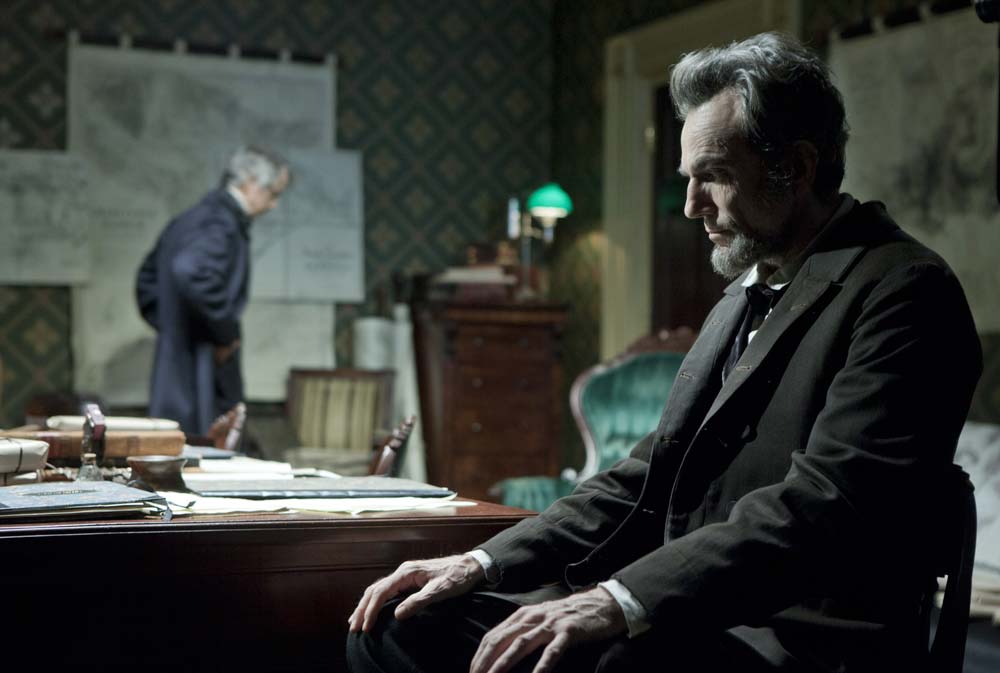
lincoln

As a young man, Abraham Lincoln fretted that there was no opportunity for his generation to accomplish anything important; gone were the days in which the founders had risen to the great challenge of establishing the nation.

Here’s an early passage from Team of Rivals: The Political Genius of Abraham Lincoln, which I finally finished reading a couple of nights ago:

… Lincoln had expressed his concern that his generation had been left a meager yield after the “field of glory” was harvested by the founding fathers. They were a “forest of giant oaks,” he said, who face the “task (and nobly they performed it) to possess themselves, and through themselves, us, of this goodly land,” and to build “upon its hills and its valleys, a political edifice of liberty and equal rights.” Their destinies were inseparably linked” with the experiment of providing the world,” a practical demonstration” of “the capability of a people to govern themselves. It they succeeded, they were to be immortalized; their names were to be transferred to counties and cities, and rivers and mountains; and to be revered and sung, and toasted through all time.”

Because their experiment succeeded, Lincoln observed, thousands “won their deathless names in making it so.” What was left for the men of his generation to accomplish?…

Of course, Lincoln was profoundly mistaken:

In 1854, the wheel of history turned. A train of events that mobilized the antislavery North resulted in the formation of the Republican Party and ultimately provided Lincoln’s generation with a challenge equal to or surpassing that of the founding fathers.

Every day that he was in office, Lincoln and his administration wrestled mightily with questions of ultimate important and great moral weight. Until very late in the war, the great issues — whether the United States would continue to exist, and whether all its people would be free — were in great doubt.

Along the way, he dealt with a great deal of human pettiness — from the criminal uselessness of General McClellan to the scheming, naked ambition of Salmon Chase, from the everyday grubbing of officeseekers to personal disputes that threatened the government’s ability to function — but his focus, and that of most of those around him, was on the towering issues of the day.

And in spite of all, the challenges were met, masterfully. By Lincoln, whom I am more convinced than ever is the most remarkable and able individual ever to hold the office of president, but also by ordinary people who rose to do extraordinary things.

All the time I was reading that book, I kept thinking how unbelievably petty our public life is today. And I’m not just talking about the partisan bickering that I decry here so regularly. It’s the things that we squabble about that are so depressing.

The whole time I was reading that book — and I read it slowly, over a period of months, mostly at the dinner table, a few pages at a time — the great crisis of our time was the “fiscal cliff.” That precipice was created by our utter inability to deal with the most routine concerns, those of financing the government. And of course, we have a series of unresolved conflicts of the same nature that we must deal with this year, since the can has only been kicked, and kicked feebly, down the road.

In her column this weekend, Peggy Noonan wrote the following, in another of her passages finding fault with President Obama:

All the famous criticisms of him are true: He has no talent for or interest in sustained, good-faith negotiations, he has no real sense of alarm about the great issue of the day, America’s debt….

Really? That’s “the great issue of the day”? How mind-numbingly appalling.

And perhaps she’s right. Politicians in Washington, and all those who ape them in the hinterlands, certainly act as though that, and attendant issues, are the great matters of our day.

But here’s the thing: There are no great moral considerations involved here, people. Figuring out what it costs to run the government and how to levy the taxes to pay for it are matters that a middling accountant could work out in a day, and the issue would be behind us. How much to tax, how much to spend are indeed debatable issues. But they are not issues of right and wrong. They are unworthy of anyone’s passion.

No, I don’t long for us to be engaged in a mighty war to settle whether this nation, or any like it, will continue to exist. I don’t want to see more that 600,000 of my fellow citizen die in settling some momentous issue.I don’t lament, as Lancelot did in a time of peace in The Once and Future King, that “We don’t see many arrows thrilling in people’s hearts nowadays.”

I would just like to see us recognize that petty issues are petty issues, and resolve them, and move on. And no, I don’t consider trillions of dollars to be small considerations; I’m just saying that these issues are eminently solvable, with just a modicum of reasonable behavior on the part of all parties. I’m saying that the “drama” of “fiscal cliffs” and debt ceilings is entirely contrived, artificial and unnecessary.

Getting rid of slavery — now that was difficult. It was the great unresolved conflict that had dogged the nation since its founding. The issue could not be resolved without tearing the nation apart and putting it back together again. The solutions accepted as fact in 1865 were unthinkable in 1860. (Yes, they were “thinkable” in that abolitionists advocated them; but it was politically impossible to implement them until the height of the war.)

We shouldn’t need a national existential crisis to solve the problem of balancing the national checkbook. We should just be able to do it, and move on.

View of Jim DeMint changed radically after the 2004 campaign

I was rather startled to run across something I’d written about Jim DeMint in 2004.

For so many years now, I’ve seen him as a hyperpartisan ideologue, as responsible as anyone in the country for pulling his party into Tea Party extremism right up until his recent resignation from the Senate, that I’d forgotten I used to see him differently.

Here’s what I wrote right after the 2004 election, when he had defeated Inez Tenenbaum in the contest to replace Fritz Hollings:

While I criticized Rep. DeMint heavily for choosing to run as a hyperpartisan (despite his record as an independent thinker), there’s little doubt that that strategy was his key to victory. The president won South Carolina 58-41, and Mr. DeMint beat Mrs. Tenenbaum 54-44, demonstrating the power of the coattail effect. I congratulate him, and sincerely hope he now returns to being the thoughtful policy wonk he was before he wrapped himself in party garb in recent weeks.

Wow. What a difference a few years make. “Thoughtful policy wonk?” I only vaguely remember that Jim DeMint.

So that’s when it began. Before the 2004 campaign, I saw him as a fairly thoughtful guy. But I guess that campaign showed him what red meat could do for him…

Columbia’s Donehue Direct becomes Push Digital

Wesley Donehue’s political tech outfit, which has helped campaigns across the country, is making a change, it announced today:

Top SC political internet firm rebrands as Push Digital
Columbia, SC – January 24, 2013 – Wesley Donehue, founder and CEO of leading political tech firm Donehue Direct, announced today the rebranding of his firm to Push Digital.
The new Push Digital will continue its nationally recognized work in website and application development, mobile marketing, online advertising and targeting, fundraising, brand management, and social media. Push is also reemphasizing its commitment to data collection, management and analytics, something that Donehue has working toward for several years.
“Four years ago when I was asked what the next big tech trend was, I said ‘data,’ and a lot of people rolled their eyes,” Donehue said. “Too many people think data is boring and it isn’t sexy, but we all saw firsthand the results of a data-driven campaign this year in the presidential race. Our goal, quite simply, is to be second to none when it comes to data, and that’s something that will mean big dividends to our clients in terms of their ability to target their message and raise cash.”
Push is one of the few political Internet firms that has run campaigns from top to bottom. Its team has been involved from the state legislative level all the way up to the presidential, as well as numerous marketing campaigns for state parties, issue groups and nonprofit organizations. The team has had broad experience running the political, finance, and communications operations.
Push Senior Vice President Joel Sawyer noted that too often, those branches of the campaigns are “siloed” from one another, and not integrated with regard to technology.
“Part of our new mission with Push is to give clients the tools they need to integrate tech into all aspects of a campaign, and more importantly, making sure all the data integrates,” Sawyer said. “We live in a world where the internet is completely pervasive in our lives, yet too many campaigns out there are run on a model from two decades ago.”
In addition to its political business, Push will continue its work with non-profits and issue advocacy groups. Push will maintain its office presence in both Columbia, South Carolina and San Francisco, California.
Learn more at www.pushdigital.com
Follow us on twitter: @pushdigitalinc

“Politics is always going to be our bread and butter,” Joel Sawyer told me this afternoon. But the kind of increasingly sophisticated data mining that the firm does can “apply to any persuasive endeavor.”

In the past, he said, many campaigns have had volunteers who are willing to wave a sign on a street corner on the one hand, and people who give $10 or $15 on the other — often missing that a sign-waver could well be a donor, and vice versa. What Push Digital will do is pull all of a campaign’s data together and make it work in ways it hasn’t in the past.

Y’all know Joel. He was for awhile Mark Sanford’s press secretary, and was the guy the gov left to hold the bag when he ran off the Argentina. Joel resigned shortly after that, although I don’t ever recall him saying that there was a cause-and-effect relationship between the events.

Wesley y’all will know from all those communications for the Senate Republicans, and from Pub Politics, which just kicked off its new season last night. (Joel fills in for Wesley occasionally, as their business often requires travel.)

Check out Pinterest for a look at the newly-renamed firm’s portfolio.

Good luck with the new identity, guys.


One of the newly-renamed firm’s many national clients.

Whoa! I missed the part about ‘Peace in our time’!

MunichAgreement_

As I said before, I didn’t catch all of the president’s speech yesterday, and something rather important got by me:

The WTF moment for me in Obama’s second inaugural address, delivered Monday at noon, was his use of the phrase “peace in our time.” This came during his discussion of foreign policy, and in such circles, that phrase is a synonym for appeasement, especially of Hitler by Neville Chamberlain in September 1938. What signal does his using it send to Iran? I hope he was just using it to jerk Netanyahu’s chain.

I also simply didn’t understand what he meant by “a world without boundaries.” But my immediate thought was, No, right now we need boundaries — like those meant to keep Iran out of Syria and Pakistan out of Afghanistan…

Yikes. You know, there are certain phrases that anyone with an understanding of history would be careful to avoid. Such as “Mistakes were made.” “I am not a crook.” “It depends on what the meaning of ‘is’ is.”

And of course, “peace in our time.” What was the thinking on that? Did the president think that his base would like the sound of it, and not understand the profoundly disturbing historical allusion? Hey, it was politically popular when Chamberlain said it, although Britain woke up later.

I just don’t see how a line like that appears in such a formal speech by accident. And no other explanation is excusable.

That’s an association you don’t want. And for another thing, it doesn’t fit well with the president’s ongoing aggressive drone war. That suggests cynicism. As in, the president gave the gift of peace to four al Qaeda militants on Monday…

Oh, and another thing… since when did people who right for Foreign Policy start using such expressions as “WTF”?

Modest turnout for King Day at the Dome

IMG_4334

I went down to the demonstration, as Mick Jagger would say, for just long enough to take a few pictures before walking briskly back to the office (I’m really trying to work in a little exercise each day).

What I saw was a respectable-sized, but smaller-than-usual crowd.

Of course, it might be a bit unfair to compare this to previous such events that had a special “draw.” There was the first of these events, in 2000, at which a throng estimated at 60,000 — you couldn’t move on the grounds, and the crowd covered Gervais and spilled northward up Main Street — demanded that the Confederate flag come off the dome. (Which it did later that year, and now all subsequent King Day events have occurred under the one flapping on the grounds.)

Then there was the big turnout for the aforementioned one in 2008, with all the presidential candidates. The one before that, at which Joe Biden and Christopher Dodd spoke, wasn’t bad, either.

But this time, the event was up against Barack Obama’s second inauguration, and a lot of people who go to demonstrations went to that instead. Or watched it at home, instead of on the screen provided on the State House steps.

I didn’t hear much — as I said, I was just there long enough to take a few pictures. And as usual, that was a challenge, with the crowd in sunlight and the speakers in shadow. One of these days, somebody needs to have one of those on the other side of the State House.

I did hear part of an address by the Rev. Brenda Kneece about gun violence (from what I heard, she was against it). Then, as I was leaving, Tom Turnipseed got up, and after a reference to his having been “hooked up to jumper cables” (it was him saying it this time, not Lee Atwater) in his youth, he started talking about MLK Jr. having psychiatric problems. I’m not sure where he was going with that, but the theme of this event was supposed to be mental health, so…

As I walked away, I ran into Sammy Fretwell of The State. Someone else was doing main coverage of the event, he said, explaining that he was there to look for “fringe elements.” And as it happened, someone had just been arrested… he broke off then to ask a passing cop about it, but didn’t get anything.

Anyway, I hope Sammy found some fringe elements, to make his efforts worthwhile.

IMG_4336

Hey, I LIKE my pols to be off-message…

Today in the WSJ, Daniel Henninger asks the unmusical question, “Where Is the GOP’s Jay Carney?” By which he meant that the president — and by extension the Democrats as a class (as Henninger sees it) — has someone who can be out there constantly, every day, pushing a consistent message. And that message gets pushed without the president himself having to waste his own capital by commenting on every little thing.

An excerpt:

The whole wide world is living in an age of always-on messaging, and the Republican Party is living in the age of Morse code. It isn’t that no one is listening to the GOP. There is nothing to hear.

Smarting from defeat by Barack Obama’s made-in-Silicon-Valley messaging network, congressional Republicans in Washington are getting tutorials to bring them into a Twitterized world. I have a simpler idea: First join the 20th-century communication revolution by creating an office of chief party spokesman. One for the House and one for the Senate…

Henninger goes on at some length about how the GOP lack that everyday messenger — and complains that our own senior senator makes matter worse (for the party), not better:

The best members are becoming frustrated at the messaging vacuum, and some are moving to fill the void. Marco Rubio comes to mind, and more power to him given the nonexistent alternative. But others will follow, creating a GOP tower of Babel. The TV networks know they can dial up a Lindsey Graham to blow a hole Sunday morning in any leadership effort at a unified message. It will get worse, and the near-term consequence of getting worse is being out of power.

But of course, that’s precisely what I like about Lindsey Graham. He can be relied upon to think for himself. Oh, sure, he’ll mouth orthodoxies now and then, as with this release on the president’s gun proposals. But an unusual amount of the time for a Washington politician, he has something more thoughtful to say than what may be in the party playbook. Not as off-message as Chris Christie, perhaps, but he still says things that show he actually thought about the issue himself.

Would it really be a good thing for the House to have its own Ron Ziegler?

Would it really be a good thing for the House to have its own Ron Ziegler?

(Oh, and by the way — unlike some of my friends here, I see nothing wrong with Graham going out of his way to let us know when he DOES agree with the orthodox position. That doesn’t make him inconsistent, or a hypocrite, or anything else that some of y’all call him. I, too, sometimes agree with the party zampolits on an issue. And if I were a Republican officeholder — or Democratic; the dynamic is the same — and wanted to continue to serve in that office, I would put out releases emphasizing the issues on which I agreed with my likely primary voters. Why wouldn’t I? I’m sure I’d do plenty of things to tick off those voters at other times, so why not say, when I can honestly do so, “Hey, we agree on this one”?  I want Lindsey Graham to stay in office, so I’m glad he puts out such releases.)

Also, I think Henninger overemphasizes the extent to which a presidential press secretary is a spokesman for the entire party that the president belongs to. He speaks for the president. And yeah, in these hyperpartisan times, that can benefit his party. But it’s more of an institutional phenomenon than a partisan one. It’s in the nature of the presidency, and has been since long before the modern office of press secretary developed. The president speaks with one voice; the House is not expected to (and I would argue, should not, except in the context of the outcome of a specific vote). The presidential press secretary is a surrogate standing in the bully pulpit. I see no good reason for the House, or Senate, having a similar functionary.

Graham plants himself squarely in pro-gun territory

Lindsey Graham, widely expected to face a challenge next year from right out of the 1830s, has responded to President Obama’s gun proposals today with words that place him safely in NRA territory:

Graham Expresses Opposition to President Obama’s Gun Control Proposal

WASHINGTON – U.S. Senator Lindsey Graham (R-South Carolina) today made this statement in opposition to President Obama’s gun control proposal.

“The recent tragedy at Sandy Hook Elementary School is heartbreaking and beyond words.  However, the gun control plans brought forward by President Obama fail to address the real issues and I’m confident there will be bipartisan opposition to his proposal.

Graham-080106-18270- 0005

“One bullet in the hands of a homicidal maniac is one too many.  But in the case of a young mother defending her children against a home invader — a real-life event which recently occurred near Atlanta — six bullets may not be enough.  Criminals aren’t going to follow legislation limiting magazine capacity.  However, a limit could put law-abiding citizens at a distinct disadvantage when confronting a criminal.

“As for reinstating the assault weapons ban, it has already been tried and failed.

“Finally, when it comes to protecting our schools, I believe the best way to confront a homicidal maniac who enters a school is for them to be met by armed resistance from a trained professional.”

#####

But take heart, gun control advocates: At least he doesn’t want to arm teachers, right? Not unless that’s what he means by “trained professional.” I initially took it to mean “cop,” but can we be sure?