Category Archives: The Nation

Reagan told Irmo kid to get his act together

This, “Letters of Note,” is a pretty cool site that was first brought to my attention several days ago. The letter in question was one that a 16-year-old Sidney Poitier wrote to FDR asking him for a $100 loan to help him get back home to Nassau. He promised to pay it back. Poitier had come to this country, alone, at 15 with nothing, and was ready to pack it in. This was before he discovered acting.

He didn’t get the loan, of course. Which is why we’ve heard of him.

Today, I see another such letter — written with a similar intent — from a kid in Irmo. He wrote it to Ronald Reagan, but unlike Poitier, he got a reply from the president. I guess, when you’re a Republican, you sit up and take notice when someone from Irmo writes.

Seventh-grader Andy Smith wrote as follows to the president in 1984:

Today my mother declared my bedroom a disaster area. I would like to request federal funds to hire a crew to clean up my room.

Reagan responded, in part:

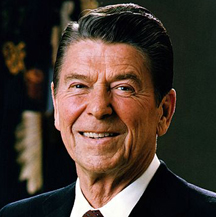
Your application for disaster relief has been duly noted but I must point out one technical problem: the authority declaring the disaster is supposed to make the request. In this case your mother…Official_Portrait_of_President_Reagan_1981

May I make a suggestion? This administration, believing that government has done many things that could better be done by volunteers at the local level, has sponsored a Private Sector Initiative program, calling upon people to practice voluntarism in the solving of a number of local problems.

Your situation appears to be a natural. I’m sure your mother was fully justified in proclaiming your room a disaster. Therefore you are in an excellent position to launch another volunteer program to go along with the more than 3,000 already underway in our nation—congratulations.

Go read the whole letter.

Everything that is wrong with our politics, in state & nation

Haley Palin

OK, so maybe it’s not everything — there’s personal pettiness, and anti-intellectualism, and an appalling willingness on the parts of too many to stoop to the lowest common public impulses for advantage — but it’s something that runs through it all, and ruins everything it touches. And besides, those things are more or less related to this thing.

It was on display in this story today about the campaign “warchest” — oh, let’s not forget that another thing that is wrong with our politics is that we pretend that it is war, with all that attendant “fighting for you” trash — that Nikki Haley has assembled for an as-yet-undeclared re-election campaign.

I’m not talking about Nikki Haley in particular here. I’m talking about something that is all too much a part of modern politics, and she just provides us with a good example, because she’s a particularly avid practitioner of what I’m talking about. The relevant passage:

Haley had six fundraisers last quarter, half of them out of state, in California, New York and Florida.

Donations from S.C.-based businesses and residents accounted for less than 60 percent of the total she raised during the quarter. Florida donations were next at 10 percent, followed by New Yorkers at nearly 6 percent.

Californians’ 51 donations ranked second in number behind the 418 reported from South Carolina, but their combined $21,000 ranked fifth in total amount, at 4 percent.

“It’s a strong showing,” Pearson said. “It shows that people in and outside the state want her to be re-elected gov

Haley had six fundraisers last quarter, half of them out of state, in California, New York and Florida.

Donations from S.C.-based businesses and residents accounted for less than 60 percent of the total she raised during the quarter. Florida donations were next at 10 percent, followed by New Yorkers at nearly 6 percent.

Californians’ 51 donations ranked second in number behind the 418 reported from South Carolina, but their combined $21,000 ranked fifth in total amount, at 4 percent.

“It’s a strong showing,” Pearson said. “It shows that people in and outside the state want her to be re-elected governor if she runs.”

And no, I’m not saying it’s awful that she goes after money where she can get it, or anything like that. The thing that I am saying is a problem is the fact that it is possible for a governor, any governor, to go outside his or her state to raise campaign money. It’s the fact that those outsiders will give, when asked the right way, that is the problem of which I speak.

Reading that story, I tried putting myself in Nikki Haley’s place. I tried imagining that I was running for governor, and I was on a fund-raising trip to New York or Florida or California or wherever, and I was standing in front of a well-heeled group of people with checkbooks in their pockets, and I thought:

What on Earth would I say to those people to get them to give money to me for my campaign for governor of South Carolina?

And I couldn’t think of a thing. I mean, I think about the reasons I would run for governor if I did, and they are many. I refer you to my last column at the paper for just a tiny few of those reasons. But not one of the reasons that could ever conceivably motivate me to run could ever possibly motivate someone who does not live in South Carolina and has no stake in South Carolina to give me money.

I would have nothing to say to them. Nothing that would be relevant to them, in any case.

But Nikki Haley, and other politicians who do what she does, have no problem in that regard. That’s because pretty much everything they say, and think, as political creatures is cookie-cutter stuff, the kind of stuff the national talking heads constantly spew out of the Beltway via 24/7 TV “news.” You can’t tell one from another.

That’s why it’s so easy and comfortable for someone like Sarah Palin to campaign alongside Nikki Haley, which they did with such aplomb and comfort in one another’s company during our governor’s first campaign. That’s because, even though they are from very different states with different issues and different needs, they think the same thoughts and say the same things. Henry Ford’s methods of mass production have been applied to politics, so that parts are interchangeable.

This is made possible by the fact that all these folks talk about is ideology — pure, simple, lowest-common-denominator ideology, unsullied by the specifics of reality, which is understood everywhere because of modern communications.

Their words and their thoughts have nothing to do with the messy, organic, ad hoc, practical, idiosyncratic business of governing — which to an honest person who engages it with an open and critical mind practically never meshes with the neat constructs of ideology.

And that’s what’s wrong. That’s what that story made me think about.

Tom Davis at the ‘nullification rally’

This morning, I saw this on Twitter from Tom Davis:

Thanks, Ed Eichelberger, for this video of my speech at Tuesday’s nullification rally at the S. C. State House. http://fb.me/1eyP5zmGG

“Nullification rally?” Is that what was going on when I passed by on Tuesday.? Wait, let me go check. No, I was right: This is 2013, and not 1832…

I didn’t have time to look at the video until tonight. Before I wrap up for today, I want to take note of it here. We must all remember this when Tom runs against Lindsey Graham next year. If he does. Or when he runs for anything in the future.

I have always liked Tom Davis personally, and I have been very disturbed to see his steady descent into fringe extremism.

In case you don’t have time to watch it all, some lowlights:

  • Lee Bright’s absolutely right.
  • Launching on a history lesson — neoConfederates are big on condescendingly explaining their version of history to the rest of us, and Tom is picking up their habits — he says that George Washington was president in 1800. No, Tom, he wasn’t. Kind of makes you want to double-check all the other stuff he says. In case you didn’t already know to do that.
  • He says, with fierce, defensive passion, that as a South Carolinian he is “proud of John C. Calhoun,” whom he characterizes as “a great man who has been maligned far too long.”
  • “You have the intellectual high ground here.” This to the assembled nullificationists.
  • “I can’t do anything right now up in Congress…” As opposed to later, I guess.
  • “This state has a proud tradition of leaders stepping up and holding aloft the candle of liberty at a time when things were darkest.” Really? I would like to have heard an elaboration on that, with names and dates, so I can understand how Tom is defining “liberty” these days.

Joe Wilson accused of disaster hypocrisy

… or at the very least, inconsistency.

I’m not going to quote the whole thing because of the language that he used, but here’s part of what someone named Jonathan Valania had to say about Joe Wilson’s vote against Sandy relief last week:

… this despite the fact that South Carolina has had 13 major disaster declarations and two emergency declarations in the last 30 years, according to the Federal Emergency Management Agency. The worst storm to ever hit the Palmetto State, Hurricane Hugo back in 1989, caused over $13 billion in damage and left nearly 60,000 people homeless.

Guess who picked up the tab?

And back in 2003 when the South Carolina suffered through a severe drought, all 46 counties in the Palmetto State were declared federal disaster zones at Wilson’s urging. In 2005, he voted for a $10.5 billion Katrina relief package.

“The compassion, generosity, and solidarity of the American people during difficult times are one of our most cherished blessings as citizens of our great nation,” Wilson said after the Katrina relief bill passed the House. “As we now face the severity of this historic natural disaster, Americans must do what we do best: help each other.”...

That was then and this is now.

Indeed. That was before the Tea Party, and before Joe decided he must do its will. And this is now, after Joe has followed the Four Freshman (OK, so now it’s Three Sophomores) through the looking glass.

Why have BOTH parties wasted our money on Voter ID?

This just in from Lindsey Graham and Trey Gowdy:

Graham, Gowdy Defend South Carolina Voter ID Law

 WASHINGTON – U.S. Senator Lindsey Graham (R-South Carolina) and U.S. Congressman Trey Gowdy (South Carolina-4) today sent a letter to Attorney General Eric Holder renewing their request for documents pertaining to the Justice Department’s costly opposition to South Carolina’s Voter ID law.

Last Friday, the Washington, D.C. District Court issued a unanimous decision awarding South Carolina certain litigation costs incurred while defending its Voter ID law against a Justice Department challenge.  The case cost the State of South Carolina an estimated $3.5 million.

“Not only do we strongly support the Court’s decision to award costs, we request follow up on our previous letter regarding the reasons why this costly litigation occurred in the first place,” wrote Graham and Gowdy.  “If some, or all, of the costs associated with these actions could have been avoided by following the recommendation of career Voting Section experts, then we would like to know the reason why they were overruled.”…

Good question. Of course, it would be just as good a question to demand that our governor and legislative majority why they have insisted on passing and then defending in court a completely useless Voter ID bill.

As I’ve said so many times before, I remain completely unconvinced by either Republicans’ claim that there is a need for such a law, or by Democrats’ claim that it constitutes an intolerable burden. Every taxpayer dollar that either party has caused to be spent on the bill has been a waste, in my book.

Everybody’s got an agenda these days

Remember how I mentioned the other day, with unbated breath, that Joe Wilson was going to unveil his agenda for this session of Congress? Well, here it is:

Wilson’s Agenda for 2013:

Create Jobs Through Economic Growth: Cut excessive red tape and regulations to help small businesses grow; Work with county, regional and state agencies to attract businesses to South Carolina; Protect South Carolina’s “Right to Work” laws; Defund the Government Healthcare Takeover Bill

Reducing Washington’s Out of Control Spending: Require a vote on Congressional pay; Make the government more accountable by sponsoring legislation calling for biennial appropriations; Support a Balanced Budget Amendment to the Constitution; Efficiencies within federal government agencies

Energy Independence and Efficiency: Promote construction of Keystone XL Pipeline; Fight to ensure South Carolina does not become our nation’s dumping ground for Spent Nuclear Fuel; Work to promote clean energy across our state via Energy Saving Performance Contracts

And right next to that in my Inbox, I see that the the Republican caucus in our state Senate have an agenda, too:

 Senate Republican Caucus unveils jobs and reform agenda
Columbia, SC – January 8, 2013 – The Senate Republican Caucus today announced a six-point legislative agenda, centered on growing the economy and reforming government.
Jobs and the Economy:
Transportation Reform – The Caucus will support structural and funding changes to our state’s infrastructure maintenance and construction process to make sure every dollar is maximized and allocated based on merit. The Caucus will explore mechanisms for increasing funding to meet growing infrastructure needs without raising taxes.
Spending Caps – Congress’ recent inability to deal effectively with the Fiscal Cliff could have paralyzed the country’s economy. South Carolina needs a real spending cap to provide for sustainable and predictable growth in state spending. Doing so protects taxpayers, businesses and those served by government by helping guard against unexpected tax increases or cuts to services.
Cyber Security – It’s critical that taxpayers and businesses know their information is secure when they interact with government. The Caucus will make it a priority to enhance cyber security so that people can conduct business in South Carolina with confidence.
Government reform:
Ethics Reform – The Senate, the House, and the Governor’s Office are all in the process of reviewing our state’s antiquated Ethics laws and making recommendations to modernize them for the 21st Century. The Senate Caucus believes strongly that voters need more transparency and information about the people representing them in order to hold their elected leaders accountable for their decisions.
Ballot Reform – The Senate Caucus will act quickly to fix state law in regards to ballot access, to make sure candidates are not again denied access to the ballot as hundreds were this year. In addition, the Caucus plans to correct the disparity in filing requirements between incumbents and challengers.
Department of Administration – Last year, the Senate passed the first bill by either legislative chamber to completely eliminate the Budget and Control Board and create a Department of Administration. The Caucus believes that we need clear lines of accountability in state government.
Senate Majority Leader Harvey Peeler noted that with a one-seat GOP pickup in the Caucus that the agenda stands a good chance for passage this year:
“These are issues that all conservatives should be able to agree on, and they’re issues that the people of South Carolina clearly want us to move forward with,” Peeler said. “I am committed to making sure these items remain a priority throughout the session, and that we work with the House to move these bills to the Governor’s desk.”
In addition to announcing its agenda, the Caucus also re-elected Senator Peeler to the post of Senate Majority Leader. Peeler named Senators Danny Verdin and Shane Massey as Majority Whips.

###

Agendas, it seems, are like opinions (or something): Everybody’s got one. Except yours truly, of course.

So which is it, Peggy? Is Obama’s situation unique, or what?

Sometimes, pundits are at their best when the party they oppose is in power. Not necessarily so with Peggy Noonan. I’ve long admired her style, but her drip, drip, drip of condescending disdain for Barack Obama wore thin some time ago.

And her column over the weekend, “There’s No ‘I’ in ‘Kumbaya’,” particularly bugged me because she wanted it both ways. First, she wrote:

Mr. Obama’s supporters always give him an out by saying, “But the president can’t work with them, they made it clear from the beginning their agenda was to do him in.” That’s true enough. But it’s true with every American president now—the other side is always trying to do him in, or at least the other side’s big mouths are always braying they’ll take him down. They tried to capsize Clinton, they tried to do in Reagan, calling him an amiable dunce and vowing to defeat his wicked ideology.

We live in a polarized age. We have for a while. One of the odd things about the Obama White House is that they are traumatized by the normal.

A lot of the president’s staffers were new to national politics when they came in, and they seem to have concluded that the partisan bitterness they faced was unique to him, and uniquely sinister. It’s just politics, or the ugly way we do politics now.

In other words, these rubes just need to put their Big Boy pants on and recognize that there’s nothing unique about the calumny heaped on their guy; it’s politics as usual, as regrettable as that may be.

Then, five paragraphs later, she writes of the president:

He is a uniquely polarizing figure. A moderate U.S. senator said the other day: “One thing not said enough is he is the most divisive president in modern history. He doesn’t just divide the Congress, he divides the country.” The senator thinks Mr. Obama has “two whisperers in his head.” “The political whisperer says ‘Don’t compromise a bit, make Republicans look weak and bad.’ Another whisperer is not political, it’s, ‘Let’s do the right thing, work together and begin to right the ship.’ ” The president doesn’t listen much to the second whisperer.

So… which is it? Is this politics as usual, or is the polarization Obama inspires “unique?”

She would probably defend her inconsistency by saying that the unique part is all Obama’s fault, that the animus aimed at him would be politics as usual, except for the way he deliberately rachets it up.

Which would probably be persuasive to a partisan Republican. Not so much to the rest of us along the spectrum. Not to this independent, anyway.

The polarization that characterizes the president’s relationship with his political opponents is indeed unique. Yes, it exists on a political timeline in which we have seen continuing, rising polarization dating back, I would say, to the early 1980s (from my perspective, about 1982, when Robin Beard ran a startlingly negative Senate campaign against Jim Sasser in the state where I was, while in SC, a young man named Lee Atwater was moving from dirty local campaigns toward national prominence), and becoming overt to the point of completely poisoning presidents’ relationships with their not-so-loyal oppositions starting in about January 1993.

But there’s a unique flavor to the animus toward Obama, and has been since the beginning. That’s not an excuse for him not to work in good faith with the opposition, to the extent that they will let him. But it’s a fact.

Graham’s on Hagel’s case (and he’s not alone)

As Washington media gather the soundbites on the Obama administration’s nomination of Republican Chuck Hagel as secretary of defense, one of the first gathered is Lindsey Graham’s:

“This is an in-your-face nomination by the president. And it looks like the second term of Barack Obama is going to be an in-your-face term.”

Of course, that quote is distinctly lacking in substance. Here’s what Graham said further on CNN’s “State of the Union”:

“Chuck Hagel, if confirmed to be the secretary of defense, would be the most antagonistic secretary of defense toward the state of Israel in our nation’s history,” Graham said. “Not only has he said you should directly negotiate with Iran, sanctions won’t work, that Israel should directly negotiate with the Hamas organization, a terrorist group that lobs thousands of rockets into Israel. He also was one of 12 senators who refused to sign a letter to the European Union that Hezbollah should be designated as a terrorist organization.”

Beyond Graham, those Republican senators vocalizing opposition to Hagel include Roger Wicker of Mississippi,  John Cornyn of Texas, Ted Cruz of Texas, David Vitter of Louisiana, and Tom Coburn of Oklahoma.Chuck_Hagel_official_photo

In the plus column are Democrats Carl Levin of Michigan, Jack Reed of Rhode Island, Dianne Feinstein of California, and Jay Rockefeller of West Virginia.

That’s all according to The Washington Post.

Much of the animus toward Hagel dates from his opposition to U.S. involvement in Iraq. Then there’s his opposition to Iran sanctions. Then there’s his “Jewish lobby” quote. And gay rights advocates are still mad about something he said in 1998.

Evidently, the Susan Rice experience didn’t diminish the president’s willingness to engage in a nomination fight as his second term begins…

SC had two of the 10 most-mentioned senators

There was an interesting tidbit in the Smart Politics piece that I mentioned in my last post:

For although DeMint was simply 1 of 100 in the senate, he was also an unofficial voice of the Tea Party, one of the most vocal critics of Barack Obama, and among the Top 10 most mentioned senators in broadcast media reports.

That made me think, Yeah, but I’ll bet Lindsay Graham is mentioned even more.

Sure enough, when I followed that link, Graham was at No. 6, and DeMint was ninth. (John McCain came in first, followed by Marco Rubio. Only two Democrats, Harry Reid and John Kerry, made the Top Ten.)

These two young fellas have made quite a mark, even though they are newcomers by our accustomed Thurmond/Hollings standard.

Tim Scott will have a lot to live up to.

Mulvaney among those Republicans flipping off Boehner

As much as all of the Four Tea Party Freshman in the SC congressional delegation (I guess after yesterday, they are technically sophomores) like to dis the GOP leadership in the House, with Joe Wilson tagging along behind them, only one of them refused to vote for John Boehner for another term as speaker.

That was Mick Mulvaney. Why? Well, he’s not talking about it:

WASHINGTON — U.S. Rep. Mick Mulvaney declined Thursday to support giving U.S. Rep. John Boehner a second term as House speaker, joining 11 other Republican lawmakers who protested the Ohioan’s leadership…

398px-Mick_Mulvaney,_Official_Portrait,_112th_CongressNine Republican lawmakers voted for someone other than Boehner, three of them backing his deputy, Majority Leader Eric Cantor of Virginia.

Mulvaney, by contrast, declined to vote for anyone despite being present in the House chamber. Raul Labrador of Idaho, like Mulvaney a tea party favorite who first gained election in 2010, chose the same tactic…

Mulvaney, who represents South Carolina’s 5th Congressional District, later declined to respond to subsequent requests for comment from reporters.

“Mick won’t be available to speak,” his press secretary, Stephanie Faile, told McClatchy. “He is spending the rest of the day with his family.”…

I wonder whether he sat up the night before this, thinking, What would be even more petulant and pouty than declining to vote for speaker? I know! Declining to vote, then refusing to say why!

I guess it beats pulling Boehner’s pants down and shoving him into the ladies’ room

First sex offenders, then gun permit holders…

Click on this image of the map to get to the original article.

Click on this image of the map to get to the original article.

Chip Oglesby (the guy who very kindly gave this blog a whole new theme this week, just because y’all complained about the comments format in the previous new one) brings this to my attention today.

The L.A. Times is reporting on a contretemps precipitated by another newspaper, on the East Coast:

It’s getting hard to find a public official in Putnam County, N.Y., who thinks putting the names of gun permit-holders on a map does anybody good.

On Thursday, a flock of officials gathered at a news conference to announce their support for County Clerk Dennis Sant’s decision to refuse a public-records request by the White Plains-based Journal News for a list of licensed handgun permit-holders, whose names and addresses are public record under law.

The state’s top open-records official previously told the Los Angeles Times that county officials would be breaking the law by refusing the newspaper’s request.

On Dec. 22, the newspaper published online an interactive map that included the names and address of people who had pistol permits  licensed by Westchester and Rockland counties. The map led to so much outrage that the newspaper has hired armed guards to protect its newsroom. Reporting on one recent incident, the newspaper said it received a suspicious envelope containing white powder on Wednesday evening, which was deemed to be nontoxic.

The Journal News also wants to publish a similar map for Putnam County, but officials have resisted. On Thursday, there was no indication of the battle easing after Putnam County officials said they’re prepared to take the fight all the way to its conclusion, according to statements released by the office of state Sen. Greg Ball, a Republican who represents the area…

This raises all sorts of questions, mainly about privacy in an age in which very little privacy exists. Also about the principle that so many newspaper editors like to go on about, which holds that “the people have a right to know” pretty much anything that an editor gets it into his head to publish.

Do the people have not only a right, but a need, to see this map? And does it outweigh any presumed privacy that a gun permit holder might feel entitled to? I mean, it’s one thing for permits to be public information, so that an individual holder could be looked up. It’s another to publish a map, holding these people up to… I don’t know what, really. Because I don’t really understand what practical purpose the map serves. Is it intended as a sort of sociological study of the county, to satisfy someone’s curiosity as to where permit holders are most likely to live?

I’m curious to know the editors’ thinking on that, because without knowing that, I don’t know what to think. Going by this story, the editors haven’t been forthcoming on that point. But the publisher said, “We believe the law is clear that this is public information and the residents of Putnam County are entitled to see it. We’re troubled that county officials have apparently switched their position since we first requested the information.”

In response, a critic of the newspaper’s position says, “The Journal News has really come up with the perfect map for the perpetrators and for the stalkers and for the criminals. They have yet to give us a cogent reason why, except for the reason that they can. I am sorry — that is not acceptable.”

Frankly, I’m not persuaded either that the editors had a clear, thought-out reason for using that portion of their newshole for this purpose. Nor am I convinced that anyone has been harmed by their doing so. But that’s the way it is with so many things that people get really, really stirred up about…

No, actually, ‘Islamist’ has a pretty clear meaning

Just got a release from CAIR on this subject:

(WASHINGTON, D.C., 1/3/13) — The Council on American-Islamic Relations (CAIR) today distributed a commentary urging media outlets to drop the term “Islamist” because it is “currently used in an almost exclusively pejorative context.”…

In this connection, the group offered an op-ed from Ibrahim Hooper, CAIR’s national communications director. Here are the first few grafs:

As many people make promises to themselves to improve their lives or their societies in the coming year, here is a suggested New Year’s resolution for media outlets in America and worldwide: Drop the term “Islamist.”

Hooper-thumbnail

Hooper

The Associated Press (AP) added the term to its influential Stylebook in 2012. That entry reads: “Islamist — Supporter of government in accord with the laws of Islam. Those who view the Quran as a political model encompass a wide range of Muslims, from mainstream politicians to militants known as jihadi.

The AP says it sought input from Arabic-speaking experts and hoped to provide a neutral perspective by emphasizing the “wide range” of religious views encompassed in the term.

Many Muslims who wish to serve the public good are influenced by the principles of their faith. Islam teaches Muslims to work for the welfare of humanity and to be honest and just. If this inspiration came from the Bible, such a person might well be called a Good Samaritan. But when the source is the Quran, the person is an “Islamist.”

Unfortunately, the term “Islamist” has become shorthand for “Muslims we don’t like.” It is currently used in an almost exclusively pejorative context and is often coupled with the term “extremist,” giving it an even more negative slant…

Look, I sympathize with people who feel like their group is marginalized or misunderstood. But I’m sorry, “Islamist” has a clear meaning in newswriting, one that the AP set out quite well. It most assuredly does not mean “Muslims we don’t like.”

What it does mean, and what professional journalists are careful to use it to refer to, is someone or something based in a worldview that holds “the Quran as a political model.” It’s about theistic government (which is not the same as being influenced by the principles of one’s faith in seeking to serve the public good, although of course the two things can coincide). If that comes across as pejorative, that’s because in the West, we believe in pluralistic government that neither dominates, nor is dominated by, a particular faith. So yeah, even when we’re not talking about an Islamist extremist (another very useful word, which by its employment lets anyone who understands English know that not all Islamists are extremists), we’re talking about someone whose political views are fairly inimical to values we hold as fundamental.

“Islamist” is also useful from an American context (since we do distinguish between the political and the religious) because it allows us to separate the political viewpoint from Islam itself. It’s important to most of us to respect the faith, even as we disagree with the idea of its being used as a basis for government.

Distinctions are important. “Islamist” allows us to make distinctions. I’d be surprised, and disappointed, if any news organizations respond as CAIR asks here.

I guess they just love having Boehner to kick around

Note that the House Republicans, who have abused, undermined and humiliated the guy every which way over the last couple of years, have given John Boehner another term as speaker:

House Speaker John A. Boehner (R-Ohio) on Thursday formally won reelection to a second term overseeing a chamber that has proved difficult to manage, just days after several insurrections from rank-and-file Republicans left him in a less powerful position heading into critical negotiations this year.

Boehner survived the defections of a handful of Republicans from the most conservative wing of his party, winning the final vote tally 220 to 192 over House Minority Leader Nancy Pelosi (D-Calif.). House Majority Leader Eric Cantor (R-Va.) received three votes.

I guess they just love kicking that guy around. He must like it, too.

I didn’t really see the above SNL skit from a few weeks ago as all that much of an exaggeration.

Questionable claims for the AR-15

Just read an interesting piece over at Slate, by a guy who calls himself “a Second Amendment supporter” (although, living in NYC, he doesn’t own a gun — but I guess that’s as close to pro-gun as Slate gets), discussing the claims that the AR-15 is a great weapon for hunting and home defense.

Which seems doubtful to me on both counts. This writer, Justin Peters, cites most of the reasons I already thought that. If I were into hunting, I’d use a rifle (or for birds, a shotgun), rather than a weapon that, as Sean Connery’s Raizuli would say, “fires promiscuously.” A matter of sportsmanship. For home defense, a pistol seems far more practical than a long gun, even a carbine.

But then I’m not trying to sell “modern sporting rifle” to the public.

Here’s the core of the article’s argument:

But the AR-15 is not ideal for the hunting and home-defense uses that the NRA’s Keene cited today. Though it can be used for hunting, the AR-15 isn’t really a hunting rifle. Its standard .223 caliber ammunition doesn’t offer much stopping power for anything other than small game. Hunters themselves find the rifle controversial, with some arguing AR-15-style rifles empower sloppy, “spray and pray” hunters to waste ammunition. (The official Bushmaster XM15 manual lists the maximum effective rate of fire at 45 rounds per minute.) As one hunter put it in the comments section of an article on americanhunter.org, “I served in the military and the M16A2/M4 was the weapon I used for 20 years. It is first and foremost designed as an assault weapon platform, no matter what the spin. A hunter does not need a semi-automatic rifle to hunt, if he does he sucks, and should go play video games. I see more men running around the bush all cammo’d up with assault vests and face paint with tricked out AR’s. These are not hunters but wannabe weekend warriors.”

In terms of repelling a home invasion—which is what most people mean when they talk about home defense—an AR-15-style rifle is probably less useful than a handgun. The AR-15 is a long gun, and can be tough to maneuver in tight quarters. When you shoot it, it’ll overpenetrate—sending bullets through the walls of your house and possibly into the walls of your neighbor’s house—unless you purchase the sort of ammunition that fragments on impact. (This is true for other guns, as well, but, again, the thing with the AR-15 is that it lets you fire more rounds faster.)

AR-15-style rifles are very useful, however, if what you’re trying to do is sell guns. In a recent Forbes article, Abram Brown reported that “gun ownership is at a near 20-year high, generating $4 billion in commercial gun and ammunition sales.” But that money’s not coming from selling shotguns and bolt-action rifles to pheasant hunters. In its 2011 annual report, Smith & Wesson Holding Corporation announced that bolt-action hunting rifles accounted for 6.6 percent of its net sales in 2011 (down from 2010 and 2009), while modern sporting rifles (like AR-15-style weapons) accounted for 18.2 percent of its net sales. The Freedom Group’s 2011 annual report noted that the commercial modern sporting rifle market grew at a 27 percent compound annual rate from 2007 to 2011, whereas the entire domestic long gun market only grew at a 3 percent rate…

Just before that excerpt, Peters cited what I suspect is the biggest appeal of the AR-15: “because carrying it around makes you look like a badass.”

Indeed.

SC delegation as useless as ever on ‘cliff’ vote

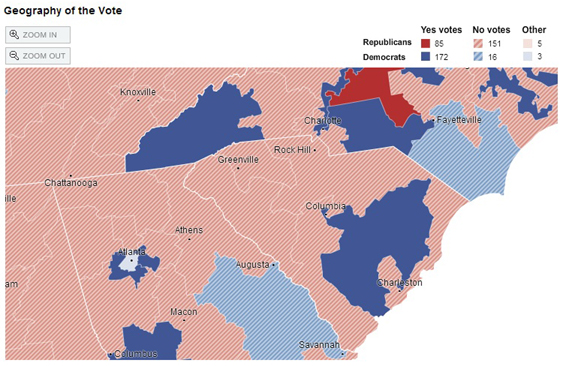
scvote

To the extent that anyone is inclined to congratulate the Congress for voting at the 13th hour to avert the “fiscal cliff,” they should carefully avoid directing any positive vibes at the SC delegation.

They were predictably petulant, recalcitrant and useless. Far be it from them to be part of anything that might be construed by anyone as getting anything done.

As you can see on this nifty interactive map provided by The New York Times, Joe Wilson and the Four Freshmen all voted “nay.” One would be tempted to pat Jim Clyburn on the back for being the grownup in the room, but the fact is that he is as wedded to his own rigid partisan attitudes as they are to theirs, so his vote was just as predictable.

But at least he voted to do something.

Here, by the way, is what Clyburn had to say about the vote last night:

Mr. Speaker, it is tempting to say it’s about time the House put aside extreme partisanship and work together on compromise to address the nation’s most pressing issues.  But in reality, it is far past time that we put aside its extreme partisanship.  Throughout the entirety of the 112th Congress, the Republican Leadership repeatedly put its own narrow political interests ahead of the public interest.


So here we are on New Year’s night, with the clock running out on the very existence of this Congress, finally considering bipartisan legislation to provide middle class tax cuts, require the wealthiest to once again pay their fair share so we can grow the economy, create jobs and protect the most vulnerable in our society.  It is indeed well past time we got about the people’s business.


Mr. Speaker, in 2011, I served on the Biden group of both Republican and Democratic Representatives and Senators who worked with the Vice President on our nation’s fiscal issues.  We made good progress in those talks until our Republican friends walked away, fearing the wrath of the Tea Party Caucus here in the House.


I also served on the bipartisan Joint Select Committee on Deficit Reduction, the so-called supercommittee that spent countless hours discussing these issues in detail.  It was very clear that the elements of a fair and balanced fiscal plan were achievable.  But at the end of the process, the Republican leaders refused to compromise and the supercommittee failed.


So here we are.  While this bill is not perfect, and I have serious concerns about some of the cuts it contains, it does contain the element of fairness.  This bill protects the middle class and working people with a more progressive tax code than we’ve had in a very long time.  And this bill prevents the meat axe approach of budget cuts that could do severe damage to our national defense and important domestic priorities.


Mr. Speaker, I hope that the partisanship of the 112th Congress will end this week with the end of the 112th Congress.  And I am hopeful that the 113th Congress can work together toward honorable compromises that get the people’s business done.  I urge a Yes vote.


-30-

I have not yet received any releases on the subject from the GOP members.


Here we go over the cliff, y’all!

This just came over the wire a few minutes ago:

WASHINGTON (AP) – The House will miss the midnight Monday deadline lawmakers set for voting to avoid the “fiscal cliff.”

House Republicans notified lawmakers that the chamber will vote Monday evening on other bills. They say that will be their only votes of the day.

President Barack Obama and Senate Republican leader Mitch McConnell said Monday they are near a deal to avoid wide-ranging tax increases and spending cuts – the fiscal cliff – that take effect with the new year.

Both men said they were still bargaining over whether – and how – to avoid $109 billion in cuts to defense and domestic programs that take effect on Wednesday…

OK, so there could still be a deal by Wednesday. And truth be told, the “cliff” is more like a steep incline, with various painful measures being enacted as we move into the new year. There is time, even after tonight, to undo much that the cliff entails.

But still. They’ve known this was coming a year and several months. Pretty much everyone wanted to avoid it. But Washington is so pathetic, they couldn’t get it done.

These are the times we live in.

‘Demand a Plan’ actors part of problem?

My favorite celebrity Twitter follower, Adam Baldwin, brings my attention to the above video, which is an answer to the below video, in which various Hollywood types demand a plan for ending gun violence.

Ouch. As a demonstration of just how pervasive gun violence is in our popular culture, the answering video packs a lot of punch…

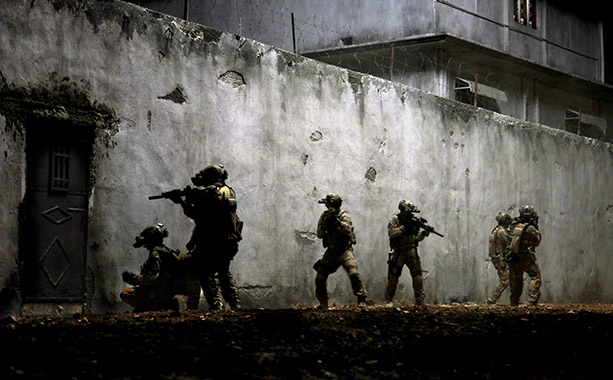
Your ‘Zero Dark Thirty’ scoreboard

1134604 - Zero Dark Thirty

OK, I think I’ve got it straight now.

I had thought that the official GOP position was that “Zero Dark Thirty” was the result of an unholy relationship between the filmmakers and the Obama administration, meant to aggrandize the latter.

I had seen Sen. John McCain’s criticism of that film as overlapping somewhat with that position, although I also saw it as consistent with his principled, and very personal, opposition to torture.

I was vaguely inclined toward emphasizing the latter reason for McCain’s objections over the former, because I had heard that Democratic Sens. Dianne Feinstein and Carl Levin were joining McCain in his criticism of the movie.

Anyway, the editorial board of The Wall Street Journal stepped in today to straighten me out and clarify the partisan battle lines over the film:

You know it’s a bad day in America when Hollywood seems to have a better grip on intelligence issues than the Chair of the Senate Intelligence Committee and the top two Members at Armed Services. The film depicts the “enhanced interrogation techniques,” or EITs, used on the detainees held at the CIA’s so-called black sites, and hints that the interrogations provided at least some of the information that led to bin Laden’s killing.

What Ms. Bigelow intended by depicting the EITs is not for us to explain: This is an action flick, not a Ken Burns documentary. Yet the mere suggestion that such techniques paid crucial intelligence dividends—as attested by former Attorney General Michael Mukasey and former CIA Director Michael Hayden, among many others—has sent Mrs. Feinstein and her colleagues into paroxysms of indignation. They even have a 5,000-plus-page study that purports to prove her case…

One day, perhaps, some of our liberal friends will acknowledge that the real world is stuffed with the kinds of hard moral choices that “Zero Dark Thirty” so effectively depicts. Until then, they can bask in the easy certitudes of a report that, whatever it contains, deserves never to be read.

So, in the never-ending partisan argument, which requires that everyone take one of two (and only two) directly opposing positions, apparently opposition to the movie is officially a Democratic, liberal position, and John McCain’s agreement with that position is designated as just one of his “maverick” positions.

Whatever. I still sympathize with McCain’s objection to our nation embracing torture on any level.

And… I still look forward to seeing “Zero Dark Thirty.”

The Jeffersonian notion of ‘militia’ didn’t work all that well out in the real world

General Brock was mortally wounded, but his redcoats won the Battle of Queenston Heights.

General Brock was mortally wounded, but his redcoats won the Battle of Queenston Heights.

On a previous thread about the Second Amendment, I promised to comment further on the notion that the Framers had of a militia made up of a well-armed citizenry.

I got to thinking about it because of this column in The Wall Street Journal on Friday. It’s purpose was to argue, on that conflict’s bicentennial, that the War of 1812 was more important than many people believe. It did so ably enough. An excerpt:

First, the war validated American independence. The new republic had been buffeted between the two great powers of the age. Great Britain had accepted the fact of American independence only grudgingly…

Thus historians have sometimes called the War of 1812 the second war of American independence.

Second, it called into question the utopian approach to international relations. As president, Thomas Jefferson had rejected Federalist Party calls for a robust military establishment. He argued that the U.S. could achieve its goals by strictly peaceful means, and that if those failed, he could force the European powers to respect American rights by withholding U.S. trade.

Jefferson’s second term demonstrated the serious shortcomings of his thinking… As a result of the War of 1812, American statesmen realized that to survive in a hostile world, the U.S. would have to adopt measures, including the use of military power and traditional diplomacy, that doctrinaire republicanism abhorred.

Third, the conduct of the war exploded the republican myth of the civilian militia’s superiority to a professional military. Thus, during the three decades after the War of 1812, the Army would adopt generally recognized standards of training, discipline and doctrine. It would create branch schools, e.g., schools of infantry, cavalry and artillery.

It’s that third item that I call y’all’s attention to in particular.

The Jeffersonians, among whom we for most purposes can count leading Framer James Madison, had an image in their minds of what government in general should be, which in a word one would say minimal. It was close to the ideal that libertarians still embrace today. We were to be a nation of independent yeoman farmers, each of whom looked after himself, and should the need for national defense arise, these doughty free men would come together spontaneously to drive away the invader.

Consequently, Jefferson opposed both a standing army and a navy, for anything other than coastal defense.

It is in that context that the Second Amendment makes the most sense. If those citizens were to be any use in a militia, they needed to be armed, and to have some personal experience with firearms.

But it didn’t take long at all for history to teach us the utter inadequacy of the Jeffersonian ideal of an armed citizenry being the only defense we needed. In Jefferson’s own time as president, he discovered the need to project power far beyond our coast, against the Barbary pirates. Our young Navy and its Marine contingent came in very handy in that instance.

But it took the War of 1812, “Mr. Madison’s War,” to demonstrate how useless untrained or lightly trained militia, with an unprofessional officer corps, was against the army of a superpower.

We got spanked by the redcoats, in one land encounter after another. The Brits burned Washington. Until the Battle of New Orleans — which unbeknownst to the combatants occurred after the war was over — the irregular American troops were humiliated time and again. If not for the occasionally sea victory, in single-frigate-versus-single-frigate actions (which, until Philip Broke’s big win off Boston Harbor, totally demoralized the Royal Navy, accustomed as it was to dominating the French), there would have been little to give heart to Americans during most of the course of the war.

Being reminded of all this led me to an interesting train of thought, as follows: The constitutional justification for universal gun ownership, a well-regulated militia, was shown within a generation to be a deeply flawed model of national defense.

From then on, American history saw a fairly steady march toward maintaining professional military forces, led by a professional officers. The notion of the citizen-soldier is far from dead, but it’s highly amended. We created a mighty force out of the civilian population in World War II, but they were trained up to effectiveness by a core of experienced professionals. And today’s National Guard contains some of the most thoroughly trained individuals in our overall defense establishment. Technology has made warfighting such a specialized enterprise that no one expects anyone to be an effective soldier just because he owned a rifle growing up.

Oh, one footnote, from that same column. I thought the South Carolina angle intriguing:

Many of these military reforms were the work of John C. Calhoun, who proved to be one of the most innovative and effective secretaries of war (which was the title of the cabinet officer before 1947, when it was changed to secretary of defense).

Early in the war, our only victories were at sea. Here, USS Constitution defeats HMS Guerriere.

Early in the war, our only victories were at sea. Here, USS Constitution defeats HMS Guerriere.

A better version of the Second Amendment

Well, I just learned something from Wikipedia I didn’t know before, but should have known — given all that time I spent studying that period in college.

I’ve always found the punctuation (and capitalization, but hey, it was the 18th century) of the Second Amendment problematic to the point that it was little better than gibberish. That’s because I was looking at the version that Congress passed:

A well regulated Militia, being necessary to the security of a free State, the right of the people to keep and bear Arms, shall not be infringed.

That comma after “Militia” just destroyed any clear meaning that may have been intended.

But now I’ve seen the version that was ratified by the states and authenticated by Thomas Jefferson in his capacity as secretary of state:

A well regulated militia being necessary to the security of a free state, the right of the people to keep and bear arms shall not be infringed.

Much better. It actually seems to have been composed by someone whose first language is English. And it certainly makes the role of the militia in the rationale of amendment much clearer.

Speaking of militias… I have another post I want to write on that subject. I’ll see if I can get to it before I need to leave this evening…