Category Archives: The Nation

Surprise! The NRA concedes nothing

Stag2wi_

Earlier in the week, we saw this release from the NRA:

National Rifle Association of America is made up of four million moms and dads, sons and daughters—and we were shocked, saddened and heartbroken by the news of the horrific and senseless murders in Newtown. Out of respect for the families, and as a matter of common decency, we have given time for mourning, prayer and a full investigation of the facts before commenting. The NRA is prepared to offer meaningful contributions to help make sure this never happens again. The NRA is planning to hold a major news conference in the Washington, DC area on Friday, December 21.

… which kind of made it sound like the gun lobby, sensing a change in mood in the country, even among some traditional allies, was willing to concede something, give some ground, agree to something it would never have agreed to before. I mean, that’s what “The NRA is prepared to offer meaningful contributions” sounds like to most people.

Fat chance.

Here’s what they came up with today:

WASHINGTON—The nation’s most powerful gun-rights lobby called Friday for armed security guards in schools, saying that children had been left vulnerable in their classrooms.

Wayne LaPierre, executive vice president of the National Rifle Association, said that “the monsters and the predators of the world” have exploited the fact that schools are gun-free zones. Other important institutions—from banks to airports to sports stadiums—are protected with armed security, he said, but this country has left students defenseless.

So basically, their response to the nation’s concern over all those guns out there is… more guns. That, and gun-lover buzz phrases: “The only thing that stops a bad guy with a gun is a good guy with a gun.” It would never occur to the NRA that maybe, just maybe, an even better solution would be to keep the bad guy from getting a gun to begin with. There’s a whole lot less crossfire that way, for one thing.

Mind you, I’m not entirely against the idea of armed officers in schools. Mainly because, as I’ve said before, I think the likelihood of gun control measures that would really, truly keep guns out of the hands of bad guys is next to nil. It’s an economic problem. There are just too many guns out there chasing too many tragedies. Think chaos theory gone mad.

But I also think that’s not going to happen. For every extreme gun nut out there — the kind who sits up late oiling and stroking his weapons and whispering pet names to them, and thinks government exists to threaten his “freedoms” — there’s a corresponding gunophobe who goes weak in the knees at the very sight of anything that looks like a firearm, who gets chills down the spine at the idea of being within range of one, even in the hands of cops. And a lot of those folks in the latter groups have little kids in school, and would have an absolute stroke at the idea of any sort of firearms in the vicinity of their children. (And this week, it’s a little hard to argue with their emotional response.)

Beyond that, though, my real objection is this: The NRA’s utter unwillingness to say, “Here’s something we’re willing to give up.” This was a moment for doing that. Something, anything, however marginal or minimal in impact, that said “fewer guns” rather than “more guns.”

But the folks at the gun lobby seem to be genetically incapable of that. Or something.

A communitarian view on gun control

I thought y’all might be interested in this perspective on gun control from Amitai Etzioni, who is sort of the godfather of the rather modest communitarian movement in this country. An excerpt:

etzioni_mainWe should not wait for our elected officials, in President Obama’s good words, “to come together and take meaningful action to prevent more tragedies like this, regardless of the politics.” We should do our share. One way to proceed is to mark our homes, apartments and condos, with a “gun free” sign. Parents should notify their friends that they would be reluctant to send their child over for a play date unless the home was safe from guns. Residential communities should pass rules that ban bringing guns onto their premises, clearly marking them as gun free.

Anyone who puts up such signs will become an ambassador for gun control, because they are sure to be challenged by gun advocates to explain their anti-gun positions. Here are some pointers they may wish to use against the typical pro-gun talking points.

“Guns don’t kill people, people kill people.”

• Tragically, it is the case that there will always be dangerous individuals, but they can kill a lot more with easy access to guns. On the same day as the massacre in Newtown, Connecticut, a knife-wielding man targeted a primary school in a Chinese village. Twenty-two children and one adult were wounded, but none were killed.

“Guns deter crimes and save lives.”

• Of the 30,000 gun deaths in America every year, only 200 are caused by self-defense. Studies have shown that a higher rate of gun ownership is correlated with higher rates of homicide, suicide and unintentional shootings. The U.S. has a firearms homicide rate 19.5 times higher than the combined rate of 22 high income countries with similar non-lethal crime and violence rates…

Note the emphasis on community-based solutions — starting in one’s home and workplace, engaging one’s neighbors in debate. Very much based in faith in engaged communities.Very different from the “50 percent plus one” forced solutions that left and right tend to jockey for…

Not that a communitarian would object to more reasonable laws regarding guns. As Etzioni says, “No right is absolute. Even the right to free speech, considered the strongest of them all, is limited. You cannot shout ‘fire’ in a crowded theater — precisely because it endangers life.”

The hopelessness of discussing school shootings

OK, so we have another mass shooting in a school, and this one may be a record-breaker, in the K-12 category. Twenty children dead, several adults.

We’ve had the obligatory statement from the president. There’s no reason for the president of the United States to comment on such things, as it has nothing whatsoever to do with his job description. After the Columbine shootings, I wrote about the absurdity of reporters standing outside the White House for hours waiting for the president to say something. But it’s expected now. People don’t think about what the president’s job is and isn’t; he’s expected to be emoter in chief.

So he said something, and he shed tears. He might as well. I mean, what do we expect him to do? He indicated his intention to do something:

President Obama, in one of his most emotional speeches as president, wiped away tears as he spoke about the shooting from the White House’s briefing room. “Our hearts are broken today,” Obama said. He promised “meaningful action to prevent more tragedies like this,” but did not say specifically what he might do….

What would he do, indeed?

I don’t normally post about stuff like this because there’s really nothing helpful to say. These things fill me with hopelessness. The only thing that would do anything to prevent such events in the future would be a level of gun control that would mean changing unshakable reality in this country by 180 degrees.

Understand me — I’m not proposing anything, because I don’t know of anything that would both solve the problem and also be achievable.

Here’s why it’s so hopeless: Even if, by some miracle, we bypassed or reinterpreted the Second Amendment so as to allow for the strictest laws in the world regarding gun ownership, we still would not have solved anything. Which is why you don’t see me going around advocating gun control.

That’s because the guns would still exist. And the gun-rights people are right: If you outlaw guns, outlaws will still have guns. The problem is that there are just so many firearms out there in this country. Even in the most repressive, worst jackbooted nightmare for the gun rights people, with police rounding up all the guns they can lay their hands on, there would still be so many left that you would see incidents such as this school shooting still happening from time to time.

It’s an economic problem — too many guns chasing too many potential shooting victims. There are at least a couple of hundred million guns in the country — I’ve seen statistics suggesting there are 90 for every 100 people. And of households that have one firearm, more than 60 percent have multiple guns.

You know what this situation reminds me of? Slavery before 1860, and why it was such an intractable problem for the country. No, gun lovers, I’m not saying it’s the moral equivalent or anything like that. I’m saying the dynamics of the political challenge are similar.

There were about 4 million slaves in the country when South Carolina seceded. Here in SC, there were more slaves than free people. Slaveholders were so invested in the institution that there was no possible political or legal solution that would have induced them to give up their slaves. The position of white elites in this and other states (but most especially this one; SC had always been the most extreme on the issue) was essentially that you’d have to pry their slaves from their cold, dead hands. And that’s what happened. It took a war that killed more Americans than ALL of our other wars, from the Revolution through Iraq and Afghanistan, combined, to end slavery. And we’re still wrestling over the repercussions.

For Barack Obama, if he wanted to address the gun issue meaningfully, the political obstacles are very similar to those that faced Lincoln dealing with slavery. Lincoln had to spend the early months of his administration, the early months of the war, insisting to the world that he was NOT the abolitionist that the Southerners depicted him as. It’s not that he was pro-slavery; he was always opposed to it. But even well into the war itself, he saw abolition as a political impossibility. He and others saw the fact of those 4 million slaves as something they didn’t know how to deal with. It seemed unimaginable to many anti-slavery pols then that former slaves could just co-exist with former slaveholders in the future.

Obama is to gun-rights people, in a way, what Lincoln was to the slaveholders. He didn’t run on a gun-control platform, and has never made any serious proposals to limit gun rights, that I can recall. And yet I’m going to go out on a limb here and say that there has NEVER been a president of the United States as distrusted by gun-rights people — and I mean serious gun-rights people, the sort who would list the 2nd Amendment as a top concern.

For Barack Obama to step out and advocate anything that would put a serious crimp in gun availability in this country would create a political backlash that — while it wouldn’t be the same as secession (and the reaction would be more individualized than a state-by-state thing) — would probably outstrip anything sense, in terms of the sheer passion of the response.

It would be the most politically (and, frankly personally — the Secret Service would have a horrific new challenge on its hands) risky thing I’ve ever seen a president do in my adult lifetime.

Which is why I kind of doubt we’ll see it.

Which is why waiting for the president to say something about such things seems so hopelessly pointless…

We don’t need special elections to replace senators

Rick Quinn has an idea that sounds good — especially under circumstances that empower Nikki Haley to make the decision unilaterally — but I can’t go for it:

S.C. Rep. Rick Quinn (R-Lexington) today submitted legislation for pre-filing to change the way vacancies are filled for the office of United States Senator. If enacted, the bill would require a Special Election to be held to fill any future vacancies.  To explain his legislation, Rep. Quinn released the following statement:

“This proposed legislation is not intended in any way as a criticism of Governor Haley or any of the outstanding leaders she is apparently considering for appointment to the United States Senate.   I am certain they would all do a fine job.

My concern is the lack of public involvement in the process of selecting a person to fill a vacancy in the United States Senate.  The present system allows a governor to pick a replacement for up to two full years before any votes are cast.

No one person should be able to select a U.S. Senator for the over four million citizens of South Carolina.  When we vote for our United States Senator, it is one of the most important electoral decisions we make.  One person should not be empowered to appoint that position for such an extended period of time.

An incumbent United States Senator has a huge advantage.  Not only can incumbents raise far more money than challengers but also the bully pulpit gives incumbents a forum unavailable to those who might run in the future.  It is a simple reality that money and media access dominate the modern election process.

The present system gives an appointed Senator what may well amount to an overwhelming advantage before an election is held.  That is why all candidates for the office should start from a level playing field as soon as possible when a vacancy occurs.  This gives the voters more choices and a more decisive role in choosing their next U.S. Senator.

The need for change is highlighted by the fact that the U.S. Senate is the only Federal office handled in this non-democratic manner.  In fact, if the Governor appoints any of the current elected officials on her short list, the law would require an immediate special election to fill those vacancies.

Looking around the nation, many states have gone to a special election process to fill vacancies in the U.S. Senate.  Today, fourteen states would call for an immediate special election.  Under current South Carolina law, a special election would take sixteen weeks to conduct.

Unexpected vacancies happen from time to time.  It’s part of life.   Any way we fill those vacancies will have flaws.  But we must not dilute the people’s right to choose their representation at the ballot box.  It is a fundamental right in our American system of governance. “

# # #

The Framers of our system intended for each constituent part of our government — the House, the Senate, the president and vice president, the judiciary — to be balanced in a number of ways, including having very different methods of selection, meaning they answer to very different constituencies.

Senators were supposed to represent states, not groups of voters like House members. We made the Senate more like the House when we passed the 17th Amendment — although they are still elected by all of the voters of a state, rather than the voters of narrow districts, which is something. I have yet to be convinced that was an improvement.

A better idea than Rep. Quinn’s would be to let the Legislature choose an interim senator. That would return us to the original idea, and it would address the problem Rick is too polite to confront, which is having a U.S. senator being chosen on the basis of Nikki Haley’s political priorities.

But there’s no question that Rick’s idea would be more popular than mine.

Yes, that’s what we have experience for

While I was out with the flu, we had a good-news-bad-news situation arise here in South Carolina.

The good news was that Jim DeMint was leaving the Senate.

The bad news was that, incredible as it still seems every time I’m reminded of the fact, Nikki Haley is actually the governor of our state.

But looking on the bright side even of that, Gov. Haley inadvertently explained something important yesterday (while meaning to say the opposite):

COLUMBIA, SC — Gov. Nikki Haley said Thursday (sic — since this was in this morning’s paper, I’m assuming she actually said it Wednesday) that political experience is not a requirement for the successor to resigning U.S. Sen. Jim DeMint.

Haley will name that successor, and two of the governor’s five reported finalists for the coveted seat – former first lady Jenny Sanford and state agency head Catherine Templeton – have not held elected office.

“It is not about time in office, which I think is the wrong way of looking at government,” said Haley, who was a political newcomer when she won a state House seat in 2004. “It’s the effect and the result they can show in office.”…

Focus on that last sentence: “It’s the effect and the result they can show in office.”

Indeed. In fact, in deciding who might be suited to public office, you have no better guide than what you have been able to observe that person doing in public office in the past. Nothing else is truly useful.

Of course, if she were to elaborate, the governor would no doubt say that what she meant was “the effect and the result they SAY they can show in office,” since with populist ideologues of her ilk, it’s all about the talk and the theory.

But no practical person gives what a candidate says he will do even a hundredth the weight of what the observer has actually seen that candidate do under real-world conditions.

That’s the test.

A reasonable person would not insist upon experience in a school board or city-council candidate, although it’s nice to have. One can excuse the lack of it in a state legislative candidate, if one doesn’t have a better alternative. But the United States Senate? Jimmy Stewart’s Mr. Smith aside, when you have a universe of qualified people out there to choose from, there is NO excuse for choosing a public-office novice. None whatsoever.

And for any who don’t understand the difference, experience running a business — or running your husband’s gubernatorial campaigns, or occupying a government job to which your friend the governor appointed you and in which you have not under any stretch of the imagination distinguished yourself — are not the same as having been elected by the people to public office and spent observable time in that fishbowl, discharging the duties of that office.

South Carolina’s U.S. House delegation is nearly full of relative neophytes (the governor’s kind of people) who at least have spent a couple of years each in an office that is a reasonable precursor to the Senate. Beyond that, the Republican Party has in the past generation produced a large number of potential senators with better resumes that that.

Under the circumstances, there is no excuse at all for choosing inexperience.

How many strikes DOES Rice have against her?

Just to get something new up on the blog for discussion, I thought I’d share something I read in the WSJ today. It was about Susan Rice, and, this being the WSJ, it didn’t exactly build her up.

In fact, it was (if to be believed) a pretty damning account of her handling of a crisis situation in Sierra Leone during the Clinton administration.

Basically, she stood up for, championed and espoused a deal involving, and rewarding, a revolutionary faction that apparently would make other child-soldier-exploiting, limbs-hacking, baby-raping elements in Africa look good by comparison. And it all came to a bad end very quickly, so that the U.S. was completely discredited as an arbiter in that country, and Tony Blair had to send the Tommies in and, in Blair’s own words, “sort out” the bad guys and put things to rights.

So… more abuse heaped on poor Susan Rice by a columnist who carries water for the other side of the aisle, right?

But here’s the thing I’m noticing about Susan Rice…

There is so much stuff out there that makes her look bad.

First, there’s her getting it wrong about Benghazi days after she should have gotten it right. But if there’s only that, well, I suppose we can dismiss that as McCain and Graham chasing a Great White Whale. The guys are just obsessed, right? Anyone’s entitled to a bad day on national television.

But then there was the Rwanda stuff, which truly did not make her look good.

Then, while I’ve been sick, apparently other stuff has come out bearing on Ethiopia, the Democratic Republic of Congo. According to Bret Stephens anyway, who wrote this column today as well as an earlier one on those incidents.

Think about this…

Susan Rice is being talked about to replace Hillary Clinton. Now, there’s a woman with some political enemies. Ask her; she’ll tell you. Ask any Democrat, for that matter.

And yet, think about it… Has anyone ever gone around telling story after story about her indicating gross ineptitude, a political tin ear, aggressive cluelessness? I mean, they might have hated her, but no one ever said she was bad at the job — any job — per se.

In fact, I’m trying to think whether I can recall a secretary of state nominee ever who was dogged by so many stories — true or not — of fouling up royally in the course of conducting U.S. foreign policy. I can’t.

Which is disturbing.

OK, that’s it. I’m worn out; going to bed. But I wanted to throw out something new for y’all to talk about. Show I’m still kicking.

What do YOU think of John Brown, all these years later?

I used to see this original mural in the state capitol in Topeka when I supervised the people who covered state politics for the Wichita paper. It seems to me to sum up Brown pretty well.

I’ve learned a lot of new things, and been reminded of things I once knew, in reading Doris Kearns Goodwin’s Team of Rivals: The Political Genius of Abraham Lincoln, the latter part of which inspired the movie “Lincoln.” (I’m not nearly to that part yet; last night I read up through Lincoln’s inauguration in 1861.)

One of them was the radical differences of opinion that existed about John Brown at the time. From my 21st-century perspective, I tend to think of who Brown was and what he meant as being a pretty settled matter. It is in my mind, anyway. But of course, at the time, he was perhaps the most extreme litmus test of attitudes ever to occur in U.S. history.

Today, I perused a review of another book, The Tribunal: Responses to John Brown and the Harpers Ferry Raid, which consists of contemporary writings about Brown from authors including Ralph Waldo Emerson, Henry David Thoreau, Frederick Douglass, Walt Whitman, Henry Ward Beecher, Jefferson Davis, Herman Melville, Stephen Douglas, Louisa May Alcott, Victor Hugo and Karl Marx.

Emerson saw Brown as a Christ-like “saint” and Douglass hailed him as “our noblest American hero.” His detractors saw him as “a deranged fanatic whose violent actions made civil war inevitable.”

I always thought of him as a deranged fanatic who just happened to be right about slavery. What he did was inexcusable, however laudable his motivations.

What the Union did in the Civil War was justified not only by the nobility of the cause, but by the fact that it was a case of the duly constituted authority of the country taking action against violent insurrection. But what Brown did was itself violent, murderous insurrection, not in any way supportable under the rule of law, and therefore unjustifiable. (There’s another measurement suggested by Just War theory, which is, Were the goals of his actions achievable? His most decidedly were not.)

A person can have the right idea on a burning issue and still be mad. A person can have noble goals and do despicable things in the name of them. To me, that’s always summed up Brown.

Your thoughts?

These voices of reassurance don’t soothe me

This morning, there was an op-ed piece by Rand Paul (not Paul Ryan; the other one with very similar name and identical ideas) suggesting that we need not necessarily “wring our hands in despair at the possible fiscal cliff.”

Then later today, I get this from Gary Johnson, the guy who ran for president this year as a Libertarian:

Since the election, I’ve been able to spend some time at home in New Mexico, recharge my batteries a bit, and most important, watch what’s going on in Washington, DC – which is really nothing good.

Gary Johnson

The news is filled with stories about the “looming fiscal cliff”.  Of course, in Washington, their definition of a “cliff” is that government spending will be cut next year by slightly more than $100 billion – IF Congress and the President don’t come to an agreement to cut spending by LESS than that. With a $16 trillion debt and trillion dollar deficits as far as the eye can see, only in Washington would cutting $100 billion be viewed as an impending disaster.

The real disaster – the real “fiscal cliff” – is the one we face if spending ISN’T cut by far more than $100 billion…  There are talking heads on TV saying, with a straight face, that cutting spending by a few small percentage points will devastate the economy. Where were those talking heads when the Democrats and Republicans were conspiring to run up an unsustainable $16 TRILLION national debt.  Who is pointing out the obvious:  That ridiculous levels of spending have already devastated the economy – and that the so-called fiscal cliff is a pothole compared to the real cliff that our Thelma and Louise government is driving us over.

And so forth. Somehow, I am not consoled by these assertions. Nor am I pacified when some of our friends on the left (and more libertarian elements of the right) say it’s just fine if military spending is eviscerated.

Call me wacky, but count me among those hoping that the Dems and Repubs will work out a way to avert this booby-trap they set during their last major failure to be reasonable on fiscal matters — you know, the one that let to the downgrade of the nation’s credit rating.

Is Rwanda a bigger problem for Rice?

I was intrigued by this argument over at Foreign Policy, saying that there are big problems in Susan Rice’s record, and they have nothing to do with Benghazi:

GOMA, Democratic Republic of the Congo — Televised comments made by Amb. Susan Rice shortly after the attack on the U.S. consulate in Benghazi have dominated the debate over her probable nomination for secretary of state. This is a bit surprising, since it’s clear that she played only a marginal role in the affair and appears to have just been reading from the briefing notes provided. It’s also unfortunate that the “scandal” has crowded out a healthy discussion of her two-decade record as U.S. diplomat and policymaker prior to Sept. 2012 — and drawn attention away from actions for which she bears far greater responsibility than Benghazi.

Her role in shaping U.S. policy toward Central Africa should feature high on this list. Between 1993 and 2001, she helped form U.S. responses to the Rwandan genocide, events in post-genocide Rwanda, mass violence in Burundi, and two ruinous wars in the Democratic Republic of the Congo.

She did not get off to an auspicious start. During her first year in government, there was a vigorous debate within the Clinton administration over whether to describe the killing in Rwanda as a “genocide,” a designation that would necessitate an international response under the 1948 U.N. Genocide Convention. In a now infamous incident from that April, which was reported in her now State Department colleague Samantha Power’s book, A Problem from Hell,Rice — at the time still a junior official at the National Security Council — stunned her colleagues by asking during a meeting, “If we use the word ‘genocide’ and are seen as doing nothing, what will be the effect on the November [congressional midterm] election?” She later regretted this language,telling Power, “I swore to myself that if I ever faced such a crisis again, I would come down on the side of dramatic action, going down in flames if that was required.” And she has indeed emerged as one of the more forceful advocates for humanitarian intervention in U.S. foreign policy. Unfortunately, she has also often seemed to overcompensate for her earlier misstep on Rwanda with an uncritical embrace of the the country’s new leaders…

I didn’t realize any of that. Nor did I know about this:

Perhaps the most damning anecdote — told by French academic Gérard Prunier and confirmed by New York Times journalist Howard French — was of a private converation Rice had after her first trip to Central Africa around this time: “Museveni [of Uganda] and Kagame agree that the basic problem in the Great Lakes is the danger of a resurgence of genocide and they know how to deal with that. The only thing we [i.e., the United States] have to do is look the other way.”…

Um — why can’t we just keep Hillary as SecState?

As the Susan Rice contretemps continues to simmer — with another moderate Republican joining Lindsey Graham et al. in expressing dissatisfaction with her — I find myself wondering…

Why can’t we just keep Hillary Clinton in the job? Near as I can tell, she’s done pretty well at it. While I didn’t favor her for the nomination in 2008, I’ve always considered her to be a person who, if you gave her a tough job, whatever it is, she’d handle it pretty well — and I think her tenure as SecState has borne that out. She comes across as, to use Ken Kesey’s phrase, deadly competent. In other words, on a spectrum that had Lillian McBride on one end, Hillary Clinton would be on the other.

You’d never see Lindsay Graham claiming Hillary Clinton wasn’t up to the job (aside from the fact that they’ve always sort of been pals).

Also… am I the only person that this Hillary-retiring business sort of snuck up on? Everybody’s talking about it now like we always knew she wouldn’t be part of a second Obama administration, but somehow I’d missed that.

I don’t think I’d heard a word about Sec. Clinton’s plans to leave until we started talking about possible replacements. I know there was an election going on and everything, but somehow that had just gone right past me.

And yeah, I realize that conventional gossip would have her running for president in 2016. Warren Buffett, among many others, would like to see that. And this would certainly free her up for that.

But until such time as she does launch a campaign, I sort of wish she’d stick around. At least it would put a temporary end to this endless jousting about her successor…

The Onion turns to straight reporting

Don’t know if you saw this at The Onion. What grabbed me about it is that it is in no way an exaggeration. There are hundreds of Republicans across the nation who are actually, sincerely torn by the horns of this very “dilemma,” even though they wouldn’t describe it in the same words:

Congressman Torn Between Meaningless Pledge To Anti-Tax Zealot, Well-Being Of Nation

WASHINGTON—Amid ongoing negotiations in Congress over the looming “fiscal cliff,” Rep. Tom Reed (R-NY) told reporters Wednesday he is “completely torn” between his commitment to conservative activist Grover Norquist’s meaningless anti-tax pledge and the general welfare of the entire country. “On the one hand, you have a nonsensical promise to blindly oppose tax increases regardless of circumstances, but on the other, you have the well-being of more than 300 million people and the long-term stability of the entire U.S. economy,” said Reed, adding that he is “really stuck between a rock and a hard place” now that he must decide between his loyalty to a dogmatic political lobbyist and his responsibility to serve the best interests of his constituents. “At the end of the day, it’s a question of whether a nonbinding signature on an outdated and worthless pledge written 26 years ago is more important than preventing the nation from completely going to hell. I just don’t know what to do here.” When reached for comment, Norquist urged the pledge’s signatories in Congress to “remember what’s really important” before sacrificing utterly irrational principles for the sake of the country’s future.

The hole DeMint’s been digging to bury his party in (and how that affects our OTHER senator)

Juan Williams (isn’t he a TV guy?) wrote a piece that appeared in The Wall Street Journal today about what has led to the irrelevance of Republicans in the U.S. Senate. After noting that John McCain and Lindsey Graham can huff and puff all they like, but won’t be able to blow Susan Rice down, Williams says of Senate Republicans in general:

They have only themselves to blame. Six months ago, a GOP takeover of the Senate was plausible. Yet in the Nov. 6 elections, Democrats expanded their hold, to 55-45, from 53-47. (Two independents caucus with the Democrats.) By any pre-election reckoning, Democrats should have lost seats. They had to defend 23 seats while the GOP had to defend only 10.

In the aftermath of the vote, there is no better place than in the U.S. Senate to observe the current war over the future of the Republican Party.

The 2012 vote was the second cycle in a row when the GOP had a clear shot at winning control of the Senate but blew the chance by nominating ideologues. Conservative activists who dominate the GOP primaries selected hard-line, right-wing candidates without any regard for their ability to win the general election and increase the number of Republicans in the Senate…

This, of course, is what Jim DeMint and his ilk have wrought, running about the country pushing extremists.

And as we all know, one of the prime targets of such efforts is our other U.S. senator:

And now conservative and tea party activists look to be doubling down for 2014. They are already talking about primary challenges to Senate Minority Leader Mitch McConnell, a Kentucky Republican; to Maine Sen. Susan Collins; and to Mr. Graham in South Carolina…

Mr. McConnell is far from alone in this fight for the future of Senate Republicans. Sen. Graham is known in Washington for his battles with Mr. Obama over everything from budgets to Benghazi. But the head of the conservative group Club for Growth, Chris Chocola, said in September that his group “has a lot of interest” in finding a more conservative candidate to take the Senate seat for South Carolina. “Our first focus is open, safe Republican seats,” Mr. Chocola said. “Our second focus is incumbents behaving badly. Regardless of whether you win or lose, you scare the heck out of the rest of them.”

Scaring incumbent Republicans from the right wing of the political spectrum is proving to be effective at keeping them in line. GOP senators know the danger of moderating their views—there is a political penalty attached to any political compromise with Democrats…

That seems to be a major pastime for extremists on the right — scaring people. Nikki Haley has referred to making mainstream pols afraid as “a beautiful thing.”

The column doesn’t mention Tom Davis. I guess he’s not quite on the national radar yet.

One wonders what they think they are accomplishing. It must be a terrible thing for one’s mind to be in the grip of an ideology. Sort of like the fable about the scorpion and the frog. That’s just what scorpions do, even if it means drowning themselves.

Graham, others break with Norquist

With most Americans pessimistic about the chances for a compromise that could avert the “fiscal cliff” — and inclined to blame Republicans for the failure — it’s worth noting that our own Lindsey Graham is among those trying to lead the GOP away from Grover Norquist and toward a somewhat more rational course:

A pair of congressional Republicans reiterated their willingness Sunday to violate an anti-tax pledge in order to strike a deal on the “fiscal cliff,” echoing Sen. Saxby Chambliss, the Georgia Republican who suggested last week that the oath may be outdated.

Sen. Lindsey O. Graham (R-S.C.) said he was prepared to set aside Grover Norquist’s Taxpayer Protection Pledge if Democrats will make an effort to reform entitlements, and Rep. Peter T. King (R-N.Y.) suggested the pledge may be out of step in the present economy.

“I agree with Grover — we shouldn’t raise rates — but I think Grover is wrong when it comes to we can’t cap deductions and buy down debt,” Graham said on ABC’s “This Week With George Stephanopoulos.” “What do you do with the money? I want to buy down debt and cut rates to create jobs, but I will violate the pledge, long story short, for the good of the country, only if Democrats will do entitlement reform.”…

Hey, Lindsey, I’ve got your entitlement reform right here: Eliminate the income cap on contributions to Social Security, and raise retirement age slightly. That would save that benefit, and would be a good place to start. Then, bada-bing, go raise some revenue for the general fund…

‘Lincoln’ is one of those rare films you really must see

The nitty-gritty of greatness.

Over the weekend, I experienced the polar opposites of cinematic achievement: First, AT&T was having a free weekend for premium channels, and while I recorded a number of films I expect to enjoy, one of those channels also showed David Lynch’s execrable “Dune.” I had not watched it since that bitterly disappointing night in 1984 in a Jackson, TN, theater when it first came out. Those few minutes I watched over the weekend convinced me that it wasn’t just that my expectations had been so high at the time. This actually was the worst film I’ve ever seen in my life. Every line of dialogue, every visual touch, every gratuitous plot change from the book (“weirding modules”? Are you kidding me?), was so bad it had to be as intentional as those revolting pustules the make-up people put all over the Baron Harkonnen’s face (something else that wasn’t in the book). Every aspect of it was horrible.

So it was very nice, Sunday evening, to wipe that away by seeing one of the finest new motion pictures I’ve seen in years: “Lincoln.”

Everyone should see this. Every American should, anyway, because it tells so much about who we are and what led to our being what we are. And it tells us something I think we’ve forgotten, which is that great things can be accomplished through our system of representative democracy, even when the barriers and stakes are far greater than anything we face in Washington today.

I could go on and on about the way Daniel Day Lewis inhabits Abraham Lincoln and eerily embodies everything I’ve read about him, or how Spielberg has honed his craft to the very limits of film’s ability to tell a coherent story, while simultaneously making you feel like you’re looking through a time portal at the actual events.

But I’ll just zero in on one thing that contributed to making it so good: The political realism. Most specifically, the way the film not only avoids the temptation to make everything appear to be morally black or white, but rubs your nose in the messiness of real decisions made in a real world.

The main narrative has to do with Lincoln, after his second inauguration, pulling out all the stops to get the House to pass the 13th Amendment, which made slavery unconstitutional. To get the two-thirds, he needs at least 20 more votes even if every Republican supports the measure. This means not only peeling off some Democrats, each defection like pulling teeth out of a dragon, but somehow keeping the peace among the radicals (such as Thaddeus Stevens, played by Tommy Lee Jones) and conservatives (such as Preston Blair, played by Hal Holbrook) in his own party.

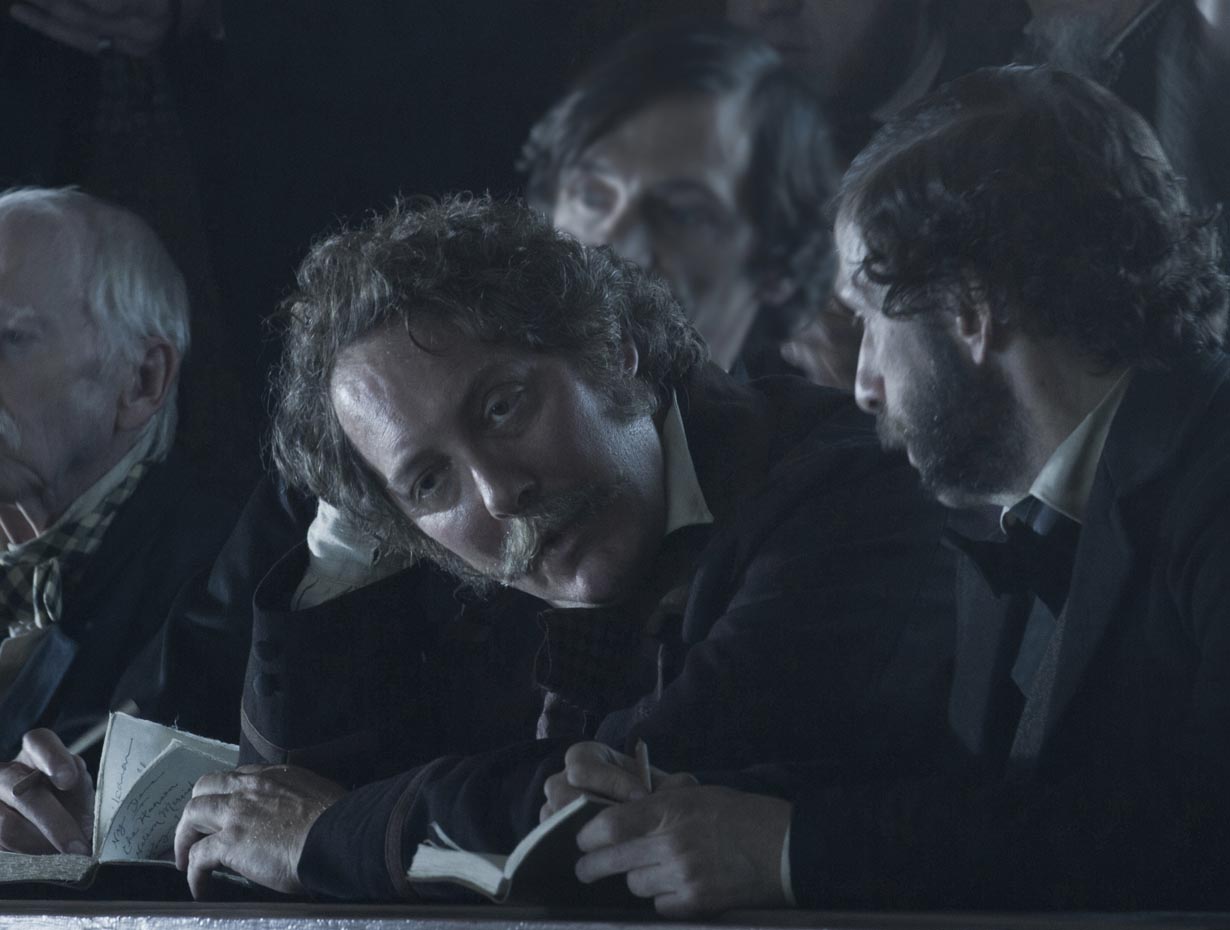
Every stratagem is used, starting with the hiring of some sleazy political operatives (I was amazed to realize after I saw the film that that was James Spader playing lobbyist W.N. Bilbo) to employ every trick they can come up with, starting with raw political patronage and moving on from there. (A key part of the strategy involved offering jobs in the second Lincoln administration to lame-duck members of the other party who had just lost their bids for re-election, but not left office yet.) The Lincoln team even stoops to a half-truth — told by Honest Abe himself — at a critical moment to keep the coalition from blowing up.

It’s very, very messy. No plaster saints here, and feet of clay all over the place. Yet through it all, the ultimate nobility of what is being done, in spite of all the odds, shines through irresistibly. We see how politics, with all its warts, can accomplish magnificent things. At a moment when Democrats and Republicans can’t even seem to do a simple thing like keep from going over a “fiscal cliff” with their hands around each others’ throats, we see how politicians (and they evince all of the worst things we think of when we use that term) can accomplish something great, even when (or perhaps, because?) the stakes are so much greater.

This film not only doesn’t flinch at moral complexity; it wallows in it, to wonderful effect. An excellent example is the scene in which Lincoln muses aloud before his team about all the convoluted, mutually contradictory, logical and constitutional boxes he put himself and the nation in when he decided to issue the Emancipation Proclamation. And the tension builds as we come to fully understand why the Amendment — which would fulfill the dream of freedom that the Proclamation could not — must be passed NOW, before the war ended. And we share Lincoln’s intense, focused urgency.

No significant aspect of Lincoln’s public character is missing from this portrait, including the delight that both he and his audiences took in his jokes. (But not all the people all of the time — Secretary of War Edwin Stanton storms out rather than listen to a funny story at a tense moment.) And at the end, after all the deal-making and maneuvering and fiddling and pushing and pulling and playing to venality and petty egos — one is left believing that Abraham Lincoln was a greater man than any marble statue could ever convey. I don’t know how to explain to you how the film achieves that; it just does.

I suppose there will be some people who just don’t get it — black-and-white, concrete thinkers who will be disturbed at the honest portayal of the messiness of politics as it was practiced in 1865. The neo-Confederates who think the Lincoln would originally have kept slavery if he could preserve the Union is some sort of great “gotcha” won’t get it. Nor will those like the local political activist who, a few days ago, said on Facebook that “Lincoln was not a good man” because his attitudes about racial equality weren’t a perfect match for those of a 21st-century “progressive.”

But seeing “Lincoln” may be among the best chances they’ll ever have to see that reality is broader, and often more inspiring, than their narrow perspectives on it.

No-holds-barred 19th-century lobbying in all its grubby glory.

Did the ‘war on women’ meme even work?

Ralph Reed (answering the question, What ever happened to that guy?) had an op-ed piece in the WSJ today (“Round Up the Usual Social Conservative Suspects“) bemoaning — as you would expect him to — that once again, social conservatives are being blamed for a Republican defeat.

The main thrust of his piece is that the GOP would push the culture warriors away only at its peril.

Nothing new there. What interested me was this one paragraph in which he was speaking not about Republicans, but about Democrats:

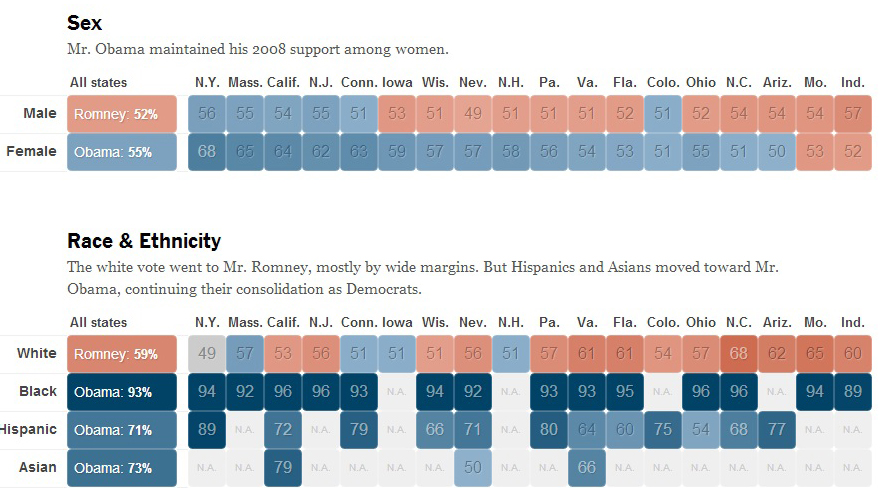
Despite the Obama campaign’s accusation of a Republican “war on women,” Mr. Obama actually won women by a narrower margin than he did in 2008; he lost married women by seven points. Nor did single women—who went heavily Mr. Obama’s way—vote on reproductive issues. Forty-five percent of single women voters listed jobs and the economy as their most important issues, while only 8% said abortion.

That was welcome news to me, given my repeated complaints about the Dems overemphasizing Kulturkampf stuff this year. (I would like very much for the president’s victory to be because of other factors, and for both parties to know that, and in the future act accordingly, so that I don’t have to be quite so appalled at the tenor of campaigns to come. And on the immigration front of the Kulturkampf, there are actually some signs that some Republicans learned something.) Of course, considering the source, I immediately wondered how accurate his characterization was.

That led me to this interesting 2012 exit polls graphic at the NYT site (if you don’t get anything else from this post, go check that out). While the words on the graphic seem to contradict Reed, saying, “Mr. Obama maintained his 2008 support among women,” when you call up the actual numbers (just scroll your cursor over the blue and pink bubbles), you see a slight drop — although it’s only one percent, which is well within the 4 percent margin of error.

But in looking further at the numbers, I saw something that I had forgotten about, if I ever knew — that in 2008, President Obama edged out John McCain among men — the only time the Democratic nominee has done that in the last four presidential elections. Maybe, if they believe their “war on women” meme worked, Democrats should have claimed the Republicans were conducting a “war on men” as well.

I knew without looking that Reed was accurate in saying Obama won among single women and lost among married ones. As for what he said about single women caring far more about the economy than abortion — well, that makes sense (think about it — I would expect pretty much every broad demographic group to cite the economy as a bigger issue than abortion), but I haven’t found data that back it up. Has anyone seen that subset analyzed along those lines? I have not.

I have always believed that we don’t look hard enough at exit polls after elections. Yet in the polling world, that’s where the substance is. Ahead of the election, political junkies mainline polls in their desperate desire to know what might happen. Exit polls are the only kind that tell you what the actual voters who actually showed up were actually thinking on Election Day. Maybe you have to allow a bit for a Democratic bias (Republicans are more likely to refuse to participate in exit polls), but it’s still valuable stuff.

SC’s historical resistance to Thanksgiving

The WSJ today had a piece today about the first official Thanksgiving proclamation — which was George Washington’s first proclamation of any kind as president — and it struck me how fitting that the main objections to it came from South Carolinians. During debate over the resolution asking the president to proclaim the holiday:

Rep. Aedanus Burke of South Carolina objected on the grounds that a Thanksgiving was too European. He “did not like this mimicking of European customs, where they made a mere mockery of thanksgivings.”

Rep. Thomas Tudor Tucker, also of South Carolina, raised two further objections. “Why should the President direct the people to do what, perhaps, they have no mind to do?” he asked. “If a day of thanksgiving must take place,” he said, “let it be done by the authority of the several States.”

Tucker’s second reservation had to do with separation of church and state. Proclaiming a day of Thanksgiving “is a religious matter,” he said, “and, as such, proscribed to us.” The Bill of Rights would not be ratified until 1791—but Congress had just approved the wording of First Amendment, and that debate was fresh in everyone’s mind.

It fell to a New Englander to stand up in support of Thanksgiving…

Of course, the only one of those objections that had a ghost of substance was the church-and-state one — you can see how someone who had recently debated the First Amendment might pause remembering the words “Congress shall make no law…” But of course, a reasonable person’s next thoughts would be that this was just a resolution, it only asked that the president recommend a day of thanksgiving, and it in no way established anything, much less a religion, or inhibited the free exercise thereof.

It’s not the substance of the objections that strike me. It’s that it’s so very South Carolina to be the ones objecting to even the most vanilla, Mom-and-pumpkin-pie actions by the federal government. I mean, leave it to a South Carolinian to inject state’s rights into a discussion of Thanksgiving.

What is it in our water, or whatever, that has always made white men from our state so prickly?

Romney campaign, other Republicans still blaming Christie

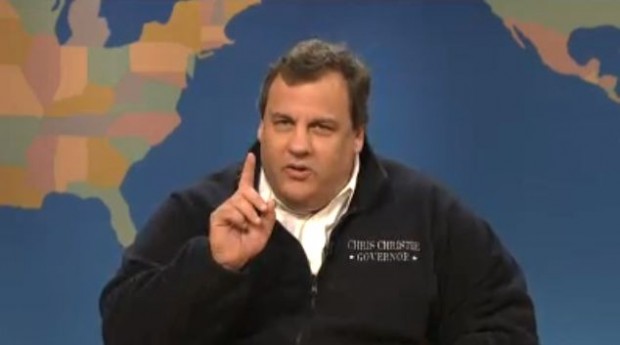
Gov. Christie on SNL over the weekend.

There’s an interesting NYT story today about how Chris Christie got a chilly reception at the Republican Governor’s Association meeting in Vegas. It also goes into just how much the Romney campaign people blame him for their loss. Some experts:

But in the days after the storm, Mr. Christie and his advisers were startled to hear from out-of-state donors to Mr. Romney, who had little interest in the hurricane and viewed him solely as a campaign surrogate, demanding to know why he had stood so close to the president on a tarmac. One of them questioned why he had boarded Mr. Obama’s helicopter, according to people briefed on the conversations.

It did not help that Mr. Romney had not called Mr. Christie during those first few days, people close to the governor say.

The tensions followed Mr. Christie to the annual meeting of the Republican Governors Association in Las Vegas last week. At a gathering where he had expected to be celebrated, Mr. Christie was repeatedly reminded of how deeply he had offended fellow Republicans.

“I will not apologize for doing my job,” he emphatically told one of them in a hotel hallway at the ornate Wynn Resort…

Inside the Romney campaign, there is little doubt that Mr. Christie’s expressions of admiration for the president, coupled with ubiquitous news coverage of the hurricane’s aftermath, raised Mr. Obama’s standing at a crucial moment.

During a lengthy autopsy of their campaign, Mr. Romney’s political advisers pored over data showing that an unusually large number of voters who remained undecided until the end of the campaign backed Mr. Obama. Many of them cited the storm as a major factor in their decision, according to a person involved in the discussion.

“Christie,” a Romney adviser said, “allowed Obama to be president, not a politician.”…

Gee, folks, do you think it could be, as this story suggests, something as simple as the fact that Obama was taking an interest in what was happening in New Jersey, and his opponent was not?

Graham may not vote against Rice for SecState

I thought this was interesting. After several days of being the point man on criticism of Ambassador Susan Rice, one might think (by the news coverage) that at the very least, Lindsey Graham would vote against confirming her were she nominated for secretary of state.

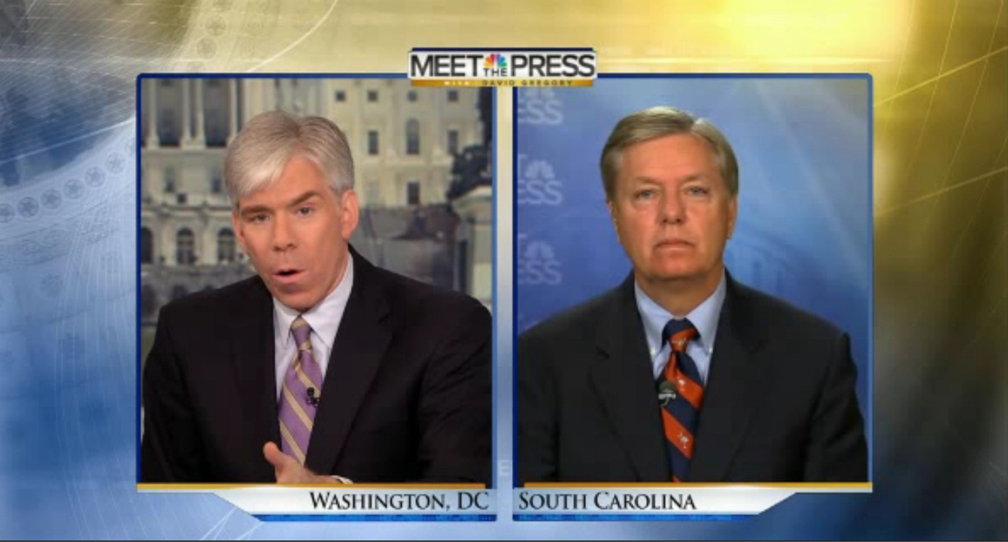
Well, on “Meet the Press” Sunday, he kept up the heat on the ambassador, but refused to say he’d vote against her:

GREGORY:  Senator, can Susan Rice– can Susan Rice be confirmed of Secretary of State if nominated by the president?

SEN. GRAHAM:  I– I don’t know.  You know, I’m deferential to the president’s picks.  I voted for Kagan and Sotomayor.  President, oh– Senator Obama voted against John Bolton, Elido and Roberts.  He had a very high bar for confirmation.  I have a very low bar.  I’m going to listen to what Susan Rice has to say, put her entire record in context, but I’m not going to give her a plus for passing on a narrative…

GREGORY:  But your…

SEN. GRAHAM:  …that was misleading to the American people…

GREGORY:  You wouldn’t filibuster her nomination?

SEN. GRAHAM:  ….and whether she knew it was misleading or not.  I’m going to wait and see what the State Department’s review has, but I’m very disappointed in– Susan Rice…

That may sound, to people who like a simple, dichotomous, partisan world, to be be inconsistent. But it’s actually completely consistent with the senator’s oft-expressed maxim that “elections have consequences” — which means you let the president have the people he chooses, barring some gross disqualification.

And bottom line, Graham indicated, it’s not Rice he really blames anyway. He seems mostly ticked that the administration put forward someone who didn’t know squat about Benghazi to speak publicly about it:

I’m saying that the ambassador that had nothing to do with Benghazi– why would you choose someone who had nothing to do with Benghazi to tell us about Benghazi?  That’s kind of odd.  The president said, why pick on her?  She didn’t know anything about Benghazi.  She was the most politically compliant person they could find. I don’t know what she knew but I know the story she told was misleading….

(W)hat about the months before this attack?  What about the rise of al Qaeda in Benghazi?  What about the British ambassador closing the consulate in Benghazi because it was too dangerous for the British?  What about the Red Cross leaving?  What about all of the warnings come out of Benghazi?  Did the CIA tell the president that Benghazi is falling into the hands of al Qaeda?  And I blame the president more than anybody else.  Susan Rice is a bit player here.  Was he– was he informed of the June attack on our consulate where they blew a hole where 40 people could go through?  Was he aware of the August 15th cable where Stevens was saying we can’t withstand a coordinated al Qaeda attack?  There are 10 militia groups all over Benghazi.  I blame the president for… making this a death trap.  I blame the president for not having assets available to help these people for eight hours…

Still, even with blaming the president, the Lindsey Graham who likes to work across the aisle asserts himself if Angry Graham lets his guard down for a moment:

I’m just not here to pick on the president.  I look forward to working with him on immigration and solving the fiscal cliff problems.  But I’m going to get to the bottom of Benghazi and hold him accountable for a national security breakdown…

He might find it’s tough to do both of those things, but we’ll see.

One other interesting thing from this interview was the senator’s musing on what’s wrong with his party:

We’re in a big hole.  We’re not getting out of it by comments like that.  When you’re in a hole, stop digging. … We’re in a death spiral with Hispanic voters because of rhetoric around immigration.  And candidate Romney and the primary dug the hole deeper.  You know, people can be on public assistance and scheme the system.  That’s real.  And these programs are teetering on bankruptcy.  But most people… on public assistance don’t have a character flaw.  They just have a tough life.  I want to create more jobs and the focus should be on how to create more jobs, not demonize those who find themselves in hard times…

What a sad difference four years makes

Four years ago, I went on and on about all the signs that, following the election of Barack Obama, we were going to put the more petty and pointless forms of partisan bickering behind us, and move forward in addressing the nation’s challenges.

A central theme at the time was the conciliatory relationship between the president-elect on one hand, and Sens. John McCain and Lindsey Graham on the other — particularly on national security. Here are some of the things I wrote back then, in my last few months at the newspaper:

That last one is particularly poignant in light of the McCain/Graham reaction to the president’s possible choice for new secretary of state, and the president’s reaction to that reaction:

If there was still any thought that President Obama and Senator John McCainmight eventually move past their once-bitter White House rivalry toward a cooperative governing agenda, it was all but dashed on Wednesday.

The two men who battled for the presidency four years ago spent the day bumping chests and marking their turf over the attack on the United States consulate in Benghazi, Libya, and the possibility that Mr. Obama might soon nominate Susan E. Rice, his ambassador to the United Nations, as his next secretary of state.

Mr. McCain, Republican of Arizona, began the ping-pong volley of sharp-edged commentary in the morning, calling Ms. Rice “unqualified” to serve as secretary of state for her public statements about the September attack in Benghazi. He vowed that he and Senator Lindsey Graham, Republican of South Carolina, would do anything “within our power” to block her appointment. The president responded at a news conference in the afternoon, accusing Mr. McCain of trying to “besmirch” Ms. Rice’s reputation and daring him to “go after me” if he wants to.

Mr. McCain then took to the Senate floor to denounce the administration’s handling of the Benghazi attack and to call for a select committee to investigate. He accused the president and his staff of misleading Americans about the events in Benghazi and said Mr. Obama has created a “credibility gap” with the public on the issue.

That story concentrated on McCain, so here’s a quote from a Graham press release:

“Mr. President, don’t think for one minute I don’t hold you ultimately responsible for Benghazi.  I think you failed as Commander in Chief before, during, and after the attack.

“We owe it to the American people and the victims of this attack to have full, fair hearings and accountability be assigned where appropriate. Given what I know now, I have no intention of promoting anyone who is up to their eyeballs in the Benghazi debacle.”

This Benghazi thing that people I respect are bickering over — I’ve never fully gotten it. Way back on Sept. 27, I wrote in puzzlement to Graham’s office, trying to understand what they were all worked up about. Kevin Bishop responded with some links (all from the MSM that some Republicans maintain have ignored the issue), which I found helpful.

OK, yes, I see that statements from the administration following the attack were muddled, back-and-forth. But there were three significant reasons why I couldn’t see it as the “debacle” that Graham describes:

  • I expect a certain amount of confusion, especially in the initial days, about such an out-of-control incident. The fog of war is a real phenomenon. And a terrorist attack involving a lot of people and extreme violence in a remote part of the world is as foggy as anything. Personally, I’m impressed that authorities in that part of the world managed to identify suspects after such a melee.
  • Of course the administration was talking about the inflammatory video. It had already threatened embassy security in one country in the region, and sparked violence in several other locales in the following days. And to think this, initially, was part of that pattern was perfectly reasonable. But even when the administration knew better, it still had a significant problem dealing with the fallout from that video in all those other places. So it was not out of place to keep talking about it.
  • This is the biggest reason. And if it weren’t for the fact that I screwed up and lost a key link, I would have written about this back in September. Just minutes after I had posted that our ambassador had been killed, apparently (I thought) in connection with another video-related protest (my headline was “So now one of these random rioting mobs has killed a U.S. ambassador“), I posted this addendum: “Of course now, all of that said, the administration is saying that maybe this was planned, rather than being a crowd spontaneously getting out of control…”

Unfortunately, as you can see if you click on it, the link I provided on that new development was to the wrong story — it went back to something about the video, not the item that told me the administration was changing its story. This occasionally happens when I’m running multiple windows and tabs (sometime more than 20 at a time) and doing a lot of copying and pasting.

So I don’t know where I learned that, although I’m sure it was one of the usual MSM sources I rely on, the ones you see in my Virtual Front Pages — the NYT, the WSJ, the Washington Post, something along those lines. I wouldn’t have believed it and passed it on, otherwise.

So I can’t say, “Look, senators, you’re wrong. See what the administration said that day.” But I can never quite connect with their narrative that the administration was hiding the hand of terror in this incident, because I got the impression from the administration that it was terrorism on the very first day. And I continued to see reports to that effect going forward, becoming more definite with the passage of time, as I would expect.

If Susan Rice persisted in saying something different, maybe that’s a problem. She was either misinformed, which would not be good, or deliberately trying to portray the incident as something other than what it was. Why she would do that, I’ve never fully understood, but there’s that possibility, I suppose.

Yeah, I know, there’s this whole narrative where the administration failed to heed cries for more security, or failed to react quickly enough to the attack itself, and sure, go ahead and investigate that. A U.S. ambassador was killed. We should know everything that went wrong so that we might keep it from happening again.

But all this chest-puffing, finger-pointing “debacle” talk is over the top. We don’t need this right now.

I subscribe to Thomas Friedman’s assertion that this is a very dangerous time in the region, starting with the meltdown of Syria and on through a litany of other delicate situations that make that part of the world more of a powder keg than usual. This would be an excellent time to go back to having partisan hyperbole stop at our shoreline. The way it did four years ago.

Did YOU think Romney was a ‘poopy-head’?

That’s what Grover Norquist says President Obama portrayed him as:

Grover Norquist, founder and president of Americans For Tax Reform, has a new theory about why President Barack Obama won — he portrayed Mitt Romney as a “poopy head.”

“The president was committed; elected on the basis that he was not Romney and Romney was a poopy head and you should vote against Romney and he won by two points,” Norquist said on CBS’ “This Morning” Monday. “But he didn’t make the case that we should have higher taxes and higher spending, he kind of sounded like the opposite.”…

This was a neat way, for Mr. Norquist, of distracting us from the fact that exit polls show that most voters last Tuesday want to raise taxes on higher-income individuals.