Category Archives: The Nation

Was Romney better than the GOP deserved?

Just read Kathleen Parker’s column from over the weekend about how the GOP doesn’t need focus groups to figure out why it lost the presidential election; it just needs to look in a mirror.

I liked this part:

Some Republicans stubbornly insist, of course, that the problem was that Romney wasn’t conservative enough. Really? In his heart, this may be true. I never believed Romney was passionate about social issues. He embraced them because he had to, but he had no intention of pursuing a socially conservative agenda.

But the real problem is the Republican Party, which would not be recognizable to its patron saint, Ronald Reagan. The party doesn’t need a poll or a focus group. It needs a mirror.

The truth is, Romney was better than the GOP deserved…

I agree. While Romney wouldn’t have topped my list of candidates (if I were allowed to choose the field, rather than having that crowd of undesirables that actually ran for the GOP nomination this time), he’s a relatively decent sort of guy, and no sort of nut. And the traumatized party that has been spinning off into irrelevance since the rise of the Tea Party did not deserve him.

Of course, I don’t agree with her that it was the gross missteps by a couple of GOP candidates (who were not running for president or vice president) on Culture War issues that best illustrated what was wrong. As she put it, in her most colorful passage:

Party nitwits undermined him, and the self-righteous tried to bring him down. The nitwits are well-enough known at this point — those farthest-right social conservatives who couldn’t find it in their hearts to keep their traps shut. No abortion for rape or incest? Sit down.Legitimate rape? Put on your clown suit and go play in the street.

No, the GOP has long been on the right on social issues — although perhaps not as given to such bizarre ways of expressing itself — and remained a mainstream party, for a long, long time. That’s nothing new. What’s new is the way it’s gone off the deep end on fiscal issues, and other attendant weirdness such as refusal to be reasonable on immigration (which is WAY far away from being the party of Ronald “Amnesty” Reagan) that distinguishes the spin-off into irrelevance in the last handful of years.

The pre-2010 GOP might have deserved Romney. The post-2010 party, not so much…

Petraeus quits over extramarital affair

Well, this is shocking, and sad, news:

CIA Director David Petraeus resigned Friday, citing an extramarital affair and “extremely poor judgement.”

In a letter released to the CIA work force on Friday afternoon, Petraeus disclosed the affair, and wrote: “Such behavior is unacceptable, both as a husband and as the leader of an organization such as ours.”

President Obama “graciously accepted my resignation,” he wrote…

I’m bracing myself for an onslaught of bad jokes playing on the word “surge.”

This is a sad thing for all involved. Petraeus has done a great deal for his country, and it’s terrible for his career to end in such an ignominious manner.

I’ll even refrain from noting that this is the way an honorable man behaves when he has fallen, by contrast with such people as Bill Clinton and Mark Sanford, who stay in office and drag the world through the sordidness with them.

OK, maybe I won’t refrain. But I won’t go on about it…

Stepping back from the fiscal cliff?

Well, here’s an encouraging post-election development:

Quickly pivoting the political conversation from President Obama’s reelection to Washington’s looming budget battles, House Speaker John A. Boehner on Wednesday offered a potential path to compromise, saying Republicans are “willing to accept new revenue” to tame the soaring national debt and avert an ugly battle over the approaching “fiscal cliff.”

With Obama’s decisive electoral victory and Republicans’ hold on the House, with a slightly smaller majority, Boehner (R-Ohio) said Tuesday’s election amounted to a plea from voters for the parties to lay down their weapons of the past two years and “do what’s best for our country.”

“That is the will of the people. And we answer to them,” Boehner said at an afternoon news conference at the Capitol. “For purposes of forging a bipartisan agreement that begins to solve the problem, we’re willing to accept new revenue, under the right conditions.”…

Last night, I was hearing that it appeared unlikely that House Republicans,  having held onto their power, would be any more willing to talk compromise than they have since 2010.

So this is good news. We may be able to arrive at a reasonable solution — although I’m sure the end product won’t be pleasant or fun for anyone involved, including us, the people.

But here’s the tough question: Can Boehner back this up, or will Eric Cantor be explaining to him right about now that he’s not allowed to do this?

Peggy Noonan is going with her gut on this

Last night was the annual Cardinal Bernardin lecture over at USC, and on my way in to hear Archbishop Wilton D. Gregory of Atlanta speak, Florence attorney and longtime USC Trustee Mark Buyck asked me what was going to happen in the presidential race. I told him what I said in this post, that it looked like Obama, at least in the Electoral College.

He said I should go read what Peggy Noonan had posted on her blog.

So I did. And in what Business Insider called “The Most Anti-Nate Silver Column Imaginable,” she basically argued that we should ignore the numbers and go with our gut. And her gut was telling her that Mitt Romney is going to win:

But to the election. Who knows what to make of the weighting of the polls and the assumptions as to who will vote? Who knows the depth and breadth of each party’s turnout efforts? Among the wisest words spoken this cycle were by John Dickerson of CBS News and Slate, who said, in a conversation the night before the last presidential debate, that he thought maybe the American people were quietly cooking something up, something we don’t know about.

I think they are and I think it’s this: a Romney win.

Romney’s crowds are building—28,000 in Morrisville, Pa., last night; 30,000 in West Chester, Ohio, Friday It isn’t only a triumph of advance planning: People came, they got through security and waited for hours in the cold. His rallies look like rallies now, not enactments. In some new way he’s caught his stride. He looks happy and grateful. His closing speech has been positive, future-looking, sweetly patriotic. His closing ads are sharp—the one about what’s going on at the rallies is moving.

All the vibrations are right. A person who is helping him who is not a longtime Romneyite told me, yesterday: “I joined because I was anti Obama—I’m a patriot, I’ll join up But now I am pro-Romney.” Why? “I’ve spent time with him and I care about him and admire him. He’s a genuinely good man.” Looking at the crowds on TV, hearing them chant “Three more days” and “Two more days”—it feels like a lot of Republicans have gone from anti-Obama to pro-Romney.

Something old is roaring back. One of the Romney campaign’s surrogates, who appeared at a rally with him the other night, spoke of the intensity and joy of the crowd “I worked the rope line, people wouldn’t let go of my hand.” It startled him. A former political figure who’s been in Ohio told me this morning something is moving with evangelicals, other church-going Protestants and religious Catholics. He said what’s happening with them is quiet, unreported and spreading: They really want Romney now, they’ll go out and vote, the election has taken on a new importance to them.

There is no denying the Republicans have the passion now, the enthusiasm. The Democrats do not. Independents are breaking for Romney. And there’s the thing about the yard signs. In Florida a few weeks ago I saw Romney signs, not Obama ones. From Ohio I hear the same. From tony Northwest Washington, D.C., I hear the same.

Is it possible this whole thing is playing out before our eyes and we’re not really noticing because we’re too busy looking at data on paper instead of what’s in front of us? Maybe that’s the real distortion of the polls this year: They left us discounting the world around us…

Now, on a certain level I have to sympathize with Peggy on this. After all, I’m the intuitive type, and have no great love of numbers. And more often than not, my own gut has been right when it comes to knowing who will win an election. It’s been right ever since the first statewide race I covered in Tennessee, the gubernatorial contest between Lamar Alexander and Jake Butcher in 1978. All the top political writers at the big papers were saying it was a dead heat, too close to call.

But I had accomplanied each of both candidates, practically 24/7 (we used to really cover campaigns in those days), for a week each late in the race, and Alexander acted like a winner, and crowds reacted to him that way. And Jake Butcher was pathetic. I remember Speaker Ned Ray McWherter walking him around his district to introduce him to constituents, and he looked like a lost child.

I was right. And I was right that day Sarah Palin campaigned with Nikki Haley, and I saw how Nikki had hit her stride at just the right moment, and was convinced she had the nomination.

I have also been very wrong. In the primaries early in that same gubernatorial campaign, I traveled with Roger Murray, a Democrat who was getting tremendous positive reactions everywhere he went. Voters kept telling him he had done the best job in the multi-candidate debate just before this tour, and I believed that meant he was going to win. He wasn’t even in the top two.

But I was just a kid then — even months later, in the general, I had gained a lot of savvy I lacked during the primaries — and it was a valuable lesson, learning to discount the effect of being in the bubble. I haven’t been that spectacularly wrong since.

All that said, while I may not love numbers, I respect them, while Peggy Noonan seems to be wishing them away. “The vibrations are right.” Really? We’ll see, very soon.

How’s the voting going at your polling place?

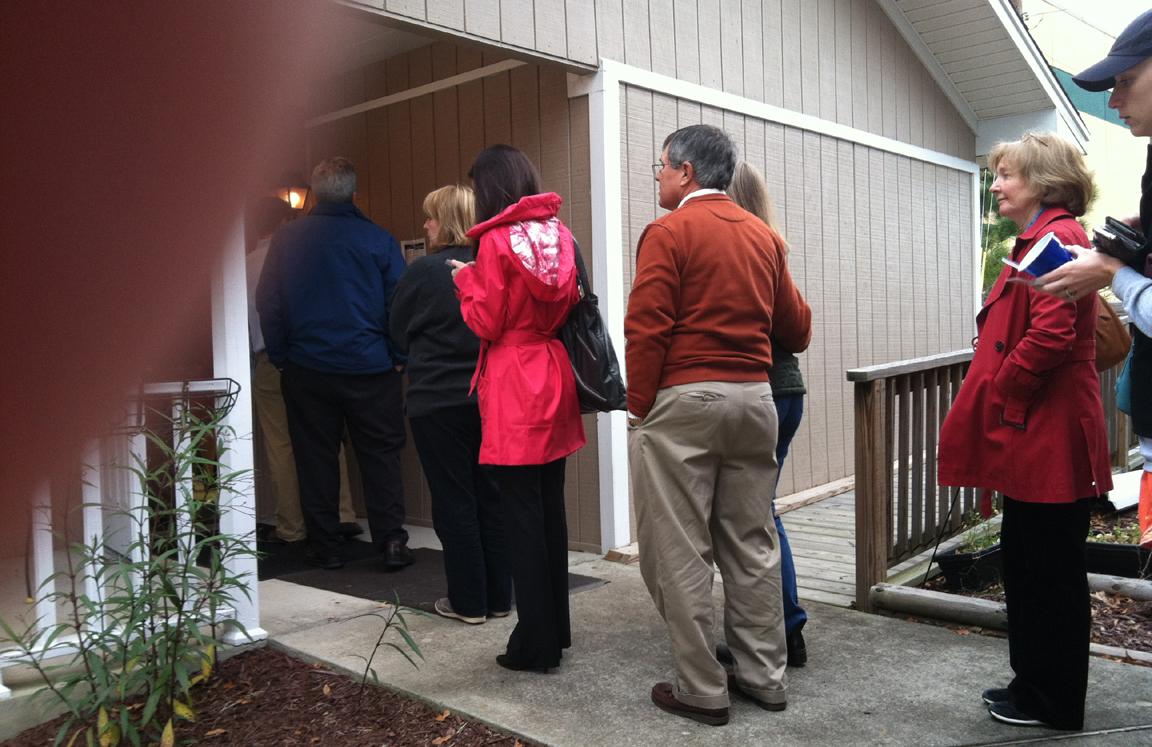
Sorry about the finger. I was trying to be sly and not make people self conscious (something I'm usually better at than this). There were only about a dozen people outside the door this morning, and no more than that waiting inside, when I arrived.

This morning Holly Bounds, who covers SC for WSAV out of Savannah, wondered the following:

Looking at all the lines people are posting, I wonder why more don’t take advantage of early voting. It was no wait Saturday.

I replied:

Here’s why: Voting is a community exercise of citizenship, and should be done with one’s neighbors at the appointed time…

But y’all have heard that sermon from me before.

Actually, I didn’t have all that much time to commune with the Quail Hollow folk today. I got in and out pretty quickly. The picture above shows what I found when I got there — about a dozen people waiting outside, about that many in the queue inside. (Sorry about the finger in front of the lens, but this shot still shows the situation better than the other one I took.) Right after this shot, someone said everyone from L-Z should come on in, so I and maybe one other person did so. One of those few instances when it’s best to be at the end of the alphabet. Inside, there were only a couple of people in front of me.

In the A-K line next to me was Big John Culp, the retired Methodist minister best known for having founded the Salkehatchie Summer Service program. John lives a couple of blocks from me, and passes my house on his daily constitutional. We talked about my Uncle  Woody in Bennettsville, where John was once the pastor at the Methodist church on Main Street. I noted that where Woody would be voting today, the outcome was likely to be different from at our precinct.

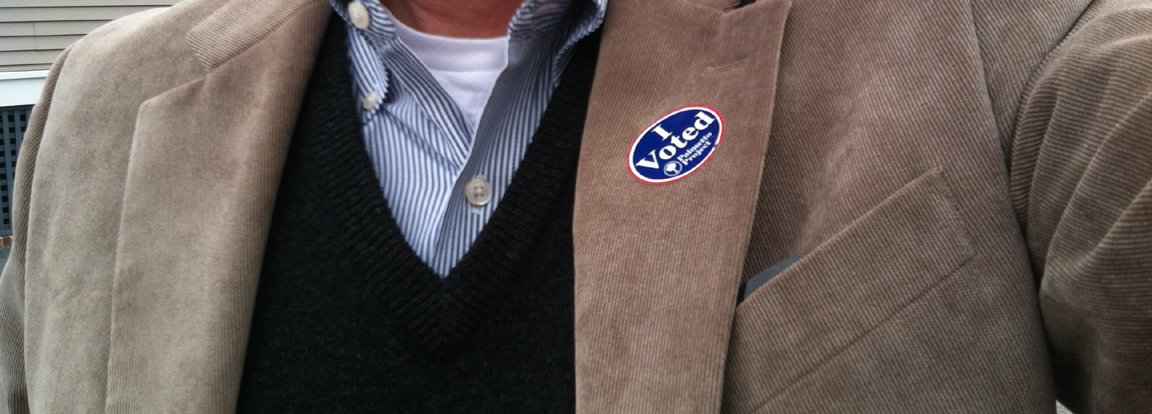
That, and a brief exchange with my county councilman Bill Banning, who was leaving when I first arrived, was all the socializing I had time for. I was done voting in about 10 minutes. I could have been done faster if not for my compulsively pausing to take pictures of the voting machine screen (the picture above was taken at 8:42, the last shot I took of the screen was at 8:51).

But… that’s not the way it had been earlier. There was a long line stretching out to the parking lot earlier, but it was mostly gone when I got there at 8:40. (I had figured that would give enough time to clear out the early rush, and I was right.) Right after I entered the building  to join the short K-Z line, one of the workers looked out and marveled, “We’re almost at the end of the line!” Another worker told me there had been about 300 voters so far — I neglected to ask her whether that was the total, or just the K-Z line that she was working.

What do you think will happen tomorrow?

A graphic that ran with the Post/ABC results.

Someone asked me that at Rotary today, and I say that in the presidential contest (which is what the question was about), if you force me to pick a winner, I say it will be President Obama. In the Electoral College at least. Although it’s close enough that I could be wrong, at this point I think we’re where we were months ago: A slight edge for the incumbent.

As more than one poll has indicated, I’m with most Americans in making that prediction. The latest one I’ve seen shows that 55 percent of the electorate thinks Obama will win, and only 35 percent thinks Mitt Romney will.

Here’s the boiled-down-to-essentials way Nate Silver over at FiveThirtyEight put it several days ago:

Mr. Obama is leading in the polls of Ohio and other states that would suffice for him to win 270 electoral votes, and by a margin that has historically translated into victory a fairly high percentage of the time.

Over the weekend, Silver noted that various polls also show a slight Obama advantage in the popular vote, but generally within the margin of error.

Now comes the last Washington Post/ABC p0ll of the election, showing that same pattern:

Heading into Election Day, likely voters divide 50 percent for President Obama and 47 percent for his challenger, Republican Mitt Romney, according to the latest, final weekend release of the Washington Post-ABC News tracking poll.

A nail-biter throughout, the presidential contest remains closely competitive through its last days, even as most voters perceive a likely win for the president.

In regular polls since early July, neither candidate ever gathered more than 50 percent of likely voters, and neither ever slipped below 46 percent. Across nearly 7,000 interviews with likely voters from Oct. 18 through Sunday evening, less than four-tenths of a percentage point separates Obama and Romney.

The difference between the candidates in the final weekend tally is right at the 2.5 percentage margin of sampling error for the final four-night sample of 2,345 likely voters. This makes Obama’s being at plus three points over Romney an edge only by the slimmest of margins, well below conventional measures of statistical significance…

So how are you seeing it?

Apparently, the kids like Obama

Got this release today:

November 4, 2012, Mount Hermon, MA – High school students across the country took to the polls this month and chose President Barack Obama to serve another term as President of the United States in a nationwide mock election.

More than 54,000 students from more than 130 schools across the United States–at least two from each of the 50 states and the District of Columbia–participated in this year’s VOTES Project (Voting Opportunities for Teenagers in Every State), one of the nation’s largest mock elections, began in 1988 by teachers at Northfield Mount Hermon School. High school students across the country campaigned on behalf of President Barack Obama and Republican challenger Mitt Romney–as well as third-party candidates–holding rallies, debates and other campaign events leading up to tonight’s announcement of the winner.

Barack Obama received 316 electoral votes and Republican challenger Mitt Romney received 208. Obama received 50.2% of the popular vote (27,107), and Romney earned 41.2% (22,252).

The final tally took place at the 2012 VOTES Election Central gala in James Gym on the NMH campus. The NMH Singers and Jazz Band provided campaign music, and students acted as television moderators, conducting interviews and reporting electoral results by fixing either a blue or a red pin to a map of the United States.

Due to Hurricane Sandy, a total of five schools in New Jersey, New York, and Pennsylvania were unable to hold mock elections, meaning 14 electoral votes were not distributed…

But how valid can that result be when it doesn’t include votes from a single high school that I personally attended (I attended three, in SC, Florida and Hawaii)?

Thomas Jefferson as unrepentant slaveholder

The usual take on the man best known for writing that “All men are created equal” has been that he owned slaves, but… after which you choose your excuse:

  • He was really conflicted about it.
  • He just didn’t think freeing them would be practical.
  • He was a particularly benevolent master.
  • It’s not fair to judge someone who was born into that system, and knew no other, by modern ethical standards.

The excuses may bear revisiting in light of a new book, Master of the Mountain: Thomas Jefferson and His Slaves, byHenry Wiencek. Here’s an excerpt from a review of the book this morning in The Wall Street Journal:

The strongest sections of the book track Mr. Wiencek’s close reading of Jefferson’s estate records, where he found a coldblooded taskmaster who ruthlessly exploited child labor and overworked his slaves as a matter of course. Jefferson sometimes countenanced brutal punishment, including the whipping of boys as young as 10 or 11 in his highly profitable nail factory, “whose profits paid the mansion’s grocery bills,” Mr. Wiencek writes. Despite Jefferson’s occasional assertions that slavery would one day wither away, he never lifted a finger to weaken it as an institution, even when implored to do so by friends and allies who regarded slavery as an affront to the values for which patriots had fought the Revolutionary War.

In his youth, Jefferson did hold antislavery convictions. And in his earliest draft of the Declaration of Independence, he may well have had slaves in mind when he declared that all men were created equal.(Southerners were sufficiently worried that they tried unsuccessfully to have the word “men” changed to “freemen.”) By 1784, however, in “Notes on the State of Virginia,” he expressed in graceful but cringe-inducing prose a deep personal distaste for blacks, who, he asserted, smelled wrong, copulated with apes in Africa, and were incapable of intellectual achievement.

Whatever moral ambivalence he may have felt toward the institution of slavery he overcame when he sat down and did the numbers for Monticello. In 1792, he calculated precisely what his slaves were worth. Mr. Wiencek writes: “What Jefferson set out clearly for the first time was that he was making a 4 percent profit every year on the birth of black children. The enslaved children were yielding him a bonanza, a perpetual human dividend at compound interest.” To intimates, Jefferson described slavery matter-of-factly as a good investment strategy, advising one friend that if his family had cash to spare, “every farthing of it [should be] laid out in land and negroes.”…

Actually, I was a bit surprised that Jefferson even handled the books for his estate. I supposed he followed the practice of the landed gentry of having a “man of business” deal with all that. I had supposed he was detached from the enterprises that gave him his wealth, devoting all his time to politics, science and music. I had read that he was a terrible money manager, embodying the Southern planter’s typical indifference to debt, spending above his means on books, scientific instruments and other things that scratched his intellectual itch.

I supposed that, to paraphrase John Travolta (on being a loan shark) in “Get Shorty,” he was never that into it. But supposing he remained above the details of running his estate was just my way of offering him another excuse, I guess.

Mr. Wiencek’s premise seems to be that he was not only his own man of business, but a particularly hard-eyed one, especially on the subject of slavery.

Not that I was ever prepared to give him a pass on that. There are a number of reasons why, among the Founders, I have always preferred John Adams to Jefferson, and have resented that Jefferson was in their day, and still is, more celebrated and revered. One of those reasons was that Adams was adamantly opposed to slavery, while Jefferson, high-minded words aside, was a major practitioner of that evil.

This book should give us all, including those of you who admire Mr. Jefferson more than I do, something new to consider.

How to help Red Cross help those hurt by Sandy

I’m kicking myself because I neglected to pass this on to y’all yesterday. Doing so now:

Dear Brad,

Superstorm Sandy has forced the cancellation of approximately 325 American Red Cross blood drives, resulting in a shortfall of nearly 11,000 units of blood and platelets so far. That number is sure to rise over the next several days as Sandy is causing power outages and flooding in many areas along the East Coast, which will result in the cancellation of additional blood drives throughout the week.

While Sandy will affect the number of people available to donate, hospital patients still need blood. The Red Cross has begun moving blood products to the affected areas as necessary, but nationwide, around 44,000 blood donations are needed each and every day to meet the needs of accident victims, cancer patients, and children with blood disorders. When disaster strikes, the need for blood does not diminish, even though blood donors may find it difficult or impossible to get to a convenient donation opportunity.

It’s the blood that is already on the shelves that helps save lives before, during and after a disaster. We urge you to schedule an appointment today to donate blood or platelets.

Sincerely,

The American Red Cross

P.S. If you have recently donated blood or platelets, there are other ways to help. To make a financial donation, please visit www.redcross.org, call 1-800-RED CROSS (1-800-733-2767) or text the word REDCROSS to 90999 to make a $10 donation*. Your gift enables the Red Cross to provide shelter, food, emotional support and other assistance to those affected.

Where Howie Rich et al. are spending these days

Phil Noble’s New Democrats have released a list of those receiving money from Howard Rich and allies (I’m not sure how the allies are defined), in the continuing quest to purchase privatization of education in South Carolina. First, an excerpt from the commentary:

After the Civil War, South Carolina was invaded by Northern carpetbaggers and their local scalawag allies who abused our state and exploited our people.

Howard Rich

They are back – this time Howard Rich is the carpetbagger and there are 25 legislators and candidates, as well as party and legislative organizations, who have joined him to exploit our children with their so-called school voucher social experiment scheme.

We are here today to name these 25 candidates and party organizations that have taken over $333,000 in funds from Rich and his out of state cronies to make our state’s children lab rats in his radical school voucher experiment.

In 2011-12, Rich and his cronies have contributed $325,640 to Republicans and $8,000 to Democrats. They should all be ashamed of what they have done and they should give the money back…

And now the list:

Contributions by Howard Rich and Cronies

Below is a list of the total contributions to South Carolina candidates made by Howard Rich and his cronies in 2011-12. Source: FollowTheMoney.org and the SC Ethics Commission. See itemized list of contributions here.

TOTAL: $333,640
Republicans: $325,640
Democrats: $8000

SC HOUSE
Total: $37,500

Barfield, Liston D (R, 58) $3000
Bowen, Don C (R, 08) $3000
Chumley, Bill (R, 35) $15,000
Crawford, Kris (R, 63) $500
Erickson, Shannon (R, 124) $500
Gambrell, Michael W (R, 07) $500
Hardwick, Nelson (R, 106) $2000
Herbkersman, Bill (R, 118) $1000
Putnam, Joshua (R, 10) $11,000
Smith, Garry R (R, 27) $1000

SC SENATE
Total: $109,000

Bright, Lee (R, 12) $17,000
Bryant, Kevin L (R, 03) $8000
Campsen, Chip (R, 43) $1000
Corbin, Tom (R, 05) $8000
Davis, Tom (R, 46) $1000
Fair, Mike (R, 06) $18,000
Ford, Robert (D, 42) $6000
Grooms, Larry (R, 37) $5000
Massey, Shane (R, 25) $3000
Peeler, Harvey (R, 14) $3000
Rose, Mike (R, 38) $18,000
Thomas, David (R, 08) $18,000
Thurmond, Paul(R, 41) $3000

LEGISLATIVE CAUCUSES
Total: $105,000

House Democratic Caucus Committee $2000
House Republican Caucus Committee $3000
Senate Republican Caucus Committee $100,000

STATEWIDE
Total: $38,500

Loftis, Curtis (R, Treasurer) $31,500
Wilson, Alan (R, AG) $7000

PARTIES
Total: $43,640

South Carolina Republican Party $43,640

The SC Dems site notes that Logan Smith has more over at his blog.

Last week’s election forum at the library

For those of you who are interested, but were unable to make it last week, I offer the following:

Brad Warthen moderates a bipartisan panel debate on the hot issues of this year’s presidential campaign. Panelists include: Matt Moore, SC Republican Party Executive Director; Amanda Loveday, SC Democratic Party Executive Director; Representative Nathan Ballentine; and Representative Bakari Sellers. This program is co-sponsored by the Central Carolina Community Foundation and Richland County Public Library. Recorded at the Richland County Public Library in Columbia, S.C. on October 23, 2012.

Gov. Chris Christie’s effusive praise of Obama

Here’s something you don’t see every day:

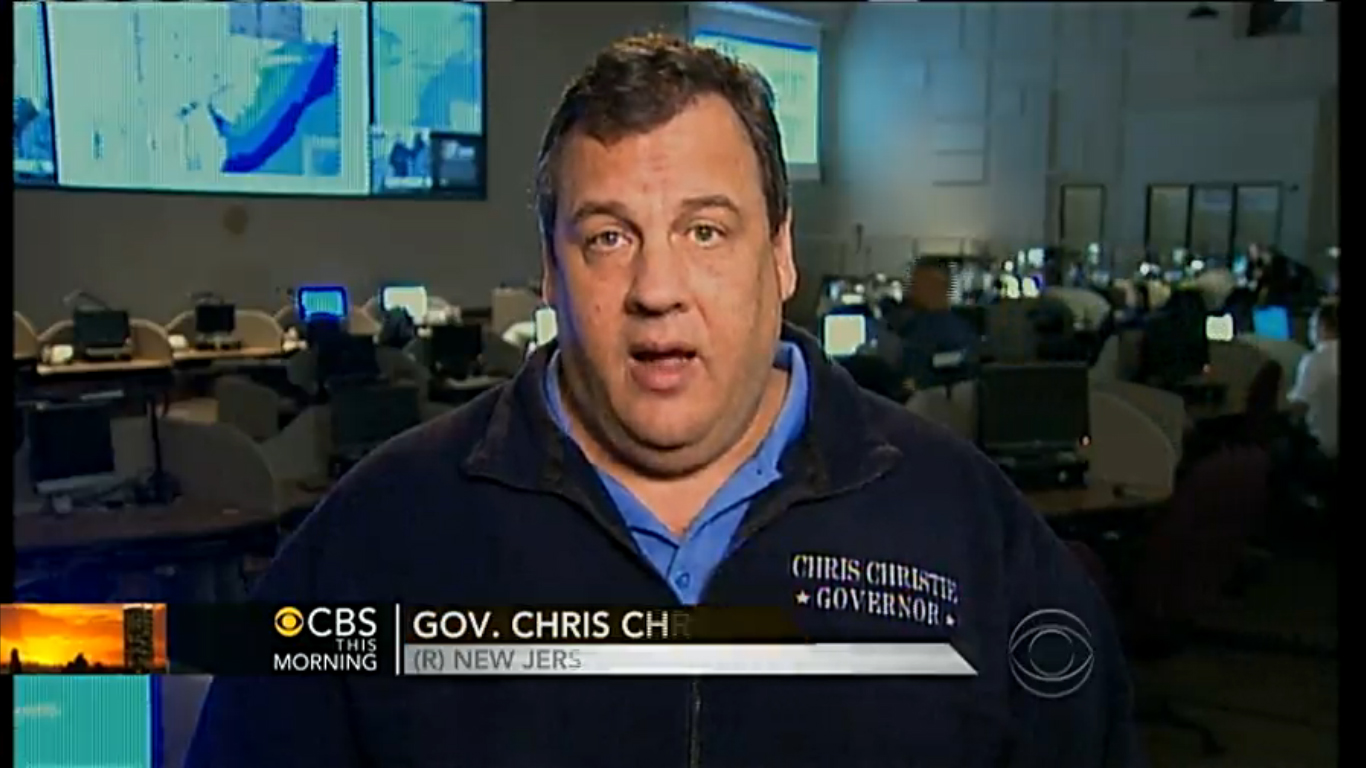
Gov. Chris Christie of New Jersey took an unscheduled break from partisan attacks on the President Obama on Tuesday to praise him, repeatedly and effusively, for leading the federal government’s response to the storm.

“Wonderful,” “excellent” and “outstanding” were among the adjectives Mr. Christie chose, a change-up from his remarks last week that Mr. Obama was “blindly walking around the White House looking for a clue.”

Some of Mr. Christie’s Republican brethren have already begun grumbling about his gusher of praise at such a crucial time in the election.

But the governor seemed unconcerned. When Fox News asked him about the possibility that Mitt Romney might take a disaster tour of New Jersey, Mr. Christie replied:

I have no idea, nor am I the least bit concerned or interested. I have a job to do in New Jersey that is much bigger than presidential politics. If you think right now I give a damn about presidential politics, then you don’t know me.

A governor who cares more about serving his (or her) state more than national partisan politics? Imagine that. If you live in South Carolina, you might find that difficult, but try…

Is Hurricane Sandy God’s ‘October Surprise’?

And if so, which candidate does he want to benefit?

Nate Silver is worrying about Sandy, and not just because he lives in Brooklyn:

I’m not sure whether I render the greater disservice by contemplating the political effects of a natural disaster — or by ignoring the increasingly brisk winds whipping outside my apartment in Brooklyn. Still, I thought it was worth giving you my tentative thoughts on how Hurricane Sandy might affect the runup to next Tuesday’s election.

We may see a reduction in the number of polls issued over the coming days. The Investor’s Business Daily poll has already announced that it will suspend its national tracking poll until the storm passes, and other cancellations may follow. And certainly, any polls in the states that are most in harm’s way, including Virginia, New York, New Jersey, Delaware, Maryland and Pennsylvania, will need to be interpreted with extreme caution…

But beyond the polls that Silver lives by, what about the election itself?

The aftermath of Katrina did enormous damage to public perception of President Obama’s predecessor. What will happen in those blue states that will bear the brunt of this storm, and how quickly will it happen?

Will this be a chance to show political leadership that will enhance the incumbent’s chances, or will it inevitably cause a bad taste that accrues to Mr. Romney?

The Washington Post has put together this interesting explainer on “five places where Hurricane Sandy could affect the election.” Interesting. A snowstorm in conservative southwest Virginia keeping people from the polls? Whoa.

Meanwhile, the Obama team is shrugging everything off and declaring their victory inevitable. The other side is pumping out some hubris, too, saying in a memo: “Every day, Barack Obama’s so-called Ohio firewall crumbles a little bit more because of Mitt Romney’s electric appearances, our campaign’s robust ground game, and Romney’s forward-looking message that lays out a serious and specific agenda for the future.”

Electric appearances? Really?

Hey, Clint, where’s the chair?

Just thought I’d share this new ad Clint Eastwood did for the American Crossroads Super PAC.

He says, among other things:

Obama’s second term would be a rerun of the first, and our country just couldn’t survive that.

Really, Clint? Couldn’t survive it?

I think he has a greater sense of perspective and proportion in his movies. (Particularly “Gran Torino,” which is awesome.)

Anyway, if you want to see the PRO-Obama the Hollywood legend did not so long ago, I include that below…

At the nexus of religion and politics

Here we have a more 19th-century understanding of the relationship between faith and politics...

A column in The Wall Street Journal this morning notes:

A hypothetical Martian with a deep interest in America’s political and cultural history would be surprised and perhaps amused at the religious composition of those running in the current presidential campaign.

The incumbent president is an adult convert to Christianity after being raised by a mother he has described as agnostic but interested in many faiths. His opponent is a Mormon, a faith tradition entirely indigenous to America and less than two centuries old. As for the two vice-presidential candidates, both are Catholic. This is the first presidential election in American history in which neither of the two presidential candidates or vice-presidential candidates was brought up as a Protestant…

I sort of knew all that, of course, but hadn’t put it together that way. And so it is that Protestant hegemony in American politics passes away, almost unnoticed.

After a review of times, especially the 19th century, when such would have been unthinkable, and some discussion of our growing secularism, the author concludes:

The eyes of all are still upon America, but it is a markedly different place. As the secularization of that city upon a hill continues, it is not hard to imagine a presidential race one day that involves candidates who practice no religion at all.

I’m not sure how to put this in a morally defensible way, since there is no way I can truly know the content or quality of another man’s soul, but… I’m wondering just how big a departure from the past that would be.

Let me just put it in generalities… Generally, I seldom believe that national politicians are as interested in religion as they let on to be. They are after all men, and occasionally, women of the world, not given to extended periods of contemplation. The world is so much with them that their pieties have a sort of formalism about them. Not that they’re lying or being hypocritical, just that… they’re more like, “Going to church is something you do, so I go to church.”

There are exceptions. Jimmy Carter was serious about his faith. I think Paul Ryan is, even though I think he’s really confused as to what “subsidiarity” means (which isn’t something most Catholics sit up nights thinking about, frankly). Rick Santorum is. I suppose, just on the basis of the time he’s put in, that Mitt Romney is, although I confess to such a lack of understanding of Mormonism that I’m not qualified to tell.

I think Joe Biden is sincerely Catholic, in the way of cultural, cradle Catholicism. It goes well with his hail-fellow-well-met manner, reminding me for some reason of the Belloc quote, “Wherever the Catholic sun doth shine, There’s always laughter and good red wine.” It sets him apart from gray-faced Calvinists, I think. And I think he truly cares, in a Catholic way, about the common folk from which he keeps telling us he springs, which speaks to the warm, human side of theology.

Barack Obama? I don’t know what to think, except to take him at his word about his faith. His adoption of Christianity as an adult is so tied in with his deliberate self-invention from being an unrooted child of uncertain identity that it’s hard to grab hold of (in one way — in another, I sort of identify with his journey). But I’ll put it this way, meaning no judgment of anything I have no right to judge: If asked to describe him, “religious” would not be one of the first words I mentioned — whereas with Jimmy Carter, and maybe Rick Santorum, it would be.

The president’s relationship with religion is of a sort that the more aggressively secular legions of his party can be more comfortable with, whereas one gathers that Jimmy Carter’s piety sort of gave them the willies.

Don’t know where I’m going with this; I just thought I’d toss those thoughts out there…

Obama debate performance: Just ONE cup of coffee too much

Again today, The Onion captures the essence:

Obama Takes Out Romney With Mid-Debate Drone Attack

BOCA RATON, FL—Saying that the high-value target represented a major threat to their most vital objectives, Obama administration officials confirmed tonight that former governor Mitt Romney was killed by a predator drone while attending a presidential debate at Lynn University.

Sources said the drone attack, which occurred at approximately 10:10 p.m. Monday night, obliterated Romney in the middle of a statement on Chinese-purchased U.S. securities, sending his dismembered limbs and internal organs into the audience and leaving a smoking pile of charred flesh and bone in his seat.

“The information we have received from military personnel in the field indicate that tonight’s drone strike took out Mitt Romney, a former businessman the Obama administration has long considered a serious danger, especially in past few weeks,” said White House press secretary Jay Carney, describing the operation as “an unmitigated success.” “The president personally authorized the strike earlier this evening, and as soon as we had visual confirmation that the target in the drone’s sights was, in fact, Mitt Romney, we eliminated him.”…

So maybe President Obama didn’t quite go that far last night, but he was certainly on the attack to a degree that often seemed, to me, unseemly.

By the way, I tried to post this last night, but ran into technical problems — I had left my laptop’s mouse at the office, and my wife’s desktop internet connection was running so slow I figured I’d never get to bed. So here’s what I wanted to share, which was my Twitter feed from the debate. These started at 9:21 p.m. As usual, all Tweets are by me except where another screen name is indicated:

  • Obama needs to chill. Looks desperate. Nobody wants an Interrupter in Chief…
  • The Fix ‏@TheFix Worth noting: Obama has attacked Romney on every question thus far. #lynndebate
  • Peter Beinart ‏@PeterBeinart The egyptian govt needs binders of women to fully develop
  • Romney is coming across as calmer, which, when we’re talking national security, can sometimes count more than the words being said.
  • Yeah, Madeleine Albright redux! “@politico: Obama: “America remains the one, indispensable nation.” #debates
  • @howardweaver@BradWarthen that one redux’es WAY farther back than Albright.
  • Yeah, but I liked her cover version…
  • In Godfather terms, Romney is playing the Man of Reason tonight. Obama at times seems to be shooting for Crazy Joey Gallo
  • OK, I’ve heard the president say he “ended the war in Iraq” too many times. He didn’t do that; the Surge did.
  • The thing is, I generally approve of the job Obama’s done in the world. But he’s not selling it very well tonight…
  • If Obama loses this election, and does so because of this debate, I wonder, will it be because he just had ONE CUP OF COFFEE TOO MUCH TODAY?
  • That’s what I wanna hear! RESOLVE! “@DepressedDarth: I will build 5 new Star Destroyers if I’m elected president. #finaldebate
  • grannykate ‏@katespalmer @BradWarthen Surge changed tide. POTUS brought troops home
  • So would McCain have. Even Bush was on track to do that…
  • Almost an hour into this, and neither Obama nor Romney has indicated what he would do about Quemoy and Matsu. This is unacceptable.
  • Slate ‏@Slate RT @fmanjoo: Here’s the place for Obama to say, “Ask Osama Bin Laden if I apologized. Oh, that’s right, you can’t. Because he’s dead.”
  • Yeah, kinda what I thought… “@washingtonpost: FACT CHECK: Obama did not go on “apology tour” http://wapo.st/SjFXqM #debate
  • In what alternative universe did this “apology tour” take place? I totally missed it. Yet so many GOP tweeters assert it as article of faith
  • The president’s calmed down some. Hasn’t jumped anxiously down Gov. Romney’s throat in awhile.
  • No, Mr. President, we were no longer “bogged down” in Iraq when you took office. Not after the Surge. Stick to the good things you HAVE done
  • SunnyPhilips ‏@SunnyPhilips Sad many Americans would rather watch HoneyBooBoo or other trash TV than debates impacting their country’s leadership.#theirvotecountstoo
  • OK, I give up: What’s a Honey Boo-Boo?
  • SunnyPhilips ‏@SunnyPhilips Ha. You’ve made my day.
  • Romney’s strategy tonight has been not to commit major errors tonight. No big strategy proposals, just no screwing up. Generally working…
  • Nicholas Kristof ‏@NickKristof Candidates take a break from bashing each other to jointly bash China. 太过分了!
  • If Obama would blame China for Gamecocks’ two losses in a row, he could win South Carolina.
  • Ramez Naam ‏@ramez China holds only about 8.2% of US federal debt. Most is held by Americans. http://bit.ly/kaOUzI
  • Really? I’m not seeing that… “@ebertchicago: Obama looks cool. Romney looks sweaty. Will post-mortems agree? #debate
  • Scott Huffmon ‏@WinthropPoll Foreign Policy debate: Good thing there are no issues with South America or most of Africa or Europe to be dealt with !
  • Obama mentions Pacific strategy. About time we got into mega strategy. Still no mention of Quemoy and Matsu…
  • My Navy Brat nervous system is still twitching indignantly over the horses and bayonets thing…
  • Nicholas Kristof ‏@NickKristof Foreign policy debate spent more time on Israel than on Europe, India and Africa combined. That’s not our world.
  • Aaron Gould Sheinin ‏@asheinin Serious tweet: Seeing lots of Republicans calling the debate a draw.
  • That’s because they wanted their guy to be as combative as Obama was — which frankly was NOT a good thing…
  • I liked that they shook hands civilly and smiled at each other at the end. How pitiful is it that I’m clinging to something that small?
  • Dan Gillmor ‏@dangillmor If Romney can persuade the public that he’s the peace candidate — there isn’t one — then the American people are truly out to lunch.
  • But he might with some, purely on demeanor.
  • Anyone else think Romney was going particularly after women tonight, rocking back and not being Mr. Aggressive?
  • David GregoryVerified ‏@davidgregory The President is determined to pick a fight tonight; Romney determined to avoid it. What does that say about where each camp sees the race?
  • A lot.

That last one posted at 10:50 p.m.

So… what did y’all think — both during, and upon reflection? I haven’t had much time for reflection, so I leave you for now with the stream-of-consciousness.

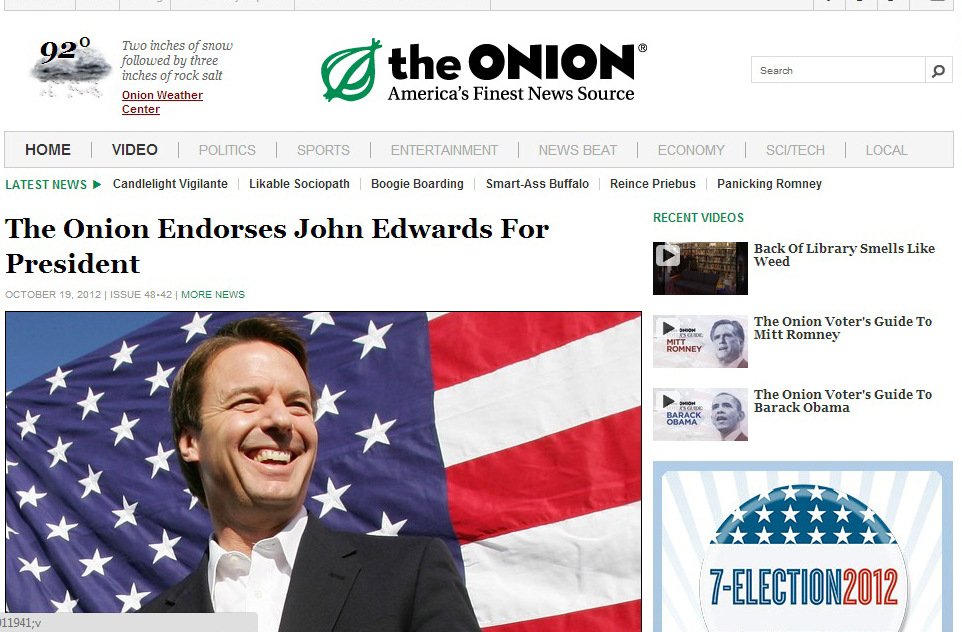
The Onion’s bold endorsement of SC native son John Edwards

Gary Karr, ex-reporter, ex-press secretary to Gov. David Beasley, brought this to my attention Friday (Tweeting, “I bet my friends @bradwarthen and@cindiscoppe are envious.”), but I didn’t have a chance to read it until Saturday night, backstage at “Pride and Prejudice” in Finlay Park. And I was busy then.

So I’m just getting around to passing it on to y’all.

Everyone knows what I thought of John Edwards way before the sex scandal, and any of you who remain among his admirers will no doubt be saddened to learn that my opinion has not improved. But then, I’m a stick-in-the-mud, and lack the bold vision of The Onion‘s editorial board.

This seems to mark a departure for that revered organization. They used to be satisfied just to be funny. This goes to a whole new level. It’s positively Swiftian. And it makes anything I ever wrote about the guy seem almost complimentary.

The core argument for the former U.S. Senator (and, we must not forget our shame, winner of the 2004 SC Democratic primary — y’all remember I told y’all to vote for Joe Lieberman, but did y’all listen?), begins as follows:

Mr. Edwards’ career has not been without its missteps. He has, like all of us at one time or another, made his share of mistakes. His opposition to a nationwide military draft, for instance. In addition, his support for the expansion of immigrants’ rights has angered this newspaper’s editorial board. And yet at each turn, Mr. Edwards has recovered in full, with two feet planted firmly on the ground and his dignity and political acumen intact. He is a man who has learned from adversity, knowing, as any former attorney does, that the strongest individuals are forged through trials by fire.

Furthermore, Mr. Edwards conducted a protracted extramarital affair with a younger woman while his wife was dying of cancer, and we like that he did this. Our reasons for liking that he did this are tenfold:

1. It was a brave thing to do, given the possible consequences

2. The woman in question was more attractive than Mr. Edwards’ wife

3. He did what he did without compromising his ideals, at least not to any illegal extent

4. He enjoyed himself, and good for him

5. The Onion believes sex is a natural and healthy biological function

6. Women have a weakness for men in powerful positions, and Mr. Edwards expertly exploited that weakness…

… and so forth. Be sure to read the whole thing. The logic is seamless, and who can say them nay? By these standards, there is no better choice on Nov. 6 than John Edwards.

Think about that as you watch tonight’s debate between Barack Obama and Mitt Romney. It should make both of them look better.

‘The power of Zeus,’ in the president’s hands

The teaser headline at the bottom of a Slatest email said, “New Drones in Libya Will Give Obama the Power of Zeus.”

The item it links to says, in part:

After the attack on American diplomats in Benghazi last month, President Obama vowed to hunt down the killers and bring them to justice. There is a good chance that this means that they will be incinerated by missiles fired from drones. If so, the United States will have used drones to kill members of al-Qaida and affiliated groups in Afghanistan, Iraq, Pakistan, Somalia, Yemen, and Libya—six countries in just a few years. Mali may take its turn as the seventh. This startlingly fast spread of drone warfare signifies a revolution in foreign affairs. And, for good or for ill, in an unprecedented way it has transformed the U.S. presidency into the most powerful national office in at least half a century.

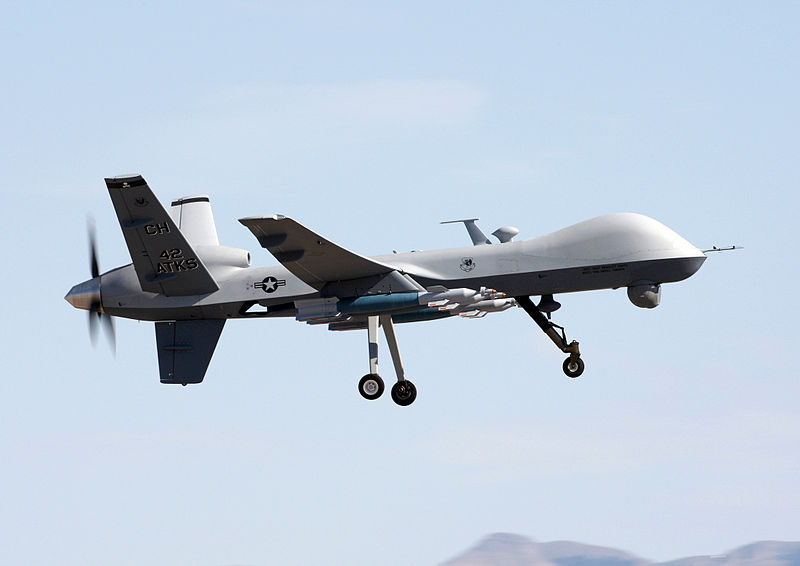
A MQ-9 Reaper flies above Creech AFB during a local training mission. (from Wikipedia)

In the past, presidents faced two major obstacles when trying to use force abroad. The first was technological. The available options—troops, naval vessels, or air power—posed significant risks to American military personnel, cost a lot of money, proved effective only under limited conditions, or all of the above. Dead and maimed soldiers, hostages, the massive expense of a large-scale military operation, and backlash from civilian casualties can destroy a presidency, as Vietnam and Iraq showed.

The second obstacle was constitutional. The Constitution includes a clause that gives Congress the power to declare war. Presidents have been able to evade this clause for small wars—those involving only naval or air power, or a small number of troops for a limited period of time. They have mostly felt compelled to seek congressional authorization for large wars, no doubt in part so that they could spread the blame if something went awry.

But drones have changed the calculus. Because they are cheap and do not risk the lives of American soldiers, these weapons remove the technological obstacle to the use of force. And because drone strikes resemble limited air attacks, they seem to fall into the de facto “small wars” exception to the Constitution’s declare-war requirement. Unlike large wars, drone actions do not provoke congressional attention or even much political debate…

The thing is, this isn’t theoretical. This is power that this president is regularly using (in keeping with my thesis that Bush was Sonny Corleone, Obama is Michael).

When was the last time we killed people in six or seven different countries in one year? WWII? Then, even?

And now it’s with no muss, no fuss. Seriously, how many of you could even have named, without prompting, all those countries where we’ve engaged in this kind of warfare? Sort of makes our continuing arguments over the Iraq invasion and Vietnam seem quaint, doesn’t it? Maybe it’s good I look like someone out of the Regency Period while I address such subjects…

Scott thinks F-35 pretty cool after ‘flying’ it

Remember that previous post about the dog-and-pony show up in North Carolina, the one that was to allow reporters to check out an F-35 simulator?

Well, Lockheed had another one on USS Yorktown in Charleston, and they managed to wow Rep. Tim Scott:

U.S. REP. TIM SCOTT FLIES F-35 COCKPIT DEMONSTRATOR DURING USS YORKTOWN VISIT

F-35 will serve as a cornerstone of global security and create South Carolina jobs

CHARLESTON, S.C., October 18 – U.S. Rep. Tim Scott, (R-S.C.), today joined local elected officials and community leaders on the USS Yorktown at Patriots Point Naval and Maritime Museum to receive an update on the Lockheed Martin [NYSE: LMT] F-35 Lightning II program and hear about its contribution to South Carolina, national security, and the U.S. economy.

During his visit, Scott “flew” the F-35 cockpit demonstrator to experience firsthand how advanced stealth, fighter agility and integrated information systems make the F-35 the most capable multi-role fighter in the world. The cockpit is visually and audibly interactive and provides a realistic look at the F- 35’s performance, air-to-air and air-to-ground capabilities, sophisticated sensor fusion and advanced computational capabilities.

“Coming from a military family, I understand and appreciate that American men and women serving in uniform deserve the best technology that this nation can provide. Those that threaten our country are evolving everyday, and it is essential we stay ahead of them.” Scott said. “There is no doubt the fifth generation, multi-role F-35 Lightning II’s ability to defeat sophisticated surface-to-air missiles and enemy fighters in the air and on the ground will allow us to do just that.

“Our military leadership associated with Beaufort Air Station, McEntire Joint National Guard Base, and Shaw Air Force Base has told me clearly and convincingly that these capabilities are critical to defending our freedoms,” Scott added.

Lockheed officials noted that even at its current low rate of production, the F-35 program supports a broad industrial base of more than 1,300 suppliers in 45 states, contributing to more than 133,000 direct and indirect U.S. jobs and over $17.7 billion in direct and indirect annual economic impact. Those numbers are expected to grow as the program ramps up to full rate production over the next few years.

In South Carolina, the F-35 program generates nearly 123 jobs and more than $5 million annually in direct and indirect economic impact. Currently, there are four South Carolina companies supporting the program.

The F-35 is a supersonic multi-role fighter designed to replace a wide range of aging fighter and strike aircraft. Three variants derived from a common design will ensure the F-35 achieves its security mission while staying within strict affordability targets.

Lockheed Martin is developing the F-35 in conjunction with its principal partners, Northrop Grumman [NYSE: NOC] and BAE Systems, and Pratt & Whitney. Among the aircraft F-35 will replace are the A- 10, AV-8B Harrier, F-16, F/A-18, and the United Kingdom’s Harrier GR-7 and Sea Harrier.

Headquartered in Bethesda, Md., Lockheed Martin is a global security and aerospace company that employs about 123,000 people worldwide and is principally engaged in the research, design, development, manufacture, integration and sustainment of advanced technology systems, products and services. The Corporation’s net sales for 2011 were $46.5 billion.

The USS Yorktown was commissioned on April 15, 1943, and was one of the preeminent aircraft carriers to serve in the Pacific theater of operations during World War II. In the 1950’s, Yorktown was modified with the addition of an angled deck to better operate jet aircraft. In 1958, the ship was designated an anti-submarine aircraft carrier, and served admirably during the Vietnam conflict. Yorktown was decommissioned in 1970 and placed in reserve. In 1975, the ship was towed from Bayonne, N.J. to Charleston to become the centerpiece of Patriots Point Naval and Maritime Museum.

###

Hey, if I’d had a chance to go try it out, I’d probably think it was pretty cool, too. At a projected $323 billion, this is “the Pentagon’s most expensive weapons program.” In a budget like that, they ought to be able to come up with something better than my old Microsoft Combat Flight Simulator.

Last night’s debate news (or part of it) this morning — another problem for what’s left of newspapers

OK, so I’m behind the curve today. I got home from final dress rehearsal last night at about 11:30, heated up some dinner, watched a few minutes of both the beginning and the end of the debate (having heard a BBC assessment of it on the radio on the drive home) then watched some of the PBS commentary after the debate, then hit the sack.

But I’m not as far behind the curve as most daily newspapers were in today’s print editions.

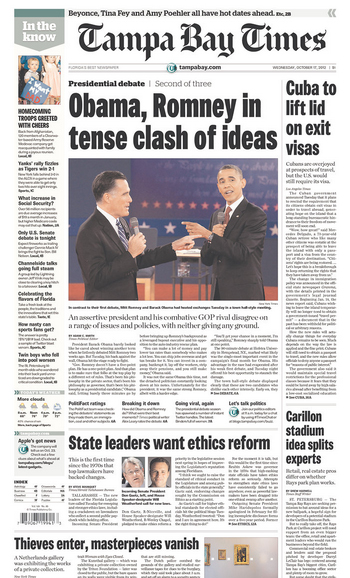
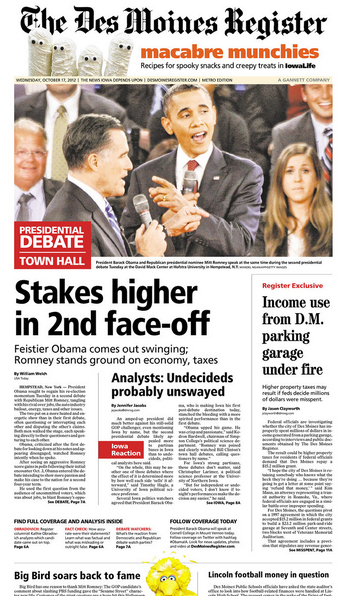
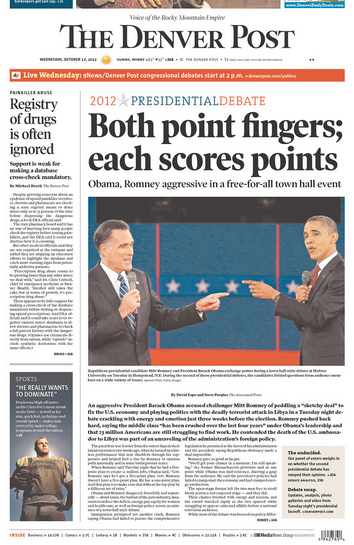
Slate calls our attention to today’s front pages (all taken from the Newseum, where you can see plenty of others), which have a sameness about them: They pretty much all say the same thing in their headlines, and most run photos of the same moment, with the candidates’ fingers pointed at each other. Sure, you might find some “analysis” in there somewhere, and the more enterprising (and better-staffed) opinion pages will have some sketchy opinions expressed. As Slate’s Josh Voorhees writes:

As we explained late last night, the insta-polls and the pundits saw a tight contest on the Long Island stage on Tuesday, but one that was won narrowly by President Obama. Given the lack of a clear-cut win, however, it should come as little surprise that a quick scan of the morning’s front pages show the nation’s headline writers and art teams focused on the on-stage clash and largely left the who-won question to the domain of the cable news talking heads (as most papers had likewise done following the previous two debates).
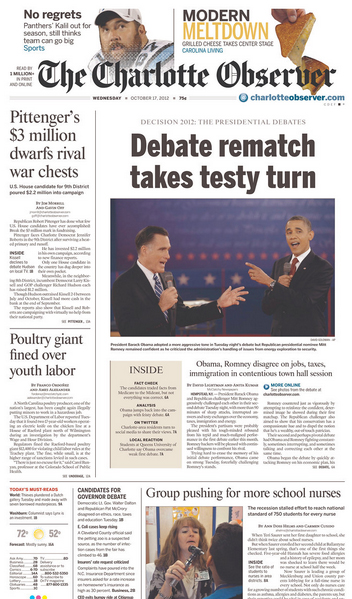
Once, this sameness, this lack of personality or individualized expression was the glory of newspapers. If 10 different journalists from 10 different papers covered the same event, they would all write pretty much the same thing. It was a measure of their professionalism, and the self-effacement that news writing demanded of them. It was about giving it to you straight, unadorned, plain, and God forbid there should be any hint of opinion in it. Who, what, where, when, maybe how, and, if you put an “Analysis” sig on it, why.

The monotony of it didn’t strike the reading public because unless they lived near an urban newsstand, most people only saw one daily newspaper.

But here’s the problem with that today: What newspapers put in those lede headlines today, and what they conveyed in those pictures, was all old news by the time I was driving home from rehearsal last night.

I hadn’t driven more than a few blocks when I knew the conventional wisdom on what had happened. It went something like this: Obama did all the things he failed to do in the first debate, particularly having a strong finish. Romney did fine, although was maybe not quite as sharp as in the first debate. If you’re declaring a winner, it’s Obama, although I didn’t get the sense that he dominated in this debate the way Romney did in the first one, so if you’re going on cumulative totals, Romney’s probably still ahead in this debate series. How this affects the polls remains to be seen.

I had even heard about “binders full of women,” but I was mostly confused by that.

In the post-debate analysis I watched after I got home, I heard David Brooks and Mark Shields give their assessments. Brooks said Obama won because he was able to exploit Romney’s biggest weakness better than Romney was able to press Obama on his biggest weakness. He said Romney’s biggest weakness is that his numbers don’t add up, and Obama’s problem is that he never provides a vision of what the next four years will be like if he is re-elected. Shields said it might surprise everyone, but he agreed with Brooks on all those points.

Since then, on the radio this morning, I’ve heard that “Obama hasn’t sketched a vision going forward” meme several more times.
I was also interested in what a young woman (didn’t catch her name) who analyses Twitter during debates for PBS had to say. I didn’t get as much of an overview of the Twitter take as I wanted because she decided to zero in on the reactions of women. But I’ve found her assessments interesting in the past: What was trending? What were the memes people were obsessing over? What caught on? I’ve become more and more interested in the instant reactions of Tweeters in the aggregate during events like this. It has something to do with the wisdom of crowds. It’s like having sensors attached to the brains of millions of highly engaged, clever voters — which is what the most-followed people on Twitter tend to be.

And I felt left out because I wasn’t on Twitter myself during the debate. Increasingly, that’s where I like to be during these kinds of real-time shared events, sifting through the flood of reaction as it washes over me.

And in a Twitter world, seeing these front pages feels like reading ancient history. No, it’s worse than that. Historians look at the whole of a thing after it’s over and draw conclusions. There’s a wholeness to historical accounts. These reports — and I’m just reacting to the headlines, mind you — don’t do that. They give only the most noncommital account, essentially just telling you that the candidates came together and vied against one another, and there the account ends. The Des Moines Register headline (“Stakes higher in 2nd face-off”) could have been, and possibly was, written before the debate started. (And pre-Gannett, that was one of the best papers in the country for political coverage.)

And I was already so far beyond that, without even trying hard to be, last night — without even having seen the debate.

I’m not saying these papers aren’t doing their jobs well. What I’m saying is that the job they’re doing, within two kinds of constraints — the convention of not drawing conclusions in a news account, and the severe time problem of the debate ending as they have to get those pages to the press room (depending on the edition we’re talking about, a lot of editions went to bed BEFORE that) — fails to satisfy in a Twitter world.

Again, there might be all kinds of good stuff in the stories, but the presentation — the quick impression that a glance at the front page provides — is deeply lacking. It makes you not want to read more deeply. It causes me to want to go read those papers’ websites today, and see what good stuff didn’t make it into the paper. (And the better papers will have something for me when I go there.) Because the conversation has moved, by the time the paper hits your stoop, so very far beyond what’s in those headlines.