Category Archives: The World

Have some fun in the Sistine Chapel

The guy who did the ceiling.

Before I forget about it totally — go check out this cool interactive Vatican site that Burl brought our attention to in a comment the other day. You can spin it around 360 degrees in three dimensions, and do so all sorts of different ways by changing the mouse

setting down in the left-hand corner (where you’ll also find the buttons that let you zoom in and out).

Very cool. And much cheaper than a trip to Rome. I enjoyed it, anyway.

Michelangelo did a pretty awesome job. I wonder what he would have charged, say, to do my TV room?

From the middle of things in Bahrain

Thought y’all might find this interesting. I’ll apologize in advance, though, for not using names. That was a condition of my using the material.

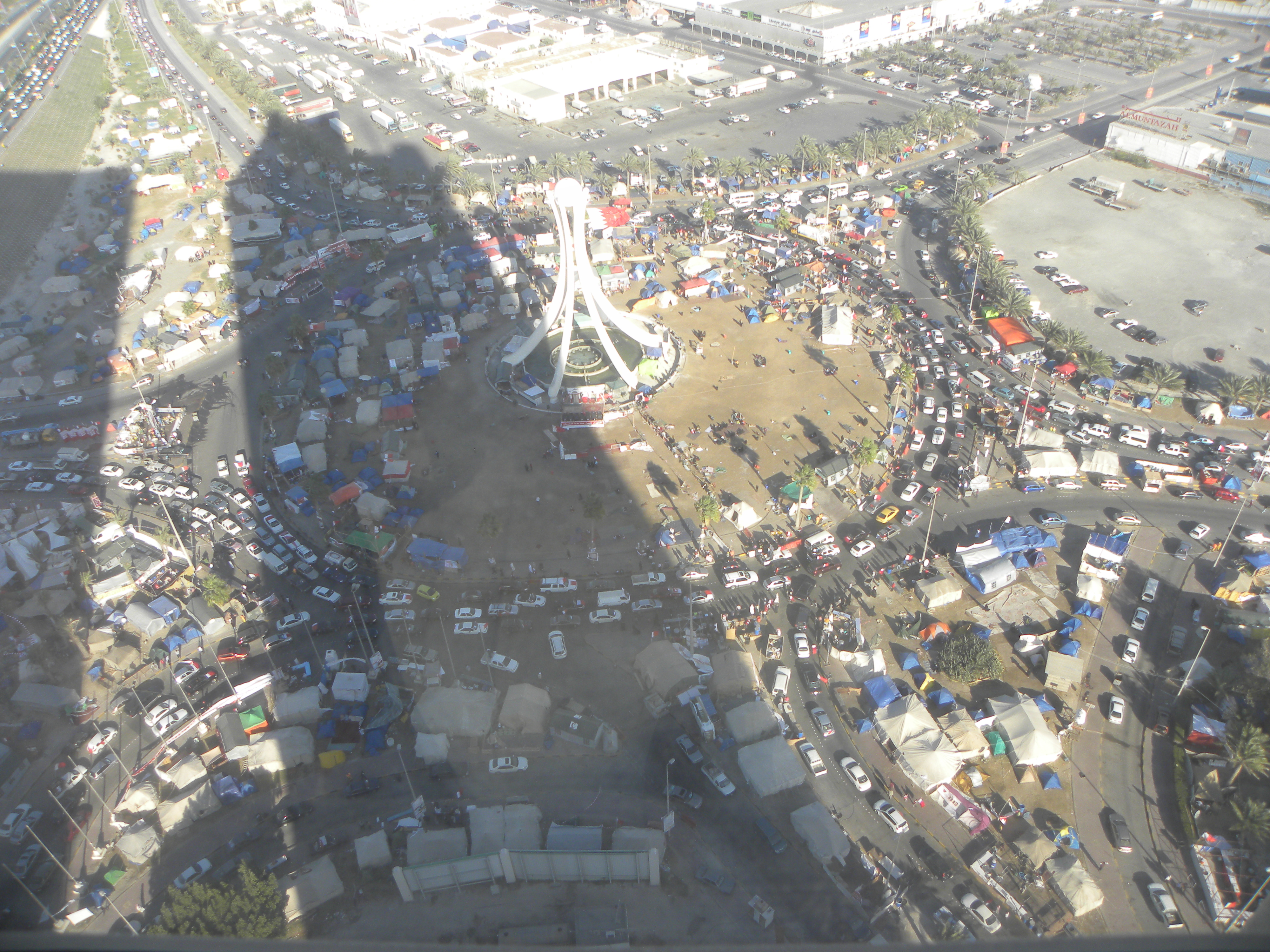
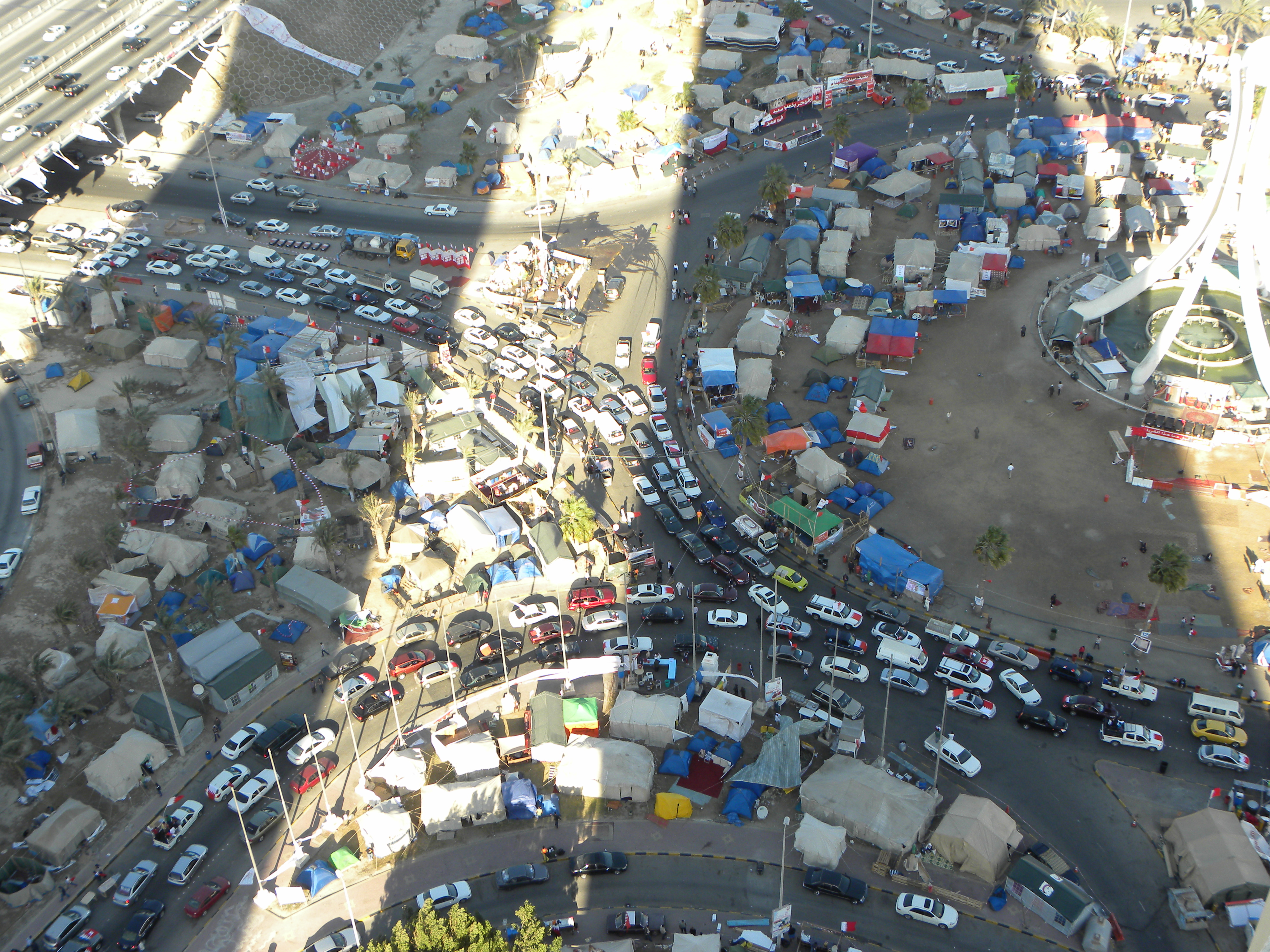
These images are from a Westerner who works for an American company in Bahrain. He lives right smack in the middle of protest central, which is having a big impact on his daily routine. He’s been keeping people at the home office apprised of the situation. When he was asked yesterday by someone back home whether he was “having to schedule your leaving and returning around the demonstrations and are you having to stay in once you arrive,” he answered as follows:

Yes and yes… security posted a message to get to the villas before 5:00, otherwise it will be almost impossible unlessyou park at the mall and walk a mile or more through the crowd. It clears out around 1:00AM. I took this at 4:15 PM today and the bigger crowds will not assemble for another couple of hours. They have live music, a wedding, food vendors, and speeches ongoing. The noise even at 36 floors above the ground is crazy…Once I get in I cannot leave until very early the next day….As long as it stays peaceful it’s  actually a pretty amazing spectacle to witness. I have hotel lined up should it turn violent again.

I’ve kept the picture files big so that you can zoom in and see large televisions, tents and food vendors, all contributing to a sort of celebratory, tailgating atmosphere. The picture above was taken out the window of his 36th-floor apartment.

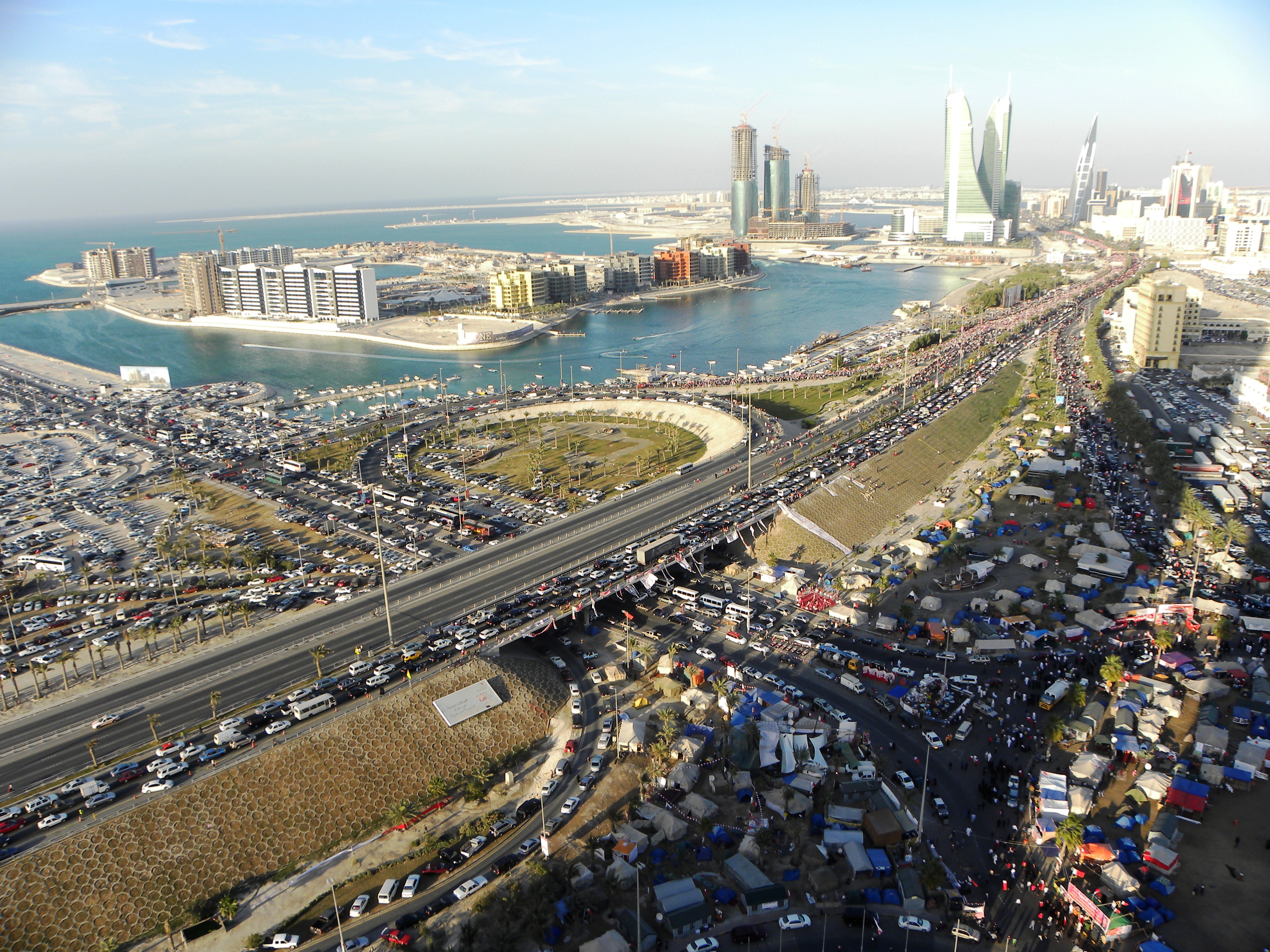
Today, he sent the picture below and the following additional message:

Got a good show going on down below this afternoon. They are marching from the Ministry office downtown which was a planned and scheduled event. It’s very peaceful just very noisy and traffic is blocked as far as you can see in that direction. Glad I stocked up this morning. Also glad the plants are on the other end of the island and our roads to the port are in the other direction as well.

This doesn’t give you the whole picture of what’s going on there, but it does give you one man’s view.

112 ways to spell ‘Gadhafi,’ or whatever that goofball’s name is

I’m almost positive that in the early years of my career, the Associated Press spelled the last name of the dictator of Libya with a “K.” (Or was it a “Q?” It’s been a long time.) Then, at some point the AP Stylebook switched to “Gadhafi.” I sorta kinda remember this because back in the 80s my responsibilities as news editor at The Wichita Eagle-Beacon (since simplified back to The Wichita Eagle) included supervising the national desk (which dealt with national and international news), as well as the copy desk (the final arbiters of how things were spelled in the paper).

And every paper I’ve ever worked at conformed, more or less (there were sometimes local exceptions), to AP style. But some larger news organizations, just to be different and arrogant, have maintained their own, separate style bibles. And it sometimes seems that every one of them asserts its individuality by spelling Col. Moammar’s name a different way.

Me, I’ve been spelling it any way I have felt like spelling it at any given moment here on the blog. Because, after 35 years of following arbitrary rules invented to establish uniformity, I can do whatever I want now. (Freedom, Baby!) My only obligation to you, the reader, is to ensure that you know about whom I’m writing. And there are various ways to communicate that, mostly having to do with context.

And why not do whatever feels right, when there is no consensus among the MSM?

For instance:

As mentioned, the AP spells it “Gadhafi.” Now, anyway. (It’s frustrating that my Google searches have not yet produced the old spelling.)

The New York Times, with its usual “this is the way WE do it, so that, by God, is the way it’s done” manner, spells it “Muammar el-Qaddafi.” Note that they don’t even do the first name the usual way. On subsequent references, they drop the “el-” and go with “Colonel Qaddafi.”

The Times (as in the real Times, of London), spells it “Muammar Gaddafi.” The Jerusalem Post agrees. So, amazingly, does the BBC (an emerging consensus, where I thought there was none?).

The Washington Post agrees with The Times on the last name, but not the first: “Moammar Gaddafi.”

NPR, which isn’t a print medium anyway, sticks to AP style, apparently: “Moammar Gadhafi.”

But folks, that’s just the beginning. ABC, apparently aiming to make print media look ridiculous (which isn’t hard when it comes to something like this), has compiled a list of 112 ways to spell the guy’s name. I’ll give you a few of them, and you can go to the story on the web for the rest:

  • Qaddafi, Muammar
  • Al-Gathafi, Muammar
  • al-Qadhafi, Muammar
  • Al Qathafi, Mu’ammar
  • Al Qathafi, Muammar
  • El Gaddafi, Moamar
  • El Kadhafi, Moammar
  • El Kazzafi, Moamer
  • El Qathafi, Mu’Ammar
  • Gadafi, Muammar
  • Gaddafi, Moamar
  • Gadhafi, Mo’ammar
  • Gathafi, Muammar
  • Ghadafi, Muammar
  • Ghaddafi, Muammar
  • Ghaddafy, Muammar
  • Gheddafi, Muammar
  • Gheddafi, Muhammar
  • Kadaffi, Momar
  • Kad’afi, Mu`amar al- 20
  • Kaddafi, Muamar
  • Kaddafi, Muammar
  • Kadhafi, Moammar
  • Kadhafi, Mouammar
  • Kazzafi, Moammar
  • Khadafy, Moammar
  • Khaddafi, Muammar
  • Moamar al-Gaddafi
  • Moamar el Gaddafi
  • Moamar El Kadhafi
  • Moamar Gaddafi
  • Moamer El Kazzafi
  • Mo’ammar el-Gadhafi
  • Moammar El Kadhafi
  • Mo’ammar Gadhafi
  • Moammar Kadhafi
  • Moammar Khadafy…

That last one, before I stopped to keep myself out of Fair Use trouble, is awfully close to the way I think the AP used to do it. But I can’t say for sure.

So now you know. That is to say, you know that nobody knows.

40 Years of Living Dangerously: 1st impressions of Qaddafi

There’s a really neat account of Western media’s first encounters with Moammar Qaddafi back in 1969, after the colonel deposed the king of Libya, in The Wall Street Journal today.

It reads a lot like “The Year of Living Dangerously” (an awesome movie, by the way, which you must see if you haven’t, and must watch again if you have), with similar scenes of Western journalists going into a wild, woolly, unsteady Third World dictatorship and trying to get access to the megalomaniac at the top. Fascinating stuff, a great adventure yarn. Educational, too.

But being who I am, I was personally struck by the account of the lengths that the then-WSJ reporter went to to get the story. A real blast from the past for me. Sure, the WSJ always had, and still has, more resources at its disposal, by far, than any news organization I ever worked with. But… back when I was a reporter working for the dinky little Jackson Sun in Tennessee (about the size of the Florence paper, I guess), we would do relatively extravagant things (compared to what bigger, metropolitan dailies do today) if that’s what it took to get the story. Only we were hopping about Tennessee and the nation, rather than the world.

Here’s what I mean:

When news came that King Idris of Libya had been overthrown by a young colonel, my editors dispatched me from London to Tripoli. Libya was a big oil producer and home to Wheelus Air Force Base, an important U.S. military presence in North Africa. So the U.S. had significant interests in this lightly populated kingdom of desert tribes.

But I couldn’t get to Tripoli. An agent at British Overseas Airway Corp. told me that the new regime had shut down all travel. So I flew to next-door Tunis, hoping to find a land route. Other American and British reporters had the same idea. But in Tunis we learned from refugees that the border had been closed. An enterprising AP reporter, Mike Goldsmith, hired a small plane. But when he arrived at Tripoli airport he was surrounded by Gadhafi’s men and forced to return to Tunis.

I flew to Malta, hoping to persuade a pilot serving the Libyan oil fields to give me a ride. But nobody wanted to risk losing his franchise. So I gave up and returned to London. My first lesson had been learned. A would-be dictator could control the news simply by barring foreign reporters.

Finally we got a summons saying that Libya was receiving visitors again. In Tripoli, all was confusion…

Sure, the WSJ is probably being just as enterprising today getting people into Libya, Tunis, Egpyt, Bahrain, Yemen, etc., today. But today, those are the lead stories in the paper. When they go to those places today, they’re doing what it takes to “ride the hot horse.” Back then, Libya was a bit of a Cold War sideshow, so this impresses me. And back then a reporter was much more on his own out in the field, relying on his own ingenuity and making his own arrangements and decisions, which adds to the drama.

Anyway, you should read the whole thing.

And just for fun, here’s a clip from “The Year of Living Dangerously.”

Wait a sec — someone was paying THIS person to design clothes?

Well, you’ve probably heard the shocking news about John Galliano.

Not that he was fired by Christian Dior.

Not that he said all sorts of disgusting, vicious, antiSemitic things.

No, I’m going to the shocking fact that existed before any of that. The one I discovered when I heard of him for the first time, a couple of days ago, and I went “who’s that?” and I looked to see, and was totally stunned that somebody — a name designer house, in fact — was paying this person to design clothes.

I can’t post any picture to support my shock here, because I can’t seem to find anything in the public domain. So I will refer you to pictures of him elsewhere, courtesy of Google Images. Such as this one. And this one. And this one. And this one.

Or the first one I saw, in the WSJ the other day.

And now, if you’ve looked at any of those links, you’re wondering the same thing I am — having had a look at his own, personal expression of taste, who would pay him to design anything?

Dior, apparently. But why, I don’t know.

That’s a whole universe that I just do not get… and I don’t think I want to. You want answers to fashion and stuff like that, check with my friend The Shop Tart.

Zenga Zenga: Gettin’ down with Qaddafi, and bringing Arab and Israeli closer together

Stan Dubinsky brought this to my attention, and I just had to share:

Qaddafi YouTube Spoof by Israeli Gets Arab Fans

By ISABEL KERSHNER

JERUSALEM — A YouTube clip mocking Col. Muammar el-Qaddafi’s megalomania is fast becoming a popular token of the Libya uprising across the Middle East. And in an added affront to Colonel Qaddafi, it was created by an Israeli living in Tel Aviv.

Noy Alooshe, 31, an Israeli journalist, musician and Internet buff, said he saw Colonel Qaddafi’s televised speech last Tuesday in which the Libyan leader vowed to hunt down protesters “inch by inch, house by house, home by home, alleyway by alleyway,” and immediately identified it as a “classic.”

“He was dressed strangely, and he raised his arms” like at a trance party, Mr. Alooshe said Sunday in a telephone interview, referring to the gatherings that feature electronic dance music. Then there were Colonel Qaddafi’s words with their natural beat.

Mr. Alooshe spent a few hours at the computer, using pitch corrector technology to set the speech to the music of “Hey Baby,” a song by the American rapper Pitbull, featuring another artist, T-Pain. Mr. Alooshe titled it “Zenga-Zenga,” echoing Colonel Qaddafi’s repetition of the word zanqa, Arabic for alleyway….

Mr. Alooshe, who at first did not identify himself on the clip as an Israeli, started receiving enthusiastic messages from all around the Arab world. Web surfers soon discovered that he was a Jewish Israeli from his Facebook profile — Mr. Alooshe plays in a band called Hovevey Zion, or the Lovers of Zion — and some of the accolades turned to curses. A few also found the video distasteful.

But the reactions have largely been positive, including a message Mr. Alooshe said he received from someone he assumed to be from the Libyan opposition saying that if and when the Qaddafi regime fell, “We will dance to ‘Zenga-Zenga’ in the square.”…

The video is above. It’s now gotten 1,922,004 views.

You mean, he doctored this? It seems so lifelike.

Some thoughts on Robert Gates’ recent remarks

I like that headline. Sort of 19th century-sounding in its plainness. Anyway, moving on…

Back on the previous post, Phillip said:

This is somewhat indirectly related to issues raised by #1, but I couldn’t help wondering what you made of Sec’y Gates’ remarkable speech at West Point last week:

http://www.nytimes.com/2011/02/26/world/26gates.html

And I responded in a comment that seems worth a separate post, to wit…

Phillip, I had several thoughts about Gates’ remark (which, for those who missed it, was “In my opinion, any future defense secretary who advises the president to again send a big American land army into Asia or into the Middle East or Africa should ‘have his head examined,’ as General MacArthur so delicately put it.”):

  • First, my facetious reaction — Asia? Africa? Middle East? So that leaves what? Europe? Australia? South America? Antarctica? Quite a sweeping set of eliminations. Next thing you know, we won’t be able to go war anywhere, and he’ll be out of a job. Golly, I wonder if the world will cooperate with us on that, and make sure, out of sympathy to our preferences, that the next crisis demanding a deployment of U.S. ground troops happens in, say, Sydney. MayBE, but it seems unlikely.
  • I like Robert Gates (here’s a column I did about him in 2006), have liked him ever since he became CIA director in the 80s (and especially liked him when he delivered us from the disaster of Rumsfeld), so he has my sympathy. And I fully understand why someone who’s had the challenges he’s had as SecDef.
  • From a pragmatic standpoint, what he says makes all the sense in the world. That’s why the option we’re looking at in Libya is a no-fly zone — you know, the mode we were in in Iraq for 12 years during the “cease-fire” in that war against Saddam that started in 1990 and ended in 2003. It’s manageable, we can do it easily enough (we and the Brits are the only ones with the demonstrated ability to provide this service to the people of Libya and the world). Air superiority is something we know how to assert, and use.
  • Ground forces are a huge commitment — a commitment that the United States in the 21st century appears politically unwilling to make. If you’re a pragmatist like Gates — and he is, the consummate professional — you consider that when you’re considering whether the goals are achievable. We’ve demonstrated back here on the home front that we’re unable to commit FULLY to a nation-building enterprise the way we did in 1945. It takes such a single-minded dedication on every level — military, economic, diplomatic — and that takes sustained commitment. One is tempted to say that there’s something particular about Americans today that prevents such a consensus — our 50-50, bitter political division, for instance — but really, this is the norm in U.S. history. The anomaly was 1945. It took two world wars for us to bring us to the point that we could make that kind of commitment.

So there you go. I had another bullet in mind, but was interrupted (blast that person from Porlock!), and it hasn’t come back to me yet. Please share your own thoughts…

UK deals properly with Assange — which reminds me of something funny

Have you seen the latest? A UK court has decided to send Julian Assange where he belongs:

A U.K. court ordered that WikiLeaks founder Julian Assange be extradited to Sweden to face questioning about sexual-assault allegations, dealing a serious blow to the document-leaking site and its founder.

The decision means that Mr. Assange’s efforts to build and promote WikiLeaks will be detoured to some degree in coming months by the possibility that he will face criminal sex charges. WikiLeaks has gained notoriety with governments around the world through its release of thousands of classified documents and diplomatic cables.

Sweden hasn’t formally charged Mr. Assange with a crime, but wants to question him over allegations that he raped one woman and molested another during a visit to Stockholm last August. He denies any wrongdoing and said he will appeal the U.K. decision.

Good. Whatever the outcome of that case, if he is charged, Assange should be there to face the court’s decision.

But while he may be a super-creepy guy (and, say some, a rapist), he can still inspire some decent comedy. I loved this Bill Hader skit from back before Christmas, and today’s news reminded me of it.

In the skit, Assange hacks into a broadcast Mastercard commercial — from his jail cell in Britain (how did he do that? “Maybe you weren’t listening — I’m Julian Assange!” — and issues threats to the world if he is not released, with his “punishments” escalating each day he is held. Such as:

  • Day three. Facebook: You know that one profile picture that makes you look thin? It’s gone. Boo-hoo….
  • Day five, Netflix. Have you seen the fourth season of “Hanging with Mr. Cooper?” You’re ABOUT to. It’s first on your queue…
  • And if I’m incarcerated for one whole week, we start messing with porn sites — the FREE ones. Ooooh — got your attention NOW, do I?

Of course, it’s funnier the way Hader does it. There’s also a good Osama bin Laden joke — but I won’t spoil that. Enjoy.

Promise to Egypt: All your dreams will come true

Since it’s way historic and all, I thought I’d put something here about the news that’s been breaking in recent minutes (you’d have seen it earlier if you followed me on Twitter), so y’all can talk about it even though I don’t have time to say much right now:

Military says Mubarak will meet protesters demands

By MAGGIE MICHAEL
Associated Press

CAIRO (AP) — President Hosni Mubarak will meet the demands of protesters, military and ruling party officials said Thursday in the strongest indication yet that Egypt’s longtime president may be about to give up power and that the armed forces were seizing control.

Gen. Hassan al-Roueini, military commander for the Cairo area, told thousands of protesters in central Tahrir Square, “All your demands will be met today.” Some in the crowd held up their hands in V-for-victory signs, shouting “Allahu akbar,” or “God is great,” a victory cry used by secular and religious people alike.

The military’s supreme council was meeting Thursday, without the commander in chief Mubarak, and announced on state TV its “support of the legitimate demands of the people.” A spokesman read a statement that the council was in permanent session “to explore “what measures and arrangements could be made to safeguard the nation, its achievements and the ambitions of its great people.”

The statement was labelled “communique number 1,” a phrasing that suggests a military coup…

OK, the military coup part may give us pause — more about that later when we know more — but what a heady moment for all those folks who’ve taken to the streets.

How about that quote?

“All your demands will be met today.”

Reminds me of Pedro’s extreme, over-the-top, meant-to-be-seen-as-ridiculously-hyperbolic campaign pledge (which was recommended to him by campaign consultant Napoleon Dynamite): “Vote for me, and all your wildest dreams will come true.”

Perhaps the general is overselling as well — and again, it remains to be seen how the people would feel about a junta (you might say that, like Pedro, the military is offering Egypt its “protection” — but if Mubarak is stepping down, that’s something Egyptians had hardly dared dream a month ago.

So, wow. This is quite a moment.

Sanford continues to exert strange and mysterious power over world’s topography

Very strange, indeed, as was noted in The State over the weekend:

Shortly before then-Gov. Mark Sanford left office this month, The State asked the two-term Republican what his immediate plans were.

Sanford said he was going to jump on I-26 and head east to the coast, where his sons live with his former wife.

It turns out that I-26 runs through Uruguay. Photos taken shortly after Sanford’s departure from office show him basking in the sun in Punte Del Este with soul mate, Maria Belen Chapur.

The two certainly look in love in the photos, one of which shows Chapur leaning out of her beach chair to kiss Sanford, who is sitting in a hole in the sand.

First, he bends the Appalachian Trail to run through Argentina. Now this.

My first reaction to this is, why does he always feel the need to lie? To his staff (and through them, to South Carolina) in the first instance, and to all of us through the MSM this time.

But then I thought, well, maybe it wasn’t a lie. Maybe he did spend a day or two with the kids before heading south of the border. And I-26 does run to some airports that go that way.

But still. Never mind whether it’s lying or not. Since he’s not governor any more, why couldn’t he just not say anything about his plans? It’s truly none of our business now. Even if asked, I would think he would say, Well, that’s my business. Why construct a false trail? I don’t get it. But then, I still don’t get the “soulmate” interviews. It makes no kind of sense.

Well, maybe it’s the last we’ll hear about all this… Yeah, I know. But I can dream, can’t I?

Being watched in Airstrip One

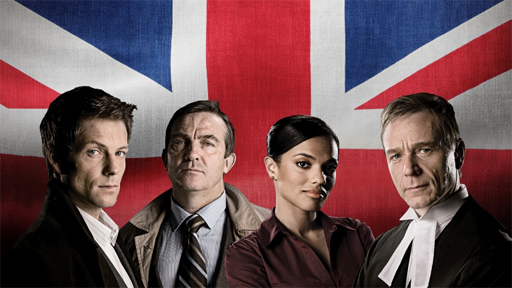
Last night I was watching an episode of “Law & Order: UK” on BBC America, and was impressed by the extent to which the writers just expect you to keep up with the idiom, and the small differences between American and British culture and assumptions. For instance, there’s a scene in which detectives are fretting over the fact that they can’t easily retrace a suspect’s movements: He doesn’t carry a mobile, and probably doesn’t have an Oyster card. Then, a moment later, there’s a reference to CCTV.

The folks who do the show’s website are less respectful of the audience’s intelligence. The “British Terms Glossary” wastes time with “bloke” and “coppers” and “flat” and “guv.” Let’s face it, folks — if you don’t know what those mean, stick to re-runs of “Hee-Haw” (“Hey, Grandpa: What’s for supper?“) or the like. They also define “mobile,” but we know what that is too, don’t we?

The Oyster card is more subtle (and, you would think, a far more likely candidate for the online glossary than “Tube”). It’s the card you buy, and top up (do we say “top up”? I forget — but they say it a lot over there) as needed, to use the magnificent London system of public transportation. You swipe it to get through a turnstile on you way into a Tube station, and — here’s the pertinent part — you do the same to get out at your destination. Which means there exists an electronic record of your movements through the city. In the previous scene we had learned that the suspect had a fear of crowds that kept him away from the Tube. So, no Oyster card.

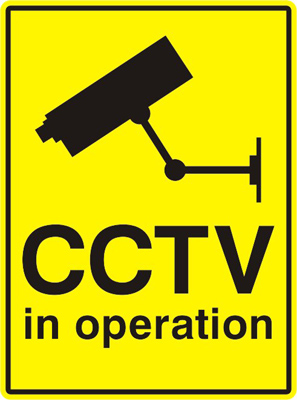
Of course, most people know what Closed Circuit TeleVision is. But it took me a day or so to consciously realized the implications of those signs I saw everywhere: “CCTV in operation.” (I actually had to think a minute to separate it in my mind from CATV, the old term for cable TV back in the days when it was the Community Antenna for small towns and rural communities, before it went all urban.)

What they meant, of course, is that you are under surveillance a huge proportion of the time. Yes, I know businesses here have CCTV, and footage from such cameras is often important in crime investigations. But it’s just nowhere near as ubiquitous as in London, and it doesn’t loom nearly as large in public consciousness. Watch TV news there, and it seems that every other word is CCTV, whether you’re talking the images of the crossbow robbers holding up a post office, or the images of murder victim Joanna Yeates (THE big story while we were there) picking up a couple of items at Tesco, or a routine crime at an off-licence. (Now there’s a term I had to look up — turns out “off-licence” doesn’t mean the shop is extralegal, that it lacks a license; it means it HAS a license to sell alcohol for OFF-premise consumption, as opposed to a pub. Generally, it’s what we’d call a convenience store.)

Of course, such consciousness of being watched — that those bright yellow signs — are a large part of the deterrent effect in themselves.

All of which is fine by me. As I always say, knock yourself out, Big Brother. I was conscious that some of my more libertarian friends back here in the States might have found it all creepy, but at no time in my sojourn in Airstrip One — I mean, England — did I feel the least bit put-upon or oppressed.

To me, it was part and parcel of being in a place that is very much like home, with freedom-loving people who respect the dignity of the individual, but where the politics is not plagued by the legions of radical-individualist paranoids who resist any effort at putting any sort of rational infrastructure in place. I loved the novelty of being in a place with such a dream public transit system, and where waiters and bartenders don’t mind not getting tips (or at most, don’t expect more than 10 percent) — after all, what are they worried about? They have health benefits they cannot lose. And I was very happy to pay the taxes that helped pay for it all. Some friends advised me that I could get a VAT refund on leaving the country, but there was no way I wanted that. I was happy to pay my share.

(And yes, sometimes it all goes overboard, which is why the coalition government is cutting back — AND raising taxes, remember, which they’re able to do because their conservative party doesn’t make a religion of irrational tax hatred. But on the whole, it was wonderful to be in a place where it’s assumed that one should have the Tube, and the buses (that’s “coaches” to you) and trains and parks and fantastic free museums (contributions suggested, but quite low and entirely voluntary) and a population of people who don’t fear being ruined by an unplanned sickness.

And which doesn’t mind being on Candid Camera, if it means you might catch a crossbow robber now and then.

The terrible, awful, horrible day that the VAT went up

So maybe you didn’t feel it where you are, but today was the day — and they’ve been building up to it for the whole week that we’ve been in the UK, with sales urging people to come out and buy before it happened — that the VAT went up from 17.5 percent to 20 percent.

Guess what — I didn’t feel it, either.

There are several things that it’s taken some time to get used to here in the UK:

  • People driving on the left. This is maddening when you’re riding in a bus. And I’ve almost been hit from behind by buses several times walking along a road too close to the curb, with the road on my right (you expect to see traffic oncoming, but it sneaks up behind you — and is really close, because the lanes are so narrow).
  • The fact that tips aren’t expected. We made friends with a barman from Sri Lanka in Greenwich (a really nice guy), and he explained that they don’t get tips. We left him one anyway. But it’s really weird to leave, say, 15 quid for a bill of 12 pounds 52 pence, and have the server chase you out of the place trying to give you change. It happens time and again.
  • The fact that you NEVER feel the tax, no matter how high it is. That’s because it’s built into the price of the things you buy. If something is listed as 99p, and you give the clerk a pound coin (and why is it we haven’t had a dollar coin, or two or three dollar coin, catch on in this country? they’re so convenient), you get back a penny.
  • The fact that I’m in a country where the conservative party is raising taxes (OK, technically it’s a coalition government), and the dominant party of the left (Labour) is griping about what a terrible burden taxes are on ordinary families.

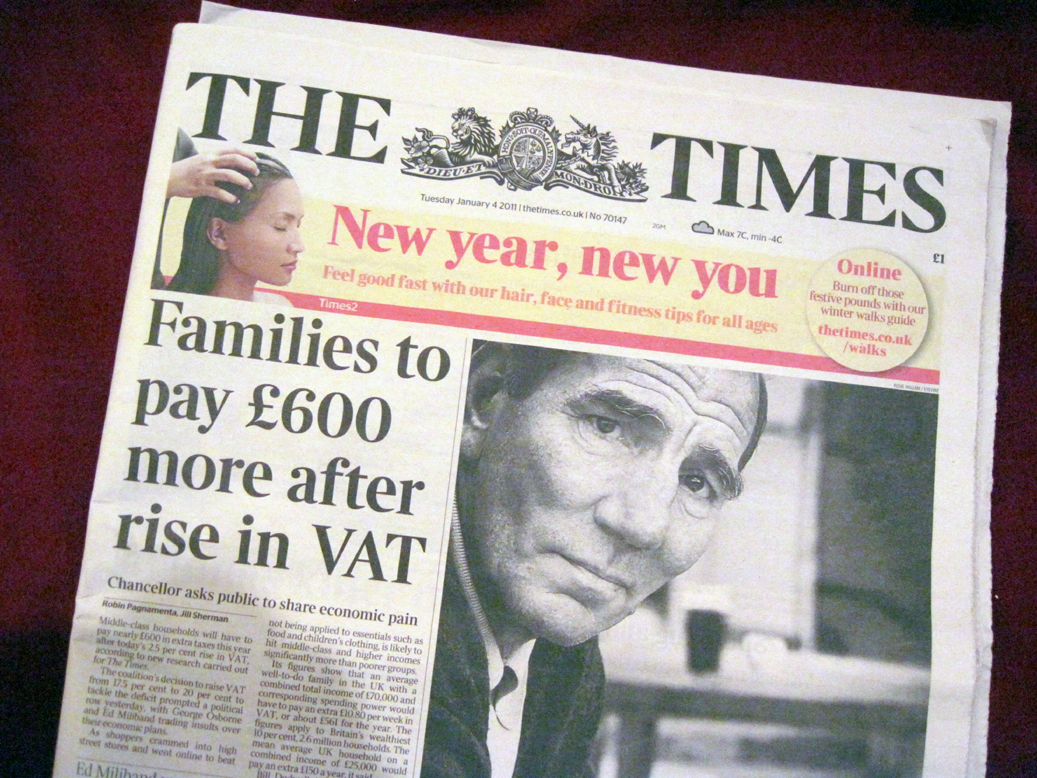
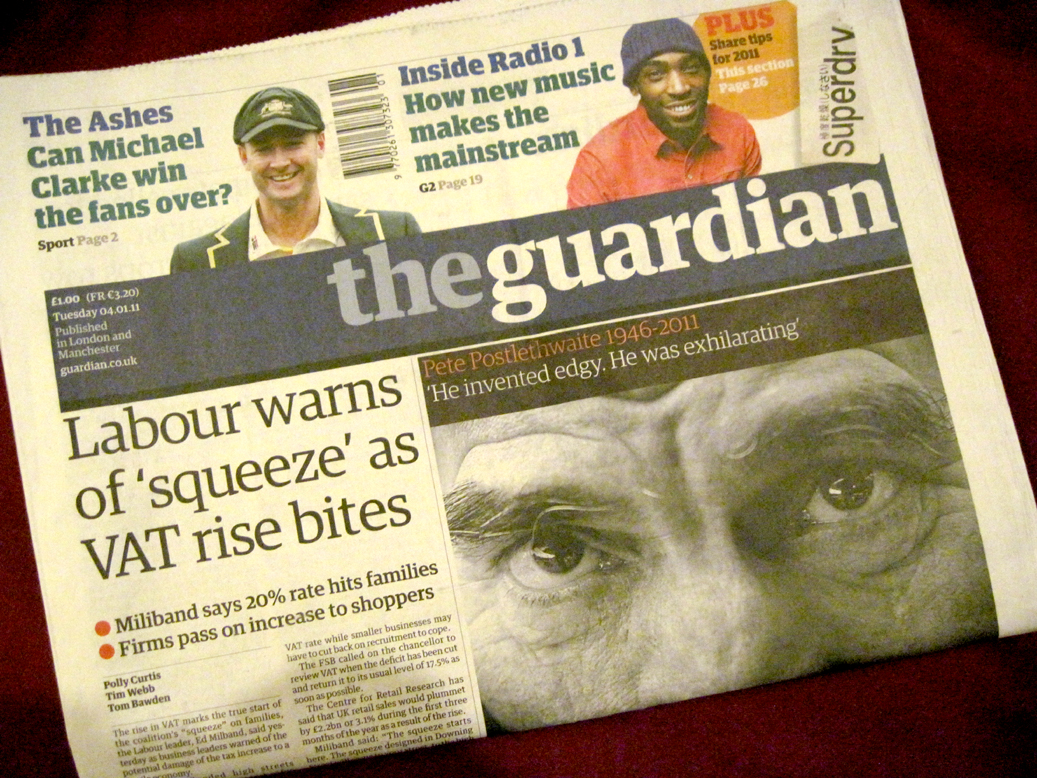
But both The Times and The Guardian are going on about this big, monstrous, huge increase. To which I say, who crosses the street to get a 2.5 percent discount on anything? I mean, really? This increase would amount to 25 p on 10 pounds. Or say you spend a thousand pounds on something — which is a lot more than a thousand dollars, mind — what’s the increase in tax? Twenty-five pounds. Like you’re going to worry about that if you can afford a thousand. (Oh, and by the way — that 600 pounds a family The Times predicts is on families that make 70,000 pounds or more. The burden is much less on median incomes.)

All that aside, the most amazing thing, the thing hardest to get used to, is that I’m in a country where the government has decided to deal with the deficit by — now get this — cutting spending and raising taxes. Of course, back home, the recent huge compromise between President Obama and the Republicans was to raise spending and lower taxes. That’s how we deal with deficits in the U.S. of A.

Riding through London on the magnificent Tube — which as far as I’m concerned is one of the marvels of the world, a testament to the ingenuity of Man — and asking directions from the helpful bobbies (“just 200 metres more on your roight, mate”), reading the extremely clear directions on where the buses that come every few minutes go, or going to the fantastic museums and paying nothing (except a few pounds voluntary contribution now and then), I personally feel that the tax I’m paying is one of the great bargains of all time.

And I’m wondering how well I’ll adjust when I get back home to a place where folks don’t want the gummint doing anything, ever, if it’s going to cost a penny more…

No, folks, I’m not a convert to socialism. I worry about the burdens of the welfare state, and I know that increasing taxes too much can have a nasty cooling effect on growth. But I have enjoyed some amenities here that seem more than worth the taxes I’ve paid here. All I’m saying.

I found “Championship Vinyl” (and you can’t prove I didn’t)

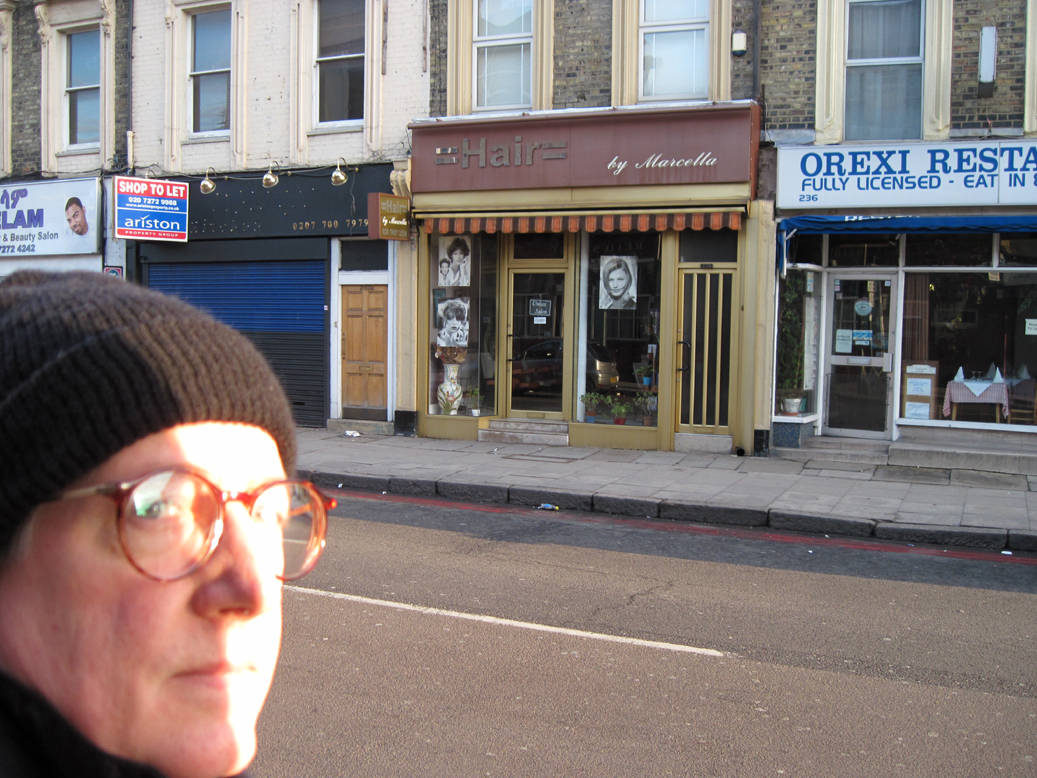
See where it says "shop to let"? And do you see any window-shoppers?

Well, I told you I would find the former site of “Championship Vinyl,” the record shop in High Fidelity, and I did. And no one (except maybe Nick Hornby) can tell me I’m wrong.

It satisfies the criteria:

  1. It’s in Holloway.
  2. It’s just off the Seven Sisters Road.
  3. It’s in a location that guarantees the “minimum of window-shoppers” — in other words, the only customers are those geeky young males who go out of their way to seek the place out.
  4. I was looking for a vacant space, on the theory that since the book was published 15 years ago, and since Rob was trending toward changing his life for the better toward the end, that he would have moved on from running the store, or moved it to a better location, or something by now. I mean, he and Laura would have some kids by now. Any road, this is a good theory for me to have to explain that it’s not actually there, since, you know, it never really existed.

I made up that last criterion, but the first three are in the book.

So, you ladies are wondering — just how patient is my wife, to go along to places like this? Well, she didn’t. This was the one thing I did

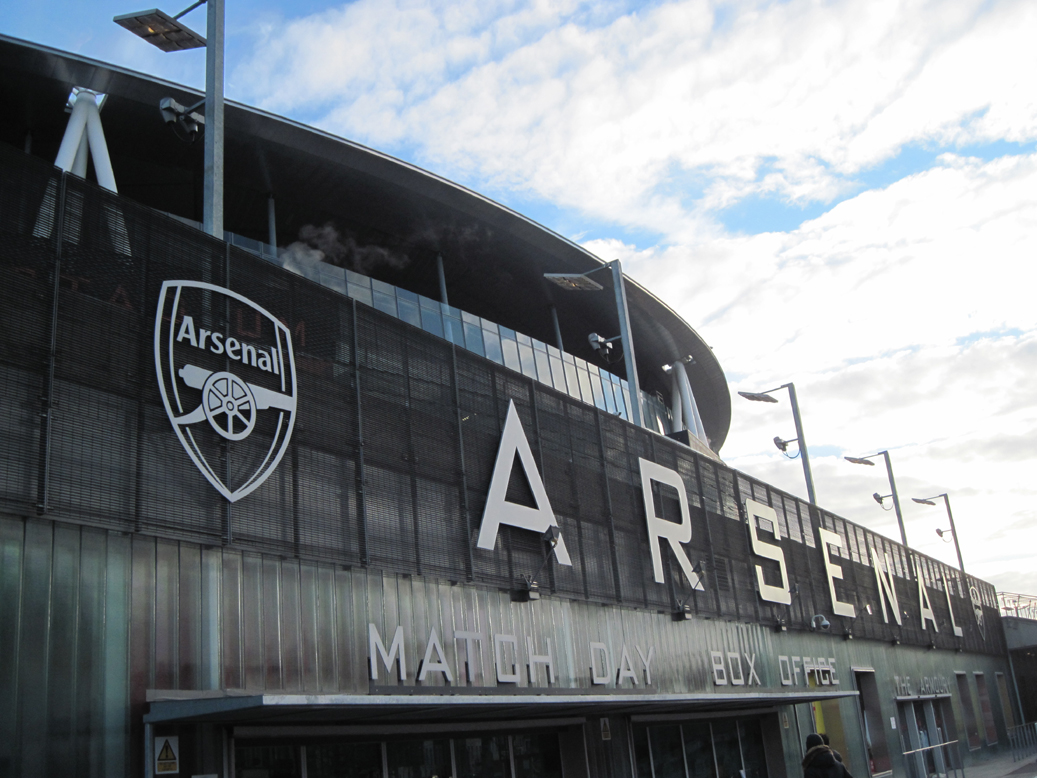
Unfortunately, the souvenir shop wasn't open. I had wanted one of those scarves...

on my own. Today was the day we were leaving London for Oxford, and she just wanted to get up and get ready. So I got up before she did, hopped the Jubilee line down to Green Park and got on the Picadilly way out to Islington, to Holloway Road, and hiked over to Seven Sisters.

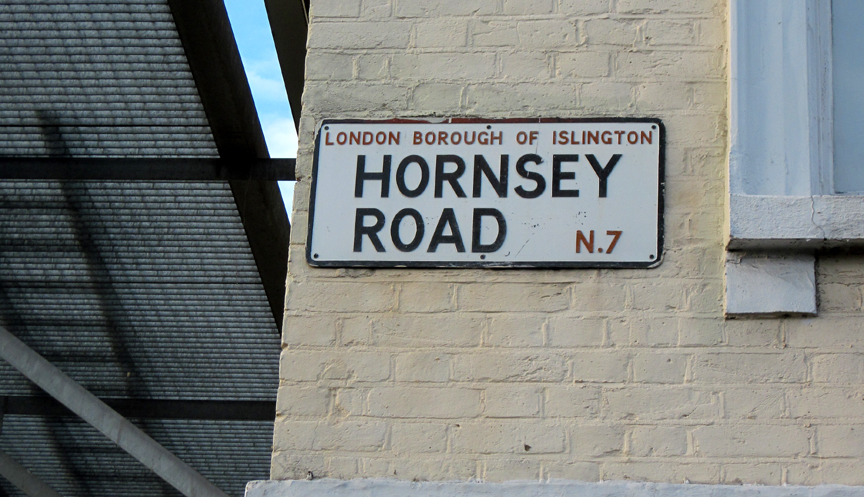
Then, after “finding” Championship Vinyl (it was the first street off Seven Sisters with some actual commercial fronts off the main road) on Hornsey Road, I walked back east until I got to Arsenal Stadium, the scene of other Hornby tales. At Arsenal, at least, I wasn’t the only geek taking pictures of the stadium — but the others were English football fans. One guy was having his wife take his picture there while she tried to keep the kids in order.

After I found the Arsenal Tube station (this required asking directions four times, twice from people who did not speak English), I rode back to our stop, and left Swiss Cottage station with sadness. I really, really love the Underground. (There’s no other way I could have gone all the way to Islington in a city this crowded and done all that walking about and gotten back in less than two hours.)

When I got back, J had packed for both of us, and we took a taxi to Victoria Coach Station for the ride to Oxford. Come to think of it, she really is enormously patient with me…

Oh, and if you wonder why I would want to do this… well, you just have to read High Fidelity. The movie was great, but the novel was much better.

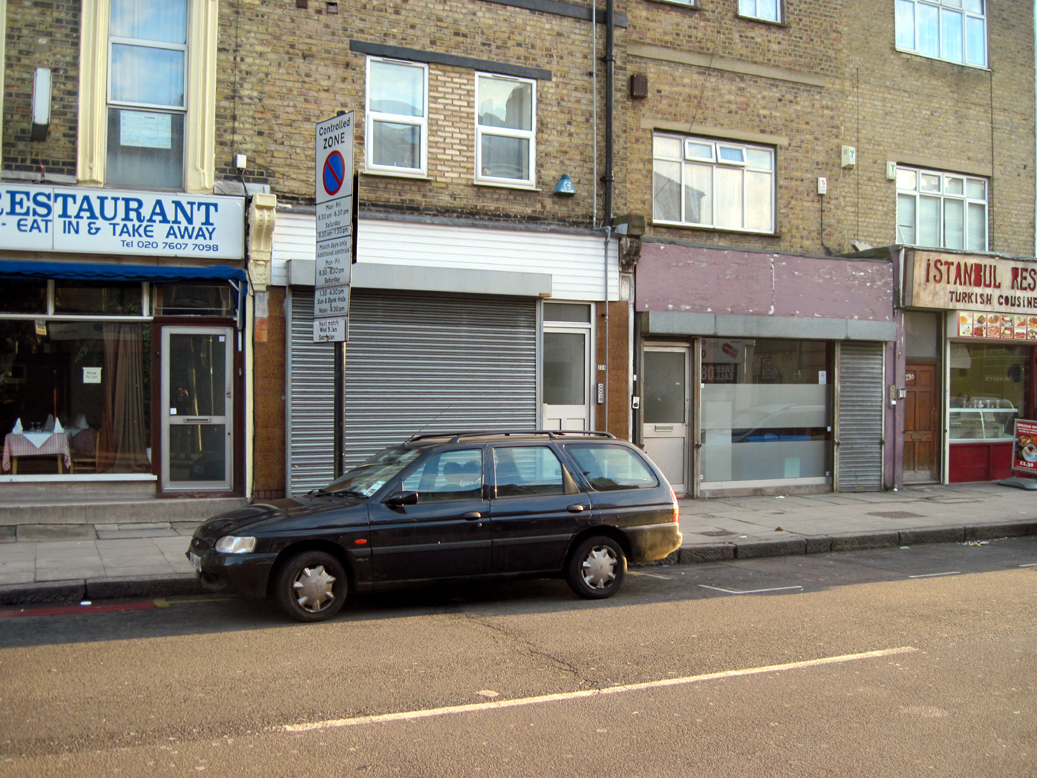
Or maybe THIS is it, a couple of doors down. I can see how experts could in good faith disagree...

Ruining my “typical” English breakfast with The Guardian

What is THE very most obnoxiously touristy thing I could do on my first day in London? Yes, you guessed right -- here, my granddaughter and I harass one of the Horse Guards.

First, an apology for not blogging more. Had major trouble connecting to the wi-fi at the hotel again. After working on it for about an hour and harassing the Polish night clerk for half that time, back in my room I finally got on. My wife asked me what I did differently. I explained that I entered the username and password with my left hand that time. True, there were other things I did as well. But the only one I remember was entering the login info with my left hand. So… there could be trouble again tomorrow.

Now, to report on a bit of my day… the very first bit… I’ll write about how The Guardian did its best to spoil the typical “English breakfast” that I had this morning. OK, modified English breakfast. First, I was eating it at an Italian bistro near the hotel (but they advertised it as a typical English breakfast). Then, I asked them to leave out the eggs and the toast (because of my allergies), and to substitute chips. Other than that, quite typical — bacon (OK, it was like bacon in the Great White North, but that’s what they called it), sausage (or should I say “banger”?), fried tomato, mushrooms, and baked beans (with a bit of HP sauce on it). And a couple of espressos. (But don’t call it espresso. I made the mistake of saying “another espresso” to the waitress — I was going by the foam — and she corrected me saying it was “black coffee.” No, black coffee was what I had at Starbucks later in the day. Whatever.)

It really fortified me for walking about all day in typical English weather (something like 45-50 degrees, totally overcast, occasional mist — which I’m loving; I’d be so disappointed if it were sunny). And I enjoyed it thoroughly.

But it was very nearly ruined by reading The Guardian, which someone had left in the restaurant. Actually, as it turned out, it was a two-day-old Guardian. But I didn’t realize that until later.

I guess you could call this post my British version of my Virtual Front Page, which I haven’t done in awhile. So enjoy.

The biggest news today, by the way, has been England winning the Ashes in Melbourne. This, apparently, is huge, since they haven’t done it in 24 years. But just try understanding the coverage of it. For instance, try diagramming the two sentences in this paragraph:

England had arrived knowing that they required four more wickets, but notionally three for the crippled Ryan Harris was never going to bat: no tail-ender in a surgical boot has ever batted out more than five sessions to secure a draw and they were not about to find out. Eventual victory did not come easily however and Andrew Strauss and his men had to wait until 40 minutes before lunch before Matt Prior swooped on to an inside edge from Ben Hilfenhaus, a fourth wicket for Tim Bresnan, and the entire team, along with a corner of a very large foreign field that was England, were able to erupt in their collective euphoria.

I don’t think understanding the jargon would help; I’m pretty sure those sentences are nongrammatical. Maybe it’s the punctuation. Anyway, we move on.

In the Monday paper, I read about Elton John having purchased a child in California. But that didn’t make much of an impression. Then, I read truly shocking news: David Cameron has called off a free vote on lifting the ban on hunting with dogs. I especially enjoyed this quote from Cameron:

Cameron, a self-confessed “shire Tory”, has said he is a country man at heart and favours hunting, but he recognises it is a highly divisive issue and would play to negative stereotypes around his party.

Bloody do-gooders. Bloody leftist rag I’m reading about it on. I mean, what’s the use of having a Tory government (or a coalition government in which the Tories dominate), if you can’t restore riding to the hounds? I mean, is this England? I wonder if Cameron was so mealy-mouthed in The Times. Harrumph.

But seriously, folks, that’s not what upset me. What upset me was this story:

The government is to follow the lead of The X Factor television programme and allow the public to decide on legislation to be put before MPs.

In an attempt to reduce what is seen as a disconnection between the public and parliament, ministers will ensure that the most popular petition on the government website Direct.gov.uk will be drafted as a bill. It is also planning to guarantee that petitions which reach a fixed level of support – most likely 100,000 signatures – will be guaranteed a Commons debate.

Ministerial sources acknowledge that the proposals have the potential to cause headaches for the coalition because populist causes célèbres – such as a return of capital punishment or withdrawal from the European Union – could come top of the list.

The leader of the Commons, Sir George Young, has signalled he wants to press ahead with government by petition in the new year.

There would be no guarantee that the government would support the most popular proposals but, subject to discussions, there would be an agreement that the issues would be converted by parliamentary draftsmen into a bill…

My God, direct democracy? Worse, reality-TV-style direct democracy. In Britain? I got here too late.

And I thought American politicians were the kings of pandering. Obviously not. I suppose this is what they mean when they say travel is broadening.
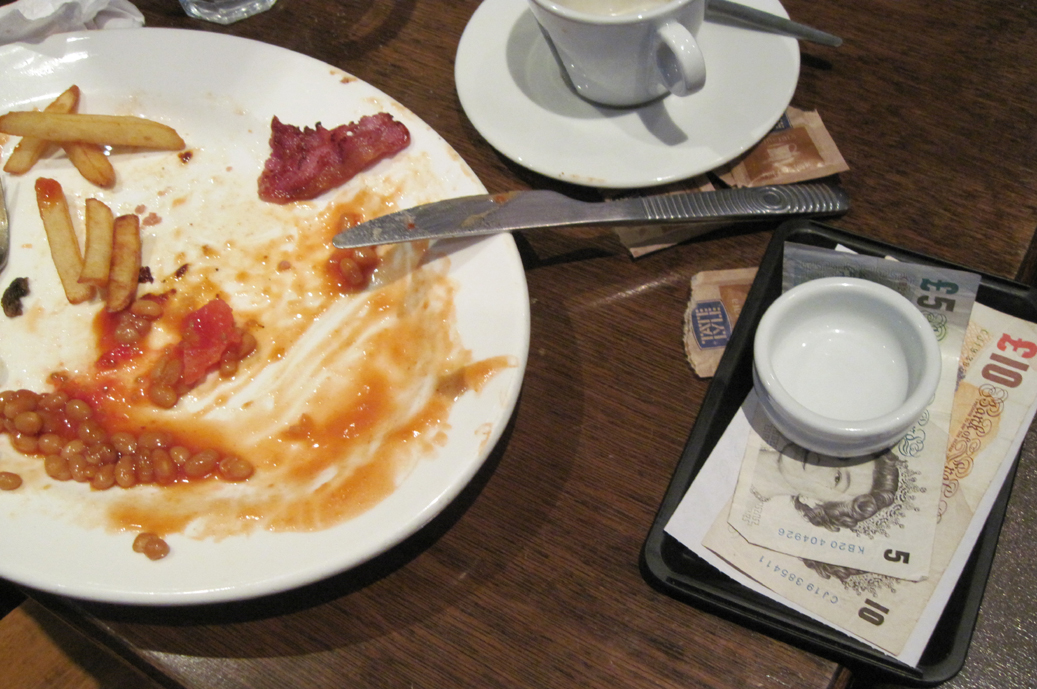
As you see, I didn't let The Guardian upset me SO much that I didn't finish the breakfast. Oh, as for the 15 quid on the tray -- that's not just for me; that's for three breakfasts, plus tip. And yes, I know The Shop Tart shows you her meals BEFORE she eats them, but I'm not The Shop Tart, am I? I'm more avant-guarde...


Tinker, Tailor, Soldier, Tourist

Sitting in the Detroit airport, thinking about our eventual destination…

Maybe I’m not, as friends and family seem to think, Jethro. But I am an … idiosyncratic sort of tourist.

Sure, I want to see the usual things in and around London – the Tower, the Bridge, maybe Stonehenge when we get out of town. My granddaughter wants to see Mme. Tussaud’s. I will also reluctantly accompany her onto The Eye, even though the smallest carnival Ferris Wheels give me the fantods.

But I hope she and my wife will indulge me on a few somewhat more oblique digressions.

My notion of what to see Over There is heavily influenced by fiction. This means that I want to see places where people who never actually existed didn’t actually do the things that I read about. That means some of these sights aren’t much to look at, while some are entirely imaginary. But I want to see where they would be if they did exist. Hard to explain.

I’m not entirely alone in this. Some of the more esoteric (I thought) sights have been sought out by other fiction geeks ahead of me – which will save me time in “finding” them. Others are a bit more problematic.

Some examples:

  • The one that causes the most eyebrow-raising when I mention it (so I’ve stopped mentioning it) is Championship Vinyl. You know, the record shop in High Fidelity. Yes, I know it’s not real. But I want to find where it would be if it did exist. Fortunately, Nick Hornby supplies some good clues (“We’re in a quiet street in Holloway, carefully placed to attract the b are minimum of window-shoppers…” near Seven Sisters Road…). When I find the perfect location, I suspect it will be a vacant storefront or some such. Nevertheless, I’ll take a picture to prove I “found” it. And if I don’t find a likely location, I’ll console myself by heading over a few blocks to Arsenal Stadium (Fever Pitch).
  • I had thought no one else would ever think of this one, but I was wrong (link): I want to see the path in Hampstead Heath (just a few blocks from our hotel) where Gen. Vladimir was assassinated by Karla’s people at the start of Smiley’s People. Maybe I could even find the fork in the tree where George found the tattered packet of Gauloises with the crucial negative in it. If so, I’ll get a picture of that, too.
  • Of course, there’s always Smiley’s flat, and I know the actual address.
  • I’ll go see the new MI6 HQ, which le Carre called “the River House” in The Night Manager. But what I really want to see is The Circus. Fortunately, others have identified it as being this building. And it’s near some great book shops, so my wife might not mind this detour too much.
  • The Islington highway exit where Arthur Dent was dropped off when he returned to Earth at the start of So Long, and Thanks for All the Fish.
  • Tea at Fortnum’s. OK so this is a typical tourist thing. But here’s my reason for wanting to do it: When Percy Alleline confronts Peter Guillam in Tinker Tailor Soldier Spy, accusing him of consorting with “defector” Rikki Tarr, a long stream of things run through Guillam’s head in an instant (one of the best passages of that sort I’ve read outside Dostoevsky). But what he says is, “Sure, Chief. Rikki and I have tea at Fortnum’s every afternoon.” Like a couple of scalphunter tough guys would do that. His facetiousness saves him. Anyway, that’s what got me interested in having tea at Fortnum’s: I want to do something that two people who never existed didn’t even do in fiction. Also, I think my wife will enjoy it.
  • Finally, I’d really love to find some landmarks for the Aubrey/Maturin novels, but I know that after all this time it will be hard to find places that look just as they did in the early 19th century. For instance, can I find anything that looks like the Grapes, in the liberties of the Savoy? Or, is the old Admiralty building still in use, where Jack and other officers paced the First Lord’s waiting room, hoping for a ship? We’ll see…

So you see, I’ll be busy.

But you know what I want to do the most? Find and experience things I never even thought of, things I didn’t plan. The places and things I’ll just run across and be delighted by – those are the greatest rewards of travel, I find.

Don’t you?

See you — I’m off to England

Or not. They just announced a “maintenance problem” on our aircraft. To be fixed in a “coupla minutes.” We’ll see. But it just gives me time to dash off this note.

So I think we’re ready. Some last observations before leaving:

  • One reason I didn’t post yesterday was that I had some last-minute shopping to do, such as for a carry-on bag that will also hold my laptop. And I have this question:  What happened to the day after Christmas, which is supposed to be one of the biggest shopping days of the year? I went to WalMart and out to Harbison, and did not run into crowds anywhere. WalMart had several registers given over to “returns,” but there was no one lined up at them. And the “crowd” in the store might have been a midyear weekday. And after they pushed so hard to get rid of the blue law. Harbison was practically deserted — I got around MUCH more easily than on a typical weekend. So what happened? Did that uptick in consumer spending just crash, or were they waiting until today? Surely it wasn’t that little bit of snow, none of which was on the roads…
  • Speaking of Boxing Day — here’s hoping the London Tube workers got their little strike out of their system yesterday. What worries me is that the Boxing Day holiday is actually on Tuesday this year. Here’s hoping some of the workers didn’t think that was the day, since that’s the day I arrive. If I have trouble getting around London because of labour unrest, I’m voting Tory next time. Strikes? That’s SO Old Labour. It’s like they never heard of Tony Blair or something…
  • By the way, I’m totally set for thoroughly embarrassing my wife on this trip. When she saw me last night proudly showing off my new travel vest with all the pockets stuffed, she laughed uncontrollably. Then she seized control of my bulging wallet and forced me to give up most of the cards that I “wouldn’t need,’ in her opinion. She did let me keep the one with the Our Father in Spanish on it. Good thing she’s Catholic….
  • Speaking of embarrassing my wife — in spite of Kathryn Fenner’s urging, I’ve decided NOT to put on phony British accents wherever I go. After all, I’d probably use the wrong one in the wrong place — go all posh in a working-class pub or something — and get into trouble. No, I have a better plan: I’ll pass myself off as Irish…
  • It’s totally amazing that we didn’t have any trouble checking in at CAE, the way those things were stuffed. But I did have a spot of passport trouble. It wouldn’t scan, so they had to handle in manually. Here’s hoping I don’t have that trouble everywhere. Maybe I should have brought one of the others from the safe deposit box. The Bourne one, maybe…

I will check in with y’all as soon as I’m settled at the hotel. Assuming the laptop works there.

Sorry, but commies don’t get to DO holy war

Especially not extremely backward, stone-age commies led by a guy who looks and acts like an alien (a reference to my favorite Economist cover ever, below)

Did you see or hear the latest?

NKorea threatens ‘sacred’ nuclear war if attacked

By FOSTER KLUG and HYUNG-JIN KIM – Associated Press
POCHEON, South Korea — North and South Korea beat the drums of war Thursday, with each threatening the other with immediate retaliation if attacked.
Seoul has staged days of military drills in a show of force meant to deter North Korea, including live-fire exercises earlier this week on a front-line island shelled by the North last month. Angered by the exercises, North Korea threatened Thursday it would launch a “sacred” nuclear war if Seoul hit it and warned that even the smallest intrusion on its territory would bring a devastating response.
The two sides are still technically at war because their 1950-53 conflict ended in a truce not a peace treaty, and a U.S. governor who recently made an unofficial diplomatic mission to the North has said the situation on the peninsula is a “tinderbox” and the worst he had ever seen it.
Still, the latest rhetoric seemed likely to be just that, words aimed at stirring pride at home and keeping the rival at bay.
Defense chief Kim Yong Chun said North Korea is “fully prepared to launch a sacred war” and would use its nuclear capabilities, calling Monday’s drills a “grave military provocation” that indicated South Korea and the U.S. are plotting to invade the North.
Kim told a national meeting in Pyongyang that the North’s military will deal “more devastating physical blows” to its enemies if they cross into the North’s territory even slightly. He also threatened to “wipe out” South Korea and the U.S. if they start a war, the official Korean Central News Agency said in a dispatch….

Here’s an interesting side topic for consideration by you lovers of language: Why is it that hyperbole seems to translate so badly from culture to culture? Or is it just a dictator thing? We’re all still having fun with Saddam Hussein’s “mother of all battles” — to which, after it was over, we could well have taunted “Maybe next time you ought to send the DADDY of all battles,” were George H.W. Bush given to trash talk. I certainly had a lot of fun with it back at the time — sending out memos to the newsroom, in connection with coordinating our war coverage, couched in Saddam style (I ran across one of those recently, and meant to post it — now I don’t know where I put it).

And now this — which frankly, I don’t think anybody’s going to be quoting 19 years from now. I mean, it just doesn’t work. Sorry, Kim, but you don’t get to have a “sacred war.” You’re a godless commie. Did you forget, or what? Stalin would have never slipped up like this. And another thing, Poindexter: If Stalin had threatened “devastating physical blows” — well, first of all, he would never have used a pantywaist construction like that, but if he said something LIKE it — you knew he’d have backed it up. You, not so much.

It’s just … embarrassing…

Don’t mess with the hackers of the IDF

Apparently, exploiting the vulnerabilities of our plugged-in world is not just the province of Julian Assange and the pimply anarchists who attacked credit card companies (as well as those they perceived as the “persecutors” of Assange) last week. It can also be done by the good guys, for good purposes.

At least, that’s the case if this story is true:

‘Stuxnet virus set back Iran’s nuclear program by 2 years’

By YAAKOV KATZ
12/15/2010 05:15
Top German computer consultant tells ‘Post’ virus was as effective as military strike, a huge success; expert speculates IDF creator of virus.

The Stuxnet virus, which has attacked Iran’s nuclear facilities and which Israel is suspected of creating, has set back the Islamic Republic’s nuclear program by two years, a top German computer consultant who was one of the first experts to analyze the program’s code told The Jerusalem Post on Tuesday.
“It will take two years for Iran to get back on track,” Langer said in a telephone interview from his office in Hamburg, Germany. “This was nearly as effective as a military strike, but even better since there are no fatalities and no full-blown war. From a military perspective, this was a huge success.”…
So… Israel, sick of the rest of the world dithering, just bought us all another couple of years before Nutjob Ahmadinejad and company have the bomb. And they did it without any bombs of their own, or violence of any kind. Not that there aren’t dangers inherent in this kind of cyberpower.

If this is true.

Fascinating. Of course, if this doesn’t get the job done, Israel is still pretty good at doing things the old messy way, as this T-shirt (brought to my attention by the same alert reader who brought me the above) rather baldly asserts, with a slogan that is a more polite version of what Daniel Craig said in “Munich.” Note that Dubai still hasn’t gotten to the bottom of that hit close to a year ago.

Scotland Yard always gets its man, but sometimes has to let him go

At least, that was the word earlier today, although the actual release of Julian Assange, the accused sex offender and would-be saboteur of U.S. security, has now been delayed pending a hearing.

From the NYT:

LONDON — After a week in detention facing possible extradition, Julian Assange, the founder of the WikiLeaks antisecrecy group, was ordered released on $310,000 bail by a court on Tuesday as he challenges a Swedish prosecutor’s demand that he return to Stockholm for questioning about alleged sex offenses.

However, Mr. Assange remained in custody pending a hearing on an appeal by the prosecutor, which would take place within the next 48 hours.

In granting bail, Judge Howard Riddle ordered that Mr. Assange appear again in court on Jan. 11. He also said that between then and now he must reside at Ellingham Hall, a Georgian mansion in Bungay, in eastern England, owned by Vaughan Smith, the founder of a club for journalists. Mr. Assange must spend every night at the mansion and will be electronically tagged so the police can track his movements, the judge said…

So even when he DOES walk out, it’s sort of a tag-and-release situation. Which shows the Brits haven’t lost their minds. Good to know, since I’m about to go over there. If I DO run into the guy, though, I’ll let you know.

Oh, and about those sex charges — as muddled a mess as any he-said-she-said (and she said, too) you’re likely to run across. Whatever the facts, Mr. Assange seems to fall somewhat short of a paragon (even if you believe his defense):

Speaking about the case in recent weeks, Mr. Assange has said that he had consensual relations with two young Swedish women. He said he met them during a trip to Sweden in August that he made in a bid to establish a haven for himself and WikiLeaks under Sweden’s broad laws protecting press freedoms.

The charges relate to the question of whether these encounters ceased to be consensual when a condom was no longer being used. Sweden’s request for extradition is designed to enable prosecutors to question Mr. Assange about charges of “rape, sexual molestation and unlawful coercion.”…

In a packed courtroom hearing lasting nearly an hour a week ago, Gemma Lindfield, a lawyer acting for the Swedish government, outlined some of the detailed allegations against Mr. Assange made by the Swedish women, both WikiLeaks volunteers. They involved three incidents, including one in which Mr. Assange was alleged to have had unprotected sex with one of his accusers while she was asleep.

But that’s not why we’re talking about this guy, is it?

Oh, and about the NYT’s blithe assertion that WikiLeaks is an “antisecrecy group”… I read an interesting opinion piece the other day that argued it is pretty much the opposite of being a champion of transparency — and backed up the argument fairly well:

Whatever else WikiLeaks founder Julian Assange has accomplished, he’s ended the era of innocent optimism about the Web. As wiki innovator Larry Sanger put it in a message to WikiLeaks, “Speaking as Wikipedia’s co-founder, I consider you enemies of the U.S.—not just the government, but the people.”

The irony is that WikiLeaks’ use of technology to post confidential U.S. government documents will certainly result in a less free flow of information. The outrage is that this is Mr. Assange’s express intention….

Mr. Assange is misunderstood in the media and among digirati as an advocate of transparency. Instead, this battening down of the information hatches by the U.S. is precisely his goal. The reason he launched WikiLeaks is not that he’s a whistleblower—there’s no wrongdoing inherent in diplomatic cables—but because he hopes to hobble the U.S., which according to his underreported philosophy can best be done if officials lose access to a free flow of information.

In 2006, Mr. Assange wrote a pair of essays, “State and Terrorist Conspiracies” and “Conspiracy as Governance.” He sees the U.S. as an authoritarian conspiracy. “To radically shift regime behavior we must think clearly and boldly for if we have learned anything, it is that regimes do not want to be changed,” he writes. “Conspiracies take information about the world in which they operate,” he writes, and “pass it around the conspirators and then act on the result.”

His central plan is that leaks will restrict the flow of information among officials—”conspirators” in his view—making government less effective. Or, as Mr. Assange puts it, “We can marginalize a conspiracy’s ability to act by decreasing total conspiratorial power until it is no longer able to understand, and hence respond effectively to its environment. . . . An authoritarian conspiracy that cannot think efficiently cannot act to preserve itself.”

As I said earlier today to a friend over on Facebook:

Assange and his crowd are not journalists. They’re not the vaunted Fourth Estate, playing a role in stimulating political debate over a national issue. They are foreign political activists who intend to harm the security of the United States. Their goal is to shut down information-sharing among our agencies, from Defense to State to Homeland Security to CIA and so forth, so that they will be less effective. To return us to a pre-9/11 state — you know, back when one agency knew the 9/11 attackers were in the country, and another agency knew why they were dangerous, but they weren’t talking to each other. (An argument can be made on security grounds for keeping information in such silos, but it’s an argument that you can go around and around on — and Assange is not a legitimate participant in that debate.) The goal of WikiLeaks is not transparency, but the opposite — they want to shut down information-sharing.

I’d like to see Obama COMMIT to something

My friends at The State were right today to praise the fact that President Obama is working with Republicans on a compromise on taxes and unemployment benefits. But they were equally right to be unenthusiastic about the deal itself.

On the one hand, it’s good that we’re not going to see our economy further crippled by untimely tax increases (even if all they are are restorations to pre-Bush levels). And it’s good that the jobless needing those benefits will have them. (At least, that these things will happen if this deal gets through Congress.) On the other, we’re looking at a deal that embodies some of the worst deficit-ballooning values of both parties: tax cuts for the Republicans, more spending for the Democrats.

It’s tragic, and bodes very ill for our country, that this flawed compromise stirs such anger on both partisan extremes: Some Democrats are beside themselves at this “betrayal” by the president. (Which bemuses me — as y’all know, I have trouble understanding how people get so EMOTIONAL about such a dull, gray topic as taxes, whether it’s the rantings of the Tea Partiers who don’t want to pay them, especially if the dough goes to the “undeserving poor,” or the ravings of the liberal class warriors who don’t want “the undeserving rich” to get any breaks. Why not save that passion for something that really matters?) Meanwhile, people on the right — such as Daniel Henninger in the WSJ today — chide Obama for not going far enough on taxes.

In this particular case, I think the folks on the right have a bit of a point (some of them — I have no patience for DeMint demanding the tax cuts and fighting the spending part), but it doesn’t have to do with taxes — it has to do with the president’s overall approach to leadership, and a flaw I see in it. Henninger complains that these tax cut extensions are unlikely to get businesses to go out and invest and create jobs, since the president threatens to eliminate the cuts a year or two down the line.

That actually makes sense (even if it does occur in a column redolent with offensive right-wing attitudes — he sneers at Ma Joad in “The Grapes of Wrath”), and I see in it echoes of the president’s flawed approach in another important arena — Afghanistan.

Here’s the thing: If keeping these tax cuts is the right thing to do to help our economy, then they should be kept in place indefinitely — or “permanently,” as the Republicans say. Of course, there is nothing permanent in government. The next Congress, or the one after that, can raise taxes through the roof if it chooses.

The problem, in other words, isn’t that the cuts won’t be permanent, because nothing is in politics. The problem is that the president is, on the front end, negating whatever beneficial effect might be gained from extending the cuts by coming out and promising that they won’t last.

One of the big reasons why the economy hasn’t improved faster than it has this year is that businesses, small and large, have not known what to expect from the recent election in terms of future tax policy with these tax cuts expiring. People were waiting to see what would happen on taxes before taking investment risks. (Even if the liberal Democrats were to eliminate the cuts, knowing that would be better than the uncertainty.) And even with the election over, the future has remained murky. The best thing about such a deal between the president and the GOP should be that it wipes away those clouds and provides clarity.

But the president negates that by saying yes, we’ll keep the cuts in place, but only for a short time. You may look forward now to a time when there are unspecified increases. And Henninger has a point when he says:

But if an angry, let-me-be-clear Barack Obama just looked into the cameras and said he’s coming to get you in two years, what rational economic choice would you make? Spend the profit or gains 2011 might produce on new workers, or bury any new income in the backyard until the 2012 presidential clouds clear?

Ditto with the Taliban and al Qaeda in Afghanistan and Pakistan. What good is it to say we’re going to stay and fight NOW if at the same time you give a future date when you’re going to leave (or, as the president has said, start leaving)? What are they going to do? They’re going to sit tight and wait for you to leave on schedule.  (And yes, pragmatic people may take comfort from the fact that the president has allowed himself lots of wiggle-room to stay there — but the harm has been done by the announcement of the intention to leave). Every effort should be taken to make one’s adversaries believe you’re willing to fight them forever (even if you aren’t), if you ever hope to achieve anything by fighting.

The problem in both cases is trying to have one’s cake and eat it, too — making a deal with the Republicans without one’s base getting too mad at you, or maintain our security commitment without (here comes that base thing again) freaking out the anti-war faction too much. What this ignores is that out in the REAL world, as opposed to the one where the parties play partisan tit-for-tat games, real people react in ways that matter to your policy moves: Business people continue to sit rather than creating jobs; the Taliban waits you out while your allies move away from you because they know they have to live there when you’re gone.

What would be great would be if Barack Obama should commit for the duration to something. He should have committed to a single-payer approach to health care from the beginning. Going in with a compromise meant that we got this mish-mash that health care “reform” turned into. He should commit to a plan on the economy, and not undermine it by saying he’s only going to do it for a little while. And most of all, he should commit to Afghanistan, and not try to mollify his base with dangerous deadlines.

What the president does, and even says, matters. He needs to recognize that, pick a direction, and stick with it long enough to have a salutary effect. Whatever their ideology, that’s what leaders do. And we could use some leadership.