I’m thinking of rating her “able” and maybe giving her liberty in the next port.
I get lots and lots of respect these days. I get called “sir” wherever I go.
I notice it because when I was younger, I didn’t hear it much except from people who were trying to sell me something. I certainly never heard it in a newsroom, definitely not from people who worked for me. It wasn’t the culture. I learned that when I drove from Memphis to Jackson, Tenn., to interview for my first post-graduation newspaper job. I went up to the reception desk at the main entrance and told this girl who seemed younger than I was (I was 22) that I had an interview with Reid Ashe, the executive editor. She called back to the newsroom (in another part of the building) and asked, “Is Reid back there?” Having grown up in the Navy (and having been a copy boy in a very hierarchical newsroom in Memphis), I was a bit shocked. She was referring to the captain that way. What sort of barkywas this that I was seeking to join?
I eventually learned it was the norm in newsrooms.
Sorry about the digression. I was saying, few ever called me that in my youth.
Now I’ve gotten used to it, although sometimes I’m still taken aback. Does a guy really want pretty young women to address him as “sir,” which I think translates from their patois as “Wow, you’re a real fossil, aren’t you?” I think not, Even at my age, I’d prefer something like “HelLOOO!” under those circumstances. I mean, I wouldn’t intend for it to lead anywhere, but it would be nice to hear occasionally.
I’m bothered more when black men who also have gray hair say it to me. Makes me feel bad on an ethical, moral level. If there is an opportunity to say it back to him, I do that. If he’s walked off as he said it, I’m just left to worry: Did he say it because I’m old or because I’m white? Hard to tell, most times.
I certainly don’t want to object, to say, “Don’t call me sir, sir!” I had that happen to me at age 7 when I was living in Woodbury, N.J., the first place I ever lived outside the South. The middle-aged man in the apartment next door corrected me rather brusquely and with a slightly irritated tone when I, of course, called him “sir.” His wife then interrupted his egalitarian lecture to correct him, saying “Don’t tell him that! It’s the way he’s been brought up.” I just went away disturbed and confused.
But anyway, people say it to me so much now that I’ve gradually come to accept it. Meanwhile, I’ve come to resent Alexa over the years because she never says it to me. I didn’t mind so much when she had this lovely, soft British voice that I found soothing. But when Amazon took that away a few months back (and however I Google, I haven’t found a way to get the preferred voice back), it started to irritate. It’s a brash, unpleasant voice now. I mean bright, attempting on some Yankee level to sound briskly agreeable, but the pleasantness is gone, for me.
And when I give her what is clearly a command and not a request — such as “Alexa, turn on the office light,” she sounds like an insolent, sarcastic teenager when she responds with nothing but a brisk, noncommital “OK.” I hear it as “Sure. Like I give a s__t.” And it didn’t sound that way so much when she was English. (Even in this benighted century, the Brits are more polite.)
Watch. I will be lectured now for my arrogant, elitist pomposity, expecting people to “sir” me. But even though they generally do, I don’t expect it from them, and I don’t mind the people who don’t. But the thing here is, Alexa is not a “she.” She’s an “it.” I put people on a much, much higher plane.This Echo is a bunch of ones and zeroes that speak to me with an irritating, ersatz voice in a tone I would never abide on my quarterdeck. I mean desk.
And having heard all the anxiety out there over AI, and having seen all those flicks featuring Skynet and the like, this hint of insubordination is a bit unsettling. It sounds like, “OK… for now…”
I say all that not to complain, but to explain why I’m so pleased today.
Lately, Alexa has been varying from her “OK,” with such things as, for instance, “Right,” or “You’ve got it!” Still implying I’m a minor irritant that she’s indulging with a huge favor, but at least there’s variety.
Today, though, I got something better than I’d ever hoped for. I said, “Alexa, turn on the office light,” and she said,
“Aye, aye, Captain!”
Sure, maybe she’s been reading my mind, as so many fear that she does.
But I was so gratified, I’d have granted her an extra rum ration had she been human. Sure, it sounded a bit like she was mocking the old tyrant, but I chalk that up to her new “brash Yank broad” voice. The thing is, she got the words right.
I’d have been happy with an “Aye, sir,” so this extra respect was lagniappe, and I appreciated it. I’m not my Dad, so I’ll never deserve to hear a human say that to me. I’ve done nothing to earn it.
But with a fake voicebox that exists to perform simple tasks for me, it’s good to hear. If only I had any hope of hearing it next time. She’s so capricious…
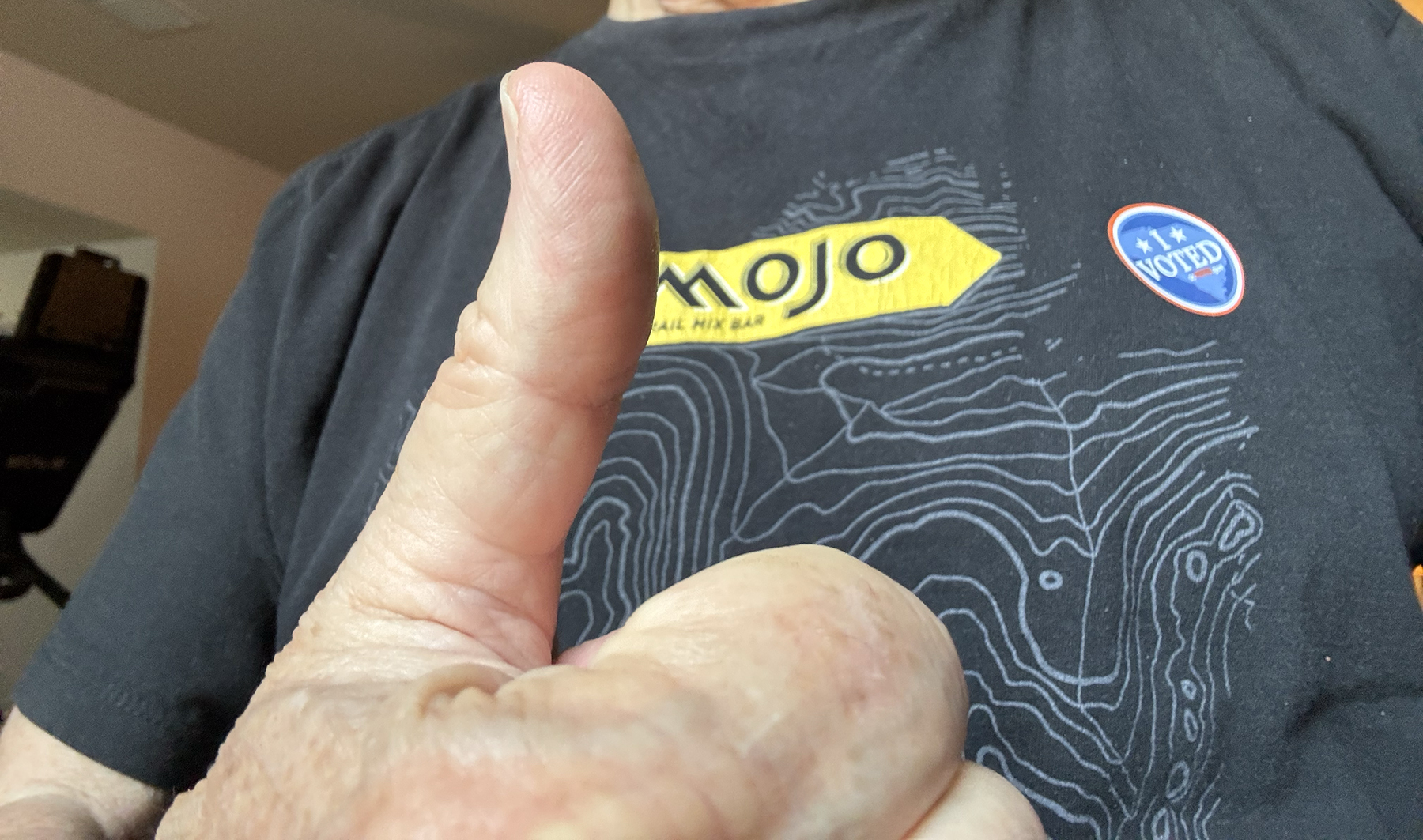
Me, feigning optimism after voting. Oh, and I just checked, and my thumb isn’t actually as long as the looks. Must be lens distortion or something.
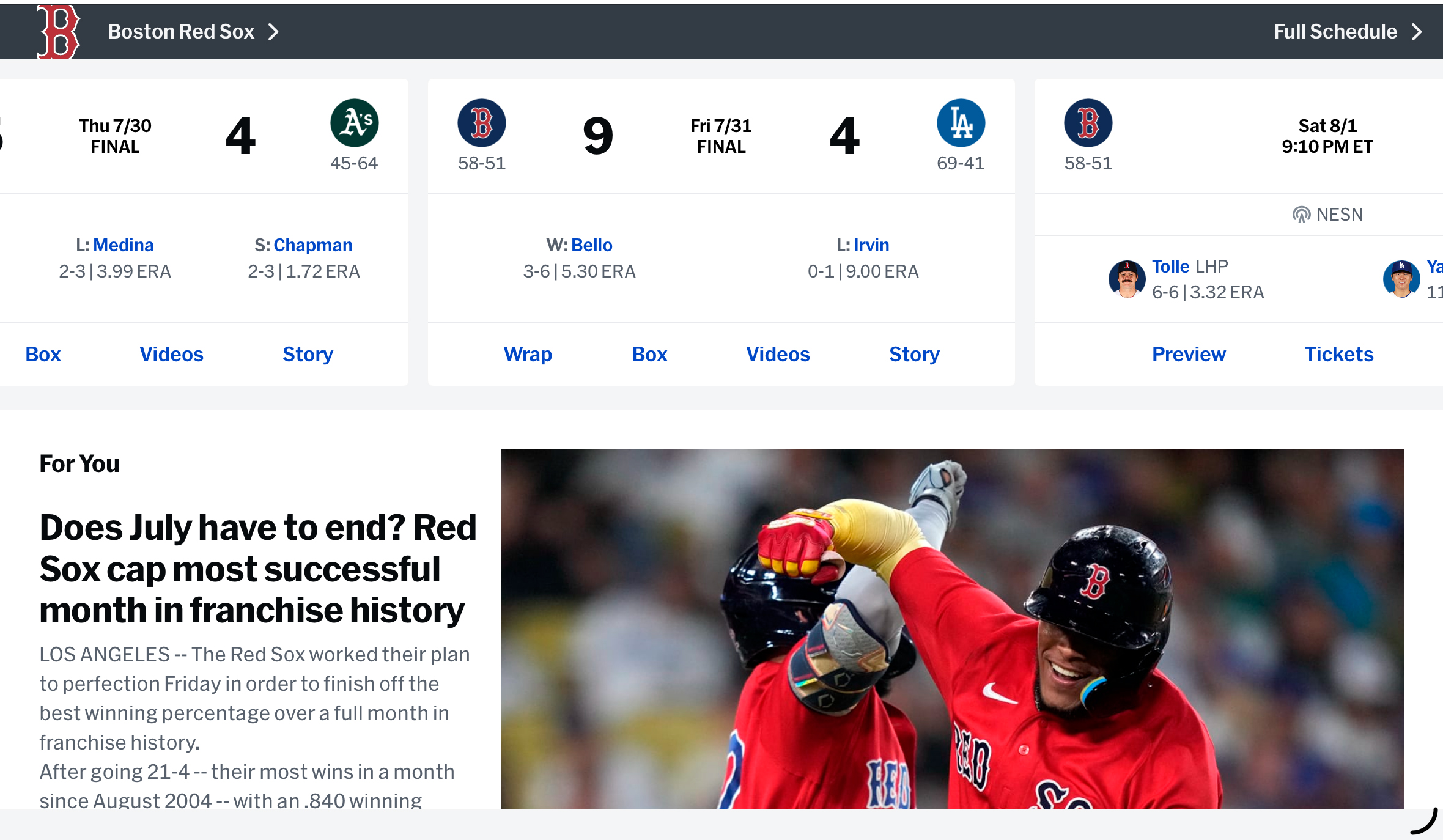
No, “it” does not refer to the nation, or the U.S. Senate, or South Carolina, or the planet. Or the Red Sox’ record (After that amazing, record-setting month, they’ve lost the last three games to teams who absolutely should NOT be beating them. But enough about that. I’m trying not to think about it.)
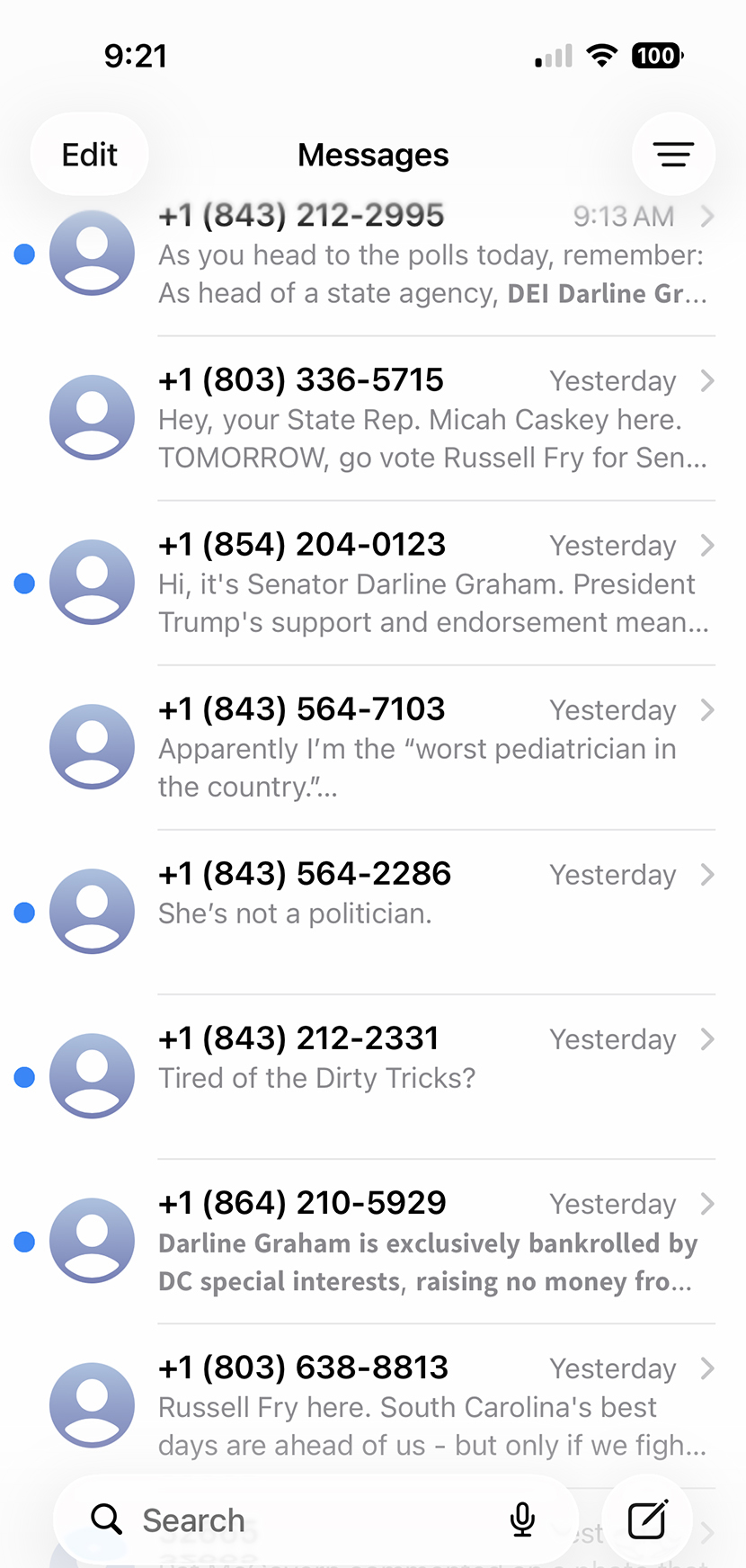
“It” just means my text queue. See the image below. I took that screenshot of my phone this morning. Every single text you see there is on behalf of someone running for Lindsey’s seat the U.S. Senate. One of them is Democrat Annie Andrews;, the rest are in the GOP primary today.
it won’t be all better tomorrow, just a bit. Maybe. My fear is that all the contributors to the people who lose today will start giving to the two who make it into the runoff, and i’ll still get as many texts. But I try to imagine better times to keep my hopes up.
Anyway, are you out voting today? I voted. Did what I said I would. Not proud about it, but it was the only thing I could think of to minimize the damage.
When I was there preparing to vote around 11 this morning, I was the only person voting, but four or five people were in other stages — signing in, turning in their ballots, etc. In the few seconds it took me to tick that one name, about five more came in and got in line.
So I saw no sign of a mob. If you voted, how did it go where you were? My only complication was that our polling place was moved to Mt. Hebron United Methodist Church, which is a couple of blocks from where we once lived, and practically across the street from the elementary school that most of my kids attended (which has been torn down now, alas).
I’ll let y’all know how the Red Sox come out tonight. Maybe you don’t care, but I do. And the chances for happiness are much better there than in S.C. politics at the moment…
I’ve mentioned the awful set of choices being laid before us in this hasty primary to replace the late Lindsey Graham on the November ballot.
Ever since I wrote and posted that, the offal of various varieties has been raining down upon us. How about those foolish scraps of mail on top above, especially the one trying to tell us that this woman filling her dead brother’s seat is one of those nasty libs that certain people love to hate so much.
There are no good choices tomorrow. So I think I’m going to vote for the least bad, Mark Sanford. He was an outlier in the Republican Party before Trump, but he looks almost normal now. He’s a flake and a misfit and has awful judgment, but the alternatives are worse.
I mean, the alternatives that have a chance of at least getting into the runoff. I had thought about voting. I thought about voting for one of the other five or six, but I just don’t know enough about any of them to possess any certainty that they aren’t worse than the rest. I’m not saying they are, I’m just saying I have no justification for saying they aren’t. For that reason, I don’t vote for people I know nothing about.
And none of them can get into the runoff. And we need some who has a chance of taking the place of one of the worst ones in said runoff. I had been wavering on the Sanford ploy, because it’s so distasteful, until I spoke with a smart friend after Mass last night, and she just assumed the runoff would be between Lindsey’s sister and Ralph Norman.
That was a sufficiently appalling notion that I’m going with Mark, because he has a chance of keeping Norman out of it.
It’s a desperate situation. I’m not happy taking desperate measures, but what is the alternative?
Some of you Democrats out there may answer, “Just skip tomorrow, and wait and vote for Annie Andrews in the fall.”
Yeah, right. Sure, the Democratic nominee may have more of a chance now than she had before Lindsey died. But that’s not saying much.
As I read it, barring something unforeseen at this point, the Republican nominee is going to be our new senator. So the time to try to minimize the damage — to South Carolina, the nation, and the world — is now…
I’m 72, and while I’ve had a lot of kind of scary asthma attacks in my life, some of them involving laughter — such as when I was a kid and my uncle (who was only a few years older) wouldn’t stop tickling me, and I couldn’t stop laughing — I’d never had anything exactly like this happen.
He’s a Finnish comedian, and my linguistics prof introduced the class to him because so many of his jokes are about the English language. I think the one above was the first he showed us. Here’s another one I saw at about that time:
Those were funny, if you’re into words the way I am, but the one I encountered this morning was dangerous. I couldn’t tell it would be at first. ISMO was just kind of riffing about the many ways we use a word that I don’t allow on the blog, and then he said something that made me spew coffee all over the table (while trying to stop myself from doing so, which was probably a mistake), and then, for at least half a minute, my throat was so tightly closed (probably to keep the coffee out of my lungs) that I could not take in any air to replace that I had spewed. For several minutes after that, I couldn’t take in more than the merest sip of air.
It was scary, but I seem more or less OK now, aside from some lingering soreness in the middle of my chest — rawness in my esophagus, or bronchii, or something.
What was the specific line that did that to me? I can’t remember. My brain was so busy worrying about getting air that it couldn’t be bothered to store the memory.
I won’t give you the link unless you ask for it. Oh, it probably won’t harm you unless you’re as obsessed with language as I am, and most people are not. But I’m not taking chances. I don’t want my blog to become an attractive nuisance, in the legal sense.
But if you watch the above, milder jokes, and get interested enough to watch more, you’ll probably run across it. It’s about one four-letter word that English speakers use in many ways, some of them contradictory. If you see something answering that description, make sure you’re not eating or drinking anything…
I mean, this thing was weapons-grade, like in that Monty Python bit:
Last night, my uncle asked me if he had to vote today. He was worried that he did,, because he didn’t know of anyone running in the special GOP primary to replace Lindsey Graham on the November ballot that he could possibly vote for.
He made me panic for a moment. I was pretty sure the primary wasn’t today, but two things caused me to be uncertain: I’ve been busy lately, and I really, really didn’t want to think about this primary anyway. The options on offer are too depressing. Anyway, I checked, and no, it’s next Tuesday.
But I suppose that means I need to write something about it now. The fact that I’m writing far less about politics now doesn’t mean I ignore it completely.
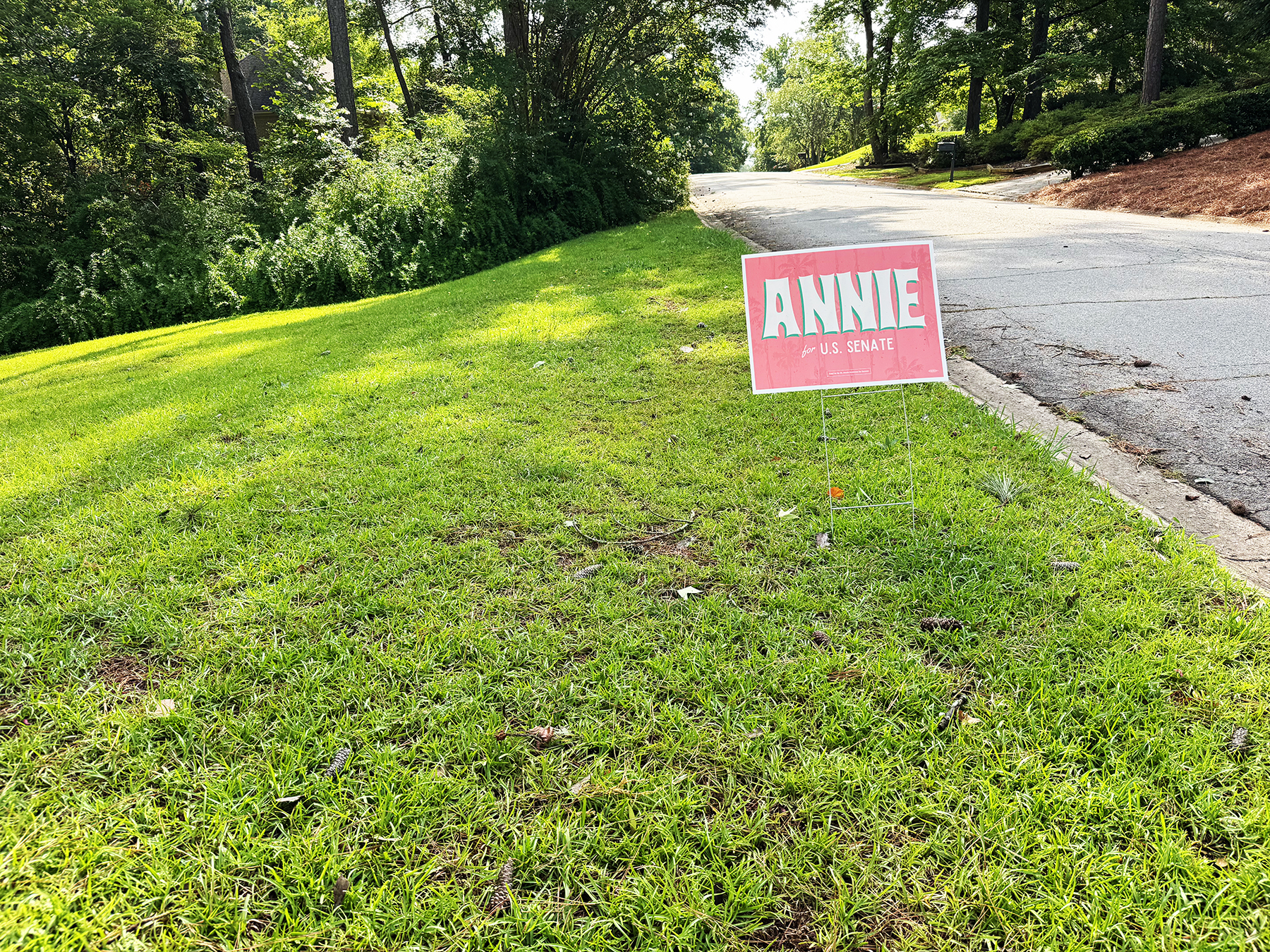
When we were last on this subject, I had just taken down my “Annie” sign because Lindsey had just died, suddenly and rather shockingly. I took it down as respect for the dead (I don’t know if that’s an established custom, but perhaps it should be). I’d like to say I also did so because I had high hopes for what the special primary might come up with, but of course, I can’t. It’s more that I had only put the sign up because a) she was the only alternative to the sad disaster that Lindsey Graham had become, and b) my neighbor who had put up a sign I gave him in the last general election had given me this sign. In fact, he put it up (after asking my permission), and I just left it. I lack enthusiasm for Dr. Andrews, which I can address separately after this unpromising current exercise is over.
In the meantime, I wish I could say something more positive than “I lack enthusiasm” about one of these candidates in the special primary. But I can’t. Maybe some miracle will happen between now and next Tuesday. It it does, I’ll say something about it.
The saddest thing I can say about this crew is that among those I know (and I only vote for people I know something about, unlike so many), the one who comes closest to being a reasonable person is Mark Sanford. Yes, that’s how bad it is. If you don’t know what I mean, look at what I’ve written about him over the years. You’ll see that at first I liked him, but then was soon appalled, and kind of stuck with that. But then, he was appalling by pre-Trump standards. And as you know, if we could resurrect Richard Nixon and put him in the White House in place of what we’ve got, I’d be a pretty happy camper.
So let’s start with him and run down the rest of the list. I’ll say less about those I know less about:
Mark Sanford. What he’s offering is pretty much what he’s always offered. The best thing I can say about him is that he is not a Trumpista. And that’s important. Beyond that… well, he brags about being a budget-cutter. He brags (in one of the many texts I’ve received) that as governor, he “balanced 8 state budgets.” No, he didn’t. The Legislature did. The state constitution requires that the state budet be balanced, every year, and that would have happened no matter who the gov was. What he did do, one year, was put on a childish display by vetoing the entire budget. It was the most grossly irresponsible thing I’d seen a chief executive do until Trump came along. The grownups in the Legislature fixed it, of course, as Sanford knew they would (which to me makes it worse, not better — he was leaving it up to the people who actually cared about the job, rather than pulling stunts). Folks, this guy is THE most extreme libertarian I have every encountered. Most libertarians don’t like paying taxes to support government. This guy didn’t want any money spent on government, even if the money fell from the sky. In 2009, with our economy a shambles, he tried to refuse $700 million in federal stimulus funds (that was going to be spent anyway, somewhere), simply on the principle that he didn’t want SC to have any more money to spend on government services. That time, the state Supreme Court stepped in as the grownup. Hey, if you like that stuff, go ahead and vote for him. But if he’s elected, you might want to put a bell on him, in case he wanders off again.
Darline Graham. I was happy to accept her as her brother’s interim replacement for a few months. I didn’t think about beyond that. If I had, I would have said this was her chance to define herself for voters. Unfortunately, she is using this opportunity to define herself in terms of what her brother became after 2016, not what he was before. On the good side, she does proudly mention on her website her experiences serving in state government leadership roles. But that’s not her headline. Her big, bold headline is “Proudly Endorsed By President Trump.” Most voters are doing well if they know even one thing about a candidate, so that’s the one thing she wants them to know definitely. If she wins the primary, maybe she’ll drop that garbage and offer herself as a serious alternative to the Democratic nominee. But that remains to be seen.
Ralph Norman. Remember when, early this year, I acknowledged an ad of his as a nominee for worst political ad for 2026 so far? The ad brought up so many depressing thoughts that I took the post down right after I put it up. I just didn’t want to bring up such things, much less discuss them on a blog. Unfortunately, there was a comment or two before I could take it down, so I decided I had to put it back up. I cursed my luck. I just wanted to get back to writing about more pleasant things. Well, now I can tell you that nothing Norman did or said after that caused him to rise in my estimation. This was not a surprise. I’d known about Norman from well before he insulted us by running for governor. Here’s something from 2023. If you want to go see if you can find something positive about him, here’s his website.
Russell Fry. He’s technically a member of Congress (representing a district that didn’t even exist when I was at the paper, and I can’t name his predecessors either), but beyond that, if you mentioned his name to me before this, it might have sounded familiar, but I would have guessed he was a backbencher in the Legislature. In other words, I knew nothing about him until he ran for this. And everything I’ve seen since then tells me he’s trying to outRalphNorman Ralph Norman. Here’s his website.
Duke Buckner. All I know is that I saw a picture, and aside from being a pleasant-looking fellow, I notice he’s black. Although it might be cool — in a weird, ironic, misleading way — for both of our U.S. senators to be black Republicans, it wouldn’t be cool enough to vote for him unless I know a lot more. Preferably something having nothing to do with Identity Politics. Here’s his website. One good thing I see is that he doesn’t mention Trump on the main page. That’s something…
Samuel Sam Shepherd. I don’t know why his name is on the ballot like that. Maybe he doesn’t want you to think he’s this guy. Not that I would have. Here’s his website… No, wait — I couldn’t find one in a brief search. Here’s a TV news story. And here’s a Facebook page. Let me know if y’all find a website.
Danny Ford II. I don’t see a website for him, either (but maybe I’m not looking for it correctly). Here’s his Facebook page. I see that he is a farmer, that his father had something to do with football (not that I’d hold that against the son), and that the party tried to keep him off the primary ballot. The reason they tried that makes me glad he won his court case. Might be worthwhile to look a bit further…
Glenda Gail Parker. Don’t know anything, beyond noticing that she’s a woman, but Darline can claim the same distinction. More in Ms. Parker’s favor: No prominent mention of Trump on her website. Interesting…
Mark Lynch. A second Mark! Here’s his website. (No prominent mention of Trump!)
Mark McBride. Yet another Mark! Here’s his website. Again, no obvious mention of Trump (mind you, I haven’t read every word on any of these sites), and his issues page mentions relatively normal things that a Republican in, say, the 1990s might have talked about. Fascinating.
I’m going to look more closely into those folks who show no interest in the current president. Some of them sort of exude an aura of sanity that is sadly unfamiliar these days. I’ll let you know if I decide to vote for any of them.
Of course, if there are any professional Republican consultants who have taken a moment to pay attention to any of those candidates who seem to be from a pre-Trump universe, they are snorting with derision and saying something like, “Huh! Another loser who wants to stay a loser!”
That’s their conventional “wisdom.” Me I’m looking forward to a day when they’re wrong. You know, a day when our country is Great Again.
Once, I was a hard-news guy. Strictly hard news. I was ready and eager to cover almost any disaster that befell my fellow humans — fire, murder, kidnapping, bank robbery. Even as an editor, I’d desert the newsroom and rush out to the scene to see if my reporters needed a hand covering it.
And yeah, I felt guilty about being enthusiastic about other people’s misery, but (I told myself) I didn’t cause the misery; I just wanted to be the first to tell everybody about it. (And I swear, I never exploited misery by asking a victim “How do you feel?” That kind of “news” coverage always nauseated me. Just the facts, ma’am.)
Once, there was a big bank robbery breaking on deadline, with the scanner telling us the robbers were holed up in a nearby apartment in a complex where I had once lived. Though we were between editions, I rushed to the scene and stood amid the cop cars that were surrounding the building, staring at the doors and windows and waiting for the action to break. Then I glanced to the left and the right, and saw all the cops were taking cover behind their cars, with weapons drawn. I decided to get behind something myself, but in a position where I wouldn’t miss anything.
I had to get back to the office a few minutes later, but don’t fret; I didn’t miss anything. The robbers weren’t there. Bad tip.
Once, my boss told me that I was her “news hound.” I protested that we had a newsroom of 150 news hounds. She said, “No, we don’t.” I say that not to brag, but to set up my point, which is coming soon.
Of course, my main hard news jam was politics — in my newsroom days, and even more so after my conversion to editorial. Politics was the main thing; the others were just interesting breaks in the routine. Political coverage and commentary is why we have the First Amendment protection for the press. Our Framers knew that an informed electorate was essential for our republic to survive, and that meant a free press. Politics was the one hard news thing every citizen could do something about. So they needed a lively, detailed source of reliable information on the subject.
And as long as we had healthy newspapers in our communities, our republic thrived.
But that’s not my point. My point is that our polis, our political community, our marketplace of ideas has now degenerated to the point that I take little interest in the political stuff. Which is why I don’t blog much anymore — and when I do, it’s usually about popular culture or other trivia outside the political sphere. There just seems to me to be no point to delve into what was the important stuff to me for most of my life.
You can inform people all you want, and reflect upon the salient facts as carefully and intelligently as you are able, and it has zero effect. Everyone rejects it vociferously. It’s not only that they are unaffected by the commentary; they completely disregard the facts. If the facts (much less the opinions) are not in agreement with their own prejudices, they sweep them aside with hardly a glance. After all, their own preferences are constantly reinforced by the more comfortable (to them) “facts” and viewpoints fed to them by the sources of information that have replaced serious news coverage.
So I spend more and more time thinking about other stuff. Like sports. Which is particularly ironic, given it’s me. I didn’t say anything to them, but when guys used to tell me, “I just read the sports pages,” it always lowered them a bit in my estimation. And now I’m sort of one of them.
Of course, it’s just baseball, the National Pasttime, but it’s still sports. And while I’ve got you, the latest is that last night, the Red Sox beat the Dodgers (currently the Best Team in Baseball, statistically), to close out the best month Boston’s history. Their won-loss average was .840 in July — 24 and 4. You know how I said, back when Boston took its first step up from the cellar, that all the bestsportsmovies start with the team being in the hopeless dumps, before they climb and climb and climb until they win it all? Well, we’re really getting into the good part now. The final, triumphant reel is rolling.
So that was my favorite thing in the paper this morning. But I’m here to share my second favorite: “Too many chickens coming home to roost.” It was on the Globe’s front page:
Sure, roosters don’t lay eggs and are known to make a racket, so most amateur chick hatchers don’t have any use for them. But, the Wood Family Farm would like you to know it already has plenty, thanks all the same….
But folks in the area keep dumping their roosters there.
This story ties together a number of things that have interested me for some time. My family is into vegetable (and fruit) gardening, but we have to build raised beds because our soil is essentially red-clay brick. And my wife would like to have chickens, but, you know — subdivision covenants. My son, who lives in a nearby community, built a nice coop and got some chickens and his family had “free” eggs for awhile, but all he could keep where he lives was hens.
In populated areas, roosters aren’t allowed because, you know, the crowing. Hey, when we were in Thailand, everyplace we stayed (even Bangkok) had nearby roosters, and it was kind of nice. We always wanted to get an early start on the sight-seeing. But them’s the rules in populated areas.
And the reasons that one Peabody farm was a fave dumping ground for roosters were a) it was in the general Boston metro area (just west of Salem), and b) it was located at the junction of two major roads. And it’s driving Madison Wook, the young woman running the farm, nuts:
“I am just a 25-year-old girl taking care of her family’s farm, and it keeps falling on me to take these roosters in when they’re dumped,” Wood said.
And bless her, she’s sweet-hearted enough that she does take them in, even though there are now 15 of the useless braggarts and she’s not set up to have any. She feeds them and puts them “in her paddock alongside her ducks and cows.”
So I like Madison Wood. And I even have some sympathy for the folks who are inflicting this plague upon her. They care enough about chickens to keep them, and they can’t keep the these guys, but they don’t have the heart to butcher and cook them. (And sure, our farming ancestors would scoff at that, and their hunter-gatherer ancestors wouldn’t even scoff, because they’d be too busy starting a fire and making a makeshift rotisserie. But we are prisoners of our soft environment, so as I say, I’m sympathetic.)
But these folks need to take their Foghorn Leghorns somewhere else now. I hope Madison doesn’t get any more boarders to worry about. But one upside: She’s not going to have any trouble waking up in the morning for awhile…
Since I needed art for the page, I thought I’d brag that for once, one of my fig trees is bearing really well. Huzzah!
I think the blog is back up and functioning normally, but let’s test it out with a quick VFP!
U.S. Strikes Iran as Fighting Reignites Across Region — And here we go, on and on. You may want to take note of the sidebar to that lede story in the NYT: Trump Encounters a More Determined Iran as War Widens. Indeed. They know that, after all his ridiculous bluster and bravado, he very badly wants out of this fight. Do you think they can outlast him? I do.
‘There will never be another Lindsey Graham’ — That’s what Henry said today at his funeral, and I expect he’s right. In that way, he matched his prececessor, Strom Thurmond. In important ways, he exceeded him. Personally, I’m going to remember the days I was so proud to have him as my senator, before the terrible period that started at the end of 2016. We could use another senator like the one he was back then.
And now from the world of sport — The Red Sox lost one last night. And although the glow of their record-tying streak is still upon them, they’re trailing in this one. I’m confident they’ll pull it out, but I need to go to bed. After this, they should stop playing these games on the West Coast — unless those people learn to set their clocks properly. No, this isn’t an actual sports story, and doesn’t really belong on the front; I just wanted to get that off my chest.
EDITOR’S NOTE: Still having serious technical problems with the blog, but I’m going to try to post a short one as an experiment…
America Magazine notes that while most popes refer to Scripture or other church documents in their missives, Pope Leo branches out:
Sometimes popes go rogue. Pope Francis liked to reference the English priest and novelist Robert Hugh Benson as well as Fyodor Dostoevsky. As is the case with any pope who reigns for more than a few years, the documents of the latter years of Francis’ tenure also had a lot of references to his own papal oeuvre. (If you want to get technical, even St. Luke liked that move: What’s the opening line of Acts of the Apostles? “In my first book, Theophilus…”) And Pope Benedict XVI liked to include Plato and other classical Greco-Roman authors as much as he did any church father.
What no pope has ever done until now, however? Quote Bob Dylan.
Dylan? I really like this pope. (And I LOVE Francis for the Dostoyevsky.) Of course, being a pontifex maximus, Leo goes DEEP with his Dylan. No “A hard rain’s gonna fall” or other stuff everybody knows, he digs down into arcana like a superfan:
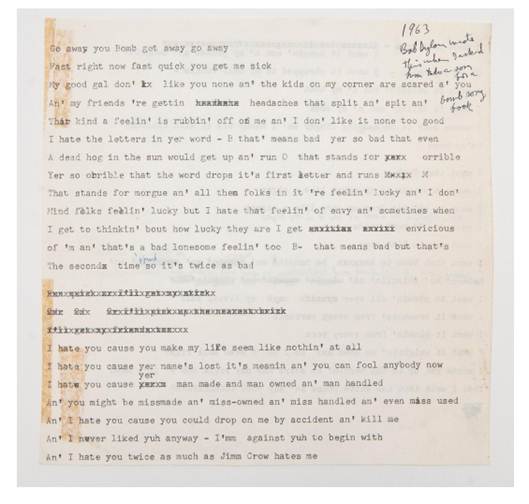
In the foreword to a new book collecting his writings on peacemaking, Disarmed and Disarming: Peace Is a Gift, the pontiff quoted a 1963 Bob Dylan song, “Go Away You Bomb,” citing a line Dylan directed at nuclear weapons: “I hate you cause yer man-made and man-owned an’ man-handled.”
If you’ve never heard of the verse or the song, you’re not alone: “Go Away You Bomb” was never recorded by Dylan. He seems to have written the song in a day in 1963 at the request of Izzy Young of the Greenwich Village Folklore Center, and it only exists as a typewritten manuscript. The lyrics have the same tone and feel as “Masters of War,” the classic song released the same year on “The Freewheelin’ Bob Dylan,” but Pope Leo didn’t cite that famous track: Instead, he dug deep, like a hipster tossing aside “Bob Dylan’s Greatest Hits” for a vinyl B-side of something terrible from “Self-Portrait.”…
See, that’s cool. Reminds me of cool friends who were into Jeff Beck when I was in high school, while I didn’t know who he was. I was too busy trying to figure out whether Paul was dead. (You’ll be glad to know I decided he wasn’t.)
This was among the frozen goods offered for sale at a local Aldi.
OK, no more Homer for the moment. Let’s move on.
It’s been awhile since I’ve done one of these, and I expect it to be harder than it used to be, but here goes…
Man told he’d have to pay $2.4 million for school pollution records — OK, this one grabbed me. Usually, an agency that wants to say “F___ you!” to a citizen’s public records request will charge, say, $100. Prices really are rising, aren’t they? By the way, the agency involved is one of the two that we used to call DHEC.
Speaking of prices going up… — This refers to the picture at the top of this post. My source failed to check the price, but if it was a nickel, that would be five cents more than anyone should have to pay for ice cubes. But you know, the moment we first paid for water in bottles, we should have known this was bound to happen. Me, I’m gonna keep making my own, like our hunter-gatherer ancestors.
Trump Threatens Canada With Tariffs for Wildfire Smoke Over U.S. — So… a bad thing happens to Canada, and Canada struggles to deal with it, so he proposes to punish Canada for it? I guess it makes as much sense as persecuting people for coming here from countries where they are starving and/or oppressed. You see why I don’t read as much “news” as I used to? This is what it’s like.
Nicaragua’s President Ortega says no more elections — He’s been the dictator there for 20 years now. So much for those idealistic Sandinistas, huh? Elections? He don’t need no estinking elections! (Yeah, I know that’s from a Mexican character, but it’s all I could think of…)
Red Sox are one win from tying their record for longest win streak — You knew I’d get to this, right? As of last night, they’d won 14 games in a row. If they win tonight — the game starts in less than an hour — they’ll tie the franchise record of 15 straight. And that was in 1946, when they had Ted Williams at his peak. See? I gave you some good news…
Matt Damon did a good job of humanizing Odysseus. Beside him is the unprepossessing Athena.
Wow. That was quite an experience, seeing “The Odyssey” last night. It’s one of the few times I’ve been at a film that the audience applauded at the end. I joined in.
Christopher Nolan really accomplished something here. I was very impressed, and not a bit disappointed — which is unusual for me, with things I’m familiar with when I go in.
I highly recommend it.
I do have one BIG complaint, which is definitely not Nolan’s fault. I went to see the movie in Imax, so it looked great. But the first thing I did when I got there was turn off my hearing aids, and that wasn’t enough to shut out the painful noise. You’d think that would be great for a guy who’s hard of hearing, but it isn’t. Loud sounds produce a tremendous buzzing distortion in my ears. I couldn’t make out dialogue; I could only understand about 20 percent of what was said. (Sometimes it helped to put my fingers in my ears.) I knew the story, so I usually knew what was going on. But I can’t wait to see it again with normal sound — and maybe subtitles.
Another thing that helped me follow and enjoy the flick was that it followed the original about as faithfully as you can in just three hours of running time. There were changes, but they were very inventive and helped move the story forward convincingly. Examples of that:
In Homer’s verson, a priest at Ismarus gives Odysseus a supply of sweet, super-powerful wine that a normal human needed to dilute 20 to 1 before drinking. Later, our hero uses the uncut stuff to drug the Cyclops so he and his men can escape. In the movie, there’s no stop at Ismarus, so no wine, and Odysseus just waits until the Cyclops is asleep before blinding him. It works.
He doesn’t stop in the land of the lotus-eaters, either. Instead, Calypso feeds lotus flowers to Odysseus to give him amnesia and keep him around for seven years. This works on a couple of levels. First, it sort of exonerates Calypso because she ultimately decides to let the hero go, and even helps him remember who he is and where he wants to go. First step: stop eating the flowers!
Secondly, it exonerates Odysseus for leaving his loving wife in the lurch back in Ithaca while he spends every night in the bed of a nymph for seven years. Hey, he forgot! This is not the only thing Nolan does to make Odysseus a more sympathetic figure to a modern audience. Between all the slashing bloodshed and hanging girls who slept with the enemy and selling captive women into slavery, and lots of lying, Homer’s character wasn’t quite the thing for moderns seeking a hero. He had problems. But by skipping and soft-pedalling a lot of that, plus casting Matt Damon in the role, Nolan made Odysseus someone a 2026 audience could cheer for. It was very artfully done, and he didn’t overdo it and make him fake or too vanilla.
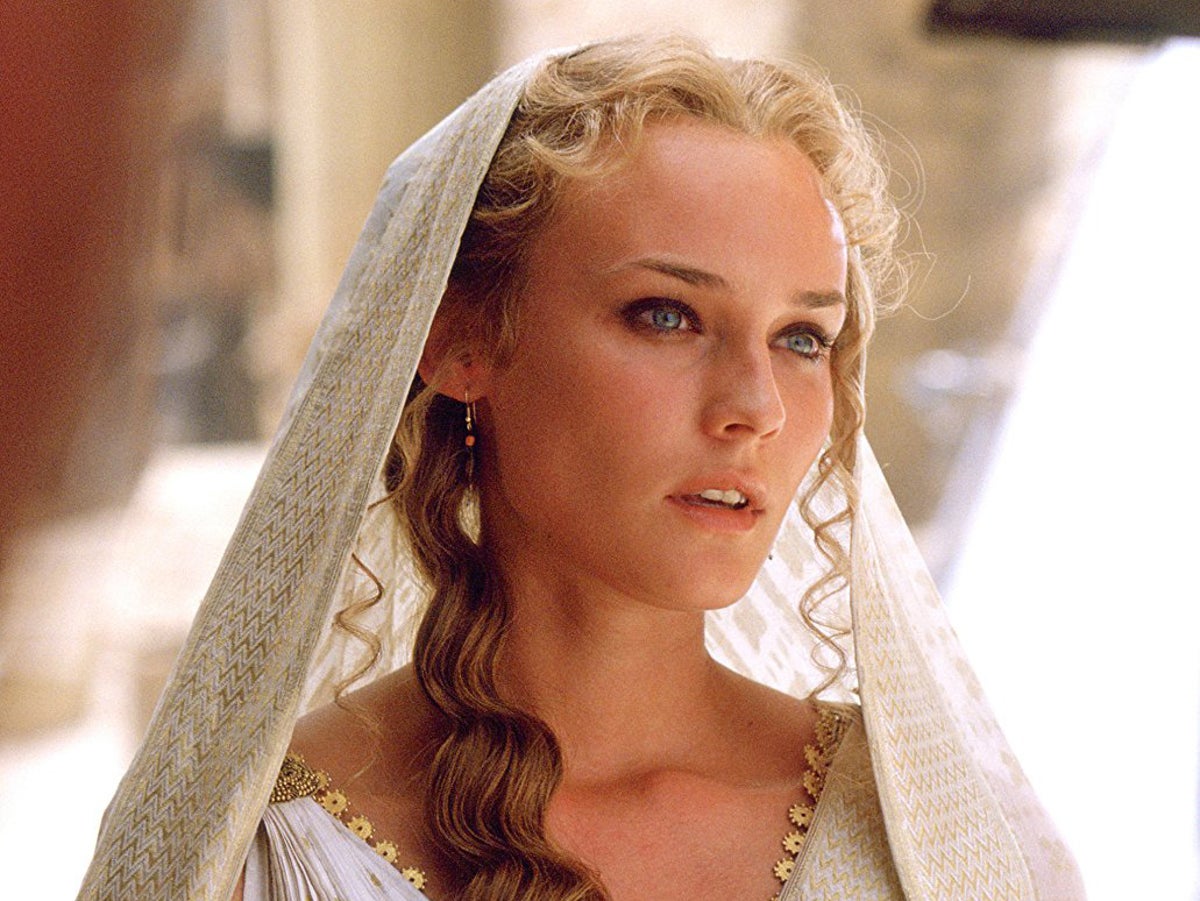
He also toned down Athena. She keeps showing up, but she’s a very unprepossessing goddess, considering. People tend to think of her as the goddess of wisdom, like her Roman rip-off Minerva. But she’s also the goddess of war — a tall, strong figure who wears a soldier’s helmet. She was into bloodshed, and was always counseling Odysseus — and Telemachus — to man up and swing the sword about. In this, she wore a lovely white robe and imparted Wisdom to our man O during relatively quiet moments (as in the still you see above). I mean I think she did. Since I couldn’t hear dialogue, especially quiet dialogue, I admit she could have been saying, “Get on out there and kick some ass, ya sorry wuss!” But in a quiet, philosophical kind of way.
Anyway, all those changes worked. What were the best parts?
My son was there with his family, and in discussing it with them after, I brought up the scene with Polyphemus, the Cyclops, which I thought was very well done, as I said above.
But after I got home, I remembered the very best part — when Circe turns O’s men into swine. It was astounding, and it was done without CGI, which makes it more amazing. I won’t tell you how she does it, but it’s not your garden-variety, wave-a-wand hocus-pocus. SPOILER: It’s particularly shocking to see after the way Circe appears (and hasn’t identified herself) — not as a foxy enchantress, but like somebody’s mom, utterly terrified to find armed soldiers in her home. She looks like an everyday middle-aged lady throughout the scene, but by the end there’s no doubting her power. Earlier I quoted Jack Aubrey as saying, “… as for that tale of all his foremast-hands being turned into swine… why, he might tell that to the Marines.” He would not have doubted had he seen this.
As for least-favorite part… above, I said I was “not a bit disappointed” by anything, but I’d have been happier if I’d seen some sirens. Oh, Odysseus gets tied to the mast, and acts out the words of my fave Cream song, “How his naked ears were tortured/By the sirens sweetly singing…” But I saw nothing. I was eager to see whether they looked like this or like this. I would have preferred the former, but been happy to see anything.
Oh, about those controversies: I wish I could say Lupita Nyong’o was awesome as Helen, but I can’t. And it’s not just because, her face aside, she’s too skinny for me to think of her as the world’s most beautiful. She just wasn’t as good in the role as she needed to be to shut the complainers up. She wasn’t, say, as good as Sophie Okonedo as Queen Margaret in the recent production of Shakespeare’s Henry VI plays. When I first saw that, I kinda went, “Huh?” (I mean, she was supposed to be from Anjou), but was deeply impressed at what she did with the role. Not so in this latest instance. But it didn’t matter much given that Helen wasn’t as critical to this particular story, once the war was over.
I did have a “Huh?” moment early in this masterpiece early in the story, when I thought, “Why is there a girl dressed as a Greek soldier on that beach?” I finally decided it was supposed to be a very young boy, and I was right. It was supposed to be Sinon, who wasn’t actually a character in The Odyssey, but was added by Virgil in his Latin version. Nolan had added Sinon to set up something involving one of Penelope’s suitors, showing you what a bum that guy was (paying a kid to go to war in his place). Later, I learned Sinon was played by the same person who starred in that charming and witty movie “Juno” quite a few years back, who later became a trans activist. Which explained things, sort of. Maybe Nolan wanted to tick off somebody else out there besides Elon Musk. But what I don’t understand is why Odysseus would have sent this kid Sinon on essentially a suicide mission. Sinon sort of had the same question when O later looked the kid up in the realm of Hades.
As for the other casting choices I had been wondering about… I already said Matt Damon was perfect as the guy who could present O as someone who appealed to a Hollywood audience. He really made the movie work. Anne Hathaway and Tom Holland did fine as Penelope and Telemachus (the loved ones O was forgetting while shacking up with Calypso). And believe it or not, the “Twilight” guy was good as the very worst of the suitors, Antinous. I suppose he’s matured as an actor.
I said above that this was one of a very few films I’ve seen that caused the audience to applaud. There was another thing that has seldom happened in my adulthood: I came out of the theater feeling like I was still in the movie. It took awhile to shake. When I saw (and then reviewed) “Star Wars” in 1977, I was having trouble shaking the feeling that my Chevy Vega was an X-wing, and I was swooping in to finish off the Death Star (which was not the safest illusion to have while zipping East on Walnut Grove in Memphis). I had a similar experience after seeing “Apocalypse Now,” which haunted me the rest of the day.
I had that experience a lot when I was a kid living in Ecuador. My best buddy Tony Wessler and I would go to the Variedades theater near my house, pay the equivalent of two cents to get in, and sit on plain wooden benches to watch Italian (and sometimes French) movies with classical themes — gladiators or Hercules or whatever. The special effects were terrible, and if not for the Spanish subtitles we’d have understood none of the dialogue, but these shows were about the action. Afterwards, walking the six blocks or so home, we’d pass by construction sites littered with pieces of bamboo (they used it for scaffolding), and use them to swordfight constantly, all the way. We were IN the movie.
But since I’ve been grown, movies have to be something really special, do something new and different to give me that feeling. Last night, when I got to my car, I felt it strongly. Before driving away, I texted my wife, who had not come along, to say that after three hours of what I had experienced, I had this feeling it was going to take me another three to get home. She took it as a joke, but I actually felt that way.
I hope ol’ Tony has been to see it. This was everything those cheap flicks we enjoyed so much back in the day wanted to be…
In this depiction from 550 BC, Helen’s white, but everybody else is black. Go figure.
OK, here we go again…
Yesterday, I questioned the casting decisions for the new film I still haven’t seen, but am anxioius to see — “The Odyssey.” But I did so optimistically, thinking it’s likely that Christopher Nolan knew what he was doing, and has more imagination regarding such things than I do.
Then, I listened to the third of four podcasts (yesterday I forgot the one in the video) that “The Rest is History” put out about about “The Odyssey” (both Homer’s and Nolan’s versions). And I found myself groaning when Tom Holland and his guest, classicist Daniel Mendelsohn cited the first of the “controversies” that have cropped up about the film.
And of course, this being the 21st century, it was about Identity Politics.
It seems that the actress who plays Helen of Troy is black. Her name is Lupita Nyong’o. So here we go.
Well, she definitely fulfills the primary job requirement: She’s beautiful. Does that make her the best choice for the role? I’ll get back to that. Meanwhile, the “controversy” seems to have been kicked off most prominently by a guy who, now that he’s the richest guy in the world, seems to have decided to dedicate the next chapter of his life to reinforcing every negative stereotype about white South Africans:
Chris Nolan is pissing on Homer’s grave. Disgraceful.
Sheesh. You’ll notice that in my previous post, I didn’t mention who was playing Helen in this film because I didn’t look to see. It didn’t even occur to me that she would be depicted, since this isn’t the Iliad, but the story about what happened to this one guy and his crew after the Trojan War is over. But apparently it includes the part when Odysseus wins the war by coming up with that big wooden horse trick.
I did raise the question of whether Matt Damon was right to play the star, and so did Holland and Mendelsohn, pointing out that Damon is sort of the ultimate whitebread All-American boy type, which the ancient Greeks were not. And one of the guys on the podcast, at some point, asked one of those overused points of the PC universe by asking, Why don’t they question that, huh? Well, I did, but I’m hoping Damon does a good job with it.
From there, they took the discussion in an intellectually respectable direction by discussing the question: How DID Homer picture Helen?
To encapsulate what they said, they made two excellent points: The first was that Homer was careful not to give many details about what she looked like. (Although he did say she was “white-armed,” but I see that as a reference to class rather than pigment. Upper-class ladies stayed out of the sun. Also, her father was a “swan.”) That, of course, left it up to the reader or listener to picture Helen according to whatever standard of beauty was admissable to those audience members.
Secondly, they made the logical point that what Homer and other ancient Greeks were picturing was probably someone who looked like them and their immediate neighbors. It’s extremely unlikely that they pictured in their minds either a blonde such as the one who played Helen in this flick, or a sub-Saharan African like, well, Lupita Nyong’o. (Although technically, she’s from Mexico. Still, her parents were Kenyan.)
Personally, that’s the way I would have gone. I wouldn’t have taken it to extremes — I wouldn’t say, insist upon a Greek woman — but I would have gone for a more or less Mediterranean look. Or at least sought a beautiful woman with dark hair, like Anne Hathaway — who plays Penelope in the film.
I thought the makers of “Troy: The Fall of a City” did a good job when they chose Bella Dayne to be their Helen. But, possibly illustrating the idea that we all have our own notions of beauty, I thought the most attractive actress in the series was Frances O’Connor. She was cast as Hecuba, Paris’ mom. (Still, she’s a lot younger than I am.)
Anyway, what do y’all think? Who would be the perfect Helen? To get you started, I’ll throw out a few names, and link to images. It’s not a Top Five List or anything. I didn’t think that hard about it. I just thought:
Who is really, really beautiful, the kind ancient men might have gotten into a huge scrap over? Not only that, but what does she have that’s extra, the X factor, that turns heads?
Who looks vaguely Mediterranean, or at least isn’t a blonde or redhead or East Asian or sub-Saharan African or anybody who makes the average viewer go “Huh? I thought she was from Greece!” Although if she has the other qualifications and is at least a brunette, I’ll give her a pass on the olive complexion (yeah, I’m cheating to give Anne Hathaway a chance).
Who is a real actress, preferably with the chops to handle the role — not just some hot pop singer or model?
She doesn’t have to be the right age for the role NOW. That’s too restrictive because I’m not likely to think of actresses who are that age (which I suppose, given the place and time, would be somewhere between 20 and 30 during the years of the war) at this moment.
Here are my suggestions (not in order):
Penelope Cruz. Admittedly, I didn’t think of her on my own, but she came up when I Googled beautiful actresses who looked Mediterranean (just to kind of get me started), and she fit the bill.
Rashida Jones. Wait, you say, her father is of African descent! And you’re thinking that because you’re thinking in racial, Identity Politics terms. I’m thinking looks. And in this case, a combination of a man of African descent and the chick from the Mod Squad gives us the right look. And she certainly has the X factor.
Rachel Weisz. Dang. I just said “X factor,” and I’m not going to keep repeating myself.
Emily Blunt. OK, OK, I know — too Northern European. But there’s something Hellenic there that I think the costume and makeup people could work with.
Gal Gadot. I was done with this list, then someone on the telly mentioned her name, and I had to come add her.
Marisa Tomei. I’m going to say “X factor” again because she’s got more of it than anyone here. As for unmistakeable Mediterranean (or at least Caribbean) allure, did you ever see “The Perez Family?”
Marisa Allasio. Mentioning the other Marisa made me think of this one, whom I admit I’ve never seen act, possibly because she retired and married a count when she was 22 and I was 5. She’s way more Helen than those gorgeous Itallian actresses who came along in the ’60s (sorry, Sophia). OK, she’s blonde, but give her a break; she’s from Turin, not Naples! But she’s way Italian, so dye her hair.
That gives us something to start with. But we’ll need a time machine to get them. That last one retired in 1958.
EDITOR’S NOTE: I actually saw the film last night, but nothing in this post reflects that. I mostly wrote it yesterday, but wasn’t done before I had to head to the theater. I just did some editing and fleshing-out of points this morning before posting it. I’ll make observations later about what I saw.
Of course, one of them — the Tom Holland we know better as Spider-Man — has a vested interest. And the other Tom Holland is an enthusiastic classicist, and co-host of my fave podcast, “The Rest is History.” The latter is particularly a fan of The Odyssey, and had been looking forward to Chistopher Nolan’s new film version for some time. The younger Tom Holland plays Telemachus in the movie.
Still, I appreciate their recommendations, which reminded me to buy a ticket. Not for tonight (opening Fridays are such a mob scene), but for soon. I didn’t really need the video reminder, though, because the elder Tom and his podcast partner Dominic Sandbrook have done no fewer than three episodes on the Homer’s epic this week.
I’m still listening to the first one. And no, The Odyssey isn’t itself a work of history. But it is about a key figure in the defining story that loomed over and fired the imaginations of the ancient Greeks and Romans — the Trojan War. The entire Greek culture is called Hellenism, for the woman whose beauty started that whole 10-year contretemps in the Hellespont area. And as we know, the Romans were too busy conquering people to create their own culture, so they just stole the Greeks’. Remember Romulus and Remus? In one version of their story, they were descended from a Trojan War veteran.
And when I say defining story, I mean the way the Arthurian legends were in England (you know, the Matter of Britain). And the Trojan saga was at least as big as everybody in the Marvel Universe is in America today. They were sort of like all those superheroes (wrap in D.C. as well) combined with George Washington and the Pilgrims who landed at Plymouth Rock. (These days, we do have some tiny awareness of actual history. But history was not a thing before Herodotus invented it.)
And frankly, I’ve always been more interested in the story of Odysseus problems getting home after the Trojan War than in the war itself. Maybe I’d understand the actual war and its motivations better if I could just once see a photo of Helen herself. Lacking that, I’m more into the Sirens and the Cyclops and the lotus-eaters and Calypso than a 10-year siege.
But that’s not the only reason I’m pumped about the movie. I’ve never seen anything in the IMAX format. I’m eager to see how film can produce better resolution than most digital images. More than that, this flick is the first to be shot entirely on IMAX 70 mm film, and to be processed without any digital tricks — things like adjusting color tones were done by filter overlays, old-school. Since I’m sharing videos, take a look at this clip:
Finally, I’m intrigued by Nolan’s casting choices. Some were unexpected, but I hear they worked out well:
Matt Damon as Odysseus. I think Damon is great, but I never saw him as a mythical hero on this scale. No, I didn’t think, like Paul Rudd’s character in “The 40-Year-Old Virgin” that he was a “kind of a Streisand” (Will Hunting was a pretty tough kid), but I truly didn’t see him as an action protagonist until “The Bourne Identity.” Yet he was awesome in that. So maybe, despite not being Russell Crowe or Kirk Douglas, he’ll be just as awesome in this.
The aforementioned younger Tom Holland as Telemachus. Really? Peter Parker as the young son of Odysseus whose father has been gone so long he doesn’t remember him? Maybe. We’ll see.
Anne Hathaway as Penelope? Admittedly, she’s beautiful enough to play Helen herself, but I’ve got to get “The Devil Wears Prada” and “The Princess Diaries” out of my head.
Charlize Theron as Calypso? Well, maybe she could be a nymph. Maybe. Even if she is (and I’m going to get myself in trouble, but the thought insists on coming to the fore) 50. But hey — if she had existed, Calypso would probably have been older.
Robert Pattinson as Antinous? Isn’t this the teen heartthob from “Twilight?” I don’t picture him as one of Penelope’s thuggish suitors.
But based on what I’ve heard from the Tom Hollands and others, I expect to be surprised by their performances. So I’m very much looking forward…
Which is experiencing an annual pause, the All-Star Break, which I always hate. And especially this year.
My boys from Boston have a remarkable streak going — nine wins in a row, by far the longest in baseball at the moment. But now they’re resting, getting soft, losing the feeling of the streak — or so I fear.
And the first team they’ll face when the games start back is… the Tampa Bay Rays. As you can see above, those are the guys who are leading the AL East, and are three games ahead of the Yankees.
Fine, I say to buck myself up. The White Sox are leading their division (as you can also see above). And the Red Sox swept them last week, in Chicago. Hey, and remember a few days ago when I celebrated the fact that they were no longer in the Cellar? Well, now they’re up another notch, in third place.
But, I worry: That’s when the Bosox had the big Mo going, before this blasted Break. Now they’re sitting around… except for Contreras, Chapman, Rafaela and Suárez, who are in this thing today.
But, back on the first hand, the Tampa boys will be cold, too. Right? And maybe some guys will be off Boston’s IR list by then. Right?
I just wish the Break was over. I need some baseball. REAL baseball, not silly, gimmicky exhibitions…
He was absolutely right. “We” — the Republican Party, he meant… was almost completely destroyed. The party of Lincoln — which all my life had frequently produced candidates that were better than those from the opposing party — was no more. The process was complete by 2014. More than that, the America that was founded as a monument to deliberative government lay in pieces in the acrimonious dust. But I’ve addressed that before; back to our subject at hand…
During the 2016 campaign, Graham played the role of the acid-tongued party jester, daring more than anyone to speak the truth about Trump, and do it in a way that got widely quoted. You may recall some of the things he said. Here’s one:
“You know how you make America great again?” Mr. Graham said in a CNN interview in 2015. “Tell Donald Trump to go to hell.”
But that’s not the Lindsey Graham I appreciated most. It’s not why, in 2007, I called him a “stand-up guy.” It wasn’t for being a wiseacre. The world has plenty of those. It was for being an actual wise — and courageous — senator who in the years before American went mad, had distinguished himself for exercising nonpartisan judgment over and over. He was the guy you could depend on most to try to hold back the ill tides that brought about the disastrous things that were poised to destroy our country, from hyperpartisanship to xenophobia.
Of course, as the obituaries are saying, he was — with two of my other favorite senators in that time, John McCain and Joe Lieberman — one of the “Three Amigos,” who believed fervently that the strongest nation in the world was obligated to live up its global role since 1945. That meant standing up for liberal democracy and collective security, no matter how much that ticked off either the kind of Republicans who would embrace Trump’s advocacy of “America First,” or Democrats still deeply traumatized by Vietnam.
I was with him there, but I was just as proud of him for his activities as a gang member. I mean the Gang of 14 and the Gang of 8. (If you don’t remember what those were, click on the links.)
The Gang of 14 was about the way the Congress (and the country) was being torn apart by absurdly fierce, take-no-prisoners, partisan battles over judicial nominations. This had been getting worse and worse every year since about 1973, and the partisan nastiness was spoiling the country’s ability to deal with anything else. Graham was a leading member of the Gang, and the best at articulating its reason for being. He kept saying “elections have consequences,” and he proved that he meant it by backing Democratic nominees (assuming they found them objectively qualified) when there was a Democratic president.
Such an attempt — and in Graham’s own case, a reality — was based in belief in two things that had long been missing in the confirmation process: rationality, and a sense of proportion.
The Gang of 8 was just one instance of the most politically suicidal stand Graham ever took: trying to create a sensible, truly American, and workable immigration system. He did it right at the moment when his party was going into full-xenophobe mode — which of course is what created Trumpism, the rebirth of Know-Nothingism.
But he bravely stood up against the backlash that came his way over the next couple of years. I particularly recall the time when he was booed by the mob attending a South Carolina Republican Party gathering when he stood to speak. He just brushed it off with a surprising insouciance, waiting for those people to shut up so he could go on with his speech.
When was it that Lindsey Graham stopped standing up? When did he become the most lickspittle toady of Donald Trump? Apparently, a lot of people have trouble remembering. The New York Times this morning said, after mentioning Lindsey’s goading of Trump in 2016, “A decade later, though, he was regularly and effusively lauding Mr. Trump.”
Well, that’s true. But that wording makes it sound like a long, slow process over the course of a decade. It most certainly was not. It was sudden, and stunning. Of course, I remembered it slightly inaccurately myself — I thought it happened as soon as the 2016 election was over. It really occurred over the following year.
It’s really a shame to see this. Especially when Lindsey’s best buddy John McCain, as sick as he is, is determined to go down swinging against the guy Graham once quite rightly termed “the world’s biggest jackass.”
Because the thing is, he does know better. And therefore, he owes us better…
Several months earlier, there were signs Graham would be a Republican who would stand up to Trumpism with the same lack of personal regard as he had against isolationism, hyperpartisanship and xenophobia. But that was at an end.
It’s a tragedy for Lindsey Graham, and the country, that he never went back to being the man whom I had admired for very good reasons — before he let Trumpism overwhelm him.
Why did he do it? It’s an inadequate explanation, but the most convincing one to me is simple and personal: Lindsey Graham was a guy who had nothing to fill his life but being a United States senator. He had never married, and had no kids or grandkids. His parents had both died by the time he was 20. There was only his little sister, 11 when he was 20, whom he finished the process of raising. She has always expressed her appreciation to him for that, but she grew up and had her own family. I’m sure he stayed close, but there seems little doubt that the most consuming part of his life in recent decades has been in Washington. And it was certainly consuming. By the end, it seemed to be eating him alive.
Being not only a senator, but one of the most notable and quotable senators in Washington, was a tremendous addiction for a man with his sort of mind. How could he stand going back to S.C. and trying to build a new persona — maybe starting his own private law practice — as he was moving into his 70s? He had to stay in the Senate, or so he seemed to firmly believe.
Anyway, that’s my theory. It could be wrong. After all, he didn’t seem so terrified at losing his seat when he was infuriating so many in his party over immigration and judgeships. But something in him seems to have cracked as he realized that his party was no longer a party of ideas, but a cult with one main rule: Love Trump, or we hate you. He hadn’t seen anything like that before. (Neither had I, in this country.)
So what happens now? An anecdote…
A couple of days ago, a good friend who lives in my neighborhood called me and asked if I’d let him put an Annie Andrews sign in my yard. This was something that I hadn’t thought about, and I hesitated for a second or two, before remembering that this friend was someone who agreed to let me put a Russell Ott sign his yard two years ago. A this point I said “yes.”
I was out at the time, and when I came home, there it was.
This morning, a little before 9 a.m., that same friend called to tell me that Lindsey Graham was dead. He also expressed amazement that I hadn’t heard that, but I hadn’t. I do sleep sometimes.
A few minutes after that call, I went out and took down the “Annie” sign. Not for good, necessarily. I just took it down for two reasons:
Respect for the dead. I’ve got one of those short flagpoles by my front door — the kind that hangs diagonally from a wall. There’s no way to lower it to half-staff. So I did this instead.
I was supporting Andrews, even though I knew little about her, because I didn’t know anything bad about her, and since 2017, I have voted for any decent candidate who opposed Graham in a general election. But now, I wasn’t sure about who would be facing whom in the general. Henry McMaster will be appointing a replacement for Lindsey, and then there will be a special Republican primary. So there are variables.
Now, do I think that in this age of Trumpism, I will like either Henry’s appointee, or the winner of that special primary? No, probably not. But maybe the fallen GOP will surprise me with an unknown — somebody I will have to learn about just when I’m doing what I hadn’t really done before that phone call Friday (which is what made me hesitate about the sign) — study Annie Andrews as a candidate.
I need some time — the thing Lindsey didn’t get enough of, in the sense of enough to return to being the man he had been — to figure this out.
This just happened last night, when the Red Sox beat the White Sox, 8-1.
And it’s been awhile.
So you know what this means, right? Haven’t you ever seen a baseball movie about a hapless but loveable team that goes from worst to first? Think “The Natural.” Think “Major League.”
This is the point in the plot — somewhere near the middle of the season, or a bit past that — when the team makes the turnaround, but the pennant still seems beyond its grasp.
You might run some numbers and say with the number of games left, it’s highly, highly unlikely. But remember, we’re now in the era of playoffs, and it’s possible for a Wild Card team to win it all.
Oh, I should add: This formula also applies to basketball. Think “Hoosiers.”
When I attended Karr Junior High School in New Orleans for my 7th and 8th grades, standardized testing had me on the college-prep track, along with a lot of my friends at the time.
But not one of us took algegra in the 8th grade. We weren’t allowed to. Everyone had to wait until the 9th. The thing is, I was no longer living there in the 9th.
That year, which my Dad spent in the mangrove swamps of IV Corps in Vietnam, I attended Bennettsville High School (an institution that, like the once-magnificent State newspaper building, has vanished from the Earth). We stayed there with my grandparents while my Dad was at war.
And in B’ville, the most academically inclined kids had taken algebra in the 8th grade, when I was taking plain “math” (and frankly, not doing too well at it). So I took algebra in the 9th with the cohort of kids who were also probably headed to college, but were not overeager to get there.
This will surprise some of you whose experience of South Carolina public schools has come after real integration came to the state in 1970. That’s when all the seg academies cropped up, and from then on white voters became gradually less and less invested (monetarily and in terms of giving a damn whether the public schools succeeded or not). I arrived at BHS three years before that happened, and things were in many ways the way they had been when my mother attended the older BHS downtown. All the middle (and upper) class white folks did what they could to support the Green Gremlins (easily the best and most original mascot name of all the schools I attended).
Also, economically, Bennettsville was a far more prosperous place than it is now. That helped.
Anyway, at that point South Carolina was ahead of Lousiana in math, in spite of all those free textbooks Huey Long passed out during the Depression. Still, only those kids assessed as having the skill were taking algebra in the 8th.
But suppose you see your entire community as the most academically advanced in the nation? What happens if you try to prove how wicked smaht all your kids are? (Although in Cambridge, they probably don’t say it that way, but leave that to the Southies.)
In other words, living near Harvard Yard, or even MIT, did not automatically endow children with outstanding math skills.
Perhaps they were skilled in other ways. You know how there are word people and number people? Maybe some of them repeating algebra will someday write the Great American Novel. Or become awesome auto mechanics (who can also be found in Cambridge). Different strokes. Also, even if kids have the same inclinations, their brains develop at different rates.
The Globe story contains a lot of fingerpointing, with some teachers charging (anonymously) that the administration rushed the rollout of this experiment, and and administrators saying no we didn’t.
The larger issue, of course, is whether all kids should be forced to learn at the same rate as those who are more gifted in what the Brits call “maths.” This seems doubtful to me, and in this passage the story backs me up:
Secondary school is when you start individualizing education according to children’s personal talents and interests. It’s not the time to make them proceed at the same rates in every possible direction.
Anyway, thoughts? And what was your experience with math in school? Did that help or hurt? And do you recommend tailoring the curriculum to each individual student (as public schools have traditionally done, to the extent possible), or expected everyone to keep up on everything at the same rate (which trends more toward the small private school approach)?
A couple of times during that last post, I mentioned how well things were going in this country until the presidential election of 2016. At every point before then, while one party or the other might have been bitterly or even childishly disappointed (like the Democrats in 2000, or the Trumpistas in 2020), our system had worked wonderfully, for the nation and the world.
That got me thinking. Yes, things worked well for those first 56 national elections. But which were the elections when it all worked out best?
Which seemed to me like a situation that called for a Top Five List. So here goes. Note that this time, I’m not ranking the five, but putting them in chronological order:
1800 — This is the one that proved our system could survive, that one party actually could peacefully relinquish power and step aside, and the nation would continue. We all know that my man John Adams lost this one, but we don’t talk much about the fact that it remained tied between Thomas Jefferson and Aaron Burr, which was a real crisis. But the backup plan worked (barely), as Jefferson won in the House of Representatives, thus protecting the nation — if not poor Alexander Hamilton — from the execrable Burr.
1824 — This is another that went to the House (although under the new rules of the 12th Amendment), which protected the nation from the awful Andrew Jackson, and gave us the last of that string of extraordinary founding presidents, John Quincy Adams. But this did not last. We got stuck with Jackson in 1828, and this lowered expectations almost to Trumpian levels, and Old Hickory was followed by a string of mediocre-to-bad presidents that most of us would be hard-pressed to name in order. And who would want to, anyway? This one was not lasting in its effect — much like the election of 2020, which gave me such joy and hope for the nation at the time, before we learned that madness still gripped our country. But I include it so that we remember John Quincy, perhaps our most-qualified presidential candidate ever.
1860 — The one that elected our greatest president, and launched our bloodiest war — the one against each other. This was the pivotal moment in our history. Abraham Lincoln was the only man in our history who could have gotten us through what was to come, and with the right outcome. No one else in our history ever possessed such eloquence, such brilliance as a leader, such high ideals, and such an exquisite political skill, which guided him to do the right thing at the right moment at every critical step.
1864 — In its way, just as critical as 1860. The threat from the useless McClellan and the Democrats, the Copperheads and people who were simply sick of our bloodiest war ever, was created a real possibility that we would not complete the task that all this bloodshed was about, and therefore fail to live up to the promise of this country. But Lincoln won re-election, delivered the best inaugural speech ever, rammed the 13th Amendment through the House, thereby ensuring the actual end of slavery (even though most Americans think the Emancipation Proclamation did that, Lincoln knew it did not). And he got it all done before he was uselessly martyred. If only he could have still been around to lead us into the Reconstruction.
1932, 1936, 1940, and 1944 — Yes, every election in which FDR was elected. I couldn’t make up my mind which was most important. The year he was first elected, with the country in its worst economic mess ever? Or 1940, with the war having started in Europe and the Pacific and our country’s ability to act crippled by isolationism? Or 1944, when it would have been crazy to change captains with a war still to be won? I don’t know enough about 1936 to assess it, except that this group of four seems a critical series to me.
Those are my picks — sorry about cheating a bit on that last one, but I really don’t think one of them would have done without the other three. Franklin Roosevelt was our second-greatest president, and we needed him throughout that period.
We’ve had other good ones, and a couple that gave me great joy in my lifetime, but none with the same positive impact.
What are your picks, and your justifications for them? And more importantly, when will we ever have such great elections again?
The Ecuadorean Guayas, named for the river that was the home of the city where I lived in the early ’60s. Nice to see them celebrating, even though this isn’t the Nueve de Octubre.
And I mean really random. So have my thoughts been in the big buildup to this day — random, confused and even conflicted at times.
I didn’t feel a bit that way 50 years ago today. The Bicentennial was pure, unadultered celebration of the country I loved then, and have loved all my life, including now. Proceeding with subheds, as a demonstration of just how random my thoughts have been this time…
The Bicentennial
I got up late this morning after going with my younger son and my grandson to see “The Mandalorian and Grogu.” I may review that later, but I mention it here only to note that I didn’t get up until after 10, because the show was at 8:55, and what with all those previews and such, I didn’t get home until well after midnight.
Celebrations were under way as I broke my fast. One of my wife’s classmates from high school — there were 37 girls in the St. Agnes Academy class of ’71, and they’ve stayed close — texted her to say she was watching the “tall ships” parade in New York Harbor. So my wife tuned it in, and we watched for awhile. It was enjoyable, just as it was 50 years ago. Other members of the Class of ”71 joined in, and one sent a picture of my wife standing with her dear late mother, both smiling hugely, on the Bicentennial Day. My wife was four months away from giving birth to our first child, and all was happy and beautiful.
And I don’t mean just for us on a personal level, but for the country as well. To me and to so many others, there was nothing but pride as I watched those ships on the small, low-res screen, and otherwise observed the occasion. To me, the American experiment was a tremendous success at 200. My love of country hadn’t been warped, as it was for so many, by Vietnam. And to my mind, Watergate had simply proved that our system — carefully devised more than a decade after 1776 — still worked. Then, we had a prominent Republican who asked, “What did the president know and when did he know it?,” and proceeded, along with his colleages, as the facts warranted And when it was plain that Nixon would be impeached, he resigned to spare the nation and himself that shame (for which I honor him still). Today, there is no shame, and no working system to protect our country. We have a president who was convicted of 34 felonies in the summer of 2024, and he was subsequently elected rather than serving a sentence or paying any penalty. So he tears a significant portion of the White House down, messes with the nearby Reflecting Pool, and holds a UFC event on the ground to celebrate his own birth, and continues on his merry way, unmolested. (And we thought Andrew Jackson’s raucus inauguration party was an embarrassment.)
Back then, Gerald Ford was our president, and that was fine. He was a good man. I would soon be overjoyed that Jimmy Carter would replace him — things were just getting better and better. We had 40 good years ahead of us. We could reflect on the triumph of 200 years of America taking giant steps to make its union more perfect for all, and its leadership of the Free World since 1945.
A Linguistic Question
I was thinking this morning a thought identical to one I wondered about in 1976: Why were we calling them “tall ships?” At the time of our revolution, wouldn’t they just have been “ships?” Although some — compared, say, to a frigate — did seem to have unusually tall masts. What do you call sails that fly even higher than the royals? Because I think I saw some of those.
Speaking of frigates… I wished the USS Constitution could have been there, as the U.S. Navy’s only still-commissioned square-rigged warship. I mean, I think I saw the Blue Angels, so why not Old Ironsides? I guess because although she occasionally gets under way, the old girl never leaves Boston Harbor anymore. Of course, despite being fabulously old, she’s still young enough to be slightly anachronistic. She wasn’t launched until 1797. But she was much, much closer to the period than anything else I saw sailing today.
We can still celebrate, but we do it 2 days late
I’ve mentioned before the live history lectures I help the Relic Room stage twice a month. Yesterday’s was a triumph — we drew a crowd of 80 (our previous record was 62), and we ran out of both chairs and space in the museum’s small Education Room. The speaker was award-winning high school history teacher Michael Burgess, and his topic was “We Hold These Truths to be Self-evident – the Declaration of Independence at 250.”
He was excellent as always, and the crowd enjoyed it. But as good as Mike’s words and delivery always are, perhaps the best part for me was the clip he played from HBO’s “John Adams,” which celebrates my favorite Founding Father (and fave Founding Mother, Abigail). It was this part, when the Continental Congress actually votes to declare independence:
After the clip, Mike encouraged us all to notice how quiet all those men were once it was announced that “the motion carries.” Everyone, including the nervous, foppish young Edward Rutledge from South Carolina (seen in the still on the video link above), was overwhelmed, struck to silence, at the enormity of what they’d just done, breaking away from the world’s greatest superpower. No fireworks. No “shot heard ’round the world.” Just thoughtful sobriety.
Quiet. I was wishing for some of that when I watched the “tall ships” this morning. My hearing aids distort loud sounds of certain pitches, to a painful degree. So I turned them off, and then turned off the volume so I could enjoy the spectacle without listening, say, to the overexcited, bombastic, stentorian announcers. One of the wonderful things about sailing ships is that when you’re sailing, you hear little more than the wind. And if you’re sailing before the wind, you don’t even hear that.
Oh, one last point on this part (and one I’ve mentioned before, many times) — that vote depicted in the video clip was on July 2, which John Adams always thought would be celebrated as our Independence Day — instead of the day of the signing of the document that the Committee of Five had drafted, with Jefferson doing much of the work at Adams’ behest. Jefferson hadn’t said a word during the debate, when Adams was browbeating those guys into voting “yes.” But Adams knew Jefferson was handy with a pen, and was also way more popular than Adams himself was. A situation that sadly exists to this day.
The Tax Revolt
Y’all know how I enjoy listening to Tom and Dominic on “The Rest Is History.” And of course their often mocking, wiseacre delivery helps make it enjoyable, particularly when they speaking of, say, the French. They’re English of course, and it’s sort of refreshing to listen to their somewhat exaggerated (for entertainment effect) John Bull patriotism in a time when there’s so much sad turmoil in Britain.
But it can be a tad uncomfortable to listen to them dismiss our revolution as a petulant “Tax Revolt,” and air the same views common to most Britons at the time, which can be summarized as “Why can’t those whiny colonists pay the taxes necessary to protecting their homes (such as in the Seven Years War), and shut up about it?”
Still… they have a point.
Make no mistake. I think the fact that the United States came into being as one of the best things that ever happened in human history. And as Mike Burgess stressed, our example (that is, our example prior to 2016) is still an inspiration to so much of the world. As you know, I’ll argue vehemently with cynics who run our country down.
But I’ve never felt good about the original excuses we offered for our revolt. The great thing about the Declaration, which we celebrate today, was the fact that we were legitimizing the war that had started more than a year earlier. At the point of July 1776, we had more legitimate grounds for a group of serious, sober men to gather and declare our split. After that, there was a legal justification to continue fighting. At Lexington and Concord the year before, there was not. Nor were many of the acts of resistance committed before that. The Stamp Act, for instance, was not a valid reason to take up a gun (many stages later in the escalation of hostility) and shoot at the only legally consituted authority our county had at the time.
‘No Kings’
Therefore, I have somewhat tempered views of some of the things that many of my fellow Americans think our independence is all about.
Do you get those texts urging you to participate in (or contribute money for) an upcoming “No Kings Rally?” I kind of wince at those. The problem today isn’t that we have a president who thinks he’s a “king.” The problem is that we have a president — a democratically elected president, elected after he had demonstrated previously just what he was — who is Donald John Trump. And that means our real problem is the American electorate, which has gone seriously mad. This would never, ever have happened before 2016. We had our problems, but we weren’t this crazy and depraved in those first 240 years. The great mass of American voters laughed anyone like Trump right off the stage back then.
We all quote Churchill saying “Democracy is the worst form of Government except for all those other forms that have been tried.” We do that because both parts of his statement were correct. Although I would have said “representative democracy” or “liberal, constitutional democracy” rather than just that one word, which can be highly problematic by itself.
The word certainly made our Framers nervous, which is why they set up our federal system so that pure democracy came into play only in one half of one of the three branches — the House of Representatives. And even that, thank God, was representative, not direct, democracy.
But a lot of Americans have not been nearly as wise as the Framers, and while our country has done many wonderful things over the centuries — such as ending slavery, whipping the Nazis and freeing Western Europe, and the Civil Rights Act of 1964 — we’ve also steadily eaten away at the safeguards against the most dangerous elements of democracy. Probably the worst change in terms of our present problem was demolishing the party convention system to guarantee that the candidate who won the most votes in primaries and caucuses would win his party’s nomination, and therefore have at least an even chance of becoming president.
A lot of Democrats warned that Trump was a “threat to democracy,” reflecting our national habit of inadequately summing up the virtues in a single word — which doesn’t hold up upon examination. So I was encouraged, back during the 2024 election, when I was having breakfast at a local restaurant with a couple of friends, and one of them — a committed Democrat — said he didn’t think that was the problem. I eagerly agreed with him. Trump wasn’t a threat to democracy, he was an example of the harm that democracy itself can wreak in a time when our electorate has gone mad and lost its way.
Democracy’s great when you have serious voters who want the best possible leaders for our country — which is what we experienced for most of our history. But what do you do when a majority actually wants the worst candidate ever to step forward and ask for the job?
Time to celebrate
As concerned as I am in these times, I’ll still celebrate the promise of America today. We’re going to a cookout, and looking forward to it. And while I lightly disparaged noisy celebration and praised sober contemplation above, I took my grandchildren to the ballpark last weekend to hear the South Carolina Philharmonic play stirring music ranging from John Philip Sousa to John Williams. And it was perfect when, after dark, the fireworks started precisely as the “cannonfire” part of Tschaikovsky’s “1812 Overture.” It was wonderful, as always (especially when you can turn off hearing aids during the banging, and still hear the music quite well).
God Bless America. And in our troubled times, God Save America, because what those sober men started 250 years ago is eminently worth saving.
The Peruvians showed up, too. I hope they didn’t get too close to the Guayas. Last time I was down that way, some Ecuadoreans were still pretty sore about the War of ’41. Nautical footnote: What was going on in that harbor, in terms of wind conditions? The Ecuadorians had all their squaresails aloft, and the Peruvians had nothing flying but staysails…
The version of the book that two or three generations grew up on. As you can see, my copy is a little worse for wear (and I think maybe this was my SECOND copy). But it still reads better than the ‘new’ edition.
I changed the wording to emphasize that, even if you don’t have someone else to edit you (which you should, if at all possible), whatever you’ve written deserves a hard second (or third or fourth or fifth) look from you, the writer.
That’s not nearly as good, for catching errors, as a fresh set of eyes. The problem with editing yourself is that you know what you meant to write, and there’s an overwhelming tendency on the writer’s part to see the intention instead of what’s actually there. Whereas another person is far more likely to say, after the briefest glance, “What the hell do mean here?”
But if you’ve looked away for awhile, you can come back with at least a relatively fresher eye than immediately after writing the copy in question.
More than that, if the type of editing needed is to make the copy shorter, you’re the best person to do the job. You’re less likely to chuck out the nuances of what you were trying to say in the process of cutting.
Of course, people don’t often trim their copy unless an irresistible outside force is making them do it. And since online writing is almost completely without space limits, such outside forces have almost completely disappeared. It takes strong personal discipline, which I utterly fail to bring into play except on rare occasions. I don’t really have time to check for errors on this blog — which is why so many occur — much less slash and trim to make the copy more svelte. Hey, I didn’t have time to write the post in the first place, which is why I do it so seldom these days.
Cutting your own copy is a very time-consuming process, which is why Mark Twain wrote “I didn’t have time to write a short letter, so I wrote a long one instead.” When I was writing for the paper, my Sunday columns usually took me about two hours to write. Then, because writing in a free-association manner made the columns twice as long as we had room for, I turned to the second half of the process. Cutting them down (usually to half the unedited length) took another two hours. But this pretty much always made them better. (Why not make it the right length to start with? That didn’t work — for me. I had to get the whole idea down in front of me, and that meant letting the words flow until I’d set it all out. Otherwise, I’d lose it. I couldn’t stop to worry about leaving things out. I needed to get it all in front of me before whittling down to essentials.)
That’s the thing. Cutting almost always makes the copy better. Carefully considering every single word in terms of whether it adds to or detracts from what you’re trying to say makes a difference.
Recently, I’ve learned that the same applies to novels. Last year, I found myself with a little time to kill in a Barnes & Noble. So I grabbed a book off a shelf and plopped down in an upholstered chair to start reading. Since I wouldn’t have time to finish it, I grabbed something I’d read before, many times since 1970: Robert Heinlein’s Stranger in a Strange Land. At least, I thought that’s what it was.
Right away, something surprised me: The very first lines were quite different. It started like this:
Those first two lines threw me, on two levels. First, it was unfamiliar, and second, it didn’t quite work. I was used to it beginning like this:
I’d always admired that lede. The first line was great, as a summary of what the book would be about, flavored with the irony of an alien from space having such a name.
After that, no time was wasted. The next words launch immediately into the narrative, with no mucking about. In other words, no pointless, silly lines such as “Valentine Michael Smith was as real as taxes but he was a race of one.” Something that adds nothing, and is obviously something that at some point, the author thought sounded clever. Never mind the silly cliche of “when the world was young.”
The preface of this new edition explained why I was reading something so odd and overwritten. It seems this was the original text of the novel, as Heinlein had sent it to his publishers in 1960. The publishers thought the book was so far off the beaten path (which it was) that they wanted him to cut it down to minimize their risk. So he did. He cut it down from 220,000 words to 160,000.
As near as I can tell — I later ran quickly through this new-old version from beginning to end (at my request, someone gave it to me as a gift last year) — he didn’t cut out big chunks, such as entire chapters. He cut it the same way I would cut a column — a few words from practically every paragraph, eliminating phrases or sentences that were truly unnecessary to telling the story, and that added nothing that was worth keeping.
But Robert Heinlein’s widow, Virginia, found this version after his death, and she explains in the preface, “I came to the conclusion that it had been a mistake to cut the book.” She then showed it to the late author’s agent, who agreed with her. The agent showed it to the publishing house, and they agreed, too.
But they were all wrong, probably for their own reasons. The widow probably thought every word her dear husband had written was golden, so how dare anyone make him cut 60,000 of them out? And while I don’t mean to cast aspersions, I expect the agent and publishers saw dollar signs as they imagined putting out a “new” Stranger in a Strange Land.
(By the way, I keep saying “new.” Actually, this “uncut” version — that’s what the publishers call it; my description would be “unedited and therefore incomplete” — first came out in 1991. I just didn’t run across it until last year. Even when I had downloaded a Kindle edition earlier in this decade, it had been the version I was used to. It’s confusing.)
I was unimpressed with the opening you see above, and had the same reaction throughout the text, over and over. I’ll share a couple of other examples, chosen rather randomly. The first is from the section when Gillian Boardman and Smith have recently taken refuge with Jubal Harshaw. I’ll start with the cut version that I had read and enjoyed for decades:
And here’s the longer version that Heinlein’s widow thought was better:
Sorry, folks, but I don’t see it. That business about linguistics and Jill’s youth is unnecessary. That, and especially the knotty phrase “I misdoubt I am not” really needed to go. I would had tossed them in a second reading even if I hadn’t been under pressure to do so.
Then there’s this, after the “battle of the swimming pool” at Jubal’s place. First, the cut version:
Works for me. And now the uncut:
Did that add any value for you? All that extra verbiage was just a boring delay to me. We don’t need the “what makes the frog jump” line. We know Jubal likes colorful metaphors. A certain number of them help to define his crusty character. But the ones Heinlein kept were better than this one. Just get on with your point, doctor.
NOTHING that I read for the first time in this long version made me think “this makes it better.” That fact made me more impressed than ever with the shorter version. It showed that Robert Heinlein had great judgment, and knew just what to cut to make the book better, not just shorter.
Why do I tell you all this? Because I think it’s a good way of illustrating something I learned, often painfully, over the course of my newspaper career. However much you may love your prose, if you’re forced to cut it, and you do so carefully and thoughtfully, it will almost always turn out better.
Nothing in the history of writing needed 60,000 surplus words to delay and bore the reader. That won’t make the frog jump at all…
The ‘new’ edition of the book, with 60,000 utterly unnecessary words.