Category Archives: Parties

Politically diverse crowd at Alan Wilson event

Catching up here…

Friday night, on my way home, I stopped by a fund-raiser for Attorney General Alan Wilson. The promotion for the event said that George Rogers would be there (with his Heisman Trophy, as it turned out), and Todd Ellis as well. I was curious to see what sort of crowd that would turn out.

The crowd wasn’t as big as I’d anticipated, but it was politically diverse, which would seem to indicate that the  AG is in a pretty strong position halfway through his term.

I saw plenty of usual suspects, but then a few less-likely attendees as well. A partial list of folks I saw and/or spoke with:

Notice how I sort of kept Cameron and James — particularly James — until the end there, to keep you hanging…

At one point when I was talking to someone else, Todd Ellis came up and introduced himself, and I introduced myself, and he remarked that it had been a long time. Indeed it had. I don’t think I’d met him before, although I could be wrong…

Ann Romney to critics: ‘Stop it. This is hard.’

And she’s saying that to the Republicans who are getting on her husband’s case, according to Slatest:

During an interview with Radio Iowa last night, Ann Romney had a message for the growing ranks of Republicans who have criticized her husband in recent days.

“Stop it. This is hard. You want to try it? Get in the ring,” she said. “This is hard and, you know, it’s an important thing that we’re doing right now and it’s an important election and it is time for all Americans to realize how significant this election is and how lucky we are to have someone with Mitt’s qualifications and experience and know-how to be able to have the opportunity to run this country.”

I find myself wondering whether that was spontaneous on her part — which it could well be — or whether someone in the campaign decided, Let’s have Ann say this. Being a woman and being the spouse and not the candidate, she can get away with it — whereas Mitt would be labeled a whiner.

I could see someone in the campaign thinking that, but I prefer to think it was spontaneous.

Beyond that, I have two reactions:

  1. Yes, indeed. One reason we don’t have more (and better) candidates for public office is that the audience is so cruel and unforgiving, and obsesses over the tiniest slip-up. It isn’t fair, and if you’re in the middle of it all, you do sort of wish the facile critics would have the guts to see what it’s like sometime to be in there trying your heart out.
  2. On the other hand, I’m cognizant of exactly why these GOP critics are getting on her husband’s case, and that makes me think, Yeah, you’re right: It IS hard. Especially for certain people, apparently…

Mitt Romney, peering deep into the abyss

How bad has the past week been for Romney, between the Libya remarks and the “47 percent” video? Bad enough that this bit from The Onion is just barely funny:

DALLAS—With his campaign still reeling from a series of miscues, Republican presidential nominee Mitt Romney asked a group of top advisers Wednesday whether it would be worth going after Obama by questioning the nation of his birth. “What about that whole deal with his birth certificate, or him being born in Kenya or wherever—you think that might stick?” said Romney, adding he was “just spitballing here.” “Also, wasn’t he connected to that terrorist guy, what’s-his-name? Ayers? Bill Ayers? That might have legs, right? Let’s look into that.” After agreeing that the situations should be investigated, Romney and his aides then reportedly sat in silence for 10 whole minutes.

And somewhere out there, some second-guessing Republicans are thinking, “The Donald is tanned, rested and ready…”

Meanwhile, over in a quarter where none of this is funny, one WSJ columnist is lecturing the nominee that his loyalty should be to the country, not his hapless campaign staff, and Karl Rove is saying yes, the situation is bad, but it’s not over — after all, Jimmy Carter was leading Ronald Reagan at this point in 1980.

Speaking of Reagan, Peggy Noonan is writing that it’s “Time for an Intervention:”

What should Mitt Romney do now? He should peer deep into the abyss. He should look straight into the heart of darkness where lies a Republican defeat in a year the Republican presidential candidate almost couldn’t lose. He should imagine what it will mean for the country, for a great political philosophy, conservatism, for his party and, last, for himself. He must look down unblinkingly.

And then he needs to snap out of it, and move…

The central problem revealed by the tape is Romney’s theory of the 2012 election. It is that a high percentage of the electorate receives government checks and therefore won’t vote for him, another high percentage is supplying the tax revenues and will vote for him, and almost half the people don’t pay taxes and presumably won’t vote for him.

My goodness, that’s a lot of people who won’t vote for you. You wonder how he gets up in the morning.

This is not how big leaders talk, it’s how shallow campaign operatives talk: They slice and dice the electorate like that, they see everything as determined by this interest or that. They’re usually young enough and dumb enough that nobody holds it against them, but they don’t know anything. They don’t know much about America.

We are a big, complicated nation. And we are human beings. We are people. We have souls. We are complex. We are not data points. Many things go into our decisions and our political affiliations.

You have to be sophisticated to know that. And if you’re operating at the top of national politics, you’re supposed to be sophisticated…

And this is what Mitt Romney is hearing from what should be his cheering section.

A dangerously simplistic view of foreign affairs

Just got a very strange release, considering that it comes from a state senator (albeit one with national ambitions):

BEAUFORT, S.C. – South Carolina State Senator Tom Davis today released the following statement regarding the vote tomorrow in the United States Senate on Sen. Rand Paul’s amendment to end U.S. aid to Pakistan, Egypt and Libya, pending the satisfaction of certain conditions.

“Today I call on South Carolina’s senators, Jim DeMint and Lindsey Graham, to cast their vote in support of Sen. Paul’s amendment,” Davis said. “If these countries want to be our allies and receive our money, then they should act like it.”

“The conditions to receiving foreign aid set forth in Sen. Paul’s amendment are reasonable: the Libyan police must hand over to U.S. officials the suspects in the recent attack that killed four Americans in Benghazi; the Egyptian government must vow to protect our embassy; and the Pakistani government must release from custody Dr. Shakil Afridi, a man who risked his life to provide us with information that confirmed the location of Osama bin Laden.

“Simply put, bad behavior should not be rewarded. America currently gives approximately $4 billion a year to Pakistan, Libya and Egypt, and all we get in return is disrespect and violence. Sen. Paul put it exactly right: ‘American taxpayer dollars should not go to Libya until the murderers are delivered to justice. Nor should they go to Egypt until the Egyptians prove that they are willing and able to protect our embassy. Finally, not one more penny of American taxpayer dollars should go to Pakistan until the doctor who helped us get bin Laden is freed.’”

Really? That’s your view of it? That “all we get in return is disrespect and violence”? Do you really suppose that we have close ties to Pakistan just because Pakistan wants it? We have that relationship because, despite all the godawful aggravation we get out of the relationship, we need it. As maddening as the many factions of that nation, many of them openly hostile, can be, that’s a door we need propped open, at least a little. Just whom are punishing if we cut off that relationship entirely? Is that what it’s actually about to you — the lousy $4 billion?

And you’re going to blame the new, Libyan government, a thing largely of our creation, for what some bad actors — people they have arrested — did? Do we so little value the fact that we have a friendly regime there after more than a generation of Gaddafi (a cause to which ambassador Stevens devoted the end of his life) that we’ll just throw it away because Sen. Paul is peeved and wants to save the money?

And Egypt — is it your plan to say, now that Mubarak is gone, we don’t want to be close to you anymore, Egypt? Is that our response to the Arab Spring? Sure, it’s problematic the role the Muslim Brotherhood is playing, but isn’t that a reason to hold the new regime closer, rather than pushing it away? Do you want to return to the days of Nasser? You sure about that?

Of all of these, the one I’d like to get tough with is Pakistan, because I’ve had it with their playing footsie with terrorists. But I know that’s an emotional, rather than a coldly rational, response. And that adolescent emotional urge on my part was quite satisfied for the time being by the raid on Abbottabad, and the many strikes in the lawless northwest before that.

This isn’t a foreign policy proposal; it’s domestic posturing. And I’m sorry to see my friend Tom Davis reaching outside the purview of his office to engage in it.

Is Mitt Romney a bad CEO? No, says this writer

Over at Bloomberg Businessweek, Joshua Green insists that the chaos in Mitt Romney’s campaign does NOT mean that he’s a bad CEO:

Romney’s problem is not that he’s brought too little executive rigor to the job of running for president. It’s that he’s brought too much. He’s behaved too much like a businessman (or a consultant) and not enough like a politician. His campaign has all the hallmarks of being run by someone looking only at the numbers, someone who lacks a true politician’s appreciation for the other dimensions of a race—a feel for the electorate, a convincing long-term plan for the country. Were he forced to defend himself before a board of directors, Romney would actually have a pretty solid case for doing what he has done….

… Romney has scrupulously avoided committing to anything that is remotely unpopular, such as naming which tax loopholes he’d close to pay for his agenda. That is to say, he is doing just about everything a close reading of the polls says you should do, and he’s trying hard not to do anything the polls say you shouldn’t do. If a team of Bain consultants were hustled in to pore over the data and devise a strategy, I doubt they would have devised a meaningfully different campaign.

The problem is that politics is about much more than a tactical, short-term reading of the numbers. Candidate skills matter, and the audience in a presidential election is much more variegated than a board of directors. There isn’t much, frankly, that a stiff guy can do to make himself warm and approachable. (Earth tones, anyone?) The glaring weaknesses in Romney’s campaign—the fuzzy details, the inability to convincingly articulate plan for growth, and above all the weird tics and gaffes—are not ones that a businessman’s skills can rectify.

In other words, he’s more a bad politician than a bad CEO. We are left to conclude what we like about what sort of president he would be.

Something to consider, for all those who still think the silly phrase “run government like a business” makes sense.

Harvey Peeler on road funding priorities

I received this oped by Harvey Peeler, the best Tweeter in the SC Senate, from the Senate Republicans. It contains some thoughts worth considering:

Force-feeding asphalt to Charleston while the rest of S.C. starves
by Senate Majority Leader Harvey Peeler

When a conservative think tank and the environmentalists team up to criticize the same state agency, you can bet they’re probably on to something.

Our entire system of funding road and transportation needs in our state is just about as broken as it gets, with a recent decision by State Transportation Infrastructure Bank (SIB) being the prime example.

Last month, the SIB took a vote to build an eight mile extension of the Mark Clark Expressway in Charleston, despite the fact that their bonding capacity is used up and the project is wildly unpopular locally.

Or to put in language folks outside the Statehouse might use, they spent money we don’t have on a project we don’t need and the people don’t want.

But the bigger problem is that the SIB is force feeding asphalt to Charleston, while the rest of our state is on a starvation diet.

Seeing this, the conservative South Carolina Policy Council and the environmentalist Coastal Conservation League – two groups who are rarely singing off of the same sheet of music – teamed up to point out just how corrupt our system for funding infrastructure has become.

I think they’re on to something.

Anybody who drives has seen the sorry shape of our roads first hand. In my neck of the woods, we have “see-through” bridges just miles from our homes with more holes than Swiss cheese. In Cowpens on Exit 83, the exit is in such bad disrepair that you have to drive through the parking lot of Mountain View Baptist Church to get back onto the Interstate. Or how I-26 becomes a parking lot on many weekends between Charleston and Columbia.

Meanwhile, since the SIB was created in 1997, they’ve doled out about $4 billion for road projects, with about half of it, a little over $2 billion, going to just two counties – Charleston and Horry. In fact, only 11 of our 46 counties have ever even gotten a penny of SIB funding.

The state Department of Transportation estimates that to bring all the roads and bridges in this state just up what is considered “adequate” level, it would take $20 billion.

Let’s think about that for a second – we need $20 billion to make our existing roads safe, and the SIB is busy spending another $4 billion on NEW roads in the backyards of politically connected legislators and the tourism lobby.

That latest Charleston boondoggle – which, it’s worth remembering, was built with promised money above and beyond what we’re already authorized to borrow – has never even been ranked by the state DOT as a funding priority. It even ranked 15th on a list in Charleston for priorities.

The question I have is, why do we even have a board separate and apart from the DOT, buying bells and whistles for our road system? It’s like a farmer borrowing money to buy a new Corvette when the wheels of his tractor are falling off.

Of course, it’s not like the DOT is any better. What is the DOT’s top priority right now? An interstate that hasn’t even been built yet, and may never wind up being built. I-73, which is supposed to go from Detroit to Myrtle Beach, will cost our state more than $1 billion just to reach the North Carolina line.

Now I’m no expert, but the times I’ve been to Myrtle Beach and looked around at the license plates, it didn’t seem to me like folks from Michigan and Ohio are having any trouble getting here.

The seven-member DOT and the seven-member SIB are driving our state into a ditch. Fourteen people making road-funding decisions. As the old saying goes, “When everybody is in charge, no one is in charge.”

It’s true in business, it’s true in government. We have a rogue Infrastructure Bank committing money that doesn’t exist to a project we don’t need, on top of a state Department of Transportation, where an unaccountable commission controls everything from traffic lights to curb cuts.

If we’re going to move our state forward, we’ve got to stop funding infrastructure based on favor swapping and horse trading. We’ve got to put first things first, fix the roads we have, and stop building new ones based on which legislator has the most pull or which special interest screams the loudest.

I pledge to work with the Policy Council, the Coastal Conservation League and any other group that wants to make this the reality for South Carolina.

What Mitt Romney thinks of Obama supporters

The WashPost brings my attention to the above video, which was put out by Mother Jones (and of course, if it were just Mother Jones, I wouldn’t be paying as much attention — but the Post seems to regard it as legit, so…) From the Post report:

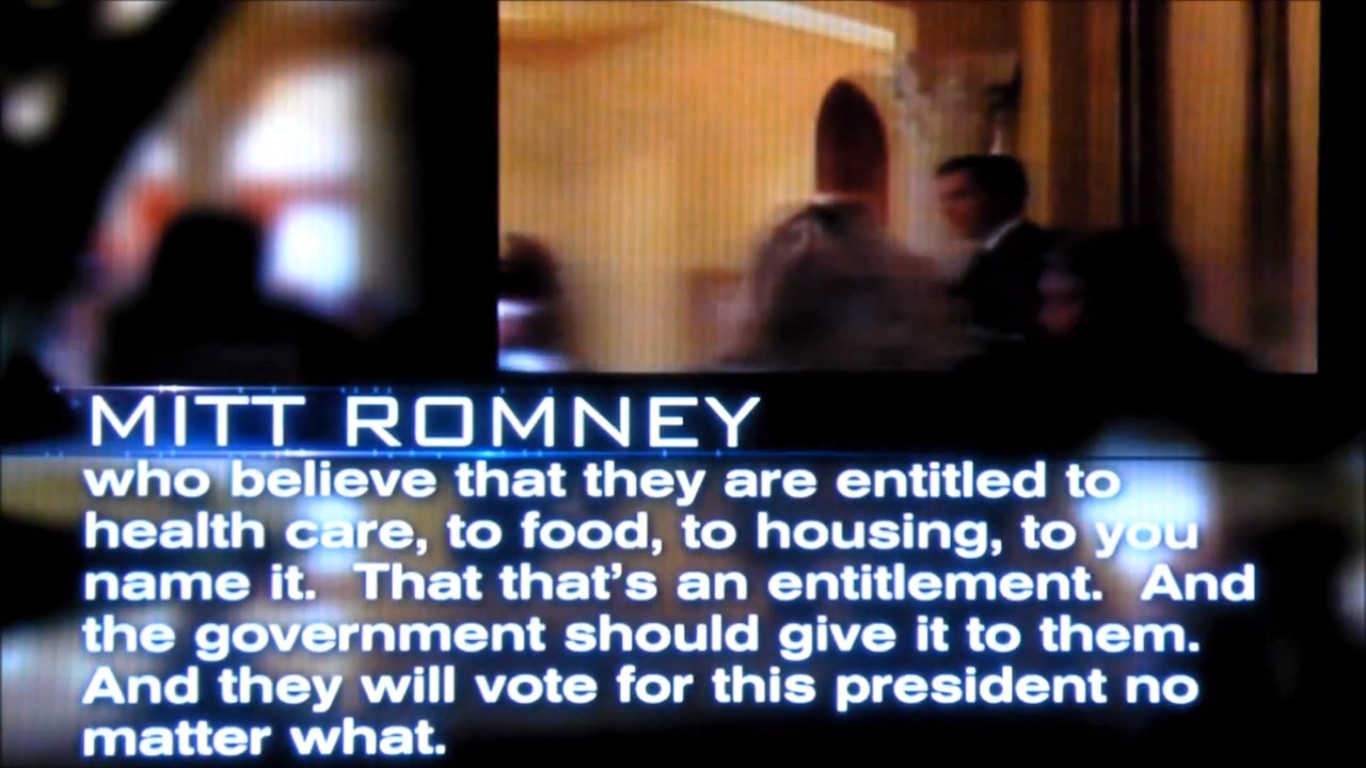
Bits and pieces of a private fundraiser held by Mitt Romney have been leaked to Mother Jones magazine, exposing some blunt talk from the Republican candidate on voters, his campaign and American society.

In one video, Romney argues that it’s not “my job” to win over the 47 percent of voters committed to President Obama, because they are “dependent on government” and he will “never convince them they should take personal responsibility and care for their lives.”

What Romney says in the video will perhaps endear him to some of the base that have thus far been cold to him, because that’s exactly what they think of Obama voters.

But personally, I would have thought Mr. Romney had a somewhat more respectful, and open-minded, attitude toward this nearly half of the American electorate. It’s a bit disturbing to think that, if elected, he’d come into office holding 47 percent of Americans in contempt to this degree.

This is an occasion for national unity, not sniping

This would be a good moment to remember the thing about partisan politics stopping at the water’s edge.

I got a release from Lindsey Graham last night — I’m just now getting to it in my email — that quoted the senator as saying the following:

South Carolina Sen. Lindsey Graham, a leading Republican voice on foreign policy, launched a sharp attack against the Obama administration on Wednesday, saying the president’s lack of leadership would “lead to an explosion in the Middle East.” … The American disengagement, lack of leadership, and leading from behind is leading to uncertainty and doubt on all fronts. … There is no substitute for leadership by the United States and every group within the region is uncertain about who we are and what we believe.”

The thing is, when I watched the accompanying video, for the first few minutes I didn’t hear that sort of tone. Instead, the senator said the sorts of things I would expect a politician who cares about foreign policy to say. He talked about how this should not be allowed to weaken our strong ties to the new democratic leadership of Libya. He stressed that the attack — whether calculated or spontaneous — was the work of a tiny minority who do not reflect our relationship with that country.

He even expressed agreement with what Secretary of State Clinton had to say. And I like that, even though part of it may be the longtime mutual admiration society that Hillary and Lindsey have going.

Then, toward the end, he launched into the GOP talking points about the administration’s alleged failures. About the only thing I might agree with him on is that I wish we were acting more effectively to keep Assad from killing his own people in Syria.

But in his eagerness to criticize, the senator implied, if he did not exactly say, two things he should know are not true:

  1. That somehow the mess of the last couple of days is the administration’s fault.
  2. That the way forward in light of the ongoing “Arab Spring” movement is simpler and clearer than it is.

Given his respectful ties to some of the key people in the administration’s national security team, and the many areas of agreement he has with them, I would think Senator Graham would be hesitant to throw out the people he knows in favor of the uncertainties Romney would bring.

But that’s me engaging in wishful thinking, I guess. Just because Sen. Graham is occasionally an iconoclast, I like to tell myself he can be that all the time. Obviously, I’m not in charge of his re-election in two years…

Looks like Nikki will stay away from SC even more

This is bound to create mixed feelings in people who care about South Carolina:

Gov. Nikki Haley will balance her time between governing South Carolina and stumping for Republican presidential nominee Mitt Romney over the next two months.

Haley’s target audience? Women voters, a critical voting bloc for Romney because of polls that show women favor incumbent Democratic President Barack Obama by a double-digit margin.

“Governor Haley has a very full schedule of job creation and economic development meetings and events in the next two months,” said Rob Godfrey, Haley’s spokesman. “But as much as her schedule permits, she does plan on helping the Romney-Ryan ticket. …

“Mixed feelings” in that our state could use some leadership in trying to pull out of, not only a recession, but our historic near-last ranking in by so many measures. On the other hand, if the only governor we’ve got is Nikki Haley, well… maybe she might as well run off and have her picture made some more, and leave us alone.

I find myself torn between the two ways of looking at it.

‘Sugar high?’ Sounds like someone’s a bit envious of someone else’s post-convention bounce

It appears that the Democrats got a modest bounce from last week’s convention, but the opposition refuses to be impressed, according to the WashPost:

BOSTON — Acknowledging Monday that President Obama has seen a surge in voter support since last week’s Democratic National Convention, the Romney campaign’s pollster likened the bounce to a “sugar high” and argued that the Republican challenger has a long-term advantage over the president.

Neil Newhouse, Mitt Romney’s pollster and senior strategist, wrote a memorandum released to reporters to rebut the conventional wisdom that Romney has fallen behind in the presidential race and to calm any panic among supporters. In the memo, Newhouse wrote that Obama “has seen a bounce from his convention” but contended that the president’s approval ratings are likely to recede in the weeks ahead.

“Don’t get too worked up about the latest polling,” Newhouse wrote. “While some voters will feel a bit of a sugar-high from the conventions, the basic structure of the race has not changed significantly. The reality of the Obama economy will reassert itself as the ultimate downfall of the Obama Presidency, and Mitt Romney will win this race.”

According to several new national polls, after months of deadlock, Obama opened a lead over Romney after last week’s Democratic convention in Charlotte. In a Reuters/Ipsos poll released Sunday, 47 percent of likely voters supported Obama and 43 percent Romney. In a Gallup tracking poll, Obama leads Romney 49 percent to 44 percent, while an automated Rasmussen poll released Monday put Obama at 50 percent and Romney at 45 percent….

“Ultimate downfall?” Really. It looks like maybe Jim DeMint is acting as scriptwriter for Mr. Newhouse. Here I thought we were just facing an election. The Romney team seems to be planning something more on the order of Götterdämmerung. I can see Mitt in his helicopter now, cranking up the Wagner and explaining, “It scares the hell out of the libs… but our boys love it!“

‘She’s a drag, a well-known drag…’

GEORGE: Oh! You mean that posh bird who gets everything wrong?
SIMON: Excuse me?
GEORGE: Oh, yeah. The lads frequently sit around the telly and watch her for a giggle. One time, we actually sat down and wrote these letters saying how gear she was and all that rubbish.
SIMON: She’s a trendsetter. It’s her profession.
GEORGE: She’s a drag. A well known drag. We turn the sound down on her and say rude things.

Many of the speakers at the two political conventions brought out the George Harrison in me. When they came on, I’d only be able to listen for a moment. Then I’d turn the sound down on them and say rude things.

Peggy Noonan apparently kept listening, and then when it was done, wrote down the rude things she was thinking. For my part, sometimes I only went so far as to turn the sound down. That was the case, near as I can recall, with Sandra Fluke. She came on, I listened a bit, then turned the sound down and went back to reading Wolf Hall. So next time I see her, I might confuse her with Anne or Mary Boleyn.

I learned later about what she had to say from reading Ms. Noonan, who characterized it thusly in her column this weekend:

The sheer strangeness of all the talk about abortion, abortion, contraception, contraception. I am old enough to know a wedge issue when I see one, but I’ve never seen a great party build its entire public persona around one. Big speeches from the heads of Planned Parenthood and NARAL, HHS Secretary and abortion enthusiast Kathleen Sebelius and, of course, Sandra Fluke.

“Republicans shut me out of a hearing on contraception,” Ms. Fluke said. But why would anyone have included a Georgetown law student who never worked her way onto the national stage until she was plucked, by the left, as a personable victim?

What a fabulously confident and ingenuous-seeming political narcissist Ms. Fluke is. She really does think—and her party apparently thinks—that in a spending crisis with trillions in debt and many in need, in a nation in existential doubt as to its standing and purpose, in a time when parents struggle to buy the good sneakers for the kids so they’re not embarrassed at school . . . that in that nation the great issue of the day, and the appropriate focus of our concern, is making other people pay for her birth-control pills. That’s not a stand, it’s a non sequitur. She is not, as Rush Limbaugh oafishly, bullyingly said, a slut. She is a ninny, a narcissist and a fool.

And she was one of the great faces of the party in Charlotte. That is extreme. Childish, too.

Unusually harsh language, coming from Peggy “Thousand Points of Light” Noonan.

I didn’t watch Ms. Fluke long enough to form the same impression Ms. Noonan did. But her description of why she found the young woman so off-putting is very familiar to me — it’s very like what I thought listening to non-headliner speakers at both conventions (sorry I’m not remembering any names; I wouldn’t have remembered this one had Ms. Noonan not made such a thing of her). So much of what they talked about just seemed… off-topic. Something they were going on about just to divide their partisans from the other partisans.

What’s interesting about this is that the parties apparently know this. They know the difference between these wedge issues and the central ones that should decide elections. The central issues, the ones that are not non sequiturs, are the ones the nominees themselves, and to some extent their running mates and other top surrogates talk about. There seemed to be a fairly strict line between the pre-10 p.m. speakers and topics, and the ones we heard from and about post-10 — the hour at which the parties got serious about trying to reach beyond their bases to try to win an election.

Are we actually being offered a clear choice between libertarianism and communitarianism?

Back when he was elected governor in 2002, Mark Sanford was an outlier in the Republican Party. He called himself a “conservative,” but his words and actions in his first months in office made it increasingly clear that he was not that at all, but was a rather extreme libertarian — which is to say, a classical liberal.

For years, this put him at odds with most elected Republicans, who were more conventionally conservative. Among people who knew and understood him, his fan base was generally limited to the Club for Growth, the editorial board of The Wall Street Journal, and such anti-public education activists as Howard Rich.

Then came the Republican defeats of 2008. After that, the party went through paroxysms of self-accusation, and the loudest voices were those that said the party’s problem was that it was not extreme enough (especially in nominating iconoclast John McCain), in particular that didn’t hate government enough. And those voices, belonging to Jim DeMint and others, started to gain traction quite rapidly. While they were still calling themselves “conservative” and still do, they were defining the term away from the more traditional meaning that I have long embraced.

Then came the election of 2010, which brought together the elite theorists of the Club for Growth and the lowest-common-denominator populists of the Tea Party, united only by the fact that they deeply despised the idea that citizens can ban together to address their common challenges as a community — that is to say, despised the very idea of government in a free society.

In spite of all that, the Republicans in 2012 chose as their standard-bearer a relative nonideologue. But he only got the nod by the skin of his teeth, after the extremists failed to unite, for more than a few days or weeks at a time, behind a candidate they liked better. And in order to make sure the muscular, energized libertarian elements of the party turn out in November, he chose the most vocal and articulate exponent of their worldview as his running mate.

And so the picture was complete: The GOP ticket was fully onboard with the libertarian agenda. (Economic libertarianism, anyway. Cultural libertarianism has generally been left to the Democrats.)

But who, if anyone, was out there to champion what I see as the viable alternative to that view — communitarianism?

Well, to my great interest, key Democrats started saying some very communitarian things this week. Bill Clinton put it as strongly as anyone:

We Democrats think the country works better with a strong middle class, real opportunities for poor people to work their way into it and a relentless focus on the future, with business and government working together to promote growth and broadly shared prosperity.  We think “we’re all in this together” is a better philosophy than “you’re on your own.”

The former president accomplished two things there: He shoved aside so much of the divisive class-warfare rhetoric we had heard from other DNC speakers (such as the one just before him), and said the one thing that is the simplest possible assertion of the communitarian worldview — that “we’re all in this together.”

At  least — and here’s a huge disclaimer — I think of that as being a purely communitarian statement. Truth be told, there is so little discussion of communitarianism out there that I’m not always entirely sure I understand it, which is why I say I think I have communitarian tendencies, rather than “I am a communitarian.”

But to me at least, “we’re all in this together” isn’t just a description of how the world should be. It is a simple description of the way the world is, and you can’t engage the world realistically and effectively if you don’t recognize it.

But if I liked that, I really liked the things the president had to say the next night. First, there was his use of the word “citizenship.” That probably doesn’t sound like much to you, just another Civics 101 kind of term that you would expect to hear in a political speech. But actually, we haven’t heard it all that much since JFK’s “ask what you can do for your country” speech. You won’t find it, for instance, in the speeches of Paul Ryan or Mitt Romney at the RNC the week before.

“Citizenship” jumps out at me because of something I noticed several years ago — that the radical libertarian wing of the GOP, which now so dominates the party, doesn’t really believe in it. Or at least, doesn’t believe in it in any way I would recognize it.

I wrote about this several years back, in the context of the “school choice” debate. I had noticed something fundamental about the thinking of the people who advocated for tax credits and vouchers: They saw themselves as consumers, rather than as citizens. A citizen understands that he pays taxes to support public schools because they are a public good that benefits the whole society, not just the children who attend the schools or their families. Because he wants to live in a society in which everyone has some education and some ability to support themselves and contribute to the community, rather than having vast swaths of the society being incapable of constructive engagement. By contrast, the “school choice” advocates saw themselves as consumers. They saw themselves as paying for a service with those taxes — and if they, personally, had no one in their families attending those schools (ifthey were childless, or if their children attended private school or were homeschooled), then they shouldn’t be paying for the service. To them, this was irresistible logic — because they related to the world as consumers rather than as citizens.

So the word got my attention. Here’s how the president used it:

But we also believe in something called citizenship — citizenship, a word at the very heart of our founding, a word at the very essence of our democracy, the idea that this country only works when we accept certain obligations to one another and to future generations.

Exactly. But Mr. Obama went beyond that. He went on to use language that seemed directly lifted from a communitarian website or something:

We don’t think the government can solve all of our problems, but we don’t think the government is the source of all of our problems — any more than our welfare recipients or corporations or unions or immigrants or gays or any other group we’re told to blame for our troubles — because — because America, we understand that this democracy is ours.
We, the people — recognize that we have responsibilities as well as rights; that our destinies are bound together; that a freedom which asks only, what’s in it for me, a freedom without a commitment to others, a freedom without love or charity or duty or patriotism, is unworthy of our founding ideals, and those who died in their defense.
As citizens, we understand that America is not about what can be done for us. It’s about what can be done by us, together — through the hard and frustrating but necessary work of self-government. That’s what we believe.

“Rights and Responsibilities” is essentially the tagline of The Communitarian Network.

But use whatever words you want to describe it — communitarianism, citizenship, civic-mindedness, or Donne’s “no man is an island” — the fact is that the president, and Bill Clinton before him, were offering a powerful alternative to the radical individualism that the GOP ticket is offering.

There is still much I find terribly off-putting about the Democrats, all of which was on display this week — the Identity Politics, the unquestioning embrace of abortion on demand, the unrealistic way so many of them still speak of national security (for that matter, their general lack of concern about it, as so many of them prefer to dwell on domestic issues).

But this notion of citizenship, set against a very different view of reality being set forth by the GOP ticket, to me rather powerfully recommends President Obama going forward. Now that he has framed the choice in this manner, I will listen with great interest for the GOP response. At this point, I fear that it is sadly predictable.

Meanwhile, Cardinal Dolan spanked the Democrats on their home field

My favorite moment in either convention came late last night, when one of the commentators on PBS used the word “exegesis” in describing what he’d just heard.

He was referring to Cardinal Timothy Dolan’s benediction right after President Obama’s speech. I had not heard it, whether because PBS didn’t show it or I was out of the room, I can’t recall. But C-SPAN had it, as you see above.

The commenter — I think it was Ray Suarez — was saying that the Cardinal had delivered “a riff” on something. Then he corrected himself, saying perhaps the word “exegesis” was more appropriate. His colleagues were impressed.

I very much appreciate that the Democrats gave the cardinal this forum, only about an hour after ostensible Catholic Joe Biden had roared out his approval of the party’s embrace of abortion. The cardinal said, among other things:

Thus do we praise you for the gift of life. Grant us to defend it. Life, without which no other rights are secure. We ask your benediction on those waiting to be born, that they may be welcomed and protected…

At the end of his prayer, the assembled Democrats responded with a strong “amen,” which was a settler for all those Republicans who think they’re just a bunch of heathens. To what extent all had been listening carefully, I don’t know. But the fact is that as with most public prayers, most of the words were ones they would most likely have agreed with.

The coverage came later, after the assembled media caught their breath.

The cardinal was the one person who spoke at both conventions, by the way.

Oh, what did I mean by my headline above? Well, this morning I saw a Tweet from the Charleston paper that said, “Bishop England beats Porter-Gaud. Story:http://bit.ly/NYyg6j .” So I couldn’t resist responding, “… And Cardinal Dolan thrashes the Democrats. Big night for the Catholics…”

Mackerel-snappers had a big one the night before, too. Among the non-headliners, I thought the speech by Sister Simone of “Nuns on the Bus” probably the most uplifting, least off-putting of the two weeks. Her delivery was beatific, but pulled no punches: After taking apart the budget of another dubious Catholic, Paul Ryan, she said to fervent cheers, “This is part of my pro-life stance, and the right thing to do.”

Both of them expressed what I believe. Which is a big reason why I’m so uncomfortable with both parties.

Obama provides strong finish to successful convention

OK, the quick, overall assessment: However this election turns out, in the short term the Democrats will likely get the bigger convention bounce. They earned it these last two nights.

Yes, there was just as much irritating nonsense at this convention as at the one last week — I turned down the sound and picked up a book to spare myself the aggravation just as many times. But the headliners were stronger. They showed greater conviction, presented more compelling ideas (and, alas, emotions), and I believe did a better job of engaging not only the true believers in the room, but the more important audience at home.

Doubt me? Honestly, now, whatever your political persuasion — do you really think Mitt Romney truly believes all the things he said as much as Barack Obama does, whether you agree with the president or not? And sincerity sells; it connects.

Of course, it didn’t hurt the president a bit that veteran Bill Clinton left him a five-run lead going into the last inning. He just had to hold on to it, and he actually did better than that.

But I’m just repeating what I already said on Twitter. So here are my Tweets as they came to me, starting at 9:02 p.m.:

  • David Brooks just made the good point that if you talk to both sides’ advisors, there’s not that much polarization over national security…
  • Biden says Romney & Obama bring vastly different values to the contest. I wish they didn’t. This nation so badly needs sensible consensus.
  • Tim Kelly ‏@tdkelly Drinking a Red Hoptober by @newbelgium — http://untp.it/NfjegL
  • One ping. One ping only, Vasily…
  • The Daily Beast ‏@thedailybeast Biden: Conviction, Resolve, Barack Obama. That’s what saved the automobile industry.
  • “The finest soldiers in the history of the world.” Hooah, Joe, Hooah.
  • This may be the first time in my life that talk of whacking a guy was applause line at a national convention. Not criticizing, just noting.
  • Benjy Sarlin ‏@BenjySarlin Clinton was about policy. Biden speech entirely about character, through policy lens. Different but very effective approaches.
  • Yeah, but only under a yellow sun… “@scott_english: Biden on Obama: “A spine of steel.” And adamantium claws? #wolverine”
  • Coo-coo-ca-choo… “@TheFix: Biden’s call outs of people in the audience — “Mrs. Robinson” — is hilarious. #dnc2012”
  • Even tho admiral advised against. “@alexcast: Per joe biden, Barack Obama is a man of courage. must be. He gave Biden a live mic.#cnn2012”
  • God love him… “@JKuenzie: Biden says “look” at least as often as “literally.” #DNC2012”
  • Sometimes I get tired of hearing about all the people who lost their jobs in the Great Recession. And I’m one of them…
  • I was gonna say “what are VMAs?” but I looked it up. Oh. “@BlondeScientist: Why in the hell are the VMAs on tonight?!?!”
  • Forrest L. Alton ‏@YoungGunCEO come on Brad, you know you’re a VMA kinda’ guy.
  • I’m not an ANY kind of pop culture awards guy. And I quit watching MTV when they quit showing videos 24/7.
  • I love movies, but hate the Oscars…
  • Commenter on PBS said it looks like Biden WILL stay on the ticket now. Funny thing was, she didn’t sound entirely, 100% certain…
  • I kid about Joe Biden, but I’ve always really liked the guy. And tonight, his performance was full of Joeness…
  • Was that George Clooney just then? The voice?
  • Dan Cook ‏@DanCookSC yes
  • So was that what we got tonight instead of Eastwood?
  • Let the man talk! [during prolonged applause when Obama came out]
  • That critique was dead-on. A philosophy that responds to every situation with a tax cut is surreal, and moronic.. .
  • “Our problems can be solved.” The candidate who more confidently asserts that is the one who wins. Or should win, anyway…
  • Cars going twice as far on a gallon of gas is at least less grandiose than lowering the oceans. Magical, but more achievable-sounding.
  • This is not, and probably won’t be, as exciting as Clinton’s speech. But then, I don’t think it really has to be. POTUS should be cooler…
  • “… and Osama bin Laden is dead.” Matter-of-fact, not cheerleading. As befits the office. More Michael than Santino…
  • “My opponent and his running mate are.. . new… to foreign policy.” Excellent timing.
  • As one who sees POTUS in terms of international relations, I didn’t like that “nation-building at home” bit of pandering.
  • Nothing against nation-building at home, but don’t suggest we’ll do it by turning our backs on the world…
  • “This is what this election comes down to”… Have a feeling we’ll hear that as voiceover on an ad…
  • “Citizenship.” That’s the most welcome word I’ve heard these two weeks.
  • Roll Call ‏@rollcall Obama: We don’t think government can solve all our problems. But we don’t think that government is the source of all our problems.
  • “Responsibilities as well as rights.” Wow. Pure communitarianism in a presidential acceptance speech! Who wrote this, Amitai Etzioni?
  • This isn’t Bill Clinton, but it’s solid, even masterful. More to the point, it’s more powerful, easily, than Romney’s speech.
  • There was much irritating nonsense in this convention, just as in GOP’s. But the Democrats’ headliners have been stronger, more engaging…
  • I don’t know how this ends up, but the Democrats seem sure to get the bigger convention bounce. The headliners were more inspiring, engaging
  • … of course, it helped that Bill Clinton left the closer a five-run lead going into the last inning…
  • One big difference between Obama and Romney, for good or ill, is that you know Obama really believes the things he’s telling us…
  • Yeah. Sorta glad I didn’t end up going up there tonight… “@JKuenzie: And now, the traffic. #DNC2012”

Bill Clinton just gave the best political speech of this century, thus far

Earlier today I wrote something about the contrast that was expected between Elizabeth Warren’s speech and Bill Clinton’s. That was certainly dead on. She gave one of those speeches full of resentments and blame, the kind that makes me dislike political parties so much.

And then Bill Clinton gave a speech that, while lifting the crowd in the arena to their feet, talked right on through them and to all of America, making the case for Barack Obama as no one has ever made it before, in a way that was a feel-good celebration of politics and democracy and this country and the things that make it great.

I can’t remember the last time I heard a political speech this good. Here are my thoughts, via Twitter, as it unfolded. You can see my enthusiasm build from the moment the former president started talking. The Tweets that follow, starting at 9:29 p.m., are mine, except where otherwise indicated:

  • The most warmly positive, uplifting speech I’ve heard tonight so far was from the sister from Nuns on the Bus. It was beatific…
  • Back in the day, when there were 3 networks covering gavel to gavel, I seem to recall less gab and more voting; less show, more action.
  • Wow, they weren’t kidding about this woman [Warren]. Who wrote her speech? Huey Long? https://fpp.3be.myftpupload.com/?p=17980
  • amhistorymuseum ‏@amhistorymuseum Abraham Lincoln was the first presidential candidate to distribute his campaign portrait all over the country. #campaigncollecting
  • … Which you wouldn’t automatically assume would have been to his advantage…
  • Billy’s doing his duty, actually talking about Obama rather than himself. How about that?
  • Good line about “cool on the inside”…
  • “Business and government working together… ” That’s a welcome contrast to Warren’s anti-biz, populist rant…
  • He’s giving the Third Way a hard sell, and doing it well…
  • They’re not quite sure what to make of Clinton’s lauding of Republicans for the good things they’ve done…
  • The speech Bill Clinton is giving fulfills the Democrats’ best hopes (and stills their worst loose-cannon fears). This is impressive.
  • Bill Clinton is reminding American what it’s like to be a Democrat, a winning Democrat, whose politics aren’t based in resentment…
  • Maybe President Obama should let Bill Clinton do the speech TOMMOROW night, too…
  • He may have lost weight, but he hasn’t lost his touch. The Comeback Kid still has it. Maybe some of it will rub off.
  • No, Bill! Don’t say “listen to me…” Shades of the Lewinsky denial. You’re on a roll! Don’t go off course…
  • When Bill Clinton’s talking, it almost sounds like it would be fun to be a Democrat…
  • Warren Bolton ‏@BoltonWarren If nothing else, this will have Obama juiced for tomorrow for sure. Can he deliver?
  • I don’t know, but Bill sure is teeing it up for him. The key to what he’s doing is the confidence, and the sheer joy.
  • He [Obama] just needs to come out cool on the outside, and burning inside for America…
  • Bill is the first person speaking positively to independents tonight — except for maybe Sister Simone…
  • I’ve never heard anyone make the case for Barack Obama this well.
  • The thing about Clinton is, he convinces you he really understands the wonkish details (mainly because he does), and is really INTO them.
  • “It takes some brass.” His second best line of the speech. The best was the “cool on the outside” thing…
  • He knows he’s got them. He can feel it. He can slow it down, or speed it up, and they’re right there with him every second…
  • John O’Connor ‏@johnroconnor I really only needed Clinton 101, not 201 and 315
  • This is the graduate seminar course. This is Bill Clinton under a yellow sun, with all his powers.
  • One of the many things Bill Clinton understands is the importance of talking to the millions of us who are NOT in that room.
  • Bill knows how to tear the Republicans a new one — or two — without making you think he hates them…
  • Warren Bolton ‏@BoltonWarren This is where the preacher, with the congregation firmly in his hands, says “I’ about to take my seat.” Then 15 minutes later …
  • Now he’s schoolin’ ’em on ‘rithmetic…
  • No, don’t shake your finger at us, Bill. It evokes bad stuff. Stick with the good stuff…
  • This speech is the most generous and selfless thing that Bill Clinton has done in his whole life.
  • Bet on America… we always come back… Man, he’s hitting every note, and hitting it just right…

It was amazing. He’s just that good. And I say that as the editor who presided over an editorial board that was tied as first in the country to call on him to resign after he admitted lying to us. But he was always really, really good at this, and I don’t just mean in ways that were good for him. It’s actually good for the country to hear a speech like this. So much of politics these days is depressing, dispiriting. We all needed a lift like this.

Some were complaining that the speech was too long. No. Bill Clinton has given some of the longest, most tedious speeches most of us can remember. But tonight he wasn’t indulging himself. Tonight he was giving.

‘The night Democrats reclaimed “Obamacare”’

I thought this piece at the WashPost was interesting:

There’s been a major development in health-care politics over the last few months. The Obama administration and the Republicans came to an agreement on health reform. Not the law itself — they’re still at each other’s throats over that. But they finally agree on how to refer to it. Nowadays, both sides are calling it Obamacare. And during the first night of the Democratic National Convention, the Democrats talked about Obamacare. A lot.

That was, in itself, a surprise. Obamacare — or, as it’s officially called, the Patient Protection and Affordable Care Act — doesn’t poll particularly well, and it’s believed to have been a key contributor to the Republican victory in 2010. But Democrats appear to think that the politics have changed. Indeed, if the first night of the Democratic Convention is to be remembered for anything aside from Michelle Obama’s speech, it will probably be remembered as the night that Democrats stood up and began fighting for their health-care law.

Well, good for them. It certainly beats much of the divisive nonsense parties embrace at their conventions. Of course, it’s not what we need — it’s not single-payer — but it beats what the Dems’ opposition offer toward fixing our insane system of paying for health care, which is nothing.

On tap tonight, competing strains of liberalism

I thought this piece at the NYT site was interesting, contrasting the two strains of liberalism that compete for control of the Democratic Party these days — personified in two speakers at the convention tonight. An excerpt:

Wednesday, though, begins the hard sell of President Obama to the middle class. And for this task, the campaign has juxtaposed two prime-time speakers — Elizabeth Warren and Bill Clinton, one right after the other — who in their core philosophies represent contradictory, even irreconcilable strains of American liberalism….

Mr. Clinton is the president who made the sustained case to Democrats that they had to be pro-growth and pro-Wall Street, not just to get elected, but also to build a more modern economy. He was the one, as spokesman for the centrist Democratic Leadership Council, who told Democrats again and again that they couldn’t succeed as a party that “loved jobs and hated business.” Mr. Clinton transformed welfare, balanced the budget and declared an end to the liberal era of government, which is why a lot of conservative-leaning independent voters would re-elect him if they could.

As a Harvard law professor during the Bush years, Ms. Warren, who is now a candidate for Senate in Massachusetts, came to represent a rebuke of such Clintonian expedience. Her indictment against the excesses of Wall Street and the abdication of centrist Democrats became popular among a new generation of old-style economic populists (most notably John Edwards and then Mr. Obama), who often cited Ms. Warren’s arguments in making the case that the party had to reverse course from the Clinton years and rein in a business community that was prospering at the expense of the middle class…

Of course, if I had to pick one of them, it would be the Clinton strain. There are things I liked about Bill Clinton, and things I didn’t like. I tended to like him when he was being a Third Way guy, when he seemed to be channeling my main man Tony “New Labour” Blair.

Comments about the first night of the DNC?

The First Lady tells about the "rusted-out" car in which Mr. Obama used to pick her up for dates.

I have to confess I did not watch the convention last night — during the portion of the evening I devoted to television, I watched the last episode of the “Breaking Bad” season from Sunday night — although I plan to catch Bill Clinton’s act this evening. Watch for my comments on Twitter in real time.

It’s probably just as well I missed it all, since I read that last night “was crafted to make a special appeal to women and Latino voters,” which by the logic of Identity Politics means that the Dems weren’t interested in speaking to me.  I used to be a member of the South Carolina Hispanic Leadership Council (really; I’m not making this up), but I ended up resigning on account of, you know, not being Hispanic. So I don’t think that qualifies me. And even if I were a woman, I doubt the way the Dems would speak to me would appeal. Speeches from NARAL are not the way to win points with me.

The highlight seems to have been Michelle Obama’s speech, which I’ve heard described in various ways, but I don’t feel that I have enough of a grasp on it to comment in any way. Well…  except to react to some nonsense I heard this morning on the radio on the subject. Someone was paraphrasing Alessandra Stanley at the NYT as saying, in essence, what a terrible thing it is that in this day and age, a First Lady or one who would be First Lady defines herself in 1950s terms, talking about how she met the candidate, etc.

Listen, folks: I care about what the person running for office has to say, and after that my interest drops off sharply. Were I to care what that person’s spouse thinks — whether that spouse is Michelle Obama, Ann Romney, Michael Haley, or Dennis Thatcher — the only conceivably useful information for me would be any light they could shed on the candidate himself or herself. Since the only reason for that spouse to be on the podium is his or her relationship with the candidate, why would I want to hear about anything else?

And truth be told, probably the only thing a political spouse could say to me that would affect my vote would be this: “Look, I know this guy. Nobody knows him better. Do NOT vote for this joker, not matter what you do.” But so far, I’ve never seen that happen. But it could. Which is why, if I were to run for office, I would not insist that my own better half make any campaign speeches…

But as I say, I didn’t even catch any of these speeches. As to those of you who did tune in last night — your thoughts?

God is all very well and good, as long as he makes himself useful to the cause?

So I noticed on Facebook that a blogger with the Christian Broadcasting Network is making a bit of an issue of the fact that a plank in the proposed Democratic platform that mentioned God four years ago no longer does:

Guess what? God’s name has been removed from the Democratic National Committee platform.

This is the paragraph that was in the 2008 platform:

“We need a government that stands up for the hopes, values, and interests of working people, and gives everyone willing to work hard the chance to make the most of their God-given potential.”

Now the words “God-given” have been removed. The paragraph has been restructured to say this:

“We gather to reclaim the basic bargain that built the largest middle class and the most prosperous nation on Earth – the simple principle that in America, hard work should pay off, responsibility should be rewarded, and each one of us should be able to go as far as our talent and drive take us.”

Yes, that could have been the work of an overzealous secularizer, but it could also have been inadvertent. After all, “God-given” (something a Deist could well have said, by the way, not exactly a Bible-thumping sort of mention) wasn’t just deleted, as such; the whole sentence was recast.

I was more interested in what the blogger went on to cite as the platform’s only remaining mention of “faith:”

“Faith has always been a central part of the American story, and it has been a driving force of progress and justice throughout our history. We know that our nation, our communities, and our lives are made vastly stronger and richer by faith and the countless acts of justice and mercy it inspires. Faith-based organizations will always be critical allies in meeting the challenges that face our nation and our world – from domestic and global poverty, to climate change and human trafficking. People of faith and religious organizations do amazing work in communities across this country and the world, and we believe in lifting up and valuing that good work, and finding ways to support it where possible. We believe in constitutionally sound, evidence-based partnerships with faith-based and other non-profit organizations to serve those in need and advance our shared interests. There is no conflict between supporting faith-based institutions and respecting our Constitution, and a full commitment to both principles is essential for the continued flourishing of both faith and country.”

Anything strike you about that? Here’s what struck me: that the value of faith is set entirely in terms of how it furthers the political and social agenda of those writing the words. “a driving force of progress and justice… critical allies in meeting the challenges that face our nation and our world… We believe in constitutionally sound, evidence-based partnerships…” In other words, there is no particular inherent value; religion is only useful insofar as it is, well, useful.

Which isn’t exactly the way most people of faith would look at it. In fact, they’d be more apt to evaluate a party in terms of the degree to which it further’s God’s, or Allah’s, will. This seems the other way around, more like, God is good, but only when he votes our way.

I in no way malign the Democrats by interpreting the paragraph this way, though. Does anyone doubt that Republicans try to use the Almighty in the same manner? The Dems are just being franker about it. The main difference is that Democrats feel that they have to go through all kinds of explanations as to why it is, too, constitutional for them to be talking about faith.

Democrats ask Nikki to come home soon, please

Mia Butler Garrick and James Smith urge Nikki Haley to come home. That blinding light is emanating from the direction of the governor's vacant office.

Alleging that she is now entering her third week of absence from the state for political purposes, Reps. James Smith and Mia Butler Garrick, both Richland County Democrats, stood outside Nikki Haley’s office this afternoon and asked her to return and do the job she was ostensibly elected to do.

Among the points the two representatives made about the gov:

  • The state’s unemployment rate is climbing.
  • Her trips have been purely political.
  • Her activities don’t even have anything to do with South Carolina politics, but are purely national.
  • She isn’t really benefiting Mitt Romney doing this, but merely herself.
  • They fully understand that a governor would go to her own convention, just as SC Democrats are now flocking to Charlotte — but she doesn’t have to spend the week attending theirs as well.
  • No other full-time state employee — a teacher, say, or a DHEC worker — would be able to take such a purely personal extended vacation, at least not without being fired.
  • It is unclear who is paying for her junkets.

I had not realized that the gov was planning on spending all of this week out of town as well. For that matter, I had not known she stayed in Tampa after her speech, but that would be par for the course.

It’s also far from unprecedented for a governor to visit the opposing party’s national convention, when it is in a neighboring state. I remember seeing Carroll Campbell at the DNC — the one Don Fowler ran — in Atlanta in 1988. (It was kind of a hoot because Campbell — or maybe his press guy Tucker Eskew; I forget — noted that he didn’t bring with him nearly the extensive security retinue that Lt. Gov. Nick Theodore had with him there all week, complete with a command post set up on the ground floor in the delegation’s hotel.)

It’s a very tacky partisan practice, this business of trying to spoil the other side’s celebration — I’ve thought so ever since I saw Campbell do it — but it’s certainly not unusual.

But, noted Mia and James, Nikki is spending the whole week up there for the “counter-convention,” doing various national media interviews, with her schedule for the week showing her having no scheduled events here.

That’s hardly fair to the governor, I pointed out. If practically the entire retinue of national political media — Nikki Haley’s constituency, the people who elected her — are just up the road in Charlotte, how could anyone expect her to stay down in Columbia? After all, anyone who voted for her expecting her to do anything other than just what she is doing at this moment was sadly deluded.

Precisely, said Rep. Smith.