Category Archives: Personal

Just don’t want her making any mistakes…

"Mama, will you make the cake for my wedding?"

The picture above is far from the best I’ve shot of the Twins, but it perfectly illustrates my story. It was taken at the very moment in question.

I met several members of my family at the State Fair at lunchtime today. The Twins were there. I think they were the two tiniest people actually walking around as opposed to being in strollers. They were turned away from one kiddie ride for being too short — “Maybe next year,” the carnie told them.

Just before I left them to head back into town, they were admiring decorated cakes submitted for Fair competitions. While Twin B was still looking, Twin A turned to her mother — who is into cake decorating as a hobby — and asked, “Mama, will you make the cake for my wedding?

“Of course,” my daughter said. “Who are you going to marry?”

The sweatheart started to gaze off into the distance, but before she could say anything, my wife (who had been on this subject with her before) cut in:

“You’re NOT waiting around for Prince Charming. Remember, we talked about that. You’ll make your own fortune in the world.”

Poor baby. All they want to wear is princess dresses — and tutus. I don’t know how my wife, or my daughter, or whoever dressed them this morning even got them both into jeans — perhaps because they were matched with pink tops. Twin A recently refused to wear shirt-and-pants style pajamas any more, causing my daughter to order a new nightgown by overnight delivery. Because, you see, that’s what girls wear.

But I think my wife is trying to keep the child from making the mistake she made. She knew better, but I was just so dashing, riding in and swooping her away like that…

Happy Birthday, Sheriff Lott!

At breakfast at the Capital City Club today, I was surprised by the staff with this. The sheriff, who is on the Cap City board with me, was NOT there to have "Happy Birthday" sung to him. Ha.

Friday night, my wife and I were at a social event at the Capital City Club with my parents. Seeing Sheriff Leon Lott there, I went up to him and said, “Hey, twin. We’ve got another one coming up. We’re getting old, aren’t we?”

Long-time running joke. Leon and I were born on the same day, October 3, 1953.

When I got back to our table, my wife introduced a twist on this that I hadn’t heard before: “You two actually sort of look alike. Something in the shapes of your faces. Maybe…”

No, I said, indicating my mother sitting there. If we were separated at birth, she would certainly know… Not necessarily, my wife

Quick! Which twin is this?

said. Back then, women frequently weren’t conscious during childbirth. My mom, sitting across the table with her back to the amplified entertainment, didn’t say anything — presumably because she couldn’t hear the conversation. I could barely hear us myself.

Or… now that I think about it later, is there another explanation for her not responding?

In any case, I can understand how people could leap to such a conclusion. I’m sure that folks look at me and see a guy who, were he a cop, would be named “South Carolina’s Toughest Cop.” Twice. There’s just that certain rugged je ne sais quoi (memo to self: tough guys probably don’t say, “je ne sais quoi“) that we share.

The resemblance is so uncanny that I’ve doubled for him on stage. OK, maybe that’s not the reason, but it actually happened. When the Sheriff couldn’t make it for his cameo in the Workshop Theater production of “The Producers” back in 2009, I filled in for him. Really.

Anyway, on Saturday I got my annual card from Leon. I am so impressed by people who do that. I have enough trouble remembering to buy cards for my actual family. By that time, of course, it was too late to buy one and get it to him by Monday.

So this will have to do. Happy Birthday, Sheriff!

Welcome new advertiser Palmetto Citizens FCU!

When I first went to work at The State in 1987, I immediately opened an account with the newspaper’s credit union. In our old building there in the shadow of Williams-Brice Stadium (it now houses part of S.C. ETV) it was located in what I remember as practically a closet in the Human Resources department — a cubby behind a sliding glass door and curtain.

Perhaps my memory exaggerates. In any case, it was small. But it wasn’t there for long. The company credit union soon merged with Columbia Teachers Federal Credit Union — which had been formed in 1936 when 10 individuals all chipped in $5 apiece. Columbia Teachers opened a branch just down the street from us near the intersection of Shop and George Rogers (or is it Assembly there? hard to tell), and put an ATM in the basement of our building.

By this time, the credit union had expanded well beyond just Columbia teachers, and in 2001 changed its name to Palmetto Citizens Federal Credit Union.

They’ve still got my money — what there is of it — including the account where I put revenues from the blog. Which will, for the next year, include payments from the credit union itself, for the ad you see at right. Which has a neat sort of circularity to it…

In any case, I’m pleased and proud to welcome a very fine community organization, Palmetto Citizens Federal Credit Union, to bradwarthen.com.

Does everything come in twos now?

Above you see the rather startling double rainbow over Columbia last evening, shot through one of the front windows of Yesterday’s. Below you see the more earthbound view from several moments earlier.

The gray Jetta across the river — I mean, street — belongs to my daughter-in-law. I had invited her and my son and youngest granddaughter to Five Points for dinner last night. As we were eating, we were aware of how hard the rain was falling outside. Then, we noticed a crowd gathering to look out the the window. Was there a fire?

I went to check, and got the pictures. And yes, their car was flooded. Which makes me feel pretty bad, since if I hadn’t asked them out, their car would have been high and dry in their driveway.

We had to take them home — the parking lot was high enough to be out of the floodwaters, and that’s where my Buick was. Then we had to bring my son back for the bailing. The car started, but it’s saturated.

As you’ll recall, this is the second time in three days that a car belonging to a member of my family has been drenched by the chronic floods of Columbia. (My wife’s car started after the flood receded, but there’s still water squelching under the carpet, and it started to smell over the weekend. We kept trying to sop up the water and air it out, but it kept raining.)

My eldest daughter (unlike me, a Columbia resident) said last night, “I’m not someone who normally says this, but what am I paying taxes for?”

Indeed. I saw Cameron Runyan this morning and advised him, “Here’s a city issue for you.”

This is totally unacceptable. As we were leaving, we saw the business owners fighting the water in their shops. Shoes were floating around in a shoe store. Lights were on everywhere on this Sunday night.

Five Points is a gem for Columbia. But it’s kind of hard to keep a business going when there are whitecaps in the street.

It wasn’t just Five Points last night, of course. I saw someone else stalled in Shandon after the waters receded. And state GOP Executive Director Matt Moore Tweeted this, at about the time I Tweeted out the double rainbow:

Water 6 feet deep on Leesburg Rd, in@columbiasc #sctweetshttp://yfrog.com/h8ba7gcj

That’s no everyday occurrence — or rather, it shouldn’t be. That kind of flooding in Louisiana inspired Randy Newman to write this wonderful song 50 years later:

The river rose all day
The river rose all night
Some people got lost in the flood
Some people got away alright
The river have busted through clear down to Plaquemines
Six feet of water in the streets of Evangeline…

Let me leave you with a theological question: If one rainbow means it’s not going to flood any more, is a double rainbow a double guarantee? Or is it a toggle sort of thing: One the promise is on; two it’s off? Is it like adding positive three to negative three, so you end up at zero?

In Columbia, I fear that may be the case.

Another snapshot of what we were thinking 10 years ago — what I was thinking, anyway

I almost forgot that today was the 23rd. Weeks ago, when I was digging up columns from 9/11/01 and the days after, I also hunted for this one, which ran 9/23/01.

It was unusual, because I was trying — rather indirectly, as I look back — to express something about the way I had reacted to the attacks earlier in the month, on a personal level.

I  knew there was a lot of emotion in our country — shock, grief, anger, fear. And I realized that I wasn’t feeling those things as sharply as a lot of other people seemed to be. Part of that is my personality, and my habit. When something huge happens in the world, rather than internalizing it, I tend to think, Here’s something to be figured out, and commented on. This causes me to be out of sync with a lot of readers sometimes.

But there was more to it than that. Several months before, my wife was diagnosed with breast cancer. It had already spread to her liver. Pretty much all the emotions I had to deploy were devoted to that, and to what our whole family was going through. I was interacting with the larger world, but in a muted sort of way. (Maybe “muted” isn’t the right word. I just knew my reaction was different from what it otherwise would have been.)

Within our family, we didn’t know what was going to happen, and we were taking it a day at a time. Now, 10 years later, she’s doing great, except for having a nasty cold in the moment. I can hear her in the other room as I type this, talking to her brother on the phone. Thank God, again and again.

Anyway, here is my attempt at the time to wrestle with both that, and what was happening in the wider world. You’ll see emotion in it — some anger, for instance. But also detachment, even with echoes of fatalism, that you might find it hard to relate to. Here it is:

THOUSANDS OF PEOPLE WERE KILLED BY HOPE – THE WRONG KIND

The State – Sunday, September 23, 2001

YOU KNOW WHAT killed those thousands of innocent people in the World Trade Center, and on the planes that plowed into them?

Hope.

Oh, I know what you’ll say, and you’ll be right: They were killed by murderous, merciless fanatics who hate Americans. But those fanatics couldn’t have succeeded if the crew and passengers aboard those two planes hadn’t been clinging to hope.

There is, of course, no way to know exactly what they were thinking. But it’s reasonable to assume that it’s pretty much what you or I would have thought under similar circumstances:

If I just sit still and do what the hijackers say, maybe they won’t hurt me or anyone else. We outnumber them, and they’re armed only with knives, but there’s no sense in trying to overpower them; somebody could get hurt. They’ll land somewhere, and make their demands, and once we’re on the ground, maybe they’ll let us go.

Their hope was in vain. They had no way of knowing that. And so they, and thousands of others, died – the victims of hope.

I find that thought repugnant. After all, life is nothing without hope. The absence of hope is despair. Isn’t it?

But then I realized there are different kinds of hope. There’s the passive kind, in which you do nothing and hope everything will be all right. Then there’s the active kind, in which you have the courage to do something, even when taking action can be difficult, painful and risky, in the hope that you can make things better – for others if not for yourself. That’s the kind of hope that is more likely to be paired with faith and love. It’s real hope, not the false kind.

The people on those planes that were turned into guided missiles clung to that false hope because they lacked critical information. By contrast, the folks on Flight 93 knew that if they sat still, hoping things would turn out all right, they would die for sure. They knew that because they had heard, via cell phone, what had happened in New York. So they tried to stop the hijackers.

They all died anyway. But not in vain. They prevented the deaths of untold others.

They acted because they had information that helped them understand something soldiers learn in the bitter crucible of combat. The key is to give up the false hope that if you do nothing, you and those around you will be safe. It’s a hard thing to do in combat. It’s a hard thing to do under any circumstances.

When my wife discovered she had breast cancer several months ago, and within three weeks learned it had spread to her liver, we lost that old, familiar false hope – the kind that makes you live your life blithely, thinking you’ve got all the time in the world, as long as you don’t take unnecessary chances.

Now, we know that each day is a gift from God, not some right that we’re entitled to because we’re middle-class Americans. We know that we have to make the most of it, for the sake of others as well as for ourselves. We know that we have to fight. And we have fought. That is, my wife has. She’s the combat soldier here; I’m just support services.

She has held back nothing in this battle. All weapons have been thrown into the fight – chemotherapy, surgery, chemo again. We’re not sure what else will be necessary, but we’re assuming radiation. We have collected invaluable intelligence through a wearying series of tests. And she has terrible scars, most of them hidden.

But the fight has gone well. The cancer is at this point on the run. We rejoice in this, and continue to live our lives – hopefully. But we don’t slide back into the old, deceptive kind of hope. We can’t afford that now. We know there will never be a time when we can be complacent again.

The world has a cancer , and it has struck at the vital organs of this nation. Even when we root out the visible tumors, we’ll know that microscopic bits of it can live on to strike at us again.

A lot of Americans haven’t undergone the necessary change in attitude to fight this cancer. They want guarantees that action won’t lead to further pain. They want to know there’s an exit strategy. They want to cling to false hope, or none at all.

But there are no guarantees. The nation will just have to do the best it can, acting in as decent and humane a manner as possible while doing everything within our power to root out the disease – even when it causes pain and has sickening side effects.

That’s a huge challenge, but we’re going to have to find a way to meet it.

The alternative is to cling to the old, false hope that if we just do nothing, the terrorists won’t hurt us. We now know where that kind of hope leads.

Some of you will notice themes that we would later argue over a great deal on this blog. But I didn’t post this to have another argument.

And I didn’t just post it to reminisce about personal matters. I see it as a sort of artifact, not only of what I was thinking at the time, but to provide a snapshot in time, a time of limbo between the attacks and the beginning of our war in Afghanistan. Before the Patriot Act. Before the anthrax scare.

I was reminded to post this tonight by a documentary my wife was watching about what happened on the actual day of the attacks. We’ve gone over and over that ground in recent weeks. Something I think a lot of us have forgotten is what it was like to be living through the time — the weeks, the months, even the next year or two — after that. The mind naturally amends, in light of facts learned subsequently. I know that when I went looking for this column, I remembered it a little differently from what I actually found when I read it. I found that interesting. I thought you might, too.

What I wrote later in the day on 9/11/01

Yesterday, I showed y’all what I wrote in the first hour, more or less, after learning of the attacks in New York and Washington 10 years ago. That raw, stream-of-consciousness piece ran in the “extra” that The State put out that day.

As soon as I had handed that to the folks putting that special edition together, I turned to what we would say for the next day’s paper — for Sept. 12. Then, almost as quickly, but with the benefit of a couple of more hours to let the news sink in, I wrote the following column.

Still nothing I would hold up as one of my best pieces of work, but it has its moments. For me. See what you think. And remember again: This is not a piece written with the benefit of years of reflection:

NOW THAT REALITY EXCEEDS FICTION, WHAT SORT OF ENDING WILL WE WRITE?

State, The (Columbia, SC) – Wednesday, September 12, 2001

Author: BRAD WARTHEN , Editorial Page Editor

WE’RE IN TOM Clancy’s world now.

Mr. Clancy is derided as a writer by critics for many reasons, one of them being the fact that his plots tend to be so fantastic and contrived. Take his novel Executive Orders. It was too much to be believed. It opened with a 747 having been deliberately flown into the U.S. Capitol, shutting down the government. This is followed by a series of coordinated terrorist attacks that result in thousands of civilian deaths on American soil. And for most of the book, no one knows who is doing this to us, or why.

We now know what that’s like. In fact, what we are now facing is worse than Mr. Clancy’s fevered imaginings.

It may seem unbelievably frivolous to be thinking about pulp fiction at a time like this, but my mind keeps returning to it, and partly because this seems so much like something from the realm of fiction – or because I wish it were.

It certainly outstrips anything that’s happened on any one day in this nation’s real-life history.

The comparisons to Pearl Harbor are inevitable. But in so many ways this is different – and worse. The death toll is larger, and the bodies we’re counting – and will continue to count for some time – aren’t wearing uniforms. They didn’t sign up to fight. They were just going to work, in what they thought was a free and peaceful country.

It’s also worse because we don’t know where to go with our grief and our rage. On Dec. 7, 1941, those sailors looking up at the red suns on the wings of the planes that were killing their buddies knew exactly what to do – and so did the rest of the nation.

I wonder if we’ll ever know what to do about this, in the same, ultimately satisfying sense of being able to restore peace and security to our nation and world. Oh, when we find out who did this, there’s no question about what we’ll do in the short term. Give us a target, something to shoot back at, and it will soon be nothing but smoke and ashes.

It will be a very short war. But what will we do when it’s over? How will we deal with the other disaffected, unconnected people around the world who will take inspiration from Tuesday’s events? What can we do, and what will we do, about the fact that there are people who hate us for no better reasons than that we are strong, wealthy and free?

Pearl Harbor isn’t our only comparison. People have mentioned the explosion of the Challenger as being comparable – then, too, the nation watched in helpless horror as fellow human beings died, in real time. But as awful as it was, there were only seven dead. And we figured out how to fix it. It was a simple problem of engineering.

Better O-rings won’t take care of this.

There are no precedents. Nothing in our past was quite like this. Even the Civil War, the most traumatic event in our collective experience, was in a sense less unsettling, in that everyone had a clearer understanding of what was going on.

Just as we can take little comfort from the past, our future offers no solace. It’s certainly not going to be anything like what we expected.

Some of the changes will come only if we’re smart enough to make them happen ourselves. Americans are going to have to start caring more about foreign affairs, if we’re ever going to deal adequately with this challenge. We can’t just fire a few cruise missiles and then hide behind a magical “Star Wars” shield. We’re going to have to engage the world – or at least, we’re going to have to demand that our elected leaders do so. And those political leaders are going to have to set aside a lot of their petty, partisan differences – or we’re going to have to replace them.

In other ways, some kind of change is inevitable, and all we can do is pick between unsavory choices.

From now on, this nation will be either less safe or less free. The openness and the freedom of movement that we take for granted make us enormously vulnerable, a fact that is absurdly obvious today. I suspect that at least in the short term, we’ll choose being a little less free in order to be a little safer. And that’s a sad choice to have to make.

I said we’re in Tom Clancy’s world. That’s true up to a point. The biggest difference is that I know how the book ends – once Jack Ryan and the other fictional protagonists figured out who was attacking the United States, they made war upon them with devastating effectiveness. In the end, the nation emerged stronger than ever.

What will happen in real life? Our capacity to make war is undisputed. But in the long term, how will we ever be the same?

The fact is, we won’t be. Our challenge is to emerge as something better than we were, not something worse.

The first words I wrote after the planes hit

I think I’ve told this story before, but to recap…

In 2001, the senior staff of The State — the heads of all the newspaper’s divisions (including news, advertising, circulation, HR, finance, production, marketing and of course, editorial) — met with the publisher ever Tuesday morning at 9. On Sept. 11, 2001, we had just sat down when someone from the newsroom came to the door seeking John Drescher, who was then our managing editor. John told us that a plane had hit the World Trade Center, then left the room.

We had it in our minds that it was a big story, and certainly John needed to get started on it, but we were picturing (at least I was) another confused amateur pilot in a Beechcraft or something. The WTC bombing of several years earlier crossed my mind, but I didn’t take it seriously yet.

It seemed we had just resumed the meeting when Drescher burst back in and told Executive Editor Mark Lett (News and editorial each had two editors who were on Senior Staff. The newsroom was represented by Lett and Drescher, while Associate Editor Warren Bolton joined me in representing editorial) that a second plane had hit the other tower.

Now we knew it was a coordinated attack  on the United States.

That was it. Meeting over. Everybody jumped up. A few of us huddled over by the window and discussed putting out an “Extra,” before moving on to putting together the regular paper for the next day. I asked whether they’d like a column from editorial, just to inject a bit of opinion into the special edition. They said “yes,” and I went to get to work.

The first job was to get some sort of sense of what was happened — I mean the total picture, not just the Twin Towers (which probably had not yet collapsed as I began). That wasn’t easy. A  lot was happening at once — the Pentagon getting hit, the Capitol evacuated, the president up in the air, somewhere. And then there were some the unconfirmed reports that later proved to be untrue — I don’t even remember the details of them now, some sorts of smaller incidents going on in the streets of Washington. Once they were discounted, I forgot them so my brain could process all the other stuff going on.

Once I turned to my keyboard, it took me about 20 minutes to write the following. That didn’t keep Drescher from sending up messages from the second floor: Where’s the copy? We’ve gotta go. Of course, all news really had to do is grab the stuff coming in and put it on a page. I had to think about what it meant, on the basis of alarmingly incomplete information, and write it.

So you might say this was written in even more of a hurry than a similar number of words on the blog, and amid great confusion and a certain amount of duress. You can read that in these words. There’s some emotion, and some thoughts, there that wouldn’t have been there a day later, or even a few hours later. Very stream-of-consciousness. I wince at some of it now. But it’s a real-time artifact, at least of what was going through my head that morning. See what you think:

AMERICA WILL FIND A WAY TO PREVAIL AGAINST COWARDLY ENEMY

State, The (Columbia, SC) – Tuesday, September 11, 2001
Author: BRAD WARTHEN, Editorial Page Editor
Sometime within the next 24 hours, no doubt, some television talking head somewhere will say, “This doesn’t happen here.”
Yes, it does. It has.
It’s happened before, in fact. It just wasn’t this close to home.
We remember Pearl Harbor. We’ll remember this, too.
The question is, what will we do about it?
Two nights ago, the nation delved back into its history with a celebrated media event, the premiere of the television version of Stephen Ambrose’s “Band of Brothers.”
We marvel at how a previous generation responded to an unprecedented crisis – a sudden attack by a ruthless, remorseless enemy. We think of those people as the “greatest generation,” and they deserve that appellation because of the way they came together to settle their own crisis and secure our future.
And we all wondered: Are we like them? Do we have it in us?
We’re about to find out.
We’re about to find out if we can snap out of shock, pull ourselves off the ground, set our petty differences aside, and come together as a nation to deal with our enemies.
For now, there is no question that we have enemies. And these enemies are in many ways different from Imperial Japan. In some ways, they are worse.
Pearl Harbor was an attack upon a distant outpost of American military power. The attack, as sudden and dishonest and vicious as it was, was at least an attack that made strategic sense in traditional military logic. And while there were civilian casualties, the obvious primary target was our fighting men and their machines of war.
This time, there is no pretense of such rudimentary “decency,” if you want to stretch so far as to call it that.
This time, civilians were the target every bit as much – if not more so – as our men and women in uniform.
This was a strike – and a temporarily successful one – at the chief power centers that have given this nation the strength to stand astride the world as its only superpower.
We are the world’s largest economy, so they struck, with devastating effect, at the very symbolic heart of that strength.
We are the undisputed military champion of the world, guarantor of security not only for this nation but for the rest of the globe. And this time they struck not just battleships and sailors, but the nerve center of our military colossus.
The greatest gift this nation has given the world is our form of democracy. And they have shut down and evacuated our Capitol and the White House. The home of the most powerful man in the world stands empty, surrounded by nervous men with automatic weapons and itchy trigger fingers.
The nation that gave the world flight is frozen, earthbound, at a standstill.
We are stunned. This attack has been devastatingly successful. We don’t know who did it, and we don’t know how much there is to come.
Our response will have to be different from the response after Pearl Harbor. This appears to be a different kind of enemy – the worst kind of coward. An enemy who strikes, and ducks and runs and hides.
How to prevail against such an enemy and restore peace and prosperity to the land is not immediately apparent.
But we will find a way. This is the same nation that was laid low 60 years ago, by an enemy who thought we lacked the will or the know-how to stop them. They were wrong then, and they’re wrong now.
We may not be the greatest generation, but we are their grandchildren. We are Americans. We are shocked, and we will mourn.
But then we’ll dust ourselves off, and find a way.

Later, I briefly attended a newsroom meeting in which they were talking about the next days paper (the only time I remember doing that during my years in editorial), and then turned to directing my own staff and writing stuff for the next day. I’ll show you that tomorrow.

The MB strip is still the MB strip…

Last weekend, I took my eldest granddaughter (the one you last saw in England) with me to see Ocean Boulevard in Myrtle Beach. I knew she had seen “Shag, the Movie,” and I thought she might want to see the real thing — within limits, of course. She had had a hard day. She had suffered multiple jellyfish stings earlier that day, which was pretty traumatic, but she seemed largely recovered, so we drove up to check it out. (She’s OK.)

I had expected not to find much, since they tore down the Pavilion several years back. But except for that former landmark (and the amusement park across the street) being replaced by a gaping hole in the night, things were pretty much the way they had been back in the day. The people in the cars crawling slowly up and down the strip were full of people who were more like tourists than the Surging Youth of Shag, or American Graffiti, but at least for a block or so there, it all felt about the same. More henna tattoo and piercing stands than I had remembered, but it was all in the tacky spirit of the thing.

Pushing our way through the throngs on the sidewalks, I said, “Kinda like London, huh?” She was too kind to say, “Not a bit, you old fool.”

We stopped on the street to get cotton candy, and there it took awhile, because there was just this one guy working behind the window. One big, hulking guy with a shaved head, a gold chain, and a Fu Manchu mustache. And a T-shirt, which you can see above. A guy standing in line outside made catty remarks about the man in the booth, but was careful to do so outside of his hearing.

I thought that image kind of captured the spirit of the place, so I share it with you.

Guy’s back! Thanks for your concern, everyone!

Here he is, about an hour after he got back. Mostly dried off, but still worn out. Here's he's heading down the porch steps for a bathroom break. Afterward, he refused to climb back up, but lay down in the grass.

Well, he just turned up in our yard! Wet, bedraggled and much the worse for wear. I had been unable to sleep, and had moved to a recliner in our TV room at about 5:45. About an hour later, I thought I heard a feeble scrabbling at the front door. I opened it, and saw no one. I called his name, before realizing it was a little early for my neighbors.

I looked out the back door — we had kept the storm door propped open all night (inviting him to scratch on the wooden door) and the porch light on. I looked out, saw nothing, and with the gathering daylight turned off the porch light and closed the door. Just then, my wife got up, went to the door right behind me, and then I heard her say, “Hello, buddy!”

He looked like the proverbial drowned rat, and had to struggle to get up the steps. I’m guessing that’s why he hadn’t been scratching on the back door. But he’s inside now, eating the dinner he missed last night.

Where in the world he’s been I have no idea. But he must have gone pretty far before finding his way home. When I was a kid, Disney would have made a movie of such a trek.

So I guess I won’t be putting up those posters I made a few hours ago, and was waiting to put up in daylight.

Thanks so much for the kind concern of so many of you — Burl and Mark and Bart here on the blog last night, and then so many people who reTweeted my appeal or expressed concern on Twitter last night, including @PhilBaileySC, @ToddKincannon, @courtherring, @dphamilton, @bryandcox, @AliNBCNews, @Erinish3, @asnowrose, @nettie_b, @BethBaldauf, @RebeccaKaz and @billy_simons. And Kristine Hartvigsen, Judy Cooper and Cheryl Levenbrown via Facebook. Yep. Folks as far away as Memphis and New York were at least offering sympathy. People closer to home were spreading the hue and cry.

Maybe that’s not why he made it back, but certainly not for lack of good intentions. There are a lot of nice people in the world.

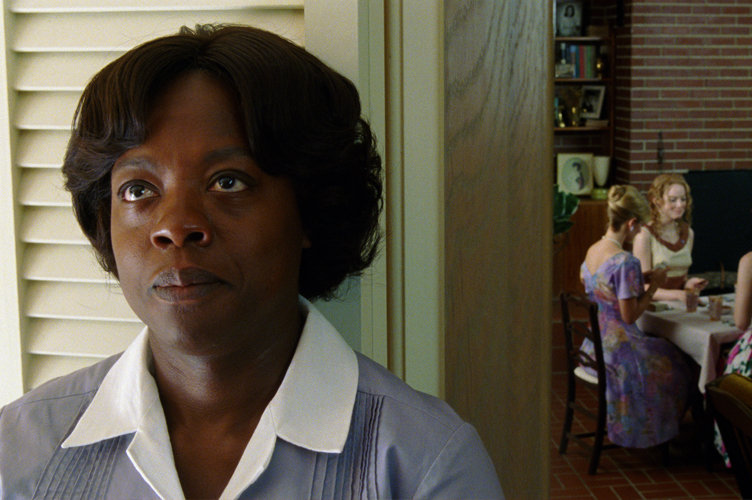
Saw “The Help” last night…

I don’t get to the actual movie theater anymore. Even though I’ve largely cut off the firehose flow of entertainment into my house, between Netflix and the DVDs I own (most recent acquisition: a Blu-Ray of “True Grit”), I’ve got more movies to watch than I really have time for — without paying those ridiculous ticket and concession prices.

But I have seen five movies this summer, which is unusual for me. Here they are, in order:

  1. “Thor“
  2. “X-Men: First Class“
  3. “Green Lantern“
  4. “Captain America“
  5. “The Help“

Oops, did I give you whiplash there? Did you think you knew where you were going and then, WANG!, a sudden change of direction.

Well, I went to the first four with my son, because of our shared interests in comic books, and the last one was my wife’s idea. We went to see it for our anniversary last night.

I went thinking, “This is my anniversary present, because this is a chick flick,” but I enjoyed it. And not just because of the views of that social outcast “Celia.” It was just a well-told, real-life story about people. Of course, I guess a lot of things would look like that after the other four movies I saw before it. (Best of the bunch? “Captain America.” But I expected that. The one that most exceeded my expectations? “Thor.”)

Something that struck me at the end, though: During the credits, I got up and looked around, and noticed two things. Most of the audience was female, which I had expected. And most of the audience was white. I found myself wanting to interview the audience, to get their impressions, and ask how it spoke to them and their lives. Did it match their memories? How do they think life has changed since then, and how stay the same?

More than that, I wanted to ask black folks who weren’t there: Why not? I can guess some reasons why not, but I’d probably be off-base. Then again, this audience, while numerous, may not have been representative. This was out at Harbison. Demographics would have been different somewhere else. Probably.

But I didn’t bother anybody with questions. It was our anniversary.

Last anniversary, we went to a bourbon tasting at the Capital City Club. That is to say, we went out to dinner at the club for our anniversary, and before that there was this bourbon tasting that was free to members (I think I’m remembering that right), so I managed to talk my wife into attending. It was fascinating. The speaker was a great-grandon of Jim Beam, and a very colorful and knowledgeable guy.

This year, we decided on a more low-key celebration. And “The Help” served the purpose well. It was particularly meaningful because the central character has the same last name as my wife’s maiden name. OK, that’s just a coincidence, of no interest to you, but we found it interesting… sort of like the family in “Driving Miss Daisy” being named “Werthan.”

I receive a welcome Elvis Day invitation

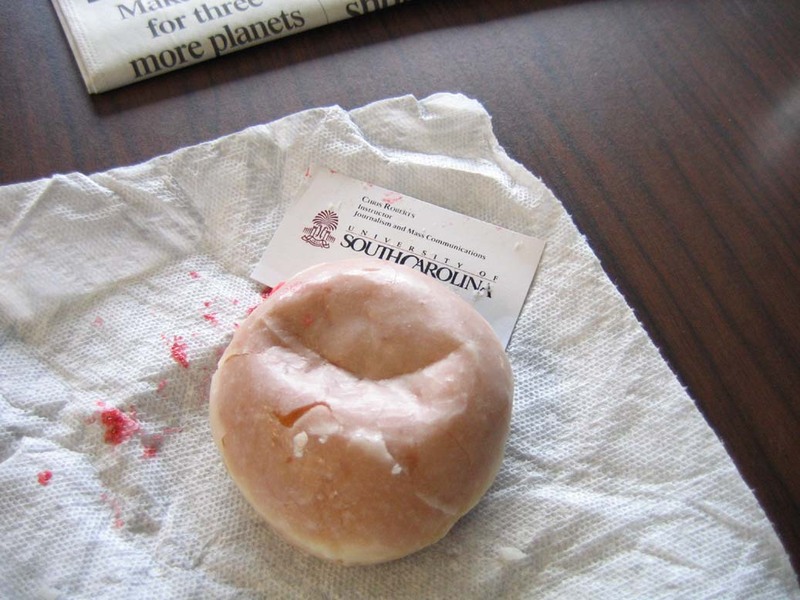
One of the doughnuts Chris left me back when some of the King's loyal subjects still worked at newspapers.

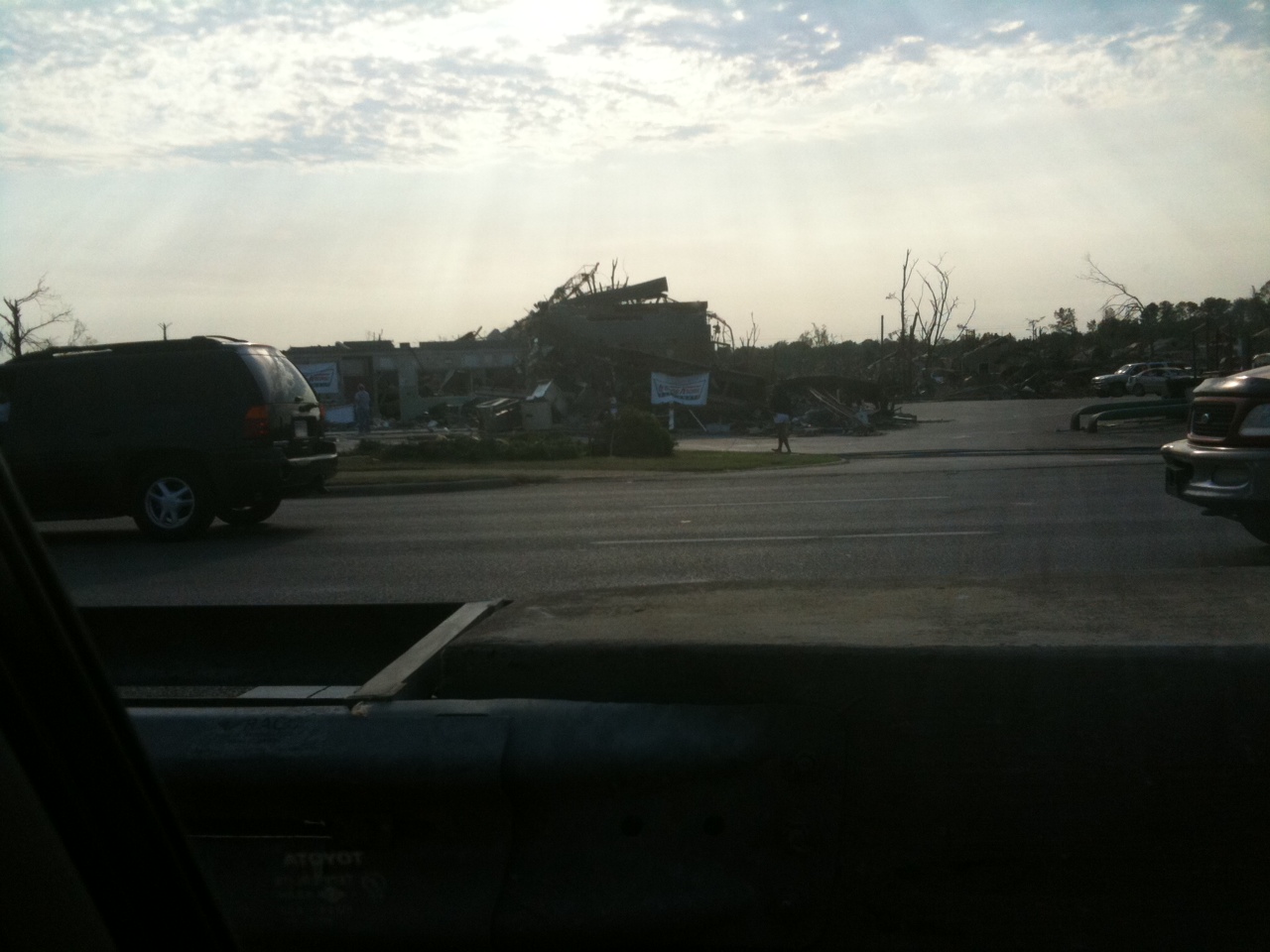
This rubble used to be the Krispy Kreme Chris went to in Tuscaloosa. Took a direct hit...

When we worked together at The State, Chris Roberts used to bring me a jelly doughnut every Aug. 16 in honor of the King.

He’s not in a position to do that now — he’s in Alabama — but he did show he was thinking of me by sending this:

He went on to say that he would have tried to get a doughnut to me, but the local Krispy Kreme got knocked down by a tornado back in April.

So I sent him a picture of one.

Chris knows how special this day is to me, because I was one of the first people in the world to hear the awful news in 1977:

MY GOOD FRIEND Les Seago was the man who told the world that the King was dead. But before he told the world, he told me.
I’ve always appreciated that, even though it didn’t do me much practical good at the time.
On Aug. 16, 1977, Les was the chief Memphis correspondent for The Associated Press. I was the slot man on the copy desk of The Jackson Sun, which meant I had been at work since 5:30 a.m. By early afternoon, the paper was on its way to readers. I had also been a stringer for Les for years, and I was used to his calls to see what was going on in our area. But he didn’t have time for that this day.
Was it too late to get something in? he demanded. Well, yeah, it was, just barely, but why…?
It looks like Elvis is dead, he said, explaining quickly that he had a source, an ambulance driver from Baptist Hospital, who told him he had just brought Elvis in, and he was pretty sure that his passenger had been beyond help. Gotta go now, ‘bye.
He must have broken all speed records getting it confirmed, because I had just begun to tell my co-workers when the “bulletin” bell went off on the wire machine as it hammered out the news.

Les himself was found dead at his home two years ago [this column ran on this day in 2006], at age 61. Though his career had spanned many years and he had covered Martin Luther King’s assassination, The Associated Press identified him in his obituaryas the man “who filed the bulletin on the death of Elvis Presley.” His ex-wife Nancy said “He wasn’t wild about Elvis, but he was glad that he did break the story.” That was Les…

Long live the King.

Oh, no! I appear to be part of a trend…

Tim brings this to my attention:

NEW YORK (AP) — The weak economy is hitting Americans where they spend a lot of their free time: at the TV set.

They’re canceling or forgoing cable and satellite TV subscriptions in record numbers, according to an analysis by The Associated Press of the companies’ quarterly earnings reports.

The U.S. subscription-TV industry first showed a small net loss of subscribers a year ago. This year, that trickle has turned into a stream. The chief cause appears to be persistently high unemployment and a housing market that has many people living with their parents, reducing the need for a separate cable bill.

But it’s also possible that people are canceling cable, or never signing up in the first place, because they’re watching cheap Internet video. Such a threat has been hanging over the industry. If that’s the case, viewers can expect more restrictions on online video, as TV companies and Hollywood studios try to make sure that they get paid for what they produce…

Tim was sympathetic in his comment about it, saying, “Don’t you hate it when you feel like just part of a trend?”

Yes, I do. Makes me feel… common. Low. Might as well start watching “reality TV” on my few remaining channels. That appears to be about all those channels show, anyway.

For the record, I have NOT moved home with my parents — yet. But I am one of those who is watching cheap Internet video instead of cable. I’m halfway through the first season of “Lost” on Netflix so far. The HD picture is awesome. “Lost” is… well, about like I thought “Lost” would be. I am not what you’d call enraptured. But at least I’m finding out what all the fuss was about. Sort of.

I dig my window

It's not that it's a beautiful view or anything. It's all the light it lets in. (And, when I want it, air.)

For days, I’d been in a foul mood.

Chalk it up to the feckless debt non-deal, the nonsense that led up to it, the madness in the stock markets that ensued, the credit downgrade, getting rid of HD TV and the phone line we’d had for 24 years,  etc.

I told my wife Monday night that it’s bad. How bad? So bad that I am actually letting economic news get me down, or at least ticked off. Which didn’t happen even when I was laid off. It’s just the long continuation of this sequence of events that just suck more and more as time goes on, with no one seeming to be inclined to do what they should to make it better. That included everyone I castigated in this post, and anyone else you can think of.

See the picture at right. Here’s how I happened to take it: I was waiting at a long light (Huger and Taylor) and wondering just how hot it actually was, and pulling out my iPhone to glance at it — a two-click process. But at the first click, I saw it was in camera mode, and for some reason in reverse-camera mode, so I just clicked the shutter and then stuck it back in its holster. Later I looked back at my pictures for the day, and this just seemed to capture well my mood. I look sort of like “Heisenberg,” halfway through the process of breaking bad. (Of course, my wife might say I always look like this.) I was not putting on for the camera. If I had been posing, I might have taken off my dorky clip-on shades.

So, you have the background.

But then, Tuesday morning, I came into the office, and there was all this… light. Light that I’d never seen before, and it made all things new in the offices of ADCO. I’d never seen any of these things this way before. The light was revelatory, serendipitous, and apocalyptic (in the original, positive sense). It was an epiphany. I’d give you more quasi-religious big words if I had time right now to think of some.

There was a crew washing the windows, inside and out, and they’d taken down all the blinds and screens and storm windows, and ADCO is in this old house with these really tall, crystal-clear windows… and behold, the light made all things new. It revealed new possibilities: See, things don’t have to be the dark way that you think they are. They can become brilliant, quite suddenly.

I’ve written before how much I appreciate my office window, since I had never, ever worked before in a building where it was possible to open the windows before. Well, this just deepened my appreciation considerably.

I’ve been in a much better mood ever since. Not an awesome mood. Not giddy or anything. Just not as ticked off.

Weird, huh? I don’t even like to think that I am such a malleable creature that such simple shifts in physical surroundings can affect me on such a level, shifting my life attitude from negative to positive, even if only briefly. I’m not an animal. I’m a thinking creature. (Also, I’m not one of these sun people. I felt very much at home in the winter drizzle of England.)

But there it is. I feel better now. Not great, just not so ticked off. How are you?

Tell Navin I’m not “somebody” any more

Somebody tell Navin Johnson I just fell off the grid. I’m guessing I’m not a real person any more, because I no longer have a landline.

On Saturday, we called AT&T and dropped our home phone service AND more than 90 percent of our cable TV. We had just recently signed up for Uverse, and it included three months free HBO and several other services, and I was watching a LOT of HDTV. Too much.

I won’t be doing that anymore. Now, we have the local broadcast channels (which I almost never watch), and a few random junk channels. There’s no HD (and I can hardly bear to watch standard def anymore), no 24-hour news channels, and no sports. The latter two aren’t much of a loss for me. I recently discovered I will watch sports in HD, when I didn’t before, just for the spectacle — about as clear a case of the medium being the message as one is likely to find. And y’all know how I hate 24/7 TV “news.”

What does get to me is losing all the movie channels. The things I tended to watch the most were American Movie Classics (“Mad Men!” — which I won’t get to see at all now!), Turner Classic Movies, TBS and TNT — along with FX and a few others. And the HBO selections were pretty dazzling. Since we signed up for AT&T last month (after dropping Time Warner), I had spent a LOT of time on HBO. When I wasn’t watching a movie, I was recording one, or two, or three, on the DVR.

But part of the point here was that I was spending too much time on TV, period. I’ve got shelves of books I want to read and haven’t touched. I need to get to them. What has worried me lately is that I didn’t even want to get to them, as much as I should. Sure sign of brain rot.

What else did we give up? The phone number we’ve had since moving to Columbia in 1987. The one our kids had growing up. The one that was the reference point for so many different kinds of accounts all over town. I’m bracing myself for the first situation in which someone is calling up my account and says “What’s your home phone number?” And I have to say I don’t have one. (I also worry that someone might NEED to reach me, and has no way of finding me other than through published listings.) Now, I realize that’s not any kind of deal to my kids or their contemporaries. None of them live at home, and not one of them has a land line. But a land line — as irritating as it was, since nothing came in on it but telemarketers — was one of those things that said you were a grownup, you were rooted, you were established. I think that’s why so many people who HATE answering their land lines on the rare occasions when they ring still pay that monthly bill. Not doing so would make them feel — insubstantial, ethereal, not really there.

But NOT paying a bill for something I wasn’t using just didn’t seem a smart option anymore, so we pulled the trigger on the service.

There were a number of factors in the decision:

  • Too much TV. The temptation to watch it was too great. I was losing sleep staying up watching it — that happens when what you’re into is movies.
  • I was paying for Netflix, and wasn’t watching it at all any more. And didn’t want to give that up. And since I still have the Internet, I can still stream that, and that provides more TV than I’ll ever need.
  • The upcoming deadline for dropping the AT&T service without penalty. We had 30 days since we signed up, and about a week left of that. So a decision needed to be made.
  • The S&P downgrade of the U.S. credit rating. OK, that’s an oversimplification, but that was sort of the last straw. It was really a) our failure really to recover from the 2008 crash; b) my getting laid off in 2009; c) the fact that, after a reasonably encouraging start, it seems harder to sell ads on my blog, which beyond the way it hurts my bank account, is indicative to me of people being tighter and tighter with their money; d) the political failure to come to grips with debt last week, and knowing that even if we had, it would have meant cutting more spending and raising taxes, which both tend to cool the economy; e) the turmoil in markets Thursday and Friday, which to me reflected less the usual fact that traders are feckless, fearful jitterbugs, and more the larger situation; f) the debt crisis in Europe and its long-term implications; and g) the downgrading of the credit rating. I didn’t figure any of us was going to be making any more money anytime soon, so spending all this on HD movies (as cool as they are) and telemarketing calls was ridiculous.

As you can see, it takes a lot to make me give up my HD.

I got up Saturday morning thinking that if we were going to move before the AT&T deadline, we had to move soon. And then, right after writing this post about the S&P thing, I told my wife I thought we needed to do it. She got on the phone immediately, because as far as she was concerned, we just had all that stuff for me, anyway.

Here’s the really bad news in all this: You know how much I saved? About $64 a month. That’s all. Which is why so few people actually take this step. Our bundle — high-speed Internet, phone, TV — was $150 a month. You would think you could get Internet service and the local broadcast channels (which is probably about 5 percent of what I was getting) pretty cheap, right? But the new total is $86. My wife — who writes the checks at our house — is pleased with that. I am not. I feel like I’ve given up so much, they should probably be paying ME for the loss.

But I guess that’s not realistic.

What it cost me to go to college in 1973-74

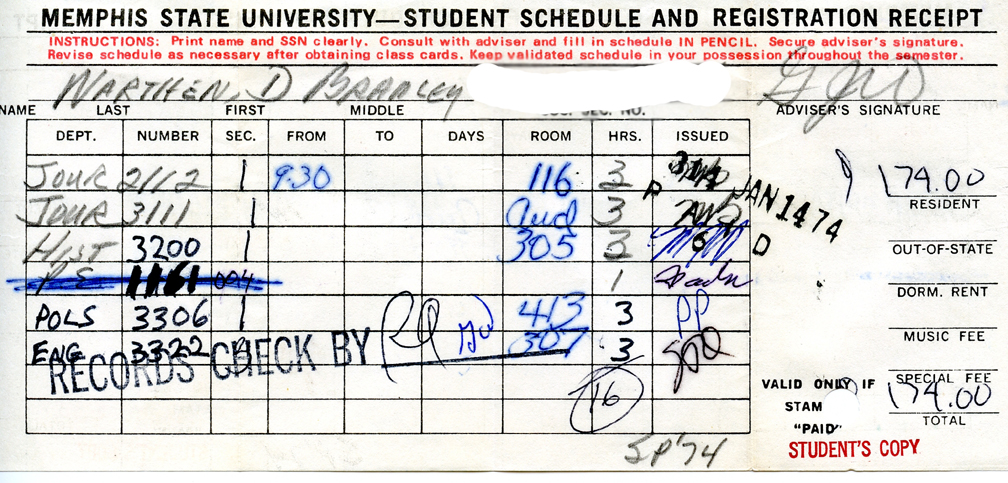
I’m going through some old boxes of stuff, and ran across a wallet I carried in my college days. I scanned for you three of the items I found in it.

The first, above, shows what I paid for a semester at Memphis State University on Jan. 14, 1974. As you can see, the total cost for 16 credit hours — as usual, crammed with journalism classes I had to take, history and English classes I didn’t have to take but wanted to, and some PE to force me to get some exercise — was $174.00.

That’s one HUNDRED — not even thousand — and seventy-four dollars.

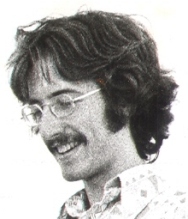
Me, at about that time.

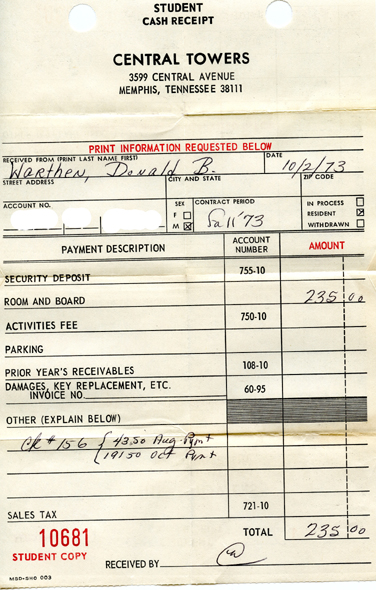
Below, I include a receipt for my room and board for the previous semester — $235. This was not for a regular dorm. This was for a room in a private dorm, right on the edge of campus. Few people actually stayed on campus at Memphis State; it was a huge commuter school (a lot of people called it “Tiger High” because people just continued on there from high school without leaving their parents’ homes). Housing was such a low priority there that there were a lot of us who couldn’t find official campus dorm space at all, but who were willing to pay private rates (that is to say, my parents were willing to pay) for the experience of staying there.

Central Towers was two 10-story towers with the boys on one side and girls on the other, although the procedures were keeping us apart were not what you would call stringent. Making this an even more fun community was the fact that the dorm would periodically throw FREE beer busts with no limit. Enough said about that.

And all of that, including pretty decent food, cost $235 a semester.

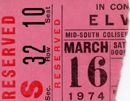
Just for fun, I’ve included a ticket stub, also from that wallet, from when my then-fiancee and I went to see Elvis — Presley, not  Costello — on March 16, 1974. It was one of seven shows in a row he did at the Mid-South Coliseum. It was originally going to be fewer than that, but the hometown demand was so great they kept adding shows. It was the first time he had performed publicly in Memphis since 1961, and almost the last time ever.

I don’t know how much it cost, but in those days it was almost certainly less than $10. The usual price I remember paying for concerts then (Bob Dylan with The Band, Leon Russell, Joe Cocker, Joan Baez and the like) was $5.

If that was a highlight, what were the lowlights?

Just looked at the weekly newsletter from the Columbia Rotary Club, and it included the above among the “highlights” from last week’s meeting, with the caption, “Brad Warthen delivers the Health and Happiness Report.”

I’m pretty sure I know what’s happening in that picture. I’m saying, “What’s the matter with you people? This stuff is funny!“

Well, at least Rusty liked it

I saw Rusty DePass yesterday, and he stopped me to tell me that while my Health and Happiness routine at Rotary on Monday didn’t get what I would call big laughs, he thought it was hilarious.

I appreciated that. I don’t know what was wrong Monday. I mean, I got some laughs, but it was very low-key. The biggest laugh I got was after one of the lines I got from Herb Brasher, I said, “Come on! That was funny!” I said it with such vehemence and frustration, that it really cracked them up.

Maybe it was because a lot of people were missing, this being mid-summer, and we just didn’t have critical mass. I don’t know. I looked in that direction once and saw Kathryn Fenner laughing. At least, she looked like she was laughing, but I couldn’t hear it. It was like a mime laugh.

See, now? THAT was funny… Maybe I should have used it.

Anyway, running into Rusty and getting his kind feedback reminded me that I didn’t thank y’all for your input — particularly that of Herb (and his friend Larry) and Doug Ross, who returned from the wilderness just in time to give me the “Famously Hot” idea. (Which actually got one of my better laughs, although it was slightly delayed. Maybe it would have been bigger if I had paused longer after the punch line.)

Here are my prepared remarks:

Been looking through the news for some humor. It’s tough finding anything funny. I see Michele Bachmann is almost leading the GOP polls for president of the United States. Of course, she’s still a distant second to Mitt Romney. You know, he’s the guy whose most notable accomplishment was starting a health care system in Massachusetts that he can’t talk about in front of Republicans…

See? The topical stuff isn’t funny. So I’m going to intersperse it with some words of wisdom that my friend Herb – Kathryn knows Herb — said he got from HIS friend Larry:

I asked God for a bike, but I know God doesn’t work that way. So I stole a bike and asked for forgiveness.

Do not argue with an idiot. He will drag you down to his level and beat you with experience.

The last thing I want to do is hurt you. But it’s still on the list.

If I agreed with you, we’d both be wrong.

Back to the topical…

As you know, I work over at ADCO with Lanier Jones. ADCO is the agency that came up with “Famously Hot.” The last few days, one of the readers on my blog – that’s bradwarthen.com – has suggested that we change that slogan. He just wants to change the first word. It would still start with the same letter.

I see that China, which holds all that U.S. debt, is now watching what’s happening in Washington and thinking WE have a really fouled-up political system. The bad news is, they’re right.

By the way, in case I’m not being clear enough, I refer to those children in Washington, a.k.a. our nation’s leaders, playing games with the full faith and credit of the United States of America.

And no, I wasn’t even trying to be funny about that…

More from Larry:

We never really grow up, we only learn how to act in public.

Knowledge is knowing a tomato is a fruit; wisdom is not putting it in a fruit salad.

Whenever I fill out an application, in the part that says, “In an emergency, notify:” I always put, “DOCTOR.”

Back to the news:

South Carolina Democratic Party Chairman Dick Harpootlian – by the way, try fitting “South Carolina Democratic Party Chairman Dick Harpootlian” into a headline sometime, and you’ll see why the press will miss Ken Ard when he’s gone…

Where was I? Oh, yeah… South Carolina Democratic Party Chairman Dick Harpootlian said something that puzzled me the other day. He was criticizing Nikki Haley for saying, when she signed the voter ID bill, that if anyone had trouble getting a photo ID, she would personally drive them to the DMV. I don’t see any problem with that. I mean, it would be nice, right? It’s not like she’s Andre Bauer.

Oh, and for my Republican friends here today:

Look, I wanted to make some jokes about Democrats in office, but hey, gimme a break: This is South Carolina. I couldn’t find any.

OK, some more from Larry:

I didn’t say it was your fault; I said I was blaming you.

A clear conscience is usually the sign of a bad memory.

Always borrow money from a pessimist. He won’t expect it back.

Light travels faster than sound. This is why some people appear bright until you hear them speak.

I ad-libbed a few times. Such as, when I saw Boyd Summers laughing about the no-Democrats-in-office gag (although he, too, may have been doing a mime laugh), I said, “See? Boyd Summers gets it. Ladies and gentlemen, Boyd Summers — chairman of the Richland County Democratic Party. Boyd, you need to work a little harder…”

Thanks again for your help, folks! Your material was good. Maybe it was the delivery.

Bow before me: I’m one of the Twitterati!

A couple of years back… actually, to be precise, it ran on the very day before I got laid off from the paper (which really made the part where I reflected on a politician declaring the death of news media, um, interesting)… I wrote a column in which I blasted the very idea of Twitter:

… But so far I haven’t figured out what Twitter adds to modern life that we didn’t already have with e-mail and blogs and text-messaging and, well, the 24/7 TV “news.” Remember how I complained in a recent column about how disorienting and unhelpful I find Facebook to be? Well, this was worse. I felt like I was trying to get nutrition from a bowl of Lucky Charms mixed with Cracker Jack topped with Pop Rocks, stirred with a Slim Jim…

Then, a few months later, Tim Kelly persuaded me that I could promote my blog using Twitter. So I tried it. And I got hooked on the form, sort of a cross between headline writing and haiku. And Tim was prophetic. My blog gets 3 or 4 times the traffic that my old blog did when I was at the paper — something close to 200,000 page views a month, and sometimes well over that.

And now, I’m one of the top Tweeters in Columbia, one of the “Twitterati,” according to the Free Times:

The former editorial page editor of The State tweets a lot and has 1,200 followers. He’s often re-tweeted, tweeted at, and he becomes involved in Twitter debates. Sometimes he’ll even play mediator in said debates.

In any case, it’s obvious that while Warthen has been out of the newspaper game for a few years now he still has some pull at the paper. On May 31, he tweeted, “What in the world are these UFO-looking things all along I-26?” Days later, The State ran a story answering this life-altering question under this headline: “What Are Those Green Things?” — Corey Hutchins

So, you just never know what’s going to happen, do you?

Congratulations to Bud on the new granddaughter! (And the son in the Navy!)

Got some great news from our regular Bud (a.k.a. William Bloom). He’s a grandpa — again.

Above you see his second granddaughter, who was literally born yesterday, weighing in at 6 lbs., 11 oz.

He’s also got a son graduating from U.S. Navy training up at Great Lakes, and he is beside himself:

I’ve got a real dilemma. My son graduates from navy boot camp Friday in Chicago and my new granddaughter is in Brooklyn. Can’t be in 2 places.  Since the Chicago trip is already planed I guess that’s where I’ll be. Hopefully in a couple of weeks I can go to Brooklyn. My head is still spinning over all this excitement.

That is all so wonderful, Bud. We’re thrilled for you. Have a wonderful trip to Great Lakes — and to Brooklyn as well.

Tinker, Tailor, Soldier, Trailer

Just thought I’d share this, so that if there’s anyone among you who is as big a George Smiley fan as I, you, too, can start being frustrated waiting for this movie to come out in November. (Why does it take so long? If they’ve got it edited enough to put out a trailer…)

I was putting off posting this, after Mike Fitts brought it to my attention, until I could write a longer post I’ve been meaning to write ever since January, about my own successful Quest for Smiley (yes, Circus fans, that is an allusion to the Quest for Karla). But until I do that, here’s a picture of me standing in front of George’s actual house in London. Sort of a blog trailer, if you will. I think the picture captures a Le Carre kind of feel, doesn’t it? It was taken at dusk in winter, which is appropriate. Very Cold War.

Remember I said, in a post sent from the airport in Detroit, that I was going to look for signs of Smiley in London? Well, I did. More about that later…