Ralph Hightower mentioned this Robert Ariail cartoon this morning on a previous post, so I thought I’d share it. Reminds me of something David Letterman did — Friday night I think — altering a clip from “It’s the Great Pumpkin, Charlie Brown” to show Herman Cain’s head slowly rising out of the pumpkin patch, and ending with him flashing that unsettling grin from the end of the smoker ad. (See below.)
Category Archives: Popular culture
Then they came for the people with good taste…
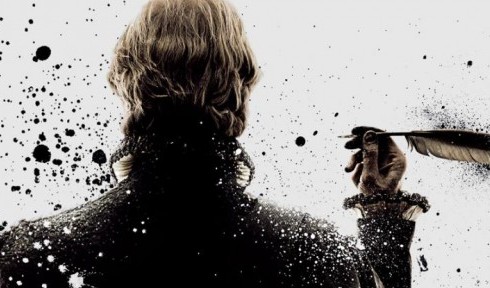
I really like this treatment, in The New York Times, of the silly-sounding new film, “Anonymous:”
“Was Shakespeare a fraud?” That’s the question the promotional machinery for Roland Emmerich’s new film, “Anonymous,” wants to usher out of the tiny enclosure of fringe academic conferences into the wider pastures of a Hollywood audience. Shakespeare is finally getting the Oliver Stone/“Da Vinci Code” treatment, with a lurid conspiratorial melodrama involving incest in royal bedchambers, a vapidly simplistic version of court intrigue, nifty costumes and historically inaccurate nonsense. First they came for the Kennedy scholars, and I did not speak out, because I was not a Kennedy scholar. Then they came for Opus Dei, and I did not speak out, because I was not a Catholic scholar. Now they have come for me.
Professors of Shakespeare — and I was one once upon a time — are blissfully unaware of the impending disaster that this film means for their professional lives. Thanks to “Anonymous,” undergraduates will be confidently asserting that Shakespeare wasn’t Shakespeare for the next 10 years at least, and profs will have to waste countless hours explaining the obvious…
No, I haven’t seen it, and don’t intend to. I mean, I saw “The Da Vinci Code,” and I’d like to have that time back. I also read Foucault’s Pendulum, which was essentially the same thing (grand, paranoid conspiracy, involving the Knights Templar, reaching back into ancient times). That one really disappointed me, because I had enjoyed The Name of the Rose.
Bottom line, what does it matter who wrote those plays and poems? Whoever it was was probably the most brilliant writer of English ever, largely responsible for the linguistic and cultural hegemony of the Anglosphere. But so what if it was Will Shakespeare or Joe Blow down the street? What’s in a name, yadda, yadda? It’s not like the actual person can enjoy our adulation today. We can’t shake him by the hand or anything. He can’t make any money out of it. Having that name, and that visage, associated with the works suits fine. And since no one will ever know that it was someone else — even if we found a document with a royal seal attesting to it, that could be a fraud itself — what’s the point?
Would it matter that Julius Caesar was actually someone else using that name? No. Gallia would still have been divisa in partes tres. (Latin scholars, help me out — I suspect that “divisa” is wrong with “would have been.” And to me, that matters.)
It remains most likely that
They may have come for Opus Dei and gotten away with it, but they’re not coming for me, not again.
Listening to hunterherring.com, right now
Listening right now to my fellow granddad at hunterherring.com.
The picture above shows Hunter with our youngest granddaughter (his daughter’s, my son’s) at a Lunch Money concert in front of the Columbia Museum of Art several months ago. (Hunter’s wife works with us at ADCO, and Lunch Money’s drummer is with ADCO interactive, and the cameraman for “The Brad Show.” How’s that for cross-promotion? Back off, Jack — I’m a professional…)
Right now, Hunter’s playing Mary Wells singing “You Beat Me to the Punch.”
Listening to Hunter’s web station is like experiencing Nick Hornby’s “High Fidelity” in real life. I’m pretty sure that most of the songs on the fictional Rob’s Top Five lists would eventually be played on hunterherring.com.
No, really, I think Fox will tire of Sanford
Meg Kinnard Tweeted earlier that Fox News and Mark Sanford have made it official:
Former SC Gov. Mark Sanford hired by Fox News
SC State Wire
Published: TodayCOLUMBIA, S.C. (AP) – Former South Carolina Gov. Mark Sanford is joining Fox News as a political commentator through the 2012 presidential elections, a Fox Channel spokeswoman confirmed Saturday.The network spokeswoman told The Associated Press the two-term Republican governor has been hired as a contributor, though she declined to give any details on his pay or when he would start.
Sanford was a rising political star before he vanished from the state for five days in 2009, and reporters were told he was hiking the Appalachian Trail. When he reappeared, the father of four admitted to being in Argentina with a woman he later called his soul mate.
The international affair destroyed his marriage, which ended in divorce, and derailed his once-promising political career, which had included talk of presidential aspirations…The term-limited Sanford has appeared on Fox since leaving office in January. In September, he told the Associated Press his interview with Sean Hannity was his way of slowly getting back to talking about the nation’s troubles.
“I think this represents me sticking my toe back in the water and talking about things I care about,” he said then. “I care passionately about the direction of this country and deficit and debt and all the things that seem to be in vogue right now.”
He reiterated that he had no intentions of getting back into politics, though he noted he’s learned “you never say never in life.”
Sanford did not immediately return phone or e-mail messages Saturday.
Sanford’s new job was first reported by The New York Times.
When I reTweeted the news, I added the comment, “Fox will tire of this sooner than they realize…”
Apparently, my comment was taken in a spirit other than the way I intended it, because former Sanford press secretary Joel Sawyer (recently seen with me on Pub Politics) responded:
But I wasn’t being hateful at all. I was just saying something that I believe to be true. I really do think that, six months or perhaps a year after he starts, they are likely to question the decision.
I think he has plenty of experience that will stand him in good stead at the outset. After all, they did have him on 46 times during those few months when he was fighting to prevent South Carolina from getting all of its stimulus money. Really. Not making it up.
So there had to be something they liked.
But here’s the thing about Mark: After awhile, he naturally kicks back into his normal mode of speaking. And the nation hasn’t heard him in large-enough doses to know what I’m talking about.
Except once.
After his infamous post-Argentina press conference (later on the same day Gina Smith caught him at the Atlanta airport), several national media types remarked to me the weird, aimless way he had wandered about, seemingly endlessly, in making his confession.
I was surprised that they remarked upon it. That’s the way he talks all the time! He backs into topics, and backs out of them. I don’t have much room to talk on this score, I realize — maybe it’s why I liked Sanford so much early on — but that’s the way he speaks. Like neither his nor anyone else’s time is valuable. About as hurried as he is out operating the backhoe out on the “farm.”
There’s good TV and bad TV, and it has nothing to do with what sort of human being you are. The world is loaded with fine people who would not be good on TV.
I could be wrong, but I really think a time is likely to come when someone at Fox cries to the ceiling, “Why did we do this?”
We’ll see. Or you’ll see. I don’t get those 24-hour TV “news” channels any more.
Even the rednecks pick on South Carolina now
This morning, I could not tolerate another second of the pledge drive on ETV Radio (even when I have money to give, and DO give, I can’t abide actually listening to the pledge drive; it’s all those repetitions of the phone number that get to me), and I didn’t like what was on Steve-FM, so I decided to get my first John Boy and Billy fix in a long while.
And that’s when I heard the Tim Wilson song you hear in the video above.
Partial lyrics:
You can go to war when you’re 18
But you can’t buy a beer
You can load missiles on a submarine
But you can’t buy a pistol here
You can breathe chemical weapon fumes
But they don’t want you to smoke
so when you’re shootin’ up a bar in Baghdad, don’t order a rum and coke
OK so far, typical redneck comic lament. But then you get to:
You can be a governor at 21
Or a president at 35
You can be the senator from South Carolina
If you can just stay alive…
This has gone too far. Jon Stewart picking on us is something you’d expect, but when the rednecks start giving us a hard time over our political predilections and idiosyncrasies, maybe we’d better start talking seriously about making some changes.
The diminishment of creativity over time
Lately, in my truck, I’ve been listening to “The Union,” a CD put out by Leon Russell and Elton John. Speaking of gifts, my brother gave it to me last Christmas, but I only broke it out recently.
I’ve enjoyed it. It’s quite good. I’ve kept it in the player for weeks. I’ve even caught some of the tunes going through my head during the day. They worked well together, although their styles remain quite distinct. When you hear the opening piano chords, you know which voice you’re about to hear.
But… there’s this sadness I associate with it. Good as it is, it’s simply nothing like what both of them were producing in 1970 and ’71, and for a short time after that. I really enjoyed John’s work, from “Your Song” through “Tiny Dancer” on “Madman Across the Water.” As for the Master of Space and Time, I doubt that he had any bigger fan than I, back during the “Shelter People” period. “Stranger in a Strange Land,” for instance, remains an all-time favorite. And who else could have pulled off his show-stealing performance at the Concert for Bangladesh?
On that subject, Leon put on the most awesome show I saw live in the early ’70s, if ever. It was in Memphis. The opening: All the Shelter People were on stage, without Leon. There were two grand pianos. At one of them sat a black guy (who really music aficionados can probably name, although I cannot) rocking out in a gospel style (or so it sounded to my untrained ear), and the Shelter People — or whatever they were called at this point, essentially a “hippie commune bonafied” on tour — were energetically jamming along with him. The music built, and built, still without Leon. It had been going on about 10 minutes, it seemed, and everybody was pumped, and then… Leon stolled out on stage. He was wearing a white suit, with a white top hat, and playing a white Stratocaster. He ambled, back and forth, playing lead over the music… then he climbed up onto the second piano, and stood there with the guitar, rocking away. Finally, he climbed down, put down the Strat, and got serious. He sat at the second piano, and he and other pianist duelled away, with the other dozen or so other people on stage rocking along with them…
It was amazing. What a showman.
People get older. Their powers diminish. Certainly, their energies do. One great thing about being a musician, though, is that you generally retain the ability to make something beautiful, even if it lacks the power of what you did that made you a star, if you were a star.
I got to thinking about this yesterday when I saw a Tweet leading me to a thing about Kevin’s Smith’s movies, ranked from Worst to Best. There were 10 of them. Fortunately, it was not called a Top Ten list. You couldn’t even honestly come up with a Top Five from this guy’s work, not if you had taste. Basically, he had a Top One — “Clerks.” Some of you who think me a prig would be surprised that I even liked that, but it was really well done. The pottymouthed script was inventive, clever, as were the acting and the direction. Not even Jay and Silent Bob wore thin, for as long as the film lasted. It made you want to see more from this guy.
And then you did see more, and you wished you hadn’t. It’s probably a good thing he’s decided to desert his oeuvre and turn to more pedestrian, formula comedy (“Cop Out,” which this list placed last, but which was at least mildly amusing).
Kevin Smith is only 41. He was born when Elton John and Leon Russell were at their peak. But he peaked with one film.
That happens, with creativity. It’s a tragedy, when it deserts the young. Look at the Beatles. Of course, the Beatles were so amazingly improbable to begin with. How could anyone, so naturalistically, produce so much material that was that diverse, from year to year, and that appealing? It was inhuman. It was the sort of thing that in a different cultural context gives rise to dark mutterings about clandestine meetings at the Crossroads at midnight.
But it didn’t last. As they broke up, it looked as though it would. Lennon produced “Instant Karma;” McCartney gave us “Maybe I’m Amazed.” George Harrison seemed to explode, having been repressed, with “All Things Must Pass.”
And that was it. They faded. Mozart died, but they lived to see their talents fade. The wonderful thing about Paul McCartney is that he appreciated that his fans loved the old stuff. So did he. (If you’d made John Lennon stand on stage and play Beatles songs, he’d have shot himself before that other guy did.) I saw him at Williams-Brice, and loved it. But, as I noted the other day, it’s sad to see him dyeing his hair, still trying to be the Cute One. That time is past, Paul.
Of course, one looks for such fading in oneself. Fortunately for me, I never hit the heights that these guys did. I was a decent writer by local standards, impressive to some people. Just enough people, in my book. It’s nice to have strangers come up and say kind things occasionally, but it’s also good to be able to walk down the street anonymously 99 percent of the time.
And as we age, things fade. First, one is no longer indefatigable. Gone are the days when, as a reporter, I could work all day, all night, and through the next morning before taking a nap (something I did frequently, back in the day).
But if you don’t rise too far, you don’t have as far to fall. I never wrote the Great American Novel (not yet, anyway), so I didn’t have to publicly struggle to replicate that for the rest of my life, while everyone scoffed. When one muddles along, one can continue more easily.
I look back at stuff I wrote 30 years ago when I find it moldering in a box, and it’s good. It has a spark, one that I lament. But it’s strange how one’s appreciation of one’s own work morphs. At any time in my adult life, I’ve thought the stuff I’d written six months earlier SO much better than what I was writing currently. Then, six months later, I’d think THAT stuff was the best I’d ever written. That has continued through my blogging years. (My old blog was SO much better-written than this one — even though it wasn’t nearly as well-read. And the stuff I wrote on this blog a year ago is amazingly better than this tripe I’m churning out now.)
What I’m writing now is the worst stuff I’ve ever written. (In my opinion, which is what counts, since I’m an introvert.) But it has always been thus. Aside from its lack of creativity, it’s shot through with typos and incomplete thoughts, mangled sentences. Because I don’t read back over it, and don’t have an editor — and everybody needs one. But I look forward, ever hopeful, to enjoying it later.
When I don’t do that any more, I’m not sure what I’ll do. Relax, I expect.
What about y’all, in what you do? As critics, do you disappoint yourselves? If so, take heart. Perhaps it will look better later. And even if it doesn’t, the stuff Leon and Elton are putting out is still quite good…

Netflix listened! ‘No Qwikster.’ I’m impressed…
… but not overwhelmed with gratitude or anything. After all, the rates DID go up.
But the boss man there had seemed so adamantly sure that his way was the way to do it, and everybody else was an idiot, that I was pleasantly surprised to see this release today:
Dear Brad,It is clear that for many of our members two websites would make things more difficult, so we are going to keep Netflix as one place to go for streaming and DVDs.This means no change: one website, one account, one password…in other words, no Qwikster.While the July price change was necessary, we are now done with price changes.We’re constantly improving our streaming selection. We’ve recently added hundreds of movies from Paramount, Sony, Universal, Fox, Warner Bros., Lionsgate, MGM and Miramax. Plus, in the last couple of weeks alone, we’ve added over 3,500 TV episodes from ABC, NBC, FOX, CBS, USA, E!, Nickelodeon, Disney Channel, ABC Family, Discovery Channel, TLC, SyFy, A&E, History, and PBS.We value you as a member, and we are committed to making Netflix the best place to get your movies & TV shows.Respectfully,The Netflix Team
The “respectfully” was a nice touch, but unnecessary. You showed your respect by listening.
Now, about some of those videos that still aren’t yet available on Netflix…
Happy Birthday, John. Oh, give it a rest, Paul…
A friend shares this today:
LONDON (AP) — A hint of autumnal Beatlemania was in the air Sunday as Paul McCartney — for the second time in his improbable life — climbed the steps of Old Marylebone Town Hall to get married.
True, thousands of heartbroken female fans crowded the venerable registry office in 1969 when he married Linda Eastman and only a few hundred showed up Sunday as he wed American Nancy Shevell. But the feeling this time was not regret at the loss of a bachelor heartthrob. Instead there was joy that McCartney, regarded as a national treasure, seemed happy again…
Oh, give it a rest, Paul. Still getting married, when it’s past time for him to be spending his time bouncing Vera, Chuck and Dave on his knee.
You know, at least he could have waited a day. Today is John Lennon’s birthday (his 71st). And Paul is gallivanting about with his new bride (here’s a picture) and his dyed hair, while poor John is moldering in his grave. Or would be, had Yoko not had him cremated.
John would pose the question, how does he sleep? The answer, of course, would be, not alone…
Seriously, I wish the old guy all the best. The happiest Beatle should continue doing his best to enjoy life. But honestly, my first reaction actually was, “Oh, give it a rest.” Then I realized what today was.
Finally got into the Hatch, and here’s all I found
Yeah, I know this is stupid, but I was struck by this drain I saw in a public restroom this morning.
It reminded me of a logo I’d seen a lot recently.
Yep, I’ve been watching “Lost” on Netflix.
When I saw this drain, I felt like maybe I was supposed to stay there and push the button every 108 minutes. But I didn’t. So if really bad stuff happens today, you know whom to blame.
Sorry, ladies: ‘Moneyball’ makes the Top 5 list
After I did my “All-Time, Desert-Island Top 5 Baseball Movies” list recently, I got congratulations from several readers — readers of the female persuasion — for my good judgment in putting “A League of Their Own” on the list. And it was, I believe, a good choice.
Unfortunately, it just got sent down.
I saw “Moneyball” yesterday. Definitely Top Five material. I saw it with my Dad. He said it was the best film he’d seen in awhile, and the best thing Brad Pitt has ever done. I don’t know if I’d agree with that last part, being a fan of both “Fight Club” and “Snatch,” but the film overall is definitely one of the best baseball movies ever. (And the best acting in it, as usual, is done by Phillip Seymour Hoffman — although I thought Billy Beane’s front office staff was impressive, too.)
In fact, I’m going to put it at number four. Actually, technically — as an example of filmmaking — it should probably be at No. 2 and giving “The Natural” a run for its money. But while it is unquestionably all about baseball, it’s about other things, too. Communicating the essence of baseball is not quite its mission the way it is with the top three. It is also about change, and modernity, and the never-ending struggle between statistics and intuition. The top three are more about answering the question, “Why do I love baseball?” “Moneyball” is about that, too — but not entirely.
Hence my new Top Five:
- The Natural – American myth-making on the grand scale. If you wanted to put a movie on a spacecraft to explain to aliens what the game means, you’d choose this one. It’s perfect.
- Major League — Silly, yes, but a good complement to the reverential seriousness of “The Natural.” Hits all the buttons in explaining why the game is fun.
- The Sandlot — Maybe because it’s set in the days when I was a kid, and also spending hours on a sandlot — without uniforms, without adult supervision, just being kids — this really resonates as a depiction of the ball-playing experience of those of us who will never play in the majors.
- Moneyball — Just an incredibly well-made film, independently of being about baseball — perhaps the best on the list in that regard. While it’s about the triumph of Bill James‘ statistical method, there’s plenty here for us intuitive types to cheer for.
- Eight Men Out — A masterly, credible evocation of how the game’s blackest scandal came about, told in a way that you can understand motives. Say it ain’t so, Joe.
Now that I look at it without the Tom Hanks one, I’m starting to wonder about “Eight Men Out.” I’m not sure this list is final. I think maybe I’ll refer this to the blog’s Ad Hoc Committee on Baseball Movies. The committee will be assigned to watch both of those again to decide conclusively which should be in fifth place.
Until then, “A League of Their Own” is sixth on the list.
All-Time, Desert-Island Top 5 Baseball Movies
All right, let’s lighten things up a bit.
Our conversation about “Moneyball” yesterday was starting to turn in this direction, and I see the movie has inspired others to compile such lists — such as here and here and here — so here are my All-Time Top Five Baseball Movies:
- The Natural — American myth-making on the grand scale. If you wanted to put a movie on a spacecraft to explain to aliens what the game means, you’d choose this one. It’s perfect.
- Major League — Silly, yes, but a good complement to the reverential seriousness of “The Natural.” Hits all the buttons in explaining why the game is fun.
- The Sandlot — Maybe because it’s set in the days when I was a kid, and also spending hours on a sandlot — without uniforms, without adult supervision, just being kids — this really resonates as a depiction of the ball-playing experience of those of us who will never play in the majors.
- Eight Men Out — A masterly, credible evocation of how the game’s blackest scandal came about, told in a way that you can understand motives. Say it ain’t so, Joe.
- A League of their Own — This one’s about a lot of stuff other than baseball, but a great period piece with great characters. It would make the list if there were nothing in it but “There’s no crying in baseball!”
Actually, to be honest, I would have been happier with a Top Three list. There’s a drop-off for me after the first three. (But in keeping with the Hornby principle, I disciplined myself to come up with five.)
“Field of Dreams” almost edged out “A League of their Own.” But while it is emotionally affecting, and certainly invokes the love of baseball well, I find it hard to ignore its flaws. I’d read the book, and while it was awfully weird for the writer character to be J.D. Salinger, it was jarring when it was changed in the movie. And Ray Liotta as Shoeless Joe (the title character of the book) was really disappointing, particularly as I’m such a fan of Liotta. It’s like he phoned it in, and it’s hard to believe the director let that happen. D.B. Sweeney’s characterization in “Eight Men Out” was much more persuasive. You actually believed in him as a conflicted illiterate from South Carolina.
As for the other Kevin Costner baseball movies — I never liked “Bull Durham.” It had a moment or two — a conference on the mound, the bit about “The rose goes in the front, big guy” — but beyond that it left me cold. Then, far less noticeable, there’s “For the Love of the Game.” All that has to recommend it is a pretty good evocation of what it’s like for a pitcher who realizes late that he’s pitching a perfect game. The rest of it I could do without.
There’s wonderful acting in it, but I never really got into “Bang the Drum Slowly.” And I should like “Pride of the Yankees” more than I do. Perhaps I should see if I can get it on Netflix, and try again.
The end (almost) of violence
In my previous post, I referred to the “peaceful times” in which we live. That’s counterintuitive for many people, for two reasons: First, modern communications make them aware of far more, and more widely spread, instances of violence than they would have known of in previous eras. And second, those things grab our attention — indeed, they are reported in the first place — because they stand out as exceptions to the peaceful rule.
There’s a very good piece in The Wall Street Journal today (there are always so many wonderful pieces in that paper on Saturdays — the only day I take now, after my subscription price more than doubled) taking the long view, and explaining why “we may be living in the most peaceable era in human existence.” None of what it says is surprising or new — except perhaps for the statistics — but it’s nice when someone takes a moment and pulls it all together.
In “Violence Vanquished,” Steven Pinker describes six major declines in violence through human history. The first is one that our friends who believe that government is the worst plague ever visited upon mankind should contemplate:
The first was a process of pacification: the transition from the anarchy of the hunting, gathering and horticultural societies in which our species spent most of its evolutionary history to the first agricultural civilizations, with cities and governments, starting about 5,000 years ago.
For centuries, social theorists like Hobbes and Rousseau speculated from their armchairs about what life was like in a “state of nature.” Nowadays we can do better. Forensic archeology—a kind of “CSI: Paleolithic”—can estimate rates of violence from the proportion of skeletons in ancient sites with bashed-in skulls, decapitations or arrowheads embedded in bones. And ethnographers can tally the causes of death in tribal peoples that have recently lived outside of state control.
These investigations show that, on average, about 15% of people in prestate eras died violently, compared to about 3% of the citizens of the earliest states. Tribal violence commonly subsides when a state or empire imposes control over a territory, leading to the various “paxes” (Romana, Islamica, Brittanica and so on) that are familiar to readers of history…
Since those days, violent death has shrunk to less than 1 percent, even if you factor in war-caused disease and famine. Oh, and we’re not just talking about good or benevolent government. Even the plunder economy of the Romans had its positive effect:
It’s not that the first kings had a benevolent interest in the welfare of their citizens. Just as a farmer tries to prevent his livestock from killing one another, so a ruler will try to keep his subjects from cycles of raiding and feuding. From his point of view, such squabbling is a dead loss—forgone opportunities to extract taxes, tributes, soldiers and slaves…
And this is not just about pointing out how wrong the Tea Party is (although deeply wrong it certainly is). Some of our other friends on the left view commerce as though the taking of profit itself were inherently evil and destructive to mankind. Quite the contrary; it is a civilizing force just as is a well-ordered government (which is why the haters of government and the socialists are both wrong):
Another pacifying force has been commerce, a game in which everybody can win. As technological progress allows the exchange of goods and ideas over longer distances and among larger groups of trading partners, other people become more valuable alive than dead. They switch from being targets of demonization and dehumanization to potential partners in reciprocal altruism.
Finally, back to that matter of perception. If you wish to be simplistic, you can say it’s “the media’s fault,” for always telling you about the bad things rather than the good. If you ever spent, say, a month having to make decisions for a media outlet, you would realize how foolish that is. Even when times were flush, a newspaper’s or television station’s resources, and claim on your time, were finite. If you’re a town crier, your job is to tell people about the one house that’s on fire, so they can rise up and do something about it. You are useless if you instead say, “99.9 percent of the houses in the village are fine.”
That’s not to say I don’t decry the effect. In the grand scheme, media have had a devastating effect on society simply by playing their rightful role as government watchdogs. Over time, readers have come to the shockingly erroneous conclusion that government is nothing but crooks and waste, and the ability of government to be that civilizing force has been seriously weakened. As for violence — one of the most distressing developments of recent years in media is the rise of 24/7 TV news, which creates unlimited time that has to be filled. Consequently, violent crimes that would have been purely local stories 30 years ago are now thrown in the faces of the world constantly. There’s always something bad happening somewhere. This type of coverage creates the impression that it’s happening everywhere all the time.
If you can gain access to the full piece, it’s worth reading. So might be Mr. Pinker’s book, The Better Angels of Our Nature: Why Violence Has Declined.
The intelligent hype around “MoneyBall”
I had never heard about “MoneyBall” until I heard a story about it on NPR yesterday morning.
Then last night, I heard Terry Gross interview Brad Pitt about it. OK, they talked a lot about “Fight Club,” with Ms. Gross asking the star how many people come up to him and say, “The first rule of Fight Club is: you do not talk about Fight Club.” Not that many, actually. But the bottom line message of his being there was, “See ‘MoneyBall.”
Then this morning, I hear a review, also on NPR, from Kenneth Turan. Again, the message is to see the movie.
Also this morning, the teaser across the top of The Wall Street Journal (you know, the space devoted to football, year-round, in The State), was all about “MoneyBall.” It referred you to a big story headlined, “Baseball After Moneyball,” and a review by Joe Morgenstern, which says this film “…renews your belief in the power of movies.”
Then, in my email this morning, I get a link to the Roger Ebert review:
In the 2002 season, the nation’s lowest-salaried Major League Baseball team put together a 20-game winning streak, setting a new American League record. The team began that same season with 11 losses in row. What happened between is the stuff of “Moneyball,” a smart, intense and moving film that isn’t so much about sports as about the war between intuition and statistics.
OK, I get the message: I want to see this movie. Not only because I like good baseball movies, but because I’m very interested, as readers here will know, in “the war between intuition and statistics.”
But I have to say, I’m also quite impressed by the hype. Not just the volume of it, but the quality.
Note this isn’t your usual slam-bam action movie kind of promotion, that washes over you like a tidal wave and either pulls you into the theater or makes you run, screaming, for higher ground. The kind with lots of stuff blowing up. The kind that would never concern itself with “the war between intuition and statistics.”
This is targeted. This is more subtle. And it grabs people who are into baseball as a Thinking Man’s Game. Grabs them every which way.
Nice job by whoever was handling the media relations on this. I mean, everything they did was rather obvious, but I don’t remember the last time I saw these particular venues flooded this way for one movie. The buildup, from my perspective, was last-minute, but compete, and effective.
I may even shell out money to go see it in the theater. Which for me would be remarkable.
Madness has taken hold of Netflix
Did you get an email this morning from Reed Hastings, head honcho at Netflix? I did. Here’s an extended version of it on a Netflix blog. I am spared the trouble of writing a full response, because an NPR blog has spoken for me:
Netflix has figured out that people are very upset about its decision to split streaming video and DVD delivery — a decision that got it in huge hot water earlier this year. Customers who had previously gotten both streaming and DVDs for a single price would now have to pay separately. If you only use one or the other, you could pay less, but if you still wanted both, you’d pay more.
The Netflix response? Separate the businesses even more. In a new blog post, Netflix co-founder Reed Hastings explains that for some reason, he has concluded that separating the businesses completely is going to help people understand what’s going on. Thus, Netflix will not send DVDs at all anymore but will only provide streaming, while the company’s DVD business will happen under the new “Qwikster” brand.
Hastings seems to be operating under the premise that customers don’t really understand what’s going on; that they are angry because they think that a single business has increased its price when in fact it has merely split into two businesses that charge separately. Presumably, the idea is that making the split more definitive will make people slap their foreheads and say, “Oh, now I see. Netflix actually lowered its prices, as long as I don’t buy Qwikster! And new Qwikster is cheaper than old Netflix! I’m coming out ahead, sort of, if I don’t want all the services I used to get!”
The only problems with this approach are that its underlying assumptions are almost certainly wrong, and that it ignores major inefficiencies that will be introduced for customers who do, indeed, want to continue to use both streaming and DVDs. Now, if you want both, you have to go to two different sites with two different queues, you have to pay two different charges to two different entities, and in general, you have to have two different memberships. That’s not psychologically better for consumers. That’s buying two things which are both less helpful than the single thing you could get before.
It’s like a shoe company deciding to sell right shoes and left shoes for 12 dollars each where pairs of shoes used to be 20 dollars and thinking that consumers will notice the lower 12-dollar price but not the fact that it buys only one shoe….
Good response, and I hope NPR will forgive me for quoting it so extensively (please go to NPR and fully experience its services).
Lemme ‘splain somethin’ to you, Mr. Hastings: Neither your DVD service nor your streaming service stands alone; they are complementary. OK, so maybe the DVD service is complete in its way, as a fine service if this were the year 2001. But you and I know (or think we know) that Web streaming is the way the business is going to go, so if you are survive you have to get into that business big. Which you have done.
But here’s the critical point you’re missing: Your streaming business (which you laughably call “instant”) does NOT stand alone. It is not complete. Perhaps you’ve noticed that you are unable to get permission to stream most popular, recent titles. Therefore if your customers want a full service that will provide them with a full selection of the movies and TV shows they want to see, they have to supplement their streaming with DVDs. Which you seemed to get until, quite suddenly, recently.
If I weren’t so dependent on you, I’d drop your service now. But I got rid of my cable (or all of it except local stations, which almost amounts to the same thing), so almost all of the video content I ever watch now comes from you. It’s not the added cost, although that’s not pleasant (I dropped the cable because you were such an economical alternative). It’s the way you’ve done this.
I used to think that Netflix was a company that knew what its customers wanted. Not so much now.
Ideal local TV interview: “Foom! Foom! Foom!”
Power Lines Fall on Crashed Vehicle, Driver Trapped: MyFoxPHOENIX.com
This morning, Jack Kuenzie of WIS brings my attention to this. This guy is being billed on The Daily What as the “Second Coming of Chris Farley,” and I can see that.
I also see a little of Hurley, the guy from “Lost,” even though this guy isn’t nearly as big as either of them. Know what I mean, dude?
The situation was extremely serious — as KSAZ in Phoenix described, “The driver of an SUV was trapped Thursday afternoon when he lost control of his vehicle and it rolled over and struck a utility pole.” But the entertainment value in this description is undeniable.
The MB strip is still the MB strip…
Last weekend, I took my eldest granddaughter (the one you last saw in England) with me to see Ocean Boulevard in Myrtle Beach. I knew she had seen “Shag, the Movie,” and I thought she might want to see the real thing — within limits, of course. She had had a hard day. She had suffered multiple jellyfish stings earlier that day, which was pretty traumatic, but she seemed largely recovered, so we drove up to check it out. (She’s OK.)
I had expected not to find much, since they tore down the Pavilion several years back. But except for that former landmark (and the amusement park across the street) being replaced by a gaping hole in the night, things were pretty much the way they had been back in the day. The people in the cars crawling slowly up and down the strip were full of people who were more like tourists than the Surging Youth of Shag, or American Graffiti, but at least for a block or so there, it all felt about the same. More henna tattoo and piercing stands than I had remembered, but it was all in the tacky spirit of the thing.
Pushing our way through the throngs on the sidewalks, I said, “Kinda like London, huh?” She was too kind to say, “Not a bit, you old fool.”
We stopped on the street to get cotton candy, and there it took awhile, because there was just this one guy working behind the window. One big, hulking guy with a shaved head, a gold chain, and a Fu Manchu mustache. And a T-shirt, which you can see above. A guy standing in line outside made catty remarks about the man in the booth, but was careful to do so outside of his hearing.
I thought that image kind of captured the spirit of the place, so I share it with you.
A few words about football fashion
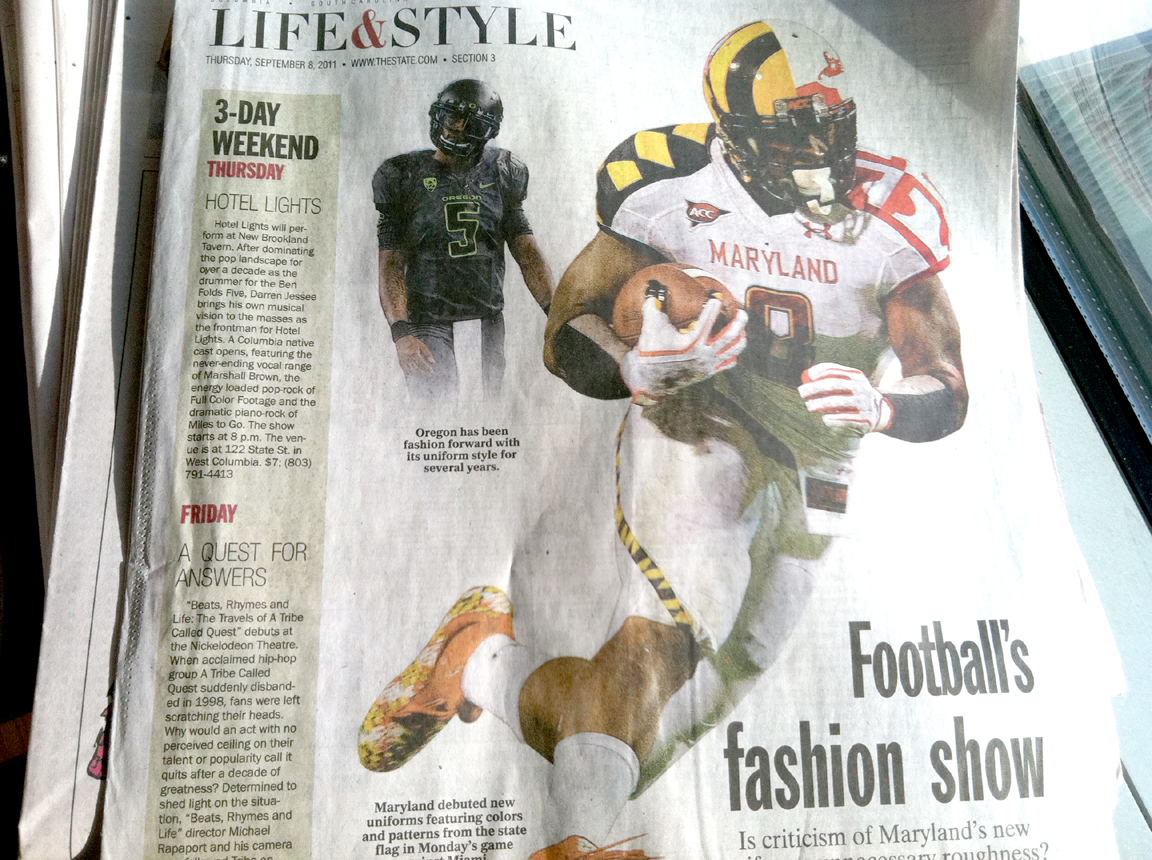
Most mornings, I read both The State and The Wall Street Journal over breakfast. This morning, I was struck by a certain contrast.
The WSJ had, teased from the front and filling most of a section front, a feature on the coming fashion season.
The State had a fashion spread, too. But it was football fashion. That says a lot about who we are, don’t you think? The fashion thing may have seemed odd to old-time readers of the Journal, but the football stuff looked right at home in the hometown paper.
Here’s a thought: The new Maryland unis looked pretty good. They’re sharp, innovative, and yet invoke tradition, really telling you where they’re from.
Wouldn’t it be great (and I’m bracing myself as I say this, at the height of Garnet and Black Fever time) if the Gamecocks wore solid indigo blue uniforms with white lettering, and the Palmetto tree (in white) on one shoulder and the crescent moon on the other? That would say so much about this being the University of SOUTH CAROLINA.
It would also, politically, position the school as THE flagship university in an indelible manner.
And it would look really, really sharp.
But I’m not holding my breath for that to happen.
Some videos that are more in the UnParty mode
Ran across the above awesome video of a classic moment, and thought I’d share it with you. That was sort of Leon’s big moment in the limelight. I had the album, and that was my favorite part of it — even more so than Harrison and Clapton both playing lead on “While My Guitar Gently Weeps.”
Then, when I was getting into that, YouTube brought my attention to the item below, and others like it — which blew my mind to another place entirely.
I had heard about him being on Shindig, but I not seen video. Leon Russell’s moment had not yet arrived in 1964, but he was ready for it. Even though he hadn’t settled on The Look.
Anyway, I thought I’d share these with you as a sort of sorbet — something more in the UnParty taste, to cleanse the palate after those Republican and Democratic videos yesterday.
The new normal: This is what a complete network TV crew looks like today
The other day, I was at the presser at which Jon Huntsman announced that Attorney General Alan Wilson was supporting him (which I still intend to write a post about, but haven’t had time to go back through all my notes), and at one point I happened to look around and think how very, very young most of the media people were.
When I stood in that same place two years ago representing The New York Post, in front of that same (I think) lectern, listening to Mark Sanford tell about his surprise vacation in Argentina, I didn’t think that. I saw mostly usual suspects I had known for years. (Although I did notice in photos of the gaggle later that I had the grayest hair in the bunch. It was one of those “Who’s that old guy? … oh!” moments.)
But the biggest difference between this group and the media mob scenes I experienced when I was as young as these kids were was that the TV crews are so much smaller. As I saw Ali Weinberg of NBC packing up her stuff after, I mentioned to her that back in the day, her network would have a four-person crew covering a presidential candidate: the talent, (at this point she started saying it along with me), the camera guy, the sound guy (and back then those two jobs usually were filled by guys), and the field producer. Now, it’s just her. And she’s in front of the camera, behind the camera, carrying the equipment, handling her own arrangements, Tweeting, and I don’t know what all.
Of course, it’s been this way for several years now. I remember Peter Hamby and others doing the same thing four years ago.
But seeing someone as petite as Ali getting ready to carry all that stuff kind of dramatized the situation. Yes, Ali agreed with me, all told it probably did weigh as much as she does. And no, she didn’t need any help.
Her affiliation reminds me of the NBC crew I kept running across in Iowa in 1980 when I was following Howard Baker, who was running in the caucuses that year. I rode with Jim and Flash (the sound and camera guys, respectively) through an ice storm in a four-seater plane between Des Moines and Dubuque. Just the two of them, the pilot and me. The pilot kept squirting alcohol on the outside of his windshield to make a clear space in the ice about the size of his hand to see through to fly. When we got out on the tarmac — which was covered in ice — I went to put my overcoat back on, and the wind caught it and I started gliding across the runway like a ship on the sea. (I only realized later — after the crash of Air Florida Flight 90 into the Potomac in 1982 — how dangerous that trip was.)
On another occasion, the producer of that crew — a pretty young woman who reminded me of the actress Paula Prentiss — overheard my photographer, Mark, and me discussing where we were going to stay the night and holding open our wallets to see what was left inside. She offered to put us up if we were in a bind. Producers had that kind of cash to throw around in those days. Like Ali today, we said no, thanks.
Those days are long gone.
Before the storm: “Irene!”
Thursday, Friday and Saturday, as different parts of the East Coast anticipated the coming battle against the elements, and I heard the code word over and over and over, before anything had happened in the area where the name was coming from, I kept thinking of the above.
The relevant part is all in the first 27 seconds of the clip. Excuse the language. These are soldiers, heading into battle (and to sudden death, in the case of one of the men saying it), and their mothers aren’t around.