Yes, I can think of some reasons, but since all of the ones I think of are… unpersuasive… I continue to wonder whether there are any defensible reasons for having devoted that choice real estate to such a purpose (not to mention putting the Strom Taj Mahal workout center in a location that only the Greeks could walk to conveniently and safely).
If you know of any, share them.
Here’s the thing about this sudden discovery by the university that fraternities tend to encourage unseemly behavior (“USC officials, Greeks debate hospital trips, strippers,” The State) — I’ve never understood why their presence is in any way encouraged at public institutions of higher learning.
At all of our colleges and universities today, administrators know that one of the most serious problems they face is binge drinking, and other activities that most of us associate with… well, Greek life. It astounds me that, in the 21st century, we even allow these organizations onto campuses, much less do anything to make them feel welcome. Not that we independents haven’t been known to chug a brew or two in college, but most of us didn’t join societies that, to the larger world, are essentially seen as drinking clubs.
I could see it if these associations had a salutary effect — say, if they militated against such irresponsible behavior. But I’m not seeing much indication of that.
Of course, I’m prejudiced. I went through college in the early 70s, which is actually the time that the cultural phenomena we associate with the 60s kicked in across most of the country. In my day, there were Greeks, but they seemed terribly anachronistic. It was something my Dad did (Pi Kappa Alpha), but not cool people in my generation. By the 70s — or at least by 1978 — they were associated with a benighted past, an object for satire. It was like, if you were in a frat, what century (or at least, what decade) were you living in? I understood that some people had their arms twisted by their parents into joining their frats and sororities, but what was the motivation beyond that? (There was this one guy who kept calling to invite me to check out his frat, and he only did it because he was bugged by his Dad, who worked with my Dad. I always came up with excuses to be elsewhere.)
The fact that people actually attached importance to this presumed bond — which is a perfect illustration of a granfalloon — has always puzzled me, and even caused me to think a little less of the human race. (While different, it’s distantly related to the way I feel about political parties.) To share another anecdote…
Once, when I was a student at Memphis State, a bunch of us were playing basketball on an outdoor court next to my dorm. Some guy got mad about something stupid and pointless, and put on a disgusting display of petulance, quickly convincing everyone that he was a total jerk. Finally, he decided to walk away, pouting. The attitude of every guy present was, Good Riddance. Every guy but one, who had to chase after him and try to… I don’t know, console him or commiserate or whatever. “We all said, what the hell, man? The guy’s a complete d__k! Come back and play.” There was some reason that his departure mattered to us, I forget what that reason was. Maybe he was taking the ball with him. Otherwise, we probably would have said Good Riddance to him as well.
Anyway, he said he had no choice but to run after that guy, because… he was his fraternity brother. We all looked on in disgust at this display of completely misplaced loyalty based on nothing more substantial than that.
But I’m sure some of you have a different perspective. Please, help me understand the ways that frats contribute to institutions of higher education.
Clue me in as to why those brick palaces, in the core of our community, add to our community.
I don’t get to the actual movie theater anymore. Even though I’ve largely cut off the firehose flow of entertainment into my house, between Netflix and the DVDs I own (most recent acquisition: a Blu-Ray of “True Grit”), I’ve got more movies to watch than I really have time for — without paying those ridiculous ticket and concession prices.
But I have seen five movies this summer, which is unusual for me. Here they are, in order:
Oops, did I give you whiplash there? Did you think you knew where you were going and then, WANG!, a sudden change of direction.
Well, I went to the first four with my son, because of our shared interests in comic books, and the last one was my wife’s idea. We went to see it for our anniversary last night.
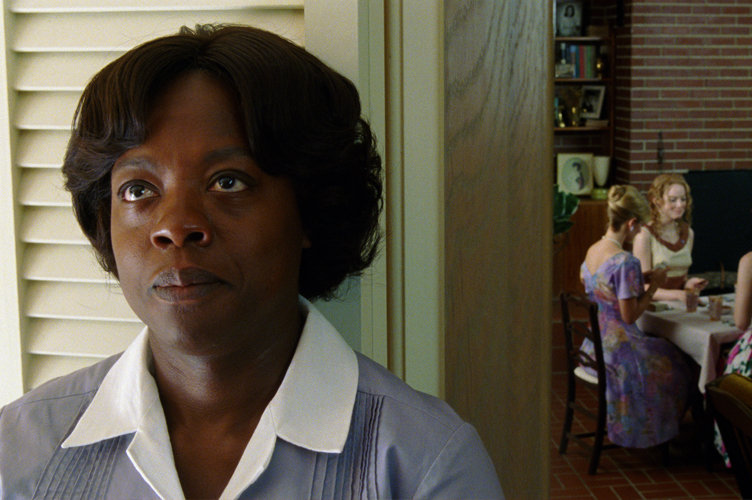
I went thinking, “This is my anniversary present, because this is a chick flick,” but I enjoyed it. And not just because of the views of that social outcast “Celia.” It was just a well-told, real-life story about people. Of course, I guess a lot of things would look like that after the other four movies I saw before it. (Best of the bunch? “Captain America.” But I expected that. The one that most exceeded my expectations? “Thor.”)
Something that struck me at the end, though: During the credits, I got up and looked around, and noticed two things. Most of the audience was female, which I had expected. And most of the audience was white. I found myself wanting to interview the audience, to get their impressions, and ask how it spoke to them and their lives. Did it match their memories? How do they think life has changed since then, and how stay the same?
More than that, I wanted to ask black folks who weren’t there: Why not? I can guess some reasons why not, but I’d probably be off-base. Then again, this audience, while numerous, may not have been representative. This was out at Harbison. Demographics would have been different somewhere else. Probably.
But I didn’t bother anybody with questions. It was our anniversary.
Last anniversary, we went to a bourbon tasting at the Capital City Club. That is to say, we went out to dinner at the club for our anniversary, and before that there was this bourbon tasting that was free to members (I think I’m remembering that right), so I managed to talk my wife into attending. It was fascinating. The speaker was a great-grandon of Jim Beam, and a very colorful and knowledgeable guy.
This year, we decided on a more low-key celebration. And “The Help” served the purpose well. It was particularly meaningful because the central character has the same last name as my wife’s maiden name. OK, that’s just a coincidence, of no interest to you, but we found it interesting… sort of like the family in “Driving Miss Daisy” being named “Werthan.”
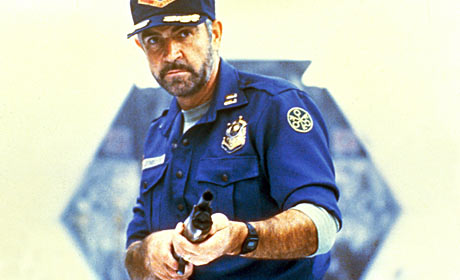
I'm picturing sawed-off shotguns -- but no federal marshals like Sean Connery to stop you from using them as you like!
Bart had to know he was going to set me off on a laugh-fest when he shared this:
Pay Pal founder and early Facebook investor Peter Thiel has given $1.25 million to an initiative to create floating libertarian countries in international waters, according to a profile of the billionaire in Details magazine.
Thiel has been a big backer of the Seasteading Institute, which seeks to build sovereign nations on oil rig-like platforms to occupy waters beyond the reach of law-of-the-sea treaties. The idea is for these countries to start from scratch–free from the laws, regulations, and moral codes of any existing place. Details says the experiment would be “a kind of floating petri dish for implementing policies that libertarians, stymied by indifference at the voting booths, have been unable to advance: no welfare, looser building codes, no minimum wage, and few restrictions on weapons.”
the part that really cracked me up about this particular libertarian fantasy is where they envision “looser building codes.”
You’re going to be living on, essentially, an oil platform — an extremely physically limited space — in the middle of the ocean? You’d better have the strictest building codes in the history of the world. In fact, while you’ve got me going — “building”? Really? You’re saying that these Überflakes would be able to take it into their heads to build new structures, according to the whims of each Ayn Randian individual, in a shared space that exists on the oceanic equivalent of the head of a pin?!?!?
For the engineering even to be feasible, you’d have to design the whole sovereign city-state all in advance, on shore. I’m talking physics here, not political philosophy. Sure, you could allow for expansion, but only within the context of the original design, or the whole thing would become untenable. A desert island, maybe — if it’s really huge, so these cranky individualists can spread out and not get on each others’ nerves. But on one of these tiny things? Really? You mean, somebody thought about this for more than five seconds, and is still considering it? And this guy gave them a million and a quarter?
But yeah, let’s roll with this! Go ahead and eliminate building restrictions entirely! Stick planks out over the edge like on a pirate ship and put condominiums on them! Who’s to stop you?
Combine that with the “few restrictions on weapons,” and these few individuals should be able to make a lot of money in the Reality TV market by putting cameras in every nook and cranny (if they can suppress their strong libertarian prejudices against such things — which I think they could for enough moolah, which libertarians crave). As entertainment, it would rival anything the Roman Colosseum ever dreamed up. And it would be perfectly legal! No one could say thee nay?
Imagine it, those of you who have actually been paying attention to the way humans behave in reality. Surely we’ve all encountered the phenomenon of neighbors suing each other over minor infractions of the neighborhood covenant. The ill will gets to bad that people move away from their dream homes. Imagine the tensions in this super-tight space — no rolling lawns to act as a buffer — with “looser building codes” and everyone packing an arsenal!
Sawed-off shotguns. That would be my weapon of choice in such tight quarters.
Anybody ever see “Outland,” with Sean Connery? It’s “High Noon” transferred to a mining colony on one of the moons of Jupiter. No ray guns, but sawed-off shotguns. (That was the touch that made the movie.) Awesome.
That’s what a Seastead would be like, as envisioned. Only without the federal marshal, which was Sean Connery’s role (and don’t ask me how a Scot got to be a federal marshal — it’s the future!). I suspect Thiel knew all this when he gave them the money. It’s pocket change to him, and maybe he thinks it would be fun to watch.
I’d never seen this before, but I certainly saw it tonight. I was wandering through the men’s clothing section (did you know you can’t find plain white boxers at Walmart any more? this was the fourth one I’d tried), and I started hearing something that could only be live music. So I flipped on the video on my phone and kept approaching, and above is what I saw.
Perception That Retailer No Longer Has Best Prices Undercuts Sales Turnaround
Wal-Mart Stores Inc. is losing its longstanding reputation for offering consumers the lowest prices, complicating its efforts to end a two-year sales slump in the U.S.
The Bentonville, Ark., retail colossus became the world’s largest store chain by avoiding sales gimmicks through “every day low prices” on everything from food to sporting goods under one roof.
But surveys by retail consultants, analysts and brand experts now find that Wal-Mart’s aura of price leadership has faded since the recession, because customers who searched for better deals sometimes found them at competitors such as Dollar General Corp., Aldi Inc. and Amazon.com Inc….
It certainly didn’t look troubled tonight. Based on my difficulty in finding a checkout line that was neither too long (the “express” lanes”) nor featuring people with more than one filled cart. (I wrote on Twitter while waiting, “Waiting in crazy lines at Walmart. Apparently, a lot of people are simultaneously planning polar expeditions…”)
Not that I’ll mourn if Walmart suffers a bit. Walmart is just one of a bunch of factors that killed the newspaper business. You’ll recall a time when grocery stores were a huge newspaper advertiser, along with department stores. Well, Walmart threatened and undercut them both with a strategy that did not require regular local advertising: With “Everyday Low Prices,” you don’t need to advertise any specials. You just have to let the word get around town, and you’re permanently set. And a lot of traditional newspaper advertisers were permanently shafted.
But the live music makes it all worthwhile, right?
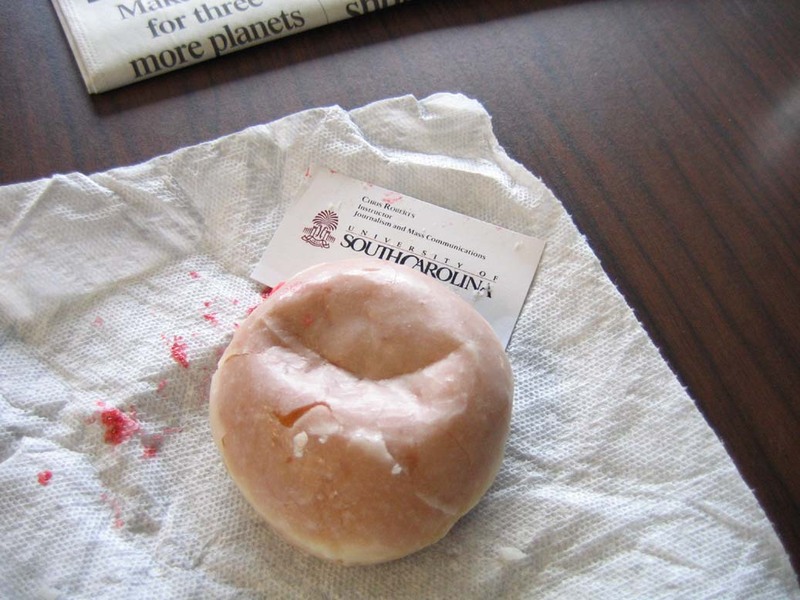
One of the doughnuts Chris left me back when some of the King's loyal subjects still worked at newspapers.
This rubble used to be the Krispy Kreme Chris went to in Tuscaloosa. Took a direct hit...
When we worked together at The State, Chris Roberts used to bring me a jelly doughnut every Aug. 16 in honor of the King.
He’s not in a position to do that now — he’s in Alabama — but he did show he was thinking of me by sending this:
He went on to say that he would have tried to get a doughnut to me, but the local Krispy Kreme got knocked down by a tornado back in April.
So I sent him a picture of one.
Chris knows how special this day is to me, because I was one of the first people in the world to hear the awful news in 1977:
MY GOOD FRIEND Les Seago was the man who told the world that the King was dead. But before he told the world, he told me.
I’ve always appreciated that, even though it didn’t do me much practical good at the time.
On Aug. 16, 1977, Les was the chief Memphis correspondent for The Associated Press. I was the slot man on the copy desk of The Jackson Sun, which meant I had been at work since 5:30 a.m. By early afternoon, the paper was on its way to readers. I had also been a stringer for Les for years, and I was used to his calls to see what was going on in our area. But he didn’t have time for that this day.
Was it too late to get something in? he demanded. Well, yeah, it was, just barely, but why…?
It looks like Elvis is dead, he said, explaining quickly that he had a source, an ambulance driver from Baptist Hospital, who told him he had just brought Elvis in, and he was pretty sure that his passenger had been beyond help. Gotta go now, ‘bye.
He must have broken all speed records getting it confirmed, because I had just begun to tell my co-workers when the “bulletin” bell went off on the wire machine as it hammered out the news.
Les himself was found dead at his home two years ago [this column ran on this day in 2006], at age 61. Though his career had spanned many years and he had covered Martin Luther King’s assassination, The Associated Press identified him in his obituaryas the man “who filed the bulletin on the death of Elvis Presley.” His ex-wife Nancy said “He wasn’t wild about Elvis, but he was glad that he did break the story.” That was Les…
It was the usual act that we’ve seen and heard at Rotaries and in other venues across the state, only now it’s going national.
It’s all a bit hard to take, hearing stuff like this: “There’s something sacred about the family unit; I have four boys.” This from the guy who ditched his family, his security detail, his job and the people of South Carolina to spend Father’s Day weekend with his mistress in Argentina. Yes, that’s within the context of expressing regret. But manohman, am I sick of him taking his rather bland and superficial regret public.
Why can’t he shut up about it already? The simple explanation is unavoidable: Mark Sanford is not done inflicting himself on us. He sees this as a stage on his way back. Could I — and all the others who are saying it — be wrong about that? Could it just be his usual narcissism, with no actual political end in sight? I’d love to think so…
(By the way, I would apologize for the fact that both this video and the YouTube version seem to cut off in the middle. But I think you should regard that as a merciful blessing.)
In case you missed it, Mark Sanford is making his second appearance on the comeback trail — not to be confused with that other trail — tonight at 9 p.m. by appearing on CNN live with Piers Morgan:
LIVE: Former Governor Mark Sanford
In an in-depth interview, the former Governor of South Carolina opens up about the scandal that caused him to leave office & more.
And what’s all this about? Well, we’d all heard in the past about the possibility that he’d run against Lindsey Graham. But today I heard on the street — or reasonably close to the street — another scary possibility: He wants to be governor again.
Imagine the psychodrama. After the apology tour that seemed like it would never end, but finally did, he’s going to make us prove to him that we really DO forgive him by re-electing him. And the really, really scary part is that we’re highly likely to do that if he demands it of us. Because, let’s face it: We’re pretty messed up, too. We, the South Carolina electorate, have issues.
Anyway, now that he’s on this trail, I for the first time feel truly glad that I gave up cable. I don’t get those channels anymore! I can’t even record it! No one can expect me to watch it! Ha-ha-ha-ha-ha-ha-haaaaahhhhh!…
That Stan Dubinsky veck, being the sort with a large gulliver, has drawn a comparison, oh, my brothers, between the rioters in England and your own Humble Narrator’s loyal droogs.
There may be a slight resemblance to one’s glazzies at first glance, but note that those grahzny bratchnies are not dressed in the heighth of fashion; they do not wear our platties of the night! Consider that before thou dost make up thy rasoodocks.
One thing is true: There aren’t enough millicents to put their rookers on them all, much less put them in the staja where they belong…
Those whose attention is on the London riots of 2011 might recall that Anthony Burgess and Stanley Kubrick anticipated all this 50 and 40 years ago, respectively. Time to dig out your copy of A Clockwork Orange, and read or watch it again.
It’s available for streaming on Netflix, by the way. But the book’s better.
I’ve always been aware, on a superficial, untested level, that “The Graduate” stood in a league of its own, defying characterization.
I suppose you could call it a sort of dark comedy, if you like, or social satire, or whatever. But try to think of another movie that makes you think and feel anything like what “The Graduate” does. You can’t.
I had empirical confirmation of that tonight. I saw it among the “Watch Instantly” flicks on Netflix. I didn’t need it in my queue because I have it on DVD, but I clicked on it to put it in my queue just to see how the algorithms of Netflix dealt with it.
And as I suspected, it could not come up with movies like “The Graduate.” Look at the lame attempt above. “Kramer vs. Kramer?” “The Paper Chase?” Both fine films, but neither of them anything like “The Graduate.” Aside from the incidental presence of Dustin Hoffman in one of them, which is meaningless.
And please, do not mention the execrable, silly “Tom Jones” in the same conversation.
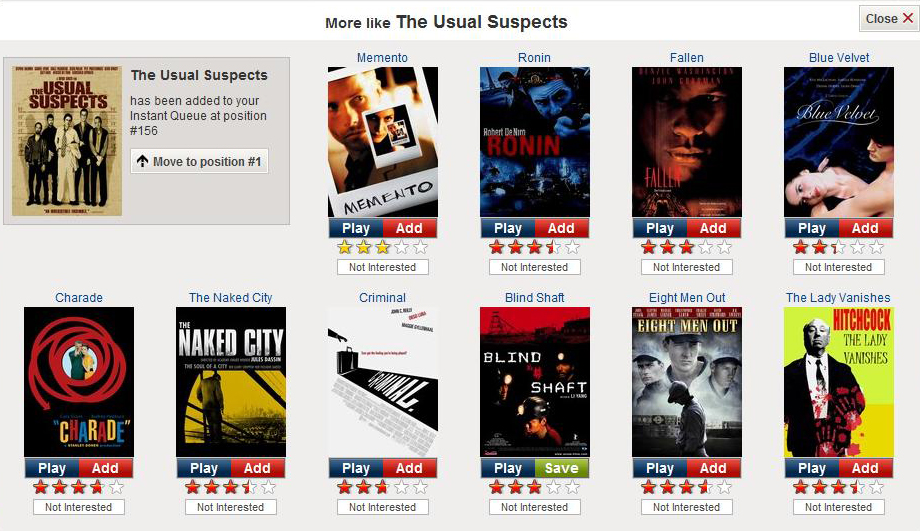
Netflix is far from infallible. But it generally does a better job than this. Take another quirky film, “The Usual Suspects.” A challenge, yes?
OK, there’s nothing exactly like it maybe, but some of these selections — “Memento,” “Blue Velvet,” a Hitchcock or two — at least get its range, landing in a loose pattern around it. I’d throw some of these out, though (“Eight Men Out?” Fine film, but doesn’t fit here), and throw in a Tarantino, or “The Professional.” None score a direct hit. But they come a lot closer than anything does to “The Graduate.”
The U.S. subscription-TV industry first showed a small net loss of subscribers a year ago. This year, that trickle has turned into a stream. The chief cause appears to be persistently high unemployment and a housing market that has many people living with their parents, reducing the need for a separate cable bill.
But it’s also possible that people are canceling cable, or never signing up in the first place, because they’re watching cheap Internet video. Such a threat has been hanging over the industry. If that’s the case, viewers can expect more restrictions on online video, as TV companies and Hollywood studios try to make sure that they get paid for what they produce…
Tim was sympathetic in his comment about it, saying, “Don’t you hate it when you feel like just part of a trend?”
Yes, I do. Makes me feel… common. Low. Might as well start watching “reality TV” on my few remaining channels. That appears to be about all those channels show, anyway.
For the record, I have NOT moved home with my parents — yet. But I am one of those who is watching cheap Internet video instead of cable. I’m halfway through the first season of “Lost” on Netflix so far. The HD picture is awesome. “Lost” is… well, about like I thought “Lost” would be. I am not what you’d call enraptured. But at least I’m finding out what all the fuss was about. Sort of.
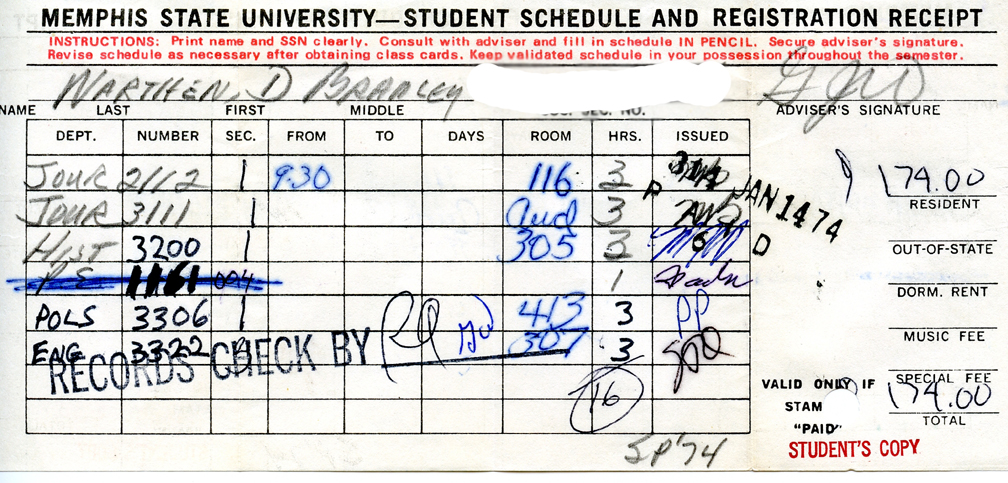
I’m going through some old boxes of stuff, and ran across a wallet I carried in my college days. I scanned for you three of the items I found in it.
The first, above, shows what I paid for a semester at Memphis State University on Jan. 14, 1974. As you can see, the total cost for 16 credit hours — as usual, crammed with journalism classes I had to take, history and English classes I didn’t have to take but wanted to, and some PE to force me to get some exercise — was $174.00.
That’s one HUNDRED — not even thousand — and seventy-four dollars.
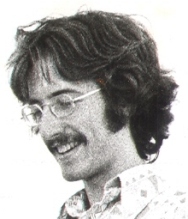
Me, at about that time.
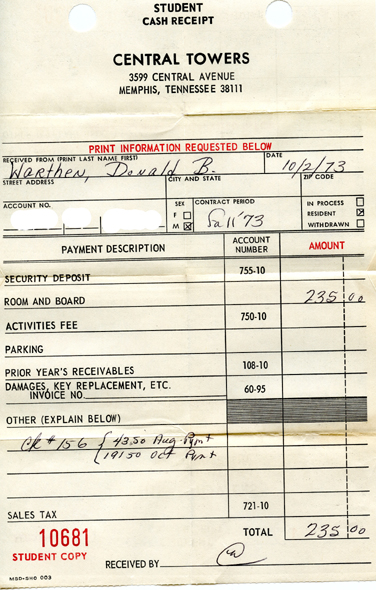
Below, I include a receipt for my room and board for the previous semester — $235. This was not for a regular dorm. This was for a room in a private dorm, right on the edge of campus. Few people actually stayed on campus at Memphis State; it was a huge commuter school (a lot of people called it “Tiger High” because people just continued on there from high school without leaving their parents’ homes). Housing was such a low priority there that there were a lot of us who couldn’t find official campus dorm space at all, but who were willing to pay private rates (that is to say, my parents were willing to pay) for the experience of staying there.
Central Towers was two 10-story towers with the boys on one side and girls on the other, although the procedures were keeping us apart were not what you would call stringent. Making this an even more fun community was the fact that the dorm would periodically throw FREE beer busts with no limit. Enough said about that.
And all of that, including pretty decent food, cost $235 a semester.
Just for fun, I’ve included a ticket stub, also from that wallet, from when my then-fiancee and I went to see Elvis — Presley, not Costello — on March 16, 1974. It was one of seven shows in a row he did at the Mid-South Coliseum. It was originally going to be fewer than that, but the hometown demand was so great they kept adding shows. It was the first time he had performed publicly in Memphis since 1961, and almost the last time ever.
I don’t know how much it cost, but in those days it was almost certainly less than $10. The usual price I remember paying for concerts then (Bob Dylan with The Band, Leon Russell, Joe Cocker, Joan Baez and the like) was $5.
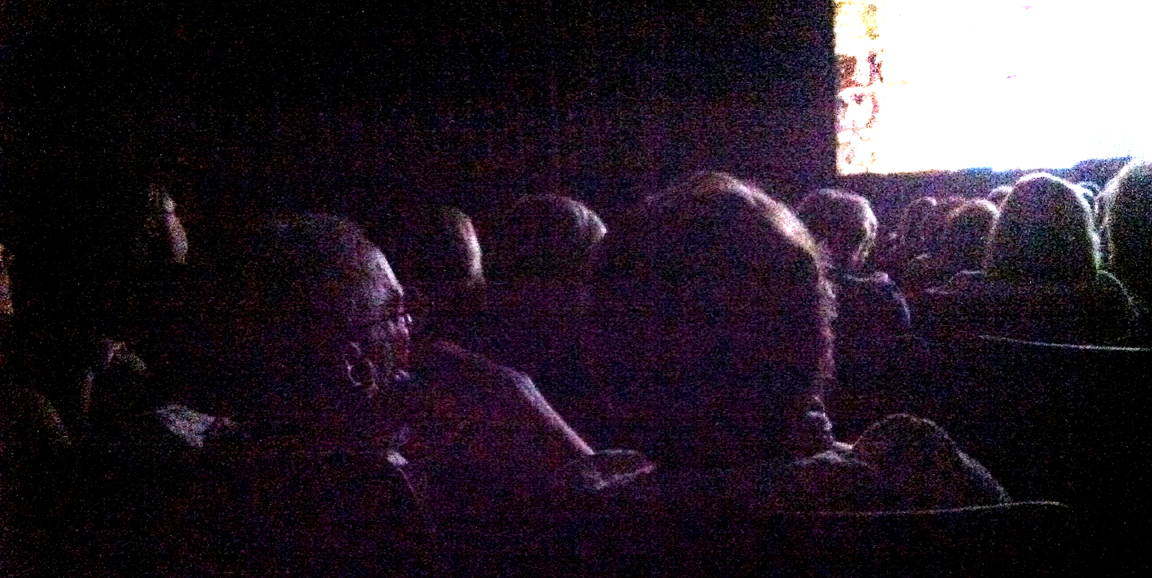
A packed house watches "Page One" at the Nickelodeon last night.
Last night, I went to see “Page One: Inside The New York Times” at the Nickelodeon. I had been asked to watch the movie, a 2010 documentary, and then stay to be a panelist for a discussion — along with Charles Bierbauer of USC and Dan Cook of the Free Times.
As I arrived, I felt a pang of guilt that yet again, I was making a public appearance and forgetting to tell you, my readers, in advance, in the remote chance you’d like to attend. But I needn’t have worried. The show was sold out. The audience included a lot of familiar faces, such as my old boss Tom McLean, who hired me at The State and was my predecessor as EPE, and the paper’s long-time attorney Jay Bender.
On the way in, I ran into Bill Rogers, head of the state Press Association. He said he was sorry he wouldn’t be able to hear me, because the show was sold out. I told him they had given me two tickets, and my wife was at a book club meeting instead, so he could be my guest. When he sat next to me at the back of the theater (I couldn’t sit at the front because of my neck thing, for which I’m going to get another shot next to my spine today), I took advantage of his slightly owing me to make a pitch: Look Bill, I see that the Press Association is offering online, multi-publication ad packages, and advocacy-ad packages as well. Why not throw come blogs in? It might add some value for the buyer, and I need somebody to sell ads for me.
Shameless, huh? Well, that’s the state of news media in America today.
In fact, one of the most meaningful lines in the film, to me, was spoken by David Carr, who was essentially the star. He’s a great character. A former crack addict, he’s now a media columnist for the NYT — a brilliant reporter, and an awesome bark-off spokesman for why a dying industry matters. (Favorite momentThe movie wasn’t so much about the Times as it was about the horrific troubles of the MSM, using the media desk of the NYT as a window on that world.
Great Carr moment: He’s interviewing the founder of Vice, and said founder is going through the usual mantra about how the MSM don’t cover the real story, so you need the gutsy, edgy fringe guys to tell you what’s really going on and Carr interrupts:
Just a sec, time out. Before you ever went there, we’ve had reporters there reporting on genocide after genocide. Just because you put on a fucking safari helmet and looked at some poop doesn’t give you the right to insult what we do. So continue.
Excuse the language, but one of the things this movie does is show the way people talk in newsrooms. And Carr was talking to a guy who pumped that up to the nth degree to show how hip and edgy he is, so Carr used his own terminology to put him in his place. By the way, here’s the story Carr wrote from that interview.
But that wasn’t his most meaningful line to me. That came when he had been researching an in-depth story about how the boorish Sam Zell had run the Chicago Tribune the rest of the way into the ground, and had done the obligatory interview with the Trib’s spokesman in which you say, Here’s what I’ve got; what’s your reaction? After the ritual comments about “hatchet job” and “I’ll get back to you,” Carr hangs up the phone. Sometime later, after communications from the Trib’s lawyers, he says,
The muscles of the institution are going to kick in at some point. It’s not up to me.
Exactly. And that’s one of the virtues of working in the MSM. There’s somebody to sell the ads, and you’re not even supposed to talk to them (usually, you don’t know them). There’s somebody else to worry about threats of legal action. You just worry about getting your story, and getting it right. And people who’ve never worked at such an institution — or even the somewhat smaller ones like it, across the country — have no idea how liberating and empowering that is.
Frequently, people ask me today whether I find I have greater freedom as a blogger than I did as editorial page editor of the state’s then-largest newspaper. That’s a really stupid question, although I don’t say that, because the asker has no way of knowing that.
Part of the stupidity of the question is based in the notion that when you work at a newspaper, “They tell you what to write.” I’m not entirely clear on who “they” are, but I suppose it’s the owners of the paper. I suppose, and I’ve heard, that when you work at a locally-owned paper where your masters are intricately tied into the community you cover, there are sacred cows, and positions you are told to take and others you are told not to take. But that doesn’t happen when you’re a part of a publicly-traded corporation. In all my years as editorial page editor, only once did anyone at corporate made even a suggestion about editorial content: Tony Ridder tried to make the case to Knight Ridder editorial page editors that the company’s papers should not endorse in presidential elections. His reasons for saying that appeared to be a) that we needed to concentrate on local issues; b) that what we said on our local levels about national politics didn’t matter; and c) that such endorsements only made about half of our readers furious at us. That last reason was, as I recall, more implied and stated; he really concentrated on reason a).
I thought that was a fine theory for a guy who lived and worked in California, but a pretty silly one for an editor in the home of the first-in-the-south primaries. For months before a primary, I had media from all over the country, and from abroad, contacting me to know what I, and we, thought about the candidates. I wasn’t going to tell our readers what we thought? How absurd. I ignored Tony’s suggestion. So did most of the other editors, to the best of my knowledge — I didn’t check, because I didn’t care what they did.
There’s another comment I used to get from people a lot, when I was at the paper. They used to commend me for my “courage” for taking a certain stand. That, too, was ridiculous. I got paid no matter what I wrote. I wasn’t taking any risk, beyond the inconvenience of maybe a source not talking to me any more. So I might as well take stands that mean something rather than write pap, right? I had that whole institution standing behind me, that warm blanket of security.
Here’s what I wrote a while back about the “liberating” effect of no longer working for the MSM:
The first casualty of unemployment is the truth.
OK, maybe not the first. First there’s the blow to one’s bank account. Then the loss of self-confidence. But truth is right up there. Especially for me. Until I was laid off in March, I was editorial page editor of South Carolina’s largest newspaper. A colleague once said to me, accusingly, “You don’t think this is the opinion page. You think it’s the truth page.” I just looked at her blankly. Of course it was the truth page.
Readers expected me to tell everything I knew, and plenty that I only thought I knew – about South Carolina’s feckless politicians (Mark Sanford, Joe Wilson – need I say more?), or whatever struck me, without reservation. And I delivered.
My reputation survives my career. Recently, a friend warned me that people feel constrained in talking to me, because their confidences might turn up on my blog. After all, bloggers tell all, right? Ask Monica Lewinsky. Ask ACORN.
“HAH!” say I.
As a blogger who answers to no one, I am not nearly as frank and open as I was as a newspaper editor who thought he had a secure job.
I haven’t disclosed whom I have worked for on consulting gigs since leaving the paper, because my clients haven’t been crazy about the exposure. Every word I write, I think: Might this put off a prospective employer? And I know it has, despite my caution.
There are things I have not written – pithy, witty, dead-on observations on the passing parade, I assure you – because I think, “Do you have to write that and run the risk of offending this person who MIGHT point you to a job? Can’t you just write about something else?”
And where am I applying for jobs? Well, I’m not going to tell YOU, am I?
People used to praise me for my courage for taking on powerful people at the paper. But I was taking no risk whatsoever. As long as I was supported by advertising, a transaction I was ethically barred from even thinking about, I had impunity.
But an unaligned blogger still trying to function as a journalist stands naked and alone, and is not nearly as free and honest as he was writing from the once-impregnable citadel of an editorial page. At least, this one isn’t. Keep that in mind, citizen, as newspapers fall around you.
Watching that movie launched me on many different streams of thought; I could have talked about them all night. What I just told you describes part of my reaction to a single line. As Tom McLean said after one long-winded response I gave as a panelist, I always needed an editor.
You may have heard about John McCain’s speech excoriating the likes of the South Carolina delegation, and the Tea Party in general. Here’s the full text. Here’s an excerpt:
I will take a backseat to none in my support of the balanced budget amendment to the Constitution. I have voted for it 13 times. I will vote for it tomorrow. What is amazing about this is, some Members are believing we can pass a balanced budget amendment to the Constitution in this body with its present representation, and that is foolish. That is worse than foolish. That is deceiving many of our constituents by telling them that just because the majority leader tabled the balanced budget amendment legislation that, through amending and debate, we could somehow convince the majority on the other side of the aisle to go along with a balanced budget amendment to the Constitution. That is not fair. That is not fair to the American people to hold out and say we will not agree to raising the debt limit until we pass a balanced budget amendment to the Constitution. It is unfair. It is bizarro. Maybe some people who have only been in this body for 6 or 7 months or so believe that. Others know better. Others know better.
I especially like the way he ended it:
It is time we listened to the markets. It is time we listened to our constituents. Most of all, it is time we listened to the American people and sit down and seriously negotiate something before we face a situation where we are depriving the American people of the fundamental right of having a government that doesn’t deprive them of the essential services, goods, and entitlements which they have earned.
Oh, and in case you wondered where the “hobbits” part come in. That was from when McCain was quoting from this piece in the WSJ. An excerpt from that:
The idea seems to be that if the House GOP refuses to raise the debt ceiling, a default crisis or gradual government shutdown will ensue, and the public will turn en masse against . . . Barack Obama. The Republican House that failed to raise the debt ceiling would somehow escape all blame. Then Democrats would have no choice but to pass a balanced-budget amendment and reform entitlements, and the tea-party Hobbits could return to Middle Earth having defeated Mordor.
Going an entire summer without Mad Men is frustrating. Thanks to illustrator Paul Rogers, you can get your fix of the stylish era right now. Rogers created a version of the opening credits taking a cue from “classic film and television titles from the early 1960s.” The clip might not be enough to hold you over until January (when the new season of Mad Men begins), but it will make you crave an ice cold martini.
I like it; I think it’s cool. It makes me eager to see the next season.
But I prefer the real credits, with the silhouette guy falling down the side of the building. It suggests the strange darkness of Don Draper’s journey, his alienation, his insecurity. It’s way existential.
He would interrupt the grumbling and harrumphing with calls to order that were occasionally starchy (such as when he said this is the “Mother of Parliaments,” and therefore should show the world how it’s done with decorum), but occasionally with jolly good humor.
“Can’t is Not An Option”. I guess her editor and publisher don’t not believe in double negatives. Essentially the title means “Can is an Option.” More Sarah Palindromisms, inventing the language as you speak…
OK, so let’s see if we can do better. Here are some, for want of a better word, options:
Failure Is Not An Option — The original, as spoken by Ed Harris as Gene Kranz in “Apollo 13,” works a lot better. More compelling. Better use of the English language. Of course, it doesn’t work for Nikki Haley. In fact, it’s about as wildly inappropriate as you can get. The phrase epitomizes the can-do spirit of a man leading a bunch of government employees determined to work together to accomplish something remarkable. No way Nikki would want any part of that. In Kranz’ place, she would have insisted that NASA was the problem, not the solution, and would be going on about how the space agency needed to be run like a business as the spacecraft ran out of oxygen.
Can’t Is Not a Doctrine — I like it, but I think she would disagree.
Can’t Do Cooperation
Can’t is Not a Contraction
Can I Have a Conniption?
Canned Heat, Fried Hockey Boogie
Can It, Knothead Unction
OK, so I’m running out of actual ideas here, although I don’t see that necessarily as a disqualification.
What do y’all have?
I’m just trying to pass the time here. It’s SO hard waiting until January, when the book comes out.
Just thought I’d share this, so that if there’s anyone among you who is as big a George Smiley fan as I, you, too, can start being frustrated waiting for this movie to come out in November. (Why does it take so long? If they’ve got it edited enough to put out a trailer…)
I was putting off posting this, after Mike Fitts brought it to my attention, until I could write a longer post I’ve been meaning to write ever since January, about my own successful Quest for Smiley (yes, Circus fans, that is an allusion to the Quest for Karla). But until I do that, here’s a picture of me standing in front of George’s actual house in London. Sort of a blog trailer, if you will. I think the picture captures a Le Carre kind of feel, doesn’t it? It was taken at dusk in winter, which is appropriate. Very Cold War.
Remember I said, in a post sent from the airport in Detroit, that I was going to look for signs of Smiley in London? Well, I did. More about that later…
CUSTOMER: Al, did you read Mercy’s article?
Al: Why should I read it? I heard it.
— “The Natural”
I sort of figure that if you were interested, you also heard — or rather, watched — the Gamecocks beat Florida last night, bringing them… Well, never mind where it brings them. Don’t want to jinx anything.
So I’m not going to attempt a written description here.
But Bud mentioned the game back here on an unrelated subject, and in case some of y’all would like to discuss it here, I thought I’d give you a place to do it.
Michele Bachmann spent plenty of time Monday letting everyone know that she was born in Waterloo, Iowa, a small industrial town she credits with instilling within her many of her conservative ideals.
But in one interview surrounding her formal campaign rollout, the Tea Party favorite seems to have gotten a little confused about some of the finer points of the Hawkeye State’s history.
Speaking to Fox News, Bachmann said that she had the same spirit as Waterloo’s own John Wayne. One can only assume that she was referring to the movie star, who was born in Winterset, Iowa, roughly a three-hour drive from Waterloo. The problem, however, is that Waterloo appears to have much closer ties to serial killer John Wayne Gacy, the “killer clown” who had his first criminal conviction there.
OK, I was kidding about that. I have only Denis Leary to go by on the Duke being frozen. But I do have a question — didn’t she launch her campaign a couple of weeks ago? She announced it at the debate…
Well, that was quick. Earlier this week, I read in the WSJ that the FBI was trying something it had never tried before — a major ad campaign aimed at a Ten Most Wanted fugitive. Or rather, at his moll. Or frail. Or whatever they say now.
Fitting, given James “Whitey” Bulger’s pop-culture profile — he was the inspiration for Jack Nicholson’s character in “The Departed.”
Somebody got the bright idea — based upon the belief that Whitey’s girlfriend, Catherine Greig, was not being as reclusive as he was — of advertising where women would see it. Women who just might have seen her at the beauty parlor or something. From Tuesday’s paper:
On Tuesday, the agency will begin airing public-service announcements in 14 U.S. cities during shows such as “The Dr. Oz Show” and “The View,” focusing not on Mr. Bulger but on his girlfriend, Catherine Elizabeth Greig. Images of the couple also are featured on digital billboards in New York’s Times Square.
The FBI says the advertising campaign is the first of its kind in hunting a most-wanted figure.
The duo went underground just before Mr. Bulger’s 1995 federal indictment for his alleged role in 19 murders during the 1970s and ’80s, according to the FBI. Ms. Greig isn’t implicated in those crimes, but was indicted in 1997 for harboring Mr. Bulger….
While the FBI has sought Mr. Bulger all over the world, it says the new publicity campaign explores the possibility that clues to his whereabouts may lie with friends or co-workers of the 60-year-old Ms. Greig. The agency believes she may carry on a relatively normal routine of frequenting beauty parlors, visiting the dentist and caring for or spending time with animals.
“Have you seen this woman?” asks the 30-second TV spot…
The focus on Ms. Greig is “part of a unique initiative” aiming to reach women her age, said Special Agent Greg Comcowich, an FBI spokesman in Boston. “Our hope is that a friend, or co-worker, or someone she goes to the beauty salon with or interacts with on a daily basis will see it,” he said.


 In an in-depth interview, the former Governor of South Carolina opens up about the scandal that caused him to leave office & more.