Category Archives: Popular culture

Schumer was just testing us

I knew that following Adam Baldwin on Twitter (no, not one of those Baldwins — we’re talking Jayne Cobb from “Firefly”) would pay off eventually. Today, he brought my attention to this:

Adam Baldwin @adamsbaldwinAdam Baldwin

QFE: “We have 3 branches of government. We have a House. We have a Senate. We have a President.”- Sen. Schumer (D-NY) ~ http://bit.ly/eqwbNq

Hey, we all misspeak. And maybe the good senator was just checking to see whether the viewers were paying attention.

Here’s a question: Would Jayne Cobb have known about the three branches of government? Probably not. Of course, in his ‘verse, all you need to know is that there’s the ruttin’ Alliance, and there’s the freedom-loving Browncoats.

Joe’s alternative to the alternative to the GOP response

I got bushed and went to bed last night before getting this video, which is Joe Wilson’s response to the State of the Union.

So… since some guy named Paul Ryan gave the “official” Republican response, and Michele Bachman (another nonentity to me, but I’ve vaguely aware she’s one of those fringe people the shouting heads on TV go on and on about, like Sarah Palin) delivered a sort of self-appointed alternative response as a way of playing directly to the Tea Party, that means Joe’s clip is sort of the alternative to the alternative. Or maybe, since the “official” GOP response is in itself offered as an alternative to the actual State of the Union, Joe’s is an alternative-alternative-alternative. Which sounds way more avant-garde than the way I think of Joe Wilson.

Speaking of Joe… I ran into his guy Butch Wallace this morning at breakfast and told him — sort of joshing, sort of serious — that I appreciated that Joe had behaved himself last night, adding that I suppose it was hard to do otherwise sitting with those Democratic ladies. Butch smiled politely. Then I added, quite seriously, that I appreciated that Joe had wanted to make that gesture — which others in our delegation refused to do, even though it would have taken them so little trouble. Butch said Joe wanted to work with all kinds of people, regardless of party, and I said that’s good — because the more folks you’re willing to work with, the more you’re likely to get done.

As for Joe’s message — it sure beats “You Lie!” (which, if you’ll recall, was NOT during a SOTU), although in his hurry, he sort of flubbed a couple of the lines. And the overall message is rather thin and lacking in substance. But these things always tend to be that way. There’s a formula: 1.) Due respect to the president (no name-calling); 2) A brief reference to something that was in the president’s speech, a cursory effort to give the impression that the responder actually read or heard it and thought about it before responding; 3) A rather trite and general statement of ideological difference with the president that may or may not bear relevance to the president’s points; 4) Some sort of statement of civic piety such as asking the deity to bless the troops, or America, or the taxpayers, or whatever.

So much for Joe and his message. Now to the larger issue: This nonsense of opposition-party “responses” to the State of the Union, which I have always found offensive. I thought this writer put it well: “The very idea of a rebuttal is asinine.”

Or at least, the idea of some sort of formal response with an “official” status is asinine. Of course, we’re all entitled and encouraged in this free country to share what we think of the president’s speech. But over the years, something really weird and insidious has happened, and like so many other media/political phenomena in the modern age, it has done much to solidify in the average voter’s mind the nasty notion that there is something good and right and natural about everything in our politics being couched in partisan terms.

First, just to give the broadest possible perspective, the State of the Union is a constitutional responsibility of the president of the United States — not of a party, or of an individual, but of the chief executive. It’s right there in black and white in Article II, Section 3:

He shall from time to time give to Congress information of the State of the Union and recommend to their Consideration such measures as he shall judge necessary and expedient.

Note that it doesn’t say he has to do it every year, much less in January just before the Super Bowl. Nor is he even required to give a speech of any kind: Before Woodrow Wilson, presidents took care of this requirement in writing.

So, no one has to give a speech. But the president is required to make a report (including recommendations, if he judges such to be necessary and expedient, which you know he always will). It’s his job. It’s not a campaign speech (even though no politician yet born would pass up such an intro once it’s handed to him). It’s not something that he does on behalf of his execrable party. It’s something he is required to do.

In other words, the “equal time” requirement placed on purely political TV face time doesn’t apply. No member of the opposite party is in any way obliged to offer a “response,” and no broadcast outlet is obliged to run it — not by law, and not by any sense of journalistic obligation. Sure, you might cover it — you ought to cover it, and any other politically relevant response. (Just as you ought to cover the SOTU itself, if you know what’s news.) But the idea of a formal, ritualistic response is completely unnecessary.

And harmful. Because it instills in the public’s mind the notion that this is just some guy giving a political speech, rather than the president of the United States fulfilling the requirements of his job. And it inflates the ceremonial, institutional importance of parties to our system of government, putting the prerogatives of a party on the same level as the most fundamental requirements of our Constitution.

My reaction to the GOP response last night — that is to say, my reaction to the idea of a GOP response, because as usual, I didn’t watch it (when the pres was done, I ran upstairs to plug in my laptop because the battery was nearly dead and giving me warning messages) — was exactly the same as to Democratic responses to a Republican president: You want to give a free-media speech to the whole nation on this particular night, you go out and get elected president. We don’t have a president of one party and a “shadow” president as in a parliamentary system — we have one person elected to that position, and in delivering the SOTU (whether aloud or in writing), he’s fulfilling a specific responsibility that we elected HIM (and not some eager up-and-comer in the opposition party) to perform.

So share your thoughts all you want, folks. But spare me the “official” responses.

A little ditty you can sing to take your mind off being groped

That is, if you mind being groped.

Personally, I was struck by how nonintrusive security was on my recent flights across the ocean and back. You’d think that on an international flight to and from a country that’s as involved (as target, and as combatant) in the War on Terror as the UK, you’d see security as tough as anywhere (with the possible exception of Israel).

The only sign I saw of really heightened security during the whole trip was when we went to see Downing Street, which is totally barred off and heavily guarded, with at least one submachine gun being wielded up close and personal so that the tourists can’t miss seeing it. But at least we could see something — I couldn’t quite make out the famous door of No. 10, although I could see the famous railings in front of it (which is how I could tell that was it, and not another black door that was at a slightly more advantageous angle for viewing — perhaps the chancellor of the exchequer’s abode; I don’t know).

But, after all the talk about invasive, intrusive new TSA procedures in recent months, what we experienced was not noticeably different from any other trip I’ve taken over the last decade or so. The only hassle I remember at all was the rigmarole of having to reclaim our bags in Atlanta after getting back, and then having to recheck them for the flight to Columbia. That was highly irritating at the end of a day (actually, the worst thing was that it WASN’T yet the end of the day) when we’d already been up for 18 hours, and had just stepped off a 9-hour flight. Without that drill, we might have made our connection in spite of our flight from Heathrow having been delayed. Delta quickly got us onto another one — although our bags didn’t follow us until the next day.

But all that stuff about futuristic x-ray machines and being groped by the TSA? We didn’t encounter any of that. I was ready for it, and all prepared to shrug it off (why people get so worked up about such things I still don’t understand), but then it just … didn’t happen.

Still I can enjoy a joke as well as the next guy. So when a friend who closely follows such issues showed me the above video, I just had to share it with y’all…

Near as I can tell, this video comes courtesy of buckhowdy.com.

The only obviously stepped-up security I saw the whole trip was at the end of Downing Street, where it runs into Whitehall.

Being watched in Airstrip One

Last night I was watching an episode of “Law & Order: UK” on BBC America, and was impressed by the extent to which the writers just expect you to keep up with the idiom, and the small differences between American and British culture and assumptions. For instance, there’s a scene in which detectives are fretting over the fact that they can’t easily retrace a suspect’s movements: He doesn’t carry a mobile, and probably doesn’t have an Oyster card. Then, a moment later, there’s a reference to CCTV.

The folks who do the show’s website are less respectful of the audience’s intelligence. The “British Terms Glossary” wastes time with “bloke” and “coppers” and “flat” and “guv.” Let’s face it, folks — if you don’t know what those mean, stick to re-runs of “Hee-Haw” (“Hey, Grandpa: What’s for supper?“) or the like. They also define “mobile,” but we know what that is too, don’t we?

The Oyster card is more subtle (and, you would think, a far more likely candidate for the online glossary than “Tube”). It’s the card you buy, and top up (do we say “top up”? I forget — but they say it a lot over there) as needed, to use the magnificent London system of public transportation. You swipe it to get through a turnstile on you way into a Tube station, and — here’s the pertinent part — you do the same to get out at your destination. Which means there exists an electronic record of your movements through the city. In the previous scene we had learned that the suspect had a fear of crowds that kept him away from the Tube. So, no Oyster card.

Of course, most people know what Closed Circuit TeleVision is. But it took me a day or so to consciously realized the implications of those signs I saw everywhere: “CCTV in operation.” (I actually had to think a minute to separate it in my mind from CATV, the old term for cable TV back in the days when it was the Community Antenna for small towns and rural communities, before it went all urban.)

What they meant, of course, is that you are under surveillance a huge proportion of the time. Yes, I know businesses here have CCTV, and footage from such cameras is often important in crime investigations. But it’s just nowhere near as ubiquitous as in London, and it doesn’t loom nearly as large in public consciousness. Watch TV news there, and it seems that every other word is CCTV, whether you’re talking the images of the crossbow robbers holding up a post office, or the images of murder victim Joanna Yeates (THE big story while we were there) picking up a couple of items at Tesco, or a routine crime at an off-licence. (Now there’s a term I had to look up — turns out “off-licence” doesn’t mean the shop is extralegal, that it lacks a license; it means it HAS a license to sell alcohol for OFF-premise consumption, as opposed to a pub. Generally, it’s what we’d call a convenience store.)

Of course, such consciousness of being watched — that those bright yellow signs — are a large part of the deterrent effect in themselves.

All of which is fine by me. As I always say, knock yourself out, Big Brother. I was conscious that some of my more libertarian friends back here in the States might have found it all creepy, but at no time in my sojourn in Airstrip One — I mean, England — did I feel the least bit put-upon or oppressed.

To me, it was part and parcel of being in a place that is very much like home, with freedom-loving people who respect the dignity of the individual, but where the politics is not plagued by the legions of radical-individualist paranoids who resist any effort at putting any sort of rational infrastructure in place. I loved the novelty of being in a place with such a dream public transit system, and where waiters and bartenders don’t mind not getting tips (or at most, don’t expect more than 10 percent) — after all, what are they worried about? They have health benefits they cannot lose. And I was very happy to pay the taxes that helped pay for it all. Some friends advised me that I could get a VAT refund on leaving the country, but there was no way I wanted that. I was happy to pay my share.

(And yes, sometimes it all goes overboard, which is why the coalition government is cutting back — AND raising taxes, remember, which they’re able to do because their conservative party doesn’t make a religion of irrational tax hatred. But on the whole, it was wonderful to be in a place where it’s assumed that one should have the Tube, and the buses (that’s “coaches” to you) and trains and parks and fantastic free museums (contributions suggested, but quite low and entirely voluntary) and a population of people who don’t fear being ruined by an unplanned sickness.

And which doesn’t mind being on Candid Camera, if it means you might catch a crossbow robber now and then.

Amusing commentary on the 2nd Amendment

How often do you see a headline like that? Usually, there’s a lot of anger when we talk about guns — which is kind of worrisome, if guns happen to be present during the discussion.

We were talking guns back on this post (fortunately, we were all out of range of each other) and it reminded me…

Well, I actually saw something very funny on Saturday Night Live the other night — something I haven’t been able to say since Tina Fey first did Sarah Palin. It was during the weekend update. Seth Myers imagine how the Framers would react if they could see what guns can do right now. He acted out how dangerous guns were then by comparison: “Hold on, you can’t say that about my wife! Hold on… I… am… gonna… show… you…” as he goes through the motions of picking up a flintlock musket, pouring in the powder, ramming it, priming it, and then looks up and says, “AWWW, he drove off!” In case the above embed doesn’t work for you, You can watch it here.

See? Kinda funny. And it makes an interesting point, as well. Several, actually.

I think maybe SNL has some new writers. Or maybe some old ones, back.

Prospective cover photo for my next album

OK, so technically it would actually be my first album. And of course, I first have to have a band, and learn some songs, and other details. It’s a project that’s been in the works for about 40 years. But don’t make like I’m procrastinating or anything. As you well know, I’ve been working on band names, and a playlist, and other essentials. (As a former managing editor I knew who was famous for his malaprops used to say, there I go again, putting the horse before the cart.)

And now, my cover art. Never mind that cover art is a passé art form, because people don’t put covers on their MP3s. I don’t care. I love album covers. Art for art’s sake, and all that. Let the Philistines sneer. Or the modernists. Or whoever is inclined to sneer, let them.

Bottom line, today is another really busy day, and I have two or three little ADCO projects I have yet to start, and finish, by the end of the day. So just to say I posted something, here ya go.

The backstory: This VERY out-of-tune piano was in the hallway outside our room at the bed-and-breakfast where we stayed in Oxford (that’s the exterior below). No one but me touched the piano while we were there. I would have known; immediately on the other side of the wall it’s up against is the head of the bed I slept in.

What am I playing? Well, my right hand is playing the opening chords of “Let it Be.” My left hand is just posing. I never really even learned to play the piano with one hand, much less play with two at the same time.

Anyway, I’m the front man. I don’t need an actual talent.

As for my costume… there’s no costume; these are my real clothes. I liked wearing them for this because something about the ensemble made me think of the “Our House” video by Madness. (Watch the first 45 seconds to see what I mean.) And no, I didn’t get that hat to wear in England (although lots of guys there actually DO wear them, and by no means are they all tourists). I’ve been wearing that very hat for more than 30 years. Not every day, of course, but often on weekends.

And finally, the credit. My wife shot this picture, quite reluctantly (and hurriedly, lest another guest see her doing it), at my request. She’s very patient. And she’s always paying me compliments. For instance, when she caught me using my digital recorder to record the sounds of the coffee shop at Blackwell’s book store in Oxford, she said “You’re very different from traveling with Mary.” Mary being her friend that she backpacked around Europe with just before she met me and I started monopolizing her time.

I took it as a compliment, anyway.

Stand in the place where you live

Strong misgivings: Yossarian and the chaplain.

For the longest time, I didn’t have a quotation on my Facebook profile. This didn’t seem right. I’m all about words. I’m all about pithy expressions of one’s world view, yadda, yadda. (Although I fear that now that I no longer have the discipline of writing a weekly column, I’ve gotten somewhat lazy about it, hence the “yadda, yadda.”)

Loads of other people — people who were not overly thoughtful students of rhetoric, judging by the quotations they chose — had multiple quotations. They had all sorts of things they wanted to say — or rather, things they wanted to let other people say for them.

But the thing is, I like so MANY things that I read — one of my problems in reading books is that, as I read them, I follow people around reading great passages aloud to them (and a well-written book will have at least one such passage per page), which is why people avoid me when I’m reading books — that the idea of singling out one, or two, or even 10 such quotes just seemed too restrictive. I thought, What is that good that I’m willing to have it almost as a personal epitaph? People will see that and think this sums me up. What quotation is there that I like that much?

It would need to be semi-original (obviously, if it were entirely original, it wouldn’t be a quotation). It couldn’t be trite. I couldn’t have seen anyone else use it. It needed to say something I believe. And it needed to be something that has truly stuck with me over time, as opposed to, say, the funniest recent thing I’ve read on Twitter.

So one day it struck me that I should post this:

“I wouldn’t want to live without strong misgivings. Right, Chaplain?”
— Yossarian, in Joseph Heller’s Catch-22

So I did.

And for the longest time, that stood alone, and I was satisfied to let it do so. I liked it on a number of levels. For instance, in a day when our politics are dominated by people who are SO DAMNED SURE they’re right and other people are wrong, it had a certain countercultural UnParty flavor to it. At the same time, it’s not an existential statement of doubt — the fact that he’s saying it to a chaplain, one who certainly believes in God (although in an unorthodox way, being an Anabaptist), anchors it in belief, but still expresses the idea that one should always be willing to question one’s assumptions.

It also said something I wanted others to know about me. Because I tend to argue whatever position I’m arguing rather tenaciously, even vociferously, people tend to think I’m inflexible. They’re wrong about this. I can usually think of all the reasons I might be wrong just as readily as they can, perhaps even more readily. (After all, one of the main steps in building an argument is imagining all the objections to it.) For instance, take our arguments over the Iraq War, or the debates I have with libertarians. My interlocutors think I’m a bloodthirsty war lover, and a rigid authoritarian. But I’m not, not really. I have a tendency to argue very insistently with your more radical libertarians because I think they go overboard, and that I have to pull REALLY HARD in the other direction to achieve any balance. And on the subject of the war, well… when you reach the conclusion that military action is necessary, and that action is initiated, I feel VERY strongly that you have to see it through, and that the time for debating whether to initiate it is long past. At least, that’s the way I saw the Iraq situation. That doesn’t mean I didn’t think there were viable arguments against it in the first place — I was just unpersuaded by them.

I suppose I could go on and on about why I like the quotation, but that’s not what this post is about.

This post is about the fact that I thought that quote was sort of lonesome, so I added another today:

“Stand in the place where you live.”
— R.E.M.

And here’s why I picked this one.

I’ve always had a beef with people who constantly tear down the place where they live. You know, the whiners who always want to be someplace else. The people who seem to think that if it’s local, it’s no good. These people are destructive. They’re not good neighbors to have.

You know that I’m a born critic, and I’m constantly expressing dissatisfaction with aspects of Columbia, or South Carolina. But I do it from a love of my home, and from a determination to make it better. If there’s something you don’t like about your home, you should be trying with all your might to make it better.

To me, this is a fundamental moral obligation. And like most true believers, I can find Scripture to back it up. Remember the passage that Nathan Ballentine came up with to encourage me when I got laid off? It was Jeremiah 29:11:

For I know well the plans I have in mind for you, says the LORD, plans for your welfare, not for woe! plans to give you a future full of hope.

Well, when I looked that up, I found that I liked what preceded that just as much, the passage in which the prophet told the people not to whine about being in exile, but to affirmatively embrace the place where they were, and get on with life in it:

Thus says the LORD of hosts, the God of Israel, to all the exiles whom I exiled from Jerusalem to Babylon:
Build houses to dwell in; plant gardens, and eat their fruits.
Take wives and beget sons and daughters; find wives for your sons and give your daughters husbands, so that they may bear sons and daughters. There you must increase in number, not decrease.
Promote the welfare of the city to which I have exiled you; pray for it to the LORD, for upon its welfare depends your own.

Let’s repeat that last:

Promote the welfare of the city to which I have exiled you; pray for it to the LORD, for upon its welfare depends your own.

Amen, I say unto you. Stand in the place where you live.

Dick Winters is gone, and I never did shake his hand…

Dick Winters has died. “Captain Winters,” I think of him as, from the time when he commanded Easy Company of the 506th PIR,101st Airborne Division — although on D-Day, the day on which his actions should have earned the Congressional Medal of Honor, he was still a lieutenant, and by the time the company had captured Hitler’s Eagle’s Nest he was a major, and battalion commander.

Yes, the guy who was the main character in “Band of Brothers.”

He was a peaceful, modest man who, when war was thrust upon him and the rest of the world, discovered talents and personal resources that would otherwise likely have gone unsuspected. The video clips above and below, with actor Damien Lewis in the role of Winters, perfectly illustrates the qualities that Stephen Ambrose described in the book that inspired the series: Mainly, an uncanny coolness under fire, and certain, unhesitating knowledge of exactly what to do in a given situation — knowledge which he quickly and effectively communicated to his men in real time, with a minimum of fuss. The video clips show how Winters led a tiny remnant of Easy Company (of which he was only acting commander, since the CO was missing, later found to be dead) to take several well-defended, entrenched guns trained on Utah Beach — saving untold numbers of GIs — with only a couple of casualties among his own men. This was on his very first day in combat. The action is used today at West Point as an illustration of how to take a fixed position.

This guy has long been associated in my mind with the definition of the word, “hero.”

In later years, when he was interviewed in old age about the things that happened in 1944-45, you could still see the manner of man he was. His manner was that of a man you’d be confident to follow, a man you’d want to follow if you had to go to war, while at the same time being perfectly modest and soft-spoken about it. And on this link you’ll see what some of his men thought of him.

As I wrote about him last year:

Over the last few years I had occasion to visit central Pennsylvania multiple times, while my daughter was attending a ballet school up there. Almost every time I went there, I thought about going over to Hershey to try to talk to Dick Winters, the legendary commander of Easy Company of the 506th Parachute Infantry Regiment in the 101st Airborne Division during World War II. He was the leader — one of several leaders, but the one everyone remembers as the best — of the company immortalized in Stephen Ambrose’s book Band of Brothers, and the HBO series of the same name (the best series ever made for television).

But I never did. As much as I wanted just to meet him, to shake his hand once, I never did. And there’s a reason for that. A little while ago, I was reminded of that reason. The History Channel showed a special about D-Day, and one of the narrators was Winters, speaking on camera about 60 years after the events. He spoke in that calm, understated way he’s always had about his heroics that day — he should have received the Medal of Honor for taking out those 105mm pieces aimed at Utah Beach, but an arbitrary cap of one per division had been place on them, so he “only” received the Distinguished Service Cross.

Then, he got a little choked up about what he did that night, having been up for two days, and fighting since midnight. He got down on his knees and thanked God for getting him through that day. Then he promised that, if only he could get home again, he would find a quiet place to live, and live out the rest of his life in peace.

I figure a guy who’s done what he did — that day and during the months after, through the fighting around Bastogne and beyond into Hitler’s Eagle’s Nest itself — deserved to get his wish. He should be left in peace, and not bothered by me or anyone else.

So I’ve never tried to interview him.

Well, I never did impose upon him to get that handshake, even though I’ve been to his general neighborhood again since I wrote that. And that causes me now a mixture of satisfaction and regret.

I read the leader today, oh boy…

All right, so it wasn’t properly a leader, but a column. I just wanted to add some British idiom to my allusion…

Thought y’all might be interested in this item in The Guardian today (over breakfast at our B&B in Oxford, my wife was reading The Times and I had The Guardian — which I had run next door to the off-licence to get — but she never gave up The Times).

We never got around to visiting the Abbey Road crossing in London, even though it wasn’t far from where we were staying. I sort of lost interest after reading that the local council had moved the zebra crossing so that it wasn’t the real one. But I’ve been bemused at how they do go on about The Beatles here. I had sort of thought they had faded from memory here, rather the way one never saw much about Elvis in Memphis until after he died (I know, I lived there then).

That’s mostly because there have been two recent news items. The first was that the Abbey Road crossing was recently given Grade II historic status — even though it’s the wrong place. The second was that a Tory minister wants to protect Ringo Starr’s birthplace in Liverpool from demolition.

So today’s columnist wrote a piece headlined, “I am a Beatles obsessive. But let’s cut the Fabs-worship.” And quite right he is, even though I love the Beatles. As he wrote,

Such, anyway, is yet another episode in a story that has long since ballooned into absurdity: the transformation of the Beatles into a national religion – arguably bigger than Jesus, as John Lennon infamously put it. X Factor contestants must, by law, deliver warblesome readings of Let It Be and The Long and Winding Road; each time Sir Paul McCartney ventures out to hack out his versions of the hits, the public is encouraged to think something miraculous is afoot; Yoko Ono, bless her, keeps the posthumous Lennon machine grinding on.

In Liverpool, meanwhile, delusions of post-industrialism have reached their apogee in the idea that Beatledom can be a substitute for a lost mercantile past. It’s all there: John Lennon international airport, the Hard Day’s Night Hotel, the “Magical Mystery Tour” that wends around the city, even a Fabs-themed Starbucks — though judging by the forlorn atmosphere of too many of the surrounding streets, Beatles-driven regeneration really isn’t working. Funny, that.

Yes, isn’t it? He goes on to note that not ALL Beatles music is iconic:

Moreover, the idea of the Beatles as all-dominating titans had yet to take root: well away from their legacy, music developed on its own terms. These days, by contrast, they use up so much of the cultural air that we seem little able to breathe. There must be more to life than nodding-dog piano ballads of the Hey Jude variety, but there are times when they seem to define a good 50% of the mainstream. For all their inventive wonderment, one would imagine that I Am the Walrus, Happiness Is a Warm Gun and Helter Skelter left at least some of rock’s more creative possibilities unexplored, though listening to the bulk of even supposedly cutting-edge music, you’d never know.

Indeed. Then, he ends,

In 1970, John Lennon said this: “It’s just a rock group that split up, it’s nothing important – you can have all the records if you want to reminisce.” The words crumble next to his group’s myth, but they also speak an undeniable truth — which is why the 72% of local people who are reportedly OK with the Madryn Street demolition ought to have their wishes respected, and life should go on. And one other thing: Ringo was the drummer, remember.

I’m not sure what he meant by that last bit. As “Paul’s grandfather,” the clean old man, observed in “A Hard Day’s Night,” where would they be without his steady beat. But I thought the piece was food for thought.

I found “Championship Vinyl” (and you can’t prove I didn’t)

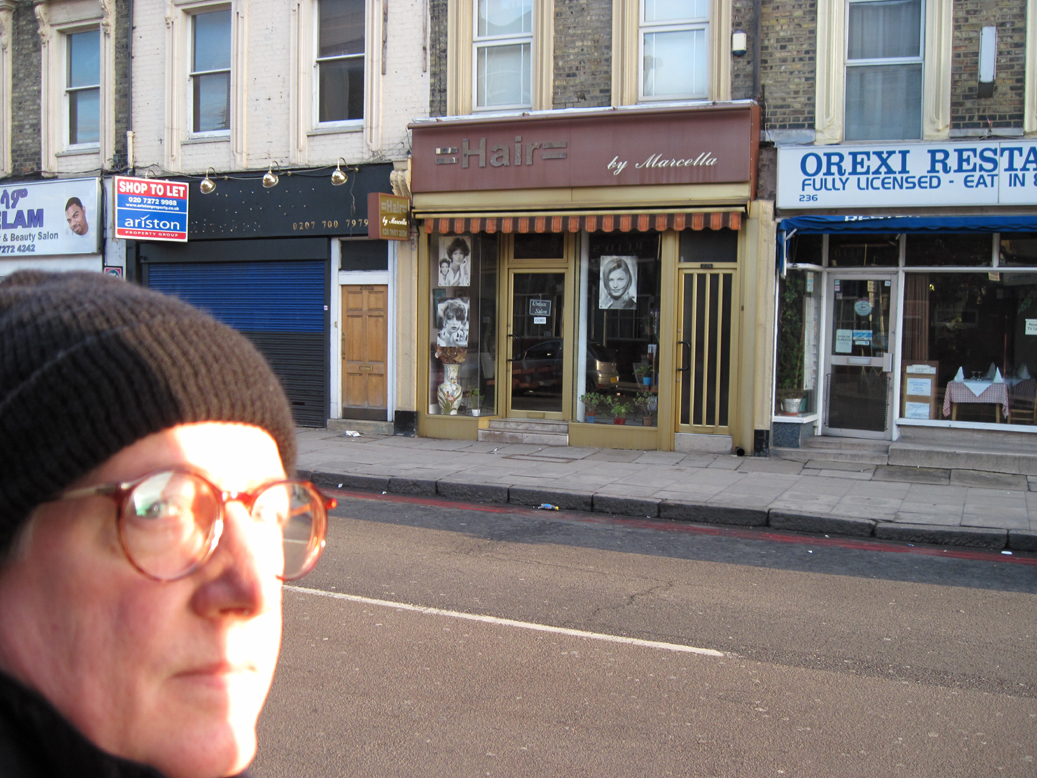
See where it says "shop to let"? And do you see any window-shoppers?

Well, I told you I would find the former site of “Championship Vinyl,” the record shop in High Fidelity, and I did. And no one (except maybe Nick Hornby) can tell me I’m wrong.

It satisfies the criteria:

  1. It’s in Holloway.
  2. It’s just off the Seven Sisters Road.
  3. It’s in a location that guarantees the “minimum of window-shoppers” — in other words, the only customers are those geeky young males who go out of their way to seek the place out.
  4. I was looking for a vacant space, on the theory that since the book was published 15 years ago, and since Rob was trending toward changing his life for the better toward the end, that he would have moved on from running the store, or moved it to a better location, or something by now. I mean, he and Laura would have some kids by now. Any road, this is a good theory for me to have to explain that it’s not actually there, since, you know, it never really existed.

I made up that last criterion, but the first three are in the book.

So, you ladies are wondering — just how patient is my wife, to go along to places like this? Well, she didn’t. This was the one thing I did

Unfortunately, the souvenir shop wasn't open. I had wanted one of those scarves...

on my own. Today was the day we were leaving London for Oxford, and she just wanted to get up and get ready. So I got up before she did, hopped the Jubilee line down to Green Park and got on the Picadilly way out to Islington, to Holloway Road, and hiked over to Seven Sisters.

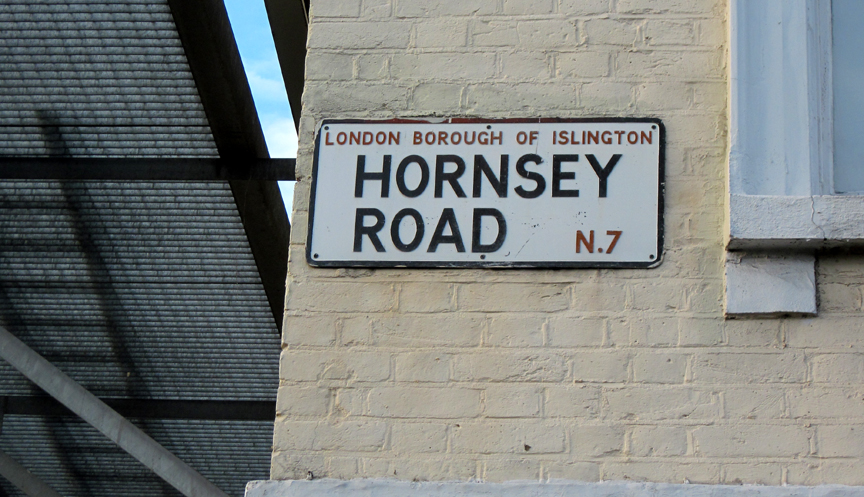
Then, after “finding” Championship Vinyl (it was the first street off Seven Sisters with some actual commercial fronts off the main road) on Hornsey Road, I walked back east until I got to Arsenal Stadium, the scene of other Hornby tales. At Arsenal, at least, I wasn’t the only geek taking pictures of the stadium — but the others were English football fans. One guy was having his wife take his picture there while she tried to keep the kids in order.

After I found the Arsenal Tube station (this required asking directions four times, twice from people who did not speak English), I rode back to our stop, and left Swiss Cottage station with sadness. I really, really love the Underground. (There’s no other way I could have gone all the way to Islington in a city this crowded and done all that walking about and gotten back in less than two hours.)

When I got back, J had packed for both of us, and we took a taxi to Victoria Coach Station for the ride to Oxford. Come to think of it, she really is enormously patient with me…

Oh, and if you wonder why I would want to do this… well, you just have to read High Fidelity. The movie was great, but the novel was much better.

Or maybe THIS is it, a couple of doors down. I can see how experts could in good faith disagree...

Tinker, Tailor, Soldier, Tourist

Sitting in the Detroit airport, thinking about our eventual destination…

Maybe I’m not, as friends and family seem to think, Jethro. But I am an … idiosyncratic sort of tourist.

Sure, I want to see the usual things in and around London – the Tower, the Bridge, maybe Stonehenge when we get out of town. My granddaughter wants to see Mme. Tussaud’s. I will also reluctantly accompany her onto The Eye, even though the smallest carnival Ferris Wheels give me the fantods.

But I hope she and my wife will indulge me on a few somewhat more oblique digressions.

My notion of what to see Over There is heavily influenced by fiction. This means that I want to see places where people who never actually existed didn’t actually do the things that I read about. That means some of these sights aren’t much to look at, while some are entirely imaginary. But I want to see where they would be if they did exist. Hard to explain.

I’m not entirely alone in this. Some of the more esoteric (I thought) sights have been sought out by other fiction geeks ahead of me – which will save me time in “finding” them. Others are a bit more problematic.

Some examples:

  • The one that causes the most eyebrow-raising when I mention it (so I’ve stopped mentioning it) is Championship Vinyl. You know, the record shop in High Fidelity. Yes, I know it’s not real. But I want to find where it would be if it did exist. Fortunately, Nick Hornby supplies some good clues (“We’re in a quiet street in Holloway, carefully placed to attract the b are minimum of window-shoppers…” near Seven Sisters Road…). When I find the perfect location, I suspect it will be a vacant storefront or some such. Nevertheless, I’ll take a picture to prove I “found” it. And if I don’t find a likely location, I’ll console myself by heading over a few blocks to Arsenal Stadium (Fever Pitch).
  • I had thought no one else would ever think of this one, but I was wrong (link): I want to see the path in Hampstead Heath (just a few blocks from our hotel) where Gen. Vladimir was assassinated by Karla’s people at the start of Smiley’s People. Maybe I could even find the fork in the tree where George found the tattered packet of Gauloises with the crucial negative in it. If so, I’ll get a picture of that, too.
  • Of course, there’s always Smiley’s flat, and I know the actual address.
  • I’ll go see the new MI6 HQ, which le Carre called “the River House” in The Night Manager. But what I really want to see is The Circus. Fortunately, others have identified it as being this building. And it’s near some great book shops, so my wife might not mind this detour too much.
  • The Islington highway exit where Arthur Dent was dropped off when he returned to Earth at the start of So Long, and Thanks for All the Fish.
  • Tea at Fortnum’s. OK so this is a typical tourist thing. But here’s my reason for wanting to do it: When Percy Alleline confronts Peter Guillam in Tinker Tailor Soldier Spy, accusing him of consorting with “defector” Rikki Tarr, a long stream of things run through Guillam’s head in an instant (one of the best passages of that sort I’ve read outside Dostoevsky). But what he says is, “Sure, Chief. Rikki and I have tea at Fortnum’s every afternoon.” Like a couple of scalphunter tough guys would do that. His facetiousness saves him. Anyway, that’s what got me interested in having tea at Fortnum’s: I want to do something that two people who never existed didn’t even do in fiction. Also, I think my wife will enjoy it.
  • Finally, I’d really love to find some landmarks for the Aubrey/Maturin novels, but I know that after all this time it will be hard to find places that look just as they did in the early 19th century. For instance, can I find anything that looks like the Grapes, in the liberties of the Savoy? Or, is the old Admiralty building still in use, where Jack and other officers paced the First Lord’s waiting room, hoping for a ship? We’ll see…

So you see, I’ll be busy.

But you know what I want to do the most? Find and experience things I never even thought of, things I didn’t plan. The places and things I’ll just run across and be delighted by – those are the greatest rewards of travel, I find.

Don’t you?

Shop Tart’s coming! (And Jim Rex has been here)

See the way Will Ferrell as Buddy the Elf reacted when he heard Santa was coming? Well, that was me today when I found out that The Shop Tart herself will be here on Monday to tape a special pre-Christmas edition of “The Brad Show.” Well, sorta. Think how it would have been if James Caan had played the elf. More like that. But I was excited, nevertheless.

And today, we taped a show with outgoing SC Superintendent Jim Rex. Plans are to have that one up on the blog Monday. Then we’ll tape the Tart on Monday for showing later in the week.

Trying to get the momentum going again on “The Brad Show,” just in time for Christmas. And if you want to buy the boxed DVD set of Season One for that just-right gift for a loved one, well… I don’t have any made, but if you send us enough money we’ll burn the frickin’ shows onto a DVD, and put it in a box, too.

Who better to get us into the spirit of the last-minute shopping frenzy than the Tart herself? Watch for her, and Dr. Rex, right here on this station…

Green Zone: good flick, if you take it for what it is

Just in case I haven’t provoked my anti-war friends on the blog enough lately…

I saw”Green Zone” over the weekend, and it was a corking good thriller. Just as long as you don’t take the premise seriously.

No, wait — I need to refine that: As long as you don’t take too seriously the one spectacular conceit that does the most to drive the action, which is this… There’s this Iraqi general who is sort of the movie’s Great White Whale, only there’s no one Ahab — EVERY character is frantically pursuing him, with each character having a different motive for doing so. Matt Damon’s character wants him because he thinks he knows where the WMD are, and it’s his (Damon’s) job to find them  (he plays a chief warrant officer named Miller). An idealistic one-legged Iraqi (his other leg is in Iran) wants to find him because of what the general and his ilk have done to his country. A CIA officer wants to find him because he believes the Army is the key to preventing the insurgency. A Wall Street Journal reporter wants to find him because he is the mysterious source Magellan that a Pentagon official has told her has provided intel on where the WMD are — reports that she has passed on uncritically in the paper. The Pentagon official, played by Greg Kinnear, want to find him and kill him before he tells everybody the truth.

What truth? This “truth” (SPOILER ALERT!): We eventually learn that before the war, Poundstone (Kinnear’s character) had secretly met the general in Jordan, where the general told him there WERE no WMD. And Poundstone returned to Washington and told everyone that the general had told him the exact opposite, even telling him where to find the weapons. So we invade Iraq, and Miller’s unit risks their lives going to these supposed WMD sites and coming up empty.

This makes Poundstone the Great White Whale of all those antiwar folks who believe “Bush lied” — the perfect representation of the supposed great misrepresentation. He, Poundstone, KNEW the truth and deliberately lied. No mere wishful thinking. No making a mistake (the mistake made by pretty much the whole world — the debate about the invasion wasn’t over whether the WMD existed, but about the best way to get them out of Saddam’s hands). A big, fat, montrous lie.

Which, of course, didn’t happen. If something like that had happened, someone of the millions of people who would love to find out such a thing and tell the world — from the antiwar Democrats who now control our government and have access to all its secrets, to Julian Assange, to the director of this movie — would have let us know by now.

So…  the bad news is that people will see Green Zone and think that such a thing happened. And that’s bad even if you are deeply opposed to the war and want to avoid such conflicts in the future, because it keeps you from confronting whatever REALLY happened and realistically assessing how to keep it from happening again. Politically attractive fantasies are just dangerous all around — as the antiwar folks would no doubt say about the delusion that there were WMD.

The good news, though, is that it’s a great action flick. And the other questions the movie raises — including some serious ones that deserve answers — are intelligently, provocatively and even realistically portrayed. Where the movie falls down is wherever it touches upon the Poundstone character. And I mean this in an artistic, esthetic sense as well as political: Kinnear’s character is cartoonish, the portayal more suited to low farce than to serious drama. When he’s on screen, the quality drops. NO ONE would believe this guy; if he told you your mother loved you, you’d say “What’s his angle?” He’s just ridiculous. He might as well be wearing a black cape, stovepipe hat and Snidely Whiplash mustache.

Everybody else is credible; everybody else feels real. While comparisons to the Bourne movies are inevitable (with Damon and the director of the second and third films in that trilogy on board), this film is far more believable, in that there are no superheroes like Bourne in it. (The flaw that it shares with those films is the aforementioned fantasy plotline about a vicious government conspiracy — a great plot device, as long as you don’t start thinking stuff like that really happens.) In fact, the closest thing to Jason Bourne is the Special Forces guy who promptly beats the stuffing out of Damon’s character when he fails to give him what he’s after. And that violence is realistic, not balletic.

Other things that are good, and deserve more explication, are such things as the issue of whether we should have worked with the Iraqi army rather than banishing it into insurgency. If the director wanted a political point, that would have been an excellent one to stick with.

Perhaps the most provocative questions raised surround the frantically earnest one-legged Iraqi, “Freddy.” He tries to approach harried soldiers to give them critical information, and gets knocked around for his trouble. He is forced into suicidally dangerous (for a guy who has to live there) situations in order to help the Americans. In the end, (MAJOR SPOILER ALERT) he raises the film’s most provocative question when he takes matters into his own hands with deadly force. Damon’s character, persuaded by the CIA that the general must be found so we can work with him to prevent the insurgency (I REALLY MEAN IT — MAJOR SPOILER ALERT!), manages to get to him before the Special Forces guys who have been sent to kill him. You think Damon has won the day. Then out of nowhere comes Freddy with a pistol and blows the general away. Freddy then says to Damon — and I don’t have it in front of me, so this might not be verbatim — “YOU don’t get to decide what happens here.”

If you want a good antiwar message, one you can chew over productively, that would be it. But the whole Poundstone thing is offensively ridiculous. You want to talk about a Big Lie, suggesting that anything that clearly duplicitous happened qualifies.

That’s particularly insidious since we are told this story is based in nonfiction. Oh, and if you don’t want to believe me, believe Richard “Monty” Gonzales, upon whom Damon’s character Miller was based, and who acted as technical adviser on the film:

“Green Zone” contains several messages, an unavoidable consequence of making a film of this genre. Critical blunders preceding the invasion, chiefly the bad intelligence that led us to war, made certain that no quick victory would be achieved and certainly undermined U.S. credibility around the world. Later, the U.S. directed a de-Bathification policy which disenfranchised a massive section of the population and helped fuel an insurgency. Consequently, any hope of victory in Iraq was made vastly more complicated and costly — as the last 7 years have proven. I believe this is true.
.
However, “Green Zone” also suggests that we were lied into the war in Iraq; a subtext that is unfortunately being twisted by some in order to give credence to a bumper sticker I deplore, the mantra which has become the left’s version of the war — which is well on its way to becoming the Iraq conflict’s official history — “They lied; people died.” As intriguing as that idea may be, it’s simply not true.

“Swamp Fox, Swamp Fox, tail on his hat…”

A reader this week reminded me of something that I may have known, but had forgotten — that long before he was the funniest deadpan comic actor in America, Leslie Nielsen was … “The Swamp Fox” on TV. She wrote:

I occasionally post on your blog as Abba.  Would you consider posting this clip from YouTube showing Leslie Nielsen, who died this week, as South Carolina’s Francis Marion, the Swamp Fox, in Disney’s series from the early 1960s – http://www.youtube.com/watch?v=3vvQJ7ZDg1Y.  Here’s a longer version – http://www.youtube.com/watch?v=sVGN1pDzYAY&feature=related.  Leslie Nielsen never looked so good!  This clip has the catchy theme song that I remember so well from my childhood.  We used to play the Swamp Fox on the playground at school, and many of the boys in my class had tri-cornered hats with fox tails attached.  Hear the song once, and you’ll be humming it all day long!  A fitting tribute to Leslie Nielsen from our corner of the world, I think.

I loved that show, which ran from October 23, 1959 (right after my 6th birthday) to January 15, 1961 — hardly more than a year.

Like the far, far more successful “Davy Crockett” series and generally forgotten “Gray Ghost,” these shows inspired me and other very young kids to run out and play at being actual figures from history. (Anyone remember that goofy, overly elaborate way Col. Mosby saluted? I thought it was cool, and used to go around imitating it. Wouldn’t you like to see video of that?)

Actually, to take that a bit farther… to this day, whenever I hear the words “Tory” and “Patriot,” I think of first hearing them used on “The Swamp Fox.” So while my understanding of the term was to grow and expand later, I actually had a minimal working knowledge of what a “Tory” was at the age of 6. If I ran into a 6-year-old who used a term like that today, I’d be shocked. But it was common currency among fans of “The Swamp Fox.”

I can also remember a conversation I had with my uncle about “The Gray Ghost.” I was confused about the whole blue-vs.-gray thing (especially since I was watching it in black-and-white), and I asked him during one show, “Are those the good guys or the bad guys?” My uncle, who was only a kid himself (six years older than I) could have given me a simplistic answer, but instead, he said, “Well, they’re both Americans…” and went on to suggest that a case could be made for both being good guys. That sort of rocked my world. There was no such ambiguity on the Westerns I watched. This was my introduction to the concept that in war, in politics, in life, things can be complicated, that there are many shades of gray. Perhaps the track that set mind on has something to do with why I don’t buy into the whole Democrat-vs.-Republican, left-vs.-right dichotomy that drives our politics. After all, they’re all Americans. And in the wider world, they’re all humans. Even the Nazis. (Of course, this doesn’t keep me from understanding that when humans’ actions go beyond the pale — as with Nazis, or terrorists — they must be opposed, with force if necessary.)

Also, while at first I didn’t think I remembered the “Swamp Fox” theme song, as I listened to it repeated over and over on that clip above, I had a dim memory of being struck by the odd syntax of that second line, “no one knows where the Swamp Fox at” — I didn’t know WHY it sounded odd (I was just learning to read, and hadn’t gotten to grammar yet), it just did.

In other words, these shows — which presented very simplistic, often inaccurate glimpses of history — not only helped feed a lifelong interest in history, but helped foster the ability to think.

So… TV doesn’t actually have to be junk, although it’s often hard to remember that these days.

That great new GM ad

Gotta hand it to the folks at GM. This ad, which I first saw during the Macy’s Thanksgiving Day Parade, is a grabber. It works really well.

The part that really pulled me in and kept me watching long enough to find out what it was about? The bit from “Animal House” when the Deltas are all sitting around looking dejected. They offer that slightly vague little pop culture reference, and it feels like a bit of a challenge, like, “Do you know what this is?” and you do, and you feel cool for knowing, so you keep watching to see what else you’ll see.

You get the sense that it’s pitched at Boomers and our elders, because of the combination of that and Popeye, and to a slightly lesser extent Evel Knievel, and especially the failed launch from the early days of NASA. (I had to explain that to my daughter, because she didn’t understand there was a time when we all thought, as Tom Wolfe summed it up, “Our rockets always blow up!“) It’s nice to see an ad pitched to grownups, one that makes us feel like we’re with it. If we listen hard enough, we even realize that piano is wandering about the melody of “He Ain’t Heavy, He’s My Brother.” (I thought, “Long and Winding…” no, but something about a road being long… Um, Neil Diamond… no, not originally… then I got it. The Hollies.)

Anyway, nice job. It was almost worth all that money we gave y’all.

Bad Things Arising (got to shake these from my head)

Over the weekend, I had some silly be-bop song running through my head, after hearing it on a CD my wife was playing in the kitchen. Perfectly harmless, and no permanent damage. I’ve already forgotten what song it was.

Today, something more ominous has gripped my mind… I’ve got two songs from “Jesus Christ Superstar” running through my mind — “This Jesus Must Die” (which is bad enough) and “Judas’ Death.”

This is what I get, I suppose, for not going to Mass yesterday. I had a cold, I was scheduled to administer the Eucharist, and under the circumstances I thought it best not to show.

Now this.

Sample lyrics from the first song:

Caiaphas:

Fools! You have no perception
The stakes we are gambling
Are frighteningly high
We must crush him completely
So like John before him
This Jesus must die
For the sake of the nation
This Jesus must die
Must die, must die
This Jesus must die…

And a sample from the second:

Judas
My God, I saw him
He looked three-quarters dead
And he was so bad
I had to turn my head
You beat him so hard
That he was bent and lame
And I know who everybody’s
Going to blame
I don’t believe he knows
I acted for our good
I’d save him all the suffering
If I could
Don’t believe
Our good
Save him
If I could

Now, in my defense, the first song really has some appealingly clever lyrics, before you get to the bloodthirsty ones:

Annas
What then to do about Jesus of Nazareth?
Miracle wonderman, hero of fools

Priest
No riots, no army, no fighting, no slogans

Caiaphas
One thing I’ll say for him, Jesus is cool…

What then to do about this Jesusmania?
How do we deal with the carpenter king?
Where do we start with a man who is bigger
Than John was when John did his baptism thing?

But nevertheless, this is not a good way to start the week…

McCain has a point comparing Palin, Reagan

Since I don’t watch those Sunday talk shows, I’m always reading the reactions, and reactions to reactions, on Monday (which is quite soon enough to suit me). Today I’m reading what Chris Cillizza has to say about what John McCain said on Sunday:

The Arizona Republican, responding to a question from CNN’s Candy Crowley about Palin being “divisive,” noted that Ronald Reagan was often seen as divisive as well.

It wasn’t a direct comparison to Reagan (McCain never said Palin is similar to Reagan), but it was a comparison nonetheless. And the reaction was swift, as it often is when it comes to Palin.

So the big question follows: Is it a valid comparison? The answer: In many ways, yes.

The fact is that Reagan has benefited tremendously from the years since his presidency, and people look back on him in a much favorable light than they did during his presidency.

According to Gallup polling data, Reagan’s average approval rating during his presidency was 53 percent — lower than John F. Kennedy,Lyndon Johnson, Dwight Eisenhower and George H.W. Bush andBill Clinton.

As for the operative word here — “divisiveness” — Reagan had a claim to it. Many more Republicans approved of him than Democrats, and even at his peak, just 68 percent of Americans approved of him, a number lower than everyone but Richard Nixon over the last 65 years.

The reason Reagan couldn’t get higher than that was because there was a segment of the population, about one-third, that was dead-set against him. Reagan is often listed in polls of people’s favorite presidents, but because of that one-third, he’s also among the leaders for people’s least favorite presidents. His detractors often feel just as strongly as his supporters about Reagan’s legacy.

Recent polling shows Palin is on par with all of that…

Hey, it works for me. I, for the record, was among that one-third. And probably one of the more adamant members of that segment. My attitude has softened somewhat over the years, but that may be due to the 1984-style revisionism to which I’ve been subjected in media for more than two decades. You know, Ronald Reagan was a great president; he was always a great president — and we have always been at war with Eastasia. (Or would a better analogy be the sleep-teaching in Brave New World? Discuss.)

To the extent that I can clearly recall the past, I remember seeing Reagan — when he emerged on the national scene in 1976, then again in 1980 — as a destructive, negative, insurgent, dumbing-down force in the GOP. So yeah, a comparison to Sarah Palin is valid on those grounds.

Of course, after all these years of hearing what a great job he did, it seems a disservice to him to compare him to Mrs. Palin. One thing’s for sure, though — as a thoroughly professional actor, Reagan played the role of president with far greater dignity than I can imagine the ex-governor of Alaska managing to project.

Bill Cosby gets lost between Due West and North, South Carolina

Some of y’all may have seen this video, but I had not until Stan Dubinsky shared it with me today.

Consider it a cautionary tale as you get on the road for Thanksgiving: Don’t take directions from the Cos, ’cause he’s confused.

In addition to North and Due West, Charleston, Beaufort and Bishopville are also featured.

But… um… she’s 48 years old…

Mostly, I do a good job of ignoring celebrity “news.” I have been, for instance, only vaguely aware (and therefore vaguely appalled) that some people actually seem to care about some sort of scoring controversy on a dance competition show that involves the daughter of the former governor of Alaska.

But today, curiosity got the better of me, when I saw this item on Twitter:

Kelly Preston and John Travolta Welcome a Son http://bit.ly/g4ypDG (via @CelebCircuit) /via @CBSNews

Right away, I thought to myself that the sentence, “Kelly Preston and John Travolta welcome a son…” would continue, in the longer-than-Twitter format of a Web page, “… home from Afghanistan for Thanksgiving,” or some such.

Surely they didn’t… oh yes, they did:

NEW YORK (CBS/AP) John Travolta and Kelly Preston’s baby Benjamin has arrived.

A publicist says the couple’s son was born Tuesday at an undisclosed Florida hospital. The baby weighed 8 lbs., 3 oz.

“John, Kelly and their daughter Ella Bleu are ecstatic and very happy about the newest member of the family,” the family said in astatement. “Both mother and baby are healthy and doing beautifully.”…

All right, then, surely they had this child via surrogate. Or he’s adopted. But no, apparently not.

Set aside the creepiness of a “replacement baby” so soon after their nearly-grown son died (another piece of celebrity news that made it through my defenses). John Travolta is… like… my age. I’m pretty sure he wasn’t actually high school-age when he made “Welcome Back, Kotter.”

And his wife — even though she’s a lovely, youthful-looking woman; don’t get me wrong here — probably isn’t all that much younger, if she was the mother of the boy who died.

Yep: She’s 48.

When I was her age, not only was I a grandfather, but my two sons (neither of whom was my oldest child) were 23 and 21.

There are all sorts of things I could say about wealthy celebrities thinking they can have anything they want, including their youth back, and what that implies for our society at large…

But I won’t. I’ll just say “mazel tov,” and walk away shaking my head…